HOA Karen Called 911 When I Locked My Ranch Gate—Then Learned Her 25 Homes Used My Road
HOA Karen Called 911 When I Locked My Ranch Gate—Then Learned Her 25 Homes Used My Road
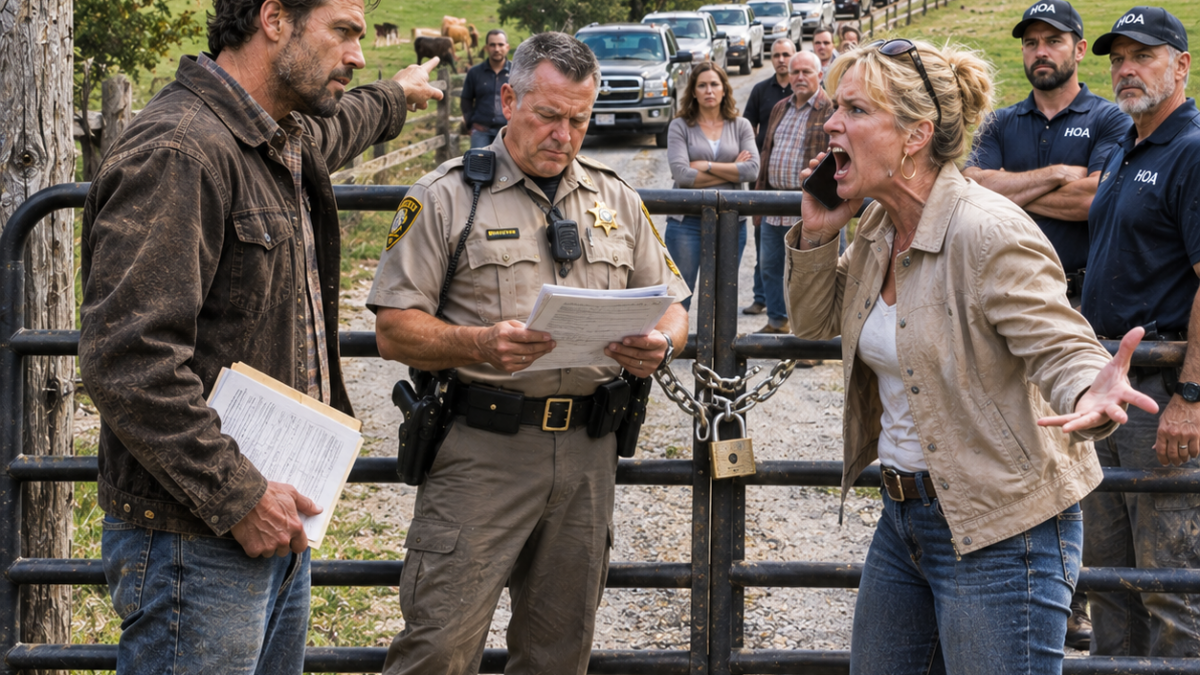
**“ARREST HIM! HE JUST LOCKED TWENTY-FIVE FAMILIES OUT OF THEIR HOMES!” HOA president Denise Caldwell screamed as the sheriff’s cruiser stopped beside the steel gate I had locked across my own ranch road.**
**For years, Eagle Creek had treated three-quarters of a mile of my private gravel lane like a neighborhood entrance, collected access fees for it, and even removed my gate when I objected.**
**Then one homeowner unfolded the subdivision map he had received at closing, and four faded words beside a road nobody had built changed the entire argument.**
The first sheriff’s cruiser reached Turner Creek Ranch less than fifteen minutes after I locked the gate.
Deputy Samuel Grant stepped out, looked at the line of cars stretching toward Ridge View Court, then looked at me standing beside the black steel gate.
Behind him came Denise Caldwell in her white SUV.
She barely stopped before throwing the driver’s door open.
“Officer, arrest him.”
Samuel raised one eyebrow.
“For what?”
“He blocked the only road to twenty-five homes.”
Six homeowners had followed her.
Several more were standing beyond the gate.
A delivery truck had pulled into the grass because there was nowhere to turn around.
Parents were trying to get home.
One man shouted that his children were waiting for him.
Another woman demanded that I unlock the gate before somebody called the county.
Denise pointed at the road as though the gravel itself was evidence.
“This is Eagle Creek’s western access.”
I looked at Samuel.
“No. It’s Turner Road.”
Denise laughed sharply.
“You cannot just rename a community road because it crosses your property.”
“I didn’t rename anything.”
I reached into the folder on the hood of my truck.
“This is my deed.”
Samuel took it.
The legal description included the same gravel lane running behind us.
TURNER PRIVATE FARM ROAD.
I pointed at it.
“My family has maintained this road for forty years.”
Denise crossed her arms.
“Eagle Creek has permanent access.”
“Then show him the recorded easement.”
She hesitated.
That hesitation told me more than the shouting.
Samuel looked at her.
“Do you have one?”
Denise opened a leather folder.
“Yes.”
She pulled out several sheets.
PART2:
My late father’s name was printed at the bottom.
Robert Turner.
For the first time that afternoon, I felt something tighten in my stomach.
The document claimed Dad had granted Eagle Creek permanent neighborhood access over nearly three-quarters of a mile of Turner Road.
And the signature looked real.
My name is Jacob Turner.
Turner Creek Ranch sits on eighty-six acres in eastern Kentucky.
My grandfather bought the first part of it in the late 1960s.
Dad expanded it over the years until the property stretched from Milstone County Road on the west to wooded ridges along the east.
Pasture.
Creek.
Barn.
Two cattle gates.
One old wooden bridge.
And the gravel road running through the center.
Turner Road.
The county never maintained it.
The state never maintained it.
Dad did.
After he died, I did.
When I was a kid, Dad made me help shovel crushed limestone into potholes.
We cleaned drainage ditches after thunderstorms.
Replaced bridge boards.
Cut fallen trees.
Checked culverts.
Sometimes we spent entire Saturdays repairing a road almost nobody outside the family knew existed.
Dad was generous with it.
That mattered later.
An elderly couple east of us sometimes used Turner Road during icy weather because their regular driveway was steep.
Utility crews crossed when power lines needed service.
Neighbors hauling equipment occasionally asked permission.
Dad usually said yes.
Nobody paid.
Nobody signed some complicated contract.
They asked.
Dad helped.
And everybody understood the same rule.
Permission was permission.
It did not become ownership just because the favor lasted a while.
Eagle Creek Estates arrived years later along our eastern boundary.
Originally, it was supposed to be a sixty-home subdivision with two proper access points.
The developer built a wide entrance from County Highway 18, paved several streets, installed drainage ponds, and constructed a large brownstone Eagle Creek sign.
Only the western edge of the subdivision touched my ranch.
There was no reason for Eagle Creek residents to use Turner Road.
At least that was the plan.
Then the developer ran into financial trouble.
Construction stopped after thirty-two houses.
Seven homes connected naturally to the existing highway entrance.
The other twenty-five sat farther west in a section called Ridge View Court.
I did not know those twenty-five houses would eventually become dependent on my ranch.
At the time, I traveled constantly for work.
I repaired industrial refrigeration equipment for food plants and grocery warehouses.
Sometimes I was gone for two or three weeks.
Mom still lived at the ranch house.
She mentioned seeing more vehicles on Turner Road, but we assumed contractors were working on neighboring land.
Then Mom became sick.
For almost two years, most of my attention went toward hospitals, medications, home care, and trying to make her last months comfortable.
The ranch became basic maintenance.
Cattle.
Fence.
Road.
Taxes.
That was all I had energy for.
After Mom died, the property became fully mine.
I was thirty-nine.
One Saturday morning I was fixing fence near the east pasture when a blue minivan came down Turner Road.
I assumed the driver was lost.
Then another car followed.
Then an SUV.
All three passed through the eastern gate toward Eagle Creek.
That afternoon, more came from the opposite direction.
Families carrying groceries.
Teenagers.
A woman walking a dog.
It looked less like a private ranch lane and more like an ordinary neighborhood street.
I drove to the eastern gate.
Dad’s old PRIVATE RANCH ROAD sign was gone.
Someone had installed a small green sign.
EAGLE CREEK WEST ENTRANCE.
I removed it.
The next morning, another appeared.
That was when I called the HOA.
Susan Parker answered from the management office.
I told her Eagle Creek residents were apparently using my ranch road.
She searched the property database.
“According to our system, Ridge View Court has secondary community access through Turner Road.”
“What does that mean?”
“I’m not sure.”
“Who owns Turner Road?”
Another pause.
“I’ll transfer you to Denise Caldwell.”
Denise sounded pleasant in those days.
She told me Eagle Creek had used Turner Road for years without complaint.
“That doesn’t tell me who owns it.”
“The developer arranged access.”
“The developer never owned my ranch.”
“I believe your father approved it.”
“Then send me the agreement.”
She promised she would.
I asked Eagle Creek to stop directing residents through my property until ownership was clarified.
Her voice changed.
“You can’t suddenly close access. Twenty-five homes depend on it.”
That number surprised me.
“Twenty-five?”
“Yes.”
“What happened to your real subdivision entrance?”
“Ridge View Court has always used Turner Road.”
Always.
I hated that word immediately.
My ranch existed decades before Eagle Creek.
Nothing about its use could have been “always.”
I called Sarah Reynolds, my attorney.
Sarah pulled my deed.
County maps.
Easement index.
Subdivision records.
Nothing gave Eagle Creek permanent rights across Turner Creek Ranch.
One utility easement existed on the southern edge.
That was it.
Sarah sent Denise a formal request.
Produce the document establishing Eagle Creek’s roadway rights.
Two weeks later, the HOA sent something called a Permanent Roadway Cooperation Agreement.
Supposedly signed by Dad almost eleven years earlier.
It granted the original Eagle Creek developer permanent access over Turner Road for as many as thirty homes.
Dad’s signature looked genuine.
I stared at it a long time.
He had been generous.
Maybe he had agreed to something I never knew about.
Sarah asked a different question.
“Where is the recorded version?”
There wasn’t one.
The HOA said the agreement had been private.
The developer supposedly planned to record a final easement later.
“Do they have the original?”
“No. Digital copy only.”
That bothered Sarah.
A permanent road serving twenty-five homes should not exist only as a scan somebody found in an old folder.
Still, I did not close the road.
Twenty-five families were using it.
Kids had school.
People had jobs.
Doctor appointments.
Deliveries.
Whatever mistake existed, they had bought those homes believing access was legal.
I met several residents.
Frank Wilson had lived on Ridge View Court for nearly eight years.
His closing packet described Turner Road as the West Access Route.
He thought Eagle Creek owned it.
Brian and Jessica Moore told me their real estate agent said Ridge View Court would eventually have two exits.
“Did anyone tell you this road crossed private ranch property?”
Brian shook his head.
“No.”
That bothered me.
Not because Brian had used the road.
Because somebody had apparently sold houses using my property without explaining the situation to either side.
So I allowed existing residents to keep using Turner Road temporarily while Sarah investigated.
But we sent Denise written terms.
Existing residents only.
No new construction traffic.
No widening.
No HOA crews.
No signs.
No permanent rights recognized.
Denise replied with one sentence.
Eagle Creek rejects your claim that community access is temporary.
That was when our relationship changed.
A week later, an HOA dump truck showed up with gravel.
Workers started filling potholes on Turner Road.
I stopped them.
The supervisor showed me a work order signed by Denise.
“This is private property.”
He looked embarrassed.
“We were told the HOA maintained it.”
“I maintain it.”
He apologized and left.
Denise called ten minutes later.
“Our homeowners pay dues for this route.”
“Then your homeowners are paying for something you don’t own.”
“This road has become a community necessity.”
“Necessity doesn’t change title.”
Then she said something I never forgot.
“You cannot suddenly reclaim a road people depend on.”
Reclaim.
As though the road had stopped being mine because enough people drove across it.
I asked Sarah whether long-term use could create legal rights.
She said access disputes could become complicated.
How use began mattered.
Permission mattered.
Alternative access mattered.
What buyers were told mattered.
Whether anybody openly claimed permanent rights against Dad mattered.
So I searched Dad’s papers.
He kept everything.
Receipts.
Maps.
Feed bills.
Fence estimates.
Letters.
Inside a filing cabinet I found a folder marked EAGLE CREEK.
The first document was a temporary construction letter.
Nine years earlier, a landslide had disrupted the subdivision’s access work.
The developer asked Dad for permission to let construction trucks use Turner Road.
Dad agreed.
Ninety days.
The letter could not have been clearer.
TEMPORARY CONSTRUCTION ACCESS.
NO PERMANENT ROAD RIGHTS CREATED.
Dad’s signature sat at the bottom.
I placed it beside Denise’s permanent agreement.
Same long first stroke.
Same sharp bend.
Same tiny mark near the last name.
Almost too similar.
Sarah sent both to a document examiner.
Then I found another letter from Eagle Creek’s original developer.
Thank you for temporary assistance while county access improvements are completed.
County access improvements.
Plural.
That sent me to the planning department.
Michael Harris pulled the original subdivision plans.
Two entrances.
Main access from Highway 18.
And a second public connector behind Ridge View Court running toward Mil Creek Highway.
Neither touched my ranch.
I pointed at the dotted road.
“What happened to this?”
Michael frowned.
“The original developer went bankrupt. Some final records are incomplete.”
The public connector had never been completed.
That was important.
But Sarah warned me not to jump from incomplete road to conspiracy.
Then the signature examiner called.
Dad’s signature on the permanent agreement was not simply similar to the one on the temporary letter.
It was the exact same image.
Same ink pattern.
Same microscopic imperfections.
Somebody had copied Dad’s real signature from a ninety-day construction permission and placed it beneath permanent language.
That changed everything.
Sarah notified Eagle Creek’s attorney.
Denise responded by emailing the residents.
She said I was threatening to close their only safe road.
Twenty-five homeowners began calling.
Some furious.
Some scared.
Some polite.
I told each of them:
“I’m not throwing you out tomorrow. I’m trying to understand why a private temporary construction road became your only entrance.”
Frank came to the farmhouse.
“I yelled at you before I understood.”
“You thought I was trying to trap you.”
“That’s what Denise told us.”
Then he brought his closing packet.
The access map showed Turner Road highlighted.
But farther behind Ridge View Court was another line.
FUTURE COUNTY CONNECTOR.
Frank said his realtor told him that second road would be completed within a year.
Eight years later, nothing.
Sarah checked ownership of the land where the connector should have gone.
It had been sold.
Not to the county.
Not Eagle Creek.
Caldwell Property Ventures.
Owned by Denise and her husband, Richard.
The company bought the corridor five years earlier at a surprisingly low price.
Then built storage garages across part of it.
If the public road had been finished, the garages could not exist.
Now the situation started making sense.
Maybe Ridge View depended on my ranch because somebody failed to build the real road.
And maybe somebody later profited from that failure.
Still, we needed proof.
I offered another thirty-day temporary agreement.
Existing families could cross.
No contractors.
No road work.
No new homes.
Denise refused to sign it.
Why?
Because signing would admit Eagle Creek did not already possess permanent rights.
Sarah replied:
Then produce the permanent rights.
Nothing.
Three weeks later, my cameras caught dump trucks on Turner Road at 2:14 in the morning.
They were hauling gravel toward undeveloped Eagle Creek property.
The next day I found four new home sites being cleared.
That made the fake agreement’s language suddenly obvious.
Up to thirty homes.
Twenty-five already existed.
Five new lots.
The number had been designed around the expansion.
Sarah got a temporary court order.
Existing homeowners could keep using Turner Road.
Construction vehicles could not.
The following morning, my gate was lying in the grass.
Not opened.
Removed from its hinges.
An Eagle Creek security vehicle sat nearby.
A new sign stood beside the road.
EAGLE CREEK RESIDENT ACCESS — DO NOT BLOCK.
Denise arrived.
“Removing the obstruction was necessary for emergency access.”
“Who authorized you?”
“The HOA board.”
“Who authorized the HOA board?”
“The permanent agreement.”
The copied signature again.
I called a fencing contractor.
By sunset, the gate was back.
Stronger hinges.
Steel posts.
Electronic lock.
I gave temporary codes directly to the twenty-five homeowners.
Not Denise.
That worked for several days.
Then someone shared a code with contractors.
I changed it.
Another leaked.
I changed it again.
Then the lock box was smashed.
Sarah finally told me:
“You’ve done everything reasonable.”
The temporary permission expired.
No real easement had appeared.
Construction traffic kept coming.
My property kept getting damaged.
So Friday afternoon, I locked Turner Road completely.
I posted a sign.
PRIVATE RANCH ROAD
NO RECORDED EAGLE CREEK ACCESS
CONTACT HOA FOR LEGAL ROUTE
Then I drove fifty yards back and waited.
Nine minutes later, the first resident arrived.
Then another.
Then five.
Then fifteen.
Within twenty minutes, traffic backed toward Ridge View Court.
An elderly woman needed medication.
I opened the gate and let her through.
Then locked it again.
I was not trying to punish twenty-five families.
I was forcing Eagle Creek to stop using those families as an excuse to avoid solving the real problem.
Denise arrived next.
“You cannot do this!”
“I just did.”
“These families have a legal right to use this road!”
“Show me the recorded right.”
“You know we have documents.”
“You have Dad’s copied signature.”
She pulled out her phone.
“I’m calling 911.”
“Go ahead.”
She did.
And now Deputy Samuel Grant stood beside my gate reading the document with Dad’s signature.
I handed him the examiner’s report.
Samuel read it twice.
Then looked at Denise.
“Do you have another easement?”
She did not answer.
That was when Frank pushed through the crowd.
“If this road belongs to Jacob, why did the HOA sell all our houses saying it belonged to us?”
Nobody answered.
He unfolded his subdivision map.
The public connector was clearly marked behind Ridge View Court.
Not crossing Turner Ranch.
Running the opposite direction.
Beside it:
PRIMARY PUBLIC ACCESS REQUIRED.
Samuel looked at Denise.
“What happened to this road?”
“The original developer never built it.”
Frank shook his head.
“You told us Turner Road legally replaced it.”
Jennifer Collins stepped forward.
“My closing papers say that connector had to be completed before the last Ridge View homes were sold.”
Sarah arrived while everybody argued.
She immediately called Michael Harris.
He checked the county approval.
Then Sarah put him on speaker.
Michael said:
“Ridge View Court was not supposed to receive permanent occupancy approval without two legal access routes.”
The crowd went silent.
Twenty-five homes had been occupied for years.
Michael continued.
“The county file contains certifications stating that the second access route had been completed.”
I stared at Turner Road.
“Did they list my ranch?”
Michael paused.
“Yes.”
“Based on what?”
“A recorded easement.”
Sarah asked him to send it.
Her phone buzzed.
Different document.
This one had been filed with the county.
Sixty-foot-wide permanent roadway easement through Turner Creek Ranch.
My gravel road was barely eighteen feet wide.
Then Sarah looked at the notarization date.
Her expression changed.
“What?”
She handed me the phone.
August 17.
I knew the date instantly.
Dad had died August 12.
Five days earlier.
My dead father had supposedly signed away a sixty-foot road five days after he died.
Denise went pale.
Frank looked at her.
“You knew?”
“I did not create that document.”
Nobody had accused her yet.
The answer came too quickly.
Then Michael spoke again.
The easement had been personally delivered to the county by an Eagle Creek development representative.
Richard Caldwell.
Denise’s husband.
The same man whose company later purchased the property where the real public connector should have been.
The homeowners erupted.
Then my phone vibrated.
Motion alert.
North Creek crossing.
I opened the camera feed.
Three excavators.
Two dump trucks.
Bulldozer.
Entering Turner Road from Eagle Creek.
I showed Sarah.
She turned toward Denise.
“Did you send construction machinery onto his ranch while deputies are standing here?”
“No.”
Then everybody heard the engines.
The first excavator appeared around the bend.
Samuel stepped into the road.
“Stop!”
The operator shut down.
Another arrived.
Then another.
The supervisor climbed out carrying a work packet.
“We’re widening the Eagle Creek access road.”
Samuel pointed at me.
“He says it’s private.”
The supervisor looked confused.
“We were told Eagle Creek owns a sixty-foot easement.”
Sarah asked:
“Who hired you?”
He checked the paperwork.
“Caldwell Property Ventures.”
Richard’s company.
Then he showed us the plans.
Turner Road widened to sixty feet.
Cattle gates removed.
Dad’s wooden bridge replaced with concrete.
Permanent Eagle Creek entrance sign installed inside my western field.
They were not simply using the road anymore.
They were going to physically transform it into a subdivision street.
Then somebody screamed.
A bulldozer farther back had left the gravel.
Its blade came down.
My pasture fence collapsed.
Cattle scattered.
The machine turned toward the wooden bridge Dad and I rebuilt together.
The supervisor yelled into his radio.
“STOP!”
The bulldozer struck the railing.
Boards snapped.
I ran.
Samuel ran.
The machine hit the railing again before the driver finally stopped.
His name was Kevin Miller.
He climbed down white-faced.
The radio had been full of shouting.
He said he thought the supervisor wanted him to clear the bridge before traffic backed up.
The supervisor handed Samuel the work packet.
Everything looked official.
County references.
Maps.
Project numbers.
Caldwell Property Ventures at the top.
Then one line:
ACCESS IMPROVEMENTS MUST BEGIN BEFORE ADDITIONAL RIDGE VIEW OCCUPANCY.
Sarah looked at me.
“Additional occupancy.”
More houses.
Denise said she knew nothing about the construction.
Her husband’s company was paying for it.
Samuel ordered all equipment removed.
The contractor complied.
I did not blame the workers.
They had been handed papers saying every property right had been secured.
That became a pattern.
Workers trusted paperwork.
Homeowners trusted closing documents.
County officials trusted recorded filings.
Somebody else was manipulating that trust.
The sheriff documented the damaged fence, bridge, work orders, and questionable easement.
Nobody was arrested that afternoon.
Samuel explained that property fraud and forged documents required proper investigation.
I understood.
Even though patience was becoming expensive.
The twenty-five families still needed a route.
So after talking with Sarah, I reopened Turner Road during limited hours.
Existing residents only.
No construction.
No developer trucks.
No HOA crews.
No modifications.
No additional homes.
The terms went in writing to Eagle Creek.
Frank thanked me.
Jennifer brought a homemade pie.
Several homeowners apologized.
I told them the same thing.
“I’m angry with the people who created this. Not families who bought homes believing the maps were honest.”
That calmer week gave Sarah and Michael time to dig.
They found the substitute access certification used to obtain occupancy approval.
It said Turner Road satisfied the second road requirement.
It carried Richard Caldwell’s signature.
And a county contract inspector named Thomas Reed.
Problem:
Thomas had stopped working as an inspector almost six months before the certification date.
Sarah located him.
He denied signing it.
A document examiner compared signatures.
His signature had been copied from a legitimate inspection report.
Same method used on Dad.
Real signature.
Different document.
Fake authority.
“How many fake papers does one road need?” I asked.
Sarah smiled tiredly.
“As many as necessary to make the road look legal.”
She was right.
One lie made Turner Road appear permanent.
The next allowed occupancy.
Then a real county employee relied on those false documents and released the reservation on the public connector corridor.
That made the corridor available for sale.
Caldwell Property Ventures bought it.
Then built garages.
Richard’s company had turned land reserved for twenty-five families’ public road into income-producing property.
The financial records made it worse.
Ridge View homeowners had been paying extra HOA fees for “western roadway administration.”
One year:
Nearly $18,000.
Next:
$21,000.
Then $24,000.
Over several years:
More than $100,000.
Where did it go?
Caldwell Property Ventures.
My father never received a dollar.
Neither did I.
Residents thought they were paying to maintain Turner Road.
No gravel was purchased.
No bridge repaired.
No drainage work performed.
Invoices simply said:
PRIVATE ACCESS MANAGEMENT.
ROAD RIGHTS COORDINATION.
WESTERN ROADWAY ADMINISTRATION.
Frank stared at the statements.
“We paid Richard to use your road.”
“Looks that way.”
Denise called an emergency HOA meeting.
The clubhouse was packed.
She opened by warning everybody against misinformation.
Laura Bennett, the treasurer, lifted an invoice.
“Why did your husband’s company collect access fees for Turner Road?”
“Development coordination.”
“What coordination?”
“Permitting. Insurance. Legal administration.”
Sarah asked:
“Did Caldwell Property Ventures ever pay Mr. Turner’s family for access?”
“No.”
“Did it own the road?”
Denise said:
“We believed the historical easement was valid.”
Sarah placed the report on the table.
“The recorded easement was supposedly signed five days after Robert Turner died.”
The room exploded.
Frank stood.
“We paid your husband for Jacob’s road.”
Then someone asked about the missing public connector.
Denise called it an old road concept.
Michael Harris happened to be attending.
“It was not a concept.”
The room went quiet.
“It was a condition of subdivision approval. Turner Ranch was never part of that required route.”
For the first time, the county said it publicly in front of residents.
The board froze every contract with Caldwell Property Ventures.
Denise’s development authority was suspended.
She left before the meeting ended.
Two mornings later, Sarah called before sunrise.
“The county found the original Ridge View bond.”
The developer had posted nearly $700,000 to guarantee the public connector would be finished.
If the developer failed, that money should have completed the road.
Instead, the bond was released.
Why?
Because Eagle Creek told the county permanent Turner Ranch access had replaced the connector.
The fake easement had unlocked the bond.
Then Sarah found an $86,000 consulting payment from those development funds.
Recipient:
Caldwell Development Advisory.
Richard Caldwell.
He had been involved far earlier than he claimed.
Then Frank found an old welcome binder from one of Ridge View’s first homeowners.
Inside was a photocopied memo.
To: Richard Caldwell.
Subject: RIDGE VIEW ACCESS CONVERSION.
Temporary Turner route can be converted to permanent community access if owner signature issue is resolved.
Next line:
PUBLIC CONNECTOR BOND RELEASE DEPENDS ON RECORDED SUBSTITUTE EASEMENT.
Then:
Once release complete, reserved corridor becomes available for private disposition.
At the bottom:
Robert Turner will not sign permanent rights.
Under it:
Need alternative.
I stared at those words.
Dad had been asked.
Dad had refused.
Then after he died, a permanent easement appeared.
Before we could process that, another ranch camera alerted.
Eastern woods.
Two pickups.
Chainsaws.
Survey equipment.
By the time I reached them, six oak trees were already down.
The supervisor showed me a Caldwell Property Ventures work order.
EMERGENCY SECONDARY ACCESS RESTORATION.
“Restoration?”
There had never been a road there.
Then Sarah saw orange stakes running across fifteen acres of my southern pasture.
A second document supposedly granted Eagle Creek emergency road rights if Turner Road became unavailable.
Date:
Two years after Dad died.
Another dead-man signature.
But this document contained something worse.
A purchase option.
Caldwell Property Ventures supposedly had the right to buy fifteen acres of Turner Creek Ranch for $75,000 if emergency access became necessary.
Locking Turner Road supposedly triggered the sale.
I stared at Sarah.
“So closing my gate means they can buy fifteen acres?”
“That is what this paper claims.”
Then a black SUV arrived.
Richard Caldwell stepped out.
First time he had personally stood on my ranch.
He carried a folder.
“Jacob, you should have left the gate open.”
He held up a recorded deed claiming his company now owned fifteen acres.
Sarah stepped forward.
“Robert Turner was dead when this purchase option was supposedly signed.”
Richard did not look surprised.
“The date may have been entered incorrectly.”
“A dead man cannot sign a purchase option.”
“That will be for a judge to decide.”
That answer told me everything about his attitude.
Recording numbers.
Legal descriptions.
Official-looking documents.
He believed paperwork could create enough confusion to change reality.
Samuel shut down the tree work.
Richard showed $75,000 deposited into escrow.
Sarah explained that depositing money did not make a fraudulent option valid.
When she asked for the original, Richard said it was stored offsite.
Again.
After he left, Sarah looked at the orange survey line.
“This may be why they never cared about the original connector.”
County records revealed the bigger plan.
EAGLE CREEK SOUTH.
118 homes.
The proposed main entrance crossed my fifteen acres.
The project could be worth tens of millions.
My land was the key.
Then the recorder found another problem.
The supposed six-year-old purchase option had been recorded only three days before I locked the gate.
Attached survey?
Eleven days old.
Somebody had recently measured the exact corridor before recording an “old” agreement.
They knew the gate conflict was coming.
Maybe they wanted it.
The option said owner closure triggered the purchase.
Three days later, I closed the gate.
Instantly, Richard claimed fifteen acres.
The trap had been prepared.
Then the document examiner finished.
Dad’s signature on the option had been copied from an old cattle lease.
The document also used a digital font not released until years after the stated signing date.
And it referenced a parcel number that did not exist when Dad supposedly signed it.
Dead signer.
Future font.
Future parcel number.
Chronologically impossible.
The court blocked Caldwell Property Ventures from entering the fifteen acres.
Then investigators found the cattle lease containing the source signature.
Where?
Richard’s former company archives.
A seized hard drive held a folder.
TURNER ACCESS SOURCES.
Inside:
Dad’s cattle lease.
His ninety-day temporary letter.
Old surveys.
Maps.
Subfolders named:
SIGNATURE.
ROAD.
COUNTY.
DEVELOPMENT.
Then:
A blank permanent easement template.
And the completed permanent easement.
File creation date:
After Dad died.
The recorded easement had not been discovered.
It had been built.
Investigators found Thomas Reed’s copied signature source too.
Then the southern purchase option.
Blank template.
Copied cattle-lease signature.
Updated legal description.
Recently created version.
Every time Richard needed authority, another document appeared.
Then came an email between Richard and Denise.
Richard:
West Access is clean enough once county releases connector.
Denise:
What about Turner family challenge?
Richard:
Robert is gone. Son is mostly away. Use will become normal before he pushes back.
I had to read that twice.
Use will become normal.
That was the strategy.
Let cars cross.
Let families depend on the route.
Let time pass.
Then if I objected, I looked like the person changing the rules.
Another email:
Denise:
Jacob asked about signs on ranchside.
Richard:
Keep HOA language simple. Historical access. Do not discuss connector.
Denise had known enough to understand the road issue.
The board removed her as president.
Unanimously.
Laura Bennett took over.
She stopped the access fees immediately.
The HOA began pursuing Caldwell Property Ventures for refunds.
For the first time, Eagle Creek and I were no longer fighting each other.
Then auditors found more.
The $86,000 payment was not the only money.
Another $140,000 had flowed through a company called Ridge Access Solutions.
Owner:
Denise Caldwell.
Over eight years, companies linked to Richard and Denise had received more than $400,000 in development fees, road administration, consulting charges, and access payments.
All while residents believed those fees protected legitimate access.
Then Michael found an original recorded covenant hidden in the storm-water file.
Unlike the questionable documents, this one appeared genuine.
It required the public connector to be completed before Eagle Creek expanded beyond twenty-five western homes.
Twenty-five.
Exactly the number already built.
The five new houses Denise had tried adding could not proceed without the public road.
That explained the rush to widen Turner Road.
Then Sarah found the email that finally connected the gate closure to Richard’s fifteen-acre plan.
Richard:
If Jacob shuts west gate, trigger south option immediately. That gives us alternate entrance and makes his lockout look like self-created emergency.
Denise:
Will the option survive challenge?
Richard:
Doesn’t need to forever. Need enough time to start corridor.
My chest tightened.
They knew it might fail.
They only needed enough time to cut trees.
Move dirt.
Create a road.
Change the physical land before a judge could stop them.
Then they could argue over documents while pointing at the new corridor and saying:
Look. It already exists.
The judge expanded the injunction.
No Turner Ranch work.
No southern road.
No surveys.
No contractors.
For several days, the ranch became quiet.
Then Frank called after dark.
“Jacob, something’s happening at the connector.”
Richard’s crews were moving the storage garages.
At first, I thought they were finally clearing the road.
Frank corrected me.
“They’re putting them across it.”
Two cranes were repositioning prefabricated garages directly over the old public route.
County enforcement arrived.
Work stopped.
Then workers uncovered a buried concrete box.
Inside:
County inspection stakes.
Road markers.
And a sealed metal tube.
Michael opened it.
Original engineering plans.
Stamped.
Approved.
The public connector had not simply been planned.
It had been partly constructed.
Gravel base.
Drainage structures.
Then somebody covered everything with soil.
A handwritten note remained attached.
STOP CONNECTOR WORK PER CALDWELL REQUEST. USE TURNER TEMPORARY ROUTE UNTIL OWNERSHIP SOLUTION FINALIZED.
Eight years old.
Richard had been involved before the first Ridge View family even moved in.
Then my southern ranch camera alerted.
Six vehicles entering from Highway 18.
Flatbed carrying concrete barriers.
Steel gate.
Drilling rig.
Someone had opened my southern fence.
Workers installed a sign.
CALDWELL PROPERTY VENTURES
FUTURE EAGLE CREEK SOUTH ENTRANCE.
Sarah stared at the camera feed.
“The injunction covers that land.”
Then one worker pulled out a folder.
EMERGENCY COURT ORDER — ACCESS AUTHORIZED.
Sarah said immediately:
“No judge issued that.”
“How do you know?”
“I checked the docket fifteen minutes ago.”
Samuel arrived before the drilling rig got far.
The supposed order named a county judge.
Sarah called the clerk.
The case number belonged to an unrelated lawsuit.
The judge had retired almost two years earlier.
Fake court order.
The contractor supervisor looked sick.
He had received it by email from an address that looked almost identical to the county court domain.
One letter was different.
Richard had personally called him.
He said the order was confidential until work began because “angry landowners” sometimes tried to interfere with lawful construction.
Angry landowner.
That was apparently me.
Samuel did not blame the crew.
Again, workers had been handed paperwork designed to look real.
The machines left.
The fake order’s electronic metadata became evidence.
Created four hours earlier.
Author initials:
RC.
The next morning, a real court order came down.
A very real one.
Richard.
Denise.
Their companies.
Employees.
Agents.
Contractors.
Nobody connected to them could enter Turner Creek Ranch without explicit court permission or my written consent.
No vehicles.
No surveys.
No chainsaws.
No drilling.
No gates.
No road construction.
The judge also ordered Richard to produce originals of every Turner document.
He had forty-eight hours.
Richard delivered boxes.
Dad’s real temporary access letter was there.
The cattle lease.
Old surveys.
Planning notes.
Invoices.
But no original permanent easement.
No original southern purchase option.
No original emergency road agreement.
Only digital copies.
His attorney said originals had been lost in an office move.
Investigators searched archived hard drives.
Folder:
WEST ACCESS STRATEGY.
Inside were old emails with the subdivision developer.
Richard:
Turner temporary route gives us breathing room. Public connector can wait.
Developer:
Turner will not grant permanent access.
Richard:
Then make temporary use normal before final lots close.
Another:
Robert Turner is ill. Son travels often. This may be best window to stabilize West Access.
That one hurt.
Dad was sick.
Mom was struggling.
I was spending weeks away for work and hospitals.
Someone saw my family’s hardest period as a development opportunity.
Then investigators opened another folder.
EASEMENT BUILD.
There was Dad’s temporary ninety-day letter.
His signature isolated as a separate image.
Below it:
Blank permanent easement.
Then:
Completed permanent easement with Dad’s signature inserted.
Created months after his death.
The truth was no longer complicated.
The permanent easement had been manufactured.
Then came Thomas Reed’s copied signature.
Then the southern purchase option.
Then the fake court order template.
Real county seal downloaded from a website.
Retired judge’s signature copied from an old public order.
Case number borrowed from a different lawsuit.
Richard’s strategy was finally visible.
He never needed the fake document to survive forever.
He needed it to survive long enough to change the ground.
Sarah said:
“Richard kept trying to turn paper into facts.”
Exactly.
Fake easement puts cars on the road.
Years later, traffic becomes the fact.
Fake purchase option puts chainsaws in the pasture.
Later, cleared land becomes the fact.
Fake court order puts a drilling rig on fifteen acres.
Then construction becomes the fact.
Afterward, lawyers argue while the physical world has already changed.
The judge froze Richard’s connector property and southern development rights.
The sheriff referred the forged-document evidence to prosecutors.
The HOA audit showed more than $400,000 had flowed to companies connected with Richard and Denise.
Old emails showed Denise knew residents kept asking about the missing county road.
One message from Richard:
Once west route is treated as permanent, reserved connector can be converted to income property.
Denise:
Need residents to stop asking when County Road will be finished.
Another:
Tell them Turner access is final.
Years before she stood at my gate calling 911.
The HOA removed Denise permanently.
Not suspended.
Removed.
Then Laura Bennett came to the ranch with Frank, Jennifer, and several homeowners.
They stopped outside the gate.
No shouting.
No demands.
Laura asked:
“What do you want to happen to the twenty-five homes?”
That question changed everything.
Not:
What are you giving us?
Not:
How much money do you want?
What should happen?
“They need their own legal road.”
Frank nodded.
“So do we.”
From that moment, Eagle Creek and I wanted the same thing.
A public connector.
Properly owned.
Properly maintained.
No fake easement.
No dependence on my ranch.
The county redesigned the original road using the old base buried beneath Richard’s storage property.
The garages had to move.
Drainage had to be redesigned.
Utilities relocated.
Richard fought.
But the county’s old release of the corridor had depended on false Turner documents.
After months of hearings, the legal position shifted.
Eventually Caldwell Property Ventures settled.
The garages came down.
One section at a time.
Drainage moved.
Electrical lines relocated.
The old gravel base emerged.
Then culverts.
Fresh gravel.
Pavement.
Streetlights.
Eight years late.
But real.
The connector opened on a rainy Tuesday.
No ribbon cutting.
No speeches.
Twenty-five families simply drove home on the road they should have received when they bought their houses.
Frank called me.
“I just drove home without touching Turner Road.”
“How did it feel?”
“Expensive.”
I laughed.
Then he became quiet.
“Free.”
I understood exactly what he meant.
Those homeowners had been trapped too.
As long as their only practical access crossed my ranch, every dispute around my gate became their emergency.
Now they had certainty.
So did I.
The next morning, I locked Turner Road again.
Click.
Nobody called 911.
Nobody shouted.
Nobody arrived with an easement.
The twenty-five Ridge View homes used their own road.
Exactly as they should have from the beginning.
The southern fifteen-acre claim collapsed next.
The court declared the purchase option invalid.
Dad had been dead when it was supposedly signed.
The signature came from the old cattle lease.
The font did not exist on the printed date.
The parcel number did not exist either.
The $75,000 remained in escrow until it was returned through the legal process.
Caldwell Property Ventures never owned one square foot of Turner Creek Ranch.
The six mature oaks their crew cut were another matter.
The company paid restoration damages.
I planted twelve young oaks.
Frank’s grandson helped with the last one.
He asked:
“Why twelve if they only cut six?”
“Because somebody took six.”
“So we put twelve back?”
“That sounds fair.”
He smiled.
Sometimes children understand restoration better than adults.
We rebuilt the bridge too.
I could have replaced Dad’s wooden bridge with concrete.
I did not.
I used stronger beams and updated the structure while keeping the same basic design.
I refused to let Richard’s bulldozer decide what my ranch looked like afterward.
County inspected it.
Safe.
Private.
Mine.
The legal cases lasted longer.
Richard faced serious allegations involving fraudulent documents, false filings, the fake court order, property damage, and other parts of the development scheme.
Denise faced consequences tied to HOA decisions, financial records, and communications supporting the road strategy.
Some issues settled.
Some changed.
Some took months.
I stopped following every detail.
I had learned justice rarely arrives as one dramatic scene.
Sometimes justice is boring.
Records.
Hearings.
Court orders.
Payments.
Audits.
Restoration plans.
After dealing with fake bulldozers and dead men signing easements, boring felt good.
Eagle Creek changed too.
Laura Bennett became permanent HOA president.
The rules were rewritten.
No board officer could hire a family-connected company without full disclosure.
No private property could appear on an HOA map as community access without recorded proof.
No road fee could be charged for a road Eagle Creek did not own.
No emergency access claim could be made without independent legal review.
Frank joked the last rule should be called the Jacob Turner Rule.
“Absolutely not.”
“Why?”
“The HOA has used my name enough.”
The five additional Ridge View houses eventually were built.
But only after the public connector opened.
Construction trucks used the legal road.
Not Turner Ranch.
Sometimes I stood near the eastern pasture and watched them in the distance.
No dust beside the creek.
No broken gates.
No trucks crossing cattle pasture.
No contractor carrying paperwork claiming my road belonged to somebody else.
Amazing how easy development becomes when everyone stays on property they actually control.
Eagle Creek South changed completely too.
Without the fake fifteen-acre corridor, Richard’s original plan failed.
Another developer eventually bought some of the southern property.
Their engineer contacted me before filing plans.
He showed me the map.
Entrance directly from County Highway 18.
No Turner Road.
No bridge.
No ranch crossing.
He asked if I had concerns.
“Runoff.”
He listened.
They moved a drainage pond farther from my fence.
The entire conversation lasted less than an hour.
No forged signatures.
No fake easements.
No fake court orders.
No 911 call.
That was the part people misunderstood when they heard the story.
I was never against homes.
Never against neighbors.
Never against roads.
I was against people using my land without permission and creating documents afterward to make that use appear legal.
Those are completely different things.
Years later, people usually remembered the dramatic version.
“Was that you? The rancher whose HOA Karen called 911 because you locked the road?”
Yes.
Denise Caldwell called 911 because I locked my own ranch gate.
She told police I had trapped twenty-five homes.
Then everybody discovered those twenty-five homes had been sold using Turner Road as their supposed access.
But even that was only the surface.
The deeper truth was those families should never have depended on Turner Road at all.
They were promised a public connector.
That road was delayed.
Then hidden.
Then the land reserved for it was released using false documents.
Then sold.
My father’s temporary kindness became a fake permanent easement.
His signature kept appearing after his death.
Residents paid access fees to a company that did not own the access.
Richard’s businesses profited.
Denise defended it.
Every time the truth threatened the plan, another document appeared.
Permanent agreement.
Recorded easement.
Substitute certification.
Purchase option.
Deed.
Finally:
Fake court order.
The last one became almost funny afterward.
The fake court order lasted a few hours.
The first real court order stopped them completely.
I eventually replaced the ranch gate with a stronger one.
Black steel.
Simple lock.
No HOA keypad.
No shared electronic code.
No community lockbox.
Beside it, I installed a sign.
TURNER CREEK RANCH
PRIVATE ROAD
ACCESS BY OWNER PERMISSION
Frank saw it one afternoon.
“You think anybody will argue this time?”
“I hope they can read.”
He laughed.
Then he looked toward the new public connector visible through the trees.
“Should’ve been there eight years ago.”
“Yes.”
He was quiet for a moment.
Then he said something I still remember.
“I spent years believing your road belonged to us because somebody put it on a map.”
That sentence explained almost everything.
Maps matter.
Documents matter.
Words matter.
Families make life decisions around them.
Frank did not knowingly steal my road.
He trusted a map.
Jennifer did not knowingly trespass every morning.
She trusted her closing documents.
Kevin did not intentionally attack my bridge.
He trusted a work order.
The drilling crew did not knowingly violate a real injunction.
They trusted something designed to look like a court order.
The people creating those documents understood exactly how powerful trust could be.
That was the hardest part to forgive.
Eventually, I let the anger go.
Not because what happened was small.
Because carrying Richard and Denise around in my head every day would have given them one more piece of Turner Creek Ranch.
My peace.
My time.
My future.
I refused to give them that too.
Today Turner Road is quiet.
Sometimes my pickup.
Sometimes a tractor.
Sometimes George coming over to help with something.
Cattle cross without waiting for neighborhood traffic.
The bridge sits above Turner Creek much like it did when Dad was alive.
The twelve young oaks are growing.
Beyond the eastern ridge, Eagle Creek’s public connector carries every resident who was once told my ranch road belonged to them.
Sometimes I lock the gate because I’m leaving for the weekend.
Nothing happens.
No Denise.
No sheriff.
No angry line of cars.
No folder filled with somebody else’s signature.
Just the sound of a steel lock closing.
Click.
That sound means more to me now than it ever did before.
Because the gate was never really the problem.
The problem was twenty-five families being told somebody else’s property belonged to them.
When I finally locked Turner Road, the traffic stopped long enough for everyone to ask the question they should have been allowed to ask years earlier.
Why are we using this ranch road?
That question exposed everything.
The missing public connector.
The copied signature.
The dead signer.
The fake occupancy documents.
The released road bond.
The access fees.
The garages.
The expansion plan.
The fifteen-acre trap.
The fake court order.
All because one rancher closed one gate.
Denise called 911 because she thought locking Turner Road would make me look like the villain.
Instead, Deputy Samuel Grant asked one simple question:
“Where is the recorded easement?”
And once everybody started checking the answer, the entire story came apart.
In the end, the solution was much simpler than every fake document Richard and Denise had created.
Eagle Creek built its road.
I kept mine.








