HOA Karen Called 911 When I Launched My Jet Ski on My Private Lake—Then the Deputy Found Out Who Owned the Entire Shoreline!
HOA Karen Called 911 When I Launched My Jet Ski on My Private Lake—Then the Deputy Found Out Who Owned the Entire Shoreline!
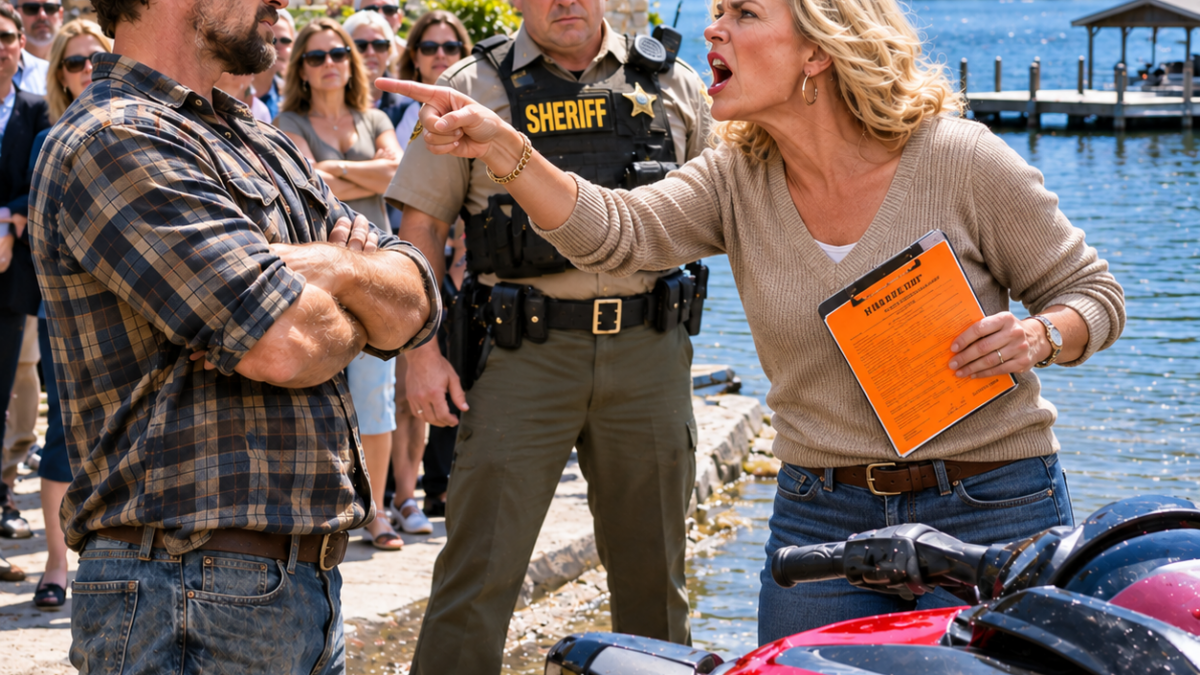
**“SHUT THAT DAMN ENGINE OFF RIGHT NOW, YOU ARROGANT REDNECK! THIS IS AN EXCLUSIVE HOA LAKE, NOT YOUR PERSONAL PLAYGROUND, AND I’LL MAKE SURE YOU SPEND THE NIGHT IN JAIL!” HOA president Bethany Reed screamed from the end of my boat ramp as a sheriff’s cruiser rolled down the gravel road behind her.**
**I killed the jet ski engine, stepped into knee-deep water, and calmly asked the deputy to check one thing before he decided who was trespassing—the deed attached to the lakebed, the dam, the boat ramp, and the narrow shoreline strip circling almost every house in Silver Pines Estates.**
**Then the deputy unfolded the county parcel map, looked at Bethany’s orange violation notice, and asked why the HOA president had called 911 on the only man whose name appeared on the title to the water beneath every private dock in the neighborhood.**
Bethany stopped talking.
That alone was worth the price of the jet ski.
The deputy, Michael Grant, stood beside his cruiser holding the laminated parcel map I kept in a weatherproof folder inside the old pump house.
Bethany still had the orange HOA violation notice raised in one hand.
Behind her, three Silver Pines residents had gathered on the walking trail.
One of them had already started recording.
Michael looked from the map to the lake.
Then toward the houses curving around the eastern shoreline.
Then back to me.
“Mr. Lawson?”
“Yes.”
“You own the lake?”
“Yes.”
“The whole lake?”
“The lakebed, dam, boat ramp, and most of the shoreline buffer.”
Bethany finally found her voice.
“That is not true.”
Michael looked at her.
“Ma’am, I’m reading the recorded parcel description.”
“That map is outdated.”
“No, ma’am.”
“The HOA controls the lake.”
Michael folded the map halfway.
“Control and ownership aren’t the same thing.”
Bethany’s face turned bright red.
“Our residents have exclusive lake rights.”
I nodded.
“They have recreational access rights.”
She pointed at my jet ski.
“Then he is violating them.”
Michael looked confused.
“How?”
“Personal watercraft are prohibited.”
“By whose rule?”
PART2:
“The Silver Pines lake-use regulations.”
Michael looked at me.
“Are you a member of the HOA?”
“No.”
Bethany stepped forward.
“He owns property adjacent to the community.”
“My farmhouse is across the dam.”
“Still part of the Silver Pines lake zone.”
Michael looked back at the map.
Then at Bethany.
“Is his parcel inside the HOA declaration?”
She did not answer.
That was when I knew the morning was about to get much more interesting.
My name is Jake Lawson.
Three years before Bethany called 911 on me for using my own lake, I had inherited just over 310 acres in northern Georgia from my grandfather, Harold Lawson.
Most of it was timber.
Some pasture.
An old farmhouse.
A machine shed.
A dam.
And a ninety-two-acre lake my family had controlled since the 1960s.
Granddad called it Lawson Lake.
Silver Pines called it Silver Pines Lake.
That difference had been irritating for years.
It had never been dangerous.
Until Bethany Reed became HOA president.
The lake was originally created when my grandfather and two neighboring farmers dammed Mill Creek.
Over time, Granddad bought the other owners out.
By 1971, the entire lakebed, dam parcel, old boat ramp, and a protected shoreline strip belonged to the Lawson family.
Then, in the early 1990s, a developer bought land east of the lake.
That became Silver Pines Estates.
The developer wanted lake access.
Granddad did not want houses built directly on the water.
They negotiated.
Silver Pines received a recorded recreational easement.
Residents could:
Fish.
Swim.
Use small boats.
Maintain approved docks.
Walk designated shoreline areas.
The HOA would contribute to dam inspections, trash removal, and basic shoreline maintenance.
What the HOA did not receive was ownership.
No lakebed.
No dam.
No authority over Lawson property.
No ability to sell water rights.
No right to alter the shoreline without written permission.
Granddad kept the boundaries simple.
The problem was that later HOA boards stopped explaining the difference to residents.
Silver Pines newsletters started calling it:
OUR PRIVATE LAKE.
Real-estate listings said:
EXCLUSIVE COMMUNITY LAKE.
A stone monument near the clubhouse read:
SILVER PINES LAKE.
Granddad did not care.
“Let them call it whatever they want,” he once told me.
“As long as they remember whose deed it’s on.”
That was how he handled most things.
Quietly.
Then Bethany became president.
Bethany was the kind of HOA leader who turned every guideline into a personal mission.
Golf carts.
Holiday lights.
Dock colors.
Fishing hours.
Guest parking.
Mailboxes.
Trash cans.
Even the number of chairs residents could leave near common areas.
None of that involved me.
My farmhouse sat outside the subdivision.
My land was never annexed.
I paid no HOA dues.
I voted in no HOA elections.
I had no obligation to follow Silver Pines covenants.
Bethany knew that.
She just hated it.
Our first argument started over my boat ramp.
The Lawson ramp sat on the western side of the lake.
Old concrete.
Rough edges.
Built decades before Silver Pines existed.
One Saturday, I found an HOA sign planted beside it.
AUTHORIZED SILVER PINES WATERCRAFT ONLY.
I removed it.
The next day, another appeared.
I removed that one too.
Then Bethany came to the farmhouse.
Pink blazer.
White SUV.
Binder.
“Why are you removing HOA safety signage?”
“Because you’re planting it on my land.”
“The ramp serves the community lake.”
“It serves my property.”
“Residents use it.”
“No, they don’t.”
That was true.
Silver Pines had its own launch point near the clubhouse.
My ramp was private.
Granddad sometimes let neighbors use it when theirs was under repair.
But the recreational easement did not include permanent access to the Lawson ramp.
Bethany opened her binder.
“The lake-use committee has designated all water access points as association-controlled.”
“That committee cannot designate my property as anything.”
She smiled.
“You may want to speak with an attorney.”
“I already have one.”
That ended the visit.
For about a month.
Then Silver Pines adopted new lake rules.
No jet skis.
No personal watercraft.
No gasoline engines larger than ten horsepower.
No boats after sunset.
Life jackets required at all times.
Guest vessel registration.
Some of those rules were reasonable.
Some were strict.
All applied to Silver Pines residents using their easement.
They did not apply to me.
I rarely used a jet ski anyway.
But that spring, my nephew Dylan asked if I could help him inspect the far shoreline after a storm.
Several trees had fallen.
A jet ski made more sense than hauling the fishing boat around submerged branches.
So I bought a used Yamaha from a friend.
Nothing fancy.
Saturday morning, I launched it.
The engine had barely been running three minutes when a golf cart appeared on the eastern trail.
Bethany.
She stopped.
Stared.
Then started shouting from across the water.
I could not hear every word.
But I heard:
“ILLEGAL.”
And:
“SHUT IT DOWN.”
I waved.
Not sarcastically.
Just acknowledgment.
Then continued toward the north cove.
Thirty minutes later, I returned.
Orange sticker on my truck windshield.
UNAUTHORIZED PERSONAL WATERCRAFT.
FINE:
$500.
I laughed.
Took a picture.
Then threw the notice on my passenger seat.
Two days later, I received certified mail.
Additional daily fine.
$250.
Another violation:
UNAUTHORIZED USE OF HOA-CONTROLLED BOAT RAMP.
Fine:
$1,000.
I called Bethany.
“This is becoming entertaining.”
“You think community safety is entertaining?”
“No. I think you fining somebody outside your HOA is entertaining.”
“You are operating on association-controlled water.”
“No.”
“You were warned.”
“I’m not paying.”
“Then we’ll place a lien.”
“On what?”
“Your property.”
That made me stop smiling.
“You cannot lien property outside your association.”
“Our attorney will determine that.”
“Great.”
I hung up.
Then called Rebecca Hayes.
Rebecca had handled Granddad’s estate and several of my construction-company contracts.
I sent her the notices.
She called ten minutes later.
“Jake?”
“Yes?”
“Do not pay these.”
“I wasn’t planning to.”
“Do not sign anything.”
“Fine.”
“And if they threaten a lien again, send it directly to me.”
Rebecca sent Silver Pines a letter.
My parcel was not governed by the HOA declaration.
The lake belonged to Lawson Holdings, the family LLC created for inheritance purposes.
Silver Pines possessed limited recreational easement rights only.
No enforcement authority over me.
No fine authority.
No lien authority.
The response came from Bethany personally.
Not the HOA attorney.
She wrote:
THE HOA DISPUTES YOUR INTERPRETATION.
Rebecca loved that.
“Interpretation?”
She pulled the deed.
Easement agreement.
Original subdivision plat.
County tax map.
There was very little to interpret.
Then something strange happened.
Silver Pines residents started approaching me.
Frank Miller lived on the northeast shore.
Retired electrician.
He came by the farmhouse with a six-pack.
“You planning to ban us from the lake?”
“No.”
“Bethany says you’re threatening to revoke access.”
“I haven’t threatened anything.”
“She says you’re challenging the lake rules.”
“For me.”
“What does that mean?”
“You’re inside the HOA. I’m not.”
Frank looked toward the water.
“So the jet-ski rule applies to us?”
“Probably.”
“But not you?”
“Correct.”
He thought about it.
“That’s going to make Bethany insane.”
“I’ve noticed.”
Then Susan Parker called.
Her dock needed repair.
The HOA told her no repairs could happen until the Lawson ownership dispute was resolved.
“What ownership dispute?”
I asked.
“Bethany says your family never actually owned the shoreline.”
That was new.
Rebecca found out why.
Silver Pines had commissioned what it called a “lake governance review.”
Prepared by:
Pine Environmental & Community Planning.
The report claimed decades of HOA maintenance had created “operational control” over the shoreline.
Rebecca read it twice.
Then asked:
“Do they have a lawyer?”
“Apparently not.”
The company was a planning consultant.
Not a law firm.
The report discussed “historic community possession” and “functional lake ownership.”
Neither phrase changed the deed.
Then Frank called again.
“The board is considering buying the lake.”
“From me?”
“I assume.”
“Nobody contacted me.”
“That’s the strange part.”
The board packet included a proposed:
LAKE CONSOLIDATION STRATEGY.
Phase one:
Assert HOA operational authority.
Phase two:
Resolve shoreline conflicts.
Phase three:
Acquire remaining ownership interests.
Rebecca looked at me.
“They want to make you negotiate from a weaker position.”
“By pretending they already control it?”
“Looks that way.”
Then Bethany appeared at the dam.
I was inspecting the spillway after heavy rain.
She walked straight toward me.
“You’re not authorized to alter the dam.”
“I’m not altering anything.”
“You’re inside a community infrastructure zone.”
“My dam.”
“The HOA contributes to maintenance.”
“Under the easement.”
“That gives us oversight.”
“No.”
She held up another orange notice.
UNAUTHORIZED WATER CONTROL ACTIVITY.
$1,500.
I stared.
“You just fined me for inspecting my own dam.”
“Your ownership is disputed.”
“It isn’t.”
She pointed toward the houses.
“Those families have invested millions because of this lake.”
“That does not give you my deed.”
She turned and walked away.
That was when I started carrying a copy of the property map in the pump house.
Not because I expected a deputy.
Because Bethany kept acting as if saying something loudly enough could turn it into fact.
Then she crossed a line that actually mattered.
One morning, I found a contractor near the old north shore.
Survey flags.
Two men measuring.
I asked who hired them.
Silver Pines HOA.
Purpose:
Future marina expansion.
My land.
Again.
I called Bethany.
“You sent surveyors onto Lawson property.”
“They were locating community shoreline assets.”
“No.”
“The shoreline belongs functionally to Silver Pines.”
“Tell them to leave.”
“You don’t have authority to interfere with HOA contractors.”
That sentence was so backwards I almost admired it.
The survey crew left when I showed them the deed.
Their supervisor apologized.
Two days later, Rebecca filed formal notice against further unauthorized entry.
Silver Pines’ actual attorney, Charles Denton, called her.
He sounded surprised.
Apparently Bethany had not told him about several enforcement notices.
Including the fines.
Including the lien threat.
Charles asked for copies.
Rebecca sent everything.
The next morning, my outstanding balance disappeared from the HOA portal.
Not because they admitted I was right.
Because their lawyer had finally seen the notices.
I thought the fight might be over.
Then I launched the jet ski again.
This time intentionally.
Not to provoke Bethany.
Storm debris had collected near the dam intake.
The jet ski was useful for checking floating logs.
I launched around eight Saturday morning.
Bethany must have seen me from the trail.
She arrived in five minutes.
Pink blazer.
Orange notice.
Then she did something I did not expect.
She called 911.
I know because she announced it.
“I’m calling the sheriff.”
“Okay.”
“You are illegally operating a banned motorized vessel on private HOA water.”
“Okay.”
“You’re trespassing.”
“On my lake?”
“On Silver Pines property.”
I pulled the jet ski toward the ramp.
Killed the engine.
Waited.
If she wanted a deputy, a deputy could come.
Twenty minutes later, Michael Grant arrived.
Bethany met him at the bottom of the road.
She spoke first.
Loudly.
“This man has been warned repeatedly. He is trespassing on association-controlled lake property and operating prohibited watercraft.”
Michael looked at me.
“Sir?”
“Morning.”
“Your name?”
“Jake Lawson.”
His eyes changed slightly.
“Lawson?”
“Yes.”
Then he looked at the lake.
“Lawson Lake?”
Bethany interrupted.
“Silver Pines Lake.”
Michael looked back at her.
Then at me.
“You own property here?”
“Three hundred ten acres on the west and north side.”
Bethany said:
“He owns adjacent property.”
I walked to the pump house.
Retrieved the map.
Rebecca had advised me never to argue when records could speak.
Michael unfolded it.
Read the parcel number.
Checked his computer.
Then looked at me.
“This entire blue parcel is yours?”
“Lawson Holdings.”
“Lakebed included?”
“Yes.”
“Dam?”
“Yes.”
“Shoreline strip?”
“Most of it.”
Bethany said:
“That map is outdated.”
Michael checked the county GIS record again.
“No.”
Then:
“Ma’am, is Mr. Lawson a member of Silver Pines?”
“He participates in the lake system.”
“That isn’t what I asked.”
Silence.
“Is his property subject to the HOA declaration?”
“No.”
Michael folded the map.
“Then what exactly are you asking me to arrest him for?”
Bethany stared at him.
“Trespassing.”
“On his property?”
“On the HOA lake.”
Michael looked toward the water again.
“County record says the lakebed belongs to Lawson Holdings.”
“The HOA controls recreational use.”
“For HOA members.”
“Yes.”
“He isn’t one.”
Bethany’s face changed.
Then she tried another angle.
“He’s creating a safety hazard.”
Michael looked at the jet ski.
“Is personal watercraft use prohibited by county law?”
“No.”
“State law?”
“No.”
“Any no-wake order?”
“No.”
“Then that’s an HOA rule.”
Bethany said:
“Yes.”
“And he isn’t HOA.”
Silence.
Frank had arrived during the conversation.
Susan too.
More residents gathered along the path.
That made Bethany angrier.
She pointed at me.
“He is intentionally humiliating this community.”
I shook my head.
“I’m checking storm debris.”
“You knew the rule.”
“I know your rule.”
Michael stepped between us.
“Okay. Nobody’s getting arrested.”
Bethany looked shocked.
“You’re refusing to enforce private property rights?”
“No.”
“I called because he’s trespassing.”
Michael raised the map.
“The property right I can verify belongs to him.”
Then he asked something that changed everything.
“Who owns the shoreline under the docks?”
Bethany answered too quickly.
“Homeowners.”
I said:
“Some do.”
Michael looked at me.
“Some?”
“The original subdivision left a Lawson buffer around most of the lake.”
Bethany snapped:
“That strip was absorbed years ago.”
“No.”
Frank frowned.
“Wait.”
He looked at me.
“What buffer?”
I explained.
Twenty to sixty feet in most places.
Wider in several coves.
Dock licenses allowed access across it.
No ownership transfer.
Frank stared at Bethany.
“Do you know about this?”
She said:
“It’s irrelevant.”
That was the wrong answer.
Susan asked:
“Is my backyard on his property?”
“I don’t know.”
Now everyone wanted to know.
The jet ski no longer mattered.
Michael looked at Bethany.
“Ma’am, this is a civil property dispute. Do not use 911 to enforce HOA rules against someone who is not subject to them.”
She looked furious.
Then pointed at my orange violation notice.
“He owes more than five thousand dollars.”
Michael almost laughed.
“He owes your HOA money for what?”
“Repeated lake violations.”
“On his own lake?”
I wish someone had taken a picture of Bethany’s expression.
Then Rebecca arrived.
I had texted her when Bethany called 911.
She stepped out holding a folder.
“Good morning.”
Bethany groaned.
Rebecca handed Michael a copy of the easement agreement.
Then another document.
Survey proposal.
“We’re starting a boundary survey Monday.”
Bethany turned.
“A survey of what?”
“The shoreline.”
“No.”
Rebecca looked at her.
“That wasn’t a request.”
That Monday, Thomas Reed arrived with a survey crew.
Tripods.
Metal detectors.
Old plat maps.
Orange stakes.
We started at the dam.
Everything matched.
Then moved east.
First five houses:
Minor differences.
One garden bed crossed the Lawson strip by three feet.
One fire pit by five.
Nothing dramatic.
Homeowners nervous.
I told them:
“We’re documenting first. Nobody is tearing anything down today.”
Then we reached Bethany’s side of the lake.
Her house had one of the most expensive waterfront lots in Silver Pines.
Stone patio.
Outdoor kitchen.
Pool.
Large private dock.
Landscaped lawn all the way to the water.
Thomas found the first original monument behind a hedge.
Then another near her garden.
The legal line sat farther inland than the HOA map showed.
Fifteen feet.
Then twenty.
Then almost thirty.
Orange stakes crossed her backyard.
Bethany came outside.
“What are you doing?”
Thomas explained.
She started arguing.
Then crying.
“This is my property.”
Thomas said:
“I’m showing where the recorded boundary appears to be.”
“You’re putting flags through my yard.”
“The flags don’t create the boundary.”
She pointed at me.
“This is retaliation.”
“No.”
“You’re doing this because of the jet ski.”
“Bethany, I bought the survey before you called 911.”
Then Thomas found another monument beside her retaining wall.
He checked coordinates.
Walked toward the pool house.
Stopped.
“Jake.”
“What?”
He pointed.
“If this monument is correct, part of the pool house sits on Lawson land.”
Bethany froze.
Then said:
“That’s impossible.”
Thomas looked at the wall.
“It gets worse.”
The retaining wall crossed the boundary too.
So did the first section of her dock approach.
Bethany called the HOA attorney.
Charles Denton arrived later.
Unlike Bethany, he did not shout.
He reviewed the deed.
Survey.
Subdivision plat.
Then asked:
“Who approved the pool house?”
Bethany said:
“The architectural committee.”
“Using what survey?”
The file showed a map where the Lawson shoreline strip disappeared entirely.
That was not the recorded subdivision map.
Thomas compared them.
Someone had extended Bethany’s lot line to the water.
Then Frank discovered the same modified map had been used for several waterfront improvement approvals.
Not just Bethany.
Ten other properties.
The survey expanded.
Most issues were small.
Patios.
Fences.
Dock approaches.
One outdoor kitchen.
Nothing I wanted demolished.
But the pattern mattered.
The false maps always favored Silver Pines.
Never Lawson property.
Then Thomas’s crew reached the north cove.
That was where the buffer became much wider.
An old drainage corridor.
Almost two hundred feet inland at its deepest point.
Silver Pines’ modern map showed it as common property.
Thomas followed the original deed.
Straight through a maintenance shed.
Behind the clubhouse.
Across part of a service road.
Then underneath Silver Pines’ main lakeside pavilion.
Frank looked sick.
“How much did we build on Lawson land?”
“I don’t know yet.”
Then a survey worker found a broken stone monument under leaves.
Fresh scrape marks.
Thirty feet away:
Another monument lying flat.
Removed.
Rebecca asked:
“Could these have been moved intentionally?”
Thomas answered carefully.
“Someone removed them recently enough that the break surface hasn’t weathered much.”
Silver Pines maintenance records showed:
SHORELINE BEAUTIFICATION.
OBSOLETE MARKER REMOVAL.
Contractor:
Reed Landscape & Shoreline.
Owner:
Richard Reed.
Bethany’s brother.
That got everyone’s attention.
Invoice:
$72,000.
Work included:
Remove outdated concrete and stone markers conflicting with current community plans.
Thomas stared at the description.
“Boundary monuments are not outdated because a different map is more convenient.”
Frank looked at Bethany.
“You approved this?”
“I was told they were old construction markers.”
“By Richard?”
“Yes.”
“Did anyone ask a licensed surveyor?”
No answer.
Then Susan found another file.
Twenty-one markers removed.
Several buried behind the maintenance shed.
County survey officials came before anything was excavated.
Three feet down:
Old Lawson monument.
Then another.
Then another.
Some broken.
One still intact.
The original Lawson parcel number had been covered by a newer metal plate:
SILVER PINES SHORELINE.
That was when the matter stopped looking like careless HOA paperwork.
Someone had tried to make the ground match the fake map.
Bethany insisted she did not know the markers were legal monuments.
Maybe.
But archived emails later made her explanation harder.
RICHARD: OLD LAWSON MARKERS CONFLICT WITH CURRENT SHORELINE MAP.
BETHANY: REMOVE IF THEY ARE NO LONGER RELEVANT.
RICHARD: SURVEYOR MAY OBJECT.
BETHANY: WE’VE USED HOA MAP FOR YEARS.
Another:
BETHANY: LAWSON FAMILY NEVER CHALLENGES ANYTHING.
That line stayed with me.
Granddad’s kindness had become part of their risk calculation.
He let residents fish.
He allowed reasonable dock work.
He did not argue over every flower bed.
And someone interpreted his patience as weakness.
That made me angrier than the 911 call.
Then things got bigger.
Frank found a confidential board presentation.
SILVER PINES WATERFRONT EXPANSION.
Second marina.
Fifteen rental cabins.
Event pavilion.
More docks.
Luxury waterfront homes on property north of the lake.
Problem:
Silver Pines did not own enough lake frontage for the project.
The Lawson buffer blocked several connections.
The presentation assumed:
HOA SHORELINE CONTROL TO BE PERFECTED.
That phrase caught Rebecca’s attention.
“Perfected how?”
Then a financing document answered.
A regional lender would fund the expansion only if Silver Pines could demonstrate permanent control over:
Shoreline access.
Dock areas.
Dam operations.
Lake management.
The HOA had recreational rights.
Not ownership.
Not enough.
Then we found another company.
Reed Waterfront Development LLC.
Manager:
Richard Reed.
Bethany’s brother.
He held options on eighty acres north of Silver Pines.
If the development gained lake access, its value increased dramatically.
Now the removed markers made sense.
The false maps made sense.
My “illegal” jet ski made sense.
They needed the Lawson ownership claim to look weak.
If the HOA could establish years of exclusive operational control, maybe they thought they could pressure me into selling.
Then Rebecca found emails.
RICHARD: JAKE IS USING WEST RAMP AGAIN.
BETHANY: KEEP DOCUMENTING VIOLATIONS.
RICHARD: NEED HIM TREATING HOA RULES AS BINDING.
BETHANY: IF HE PAYS ONE FINE, THAT HELPS.
I stared at the screen.
The fines were not about noise.
Or safety.
They wanted evidence that I recognized HOA authority.
Rebecca smiled without humor.
“That explains the absurd penalties.”
My refusal to pay became more important than I had realized.
Then another email:
RICHARD: WEST RAMP IS CRITICAL FOR PHASE TWO.
BETHANY: HE’LL SELL EVENTUALLY.
RICHARD: NOT IF HE THINKS HE CONTROLS EVERYTHING.
BETHANY: THEN STOP LETTING HIM ACT LIKE HE DOES.
That Saturday morning 911 call had not been random anger.
Bethany wanted law enforcement standing beside her while she publicly asserted HOA control over my lake.
If I backed down—
if I accepted a violation—
if a deputy ordered me off—
even temporarily—
they could point to it later.
Not proof of ownership.
But another piece of their story.
Michael Grant’s body camera recorded the opposite.
The deputy verifying that I owned the lake.
That was almost poetic.
Then Richard Reed made the next mistake.
Survey crews were working near the dam when a contractor arrived with a mini excavator.
Work order:
EMERGENCY SHORELINE STABILIZATION.
Location:
West ramp and dam access.
My land.
Thomas stopped them.
Contractor showed authorization signed by Richard.
Attached:
Silver Pines Lake Control Easement.
Supposedly signed by my grandfather Harold Lawson twelve years earlier.
I knew immediately something was wrong.
Granddad signed everything:
H. LAWSON.
The easement showed:
HAROLD E. LAWSON.
Rebecca compared it to old records.
The signature was copied from a timber-sale contract.
Exact match.
Fake.
County sheriff’s office opened an investigation.
Then another document appeared.
A seventy-five-year exclusive lake management agreement.
Granddad’s signature.
Fake.
Another:
Permanent dam-control easement.
Fake.
The lender had been shown all three.
Richard’s development company had already received a $310,000 planning advance based partly on them.
Now the case was no longer simply an HOA boundary dispute.
The lender reported suspected fraud.
Bethany stepped down temporarily.
She still insisted she had trusted Richard.
Then Frank found board emails showing Bethany knew at least some of the documents were questionable.
BETHANY: JAKE’S DEED DOESN’T MATCH OUR CONTROL AGREEMENT.
RICHARD: HIS FAMILY never updated old records.
BETHANY: WILL COUNTY ACCEPT OUR VERSION?
RICHARD: ONLY IF NOBODY FORCES TITLE REVIEW.
BETHANY: THEN KEEP THIS INTERNAL UNTIL FINANCING.
That was bad.
Still, Rebecca insisted:
“Do not make her responsible for things we cannot prove.”
Important.
Bethany had made serious choices.
Richard appeared to be driving the larger development scheme.
Different conduct.
Different responsibility.
Then the lake itself exposed the last part.
Thomas ordered a full inspection of the dam and shoreline infrastructure.
Divers found an old intake pipe beneath the north cove.
Granddad had once used it for irrigation.
Supposedly abandoned.
But attached to it—
new pump.
Modern cable.
Large discharge line heading north.
Toward Richard’s optioned development property.
Silver Pines had paid for the work under:
DROUGHT RESILIENCE IMPROVEMENT.
Cost:
$280,000.
Board members thought it upgraded the clubhouse irrigation system.
Instead, the hidden pump could send lake water toward Richard’s future development.
No Lawson permission.
No water agreement.
No commercial withdrawal rights.
Then another line came back toward the lake.
From Silver Pines’ retention basin.
Thomas stared at the map.
“This system can move water both ways.”
That was not automatically illegal.
But nobody had disclosed it.
No permits covered the full system.
Then environmental staff found records showing several overnight “flush cycles.”
Water from the retention basin had been pumped back toward the lake.
Samples showed elevated fertilizer and roadway contaminants near the outlet.
Not catastrophic.
Still unacceptable.
The county ordered the entire hidden system shut down.
Silver Pines switched irrigation back to city water.
Richard’s future development lost its unofficial water source.
The lender froze financing.
Then Richard disappeared.
For two days.
Sheriff deputies found him at a storage yard loading files into a trailer.
Search warrant produced:
Altered maps.
Fake Lawson signatures.
Removed monument records.
Hidden pump diagrams.
Development financing documents.
One folder:
LAKE CONTROL.
Inside was the strategy.
Create enough evidence of long-term Silver Pines control that any Lawson objection becomes expensive.
One handwritten note:
IF OWNER RESISTS, ENFORCEMENT RECORD HELPS ESTABLISH COMMUNITY CONTROL.
My orange jet-ski fines.
There it was.
The ridiculous notices were not ridiculous to Richard.
They were part of the paper trail he wanted.
The day Bethany called 911, she had been trying to add law enforcement to that trail.
Instead, Deputy Michael Grant’s report said:
PROPERTY RECORDS REVIEWED ON SCENE INDICATE LAKEBED AND WESTERN BOAT RAMP OWNED BY LAWSON HOLDINGS. SUBJECT NOT MEMBER OF SILVER PINES HOA. NO CRIMINAL TRESPASS OR WATERCRAFT VIOLATION OBSERVED.
I framed that later.
Not because I needed validation.
Because sometimes bureaucratic language is beautiful.
Richard faced serious legal consequences tied to the fake documents, hidden infrastructure, lender representations, and removal of survey monuments.
Bethany’s role was narrower.
Investigators found no evidence she created Granddad’s fake signatures herself.
No evidence she personally installed the hidden pump.
But she knowingly used disputed maps.
Approved marker-removal work without survey review.
Issued fines against property outside her authority.
Helped present Silver Pines as having broader lake control than the recorded agreement provided.
She eventually faced civil and legal consequences of her own.
The HOA removed her permanently as president.
Richard’s companies were terminated from every Silver Pines contract.
Then came the harder question.
What did I do with Silver Pines?
I owned the lake.
The shoreline problems were confirmed.
The recreational agreement was old.
I could have made life miserable.
Cancelled access when legally allowed.
Demanded removal of every encroaching patio.
Closed docks.
Raised fees.
Blocked shoreline paths.
Made the neighborhood pay for Bethany and Richard.
I did not.
Because Silver Pines was not Bethany.
Frank was Silver Pines.
Susan.
David.
Families who had used the lake for twenty years believing the arrangement was legitimate.
Kids learning to fish.
Retired couples walking the shoreline.
Most residents had not altered maps.
Had not removed monuments.
Had not forged anything.
So Rebecca and I built a cleanup plan.
First:
Survey.
Full recorded shoreline survey.
No HOA maps.
No landscaping maps.
No “functional control.”
Actual boundary.
Second:
Existing minor encroachments handled fairly.
A garden three feet over?
License.
Small patio?
Purchase or lease the occupied strip where environmentally appropriate.
Fences?
Move them if easier.
No surprise demolition.
No punishment pricing.
Bethany’s property was one of the larger problems.
Part of her pool house.
Patio.
Retaining wall.
Dock approach.
All crossed the Lawson strip.
She expected me to demand removal.
Instead, Rebecca proposed a small land sale under the existing structures.
Independent appraisal.
Fair market value.
No expansion rights.
No commercial use.
No larger dock.
Permanent shoreline-protection restrictions.
Bethany stared at the agreement.
“Why would you do this?”
“Because the boundary isn’t punishment.”
She looked down.
That line seemed to hit her harder than anything else.
She signed.
Third:
Silver Pines’ main recreational easement.
We replaced the old agreement with a modern twenty-year version.
Residents retained fishing.
Swimming.
Kayaking.
Approved docks.
Small electric boats.
Their HOA rules could still limit their members.
They simply did not govern me.
Silver Pines paid a reasonable annual fee toward:
Dam inspections.
Water testing.
Shoreline restoration.
Trash removal.
Habitat.
Nothing outrageous.
No revenge.
Fourth:
No commercial lake use without separate written agreement.
No outside development connections.
No hidden water infrastructure.
No rental marina expansion onto Lawson land.
No claims that Silver Pines owned the lake.
Frank proposed a new sign near the clubhouse.
SILVER PINES LAKE.
I looked at him.
He smiled.
“Kidding.”
The actual sign now says:
CEDAR LAKE
PRIVATE LAKE — SILVER PINES RECREATIONAL ACCESS BY AGREEMENT
Longer.
Less impressive.
True.
The hidden north pump was removed.
Return line sealed.
Shoreline restored.
Removed survey monuments recovered where possible.
Permanent markers installed.
County records updated.
Future buyers could see exactly where ownership stopped.
Richard’s northern development project collapsed without guaranteed lake rights.
The land itself remained available for development if its owners wanted.
Their choice.
But nobody could market it as lakefront Silver Pines expansion unless they came to me first.
Bethany remained in her house.
Some residents wanted her forced out.
That was not how property ownership worked.
She lost office.
Not her deed.
Rules have to protect people even when they are unpopular.
Months later, she came to the west ramp.
No pink blazer.
No orange notice.
No binder.
Just Bethany.
My jet ski was sitting beside the dock.
She looked at it.
“I still hate those things.”
I laughed.
“That’s allowed.”
“I really thought you were doing it to provoke me.”
“First time?”
“No.”
“Second time?”
“Maybe a little.”
She almost smiled.
Then:
“I knew our shoreline map didn’t match the old deed.”
“I know.”
“I didn’t know Richard had created those fake Lawson agreements.”
“I believe you.”
She looked surprised.
“Why?”
“Because the evidence says you didn’t.”
She nodded.
“I should’ve checked harder.”
“Yes.”
“I wanted Silver Pines to own the lake.”
“I know.”
“I thought that would protect everybody.”
“You wanted control.”
She looked toward the water.
“Maybe.”
Then she said:
“I’m sorry I called the sheriff.”
“That wasn’t the worst thing you did.”
“I know.”
“But it may have been the funniest.”
She actually laughed.
That was probably the first normal conversation we ever had.
We did not become friends.
We stopped being permanent enemies.
That was enough.
A year later, Silver Pines held a lake cleanup day.
I joined.
So did Bethany.
Frank made the mistake of asking whether I was bringing the jet ski.
“Yes.”
He groaned.
The HOA rule still prohibited jet skis for members.
I was still not a member.
I used mine to pull floating trash toward the ramp.
Michael Grant happened to drive past.
He stopped.
Looked at the jet ski.
Then at me.
“Need me to arrest you?”
Bethany was standing nearby.
She shook her head.
“Absolutely not.”
Everyone laughed.
That moment mattered because a year earlier the same scene had ended with a 911 call and threats of jail.
Now everyone understood the line.
Silver Pines could make rules for its members.
I could make decisions about my property.
Neither side had to dominate the other.
That is what boundaries are for.
Today, Cedar Lake is still mine.
Lawson Holdings owns the lakebed.
Dam.
West ramp.
Most of the shoreline buffer.
Silver Pines residents still enjoy it.
Their docks remain.
Families fish.
Kids swim.
Frank still complains that my jet ski is too loud even though I barely use it.
Susan grows tomatoes beside a shoreline fence that now sits exactly where her deed says it should.
Bethany’s pool house still stands.
But the land beneath the part that crossed the old boundary is legally hers now because she bought it properly.
No fake maps.
No assumption.
No “historic operational control.”
A deed.
The way it should have been from the beginning.
People remember the story because of the 911 call.
Bethany screaming from my boat ramp.
The deputy arriving.
Her threatening to have me arrested.
Then Michael looking at the county map and realizing the “trespasser” owned the water beneath almost every dock in Silver Pines.
That part is funny now.
But it was never the most important part.
The important part was why Bethany believed she could do it.
For years, Silver Pines had used Cedar Lake.
Granddad rarely objected.
Residents behaved reasonably.
The HOA contributed to maintenance.
And slowly, permission started feeling like ownership.
Then somebody turned that feeling into paperwork.
HOA maps.
Rules.
Violation notices.
Removed monuments.
Fake agreements.
Development plans.
The story became stronger every year—
until somebody finally checked the deed.
That is the part people forget about property disputes.
A person can sound powerful.
A board can vote unanimously.
A newsletter can call something “ours.”
A sign can say “private community lake.”
An HOA can issue fines.
Call security.
Call 911.
None of those things rewrite a recorded deed.
Bethany called the sheriff because she believed authority would settle the argument.
Instead, authority checked the records.
And the records said something very simple.
I was not trespassing on Silver Pines’ lake.
Silver Pines had been living around mine.








