HOA Karen Called 911 When I Drained Her Pond—Then the Sheriff Saw What the Water Had Been Hiding
HOA Karen Called 911 When I Drained Her Pond—Then the Sheriff Saw What the Water Had Been Hiding
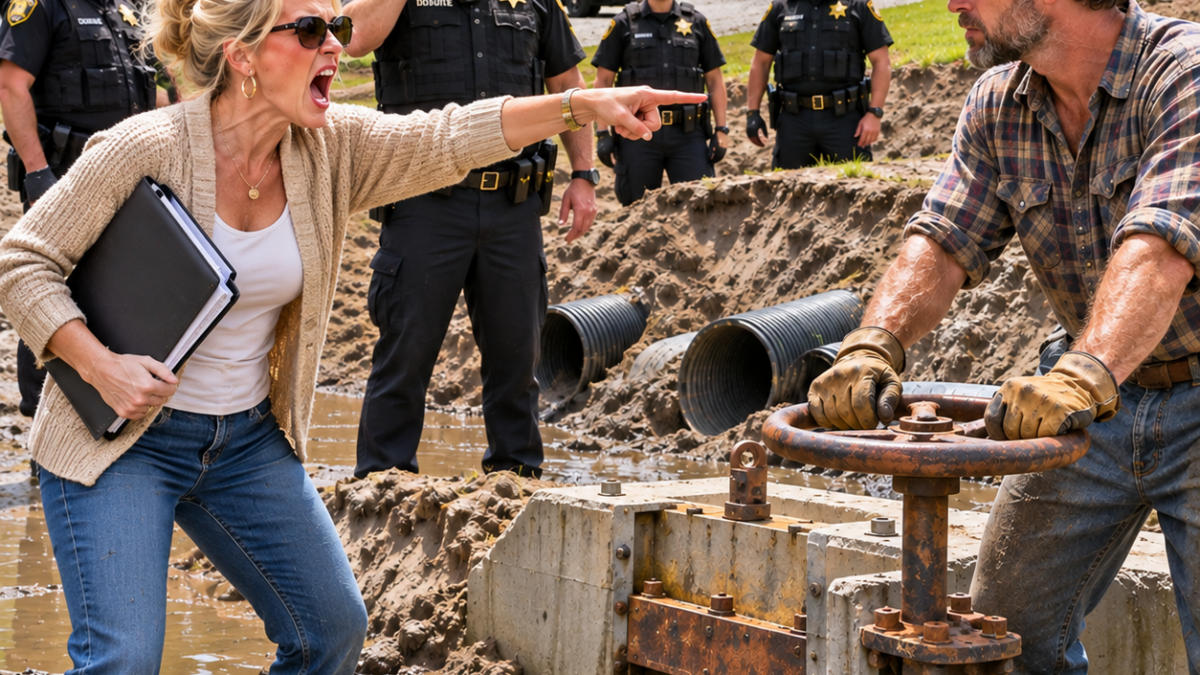
**“ARREST HIM! HE’S DRAINING MY POND ON PURPOSE, AND I WANT HIM OFF HOA PROPERTY RIGHT NOW!” Karen Miller screamed while standing ankle-deep in mud beside a pond that had been flooding my land for months.**
**The county had ordered the water lowered, Sheriff Robert Dawson was standing twenty feet away watching me turn the legal drainage valve, and my survey proved part of Karen’s “community pond” was actually covering my pasture.**
**Then the falling water exposed three enormous black pipes, a buried control box, and a metal plate stamped PINE RIDGE SOUTH EXPANSION — PHASE TWO.**
My name is Daniel Foster, and none of this started because I hated ponds.
Actually, water was one of the reasons I loved my property.
My grandfather bought forty-nine acres in northern Georgia in 1988.
Pasture.
Pine woods.
A creek.
An old barn.
And a low field that naturally collected water after storms.
Dad later improved the drainage because the lower pasture occasionally flooded badly enough to threaten the barn.
He installed a simple underground pipe that carried excess water toward the creek.
Nothing fancy.
No pumps.
No electronic controls.
No retention basin.
Just practical farm drainage.
Dad had one saying about water.
“Water doesn’t care about fences, so people have to care twice as much.”
As a kid, I thought that was just another one of his farm sayings.
Years later, I realized it was almost a legal philosophy.
If you divert water on your side of a property line, the effects do not politely stop when they reach someone else’s land.
That was exactly what happened after Karen Miller became president of Pine Ridge Estates.
Pine Ridge sat beside the northern edge of our property.
It started with about forty houses.
Eventually it grew to nearly 120.
Most residents were decent people.
My grandfather let some families walk near the creek if they asked.
Dad did the same.
I knew Susan Parker, a retired teacher who lived near the southern walking trail.
James Wilson helped me more than once after storms.
His daughter Khloe loved watching ducks and cattle from the fence.
Those were normal neighbor relationships.
Then Karen became HOA president.
At first, I thought she was simply obsessed with rules.
She always carried a folder.
Always talked about standards.
Always seemed to have a committee for everything.
The real trouble began after a large storm damaged part of the Pine Ridge walking trail.
The HOA hired landscapers to improve drainage near the neighborhood’s southern boundary.
That boundary touched my creek.
Nobody contacted me.
PART2:
I did not even know work had started until I heard heavy equipment one Saturday morning.
I walked toward the tree line.
Workers were digging a shallow channel.
They were polite.
They showed me their plans.
Everything appeared to stay inside Pine Ridge.
So I left them alone.
A month later, another storm came.
This time my lower pasture flooded worse than I had ever seen.
Water spread across the field around the old barn.
The barn itself stayed dry.
Barely.
I walked the creek trying to understand why.
Then I found the problem.
Someone had built a dirt embankment downstream.
Right where Pine Ridge drainage met the natural flow.
The embankment slowed water leaving the low field.
I assumed it was temporary.
Then Karen appeared.
She smiled like she was about to show me something wonderful.
“Pine Ridge is creating a community retention pond.”
I looked at the flooded grass.
“A pond?”
“Yes. Once the landscaping is finished, it’ll be beautiful.”
I pointed at the water.
“This is partly my property.”
“Mostly Pine Ridge.”
Mostly.
That word became very important.
“Who approved the dam?”
“The HOA board.”
“I mean the county.”
“Our contractor handled permitting.”
That answer bothered me.
The next morning I walked the property line.
Water extended almost two hundred feet onto my side.
Pasture my cattle used was underwater.
Three young oak trees Dad planted were standing in it.
I photographed everything.
Called county planning.
The county had a record for minor drainage improvement.
Shallow grading.
Stormwater work.
Nothing about a permanent dam.
Nothing about a pond crossing private property.
I called Karen.
She told me county records were probably delayed.
Then:
“Don’t worry. The HOA will maintain the entire feature.”
“That isn’t the problem.”
“What is?”
“You’re holding water on my land.”
Karen said residents already loved the pond.
Within weeks, Pine Ridge installed benches.
A wooden viewing platform.
Landscaping.
Then a sign.
PINE RIDGE REFLECTION POND.
Children fed ducks.
Couples took pictures.
Residents walked around it like it had always existed.
If you did not know the survey line, you would assume Pine Ridge owned everything.
Susan Parker stopped me one afternoon.
“This pond is beautiful. Thank you for letting the neighborhood enjoy it.”
I looked at her.
“I didn’t build it.”
She looked confused.
“I thought the HOA owned this whole area.”
That conversation taught me how quickly appearance turns into belief.
Put up a sign.
Build a bench.
Create a path.
Repeat a name often enough.
People stop asking where the boundary is.
I hired attorney Rachel Morgan.
She brought a surveyor.
The results were not ambiguous.
A large portion of the flooded area was on Foster property.
Worse, Pine Ridge’s embankment partially blocked a drainage easement designed to let water leave my land.
Rachel sent a formal notice.
Lower the water.
Remove the obstruction.
Stop installing improvements on Foster property.
Karen responded through the HOA management company.
Pine Ridge now considered the pond a “shared community water feature.”
Rachel read that phrase aloud.
Then laughed once.
“Shared by who?”
Nobody in my family had signed anything.
Not me.
Not Dad.
Not Grandpa.
Then Pine Ridge sent another letter.
Residents had supposedly developed “reasonable expectations of continued use.”
That phrase made me stare at the page.
The pond had existed only months.
Karen seemed to believe that if she left it there long enough, community affection would eventually become a property right.
Rachel told me not to tear apart the embankment myself.
Let the county inspect first.
Document everything.
So I waited.
That became harder after every storm.
Water spread farther.
One fence began leaning because the ground stayed saturated.
My cattle lost access to part of the lower pasture.
Then one of Dad’s oak trees died.
That affected me more than I expected.
Karen called it unfortunate.
Then suggested Pine Ridge could plant decorative trees around the pond.
I nearly hung up.
Instead:
“Fix the drainage.”
“Removing the pond will hurt property values.”
There it was.
Property values.
Soon real estate listings advertised homes near a “private community pond.”
One listing used a photograph taken from my pasture.
Rachel got it removed.
Karen accused me of hurting homeowners.
That bothered me because I did not want to hurt homeowners.
Susan had done nothing wrong.
James had done nothing wrong.
Khloe liked ducks.
The ordinary residents were not my enemy.
Patience matters.
But patience does not mean accepting damage.
The county finally sent inspector William Harris.
Karen met him before I arrived.
By the time I walked down, she was explaining how Pine Ridge transformed a dangerous drainage area into a safe stormwater feature.
William asked for engineered plans.
Karen said the contractor had them.
Permit number?
Management office would provide it.
Did the pond cross private land?
“There is some overlap.”
William looked at me.
“How much?”
I showed him the survey.
His expression changed.
Then he inspected the embankment.
Photographs.
Measurements.
Questions.
Karen kept answering for me.
Finally, William raised a hand.
“I need to hear from the landowner.”
That was the first time I watched an official person slow Karen down.
I explained everything.
Flooding.
Fence damage.
Oak tree.
Original drainage easement.
William said he needed county records before deciding anything.
Karen asked whether residents could keep using the pond.
William said he was not ruling on recreation.
She looked offended.
Two days later, county notice arrived.
The embankment required engineering review.
Pine Ridge could not intentionally hold water across my property without permission.
Any unapproved obstruction had to be corrected.
I thought that would finish the dispute.
Karen appealed.
Engineer.
Attorney.
Consultant.
Weeks passed.
The pond stayed.
My pasture remained flooded.
Then a metal valve appeared beside the embankment.
It connected to the old drainage pipe Dad had used decades earlier.
A contractor had installed a new handle.
The valve could lower the pond safely without removing the entire embankment.
Ironically, Pine Ridge had just created the tool needed to give me my field back.
Karen immediately locked it.
Heavy chain.
Padlock.
Control box.
“Only Pine Ridge maintenance staff can operate the pond system.”
“The pipe crosses my property.”
“The pond belongs to the HOA.”
Same sentence.
Again.
County scheduled another inspection.
Rachel said:
“Do not cut the lock.”
So I did not.
Then a major storm hit.
Friday night.
Hours of rain.
Saturday morning, the pond had risen nearly another foot.
Water reached the lower fence.
One cow became trapped on a shrinking patch of dry ground.
I managed to guide her out.
That was enough.
I called county emergency services.
Drainage officer arrived.
Deputy arrived.
Karen showed up ten minutes later.
She insisted the pond was designed to hold stormwater.
The drainage officer pointed at the valve.
“Why is the outlet closed?”
Karen said opening it could damage the pond ecosystem.
He looked at my submerged pasture.
Then the survey.
Then told her:
“The valve needs to be opened enough to lower the water.”
Karen refused.
“Only the HOA engineer can authorize that.”
“I’m giving you an emergency drainage instruction.”
She argued five more minutes.
Finally, Karen unlocked the box.
She still refused to give me the key.
So the county officer operated the valve himself.
Water moved downstream.
Slow.
Controlled.
Safe.
Over several hours, the pond dropped.
My pasture began draining.
For the first time in months, I felt hopeful.
Then Karen closed the valve again that evening.
Locked it.
By Sunday morning, the water was rising.
Rachel was furious.
County issued another written directive.
Keep the release operating until water no longer covered Foster property.
Karen resisted again.
Her attorney was supposedly seeking emergency review.
That was around the time Sheriff Robert Dawson became involved.
Not because I called him.
His sister lived in Pine Ridge.
He drove past the pond while off duty and noticed my cattle fence standing underwater.
He knew my family casually.
Stopped.
Asked what happened.
I showed him everything.
Survey.
County notice.
Photographs.
Letters.
Dawson listened.
Then said:
“This looks like a civil and county issue unless somebody starts doing something stupid.”
I laughed.
“That’s exactly what I’m trying to avoid.”
He told me to keep following the county process.
No shortcuts.
Good advice.
Two days later, the county issued its final emergency notice.
If Pine Ridge had not lowered the water by noon Friday, the affected property owner could operate the drainage system under county supervision.
That owner was me.
Karen received the same notice.
She did nothing.
Friday morning, I met the drainage officer beside the pond.
Sheriff Dawson was nearby because his sister told him the argument was spreading through the neighborhood.
Karen arrived with two HOA board members.
Furious.
“The county is destroying an HOA asset.”
The officer showed her the written order.
Karen threatened litigation.
He told her she could call her attorney.
But the water had to come down.
County personnel removed the lock.
I put my hand on the metal handle.
Karen pulled out her phone.
“I’m calling 911.”
I looked at her.
“For what?”
“You’re destroying my pond.”
Her pond.
Not Pine Ridge’s stormwater feature.
Not community infrastructure.
Her pond.
She told the dispatcher I was damaging HOA property and draining a private neighborhood pond without authorization.
Sheriff Dawson stood twenty feet away.
He heard everything.
He actually closed his eyes for a second.
Then looked at me.
“Follow the county officer’s instruction.”
I turned the valve.
Water began flowing.
Karen shouted.
Demanded Dawson stop me.
He did not.
County documented every step.
Two patrol cars arrived because Karen had called.
They spoke with me.
Karen.
Dawson.
County officer.
Nobody arrested me.
Karen got louder.
Said the sheriff had taken my side.
Dawson answered:
“Nobody is taking sides. The county issued a drainage order.”
That should have been the end.
Then the pond dropped far enough to expose the eastern bank.
Something black emerged from the mud.
At first I thought it was a log.
More water drained.
Not a log.
Pipe.
Huge black plastic pipe.
Much larger than Dad’s drainage pipe.
It ran beneath the Pine Ridge embankment toward the trees.
William frowned.
“That’s not on the plans.”
Karen stopped shouting.
Then another pipe appeared.
Then another.
Three large black pipes.
One pointed deeper toward my property.
William crouched beside the mud.
“Who installed these?”
Karen said she did not know.
But her face had changed.
Dawson saw it.
So did I.
Then rows of concrete blocks surfaced.
Newer concrete.
Metal plate bolted into one section.
William wiped away mud.
PINE RIDGE SOUTH EXPANSION — PHASE TWO.
I stared.
“Phase two?”
Karen stepped backward.
Dawson pulled out his phone.
This time, Karen was not the one calling for law enforcement.
He was.
“Send two more units. Get Environmental Services and County Planning out here.”
Then he looked at Karen.
“Nobody leaves.”
That was when I realized the pond had hidden more than water.
As the level kept dropping, another structure appeared near my boundary.
Steel gate.
Concrete channel.
Pointing directly toward the lower pasture.
William moved carefully through the mud.
“This is not a normal overflow.”
Two more sheriff’s vehicles arrived.
County planning.
Environmental Services.
Residents gathered near the Pine Ridge trail.
Deputies kept them back.
Deep mud around drained retention areas can be dangerous.
Karen complained that Dawson was turning a drainage disagreement into a spectacle.
He looked at her.
“You called 911.”
No answer.
County plans showed none of what we were looking at.
Approved work:
Shallow grading.
Small retention area.
One controlled outlet.
No buried control gate.
No three large pipes.
No concrete channel.
No Phase Two.
Nothing.
Rachel arrived in boots.
She looked at the exposed infrastructure.
“Please tell me this is in the county records.”
“It isn’t.”
She started taking photographs.
Karen said Pine Ridge would not allow interference with HOA infrastructure.
Rachel showed her the survey.
“This infrastructure crosses onto Daniel’s property.”
“Boundary is disputed.”
“No. It isn’t.”
The concrete channel extended almost thirty feet onto Foster land.
William asked who hired the contractor.
Karen blamed Summit Community Management.
William called them.
Summit’s manager was confused.
They handled bills.
Meetings.
Basic maintenance.
They had not hired a contractor to install underground drainage controls.
Who managed the pond project?
Karen and the HOA special-projects committee.
William asked for names.
Karen said she would provide them later.
Then the falling water exposed another concrete box.
Steel lid.
Locking mechanism.
Inside:
New switches.
Wiring.
Electric motor.
Labels.
HOLD.
RELEASE WEST.
RELEASE SOUTH.
South pointed toward me.
The pond was not merely holding water.
Somebody had constructed a system that could decide where water went.
William looked at the slope.
“If the south release opens during a heavy storm, where does it discharge?”
Environmental worker followed the pipe direction.
My lower pasture.
Then the barn ditch.
I looked at Karen.
“You knew this existed?”
“No.”
Too fast.
Rachel noticed.
Nobody accused her yet.
The panel had a digital display.
Recorded activity.
Three significant releases in the previous four months.
All during major storms.
I remembered them.
Those were my worst flooding events.
Rachel touched my arm.
“Facts first.”
She was right.
Maybe automatic settings.
Maybe contractors.
Maybe some legitimate function we had not discovered.
Dawson ordered photographs before anything changed.
Then he asked Karen privately:
“Who has keys to this box?”
“I don’t know.”
Dawson pointed toward her key ring.
Small silver key beside her car key.
“That’s the storage shed.”
He asked if William could test it.
Karen hesitated.
Eventually:
“Yes.”
William inserted it.
Turned.
The box opened.
Nobody said anything.
Karen immediately said HOA locks often shared keys.
Possible.
Maybe.
But Karen had direct physical access.
That fact got documented.
County ordered the pond kept low.
No operation of hidden controls.
Karen argued lower water would ruin landscaping and property values.
William answered:
“Property values are not more important than safe drainage.”
Residents heard him.
Then Susan Parker came forward.
She remembered trucks arriving at night six months earlier.
Workers installing pipes.
Karen told residents it was emergency stabilization.
James Wilson remembered concrete trucks around five in the morning.
Again:
Emergency drainage work.
Karen accused residents of turning ordinary construction into conspiracy.
Rachel asked:
“Then where are the permits?”
Karen blamed contractors.
William finally got the contractor’s name.
Miller Land Solutions.
Owner:
Steven Miller.
Karen’s brother.
There was the first family connection.
Karen said the board approved the contract.
Rachel requested minutes.
That afternoon, county workers sealed the hidden control system.
The visible drain remained open enough to free my pasture.
By evening, grass began emerging.
Flattened.
Muddy.
Fence damaged.
Dead oak tree standing near the old waterline.
But the land was visible again.
Mine again.
Rachel and I walked the newly exposed edge.
She looked toward the Phase Two plate.
“This is bigger than a pond.”
I knew.
The next morning, she requested Pine Ridge financial records.
Contracts with Miller Land Solutions.
Engineering records.
Board minutes.
Everything mentioning:
PINE RIDGE SOUTH.
PHASE TWO.
SOUTH BASIN.
HOA attorney Thomas Reed called.
He had never heard of Phase Two.
That mattered.
He found a two-year-old study.
Pine Ridge once considered expanding south.
Sixty acres.
Seventy-four additional homes.
Second playground.
Walking trail.
Land owned by Cedar Creek Development LLC.
The proposal had a stormwater problem.
Low ground.
Heavy runoff.
More roofs.
More pavement.
Engineers needed extra stormwater storage.
Recommended solution?
Expand Pine Ridge’s reflection pond.
Create controlled releases south and west.
The pond flooding my property was part of a future development strategy.
One sentence jumped out.
FUTURE BASIN CONTROL MUST BE SECURED BEFORE FINAL DEVELOPMENT APPROVAL.
Secured.
Rachel found the acquisition appendix.
Option 1:
Buy my lower pasture.
Option 2:
Negotiate permanent drainage easement.
Option 3:
Establish long-term community stormwater use.
Option 4:
Seek county intervention based on existing reliance.
There it was.
Create reliance first.
Then argue removal is too disruptive.
Same strategy Karen had been using emotionally.
Benches.
Ducks.
Flowers.
Children.
Photos.
Real estate listings.
Make the pond beloved.
Then anyone who wants his pasture back becomes the villain destroying something beautiful.
Rachel searched Cedar Creek Development.
Manager:
Steven Miller.
Karen’s brother.
Ownership:
Miller Family Holdings.
Karen was listed as a minority member.
Now the financial motive came into focus.
Future development could be enormously valuable.
But only if stormwater capacity existed.
Using my land made the project cheaper.
They did not buy it.
They flooded it.
Then called the result a community pond.
Still, Rachel kept reminding me:
“Motive isn’t proof of who ordered what.”
So we followed records.
Pine Ridge had paid Miller Land Solutions more than $78,000 over eighteen months.
Some normal landscaping.
Some vague.
WATER FEATURE ENHANCEMENT.
SOUTH BASIN REINFORCEMENT.
PHASE PREPARATION.
Then:
PRIVATE DRAINAGE CONTROL ACCESS — $18,600.
Approval:
Karen Miller.
Another invoice:
LANDOWNER RESISTANCE MITIGATION.
I stared at it.
“I’m the landowner.”
Rachel opened an attached email.
Karen to Steven:
“Daniel still thinks the water can be forced back onto Pine Ridge. Once basin is fully established county won’t want it removed.”
I read it twice.
That was not confusion.
She knew the pond covered my land.
She wanted it established long enough that removing it became difficult.
Another message:
“Residents love it now. That helps.”
I understood the strategy.
Community affection was leverage.
Karen had made the pond pretty enough that fighting flooding looked cruel.
Susan later called me.
She apologized.
“I supported the pond-preservation committee.”
“You thought it was legal.”
“I encouraged people to fight to keep it.”
“You didn’t flood my pasture.”
She still felt guilty.
I told her something Dad would have agreed with.
“What matters is what you do after you learn the truth.”
Susan started helping.
She told us Karen recently created a pond-preservation committee raising money for flowers, benches, and a fountain.
A fountain.
More permanence.
The HOA board called an emergency meeting.
Karen tried canceling it.
Four board members overruled her.
Clubhouse packed.
Thomas Reed attended.
Rachel attended.
I sat with Susan and James.
Karen started by saying misinformation was spreading.
Thomas interrupted.
“We need to address legal ownership first.”
Rachel presented the survey.
Part of the pond covered Foster property.
Hidden control structures crossed Foster property.
No approved permit existed for the underground Phase Two system.
Thomas presented Pine Ridge’s own records.
The board approved normal drainage improvements.
Not underground Phase Two controls.
Not permanent flooding on my property.
Not hidden construction by Karen’s brother.
Karen said emergency safety justified the work.
Board member Paul Bennett asked:
“Why wasn’t it placed on the official plans?”
“Engineers handled that.”
“Which engineer?”
Karen could not name one.
Then the treasurer stood.
Several Miller Land Solutions payments had been approved directly by Karen using emergency-spending authority.
One larger payment had been split into three smaller invoices.
Each one below the amount requiring full board approval.
Karen called that ordinary accounting.
The treasurer said:
“No. It isn’t.”
Then residents learned Karen’s family owned land whose value depended on the pond.
The room erupted.
Susan stood.
“You told us the pond belonged to us.”
“It does.”
Rachel answered calmly.
“No. The survey says otherwise.”
The board suspended Karen.
Five to one.
Karen voted for herself.
She left.
I thought that was the biggest moment.
Ten minutes later, Sheriff Dawson entered.
Not for the meeting.
He asked for me and Rachel.
Outside, he said county environmental workers had noticed a chemical smell inside one of the southern pipes.
Dead fish had also been found in a downstream ditch.
My stomach dropped.
Tests were underway.
Then his radio crackled.
Someone was back at the pond.
Truck on the lower road.
County seals cut.
Southern release gate opened completely.
Water was rushing toward my pasture.
Dawson ran for his cruiser.
Rachel and I followed separately.
By the time we reached the field, muddy water was already spreading through the grass.
County workers in protective boots moved cattle uphill.
William stopped me from entering.
“We don’t know what’s in it.”
That was one of the hardest moments.
My land.
My cattle.
And I could not step into the water because somebody had activated a system that should not exist.
Fortunately, every animal got out.
No collapse.
No obvious illness.
The truck belonged to Miller Land Solutions.
A young employee named Ryan Cole stood beside it.
Scared.
Dawson asked:
“Why did you open the gate?”
“I didn’t.”
“Who did?”
“There was already a guy here.”
Ryan said his supervisor, Brian Wallace, sent a text ordering him to bring a pump trailer.
He believed the county authorized emergency work.
When he arrived, a man wearing Miller Land Solutions clothing was already beside the controls.
The stranger told Ryan that Karen had cleared the work.
Then cut the county seal.
Opened the south release.
Ryan showed his phone.
EMERGENCY POND WORK.
GET UNIT 4 TO SOUTH BASIN NOW.
DO NOT CONTACT HOA OFFICE.
That last line mattered.
Karen had just been suspended.
Someone wanted activity happening without the board knowing.
County closed the release.
Added stronger locks.
Emergency barriers slowed the water entering my pasture.
The field became temporarily off-limits.
No cattle.
No irrigation.
Nobody walking through.
The next morning, lab results came back.
Not deadly poison.
But elevated fertilizer.
Nutrients.
Algae-control chemicals.
Petroleum residue.
Levels high enough that livestock should not drink directly from it.
Investigators traced the contamination to Pine Ridge’s maintenance area.
Fertilizer storage.
Weed-control products.
Fuel.
Equipment-washing drains.
Those were normal things for a large neighborhood maintenance yard.
What was not normal was connecting runoff to the pond’s hidden pipes.
Dirty water could enter the pond.
Then during high water, the southern release could move some of it onto my property.
The control panel’s three major storm releases suddenly mattered even more.
William would not let us assume every event was intentional.
Records first.
Then Summit Community Management found an archived email from Karen.
Subject:
SOUTH RELEASE DURING LARGE EVENTS.
Events meant rainfall.
Karen wrote:
“If maintenance yard backs up, use south release before residents see flooding near trail.”
Steven answered:
“South field can take it.”
South field.
My field.
Another message:
“Keep west side visually clean. Need pond presentation ready.”
There was the real priority.
From Pine Ridge:
Clean.
Pretty.
Dry trail.
Nice pond.
Anything ugly moved south where homeowners could not see it.
Onto my property.
County disconnected unapproved pumps.
Capped maintenance runoff temporarily.
Kept hidden south controls locked.
Independent engineers began designing proper drainage.
Then Pine Ridge’s audit found more.
More than $120,000 paid to Miller-connected companies over two years.
South Basin Development Preparation.
Phase Two Drainage Acquisition.
Expansion Water Control Consulting.
Then Thomas Reed showed us a document Karen had emailed him months earlier.
FOSTER SOUTH PASTURE DRAINAGE EASEMENT.
My signature appeared at the bottom.
It supposedly gave Pine Ridge permanent rights to flood and drain water across fourteen acres of my property.
Pipes.
Gates.
Future stormwater infrastructure.
Everything they had built.
I had never seen it.
My signature looked real.
Thomas had only a PDF.
Karen supposedly held the original.
No original could be found.
Not at HOA offices.
Not with Miller Land Solutions.
Not with the management company.
The agreement existed everywhere it was useful and nowhere anyone could physically inspect it.
Rachel hired Dr. Susan Keller.
Forensic document examiner.
Her first conclusion:
The signature itself was genuine.
For about two seconds, I felt sick.
Then:
It had almost certainly been copied.
Same tiny pen skips.
Same dot.
Same background texture.
Same digital imperfections as a signature on a contractor-access form I signed three years earlier.
Why did Pine Ridge have that old form?
Because one contractor needed temporary passage through the neighborhood while repairing my fence.
Karen had received a copy by email.
My real signature became the foundation for a fake permanent drainage easement.
County investigators took over that part.
I gave them the original form.
Then went home.
The water level stayed low.
My pasture dried.
Soil testing eventually showed no dangerous long-term contamination.
Good news.
James and several Pine Ridge residents came one Saturday and helped repair my fence.
Susan brought food.
Khloe carried boards.
Then she looked toward the smaller remaining water area.
“Will the ducks be okay?”
“Yes.”
County engineers had preserved a shallow pond entirely on Pine Ridge’s side.
The ducks seemed perfectly happy.
That reminded me what most residents wanted.
Not control.
Not fraud.
Ducks.
Walking trails.
Quiet homes.
The complicated part belonged to adults with money.
Sheriff Dawson later located Brian Wallace.
Brian said Steven had personally ordered him to send Ryan to the pond.
Then investigators interviewed David Price, a contractor involved in the original system.
David said Steven designed the hidden southern release because Phase Two required more stormwater capacity.
David warned him discharge onto my property required an easement.
Steven produced the document carrying my copied signature.
David believed it was real.
Then Dawson asked about the maintenance-yard contamination line.
David became uncomfortable.
“That wasn’t in my design.”
“Who requested it?”
“Karen.”
David said Karen complained dirty runoff sometimes collected near the maintenance building and made the walking trail smell.
She wanted it redirected.
He refused.
Said it needed proper environmental handling.
Later, Miller Land Solutions installed the connection themselves.
Auditors found emails.
Karen:
“David won’t connect wash area. Says environmental issue.”
Steven:
“I’ll use our crew.”
Karen:
“Do it before county comes back.”
At that point, explanations were becoming difficult.
Then Rachel found the largest financial motive yet.
Cedar Creek Development had a buyer lined up for the sixty-acre Phase Two parcel.
Regional builder.
Sale price:
Almost $5.4 million.
But the sale had conditions.
Approved stormwater capacity.
Permanent basin control.
Proof of neighboring drainage rights.
If Pine Ridge lost the pond system, the $5.4 million deal could collapse.
Suddenly, every shortcut had a number attached.
Independent stormwater infrastructure would cost roughly $1.3 million.
Using my pasture and expanding Pine Ridge’s pond cut that cost dramatically.
Fake easement cheaper than buying land.
Hidden pipe faster than county review.
Community pond harder politically to remove.
That was the business model.
Then Karen disappeared from Pine Ridge.
Not missing.
Just gone.
House empty.
SUV gone.
Attorney could not reach her.
Board could not reach her.
Dawson warned us not to assume anything dramatic.
Maybe staying with family.
Maybe following legal advice.
Two days later, she resurfaced at the county planning office.
To file a complaint against me.
She claimed I had illegally damaged a protected stormwater basin by draining the pond.
I almost laughed.
Attached to her complaint was an engineering certification.
According to it, the entire pond system—including southern controls—had been inspected and approved by county engineer Robert Hastings two years earlier.
That could have changed everything.
Robert was real.
Retired eighteen months earlier.
Signature looked real.
Dawson contacted him.
Robert reviewed the certification.
“That is my signature.”
Then:
“But I never approved this.”
He remembered signing a slope-stability inspection.
Nothing about underground pipes.
Nothing about a south release.
Nothing about flooding Foster property.
Dr. Keller compared the documents.
Same pattern.
A real signature reused on a different approval.
Now there were two.
My drainage easement.
Robert’s engineering certification.
Investigators obtained search warrants for Miller Land Solutions and Cedar Creek Development.
Computers.
External drives.
Boxes.
Project files.
Then Dawson called me.
“Come to the lower barn. Bring Rachel.”
We arrived.
Three sheriff vehicles.
William Harris.
Investigators.
Large rolled map.
Dawson unfolded it.
Pine Ridge.
Pond.
My pasture.
Phase Two land.
A network of pipes far larger than anything we knew about.
One line crossed the lower field.
Another ran beside my barn.
A third continued toward Cedar Creek.
In red ink:
FINAL DIVERSION ROUTE.
I looked at Dawson.
“Already installed?”
“We don’t know.”
County locator equipment started searching.
Twenty minutes later:
Signal beside the barn.
Then farther into the pasture.
Then toward the creek.
Workers carefully exposed one section.
Black plastic pipe.
Almost three feet wide.
William stared.
“This can move a lot of water.”
Then someone found an electronic sensor attached to it.
Wire heading toward Pine Ridge.
Remote control.
Dawson ordered digging stopped until engineers could secure the system.
Then his radio crackled.
Deputy at Pine Ridge maintenance building:
“Sheriff, we have movement on the south pump system. Pressure is climbing.”
William’s face changed.
“That pipe may be active.”
A low vibration moved through the ground.
Then a deep rushing sound.
Under my boots.
Water.
A lot of water.
Somebody had activated the hidden diversion.
The ground near the barn began shaking.
William shouted:
“Uphill! Move!”
Dawson grabbed my arm and pulled me away.
County workers headed for cattle gates.
Then soil near the barn wall lifted.
Cracked.
Burst.
Muddy water shot several feet into the air.
I wanted to run toward the barn.
Tools.
Feed.
Old family equipment.
Dawson blocked me.
“We don’t know if the ground will collapse.”
He was right.
Cattle were already on higher pasture.
Thank God.
For almost two minutes, underground pressure rose.
More cracks.
Then the water weakened.
Radio message:
County crew reached the main pump controls and shut them down manually.
The pasture was ugly.
Mud.
A trench.
Several feet of washed-out soil.
One corner of the barn foundation exposed.
But the barn still stood.
William said if the system ran longer, soil could have washed out from under the structure.
Dawson asked who controlled the pumps.
The cabinet had been locked.
County seal cut.
Remote receiver installed.
Meaning whoever turned it on did not need to be physically standing there.
Investigators traced the remote hardware.
Commercial irrigation controller.
Phone or computer access.
Administrator account:
Miller Land Solutions.
Registered email:
Steven Miller.
Still not proof Steven activated it.
Could have been another user.
So they checked logs.
Activation:
2:17 p.m.
Account:
K. MILLER.
Karen.
I did not celebrate.
I felt exhausted.
Dawson warned:
“Account name alone isn’t enough. We need the device.”
Fair.
Evidence.
Not emotion.
Search records from Steven’s company showed the real engineering plan.
Three major routes.
West release.
South release.
Underground diversion beneath my pasture.
Project notes said the purpose openly.
Move stormwater away from Pine Ridge and future Phase Two during heavy rain.
My acreage was described as:
NATURAL OVERFLOW CAPACITY.
I stared at those words.
Not Foster Farm.
Not pasture.
Not Dad’s land.
Not cattle.
Overflow capacity.
Rachel looked at me.
“People do strange things when they reduce land to numbers.”
Independent drainage for Phase Two:
Approximately $1.3 million.
Using my land:
Far cheaper.
The whole plan became obvious.
Flood part of my pasture.
Make pond look permanent.
Let residents love it.
Build hidden controls.
Create fake easement.
Create fake county approval.
Then argue the system already existed and everybody depended on it.
And if I drained the pond?
Karen could call the police.
Which she did.
Her call was supposed to make me look criminal.
Instead, Sheriff Dawson stood there while the pond drained and watched the hidden pipes appear.
Karen had brought law enforcement directly to the evidence.
Investigators eventually located her at a rental cabin about sixty miles away.
Nothing dramatic.
Rented under her own name.
Attorney said she wanted privacy.
They obtained a warrant for her phone.
The irrigation-control app was installed.
Activity record showed the hidden diversion pump had been activated from that device at exactly 2:17 p.m.
That changed the case.
Karen was arrested later.
Not because I wanted revenge.
Not because she called me names.
Not because she was a difficult HOA president.
Investigators believed evidence linked her to the unauthorized system, false documents, and the activation that sent water beneath my barn.
Steven was arrested too.
His company records tied him to hidden construction, the fake easement, the copied engineering approval, and the Phase Two development.
Other people were questioned separately.
That mattered.
Some contractors had been lied to.
Ryan Cole cooperated.
Brian Wallace cooperated.
David Price showed investigators records proving he refused to connect the dirty maintenance-yard runoff line.
Working for the wrong company did not automatically make everybody part of the same plan.
That distinction mattered to me.
The cases took months.
I stopped attending every hearing.
Rachel kept me informed about anything affecting my land.
The rest belonged to prosecutors and courts.
I wanted my property repaired.
Independent engineers redesigned everything.
The fake permanent pond was reduced.
The hidden south controls crossing my property were removed.
The three-foot diversion pipe beneath the pasture was disconnected and filled.
Maintenance-yard runoff was separated completely.
Pine Ridge had to build legal drainage entirely on land Pine Ridge owned.
Expensive?
Yes.
That was the point.
Their drainage problem should never have been financed with my pasture.
The remaining Pine Ridge retention pond became smaller.
Legal.
Entirely inside the HOA boundary.
It still held water.
Still had ducks.
Still had benches.
Children still visited.
And I was happy about that.
I never wanted Pine Ridge to lose something beautiful.
I wanted them to stop creating that beauty by damaging me.
The HOA signed a settlement.
My lower pasture belonged exclusively to me.
No drainage easement.
No flood rights.
No stormwater rights.
No hidden pipes.
No future pond structures across the line.
Pine Ridge paid for pasture restoration.
Fence repair.
Soil testing.
Barn foundation repairs.
And Dad’s dead oak.
Money could not replace the tree.
The new board asked if they could plant another oak near the boundary.
I said yes.
With permission.
Susan helped choose it.
Khloe carried the first bucket of water.
James dug part of the hole.
We planted it on my side.
Again:
With permission.
That word had caused the entire fight.
The $5.4 million Phase Two deal collapsed.
Without my land serving as cheap stormwater capacity, Cedar Creek Development could not satisfy the builder’s conditions.
The buyer walked.
Steven’s company later sold the parcel for much less.
Another developer proposed fewer homes with full drainage on its own property.
I did not oppose it.
Why would I?
People have the right to use their property lawfully.
That was all I had been defending from the beginning.
Months later, county cleared my pasture for livestock.
No dangerous long-term soil contamination.
Grass replanted.
Ditch repaired.
Fence rebuilt.
Barn stabilized.
The lower field slowly began looking like itself again.
Not perfectly.
Land remembers water.
People do too.
But recovery does not require pretending damage never happened.
Sometimes it just means the damage finally stops.
One Saturday morning, Susan and Khloe walked toward the fence carrying a small wooden sign.
They stopped outside.
Asked permission to enter.
I smiled.
“Come on.”
Khloe had painted the sign herself.
Uneven green letters.
One corner crooked.
FOSTER FAMILY OAK.
I almost said it was too sentimental.
Then I looked at her face.
Perfect.
We put it beside the new tree.
Khloe asked:
“Will it get as big as the old one?”
“Someday.”
“Will you still live here?”
“I hope so.”
She thought.
“Maybe I’ll be old then.”
Susan laughed.
“That’s how trees work.”
That afternoon, Rachel sat with me overlooking the pasture.
In the distance, Pine Ridge’s smaller legal pond reflected the sunlight.
She asked:
“Do you regret draining it?”
“No.”
Then I added:
“I regret it had to get that far.”
That was the truth.
I never wanted arrests.
Deputies.
Environmental testing.
Search warrants.
Fake signatures.
Hidden pipes.
Remote pumps.
Court fights.
I wanted somebody to stop flooding my field.
That should have been easy.
Karen could have negotiated.
Steven could have asked for an easement.
They could have bought land.
They could have designed proper drainage.
They had options.
Instead, they picked the cheapest solution.
Make someone else absorb the cost.
Sheriff Dawson stopped by near the end of summer.
Off duty.
His sister still lived in Pine Ridge.
We stood beside the new oak.
He laughed.
“She really wanted me to arrest you that day.”
“I remember.”
“Kept saying, ‘That’s my pond.’”
“I remember that too.”
Then he became serious.
“You know what helped investigators more than almost anything?”
“What?”
“She called us.”
I looked at him.
“If Karen hadn’t called 911, county might’ve discovered those pipes eventually. But she brought patrol cars, county people, me—everybody—right there while the water was dropping.”
He looked toward the smaller pond.
“She basically invited us to watch the evidence appear.”
That was true.
Karen thought authority would help because her story sounded official.
HOA president.
Community pond.
Property values.
Stormwater.
Environmental protection.
She had signs.
Committees.
Invoices.
Consultants.
What she did not have was permission to flood my land.
Once people started checking, everything else fell apart.
Fake easement.
Copied signature.
Fake county approval.
Hidden south release.
Maintenance-yard runoff.
Remote pump.
Phase Two.
Millions of dollars.
All of it protected beneath several feet of pretty water.
That is the part I remember most.
On the surface, the pond looked peaceful.
Ducks.
Flowers.
Children.
Benches.
Family photos.
Underneath sat a system designed to move Pine Ridge’s problems somewhere residents could not see them.
Onto my land.
There was a lesson in that bigger than drainage.
Sometimes something can look beautiful because somebody else is quietly paying the price.
Perfect lawn.
Perfect pond.
Perfect neighborhood.
Perfect development.
But if maintaining that perfection requires secretly damaging the person beyond the fence, it is not community.
It is camouflage.
Pine Ridge eventually became a better neighbor.
Paul Bennett became HOA president.
Before any work near the boundary, he called.
Every time.
One morning he called because a landscaper needed to step three feet onto my grass to pick up a fallen branch.
I laughed.
“Paul, you don’t need an attorney for every tree branch.”
He laughed too.
“After Karen, I’m asking about everything.”
Fair enough.
James still helped with fences.
Susan still waved.
Khloe kept checking the oak.
Children still visited the legal pond.
Nobody treated me like the man who stole their water.
Once residents knew what really happened, most understood something simple.
I had never tried to take their pond.
I wanted my pasture back.
One year later, the new oak had grown several inches.
Grass around the barn was green.
Cattle grazed the same lower field Karen’s pond had once covered.
From the hill, I could still see Pine Ridge’s smaller pond.
Honestly?
It looked good.
Maybe better.
Smaller.
Cleaner.
Legal.
And every time I looked at it, I remembered the Friday Karen stood ankle-deep in mud and called 911 because I was draining “her pond.”
She expected Sheriff Dawson to stop me.
Instead, he watched the water fall.
Saw the first black pipe.
Then the second.
Then the third.
Then the Phase Two plate.
And instead of arresting me, he called in more deputies himself.
Karen wanted the police to protect the pond.
Her call exposed what that pond had been protecting.
The hidden structures disappeared.
The fake documents failed.
Phase Two collapsed.
My pasture returned.
And Pine Ridge finally built its water system where it belonged.
On Pine Ridge property.
Not mine.
That was the difference between a neighbor and an entitled one.
A good neighbor asks.
A good neighbor listens.
A good neighbor fixes damage when something goes wrong.
An entitled one looks at somebody else’s land, money, water, time, or kindness and decides the word “community” makes taking it acceptable.
Karen kept calling it her pond.
The deed never did.
The survey never did.
The county never did.
And once the water disappeared—
even the mud told the truth.








