HOA Karen Called 911 When I Chained My Private Timber Road—By Nightfall, Rangers Had Impounded All 18 of Her Logging Trucks
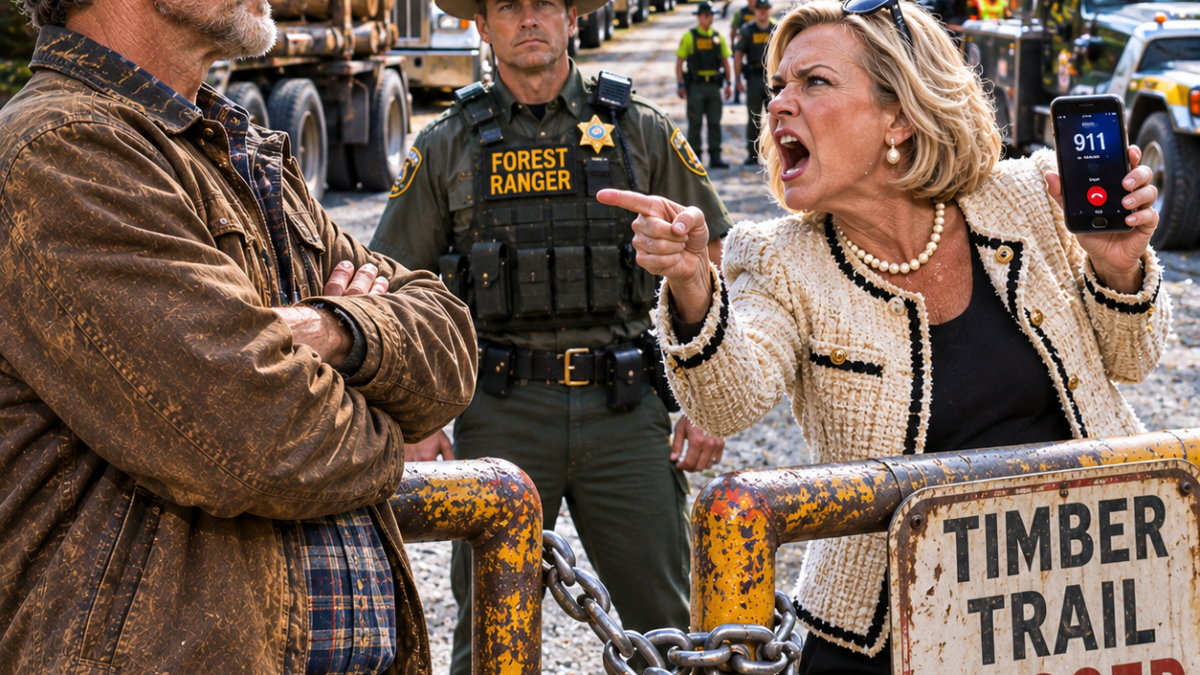
HOA Karen Called 911 When I Chained My Private Timber Road—By Nightfall, Rangers Had Impounded All 18 of Her Logging Trucks.
At 6:17 in the morning, Grant Hollis chained shut the private timber road his grandfather had cut through the mountain, and seconds later the HOA president called 911 claiming he had trapped an entire neighborhood—even though eighteen logging trucks were idling behind her waiting to cross a bridge an engineer had just declared unsafe.
She waved paperwork stamped EMERGENCY ACCESS and promised Grant would be in handcuffs before sunrise, but one working red gate a quarter mile away exposed the first lie—and the shipping tickets inside those trucks exposed something far bigger.
Before sunset, state forestry rangers would have all eighteen rigs tagged and impounded, investigators would find fresh stumps inside a protected drinking-water watershed, and the woman who had called 911 to force one private gate open would discover that she had accidentally opened the investigation that closed her entire operation.
Grant Hollis heard the first truck before he saw the headlights.
Diesel carried strangely in the mountains before sunrise.
Low frequencies traveled through timber and ravines, bounced off rock, and reached the house sounding larger than they were.
Grant stood beside the lower gate with a length of galvanized chain in his hands.
His breath hung pale in the October air.
Behind him, Timber Ridge Trail climbed into black Douglas fir.
Two-point-one miles.
Private.
Steep.
Older than the subdivision below it by nearly seventy years.
At 6:17 a.m., Grant pulled the chain through the steel gateposts.
He added the new padlock.
Clicked it shut.
Then stepped back.
The sound echoed once.
Small.
Metal against mountain.
That simple click would eventually cost one company its entire fleet.
At that moment, Grant only cared about the bridge.
Miller’s Cut sat halfway up Timber Ridge Trail.
A narrow ravine.
Thirty-five feet down at the deepest point.
His grandfather had first crossed it with a timber bridge in the late 1950s, back when loaded logging trucks were lighter and safety margins were often determined by whichever man owned the bulldozer.
Grant’s father rebuilt the crossing in 1986.
Steel girders.
Concrete abutments.
Heavy timber deck.
Grant reinforced it again eleven years earlier.
He knew every bolt.
Every drainage channel.
Every expansion joint.
For fifteen years before coming home to manage the Hollis property, Grant had inspected forest roads for the state.
He had walked bridges in snow.
Crawled culverts after floods.
Measured slope failures.
Closed haul roads while contractors screamed about schedules.
He understood one fact better than most people:
Roads rarely fail when everyone expects them to.
They fail after weeks or months of small damage people keep calling acceptable.
Miller’s Cut was no longer acceptable.
PART2:
Two days earlier, structural engineer Dale Whitaker had spent three hours beneath the bridge.
He used a crack gauge.
Hammer.
Flashlight.
Laser level.
Then he climbed out.
Removed his gloves.
And stopped talking.
Grant knew Dale well enough to recognize that as bad news.
“What?”
Dale looked back beneath the span.
“You’ve had heavy traffic.”
“Yes.”
“How heavy?”
“Don’t know.”
“Loaded rigs?”
“At night.”
“How many?”
“Enough that I can hear them from the house.”
Dale wiped dirt from his sleeve.
“Authorized?”
“No.”
That changed his expression.
He opened his notebook.
“The east abutment has a diagonal crack that wasn’t this wide in spring.”
“How much movement?”
“Enough.”
“Define enough.”
Dale looked him in the eye.
PART3:
“If a fully loaded log truck hits this bridge wrong, particularly braking or turning onto the deck, I cannot guarantee the abutment stays where it is.”
Grant went still.
“What happens if it moves?”
“The girder seat can shift.”
“And?”
Dale pointed toward the ravine.
“You know the answer.”
Yes.
Grant did.
Truck.
Trailer.
Logs.
Driver.
Thirty-five feet down.
Maybe worse if the load rolled.
Dale’s written report was even more direct:
NO HEAVY VEHICLE TRAFFIC UNTIL STRUCTURAL REPAIR.
Grant scanned it at his kitchen table that evening.
Then sent it to:
Summit Ridge HOA board.
County road department.
Sheriff’s non-emergency office.
Fire district.
He attached one paragraph:
Timber Ridge Trail will close to all heavy commercial traffic at first light tomorrow. Emergency personnel requiring access may contact me directly. The dedicated Summit Ridge emergency road remains open and unaffected.
No reply from the HOA.
Not one.
Grant assumed that meant they had finally understood.
He was wrong.
Less than thirty seconds after he locked the gate, headlights rounded the bend.
One set.
Then another.
Then six.
Then more.
Air brakes hissed.
Grant counted automatically.
Four.
Seven.
Eleven.
Fourteen.
Eighteen.
Logging trucks.
Every trailer empty.
Every cab pointed uphill.
A convoy.
Grant stared.
For six weeks, trucks had crossed the mountain at night.
Now they were here in daylight.
At his closed gate.
Right on schedule.
Then a white Range Rover pulled around the first truck and stopped ten feet from Grant.
The driver’s door opened.
Vivien Stroud stepped out.
Everyone in Cedar Basin knew Vivien.
Fifty-one.
President of the Summit Ridge Homeowners Association.
Sharp brown hair.
Tailored camel-colored coat.
Leather boots completely inappropriate for mud.
She carried a thick folder with EMERGENCY ACCESS printed in red across the cover.
Summit Ridge sat below Grant’s northern boundary.
Two hundred twelve expensive cedar-sided homes on what used to be the Palmer property.
Developers marketed it as “mountain living without mountain inconvenience.”
Grant found that phrase funny because mountain inconvenience was mostly what mountains were.
Snow.
Fire.
Mud.
Falling trees.
Closed passes.
Wildlife.
Gravity.
Summit Ridge residents generally kept to themselves.
Grant did too.
Vivien did not.
She walked directly toward him.
“Take that chain down.”
No good morning.
No question.
Grant nodded toward the trucks.
“What are those?”
“Contractors.”
“For?”
“Wildfire mitigation.”
“Where?”
“Upper Summit Ridge forest.”
Grant looked at the rigs.
“Through my road?”
“This is emergency access.”
“No.”
Her jaw tightened.
“Excuse me?”
“Timber Ridge is private.”
“It is a shared mountain access route.”
“It is not.”
“The HOA has authorization.”
“From who?”
Vivien lifted the folder.
“Multiple agencies.”
Grant held out his hand.
“Show me.”
She did not.
Instead:
“You have five minutes.”
“For what?”
“To remove the obstruction.”
“The bridge is closed to heavy vehicles.”
“The HOA’s safety project takes priority.”
Grant almost laughed.
“Safety project?”
“Yes.”
“You want to send eighteen logging trucks across a bridge an engineer says may fail.”
Vivien’s eyes narrowed.
“I don’t know anything about your bridge engineer.”
“I emailed you the report.”
“I receive hundreds of emails.”
“That’s not my problem.”
Vivien looked past him toward the mountain.
“Five minutes.”
Grant took his phone from his pocket.
Pressed record.
Set it against the windshield of his F-250.
Wide enough to capture the gate, Vivien, and the convoy.
Then he waited.
At minute five, Vivien took out her phone.
Dialed 911.
Her entire voice changed.
Grant had seen people do that before.
Calm one second.
Breathless the next.
“Please send officers immediately.”
She looked directly at Grant.
“Yes.”
“There is an armed—or potentially armed—landowner blocking the only emergency evacuation route out of Summit Ridge.”
Grant stared.
Armed?
He had no visible weapon.
Vivien continued.
“He has chained the mountain access closed during an active wildfire prevention operation.”
Pause.
“Yes.”
“Over two hundred homes could be trapped.”
Grant almost interrupted.
Didn’t.
Recording.
She continued building the emergency.
“Fire crews may need this road.”
“Logging crews are stranded.”
“He is refusing lawful access.”
She ended the call.
Then smiled.
“You should have opened it.”
Grant asked:
“Only evacuation route?”
“Yes.”
“You sure?”
“You heard me.”
“Interesting.”
Vivien frowned.
“What?”
Grant said nothing.
Behind her, one driver climbed down from his cab.
Older man.
Heavy coat.
He stretched his back.
Muttered to another driver:
“If we miss mill cutoff, penalties are gonna kill us.”
Vivien spun.
“Back in your trucks.”
The driver looked at her.
Then obeyed.
Grant remembered that sentence.
Mill cutoff.
Wildfire mitigation projects had schedules.
But eighteen trucks apparently had a commercial delivery deadline.
That was worth remembering.
Twenty minutes later, a sheriff’s cruiser climbed the county road.
Deputy Travis Barlow stepped out.
Thirty-five.
Broad shoulders.
Patient face.
He looked at eighteen trucks.
The gate.
Grant.
Vivien.
Then sighed the way deputies sigh when a call has already become worse than dispatch promised.
Vivien reached him first.
“Officer, arrest him.”
Travis blinked.
“Good morning to you too.”
“He is obstructing an emergency route.”
She handed him the folder.
“The entire Summit Ridge community is endangered.”
Travis opened it.
Top page:
EMERGENCY MOUNTAIN ACCESS AUTHORIZATION.
Seal.
Signature.
County formatting.
Lots of words.
Very little specific authority.
Grant waited.
Travis looked at him.
“Mr. Hollis?”
“Three things.”
Vivien interrupted.
“He doesn’t get to negotiate.”
Travis raised one hand.
“Ma’am.”
Then to Grant:
“What three things?”
Grant spoke calmly.
“Check whether Timber Ridge Trail is public.”
“Check whether any evacuation order, wildfire emergency, or agency request exists today.”
“And check the dedicated Summit Ridge emergency road.”
Vivien snapped:
“That road is irrelevant.”
Grant looked at Travis.
“That’s why you should check it.”
Travis walked back to his cruiser.
Radio.
Laptop.
Dispatch.
Minutes passed.
The logging engines idled.
Diesel smoke hung low.
Finally Travis returned.
“No wildfire.”
Vivien said:
“This is prevention.”
“No emergency declaration.”
“That doesn’t matter.”
“No evacuation order.”
“We’re preparing.”
“And Timber Ridge is not listed as county-maintained road.”
Grant nodded.
Vivien raised the folder.
“Authorization.”
Travis looked at her.
“What agency authorized commercial logging traffic over Mr. Hollis’s road?”
She paused.
“This is not commercial logging.”
Grant looked toward the eighteen log trucks.
Travis followed his eyes.
Then asked:
“What is it?”
“Hazard-tree removal.”
Grant said:
“Let’s check the second gate.”
Vivien’s face changed.
Slightly.
That was enough.
Grant drove a quarter mile down the county road.
Travis followed.
Vivien followed angrily.
The red gate sat exactly where it had for years.
SUMMIT RIDGE EMERGENCY ACCESS.
Knox-style emergency lockbox.
County-approved.
Gravel road beyond.
Wide.
Clear.
Maintained.
Travis took a key from his ring.
Opened the emergency box.
Gate unlocked.
He looked at Vivien.
“This works.”
She crossed her arms.
“It isn’t suitable for logging trucks.”
Grant nodded.
“Correct.”
“That’s not what you told 911,” Travis said.
Vivien’s face hardened.
“I said Timber Ridge was necessary for emergency operations.”
“You said it was the only evacuation route.”
“That was context.”
“No.”
Grant almost smiled.
Travis closed the red gate.
Locked it again.
Then said:
“I have no basis to arrest Mr. Hollis for closing commercial heavy traffic on a private road.”
Vivien stared.
“You’re making a serious mistake.”
Travis had probably heard that sentence thousands of times.
“I’ll survive.”
“If the HOA has an easement or contractual access right, talk to counsel.”
“We already have one.”
“Then use court.”
Vivien’s story changed immediately.
That interested Grant.
Now the convoy was not emergency evacuation support.
It was a state-approved hazard-tree project.
Every hour of delay, she said, cost the HOA money.
Grant asked:
“Harvest permit number?”
Vivien looked at him.
“What?”
“The state permit.”
“That information is confidential.”
Grant knew it wasn’t.
Any legitimate commercial timber operation could identify harvest authority.
Truck drivers carried documentation precisely because timber theft was real.
Travis told the convoy to clear the public shoulder.
Traffic hazard.
Drivers began starting rigs.
Then truck number seven’s driver leaned from the window.
“Hey, Miles!”
A man in a faded jacket walking beside the trucks stopped.
“What?”
“Why do we already have return tickets?”
Vivien turned instantly.
“Get moving.”
Grant heard.
Return tickets.
Completed-load paperwork for trucks that were still empty.
He walked toward number seven.
Not onto the road.
Just close enough to see the cab placard.
Yellow lot code.
W17.
Grant frowned.
No Hollis timber stand used that code.
He knew every compartment on his land.
At 9:00, Vivien launched the public-relations war.
Emergency HOA video meeting.
Homeowners.
Board.
Property manager.
She told them:
A hostile landowner had shut down a wildfire-defense project.
Millions of dollars at risk.
Insurance rates endangered.
Lives potentially endangered.
Grant’s phone began ringing.
Unknown numbers.
Emails.
One:
OPEN THE ROAD BEFORE SOMEONE DIES.
Another:
IF MY HOME BURNS, I WILL SUE YOU PERSONALLY.
Another:
YOU DON’T OWN THE MOUNTAIN.
That last one was technically funny.
Grant owned six hundred forty acres of it.
Vivien circulated a map.
Timber Ridge Trail appeared in thick black line like a public road.
Grant studied it.
Then called Lacey Whitcomb.
Forest surveyor.
Thirty-eight.
Licensed.
Mapped property and timber units throughout Cedar Basin.
She pulled county plats.
State forest boundaries.
Private parcels.
Then called back.
“The road is yours.”
“I know.”
“Entirely within Hollis parcel.”
“What’s wrong with Vivien’s map?”
“Could be just bad GIS.”
“Could be?”
“She’s using styling that makes private roads look like county routes.”
“Fraud?”
“Not enough to say.”
Lacey paused.
“One thing bothers me.”
“What?”
“Northern state forest line is missing.”
Grant looked toward the mountain.
“How much?”
“A large segment.”
“Meaning?”
“Maybe conversion error.”
“Maybe not.”
She added:
“Don’t accuse anyone yet.”
“I wasn’t.”
“You were thinking loudly.”
Grant smiled.
“Keep looking.”
A lawyer’s demand arrived before noon.
Remove chain.
Immediate access.
Grant liable for lost revenue.
Grant responded with Dale Whitaker’s structural report.
Then hired a second engineer.
Not because he doubted Dale.
Because independent corroboration matters when millions are involved.
Second report:
Same conclusion.
NO HEAVY TRUCKS.
Grant stood beside Miller’s Cut while the engineer packed equipment.
“What happens if they force the gate?”
“Call sheriff.”
“If they drive?”
“Get out of the way.”
“Bridge?”
The engineer looked at the cracked abutment.
“I wouldn’t stand below it.”
That settled any remaining doubt.
Grant started documenting the convoy.
License plates.
DOT numbers.
Cab markings.
Transport paperwork drivers voluntarily showed him.
Several drivers were frustrated enough to talk.
One handed over a ticket.
“Here.”
Grant read.
STRAUD RIDGE HAULING LLC.
His eyes stopped.
Straud.
Vivien Stroud.
Maybe coincidence.
Grant photographed it with permission.
Another driver had same company.
Another.
All eighteen.
He called a business-record search from his attorney.
Nothing obvious under Vivien’s personal name.
Layers.
Management company.
Registered agent.
Then one man approached Grant.
The same man called Miles earlier.
Miles Gentry.
Forty-nine.
Fleet dispatcher.
Twenty years in timber transportation.
He looked exhausted.
“I need to tell you something.”
Grant kept his phone visible.
“Then tell me.”
“Not on video.”
Grant stopped recording.
“What?”
“I don’t know why they insist on your road.”
“Shorter route.”
“Not by enough.”
Miles looked toward Vivien’s SUV.
“Every cleanup unit in the HOA project has easier public-road access.”
“Then why Timber Ridge?”
“That’s what I’m saying.”
“Who owns Stroud Ridge Hauling?”
Miles hesitated.
Grant waited.
“Vivien.”
“Directly?”
“Management company controlled by her.”
“Does the HOA know?”
“I don’t think so.”
Grant stared at the convoy.
“She hired herself?”
“Basically.”
“Drivers?”
“Leased equipment and employees.”
“What do you know about W17?”
Miles looked uncomfortable.
“Dispatch code.”
“For where?”
“I’m given coordinates.”
“Where?”
“North landing.”
Grant’s stomach tightened.
North of Summit Ridge lay state-managed forest.
Beyond that:
Protected watershed.
Commercial cutting tightly restricted.
Grant asked:
“Why are loaded-return tickets already printed?”
Miles rubbed his face.
“Vivien insists dispatch packets be completed early.”
“That normal?”
“No.”
“What’s the mill buying?”
“Douglas fir.”
“Hazard material?”
Miles laughed without humor.
“Some.”
“What does that mean?”
“Some logs are too clean.”
Grant understood.
Hazard removal often meant dead, diseased, dangerous, or strategically thinned timber.
High-grade green fir coming out in volume was different.
Miles said:
“I don’t want to be part of whatever this is.”
“Then document what you know.”
Grant drove to Summit Ridge.
Nora Bellamy, HOA treasurer, answered her door reluctantly.
Fifty-seven.
Nine years on board.
She looked past Grant toward the street before letting him in.
“Vivien can’t know I talked.”
“Why?”
Nora almost laughed.
“You’ve met her.”
Grant placed Dale’s bridge report on the table.
Nora read.
Her face changed.
“She knows about this?”
“Emailed whole board.”
“I never received it.”
Grant looked at her.
“Check spam.”
She opened laptop.
Nothing.
Then board portal.
Vivien had administrative control.
Several communications had not been distributed.
Nora swallowed.
“What do you need?”
“Who pays Stroud Ridge Hauling?”
Her fingers stopped.
“What?”
“Search.”
She logged into accounting software she was legally authorized to access.
Invoices appeared.
Dozens.
Straud Ridge Hauling.
Transport.
Equipment mobilization.
Hazard timber hauling.
Fuel surcharges.
Special project access.
Amounts.
Thousands.
Tens of thousands.
Nora whispered:
“Oh my God.”
“How much?”
She totaled.
Then looked at Grant.
“Hundreds of thousands.”
“Project total?”
“Special assessment was nine hundred forty thousand.”
“For wildfire mitigation?”
“Yes.”
“Competitive bid?”
“Yes.”
“Show me.”
Nora opened the board packet.
One bid.
Stroud Ridge Hauling.
Submitted two days before homeowners were even notified the project would exist.
Grant leaned back.
“Vivien owns it.”
Nora’s face went blank.
“No.”
“Miles says yes.”
“No.”
Grant showed public registration chain.
Management firm.
Beneficial connection.
Nora covered her mouth.
Then she found another set of records.
Payments from timber mill.
Not HOA accounts.
But contract references.
Vivien’s company was paid by the HOA to remove trees.
Then paid by a mill for timber.
Potentially legitimate if disclosed and contractually approved.
But nobody had disclosed it.
Worse:
Some transport charges appeared on HOA invoices and mill settlement sheets.
Same trip.
Paid twice.
Nora whispered:
“She’s charging us to haul logs she’s selling.”
Grant said:
“Maybe.”
He was careful.
“Don’t conclude more than records show.”
Nora looked at him.
“You’re defending her?”
“No.”
“I’m defending accuracy.”
That mattered.
The next thing Nora found was worse.
She had only been in the accounting system forty minutes when her screen locked.
SESSION TERMINATED.
Then email:
TREASURER ACCESS SUSPENDED PENDING BOARD REVIEW.
Nora stared.
“She knows.”
Vivien called an emergency board vote to remove her.
Too late.
Nora had already downloaded reconciliations she was authorized to obtain.
Not secret hacking.
Not stolen records.
Her own treasurer access.
Grant left with copies only after his attorney advised proper preservation.
Then Lacey called.
“W17.”
“What about it?”
“It appears on a transport ticket?”
“Yes.”
“That’s not Summit Ridge.”
“Where?”
“Protected watershed compartment.”
Grant went cold.
“How protected?”
“Very.”
The watershed supplied drinking water downstream to three communities.
Logging there required separate state approvals.
Buffers.
Sediment controls.
Specific compartments.
Grant called Reed Talbot.
State forestry enforcement ranger.
Forty-six.
Former timber cruiser.
Knew every scam from false load tickets to night harvests.
Grant did not accuse Vivien.
He put documents on Reed’s tailgate.
“Tell me if these codes mean anything.”
Reed saw W17.
Set his coffee down.
“Where did you get this?”
“Truck driver.”
“Lawfully?”
“Yes.”
“Photograph?”
“Yes.”
Reed looked at Grant.
“This compartment should not be leaving ordinary mill loads.”
“Why?”
“Protected watershed.”
Grant felt the case shift.
Again.
This was no longer private-road harassment.
No longer only undisclosed HOA conflict.
Possible state timber theft.
Grant and Lacey compared maps.
Satellite imagery.
Public terrain data.
Historical forestry roads.
A new haul route appeared north of Summit Ridge.
Fresh.
Cut within a month.
Hidden behind ridge.
Connected HOA project area to a remote landing.
Reed organized field inspection within his authority.
Grant accompanied only where permitted as landowner/witness.
Fresh stumps appeared near the watershed boundary.
Pale sawdust.
Sticky sap.
Recent.
Boundary paint on standing trees had been covered with a slightly different color.
Too fresh.
On several stumps, state inventory markings remained near bark.
Reed photographed everything.
Then they reached a creek.
Skid trail went straight through.
Banks collapsed.
Mud pushed into water.
Reed crouched.
Touched sediment.
His expression changed.
“This feeds the watershed.”
Grant said nothing.
Reed looked uphill.
“How many trucks?”
“Eighteen today.”
“How many weeks?”
“Night traffic for six.”
Reed stood.
“Do not tell Vivien what we found.”
Grant nodded.
Meanwhile, Vivien tried to physically open Grant’s gate.
She hired heavy recovery contractors.
Tow-style equipment.
Cutting tools.
Grant met them with:
Property documentation.
Two engineering reports.
Deputy Barlow.
Recovery foreman read the report.
Then looked at Vivien.
“Do you have a court order?”
“We have emergency authority.”
“That a court order?”
“No.”
“Then I’m not cutting a private lock.”
“We’ll indemnify you.”
“No.”
The man turned to his crew.
“Pack it.”
Vivien stared as another tool of pressure failed.
Then she made the decision that destroyed her operation.
“Reroute.”
She ordered Miles to send all eighteen trucks east.
State highway corridor.
Longer.
Public.
Grant looked at the map.
Then froze.
The eastern route passed through a state timber-transport checkpoint.
Every commercial load had to present paperwork.
Harvest origin.
Ticket number.
Destination.
Permit references.
Grant called Reed.
“Vivien’s rerouting east.”
Silence.
Then:
“Every truck?”
“All eighteen.”
“Route 14?”
“Yes.”
Reed almost sounded amused.
“Interesting.”
At 2:10, Lacey finished survey-grade verification.
Illegal stumps.
Inside protected zone.
Not inches.
Not ambiguous.
Deep enough that mapping error could not explain it.
Then she compared Vivien’s project maps.
Boundary lines had been selectively shifted north.
Not overall distortion.
Specific movement.
Useful movement.
Protected timber appeared inside authorized HOA project area.
Reed’s conclusion hardened.
Someone had altered mapping to disguise harvest origin.
Then Grant finally understood the obsession with Timber Ridge Trail.
It was not simply shorter.
It bypassed checkpoint.
A truck could leave the hidden landing.
Cross Grant’s private road.
Reach county highway.
Go directly toward mill.
No state timber station.
No one asking why W17 logs appeared under Summit Ridge codes.
Grant’s locked chain had not delayed a wildfire project.
It had blocked a laundering route for timber.
Witnesses began cooperating.
Nora provided financial records through proper counsel.
Miles provided dispatch information after investigators issued lawful requests.
Fleet GPS history showed night runs.
Over and over.
North landing.
Watershed edge.
Timber Ridge.
Mill.
Vivien still thought Grant was merely escalating a road dispute.
She texted him:
OPEN THAT GATE OR I’LL MAKE SURE YOU PAY FOR EVERY TRUCK.
Grant read it twice.
Then replied:
YOU TOLD 911 THIS WAS AN EMERGENCY. NOW THE STATE IS CHECKING WHAT THE EMERGENCY REALLY WAS.
No answer.
At 4:30, Miles called Grant.
“She wants trucks moved.”
“Where?”
“Private yard across county line.”
“Loaded?”
“Some are staging.”
“Paperwork?”
“She said she’ll fix it later.”
Grant’s stomach tightened.
“Did she ask you to change tickets?”
“Yes.”
“Did you?”
“No.”
Vivien threatened Miles.
Termination.
Lawsuit.
Personal liability.
He refused.
Then called Reed directly.
Grant did not park his truck across any road.
Did not chase convoy.
Did not create a showdown.
He gave state investigators information.
Current route.
License plates.
Photos.
Ticket codes.
Times.
Everything dated.
Verifiable.
Reed and forestry officers established lawful inspection at state checkpoint.
As trucks arrived, paperwork failed almost immediately.
One ticket number appeared on two vehicles.
Then three.
Harvest codes did not match state records.
Coordinates inconsistent.
Loads attributed to HOA compartments where no matching volume had been cut.
GPS history connected same trucks to protected area.
Probable cause strengthened.
Warrant process moved.
Vivien arrived at 4:56.
White Range Rover.
She marched toward Reed.
“These trucks are performing HOA-authorized wildfire mitigation.”
Reed said:
“HOA authorization does not permit state timber harvest.”
“They are carrying hazard trees.”
“Show origin documentation.”
She opened folder.
Flipped.
“Everything is here.”
“Permit matching coordinates.”
She flipped again.
“Commercial contract.”
“No.”
“Harvest authority.”
Silence.
“Compartment authorization.”
Silence.
“Load-specific ticket.”
She looked toward trucks.
“This is harassment.”
Reed waited.
Vivien tried Grant.
“This is because of him.”
Reed said:
“No.”
“If he had opened his gate—”
“These trucks still need lawful timber paperwork.”
She stopped.
That was the moment she realized the route had never been the legal issue.
At 6:03, warrants came through.
Vehicle detention.
Search.
Records preservation.
One by one, forestry officers tagged trucks.
Truck 1.
Truck 2.
Truck 3.
Engines off.
Drivers out.
Trailer secured.
Truck 7.
Truck 11.
Truck 15.
Vivien stood beside her Range Rover.
The sun sank.
Diesel smell.
Fresh fir.
Rangers photographing.
Serial numbers.
DOT registrations.
Load documents.
By 6:20, eighteen rigs lined the checkpoint.
Silent.
Vivien shouted:
“You cannot take these!”
Reed continued.
“They belong to the HOA!”
Nora’s later records would prove that false too.
Most were leased or controlled by Stroud Ridge Hauling.
Vivien’s private company.
Grant stood near his pickup.
Not celebrating.
One truck driver approached Reed.
Then another.
A younger man said:
“We’ve been sent to places not on the contract.”
Miles handed dispatch schedules over.
He looked at Vivien.
She said:
“Miles.”
He stopped.
“Tell them this was all approved.”
Miles stared at her.
“No.”
One word.
That was all.
Vivien’s face changed.
She had spent months controlling information.
Suddenly every person around her had information she could not control.
Deputy Barlow arrived to assist with order.
The same deputy from 6:40 that morning.
Vivien ran toward him.
“Stop them.”
Travis looked at the row.
“This is state forestry jurisdiction.”
“You know what he did.”
She pointed at Grant.
“He blocked emergency access.”
Travis’s expression hardened.
“I also know the emergency gate was open.”
“You’re taking his side.”
“I’m taking the report I saw.”
Vivien looked around.
No ally.
Drivers cooperating.
Rangers working.
Miles talking.
Grant quiet.
Nora not there, but her records already moving.
Vivien exploded.
“You destroyed my business!”
Grant let her finish.
Then:
“You called 911 because I wouldn’t open one gate.”
He pointed toward the fleet.
“Now the state has closed every route those trucks needed.”
The eighteenth truck left on a recovery tractor shortly after 8:00.
All eighteen impounded or detained under investigation.
Not forfeited.
Not yet.
Seizure is not guilt.
Grant understood that.
Most drivers were treated as witnesses.
They had followed dispatch.
Some had asked questions.
Some had not.
An older driver waited beside Grant for a ride home.
“I crossed Miller’s Cut three times last week.”
Grant looked at him.
“Loaded?”
“Yes.”
“How’d it feel?”
The man stared at the road.
“Bad.”
“What does bad mean?”
“Deck moved.”
Grant’s stomach tightened.
“I thought it was just old.”
The driver looked toward him.
“Thanks for the chain.”
That mattered more than the trucks.
Grant had started the morning trying to keep someone from dying.
Everything else came afterward.
Then Nora called.
“Grant.”
“What?”
“She’s moving money.”
“Whose?”
“HOA reserves.”
“How much?”
“All available.”
“For?”
“Legal fees.”
“Truck guarantees.”
“Stroud Ridge.”
Grant closed his eyes.
“Can she?”
“She still has president authority tonight.”
“Get counsel.”
“I did.”
“Board?”
“Two members will object.”
“Do it by bylaws.”
Grant did not control Summit Ridge.
He refused to pretend he did.
Nora and two board members filed emergency objection.
Association counsel froze discretionary transfers until board review.
That night, Nora found something else.
Insurance addendum.
Date:
Same day as 911 call.
Coverage for losses caused by third-party obstruction of authorized transport.
Projected claim:
$1.6 million.
Third party:
GRANT HOLLIS.
Nora stared at the page.
Then called Grant.
“I think the 911 call was part of the plan.”
Grant sat at his kitchen table.
“What?”
“She had an insurance endorsement.”
“For?”
“Transport interruption.”
He went cold.
Nora read.
Vivien intended to claim Grant caused commercial losses by wrongfully obstructing an authorized wildfire operation.
The photos were perfect.
Eighteen trucks lined behind private gate.
Chain.
911 incident number.
Her recorded emergency statement.
If Grant opened gate:
Suspected stolen timber moved through uninspected route.
If he refused:
She created evidence for a $1.6 million insurance claim.
Two exits.
Both designed to pay her.
Grant sat in silence.
“She picked me.”
“Yes.”
“Before today.”
“Yes.”
“How long?”
“Addendum prepared earlier this week.”
Vivien had not simply reacted to the chain.
She expected it.
Maybe even hoped for it.
Grant’s refusal was part of the model.
That explained why eighteen trucks arrived together.
Why she called 911 immediately.
Why she used emergency language.
Why she wanted photographs.
Why she insisted Grant was obstructing operations.
She was building a record.
Unfortunately for Vivien, Grant had built one too.
His phone recording from 6:17 onward showed:
Her claiming Timber Ridge was the only evacuation route.
Then acknowledging the separate emergency gate.
Grant explaining bridge danger.
The engineering report visible.
No emergency declaration.
Drivers discussing mill delivery deadlines.
Vivien changing story from evacuation to hazard-tree contract.
It was devastating to the insurance narrative.
Grant’s attorney submitted everything through proper insurer channels.
Bridge reports.
Video.
Forestry seizure records.
County emergency confirmation.
The $1.6 million claim never paid.
Instead, insurer referred the matter for fraud review.
Three days later, Summit Ridge clubhouse was packed.
Vivien still controlled the microphone.
For a few minutes.
She stood at front.
“You are at risk of losing nearly one million dollars.”
Residents murmured.
“If I am removed tonight, nobody will understand these contracts well enough to protect the association.”
That sentence sounded familiar to Nora.
Dependency.
Only I can fix what only I understand.
Grant sat in the back.
He had been invited.
Almost did not come.
Then association counsel asked him to present documented facts.
Three minutes.
That was all.
Grant stood.
Did not attack Vivien.
Did not mention prison.
Did not say Karen.
Did not gloat over trucks.
He said:
“My trail is private.”
“The bridge was unsafe.”
“The dedicated emergency route was open.”
“State investigators—not me—determined the timber origin required investigation.”
“Your association should separate its legitimate wildfire responsibilities from any private business interests of individual board members.”
Then he sat.
Nora stood.
She had numbers.
Those were harder to argue with.
$940,000 special assessment.
Single bid.
Submitted before project announcement.
Payments to Stroud Ridge Hauling.
Company ownership.
Duplicate transport billing.
Mill revenue.
Insurance addendum.
Attempted reserve transfer.
A retired teacher raised her hand.
“Vivien.”
“Yes?”
“Do you own Stroud Ridge Hauling?”
Silence.
Not long.
One second.
Maybe two.
Enough.
“Through a management entity.”
The room erupted.
“You own it?”
“It is a related company.”
“You charged us?”
“The project required specialized—”
“You hired yourself?”
“No.”
“You sold our timber?”
“It was part of cost recovery.”
“Then why were our assessments so high?”
Vivien raised her voice.
“You people have no idea how complicated this is.”
Wrong sentence.
The crowd shifted.
A contractor named Wade Kessler had emailed Grant threats that morning.
Now he walked to the back.
Held out his hand.
“I’m sorry.”
Grant shook it.
“Read records before sending death threats next time.”
Wade winced.
“It wasn’t a death threat.”
“You said you’d bury me under Miller’s Cut.”
“Figure of speech.”
Grant stared.
“Bad figure.”
Wade nodded.
“Fair.”
Ballots passed.
Vote not close.
Vivien removed as president.
Nora reinstated treasurer.
Independent audit authorized.
Legal action to recover misused funds.
Vivien walked out.
She thought losing office was the disaster.
It wasn’t.
Truck leases were personally guaranteed.
Not by HOA.
By Vivien.
Month after month, payments continued.
Fleet unusable.
Contracts frozen.
Investigation ongoing.
Forestry teams completed full survey.
Illegal harvest confirmed beyond permitted zone.
Protected watershed damage.
Restoration required.
Sediment remediation.
Replanting.
Potential penalties.
Timber values calculated.
Transport records cross-checked.
Some trucks eventually returned to leasing entities.
Others stayed tied up longer.
Seizure was not automatic forfeiture.
Grant understood due process.
He wanted truth, not theater.
Stroud Ridge Hauling, however, effectively stopped operating.
No fleet.
No clean paperwork.
No trusted dispatcher.
No HOA contract.
No easy mill sales.
Vivien faced private debts she had tried to hide behind community authority.
Nora rebuilt the HOA books line by line.
Every homeowner received quarterly accounting.
For first time in years, they could see where money went.
Miles found work with another timber company.
Owner told him:
“I want a dispatcher willing to say no.”
Lacey was contracted to resurvey watershed boundary.
She added permanent monument documentation.
Reed supervised restoration enforcement.
Grant returned to Miller’s Cut.
The bridge was rebuilt.
East abutment removed.
New reinforced concrete.
Girder seats repaired.
Bolts replaced.
Approach stabilized.
Engineered load rating posted.
The work cost Grant money.
He did not bill Summit Ridge families for it.
Some had demanded he open the road.
Some threatened him.
But they did not crack the bridge.
Unauthorized truck traffic contributed.
Liability became part of separate claims.
Grant let lawyers handle it.
He focused on mountain.
That winter, Summit Ridge hired a genuinely independent wildfire consultant.
No related companies.
No hidden timber contracts.
No exaggerated logging plan.
The consultant recommended:
Defensible-space work around homes.
Selective thinning.
Deadwood removal.
Fuel breaks.
Limited mechanical treatment.
No cutting inside watershed.
No eighteen-truck convoy.
The project cost far less than Vivien’s.
Funny how safety gets cheaper when nobody is secretly trying to sell protected timber.
The homeowners also asked Grant about emergency access.
This time:
Asked.
That mattered.
Their red emergency road already worked.
But fire officials wanted redundancy in case landslide or wildfire blocked one route.
Grant agreed to a narrow recorded emergency easement over a secondary rescue track on his land.
Strict language.
Fire.
Ambulance.
Sheriff.
Declared evacuation.
No commercial hauling.
No timber transport.
No construction convoy.
No HOA convenience access.
Emergency keys controlled by agencies.
The new board agreed immediately.
Grant signed.
One resident asked:
“Why help us after what happened?”
Grant answered:
“Because emergency access was never the problem.”
Vivien had used safety language as disguise.
Grant refused to let her abuse make real safety harder.
That distinction mattered.
Months later, Vivien returned to Timber Ridge.
Cold morning.
Bridge complete.
New gate.
New sign:
PRIVATE TIMBER ROAD
NO COMMERCIAL LOGGING ACCESS
EMERGENCY ENTRY BY AUTHORIZED AGENCIES ONLY
Grant was clearing a branch from ditch.
White SUV approached.
Not Range Rover anymore.
Older crossover.
Vivien stepped out.
No tailored coat.
No folder.
She looked tired.
Grant kept working.
“Grant.”
He stopped.
“Vivien.”
She looked at the sign.
“Happy?”
“About?”
“My company.”
“No.”
“You destroyed it.”
“No.”
“If you had opened this gate—”
“The bridge might have failed.”
“It didn’t.”
“Because I closed it.”
She looked away.
“My trucks were seized.”
“By state.”
“You called them.”
“I asked if your load codes matched lawful harvest.”
“You knew what would happen.”
“I did not.”
That was true.
Vivien stepped closer.
“You enjoyed it.”
Grant thought.
“Parts.”
She laughed bitterly.
“At least you admit it.”
“I enjoyed watching lies stop working.”
Her face hardened.
“My business is gone.”
Grant looked past her toward firs.
“I never wanted your trucks.”
“What did you want?”
“My road left alone.”
Silence.
Then Grant told her about the new conservation agreement.
After the scandal, Summit Ridge homeowners had voted to support permanent protection of forest bordering watershed.
Harvest limits.
Surveyed boundaries.
Independent oversight.
Fire work allowed under conservation standards.
No commercial clear-cut conversion.
The timber Vivien had planned to turn into profit now sat under stronger protection.
She stared uphill.
“All because of me?”
Grant shook his head.
“No.”
“Because people learned.”
That landed harder.
Vivien stood several seconds.
Then returned to car.
No apology.
No threat.
Drove away.
Grant watched until taillights disappeared.
Then closed gate.
Click.
Same sound as morning everything began.
Small.
Metal.
Final.
Years later, residents still told the story as:
The day Grant trapped eighteen logging trucks.
He corrected them when he had patience.
“I didn’t trap them.”
He closed private unsafe road.
Vivien brought trucks.
State found timber.
Forestry detained vehicles.
Details matter.
Especially when somebody tries to turn fact into story.
Grant had learned that from Vivien.
She could turn:
private road
into emergency evacuation route.
commercial convoy
into wildfire rescue.
logging profit
into community safety.
private company
into HOA contractor.
stolen timber
into hazard removal.
insurance setup
into obstruction damages.
Words were tools.
So were maps.
So were seals.
So were 911 calls.
None of them became truth simply because someone spoke confidently.
One spring, Grant took a group of Summit Ridge teenagers through restoration area.
State forestry education program.
They saw replanted slopes.
Creek stabilization.
Protected buffers.
One boy pointed at old skid trail.
“Why did they drive through creek?”
Grant answered:
“Shorter.”
“That’s it?”
“Yes.”
“But it damaged water.”
“Yes.”
“That’s stupid.”
Grant smiled.
“Most expensive mistakes start with somebody deciding the shortcut matters more than the rule.”
The boy nodded.
Then asked:
“Why did you close your gate?”
“Bridge.”
“Not because HOA?”
“No.”
“If bridge was safe, would you have let them through?”
Grant thought.
“Not without permission.”
The kid laughed.
“Fair.”
Later, Reed Talbot walked beside Grant.
“You know you saved a driver.”
Grant looked over.
“Maybe.”
“No.”
Reed had final engineering analysis.
Truck weight estimates.
Bridge condition.
Probability not exact.
But risk real.
One loaded rig braking on east approach could have caused failure.
“Don’t overstate,” Grant said.
Reed smiled.
“You still inspector?”
“Always.”
“Fine.”
“You may have saved a driver.”
Grant accepted that.
Maybe.
That was enough.
The 911 recording eventually became evidence in insurance dispute.
Vivien’s voice:
ONLY EVACUATION ROUTE.
Then Grant’s video:
SECOND GATE OPEN.
No fire.
No evacuation.
No emergency declaration.
Those contradictions mattered.
But one detail bothered Grant more.
The insurance addendum was prepared before the call.
He had been selected.
Not randomly.
Vivien needed an obstruction.
She expected Grant to object to eighteen trucks.
She turned his predictable protection of private land into business model.
If he opened:
timber moved.
If he refused:
claim paid.
That idea stayed with him.
People often think scams depend on victims being foolish.
Not always.
Some scams depend on victims behaving exactly as a reasonable person would.
Grant saw unsafe traffic.
Closed road.
Vivien counted on it.
What she failed to count on was documentation.
Engineers.
Second emergency gate.
Video.
Truck tickets.
Surveyor.
Treasurer.
Dispatcher.
Ranger.
Every lie required someone else not looking.
Too many people eventually looked.
That is why big schemes collapse.
Not because one person is heroic.
Because truth becomes distributed.
Grant had bridge report.
Lacey had maps.
Nora had money.
Miles had routes.
Drivers had tickets.
Reed had timber law.
Deputy had 911 call.
Insurer had claim.
No single piece was enough.
Together:
Pattern.
The new Summit Ridge board learned same lesson.
Transparency.
Multiple signatures.
Independent bids.
Conflict disclosures.
No board member could contract with company they controlled without full membership disclosure and independent review.
Fire plans published.
Timber revenues separately accounted.
Insurance riders reviewed.
Emergency routes clearly mapped.
Boring rules.
Good rules are often boring.
Vivien had preferred exciting ones.
Emergency.
Crisis.
Immediate.
No time.
Open gate.
Trust me.
Urgency is powerful because it prevents questions.
Grant learned to ask anyway.
One winter storm, real emergency came.
Heavy snow.
Tree blocked red access road.
Ambulance needed reach Summit Ridge resident with chest pain.
County dispatch called Grant at 2:13 a.m.
“Need secondary emergency easement.”
Grant was already dressing.
He drove rescue track.
Unlocked gate before ambulance arrived.
No argument.
No folder.
No HOA president.
Just actual emergency.
Lights flashed through snow.
Ambulance passed.
Fire engine behind.
Grant closed gate afterward.
Two days later, resident’s wife brought him bread.
“You saved him.”
Grant shook head.
“Paramedics did.”
“You opened road.”
“That’s what emergency gate is for.”
She cried.
Grant hated when people cried.
Accepted bread anyway.
That night he thought about Vivien.
Real emergency was quiet.
Dispatcher.
Clear request.
Known route.
Authorized people.
No threats.
No profit.
No eighteen trucks.
The contrast was almost insulting.
Miller’s Cut bridge aged.
Grant inspected yearly.
Dale retired.
New engineer took over.
Road stayed private.
Timber harvests on Hollis land continued periodically.
Legal ones.
Marked units.
Permits where required.
Tickets matching loads.
Drivers stopping at checkpoint.
Grant was not anti-logging.
His family had logged mountain for generations.
Selective harvest paid taxes.
Maintained roads.
Supported forest health when done correctly.
That made Vivien’s scheme more offensive, not less.
She wrapped theft in language of forestry.
Good forestry takes patience.
Boundaries.
Water.
Slope.
Regeneration.
Habitat.
Fire risk.
Market value.
All balanced.
Vivien saw only logs.
One time a reporter asked Grant whether he considered himself environmental activist now.
He laughed.
“No.”
“What are you?”
“Landowner.”
“Forester?”
“Sometimes.”
“Conservationist?”
“When necessary.”
“Logger?”
“When appropriate.”
Reporter frowned.
“What does that mean?”
“It means land isn’t a slogan.”
That quote appeared in paper.
Grant regretted saying anything quotable.
He framed it anyway.
Nora remained treasurer for one more term.
Then resigned voluntarily.
Her final financial report ran seventy-eight pages.
Grant joked:
“Trying to kill them with transparency?”
She smiled.
“Working.”
Summit Ridge finances stabilized.
Some assessment money recovered through litigation.
Some not.
Families paid consequences.
Grant felt no satisfaction in that.
They had trusted president.
Some too easily.
But trust alone should not equal financial punishment.
Association pursued Vivien’s company and insurers where legally appropriate.
Courts sorted responsibility.
Not Facebook.
Not revenge.
Slow.
Imperfect.
Better.
Miles visited Grant once after everything ended.
New company truck.
Different logo.
“Boss wants to buy timber from you next winter.”
“Licensed?”
Miles smiled.
“Yes.”
“Tickets?”
“Yes.”
“Checkpoint?”
“Yes.”
“Insurance?”
“Yes.”
“Conflict of interest?”
“I hate you.”
Grant laughed.
“Send bid.”
Miles did.
Competitive.
Clean.
Grant hired them.
First load crossed rebuilt Miller’s Cut.
Grant stood beside bridge.
Truck rolled slowly.
Legal load.
Proper route.
Engineer-rated.
Driver waved.
Grant felt something loosen.
Road was not cursed.
Trucks were not enemy.
Abuse was problem.
That distinction matters too.
Years later, yellowed copy of Dale’s original closure report sat framed in Grant’s office.
Not because bridge report was beautiful.
Because it reminded him where everything began.
NO HEAVY VEHICLES.
Simple.
Vivien tried to turn that sentence into:
Grant Hollis endangers neighborhood.
State ultimately turned her convoy into:
Potential evidence.
The transformation came from facts.
Not louder voices.
At 6:17 that first morning, Grant had no idea about W17.
No idea about watershed.
No idea about Stroud Ridge ownership.
No idea about double billing.
No idea about $1.6 million insurance plan.
He knew one thing:
Bridge could fail.
So he closed gate.
Sometimes doing one small correct thing exposes every larger wrong built around expectation that you won’t.
Vivien counted on everyone accepting urgency.
Grant did not.
She counted on deputy accepting folder.
He checked second gate.
She counted on homeowners accepting map.
Lacey checked records.
She counted on Nora accepting invoices.
Nora opened books.
She counted on drivers following dispatch.
Miles finally said no.
She counted on checkpoint being avoided.
Grant’s chain forced detour.
She counted on insurer accepting 911 narrative.
Video contradicted it.
At every step, somebody asked one more question.
Schemes hate second questions.
Grant still walked Timber Ridge at sunrise.
Wind through firs.
Creek below Miller’s Cut.
No convoy.
No Range Rover.
Sometimes he stopped beside lower gate.
New chain now.
Same steel posts.
Sign weathered.
PRIVATE TIMBER ROAD.
He thought about Vivien calling 911.
Her confidence.
“Watch how fast your private road becomes public.”
He smiled every time.
Because road never became public.
Bridge got repaired.
Emergency route got protected.
Forest got restored.
Watershed remained.
And eighteen trucks that had been waiting for his chain to disappear ended that same day behind state fencing instead.
Not because Grant was powerful.
Not because he trapped anyone.
Not because he outsmarted whole HOA.
Because one private landowner listened to an engineer.
Locked a gate.
Then refused to let somebody else’s emergency become more real than the facts.
Vivien Stroud called 911 believing authority would force his road open.
Instead, the call created a timestamp.
The convoy created evidence.
The reroute created inspection.
The inspection exposed the timber.
The timber exposed the company.
The company exposed the money.
The money exposed the insurance claim.
And by the time the eighteenth truck rolled into state impound, the truth had traveled farther than any load she had managed to sneak down the mountain.
Grant closed the gate at dusk.
The padlock clicked.
Wind moved through Douglas fir.
Below, Miller’s Cut carried clean water through the ravine.
No engines.
No sirens.
No threats.
Just forest.
Exactly what the gate had been protecting in the first place.








