HOA Karen Called 911 to Have Me Arrested for Removing Her Fence—Then the Sheriff Discovered Her $2M Pool Was Built on My Land
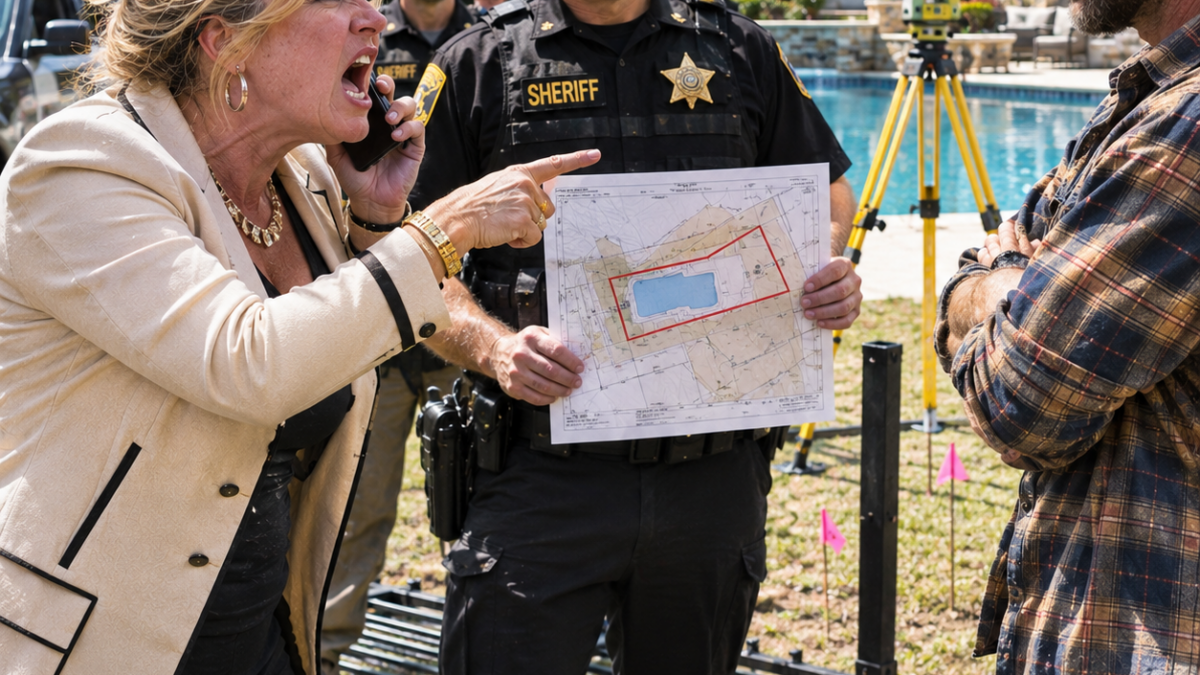
HOA Karen Called 911 to Have Me Arrested for Removing Her Fence—Then the Sheriff Discovered Her $2M Pool Was Built on My Land.
At 8:17 on a cold Tuesday morning, I removed the first section of an HOA fence that had been built across my land, and ninety seconds later the HOA president was screaming into 911 that I was destroying a multimillion-dollar community facility and needed to be arrested.
When the sheriff arrived, she proudly handed him the site plan for her new $2 million resort-style pool—until my licensed surveyor placed the recorded deed beside it and showed him that the pool, spa, patio, equipment room, and nearly an acre of landscaping were sitting on property the HOA had never owned.
What Darlene Ror did not know was that the survey was only the first problem, because buried inside the permit file was a missing boundary warning, a land-use agreement bearing a signature I had never written, and an email proving she had known exactly whose land she was building on before the first concrete truck ever arrived.
The first fence panel hit the gravel at 8:17 in the morning.
The sound was louder than I expected.
Eight feet of ornamental black metal tipped away from the concrete footing and struck the ground with a metallic crash that carried through the evergreens and bounced off the back wall of the Brierstone Reserve management building.
I looked at my watch.
8:17.
Beside me, Audrey Fenwick didn’t flinch.
She was thirty-nine, a licensed land surveyor with more than fifteen years in the field, and she had already spent three days proving exactly where my property ended and Brierstone Reserve began.
Her tripod stood twenty feet behind us.
Three orange stakes marked the boundary.
A two-person survey crew was checking coordinates.
And fifteen feet away, a videographer named Matt Kellerman was recording everything.
That last part had been my attorney’s idea.
“If she calls the police,” Marin had told me, “I want a camera running before she starts talking.”
At the time, I thought that sounded excessive.
Then the second panel came loose.
And Darlene Ror came running.
I heard her before I saw her.
“What are you doing?”
Audrey looked at me.
I kept working.
The second panel was held by modular brackets.
Exactly like the first.
Nothing was welded.
Nothing I touched extended across the surveyed boundary.
Every bolt I removed was standing on my parcel.
That mattered.
Everything mattered.
Darlene appeared from behind the management building at something close to a sprint.
She was fifty-one, wearing a cream-colored coat, black slacks, expensive boots, and the laminated HOA access lanyard she seemed to treat like a federal badge.
Behind her came two maintenance employees and an assistant manager.
“What the hell do you think you’re doing?”
PART2:
I set the panel down.
“Removing your fence from my land.”
Her face changed.
Not confusion.
Not surprise.
Outrage.
“This is HOA property.”
“The fence?”
“Yes.”
“Then you probably should’ve installed it on HOA land.”
Audrey looked down to hide what might have been a smile.
Darlene pointed at me.
“You put that back.”
“No.”
“You are damaging community property.”
“No. I’m removing three modular fence sections located entirely inside my parcel.”
“You have no authority to touch that fence.”
I nodded toward the orange stakes.
“My surveyor disagrees.”
Darlene finally noticed Audrey.
“Who are you?”
“Audrey Fenwick.”
“And?”
“Licensed land surveyor.”
Darlene’s eyes dropped to the equipment.
Then the stakes.
PART3:
Something passed through her expression.
Fast.
Recognition.
Not of Audrey.
Of the stakes.
She knew what they meant.
That was the first moment I became certain she understood more than she had admitted during the previous six weeks.
She recovered quickly.
“You people need to leave.”
Audrey said:
“We’re standing on Mr. Sutter’s property.”
“This is Brierstone Reserve.”
“No,” I said. “That’s exactly the problem.”
Darlene pulled out her phone.
“I’m calling the police.”
I picked up the third panel.
“Go ahead.”
She stared.
“You think I’m bluffing?”
“No.”
“I’m calling 911.”
“Then tell them where you built the fence.”
Her thumb hit the screen.
The videographer kept recording.
That turned out to matter more than almost anything else that morning.
Because Darlene told the dispatcher that I had forced my way into a private gated community.
I had not.
She said I was threatening HOA staff.
I wasn’t.
She said I was violently destroying a multimillion-dollar recreational facility while employees begged me to stop.
The video showed two maintenance workers standing thirty feet away drinking coffee.
She said residents were in immediate danger.
There wasn’t a resident within a hundred feet of me.
She said I was attempting to gain access to the pool.
I never crossed the surveyed line.
She said:
“He is tearing down security fencing around an occupied pool facility. I need deputies here now.”
I looked toward the empty pool.
March.
Forty-one degrees.
No one swimming.
I almost laughed.
Audrey quietly said:
“Don’t.”
“I wasn’t going to.”
“Yes, you were.”
Darlene continued talking.
The third panel came down at 8:22.
I stacked it beside the other two.
Then I stopped.
That had always been the plan.
Three panels.
No pool safety barrier.
No gates.
Nothing that might create an argument that I had endangered anyone.
Just the three sections standing unquestionably on my land.
Darlene marched closer.
“You’re finished.”
I looked at her.
“Yes.”
“I mean legally.”
“So did I.”
“You have no idea what you’ve just done.”
I took off my gloves.
“Actually, I’ve spent thirty days making sure I know exactly what I’m doing.”
That bothered her.
People like Darlene are comfortable with anger.
They know what to do with anger.
They make it look irrational.
Threatening.
Emotional.
They are much less comfortable with preparation.
Two patrol cars arrived at 8:33.
A county SUV followed.
Sheriff Callum Graves stepped out.
Forty-eight.
Gray beginning at his temples.
The kind of lawman who moved slowly when everyone around him was moving too fast.
Darlene reached him before he had fully closed the SUV door.
“Sheriff, thank God.”
Callum looked past her.
At me.
At Audrey.
At the equipment.
At the panels stacked neatly in the gravel.
At Matt’s camera.
Then back at Darlene.
“What happened?”
“This man is destroying HOA property.”
“What property?”
She pointed.
“The fence. The pool complex. This whole area.”
Callum looked toward the three missing panels.
“Did he damage the pool?”
“He’s trying to.”
“I didn’t ask what he’s trying to do.”
Darlene’s mouth tightened.
“He removed the fence.”
Callum looked at me.
“That true?”
“Yes.”
“Why?”
“Because those three sections were standing on my parcel.”
Darlene made a sound of disbelief.
“This is absurd.”
I didn’t answer.
Callum asked:
“You own the adjoining land?”
“Sixteen point eight acres.”
“You HOA?”
“No.”
“Member?”
“No.”
“Any easement?”
“Not recorded.”
Darlene stepped in.
“There is an agreement.”
That was new.
I looked at her.
“What agreement?”
She ignored me.
“I have the plans.”
She rushed toward the management office and returned carrying a glossy site package.
Pool rendering.
Architectural plan.
Landscape design.
Something that looked impressive enough to be mistaken for proof if you did not know what you were reading.
She pushed the documents into the sheriff’s hands.
“This entire facility belongs to Brierstone Reserve.”
Callum studied them.
Then looked toward Audrey.
“You have something?”
She handed him her survey.
Sealed.
Signed.
Field coordinates.
Recorded monument references.
County plat overlay.
Callum looked at the two sets of paper.
Then at me.
Then at Darlene.
“Everybody stop.”
No one moved.
He walked.
Twenty paces.
Maybe more.
First orange stake.
It stood inches from the spa.
Callum crouched.
Looked at the mark.
Walked farther.
Second stake.
Just outside the wall of the pool equipment room.
Then the third.
That one mattered most.
Because the legal boundary ran directly behind the main pool.
Not near it.
Through the landscaped grounds supporting the entire complex.
Callum stood there a long moment.
Then walked back.
He held Audrey’s survey in one hand.
Darlene’s glossy drawing in the other.
He looked at Darlene.
And asked the question that changed the entire morning.
“Darlene, why is your pool on his land?”
The people watching went completely silent.
There were maybe eleven residents outside by then.
Some wearing jackets over pajamas.
One man still holding a coffee mug.
Darlene’s face changed so quickly I almost felt sorry for her.
Almost.
She recovered.
“He gave us permission.”
I stared.
“What?”
“You signed an agreement.”
“No, I didn’t.”
“Yes, you did.”
“Show me.”
Darlene lifted her chin.
“I don’t carry legal documents around in parking lots.”
“You just brought the sheriff a folder.”
“That contains planning documents.”
“So bring the agreement.”
Callum raised one hand.
“Let’s slow this down.”
Darlene looked at him.
“This man is trespassing.”
Callum said:
“He says it’s his land.”
“It isn’t.”
Audrey spoke.
“The recorded monuments agree with his deed.”
Darlene turned on her.
“You’re being paid by him.”
“Yes.”
Audrey’s answer was immediate.
“I am.”
Darlene smiled as though she’d just proven something.
Audrey continued:
“That doesn’t move iron monuments.”
The smile disappeared.
Callum asked:
“How much of this facility are you saying is across the line?”
Audrey opened the survey binder.
“Preliminary field calculation was approximately 1.14 acres.”
Darlene laughed.
Actually laughed.
“Impossible.”
Audrey pointed.
“Main pool.”
Another point.
“Spa.”
Another.
“Patio.”
“Equipment room.”
“Partial landscape zone.”
Callum looked toward the water.
The pool was enormous.
Resort style.
Curved concrete.
Stone decking.
Separate spa.
Imported tile.
Heated.
Lighting.
Landscaping.
Darlene had spent months marketing it to residents as the “crown jewel” of Brierstone Reserve.
She had bragged publicly that it cost almost two million dollars.
Now the crown jewel had a boundary line running around it like a noose.
Callum said:
“I can’t decide ownership out here.”
“Then arrest him for destroying our property.”
“No.”
Darlene blinked.
“What?”
“I said I’m not arresting him based on what I’m seeing.”
“He tore down our fence.”
Callum looked at the panels.
“On land a licensed survey currently identifies as his.”
“This is a civil dispute.”
“Exactly.”
“Then why aren’t you stopping him?”
“I am.”
Callum looked at me.
“No more removal today.”
I nodded.
“Agreed.”
Darlene looked triumphant.
Then Callum continued.
“And the HOA doesn’t alter anything either.”
Her smile disappeared.
“Sheriff—”
“Everything stays as-is until ownership gets sorted.”
I said:
“Fine.”
Darlene did not.
“This pool is scheduled to open.”
“Then talk to your attorney.”
“You cannot shut down community operations.”
“I didn’t.”
Callum nodded toward the gap.
“He removed three fence panels. You’re the one who called 911.”
That reminded him of something.
He turned toward Matt.
“You’ve been recording?”
“Since before she arrived.”
“Can I see it?”
Darlene said:
“That is private surveillance.”
Matt looked at her.
“No. I’m standing on Mr. Sutter’s land.”
Callum watched the footage on the monitor.
Every second.
Darlene running up.
Me working.
No threats.
No staff confrontation.
No forced entry.
No attempt to approach the pool.
When he finished, he looked at Darlene differently.
“You told dispatch he threatened employees.”
“He was acting aggressively.”
Callum looked at the video.
“Where?”
“He was dismantling property.”
“That wasn’t the question.”
“He created an unsafe situation.”
“How?”
Darlene’s face hardened.
“You weren’t here.”
“No.”
Callum handed the monitor back.
“But the camera was.”
He pulled out a notebook.
“For my report, I’m noting that portions of your 911 statement are not supported by the recording.”
Darlene stared.
“Are you accusing me of lying?”
“I am telling you false statements to emergency dispatch are serious.”
“I was protecting seventy-six families.”
“Then let your lawyer protect them now.”
That was when she finally produced the land-use agreement.
Not immediately.
She went back into the office.
Returned with a thick folder.
Spread it across the hood of Callum’s SUV.
Architectural plans.
Building permit.
Construction approvals.
Then one typed page.
LAND USE AGREEMENT.
She tapped the bottom.
“My proof.”
I leaned closer.
The signature looked like mine.
Same large G.
Same sharp downward finish.
Same slightly uneven cross-stroke.
For one terrible second, even I wondered.
Had I signed something years earlier?
A contractor form?
A road-access document?
Some temporary permission?
Then I read the language.
Long-term unrestricted HOA use.
No compensation.
Pool development.
“No.”
Darlene smiled.
“You recognize your signature.”
“I recognize what someone copied.”
Her face changed.
I looked at Callum.
“I have never seen this document.”
Darlene laughed.
“Of course you’d say that now.”
“Who notarized it?”
She pointed.
There was a stamp.
Name.
Commission number.
Official-looking enough.
Audrey stepped closer.
“Sheriff?”
“Yes?”
“Don’t rely on my survey alone.”
Darlene looked surprised.
So did Callum.
Audrey opened the binder.
“Compare three things.”
She laid down my recorded deed.
“Deed.”
Then county subdivision plat.
“Plat.”
Then her field survey.
“Physical monuments.”
Callum studied each.
For thirty minutes, Audrey walked him through every reference.
Original iron pins.
Control points.
Recorded bearings.
Distances.
Subdivision plat line.
My deed line.
No theatrics.
No raised voice.
Just measurements.
All three said the same thing.
Brierstone had built across the boundary.
Darlene changed tactics.
She was very good at that.
“Even if there is some technical encroachment, the facility is complete and operating.”
Callum looked at her.
“And?”
“That creates vested rights.”
Audrey looked at me.
I said nothing.
Darlene continued.
“Seventy-six homeowners paid for this.”
“That doesn’t change my deed.”
“You cannot force demolition of a two-million-dollar amenity over a survey discrepancy.”
“It isn’t a discrepancy.”
“You are one landowner.”
“Yes.”
“We are an entire community.”
“Yes.”
“Do you understand what that means?”
I looked at the pool.
Then back at her.
“Yes.”
“What?”
“That seventy-six people should probably start asking who spent their money building a pool on land the HOA didn’t own.”
Her face went cold.
That was the real beginning.
Six weeks earlier, I had not known there was a pool.
My parcel sat along the western edge of Brierstone Reserve.
Sixteen point eight acres.
Nothing luxurious.
Old hay meadow.
Equipment road.
Evergreen windbreak.
Drainage swale.
A shed.
Land my father had helped me buy years earlier when I still believed I would build a house there.
I never did.
Life changed.
Career.
Marriage that ended.
Projects taking me out of state.
But I kept the land.
I liked it.
Quiet.
Open.
Mine.
I was not in the HOA.
Never annexed.
Never signed covenants.
Never paid dues.
They could enforce paint colors and mailbox styles on the houses east of the tree line.
My acreage was none of their business.
The previous year, I spent long stretches managing a highway-interchange reconstruction two counties away.
I’d come home Friday nights.
Leave Monday before sunrise.
Brierstone had construction screens behind the evergreens.
I heard equipment.
Assumed subdivision work.
Didn’t care.
Then in February I walked the meadow.
I came around the windbreak.
And stopped.
There was an eight-foot black fence thirty yards inside where I knew my boundary should be.
Not close.
Not arguable.
Deep.
A brass plaque read:
BRIERSTONE RESERVE
PRIVATE HOA PROPERTY
That irritated me more than the fence.
I photographed everything.
Pulled up the county parcel map.
The GIS maps were not survey-grade.
I knew that.
But the line was wrong enough to demand an explanation.
That afternoon, I went to the HOA office.
Darlene received me like I had interrupted a meeting with the president.
“Can I help you?”
“I think you’ve built a fence across my property.”
“No.”
I waited.
She didn’t elaborate.
“I haven’t shown you where.”
“I know which land you’re talking about.”
That was the first warning.
“I’d like to see the survey used for construction.”
“You don’t have standing to request HOA project files.”
“I have standing if the project is on my land.”
“The facility is complete.”
“That isn’t an answer.”
She stood.
“Mr. Sutter, the project was reviewed by engineers, contractors, county officials, and legal counsel.”
“Good.”
I smiled.
“Then showing me the survey should be easy.”
Her expression hardened.
“Your land ends at the tree line.”
“No.”
“Yes.”
“I have a deed.”
“So does the HOA.”
“Then let’s compare.”
She walked toward the office door.
Conversation over.
Then she said it.
“That land belongs to this community now.”
I remember those words more clearly than almost anything else.
Not because they were legally meaningful.
They weren’t.
Because she believed them.
Not:
We bought it.
Not:
We have an easement.
Not:
Our survey says the boundary is elsewhere.
That land belongs to this community now.
As though ownership could happen through repetition.
I left.
Called Audrey.
Three days of surveying changed everything.
The original monuments were still there.
That was the beautiful part.
Iron doesn’t care who wins elections.
Doesn’t care how expensive a pool is.
Doesn’t care whether seventy-six households prefer a different answer.
Audrey tied each monument to county controls.
Measured twice.
Then again.
Her preliminary conclusion:
Approximately 1.14 acres of my parcel had been incorporated into the pool development.
I sent Darlene written notice.
Certified mail.
Attached the preliminary survey.
Demanded:
Produce deed.
Produce easement.
Produce purchase contract.
Produce lease.
Produce recorded land-use right.
Or remove the encroachment.
Her response:
A letter threatening litigation if I interfered with HOA operations.
No deed.
No easement.
No purchase agreement.
No recorded right.
Thirty days.
Nothing.
So Marin Kincaid, my attorney, helped me choose the three fence panels.
Only those.
On my land.
Modular.
No safety impact.
Camera running.
Licensed surveyor present.
Then Darlene called 911.
By afternoon, Marin had everything.
She was forty-five.
Land-use attorney.
Known for winning arguments with paper.
Her conference room contained fewer decorations than most storage closets.
She read Audrey’s survey twice.
Watched the video once.
Then examined the agreement Darlene had shown the sheriff.
“That’s your signature?”
“Looks like it.”
“Did you sign?”
“No.”
“Certain?”
“Yes.”
“Good.”
“Good?”
“Certainty helps.”
She looked at Audrey.
“Any concerns about the boundary?”
“None.”
“Any conflicting monuments?”
“No.”
“Any deed ambiguity?”
“No.”
“Recorded easement?”
“No.”
Marin leaned back.
“Then the pool is on Graham’s land.”
I said:
“That’s what we’ve been saying.”
She looked at me.
“No.”
“What?”
“You’ve been saying you think the pool is on your land.”
She tapped the sealed survey.
“Now you can prove it.”
That distinction defined the next three months.
Proof.
Not anger.
Not Darlene.
Proof.
Marin pulled the full chain of title.
Nothing.
No conveyance.
No easement.
No lease.
No recorded permission.
Then she requested the permit file.
That’s where we found the missing sentence.
The early engineering plan contained a warning in small capital letters:
BOUNDARY SUBJECT TO FINAL OWNER VERIFICATION.
The plan submitted to the county looked identical.
Same pool.
Same scale.
Same dimensions.
Same line weights.
Except the warning had vanished.
Marin placed the two sheets side by side.
“Somebody edited it.”
Audrey nodded.
“Clearly.”
I said:
“Can we prove who?”
“Not yet.”
I hated those words.
Not yet.
Marin liked them.
She said they prevented stupid decisions.
Then came Heath Winslow.
Construction superintendent.
Forty-seven.
Had run the pool job.
At first, Heath wanted no part of us.
“My company built what we were given.”
Marin said:
“I’m not accusing your company.”
“You will when lawsuits start.”
“Maybe.”
Heath stared.
Marin continued:
“Or you can explain what happened while the documents are still documents instead of exhibits.”
He looked at me.
“What do you want?”
“The truth.”
“Everybody says that.”
I said:
“I don’t want your company to pay for Darlene’s decision.”
That changed him.
He sat.
Marin showed him the approved drawing.
He frowned.
“That isn’t our original.”
My heart accelerated.
“Why?”
“The note.”
“What note?”
“Boundary verification.”
Marin slid the older plan over.
He pointed.
“That.”
“You saw it?”
“My layout subcontractor did.”
“What happened?”
“They found monuments that didn’t match the HOA line.”
I leaned forward.
“When?”
“Before excavation.”
The room went silent.
“You stopped?”
Heath nodded.
“For a day.”
“Why only a day?”
“Because Darlene told us to continue.”
Marin said:
“Verbally?”
“Initially.”
“And after?”
Heath pulled out his phone.
“I keep everything.”
He searched email.
Found it.
PROCEED WITH CONSTRUCTION.
THE LAND ISSUE WILL BE RESOLVED BEFORE OPENING.
Sender:
Darlene Ror.
Timestamp:
Four months before the pool shell was poured.
I stared.
“She knew.”
Heath nodded.
“She knew there was an issue.”
“What did she tell you?”
“That they were acquiring the strip.”
“No one ever contacted me.”
Heath’s face tightened.
“I know that now.”
He looked uncomfortable.
Then said:
“There was something else.”
Marin waited.
Heath looked at me.
“Near the end of the project, some guys asked whether the boundary problem had been fixed.”
“And?”
“Darlene laughed.”
“What did she say?”
Heath hesitated.
“Something like, once the pool is finished, the owner will have to sell.”
Marin stopped writing.
Heath continued.
“She said no judge would order demolition of a two-million-dollar facility.”
I stared at him.
“She said that?”
“Yes.”
“Exactly?”
“I can’t promise exact words.”
“Meaning?”
“Yes.”
Heath looked down.
“She said one private owner couldn’t afford to fight seventy-six homeowners.”
That changed everything.
Darlene had not made a survey mistake.
She had made a bet.
Build first.
Spend enough money.
Create enough community dependence.
Then force me to sell because removing the pool would seem insane.
I had spent twenty years managing infrastructure projects.
I understood sunk-cost pressure better than most people.
Darlene had turned it into a weapon.
Marin looked at me.
“Do not contact her.”
“I wasn’t—”
“Graham.”
“I wasn’t.”
“You were thinking about it.”
“Yes.”
“Don’t.”
I wanted to stand in the clubhouse with Heath’s email projected twenty feet high.
I wanted every homeowner to see the timestamp.
Marin stopped me.
“Evidence released early becomes a public-relations fight.”
“And?”
“I prefer judges.”
We authenticated the email.
Heath signed a sworn statement.
Then Marin attacked the land-use agreement.
The signature bothered her.
Too good.
Not approximately mine.
Exactly mine.
She hired a forensic document examiner.
We supplied years of signatures.
Contracts.
Checks.
Delivery receipts.
Permit applications.
The examiner called three days later.
“Found it.”
We drove to his office.
He placed two signatures on a screen.
One from Darlene’s agreement.
One from a materials delivery receipt I’d signed years earlier during a highway project.
He overlaid them.
Perfect.
Stroke for stroke.
Same tremor.
Same ink-shape pattern.
Same line crossings.
A human hand does not sign a name identically twice.
Not truly.
This did.
“Copied,” he said.
“Digitally?”
“Almost certainly.”
Marin asked:
“Can you testify?”
“Yes.”
Then the notary.
The agreement claimed I signed in 2024 before a notary whose official commission did not cover the date listed.
The stamp looked real.
The authority wasn’t.
County verification confirmed it.
No matching recorded agreement.
No valid notarial record.
Multiple signs of fabrication.
That was when Marin requested a formal meeting with the HOA.
Darlene arrived with the association’s attorney.
His name was Peter Lang.
He looked bored when he entered.
He looked significantly less bored twenty minutes later.
Darlene spoke first.
For almost ten minutes.
She accused me of exploiting a minor mapping discrepancy.
Trying to enrich myself.
Endangering property values.
Attacking families.
Weaponizing an old deed.
When she finally stopped, Marin placed the land-use agreement on the table.
Then my old delivery receipt.
Side by side.
“Who gave you permission to copy my client’s signature?”
Darlene looked.
Said nothing.
Peter leaned forward.
His expression changed.
Marin slid the forensic report across.
Then the notary verification.
Peter read.
Very slowly.
Darlene said:
“This is irrelevant.”
Her attorney looked at her.
That was the exact moment he began understanding what kind of client he had.
Marin asked:
“Did you submit this agreement to the county?”
Darlene changed the subject.
“This meeting is supposed to be about a reasonable settlement.”
“I am being reasonable,” I said.
She turned.
“Finally.”
“I won’t sell.”
Her face froze.
“I won’t lease.”
“Graham—”
“I don’t consent to continued use.”
“You cannot be serious.”
“I want the encroachment removed.”
She stared.
“The pool?”
“All unauthorized structures.”
“You want us to destroy two million dollars?”
I looked at her.
“I never asked you to build it.”
Her composure broke.
Not much.
A crack.
Enough.
That week, Marin forwarded the suspected forged agreement and forensic findings to county investigators.
Then something happened we did not expect.
Rosalyn Pruitt called.
HOA treasurer.
Fifty-six.
Soft voice.
Terrified.
She came to Marin’s office after dark carrying two folders and a laptop.
“I’ve seen the agreement before.”
Marin said:
“In board files?”
Rosalyn shook her head.
“The bank.”
That one word expanded the case.
Pool cost:
$2 million.
Construction loan:
$1.55 million.
HOA reserve fund:
$450,000.
The reserve had been intended for roofs.
Roads.
Emergency repairs.
Community infrastructure.
Almost half a million dollars of it had gone into the pool.
Worse:
The bank application represented that the HOA controlled the land.
Supporting documentation included the same agreement with my copied signature.
Marin sat back.
“This was submitted to the lender?”
Rosalyn nodded.
“Yes.”
The room was quiet.
Darlene had not merely waved a fake paper at a sheriff.
The document had supported a seven-figure financial transaction.
Rosalyn had more.
Boundary warnings had been withheld from portions of the board.
Construction overruns were described vaguely.
And there was a sixty-five-thousand-dollar consulting payment to a firm connected to Darlene.
Not automatically criminal.
But undisclosed enough to matter.
Rosalyn looked sick.
“I should’ve said something earlier.”
I asked:
“Did you know about my land?”
“Not until recently.”
“The warning?”
“No.”
“Then what were you supposed to say?”
“The numbers didn’t feel right.”
Marin interrupted.
“Don’t turn uncertainty into confession.”
Rosalyn looked at her.
“You’re a treasurer.”
Marin continued.
“You asked questions. Someone gave you answers. Now you have better information and you’re acting.”
Rosalyn nodded.
I understood why Marin was good at her job.
She separated guilt from evidence.
We sent every homeowner a letter.
My idea.
Marin wrote it.
Short.
No insults.
No accusations.
No “HOA Karen.”
No dramatic language.
Just:
I own the parcel.
Independent survey identifies approximately 1.14 acres of encroachment.
No recorded transfer has been found.
I did not sign the agreement being used to justify HOA occupancy.
I seek return of my property.
I am not seeking to harm residents.
Darlene responded with an emergency community meeting.
Of course she did.
She stood in the Brierstone clubhouse in front of maybe sixty people and told them I was trying to destroy their property values.
By the time Marin and I entered, she was saying:
“If Mr. Sutter succeeds, every household may be forced to absorb enormous losses.”
People turned.
Darlene saw me.
Her expression hardened.
I walked to the front.
Placed three documents on the table.
Audrey’s survey.
Heath’s written boundary warning.
My original notice.
I did not ask for the microphone.
I looked at Darlene.
“Did you tell these homeowners the pool was built on land the HOA never owned?”
Silence.
She blinked.
“This is a pending legal matter.”
“That wasn’t my question.”
Her attorney stood.
“Mr. Sutter—”
I looked at the room.
“I’m not here to argue.”
I pointed at the documents.
“Read them.”
A man near the back said:
“I want the financial report.”
Someone else:
“Where’s the original survey?”
Another:
“Why didn’t the board vote on a boundary issue?”
Darlene reached for the gavel.
“This meeting is adjourned.”
“No.”
Rosalyn stood.
Second row.
Darlene stared.
“What?”
Rosalyn held up a report.
“The warning came before the largest construction payment.”
People turned.
Darlene said:
“Those documents are confidential.”
Rosalyn’s voice remained steady.
“The HOA received written notice that the project may be crossing private property.”
“Sit down.”
“No.”
The room changed.
Not loudly.
Power often disappears quietly before anyone notices.
Residents stopped looking at me.
They started looking at Darlene.
Marin filed for an emergency order.
Then we discovered the drainage.
The meadow below the pool had been unusually wet.
I assumed weather.
A technical inspection found something else.
Pool overflow and equipment-room drainage had been routed through my swale.
No permission.
No easement.
And the installed layout did not match the approved drawings.
The county became interested.
Very interested.
Operating review.
Safety questions.
Additional inspections.
Darlene responded by announcing the annual summer gala would proceed anyway.
Of course.
Caterer.
Wine.
Decorations.
Ribbon cutting.
Newsletter declaring that my legal challenge had “failed.”
Four days before the gala, we went to court.
Marin presented evidence in sequence.
My deed.
Recorded plat.
Audrey’s survey.
Field monuments.
Heath’s warning.
Darlene’s proceed-with-construction email.
The suspicious agreement.
Notary defect.
Drainage discrepancy.
The HOA attorney argued that closing the pool would harm innocent homeowners.
The judge agreed with one part.
They were innocent of the boundary decision.
Then he said something I will never forget.
Investment does not create ownership.
The court issued a temporary order preserving the property dispute.
Pool closed.
No use.
No alteration.
No continuing occupation beyond what was necessary to secure the facility.
Darlene called it an attack on Brierstone.
The insurer called it mandatory.
The management company chained the gate.
Morning of the gala:
POOL CLOSED BY COURT ORDER.
Residents arrived in summer dresses and linen shirts.
Wine.
Folding chairs.
Some had brought grandchildren.
They stood reading the sign.
One woman actually cried.
I did not enjoy that.
That surprised me.
I had imagined satisfaction.
Instead I saw people who had paid assessments believing their board knew what it was doing.
They had been deceived too.
I watched from my side of the old fence line.
Darlene saw me.
Marched over.
“You’re enjoying this.”
“No.”
“Liar.”
“I wanted my land.”
“You will never sell it.”
“I don’t need to.”
“I will make sure every buyer knows it’s tied up in litigation.”
“Good.”
She looked confused.
I continued.
“You’re the one who needs the land.”
Her eyes narrowed.
“What?”
“You need to remove what’s on it.”
The closure caused the bank to look again.
That was bad for Darlene.
Loan covenants relied on HOA land-control representations.
Those representations were now under serious challenge.
The bank demanded documents.
Board members stopped returning Darlene’s calls.
Then she made her final political mistake.
She mailed every homeowner a letter accusing me of trying to extort the community.
Proposed spending additional legal funds.
Framed support for her as loyalty to Brierstone.
A month earlier, it might have worked.
Instead, homeowners demanded the records.
Everything.
Survey.
Warnings.
Loan.
Consulting fees.
Emails.
Rosalyn helped organize a special meeting under the bylaws.
Required signatures collected within a week.
Notice issued correctly.
Quorum verified.
I was invited.
Not as a member.
As the landowner.
The clubhouse was packed.
Audrey’s survey was printed on a large board.
Red boundary.
For the first time, residents saw it visually.
The line wrapped around the pool.
Main water body.
Spa.
Patio.
Equipment building.
Half the garden.
One resident walked up.
Put his finger on the map.
Then looked at Darlene.
“This whole thing?”
Audrey answered.
“Yes.”
“All of it?”
“Approximately 1.14 acres of Mr. Sutter’s parcel are incorporated into the development footprint.”
He looked at Darlene.
“Jesus Christ.”
Heath testified.
Boundary warning before excavation.
Email from Darlene.
Proceed.
Land issue will be resolved.
Rosalyn presented the finances.
Reserve withdrawal.
Loan.
Consulting payment.
Then Walter Briggs stood.
Eighty-something.
Cane.
He asked the simplest question of the night.
“Did you know it wasn’t our land before you spent our money?”
Darlene did not answer.
That answer told everyone enough.
She tried to shut down the meeting.
Declared it invalid.
Ordered security to stop discussion.
The security guard did nothing.
The parliamentarian confirmed the process was valid.
Paper ballots.
Counted openly.
Sixty-one of seventy-six valid votes:
Remove Darlene Ror as president.
She sat completely still.
Then stood.
Walked out.
Left the gavel.
People expected that to be the ending.
It wasn’t.
Two days later, Sheriff Callum Graves received the supplemental investigative package.
Forged signature evidence.
Invalid notary.
Emergency-call contradictions.
Financial documents.
The prosecutor sought a warrant.
Meanwhile, the new HOA board began settlement talks with me.
They were different.
No threats.
No theatrics.
Mostly frightened homeowners who had suddenly inherited a disaster.
Their attorney asked:
“Would you consider selling the 1.14 acres?”
“No.”
“Even at premium value?”
“No.”
“Long-term lease?”
“No.”
“Could you explain why?”
I looked at him.
“Because if you can intentionally build something on my land, spend enough money, and then force me to sell because removing it is inconvenient, then I don’t actually own anything.”
Nobody argued.
The board eventually accepted my position.
Full removal.
Land restoration.
Drainage restored.
Costs paid by the HOA subject to their claims against responsible parties.
Then Darlene returned.
Gray afternoon.
Shuttered pool.
New board members meeting with Heath about demolition logistics.
She arrived carrying a thick folder.
Claimed she had proof Audrey had moved survey monuments.
Nobody reacted.
She talked faster.
Conspiracy.
Biased survey.
Fraudulent coordinates.
Personal vendetta.
Then the gate opened.
Callum Graves walked in.
Two deputies behind him.
Darlene smiled at first.
She thought he was there because she had called someone.
Then she saw his face.
Callum approached.
“Darlene Ror?”
Her smile disappeared.
“You know who I am.”
“I need you to confirm.”
“What is this?”
He repeated:
“Darlene Ror?”
“Yes.”
He removed a folded document.
“I have a warrant for your arrest.”
Her folder slipped.
Papers scattered across the stone.
“This is insane.”
Callum did not react.
Charges were explained.
Forged-document allegations.
Related offenses.
Investigation ongoing.
Rights.
Darlene stared at the board.
“Do something.”
Nobody moved.
“This is my community.”
Callum said:
“This warrant didn’t come from the homeowners.”
One deputy guided her arms back.
She twisted.
Saw me.
“You destroyed everything I built!”
I didn’t feel angry anymore.
That surprised me too.
I said:
“You built it on land that wasn’t yours.”
The deputies walked her through the gap where my three fence panels had once stood.
Same gravel road.
Same place she had called 911.
This time she rode away in the back of the patrol car.
I did not celebrate.
An arrest is not a conviction.
The criminal case was still ahead.
And my land still contained a two-million-dollar pool.
Two weeks later, we signed the settlement.
Court approved it.
The HOA had to remove everything.
The estimates were brutal.
Pool complex value lost:
$2 million.
Demolition:
approximately $390,000.
Restoration and drainage work:
approximately $210,000.
Total impact:
about $2.6 million.
Not paid to me.
That point mattered.
I did not receive $2.6 million.
I did not become rich.
The $2.6 million represented what the HOA lost by building something expensive where it had no legal right to exist and then paying to undo it.
Demolition began with drainage.
Water removed under county-approved disposal plan.
Then pumps.
Heaters.
Filtration.
Electrical systems.
Travertine pavers.
Custom spa tile.
Landscaping.
After that came concrete.
Hydraulic hammers broke the shell for nine days.
Every morning, the sound carried across Brierstone Reserve.
Boom.
Crack.
Boom.
The same homeowners who had once attended ribbon-cutting planning meetings watched from their patios while the “crown jewel” became rubble.
I watched too.
Not often.
Enough.
Workers excavated unauthorized lines.
Removed drain connections.
Filled the pool cavity with engineered soil.
Compacted in layers.
Tested.
Regraded.
Reconstructed the natural swale.
Audrey returned several times.
So did an independent monitor.
No shortcuts.
That mattered to me.
If we were putting the land back, we were putting it back correctly.
Some residents came over.
One man named Eric apologized.
“For what?”
“For believing her.”
“You didn’t know.”
“I should’ve asked.”
“Ask next time.”
He laughed sadly.
“There better not be a next time.”
Another woman said:
“We thought you hated us.”
“I don’t know most of you.”
“That didn’t stop the newsletter.”
“I know.”
She looked toward the rubble.
“My assessment is going up.”
“Probably.”
“I’m angry.”
“You should be.”
“At you too.”
“That’s your right.”
She stared.
Then laughed.
“You’re annoyingly reasonable.”
“So I’ve been told.”
The new HOA board pursued claims against contractors and consultants.
The sixty-five-thousand-dollar consulting relationship became part of the financial investigation.
The lender negotiations continued.
Insurance issues continued.
Darlene’s criminal case continued.
Nothing magically disappeared because the pool did.
Real consequences are messy.
Shared.
Some land on people who did nothing wrong.
That bothered me most.
But I refused to accept the argument that innocent homeowners should solve that problem by making me surrender property they had never purchased.
One injustice did not cure another.
Months later, the final truck left.
No concrete.
No pumps.
No spa.
No patio.
No black ornamental fence.
Native soil.
Fresh grading.
Drainage.
Audrey returned with her crew.
Installed final certified monuments.
Stamped.
Recorded.
She walked to the western corner.
Checked the number.
Then handed me a copy of the completed survey.
“Done.”
I looked across the meadow.
Green was already coming up.
“You sure?”
She smiled.
“Graham.”
“What?”
“I have never been more sure of a boundary in my career.”
The HOA eventually installed a new fence.
Plain.
Five feet high.
No spear points.
No brass plaque.
And every inch of it sat inside the subdivision.
Audrey checked.
I made her.
She called me paranoid.
I told her paranoia was cheaper than another pool.
The last time I stood where the original fence panel fell, there was no trace of the old complex.
Just meadow.
Wind.
Evergreens.
Some newly seeded grass darker than the rest.
I could see the Brierstone rooftops beyond the tree line.
For years, I had assumed property disputes happened because people misunderstood maps.
Sometimes they do.
Mine didn’t.
Darlene had been warned.
The contractor told her.
The drawings warned her.
The monuments warned her.
My letter warned her.
The survey warned her.
She kept going.
Because she believed cost would become leverage.
Spend enough money.
Build something too expensive to remove.
Create enough political pressure.
Then force the landowner to surrender.
And for a while, she was almost right.
That is the uncomfortable part.
If I had not known how to read plans, maybe I would have doubted myself.
If Audrey had been less careful, maybe Darlene could have attacked the survey.
If Heath had deleted the email, maybe intent would have been harder to prove.
If Rosalyn had stayed silent, the financial story might have remained buried.
If the old delivery receipt had not survived, maybe the copied signature would have been harder to trace.
If Matt had not filmed that morning, maybe Darlene’s 911 call would have become my word against hers.
Large abuses of authority rarely depend on one perfect lie.
They depend on enough uncertainty.
Enough intimidation.
Enough people deciding the fight is too expensive.
Darlene expected me to be one of those people.
She miscalculated.
Not because I was tougher.
Because I was patient.
I documented.
Surveyed.
Recorded.
Waited.
Asked the same boring question over and over.
Show me where you got the right to use my land.
She never could.
Everything else grew from that.
People love the moment Sheriff Graves asked:
“Darlene, why is your pool on his land?”
I understand why.
It’s satisfying.
The woman who called police suddenly being forced to explain herself.
But that wasn’t the most important moment.
Neither was her removal as HOA president.
Neither was the arrest.
Neither was demolition.
For me, the important moment came months later.
No cameras.
No deputies.
No homeowners watching.
Audrey had just set the last monument.
She left.
I stayed.
Sun going down behind the meadow.
Grass moving in the wind.
I walked the boundary from one end to the other.
Slowly.
Not because I needed to inspect it.
Because for months, the line had existed in court exhibits, surveys, arguments, emails, accusations.
Now it was just land again.
Mine on one side.
Theirs on the other.
Simple.
I stopped where Darlene’s brass plaque used to stand.
Nothing remained.
I thought about the sentence she had given me at our first meeting.
That land belongs to this community now.
No.
It never had.
A fence could not change that.
A pool could not change it.
Seventy-six households could not change it.
Two million dollars could not change it.
A forged signature could not change it.
The only things that could have changed ownership were the things she had refused to obtain in the first place.
A legitimate agreement.
A purchase.
A deed.
Consent.
She had tried to replace all four with confidence.
Confidence is powerful.
But it is not a property right.
A few weeks later, a courier delivered the final recorded survey package.
I kept it in my office.
Not framed.
Nothing dramatic.
Just a binder.
Deed.
Survey.
Monument certificates.
Settlement.
Restoration report.
Matt once asked why I kept all of it when the dispute was over.
I said:
“Because someday somebody will ask.”
He laughed.
“Ask what?”
“Where the line is.”
I tapped the binder.
“And this time nobody gets to answer with their opinion.”
Darlene called 911 because I removed three sections of fence from land that belonged to me.
She wanted the sheriff to arrest me before I touched another bolt.
Instead, the sheriff looked at the survey she had spent thirty days refusing to acknowledge and discovered that the fence wasn’t her biggest problem.
The pool was.
Then the forged agreement.
Then the permit warning.
Then the loan.
Then the audit.
Then the homeowners.
Then the warrant.
By the time it ended, Brierstone Reserve had lost the $2 million pool, spent another roughly $600,000 tearing it out and restoring the land, removed the woman who had led the association into the disaster, and begun years of work repairing the financial damage.
I didn’t take their pool.
I didn’t take their money.
I didn’t take Darlene’s presidency.
And despite what she screamed as the deputies walked her away, I did not destroy what she built.
She had done that the moment she decided someone else’s property was simply an obstacle she could spend enough money to overcome.
All I did was ask for my land back.
Then I kept asking until nobody could pretend it wasn’t mine.








