HOA Karen Called 911 to Force Her Way Into My Home—Then the Deputy Arrested Her at My Door and Exposed a $612,000 Fraud
PART2:
Finger repeatedly striking the doorbell with the other.
I actually considered not answering.
Then she leaned toward the camera.
“Bennett, I know you’re home.”
That decided it.
I set my mug on the kitchen counter.
Walked to the door.
Opened it only far enough to stand in the opening.
“Good morning.”
She did not return the greeting.
“I need access to your basement.”
“No.”
Her eyes narrowed.
“You haven’t even seen the authorization.”
“I’ve seen enough of your authorizations.”
She opened the blue folder with a sharp motion and pulled out one sheet.
Cedar Brook Reserve logo.
Bold heading:
EMERGENCY INFRASTRUCTURE ACCESS AUTHORIZATION.
PART3:
Her signature at the bottom.
Nothing else.
No judge.
No county official.
No homeowner signature.
No court order.
No warrant.
I looked at it for maybe three seconds.
Then back at her.
“No.”
Her face reddened.
“This is not optional.”
“Then show me the provision in the governing documents that lets you enter my home.”
“It’s an emergency.”
“What emergency?”
“The drainage system.”
“What drainage system?”
Her jaw tightened.
That question always bothered her.
Two weeks earlier, I had formally served Lorna with a no-trespass notice after my security cameras showed her entering my side yard twice without permission.
The second time, she had stood beside my basement window and taken photographs through the glass.
When I confronted her by email, she called it a “visual infrastructure assessment.”
I called it trespassing.
My attorney advised me to document it.
So I sent certified notice.
Lorna signed for it.
I kept the receipt.
“Lorna,” I said, “you received written notice that you are not allowed on my property without permission.”
“This is association business.”
“My foyer isn’t association property.”
“You purchased inside Cedar Brook Reserve.”
“I purchased a house.”
“You accepted the bylaws.”
“I did.”
“Then you accepted inspection rights.”
“Exterior compliance rights under specified conditions.”
I pointed toward the folder.
“Not warrantless entry into my living room.”
Her expression changed.
Not confusion.
Anger.
“You don’t get to decide when I inspect this house.”
I almost smiled.
“Actually, regarding who enters my house, I get a substantial vote.”
She stepped closer.
“Then I’ll have the police open it.”
I looked at her phone.
“Go ahead.”
I expected a bluff.
It would not have been her first.
She stepped backward.
Tapped the screen.
Put the phone on speaker.
The dispatcher answered.
“911. What’s the address of your emergency?”
And Lorna Weatherford transformed.
Her voice broke.
Breathing quickened.
She sounded terrified.
“There’s a woman trapped in the basement.”
I stopped moving.
The dispatcher asked for the address.
Lorna gave mine.
“There’s a woman trapped inside,” she repeated. “The homeowner won’t let anyone in.”
My brain took several seconds to process what she had just done.
“What?”
Lorna raised her voice.
“He’s blocking the door!”
The dispatcher said, “Ma’am, are you in immediate danger?”
“No, but she is. There’s someone down there.”
I stared at Lorna.
“There is nobody in my basement.”
She talked over me.
“I can hear her!”
My entire body went cold.
Not because I feared arrest.
Because I understood the strategy.
An HOA authorization could not get her through the door.
An invented life-threatening emergency might.
I turned directly toward the doorbell camera.
“For the record, I am the only person inside this residence. Nobody is trapped. Nobody is injured.”
Lorna raised her voice even more.
“He’s refusing access!”
The dispatcher asked whether she had personally seen the victim.
“Yes—I mean, I heard her.”
“When?”
“Just now.”
“What is she saying?”
Lorna hesitated.
“Help.”
I stared.
There had been no sound from my house except my coffee maker.
Across the street, Walt and Darlene Hutchins stepped onto their porch.
Walt wore a bathrobe.
Darlene had one slipper on.
They had lived across from me for six years.
Walt looked from Lorna to me and silently mouthed:
What the hell?
I gave him the smallest shake of my head.
A man walking a Labrador stopped on the sidewalk.
Phone came out.
Of course it did.
Lorna kept talking.
“I’m president of the association. We have an emergency access order. He has been obstructing a community safety inspection for weeks.”
The dispatcher’s tone changed.
“This is a homeowners association matter?”
“No. This is a rescue. There’s a woman downstairs.”
“Do you know the woman’s name?”
Lorna looked through the gap beside my shoulder.
Not at me.
Past me.
Toward the hallway.
Toward the basement stairs.
“I think it may be Iris Penfield.”
That was the first moment I understood exactly what she wanted.
Iris.
Not a hypothetical victim.
Iris Penfield.
Former HOA secretary.
Sixty-one.
Resigned that spring.
And less than twelve hours earlier, Iris had walked into my house carrying a yellow fireproof document box.
Lorna knew.
I had not told anyone.
Neither had Iris.
But Lorna knew.
I stepped backward far enough to close the door partially.
Lorna immediately moved closer.
“Don’t you shut that door.”
“You called law enforcement.”
“Yes.”
“Then we can wait for them.”
Her expression flickered.
She was losing control of the scene she had designed.
Six minutes later, a sheriff’s cruiser turned onto Cedar Brook Drive.
Lights flashing.
No siren.
Lorna smiled.
That smile told me more than anything she had said to dispatch.
She believed the uniform belonged to her.
She believed authority would recognize authority.
HOA president.
Sheriff’s deputy.
Different levels of the same ladder.
The cruiser stopped.
Deputy Mavis Redding stepped out.
Thirty-six.
Compact build.
Brown hair pulled back.
Body camera already recording.
She started toward the porch.
Lorna hurried down the steps.
“Officer, thank God.”
Mavis did not answer that.
“Ma’am, step away from the doorway.”
Lorna stopped.
“There’s a woman trapped inside.”
Mavis looked at me.
Then at Lorna.
“Did you see this person?”
“I heard her.”
“When?”
“Five minutes ago.”
“What exactly did you hear?”
“Calls for help.”
“From where?”
“The basement.”
Mavis glanced toward the basement windows along the side of the house.
“Which window?”
Lorna hesitated.
“The rear one.”
There was no rear basement window.
Only two small side windows.
I said nothing.
Mavis looked back at Lorna.
“Who is the person?”
“I believe her name is Iris.”
“You believe?”
“Former board secretary.”
“Why would she be inside?”
Lorna’s answer came too quickly.
“He has confidential association records.”
Mavis paused.
So did I.
The emergency had just changed categories in one sentence.
Mavis asked, “What do records have to do with a person being trapped?”
Lorna caught herself.
“Nothing. But he’s hiding something.”
Mavis’s eyes sharpened.
“Ma’am, I need you to stay right here.”
She walked toward me.
“Sir, you’re the homeowner?”
“Yes.”
“Bennett Aldridge?”
“Yes.”
“Anyone else inside?”
“No.”
“Any reason someone would believe another person is inside?”
“No.”
“Do you know Iris Penfield?”
“Yes.”
Lorna shouted from behind her.
“See!”
Mavis turned.
“Ma’am, stop interrupting.”
That shocked Lorna.
People usually did not tell her that.
I continued.
“Iris visited last night for about ten minutes. She left. My cameras show her leaving.”
“Do you know where she is now?”
“At home, as far as I know.”
“Can we call her?”
“Yes.”
Lorna stepped forward.
“We don’t have time for this.”
Mavis turned.
“Stay where I told you.”
“I am HOA president.”
“I heard you.”
“I have emergency authority.”
Mavis held out one hand.
“Show me.”
Lorna gave her the paper.
Mavis read it.
Slowly.
Then:
“Where is Mr. Aldridge’s consent?”
“Not necessary.”
“Court order?”
“No.”
“Warrant?”
“This is private association authority.”
Mavis handed it back.
“That does not authorize you to enter this residence.”
Lorna’s mouth opened.
Mavis continued.
“And until we determine whether there is an actual emergency, you will remain outside.”
I stepped into my foyer.
Retrieved the folder beside the console table.
Came back.
“I also have this.”
Certified no-trespass notice.
Delivery receipt.
Lorna’s signature.
Mavis read both.
Looked at the date.
Then at Lorna.
“You received this?”
Lorna said, “That document doesn’t apply to official HOA duties.”
“Did you receive it?”
“Yes.”
“So you knew the property owner had formally told you not to enter his property.”
“I have superior association authority.”
Mavis’s expression did not change.
“You do not have superior authority to criminal law.”
That sentence landed hard.
Walt coughed across the street like he was trying not to laugh.
Lorna heard him.
Her face turned darker.
Mavis asked me:
“Mr. Aldridge, if necessary, would you consent to a limited welfare check by deputies?”
“Yes.”
Lorna brightened.
“I’ll show you where—”
“No.”
Mavis pointed toward the sidewalk.
“You will remain outside.”
“I know where the basement room is.”
Mavis looked at her.
“How?”
Silence.
“Association plans.”
“What room?”
“The pump room.”
I said, “There is no pump room.”
Lorna snapped, “There is absolutely a pump station beneath this residence.”
Mavis looked from her to me.
“This is the drainage dispute?”
“Yes,” I said.
Lorna stepped forward again.
“He has obstructed inspection for weeks.”
Mavis’s patience visibly shortened.
“This department does not enforce HOA inspection disputes.”
“This isn’t a dispute. It’s an emergency.”
“Then let us investigate the emergency.”
“I need to accompany you.”
“No.”
Mavis turned toward me.
“Sir, can you step slightly aside?”
I opened the door wider.
Not for Lorna.
For the deputy.
That was the moment everything broke.
Lorna moved.
Fast.
She slammed one shoulder into me.
Caught me off balance.
Crossed the threshold.
My door hit the interior wall.
“Lorna!”
She ran toward the basement stairs.
Mavis was behind her instantly.
“Stop!”
Lorna grabbed the stair railing.
“I have authority!”
“Let go of the railing.”
“You don’t understand!”
“Let go now.”
Mavis took her arm.
Lorna resisted.
Not punching.
Not swinging.
Clinging.
Trying to pull herself downward.
“I need to see that room!”
Mavis turned her away from the stairs.
One arm behind her back.
Then the other.
Metal clicked.
The sound was surprisingly soft.
Handcuffs.
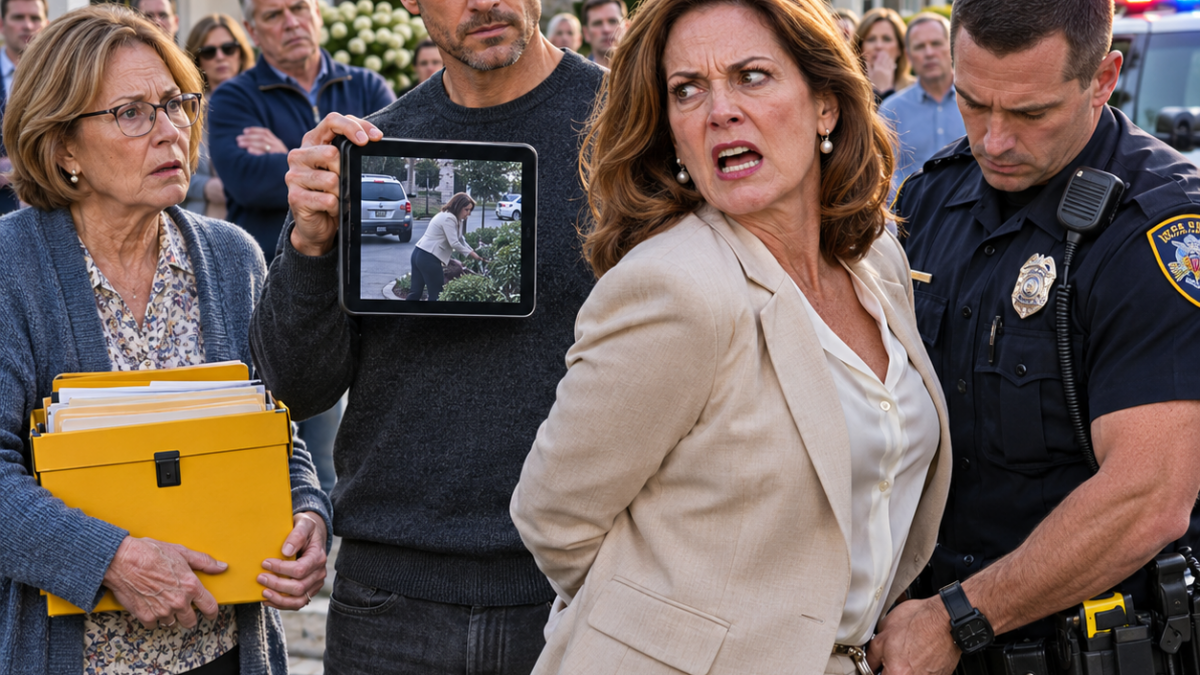
Lorna screamed.
“I called you!”
Mavis guided her toward the foyer.
“You called us to report an emergency.”
“You’re supposed to help me!”
“You did not call us to give yourself permission to trespass.”
“I’m the HOA president!”
“And right now you’re under arrest.”
Across the street, Walt’s mouth opened.
Darlene covered hers.
The man with the Labrador lowered his phone for a second like even he had forgotten he was recording.
Lorna twisted toward me.
“You did this!”
I did not answer.
Mavis walked her outside.
“You’re going to regret this!”
Still nothing.
“Everyone here is going to know what you’re hiding!”
That got Mavis’s attention.
She stopped.
Looked at Lorna.
“What is he hiding?”
Lorna stared at me.
Then realized she had said too much.
“Nothing.”
Mavis waited.
Lorna said, “The infrastructure.”
Mavis placed her in the cruiser.
Closed the door.
Then returned to my porch.
“Mr. Aldridge.”
“Yes.”
“Who else knows what you have downstairs?”
That was the question that turned Lorna’s trespassing arrest into something much larger.
I looked toward the cruiser.
Then back at Mavis.
“Apparently she does.”
“What is it?”
“A box of association documents.”
Her face changed.
“What kind of documents?”
“I don’t know yet.”
That was true.
I had not opened it.
Mavis stared at me.
“You have a box of HOA records in your basement that arrived last night?”
“Yes.”
“And she called 911 this morning claiming someone was trapped in the same basement?”
“Yes.”
“Who brought the box?”
“Iris Penfield.”
“The person she named?”
“Yes.”
Mavis took out a notebook.
“Start from the beginning.”
So I did.
Seven months earlier, Cedar Brook Reserve announced an emergency drainage project.
The number was $612,000.
That alone got everyone’s attention.
The board claimed underground pumps near our section of the neighborhood had reached the end of their service life.
Heavy rain, Lorna said, could flood basements.
Roads could wash out.
Property values could collapse.
Her favorite phrase was:
We can’t put a price on community safety.
Then she put a price on it.
Special assessment.
Thousands per homeowner.
The board claimed the vote had passed thirty-four to fourteen.
Forty-eight eligible owners.
Two-thirds approval required.
Thirty-four was comfortably above thirty-two.
I nearly paid without argument.
Then I requested the engineering packet.
Professional habit.
Read the paperwork before sending money.
Inside the packet was a site drawing.
My property.
My house.
Red lines.
And beneath the floor plan of my basement, a label:
HOA EMERGENCY PUMP STATION.
I laughed the first time I saw it.
Then realized nobody was joking.
My basement contained a furnace.
Water heater.
Laundry sink.
Household sump pump I bought at a hardware store nine years earlier.
Climate-controlled storage room.
No municipal pump.
No HOA infrastructure.
No underground station.
No backup generator.
No industrial electrical system.
Nothing worth six hundred thousand dollars.
I emailed Lorna.
There is no HOA pump station on my property.
She replied:
Association engineering records indicate otherwise. Please schedule access.
I asked for construction records.
Partial response.
I asked for installation date.
No answer.
I asked for original plans.
She sent newer plans.
I asked for county permits.
Silence.
Then came the first inspection demand.
I refused.
She fined me $2,500.
That got my attention.
I filed a formal dispute.
Then checked camera archives.
Lorna had entered my side yard twice.
One afternoon while I was home.
Once while I was at work.
Second visit lasted seven minutes.
She stood near the basement window.
Photographed it.
Tried the side gate to my basement entrance.
That was when I sent the no-trespass notice.
Friday evening, Iris Penfield called me.
Former board secretary.
Her resignation had surprised everyone because Iris had been the person who actually knew where everything was.
Minutes.
Ballots.
Insurance.
Contracts.
Reserve schedules.
If Cedar Brook had an institutional memory, it lived in Iris.
Her voice on the phone sounded frightened.
“I found duplicate records.”
“What kind?”
“Meeting minutes.”
“Duplicate how?”
“Same date. Different vote totals.”
I sat down.
She continued.
“Contracts too.”
“What do you need from me?”
“A safe place.”
“For what?”
“Copies.”
“Why me?”
“Because your basement is the location they falsified.”
That sentence stayed with me.
Saturday evening, Iris arrived with the yellow fireproof box.
I asked if she wanted me to open it.
“No.”
“Why?”
“Not until we can document everything properly.”
She explained an outside forensic audit was scheduled to begin Monday.
She had already sent some originals through a documented channel.
The box contained working copies and supporting material.
“Lorna knows?”
“I don’t think so.”
She was wrong.
A shared association security camera stood on a light pole at the corner.
Supposedly for vehicle incidents.
Lorna apparently reviewed it Saturday night.
Saw Iris carry a yellow box into my house.
Saw her leave without it.
Twelve hours later, 911.
Mavis listened.
Then asked, “Is Iris safe?”
I called.
Speakerphone.
She answered.
“Bennett?”
“Are you home?”
“Yes.”
“Are you in danger?”
“What?”
“Just answer.”
“I’m fine.”
Mavis identified herself.
Asked several questions.
Iris confirmed she had left my house the night before and had not returned.
No trapped woman.
No emergency.
Mavis called for another deputy.
Together, with my consent, they conducted a limited welfare check.
Basement.
Storage room.
No person.
No restraints.
No evidence of violence.
Only furnace.
Water heater.
My old sump pump.
Shelves.
Yellow fireproof box.
Mavis looked at it.
“That?”
“Yes.”
She did not touch it.
“Do not open it for me.”
“I wasn’t planning to.”
“Preserve whatever you have.”
“I will.”
When we returned outside, Lorna was still in the cruiser.
Mavis opened the rear door to confirm information.
Lorna leaned toward the gap.
“You have no idea what he has in that basement.”
Mavis’s eyes sharpened.
“What does he have?”
Lorna went quiet.
The door closed.
Mavis looked at me.
“Save every camera recording.”
“I already am.”
“Good.”
I asked, “What happens now?”
“With her?”
“Yes.”
“Trespassing. Possibly other issues depending on the 911 call.”
“False report?”
“I don’t decide charges.”
She looked toward my house.
“But I’d preserve everything.”
Lorna was booked.
Released on bond that evening.
By Monday, the neighborhood was already at war.
A thirty-second video circulated through the resident email group.
Edited.
It showed Lorna saying someone was trapped.
Me blocking the door.
It ended before she shoved me.
Before Mavis warned her.
Before the arrest.
Caption:
HOMEOWNER REFUSES EMERGENCY HOA ACCESS WHILE POSSIBLE VICTIM INSIDE.
People reacted exactly as intended.
One neighbor wrote:
If there was even a chance someone was in danger, why not let them look?
Another:
What is Bennett hiding?
Another:
This is what happens when people think property rights matter more than human life.
My favorite came from someone named Richard who lived three streets away and had never spoken to me.
IF HE HAS NOTHING TO HIDE, WHY NOT OPEN THE BASEMENT?
I nearly responded.
My attorney told me not to.
Russell Hammond was fifty-eight, gray suit, gray hair, expression of a man permanently disappointed by people who communicated before consulting counsel.
“Do not argue in the neighborhood group.”
“They’re calling me dangerous.”
“Good.”
I stared.
“Good?”
“It makes them careless.”
“That is a very lawyer answer.”
“It’s why you hired me.”
He had me preserve footage.
Download the doorbell video.
Side camera.
Interior entry camera.
Copy each to two encrypted drives.
One stayed with me.
One went to his office.
Then we sent formal preservation requests for:
911 recording.
Body camera.
Incident report.
Dispatch notes.
HOA security footage.
Board emails.
Shared-drive document history.
Russell said, “Do nothing emotionally.”
“That seems unhealthy.”
“Do it privately.”
On Monday afternoon, Cedar Brook’s vice president, Gerald Pruitt, circulated an official notice accusing me of “interfering with emergency infrastructure access.”
Gerald was not aggressive.
That made it worse.
He had always seemed reasonable.
Quiet man.
Accountant.
Two grandchildren.
He signed what Lorna put in front of him.
The board scheduled a special meeting Thursday to consider sanctions against me.
My $2,500 fine.
Suspension of clubhouse privileges.
Additional assessment.
Designation as “non-cooperative homeowner.”
I asked Russell what that meant.
“Mostly invented language designed to make you sound dangerous.”
“Can they do it?”
“They can vote on almost anything.”
“Enforce it?”
“Different question.”
Tuesday evening, Iris returned.
This time we opened the yellow box.
My dining table became a document lab.
Two lamps.
Camera recording continuously.
Cotton gloves.
Numbered evidence sheets.
I handled every page the way I would handle a disputed historical archive.
Photograph before moving.
Front.
Back.
Page number.
Condition.
Staples.
Ink.
Annotations.
Iris watched.
The first document made my hands stop.
HOMEOWNER INFRASTRUCTURE ACCESS CONSENT.
My property.
My name.
My alleged signature.
Bennett Aldridge.
Blue ink.
I had never signed it.
The form claimed I attended a board meeting in April.
I had been in Chicago that week working on a university archive.
Flight receipts existed.
Hotel bill existed.
My phone photos showed me standing beneath a sign reading UNIVERSITY OF CHICAGO SPECIAL COLLECTIONS.
Yet the HOA file said I sat in a Cedar Brook meeting and volunteered access to a pump station that did not exist.
Iris whispered, “Keep going.”
We did.
Ballots.
Thirty-four yes.
Fourteen no.
At first glance, fine.
Then Iris placed her original sign-in list beside them.
Nineteen yes ballots had problems.
Two owners had sold before the vote.
Three had been traveling.
Several signatures looked copied.
One belonged to Thomas Breyer.
Thomas had died five months before the meeting.
I stared at the ballot.
“This person was dead.”
“Yes.”
“And he voted for the drainage project.”
“Apparently civic engagement continues.”
I looked at Iris.
She almost smiled.
The arithmetic was devastating.
Remove the nineteen suspicious approvals.
Fifteen valid yes votes remained.
Fifteen of forty-eight.
The project had not passed.
Not close.
Then the contractor file.
Blue Span Site Works.
$612,000 total.
Milestone payments.
First payment: $87,000.
Second: $130,000.
Total released: $217,000.
Remaining: $395,000.
Scheduled for release after final certification.
There were completion photos.
I stared.
Concrete walls.
Industrial pipe.
Electrical cabinet.
None from my basement.
My walls were cinder block.
My staircase turned left.
The photo staircase turned right.
Iris pointed at an engineering certification.
“Look at the date.”
It was signed four days before the work order authorizing that phase.
Another inspection happened on Thanksgiving Day.
No work crews had been present.
A third certificate used an engineer stamp without a license number.
My forged consent was only one piece.
They needed paperwork showing infrastructure under my home.
They needed proof it had been accessed.
They needed certification of work.
And Monday’s audit threatened to compare paper with reality.
I sat back.
“That’s why she wanted inside.”
Iris nodded.
“She needed something.”
“Photos?”
“Probably.”
“Of my sump pump?”
“Enough to create confusion.”
“She called 911 for a photograph.”
“And the box.”
I looked at her.
“You said there were duplicates.”
“There are.”
She had already transferred key originals to Cynthia Wexler, a forensic auditor.
Documented chain of custody.
Receipt.
Date.
Witness.
The yellow box was not the only evidence.
Lorna did not know that.
“If she’d gotten this box,” I said, “it wouldn’t have saved her.”
“No.”
Iris folded her hands.
“She risked everything for something that no longer mattered.”
That was Lorna’s tragedy.
Every desperate action came after the truth had already moved beyond her reach.
Wednesday morning, independent engineer Tobin Kerns inspected my basement.
I invited him.
Consent in writing.
I almost laughed signing it.
That was how legitimate access worked.
Ask.
Explain.
Permission.
Tobin spent three hours measuring.
Pipe camera.
Electrical tracing.
County maps.
He compared my system to the official engineering drawings.
His final conclusions were painfully simple.
No community pump station.
No infrastructure connection.
No industrial power.
No control panel.
No backup generator.
No access vault.
No evidence any such equipment had ever been installed.
He looked at the HOA completion photograph.
Then at my wall.
“Different building.”
“You’re certain?”
“Your basement is block construction.”
The photograph showed poured concrete.
“Could it be another section?”
“No.”
He pointed at joists.
“Different framing.”
Then staircase.
“Opposite orientation.”
Then ceiling height.
“Different.”
He shook his head.
“This isn’t close.”
I asked, “Could someone mistake my household sump pump for the system in these drawings?”
“No qualified person.”
“What about a rushed auditor looking at an incident report saying deputies confirmed a pump room?”
Tobin looked at me.
That was when the full plan became clear.
Lorna did not need a real engineer fooled forever.
She needed delay.
A photograph.
An incident number.
An HOA minute saying emergency responders accessed the site.
Enough procedural noise to prevent the auditors from freezing the $395,000 before it moved.
Cynthia Wexler called that afternoon.
Forensic auditor.
Fifty-two.
Voice so calm it made bad news worse.
“Blue Span was incorporated eleven weeks before contract award.”
“That’s suspicious?”
“Not automatically.”
“Address?”
“Residential property associated with a relative of a current HOA official.”
“Lorna?”
“I’m not making that allegation yet.”
“Understood.”
She continued.
“Invoice numbers repeat formats from another vendor. Several milestone certificates contain inconsistent metadata.”
“Meaning?”
“Some were created later than their stated dates.”
My stomach tightened.
“And the money?”
“$217,000 released. $395,000 pending.”
“When?”
“Scheduled this week.”
There it was.
The clock.
Cynthia said, “We’re requesting preservation and suspension pending audit.”
By Wednesday evening, Lorna called another emergency meeting.
Not about the contractor.
Not about forged ballots.
About me.
Agenda:
SANCTIONS AGAINST BENNETT ALDRIDGE FOR OBSTRUCTION OF COMMUNITY SAFETY INFRASTRUCTURE.
I actually admired the audacity.
Four days after being arrested inside my house, she planned to chair a hearing about my behavior.
Thursday morning, the clubhouse was packed.
Thirty residents.
Some had seen the edited video.
Some had heard about the arrest.
Most had no idea what was true.
Lorna sat center table.
Perfect blazer.
Perfect hair.
No visible sign she had spent Sunday morning in handcuffs.
She opened:
“Recent events have been distorted by one homeowner and a disgruntled former board member.”
I sat in the second row.
Russell beside me.
Iris behind us.
Lorna continued.
“My detention Sunday occurred because an inexperienced deputy misunderstood association emergency powers.”
Russell leaned toward me.
“Do not react.”
“I’m not.”
“You’re smiling.”
“I can’t help it.”
Lorna proposed three sanctions.
Uphold my $2,500 fine.
Classify me as non-cooperative.
Require surrender of all HOA records in my possession within forty-eight hours.
That last one mattered.
She wanted the box.
Still.
Elaine Mercer, a board member I barely knew, raised her hand.
“Where is the drainage equipment?”
Lorna blinked.
“Beneath Mr. Aldridge’s residence.”
“Has anyone verified that?”
“Yes.”
“Who?”
“Engineering contractors.”
“Can we see the inspection?”
“It’s confidential.”
Elaine frowned.
“Why would the board’s own infrastructure report be confidential from the board?”
Murmurs.
Lorna stiffened.
“Legal reasons.”
Gerald Pruitt looked uncomfortable.
Then they called me.
I walked forward carrying one binder.
No yellow box.
No theatrics.
I set the binder on the table.
“Before you vote against me, I have one question.”
Lorna folded her arms.
“Proceed.”
“Where is the $612,000 pump station?”
People shifted.
Lorna said, “This has already been explained.”
“No.”
I opened Tobin’s report.
“An independent licensed infrastructure engineer spent three hours inspecting my basement yesterday with my full consent.”
I emphasized that.
A few people smiled.
“He found no HOA drainage infrastructure.”
Lorna said, “Your private engineer has no authority to overrule association plans.”
“He didn’t overrule a plan.”
I held up photographs.
“He looked for the equipment.”
I showed my basement.
Then the official completion photo.
Different walls.
Different stairs.
Different ceiling.
One resident stood for a better view.
“What the hell?”
Lorna raised her voice.
“Those images are being taken out of context.”
I placed another document on the table.
“Then explain this.”
My forged signature.
The room quieted.
“This form says I authorized entry at a meeting I never attended.”
Lorna looked at the page.
“Records show—”
“I was in Chicago.”
Russell placed travel documentation beside it.
Flight.
Hotel.
Project invoice.
Date.
I said:
“The form also claims an inspection occurred on May 14.”
I displayed camera logs.
“No inspectors entered my property that day.”
Then the door opened.
Iris walked in carrying original meeting records.
Lorna stood.
“You have no right to be here.”
Elaine said, “She is a homeowner.”
“She stole confidential records.”
Iris’s voice trembled but remained clear.
“I maintained those records for six years.”
“You resigned.”
“After I discovered duplicate minutes.”
Lorna turned toward the other board members.
“This woman is disgruntled.”
Gerald finally spoke.
“I want to hear her.”
Lorna stared at him.
Gerald looked terrified.
Still spoke.
That was enough.
Iris explained the ballots.
Nineteen questionable approvals.
Dead owner.
Former residents.
Absent homeowners.
Fifteen legitimate votes remaining.
The room changed.
People began doing arithmetic.
A man near the back said:
“I paid $8,400 because thirty-four people supposedly approved this?”
Another:
“I voted no.”
Another:
“I never voted.”
Iris checked her list.
His name appeared on a yes ballot.
He stood.
“I did not sign that.”
Lorna began talking over everyone.
“This is a coordinated attempt to destabilize the association.”
Elaine raised her voice.
“Sit down.”
Lorna stared.
Elaine had never spoken to her like that.
Nobody had.
Gerald said:
“We should suspend the drainage project.”
Lorna snapped:
“You do not have authority.”
“I’m vice president.”
“You serve at the pleasure of the board.”
“So do you.”
Silence.
Russell whispered beside me:
“That’s new.”
The sanctions against me failed.
Every one.
Elaine then moved to freeze all board action related to Blue Span pending independent audit.
Passed.
Lorna grabbed her folder.
Walked out without formally adjourning.
It was the first time I watched control leave her body.
Not dignity.
Control.
There is a difference.
That afternoon, Detective Nolan Briggs called me.
Sheriff’s Investigations Unit.
“We preserved the 911 recording.”
“Good.”
“There’s something you need to hear.”
Russell and I went to the sheriff’s office Friday morning.
Small interview room.
Recorder on table.
Briggs pressed play.
Lorna’s voice filled the room.
Panicked.
“There’s a woman in the basement.”
Dispatcher:
“Do you see her?”
“No, but I know she’s there.”
“How?”
“I heard her.”
Then later:
“He’s moving things.”
“What things?”
“A yellow document box.”
I looked at Russell.
The dispatcher asked:
“What does a document box have to do with the person you say is in danger?”
Lorna hesitated.
Then:
“It’s evidence. Officers need to secure the storage room.”
Briggs stopped the recording.
Nobody spoke.
He said:
“She mentions the box before deputies arrive.”
“Yes.”
“Only you, Iris, and whoever saw that box enter the home should have known.”
“Yes.”
“And she repeatedly asks dispatch to help her access the storage area.”
“Yes.”
Russell leaned back.
“So the emergency call itself establishes motive.”
Briggs nodded.
“It helps.”
Then came the locksmith.
Harlan Dobbs.
He voluntarily walked into the sheriff’s office after seeing news about Lorna’s arrest.
Saturday night, Lorna texted him.
Be near Cedar Brook at 8:30 tomorrow.
Possible emergency HOA access.
Need basement storage lock opened after sheriff clears entry.
Harlan replied:
Homeowner permission?
Lorna:
Emergency authority. Police will handle homeowner.
He drove toward my neighborhood Sunday.
Saw cruiser.
Saw me standing in doorway.
Realized nobody had consented.
Left.
His phone preserved the messages.
Then investigators obtained a draft from the HOA shared drive.
Created Saturday night.
Author:
Lorna Weatherford.
Title:
EMERGENCY INSPECTION MINUTES.
The document described an event that had not yet happened.
Sheriff’s deputies responded.
Emergency authority established.
Basement pump station accessed.
Infrastructure condition visually confirmed.
Homeowner resistance documented.
The draft was timestamped hours before Lorna called 911.
I read it twice.
She had written the official history of Sunday before Sunday arrived.
All she needed was reality to cooperate.
Mavis refused.
That was the moment her plan died.
Not when she was handcuffed.
When a deputy stepped out of her cruiser and refused to confuse Lorna’s confidence with lawful authority.
The financial investigation expanded.
Court order froze the remaining $395,000.
Bank records followed.
Blue Span Site Works had connections investigators considered significant enough for separate criminal scrutiny.
The owner was not Lorna.
But money moved through accounts linked to people in her personal circle.
Prosecutors later proved enough of that chain to bring serious fraud charges.
Gerald cooperated.
Elaine cooperated.
Other board members turned over emails.
Most had been careless.
Not criminal.
That distinction mattered to me.
It would have been easy for neighbors to decide the entire board was corrupt.
Evidence showed otherwise.
Some people signed paperwork without reading.
That was irresponsible.
It was not the same as creating fraudulent ballots.
Accountability should follow proof.
Not anger.
Two weeks later, Cedar Brook held the meeting that ended Lorna’s presidency.
All forty-eight eligible homeowners received notice.
Removal vote.
No hidden agenda.
No surprise.
The clubhouse overflowed.
People stood along walls.
The evidence was presented carefully.
Tobin first.
Real basement photos.
Official contractor photos.
Infrastructure maps.
No pump station.
Cynthia next.
Invoices.
Payments.
$217,000 released.
$395,000 stopped.
Questions regarding Blue Span.
Iris followed.
Original vote records.
Nineteen fraudulent or invalid approvals.
Then came the video.
My full doorbell footage.
Not thirty seconds.
All of it.
Lorna ringing repeatedly.
Demanding entry.
Calling 911.
Inventing a woman.
Deputy arriving.
Warning her.
No-trespass notice.
Lorna lunging.
My door slamming.
Her hands on my stair rail.
Mavis pulling her away.
Handcuffs.
The room watched in silence.
The neighbor who had written SHAME ON YOU on the notice left in my mailbox sat three rows ahead.
He stared at his shoes.
When the video ended, Lorna stood.
“Everything I did was for this community.”
Nobody interrupted.
“I was trying to prevent catastrophic flooding.”
Still silence.
I stood only because the interim chair gave me the floor.
I did not call her a liar.
No need.
“Why did a safety project require my forged signature?”
She looked at me.
No answer.
“Why did nineteen homeowners vote without voting?”
No answer.
“Why did a contractor receive $217,000 for infrastructure that does not exist?”
“The contractor misled us.”
“Then why did you call 911 the morning before the audit and ask deputies to secure the document box containing evidence about the same contractor?”
Her face changed.
That question had no safe answer.
She pointed at me.
“You think you’re clever because you preserve papers.”
“No.”
I paused.
“I think papers are useful because they don’t care who has the louder title.”
That got the room.
Not applause.
Something better.
Stillness.
Elaine moved to remove Lorna from the chair before the vote.
Passed.
A retired attorney named Harvey Glenn took over the meeting.
Ballots distributed.
Requirement:
Thirty-two votes.
Counted publicly.
Thirty-seven voted to remove her.
Six against.
Five abstained or did not participate.
77.1 percent.
Lorna Weatherford was no longer president.
Immediately:
Passwords revoked.
Bank authority suspended.
Shared-drive access removed.
Association credit card canceled.
Records transferred.
Lorna remained seated against the side wall.
For years she had occupied the center.
Now nobody asked what she thought.
When the meeting ended, she crossed the room toward me.
Russell saw her.
So did several others.
She stopped inches away.
“You think this is over?”
“No.”
“I’ll sue you until you have nothing.”
“Talk to Russell.”
“I’m talking to you.”
I looked at her.
“You called 911 to open my front door.”
Her jaw tightened.
“All you opened was an investigation into yourself.”
She looked around for support.
Nobody moved.
Then she walked out.
Months passed.
Investigations are slower than neighborhood gossip.
Subpoenas.
Interviews.
Forensic document comparison.
Digital metadata.
Bank records.
Contractor records.
Signature analysis.
The trespassing charge was straightforward.
The larger financial case was not.
Prosecutors built it carefully.
That mattered.
I did not want Lorna convicted because everybody hated her.
I wanted evidence examined correctly.
Eventually, she accepted a plea agreement.
Trespassing remained part of it.
False statements related to the emergency report.
Forgery-related offenses.
Financial fraud counts prosecutors believed they could prove beyond reasonable doubt.
She received eighteen months in custody.
Blue Span’s owner faced separate charges.
Restitution orders followed.
The $395,000 never left the association.
The earlier $217,000 became part of recovery proceedings.
Not all of it came back immediately.
Some losses were real.
That was difficult for the neighborhood.
People wanted a satisfying ending where every stolen dollar returned.
Real financial fraud does not work that way.
Money moves.
Gets spent.
Gets hidden.
Recovery takes time.
Sometimes not everything is recovered.
The new board hired independent accountants.
Opened records.
Published monthly reconciliation reports.
Cancelled invalid assessments.
My $2,500 obstruction fine disappeared.
The board formally withdrew its accusation that I endangered community safety.
Then came the apology.
Signed by every interim board member.
Dear Mr. Aldridge,
The Cedar Brook Reserve Homeowners Association acknowledges that prior notices concerning your refusal to permit unauthorized interior access were improper…
I kept it.
Of course I did.
Paper remembers.
Neighbors slowly changed too.
Not all.
Some avoided me because admitting they had been wrong made them uncomfortable.
That was fine.
Walt came over with bourbon.
Darlene brought pie.
The man with the Labrador turned out to be Curtis Lowe, a chemistry teacher.
His phone recording became evidence.
He apologized for filming.
I told him the filming helped.
He said:
“Well, that’s the first time my inability to mind my business has assisted law enforcement.”
The neighbor who left SHAME ON YOU in my mailbox came by one Saturday.
His name was Steven.
He stood awkwardly on my porch holding another piece of paper.
“I wrote this.”
I looked.
A handwritten apology.
“I shouldn’t have assumed.”
“No.”
“I saw the short video.”
“I know.”
“That’s not an excuse.”
“No.”
He shifted.
“I’m sorry.”
I accepted it.
Then said:
“You can keep the apology.”
He looked confused.
“I already have enough paper.”
He laughed.
That helped.
Cedar Brook also had to face the drainage issue it actually had.
Because beneath all the fraud, there was a legitimate concern.
Parts of our neighborhood did have stormwater problems.
The fake project had exploited a real fear.
That made it more dangerous.
The new board commissioned an independent engineering study.
Actual problem:
undersized storm drains near the south entrance.
Aging retention basin control.
No underground pump beneath my house.
Real solution cost:
$184,000.
Still expensive.
But real.
Open bids.
Permits.
County review.
Owners saw proposals before voting.
The measure passed legitimately.
Thirty-nine votes.
I voted yes.
People found that funny.
“You fought the drainage project for almost a year,” Walt said.
“No.”
I corrected him.
“I fought a fake project.”
That distinction matters in everything.
Opposing fraud does not mean opposing infrastructure.
Opposing illegal HOA entry does not mean opposing HOAs doing legitimate work.
Rights are not arguments against cooperation.
They are boundaries that make cooperation meaningful.
A year after Lorna’s arrest, I received a call from Iris.
She had moved closer to her daughter.
She sounded lighter.
“I wanted to tell you something.”
“What?”
“I almost burned the box.”
I stopped.
“When?”
“The week before I brought it.”
“Why?”
“I was scared.”
“Of Lorna?”
“Of everyone.”
She explained.
For months, Lorna had told her she was confused.
Old.
Forgetful.
That discrepancies were memory problems.
Iris began doubting herself.
That bothered me more than the forged ballots.
Paper fraud was one kind of abuse.
Making someone distrust their own mind was another.
“You saved the originals,” I said.
“Eventually.”
“That’s what matters.”
“No.”
Her voice softened.
“What matters is you believed me.”
I looked around my basement.
The shelf where the yellow box had sat was empty.
“I believed the records.”
She laughed.
“That sounds like you.”
Then:
“But you believed me enough to read them.”
Fair.
A few months later, Deputy Mavis Redding returned to my house.
The criminal case had closed.
She needed one administrative signature relating to property evidence.
She rang the bell once.
I opened.
She stood a full step away from the threshold.
“Morning.”
“Morning.”
“I need about five minutes if you’re available.”
“Sure.”
She held up the folder.
“Mind if I come in?”
I looked at her badge.
Real legal authority.
Sheriff’s deputy.
Body camera.
Sworn officer.
Still asking.
I smiled.
“Come in.”
She noticed.
“What?”
“Nothing.”
“You’re doing the face.”
“What face?”
“Something amused you.”
I stepped aside.
“The contrast.”
She understood immediately.
“Oh.”
“Yes.”
She entered.
We sat at the dining table.
Signed the paperwork.
Then she asked:
“Did you ever figure out why she thought she could just walk in?”
“I think she’d gotten away with smaller versions of it for years.”
Mavis nodded.
“That’s usually how boundaries disappear.”
Not all at once.
One gate.
One photograph.
One demand nobody challenges.
One fine paid because fighting seems exhausting.
One board member signing without reading.
One homeowner deciding it is easier to surrender a little privacy than become the difficult neighbor.
Power rarely begins with somebody saying:
I am taking your rights.
It usually begins with:
This will only take a minute.
Why are you making this difficult?
Everyone else cooperated.
If you have nothing to hide…
Lorna had built her authority out of those sentences.
Until she reached my doorway.
I was not braver than everyone else.
My profession simply made me unusually irritating to people who relied on paperwork nobody read.
I read it.
All of it.
The bylaws.
Amendments.
Voting requirements.
Inspection language.
Contract dates.
Engineering plans.
Certified mail receipts.
Once you do that, titles become smaller.
Not meaningless.
HOA presidents have authority.
Board members have authority.
Police have authority.
Judges have authority.
Property owners have authority.
But legitimate authority has boundaries.
Lorna’s problem was never that she had no power.
She had real power.
Enough to call meetings.
Send notices.
Manage certain association business.
Authorize actions within the bylaws.
Her collapse began when she decided the existence of some authority meant there could be no limit to it.
That is how a $612,000 fake infrastructure project ended inside my foyer.
Not with some brilliant trap.
Not with me outsmarting her.
With a door.
I said no.
A deputy said stay outside.
Lorna decided those two words did not apply to her.
Then crossed the threshold anyway.
Handcuffs followed.
Everything after that was paperwork.
The irony has never left me.
Lorna spent months manufacturing documents because she believed paper could create reality.
Fake ballots.
Fake inspection consent.
Fake completion certificates.
Prewritten meeting minutes.
She thought if enough official-looking pages existed, people would accept the story.
She misunderstood the thing I had spent my career learning.
A document is only as strong as the truth around it.
Dates have to match.
Signatures have histories.
Ink tells stories.
Digital files keep metadata.
Cameras remember.
Bank transfers leave trails.
People retain copies.
And sometimes a 911 dispatcher records the exact sentence a liar desperately wishes she had never spoken.
The association eventually reimbursed owners for the invalid portion of the special assessment through a combination of recovered funds, reserve adjustments, insurer payments where applicable, and restitution proceedings.
It took time.
Some homeowners were angry that the process did not make them whole overnight.
I understood.
Money is personal.
Especially when it was taken through a vote that never happened.
The new board adopted reforms.
All major votes independently counted.
Ballots retained.
Meeting minutes version-controlled.
Contracts above a defined threshold required competitive bids.
Related-party disclosures mandatory.
Interior access to private residences required written homeowner consent or lawful legal authority.
I pushed for that last one.
Elaine laughed.
“Do we really need to write ‘don’t break into people’s houses’ into policy?”
“Yes.”
She thought.
“Fair.”
It passed unanimously.
Cedar Brook became quieter.
Not magically harmonious.
We still argued.
Fence stain.
Landscaping.
Pool hours.
One historic war over whether decorative address numbers could be six inches tall.
Human beings will always find things.
But the arguments became smaller because the stakes became real again.
No secret pump station.
No fictional emergencies.
Just neighborhood governance.
Exactly as boring as it should be.
My basement remains unchanged.
The same furnace.
Same water heater.
Same old sump pump.
I kept the pump.
Tobin joked that I should donate it to a museum.
I considered putting a brass plaque above it:
CEDAR BROOK EMERGENCY PUMP STATION
ESTIMATED VALUE: $612,000
Russell strongly advised me not to.
He has no sense of humor.
The yellow box eventually went into evidence, then back to Iris.
Copies remain with auditors and attorneys.
I kept one certified copy of the forged access form.
Not because I enjoy remembering Lorna.
Because sometimes one page can explain an entire year.
My name.
My fake signature.
Permission I never gave.
That was the whole conflict in miniature.
Someone had decided consent was an inconvenience that could be manufactured.
On a quiet Saturday morning the following spring, I repaired the hinge damaged when Lorna shoved through the door.
The wood around the screw had cracked.
Nothing major.
I could have fixed it immediately.
For months I did not.
Maybe part of me liked the damage.
Proof.
Then I realized I did not need proof anymore.
So I filled the hole.
Reset the hinge.
Tightened the screws.
The doorbell rang.
Mavis.
That was the visit for the final form.
After she left, I stood at the threshold.
Opened the door.
Closed it.
Perfect alignment.
Latch caught.
Soft click.
Across the street, sprinklers moved.
Walt was washing his car.
Darlene waved.
I waved back.
Normal.
I bought a small brass plaque later.
Not as a joke.
Simple.
PRIVATE PROPERTY
ENTRY BY PERMISSION ONLY
I mounted it beside the door.
Some people thought it was aimed at Lorna.
It wasn’t.
Not anymore.
It was a reminder to me.
Boundaries matter before anyone challenges them.
Rights matter before you need them.
Records matter before somebody rewrites the story.
And a title—president, manager, director, officer—never becomes a substitute for consent simply because the person carrying it speaks with enough confidence.
Lorna thought calling 911 would convert my front door into association property.
Instead, the recorded call exposed why she needed the door opened.
She thought a deputy would make her authority look legitimate.
Instead, Mavis showed the entire neighborhood what legitimate authority actually looks like.
It asks questions.
Checks facts.
Recognizes limits.
And when it needs to enter a private home without an emergency, it obtains lawful authority first.
The woman with the badge waited.
The woman with the HOA folder did not.
That contrast became the simplest explanation of everything.
People sometimes ask whether I felt vindicated when Lorna was sentenced.
Not really.
Vindication is dramatic in imagination.
In reality, by the time the case ended, I was tired.
I wanted my Sundays back.
I wanted neighbors discussing grass instead of criminal subpoenas.
I wanted my basement to become boring again.
What I felt was relief.
Relief that the remaining $395,000 had been stopped.
Relief that Iris had trusted her instincts.
Relief that Mavis had listened instead of being intimidated by Lorna’s title.
Relief that Gerald eventually cooperated instead of doubling down.
Relief that investigators distinguished carelessness from criminal conduct.
Relief that the neighborhood learned enough to prevent the same structure from happening again.
Justice was not Lorna becoming small.
It was everyone else becoming harder to manipulate.
That mattered more.
There is one part of the story I return to more than the arrest.
It happened about thirty seconds before Lorna shoved through my door.
Mavis had the no-trespass notice in her hand.
She looked directly at Lorna and said:
“You are not permitted to enter this home.”
Clear.
Simple.
No ambiguity.
Lorna heard it.
Understood it.
And crossed anyway.
People often assume wrongdoing happens because rules are unclear.
Sometimes.
But some of the worst decisions happen when the rule is perfectly clear and a person has become convinced it should apply to everyone except them.
That was Lorna Weatherford’s real mistake.
Not calling 911.
Not the forged vote.
Not the fake pump station.
Those were consequences of something deeper.
She believed her purpose made her limits optional.
Once someone believes that, almost any line can become negotiable.
A gate.
A signature.
A ballot.
A contract.
A 911 call.
A front door.
Until the line finally refuses to move.
Mine did.
Months after everything ended, Walt asked me over the fence:
“If she hadn’t called 911, would you have found the fraud anyway?”
I thought about it.
“Yes.”
“Really?”
“The audit was Monday.”
“So she destroyed herself for nothing?”
“Pretty much.”
He shook his head.
“That’s incredible.”
It was.
Lorna believed she was racing to stop the evidence.
The evidence was already duplicated.
The auditor already had originals.
The contractor file was already under review.
The pump station still did not exist.
Her emergency plan solved nothing.
It simply connected every separate problem.
The false 911 call connected her to the basement.
The basement connected her to the box.
The box connected her to the ballots.
The ballots connected to the project.
The project connected to Blue Span.
The prewritten minutes connected the emergency call to the financial motive.
The arrest did not create the scandal.
It gave investigators the thread.
They pulled.
Everything came apart.
That is why, when people tell this story around Cedar Brook now, they usually begin with the handcuffs.
I don’t.
I begin with the door.
Lorna rang.
I opened it enough to speak.
She demanded access.
I asked for authority.
She had none.
Everything else followed from her inability to accept that answer.
There was no trapped woman.
No emergency pump station.
No lawful inspection order.
No legitimate thirty-four-vote approval.
No reason for her to cross my threshold.
Only a woman with a title who had grown accustomed to confusing resistance with wrongdoing.
And one deputy who refused to make that confusion her problem.
The last time I saw Mavis, she finished the administrative paperwork and stood to leave.
At the door, she paused.
“Funny thing.”
“What?”
“That first morning, she kept telling me she was the HOA president like it should change the law.”
“I noticed.”
Mavis smiled.
“People with real authority usually know where it stops.”
Then she stepped onto the porch.
I watched her walk to her cruiser.
The door remained open for another moment.
Nobody crossed it.
Nobody demanded anything.
Then I closed it.
Soft click.
Private property.
Entry by permission only.
And for the first time in almost a year, those words felt completely ordinary again.








