HOA Karen Called 911 on My Wife for Changing Our Cabin Gate—Then Froze When She Realized Who We Were
HOA Karen Called 911 on My Wife for Changing Our Cabin Gate—Then Froze When She Realized Who We Were
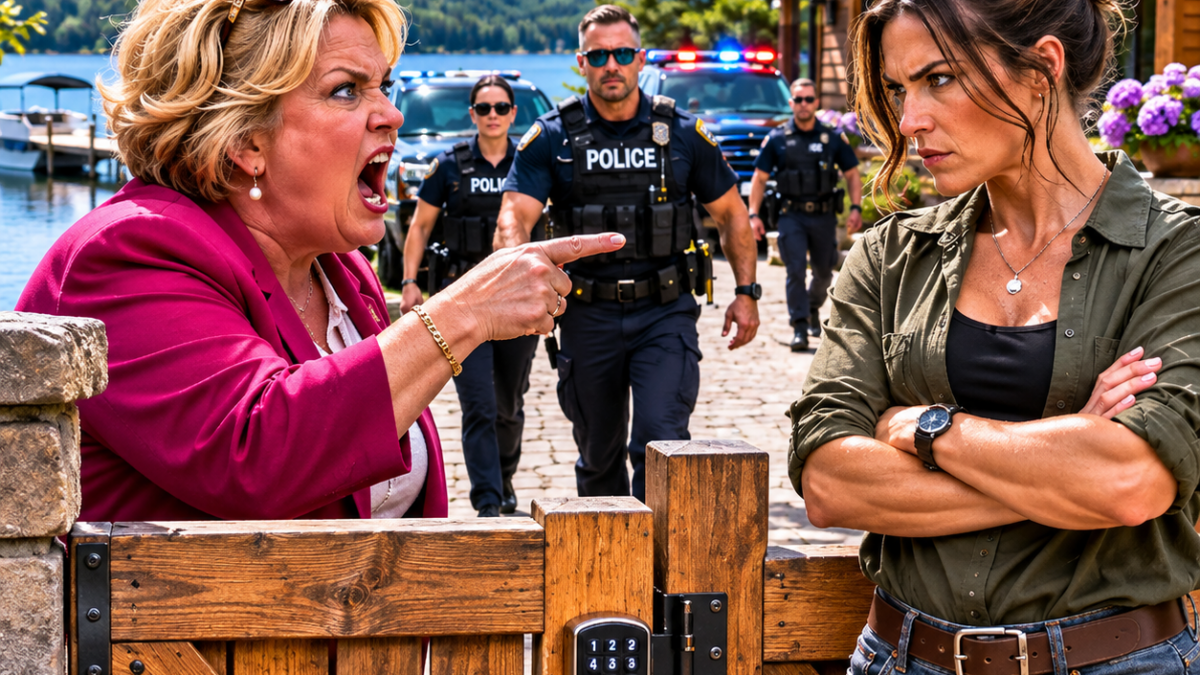
**“THAT WOMAN DESTROYED HOA PROPERTY—ARREST HER, AND DETAIN HER HUSBAND TOO!” Brenda Whitmore shouted as two sheriff’s cruisers stopped beside the brand-new gate my wife had just installed on our own land.**
**Rachel still had a cordless drill in one hand, our deed and survey were sitting inside my truck, and Brenda had just told 911 that we might be armed because we refused to reinstall the rusted gate that had almost fallen on Rachel a week earlier.**
**Then a county SUV came down the private road, the official stepped out, looked straight at my wife, and said, “Rachel? I thought you were supposed to be on leave.”**
My name is Nathan Cole.
My wife Rachel and I bought the cabin because we wanted quiet.
That was the entire plan.
No big development.
No investment scheme.
No rental business.
No second-home empire.
Just a small cedar-sided cabin on Lake Waverly in northern Georgia where we could spend weekends listening to water instead of phones.
Rachel and I had been married sixteen years.
We both worked too much.
There were weeks when breakfast together felt like something that should have been scheduled through an assistant.
We had been saying for years that we needed to slow down.
Then one afternoon Rachel sent me a real-estate listing.
Old cabin.
Two bedrooms.
Stone chimney.
Wide porch.
Private cove.
Nearly eighteen wooded acres.
Her message:
“We need this.”
I replied:
“We need a roof inspection.”
Her answer:
“You have no romance in your soul.”
Six weeks later, we owned it.
The property had belonged to the Bennett family for more than sixty years.
Their grandfather built the cabin in 1959, long before the neighborhood around it existed.
That history mattered.
Lakeshore Heights came later.
Beginning in the 1990s, a developer bought hundreds of acres east of the Bennett property and turned them into lake homes.
Our cabin was never incorporated into the HOA.
The deed said so.
Survey said so.
County map said so.
We shared one thing.
The road.
PART2″
Bennett Lake Road began at the county highway, passed through part of Lakeshore Heights, then continued through woods another half mile to our cabin.
An old road agreement gave Lakeshore residents certain rights over the first section while preserving access to the Bennett property.
Nothing unusual.
At least that was what we thought.
About three hundred feet before our driveway stood an old steel gate between two stone pillars.
Green paint.
Rust.
Heavy tubing.
Probably installed around 1980.
Our home inspector touched one hinge.
A piece fell off.
He laughed.
“This thing is going to drop.”
Rachel asked:
“Soon?”
“Possibly now.”
We added it to the repair list.
Roof flashing.
Dock boards.
Water heater.
Gate.
Normal old-cabin problems.
Then we met Frank Miller.
Frank was seventy-one and lived about a quarter mile uphill inside Lakeshore Heights.
Retired hardware-store owner.
The kind of man who somehow knew every property line, broken culvert, stray dog, and storm drain within five miles.
He appeared on our second weekend carrying a toolbox.
“You the Coles?”
“Yes.”
“Gate sticks.”
“We noticed.”
“Needs grease.”
“We need a new gate.”
He stared at the rust.
“Also true.”
Frank helped me adjust the hinge enough that we could open it without throwing our backs out.
Rachel brought lemonade.
We sat on the porch.
Then Frank asked:
“You met Brenda yet?”
“Who?”
He smiled slowly.
“You’ll know.”
We met her two days later.
Blue golf cart.
LAKESHORE HEIGHTS HOA across the windshield.
Brenda Whitmore stepped out looking like she had just left a committee meeting because, as we later learned, she usually had.
Late fifties.
Perfectly organized.
Folder under one arm.
She walked directly toward Rachel.
“You’re the new owners?”
“Yes. Rachel Cole. This is Nathan.”
“I’m Brenda Whitmore, HOA president.”
She looked past us toward the cabin.
“Have you submitted your renovation plans?”
Rachel glanced at me.
“What renovation plans?”
“Anything you intend to change.”
“We’re replacing a few dock boards.”
“That requires architectural approval.”
I answered.
“We’re not in the HOA.”
Brenda gave me a patient look.
“Everyone on Bennett Lake Road is under Lakeshore review.”
“Our closing attorney says otherwise.”
“That’s a common misunderstanding.”
The confidence was almost impressive.
Rachel stayed polite.
“Send us whatever documents you believe apply.”
That was Rachel’s style.
Never argue when someone is willing to put their mistake in writing.
Brenda agreed.
Then she pointed toward the old green gate.
“You cannot alter that.”
Rachel looked at it.
“Why?”
“Community access.”
First time we heard those words.
Brenda said Lakeshore Heights had used the gate and road for decades for emergency lake access, maintenance, and shoreline inspections.
That sounded possible.
Old rural roads collect weird easements.
We did not dismiss her.
We asked for the documents.
That evening I checked our closing file.
The gate sat entirely inside our parcel.
Both stone posts inside our surveyed boundary.
Nearest HOA common land stopped hundreds of feet east.
The road agreement gave some access rights.
Nothing about gate ownership.
Still, ownership and easement rights are different things.
So Rachel called our closing attorney, Rebecca Hayes.
Rebecca reviewed everything again.
“They may have some limited road rights.”
“Do they own the gate?”
“I see nothing saying that.”
“Could another agreement exist?”
“Absolutely.”
“So we wait.”
“Exactly.”
We waited.
Nothing came.
Instead, an HOA violation arrived.
Unauthorized gate modification.
Fine:
$500.
The funny part was we had not modified anything.
Rachel called Brenda.
“I think you sent this too early.”
“No.”
“We haven’t touched the gate.”
“Planning an unauthorized modification still violates community standards.”
Rachel laughed.
Not sarcastically.
She genuinely could not help it.
Brenda did not find that funny.
Rachel again requested proof of HOA jurisdiction.
Brenda promised to forward it.
Nothing came.
Rebecca sent a formal letter.
Our parcel was outside Lakeshore Heights.
Any easement, access right, or ownership claim should be produced in writing.
The fine disappeared.
For two weeks, peace.
Rachel painted the porch railing.
I repaired the dock steps.
Frank helped clear branches.
Susan Parker, another neighbor, brought peach cobbler.
She apologized for Brenda.
Rachel smiled.
“You didn’t send the violation.”
Susan laughed.
“You two are going to fit in better than Brenda expects.”
Most Lakeshore residents were friendly.
That mattered.
It would have been easy to decide the neighborhood was our enemy because its president was difficult.
That would have been unfair.
People are not their HOA.
Then the old gate almost hurt Rachel.
Rainy Thursday afternoon.
Delivery truck leaving.
Rachel went to close the gate.
Lower hinge snapped.
The whole steel frame dropped toward her.
She jumped backward.
One corner caught her jacket and tore the sleeve.
No injury.
Another foot closer?
Different story.
That was enough.
“We’re replacing it.”
“Yes.”
We called a local fencing company.
New gate.
Exact same stone posts.
Same width.
Same road opening.
No change to any access route.
Black steel.
Solar-powered operator.
Keypad.
Camera.
Temporary codes.
And if Lakeshore eventually proved a legal access right, we would provide whatever access was required.
More than reasonable.
Rebecca sent Lakeshore notice.
Not a request.
Notice.
Unsafe gate would be replaced on private property.
If Lakeshore claimed access rights requiring a code, provide documentation and identify authorized users.
Three days.
Nothing.
Then Brenda arrived with Frank.
Frank looked irritated before leaving the golf cart.
Brenda pointed at contractor markings beside the posts.
“You were specifically told not to touch this gate.”
Rachel answered:
“We own it.”
“The community has used it for thirty years.”
“That doesn’t make it yours.”
“We have emergency rights.”
“Then show us.”
Frank cleared his throat.
“Brenda, that’s what I’ve been asking too.”
“Not now, Frank.”
That told us something.
Frank sat on the HOA board.
He had not seen the supposed easement either.
Then Brenda changed arguments.
Lakeshore required unrestricted access because the road led to an emergency lake pump station.
That was new.
“What pump station?” I asked.
She pointed vaguely toward our woods.
“Near the cove.”
Nothing like that appeared on our survey.
Nothing on the inspection.
No building.
No utility equipment.
Rachel asked:
“Does the HOA have equipment on our property?”
Brenda corrected herself.
“Adjacent.”
“Where?”
“That isn’t relevant.”
It was extremely relevant.
After she left, Frank stayed.
“I have no idea what she’s talking about.”
“You’ve lived here how long?”
“Twenty-six years.”
“Seen a pump station?”
“No.”
Rebecca checked county utility records.
Nothing.
Fire department records showed hydrants supplied through public water.
No lake intake.
No emergency pump.
So why did Brenda suddenly need unrestricted gate access?
Rachel found the first clue.
About fifty feet inside our gate, hidden behind overgrown laurel, an old gravel trail split off Bennett Lake Road.
Barely visible.
We followed it.
Several hundred feet through woods.
Old concrete foundation.
Rusted bolts.
Metal pipe disappearing underground.
No building.
No pump equipment.
We took photos.
Rebecca found the structure on a 1978 survey.
BENNETT IRRIGATION HOUSE.
Belonged to the old Bennett farm.
Abandoned long before Lakeshore Heights existed.
That should have ended Brenda’s pump-station argument.
Instead, another letter arrived.
The gate was now:
COMMUNITY HERITAGE INFRASTRUCTURE.
Rachel read that twice.
“What does that mean?”
“I think it means she still doesn’t have a deed.”
Rebecca laughed.
Then found something useful.
Lakeshore’s declaration referenced a western emergency route.
But it terminated on a different parcel.
Not ours.
Somewhere over the years, residents may have started using the Bennett gate because it was convenient.
Convenience becomes habit.
Habit starts feeling like entitlement.
But feeling like you own something does not change the deed.
We scheduled installation for Saturday.
Friday evening, Frank called.
“Brenda’s telling people you’re locking the community out of the lake.”
“We aren’t.”
“I know.”
“We offered codes to anyone with documented rights.”
“I know.”
“Has anybody found an easement?”
Pause.
“Not that I’ve seen.”
Saturday morning arrived cool and clear.
Rachel was far more excited about a gate than a normal person should be.
“Solar power.”
“Yes.”
“Remote access.”
“Yes.”
“Camera.”
“Yes.”
“Temporary codes.”
“You’ve explained it fourteen times.”
She ignored me.
Contractor arrived at seven.
By ten, the rusted gate lay in the grass.
Rebecca told us not to throw it away yet.
Same stone posts.
No widening.
No moved entrance.
New steel frame went up.
Frank came by.
Susan too.
Susan admired the gate.
Frank admired the motor.
Then Brenda arrived.
Golf cart stopped in the road.
Her face changed.
“What have you done?”
Rachel stood beside the control box with a cordless drill.
“Replaced our unsafe gate.”
“You had no authority.”
“It’s our gate.”
“I told you it belongs to the HOA.”
“And we asked for proof.”
Brenda took out her phone.
“I’m giving you one chance to remove it.”
Rachel looked at the brand-new steel gate.
“You want me to remove the safe gate and reinstall the one that almost fell on me?”
“Yes.”
“No.”
Brenda stared at her.
Then dialed.
Rachel looked at me.
“Is she calling the board?”
I watched Brenda.
“No.”
A moment later:
“Yes, I need police immediately. There’s an active property crime happening on Bennett Lake Road.”
Frank’s eyes widened.
“Brenda.”
She turned away.
“A woman is destroying HOA property and blocking emergency access.”
Rachel whispered:
“She called 911?”
“Yep.”
Frank stepped closer.
“That is not an emergency.”
Brenda ignored him.
Then she said:
“Yes, she became hostile when confronted.”
Rachel looked at me.
I said:
“No.”
“I know.”
Then Brenda added:
“Her husband is here too. I don’t know if they’re armed.”
That changed the mood.
Exaggerating ownership was one thing.
Suggesting to emergency dispatch that we might be armed without any basis was different.
Rachel’s expression did not become frightened.
Just disappointed.
She placed the drill on my truck hood.
I called Rebecca.
Frank and Susan stayed as witnesses.
Contractor stopped working.
We waited.
First sheriff’s cruiser came around the bend.
Then second.
Brenda moved immediately toward them.
“I’m Brenda Whitmore, president of Lakeshore Heights HOA. That woman destroyed HOA property. I want her arrested for vandalism, trespassing, and interfering with emergency access. Her husband helped.”
The younger deputy looked at us.
The older one looked at the cabin.
Then the gate.
Then property markers.
Then Rachel.
His expression changed slightly.
Recognition.
Rachel saw it too.
She gave him a tiny shake of her head.
Meaning:
Do this properly.
The older deputy was James Walker.
Professional.
Calm.
He separated everyone.
Rachel asked before reaching into my truck for our documents.
James nodded.
Deed.
Survey.
Road agreement.
Contractor paperwork.
Rebecca’s letters.
Brenda produced an HOA map.
James studied it.
It did not show a true property boundary.
It showed a red line:
COMMUNITY EMERGENCY ACCESS.
The red route crossed our gate.
Followed old Bennett Road.
Then turned onto the abandoned irrigation trail.
James asked:
“Where did this map come from?”
“HOA records.”
“Who prepared it?”
“Our consultant.”
“What consultant?”
Brenda did not answer directly.
The younger deputy noticed the date.
Four months earlier.
Not from 1990.
Not from old Lakeshore planning.
Four months before Rachel and I bought the cabin.
Then another label.
At the end of the red route, near the old foundation:
FUTURE LAKE ACCESS FACILITY.
Rachel leaned closer.
“That’s on our property.”
Brenda pulled the map back.
James stopped her.
“Leave it where it is.”
Suddenly the argument was no longer about the gate.
Someone had recently drawn a planned route across our property toward a future facility.
Frank stared.
“I’ve never seen that plan.”
“The board discussed it privately.”
“No, we didn’t.”
James asked:
“Is there an emergency right now requiring this gate open?”
“Yes.”
“What emergency?”
“Fire access.”
James checked with dispatch.
Then county fire department.
No request.
No emergency designation.
No order.
Nothing.
“So why did you call 911?”
“They’re interfering with community safety.”
“That isn’t what I asked.”
Then a dark county SUV came down Bennett Lake Road.
Brenda looked toward it.
Her face changed immediately.
She knew the vehicle.
Rachel knew it too.
So did I.
A tall man in a county jacket stepped out carrying a map case.
He saw Rachel.
Stopped.
“Rachel?”
Brenda looked between them.
Rachel sighed.
The man smiled.
“I thought you two were supposed to be taking a month off.”
Brenda asked:
“A month off from what?”
Nobody answered yet.
The county official was David Reynolds, deputy director of county infrastructure.
He had come because dispatch flagged a dispute involving Bennett Lake Road, which was already part of an active county land review.
Brenda looked nervous.
“Active review?”
David opened a map.
Our eighteen acres.
Irrigation trail.
Old foundation.
Neighboring Lakeshore parcels.
Then Brenda’s red emergency route.
“This route was never approved.”
Frank stepped closer.
“What is it?”
David looked toward Brenda.
“You tell me.”
Nothing.
Then he pointed to the shaded rectangle.
“County planning rejected this proposed facility six months ago because the applicant did not control the land.”
Six months earlier.
Before we bought the cabin.
Somebody had already tried developing on Bennett property.
Rachel asked:
“Who filed it?”
David checked.
“Lakeshore Recreation Partners LLC.”
Frank frowned.
Never heard of it.
Susan had not either.
Then:
“Fifty-one percent held by Whitmore Development Group.”
Frank slowly looked at Brenda.
Her husband Richard owned Whitmore Development.
He built vacation homes.
Marinas.
Boat-storage facilities.
The future lake-access facility suddenly looked less like community emergency infrastructure.
Rachel looked toward the hidden trail.
“So this emergency road leads to a private development project?”
David answered carefully.
“That’s what the rejected plan appears to show.”
Brenda snapped:
“It was supposed to benefit the community.”
Frank looked furious.
“What community? The board never approved this.”
Brenda started talking faster.
Marina would improve values.
Residents would get discounted slips.
The old trail had always served Lakeshore.
Gate had always been treated as community access.
Then James asked:
“Do you own the gate?”
Silence.
“Does Lakeshore own the land beneath it?”
Silence.
“Do you have an easement granting unrestricted access?”
Pages moved inside Brenda’s folder.
Nothing appeared.
Rachel finally said:
“We asked three months ago.”
James nodded.
Brenda pointed at Rachel.
“She still has no right to interfere with that route.”
David looked genuinely confused.
“She owns the route.”
Then:
“Actually, they both do.”
Brenda stared at us.
“Who exactly are you people?”
Rachel gave me the same look.
Not yet.
Our jobs were irrelevant to ownership.
The deed was enough.
Then the younger deputy crouched beside the old green gate lying in the grass.
“What’s this?”
Small black box.
Mounted underneath.
Wires ran into the hollow steel tubing.
Gate contractor shook his head.
“Not ours.”
James put on gloves.
Inside the gate tube:
Thin data cable.
Not power.
David frowned.
“That shouldn’t be there.”
Rachel spotted another device hidden beneath ivy on the stone post.
Contractor touched nothing.
“Pictures first.”
Good.
James asked Brenda whether the HOA had installed monitoring equipment.
“No.”
Too fast.
Frank stared at her.
“You knew about this.”
“No.”
“I watched one of your contractors work on that post last summer.”
County technician arrived.
The device was a vehicle counter.
It recorded gate openings.
Times.
And likely license-plate images through a tiny camera.
Could such equipment be legal on property you own?
Potentially.
But Lakeshore did not own this gate.
Nobody disclosed it to us when we purchased the cabin.
Rachel asked:
“Why were you monitoring vehicles entering private property?”
No answer.
Technician opened storage.
Thousands of records.
Previous Bennett owners.
Deliveries.
Contractors.
County workers.
Then:
Rachel and me.
Our cars.
Guests.
Movements.
Every gate opening.
Susan whispered:
“That’s creepy.”
Nobody disagreed.
Then another folder.
PROJECT ACCESS.
Nighttime photos before we bought the cabin.
Pickup trucks.
Utility trailers.
Excavators.
One excavator returning at 2:14 a.m.
Mud on tracks.
Then a truck beside the old foundation.
WHITMORE DEVELOPMENT GROUP on the door.
David’s expression hardened.
“Your husband’s company entered this land after the planning application was rejected.”
Brenda stopped talking about the gate.
Then Rachel’s phone rang.
She listened.
Her face changed.
I knew the number too.
County survey team.
They had reached the old foundation.
“What?”
Rachel covered the phone.
“They found fresh concrete underground.”
Frank frowned.
“Fresh?”
“Less than a year old.”
David stared toward the woods.
“What did they pour?”
Rachel listened again.
“Utility vault.”
David swore quietly.
Brenda stepped backward.
James noticed.
“So there really is something back there.”
Rachel’s phone buzzed with a photograph.
New concrete chamber.
Steel door.
Sign:
LAKESHORE HEIGHTS EMERGENCY USE ONLY.
Under it:
AUTHORIZED BY PRESIDENT B. WHITMORE.
Frank went silent.
The woman who called police because Rachel replaced our gate had apparently used that same gate to preserve access to an unauthorized underground facility on our property.
Nobody touched the vault until sheriff, county survey, fire marshal, and utility inspector all arrived.
That was the right decision.
Unknown underground equipment is not something you open because everyone is curious.
The trail disappeared beneath weeds.
Near the old foundation, fresh soil had been disguised with pine needles and leaves.
Steel door.
Four feet tall.
Official-looking sign.
No permit number.
No fire department ID.
No utility mark.
Just Lakeshore Heights.
And Brenda’s name.
Frank stared at it.
“I’m on the board. I have never seen this.”
James asked:
“Would something like this require a board vote?”
“If HOA money paid for it? Absolutely.”
“Can the president approve it alone?”
“Not this.”
Utility inspector detected electricity.
Low-voltage line.
Pipe entering from lake side.
Another heading toward Lakeshore Heights.
Brenda shouted from near the gate:
“It’s an emergency water system.”
“Who installed it?”
“Whitmore Development performed temporary safety work.”
Frank immediately said:
“No board request authorized that.”
Brenda changed wording.
Emergency presidential authority.
Rachel did not argue.
She was collecting contradictions.
Fire marshal arrived.
Utility crews checked for gas and electrical hazards.
Nearly an hour passed.
Susan showed up with bottled water.
Even offered Brenda one.
That was Susan.
You could disagree with somebody without deciding they stopped being human.
Finally the vault could be opened.
Commercial keypad.
Backup key.
James asked Brenda for the code.
“I don’t remember.”
Frank stared.
“You authorized an underground vault and don’t remember the code?”
“Maintenance company controls access.”
“Which one?”
Pause.
“Whitmore Site Services.”
Richard’s company.
Again.
Locksmith opened it under supervision.
Cold air.
Mechanical hum.
Concrete stairs.
Eight feet down.
Pipes.
Valves.
Electrical panels.
Large blue pressure tank.
Installation dates less than a year old.
Not abandoned.
Not temporary.
Utility inspector read labels.
LAKE INTAKE.
BOOSTER PUMP.
PRESSURE CONTROL.
Then:
“This is active.”
Frank stared.
“Active how?”
“Water is moving.”
System was pulling water from Lake Waverly through our property and sending it toward Lakeshore Heights.
Rachel asked:
“Drinking water?”
Inspector shook his head.
“Looks like irrigation or other non-potable use.”
Better than secretly feeding houses.
Still serious.
Lake withdrawals require permits.
Underground infrastructure requires permits.
No county permit appeared.
No easement from our parcel.
Rebecca arrived before noon.
She reminded everyone:
“Absence from county records does not prove no state authorization exists. Verify first.”
Brenda looked relieved.
For about thirty seconds.
Then inspector found a second outgoing pipe.
It did not head toward Lakeshore Heights.
It turned north.
Toward Richard Whitmore’s sixty-acre development property.
The same rejected project.
Locator confirmed it.
Frank looked at Brenda.
“Why does an HOA emergency system connect to your husband’s development?”
“It doesn’t.”
Locator said otherwise.
Now the gate mattered even more.
If we controlled access, Brenda and Richard could no longer send maintenance workers down the trail unnoticed.
The old gate used a construction-style padlock.
Our contractor picked it up.
“This lock is from a master-key series Whitmore Site Services uses.”
Tiny stamped number confirmed it.
The old gate had effectively been controlled by Richard’s company.
The new keypad did more than replace rust.
It killed their master-key access.
That was why Brenda panicked.
Not because the gate belonged to Lakeshore.
Because the new one no longer obeyed Lakeshore.
Sheriff documented everything.
Nobody arrested Brenda.
Some residents wanted immediate handcuffs.
I did not.
Suspicious is not convicted.
Family business is not automatic guilt.
Unknown vault is not proof of a crime by one specific person.
Facts first.
County shut down the lake intake temporarily.
Within twenty minutes:
Community sprinklers lost pressure.
Entrance fountain stopped.
Clubhouse irrigation died.
Then something on Richard’s development tract stopped.
Construction dust-control system.
His company had told the county its water came from a permitted private well.
There was a well.
But it produced almost nothing.
The hidden lake line apparently supplied most of the water.
That mattered because Richard’s project had already been rejected partly over inadequate utility capacity.
No reliable water.
No legal lake access.
No approved road.
The secret system solved several problems quietly.
The county sealed the vault.
James told Brenda clearly:
Rachel had committed no vandalism.
The gate sat on our deeded property.
There was no active emergency.
He also addressed the 911 call.
“Easement disputes are usually civil unless there’s an immediate threat or clear crime.”
“She blocked emergency access.”
“There was no declared emergency.”
“I believed there could be one.”
“That is different.”
He warned her that knowingly false claims about hostility or weapons could create another issue.
Brenda stopped talking.
Our contractor programmed the new gate.
Rachel gave Frank a temporary code.
Not because he had proven some permanent legal right.
Because we trusted him to assist inspectors during the investigation.
That evening Rachel and I sat on the porch.
Lake calm.
No sirens.
No golf cart.
No Brenda.
Rachel stretched her feet across the railing.
“You know what the real problem is?”
“The secret vault?”
“No.”
“The hidden pipes?”
“No.”
“What?”
“Who paid for it.”
That was Rachel.
Always follow the money.
An independent accountant reviewed Lakeshore finances.
Within three days:
$24,500.
$18,200.
$31,700.
$16,900.
Descriptions:
WESTERN DRAINAGE IMPROVEMENT.
EMERGENCY LAKE ACCESS MAINTENANCE.
DROUGHT RESPONSE PREPARATION.
SHORELINE STABILIZATION.
None said:
UNDERGROUND WATER VAULT ON SOMEONE ELSE’S LAND.
Most went to Whitmore Site Services or connected subcontractors.
Total:
More than $180,000.
Then another transaction.
$95,000 into Lakeshore Heights.
From Whitmore Development Group.
Description:
FUTURE AMENITY CONTRIBUTION.
Money went into a reserve controlled by Brenda and the former property manager.
Some repaired playgrounds.
Some paid storm cleanup.
Some landscaping.
Residents benefited.
That complicated the story.
Then the HOA attorney found an agreement Brenda signed sixteen months earlier.
Whitmore Development promised up to $250,000 in community improvements.
In exchange, Lakeshore Heights would “support and facilitate Western lake access integration” for Richard’s future project.
Another clause:
HOA would cooperate in obtaining emergency, utility, and recreational connectivity through “Legacy Bennett access.”
Our road.
Our gate.
Our property.
Frank checked board minutes.
No approval.
Jennifer Collins remembered a meeting where Brenda mentioned exploring a developer partnership.
Exploring.
Not signing access commitments.
Then county retrieved Richard’s development application.
It claimed a future private well would support construction.
Backup source:
EXISTING LAKE ACCESS INFRASTRUCTURE AVAILABLE THROUGH LAKESHORE HEIGHTS PARTNERSHIP.
No parcel.
No easement.
Just:
existing infrastructure.
Under our land.
Rachel asked David Reynolds to pull every county filing related to the project.
He raised an eyebrow.
“You’re on leave.”
“I said pull it.”
“I didn’t say give it to me.”
He smiled.
“Better.”
Brenda overheard.
“You work for the county?”
Rachel answered:
“No.”
Technically true.
Brenda relaxed.
Then looked at me.
“What do you do?”
“I’m on leave too.”
She did not like that answer.
Two days later, formal county meeting.
Neutral office.
Lakeshore representatives.
Whitmore Development attorneys.
County engineers.
Fire marshal.
Sheriff representative.
Rachel and I attended as landowners.
Brenda sat across the room beside Richard.
David began introductions.
Then:
“For disclosure, Mrs. Cole is currently on approved leave from her position as deputy counsel with the Georgia Environmental Protection Division.”
Brenda’s face changed.
Rachel specialized in land use.
Water.
Environmental enforcement.
Exactly the subjects now sitting under our cabin.
Then David looked at me.
“And Mr. Cole is on leave from the U.S. Army Corps of Engineers, where he serves as a senior civil engineer overseeing reservoir access, shoreline structures, and dam-safety projects across the Southeast.”
Richard looked directly at me for the first time.
Brenda froze.
Completely.
Now she understood why Rachel kept asking about water-source certifications.
Why I questioned underground infrastructure.
Why David knew us.
Why we had remained calm when she called 911.
She had accidentally called the sheriff on an environmental attorney and a federal reservoir engineer while standing beside an unauthorized access route leading to a hidden lake-intake vault.
Rachel leaned toward me.
“There it is.”
“What?”
“The face.”
That was the moment everyone remembers.
But it was not the moment that mattered most.
Our jobs did not create our rights.
The deed did.
Then another engineer stood.
He represented the federal shoreline authority.
Pointed to the lake-intake structure.
“That location lies inside a federally controlled shoreline buffer.”
No permit existed for excavation there.
Richard’s attorney whispered to him.
Then Rachel noticed another line on the project map.
Not the branch going to Richard’s land.
A second underground line.
Southwest.
Toward Lakeshore Heights’ private earthen dam.
“What is that?”
Richard answered:
“Old drainage.”
Rachel looked at him.
“You’re sure?”
“Yes.”
The Corps engineer leaned closer.
“That isn’t drainage.”
“How do you know?”
“Because drainage does not usually terminate at a gated intake structure below normal lake level.”
Silence.
Frank opened an old Lakeshore map.
Same line.
Different label.
WESTERN EMERGENCY BYPASS.
Nobody had seen it used.
Invoice date suggested it had been modified only eight months earlier.
Then a county technician entered with a laptop.
He whispered to David.
David’s expression changed.
“What happened?”
Technician turned screen.
Although county had shut the vault down, flow had started inside the second line.
Rachel sat forward.
“How?”
“Lake intake valve reopened.”
“Remotely?”
“Yes.”
Someone still had control.
The bypass line traveled beneath our woods.
Then into a large buried structure near the base of Lakeshore Heights’ earthen dam.
Frank stood.
“Why would the lake intake connect to our dam?”
No answer.
Laptop alarm sounded.
“Pressure rising.”
No rain.
Yet water level behind the HOA dam began increasing.
Rachel looked at Richard.
He looked genuinely surprised.
That scared me more than a smug expression would have.
David’s phone rang.
He listened.
Then shouted toward sheriff representatives:
“Evacuate lower Lakeshore Road.”
Brenda jumped up.
“What?”
“Your dam is receiving water from Lake Waverly.”
“That’s impossible.”
Pressure climbed.
Corps engineer looked at me.
“Nathan, if that bypass is four inches and the pump is at full capacity—”
“I know.”
Brenda looked between us.
“How bad?”
I did the rough calculation.
“Tens of thousands of gallons an hour.”
County alert system activated.
Residents below the dam moved uphill.
Then technician said:
“The outlet opened too.”
“Where?”
Map enlarged.
The outlet ran beneath Bennett Lake Road.
Directly under our brand-new gate.
My stomach dropped.
If pressure built at that junction, buried pipe could fail and lift the road.
Frank’s phone rang.
His face went white.
“The gate.”
“What?”
“The road underneath it just lifted.”
We moved.
By the time we reached Bennett Lake Road, ground beneath the gate had risen almost eight inches.
Steel frame still standing.
Gravel cracked.
Water bubbled through the road center.
Sheriff closed both directions.
County cut electricity to the vault.
Pump kept running.
A second power source existed somewhere.
I had spent years looking at pipes, dams, spillways, and bad construction decisions.
The visible water was not the worst danger.
Pressure beneath the road was.
If the line burst violently, gravel and pavement could become projectiles.
Brenda tried walking closer.
I told her to stay back.
“You don’t control this road.”
After everything, that was still her argument.
Rachel answered:
“Nobody controls anything right now. The road is unsafe.”
County crews located the high-pressure pipe.
Six feet underground.
Far below gate foundations.
Our gate work had not caused this.
The line split beneath the road.
One branch toward HOA dam.
One toward Richard’s development.
Both had opened.
Pressure backed up at the junction.
Our road sat almost directly above it.
Then Richard stepped forward.
“There’s another shutoff.”
Everyone turned.
“Where?”
“My property.”
Rachel stared.
“You knew?”
“It was part of the construction system.”
“What construction system?”
His attorney nodded.
Richard explained that the line had originally supported dust control and grading while waiting on a private well.
That explained his branch.
Not the dam.
“I never authorized the dam connection.”
For the first time, I believed his fear.
Deputies escorted him and county workers to his site.
Secondary shutoff found in a locked cabinet.
Richard provided code.
They closed it.
Road pressure dropped.
Then county manually isolated the lake intake.
Eventually gauge fell toward zero.
Nobody cheered.
Too tired.
Lakeshore dam had risen almost two feet.
Serious.
But stable.
No flooding.
No injuries.
Residents eventually returned.
Our road needed excavation.
Workers found a modern six-inch reinforced line.
Valve assembly.
No permit.
Handwritten code:
WB2.
Frank remembered:
Western bypass.
System was more than construction supply.
It reused an old route.
But why?
Emergency HOA meeting.
Brenda temporarily suspended.
Jennifer Collins chaired.
Hidden line had never been approved by current board.
Then Howard Jenkins, an older resident, spoke.
“I worked on that dam twenty years ago.”
Original Western Emergency Bypass was not an intake.
It was an outlet.
If the retention lake rose during a storm, excess water could flow away toward lower land.
Later a new spillway was built.
Old bypass abandoned.
Somebody had reused its corridor.
But instead of gravity drainage, the new system connected pressurized lake intake.
Dangerous.
Very dangerous.
Who would know the old route?
Anyone with original engineering records.
Richard offered his full project files for review.
Maybe self-protection.
Still useful.
Accountant found more money.
Vault cost was not merely $180,000.
Whitmore Development:
Another $340,000.
Blue Ridge Water Solutions:
$125,000.
Total over $645,000.
Frank stared.
“For sprinklers?”
Rachel said:
“Nobody spends six hundred forty-five thousand dollars on irrigation unless the grass is made of gold.”
Blue Ridge Water Solutions belonged to William Parker.
Small water-management contractor.
Susan Parker’s brother-in-law.
Susan looked horrified.
Nobody accused her.
Family relation is not guilt.
William voluntarily supplied plans.
Original design showed:
Vault.
Intake.
Development branch.
Old Western bypass.
But crucially, William’s drawing placed a permanent closed block valve on the bypass.
Red note:
DO NOT CONNECT TO HOA BASIN WITHOUT SEPARATE ENGINEERING APPROVAL.
No approval existed.
Construction records showed Whitmore Site Services later subcontracted modifications.
Change order had Brenda’s signature.
Handwritten:
MAINTAIN EMERGENCY FLEXIBILITY FOR HOA USE.
And:
KEEP WB PATHWAY LIVE.
She knew the connection remained active.
That made her claim about “emergency access” during the gate fight more troubling.
She had not merely been worried about a gate.
There really was an emergency system beneath it.
She simply had not told anyone what it actually was.
Then accountant found recurring payments.
$4,800 monthly.
Whitmore Development to Blue Ridge Water Solutions.
ACCESS RETAINER.
Remote monitoring and maintenance.
Who had remote access?
William.
Richard’s site manager.
And Patricia Whitmore Wells.
Brenda’s older sister.
Former Lakeshore president from 2012 to 2018.
Patricia had started the original drought project.
Now the history made more sense.
Years earlier, Lakeshore suffered severe water restrictions.
Landscaping died.
Fire reserve planning became difficult.
Residents wanted alternative water.
Patricia proposed a lake-water system.
That beginning was not evil.
It was practical.
Then costs increased.
Permits became difficult.
Bennett property stood in the way.
Old access assumptions started replacing written rights.
Temporary infrastructure stayed permanent.
Then Brenda inherited the system.
Richard saw opportunity to extend it toward his development.
Every new person added another purpose.
Irrigation.
Drought supply.
Fire reserve.
Construction water.
Private development.
Dam bypass.
By the time Rachel and I bought the cabin, nobody could honestly explain the whole system anymore.
That was the danger.
Not one giant evil plan from day one.
A chain of shortcuts.
Each one easier to justify because the previous shortcut already existed.
County audit eventually showed original drought project had approval for only three things.
Clubhouse irrigation.
Entrance landscaping.
Emergency fire-water storage.
Not Richard’s development.
Not unauthorized work on our property.
Not the dam bypass modification.
Not our road.
The board terminated every unapproved connection.
Richard agreed to disconnect his development branch.
Probably because keeping it would destroy any chance of future permits.
Self-interest can still point toward the correct decision.
County removed WB2 valve beneath our gate.
Dam branch capped.
Development branch disconnected.
Main lake intake shut pending review.
Stone gatepost repaired.
Rachel watched every minute.
“You trust the contractor?” I asked.
“Yes.”
“Then why are you watching?”
“I like my gate.”
She really did.
For several days, life became quiet.
Fishing.
Dock repair.
Peach cobbler.
Then Rebecca found something that actually helped Lakeshore.
A real 1986 easement.
Signed by original Bennett owner.
It allowed Lakeshore’s original developer to maintain one underground drainage pipe across the property.
Not irrigation.
Not pressurized water.
Drainage.
Route roughly matched old Western bypass.
A legitimate historical right.
We could have hidden it.
It complicated our position.
We did not.
Rebecca immediately gave it to the HOA attorney and county.
Frank looked surprised.
“You’re giving us something that might help Lakeshore?”
“It’s true.”
That answer should not feel unusual.
The easement still did not give Brenda ownership of our gate.
Did not authorize unrestricted vehicle access.
Did not authorize lake intake.
Did not authorize private-development water.
But it explained why the original drainage route existed.
Then county engineer found a termination clause.
If Lakeshore replaced the drainage route with a permanent alternative, the old easement automatically ended.
New spillway built in 2004 might have triggered that.
That issue would be resolved through ordinary legal review.
No shouting.
No emergency.
Just paperwork.
Sheriff also finished preliminary review of Brenda’s 911 call.
Rachel had never threatened her.
Frank confirmed.
Susan confirmed.
Contractor confirmed.
Body-camera footage showed Rachel calm and cooperative.
Dispatch recording captured Brenda suggesting we might be armed without any factual basis.
Brenda received a citation for misuse of emergency services.
Matter forwarded for local review.
No prison.
No dramatic arrest.
A citation.
Rachel was satisfied.
“You wanted more?” I asked.
“No.”
“Really?”
“She called because she was angry and scared. She made it worse. She got consequences. That’s enough.”
That was why I married her.
Then Brenda asked for a meeting.
Through attorneys.
Neutral county office.
No driveway.
No golf cart.
No gate.
She apologized to Rachel first.
“I should not have called 911.”
Rachel nodded.
“No.”
“I believed you were blocking emergency access.”
“You also said I threatened you.”
Brenda looked down.
“I was angry.”
“That is not the same as threatened.”
“I know.”
Then Brenda admitted what we already suspected.
She fought the new gate because the old master-key system allowed maintenance crews to reach the hidden vault without asking the cabin owner.
Rachel’s keypad destroyed that access.
Brenda panicked.
Not because the gate belonged to Lakeshore.
Because suddenly the gate did not obey Lakeshore.
That difference was the whole story.
Then I asked:
“Who opened the valves during the county meeting?”
“I don’t know.”
“You had access.”
“Yes.”
“Richard?”
“Yes.”
“William Parker?”
“Yes.”
“Anyone else?”
Pause.
“Patricia.”
Her sister.
Former HOA president.
“Did Patricia still have remote credentials?”
“She designed the original monitoring system.”
“Were those credentials removed after she left?”
Brenda shook her head.
Terrible security.
Then:
“Patricia came back last week.”
“To Georgia?”
“Yes.”
“Why?”
“She said the county was destroying years of work.”
“Where is she?”
“I don’t know.”
David Reynolds entered with a county emergency notice.
Someone had accessed the lake controls again.
Main branches had been disconnected.
But another line existed.
A fourth line.
West from the intake.
Away from Lakeshore.
Away from Richard’s land.
Through woods.
Toward a narrow valley behind our cabin.
Rebecca looked at the route.
“What’s there?”
David answered:
“An old earthen reservoir.”
I had never heard of it.
Neither had Rachel.
Old Bennett cattle reservoir.
Abandoned.
Overgrown.
Mostly dry.
Or supposed to be.
Live readings showed it filling.
Fast.
Somebody had opened a hidden valve connecting it directly to Lake Waverly.
County crews reached the reservoir.
Earthen wall weak.
Tree roots.
Animal burrows.
Forty years without maintenance.
Thousands of gallons pouring in.
And directly downhill?
Our cabin.
Rachel looked at me.
“How much can it hold?”
David shook his head.
“We don’t know.”
Phone rang.
He listened.
Then:
“Water’s at the top.”
Brenda whispered:
“Oh God.”
“The embankment is leaking.”
We ran.
County sirens moved toward the woods.
Then we heard something like distant thunder under a clear sky.
I knew the sound.
Earth moving under water pressure.
Rachel did too.
A line of muddy water burst through trees.
Old reservoir wall began collapsing.
Not one giant explosion.
Long section sagged.
Cracked.
Folded inward.
Water pushed through.
County had already evacuated the danger zone.
That probably saved lives.
Rachel and I stopped at the roadblock instead of racing toward the cabin.
Hard decision.
Necessary.
Water hit woods first.
Split around a natural rise.
One branch crossed driveway.
Another moved behind cabin and tore through old irrigation trail.
Cabin survived.
Porch survived.
New gate survived.
Storage shed did not.
Water moved it twenty feet into two trees.
We lost fencing.
Tools.
Firewood.
Half Rachel’s new vegetable garden.
Compared with what we could have lost?
Small.
Engineers inspected before we returned.
No major foundation shift.
No gas leak.
Living space dry.
Rachel looked toward damaged woods.
“We got lucky.”
“Yes.”
“Again.”
That word stayed with me.
Gate almost missed Rachel.
Pressure line failed without injury.
Dam stayed intact.
Reservoir flood split around cabin.
At some point gratitude becomes more useful than anger.
We spent that night at Frank’s.
Susan brought blankets.
Jennifer brought food.
Half the neighborhood offered to help.
I told Frank:
“Stop giving everyone our gate code.”
He laughed.
“Temporary emergency access.”
For the first time, it was funny.
Next morning reservoir looked like a muddy bowl.
Thomas Reed found the hidden intake pipe.
Modern valve.
Recent installation.
Construction drawing:
FUTURE RAW WATER STORAGE.
From Blue Ridge Water Solutions.
But original drawing carried a large red note:
DO NOT ACTIVATE — EMBANKMENT UNSAFE.
Somebody knew.
Repair estimate had been almost $190,000.
HOA previously rejected restoration.
Reservoir was supposed to remain abandoned.
Brenda admitted she knew about the proposal.
So did Patricia.
Original plans all showed it inactive.
Someone connected it anyway.
Control logs:
Old administrator account.
Username tied to Patricia Wells.
That did not automatically prove Patricia personally operated it.
Passwords can be shared.
Accounts compromised.
But login came from a phone registered to her.
Investigators located Patricia at a Gainesville hotel.
No dramatic chase.
She had her laptop.
Old Lakeshore project files.
Digital records showed she logged into the system repeatedly after moving to Florida.
She still thought of the drought project as partly hers.
When county began disconnecting infrastructure, she became convinced people were destroying years of work.
She started opening valves.
At first she claimed she was testing systems.
That did not explain activating a reservoir marked unsafe.
Then investigators found an email she sent Brenda the night before.
“They’re cutting everything apart. Once the Bennett line is removed, we lose western capacity forever.”
Brenda replied:
“Do not touch anything. County has control.”
Patricia:
“They don’t understand what we built.”
Brenda did not answer.
That message mattered.
For once, Brenda had told her sister to stop.
It did not erase Brenda’s mistakes.
911 call.
Undisclosed contracts.
Secret access agreement.
Vault.
Development partnership.
But details mattered.
The deeper review showed the system had evolved over years.
Drought restrictions.
Practical water-security idea.
High project costs.
Permit delays.
Old Bennett access.
Shortcuts.
Then more shortcuts.
Then Richard’s development.
Then Brenda’s secrecy.
Then Patricia’s refusal to let go.
By the time it reached us, no one person could cleanly explain why all the pipes existed.
Rebecca handled our property-damage claims.
Insurance covered cabin repairs.
Lakeshore’s insurer contributed to road and gate damage because HOA infrastructure caused part of the failure.
Blue Ridge Water Solutions and Whitmore Site Services faced separate claims over design and construction.
No magical giant settlement.
Engineering reports.
Insurance negotiations.
Actual repair costs.
That was appropriate.
We did not want to bankrupt ordinary Lakeshore residents.
Most never knew the system existed.
They already faced audit costs.
Repair bills.
Higher insurance.
We wanted our property restored and the hidden infrastructure gone.
Old Bennett reservoir was not rebuilt.
County cut and capped intake.
Filled portions of the water route.
Lowered the weak embankment so it could never hold a dangerous amount of water again.
The area became a shallow wet-weather basin with native grass.
No remote valve.
No secret capacity.
The underground vault near the irrigation foundation was removed.
Every pipe mapped first.
Disconnected.
Documented.
Concrete marker left where it once stood.
Rachel asked:
“Want to keep the LAKESHORE HEIGHTS EMERGENCY USE ONLY sign?”
“No.”
Frank wanted it.
“Why?”
“Board training.”
Fair.
Richard Whitmore still owned his sixty acres.
His development did not vanish.
He was entitled to submit a lawful proposal.
What he no longer had was:
Our gate.
Our road.
Our lake intake.
Invisible access.
Unpermitted utilities.
He had to start over.
Legal road.
Legal water.
Real permits.
Original marina concept became too expensive without shortcuts.
Eventually he submitted a smaller project with another access farther north.
Rachel had returned to work by then and formally recused herself from anything connected to our dispute.
Important to her.
Important to me.
Her job gave knowledge.
Not a private weapon.
I returned to Corps work.
I did not review Lakeshore’s dam case.
Another team handled it.
Same reason.
People joked that having a federal engineer living nearby was convenient.
I told them only if they enjoyed someone complaining about drainage during dinner.
Frank said they already had him.
Lakeshore’s board changed completely.
Brenda resigned before final board review.
She remained a homeowner.
People expected her to move.
She did not.
Frank became interim president.
Later won a real election.
Jennifer became treasurer.
Susan refused every position anyone offered.
Her answer:
“I like neighbors too much to join the board.”
Probably wise.
Forensic audit found Brenda approved contracts that should have gone to the full board.
Some involved Richard’s companies.
Disclosure was incomplete.
The development agreement created serious conflict-of-interest problems.
She faced civil consequences and local penalties.
911 issue stayed separate.
She paid the citation.
Completed a diversion program.
No jail.
Rachel was satisfied.
Patricia’s situation was more serious.
Her remote actions directly caused dangerous pressure events and the reservoir failure.
Her attorneys argued she never intended to damage property.
That might have been true.
Intent did not change the fact that she activated infrastructure after the county shut it down.
Her case ended with criminal and civil penalties.
Restitution.
Restrictions involving utility systems.
Again:
No courtroom screaming.
No giant speech.
Evidence.
Orders.
Consequences.
Richard faced financial penalties over unapproved construction and related-party contracts.
His company paid restoration costs.
William Parker’s company went through professional review.
Investigators found his original plans had actually warned against activating the old reservoir.
That mattered.
He was not blamed for later decisions he specifically warned against.
Details matter.
They always do.
The old green gate stayed behind our barn for months.
Rachel refused to throw it away.
One day I asked:
“Why are we keeping the thing that almost fell on you?”
“It started everything.”
“No. Brenda started everything.”
Rachel shook her head.
“The gate showed us everything.”
She was right.
If the hinge never broke, we might have left the gate alone.
If we left it alone, Whitmore’s master key still worked.
Maintenance crews could still enter quietly.
If Rachel had not installed the keypad, Brenda might never have panicked.
Without Brenda’s 911 call, deputies might never have looked closely at her new map.
Map exposed secret route.
Route exposed surveillance equipment.
Surveillance exposed nighttime access.
Nighttime access led to the vault.
Vault exposed hidden lake intake.
Lake intake exposed the bypass.
Bypass exposed the dam connection.
Then the abandoned reservoir.
One broken hinge opened the whole story.
Eventually we gave the old gate to Frank.
He cut off a small section.
Mounted it in the HOA meeting room.
Under it, one sign:
ASK FIRST.
That became Lakeshore Heights’ unofficial rule.
Need access?
Ask.
Need an easement?
Ask.
Want to inspect something?
Ask.
Want to put infrastructure under private land?
Definitely ask.
Written rules became stronger too.
No family-connected contracts without full disclosure.
No utility work without permits and board approval.
No private-property access without permission or genuine emergency authority.
No contractor master keys.
No remote utility accounts left active after officials leave office.
Every easement mapped.
Every access code documented.
Every major project independently reviewed.
Boring rules.
Excellent rules.
Rachel and I kept the cabin.
We repaired the shed.
Replanted the garden.
Reset the stone gatepost.
Then Rachel added a small metal sign inside the gate.
PRIVATE PROPERTY.
PLEASE CALL FIRST.
Frank saw it.
“Too subtle.”
“It isn’t for you.”
“What’s my code?”
“You don’t have one.”
He did.
Of course.
Susan had one too.
Emergency services had secure county access.
Kindness did not disappear because somebody abused access.
We just made it clear.
That was the biggest lesson.
Boundaries do not make you unfriendly.
They make generosity safer.
Almost a year after Brenda called 911, Rachel and I sat on the porch watching sunset across Lake Waverly.
Woods behind cabin were growing back.
Native grass covered old reservoir site.
Hidden utility trail was disappearing into woods again.
Rachel held iced tea.
“You know what still bothers me?”
“What?”
“She called me hostile.”
I laughed.
“That’s the part?”
“I said no.”
“Very aggressively.”
“I said it once.”
“Terrifying.”
She kicked my chair.
Then became serious.
“She really thought saying no made me the problem.”
That was true.
And not only in HOA disputes.
People get used to access.
Control.
Agreement.
Then the first person who sets a boundary suddenly looks difficult.
Rachel never threatened Brenda.
Never blocked a legitimate emergency.
Never destroyed HOA property.
She replaced a dangerous gate she owned.
Everything after that came from someone refusing to accept a simple no.
People still tell this story like the best moment was Brenda realizing who we were.
Deputy counsel in environmental enforcement.
Senior Army Corps engineer.
The powerful couple who happened to understand dams, shorelines, permits, pipes, and land-use rules better than she expected.
Yes.
Her face was memorable.
But our jobs were not why we were right.
If Rachel had been a teacher and I repaired refrigerators, the deed would still have been ours.
The survey would still have shown the gate on our property.
The missing easement would still be missing.
The unauthorized vault would still be unauthorized.
Our professional backgrounds helped us understand the evidence.
They did not create our rights.
Documents did the important work.
Survey.
Deed.
Permit records.
Invoices.
Control logs.
Old drought plans.
Real drainage easement.
Even documents that helped Lakeshore mattered.
Truth cannot depend on whether it favors your side.
A few months after everything settled, Brenda came to the cabin alone.
She stopped outside the gate.
Then called.
That part made me smile.
Rachel answered.
Brenda asked permission to come up.
Rachel opened the gate remotely.
Brenda parked near the porch.
Sat inside her vehicle for almost a minute.
Then stepped out.
No folder.
No clipboard.
No HOA badge.
She apologized again.
Not through attorneys this time.
She said she had convinced herself the project protected Lakeshore Heights.
She genuinely believed losing access would damage the neighborhood.
Then Richard’s development got involved.
Her sister’s old system.
HOA money.
Existing pipes.
Old routes.
At some point, she stopped asking whether she had the right to do something and started asking whether she could justify doing it.
Rachel listened.
Then said:
“That’s how boundaries disappear.”
Brenda nodded.
We did not become friends.
That was not necessary.
An apology does not erase consequences.
Forgiveness does not mean giving someone another key.
We treated her respectfully.
Then she left through the same gate she once called 911 over.
This time she waited for it to open.
That felt like enough.
The cabin finally became what we bought it to be.
Quiet.
Frank still visits too often.
Susan still brings too much food.
Rachel still checks the gate camera even though nobody suspicious has appeared in months.
I still inspect the slope after heavy rain because once you have watched an old reservoir wall collapse, you develop habits.
But our problems are normal now.
Fallen branches.
Dock boards.
Storms.
Fishing line tangled around the boat propeller.
Exactly what a lake cabin should be about.
Sometimes new residents hear the old story.
They ask Rachel:
“What did you do when Brenda called 911?”
Rachel always gives the same answer.
“I waited for the deputies.”
People expect something bigger.
A badge.
A phone call.
A threat.
Some secret federal authority.
No.
We waited.
Showed the deed.
Showed the survey.
Let the process work.
That answer disappoints people who want revenge.
I like it.
Because the real victory was never embarrassing Brenda.
It was proving calm boundaries can survive loud accusations.
The hidden system is gone.
Whitmore’s development has its own approved road.
Lakeshore has legal irrigation permits.
The dam has independent monitoring.
The abandoned reservoir can no longer hold dangerous water.
HOA records are open.
Our gate works perfectly.
And the only reason Rachel would ever call 911 from our cabin now would be an actual emergency.
Exactly how we like it.
Brenda Whitmore called 911 because my wife replaced a gate we owned.
She expected deputies to make Rachel undo it.
Instead, her call exposed a secret access map, years of surveillance, an underground lake-water vault, a private development arrangement, an unsafe bypass system, and a chain of shortcuts crossing land nobody had permission to use.
And yes—
Brenda froze when she finally learned exactly who my wife and I were.
But the most important thing she learned had nothing to do with our titles.
You do not need a government job, a badge, an engineering degree, or an important name to deserve respect on your own property.
Sometimes all you need is a deed.
A boundary.
And the courage to say no.








