HOA Karen Called 911 on Me SIX TIMES Because I Wouldn’t Join—Then the Police Learned Why She Needed My Land
HOA Karen Called 911 on Me SIX TIMES Because I Wouldn’t Join—Then the Police Learned Why She Needed My Land
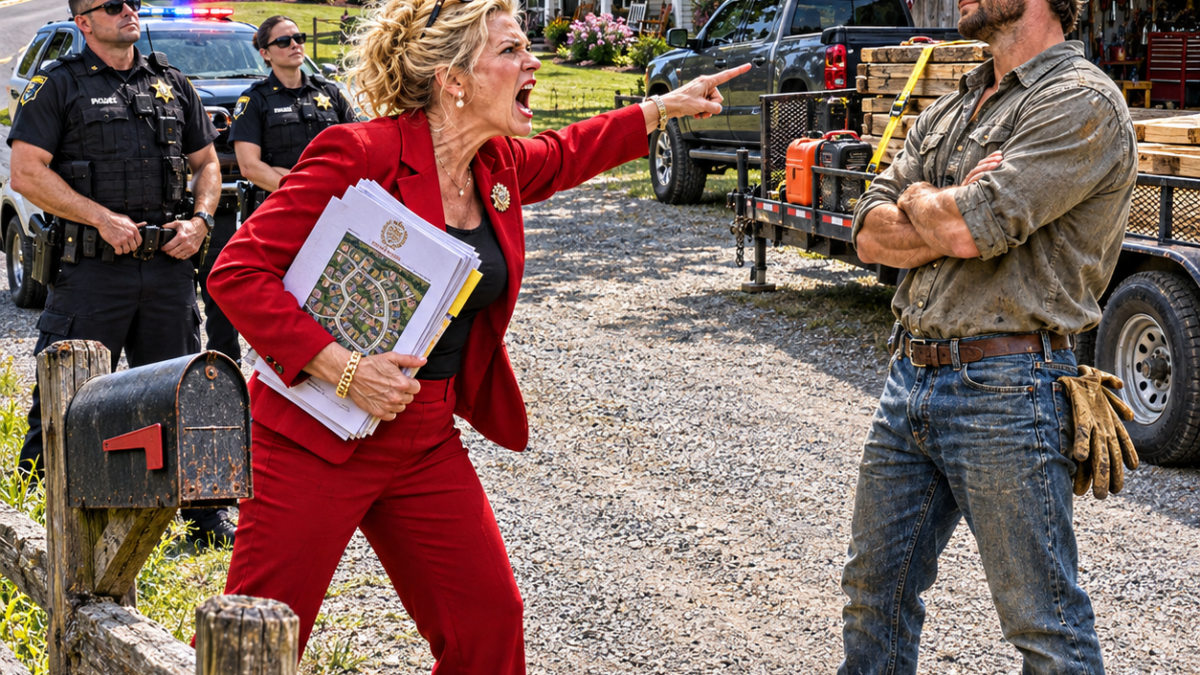
**“OFFICER, HE KEEPS REFUSING COMMUNITY RULES—AND NOW HE’S BLOCKING OUR EMERGENCY ACCESS!” Brenda Whitmore shouted as the fourth police car in three weeks stopped in front of my house.**
**I wasn’t even part of Maple Ridge HOA, yet Brenda kept reporting my truck, my trailer, my fire pit, my dog, and even the tools I carried into my own garage.**
**Then she pulled out a document claiming my grandfather had promised her HOA a road across my land—and one old file in his workshop told a very different story.**
The fourth police cruiser stopped in front of my house just as I was carrying a box of tools into the garage.
Red and blue lights flashed across my lawn.
Two officers stepped out.
Across the road, Brenda Whitmore stood beside her mailbox holding her phone.
And smiling.
That smile was what bothered me.
Not nervous.
Not confused.
Satisfied.
Like everything was happening exactly the way she expected.
Officer Daniel Reeves walked toward me.
He had already responded to my property before.
He looked tired.
“Mr. Harper?”
“That’s me.”
“We got a report about a possible emergency access obstruction.”
I looked at my work trailer.
It was parked beside my gravel driveway.
Completely inside my property.
“There is no emergency access route here.”
Brenda crossed the road before the officer could answer.
“There’s supposed to be.”
Daniel turned.
“What does that mean?”
She pointed toward my western field.
“That land is part of Maple Ridge’s secondary emergency access plan. Mr. Harper keeps refusing to cooperate.”
I laughed.
“I’m not even in Maple Ridge.”
Daniel looked at her.
“Is he a member of your HOA?”
Brenda hesitated.
“Not yet.”
That answer made the officer stare at her.
“Not yet?”
“He’s supposed to join.”
I almost laughed again.
PART2:
Nobody was supposed to join a voluntary HOA simply because its president wanted them to.
Then Brenda opened a thick blue folder.
“We’re correcting a historical boundary problem.”
My stomach tightened.
She pulled out several pages.
At the bottom was my grandfather’s name.
Arthur Harper.
Beside it was a signature.
According to the paper, Grandpa had agreed years earlier to give future development rights over a western strip of his property for community access.
The signature looked real enough to make me uncomfortable.
Brenda pointed toward my trailer.
“You see? He keeps blocking land that was promised for neighborhood access.”
I stared at the document.
I had never seen it.
Daniel looked at me.
“Did you know about this?”
“No.”
Brenda smiled.
“You should have joined when I gave you the chance.”
That sentence told me something.
I just didn’t know how much yet.
My name is Daniel Harper.
The property had been in my family since 1979.
Grandpa bought five acres outside a small Virginia town when the area was mostly woods, farmland, and older houses scattered along a county road.
He built a simple brick home.
Two apple trees near the western fence.
Detached garage.
Small workshop.
Nothing fancy.
But solid.
After Grandpa died, Mom inherited it.
She rented the place for several years while I worked construction in Richmond.
Then she decided to move to Florida.
She offered to sell the house to me below market value.
I was thirty-four.
Tired of apartment living.
I had started a small landscaping business and needed space.
Trucks.
Mowers.
Tools.
Trailer.
The old Harper place was perfect.
By then, everything around us had changed.
A developer bought the large farm east of the property and built Maple Ridge.
More than one hundred homes.
Clubhouse.
Pool.
Sidewalks.
Stone entrance pillars.
Matching mailboxes.
Neat lawns.
Rules about paint.
Fences.
Sheds.
Parking.
My place looked different.
Gravel driveway.
Old fence.
Two work trucks.
Utility trailer.
Wooden shed.
Firewood stacked beside the workshop.
Sometimes mower equipment near the side yard.
Nothing illegal.
Just not suburban.
That never mattered because I wasn’t inside Maple Ridge.
Most neighbors understood that.
James Miller lived in the closest HOA house.
Good guy.
His wife Susan brought banana bread after I helped repair their gate.
Their twelve-year-old son Luke loved hanging around whenever I worked on engines.
That was how I liked neighborhood relationships.
Different property.
Different rules.
Still neighbors.
Then Brenda Whitmore became HOA president.
The first thing I received from her was a compliance notice taped to my front door.
Four violations.
Work trailer visible from road.
Garage door open too long.
Shed wrong color.
Trash cans visible from driveway.
I called Maple Ridge management.
A woman named Linda answered.
I gave her the address.
She checked.
Then:
“Oh.”
That was reassuring.
She confirmed my parcel wasn’t inside Maple Ridge.
Said she would remove the notice.
Two days later Brenda came to my house.
Late fifties.
Short blonde hair.
Perfectly organized folder.
Friendly smile that stopped being friendly the second you disagreed.
She said my property was technically outside the recorded Maple Ridge boundary.
Technically.
That word mattered.
Then she asked me to join voluntarily.
I said no.
Simple.
Polite.
“No.”
She explained the benefits.
Pool.
Clubhouse.
Community events.
Security.
Trash services.
Landscaping standards.
I told her I ran a landscaping company from home.
My business depended on work vehicles, equipment, trailers, and outdoor storage.
Joining an HOA with rules against those things made no sense.
“The board can probably make exceptions.”
“Why would I join something that needs exceptions before I’m even a member?”
She did not like that.
Before leaving, she handed me an annexation packet.
VOLUNTARY ANNEXATION INTO MAPLE RIDGE HOA.
I placed it on the kitchen counter.
Forgot about it.
A week later:
Another compliance notice.
Commercial vehicle violation.
I called Brenda.
She said it was informational.
“Why does it threaten future fines?”
“If you join Maple Ridge, you need to understand the standards.”
“I’m not joining.”
Silence.
Then:
“You may want to reconsider.”
“Why?”
“Properties outside community standards sometimes create conflict with neighbors.”
A threat disguised as advice.
I ignored it.
Then the first 911 call came.
Tuesday evening.
I was inside my garage repairing a leaf blower.
Police lights appeared.
An officer walked up.
Possible burglary in progress.
Caller reported a suspicious man carrying tools into a detached garage after dark.
The suspicious man was me.
At my own house.
I showed ID.
Officer apologized.
Left.
The next morning James mentioned Brenda had been standing near the road when police arrived.
I didn’t accuse her.
Maybe she honestly misunderstood.
Three days later:
Another police car.
Illegal commercial activity.
Suspicious vehicles.
One employee had stopped by to pick up a mower.
That was it.
The officer even said zoning complaints usually did not belong on 911.
Again, nothing.
That evening Brenda called.
“Are you getting tired of the police showing up?”
I became very still.
“Why are you asking?”
“Residents are concerned.”
“Did you call them?”
She avoided answering.
Then:
“If you joined the HOA, I could help reduce these misunderstandings.”
I almost laughed.
“So I should join because people keep calling police?”
“That isn’t what I said.”
“That is exactly what you said.”
I hung up.
The third 911 call happened Sunday morning.
Small pile of storm branches burning inside a legal fire pit.
Water hose beside me.
Calm weather.
County rules allowed it.
Two firefighters and a deputy arrived because someone reported an uncontrolled fire threatening nearby homes.
There was barely enough flame to toast a marshmallow.
That afternoon I installed cameras.
Doorbell.
Road-facing camera.
Garage.
Not for revenge.
Records.
If someone kept turning normal life into emergencies, I needed evidence.
Then Brenda appeared again.
Another annexation packet.
Reduced first-year dues.
No.
She offered to waive “penalties” for my trailer.
“You can’t fine my trailer.”
Her smile disappeared.
“You don’t understand how much easier this would be if your property were inside Maple Ridge.”
“Easier for who?”
No answer.
That night, I finally read the annexation packet carefully.
Most was normal HOA language.
Then I reached the last map.
My property sat along Maple Ridge’s western edge.
Behind my back field was a narrow strip leading toward another county road.
Across the far corner of my land:
PROPOSED SECONDARY ACCESS.
I stared at it.
No road existed there.
Only grass.
Trees.
Fence.
I called James.
He went quiet.
Maple Ridge had been debating a second entrance for months.
The main entrance on the east side backed up during morning traffic.
Some residents wanted another route west.
“Where?”
“Probably near your land.”
Everything changed.
The next morning I went to county records.
My deed.
Subdivision maps.
No HOA covenant.
No access easement.
No Maple Ridge rights.
Then the clerk found a planning request filed six months earlier.
Maple Ridge requested an emergency access road on the western side.
Route crossed part of my property.
Approval?
No.
The county asked for proof of ownership or permission.
Maple Ridge had neither.
File inactive.
When I got home, Brenda was waiting.
“Where have you been?”
“None of your business.”
Then:
“Why did Maple Ridge file a road plan across my property?”
Her expression changed for less than a second.
Then the smile came back.
“Just an idea.”
“Does joining the HOA give you more control over that land?”
“You’re imagining connections.”
“Good. Then stop asking me to join.”
She left.
That evening came the fourth 911 call.
Threatening a woman in my driveway.
Two officers arrived.
I had video.
Brenda standing beside my truck.
Us talking.
Her calmly walking away.
No threat.
No shouting.
One officer watched twice.
“Has this woman called police on you before?”
“I think so.”
He wrote something down.
Over the next twelve days:
Aggressive dog.
My dog was inside the fenced yard.
Truck near roadway.
Completely legal.
Illegal digging near utilities.
I was planting two trees.
Six calls total.
Nothing found.
No citations.
No arrests.
No emergency.
And Brenda always seemed nearby.
Then came the call about my trailer blocking emergency access.
That was the one where Officer Reeves finally asked:
“Is he part of the HOA?”
Brenda said:
“Not yet.”
Then showed the document claiming Grandpa had promised the land.
After the police left, I called Mom.
“Did Grandpa ever talk about giving developers road access?”
Silence.
Then:
“There was an argument.”
“What kind?”
“People wanted access along the western edge. He refused.”
“Are you sure?”
“Yes.”
I told her about Brenda’s signed agreement.
Mom went quiet.
“Your grandfather kept everything.”
“Where?”
“The workshop.”
I grabbed a flashlight.
Grandpa’s workshop had boxes I had barely touched.
Receipts.
Tax records.
Equipment manuals.
Photographs.
Then behind an old metal cabinet:
Brown file box.
LAND — WEST SIDE.
Inside:
Developer letters.
Survey maps.
County notices.
Yellow envelope.
First page:
Offer for future road access across the western corner.
Grandpa’s handwritten answer across the bottom:
NO ACCESS.
NOT NOW.
NOT EVER.
My hands started shaking.
Second page:
The exact same form Brenda showed Officer Reeves.
Same date.
Same legal description.
But Grandpa’s copy had no signature.
Across the top:
REJECTED.
Behind it:
Letter from Grandpa’s attorney warning the developer never to present the unsigned agreement as approved.
Then my camera alerted.
White SUV beside the far fence.
Two men in reflective vests.
Survey equipment.
Brenda behind them.
One man drove an orange stake into my field.
I ran outside carrying Grandpa’s rejected agreement.
Brenda told the surveyor:
“The owner won’t cooperate, but we have the agreement.”
He unfolded a map.
MAPLE RIDGE WEST EMERGENCY ACCESS.
Red line straight through my western corner.
I finally understood why the 911 calls mattered.
She wasn’t simply trying to annoy me.
She was building a history.
My truck blocked access.
My trailer blocked access.
My landscaping work interfered with utilities.
My trees created safety issues.
My property generated police responses.
If someone later looked only at the incident list without details, the land could look like an ongoing emergency problem.
I shouted:
“Stop!”
The surveyor lowered his equipment.
Mark Collins.
Older guy.
Professional.
Calm.
He said Maple Ridge hired him to locate the corridor.
“Who gave permission to enter?”
He looked at Brenda.
She mentioned Grandpa’s agreement.
I held up the rejected copy.
Mark read it.
Then the attorney letter.
“Is your signed version recorded with the county?” he asked Brenda.
“The HOA attorney is handling it.”
Mark looked at his assistant.
“Pull the stakes.”
Brenda snapped:
“Maple Ridge is paying you to finish.”
Mark answered:
“You’re paying me to survey. Not trespass.”
I respected him immediately.
Brenda accused me of endangering Maple Ridge residents.
I called Officer Reeves through the non-emergency line.
When he arrived, I showed him Grandpa’s rejected version.
Brenda showed the signed copy.
Same paper.
One rejected.
One carrying Grandpa’s signature.
Reeves asked for the original signed version.
Brenda only had a copy.
Where was the original?
She refused to say.
No recorded easement.
No court order.
No survey permission.
Officer Reeves told Mark leaving was the right choice.
Then he turned to Brenda.
“911 is for actual emergencies.”
She insisted every call involved safety.
He opened his notebook.
Suspicious tools.
Work truck.
Small controlled fire.
Dog.
Tree planting.
Trailer.
“None resulted in enforcement.”
For the first time, Brenda looked worried.
Not angry.
Worried.
I hired Rebecca Lawson the next morning.
Real estate attorney.
I brought everything.
Deed.
Maps.
Compliance notices.
Annexation paperwork.
911 reports.
Grandpa’s rejected agreement.
Rebecca spent almost an hour reading.
Then:
“Let’s separate facts from suspicion.”
Fact:
I was not an HOA member.
Fact:
My deed contained no Maple Ridge covenant.
Fact:
No recorded road easement existed.
Fact:
Grandpa’s archive contained the agreement marked rejected.
Fact:
Brenda possessed a signed copy not yet authenticated.
Everything else needed proof.
She sent a formal records demand.
County planning records too.
Then things became quiet.
For several days.
I repaired a mower with James and Luke.
Susan brought sandwiches.
I tried not to make every conversation about Brenda.
James said Maple Ridge was divided.
Some residents wanted a second entrance.
Others hated the idea.
Then Susan said:
“Brenda told everyone the western access was almost secured.”
“When?”
“About a month ago.”
Before Brenda showed me Grandpa’s signed copy.
Before surveyors.
Before several 911 calls.
One administrative obstacle remained.
Me.
Rebecca obtained the full traffic study.
Three possible routes.
Route A:
Across my land.
Cost about $180,000.
Route B:
Entirely inside Maple Ridge.
Would require removing a landscaped hill and building a retaining wall.
Cost above $620,000.
Route C:
Another county road.
Required buying land from somebody else.
Nearly $500,000 plus acquisition.
Route A was dramatically cheaper.
That explained everything.
My property was not just ugly to Brenda.
It was money.
Then Rebecca found something buried on page nineteen of the annexation agreement.
Newly annexed properties agreed to support community access improvements already included in Maple Ridge’s master plan.
Would joining automatically give them a road?
No.
But it could weaken my position dramatically.
Suddenly Brenda’s obsession with membership made sense.
Get me inside.
Then argue I accepted infrastructure obligations.
Then came county emails.
Two months before Brenda first asked me to join, she wrote to a traffic consultant:
Western landowner expected to join Maple Ridge soon.
Another email:
HOA enforcement concerns may encourage final cooperation.
“What enforcement concerns?”
Rebecca showed the list.
Commercial vehicles.
Exterior storage.
Shed.
Trailer.
Emergency access obstruction.
Exactly the things Brenda later complained about.
Then another message.
Consultant asked whether my property was legally subject to HOA rules.
Brenda answered:
Not currently, but we are working on voluntary inclusion.
Not currently.
She knew.
From the beginning.
Yet she sent compliance notices anyway.
Maple Ridge responded to Rebecca’s records demand.
Large digital archive.
Maps.
Emails.
Budget reports.
Minutes.
Violation logs.
Annexation documents.
Grandpa’s signed road agreement.
Only a scan.
Original unavailable.
Metadata:
Uploaded seven months earlier.
Around the same time the western access project became active again.
User account:
Brenda Whitmore.
Rebecca still refused to accuse her.
Document examiner first.
We gathered Grandpa’s known signatures.
Tax forms.
Bank papers.
Christmas cards.
Equipment contracts.
Dr. Helen Morris compared them.
Her preliminary conclusion:
The road-agreement signature showed exact microscopic similarities to a genuine signature from an old tax authorization.
Same gap.
Same curve.
Same starting point.
Same dimensions.
Possibly copied.
The authentic tax authorization had been stored in the old development archive.
Someone with archive access could have obtained both.
Still no final conclusion without the original.
Problem:
Nobody could find the original.
Then came the emergency HOA meeting.
Subject:
WESTERN ACCESS SAFETY CRISIS.
The clubhouse was packed.
Brenda stood in front showing maps.
My property marked as the preferred emergency route.
Then photographs.
Trailer.
Truck.
Fence.
Trees.
She called my land an ongoing obstacle to emergency preparedness.
Rebecca touched my arm before I stood.
“Wait.”
Brenda displayed a slide:
SIX POLICE/FIRE RESPONSES AT WESTERN PROPERTY.
Residents whispered.
One woman:
“Why are police always over there?”
Exactly the impression Brenda wanted.
Then a man stood in the back.
Officer Daniel Reeves.
Not speaking officially.
He said he was attending as a guest.
Then:
“Since those calls are being used to describe Mr. Harper’s property as unsafe, everyone should know none of the six resulted in arrest, citation, or a finding that he created an emergency.”
The room shifted.
Then:
“And if I remember correctly, Ms. Whitmore personally made several of those calls.”
Questions exploded.
Brenda called every report good faith.
Then the rear doors opened.
An elderly man walked in carrying a brown briefcase.
Rebecca whispered:
“Charles Bennett.”
“Who?”
“The attorney who represented the developer when your grandfather rejected the road agreement.”
Charles walked to the front.
“I hear Maple Ridge is relying on an agreement signed by Arthur Harper.”
Brenda said the matter was under legal review.
Charles opened an old folder.
“I kept the original closing file.”
He pulled out the same agreement.
Across the front:
VOID.
OWNER REFUSED.
Brenda’s face went white.
“Arthur Harper never signed this agreement.”
He removed another page.
Grandpa’s original tax authorization.
The exact genuine signature Dr. Morris suspected had been copied.
Charles looked around.
“If Maple Ridge has this agreement with Mr. Harper’s signature attached, somebody needs to explain where that version came from.”
Then every phone in the clubhouse buzzed.
Emergency alert.
WEST GATE EMERGENCY ACCESS ACTIVATION IN PROGRESS.
There was no west gate.
Not yet.
Then my security camera alerted.
Two trucks outside my western fence.
Workers unloading metal barriers.
Hydraulic cutter.
Small bulldozer.
One worker approached my fence.
The cutter closed.
Metal snapped.
The entire clubhouse watched my fence being cut live on my phone.
Rebecca grabbed her bag.
“We’re leaving.”
Officer Reeves followed.
Charles followed.
Brenda shouted:
“Nobody should interfere with emergency safety work!”
Rebecca turned.
“Show me the court order.”
No answer.
“County authorization?”
No answer.
“Recorded easement?”
No answer.
I called the sheriff while driving home.
When we arrived, the crew had cut a twelve-foot section of fence.
Two metal plates crossed the roadside ditch.
Bulldozer unloaded but not yet moving.
Supervisor:
Paul Warner.
He thought he was activating an emergency route under an HOA disaster plan.
“What disaster?”
He looked confused.
No fire.
No flood.
No blocked road.
No medical emergency.
Just a work order.
Rebecca read it.
Signed electronically:
Brenda Whitmore.
Reason:
Immediate safety access due to repeated obstruction of approved emergency corridor.
The “obstructions” were my own trailer and fence sitting on my own property.
Charles showed Paul the original rejected agreement.
Paul ordered his crew to stop.
Then Brenda arrived shouting for them to continue.
Officer Reeves and two deputies arrived.
“What emergency?”
“The risk of the main entrance becoming blocked.”
“Is it blocked now?”
“No.”
“Fire?”
“No.”
“Flood?”
“No.”
“Ambulance problem?”
“No.”
“Then what emergency?”
Brenda said the risk itself was enough.
James stepped forward.
“The HOA board never voted to cut Daniel’s fence.”
Other residents agreed.
The emergency alert was the first many knew construction was happening.
For once, I said nothing.
Let the documents talk.
Let Charles talk.
Let Paul talk.
Let my broken fence talk.
The crew left the bulldozer outside the property.
Paul promised his company would repair the damage if the authorization proved improper.
Brenda waited until most people left.
Then came toward me.
“You have no idea what you’re doing.”
“You keep saying that.”
“Route A is the only realistic emergency route. Without it, Maple Ridge could face insurance issues, lawsuits, property-value problems.”
“Does that make my land yours?”
She ignored that.
Then:
“Just join the HOA. We can solve this.”
Six 911 calls.
Questionable agreement.
Survey crew.
Cut fence.
And still:
Join the HOA.
“No.”
Same answer.
The next morning Rebecca called before seven.
Maple Ridge Safety Consulting—the contractor Brenda had used—was real.
Only three months old.
Its contract exceeded the dollar amount Brenda could approve without the full board.
Yet Brenda alone had signed it.
By noon, Maple Ridge suspended her authority.
No contracts.
No emergency alerts.
No contractor instructions.
No solo action.
For several days:
Silence.
No police.
No firefighters.
No notices.
James and Luke helped repair my fence temporarily.
Luke asked:
“If Route B works, why don’t they just build that one?”
James laughed.
“They don’t want to pay for it.”
Luke shrugged.
“Then they should.”
A twelve-year-old had solved what adults had turned into a crisis.
My property was cheaper.
That did not make it theirs.
Dr. Morris completed her report.
Grandpa’s signature had been reproduced from the old tax authorization.
Not naturally written on the road agreement.
Someone changed his no into yes.
Then Charles found his old billing records.
Only one request for copies of Grandpa’s file in the previous five years.
Eleven months earlier.
Requested by Maple Ridge HOA.
Authorized contact:
Brenda Whitmore.
That still did not prove who physically created the fake document.
But it showed access.
Then the complete 911 records arrived.
All six calls came from Brenda directly or a Maple Ridge office number.
Timeline:
Three days after I rejected the second annexation offer.
Another after Brenda emailed that enforcement pressure might encourage cooperation.
Fire call after county asked for proof of access.
Dog complaint after I questioned the access map.
Utility complaint after I visited county records.
Trailer call the same day surveyors were scheduled.
And Brenda repeatedly used one phrase:
Possible emergency access obstruction.
Before any emergency road existed.
Rebecca leaned back.
“This is no longer random.”
For weeks I had been the person police kept checking.
Now law enforcement was examining the caller.
I tried to return to work.
My business had suffered.
I spent several long days catching up.
One afternoon I repaired a fence for an elderly widow free of charge.
Driving home, I thought about Grandpa.
The lesson was not:
Never help anyone.
Never trust neighbors.
Never be generous.
Grandpa had helped people constantly.
His mistake was not kindness.
He had done everything right.
When someone wanted permanent road rights, he said no.
The problem was somebody else refusing to respect it.
Maple Ridge scheduled a formal meeting to decide Brenda’s future.
I went.
Thomas Reynolds chaired it.
He began:
“Mr. Harper’s property is not and has never been a Maple Ridge HOA parcel.”
Some residents gasped.
Apparently a few still believed I was simply an HOA member refusing rules.
Thomas repeated it.
All compliance notices withdrawn.
Annexation pressure paused.
Western access suspended.
No entry onto my land without permission or valid legal authority.
Then treasurer Denise Walker stood with financial records.
Maple Ridge Safety Consulting had received almost $38,000 in three months.
Traffic studies.
Property photographs.
Emergency planning.
Survey coordination.
Owner:
Gregory Whitmore.
Brenda’s brother.
The room erupted.
Board members said they had not been told.
Brenda claimed everyone knew.
They did not.
Then Charles explained the rejected road agreement.
Then Dr. Morris’s signature conclusion.
Rebecca asked:
“Did you request Arthur Harper’s archived file eleven months ago?”
Brenda froze.
Then admitted she had.
Researching access history.
“Did that request include the rejected agreement and tax authorization?”
She said she could not remember.
Charles could.
It did.
Thomas announced a removal vote.
Before the board could take it, two sheriff’s deputies entered.
Officer Reeves with them.
He told Brenda he needed to speak privately about the 911 investigation.
Her face went pale.
Then my phone rang.
James.
“Daniel, somebody’s at your property.”
“What?”
“Excavator. Western field.”
I opened the camera feed.
Yellow machine inside the fence.
Someone had removed our temporary repair boards.
Bucket digging directly along Route A.
I zoomed.
A man with rolled plans stood beside it.
Then the bucket lifted another scoop.
Something dark beneath the soil.
Pipe.
The operator stopped.
James shouted into my phone:
“I smell gas.”
For the first time since Brenda began calling 911, there was an actual emergency at my property.
And it was caused by people trying to build the road she wanted.
Officer Reeves immediately radioed it.
Fire crews.
Gas utility.
Police.
Residents near the western side moved back.
I stayed behind the safety line.
Nobody was hurt.
That was everything.
The utility company shut down the leak.
No fire.
No damaged homes.
No injuries.
Then investigators asked:
Who sent the excavator?
Work order:
Western Access Solutions.
Project manager Eric Dalton said they had been hired that morning for drainage excavation related to the proposed road.
Authorization at bottom:
Gregory Whitmore.
Brenda’s brother.
Same family company paid by the HOA.
Same road.
Even after the Maple Ridge board suspended the project.
Nobody had told Eric the owner refused permission.
Nobody told him the access agreement was disputed.
Nobody told him the HOA suspended the project.
He believed the work was approved.
Again:
Contractor holding bad paperwork.
Not necessarily the person who created the lie.
The gas incident changed everything.
Maple Ridge emailed all residents.
Digging was unauthorized.
Project frozen.
Brenda suspended.
Gregory was not a board member.
Western Access Solutions had no authority to enter my property.
Thomas apologized.
I told him:
“Stop apologizing for decisions you didn’t make.”
He said the board had allowed Brenda too much freedom.
Fair.
Then he said Maple Ridge would build Route B.
The expensive route.
Entirely on HOA property.
Retaining wall.
More grading.
Hundreds of thousands more.
But no part of my five acres.
After everything:
That was always the answer.
Build somewhere else.
Paul Warner’s company repaired my cut fence.
Gas utility restored the damaged line.
Western Access and Gregory’s company fought over who would pay.
Rebecca told me to stay out of their argument.
Then investigators obtained records from Maple Ridge Safety Consulting.
Gregory’s computers contained:
Grandpa’s rejected road agreement.
Grandpa’s genuine tax authorization.
And a working digital file showing the rejected agreement with Grandpa’s signature inserted onto it.
The signed version had not been forgotten in an archive.
It had been assembled recently.
Then another folder:
WEST ACCESS STRATEGY.
Maps.
Annexation forms.
Photos of my property.
Pressure points.
List:
COMMERCIAL VEHICLES.
EXTERIOR STORAGE.
FIRE COMPLAINTS.
ANIMAL CONCERNS.
EMERGENCY OBSTRUCTION.
Every 911 complaint.
Then:
Repeated public-safety documentation may support access necessity.
There it was.
The harassment was part of the road strategy.
Create reports.
Show residents police visits.
Make my property look dangerous.
Pressure me to join.
Pressure me to surrender.
Save hundreds of thousands on Route A.
The sheriff’s office referred Brenda’s repeated 911 activity for investigation as possible misuse of emergency reporting.
Gregory faced a larger investigation involving the false document and unauthorized construction work.
I asked Rebecca what would happen.
She gave me the same answer she always did.
“Let investigators do their job.”
That advice kept my life from becoming about revenge.
I wanted accountability.
But I wanted something more.
Quiet.
Maple Ridge held one final public meeting about the road.
Nobody showed pictures of my trailer.
Nobody displayed the six 911 calls as proof I was dangerous.
Nobody called my fence an emergency obstruction.
Thomas apologized publicly.
Then said:
“Daniel Harper is not a Maple Ridge member. He has never been a Maple Ridge member. His grandfather never put this property into Maple Ridge.”
No authority over my truck.
Trailer.
Shed.
Fire pit.
Dog.
Trees.
Garage.
Several people clapped.
I almost wished they had not.
This was not a victory speech.
It was a correction.
Then Thomas announced Route A had been permanently removed.
Route B would be built inside HOA land.
Yes, it cost more.
Residents would probably pay part through future assessments.
Nobody looked happy.
But nobody demanded my land to save them money.
That was progress.
James stood during resident comments.
He apologized for believing some of Brenda’s story.
I told him he did not owe me anything.
He helped repair my fence.
His family had treated me like a neighbor before and after the conflict.
That mattered.
Then Margaret Ellis, one of Maple Ridge’s oldest residents, stood.
She said something I still remember.
“We became so obsessed with rules and convenience that we forgot to ask whether our neighbor was being treated fairly.”
Grandpa would have liked her.
The HOA rewrote its controls.
No president could approve large contracts alone.
No family-owned vendor without disclosure.
No enforcement against outside property without legal review.
No emergency alerts for ordinary disputes.
Months passed.
My business recovered.
Grass covered the gas-line repair.
Survey stakes disappeared.
Trailer stayed where I wanted it.
My dog remained extremely dangerous to squirrels and nobody else.
Best of all:
No more police cars.
One Saturday Luke came over while I was changing oil in a mower.
“Do you hate Maple Ridge?”
“No.”
He looked surprised.
“Why?”
“Maple Ridge isn’t one person.”
Some residents helped me.
Some questioned Brenda.
Some believed her for a while and changed their minds when they saw evidence.
Hating one hundred families because one person abused power would have been easy.
Also unfair.
“Do you hate Brenda?”
That was harder.
“I hate what she did.”
He waited.
“I want her responsible for it. But hate is heavy.”
Luke thought for a second.
Then:
“Can I use that wrench?”
Kids move on.
Adults could learn something from them.
Brenda and Gregory eventually faced consequences.
Their cases moved slowly.
I attended only when required.
Rebecca handled anything directly affecting my property.
Maple Ridge elected a new president.
Nancy Powell.
Her first visit was almost funny.
She stayed outside my gate.
Called me.
“I just want to introduce myself.”
I walked out.
She shook my hand.
“I want a better relationship with Maple Ridge’s neighbors.”
“Me too.”
Then:
“Just so we’re clear, I’m not asking you to join.”
I laughed harder than I had in months.
“Good start.”
Route B took nearly a year.
Big retaining wall.
More expensive than Route A.
Not beautiful.
But it worked.
Maple Ridge got a second entrance.
Nobody needed my land.
Sometimes I drove past and thought about how much trouble would have disappeared if Brenda had accepted one simple truth:
The cheapest solution is not automatically yours.
Officer Reeves visited once off duty.
No lights.
No complaint.
He returned a flash drive containing copies of my security videos.
“Nice visiting this address without sirens.”
“Agreed.”
Then he became serious.
Repeated false or exaggerated 911 calls are not merely annoying.
Dispatchers and officers have to treat calls as real until they know otherwise.
Every unnecessary response uses resources somebody else might need.
That changed how I remembered the story.
At first, Brenda’s calls embarrassed and irritated me.
Later, I understood they were more serious.
911 should never become an HOA pressure tool.
Never used to frighten someone into signing.
Never used to create a fake paper trail.
Emergency services exist because sometimes there really is a gas line ruptured in a field.
And when that happened, I was grateful those sirens came.
A year after the first call, James walked over with two beers.
We sat on the porch.
The western field had healed.
Grass.
Fence.
Apple trees.
No road.
No orange stakes.
He looked toward it.
“Hard to believe all this started because she wanted you in the HOA.”
I laughed.
Ridiculous.
But true.
Brenda wanted membership because it would make the road fight easier.
When I refused:
Compliance notices.
Then 911.
Then emergency language.
Then Grandpa’s fake agreement.
Surveyors.
Fence cutting.
Excavator.
All because I kept saying one word.
No.
James asked:
“Would you ever join now if Nancy offered?”
I looked across the property.
Truck beside garage.
Trailer by workshop.
Old brown shed.
Trash cans visible from one angle if someone really tried.
“No.”
He laughed.
So did I.
There was nothing wrong with Maple Ridge for people who wanted it.
Some residents loved the pool.
Clubhouse.
Rules.
Events.
That was their choice.
I wanted something different.
That was mine.
Grandpa understood that long before I did.
He wrote his answer across the old proposal in thick black ink.
NO ACCESS.
NOT NOW.
NOT EVER.
Three simple lines protected the land.
I protected it by finding his records.
Asking questions.
Staying calm.
Keeping video.
And refusing to let constant pressure convince me that somebody else’s convenience was more important than my ownership.
Brenda called 911 on me again and again.
She told police my house was dangerous.
She told residents I was blocking emergency access.
She showed them a road agreement my grandfather never signed.
She tried to make one neighbor’s refusal look like a community crisis.
In the end:
I never joined.
The false road disappeared.
The police calls stopped.
Maple Ridge built its second entrance somewhere else.
And the five acres Grandpa bought in 1979 remained exactly what he intended them to be.
Home.