HOA Karen Called 911 on Me and My Friends—She Had No Idea They Were Navy SEALs
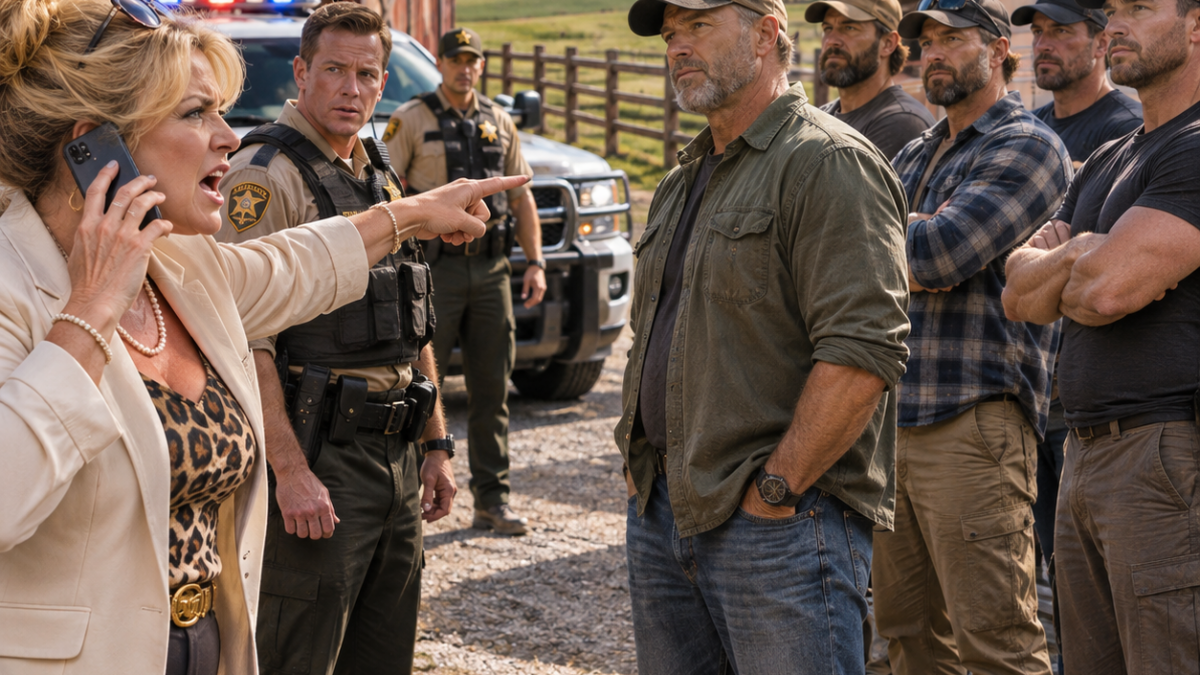
HOA Karen Called 911 on Me and My Friends—She Had No Idea They Were Navy SEALs
**“OFFICER, THESE MEN ARE TRESPASSING, BLOCKING HOA PROPERTY, AND REFUSING TO LEAVE—REMOVE THEM NOW!” Vanessa Cole shouted as two sheriff’s deputies stepped onto my ranch.**
**The five men standing beside me looked like ordinary middle-aged guys in jeans and work boots, but Vanessa had no idea every one of them had spent years serving in Navy SEAL teams—and none of us had any intention of using that fact to win a property dispute.**
**Then the deputy asked Vanessa to prove the lane belonged to her HOA, and the map she handed him showed nearly six miles of roads, trails, water lines, and emergency corridors stretching across hundreds of acres of my private ranch.**
The first sheriff’s SUV had barely stopped beside my barn when Vanessa Cole came marching down the gravel lane pointing at me and the five men standing near my horse trailer.
“That’s them!”
She sounded breathless from anger.
“Those men are trespassing, blocking HOA property, and intimidating residents.”
I stared at her.
Nobody had threatened anybody.
Nobody had stepped onto Pinerest property.
Nobody was even raising their voice.
We had been repairing fence.
Badly.
That was about the most dangerous thing happening on Garrett Ridge Ranch that morning.
Two deputies climbed out.
The older one was Ryan Holloway.
He asked everyone to remain where they were.
Vanessa folded her arms like she expected handcuffs.
Ryan looked at me.
Then at my friends.
Noah Briggs.
Daniel Price.
Cole Turner.
Samuel Hayes.
Jack Warren.
When Ryan reached Noah, his expression changed.
“Briggs?”
Noah stared at him for a second.
Then smiled.
“Ryan Holloway. Virginia Beach.”
Vanessa looked confused.
Ryan had served in the Navy before becoming a deputy.
Not as a SEAL.
But he knew Noah from years earlier.
Vanessa immediately stepped between them.
“I don’t care who he knows. They’re trespassing.”
Ryan turned toward her.
“Ma’am, knowing them doesn’t determine who owns the land.”
Exactly.
That was the first thing he said that made me trust how he was going to handle the situation.
My friends’ military backgrounds did not give them special property rights.
They did not make Vanessa wrong.
They did not make me right.
Records would do that.
Ryan continued:
“We’re going to check the property line and your complaint.”
PART2:
Vanessa opened her folder.
“I have the HOA map.”
“Good.”
Ryan held out his hand.
“Show me.”
That was when a ridiculous 911 call became something much bigger.
The map did not just show the barn lane Vanessa had accused us of blocking.
It showed roads.
Trails.
Water lines.
A supposed emergency corridor.
Nearly six miles of “community infrastructure.”
And most of it crossed Garrett Ridge Ranch.
I stared at the page.
“Where did you get this?”
Vanessa answered with complete confidence.
“It’s part of Pinerest’s permanent community infrastructure.”
Ryan pulled up the county parcel layer on his computer.
He compared it with Vanessa’s map.
Then looked at her.
“There’s a problem.”
“What problem?”
“Most of what your HOA map labels community infrastructure appears to be on Mr. Garrett’s property.”
Vanessa shook her head.
“That can’t be right.”
Ryan pointed toward one line reaching my private lake.
“What exactly is this?”
The map label read:
PINEREST EMERGENCY WATER AND RECREATION ACCESS.
I looked at Vanessa.
“Recreation access?”
She stopped talking.
Daniel Price pointed toward the north ridge.
“Luke, weren’t those orange stakes up there two days ago?”
My stomach tightened.
I had seen them.
Fresh stakes near my northern fence.
I assumed a utility crew was working along the county road.
Ryan zoomed out.
The line on Vanessa’s map continued past my lake.
Through the north pasture.
Then directly toward nine hundred acres of undeveloped land behind Pinerest Estates.
“What’s that area?” I asked.
Vanessa finally said:
“Future safety planning.”
“Future for who?”
She looked at Ryan instead of me.
Ryan closed the folder halfway.
“Nobody is being arrested over a map we haven’t verified.”
Then:
“But we do need to understand why an HOA is showing hundreds of acres of private ranch land as controlled community access.”
That was when Vanessa stopped worrying about who my friends were.
Because within the next few hours, five former Navy SEALs would become the least surprising thing anybody discovered.
My name is Luke Garrett.
I was fifty-two years old when this happened.
Garrett Ridge Ranch sat outside Colorado Springs and covered just over thirty-nine hundred acres.
Pasture.
Pine forest.
Rocky hills.
Creeks.
Private lake.
Old ranch roads built long before Pinerest Estates existed.
I did not grow up wealthy.
Dad repaired heavy equipment.
Mom worked in a school cafeteria.
I spent summers doing whatever job would pay.
I joined the Navy young.
I was never a Navy SEAL.
That matters.
I worked logistics and later supported special operations units during several assignments.
That was how I met Noah, Daniel, Cole, Samuel, and Jack.
All five later served in SEAL teams at different points.
We stayed friends after leaving active service.
I eventually built a transportation company.
Sold my share.
Bought Garrett Ridge because I wanted something I had spent much of my younger life without.
Quiet.
My friends visited every couple of years.
No tactical exercises.
No weapons training.
No dramatic military nonsense.
We grilled steaks.
Argued about football.
Fixed things that did not need fixing.
Rode horses worse than we admitted.
Jack told stories about fish nobody had ever seen.
The fish became larger every year.
Pinerest Estates sat along the eastern boundary.
About six hundred homes.
Clubhouse.
Tennis courts.
Walking trails.
Mountain views.
Most residents were good neighbors.
Some bought firewood.
Families sometimes attended an annual fishing day at a small pond near the boundary.
Nancy Mitchell, a retired teacher, brought homemade bread whenever my ranch crew helped clear snow from the county shoulder.
I never had a problem with the neighborhood.
My problem was Vanessa Cole.
The first time I met Vanessa, she came to my gate and asked me to move three cattle because residents could see them from a walking trail.
She called it a “visual landscape concern.”
I told her:
“My cows haven’t joined Pinerest.”
She did not laugh.
That should have warned me.
For the next year, we had small disputes.
HOA gardeners crossed my boundary trimming bushes.
Trail marker twenty feet inside my land.
Utility trailer parked near my east gate.
Nothing catastrophic.
I called.
They corrected it.
Life continued.
Then wildfire planning started.
That part I took seriously.
Colorado wildfire danger was real.
Pinerest had one major road toward the highway.
If fire blocked it, hundreds of families could be trapped.
Vanessa asked whether one of my eastern ranch roads could serve as temporary evacuation access during a true emergency.
I agreed in principle.
My attorney, Megan Foster, drafted a one-year agreement.
Very narrow.
Declared evacuations.
Official wildfire drills scheduled in advance.
Firefighters.
Emergency vehicles.
The road remained private.
No daily traffic.
No development rights.
No construction.
No recreation.
No permanent transfer.
Everybody signed.
It worked.
Fire crews used it during one drill.
Pinerest volunteers helped clear brush on their side.
I allowed a water tank near the gate after the county fire chief recommended it.
That was what good neighbor cooperation looked like.
Ask.
Agree.
Write down the limits.
Respect them.
The first agreement expired.
Vanessa asked for another.
I agreed.
Almost identical.
Then Pinerest hired Summit Residential Services.
Regional manager:
Peter Caldwell.
Peter contacted me about widening the route.
He said Pinerest wanted improved wildfire access.
Maybe another water connection.
Then he sent a drawing.
Route twice as wide.
Farther inside Garrett Ridge.
Ending at my private lake.
I called immediately.
“Why does Pinerest need my lake?”
“Emergency water.”
“Who requested it?”
“Fire department planning.”
I called the fire chief.
He knew Pinerest was studying emergency water.
He had never requested permanent lake access.
I declined.
Peter accepted that.
Vanessa did not.
“You’re making Pinerest less safe.”
“I support emergency access.”
“Then approve the lake connection.”
“I support what actual fire officials recommend. Not permanent HOA rights because your consultant wants them.”
“Responsible communities cannot wait for private owners to become comfortable.”
I remember that sentence.
Because it showed how she thought.
I answered:
“Responsible communities ask before using somebody else’s property.”
For several months, nothing happened.
Then Pinerest residents started driving the emergency road.
No fire.
No evacuation.
No drill.
One SUV.
Then two.
Then delivery vehicles.
A driver told me his navigation app showed the ranch lane as a neighborhood shortcut.
That road had never been public.
Megan contacted the mapping company.
Someone had submitted it as community accessible.
We corrected the listing.
Vanessa called.
“You removed an established secondary route.”
“It was never established.”
“It appears on the emergency plan.”
“Emergency is the important word.”
I installed signs.
PRIVATE RANCH
EMERGENCY ACCESS ONLY.
Traffic dropped.
Then hikers started appearing near my lake.
A couple one weekend.
Family the next.
They all had the same explanation.
Pinerest trail map showed a lake overlook.
I downloaded the HOA map.
There it was.
Green dotted trail.
Across my fence.
Along an old cattle road.
Ending at my lake.
LAKE VIEW EMERGENCY TRAIL.
I emailed Vanessa.
“Is it emergency or recreation?”
She replied:
“Part of the community safety network.”
I asked when I approved public hiking.
No answer.
Then she used the word historical.
Historical access.
That word sent me straight to Megan.
She ordered every recorded easement, license, subdivision plat, and old agreement tied to Pinerest and Garrett Ridge.
We found something.
Twenty-one years earlier, before I owned the ranch, Harold Benson had signed a temporary fire-access license.
Pinerest’s original developer could cross a narrow ranch road during construction and wildfire emergencies.
Three years.
Expired eighteen years earlier.
No recreation.
No lake access.
No future development.
No utilities.
Megan laughed.
“If this is their historical right, history ended eighteen years ago.”
We sent copies to Vanessa and Summit.
Everything calmed down again.
That was when I planned the reunion.
Noah arrived Thursday afternoon.
Old pickup.
Virginia plates.
Daniel came from Florida.
Cole from North Carolina.
Samuel from Texas.
Jack flew to Denver and complained about airline coffee for an hour.
Saturday morning, we were repairing fence near the lake.
All of us wore jeans.
Work boots.
T-shirts.
Baseball caps.
No military uniforms.
No tactical gear.
Nothing identifying their backgrounds.
Around eleven, a Pinerest golf cart came up the ranch lane.
Vanessa driving.
Another board member beside her.
She stopped near the barn.
“Who are these people?”
“My friends.”
“They cannot be here.”
I stared at her.
“This is my ranch.”
“This lane is part of Pinerest’s emergency corridor.”
“It crosses my ranch.”
“You cannot block community infrastructure.”
Noah whispered behind me:
“Is she serious?”
“Very.”
Vanessa pointed at our trucks.
“You have vehicles parked in the access lane.”
They were well off the road.
Emergency vehicles could have passed easily.
I did not want a screaming match.
“Guys, move them another ten feet.”
Everybody moved.
Vanessa still stayed.
Then she saw Jack and Samuel holding three green trail markers.
They had removed them from my fence.
“You destroyed HOA property.”
Jack looked at the marker.
“It was nailed to Luke’s fence.”
Vanessa turned toward me.
“You authorized them?”
“Yes.”
“You cannot remove emergency trail markers.”
“They lead hikers onto my private land.”
“They are part of the safety network.”
Again.
Safety network.
I asked her to leave.
She refused.
I asked again.
She pulled out her phone.
“I’m calling the police.”
Noah asked:
“Want us inside?”
“No. You’re my guests.”
Vanessa called 911.
She told dispatch several unknown men were blocking an HOA emergency corridor.
Removing community property.
Refusing to leave.
She did not mention that the men were invited by the ranch owner.
She did not mention the signs were attached to my fence.
She certainly did not know those five ordinary-looking men had spent large parts of their adult lives serving in Navy SEAL teams.
Twenty minutes later, Deputy Ryan Holloway recognized Noah.
That was the moment Vanessa’s expression changed.
Only briefly.
Then:
“I don’t care if they were Navy SEALs.”
Noah answered:
“Nobody said you should.”
Ryan nodded.
“Correct.”
That was important.
Military service was not a legal shortcut.
The property records still had to decide the dispute.
Then Vanessa showed Ryan the map.
Three hundred acres.
Lake.
Trails.
Water.
Roads.
Emergency corridor.
And the line toward the undeveloped nine hundred acres.
Megan arrived shortly afterward.
She compared the HOA map to county property records.
The difference was enormous.
Real emergency agreement:
About seventeen acres.
Modern HOA map:
More than three hundred.
Real agreement ended at an eastern pasture gate.
HOA map continued toward the lake.
North pasture.
Then the undeveloped property.
Megan pointed at it.
“Who owns this?”
Vanessa said:
“Canyon Ridge Development.”
I knew the name.
Nine hundred acres purchased behind Pinerest.
Rumors about homes.
“How many?”
Vanessa hesitated.
“About eight hundred.”
Megan checked the planning portal.
Canyon Ridge preliminary plan:
840 homes.
One primary road north.
Second emergency and traffic connection east.
Through Pinerest.
Then across Garrett Ridge.
My road.
Traffic study called it:
GARRETT-PINEREST WESTERN CONNECTION.
Not proposed.
Not potential.
Connection.
As though it already existed.
Then:
EXISTING COMMUNITY ACCESS RIGHTS TO BE UPGRADED.
My stomach dropped.
“What rights?”
Vanessa looked almost as surprised as I was.
Then Peter Caldwell arrived from Summit Residential.
He looked at Vanessa’s map.
“This isn’t the board map we normally use.”
Megan asked:
“What map is it?”
Peter looked at the file name.
“Regional infrastructure planning.”
“Regional with who?”
“Canyon Ridge.”
Vanessa turned on him.
“You told us Canyon Ridge was contributing to wildfire improvements.”
“They are.”
“How much?”
Peter hesitated.
“Up to four million dollars.”
Nobody spoke.
Four million dollars for widening the route.
Drainage.
Emergency water connection.
And a new bridge near my north pasture.
Frank Miller, my foreman, had arrived by then.
I asked:
“Have you seen bridge survey stakes?”
He nodded.
“Near Cedar Creek.”
The orange stakes.
Not utility markers.
Canyon Ridge survey work.
Ryan asked:
“Who authorized field work on Garrett Ridge?”
Peter opened his tablet.
The file said:
EXISTING PINEREST EMERGENCY AND MAINTENANCE AUTHORITY.
Megan shook her head.
“No such authority extends anywhere close to those locations.”
Then Frank’s phone rang.
A ranch hand from the north pasture.
Surveyors at Cedar Creek.
Right then.
We drove out together.
Deputies came too.
Not because anyone was under arrest.
Because Ryan wanted the existing dispute documented and nobody escalating it.
Three survey trucks.
Soil-testing equipment.
The crew supervisor immediately stopped when I identified myself as owner.
He showed Megan the authorization.
Future bridge foundation.
Canyon Ridge wanted a bridge for the Western Connection.
Then he unfolded a larger engineering plan.
Road.
Water main.
Fiber.
Stormwater.
Emergency reservoir connection at my lake.
Large area labeled:
FUTURE REGIONAL SERVICES SITE.
Megan checked the footprint.
“Luke.”
“What?”
“This affects almost five hundred acres.”
Vanessa whispered:
“Our HOA never approved this.”
The crew supervisor pointed to a land-control certificate.
It said Pinerest already had corridor authority.
Reference number.
Megan searched.
Recorded seven months earlier.
PINEREST REGIONAL EMERGENCY AND INFRASTRUCTURE DECLARATION.
It relied on Harold Benson’s old agreements.
Harold had died nine years earlier.
Yet somebody had taken limited, temporary emergency permissions from decades ago and used them to support modern claims involving roads, bridges, utilities, recreation, lake access, and future development over nearly five hundred acres.
Ryan looked at all of us.
“This is no longer about a 911 call.”
He was right.
Vanessa had called police because she believed five men were blocking HOA property.
She had no idea they were former Navy SEALs.
She had even less idea her call would expose an 840-home project, four million dollars in infrastructure funding, and a five-hundred-acre planning corridor across land Pinerest did not own.
Then Peter’s phone rang.
Canyon Ridge.
They wanted to know why soil testing had stopped.
I said:
“Tell them because they’re on my ranch.”
Peter looked at the schedule.
Then went pale.
Road clearing was supposed to start Monday.
Three days later.
Nobody had planned to ask me first.
Megan spent Sunday stopping it.
Canyon Ridge attorney agreed in writing:
No clearing.
No surveys.
No bridge work.
No lake access until valid property rights were proved.
My friends stayed another day.
Nobody wanted to pretend the reunion had been normal.
Noah cooked breakfast.
Daniel repaired fence.
Cole checked a water line with Frank.
Samuel and Jack argued about grills.
Ordinary.
That helped.
Vanessa came by Monday afternoon.
This time she stopped outside the gate.
Called.
Waited.
“Can I come in?”
That question alone felt like progress.
I opened the gate.
She apologized directly to my friends.
“I should not have described you as unknown threatening men after Luke told me you were his guests.”
Noah nodded.
“Apology accepted.”
No speeches.
No SEAL stories.
No trying to embarrass her.
Daniel simply said:
“The bigger issue seems to be the land map.”
Exactly.
Vanessa explained Pinerest’s board had approved only:
Wildfire evacuation study.
Possible improvements to existing emergency access.
Talks with Canyon Ridge about helping fund safety improvements.
The board never approved daily traffic.
Lake access.
Five hundred acres.
Regional utilities.
Connection for eight hundred forty new homes.
Then where did it come from?
Summit Residential brought records.
Harold Benson’s old three-year fire license.
Two-day snowstorm permission.
A later letter asking Harold about permanent access.
His answer:
Willing to discuss emergencies.
No regular neighborhood traffic through the ranch.
I looked at Vanessa.
“Sounds familiar.”
She looked down.
“Yes.”
Then the planning history.
Four years earlier:
Wildfire consultant gave three evacuation options.
Garrett route marked:
SUBJECT TO LANDOWNER AGREEMENT.
Correct.
Two years later:
PREFERRED EMERGENCY CONNECTION — OWNER COORDINATION REQUIRED.
Still reasonable.
Then wording shifted.
EXISTING GARRETT EMERGENCY CORRIDOR EXPANSION.
Then:
EXISTING COMMUNITY EMERGENCY CORRIDOR.
Then:
EXISTING COMMUNITY ACCESS CORRIDOR.
Finally:
PINEREST COMMUNITY INFRASTRUCTURE CORRIDOR.
Nobody signed anything between those versions.
Megan said:
“This is how planning language outruns the property right underneath it.”
The wording changed as the money increased.
Canyon Ridge purchased its nine hundred acres.
Their own northern access was possible.
Just expensive.
Using my ranch saved millions.
Andrew Lawson, Canyon Ridge project director, came with his attorney.
He did something I respected.
He did not pretend the map automatically gave him rights.
“We relied on Summit and Continental Access Partners to tell us what rights existed.”
Megan asked:
“Did your title people request the easement?”
“They received the regional declaration.”
“Who prepared it?”
Continental Access Partners.
Summit recorded it.
Pinerest board never voted on it.
Summit believed the declaration merely “clarified” existing rights.
Megan said:
“You can’t clarify rights into existence.”
Then we learned Continental earned an additional $380,000 if the Garrett connection reached final design.
Not proof by itself.
But definitely motive to keep that route alive.
Then another connection surfaced.
Front Range Infrastructure Solutions would build portions of the bridge and water system.
Martin Keller, Continental’s regional director, owned eighteen percent of that company.
Now the consultant promoting the route also had a financial interest in the contractor that could build it.
Summit suspended Continental.
Canyon Ridge stopped relying on its reports.
Then the fire chief called.
A permanent dry-hydrant application had been submitted for Garrett Lake nine months earlier.
Rejected.
Reason:
OWNER CONSENT REQUIRED.
Yet newer infrastructure maps showed my lake as an approved emergency water site.
Then a second application appeared.
Filed by Front Range.
This time an authorization letter was attached.
GARRETT RIDGE RANCH AUTHORIZES LIMITED LAKE ACCESS.
My name typed below.
Electronic approval.
Except the email address was wrong.
Mine ended one way.
The approval came from an almost identical domain with a hyphen.
Someone had created an address designed to look like mine.
Contractors arrived at my locked north gate with a drilling rig.
They stayed outside.
When I told them I had never authorized anything, they stopped.
Preserved the records.
That became important.
The false approval moved through several organizations.
Front Range permit portal showed it had been uploaded through Martin Keller’s Continental account.
Martin denied creating the fake email.
Said another permitting contractor handled owner confirmation.
Clear Path Permitting cooperated.
Their records showed they had asked Continental for my contact information.
Continental supplied the fake address.
Clear Path emailed it.
Someone replied from that address:
GARRETT RIDGE APPROVES LIMITED SITE REVIEW FOR FIREWATER PLANNING.
Not construction.
Just enough approval to move survey and soil-testing crews onto my property.
Nobody had called me.
Nobody verified the address.
Then the fake domain’s billing records surfaced internally.
Purchased with a Continental corporate card.
Continental IT found two email accounts.
One was used to impersonate owner approval.
Three employees had access.
Martin Keller.
Stephanie Moore.
Todd Benson.
That last name stopped everyone.
Benson.
Harold Benson’s grandson.
The former ranch owner’s grandson worked inside the firm planning access across the ranch.
We did not assume guilt.
Same last name was not proof.
Then Continental checked.
Todd really was Harold’s grandson.
Todd joined a video interview.
He looked terrified.
“Did you create the owner email?”
“Yes.”
“Why?”
“Martin asked me to create a dedicated project contact address.”
“Did you send a message saying Garrett Ridge approved site review?”
“Yes.”
“Did you ever speak to me?”
“No.”
“Then who did you think you were speaking for?”
No answer.
Todd claimed internal notes treated owner approval as expected because I had previously cooperated on wildfire access.
Expected.
Again.
Expected permission becoming actual permission.
Then I asked about Harold.
“Did your grandfather ever believe Pinerest had permanent rights?”
Todd shook his head.
“No.”
“Lake rights?”
“No.”
“Development access?”
“No.”
He told me Harold once said:
“A temporary gate becomes a permanent road if you stop paying attention.”
That sounded like something Dad would have said.
Then Todd produced an old note he had sent Martin when he found Harold’s archived papers.
GRANDFATHER’S RECORDS SHOW TEMPORARY EMERGENCY USE ONLY.
NO EVIDENCE OF PERMANENT LAKE OR DEVELOPMENT ACCESS.
Martin had received it.
Continental suspended him from the project.
Correction notices went everywhere.
Firewater application withdrawn.
Fake email shut down.
Drilling canceled.
County planning marked every Garrett Ridge item:
LANDOWNER AGREEMENT REQUIRED.
For the first time in months, the north pasture felt quiet again.
My friends went home.
Our group chat became unbearable.
Jack changed the name to:
LUKE’S INTERNATIONAL HOA CRISIS COMMAND.
I changed it back.
Noah changed it again.
Daniel sent a photo of his driveway with a homemade sign:
PRIVATE PROPERTY — JACK WARREN MUST ASK FIRST.
I laughed.
Those five men started the afternoon as the dramatic twist Vanessa never saw coming.
But the truth was better than the viral version.
They did not use their military past to intimidate her.
They cooperated.
Stayed calm.
Then went home and let surveys, contracts, title records, attorneys, and county documents solve the problem.
Service deserved respect.
Evidence still mattered more in a property dispute.
Pinerest held a resident meeting.
More than two hundred people attended.
One man asked why I was taking away their emergency route.
Vanessa answered before I did.
“He isn’t taking anything away. We never had the permanent route we thought we had.”
That was the clearest thing she had ever said.
I told residents I was willing to create a real long-term emergency agreement.
Eastern Ranch Road.
Declared evacuations.
Fire crews.
No daily traffic.
No recreation.
No lake access.
No Canyon Ridge traffic.
No future development rights.
Nobody had to hate anybody.
We just needed accurate boundaries.
The county fire department participated this time.
They chose gates.
Road width.
Emergency requirements.
Pinerest paid for maintenance associated with emergency use.
I retained ownership.
Simple.
Then Canyon Ridge came back.
This time they asked.
Andrew offered $7.5 million for a narrow transportation easement along the far north edge of Garrett Ridge.
Far from my lake.
Far from my barn.
Independent route.
I did not say yes.
I did not say no.
Megan ordered an appraisal and traffic study.
Andrew accepted.
That was how serious property negotiations were supposed to work.
Then Continental finished investigating Martin Keller.
They found an email.
Stephanie Moore had asked:
DO WE HAVE LUKE GARRETT’S ACTUAL CONSENT FOR LAKE SITE REVIEW?
Martin responded:
NOT FORMALLY. USE HISTORIC EMERGENCY COOPERATION AS BASIS FOR PRELIMINARY APPROVAL. WE CANNOT LET LANDOWNER CONTACT DELAY REGIONAL SCHEDULE AGAIN.
There was the sentence that ended his excuses.
He knew formal approval was missing.
He told people to move forward anyway.
Continental terminated him.
Professional review opened around his financial interest in Front Range.
Their insurer began discussing my legal and restoration costs.
Then another company surfaced.
High Mesa Land Strategies.
It had requested the modern regional declaration claiming continuing Garrett access.
Manager:
Steven Benson.
Todd’s father.
Harold Benson’s son.
The Benson family appeared again.
But this time, the discovery was not fake.
Steven had something real.
Twenty-two years earlier, Harold Benson had signed an option allowing Pinerest’s original developer to purchase up to ninety acres for a permanent emergency road if several conditions were met.
Price formula.
Survey.
County approval.
Final closing.
Twenty-five-year term.
The option had not technically reached its final expiration date.
My stomach dropped.
For months we had been dealing with stretched temporary permissions.
Now we had found an actual signed contract.
And it might still matter.
A memorandum of that conditional option had been recorded.
County conceptual approval existed.
Then Steven produced an engineering permit issued within the deadline.
Then a canceled check.
$100,000.
Paid to Harold.
Deposited.
Vanessa looked horrified.
“Does that mean Pinerest can take ninety acres?”
Megan refused to guess.
“We read the whole agreement.”
That saved us.
Because the option did not say the developer could pay $100,000 and sit on the deal for twenty-five years.
Once exercised, the developer had 180 days to complete the survey, settle the exact road parcel, pay the remaining purchase price, and close.
If closing failed because of the developer?
Deposit became Harold’s money.
Purchase expired.
High Mesa sued anyway.
Asked the court for temporary survey access.
For the first time in the whole dispute, we were facing a serious legal claim instead of inflated planning language.
Judge Rebecca Collins listened.
High Mesa showed:
Signed option.
County conceptual approval.
Engineering permit.
$100,000 deposit.
Megan showed:
No final deed.
No final signed road survey.
No remaining purchase payment.
No closing statement.
Judge Collins asked:
“If this purchase was exercised twenty-one years ago, why was it never completed?”
High Mesa did not know.
The judge denied temporary access.
First prove the right.
Then discuss entry.
A retired title officer eventually solved it.
Old paper closing file.
Three inches thick.
The developer had run into unstable soil.
Asked Harold for more time.
Harold granted forty-five days.
More engineering problems followed.
They asked again.
Harold refused.
Then the document everybody had been missing:
NOTICE OF FAILURE TO CLOSE.
Closing deadline expired.
No completed survey.
No balance payment.
Proposed conveyance terminated.
$100,000 remained with Harold under the option.
Next page:
Developer attorney acknowledged the termination.
No dispute.
No demand for refund.
Deal dead.
The only reason the old option still looked alive was astonishingly ordinary.
The release was prepared.
Somebody checked the wrong box on a closing checklist.
It was never recorded.
A twenty-year paperwork mistake sat in the public index looking like an unfinished property right.
Steven withdrew the lawsuit.
High Mesa recorded a formal release.
No continuing claim.
Canyon Ridge canceled its conditional $9 million deal with High Mesa.
That part mattered too.
Nobody had secretly been paid nine million dollars for my land.
The agreement was conditional.
Money came only if High Mesa legally delivered the access.
They could not.
Steven came to Garrett Ridge with Todd.
“I thought Dad left an unfinished right.”
“He left a finished deal nobody recorded correctly.”
Steven nodded.
“You’re right.”
“You should’ve called me before forming a company around my ranch.”
“I know.”
Todd gave me Harold’s remaining property records.
“These belong with the ranch.”
I accepted them.
That felt like a better ending than another lawsuit.
Continental and Summit eventually settled the unauthorized survey and false-approval issues.
Their insurers covered most costs.
I received $640,000 plus professional fees and restoration expenses.
Not some fantasy fortune.
Real money for a very real mess.
More important:
Every agency received corrected documentation.
Pinerest adopted the new ten-year wildfire agreement.
My lake excluded.
Daily neighborhood traffic excluded.
Canyon Ridge excluded.
Utilities excluded.
Emergency meant emergency.
Temporary meant temporary.
Proposed meant proposed.
Then Canyon Ridge returned one last time.
New northern route.
Just under forty acres affected.
No lake.
No barn.
No Pinerest lane.
Independent appraisal.
Traffic study.
Months of negotiation.
Final limited transportation easement:
$6.9 million.
Strict terms.
Fencing.
Drainage.
Ranch crossings.
Noise protection.
Long-term maintenance.
No automatic rights for other subdivisions.
No utility rights unless separately negotiated.
No expansion outside the defined strip.
Andrew Lawson shook my hand at closing.
“We should have started here.”
“With talking to me?”
“Yes.”
“That would’ve saved a lot of paper.”
Pinerest changed its rules too.
No outside property labeled community-controlled without title verification.
Proposed land had to say proposed.
Emergency agreements displayed expiration dates.
Temporary permissions could not be converted into permanent map labels.
Outside consultants had to disclose financial interests in contractors benefiting from their recommendations.
Vanessa supported every change.
Six months after she called 911 on me and my friends, Pinerest held its wildfire preparedness picnic.
I attended.
So did Megan.
Frank.
County fire crews.
Noah happened to be visiting again.
Vanessa saw him.
Then laughed.
“This time I know who your guest is.”
Noah smiled.
“Should I bring identification?”
“Please don’t make me relive that day.”
Funny thing was nobody cared anymore that Noah and the others had been SEALs.
Their service was respected.
But it never decided who owned Garrett Ridge.
Ryan Holloway understood that from the first minute.
He recognized Noah.
Said hello.
Then checked the records exactly as he should have done with anyone else.
Vanessa later told me she had originally thought learning who my friends were would be the shock of that day.
It wasn’t.
The real shock was learning how little Pinerest knew about land it had been confidently calling its own.
That was exactly right.
The version people liked retelling was simple.
HOA Karen called 911 on Luke Garrett and his five friends.
Then discovered the quiet middle-aged men standing beside his barn were former Navy SEALs.
That happened.
But the better story came afterward.
The deputy asked one basic question:
Why does your HOA claim this lane?
That exposed a trail map.
Then a three-hundred-acre infrastructure map.
Then nearly five hundred acres.
Then Canyon Ridge’s eight hundred forty homes.
Four million dollars.
The lake.
The bridge.
Utilities.
False electronic approval.
A consultant knowingly moving forward without formal consent.
A forgotten twenty-five-year option.
And finally an archived closing file proving that option had died twenty-one years earlier.
No single lie created the mess.
One assumption sat on top of another.
Harold allowed temporary emergency help.
I allowed emergency access.
Pinerest maintained a short piece of road after drills.
Consultants saw old negotiations.
Developers saw a cheaper route.
Somebody wrote “existing.”
Someone else wrote “community.”
Then somebody wrote “controlled.”
Eventually surveyors appeared with equipment because nobody stopped to ask what the original document actually said.
That is how permission turns into entitlement.
Slowly.
Quietly.
Usually on paper first.
A year later, Pinerest firefighters still crossed Garrett Ridge during real emergencies.
Families still attended the annual fishing day at the small boundary pond.
Nancy still brought bread.
Frank still communicated almost entirely through grunts and short sentences.
My friends still argued about Jack’s imaginary giant fish.
And Vanessa still annoyed me occasionally.
But she called before coming through the gate.
Every single time.
One Saturday my phone rang.
“Luke, can I come through?”
“Why?”
“Fire committee meeting. We need to look at the emergency gate.”
“Yes.”
She paused.
“That easy?”
“That easy.”
That tiny conversation contained the entire lesson.
I never wanted people to stop asking me for help.
I wanted them to stop confusing my willingness to help with ownership.
My friends being Navy SEALs never changed that.
Vanessa calling 911 never changed it.
Four million dollars never changed it.
An eight-hundred-forty-home development never changed it.
Maps never changed it.
Consultants never changed it.
A forgotten option never changed it once the full closing file was found.
Garrett Ridge was private land.
And if someone wanted something from it, the process was remarkably simple.
Ask.
Then respect the answer.








