HOA Karen Called 911 Because I Refused Her “Inspection”—Then the Deputy Asked Why I Wasn’t Even in Her HOA
HOA Karen Called 911 Because I Refused Her “Inspection”—Then the Deputy Asked Why I Wasn’t Even in Her HOA
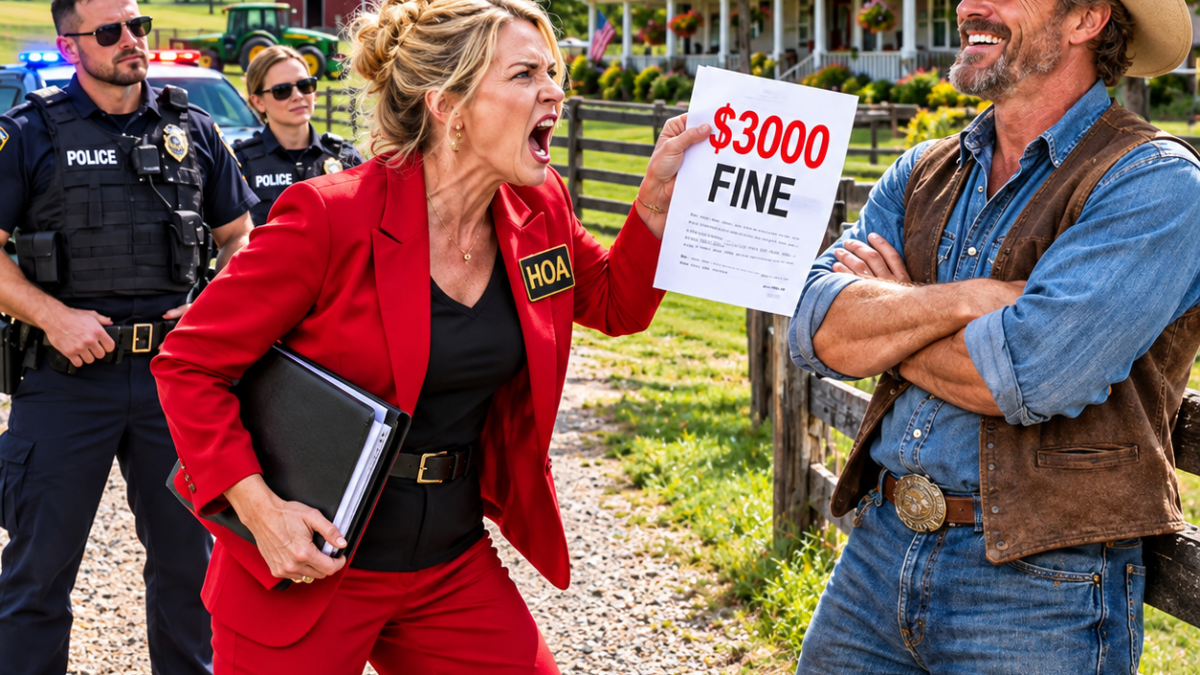
“OFFICER, HE’S REFUSING A LEGALLY REQUIRED HOA INSPECTION—MAKE HIM OPEN THIS GATE!” Karen Whitfield shouted as the third sheriff’s cruiser stopped in front of my barn.
I had refused to join Brookstone HOA months earlier, yet Karen kept sending inspectors, violation notices, and 911 complaints to my forty-nine-acre farm as if saying no had somehow made me a member.
Then she handed the deputy an agreement carrying what looked exactly like my signature—and a dusty file inside my equipment shed exposed why she needed that inspection so badly.
The third sheriff’s cruiser stopped in front of my barn just as Karen Whitfield started pounding both hands against my locked gate.
Behind her stood two men wearing bright orange safety vests.
A private security guard.
A woman holding a clipboard labeled PROPERTY INSPECTION.
Two Brookstone Community Security vehicles blocked part of the county road.
Across the fence, several neighborhood residents had started gathering to watch.
Karen pointed through the gate at me.
“Officer, he is refusing a legally required HOA inspection.”
Deputy Michael Turner climbed out of his cruiser looking tired.
He had been to my property enough times by then to recognize the driveway.
I walked toward him carrying a copy of my deed.
“Officer, I’m not an HOA member.”
Karen interrupted immediately.
“He has already accepted limited Brookstone jurisdiction.”
I looked at her.
“No, I haven’t.”
Michael raised one hand.
“One person at a time.”
I handed him the deed.
“This is Lawson Farm. Forty-nine acres. My family has owned it for more than thirty years. Brookstone was built next door long after my father bought this land.”
Karen opened a leather folder.
“That’s no longer the complete legal picture.”
Michael looked at her.
“Do you have a warrant?”
“We don’t need one.”
“Court order?”
“We have contractual inspection authority.”
“Recorded easement?”
“We have something stronger.”
That answer bothered me.
PART2:
She pulled out a document.
BROOKSTONE EXTERNAL SAFETY AND ACCESS AGREEMENT.
My name appeared at the bottom.
Nathan Lawson.
Below it was a signature.
My stomach dropped.
It looked exactly like mine.
Michael read the first page.
Then the second.
According to the agreement, I had voluntarily placed almost sixteen acres along the eastern side of my property under limited Brookstone safety jurisdiction.
It allowed the HOA to inspect fences.
Drainage.
Roads.
Outbuildings.
Potential emergency access routes.
The agreement claimed I had accepted those conditions in exchange for Brookstone maintaining portions of the boundary.
Michael looked at me.
“Mr. Lawson, did you sign anything giving this association inspection rights over your property?”
“No.”
Karen shook her head dramatically.
“He’s lying.”
I looked at her.
“I’ve never seen that document.”
“It was witnessed and processed weeks ago.”
“By who?”
“Horizon Property Compliance.”
Before she could say anything else, one of the men in orange vests had walked toward my old equipment shed.
The door was partly open because I had been repairing a leaking water line nearby.
He leaned inside.
“There’s another file in here.”
Karen turned so fast it looked instinctive.
“Don’t open that!”
Everybody heard her.
Michael turned.
The inspector stepped backward.
I walked toward the shed with Michael.
Beneath an old workbench sat a cloudy plastic storage box that had belonged to my father.
I had barely touched it in years.
Mostly receipts.
Farm paperwork.
Old surveys.
Maintenance records.
I opened the lid.
On top sat a faded folder.
BROOKSTONE DEVELOPMENT — 2014.
Karen remained outside the shed.
Silent now.
I opened the folder.
The first page was a letter from Brookstone’s original developer asking Dad for permanent access across our eastern farm lane.
Dad’s handwritten response was clipped behind it.
REQUEST DENIED.
NO HOA MEMBERSHIP.
NO PERMANENT INSPECTION OR ROAD RIGHTS.
I read those words twice.
Then another document fell loose.
Temporary permission.
Thirty days.
Brookstone workers could enter five acres of our eastern field while repairing drainage after a severe storm.
Nothing permanent.
Nothing about HOA membership.
Nothing about inspections.
Dad’s signature appeared at the bottom.
Michael put Karen’s new agreement beside it.
Same long first stroke.
Same break.
Same tiny mark below the last letter.
Except Karen’s document printed my name above the signature.
Nathan Lawson.
The old document belonged to my father.
Robert Lawson.
Michael stared.
Karen spoke from outside.
“That could be an administrative error.”
My attorney, Rebecca Hayes, arrived less than twenty minutes later.
She looked at the two signatures.
Then at Karen.
“An administrative error does not create inspection rights over sixteen acres.”
She turned another page inside Dad’s folder.
And everything changed.
It was an old development map.
Brookstone on the north.
Lawson Farm beside it.
Then a wide line crossing our eastern pasture.
Past the pond.
Down the old dirt lane.
Toward eighty undeveloped acres south of us.
At the top:
BROOKSTONE SOUTH EXPANSION — FUTURE CONNECTOR.
I had never heard of Brookstone South.
Neither had George Bennett, one of my closest neighbors inside the HOA.
Then Michael’s radio crackled.
He listened.
Looked toward Karen.
The sheriff’s office had contacted county planning about the supposed inspection agreement.
The county had something else on file.
An application submitted four days earlier.
Emergency access road across Lawson Farm.
Applicant:
Horizon Property Compliance.
The same company standing at my gate.
Attached was another document carrying my supposed signature.
This one did not merely authorize inspection.
It authorized construction.
Then diesel engines appeared on the county road.
Three dump trucks.
An excavator.
Bulldozer.
They turned toward my driveway.
The lead driver stopped outside the gate.
“We’re here for the Brookstone Emergency Access Project.”
For several seconds, nobody said anything.
Karen had called 911 because I refused an HOA inspection.
But before the deputy could even decide whether Brookstone had inspection rights, someone had already sent heavy equipment to begin building through my farm.
That was when the entire thing stopped looking like an HOA power trip.
It began looking like a plan.
My name is Nathan Lawson.
Lawson Farm sits in northern Georgia.
Dad bought the first twenty-eight acres when I was young.
Over the next two decades, whenever neighboring farmland came available, he bought what he could.
By the time the property became mine, we had forty-nine acres.
Farmhouse.
Two barns.
Equipment shed.
Pond.
Woods.
Long gravel driveway connecting directly to a county road.
Brookstone Estates sat along our eastern boundary.
But it had never been part of our title.
Brookstone did not even exist when Dad bought the original property.
The neighborhood came much later.
Forty homes at first.
Then another phase.
Then another.
Eventually more than one hundred sixty houses.
Pool.
Playground.
Clubhouse.
Landscaped entrance.
Most residents were ordinary people.
I knew several.
George Bennett was a retired firefighter whose backyard faced part of my fence.
His wife Linda bought tomatoes from my garden every summer.
When a storm dropped a tree behind Brookstone, I used my tractor to help clear it.
George borrowed my trailer occasionally.
Nobody kept score.
Dad always believed good fences mattered, but kindness mattered more.
He also believed helping someone did not mean handing them permanent rights.
Everything changed when Karen Whitfield became HOA president.
She arrived at my farmhouse one Saturday morning in a black SUV with BROOKSTONE COMMUNITY ASSOCIATION on a magnetic door sign.
At first, she was polite.
She said Brookstone wanted stronger relationships with neighboring landowners.
I told her that sounded fine.
Then she handed me a thick folder.
Voluntary HOA membership.
I thought she was joking.
Joining Brookstone would put my working rural property under rules written for suburban homes.
Fence styles.
Lawn height.
Exterior colors.
Sheds.
Recreational vehicles.
Equipment storage.
I owned chickens.
Two tractors.
Livestock trailer.
Stacks of firewood.
A metal-roofed barn older than half the subdivision.
I thanked her.
“No.”
She explained the benefits.
Security patrol.
Trash pickup.
Pool.
Road maintenance.
Reduced community-service fees.
“The county maintains my road.”
“You’d have more comprehensive services.”
“I don’t need them.”
“Think about it.”
“I already did.”
A week later, another membership packet arrived by certified mail.
First year free.
I ignored it.
Then Karen offered two years free.
Still no.
That was when her language changed.
Brookstone was apparently concerned about “unregulated properties” around its outer boundary.
“What does that mean?”
“Properties next to Brookstone can affect home values even if they’re technically outside the association.”
Technically.
That word bothered me.
I was not technically outside Brookstone.
I was simply outside Brookstone.
No covenant.
No declaration.
No membership.
No recorded agreement.
Nothing.
I called Rebecca.
She checked title records.
Confirmed everything.
Lawson Farm was independent.
For about a month, life went back to normal.
I worked four days a week repairing commercial HVAC equipment.
The other days I spent on the farm.
Fence repairs.
Pond maintenance.
Barn work.
George helped me replace rotten boards one afternoon.
That peace was exactly why I liked living there.
Then the first inspection notice appeared.
Brookstone HOA would conduct an exterior compliance inspection Tuesday between nine and noon.
Targets:
Barn.
Front fence.
Equipment storage area.
Pond.
At first I assumed somebody had put the notice on the wrong property.
Then I saw my address.
I called Brookstone management.
Susan Parker answered.
She checked the system.
“Mr. Lawson, your parcel isn’t inside Brookstone.”
“I know.”
She apologized and removed the inspection.
Less than an hour later, Karen called.
“Susan had no authority to cancel a board-directed inspection.”
“Why does your board think it can inspect land outside the HOA?”
“Your property has boundary-impact status.”
“What statute creates that?”
“Our legal team is reviewing it.”
“Then nobody from Brookstone enters my farm.”
Tuesday came.
Nobody crossed the gate.
That afternoon, a man with a clipboard stood on Brookstone’s side of my fence.
He photographed my barn.
Tractor.
Chicken enclosure.
Pond.
He stayed on their property.
I left him alone.
Two days later:
Six-page inspection report.
Eleven violations.
Barn roof was an unapproved metal color.
Chicken enclosure was an unauthorized agricultural structure.
Tractor visible from Brookstone.
Improperly stacked firewood.
Pond lacked approved landscaping.
Gravel driveway failed neighborhood appearance standards.
I sat at my kitchen table laughing.
Rebecca did not.
She sent Brookstone a formal legal letter.
Lawson Farm was not an HOA parcel.
Its rules did not apply.
No inspections.
No entry.
The HOA attorney responded:
Jurisdictional concerns under review.
Then silence.
A few weeks later, Karen shifted toward safety.
George came over after an HOA meeting.
“She talked about the dirt lane behind your pond.”
“What about it?”
“Emergency evacuation route.”
The lane was an old farm track.
Rarely used.
Karen told Brookstone residents it might be necessary during wildfires or storms.
I told George:
“If there’s ever a real emergency and families need to cross my farm to stay alive, I’ll open the gate.”
“I figured.”
That was how normal neighbors handled emergencies.
Ask.
Help.
Close the gate afterward.
Karen wanted more.
Emergency Safety Cooperation Agreement.
First page sounded reasonable.
Second page gave Brookstone representatives access to inspect roads, fences, structures, drainage, and potential transportation corridors.
Rebecca read it.
“Do not sign this.”
“I wasn’t going to.”
Karen called twice.
Then emailed:
REFUSAL MAY FORCE BROOKSTONE TO USE OTHER AVAILABLE SAFETY PROCEDURES.
I saved it.
By then I had started keeping a binder.
Notices.
Emails.
Photographs.
Incident dates.
Dad always said memories become arguments.
Documents become evidence.
The first 911 call came three days later.
Deputy Michael Turner drove up while I was using the tractor.
Someone had reported dangerous heavy equipment near neighborhood children.
No children anywhere nearby.
The closest backyard was more than a hundred feet away behind a fence.
Michael looked around.
Found nothing.
Left.
Two days later another deputy arrived.
Loose chickens creating traffic danger inside Brookstone.
Every chicken I owned was inside its enclosure.
Three days after that:
Dangerous burning.
I was burning fallen branches in a legal farm burn pile after notifying the county.
Then:
Dangerous livestock.
Illegal dumping.
Unsafe pond water.
Blocked emergency access.
Noise.
Each time, deputies came.
Each time, normal farm activity.
At first I laughed.
Then Rebecca noticed something.
Almost every police complaint matched one of Brookstone’s supposed HOA violations.
Tractor.
Chickens.
Firewood.
Pond.
Dirt lane.
It looked as though HOA complaints were being converted into police calls.
We requested incident reports.
Different callers.
Some anonymous.
Some phone numbers.
No immediate proof Karen was personally behind them.
George later told me Brookstone residents had been encouraged to report “safety issues” they noticed along my boundary.
Some probably believed they were helping.
I refused to blame an entire neighborhood for whatever Karen was doing.
Then Brookstone sent another inspection notice.
REPEATED LAW ENFORCEMENT ACTIVITY DEMONSTRATES NEED FOR IMMEDIATE SAFETY INSPECTION.
Rebecca stared at it.
“They create reports. Then they point to the reports as evidence.”
Circular.
Exactly.
Karen came to my gate with two inspectors.
Pond drainage.
Fuel storage.
Barn wiring.
Emergency lane.
I refused entry.
She said:
“Refusing inspection makes it look like you have something to hide.”
“Wanting privacy does not prove danger.”
Before getting into her SUV, she looked at me.
“The next inspection won’t be optional.”
I called Rebecca immediately.
“Save the footage. Write down the exact words. If she comes back and refuses to leave, call the sheriff.”
Three quiet days.
Then the fourth morning.
Karen’s SUV at my gate.
Two Brookstone Security vehicles.
Horizon Property Compliance van.
Clipboard.
Camera on a pole.
Large toolbox.
Karen held up another notice.
“Emergency property inspection.”
“No.”
“Your refusal will be documented as obstruction.”
“Document it from the road.”
Then Karen called 911.
She told dispatch a property owner was refusing access to inspectors during an active safety matter.
She mentioned blocked emergency access.
She never said I was an HOA member.
She never said she had no warrant.
She simply made everything sound urgent.
Michael arrived.
Then another cruiser.
And eventually we reached the moment where Karen produced the fake agreement and Dad’s old file exposed the copied signature.
Now the construction equipment outside my gate made the real purpose impossible to ignore.
Deputy Michael walked toward the lead driver.
“Shut everything down.”
The supervisor introduced himself.
Robert Jenkins.
Southern Land Works.
He handed over the packet.
Emergency access route between Brookstone and the county road south of my property.
Rebecca asked:
“Who hired you?”
“Horizon Property Compliance.”
The same company whose inspectors were standing beside Karen.
“Did you know this land belongs to Nathan Lawson?”
Robert looked confused.
His papers described the route as Brookstone’s emergency corridor.
Property owner approval already obtained.
He turned the authorization toward me.
My name.
Nathan Lawson.
Same fake signature.
It authorized tree clearing.
Grading.
Drainage.
Fence removal.
Heavy equipment across sixteen acres.
Rebecca looked at Karen.
“You scheduled contractors before today’s inspection.”
Karen said she knew nothing about scheduling.
One Horizon employee shifted.
Michael noticed.
“Name?”
“Thomas Blake.”
“Who told Horizon the owner signed?”
“Our project director.”
“Name.”
Thomas hesitated.
“Richard Whitfield.”
I looked at Karen.
Rebecca asked:
“Related?”
Karen looked annoyed.
“He’s my brother.”
George slowly shook his head from the Brookstone side of the fence.
He had attended almost every HOA meeting that year.
Nobody had disclosed that Karen’s brother was running the company pushing the emergency corridor.
Karen corrected him.
Richard did not own Horizon.
He was regional project director.
Rebecca nodded.
“That still sounds relevant.”
Karen called the relationship irrelevant.
This was about safety.
Michael looked at the excavator.
“Then why is construction scheduled before anyone knows whether Mr. Lawson will permit the safety inspection?”
Silence.
Robert ordered his drivers to move off the entrance and wait.
No argument.
That mattered.
He had been handed official-looking paperwork.
The second he learned ownership was disputed, he stopped.
Not everyone standing beside a bulldozer was my enemy.
Deputies documented everything.
Work orders.
Vehicles.
Inspection agreement.
Construction form.
Then Michael found another problem.
The construction authorization claimed I signed it eleven days earlier.
I had been in Florida that entire week repairing storm-damaged commercial HVAC systems.
Hotel receipts.
Work logs.
Fuel purchases.
Photographs.
More than four hundred miles away from the Georgia notary supposedly watching me sign.
Rebecca almost smiled.
“That one should be easy.”
Robert showed us another map.
BROOKSTONE SOUTH EMERGENCY CONNECTION.
Route through my eastern pasture.
Past the pond.
Along the old dirt lane.
Then out toward the county road.
But a dotted line continued south.
Toward the eighty undeveloped acres from Dad’s old map.
George spoke.
“I think I know what that is.”
Rumors had circulated for months.
Future Brookstone expansion.
Karen always denied anything was finalized.
Then Susan Wallace from the landscaping committee spoke.
Karen had asked her group months earlier to design concepts for a new southern entrance monument.
Before anybody supposedly knew there would be a southern entrance.
Karen called that “preliminary planning.”
Maybe.
But the pattern was getting heavy.
Michael dismissed the construction crew after collecting statements.
Horizon left too.
He warned Karen:
No entry.
No inspection.
No work until authority was established.
She looked at me.
“This isn’t over.”
I believed her.
The following days were quieter.
County planning froze the emergency road application.
Rebecca formally challenged every signature.
Then the document examiner came back.
Dad’s signature on the temporary 2014 drainage agreement and the signature under my name on Karen’s inspection agreement were not merely similar.
They were the same image.
Pixel-for-pixel pattern.
Same ink break.
Same little mark.
The construction agreement used it again.
I had not signed.
Dad had not signed those new pages either.
Somebody took a genuine old signature and reused it.
Then came the notary.
Patricia Morgan.
Real person.
Seventy-three.
Retired.
Had stopped notarizing almost two years earlier.
She remembered Dad.
She had notarized his temporary drainage permission.
Same source document carrying the copied signature.
She had never met me.
Real signature.
Real notary information.
New language.
Fake agreement.
Rebecca kept reminding me:
“We know how it was built. We still need who.”
The answer might be inside Brookstone’s historical archives.
The HOA had inherited boxes from the original developer.
Some records sat at the clubhouse.
Others had been digitized.
Recently, Brookstone hired a company to organize them.
Horizon Property Compliance.
Of course.
Brookstone’s own attorney, David Collins, told Rebecca his office had never approved any agreement with me.
Never approved construction authorization.
The board had authorized Horizon only to study drainage and emergency planning.
Not inspection rights.
Not land control.
Not bulldozers.
George obtained meeting minutes.
No vote to place sixteen acres of Lawson Farm under HOA control.
No vote authorizing contractors.
No vote authorizing my external parcel profile.
Then Rebecca found the money.
Brookstone had paid Horizon almost $94,000 in the previous year.
Ordinary inspections.
Drainage.
Safety consulting.
Then three strange invoices.
SOUTH BOUNDARY COMPLIANCE DEVELOPMENT.
EXTERNAL PARCEL INTEGRATION.
EMERGENCY ROUTE ACTIVATION.
That last one:
$26,500.
Paid two days before Karen called 911.
“Emergency route activation,” I repeated.
Rebecca looked at the pasture.
“Sounds expensive.”
Then the contract.
If Horizon successfully established an emergency access route through my property, it would receive an additional $75,000 success fee.
Richard had money riding on the road.
But that still did not explain why Brookstone needed the road badly enough to risk all this.
Rebecca searched the eighty acres south of my farm.
Recently purchased by:
Whitfield Development Group.
Listed manager:
Steven Whitfield.
Karen’s older brother.
Three siblings.
Karen — HOA president.
Richard — Horizon project director.
Steven — manager of the company owning the expansion land.
My property between Brookstone and their eighty acres.
County planning had a preliminary development.
106 houses.
BROOKSTONE SOUTH.
The easiest connection to existing Brookstone crossed Lawson Farm.
Without my corridor, their family’s development needed an entirely separate entrance.
Major grading.
A bridge across a drainage creek.
Roughly $1.7 million additional cost.
Now my refusal to join the HOA looked very different.
I was not simply refusing a pool membership.
I was standing in the middle of a cheaper road into a 106-home project.
George said:
“So Karen used the HOA to help her family.”
Rebecca corrected him.
“It looks that way. We still prove it.”
Proof came from Susan Parker.
The same management employee who originally told me my farm was outside Brookstone.
Susan called Rebecca privately.
Months earlier, Karen ordered her to create a temporary external parcel profile for Lawson Farm inside Brookstone’s system.
Susan refused.
My farm was not an HOA property.
Karen said it was for planning.
A week later, the profile existed anyway.
Created by an administrator account Susan did not recognize.
Once the profile existed, Brookstone’s software treated my address like a managed parcel.
Inspection numbers.
Violation records.
Safety reports.
Everything began looking official because somebody manually taught the computer a lie.
Susan had screenshots.
The profile said:
NOT HOA MEMBER.
Then:
OWNER DECLINED VOLUNTARY MEMBERSHIP.
ESCALATE THROUGH SAFETY PROCESS.
ACCESS NEGOTIATION PENDING.
Then:
INSPECTION NON-COMPLIANCE MAY SUPPORT EMERGENCY ROUTE ACTION.
I stared at the screen.
There it was.
My refusal to join.
Inspections.
Safety complaints.
Emergency route.
All tied together.
Rebecca forwarded everything to David Collins and the sheriff’s investigator.
Brookstone called an emergency meeting.
The clubhouse was packed.
Karen sat at the front.
Richard sat in the audience.
David Collins began:
“Lawson Farm is not part of Brookstone HOA.”
First time the association’s own attorney said it publicly.
He continued:
“My office never approved the inspection agreement or construction authorization bearing Mr. Lawson’s name.”
Karen said Horizon handled those under emergency planning authority.
Richard stood.
“Horizon relied on historical drainage documents and safety needs.”
Rebecca asked:
“Did Horizon copy Robert Lawson’s signature from an old temporary agreement and place it under Nathan Lawson’s name?”
Richard stopped.
Karen called the question insulting.
Rebecca repeated it.
No answer.
Then David showed Susan’s screenshots.
OWNER DECLINED VOLUNTARY MEMBERSHIP.
ESCALATE THROUGH SAFETY PROCESS.
George stared at Karen.
“You told us the inspections were because his farm was dangerous.”
Karen said system language was being misunderstood.
Then board member William Parker asked:
“Does your family control Brookstone South?”
Karen answered:
“The development is separate from HOA business.”
William stood.
“That wasn’t my question.”
The room erupted.
Horizon.
Whitfield Development Group.
Success fees.
Access road.
Family relationships.
Karen tried calling the meeting to order.
Nobody listened.
Then David announced another document.
A proposed agreement between Horizon and Whitfield Development Group.
If the corridor became permanent, Horizon would receive an additional $300,000 from the developer.
Not $75,000.
Another $300,000.
Richard stood and headed for the exit.
Nobody could legally keep him there.
He left.
My phone buzzed.
Security alert.
Farmhouse.
I opened the camera feed.
A Horizon truck was entering through the rear farm gate.
Chain cut.
Two men.
One carried a metal case.
The other headed directly toward my equipment shed.
The shed holding Dad’s records.
I stood so quickly my chair hit the floor.
Rebecca looked at my phone.
“They’re on the farm.”
We left.
I called 911.
My cameras showed boxes being carried from Dad’s shed.
Old papers spread across the Horizon truck bed.
Then a third man stepped from behind the barn.
Richard Whitfield.
He had left the HOA meeting and gone straight to Lawson Farm.
He opened the metal case.
Portable document shredder.
By the time Deputy Michael came around the barn, Richard had already connected it to a portable power station.
The other employees froze holding boxes.
Michael ordered everybody away.
Richard claimed the files belonged to Horizon because they contained Brookstone documents.
That argument died instantly.
Dad’s handwriting was on folders.
Tax records.
Farm surveys.
Maintenance papers.
Personal letters.
Rebecca asked:
“Why does a property compliance company need Nathan’s private family records badly enough to cut his gate?”
Richard changed direction.
Horizon had supposedly received information Brookstone files were being improperly stored on my property.
Michael asked for written authority to enter.
None.
One Horizon employee, Kevin Shaw, started talking.
Richard had told him the owner agreed to surrender old Brookstone files after the meeting.
Kevin did not know the chain was going to be cut.
The second employee, Steven Cole, said Richard had brought the bolt cutters.
Richard told them to stop talking.
Michael separated everyone.
Kevin explained that Horizon kept a list of “sensitive historical files” connected to the south-boundary project.
After the HOA meeting turned hostile, Richard said they needed to recover boxes before attorneys “misunderstood old drafts.”
Then deputies found the handwritten list beside the shredder.
LAWSON / SOUTH ACCESS CLEANUP.
2014 drainage permission.
Original signature sheet.
Boundary refusal letters.
Developer map.
Membership correspondence.
Old inspection objections.
Final line:
REMOVE DUPLICATES BEFORE COUNSEL REVIEW.
Nobody needed to shout.
The shredder was sitting beside the list.
Deputies secured everything.
Kevin provided access to work emails.
Steven gave them the field-team electronic folder code.
Neither seemed interested in protecting Richard after realizing what they had been asked to do.
That night I barely slept.
The farm was silent.
My mind was not.
Dad kept those papers because he believed documents protected ordinary people when powerful people told bigger stories.
Now somebody had returned after dark with a shredder because the papers were inconvenient.
The next morning, Rebecca called.
Investigators opened Dad’s original 2014 drainage agreement.
Attached letter from Brookstone’s original developer:
NO PERMANENT ACCESS, INSPECTION, OR ROADWAY RIGHTS ARE CREATED BY THIS TEMPORARY PERMISSION.
Clear.
Dad let workers enter for thirty days.
Nothing more.
Then three old letters asking Dad to join Brookstone.
He refused every one.
One handwritten:
I WISH YOUR RESIDENTS WELL, BUT LAWSON FARM WILL REMAIN INDEPENDENT.
I smiled when Rebecca read that.
Dad had already fought the first version of my fight.
Then came the old development map.
Extra notes.
Near our pasture:
OWNER RESISTANCE LIKELY.
Near the connector:
MEMBERSHIP PREFERRED. ALTERNATE CONTROL THROUGH SAFETY ACCESS.
The strategy existed more than a decade earlier.
Who wrote the notes was unclear.
But the idea had been waiting.
Then investigators examined the portable shredder.
It had a scan-memory function.
Horizon used it to digitize records before destruction.
Several recent filenames remained.
LAWSON SIGN SOURCE.
BROOKSTONE SOUTH INSPECTION TEMPLATE.
ACCESS BUILDOUT.
911 ESCALATION STAGE.
I sat down.
“911 escalation?”
“Yes,” Rebecca said.
Investigators recovered a spreadsheet.
Every police complaint connected to Lawson Farm.
Dangerous equipment.
Loose chickens.
Burn pile.
Noise.
Blocked emergency lane.
Drainage concern.
Inspection refusal.
Next column:
PURPOSE.
Early calls:
ESTABLISH SAFETY RECORD.
Later:
SUPPORT INSPECTION NEED.
Final call—the one Karen made that morning:
CREATE ENFORCEMENT EVENT.
I stared at those words.
They had treated emergency services like project tools.
Not fear.
Not danger.
Steps.
Report farm activity.
Create a police history.
Point to repeated police visits as proof the farm needs inspection.
If owner refuses inspection, call that obstruction.
Use obstruction to justify emergency control.
Use emergency control to activate the road.
A self-feeding machine.
Sheriff investigators reviewed the calls.
Some came from real residents.
Those needed careful treatment.
People might genuinely have believed Karen’s warnings.
Others came from prepaid phones.
Several purchased by Horizon.
One phone activated the day before the first livestock complaint.
Another used only twice.
Both calls about my property.
A third phone had connected to Wi-Fi inside Karen Whitfield’s home before calling dispatch.
Then Susan Parker produced another screenshot.
Brookstone’s fake external parcel profile included:
COMPLIANCE PATHWAY.
STEP 1 — VOLUNTARY MEMBERSHIP.
STEP 2 — EXTERIOR OBSERVATION.
STEP 3 — SAFETY NOTICES.
STEP 4 — LAW ENFORCEMENT DOCUMENTATION.
STEP 5 — EMERGENCY INSPECTION.
STEP 6 — CORRIDOR ACTIVATION.
Exactly what had happened.
My refusal to join was not the end of the conversation for them.
It was step one.
For the first time in months, I felt relief.
Not because the situation was over.
Because I was no longer wondering if I was imagining the pattern.
They had written it down.
Karen was suspended from HOA authority.
Horizon’s contract frozen.
Brookstone’s attorney told residents not to report ordinary farm activity unless there was an actual emergency.
The 911 calls stopped completely.
I used my tractor for an entire afternoon without a cruiser appearing.
The silence felt strange.
George came over with coffee.
“You must miss the attention.”
“Terribly.”
Then he became serious.
“I believed some of it.”
“You believed people you trusted.”
“When police kept showing up, I figured something had to be wrong.”
That was exactly the illusion.
If smoke appears every day, people eventually assume there is fire.
The trick had been manufacturing smoke.
Three days later, Rebecca called.
Whitfield Development Group had applied for financing.
Brookstone South.
The lender required two road connections.
One already approved.
The second crossed Lawson Farm.
Without it, funding could be delayed or denied.
The development represented tens of millions of dollars.
Investor memo:
LAWSON CORRIDOR MUST BE OPEN BEFORE QUARTER END.
Failure required nearly $2 million additional infrastructure and at least one year of delay.
That explained the deadline.
Then Rebecca explained why inspection mattered.
Horizon needed to certify the sixteen-acre route.
Drainage.
Road width.
Fence placement.
Emergency suitability.
But they could not inspect because I would not let them onto the property.
So they created the fake inspection agreement.
If I allowed entry, they could produce the report.
If I refused, the refusal became evidence that emergency authority was needed.
Either way, their plan advanced.
The 911 call was supposed to pressure me into opening the gate.
Instead, Michael arrived at the exact moment the paperwork began collapsing.
There was something satisfying about that.
Karen called law enforcement to create leverage.
Law enforcement preserved the evidence.
The civil court extended protection over Lawson Farm.
No Brookstone inspection.
No Horizon access.
No construction.
No emergency route.
No entry without my permission, genuine emergency, or legitimate legal authority.
The county removed the road application from active review.
Then the lender paused Brookstone South financing.
Three days later, Steven Whitfield finally entered the story directly.
Karen’s older brother.
Manager of Whitfield Development Group.
He called Rebecca.
They wanted to buy the sixteen-acre corridor.
$400,000.
No.
$650,000.
No.
$900,000.
Rebecca asked:
“You want time?”
“No.”
It was not about price.
My pond sat near the route.
Barn nearby.
Farmhouse farther down the same lane.
A development road through those sixteen acres would permanently change the property.
Steven’s attorney asked:
“What number changes his mind?”
“None.”
Call ended.
That evening George told me Karen was going door to door inside Brookstone collecting signatures.
Petition supporting the south-access road.
She told residents my refusal might destroy property values.
Some signed.
Others did not.
That was their right.
They could disagree with me.
The boundary was the line that mattered.
Just after midnight, my rear-pasture camera sent an alert.
No person at first.
Just a blinking red light.
Then another.
Then another.
Straight line across the field.
Electronic survey markers.
Inside my property.
I called Michael.
Then another camera triggered near the pond.
White Horizon truck.
Headlights off.
Two workers.
One carried a long equipment case.
Another carried orange construction fencing.
Passenger door opened.
Karen.
Then Steven Whitfield.
For the first time, HOA president, compliance company, and developer were physically together on my land.
Karen pointed toward the barn.
Steven pointed toward the old dirt lane.
One worker opened the equipment case.
Portable ground scanner.
Beep.
Ten feet.
Beep.
Marker.
Then they started digging.
Before deputies arrived, they uncovered a large buried PVC pipe.
Not old farm drainage.
New.
Inside:
Electrical cable.
Fiber line.
Somebody had already installed utilities beneath my pasture.
The corridor project had begun before Karen ever asked for the first inspection.
Then Steven pulled a waterproof envelope from inside the pipe.
Opened it.
Handed it to Karen.
She stared.
My camera microphone caught her voice.
“We have to get this out before Nathan sees it.”
They headed toward the truck.
Deputy Michael’s cruiser blocked the lane.
Another sheriff vehicle entered from the opposite side.
Karen stopped with the document still in her hand.
Steven held utility plans against his chest.
Nobody ran after that.
The buried pipe remained open.
The document went onto Michael’s hood.
It was a county engineering memo from nearly nine years earlier.
Same eastern corridor.
Brookstone’s original developer had asked whether the lane could support future expansion.
County response:
No public or HOA road rights existed.
Permanent access required written approval from the Lawson property owner.
Attached:
Dad’s response.
I DO NOT GRANT BROOKSTONE ESTATES PERMANENT ROAD, INSPECTION, UTILITY, OR DEVELOPMENT RIGHTS ACROSS LAWSON FARM.
His actual signature.
On the real page.
For months, Karen had acted as though some forgotten historical right was waiting to be discovered.
The county archive showed the opposite.
Dad had already refused.
Michael asked Steven why the memo was hidden inside the pipe.
Steven said he did not know.
One Horizon worker did.
Brandon Hayes.
Horizon installed the pipe almost five months earlier during supposed preliminary drainage work.
Steven asked them to place a sealed packet inside because he did not want old corridor records kept at Horizon’s office while “negotiations were unfinished.”
More questions.
Why hide county records in a pipe?
Why bury the pipe on my farm?
Why install cable without easement?
Why retrieve the packet after midnight?
Steven stopped answering.
Karen did too.
By morning, county investigators had traced the utility corridor.
It continued south toward Brookstone South.
Some sections empty.
Others already containing communications cable.
No easement.
No approval.
Crews had apparently entered from Brookstone over several nights.
That explained tire marks I once blamed on teenagers riding ATVs.
The project had begun before the inspection campaign.
That changed everything.
The inspections were not the beginning.
They were cover for work already underway.
County records showed Brookstone’s original developer had abandoned the southern connection years earlier after Dad refused access.
The problem returned only after the Whitfield family became connected to the southern land.
Then Horizon’s internal files gave the strategy a name.
LAWSON ACCESS STRATEGY.
Option One:
VOLUNTARY HOA MEMBERSHIP.
Option Two:
EMERGENCY SAFETY JURISDICTION.
Option Three:
NEGOTIATED PURCHASE AFTER COMPLIANCE PRESSURE.
If I joined Brookstone, the HOA could regulate the corridor.
If I refused, Horizon would create safety concerns.
Inspections.
Police complaints.
Obstruction record.
Emergency authority.
Then, once development financing came close, offer to buy the land.
If I refused again:
INCREASE LEGAL AND FINANCIAL PRESSURE.
Another line:
OWNER LIKELY TO ACCEPT AFTER PROLONGED COMPLIANCE BURDEN.
That phrase made George furious when he later saw it.
They had expected exhaustion to do what persuasion could not.
Letters.
Police.
Inspections.
Fake agreements.
Bulldozers.
Uncertainty.
One problem after another until I finally said:
Fine.
Take the road.
The entire strategy depended on me behaving emotionally.
If I threatened inspectors, I became dangerous.
If I fought contractors, I became violent.
If I ignored paperwork, they built a record.
If I panicked, I sold.
The thing that saved me was far less dramatic.
I stayed calm.
I kept documents.
Dad’s old folder.
Rebecca’s letters.
Michael’s incident reports.
Susan’s screenshots.
Security footage.
Every boring piece mattered.
Brookstone held another emergency meeting.
Karen was not allowed at the board table.
Richard absent.
Steven absent.
Vice president Robert Parker sat in the president’s chair.
David Collins stood beside him.
The room was packed.
David began:
“Lawson Farm has never been part of Brookstone HOA.”
Not partially.
Not temporarily.
Not through safety rules.
Never.
Then:
“The board has found no valid agreement granting Brookstone permanent inspection, utility, roadway, or development rights over Mr. Lawson’s forty-nine acres.”
I felt something leave my chest.
Robert explained the internal review.
Board never approved my fake external parcel profile.
Never approved repeated inspections.
Never approved construction access.
Never approved the emergency road.
Never approved underground utilities.
Never approved using police reports as a compliance strategy.
Most residents never knew Brookstone South depended on my property.
People asked how Karen had done so much.
The answer was uncomfortable.
Weak controls.
President could direct too much administrative work.
Horizon handled records.
Inspection.
Planning.
Safety reporting.
Too many functions inside one vendor.
Karen’s family relationship was known to a few people but never properly disclosed.
And every step carried comforting words.
Safety.
Emergency.
Planning.
Nobody asked why one independent farm kept appearing inside HOA business.
The board removed Karen permanently.
Unanimous.
Horizon Property Compliance was banned from future Brookstone contracts.
New rules:
Family relationships disclosed.
Financial interests disclosed.
No president approving outside land work alone.
No non-HOA parcel entered into Brookstone’s system without independent legal confirmation.
911 only for real safety issues.
Not HOA enforcement strategy.
Boring rules.
Good rules.
Residents then voted to issue a formal apology.
At the next meeting, Robert read it publicly.
Brookstone acknowledged it had wrongly treated Lawson Farm as though HOA authority applied.
Acknowledged repeated inspection attempts created unnecessary conflict.
Acknowledged no permanent rights existed.
When he finished, I stood.
“I don’t blame this whole neighborhood.”
Silence.
“Most of you did not call 911.”
Several people looked at Karen’s empty chair.
“You did not create those documents. You did not send bulldozers. You were told the farm was dangerous. You were told Brookstone had rights it didn’t have.”
George smiled.
“Some of you believed it.”
I shrugged.
“I understand.”
I meant it.
Anger becomes dangerous when responsibility spreads farther than the facts.
One bad HOA president did not turn one hundred sixty families into enemies.
The legal side continued.
Karen.
Richard.
Steven.
Horizon employees.
Each person treated according to what investigators believed they had actually done.
Some employees had simply followed work orders.
Others seemed to know what they were creating.
Sheriff investigators referred portions to prosecutors and county authorities.
Civil lawsuits followed.
I stopped tracking every hearing.
Rebecca handled most.
The fake inspection agreement was formally rejected.
Construction authorization voided.
Emergency road application withdrawn.
My false parcel profile deleted.
County recorded notice:
No HOA inspection easement.
No HOA road easement.
No utility easement.
The buried utility line came out.
Electronic markers removed.
Trenches repaired.
Settlements and insurance paid for restoration.
Most importantly:
Lawson Farm stayed Lawson Farm.
Brookstone South did not disappear forever.
The original Whitfield plan collapsed.
Another developer later bought the southern property.
Their engineers designed an independent road.
More expensive.
New bridge over the drainage creek.
Improved county intersection.
Their responsibility.
The new project manager, James Miller, called me before filing final plans.
“Would you like to review drainage near your boundary?”
“Yes.”
He came with maps.
No road through my farm.
No utility line.
No emergency corridor.
No hidden terms.
Thirty-minute conversation.
That was cooperation.
Nobody called 911.
Nobody needed a copied signature.
Nobody needed inspectors at my gate.
Life returned to normal slowly.
Barn wiring.
Pond pump.
Rear gate repaired.
George helped fix fence where Horizon had entered.
Linda Bennett brought sandwiches.
Susan Parker eventually left Brookstone management.
Before she left, she came to Lawson Farm.
“I should’ve warned you sooner.”
“You helped when it mattered.”
“I could have spoken earlier.”
“Probably.”
She looked down.
I smiled.
“But you did speak.”
People are imperfect.
Courage is not always stopping something before it starts.
Sometimes courage is speaking once you finally understand how wrong it has become.
Susan had.
Michael came for coffee one afternoon.
No complaint.
No emergency.
Just coffee.
We sat on the porch looking toward the eastern field.
He said:
“I never want another call involving your chickens.”
“The chickens are considering litigation.”
He laughed so hard coffee nearly came out his nose.
That laugh mattered.
For months, seeing a sheriff’s cruiser had tightened my stomach.
Now one could sit in my driveway and feel normal.
The incident reports became useful in a way Karen never intended.
She tried using repeated 911 calls to make the farm look dangerous.
But report after report said:
NO VIOLATION FOUND.
NO IMMEDIATE THREAT.
NO UNLAWFUL ACTIVITY.
NO ENFORCEMENT ACTION REQUIRED.
The paper trail she helped create became evidence of how empty the complaints were.
I asked for one unusual term in the Brookstone settlement.
Remove Lawson Farm from every community map.
Legal map.
Walking map.
Pool brochure.
Emergency-planning map.
Anything showing my property as connected to Brookstone.
They agreed.
Maps create expectations.
Draw a trail across somebody’s land and eventually people start calling it our trail.
Draw a road and eventually someone assumes it belongs to them.
After the maps changed, confusion faded.
I still helped Brookstone.
One summer storm knocked several trees across their entrance.
An ambulance needed another route to reach the southern section.
Robert called me.
He did not demand.
He asked.
“Can emergency vehicles use your old farm lane?”
“Yes.”
I opened the gate.
Two emergency vehicles crossed.
The storm ended.
Gate closed.
Nobody claimed permanent access.
Nobody sent an agreement.
Nobody asked to inspect my barn.
That was the difference between kindness and entitlement.
Kindness is offered.
Entitlement tries to convert the offer into a permanent right.
Dad understood that.
Months later, Rebecca returned his original Brookstone folder after investigators no longer needed it.
I sat at the kitchen table.
Read his handwritten refusal again.
NO HOA MEMBERSHIP.
NO PERMANENT INSPECTION OR ROAD RIGHTS.
He had dealt with the same pressure years earlier.
Maybe he thought it was finished.
Maybe he did not want me worrying.
Either way, his paperwork protected Lawson Farm long after he was gone.
I bought a fireproof box.
Placed Dad’s folder inside.
Then added mine.
Every notice.
Every email.
Every sheriff report.
Photographs.
Court orders.
Screenshots.
If somebody owns this farm after me, I want them to know exactly where the boundary is.
Then I installed a new sign on the eastern gate.
Nothing aggressive.
No NO TRESPASSING threat.
No mention of Brookstone.
Just:
LAWSON FARM
PRIVATE PROPERTY
VISITORS, PLEASE ASK FIRST
George saw it.
“After all that, you still said please.”
“Most people deserve please.”
He nodded.
That was the lesson I wanted to keep.
Karen was wrong.
Richard was wrong.
Steven was wrong.
But I refused to let them decide what kind of person I became.
Being treated badly does not require becoming cruel.
You can protect your property and remain decent.
You can build boundaries without building hatred.
You can say no and still help people when help is genuinely needed.
This entire story started with something ridiculous.
An HOA asked me to join.
I refused.
Then came inspections.
Complaints.
Police calls.
Fake safety concerns.
And finally Karen stood outside my locked gate and called 911 because I would not let HOA inspectors onto a farm that had never belonged to her association.
She probably expected the sheriff to pressure me into opening the gate.
Instead, Deputy Michael asked the question she had avoided from the beginning:
“What legal authority do you have to inspect this property?”
Everything started collapsing after that.
Dad’s copied signature.
The retired notary.
Horizon.
The Brookstone South project.
Family contracts.
$75,000 HOA success fee.
$300,000 developer payment.
The 911 escalation spreadsheet.
Fake parcel profile.
Buried utilities.
Hidden county refusal.
One question led to the next until the word safety could no longer hide what was happening.
Today, Brookstone still sits beyond my eastern fence.
Children play.
People walk dogs.
George waves.
The newer development south of me has its own legal entrance.
My barn is still the same color Karen complained about.
The pond still lacks HOA-approved landscaping.
My tractor still makes noise.
My firewood remains stacked according to my preferences.
And my chickens continue operating entirely without Brookstone licensing.
Somehow civilization survives.
Every time I drive past the eastern gate, I remember that morning.
Karen pointing toward me.
Telling a deputy I was refusing a legally required HOA inspection.
She was right about one thing.
I was refusing.
I refused because I had never joined her HOA.
I refused because my farm was not hers to inspect.
I refused because a boundary means nothing if it disappears simply because the person on the other side becomes persistent enough.
And after months of notices, police reports, fake signatures, bulldozers, buried cable, family business deals, and a development plan worth millions, the answer was exactly the same as it had been the first morning Karen handed me that membership packet.
No.
You cannot inspect my land because I refused to join your HOA.
And calling 911 does not change that.








