HOA Karen Called 911 After I Locked My Private Snow Gate—Then the Deputy Asked One Question She Couldn’t Answer.
PART3:
SCENIC MAIN ACCESS
Then buyers moved in.
The HOA formed.
The subdivision grew.
People followed the road they had been shown.
Eventually the temporary shortcut became habit.
Habit became assumption.
Assumption became entitlement.
And then Karen Halstead became HOA president.
Karen was fifty-one.
She had the particular talent some people possess for turning every situation into evidence that they should be in charge of it.
She loved committees.
Policies.
Emergency meetings.
Binders.
Official-looking emails.
She loved starting sentences with:
“As board president…”
She drove a white luxury SUV.
Wore fur-trimmed winter coats.
Carried two phones.
And spoke to service workers in the tone some people reserve for malfunctioning appliances.
For the first few years, I avoided her.
Then the road began failing.
Three weeks before I locked Frostline Gate, I was plowing after an early storm when I noticed a crack above the old box culvert.
Seven feet long.
At first I thought frost had opened the asphalt.
Then I noticed the shoulder dipping.
I stopped the plow.
Got out.
Walked the edge.
Snow near the ravine side had collapsed into a narrow depression.
I kicked at it.
The ground sounded hollow.
That scared me.
I called an independent engineer that afternoon.
His name was Dean Whitaker.
Forty-eight.
County engineer by day, consulting work where permitted.
Dean came the following morning.
We cleared snow.
He probed the shoulder.
Ran a camera through part of the drainage structure.
Then became quiet.
“How bad?”
I asked.
“Not sure yet.”
“That’s usually what people say when it’s bad.”
“It’s not good.”
Water had been washing soil away beneath the pavement.
A cavity had begun forming above the concrete structure.
The asphalt still looked intact from the surface.
Underneath, part of the road was becoming a shell.
“How much weight?”
I asked.
Dean shook his head.
“Until we inspect it properly, I don’t want heavy traffic here.”
“Define heavy.”
“Plows. Dump trucks. Garbage. Delivery trucks. Anything large.”
“Cars?”
“I’d minimize everything.”
He wrote it.
Signed it.
Dated it.
Clear language.
No heavy traffic until inspection and stabilization.
I sent a copy to every member of the Stonehaven Ridge HOA board.
Certified email.
Certified mail.
Then I hand-delivered one to the HOA office.
The receptionist stamped my copy:
RECEIVED
I kept that copy in my glove compartment.
Dad used to say people forget conversations first.
Documents second.
Karen responded to none of it.
Two days later, I found my hazard sign facedown in a snowbank.
The next morning, the HOA’s plow came through.
Full-size tandem truck.
Blade down.
Salt loaded.
I stood beside the road and waved.
The driver stopped.
“Morning, Fletcher.”
“Did Karen send you?”
“Board contract.”
“You see my letter?”
“What letter?”
Of course.
I showed him Dean’s report.
The driver, Duncan Phelps, read it.
His expression changed.
“Nobody told us.”
“Stop using the road.”
“I’ll call dispatch.”
He did.
Thirty minutes later, Karen called me.
Not to apologize.
To tell me I had no authority to interfere with an HOA contractor.
“It’s my road.”
“It is Stonehaven Ridge’s primary access.”
“No.”
“Eighty-four homes use it.”
“That doesn’t change ownership.”
“We have rights.”
“Show me.”
“We’ve used that road for years.”
“Show me the recorded easement.”
Silence.
Then:
“You know exactly what I’m talking about.”
“No, Karen.”
I stood in my kitchen looking through the window at the road.
“I know exactly what I’m asking for.”
She hung up.
The weather forecast got worse.
Hard freeze.
Then heavy snow.
Then another storm behind it.
I knew what repeated freezing and thawing could do to an undermined roadbed.
So I made the decision.
Frostline Gate had always existed.
Dad installed it when the road was built.
Heavy steel swing arm.
Two locking pins.
Reflective markers.
I added a lockbox for emergency services years earlier after the fire district requested access to the upper ranch.
The sheriff’s office had the code.
Fire district had the code.
Ambulance dispatch had the code.
I was not cutting off emergencies.
I was stopping ordinary civilian traffic from driving across failing pavement.
At 6:14 the next morning, I drove to the gate.
Got out.
Swung it shut.
Dropped both steel pins.
Ran chain through the brackets.
Padlocked it.
Then bolted a reflective orange sign beside it.
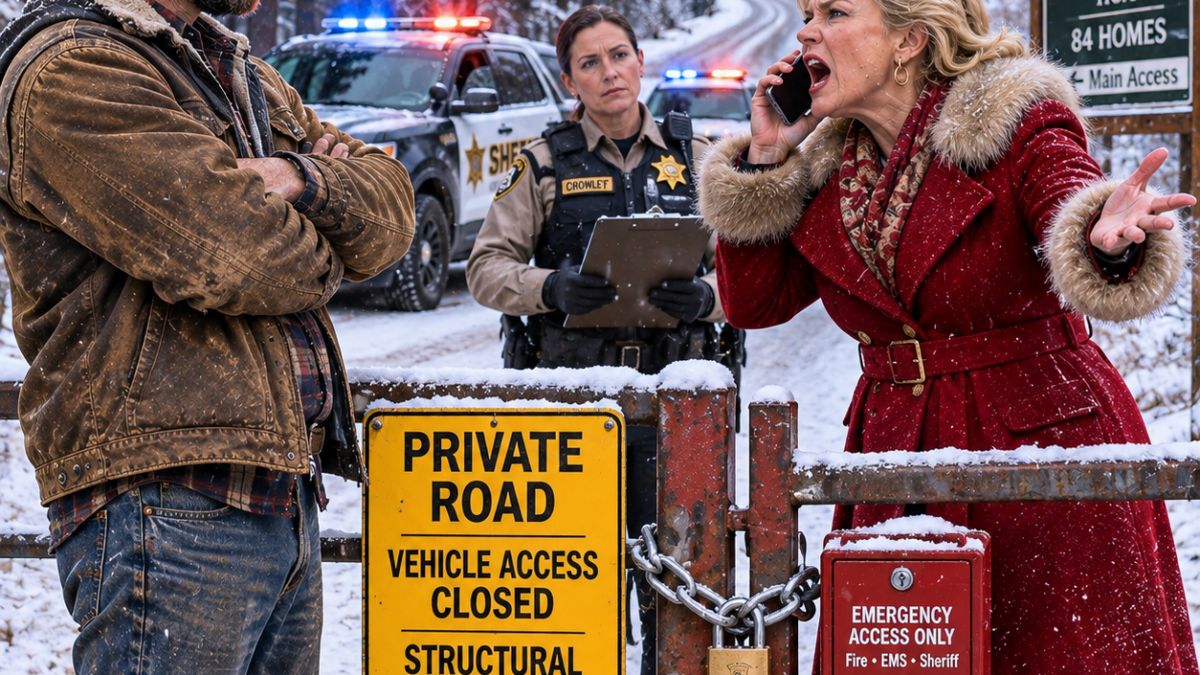
PRIVATE ROAD
VEHICLE ACCESS CLOSED
STRUCTURAL HAZARD
Below it:
EMERGENCY SERVICES ACCESS AVAILABLE
I checked the lock twice.
Turned toward my truck.
Headlights appeared.
Fast.
A white SUV rounded the bend.
Brakes locked.
The vehicle slid several feet.
Stopped sideways.
Driver’s window came down.
Karen.
Of course.
“What the hell are you doing?”
“Morning.”
“Open that gate.”
“No.”
“You cannot close this road.”
“I just did.”
“People have jobs.”
“They should use Basin Hollow Lane.”
Her expression changed.
Tiny.
But I noticed.
“What?”
“Basin Hollow Lane.”
“Nobody uses that.”
“They’re supposed to.”
“That road is not maintained.”
“By your HOA.”
“That is irrelevant.”
“No.”
I pulled my gloves tighter.
“That’s exactly relevant.”
She got out.
Red boots.
Cream-colored coat trimmed in fur.
Hair perfect despite the wind.
“You have one minute.”
“For what?”
“To unlock this gate.”
“No.”
“Fletcher, eighty-four households depend on this road.”
“Then your board has spent years creating a serious problem.”
“You don’t get to trap people in their homes.”
“They aren’t trapped.”
“Yes, they are.”
“Their recorded entrance is Basin Hollow.”
“That’s not usable.”
“Why?”
“You know why.”
“No.”
She stared.
I waited.
She could not answer without admitting something.
So she did what Karen did whenever facts stopped helping.
She escalated.
She pulled out her phone.
“You’re forcing me to call law enforcement.”
“Okay.”
That seemed to surprise her.
“Okay?”
“Yes.”
“You think this is funny?”
“No.”
She dialed 911.
Put the call on speaker.
I propped my own phone against the truck dashboard and started recording.
The dispatcher answered.
“911. What is the address of your emergency?”
Karen immediately transformed.
Her angry voice became shaken.
Urgent.
“Please send deputies to Frostline Gate at North Switchback Road. A man has illegally barricaded the road and trapped eighty-four families inside Stonehaven Ridge.”
The dispatcher asked:
“Is anyone injured?”
“Not yet.”
“Is there an immediate medical emergency?”
“The entire community is stranded.”
“Is an ambulance or fire apparatus currently blocked?”
“No, but—”
“Is anyone in immediate danger?”
“He has illegally locked our only road.”
I looked at the sign.
Emergency lockbox visible.
The dispatcher continued calmly.
“Ma’am, I need to establish whether anyone is in immediate danger.”
Karen exhaled sharply.
“People cannot leave their homes.”
Then came the question.
The question I remembered more clearly than anything else from that morning.
“Ma’am, is there another roadway connecting Stonehaven Ridge to the county highway?”
Karen said nothing.
Three full seconds.
Maybe four.
The wind moved snow across the pavement between us.
The dispatcher repeated:
“Ma’am?”
Karen looked at me.
I looked back.
“There’s an old route,” she said.
“Is it physically blocked?”
Pause.
“It’s not maintained.”
“Who is responsible for maintaining it?”
Karen ended the call shortly after that.
Not hung up angrily.
Finished.
Then stared at me.
“You’re enjoying this.”
“No.”
I pointed toward the road.
“I’m trying to stop one of your plows from falling into a ravine.”
Fifteen minutes later, two patrol cruisers arrived.
Deputy Meredith Crowley stepped out of the first.
Forty-six.
Dark hair under a winter cap.
Steady voice.
The expression of someone who had spent twenty years discovering that everybody who called law enforcement believed the badge automatically belonged to their side.
Karen reached her first.
“This man needs to be arrested.”
Meredith raised one hand.
“Morning.”
“He barricaded our road.”
“I’ll talk to everybody.”
“You need to cut that lock.”
“I said I’ll talk to everybody.”
Karen stopped.
Meredith approached me.
“Mr. Ralston?”
“Yes.”
“You own this gate?”
“Yes.”
“The road?”
“Yes.”
“Documentation?”
I opened the glove box.
Deed.
Boundary map.
Dad’s construction documents.
Engineer’s warning.
Certified HOA notice.
Stamped hand-delivery copy.
Emergency access information.
I handed over everything.
Meredith read.
Then turned to Karen.
“Do you have documentation of your association’s access right?”
“Absolutely.”
She marched to the SUV.
Returned with a glossy folder.
Inside was a subdivision brochure.
North Switchback Road highlighted in gold.
SCENIC MAIN ACCESS
Meredith stared.
Then looked at Karen.
“This is marketing material.”
“It proves the road has always been part of the community.”
“No.”
Meredith handed it back.
“It proves somebody printed it in a brochure.”
Karen’s face reddened.
“We’ve used this road for years.”
Meredith nodded.
“That may matter.”
She pointed toward my deed.
“But it doesn’t tell me ownership.”
Karen laughed.
“Deputy, eighty-four homes use this road every day.”
“Yes.”
“There is no possible way all eighty-four families have been driving across one man’s private land.”
I said, “That’s exactly what I’ve been trying to tell you.”
Meredith looked at me.
Then Karen.
“Where is Basin Hollow Lane?”
Karen’s jaw tightened.
“Technically the southeast side.”
“Technically?”
“It’s an old access.”
“Is it part of Stonehaven Ridge?”
“Yes.”
“Is it recorded?”
Karen did not answer.
Meredith said, “I’m not settling a property dispute on a roadside. County records need verification. Engineer needs to verify the hazard. Until then, nobody is cutting anything.”
Karen went back to her SUV.
Returned with a different folder.
She slapped a document onto the hood of Meredith’s cruiser.
“There.”
The title read:
PERMANENT WINTER ACCESS EASEMENT
Raised seal.
Legal language.
Recorded-looking formatting.
My name.
Stonehaven Ridge HOA.
I leaned closer.
Read the first page.
Then felt something cold settle into my chest.
Not fear.
Recognition.
The document was dated 2016.
Legal description referenced parcel number:
47-118B-3.
That number belonged to the small house parcel I created after Dad died.
In 2021.
The county did not create that parcel until five years after the supposed easement had been signed.
I read it again.
Karen smiled.
“That should settle it.”
I said nothing.
Meredith looked at me.
“Something wrong?”
“Yes.”
Karen crossed her arms.
“Of course he’ll say that.”
I pointed.
“That parcel didn’t exist in 2016.”
Silence.
Meredith looked at the document.
Then me.
“Explain.”
“I split the ranch-house tract in 2021 during estate restructuring.”
Karen scoffed.
“You’re confused.”
“No.”
I looked directly at her.
“I signed the subdivision paperwork.”
Meredith asked, “Can the recorder verify?”
“Yes.”
Karen grabbed the paper.
“This is absurd.”
Meredith said, “Leave it.”
“It’s mine.”
“I want the document noted in my report.”
Karen held it tighter.
“Fine.”
Meredith photographed every page.
I did not call it forgery.
Not yet.
Dad taught me another rule.
Do not accuse when you can document.
Before leaving, Karen pointed at me.
“If that gate stays closed, I will organize eighty-four homeowners into a lawsuit.”
I zipped my coat.
“Before you sue me, you might want to find out who sold them my road.”
The next afternoon, county land surveyor Taryn Bishop laid four sets of records across a conference table.
Thirty-nine years old.
No patience for drama.
She had my deed.
The official Stonehaven Ridge plat.
Every recorded access agreement.
Fresh survey coordinates.
She worked for almost an hour before speaking.
“North Switchback Road is Ralston property.”
Karen had refused to attend.
I was there.
Meredith.
County road representative.
My attorney, Camille Rutledge, joined by phone.
Taryn tapped the subdivision plat.
“Stonehaven Ridge’s recorded access is here.”
Basin Hollow Lane.
“Every lot?”
I asked.
“Every lot I checked.”
“How many?”
“All eighty-four.”
I leaned back.
“So none have rights to North Switchback?”
“Not according to county records.”
“What about Dad’s temporary license?”
“Expired.”
“Could long use turn it into an easement?”
Camille answered through speakerphone.
“Not automatically, particularly where use began permissively.”
Taryn nodded.
Then she looked at me.
“There’s something else.”
“What?”
“I searched the easement Karen produced.”
“And?”
“Nothing.”
“Nothing?”
“No matching record.”
I stared.
“County seal?”
“Could be reproduced.”
“Recording number?”
“Does not match index.”
“Parcel problem?”
“Yes.”
“So?”
Taryn chose her words carefully.
“I would not rely on it as an authentic recorded instrument.”
Camille said, “Nobody should call it forged until investigators determine that.”
“Understood.”
“But preserve it.”
We did.
Then Taryn asked the question that changed the entire dispute.
“If all eighty-four homes have lawful access through Basin Hollow Lane, why is everybody using your road?”
I looked toward the map.
“I don’t know.”
Taryn folded the plat.
“Let’s find out.”
Basin Hollow Lane was worse than I imagined.
On paper it looked perfect.
Paved connection from county highway.
Gentle grade.
Wide enough for snow equipment.
No ravine.
No unstable culvert.
Then we drove there.
I stopped my truck.
Taryn whispered:
“You’ve got to be kidding me.”
The roadway had been turned into a Christmas festival.
Not beside the road.
On the road.
Pine trees wrapped with white lights.
Temporary parking.
Wooden vendor stalls.
A stage.
Ice sculptures.
Snowbanks pushed shoulder-high.
Decorative arch.
Painted sign:
STONEHAVEN WINTER PROMENADE
VEHICLE ACCESS RESTRICTED
I stood beside my truck.
“You people blocked your own road.”
Taryn walked toward the stage.
County representative photographed everything.
Meredith shook her head.
“How much did this cost?”
Taryn pulled the posted HOA budget from her tablet.
Then whistled.
“Two hundred forty thousand dollars.”
I laughed.
Not because it was funny.
Because sometimes outrage reaches the point where the body chooses laughter instead.
County records showed the HOA had stopped regular plowing on Basin Hollow Lane two winters earlier.
Board minutes explained why.
Karen had argued North Switchback was:
faster,
more scenic,
preferred by residents,
and therefore there was no reason to maintain two winter entrances.
The saved maintenance money helped fund the promenade.
Except residents were still charged something called:
WINTER ACCESS MAINTENANCE FEE
Twelve hundred dollars per home.
Every year.
A man in a red hunting cap approached us.
Walter Driskill.
Sixty-two.
Retired electrician.
“I wondered when somebody would finally come down here.”
Taryn asked, “You know about this?”
“I live there.”
He pointed toward a house beyond the berm.
“I’ve asked Karen four times why this road stays closed.”
“What did she say?”
“Unsafe.”
“Engineering report?”
“Never showed one.”
County engineer Dean Whitaker arrived an hour later.
He walked the road.
Inspected grade.
Drainage.
Surface.
Then returned.
“Clear the decorations.”
Karen had arrived by then.
Of course.
She stepped from the SUV.
“Excuse me?”
Dean pointed toward the roadway.
“Remove the obstructions. Plow it. Inspect after clearing.”
“This is a community amenity.”
“It’s also a road.”
“The promenade is a major investment.”
“So?”
Karen stared at him.
Dean continued.
“Nothing I’ve seen here suggests the road itself cannot carry residential traffic once cleared.”
Karen’s composure slipped.
Barely.
I saw it.
“You spent a quarter million dollars decorating the road your people actually own,” I said, “then demanded free use of mine.”
She spun toward me.
“This is your fault.”
“How?”
“You created an emergency.”
“No.”
I pointed toward the stage.
“You decorated one.”
Dean’s phone buzzed.
He opened images from the culvert inspection team.
His face changed.
“What?”
I asked.
He showed me.
A camera had reached farther into the void beneath North Switchback.
The washout was larger than we thought.
Much larger.
Enough soil had disappeared that a pocket extended beneath part of the travel lane.
A thin frozen crust of pavement spanned it.
Dean looked at Meredith.
“This road stays closed.”
Karen said, “You can’t be serious.”
He ignored her.
“Another loaded truck could punch through.”
“How likely?”
I asked.
“Likely enough I’m issuing formal restriction.”
Karen laughed.
“Theater.”
Dean finally looked at her.
“Ma’am, gravity doesn’t care about your board.”
That evening, Karen hired a towing company.
I learned because somebody from the company texted me anonymously.
Photo.
Two heavy wreckers.
Compact excavator.
Caption:
Karen says gate comes down at sunrise.
I stared at the message.
Called Camille.
She said, “Do not physically interfere.”
“I know.”
“Do not stand in front of equipment.”
“I know.”
“Record.”
“Yes.”
“Call sheriff.”
“Yes.”
“Fletcher?”
“What?”
“She’s escalating because facts are getting worse.”
I looked toward the ridge.
“Yeah.”
At 5:42 the next morning, diesel engines came up North Switchback.
Two wreckers.
Excavator.
Karen.
Two HOA security guards.
Duncan Phelps from the snow contractor.
I stood forty feet inside my property.
Phone recording.
Karen pointed at the gate.
“Cut it.”
Nobody moved.
She turned to Duncan.
“You heard me.”
Duncan walked to the hazard sign.
Read it.
Then looked at the culvert warning.
“Where’s the authorization?”
“I am authorizing it.”
“Court order?”
“HOA emergency authority.”
“This gate is on private property.”
“We dispute that.”
“County restriction?”
“Political nonsense.”
The excavator operator leaned from his cab.
“Do you have something in writing?”
Karen waved the old developer license.
He read it.
Then looked at Duncan.
“This says temporary access.”
Karen snapped, “It establishes historical use.”
“Doesn’t say I can tear down a gate.”
He shut off the excavator.
Karen looked furious.
“I’ll cancel your company’s contract.”
Duncan said, “Then cancel it.”
That surprised everybody.
Then Meredith’s cruiser rounded the switchback.
Second deputy behind her.
She stepped out.
“Machines off.”
Karen shouted, “This is HOA-authorized emergency restoration.”
Meredith pointed toward the equipment.
“Nobody touches anything.”
Dean arrived ten minutes later.
Printed county restriction in hand.
He held it up.
“North Switchback closed to heavy traffic.”
Karen gestured toward the neighborhood.
“Eighty-four homes outweigh one man.”
Dean replied:
“Eighty-four homes do not make a cracked roadbed one ounce stronger.”
That ended the machinery.
Not Karen.
She switched tactics.
Took out her phone.
Started recording herself.
Voice trembling.
“This morning one wealthy landowner continues deliberately holding eighty-four Stonehaven families hostage during winter conditions…”
I stared at her.
Hostage.
She emailed the video to the entire community.
My phone began ringing by breakfast.
Unknown number.
“You’re a selfish bastard.”
Another.
“My wife works at the hospital.”
Another.
“We have children up here.”
Another.
“Please, Mr. Ralston, we just need to get to work.”
That last one hurt.
Because the woman was not angry.
She was scared.
I said:
“You have another road.”
“What?”
“Basin Hollow.”
“Karen says it isn’t safe.”
“It is being inspected.”
Long silence.
“We’ve never used it.”
“I know.”
That was when I understood.
These people were victims too.
Not in the same way.
Nobody had stolen their land.
But somebody had sold them a lie and then maintained it long enough that it felt like geography.
Camille and I created a packet.
No insults.
No accusations.
Just:
official subdivision plat,
road ownership map,
engineer restriction,
copies of my warning letters,
emergency access plan,
Basin Hollow reopening proposal.
We delivered one to every home.
Karen called it propaganda.
Then Duncan came to my house.
Near dusk.
He parked beside the barn.
Walked inside with a thick folder.
“You need to see this.”
Camille was already there.
Duncan spread invoices across my kitchen table.
His company had been paid for snow removal on North Switchback Road.
That part was real.
But Karen required invoices to say:
WINTER CORRIDOR MAINTENANCE
No road specified.
“Why?”
I asked.
“She said HOA accounting wanted standardized categories.”
Camille read.
Duncan pulled another page.
“This run never happened.”
“What?”
“This one.”
Another.
“This one either.”
“How do you know?”
“GPS.”
His trucks tracked every route.
“Who submitted the invoice?”
“Office generated based on work orders Karen sent.”
“You billed for work you didn’t do?”
Duncan’s face tightened.
“I billed what dispatch gave us. I questioned it last spring.”
“What happened?”
“She told me other companies wanted the contract.”
Camille said, “Preserve everything.”
“I did.”
“Do not alter records.”
“I won’t.”
“Give copies to investigators when requested.”
He nodded.
The road dispute had just become accounting.
Then HOA treasurer Holly Maddox started asking questions.
Fifty-five.
Quiet woman.
Former bookkeeper.
Karen had treated her mostly as somebody who signed checks after board votes.
That turned out to be a poor choice.
Each of the eighty-four homes paid $1,200 per year for winter access maintenance.
$100,800 annually.
Three years:
$302,400.
But the ledgers showed something strange.
More than $218,000 had been paid to:
WHITE BASIN SERVICES
Holly had never heard of them.
No visible trucks.
No known employees.
No road crew.
Public business records identified the organizer.
Trent Allbury.
Longtime business associate of Karen.
Every payment approval carried Karen’s signature.
Camille warned us:
“Connection is not proof of theft.”
Holly nodded.
“I know.”
“Need an audit.”
“I’m requesting one.”
Then Holly found a letter.
Dated 2024.
From the HOA’s own attorney.
It warned that Stonehaven Ridge possessed no confirmed permanent right to North Switchback Road.
It recommended stopping promotional language describing it as a guaranteed amenity until an access agreement could be secured.
Receipt signed:
Karen Halstead
I read the letter twice.
“She knew.”
Camille corrected me.
“She knew counsel considered the road legally uncertain.”
“She kept selling it.”
“Yes.”
“She kept charging road fees.”
“Yes.”
“She ignored my warning.”
“Yes.”
I understood Karen’s panic at Frostline Gate.
It was never really about convenience.
The instant I locked North Switchback, eighty-four families would ask the obvious question:
What road are we paying for?
That question could not be answered safely for Karen.
She tried to remove Holly’s access to HOA books.
Holly had already copied everything.
She gathered signatures for a special meeting.
Karen threatened to sue her.
Then the second storm arrived.
Wind first.
Then snow.
Heavy.
Fast.
By midnight, North Switchback remained closed.
Basin Hollow remained partially blocked by ice sculptures, stage equipment, and frozen berms because Karen still refused to authorize clearing.
Her phone rang constantly.
Residents.
Deliveries.
Hospital workers.
Propane company.
School district.
She blamed me.
Then a man named Gary Pruitt made a bad decision.
Fifty-seven.
Frustrated.
Tried an old logging track behind the ridge.
Road had not been maintained in ten years.
His SUV slid into a drift.
Snow piled past the doors.
He called 911.
Fire district contacted me because I knew the terrain.
I could have said:
Not my problem.
He belonged to the HOA.
He had probably complained about me.
None of that mattered.
A man was stuck in a storm.
I gave the incident commander maps.
Showed him which equipment routes could carry weight.
Warned him again about North Switchback.
Then rode with the crew.
We found Gary before dawn.
Cold.
Embarrassed.
Safe.
Wrapped him in blankets.
He looked at me from the ambulance.
“I said some things about you yesterday.”
“I know.”
“I’m sorry.”
“Stay warm.”
That was enough.
The county had seen enough too.
Officials ordered the lawful Stonehaven access restored.
Crews descended on Basin Hollow.
Ice sculptures removed.
Stage dismantled.
Snowbanks cut away.
Promenade sign dragged aside.
Plows opened two lanes.
Karen’s $240,000 Christmas display disappeared from the roadway in hours.
Then something happened that should never have been remarkable.
Cars used the road their deeds said they should use.
One.
Then another.
Then twenty.
Then dozens.
No ravine.
No private gate.
No fight.
Walter Driskill stood watching traffic.
Karen arrived.
He walked to her SUV.
“We weren’t trapped by Fletcher’s gate.”
She stared ahead.
Walter continued.
“We were trapped by the decisions we paid you to make.”
That sentence traveled through Stonehaven faster than any email Karen ever sent.
Residents stopped calling me.
They started calling the board.
Then Karen made another mistake.
She emailed everyone board minutes showing directors had supposedly voted to close Basin Hollow for the promenade.
Holly opened the attachment.
Saw her name.
Then her signature.
Except it was not her signature.
At the special meeting the next morning, she held up the document.
“That is my name.”
People became quiet.
“But I did not sign it.”
One director stood.
“Neither did I.”
Another:
“I wasn’t at that meeting.”
Another:
“I was in Florida.”
The room changed.
A road dispute can be explained away.
Money can be complicated.
But people recognize their own signatures.
Five days later, every one of Stonehaven Ridge’s eighty-four homes was represented at the formal special meeting.
People filled the clubhouse.
Hallway.
Back wall.
Folding chairs.
Standing room.
Karen arrived in a navy blazer.
Calm again.
She had prepared a speech.
Holly prepared binders.
Taryn brought maps.
Dean brought culvert footage.
Duncan brought GPS logs.
Camille sat beside me.
I had no speech.
I wanted facts to do the talking.
Taryn went first.
Official plat on projector.
“This is North Switchback Road.”
Line highlighted.
“Entirely within the Ralston parcel.”
She showed Dad’s temporary license.
Expiration.
No transfer rights.
Then Basin Hollow.
“Every Stonehaven lot identifies this as subdivision access.”
Murmuring.
Dean showed the culvert.
People gasped.
The cavity beneath the pavement looked much worse on a large screen.
“That asphalt was holding over open space?”
Someone asked.
Dean nodded.
“Partially.”
“What if a plow had crossed?”
“It could have failed.”
Karen said from the front:
“Could.”
Dean turned.
“Yes.”
“That’s not certainty.”
“No.”
He looked around the room.
“Engineering safety does not require waiting until someone falls into a ravine to become certain.”
Applause.
Duncan presented GPS data.
Invoices.
Plow routes.
Missing runs.
Holly presented fees.
$100,800 annually.
$302,400 over three years.
White Basin Services.
$218,700 in questionable payments.
Karen’s signatures.
Then the attorney letter.
Warning about North Switchback.
Karen received it.
Karen signed receipt.
The room went silent.
Last came the meeting minutes.
Holly projected the signatures.
Directors stood one by one.
“Not mine.”
“Not mine.”
“I wasn’t there.”
“Neither was I.”
Karen stood.
“This is a coordinated attack.”
Nobody responded.
She continued.
“Fletcher Ralston has spent years trying to undermine this community because he resents our success.”
I almost smiled.
Then she pointed toward me.
“He shut a gate during winter.”
I stood.
Only once.
“You received the engineer warning.”
She said nothing.
“I sent it certified.”
Nothing.
“I hand-delivered it.”
Her jaw tightened.
“I never asked one homeowner for money.”
I looked around the room.
“I never asked for a toll.”
“I never asked your HOA to buy the road.”
“I asked you to stop sending traffic over failing pavement you did not own.”
A woman near the front nodded.
I continued.
“And your eighty-four homes already had another entrance.”
Karen said, “An entrance nobody wanted.”
“Then maintain it better.”
Somebody laughed.
Karen’s face hardened.
I sat down.
A homeowner moved to remove her as president.
Seconded immediately.
Secret ballots.
Counted twice.
Seventy-six votes to remove.
Eight against.
Karen stood perfectly still.
For three years, people had applauded her.
Now many stared at the floor.
A few stared directly at her.
Holly became interim treasurer under a temporary board.
Two independent directors were appointed.
Records secured.
Audit authorized.
Karen gathered her coat.
At the door, she turned.
“I’ll take the road issue to court.”
Camille leaned toward me.
“Good.”
I whispered, “Good?”
“She’s finally moving this someplace her microphone doesn’t matter.”
Karen filed within a week.
Emergency motion.
She wanted a judge to order Frostline Gate opened.
Her attorney argued:
years of community use,
resident reliance,
winter hardship,
historic access.
Camille presented:
Dad’s original license,
expiration,
deed,
survey,
engineer restriction,
my notices.
Then Basin Hollow.
Open.
Plowed.
Carrying traffic.
The hardship argument collapsed.
Then came Karen’s permanent winter easement.
The document with the impossible parcel number.
County recorder confirmed:
No matching instrument.
No proper index entry.
No valid record.
The judge examined the date.
Then parcel creation.
Karen’s attorney asked for recess.
They went into the hallway.
When they returned, he stopped mentioning the easement.
The judge said authenticity questions belonged to investigators.
Then the interim HOA board submitted a letter.
Stonehaven Ridge no longer supported Karen’s motion.
They did not want North Switchback reopened.
They wanted Basin Hollow maintained.
They wanted financial irregularities investigated.
They wanted emergency access preserved.
Karen was no longer speaking for eighty-four homes.
She was speaking for Karen.
The motion was denied.
The audit took weeks.
Then months.
Results were worse than I expected.
Unsupported payments.
Questionable invoices.
Missing work records.
White Basin Services.
GPS discrepancies.
Approval signatures requiring further investigation.
The auditors could not conclusively call every unsupported payment theft.
That required investigators.
But the financial controls were a disaster.
Then Dean gave me the final culvert report.
Full replacement.
Roadbed reconstruction.
Drainage redesign.
Estimated damage:
over $300,000.
Heavy plow records showed repeated overweight crossings.
Including after my warning.
Then Camille found the invoice.
Four days after the HOA received my written restriction.
Heavy plow service.
North Switchback Road.
Approved:
Karen Halstead.
That became central to my damages claim.
Four months later, winter finally released the ridge.
Basin Hollow was being plowed under a transparent new contract.
Every invoice listed:
road,
date,
vehicle,
hours,
number of runs.
Residents could review them online.
The promenade lights had been moved to a small park near the clubhouse.
Ice sculptures returned the following December.
On grass.
Where ice sculptures belong.
Not in a travel lane.
Walter Driskill volunteered for the road committee.
His first motion required future contracts to identify exact work before payment.
Unanimous.
Holly became permanent treasurer.
The audit and civil settlements assigned $218,700 in unsupported association payments for repayment by responsible parties.
Culvert damage and related restoration accounted for approximately $310,000.
Legal fees, auditing, and reimbursements added another $81,300.
Total financial responsibility tied to the mess reached roughly $610,000.
Not dumped on the eighty-four homeowners.
That mattered to me.
The responsible entities absorbed the costs through settlements, restitution, insurance, and related proceedings.
Karen.
White Basin Services.
Other parties connected to the heavy-truck decisions.
Investigations into disputed signatures and questionable records continued separately.
People asked whether I enjoyed watching Karen lose power.
At first?
Yes.
A little.
I am not going to pretend otherwise.
There is satisfaction in watching somebody who treated documents like weapons finally meet people willing to read them.
But it faded.
Because by spring, Karen was no longer the interesting part.
The interesting part was how easily eighty-four families had been convinced their own legal entrance did not exist.
Nobody woke up one morning and voted:
Let’s abandon our road and depend entirely on Fletcher Ralston.
It happened gradually.
Skip one plowing contract.
Use the shortcut.
Put it in brochures.
Collect fees.
Add a Christmas project.
Tell residents Basin Hollow is unsafe.
Repeat.
Two years later, assumption becomes memory.
Five years later, memory becomes entitlement.
Then one man locks his gate and everybody asks:
How dare you?
That scared me more than Karen.
Karen was one person.
Systems built on unchecked assumptions can outlive people.
North Switchback stayed closed during repairs.
I replaced the culvert in late spring.
Not cheap.
New concrete structure.
Rebuilt shoulder.
Improved drainage.
Reinforced roadbed.
Native grasses planted on the disturbed slope.
Young pines placed along the ravine side.
Dad would have approved of the drainage.
He would have complained about the invoice.
I could hear him.
“You paid that much?”
“Yes, Dad.”
“For concrete?”
“Yes.”
“Concrete isn’t gold.”
“No.”
“Did you get three bids?”
“Yes.”
He would still complain.
Once repairs were complete, I did not reopen the road to Stonehaven traffic.
Emergency services?
Yes.
Formal agreement with fire district.
Sheriff.
Medical response.
Utility access when necessary and authorized.
Ordinary HOA traffic?
No.
The road returned to its original purpose.
Ranch.
Equipment.
Water station.
Emergency access.
I replaced the lock.
New keyed system.
New reflective sign.
PRIVATE ROAD
EMERGENCY ACCESS BY AUTHORIZATION ONLY
Nobody tore it down.
Nobody called 911.
Nobody threatened me with eighty-four lawsuits.
They used Basin Hollow.
Every day.
Exactly as their deeds always said they could.
One morning Meredith drove up while I was checking the hinges.
Snow had started falling.
She rolled down her window.
“Morning.”
“Morning.”
“Anybody sneaking through?”
“No.”
She looked toward the valley.
Cars could be seen lower down moving along Basin Hollow.
“Remember the first day?”
“Yes.”
“She was very sure.”
“Karen was usually sure.”
Meredith smiled.
“You locked one gate.”
“Apparently.”
“And opened every file in the HOA.”
I put one hand on the steel.
“That’s the funny part.”
“What?”
“She called 911 because she wanted somebody to force this open.”
I tapped the gate.
“Instead, everybody started asking why it was necessary.”
Meredith nodded.
Then drove away.
For a long time after she left, I stood there thinking about Dad.
He died believing Stonehaven would eventually become a problem.
Not because he hated the residents.
He did not.
He used to help their first snowplow when it got stuck.
He gave children rides on the tractor.
He sold Christmas trees to three families at cost because he thought their kids were funny.
His concern was paper.
He once told me:
“People don’t steal roads with bulldozers first.”
I was twenty-something.
“What does that mean?”
“They use your road.”
“So?”
“Then they call it our road.”
“Okay.”
“Then they forget asking.”
I laughed.
He did not.
“Then someday you have to prove the thing underneath their tires belongs to you.”
That was exactly what happened.
The neighborhood itself changed afterward.
I began meeting people I had previously known only as headlights.
Walter came by for coffee.
Gary Pruitt—the man from the logging road—helped me plant grass above the culvert.
The hospital worker who had called pleading that first morning brought homemade bread.
A family with two young boys asked whether they could walk the ranch road in summer.
I said yes.
On foot.
With permission.
That distinction mattered.
Some residents apologized.
Some did not.
I did not need eighty-four apologies.
Most had driven the road because everyone before them did.
The real responsibility belonged with people who knew better.
Karen knew the legal risk by 2024.
She had the attorney’s letter.
Her board had the subdivision plat.
They collected winter fees.
They knew Basin Hollow belonged to Stonehaven.
They chose not to maintain it because relying on my road was cheaper.
Then used the savings on things residents could see.
Lights.
Ice.
Events.
Appearance.
It is easy to win elections with things people photograph.
Drainage ditches are harder.
Nobody posts a culvert on Christmas cards.
But culverts matter more when your truck is driving over one.
The financial investigation became the final blow to Karen’s reputation.
Not because every accusation turned into a criminal conviction.
Life is rarely that neat.
But enough was documented.
Money had been spent without proper support.
Controls had been bypassed.
Records contained irregularities.
Invoices did not match GPS data.
The road the HOA charged people to maintain had been neglected.
The private road it did not own had absorbed the traffic.
That truth was enough.
Karen eventually moved out of Stonehaven.
I heard Arizona.
Maybe Nevada.
I never checked.
Someone asked whether I would sell her my gate as a souvenir.
No.
The gate belonged where it was.
Years passed.
Basin Hollow became ordinary.
That was probably the greatest success.
People stopped discussing it.
Snow came.
Plows cleared it.
Cars drove.
Bills were paid.
No drama.
A good road should be boring.
North Switchback became quiet again.
Deer used it at dawn.
My truck.
Ranch vehicles.
Occasional fire district training.
One summer morning I drove the full 2.8 miles and realized I had forgotten how peaceful the upper switchbacks were without constant subdivision traffic.
At the overlook, I stopped.
Below me sat Stonehaven Ridge.
Eighty-four roofs.
Different families.
Different stories.
I did not feel anger.
Mostly relief.
We had spent years behaving like enemies without most of us understanding the actual problem.
Karen framed it as:
One selfish landowner versus eighty-four families.
That was useful politically.
Reality was less dramatic.
One private road.
One public record.
One temporary license everybody forgot was temporary.
One HOA road neglected because leaders preferred spending money elsewhere.
One dangerous culvert.
One gate.
Once facts were separated from speeches, the conflict became solvable.
That lesson stayed with me.
Whenever somebody says:
“Everyone knows…”
I ask:
Where is it written?
Whenever somebody says:
“We’ve always done it this way…”
I ask:
Under what authority?
Whenever somebody says:
“There’s no other option…”
I look for the road nobody has been using.
Dad would probably find that irritatingly philosophical.
He preferred shorter rules.
His would have been:
Keep the deed.
Read the easement.
Fix the culvert.
Lock your gate if somebody refuses to listen.
One December, almost exactly a year after the 911 call, Stonehaven invited me to their Christmas gathering.
I almost declined.
Holly called personally.
“It’s not at Basin Hollow.”
“Where?”
“Clubhouse.”
“No road decorations?”
“Small park.”
“No stage in travel lane?”
“Fletcher.”
“Just checking.”
Walter got on the phone.
“You’re coming.”
“Why?”
“Because we bought you something.”
“That sounds threatening.”
“It is.”
I went.
The clubhouse was crowded.
Children.
Food.
Music.
No Karen.
The new board president was a retired paramedic named Susan Avery who apparently considered meetings over an hour a personal failure.
I liked her immediately.
Holly handed me a box.
Inside was a small metal road sign.
Miniature.
It read:
WRONG ENTRANCE
I laughed for nearly a minute.
Walter said, “Put it at Frostline Gate.”
“No.”
“Why?”
“Some idiot will think it’s official.”
“That’s fair.”
I hung it inside my barn.
Later that evening, a young couple approached.
They had bought one of the Stonehaven homes after the whole dispute.
The husband said:
“Our closing packet now includes a highlighted map showing Basin Hollow.”
“Good.”
“And disclosure that North Switchback is private.”
“Better.”
His wife laughed.
“Our Realtor explained the entire story.”
“I’m sorry.”
“She said Karen called the police.”
“She did.”
“Did she really claim eighty-four homes were trapped?”
“Yes.”
The woman looked toward her husband.
“That is unbelievable.”
“No.”
I took a drink of coffee.
“That part was true to her.”
“What do you mean?”
“She believed enough people using something made it theirs.”
The young couple went quiet.
I continued.
“That’s more common than you think.”
That was perhaps the most dangerous part of Karen.
I do not believe she woke every morning thinking:
How can I steal Fletcher’s road?
I think she genuinely believed Stonehaven deserved it.
The community used it.
The residents preferred it.
The HOA maintained traffic operations around it.
Therefore, in her mind, ownership became a technical obstacle to a larger truth.
Her truth.
That mindset lets people justify almost anything.
Your road is more useful to us.
Your gate inconveniences us.
Your warning interferes with our plans.
Your property rights are selfish because more people want the opposite.
Numbers become morality.
Eighty-four against one.
She said that constantly.
But eighty-four people wanting access did not make a failing culvert stronger.
Eighty-four homes did not rewrite a deed.
Eighty-four annual fees did not create an easement.
Eighty-four assumptions did not become title.
And eventually those eighty-four families understood something Karen did not.
Their interests were safer when everybody’s boundaries mattered.
Because if an HOA could simply declare my road theirs because enough residents used it, what stopped a future board from doing the same to one homeowner’s driveway?
Or yard?
Or parking space?
Rights become meaningful only when they protect the unpopular person too.
I did not become friends with everybody in Stonehaven.
Some still disliked me.
One man believed I should have donated the road outright.
He told me at the feed store.
“You could’ve just given the HOA an easement.”
“I could.”
“Would’ve avoided all this.”
“No.”
“Why not?”
“Culvert still would’ve failed.”
“You could require repairs.”
“Who pays?”
“The HOA.”
“With money from?”
He paused.
“Residents.”
“So instead of using the road they own, they should pay to rebuild mine?”
“It’s more convenient.”
“For you.”
He frowned.
I smiled.
“See the problem?”
He never agreed.
That was fine.
People can disagree without acquiring each other’s property.
A surprisingly advanced concept.
By the third winter, the new culvert had performed perfectly.
No washout.
No shoulder collapse.
Drainage improvement worked.
Native grasses held.
Young pines survived.
I sent Dean a picture.
He replied:
BORING. PERFECT.
That became my favorite engineering review.
Duncan’s company won part of the new Stonehaven snow contract through competitive bidding.
Now he plowed Basin Hollow.
Every route GPS logged.
Every invoice matched.
He stopped at my place sometimes.
“Funny thing.”
“What?”
“My company makes less money now.”
“Sorry.”
“I sleep better.”
“That’s worth something.”
“Not according to payroll.”
We laughed.
Holly eventually told me the strangest part of the audit.
“What?”
“Karen could probably have gotten residents to approve most of the promenade spending.”
“Seriously?”
“People liked it.”
“Then why hide things?”
“Control.”
That made sense.
People like Karen often get into trouble not because their goal is impossible to achieve honestly.
They get into trouble because honest process allows somebody else to say no.
She could not tolerate that possibility.
Same problem with my road.
She could have asked Dad years earlier for permanent access.
He might have negotiated.
She could have asked me.
Maybe I would have considered a limited arrangement before the structural damage.
Instead she treated permission as weakness.
Something unnecessary if she could create enough momentum.
Then came the gate.
A gate is a simple thing.
Steel.
Hinge.
Chain.
Lock.
But psychologically, gates are powerful because they turn assumptions into questions.
Who has the key?
Who owns the hinge?
Who decides when it opens?
Karen hated Frostline Gate because it made visible something she had spent years pretending did not exist.
A boundary.
One snowy morning, many years later, I was checking that boundary again.
I had more gray in my beard.
The Ford was newer.
Gate had fresh reflective strips.
North Switchback stretched uphill beneath fresh snow.
I closed the gate.
Dropped the pin.
Locked it.
Not because of an emergency.
Just normal winter ranch procedure.
A car slowed on the county turnout.
Stonehaven resident.
Window came down.
Man waved.
“Morning, Fletcher.”
“Morning.”
“Road okay?”
“Mine is.”
He laughed.
“Basin’s clear.”
“Good.”
Then he drove away.
No screaming.
No phone.
No 911.
That was progress.
I stood there with my hand on cold steel.
Remembered Karen’s white SUV skidding to a stop.
Her voice:
“You don’t get to lock eighty-four homeowners inside.”
The dispatcher:
“Is there another road?”
Three seconds of silence.
That was the moment everything began unraveling.
One question.
Not an accusation.
Not a lawsuit.
Not a speech.
Just:
Is there another road?
There was.
There had always been.
Buried beneath snowbanks.
Decorated with lights.
Blocked by a stage.
Ignored by a board.
But recorded in every deed.
Sometimes truth is like that.
Not missing.
Just inconvenient.
Karen thought calling 911 would bring deputies who would cut my lock.
Instead, deputies asked for ownership records.
Ownership records led to the subdivision plat.
The plat led to Basin Hollow.
Basin Hollow led to maintenance questions.
Maintenance questions led to invoices.
Invoices led to White Basin Services.
The audit led to signatures.
The signatures led to investigators.
The whole structure came apart because somebody finally stopped accepting the premise beneath Karen’s complaint.
That is why, when Meredith later joked that Karen’s 911 call opened the books, I knew exactly what she meant.
Karen believed the call would establish one thing:
Fletcher Ralston was the problem.
Instead, it asked a question.
Questions are dangerous to people whose authority depends on nobody looking too closely.
Years later, the $610,000 figure was what everybody remembered.
News stories loved it.
Six hundred ten thousand dollars.
But money was not the part that stayed with me.
Neither was Karen losing her presidency.
Or the fake easement.
Or the disputed meeting signatures.
What stayed with me was Gary Pruitt in the ambulance.
The man who drove onto the abandoned logging track because he believed my gate had stranded him.
He could have died.
Not from a forged document.
Not from HOA corruption.
From confusion.
That was the cost of lying about infrastructure.
Roads are not slogans.
Maps are not politics.
Culverts do not care who won an HOA election.
If you tell eighty-four families one route is their only lifeline, eventually somebody will trust you enough to risk their life on that statement.
That was why I never regretted locking Frostline Gate.
I regretted not forcing the issue sooner.
Maybe if Dad had closed it when the temporary license expired, none of it would have happened.
Maybe residents would have learned Basin Hollow from the beginning.
Maybe.
But Dad was generous.
Then I was.
We assumed people understood permission.
We were wrong.
Permission that lasts long enough begins looking like ownership to anyone who arrives after the original conversation.
That is another reason I document everything now.
If I let somebody cross the ranch:
written permission.
Limited duration.
Purpose identified.
No transfer.
Sounds unfriendly.
It isn’t.
Clear boundaries protect friendships.
Ambiguity destroys them.
The final time I spoke to Karen happened unexpectedly.
Years after she left Stonehaven.
I was in Harland Creek buying hydraulic fluid.
Someone behind me said:
“Fletcher.”
I knew the voice.
Turned.
Karen.
Older.
Hair shorter.
No fur coat.
No board binder.
Just a woman standing in a hardware store.
For a second neither of us spoke.
Then:
“How are you?”
“Fine.”
“The ranch?”
“Still there.”
She almost smiled.
“Of course.”
I waited.
She looked at a shelf instead of me.
“I was wrong about the culvert.”
“Yes.”
“I should have listened.”
“Yes.”
“You don’t make apologies easy.”
“I’m not stopping you.”
That caught her.
She looked at me.
“I thought you wanted us to fail.”
“No.”
“Back then I did.”
“I know.”
She swallowed.
“I thought every time you said private road, what you meant was I don’t care about your people.”
“That wasn’t what I meant.”
“I know now.”
I said nothing.
She continued.
“I kept thinking about eighty-four houses.”
“And I kept thinking about one roadbed.”
“Yes.”
A small sad smile.
“I told myself numbers made me right.”
There it was.
I nodded.
She asked, “Do you hate me?”
“No.”
That surprised her.
“I did for a while.”
“What changed?”
“You left.”
She laughed.
Real laugh.
The first I had ever heard from her.
I continued.
“And the road got fixed.”
“What about the money?”
“Wasn’t mine.”
“The documents?”
“Investigators handled them.”
She looked down.
“I lost almost everything.”
I could have said:
You did it to yourself.
True.
Unnecessary.
Instead:
“I hope you learned something useful.”
She nodded.
“I did.”
We parted.
No forgiveness ceremony.
No hug.
No friendship.
Just two people with an old conflict that no longer needed feeding.
I drove home.
Turned off Highway 18.
Passed the entrance to Basin Hollow.
Two Stonehaven vehicles were coming down.
Plowed pavement.
Reflective markers.
Exactly where they belonged.
Then I reached Frostline Gate.
Unlocked it.
Drove through.
Locked it behind me.
North Switchback climbed into the pines.
Quiet.
Private.
Safe.
Dad’s road.
Not because I hated the eighty-four homes below.
Not because I defeated them.
Not because one man should always win against a community.
Because the community never needed my road in the first place.
They had theirs.
All they needed was someone to stop telling them otherwise.
Karen called 911 because I locked a gate.
She thought eighty-four homes gave her enough power to force it open.
Instead, those eighty-four homes eventually became eighty-four witnesses to something much simpler.
A private road was private.
A public record meant what it said.
A safety warning mattered before somebody got hurt.
Money collected for maintenance should pay for maintenance.
Signatures should belong to the people whose names appear beside them.
And no title—HOA president, board member, contractor, manager—gives anyone the right to erase a boundary simply because respecting it has become inconvenient.
That morning, I did not trap eighty-four families.
I locked one gate.
Everything hidden behind Karen’s version of the truth opened on its own.








