HOA Karen Called 3 Police Cars to Arrest Me for Fishing With My Grandson—Then the Sheriff Opened My Father’s Deed!
HOA Karen Called 3 Police Cars to Arrest Me for Fishing With My Grandson—Then the Sheriff Opened My Father’s Deed!
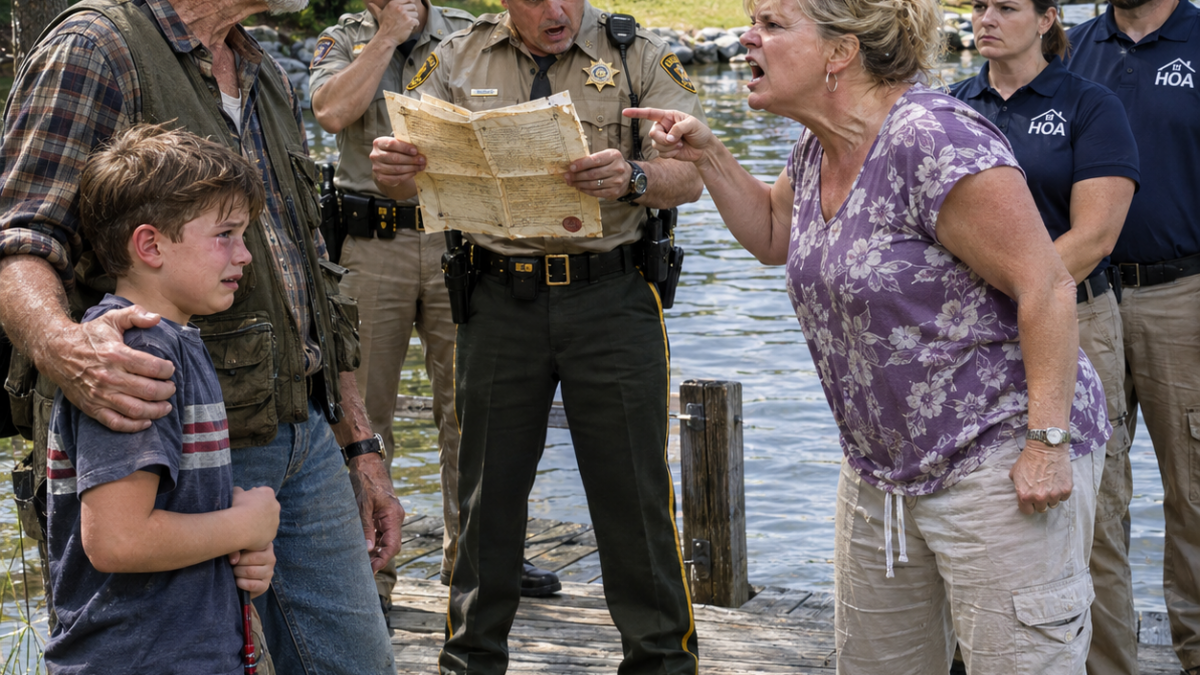
**“GET THAT LITTLE BRAT AWAY FROM OUR LAKE, YOU GREEDY OLD FOOL! I DON’T CARE HOW LONG YOUR FAMILY HAS LIVED HERE—THIS WATER BELONGS TO THE HOA, AND I’LL HAVE BOTH OF YOU DRAGGED OFF IN HANDCUFFS!”**
**HOA president Patricia Whitmore stood on my grandfather’s wooden fishing dock with three police cruisers parked behind her, pointing at my eight-year-old grandson while he clutched his fishing rod and tried not to cry.**
**Then Sheriff Owen Parker opened the yellowed deed my father had signed forty-three years earlier, read one paragraph twice, and slowly turned toward Patricia. “Ma’am,” he said, “before you accuse this man of trespassing again, you might want to explain why your HOA has been charging people to use a lake his family never sold you.”**
My name is Daniel Mercer.
I was sixty-four years old the morning Pine Hollow Estates sent three police cruisers after me for taking my grandson fishing.
And the boy Patricia Whitmore called a “little brat” was Noah.
Eight years old.
Skinny knees.
Brown hair that never stayed combed.
Missing one front tooth.
And so excited about catching his first largemouth bass that he had woken me at 4:52 that morning even though I had told him we were not leaving the house until six.
“Grandpa?”
I opened one eye.
“What?”
“Are the worms awake?”
I stared at him.
“The worms?”
“For fishing.”
PART2:
“They don’t have alarm clocks, Noah.”
“So they’re probably awake.”
“Go back to bed.”
Ten seconds later:
“Grandpa?”
“What?”
“Do bass sleep?”
I threw the blanket over my face.
That was how our morning started.
It should have been one of the simplest days of my life.
Instead, before breakfast was over, I was standing beside three sheriff’s cruisers while an HOA president demanded that I be arrested on land my family had owned since before her subdivision existed.
The place was called Mercer Lake when I was a kid.
By the time Pine Hollow Estates grew around the eastern shore, their marketing department had renamed it Pine Hollow Lake.
That should have warned us.
The lake covered about seventy acres in eastern Tennessee.
Not huge.
Not tiny.
Long enough for a small fishing boat.
Deep near the dam.
Shallow around the north cove.
bought the original farm in 1956.
At the time, there was no lake.
Just two creeks crossing one hundred forty acres of pasture and timber.
Grandpa raised cattle.
Grew corn.
Cut hay.
And complained about government paperwork even though he kept every receipt he had ever received in metal filing boxes labeled by year.
In 1968, a private development company began buying land east of us.
They wanted vacation cottages.
A small recreational lake.
Eventually they approached Grandpa about building a dam downstream.
The project would back water onto part of Mercer Farm.
Grandpa agreed.
But he did not simply sell them everything.
He was careful.
More careful than any of us understood at the time.
The developer purchased acreage around the eastern and southern sides.
Grandpa granted flood rights over several low portions of his farm.
He sold some shoreline.
He granted road access.
But he kept the western shore.
He kept the northern cove.
He kept the lakebed beneath a large section of the water.
Most importantly, he reserved permanent fishing, boating, dock, and shoreline rights for himself and his heirs.
In 1974, when my father Robert took over the farm, a new deed clarified everything again.
Dad had learned from Grandpa.
The document was fourteen pages long.
Recorded at the county courthouse.
Legal descriptions.
Survey monuments.
Water elevations.
Dock rights.
Access rights.
There was even language stating that no later residential association could restrict the Mercer family’s use of the retained shoreline or lake-access rights without a separately negotiated recorded agreement.
Nobody cared much at the time.
There was no HOA.
Just a few cottages.
My father fished.
Neighbors fished.
Everyone waved.
When somebody’s boat broke down, Dad towed them.
When we needed help cutting a fallen tree, people came over.
Nobody asked to see a deed before acting like a neighbor.
That changed slowly.
The original development company sold.
Another company expanded.
The cottages became expensive homes.
The roads were paved.
A clubhouse went up.
Then a pool.
Then tennis courts.
Then an entrance monument.
Eventually Pine Hollow Estates became a full HOA with around 190 homes.
The Mercer Farm got smaller over the years too.
Dad sold some acreage.
I inherited fifty-two acres after he died.
But I kept the western shoreline.
The old dock remained exactly where Grandpa built the first version in 1971.
Same stone supports.
Same narrow path through the sycamores.
Most of the boards had been replaced over time.
But to us it was still Grandpa’s dock.
Pine Hollow residents used parts of our shoreline too.
That was never a problem.
Dad had signed a recreational-use agreement with the HOA in 1996.
It allowed residents to walk one marked trail, fish from two designated areas, and launch small nonmotorized boats from a gravel bank.
The agreement was explicit.
Permission only.
No transfer of ownership.
No exclusive rights.
No adverse-possession claim.
No permanent easement created by continued use.
Pine Hollow paid one dollar per year.
Dad liked symbolic contracts.
“They remember better if somebody has to write a check,” he used to say.
The agreement lasted twenty years.
When it expired, the HOA president at the time, Howard Collins, called me.
“Daniel, you want another twenty?”
I said:
“Let people keep using it. We’ll update the paperwork when we need to.”
That was my mistake.
Not generosity.
The missing paperwork.
For several years, nothing bad happened.
Then Patricia Whitmore became HOA president.
Patricia was fifty-seven.
Former regional sales manager.
Extremely organized.
Extremely confident.
And apparently convinced that anything Pine Hollow residents had used long enough had somehow become Pine Hollow property.
My first disagreement with her involved a sign.
PRIVATE PINE HOLLOW LAKE
RESIDENTS AND GUESTS ONLY
It appeared beside the walking trail on my land.
I removed it.
Not angrily.
I took it to the clubhouse.
Patricia was inside.
“I think one of your signs wandered onto my property.”
She looked at it.
“That sign marks the lake-access area.”
“Which is on Mercer land.”
“Pine Hollow has maintained that area for decades.”
“Under permission.”
She smiled.
“No, Mr. Mercer. Pine Hollow owns the community lake.”
“That’s new.”
“It isn’t new.”
“My tax bill may be interested.”
Her smile faded slightly.
“We can have legal review it.”
“Please do.”
Nothing happened.
Then Pine Hollow installed another sign.
This one stayed several feet inside their property.
Fine.
I did not care what they called the lake from their own side.
But Patricia began acting like my family dock belonged to the HOA.
First, a maintenance worker left a notice saying the dock needed an HOA inspection.
I called him.
Nice guy.
He apologized.
Patricia had told him every lake structure fell under Pine Hollow authority.
Then I received a violation notice.
UNAPPROVED PRIVATE FISHING STRUCTURE.
Fine:
$500.
I called Rebecca Hayes, my attorney.
She laughed so hard she had to put the phone down.
“Your seventy-year-old family dock is an unapproved structure?”
“Apparently.”
“Are you in Pine Hollow now?”
“No.”
“Did somebody move the property line?”
“No.”
“Then I needed that laugh today.”
She sent one letter.
The fine disappeared.
Patricia never apologized.
Then Pine Hollow created something called the Lake Preservation Committee.
Its first rule:
Fishing only between 7 a.m. and 7 p.m.
Second:
All anglers needed Pine Hollow fishing badges.
Third:
No guests under twelve without a resident adult.
Fourth:
Western shoreline temporarily closed during nesting season.
My land again.
I ignored the rules.
Then Patricia called.
“You need to follow lake regulations.”
“No.”
“That isn’t optional.”
“It is on my property.”
“The lake is a shared ecosystem.”
“That doesn’t make your HOA my government.”
“Your attitude is exactly why communities need rules.”
“Maybe. But your rules still stop at your boundary.”
She hung up.
A week later, Pine Hollow began selling premium lake memberships.
That caught my attention.
Residents already paid HOA dues.
The new membership cost $600 per family per year.
It included:
Reserved fishing areas.
Priority kayak storage.
Premium picnic reservations.
Guest fishing passes.
Some of those “premium” areas were on Mercer land.
I called Patricia.
“You’re charging people to use my shoreline.”
“We’re charging for community lake services.”
“You’re charging for reservations at Grandpa’s cove.”
“Pine Hollow maintains the trail.”
“That is not ownership.”
“Mr. Mercer, this conversation is becoming repetitive.”
She was right about one thing.
It was.
So Rebecca sent a formal letter.
Stop selling exclusive rights over Mercer property.
Pine Hollow could continue ordinary historical recreational use temporarily while both sides reviewed the expired agreement.
No need to close anything.
No need to scare residents.
Just fix the paperwork.
Patricia responded with a letter from Pine Hollow’s law firm claiming decades of continuous use had created permanent recreational rights.
Rebecca was not impressed.
“Their problem is your father’s license.”
“Why?”
“Because Pine Hollow used the land with permission.”
“So?”
“Permission is very different from hostile or adverse use.”
I understood enough to be relieved.
But Rebecca was cautious.
“Do not assume this is over. Property law gets ugly when people stop documenting things.”
She suggested we negotiate a replacement license.
I agreed.
Ten years.
Resident walking.
Fishing.
Kayaks.
No commercial events.
No paid exclusive reservations.
No structures without permission.
Pine Hollow maintains the trail.
Insurance.
Rent:
One dollar per year.
Same as Dad.
I expected the board to sign.
Frank Wilson, Pine Hollow’s treasurer, wanted to.
Susan Parker, another director, wanted to.
Patricia refused.
Her reason:
Accepting a license would imply Pine Hollow did not already own permanent lake rights.
Exactly.
The principle mattered more to her than actual access.
That was when I started worrying.
Noah lived with my daughter in Chattanooga.
He visited me most school breaks.
He loved the lake.
Not because he was naturally patient enough for fishing.
He was not.
He loved fishing because Grandpa let him carry a tackle box and eat snacks before breakfast.
That Saturday was supposed to be his first real bass-fishing morning.
We walked down to the dock around 6:25.
Mist sat over the water.
No boats.
Birds everywhere.
Noah carried his new rod.
I carried worms, sandwiches, two folding stools, and more tackle than any eight-year-old needed.
He cast terribly.
First attempt:
Tree branch.
Second:
Dock post.
Third:
My sleeve.
Fourth:
Actual water.
He looked at me like he had won the Bassmaster Classic.
“Grandpa!”
“I saw it.”
“I’m in the lake!”
“Your hook is.”
“That’s what I meant.”
At 6:47 he caught a bluegill.
Tiny.
Maybe six inches.
He screamed loudly enough that half the county probably heard.
I helped him release it.
Then a golf cart came down the Pine Hollow trail.
Patricia.
She stopped at the top of the dock.
“What are you doing?”
I almost laughed.
“Fishing.”
“This area is closed until seven.”
I looked at my watch.
“Thirteen minutes.”
“The rules apply to everyone.”
“Not here.”
She folded her arms.
“You were warned about this.”
“Noah,” I said, “keep your line in the water.”
Patricia stepped onto the dock.
“Do not ignore me.”
I stood.
“My grandson is fishing on my family’s dock.”
“This is Pine Hollow Lake.”
“The water does not change ownership because you rename it.”
“You are trespassing on HOA recreational property.”
“No.”
Noah looked between us.
I hated that.
Kids should not have to watch adults turn a fishing morning into a property dispute.
I said:
“Patricia, call Rebecca Monday.”
“I’m dealing with you now.”
“No, you aren’t.”
She pulled out her phone.
“Then I’ll call someone who will.”
I assumed security.
She called 911.
I heard enough to understand she was claiming an active trespass dispute.
Then she said:
“He is refusing to leave.”
True.
“He is hostile.”
False.
Then:
“There is a child involved.”
True.
Then:
“I don’t know whether he has a weapon.”
I stared at her.
I was carrying a pocketknife.
Fishing pliers.
No firearm.
No threat.
Nothing that justified turning a lake dispute into an armed-response concern.
I said:
“You should correct that.”
She turned away.
Noah whispered:
“Grandpa, are we in trouble?”
“No.”
“You sure?”
“Yes.”
He believed me.
I wished I believed myself quite as strongly.
The first cruiser arrived eight minutes later.
Then another.
Then a third.
Apparently when dispatch hears “hostile trespasser,” disputed private property, and possible weapon, they send enough people to avoid guessing.
Sheriff Owen Parker came himself because he was nearby.
I had met Owen once at a county livestock auction.
We were not friends.
He recognized me.
Patricia reached him first.
“This man has repeatedly violated Pine Hollow restrictions. He is trespassing on HOA lake property, refusing lawful instructions, and involving a minor.”
Owen looked at Noah.
Then me.
“You armed?”
“No firearm.”
“Any weapons?”
“Fishing knife in the tackle box.”
“Leave it there.”
“Of course.”
He asked Noah to stay beside me.
Another deputy spoke with Patricia.
A third walked toward the property line.
Owen asked:
“Who owns this dock?”
“I do.”
Patricia cut in.
“Pine Hollow owns the lakefront recreational zone.”
Owen held up a hand.
“Let him answer.”
I explained the Mercer history.
Family land.
Grandpa’s dock.
Dad’s deed.
Expired recreation license.
Current dispute.
Patricia produced a glossy HOA map.
It showed the entire lake blue.
Label:
PINE HOLLOW COMMUNITY LAKE.
Owen looked unimpressed.
“Do you have a deed?”
“Our attorney has ownership documents.”
“Do you have one here?”
“I have the community plat.”
She showed him.
It showed Pine Hollow subdivision boundaries.
Not lakebed title.
Not my dock.
Owen turned to me.
“You have paperwork?”
“In the house.”
Patricia smiled.
Apparently she thought that mattered.
My house was less than five minutes away.
A deputy followed me.
I opened Dad’s old fireproof document box.
The deed sat inside a yellow county envelope.
Recorded 1981 copy of the 1974 instrument.
I also grabbed:
1996 recreational license.
Survey.
Tax map.
My current deed.
We returned to the dock.
Owen sat on the hood of his cruiser and started reading.
Not skimming.
Reading.
Patricia kept talking.
“This is ridiculous. Pine Hollow has controlled this lake for decades.”
Owen ignored her.
Page seven.
Page eight.
Then page nine.
He stopped.
Read a paragraph again.
Looked at me.
“Your father was Robert Mercer?”
“Yes.”
“Thomas Mercer was your grandfather?”
“Yes.”
Then he turned toward Patricia.
“Ma’am, this deed reserves ownership of the western lakebed up to the recorded control line, plus permanent fishing, boating, dock and shoreline rights to the Mercer family.”
Patricia’s mouth tightened.
“That document is outdated.”
Owen kept reading.
“It is recorded.”
“The HOA has later rights.”
“Show them.”
“We have decades of use.”
I handed him Dad’s 1996 license.
Owen read it.
Then looked at Patricia.
“This says Pine Hollow residents used the western shoreline by permission.”
“That agreement expired.”
“Yes.”
“So our rights matured afterward.”
Owen looked at her.
“I’m not deciding your civil case on the side of the road.”
Then he pointed toward the dock.
“But I have enough here to say I’m not arresting this man or his grandson for fishing on property the county records identify as theirs.”
Patricia went red.
“You’re allowing trespassing.”
“No.”
“I called you because they refused to leave HOA property.”
“And the paperwork in front of me does not establish that this is HOA property.”
Then Owen asked another question.
“Why did you tell dispatch he might be armed?”
“He was hostile.”
“I asked about a weapon.”
“I didn’t know.”
“Did you see one?”
“No.”
“Did he threaten you?”
Silence.
“Mrs. Whitmore?”
“No.”
Noah was still holding his rod.
He looked at the sheriff.
“Can I fish?”
Owen looked at me.
I almost smiled.
“Yes.”
He nodded.
“As far as I’m concerned, yes.”
Noah cast again.
First throw:
Right into the water.
Perfect.
Patricia could not believe it.
“This is not finished.”
Rebecca would later tell me that Patricia was absolutely correct.
The sheriff ending the 911 call did not end anything.
It started everything.
Because one of the deputies, Michael Grant, noticed something while reading the HOA map Patricia had brought.
The boundary line did not match my recorded survey.
Pine Hollow’s map showed the western shore pushed almost two hundred feet farther onto Mercer land.
That seemed too large for a drafting error.
Owen photographed the map.
Then he left.
No arrests.
No handcuffs.
No dramatic roadside punishment.
Just a sheriff telling everybody that a civil title dispute should not be turned into a false trespassing arrest.
Noah caught nothing else that morning.
But when we walked back to the house, he held my hand.
“Grandpa?”
“Yeah?”
“Why did that lady hate us?”
I stopped.
“She doesn’t hate us.”
“She called police.”
“She thinks something belongs to her that I think belongs to us.”
“Who’s right?”
I looked toward the lake.
“The paperwork says we are.”
Noah nodded.
“Then why is she mad?”
That was harder.
“Because being wrong feels worse when you’ve been very loud about being right.”
He accepted that.
Kids often understand things adults spend years avoiding.
Monday morning Rebecca called Pine Hollow’s attorney, Charles Benton.
By noon Charles had copies of everything Sheriff Parker reviewed.
His reaction was different from Patricia’s.
He did not tell us Pine Hollow definitely owned the shoreline.
He said:
“We need to investigate.”
Good.
That was what responsible people say when documents do not match.
Then Frank Wilson called me privately.
“We have a problem.”
“What?”
“Patricia told the board the Mercer license had been replaced years ago.”
“With what?”
“A permanent lake-access dedication.”
Rebecca and I had never seen one.
Frank emailed the document.
Dated 2001.
GRANT OF PERMANENT RECREATIONAL AND SHORELINE RIGHTS.
Grantor:
Robert Mercer.
My father.
Beneficiary:
Pine Hollow Estates.
It supposedly transferred control of the western dock, shoreline trail, north cove, boat ramp and lakebed recreational rights.
Dad’s signature sat at the bottom.
I stared at it.
It looked real.
Then I saw why.
I had that exact signature elsewhere.
Dad signed his name with a strange break between the R and M.
Rebecca compared the document with his 1996 license.
Exact.
Not similar.
Exact.
Same ink gap.
Same angle.
Same tiny blot at the end.
Copied.
Then the notary.
Karen Douglas.
Commission number.
Rebecca checked state records.
Karen received that commission number in 2018.
The document was supposedly notarized in 2001.
Pine Hollow’s permanent lake-rights document had a notary credential that did not exist for another seventeen years.
Charles Benton stopped defending it immediately.
Patricia did not.
She said it had been “administratively recreated” from a lost original.
Fine.
Where was the original?
Lost.
Who recreated it?
Unknown.
When?
She could not remember.
Who authorized the recreation?
Former management.
Which management?
She would get back to us.
Then Frank found something even more interesting.
Pine Hollow had been collecting premium lake-access fees for six years.
More than $430,000 total.
Kayak storage.
Reserved fishing.
Cottage guest passes.
Premium events.
Some uses occurred on Pine Hollow land.
Some did not.
Dad’s old license had never allowed commercial resale of Mercer shoreline access.
Rebecca sent a formal notice.
All paid exclusive use of Mercer property stops until rights are verified.
Ordinary resident walking and fishing could continue temporarily.
Again:
We were not shutting families out.
We were stopping the HOA from selling rights it might not possess.
Patricia called an emergency meeting.
She told residents I was trying to privatize their lake.
That sentence spread fast.
SAVE OUR LAKE signs appeared.
People who had never met me started posting online.
GREEDY LANDOWNER THREATENS COMMUNITY ACCESS.
OLD MAN WANTS TO LOCK CHILDREN OUT OF LAKE.
NO ONE OWNS WATER.
That last one was partly true in ways they did not understand.
Water ownership and lakebed ownership are complicated.
Public rights, shoreline rights and private access rights can differ.
Rebecca told me:
“Do not argue legal doctrine on Facebook.”
Excellent advice.
Instead, I sent one letter to Pine Hollow residents.
My family had no intention of blocking ordinary residents from longstanding walking and fishing access while the title issue was investigated.
The dispute concerned:
Ownership.
Commercial fees.
Exclusive reservations.
Construction.
And the HOA’s claim that my family had transferred rights when county records suggested otherwise.
Then I attached Dad’s 1996 license.
For the first time, homeowners saw it.
One dollar per year.
Permission.
No ownership transfer.
Frank called.
“You just ruined Patricia’s week.”
“Why?”
“Residents want to know why they’re paying premium fees to use land your dad let the HOA use for a dollar.”
Good question.
Then Pine Hollow made its next mistake.
A maintenance crew arrived at Grandpa’s dock.
Two workers.
Chainsaw.
Pry bars.
A small excavator.
I stopped them.
“What are you doing?”
“Removing unauthorized private dock.”
They looked uncomfortable saying it.
I showed them my deed.
They called their supervisor.
Work stopped.
The crew left.
No fight.
Then Patricia drove in.
“This dock violates community shoreline rules.”
“My grandfather built it before Pine Hollow existed.”
“It has been substantially reconstructed.”
“Replacing rotten boards doesn’t transfer ownership.”
“We are going to restore the shoreline.”
“Not on my property.”
Then she said:
“The HOA has already approved a new marina extension here.”
There it was.
“Where?”
She pointed toward Grandpa’s cove.
My cove.
The concept included:
Twenty-four slips.
Floating dock.
Kayak racks.
Rental pavilion.
Parking.
Access road.
Commercial marina memberships.
Rebecca searched county planning records.
Pine Hollow had already filed a preliminary application.
Projected project cost:
$2.8 million.
Expected annual revenue:
More than $300,000.
The western marina required control of Mercer shoreline.
Now Patricia’s obsession made financial sense.
Then we found the consultant.
Whitmore Lake Development LLC.
Owner:
David Whitmore.
Patricia’s husband.
His company would manage design and future marina operations.
Projected management fee:
$84,000 annually.
Conflict.
Not necessarily illegal by itself.
But the board had never been told the marina depended on property the Mercer family disputed.
Frank was furious.
Susan Parker was worse.
“We voted for a feasibility study. Not construction on Daniel’s land.”
Then Charles Benton resigned as HOA counsel on the lakefront project.
His letter stated Pine Hollow should not proceed until title was resolved.
Patricia hired another lawyer.
Then the HOA filed suit against me.
Quiet title.
Permanent recreational easement.
Prescriptive shoreline rights.
Control over the dock.
Recognition of the 2001 dedication.
Rebecca smiled when she saw that last part.
“They’re putting the fake-looking document in front of a judge.”
“That’s good?”
“For us? Potentially.”
I did not enjoy going to court.
Nobody sensible does.
But some arguments only end when someone without emotional investment reads the paper.
Judge Harold Collins handled the first hearing.
Patricia attended.
Frank.
Susan.
Sheriff Owen Parker sat in the back because his 911 report had become evidence.
Rebecca opened with the simplest fact.
The Mercer family’s recorded deed predated Pine Hollow.
The western shoreline remained Mercer property.
The 1996 agreement granted Pine Hollow permission to use designated areas.
It expressly denied permanent property rights.
Pine Hollow’s lawyer argued decades of continuous use changed that.
Then Rebecca placed the one-dollar checks on the table.
Pine Hollow had paid them annually through 2016.
Each memo:
MERCER RECREATIONAL LICENSE.
Judge Collins looked at the HOA lawyer.
“Your client was paying rent?”
“One dollar.”
“Amount is irrelevant to the question.”
Then:
The supposed 2001 permanent dedication.
Document examiner explained the copied signature.
Notary commission problem.
Digital metadata showed the PDF was created only three years earlier.
Not 2001.
Computer username:
PWHITMORE.
Patricia.
Her lawyer said she may have scanned an older physical document later.
Possible.
Then Rebecca asked for the physical original.
None.
Judge asked Patricia directly:
“Where is the original 2001 instrument?”
“We believe it was lost during management transitions.”
“Was it ever recorded?”
“No.”
“Was Mr. Mercer’s signature independently witnessed?”
“We believe so.”
“By whom?”
Silence.
Then Dad’s old attorney testified by video.
He remembered the 1996 license.
He remembered Pine Hollow later asking Dad for permanent rights.
Dad refused.
That was around 2000.
Why?
Dad did not want the HOA controlling the western shoreline.
The supposed 2001 dedication made no sense.
Then the attorney produced a 2002 letter.
To Pine Hollow:
**Mr. Mercer remains willing to continue permissive resident use but declines to grant a permanent easement or transfer shoreline control.**
One year after the document supposedly transferring all those rights.
Judge Collins leaned back.
That was the moment Patricia’s case began collapsing.
But something else happened outside court.
County surveyor Thomas Reed rechecked the entire western property line.
The old Pine Hollow community map was wrong.
Not slightly.
In some places:
Forty feet.
Near the marina:
Eighty-five feet.
Near Grandpa’s cove:
More than one hundred fifty feet.
Why?
The HOA had apparently begun using a planning map rather than the recorded subdivision plat.
Over time, internal documents copied the wrong line.
Then new projects used those documents.
Maintenance crews mowed to them.
Residents assumed them.
Patricia’s “community lake” map simply inherited the error.
Except someone had later moved it even farther.
Thomas found digital layers added around the north cove.
The exact area needed for the new marina.
Then Frank discovered a Pine Hollow invoice.
Whitmore Lake Development.
BOUNDARY OPTIMIZATION STUDY.
$28,500.
That phrase made Rebecca laugh.
“Boundary optimization is not a thing you do to someone else’s deed.”
The study included a note:
**Western control line should follow historic HOA-maintained shoreline rather than outdated Mercer survey monuments.**
Outdated.
The iron monuments were still in the ground.
Thomas found three.
Then someone removed one.
Security camera caught a Pine Hollow maintenance truck near the area.
The driver cooperated immediately.
He said Patricia told him the monument was an “obsolete landscaping marker.”
He did not know it was a survey monument.
Another mistake created by somebody else’s instructions.
Then the driver gave us a work order.
REMOVE WESTERN MARKERS PRIOR TO MARINA RESURVEY.
Authorized:
P. Whitmore.
Now the judge issued an order.
No construction.
No monument removal.
No new shoreline signs.
No paid reservations on disputed Mercer land.
Ordinary residents could continue historical walking and fishing temporarily.
Exactly what I had offered.
Patricia called the ruling a partial victory.
I suppose anyone can name a loss whatever helps them sleep.
Then my grandson changed the tone of the whole neighborhood.
Noah wanted to fish again.
My daughter did not.
“Dad, the last time three police cars showed up.”
“They won’t.”
“You said that the first time.”
Fair.
So instead, Noah asked whether he could invite the little boy who lived in Pine Hollow.
His name was Mason.
Same age.
They had met during summer baseball.
I called Mason’s mother.
“Would he like to fish?”
She hesitated.
“On your side?”
“Yes.”
“Are we allowed?”
That question made me sad.
“Yes.”
Saturday morning:
Noah.
Mason.
Two rods.
Way too many worms.
Susan Parker heard about it.
She came with coffee.
Then Frank.
Then Robert Jenkins.
By nine, maybe twelve Pine Hollow residents were standing around Grandpa’s dock watching two eight-year-olds fail to catch anything.
Nobody argued.
Nobody asked for lake badges.
Nobody cared which side of a legal line a bluegill crossed underwater.
That day did more to calm the neighborhood than every lawyer letter combined.
People began understanding:
I did not want their children off the lake.
I wanted the HOA to stop pretending permission was ownership.
Then Patricia escalated again.
Pine Hollow announced the western marina project had secured financing.
How could they finance construction on disputed land?
Rebecca investigated.
Collateral included:
WESTERN SHORELINE RIGHTS.
Estimated value:
$1.9 million.
Source:
2001 permanent dedication.
The same document now under judicial challenge.
The lender had not been told Dad’s signature was disputed.
It had not been told about the notary issue.
It had not been told about the court order.
When Rebecca notified the bank, financing froze.
Patricia called me.
“You’re trying to destroy Pine Hollow.”
“No.”
“You contacted our lender.”
“My attorney corrected information about my property.”
“People will lose money.”
“Then stop borrowing against land you don’t own.”
“You’re vindictive.”
That one made me laugh.
“I offered you continued resident use for one dollar.”
Silence.
Then Patricia said:
“You want control.”
“No, Patricia. I already have control over my land. That’s what ownership means.”
She hung up.
Two weeks later, sheriff’s deputies returned.
Not because I called them.
County investigator Michael Grant came with a warrant involving Pine Hollow records.
The court had referred the questionable 2001 document for investigation.
Nobody arrested Patricia that morning.
Investigators collected:
HOA computers.
Archived property files.
Marina planning records.
Whitmore Lake Development contracts.
Then they found something else.
A folder titled:
MERCER TRANSITION.
Inside:
Dad’s death certificate.
My address.
My daughter’s information.
Appraisal estimates.
Potential acquisition strategies.
One section:
**OLDER OWNER / SUCCESSOR PRESSURE OPTIONS.**
Dad had died years earlier.
I was the “successor.”
The plan discussed:
HOA fines.
Shoreline violations.
Access restrictions.
Insurance pressure.
Legal claims.
And:
**FAMILY USE MAY DECLINE IF ENFORCEMENT CREATES ENOUGH INCONVENIENCE.**
Rebecca read that sentence twice.
“They wanted you to stop using your own shoreline.”
Apparently.
Another memo:
**ONCE MERCER FAMILY USE ENDS, HISTORIC EXCLUSIVE COMMUNITY CONTROL ARGUMENT IMPROVES.**
Now the 911 call looked different.
If Patricia could create a record showing I had been removed for trespassing…
If she could keep Noah and me off the dock…
If she could eliminate visible Mercer use…
Maybe Pine Hollow’s claim would look stronger later.
That did not prove she called 911 for that exact purpose.
But it made the event much harder to dismiss as an angry morning.
Then investigators found the original source for Dad’s copied signature.
Pine Hollow’s 1996 license.
Stored inside Patricia’s project folder.
Scanned at high resolution.
A cropped Robert Mercer signature file sat beside it.
Filename:
ROBERT_SIG_CLEAN.png.
That was bad.
Another file contained Karen Douglas’s notary seal copied from an unrelated 2019 property waiver.
The 2001 dedication had been assembled digitally.
No longer looked like an innocent recreation.
Patricia’s lawyer advised her to stop speaking publicly.
Good advice.
The HOA board suspended her.
Frank became acting president.
His first call was to me.
“We want the one-dollar license.”
I laughed.
“Still available.”
“Same terms?”
“Mostly.”
Rebecca updated it.
Ten years.
One dollar annually.
Residents:
Walking.
Fishing.
Kayaks.
Children welcome.
No premium commercial reservations without separate written agreement.
No marina construction.
No claim that use creates ownership.
Pine Hollow maintains the trail.
Insurance.
Emergency access always protected.
Board voted five to one.
Patricia was no longer voting.
Agreement signed.
Recorded.
For the first time in years, residents had stronger lake access than before.
Why?
Because it was clear.
Not assumed.
Not invented.
Written.
The quiet-title case continued because ownership still needed a formal judgment.
Judge Collins issued it several weeks later.
Mercer family retained title to the western shoreline parcels described in the deed.
Pine Hollow did not own Grandpa’s dock.
Did not own the north cove.
Did not hold permanent exclusive recreational rights under the fake 2001 dedication.
Historical resident use had originated with permission.
The 1996 license proved that.
The replacement license now governed future use.
Pine Hollow could not transform permission into ownership simply by using the land for a long time.
Judge also confirmed something important:
The HOA did have legitimate rights in other parts of the lake.
Eastern marina.
Community beach.
Several shared shoreline easements.
The decision did not give me “the entire lake.”
That rumor spread anyway.
Someone posted:
OLD MAN NOW OWNS HOA LAKE.
False.
I owned what the deed said I owned.
Nothing more.
That mattered.
Being right about one boundary did not give me the right to invent another.
The western marina expansion died.
At least the version on my cove.
Pine Hollow later improved its existing marina entirely inside verified HOA property.
Fewer slips.
More expensive.
Legal.
Fine.
Whitmore Lake Development lost the management contract.
The board sued to recover certain planning costs it said Patricia had approved without proper disclosure.
Auditors separated legitimate work from questionable work.
Some engineering had real value.
Some invoices related directly to trying to establish control over Mercer property.
The board pursued only what the records supported.
I respected that.
Then came Patricia’s 911 review.
Sheriff Parker’s report documented:
I was cooperative.
No threat.
No visible firearm.
No trespass established.
Patricia had no verified ownership document at the scene.
Dispatch had been told I might be armed despite Patricia seeing no weapon.
The county handled it as misuse of emergency resources.
No dramatic felony arrest.
No squad of deputies dragging her from her house.
A citation.
Court appearance.
Diversion conditions.
That felt proportionate.
Then the document case became more serious.
The digitally assembled 2001 dedication.
Notary seal.
Copied signature.
Lender representations.
Removed survey monument work order.
Those issues went through separate investigations.
Patricia eventually faced criminal and civil consequences tied to the documents and financial representations investigators could actually prove.
Her husband David faced scrutiny around Whitmore Lake Development’s role in the marina project and consulting payments.
Not every allegation turned into a charge.
Not every suspicious email became a crime.
That distinction mattered to me.
By then, I no longer needed Patricia punished to feel safe.
The lake was still there.
The dock was still there.
Noah could fish.
The deed had survived.
The rest belonged to courts.
Patricia resigned from the Pine Hollow board before residents could permanently remove her.
Frank reluctantly became president.
He hated the title.
Which was probably why he did a decent job.
His first rules were almost comically simple.
No property claim without recorded documents reviewed by independent counsel.
No related-party development contracts without disclosure.
No survey monument removal without licensed surveyor approval.
No emergency call over a civil property disagreement unless an actual safety threat existed.
No HOA officer could sell commercial access to private land without the owner’s written permission.
Susan said:
“We needed rules telling adults not to sell other people’s property?”
Frank answered:
“Apparently.”
Pine Hollow also refunded unused portions of premium lake memberships tied specifically to disputed western areas.
Some residents chose account credits.
Some took checks.
Nobody lost ordinary lake access.
Dad’s one-dollar idea came back too.
Frank mailed the annual payment.
One dollar.
Real check.
Memo:
MERCER SHORELINE LICENSE.
I framed the first one.
Rebecca called me ridiculous.
I told her Dad would have approved.
Noah finally caught his bass the following spring.
We were on Grandpa’s dock.
Same spot where Patricia called police.
6:38 in the morning.
Technically before Pine Hollow’s old seven o’clock fishing rule.
Nobody cared anymore.
His rod bent.
He screamed:
“GRANDPA!”
I thought he was snagged.
Then the line moved.
Bass.
Maybe three pounds.
To Noah it looked like a sea monster.
I helped him bring it in.
His hands shook.
He wanted a picture.
Then we released it.
He watched the fish disappear.
“Do you think it knows whose lake this is?”
I laughed.
“No.”
“Good.”
That might have been the wisest thing anyone said through the entire dispute.
The fish did not care.
The water did not care.
The trees did not care.
Humans needed lines because humans built houses, borrowed money, charged fees, constructed docks, created HOAs, and occasionally forgot that permission came from another person.
The lake itself had no opinion.
That summer Pine Hollow held a children’s fishing morning.
Frank asked whether they could use Grandpa’s dock for overflow.
I said yes.
Written event permission.
No charge.
No legal ambiguity.
About thirty kids showed up.
Noah helped younger children bait hooks.
I brought coolers of water.
Susan brought sandwiches.
Sheriff Owen Parker stopped by for ten minutes.
No patrol emergency.
No sirens.
He walked onto the dock.
Noah recognized him.
“You’re the sheriff who said Grandpa could fish.”
Owen laughed.
“I said I wasn’t arresting him.”
“Same thing.”
Then Noah asked:
“Want to fish?”
Owen looked at me.
I shrugged.
He borrowed a rod.
Caught nothing.
Served him right.
Eventually Pine Hollow replaced the old sign near the walking trail.
The new one read:
PINE HOLLOW RESIDENT ACCESS
MERCER PRIVATE SHORELINE
USE BY RECORDED AGREEMENT
PLEASE RESPECT THE PROPERTY
Accurate.
Boring.
Perfect.
Patricia hated that kind of language because it lacked grandeur.
I loved it because nobody could misunderstand it.
The county also updated parcel maps.
Thomas Reed installed new permanent boundary markers.
Frank attended the final survey.
He pointed toward one marker.
“Can we decorate it?”
“No.”
“Landscape around it?”
“Yes.”
“Move it three feet?”
“No.”
He laughed.
Progress.
One afternoon, almost two years after Patricia called 911, I was sitting alone on Grandpa’s dock.
Noah’s red bobber was still hooked to one post from the weekend before.
The boards needed sealing.
One railing needed replacing.
Normal problems.
Frank walked down carrying an envelope.
“Annual rent.”
“One dollar?”
“One dollar.”
He handed me the check.
“You know what Pine Hollow spent fighting that one-dollar agreement?”
“I don’t want to know.”
“You really don’t.”
He sat beside me.
For a while neither of us spoke.
Then he said:
“I used to think the HOA owned all this.”
“I know.”
“Everybody did.”
“I know.”
“That’s the dangerous part.”
“What?”
“Patricia didn’t invent the belief from nothing. We all repeated it.”
That was true.
Residents called it their lake.
Maps called it their lake.
Signs called it their lake.
New families moved in and heard the same words.
Then one day an HOA president stood on my grandfather’s dock and genuinely believed I was the trespasser.
Repetition had replaced memory.
That did not excuse what Patricia later did with documents.
But it explained why so many people accepted the story before checking it.
I told Frank:
“My dad used to say land doesn’t care what you call it.”
“What does that mean?”
“The deed still says what the deed says.”
He nodded.
“Your dad sounds annoying.”
“He was.”
We laughed.
The yellowed 1974 deed now sits in a better fireproof box.
Rebecca made certified copies.
My daughter has one.
The original remains with me.
Page nine is marked with a small tab.
That is the paragraph Sheriff Parker read twice beside those three cruisers.
The clause reserving Mercer shoreline, fishing, dock and lake-access rights.
The paragraph Patricia had either never read or hoped no one else would.
I used to think the most satisfying part of the story was watching the sheriff tell her he would not arrest me.
It wasn’t.
I used to think it was the judge rejecting the fake permanent dedication.
Not that either.
The best part happened much later.
Noah and I were walking home from fishing.
He was carrying the rod.
I carried the tackle box.
A Pine Hollow family passed us on the trail.
Mother.
Father.
Little girl.
The father stopped.
“Morning, Mr. Mercer.”
“Morning.”
He pointed toward the dock.
“Okay if we fish from there for a while?”
Simple question.
I looked at Noah.
He smiled.
“Sure.”
They thanked us.
Then walked down.
No argument.
No HOA badge.
No police.
No one pretending.
Just neighbors.
That was all my father’s deed had ever protected.
Not the right to keep everybody away.
The right to decide.
There is a difference.
My grandfather let people fish.
Dad let Pine Hollow residents use the shoreline for one dollar.
I still let them.
The generosity survived.
The entitlement did not.
And that was the part Patricia never understood when she stood on our dock screaming that morning.
She thought ownership meant power over other people.
To my family, ownership meant responsibility.
Protect the land.
Know the boundary.
Help neighbors when you can.
And make sure kindness remains something you choose—not something another person steals and later calls a right.
So yes.
Patricia Whitmore called three police cruisers to arrest me for fishing with my eight-year-old grandson.
She told the sheriff that Pine Hollow owned the lake.
She told Noah he did not belong there.
She expected a badge to settle an argument she had never bothered settling with a deed.
Instead, Sheriff Owen Parker opened my father’s forty-three-year-old document and found exactly what Patricia did not want him to find.
The western shoreline was still Mercer land.
Grandpa’s dock was still ours.
Our fishing rights had never been surrendered.
And Pine Hollow’s decades of use began with permission—not ownership.
Patricia had called the police expecting them to remove me from the lake.
By the time the lawyers, surveyors and judge finished reading the same records, Pine Hollow finally understood something my father had put in writing decades earlier.
They were welcome to fish.
They were welcome to walk.
They were welcome to enjoy the water.
But they were never welcome to forget whose permission made that possible.








