HOA Karen Burned My Suspension Bridge to Trap Me on My Ranch—Then Learned She Had Attacked Protected Federal Infrastructure
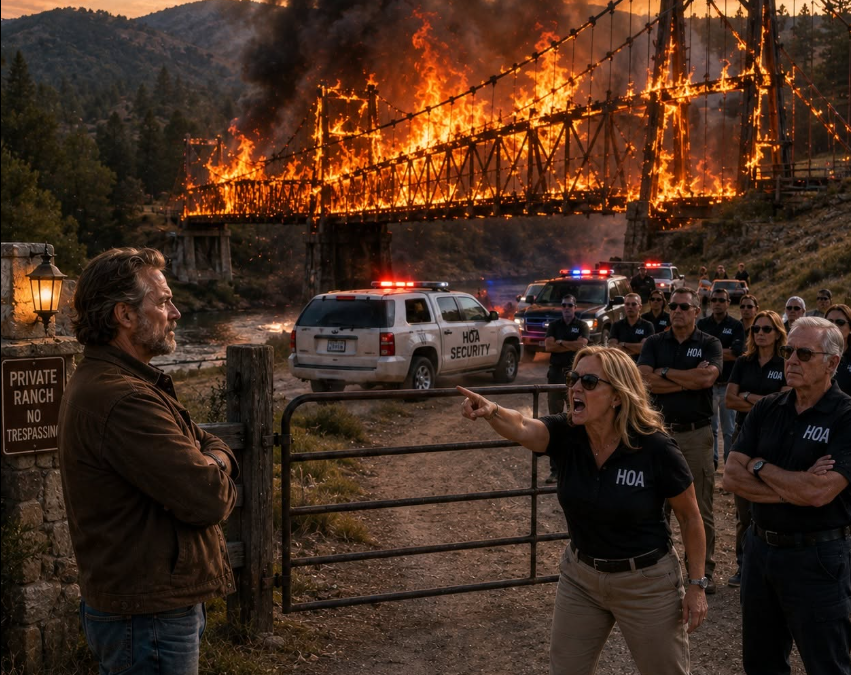
HOA Karen Burned My Suspension Bridge to Trap Me on My Ranch—Then Learned She Had Attacked Protected Federal Infrastructure.
At 2:13 in the morning, I woke to the sound of my only bridge screaming in the dark.
Both ends of it were burning at the same time, cutting my ranch off from the rest of the mountain like someone had taken a torch to the spine of my life.
Across the gorge, standing in the orange light with her arms folded, was the woman who believed fire would make me finally kneel.
My name is Everett Roark, and I had lived at Blackstone Ridge long enough to know the difference between a storm, an accident, and a message.
That night was a message.
A violent one.
A stupid one.
A message written in fire by people who thought a quiet man on a mountain was the same thing as a helpless man.
I was asleep in the old stone house when the blast rolled through the canyon.
It did not sound like thunder.
Thunder has a belly to it.
Thunder rolls over you and moves on.
This sound cracked low through the gorge, hit the stone walls, came back in pieces, and shook the window glass beside my bed.
My eyes opened before I fully woke.
That old part of the body, the one that survives before the mind starts asking questions, already knew something had gone wrong.
I did not reach for my phone first.
I reached for my boots.
That is a habit from a life I spent trying to outrun bad news.
Boots first.
Light second.
Weapon only if the night asks for one.
By the time I stepped onto the porch, the eastern sky had turned amber.
Blackstone Bridge stretched nearly two hundred yards across the gorge below the ranch, its steel cables cutting through smoke, its deck suspended over a drop so deep the river at the bottom sounded like a secret.
Both anchor points were on fire.
Not one.
Both.
Flames crawled along the cable housings and licked upward around the towers like orange hands. The wooden service deck had already caught in two places. Smoke twisted into the canyon wind and carried sparks into the black pines along the ridge.
A normal electrical failure does not begin at both ends of a bridge.
Lightning does not politely choose symmetrical load points.
A careless spark does not travel to opposite anchor blocks and ignite in the same minute.
A fire that begins in one place tells one story.
A fire that begins at both ends tells another.
I had spent half my former life reading stories people tried to burn, bury, forge, or drown.
That bridge was not failing.
It was being murdered.
For one second, I stood still and watched the flames move.
I watched how they climbed.
I watched how quickly the heat spread toward the upper cables.
I watched the color near the metal.
I watched the eastern support glow too hot too fast.
Then I turned and went inside.
Panic is a tax paid by people who do not prepare.
I had spent too many years around thieves, crooked contractors, compromised inspectors, paid-off officials, and men who smiled while signing documents that would one day kill somebody.
I knew preparation was not paranoia.
It was respect for how far people will go when money is waiting on the other side of a deed.
Inside the equipment room, I grabbed the thermal scope, satellite radio, and a rugged tablet linked to my private monitoring system.
Few people knew the system existed.
Fewer knew it ran on an independent power supply.
Nobody in Silver Pines knew the cameras streamed to a server outside the state.
That part mattered.
Criminals love local control.
PART2:
They love knowing which sheriff plays golf with which developer.
They love knowing which county clerk owes which favor.
They hate evidence that travels farther than their influence.
I opened the thermal feed.
The screen showed three figures moving away from the eastern anchor point.
Reflective vests.
Work gloves.
Slow steps.
Not panicked.
Not confused.
Not the movements of people who had discovered a fire.
The movements of people who had started one and believed the job was done.
A white maintenance truck sat on the access road below.
Silver Pines Homeowners Association crest on the door.
On the opposite hillside, beyond the smoke and flame, I saw Marlene Crowe.
HOA president.
Self-appointed queen of Silver Pines.
Professional enemy of anything she could not regulate, monetize, or intimidate.
She stood beside her black SUV with her arms folded, watching my bridge burn as if she had ordered a fountain display and wanted to admire the timing.
She believed she had trapped me.
That was her first mistake.
She believed the bridge was only mine.
That was her second.
She believed nobody was watching.
That was the mistake that would cost her everything.
I called emergency dispatch through the satellite radio because the regular line had already begun dropping.
The bridge did not only carry a road.
Beneath the deck ran emergency communication fiber, wildfire sensors, a backup radio relay, and a high-pressure water main tied into the regional firefighting system.
If the bridge fell, more than my ranch would be cut off.
PART3:
The whole northern slope would lose a critical warning corridor.
Dispatch answered with the kind of tired alertness that tells you the operator has already heard something ugly in your voice.
“Emergency services.”
“This is Everett Roark at Blackstone Ridge.”
“Blackstone Ridge?”
“My suspension bridge is on fire.”
A pause.
“How large is the fire?”
“Both anchor points are burning.”
Another pause.
That one was different.
Dispatchers hear accidents all the time.
They hear deliberate sometimes.
“Are you safe?”
“For the moment.”
“Can you evacuate?”
“No conventional road access once the bridge drops.”
“We are sending fire and sheriff’s units.”
“They will not be able to reach the ranch by vehicle.”
I looked back toward the gorge.
The eastern tower bent slightly.
Not much.
Enough.
“Hurry anyway.”
Before the flames finished their work, my phone rang.
Private number.
I answered because I already knew who it was.
“Mr. Roark.”
“Marlene.”
“I assume you can see the bridge.”
“I can.”
“Then you understand the seriousness of your position.”
I looked at the thermal screen.
One of her men was still visible near the access road.
“I understand more than you think.”
“That bridge was an illegal and dangerous structure crossing land now under Silver Pines control.”
“No.”
“You have refused every reasonable proposal.”
“No.”
“You have endangered the community with your stubbornness.”
“No.”
She inhaled quietly.
People like Marlene dislike short answers.
They cannot decorate them.
“The association is prepared to offer you temporary use of our private service road,” she said.
“On what terms?”
“You will sign over the lakefront parcel.”
There it was.
Not concern.
Not safety.
Not community.
Land.
Always land.
“How much of it?”
“Two hundred forty acres.”
“My lake, my south meadow, and the ridge access.”
“All currently creating unnecessary conflict.”
“The fire is still burning, and you are making an offer.”
“I am offering a solution.”
“You burned my bridge to create the problem.”
She laughed.
Softly.
Carefully.
“No one can prove Silver Pines had anything to do with that unfortunate failure.”
I watched the east tower lean farther.
“You certain you want responsibility for what happened tonight?”
“I have no responsibility for your neglected bridge.”
“It was inspected six months ago.”
“By people you paid.”
“No. By the state.”
Silence.
Just a breath.
Then she recovered.
“Good night, Mr. Roark.”
“You destroyed something you never bothered to understand.”
Her voice sharpened.
“By morning, you will understand isolation.”
The line went dead.
A moment later, the eastern support tower gave way.
The sound was enormous.
Steel screamed.
Cable snapped.
The deck twisted, sagged, and folded into the dark like a wounded animal. The rest of the structure tore loose in stages, each failure echoing off the gorge walls until the final roadway dropped into the ravine and vanished into smoke.
For the first time that night, my hands shook.
Not from fear.
From memory.
That bridge was the last thing I built before I walked away from my old life.
It had been a project, yes.
Steel.
Concrete.
Cable.
Load calculations.
Inspection reports.
Environmental clearances.
Emergency designation.
But it had also been a promise.
After the Black Hollow wildfire eighteen years earlier, when the northern communities had nearly been erased because one old county road washed out and a second route was blocked by fallen trees, I helped design a corridor that would never leave people trapped again.
The state partnered with me because my ranch controlled the only practical crossing.
I gave the easement.
I helped manage construction.
I stayed through every inspection.
I signed the final protection documents with a hand that still remembered smoke from the wildfire.
Then I left state service.
Or tried to.
I bought Blackstone Ridge from my father’s estate, moved into the stone house, and told myself I was done hunting men in pressed shirts who treated infrastructure like a wallet.
I wanted cattle.
Weather.
Fence work.
Quiet.
The bridge was supposed to be the last thing connecting my old life to the world I had chosen.
Now it lay burning in the gorge because Marlene Crowe thought isolation could become leverage.
Down in the control room beneath my equipment barn, I opened a steel case I had not touched in three years.
Inside were my old service badge, sealed files, and the engineering blueprints for Blackstone Bridge.
Across the top of the folded plans, raised beneath the state seal, were words Marlene had never bothered to read.
BLACKSTONE EMERGENCY CORRIDOR.
PROTECTED CRITICAL INFRASTRUCTURE.
I ran one finger over the lettering.
Then I sat at the console and began preserving evidence.
Footage.
Thermal data.
Power interruptions.
Sensor failures.
Call recordings.
Satellite logs.
Every second mattered now.
Not because I wanted compensation.
Not because I wanted revenge.
Because whoever burned that bridge had not only attacked me.
They had knocked out a wildfire warning line protecting more than three hundred homes, a water main feeding regional fire defense, and an evacuation corridor built after people nearly died.
Marlene had tried to trap one rancher.
In doing so, she had endangered the very community she claimed to protect.
That would be her undoing.
But to understand why she went that far, you need to understand what Blackstone Ridge was worth to her.
Silver Pines began as a mountain development ten years earlier, a luxury community carved into the north slope above Lake Calder.
At first, it was just homes.
Expensive homes, but homes.
Then came talk of a resort.
Private villas.
A golf course.
A marina.
A lakeside spa.
Walking trails.
Equestrian facilities for people who loved the idea of horses but not the smell.
The marketing people called it “a complete lifestyle destination.”
The county called it economic growth.
I called it what it was.
A land grab waiting for stationery.
Silver Pines could build homes on its land.
That was their right.
But the resort plan had a problem.
Water.
Access.
Emergency compliance.
The lakefront they needed belonged to me.
The water source they claimed to control fed from my side of the ridge.
The only practical emergency corridor passed across my bridge.
The only feasible heavy-equipment route to the marina site crossed my service easement.
Without Blackstone Ridge, the resort was a brochure.
With it, the project became hundreds of millions of dollars.
So they started with offers.
Polite at first.
Then insulting.
Then dressed as partnership.
Then dressed as public benefit.
Marlene came herself the third time.
She arrived wearing white linen, impractical shoes, and the expression of someone prepared to be generous with another person’s future.
“Everett,” she said, as if we were old friends.
“Mrs. Crowe.”
“Marlene is fine.”
“No.”
Her smile tightened.
She looked across the lake from my porch.
“You own a magnificent piece of property.”
“Yes.”
“A piece too large for one man to manage alone.”
“I manage it.”
“Barely.”
I looked at her then.
She had not come to talk price.
She had come to test insult.
“I am here with an opportunity,” she said.
“I am not selling.”
“You have not heard the offer.”
“I have heard enough offers.”
“Not this one.”
She opened a folder.
Two hundred forty acres.
Lakefront parcel.
South meadow.
Bridge approach.
Water rights language so slippery it could have been written in oil.
The price was a joke.
A rich joke.
Still a joke.
“No,” I said.
She blinked.
“One does not say no to an offer of this scale without review.”
“I just did.”
“You are standing in the way of regional progress.”
“I am standing on my porch.”
She looked at me in a way I recognized from investigations.
The way a person looks at a locked door and begins imagining a key.
“Progress has a way of finding routes around obstruction,” she said.
“That sounded almost like a threat.”
“It was not.”
“Good.”
I handed the folder back.
“Because threats create records.”
That was the first time I saw uncertainty cross her face.
Only a flicker.
Then it vanished.
Within a month, the violation letters began.
Fence posts painted the wrong color.
Barn height.
Generator noise.
Livestock odor.
Driveway gravel inconsistent with community standards.
A water tank visible from a proposed overlook.
My cattle, according to one letter, created “negative lifestyle impressions.”
I sent every letter back with a copy of the same statement.
Blackstone Ridge is not part of Silver Pines.
The Silver Pines HOA has no jurisdiction over my land.
Further contact regarding enforcement will be treated as harassment.
They kept sending letters anyway.
Marlene began telling residents the ranch was a “noncompliant holdout parcel.”
Preston Vale, the association’s attorney, filed a notice with the county claiming a boundary review was underway.
Then came the falsified plat.
On paper, it showed the eastern bridge anchor crossing association common land.
It was a clever lie if nobody checked the filing code.
I checked everything.
I had spent years catching public contractors who forged inspection stamps, swapped page numbers, altered survey dates, and buried fraudulent easements inside annexes nobody read.
The plat code belonged to a document never approved.
The county surveyor’s signature was dated after the man had retired.
The boundary line bent in a way no real surveyor would draw unless paid to forget geometry.
I sent Marlene the original state-sealed survey.
I sent Preston a copy too.
I expected them to back off.
That was naive.
Not because I underestimated their greed.
Because I underestimated their certainty that local influence was stronger than state record.
The harassment increased.
Silver Pines security trucks parked near my access road.
A drone hovered over the lake.
Someone cut fencing near the south meadow.
Someone put orange development flags along my property line.
Then one afternoon, a contractor arrived asking where to stage soil-testing equipment for the future marina.
I told him the future marina could stage itself on the moon.
He left quickly.
Behind the visible pressure, I began seeing a second pattern.
Older landowners around Silver Pines had sold under strange circumstances.
A widow named Helen Armitage lost sixty acres of orchard after Preston claimed her irrigation ditch crossed onto association land.
A young couple named Daniel and May Ellis sold five acres at a third of its value after months of fines over nonexistent code violations.
A retired mechanic moved away after a bogus lien appeared days before a developer announced an access road across his former property.
Different parcels.
Same rhythm.
Manufactured violation.
Falsified boundary concern.
Legal pressure.
Emergency meeting.
Lowball offer.
Forced sale.
Development announcement.
I had seen that rhythm before.
Not in HOA disputes.
In corruption cases.
Once you see a machine, you cannot unsee it.
Still, suspicion does not convict.
That is what most angry people never understand.
Truth is not evidence until you can carry it into a room where rules matter.
Marlene had spent years making people feel helpless.
I wanted more than proving she was cruel.
I wanted the whole mechanism.
So I watched.
I documented.
I waited.
Then she burned the bridge.
By sunrise, Marlene’s story was already public.
Silver Pines sent an emergency notice claiming Blackstone Bridge had failed due to poor maintenance and dangerous old wiring.
Preston Vale had a press statement ready before the smoke cleared.
He blamed me for failing to maintain the structure.
He suggested the bridge had posed a hazard to Silver Pines residents.
He called for immediate county intervention.
He petitioned for fines.
He floated emergency control of my lakefront acreage as a “public safety stabilization measure.”
That phrase made me laugh once, alone in the control room.
People like Preston were predictable.
Not stupid.
Predictable.
They break your window and ask a judge to grant them access because the house is now unsecured.
I reviewed the thermal footage frame by frame.
At 2:06 a.m., the white HOA maintenance truck arrived.
At 2:09, Graham Pike, Silver Pines’ maintenance manager, stepped out with two men.
At 2:11, they moved to the eastern anchor.
At 2:12, a figure approached from the hillside.
Marlene.
At 2:13, Graham bent near the cable housing.
A second man stood watch.
Marlene handed Graham something.
The image sharpened just enough.
A torch lighter.
At 2:13:22, the first flare appeared.
At 2:13:39, the western anchor ignited.
Both ends.
Planned.
Coordinated.
Recorded.
I did not send the footage to the county sheriff right away.
I liked Sheriff Wade Hollister.
But liking a local official is not an evidence strategy.
Marlene’s reach into county offices was one of the things I still needed to map.
So I encrypted the file and sent it to an old contact from my previous life.
Briar Whitlock.
Structural engineer.
Former state emergency infrastructure consultant.
The woman who had overseen the bridge’s most recent upgrade.
My message was one line.
Reactivate the Blackstone file.
Subject has crossed the line.
She called through satellite radio within twenty minutes.
Her voice sounded less surprised than tired.
“I knew one of them would do something stupid eventually.”
“Good morning to you too.”
“Are you safe?”
“For now.”
“Bridge?”
“Gone.”
“Comms line?”
“Severed.”
“Water main?”
“Likely compromised.”
“Sensor network?”
“Down north of the gorge.”
She went quiet.
Then she said, “That exposes Silver Pines.”
“Yes.”
“Do they know?”
“No.”
“Of course not.”
I sent her the thermal footage.
She watched while I waited.
When she spoke again, the warmth had left her voice.
“They targeted the primary load clusters.”
“I saw.”
“This was not random.”
“No.”
“Someone had access to the engineering plans.”
“Yes.”
“Who?”
“Short list.”
“County records office.”
“State archive.”
“Your files.”
“My files are secure.”
“Mine too.”
“Then county.”
We both knew what that meant.
Somebody had sold or leaked protected infrastructure plans to people willing to use them as an arson diagram.
The bridge’s destruction created immediate practical problems.
No truck could reach the ranch.
No ambulance.
No standard fire apparatus.
Marlene believed I was trapped.
She had barricades placed across the Silver Pines private service road that same morning.
Security guards took shifts at the entrance.
A formal courier delivered her ultimatum at noon.
Forty-eight hours.
Sign over the two hundred forty lakefront acres.
Waive my right to sue.
Accept financial responsibility for clearing the bridge wreckage.
In exchange, Silver Pines would allow temporary access through its service road.
It was extortion typed on expensive paper.
I placed the letter in an evidence sleeve.
Then I went to the old equipment shed behind the upper pasture, moved a rack of rusted fencing tools, and opened the hatch beneath the floor.
Long before Marlene ever dreamed of Silver Pines, my grandfather had kept a hidden trail down through the gorge.
Too narrow for trucks.
Too steep for cattle.
But years earlier, I had widened parts of it enough for a trail bike.
At the bottom, a narrow steel utility crossing ran beside a water pipeline.
No public map showed it.
No HOA security guard knew it existed.
If Marlene had researched the ranch instead of fantasizing about owning it, she might have learned that mountain families rarely build only one way out.
That night, under moonless dark, I rode down the hidden trail, crossed the utility span, and reached an abandoned equipment barn on the far side.
Nolan Mercer waited inside.
He was not related to Preston Vale, though he liked to say sharing a county with that man was insulting enough.
Nolan was a rancher on the eastern ridge.
Five years earlier, Silver Pines had taken sixty acres from him through a falsified boundary claim.
He fought until the money ran out.
Then he sold under pressure and disappeared into the kind of quiet anger that hardens instead of fading.
He still kept every document.
Every letter.
Every map.
Every email.
Every lie.
When I stepped into the barn, he looked at my smoke-stained jacket and said, “They finally burned something.”
“My bridge.”
His jaw tightened.
“I heard.”
“You said you had records.”
“I have more than records.”
He opened a metal file box on a workbench.
Inside were printed emails between Marlene, Preston Vale, and a development firm called Arden North Hospitality.
The correspondence laid out a plan to acquire my land within six months.
Not ask.
Acquire.
The developer had already wired a $1.8 million advance consulting fee into a fund Marlene personally controlled.
The payment was tied to “delivery of waterfront access rights.”
My waterfront access rights.
Nolan tapped the page.
“That is what they paid her for.”
I read the agreement once.
Then again.
Not because I needed to.
Because rage sometimes asks to verify the reason it has entered the room.
“They sold land they did not own,” I said.
“Yes.”
“And burned the bridge to pressure delivery.”
“Yes.”
Nolan leaned against the table.
“You going to release it?”
“No.”
He frowned.
“Why not?”
“Because this proves Marlene is dirty.”
“That seems useful.”
“It does not prove who helped her.”
He looked toward the barn door.
“You think county people are in it.”
“I know someone gave them bridge plans.”
“And records.”
“And possibly cover.”
Nolan’s face hardened.
“They did this before.”
“Yes.”
“To me.”
“Yes.”
“To Helen.”
“Yes.”
“To the Ellises.”
“Yes.”
“And you want the whole list.”
“I want the whole machine.”
He studied me for a long moment.
“People say you used to investigate this kind of thing.”
“People say many things.”
“You did not deny it.”
“No.”
For years, I had avoided that part of my life.
Not because I was ashamed of it.
Because walking away had been the only way I knew to stay human after my final case.
A bridge contract fraud investigation.
Three counties.
Millions stolen.
Substandard cable.
False inspection stamps.
A collapse narrowly avoided because a junior engineer refused to sign off.
We convicted contractors, consultants, and state officials.
But three senior men slipped away untouched behind immunity deals and political protection.
I left after that.
Not defeated.
Disgusted.
I told myself I would never again spend my days proving powerful men lied while watching other powerful men call it complicated.
Then Marlene burned my bridge.
The old life came back like muscle memory.
The next day, Marlene learned someone had accessed land records overnight.
She suspected me.
She was right.
But not in the way she imagined.
I had not hacked anything.
I had pulled remote copies through a lawful archive account still available to me because Blackstone Corridor remained protected infrastructure.
That status opened records she did not know existed.
She sent Graham Pike to find me.
Graham came with two hired security men, following trail-bike tracks to Nolan’s abandoned equipment barn.
He entered without knocking.
That told me enough about how Silver Pines trained its people.
Graham was heavyset, red-faced, and sweating from the climb. He wore a maintenance jacket and carried confidence he had borrowed from Marlene.
“We need those documents,” he said.
“No.”
“This is association business.”
“No.”
“Mr. Roark, you are interfering with a lawful development review.”
“No.”
He looked at Nolan.
“Hand over the laptop.”
Nolan laughed.
It was not a happy sound.
Graham stepped forward.
I moved between them.
“Do you have a warrant?”
Graham’s mouth tightened.
“Association authority is sufficient.”
“No.”
He reached past me toward Nolan’s folder.
I caught his wrist, turned with the movement, and guided his arm down without striking him.
He hit one knee because leverage is honest even when people are not.
The two security men moved forward, then stopped.
They saw something in my face Graham had missed.
I was not angry enough to be reckless.
That makes a man harder to predict.
“Let go,” Graham hissed.
“Stop reaching.”
“This is assault.”
“This is restraint.”
I released him.
He scrambled back, humiliated.
That was more dangerous than if I had hurt him.
Humiliated men report fantasies.
Sure enough, Sheriff Wade Hollister arrived within fifteen minutes.
Marlene came right behind him.
She stepped out of her SUV looking as if the dirt road itself had committed an offense.
“Sheriff,” she said, “Mr. Roark attacked our employee.”
Wade looked at me.
I handed him my phone with the footage already open.
“Whole thing.”
He watched without expression.
Then he looked at Graham.
“You said he attacked you.”
Graham looked away.
Marlene said, “He interfered with association recovery of sensitive documents.”
Wade looked at her.
“Do you have a court order?”
She did not answer.
I said, “I also want an official report opened on the bridge arson.”
Marlene laughed sharply.
“Arson?”
Wade’s eyes stayed on me.
“Do you have evidence?”
“Yes.”
Marlene said, “This is a private property dispute.”
“No,” I said. “It was protected infrastructure.”
That got Wade’s attention.
Then he looked at my face more carefully.
I saw recognition arrive.
Not from local gossip.
From an old case file.
“Everett Roark,” he said slowly.
“Yes.”
“The state bridge sabotage case.”
Marlene’s expression flickered.
Just a little.
Wade turned toward her.
“I think everyone should choose words carefully now.”
Before leaving, I asked Wade to keep my former career quiet.
He gave me a long look.
“Why?”
“Because careless people talk when they think they still hold the advantage.”
He nodded.
“Fair.”
Marlene did not stay quiet long.
That night, she ordered Graham back into the gorge.
Her goal was simple.
Burn what remained of the bridge control building.
Destroy the data recorders.
Erase anything that could prove the first fire had been intentional.
The problem was that I had already removed the real equipment and replaced it with decoys.
The second problem was that Graham had become afraid.
Afraid men make excellent recordings for other people.
He crept down near midnight carrying fuel.
The cameras watched him from three angles.
He poured.
He struck.
The decoy building burned.
An automated alert went directly to the state fire marshal’s office.
By 3:00 a.m., Lead Investigator Odessa Hart had been assigned.
Odessa did not waste words.
She arrived before noon in an unmarked state vehicle, stepped out wearing field boots and a dark jacket, and looked down into the gorge without drama.
“Two fires,” she said.
“Yes.”
“Same target area?”
“First bridge anchors.”
“Second control building.”
“Any casualties?”
“No.”
“Any idiots still on scene?”
“Not at the moment.”
She almost smiled.
“Give it time.”
Odessa found accelerant residue at both fire scenes.
Industrial fuel compound.
Sold only to licensed maintenance contractors.
Purchase records led to Silver Pines HOA.
Not near it.
Not around it.
Directly to it.
Marlene and Preston tried to make Graham disappear from their payroll.
They falsified records showing he had been terminated two weeks before the bridge fire.
Unfortunately for them, I already had a backup copy of the accounting server from Nolan’s archive materials and later state collection.
It showed a payment to Graham the morning after the blaze.
The cover story cracked before it was fully dry.
Odessa met with me privately after reviewing the bridge files.
We sat in the temporary command trailer near the collapsed span. The burned cables still hung below like black veins.
She read the protected designation twice.
Then she looked at me.
“This is not property destruction.”
“No.”
“This is an attack on an emergency corridor.”
“Yes.”
“And the water main.”
“Yes.”
“And the sensor network.”
“Yes.”
She leaned back.
“Why would an HOA president take that risk?”
I slid the $1.8 million development agreement across the table.
“Because she sold something she did not own.”
Odessa read silently.
Her expression changed line by line.
“This is land fraud.”
“Yes.”
“Organized.”
“Yes.”
“How many victims?”
“More than me.”
“How many?”
“I am still counting.”
Preston moved quickly through court.
That was his specialty.
He filed an emergency order accusing me of building an unpermitted bridge, endangering residents, trespassing on association common land, assaulting HOA personnel, and refusing reasonable access negotiations.
He asked for temporary control over my lakefront parcel.
He used phrases like public safety, community stabilization, and emergency asset management.
I had seen those phrases before.
They were velvet cloth over a crowbar.
At the first hearing, Marlene arrived with a full legal team and a row of supportive residents.
She wore dark green, like someone had told her it made her look grounded.
Preston stood beside her with a binder thick enough to impress people who confuse paper volume with truth.
I came alone.
Worn work jacket.
Boots.
No attorney.
Preston smiled when he saw me.
“Mr. Roark appears to have mistaken this proceeding for a feed store dispute.”
I looked at the judge.
“Your Honor, I do not need lengthy argument when the public record is this clear.”
Judge Corrine Alder raised an eyebrow.
“I hope you brought the record.”
“I did.”
Preston presented the falsified plat first.
He spoke smoothly about uncertain boundaries and historical association interest.
When he finished, I asked the court to examine the filing code printed in the corner.
Judge Alder did.
The clerk checked.
The code belonged to a plat that had never been approved.
Then I asked the court to check the surveyor signature.
The named county surveyor had retired before the date on the document.
Preston tried to interrupt.
The judge told him to sit.
I placed the original state-sealed survey on the table.
Both bridge anchor points fell entirely within Blackstone Ridge.
Then I submitted the structural inspection from six months earlier.
Full compliance.
No critical deterioration.
No electrical hazard capable of causing simultaneous ignition at both anchor points.
Then Odessa entered.
She did not make an entrance.
She made a record.
“The state fire marshal’s office has confirmed accelerant use at both fire scenes,” she said.
The courtroom shifted.
Marlene’s face went rigid.
Judge Alder signed search warrants for Silver Pines headquarters, the maintenance facility, Preston’s law office, Marlene’s financial accounts, and county records tied to Blackstone Ridge.
She denied Silver Pines’ request for control of my land.
She ordered the service road opened for my temporary use.
She issued a restraining order barring Marlene, Preston, Graham, and all association staff from setting foot on Blackstone Ridge.
Then she looked at Marlene.
“If this court learns that you have obstructed that service road, you will regret making me repeat myself.”
Marlene obstructed it within hours.
Concrete barriers appeared across the service road under the label routine maintenance.
When my supply truck was blocked, I did not move the barriers.
I called Wade.
He arrived, documented everything, and forced Silver Pines to clear the road.
As the last barrier was dragged away, the gravel shoulder collapsed slightly, exposing a buried pipe.
Briar examined it that afternoon.
She knelt in the dirt, brushed gravel from the line, and looked up at me with a face I did not like.
“This is not on any filed map.”
“What is it?”
“High-capacity water line.”
“From where?”
She followed the visible direction with her eyes.
“Your lake.”
The next three hours rewrote the case.
A hidden pipeline ran from Blackstone Lake into Silver Pines.
For years, without consent, permits, or payment, the association had been drawing water from my land.
It filled their artificial ponds.
Fed irrigation.
Supported landscaping.
And, according to development applications, helped establish water stability for the planned resort and golf course.
Marlene had promised investors she controlled Blackstone water rights.
That promise had earned her the $1.8 million advance.
The bridge fire was only the visible violence.
The theft had been flowing underground for years.
Nolan brought more landowners forward.
Helen Armitage, the widow who lost her orchard.
Daniel and May Ellis, the young couple forced to sell five acres.
A retired mechanic named Lou Drayton, whose shop land became an access spur after a lien he never understood.
A ranch family from the eastern ridge who paid fake penalties until they surrendered grazing land that later became a resort trail.
Each story followed the same script.
Preston produced a boundary concern.
Marlene sent violation letters.
Fines compounded.
County records shifted.
Pressure increased.
The owner sold.
A developer profited.
I built a network map on the wall of my control room.
People.
Payments.
Properties.
Surveys.
Meeting dates.
Shell companies.
Development announcements.
Records officials.
Every line told the same story.
Silver Pines was not an overzealous HOA.
It was a land seizure machine dressed in community language.
Marlene sensed the walls closing.
Preston warned her that accounts could be frozen.
She ordered funds moved.
She ordered meeting records destroyed.
She told Graham he would take the fall if needed.
That was what finally broke him.
Graham slipped onto my ranch after midnight three nights later.
I found him near the equipment barn, hands raised before I even stepped outside.
“I need to talk.”
“You need a lawyer.”
“I need not to be dead.”
That got my attention.
Inside, he placed his phone on the workbench and slid it toward me.
“Marlene knows I recorded her.”
“What did you record?”
“The order.”
He looked like a man watching his own grave being measured.
“She said if I disappeared, my family would be fine.”
“That sounds generous.”
“It did not sound optional.”
I did not promise him safety.
I did not promise him freedom.
I promised only that I would turn over what he gave me and that his cooperation would be documented.
He accepted that like it was more than he deserved.
The recording was clear.
Marlene’s voice.
Burn both ends.
He cannot move equipment out if the bridge drops.
Make it look electrical.
Preston’s voice followed.
Remove the personnel records after.
Use the maintenance vest.
No one questions official work at night.
Then Marlene again.
The control building must go too.
If he has data, it dies there.
No ambiguity.
No metaphor.
No misunderstanding.
Odessa said the recording was enough to arrest Graham and likely Marlene, but I saw the calendar.
Silver Pines’ annual meeting was two days away.
Full board.
Investors.
Preston.
Residents.
Financial reports.
Development presentation.
Everyone in one room.
“Wait,” I told Odessa.
She stared at me.
“You want them gathered.”
“Yes.”
“You understand the risk.”
“Yes.”
“And the benefit.”
“Yes.”
She studied me for a long moment.
“You really did this for a living.”
“I used to.”
“Used to looks suspiciously current.”
The annual meeting took place in the Silver Pines clubhouse, a building of stone, glass, and bad taste overlooking the artificial lake my water had been filling.
Residents arrived nervous.
Marlene had told them I was waging a revenge campaign because my neglected bridge collapsed.
Preston had drafted a resolution authorizing use of reserve funds for legal defense.
Hidden inside it was language transferring association assets into a new management entity Marlene controlled.
She planned to rob the ship while calling it emergency steering.
I walked in with Nolan and Briar.
The room went quiet.
Marlene stood at the podium.
“This is a closed meeting.”
“No,” I said. “It is evidence.”
“Security.”
Two guards approached.
Then Sheriff Wade Hollister stepped through the doors behind me with Odessa Hart and state investigators.
Wade’s voice carried across the room.
“This meeting will continue.”
He looked at the exits.
“But no one present is leaving yet.”
For the first time since I had known her, Marlene Crowe looked afraid in public.
Not much.
Enough.
I walked to the front and placed my first document on the table.
Original state survey.
Then the protected infrastructure designation.
Then footage of the HOA truck arriving at the bridge.
Then still images of Graham carrying fuel.
Then purchase receipts for the accelerant.
Then payroll records proving Graham had not been terminated.
Then the $1.8 million development contract.
Then the illegal pipeline map.
Then water draw estimates.
Then the list of landowners forced out through fraudulent claims.
The residents began murmuring louder with each page.
Preston stood.
“This is an outrageous manipulation of incomplete evidence.”
Odessa said, “Then let’s complete it.”
She played the recording.
Marlene’s voice filled the room.
Burn both ends.
No one moved.
No one coughed.
No one whispered.
Then Preston’s voice followed, coaching the cover story.
His face went pale before the recording finished.
Marlene gripped the podium.
“That audio is altered.”
Odessa looked toward the door.
Graham entered under investigator escort.
He would later be arrested formally, but that morning, he was there to confirm.
“That is her voice,” he said. “And his.”
Marlene pointed at him.
“You lying coward.”
Graham flinched but kept speaking.
“She promised me $75,000 and a house. She said Mr. Roark would sign over the land within forty-eight hours. Preston gave me bridge diagrams. He circled the load cables.”
Preston sat down hard.
Two board members tried to slip toward the side exit.
Wade blocked them.
Residents were standing now.
Shouting.
Demanding answers.
“What water line?”
“What landowners?”
“Where is the reserve fund?”
“Why is the warning system down?”
That last question mattered most.
Briar stepped forward.
“Because the wildfire sensor network ran through the bridge.”
She looked around the room.
“Destroying it removed early warning coverage from the northern forest.”
A woman in the front row whispered, “Our homes?”
“Yes,” Briar said. “Your homes.”
That was the moment Marlene truly lost the room.
Not when they heard she burned my bridge.
Not when they saw the money.
When they realized her greed had placed their own houses in danger.
Marlene had built her power by promising safety.
Now the residents saw the truth.
She had endangered them to steal from me.
She reached for her phone.
Odessa took it from her hand.
A state technician began preserving it immediately.
Messages to investors appeared within hours.
The resort had been sold as if Blackstone land were already secured.
The water rights had been represented as controlled.
The bridge access had been described as “soon to be resolved by enforcement action.”
Enforcement action.
That was one way to spell arson.
Marlene was arrested that day.
Conspiracy to commit arson.
Destruction of protected emergency infrastructure.
Land fraud.
Extortion.
Obstruction of an investigation.
Violation of a court order.
Theft of water.
Preston was arrested for document forgery, evidence tampering, fraud, conspiracy, and misuse of legal filings.
Graham was arrested for arson and destruction of infrastructure.
Two board members were detained for their roles in approving what meeting notes called “choke point removal.”
As officers led Marlene past me, she twisted toward the room.
“He destroyed this community,” she said.
Her voice cracked with rage.
“He did this.”
I looked at the residents behind her.
People scared.
Angry.
Ashamed.
People who had trusted the wrong leader because she made control sound like protection.
“No,” I said. “You burned your neighbor’s bridge before I ever walked into this room.”
The arrests made state news by evening.
By the next morning, reporters had dug into my past.
Former lead investigator.
State infrastructure oversight.
Bridge sabotage case.
Public project fraud.
Ninety million dollars recovered.
Contractors imprisoned.
Officials disgraced.
A career I had spent years burying under ranch work was suddenly on every screen in the county.
People began calling me a hero.
That word always made me uncomfortable.
Heroes are useful in stories because they simplify responsibility.
Real cases are messier.
I had missed things.
I had seen signs before the fire and waited because I needed evidence strong enough to survive court.
That waiting exposed more victims.
Maybe it also saved the case.
Both things can be true.
Some Silver Pines residents blamed me for not warning them sooner.
I understood.
Fear looks for a face, and mine was easier to see than the network they had lived inside for years.
At a public meeting held under county supervision, one resident stood and asked, “If you knew she was corrupt, why did you let us live under her?”
Nolan answered before I did.
“Because when some of us tried to tell you, you called us bitter.”
The room went still.
Helen Armitage stood beside him.
“My orchard was stolen before most of you knew the resort existed,” she said.
Her voice trembled.
“I begged someone to listen. No one wanted trouble.”
That silence did more than my explanation could have.
Still, I spoke.
“I suspected a pattern. I did not have enough proof. If I had accused Marlene publicly without evidence, Preston would have buried the records, destroyed the paper trail, and framed every victim as disgruntled.”
I looked around the room.
“That is not an excuse. It is the reason I moved carefully.”
A man in the back said, “And now?”
“Now the records are open.”
They were.
The attorney general’s office took over the broader case.
Search warrants hit Arden North Hospitality, Preston’s law office, the county records office, Marlene’s shell consulting fund, the HOA accounting system, and maintenance contractors.
Fourteen properties were identified as having been seized or pressured through fraud.
Combined value exceeded $26 million.
Fraudulent liens were dissolved.
Forged surveys were flagged.
County filing procedures were placed under audit.
The records official who sold protected bridge plans was arrested.
The hidden water pipeline became its own civil and criminal matter.
Silver Pines was placed under independent administration.
Every fine Marlene had issued was reopened for review.
Every land transfer tied to Preston was examined.
Some former owners recovered property.
Others received compensation from seized assets.
The widow who lost her orchard drove to Blackstone Ridge one afternoon with a folder in her lap and both hands shaking on the steering wheel.
I met her near the temporary crossing.
Helen Armitage was seventy-eight, small, sharp-eyed, and tougher than grief had any right to ask her to be.
“They say I may get part of it back,” she said.
“Good.”
“I stopped believing that.”
“I know.”
She looked toward the gorge where the old bridge remains lay twisted below.
“I am sorry they burned your bridge.”
“I am sorry they stole your orchard.”
She laughed once, a dry broken sound.
“Look at us, apologizing for other people’s crimes.”
That was the most honest thing anyone said that week.
The attorney general invited me to serve as a special advisor on the case.
I declined at first.
Briar found me at the gorge the next morning. The sun was low, turning the burned cables dull red.
“You are hiding,” she said.
“I live here.”
“You are hiding where you live.”
“I left that work for a reason.”
“I know.”
“No, you do not.”
She stepped beside me.
“I know enough.”
“You know the clean version.”
“Then tell me the dirty one.”
I looked down at the wreckage.
“My last case proved bridge sabotage tied to public contracts.”
“You won.”
“We won part.”
“People went to prison.”
“Some.”
“Money was recovered.”
“Some.”
“And the rest?”
“The rest retired, got promoted, or became consultants.”
Briar said nothing.
I continued.
“I spent years believing if the evidence was strong enough, the system would do the right thing.”
“And then?”
“I learned evidence still needs people willing to act on it.”
She looked across the gorge.
“Then act.”
I almost laughed.
She did not.
“The bridge was never only your road,” she said. “It protected them too.”
“Silver Pines?”
“Yes.”
“The same people who let Marlene run wild?”
“Their children did not choose her.”
That landed.
Briar always knew where to place the weight.
I agreed to advise.
Not lead.
Not control.
Advise.
That mattered to me.
I had no interest in becoming a different kind of Marlene.
Power is dangerous even in clean hands if nobody checks the grip.
The trials took months.
Graham pleaded guilty and testified.
Two board members cooperated.
The records official pleaded out after investigators found payments routed through Preston’s shell companies.
Preston tried to negotiate while admitting nothing important.
That failed.
Marlene refused every plea.
She insisted she had acted to protect Silver Pines.
Her attorneys painted me as a former investigator obsessed with revenge.
They said I had baited the association.
They said Graham misunderstood instructions.
They said the bridge was a hazard.
They said the development contract was standard planning.
They said my surveillance was suspicious.
They said a man who prepares too well must have wanted conflict.
That one almost made me smile.
Preparation is only suspicious to people who rely on everyone else being unprepared.
When I took the stand, the prosecutor asked me to explain the bridge.
Not emotionally.
Technically.
So I did.
Emergency corridor.
Evacuation route.
Water main.
Radio relay.
Wildfire sensor network.
Protected designation.
Inspection history.
Load ratings.
Maintenance logs.
Communication coverage.
I explained how losing the bridge delayed detection of a small brush fire north of Silver Pines by seventeen minutes while temporary systems were being installed.
I explained what seventeen minutes can mean in dry wind.
I explained that my goal had never been to destroy an HOA.
My goal was to protect property rights, public safety, and human lives from people who believed paperwork could turn theft into authority.
Marlene watched me the whole time.
Cold.
Furious.
Unrepentant.
Graham testified after me.
His voice shook, but the details held.
Private meeting.
Bridge plans spread on Marlene’s desk.
Preston circling load points.
Marlene instructing him to burn both ends simultaneously.
Maintenance vest.
White truck.
Torch lighter.
Second fire at the control building.
Payroll falsification.
Promise of $75,000 and a house.
Then the financial analyst testified.
The $1.8 million investor payment entered Marlene’s consulting fund.
From there, money split to Preston, the records official, two board members, and future payment schedules for Graham.
The scheduled $75,000 payment matched Graham’s testimony.
The hidden water line tied directly to resort approval documents.
The land acquisition timeline matched the ultimatum sent to me after the bridge burned.
The jury did not need drama.
They had math.
Marlene was convicted on nearly every serious charge.
Preston was convicted of fraud, forgery, conspiracy, and evidence tampering.
Complicit board members were barred permanently from community management positions.
Arden North Hospitality lost its operating license in the state.
The corrupt records official lost his job, pension eligibility, and freedom.
Silver Pines as an HOA was dissolved because the court found it had been used as a direct instrument of criminal activity.
Its remaining assets were placed under county administration.
The old headquarters was sold.
Funds went to compensate defrauded landowners, repay residents, rebuild emergency infrastructure, and restore the wildfire warning network.
I was awarded compensation for the bridge, loss of access, stolen water, legal expenses, and punitive damages.
I kept what was necessary to rebuild.
I directed a large portion toward regional fire safety.
Some people called that generous.
It was not.
The bridge had always protected more than me.
The money needed to do the same.
At sentencing, Marlene turned to me from the defense table.
Her hair was still perfect.
Her suit was still expensive.
Her eyes were not.
They were hollow with the disbelief of someone who had mistaken obedience for loyalty and fear for respect.
“You may have won,” she said. “But your bridge is still broken.”
I looked at her.
“A bridge can be rebuilt.”
Then I looked at Preston.
“But a reputation built on lies cannot.”
Marlene received a long prison sentence.
Preston lost his license and received his own sentence.
Graham, because he cooperated, received less than he might have, but not nothing.
He had still poured fuel.
He had still lit the match.
Following orders does not erase burn marks.
Six months later, construction began on the new bridge.
Briar oversaw every stage.
Wider deck.
Fire-resistant materials.
Protected cable housings.
Independent sensor relays.
Redundant water main shielding.
Open camera systems.
Public documentation.
No hidden control room.
No secret designation tucked away for people to ignore.
This time, everyone knew exactly what the bridge was.
An evacuation corridor.
A firefighting artery.
A ranch access route.
A public safety asset crossing private land by agreement, not assumption.
The remains of the old bridge were not removed entirely.
I insisted on that.
The twisted black sections in the gorge stayed where they had fallen, secured and marked as historical evidence.
Not for drama.
For memory.
People are too eager to clean up the proof of what arrogance costs.
Silver Pines residents formed a voluntary community group after the HOA dissolved.
No authority to fine.
No power to seize.
No private security patrols.
No secret board transfers.
Every expense published.
Every major decision voted on directly.
They asked me to lead it.
I refused.
They asked again.
I refused again.
Finally, I agreed to serve as infrastructure safety advisor.
That was all.
Transparent rules, not a single powerful person.
That was the lesson they needed to learn.
That was the lesson I needed to remember too.
Nolan Mercer joined the county land oversight board.
Helen Armitage recovered part of her orchard and received compensation for the rest.
Daniel and May Ellis reclaimed their five acres at the original forced-sale price.
Lou Drayton’s old shop property stayed tied up in court longer, but he eventually received a settlement large enough to buy a new garage and name it Spite & Sons, despite having no sons.
I liked Lou.
On the day the new bridge opened, people gathered on both sides of the gorge.
Not a big ceremony.
I did not want speeches.
Briar wanted load tests.
Wade wanted traffic control.
Odessa wanted coffee.
The residents wanted closure.
I only wanted the bridge to hold.
A small plaque was mounted on the western support tower.
No power stands above the truth.
No community is built through theft.
Wade drove across first in his sheriff’s vehicle.
Odessa followed.
Then Briar.
Then the first fire engine.
That one mattered most.
When the warning bells were tested, they rang across the canyon clear and bright.
The sound carried to the stone house, down into the gorge, and out across the pines.
For a moment, I heard the old bridge too.
Not the collapse.
Not the scream of cable.
The way it used to hum softly under a passing truck.
A thing doing its job without applause.
After everyone left, I walked to the center of the new bridge.
The sun dropped low behind the ridge.
Below, the river moved through shadow.
The blackened remains of the old span rested far beneath me like a warning the mountain had decided to keep.
I had once believed peace meant getting far enough away from fights that they could not find me.
Blackstone Ridge had been my retreat.
My quiet.
My proof that a man could leave the machinery of corruption behind and become only a rancher with fences to mend and cattle to move.
I was wrong.
Peace is not distance from conflict.
Sometimes peace is the line you hold when someone else decides your silence is permission.
Marlene burned the bridge because she thought it would leave me trapped.
She thought isolation would make me desperate.
She thought desperation would make me sign.
She thought a rancher alone in the mountains could not fight an HOA, a lawyer, a developer, and a corrupted records office.
She did not know the bridge was protected infrastructure.
She did not know about the cameras.
She did not know about the hidden trail.
She did not know about Nolan’s records, Briar’s files, Odessa’s investigation, Wade’s integrity, Helen’s courage, or Graham’s fear.
Most of all, she did not know me.
She did not know I had spent years following forged surveys, fake contracts, rigged bids, sabotaged structures, shell accounts, and polite criminals who thought official language made them untouchable.
She burned my bridge to leave me with nowhere to go.
Instead, she lit the way back to every skill I had tried to bury.
The bridge stands again now.
Stronger than before.
Wider.
Safer.
Honest.
Some mornings, I drive across it just after sunrise and stop at the center.
The canyon opens beneath me.
The new cables shine in the light.
The old wreckage below stays dark.
Both are part of the truth.
What was destroyed.
What was rebuilt.
What should never be forgotten.
Blackstone Ridge is still mine.
The lake is still mine.
The water no longer disappears underground into someone else’s landscaping.
The service road is clear.
The warning network is restored.
The voluntary community group meets once a month in a plain building with folding chairs and public minutes.
Nobody calls it a lifestyle destination anymore.
That is progress.
Sometimes visitors ask why I did not sell after everything happened.
Why stay where someone tried to burn me out?
I tell them the answer my father would have given.
Land is not valuable only because of what can be built on it.
Sometimes it is valuable because someone refused to let thieves rename it opportunity.
Marlene Crowe believed fire would erase my choices.
It only revealed hers.
And in the end, she did not trap me on my ranch.
She trapped herself inside the one place people like her fear most.
The official record.








