HOA Karen Buried My Trout Stream Under 90 Tons of Gravel—Then a Storm Exposed the $4M Cleanup She Thought Homeowners Would Pay
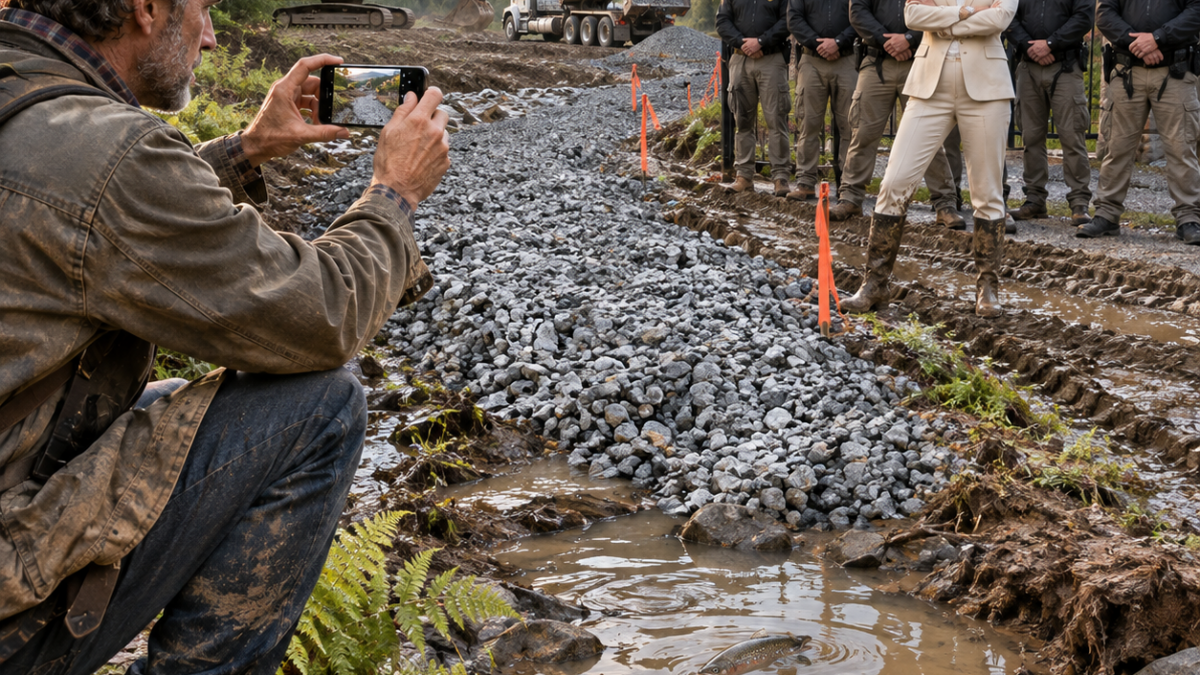
HOA Karen Buried My Trout Stream Under 90 Tons of Gravel—Then a Storm Exposed the $4M Cleanup She Thought Homeowners Would Pay.
At dawn, Cyrus Bledsoe found 150 feet of his trout stream buried beneath 90 tons of crushed gravel, brook trout gasping in shrinking pools, and six HOA security guards blocking his own road while president Lavinia Rusk smiled beside a new lakeside terrace and called the destruction an “emergency drainage repair.”
Lavinia thought she could shame Cyrus as a selfish fisherman, force him into silence with a $25,000 payoff, and make wealthy buyers believe her luxury lake was naturally spring-fed—but Cyrus had spent twenty years recording every rise, drought, temperature shift, and flow change in Gray Pine Run, and one approaching storm was about to turn those forgotten measurements into evidence she could not explain away.
When the state finally uncovered the buried 30-inch diversion pipe beneath the gravel, the ignored engineer’s warning, and the secret financial guarantee behind the development, Lavinia’s threat that innocent homeowners would be crushed by a $4 million cleanup collapsed in front of an entire courtroom—because she had already signed the document that made someone else pay to put the stolen water back where it belonged.
At 5:40 in the morning, Cyrus Bledsoe woke because he could not hear the stream.
That was the first thing.
Not a truck.
Not an alarm.
Not shouting from the road.
Silence.
For twenty years, Gray Pine Run had been the background noise of his life.
It came through the bedroom window in spring.
It murmured beneath winter ice.
In summer, when cicadas took over the woods and heat settled over the Blue Ridge Mountains, the stream still ran cold over stone below the farmhouse.
Cyrus had learned its sound without trying.
High water had a fuller note.
Late-August flow was softer.
After thunderstorms, the larger rocks near the bend changed the rhythm enough that he sometimes knew the level had risen before looking outside.
That morning, there was nothing.
He lay still.
Listened.
Refrigerator.
A crow.
Wind in the hemlocks.
No water.
Cyrus sat upright.
At fifty-four, he no longer moved quickly without a reason.
This was a reason.
He pulled on jeans and an old canvas jacket, stepped into work boots, and walked into the kitchen.
His hand reached automatically for the steel thermos hanging beside the cabinet.
Coffee.
No sugar.
The same thing he had done before dawn for most of his adult life.
Habit continued even when something was wrong.
He filled it.
Then stepped outside.
His property covered thirty-eight acres of steep meadow, hardwood forest, hemlock shade, and the narrow valley carved by Gray Pine Run.
The farmhouse sat uphill.
From the porch, Cyrus could usually see flickers of water between trees.
Not that morning.
He followed the dirt path downhill.
The farther he walked, the stranger the silence became.
Then he smelled mud.
PART2:
Freshly disturbed earth has a smell that anyone who works outdoors recognizes immediately.
Wet mineral soil.
Roots.
Crushed vegetation.
Diesel.
At the bend, Cyrus stopped.
The thermos slipped slightly in his hand.
Gray Pine Run was gone.
Not dry.
Buried.
A gray strip of crushed stone filled the channel bank to bank.
Flat.
Compacted.
Approximately one hundred fifty feet long.
It looked like somebody had built a road directly through the creek.
Below the gravel, water had retreated into disconnected pools.
In the largest one, brook trout circled frantically.
A dozen that Cyrus could see immediately.
Their backs broke the surface because the remaining water was too shallow.
One fish lay sideways near the mud.
Its gills moved.
Barely.
Cyrus set down the thermos.
He walked closer.
Ferns along the bank had been flattened.
Wild ginger buried.
Mud coated everything.
PART3:
The natural gravel beds where trout spawned had disappeared beneath crushed gray aggregate.
Heavy truck tracks crossed the meadow.
Deep ruts.
Fresh.
Orange survey stakes stood along one side of the buried channel.
This was not flooding.
It had not rained.
Cyrus knew that before checking any instrument.
He walked toward the northern boundary.
Truck tracks led there.
Highcrest Vale sat above him.
A gated community on higher ground.
Large homes.
Stone entrances.
Manicured slopes.
And, beyond the older section, a new resort-style development under construction around an ornamental lake.
Cyrus had never cared much about Highcrest Vale.
That was partly the problem, he would later admit.
The HOA had invited him twice to long-range planning meetings involving the shared boundary.
He declined both times.
Not his development.
Not his business.
He owned his land.
They owned theirs.
That should have been enough.
When Cyrus reached the gravel road near the boundary fence, six security guards stepped across it.
Matching black windbreakers.
Radios.
One held out a hand.
“Sir, you need to stop.”
Cyrus looked behind them.
An excavator.
A dump truck.
Its bed still tilted.
The tracks matched those across his meadow.
“Move.”
“Restricted area.”
“This is my road.”
Another guard said:
“HOA emergency work zone.”
Cyrus looked from one man to another.
Then Lavinia Rusk appeared.
Tailored cream suit.
Mud-resistant boots that looked new.
Forty-nine.
HOA president.
She walked between the guards holding a folder.
If Cyrus had been the kind of man who enjoyed irony, the suit would have amused him.
Standing beside a buried stream and dying trout, Lavinia looked ready for a real-estate photograph.
That, Cyrus later realized, was exactly what was happening.
A photographer stood beyond the fence near the new terrace.
Lavinia smiled toward him once.
Then turned back to Cyrus.
“Mr. Bledsoe.”
“What did you do?”
“We completed an emergency flood-control improvement.”
Cyrus looked at the gravel.
“On my property?”
“The drainage corridor serves both properties.”
“No.”
“We have documentation.”
“Permit.”
Her smile changed slightly.
“What?”
“Show me the permit authorizing you to fill Gray Pine Run.”
“This was emergency work.”
“Permit.”
“The HOA has statutory responsibilities—”
“Permit.”
Lavinia looked toward the guards.
Cyrus stepped closer.
“Show me any state authorization to bury a cold-water stream.”
She handed him a paper.
He read the heading.
**TRESPASS NOTICE**
He looked up.
“What is this?”
“You are interfering with an active emergency drainage service area.”
“This is my land.”
“The drainage corridor is shared.”
“No, it isn’t.”
“We have legal advice.”
“Then show me the deed.”
“Mr. Bledsoe—”
“You buried a living stream.”
Lavinia’s expression finally hardened.
“You are exaggerating.”
He pointed toward the pools.
“Those trout are suffocating.”
“It’s ninety tons of gravel.”
Her voice turned almost amused.
“The world will not stop turning because you lost your fishing spot.”
That sentence did more than anger Cyrus.
It clarified her.
This was not an error.
Not a contractor accidentally crossing a boundary.
Not an emergency crew making a bad decision at night.
Lavinia knew enough to minimize it.
She nodded to the guards.
Two stepped forward.
“Escort him back.”
Cyrus did not resist.
He did not shout.
He pulled out his phone.
Photograph.
Excavator.
Photograph.
Dump truck.
Photograph.
Orange stakes.
Security guards.
Boundary fence.
Gravel.
Lavinia.
Time stamp.
Coordinates.
He walked back slowly, stopping every twenty feet.
One guard said:
“You need to leave.”
“I am leaving.”
Another:
“No photography.”
Cyrus looked at him.
“On my property?”
The guard said nothing.
Cyrus photographed him too.
Then he returned to the stream.
He tied flagging tape at the old waterline.
Marked the pools.
Took photographs from upstream and downstream.
Measured the rough length.
One hundred fifty feet.
Then he called Willa Grinstead.
Willa answered on the second ring.
“Cyrus?”
“I need you at Gray Pine.”
“What happened?”
“They filled it.”
Silence.
“What?”
“Ninety tons of gravel, according to the HOA president.”
“Filled what?”
“The channel.”
“How much?”
“About a hundred fifty feet.”
Another silence.
“Are fish stranded?”
“Yes.”
“I’m coming.”
Willa was an aquatic biologist.
Forty-three.
Sharp.
Precise.
She had spent four field seasons collecting trout data from Gray Pine Run for a university cold-water habitat study.
Nobody knew that stream better biologically.
Cyrus knew it hydrologically.
Willa knew what lived in it.
“Don’t start moving fish until I get there,” she said.
“I know.”
“We need the emergency relocation protocol.”
“I know.”
“I’m bringing equipment.”
“Good.”
Cyrus ended the call.
Then he walked the gravel again.
Something bothered him.
Not the obvious destruction.
The shape.
If dump trucks simply dumped ninety tons into a creek quickly, the material should have spread irregularly.
Fans.
Piles.
Loose edges.
This was graded.
Long.
Even.
Crowned slightly near the center.
Compacted.
It did not look like emergency fill.
It looked engineered.
Cyrus photographed it from six angles.
Then went home.
In the mudroom, he removed his boots.
He did not clean them.
He walked straight to the small office beside the kitchen.
His desktop monitor displayed data from sensors around the property.
Cyrus had spent most of his career as a hydrology monitoring technician.
He had worked watersheds.
Construction sites.
Reservoir systems.
Flood studies.
Environmental monitoring.
Retirement had not removed the habit of measuring things.
Years earlier, he had installed an automatic water-level sensor in Gray Pine Run.
Not because he expected conflict.
Because data interested him.
He opened the graph.
Flow had been normal through the evening.
Then at 2:17 a.m., the line dropped.
Not gradually.
A cliff.
Cyrus checked rainfall.
Zero.
Upstream precipitation?
Nothing.
Regional gauges?
Normal.
No flood.
No storm.
No reason for an emergency drainage project.
Then he checked the forecast.
A storm system over Tennessee.
Large.
Strengthening.
Expected to hit the valley within seventy-two hours.
Cyrus stared.
Someone had blocked or diverted a mountain stream immediately before a major storm.
That was reckless.
Possibly catastrophic.
Willa arrived ninety minutes later.
By then Cyrus had already called state wildlife officials and obtained approval to assist stranded fish under emergency relocation procedures.
Willa wore waders and carried enough equipment to stock a small laboratory.
Temperature probe.
Conductivity meter.
Sample containers.
Aerated transport tubs.
Nets.
A laminated map.
She took one look at the gravel.
Her face changed.
“Jesus.”
“That’s about where I am.”
“How far?”
“One fifty.”
“Full channel?”
“Yes.”
She crouched beside the pool.
“Water temperature?”
“Rising.”
She measured.
Her jaw tightened.
“Too fast.”
Together, under approved procedures, they relocated surviving trout from the shrinking pools to suitable connected habitat.
Not all survived.
Cyrus held one small brook trout in the net for half a second longer than necessary.
Bright markings.
Orange lower fins.
Then released it into colder water upstream.
It disappeared beneath a rock.
Willa watched the pool.
“This is not a fishing issue.”
“I know.”
“No, I mean legally and ecologically. Don’t let her frame it that way.”
“She already did.”
Willa stood.
“Gray Pine is groundwater-fed.”
“I know.”
“It stays cold when other water warms.”
“I know.”
“It feeds the protected tributary below you.”
“I know.”
She looked at him.
“Then stop saying ‘my trout stream’ when you talk to regulators.”
Cyrus raised an eyebrow.
“It is my trout stream.”
“It’s also part of a connected cold-water system.”
“Fair.”
“This is bigger than your property.”
That became the first important shift.
Lavinia wanted the dispute to be Cyrus versus the HOA.
One man.
One creek.
One fishing hobby.
The truth was water does not care about property boundaries.
What happened on Cyrus’s land could move downstream.
Fast.
By four that afternoon, Lavinia had already called an emergency Highcrest Vale meeting.
By five, she had rewritten the story.
Residents filled the clubhouse.
A video played.
Cyrus stood near the boundary.
His face angry.
Voice raised.
No buried stream visible.
No fish.
No gravel.
No excavator.
Just Cyrus confronting workers.
Lavinia paused after the clip.
“This has been the association’s challenge.”
Several homeowners leaned forward.
“Gray Pine Run has threatened our internal road for years.”
That was false.
“Mr. Bledsoe has refused repeated requests to cooperate.”
Misleading.
“This morning, when emergency work was finally undertaken, he interfered.”
The screen showed Cyrus pointing.
She did not show what he pointed at.
“He has chosen a fishing hobby over the safety of your homes.”
People murmured.
Fear works quickly when delivered through community meetings.
Someone asked:
“Was the creek actually dangerous?”
Lavinia replied:
“Engineers determined intervention was necessary.”
“Which engineers?”
“We’ll provide documentation through proper channels.”
The answer sounded official enough.
Within two days, three angling groups canceled guided outings on Cyrus’s land.
He did not operate a large fishing business, but he occasionally allowed small guided groups under controlled access.
The cancellations cost money.
Then regional outfitters received HOA letters warning that Cyrus’s property was “subject to active legal and infrastructure dispute.”
A tour operator called him.
“I can’t bring clients into that.”
“The dispute has nothing to do with the western access area.”
“I know.”
“Then why cancel?”
“Insurance.”
That word again.
Fear transformed into financial pressure.
Thursday evening, several Highcrest residents drove to Cyrus’s farm gate.
Headlights across the gravel.
Seven people.
One man shouted:
“Stop trying to bankrupt the neighborhood!”
Cyrus stood on the porch.
“You’re on my property.”
“We’re on the road.”
“The road is mine too.”
A woman yelled:
“Why won’t you let them fix drainage?”
“They buried the stream.”
“It floods us!”
“No, it doesn’t.”
“Lavinia has reports.”
“Ask to see them.”
“You’re just mad because you can’t fish.”
Cyrus looked at them.
He could have argued.
He wished them good night.
Then went inside.
The next morning, a courier delivered an envelope.
Lavinia’s offer.
$25,000.
**COMMUNITY GOODWILL ASSISTANCE**
Conditions:
Drop complaints.
Withdraw objections.
Agree not to challenge the HOA drainage work.
No public discussion.
No statements to press, agencies, outfitters, investors, or buyers.
Cyrus read the document once.
He walked to the wood stove.
Fed it in.
Then called an attorney.
Margaret Hale had practiced water and environmental law for thirty years.
Calm voice.
No interest in drama.
She listened.
Then said:
“Do not burn anything else.”
Cyrus looked at the stove.
“Point taken.”
“Scan first.”
“Point taken.”
“Second: do not touch that gravel.”
“I wasn’t planning to.”
“You were thinking about it.”
“Yes.”
“Don’t.”
“I own the land.”
“Doesn’t matter.”
“How does that not matter?”
“Because right now, that site is evidence.”
He stared through the kitchen window toward the valley.
“I want the stream open.”
“So do I.”
“It’s dying.”
“I understand.”
“If I use my excavator—”
“You could destroy evidence.”
“I could restore flow.”
“You could also release sediment, damage whatever is under the gravel, trigger a downstream event, and let their lawyer call you reckless.”
Cyrus hated that she was right.
“I’m hiring you.”
“I assumed.”
He drove to the county records office.
Doris Fairbanks worked behind the counter.
Soft-spoken.
Efficient.
He requested everything.
Approved drainage plans.
Permits.
Grading applications.
HOA project records.
Board resolutions on file.
Any authorization touching Gray Pine Run.
Doris looked at the stack.
“This may take a little while.”
“How long?”
“I’ll call.”
“Today?”
She smiled.
“I’ll call.”
The first records came the next afternoon.
No stream-fill permit.
No authorization to dump ninety tons on Cyrus’s land.
No permit to divert Gray Pine Run.
There was one drainage permit.
Highcrest Vale had received approval for a modest stormwater-ditch improvement entirely on HOA property.
That was the half-truth.
A real permit.
Wrong work.
Wrong location.
Wrong scope.
Cyrus understood immediately why Lavinia kept saying “approved drainage project.”
She had a piece of paper containing those words.
Most people would never read the map.
Two days later, Highcrest’s attorney sent Cyrus a cease-and-desist letter.
Stop making unproven accusations.
Stop interfering.
Stop damaging the association’s reputation.
Potential civil liability.
Cyrus forwarded it to Margaret.
She replied:
“Good.”
“Good?”
“They put their position in writing.”
On Cyrus’s third trip to the records office, Doris unrolled a large drawing.
“Found this attached to the permit.”
Cyrus spread it across the counter.
Approved ditch.
Grades.
Culvert.
Drainage arrows.
Then a thin blue line near one corner.
Not on the legend.
It began at Gray Pine Run.
Crossed toward Highcrest land.
Continued south and east.
Unlabeled.
“What’s this?”
Doris shook her head.
“Not described.”
“Was it approved?”
“I can only tell you what’s in the file.”
Cyrus photographed it.
The blue line became the next clue.
Willa returned the following morning.
This time she was not rescuing fish.
She was measuring damage.
Temperature.
Conductivity.
Bank condition.
Spawning habitat.
Downstream flow.
She walked slowly.
Documented everything.
The pools below the gravel were several degrees warmer than historical readings for that date.
Natural spawning gravel was buried.
A bank downstream had slumped.
Sudden changes in pressure had undercut soil.
At the state monitoring station downstream, discharge had dropped in a way unmatched by weather records.
Then Willa placed Cyrus’s twenty years of data beside the current measurements.
Gray Pine Run had never gone dry like this.
Not during drought.
Not during unusually hot summers.
Not during low-water years.
Something had physically changed the water’s path.
Cyrus called the State Environmental Regulatory Office.
Eliza Newcomb returned the call.
Fifty-one.
Stern.
Reputation for not being intimidated by developers, activists, property owners, or politicians.
Cyrus described everything.
She listened.
Then said:
“At the moment, I have a construction dispute.”
“A stream was filled.”
“On private property?”
“Yes.”
“With ecological impact?”
“Yes.”
“You have documentation?”
“Yes.”
“Enough to establish unlawful interference with state waters?”
“Yes.”
“How?”
Cyrus stopped.
Eliza continued:
“I am not asking what you believe.”
“I have twenty years of data.”
“Good.”
“Dead and stranded trout.”
“Relevant.”
“Ninety tons of unpermitted gravel.”
“Relevant.”
“HOA contractor tracks.”
“Relevant.”
“Then what do you need?”
“Proof that tells me exactly what happened to the water.”
Cyrus was angry.
He wanted an inspector by sunrise.
A stop order.
Excavators.
Justice.
Eliza gave him procedure.
He hung up frustrated.
Willa sat across the kitchen table.
“You’re mad because she didn’t immediately believe you.”
“She should.”
“She doesn’t know you.”
“She has data.”
“Some.”
“She has photographs.”
“Some.”
“She has allegations.”
“Facts.”
“Facts we understand because we’ve been standing in the creek.”
Cyrus looked away.
Willa said:
“Give her enough that she has no choice.”
Then:
“Where did the water go?”
That question changed everything.
They surveyed downstream.
Public road easement.
Cyrus’s land.
No trespass.
Below the southern edge of the development, in a ravine Cyrus had known for two decades, they heard water.
He stopped.
“That’s new.”
“How new?”
“There has never been flow there.”
A small stream trickled from the hillside.
Fresh.
Cold.
Willa measured the temperature.
Then again.
“What?”
“It matches.”
“Gray Pine?”
“Close enough that I want samples.”
Not proof.
Direction.
At the farmhouse, they laid two maps side by side.
Gray Pine Run.
Highcrest drainage.
Routes should not intersect.
But the unmarked blue line crossed the stream exactly beneath the gravel.
Cyrus stared.
“They didn’t stop the water.”
Willa looked at him.
“What?”
“They moved it.”
Ninety tons of gravel came from somewhere.
Cyrus called Ridgeline Aggregate, the only quarry within thirty miles selling that grade.
He drove there.
The yard manager did not want to release much.
Margaret sent a formal preservation request.
Records were saved.
Delivery summary.
Ninety tons.
Three nights.
Correct location.
Then something else.
Thirty-inch drainage pipe.
Flexible joints.
Two flow-control valves.
Willa looked at the invoice.
“That is not stream-bank stabilization.”
“No.”
Cyrus hired Russell Kincaid.
Independent engineer.
Russell studied elevations.
Walked the boundary.
Reviewed pipe specifications.
Then pointed at the map.
“If the pipe enters here…”
He traced.
“Grade falls this way.”
Toward Highcrest’s ornamental lake.
Cyrus felt sick.
The lake had always been controversial.
A centerpiece for the new resort-style phase.
Twenty-eight luxury vacation homes.
Lakeside terrace.
High-end landscaping.
Promotional renderings.
But in dry months, the lake level dropped.
Photographs from the public road now showed something strange.
Since Gray Pine Run disappeared, the lake had risen.
The registered supply for the development could not explain the increase.
Russell did the math.
Cyrus studied the maps.
Willa compared water temperatures.
The truth emerged.
The gravel was a cap.
Beneath it, a buried diversion line intercepted Gray Pine Run.
Cold groundwater-fed stream water entered a thirty-inch pipe.
Flowed downhill.
Fed the lake.
The 150-foot stretch had been flattened and graded to hide the infrastructure and make the original channel disappear.
Lavinia had not repaired drainage.
She had stolen water.
Cyrus found the motive at a showcase event.
Highcrest invited investors, buyers, real-estate brokers, and regional tourism representatives to the new lakeside terrace.
White tents.
String lights.
Wine.
Promotional signs.
Cyrus arrived uninvited but remained in areas open to invitees and guests long enough to confront Lavinia publicly.
She saw him.
Her smile tightened.
“Mr. Bledsoe.”
“Are you diverting Gray Pine Run into this lake?”
People nearby turned.
Lavinia laughed lightly.
“This is not the place.”
“Simple question.”
“Your drainage issue is under legal review.”
“Is my stream feeding your lake?”
She looked at the water.
Then at him.
“That water is improving an entire community.”
Cyrus stared.
“You should be thanking me,” she added.
That was almost an admission.
“Do you have the legal right to take it?”
She did not answer.
Instead:
“Security.”
Two guards approached.
Lavinia said:
“Escort Mr. Bledsoe out.”
Cyrus did not resist.
On the way, he photographed the large promotional sign.
Gold letters:
**NATURALLY SPRING-FED WATERFRONT LIVING**
He picked up a brochure.
Premium lots.
Pristine mountain water.
Natural spring-fed lake.
Waterfront lifestyle.
The stolen stream was not just infrastructure.
It was marketing.
The product.
Two days later, Barton Phelps arrived at Cyrus’s farmhouse.
Sixty-one.
Developer.
Broad shoulders.
Pressed fleece vest.
Expensive truck.
He did not deny the line existed.
“Everything is permitted.”
“No.”
“Yes.”
“Show me.”
Barton unrolled drawings across his truck hood.
Pipeline.
Headwall.
Lake inlet.
At the bottom:
Professional engineer seal.
Signature.
Cyrus studied it.
If legitimate, someone licensed had approved a design crossing his property and diverting a protected stream without his consent.
If not legitimate, another problem.
Barton smiled.
“You’re turning a manageable drainage project into a crusade.”
“You’re selling my water.”
“It’s water.”
“Yes.”
“It flows downhill.”
“Not into your lake unless someone puts it in a pipe.”
Barton rolled the plans.
“You’re going to lose a lot of money fighting this.”
“Maybe.”
“Investors don’t like uncertainty.”
“Neither do trout.”
Barton smiled as if Cyrus had confirmed everything Lavinia told people.
Obsessive fisherman.
Perfect.
Highcrest’s lawyers filed an emergency motion.
They asked the county court to stop Cyrus from interfering with the “drainage system.”
They argued that if he removed gravel or damaged the pipeline, he could flood Highcrest.
Photographs showed Cyrus with survey equipment.
No context.
Lavinia told residents he was preparing sabotage.
The cruelty was that Cyrus had imagined doing exactly what she accused him of.
Every morning, he walked down with anger in his chest.
His tractor sat uphill.
He could have ripped open the gravel.
Exposed the pipe.
Let the water run.
But Margaret stopped him.
“If you touch it, they’ll make you the problem.”
“It’s my land.”
“It’s state water, contested infrastructure, evidence, and now a flood-control claim.”
“They built illegally.”
“Probably.”
“Probably?”
“I’m your lawyer. I use words carefully.”
Cyrus hated lawyers sometimes.
Margaret continued:
“Preserve the site.”
At the emergency hearing, Highcrest’s attorney described Cyrus as reckless.
Obsessive.
A danger.
Margaret did not respond emotionally.
She placed one graph on the screen.
Gray Pine Run.
Flow.
Normal.
Then:
2:17 a.m.
Collapse to near zero.
Rainfall:
zero.
Storm activity:
zero.
Flood emergency:
none.
The judge studied it.
Margaret said:
“We are not asking the court to decide the environmental case today.”
Then:
“We are asking the court to preserve the evidence until the responsible state agencies inspect it.”
The judge refused Highcrest’s broad injunction.
Neither side could alter the site.
Evidence preservation order.
Narrow victory.
Lavinia exploited every inch of the gap.
Flatbed trucks entered Highcrest.
Steel gate.
Concrete forms.
Equipment for the lake outlet.
Cyrus watched from the public road.
They were building a control headwall.
Lockable.
Permanent.
Once poured and sealed, inspection became harder.
Then Cyrus received the call.
Unknown number.
A man.
Low voice.
“I drove one of those gravel trucks.”
Cyrus stood.
“Who is this?”
“You need to know what was under the creek before they buried it.”
“Name.”
“Not on the phone.”
“Where?”
“Old truck scale on Holland’s Gap.”
“When?”
“One hour.”
The line went dead.
Margaret hated the meeting.
“Take someone.”
“Hugh might run.”
“You don’t know it’s Hugh.”
“I don’t know who it is.”
“Exactly.”
Cyrus brought Russell, who waited in his own truck nearby.
At the abandoned scale house stood Hugh Bickford.
Forty-six.
Site foreman.
Smoking.
Hands shaking.
“I supervised the gravel.”
“I know.”
“You don’t.”
Hugh held a manila envelope.
“I didn’t design that line.”
“Who did?”
“Original design didn’t cross your land.”
“What changed?”
Hugh looked toward the road.
“A revision.”
“Whose?”
He handed over documents.
Construction instructions.
Marked drawings.
Emails.
Most important:
A written warning from the project engineer.
Stop work.
Unauthorized design change.
Additional review required.
Permits required.
Do not divert Gray Pine Run until approvals obtained.
Cyrus read it twice.
“Who got this?”
“Barton.”
“Lavinia?”
“Yes.”
“Board?”
“No.”
“How do you know?”
“I was told not to circulate it.”
“By who?”
Hugh looked at him.
“You know.”
Cyrus said nothing.
Hugh continued.
The schedule mattered more than design.
Investor inspection.
Lake level.
Financing condition.
Twenty-eight vacation homes.
Then the money.
A consulting bonus.
Company connected to Lavinia.
Payable if the lake reached showcase condition and financing closed.
“How much?”
Hugh shook his head.
“I don’t know exact.”
“But she gets paid?”
“Yes.”
“Personally?”
“Her company.”
Cyrus felt something inside him settle.
Not anger.
Certainty.
This was not ego.
Not HOA overreach alone.
Money.
Hugh said:
“They called it flood-control work because there was already a permit with those words.”
“Barton knew?”
“Yes.”
“And the engineer?”
“He told us to stop.”
“Why didn’t you?”
Hugh stared at his cigarette.
“I have two kids.”
That answer irritated Cyrus.
Then humanized him.
Hugh continued:
“They said if I walked, I’d never work one of Barton’s sites again.”
“People could have died.”
“I know.”
“Fish already did.”
“I know.”
“Why now?”
Hugh looked sick.
“Because the storm is coming.”
That changed the urgency.
Hugh was not ready to testify.
Construction company lawyers.
Employment.
Potential breach.
Cyrus did not push.
He called Margaret.
She arranged proper evidence handling.
Hugh could contact regulators.
Preserve copies.
Protect himself as much as law allowed.
Inside Highcrest, Beatrice Mullen was reaching the same point from another direction.
Fifty-seven.
HOA treasurer.
Quiet.
Frequently interrupted by Lavinia.
Beatrice discovered payments not matching approved budgets.
Then flood-reserve money used for construction absent from board resolutions.
She could have signed the quarterly report anyway.
Instead, she called Cyrus.
“I think money was used improperly.”
“How much?”
“I don’t know yet.”
“Can you send records?”
“Not directly.”
“Good.”
She sounded surprised.
“Good?”
“Use legal process.”
Margaret coordinated.
Within forty-eight hours, Hugh’s instructions and the engineer’s warning reached Eliza Newcomb.
This time, Eliza called Cyrus.
Her voice had changed.
“This is no longer just unauthorized fill.”
Cyrus looked out at the valley.
“What is it?”
“We need to inspect the diversion before the storm.”
Forecast:
less than twenty-four hours.
Russell Kincaid’s flood assessment was blunt.
The ninety-ton gravel cap would behave like a dam.
The thirty-inch pipe could not carry full storm flow.
Upstream water would rise.
Where would it go?
Sideways.
Over banks.
Into saturated slopes.
One weak section below the diversion worried Russell most.
If it failed, mud, rock, and water could surge toward the county road and lower properties.
Cyrus asked:
“Worst case?”
Russell looked at him.
“You don’t want the dramatic answer.”
“I want the accurate one.”
“Road damage. Structures at risk. Potential injury if people are in the wrong place.”
The stream was no longer only dying.
The theft itself had become a hazard.
Lavinia kept the lake full.
Investor visit still scheduled.
Caterers delivered tents.
Flowers.
Barton ordered security to keep outsiders away from the outlet.
A steel gate was chained.
The lake’s control structure could not be accessed freely.
Cyrus gathered Willa, Russell, and Margaret around his kitchen table.
Three evidence packets.
Flow history.
Twenty years.
Permitted design versus actual suspected route.
Flood-risk assessment.
Photographs.
Receipts.
Pipe purchase.
Engineer warning.
They sent everything to Eliza.
Formal emergency request.
Access map across Cyrus’s land.
Eliza arrived before dawn with two state engineers.
Cyrus said:
“I can cut a channel through the gravel.”
“No.”
“If we wait—”
“No.”
“I have the excavator.”
“Absolutely not.”
“The stream is backing up.”
“I know.”
“We can release it.”
“And send trapped sediment into protected waters.”
“So what do you want?”
“Controlled release.”
“Before the storm?”
“Yes.”
“Can you guarantee that?”
“No.”
Cyrus stared.
Eliza stared back.
He respected her for not pretending.
They compromised.
Authorized emergency team.
Licensed engineers.
State-directed work.
Cyrus would provide data, access, equipment where requested, but not independently excavate.
The rain began at dusk.
By ten, it fell in sheets.
Water hammered the roof.
Cyrus sat in the office watching gauges.
Upstream sensor rising.
Fast.
Faster than forecast.
On Highcrest’s side, development security cameras later showed a technician radioing a supervisor.
“Request permission to open control gate.”
The answer:
“Hold level.”
“Water’s rising.”
“Hold level.”
“Storm inflow is above model.”
“Investors in the morning. Keep the lake where it is.”
At 11:18, Cyrus’s phone alarmed.
High water.
He grabbed a flashlight.
Ran down the path.
Rain immediately soaked his jacket.
Gray Pine roared upstream.
Then stopped violently at the gravel cap.
Water spread.
Swirled.
Foamed.
The pipe beneath could not swallow enough.
At the edge of the buried reach, gravel began washing.
A crack opened in the bank.
Cyrus backed away.
Not fear.
Procedure.
He called Eliza.
“We’re at threshold.”
“I see data.”
“Bank movement.”
“How much?”
“Visible cracking.”
“Activate.”
Cyrus opened the farm gates.
Emergency trucks came.
He guided crews down the road.
Called lower landowners.
A convenience store near the county road.
Night-shift mechanics.
A small machine shop.
“Move vehicles uphill.”
“Why?”
“Flood risk.”
“Is the road closing?”
“It may.”
At Highcrest’s boundary, the state team hit the locked gate.
Lavinia stood behind it in a rain jacket.
“No entry.”
Eliza stepped forward.
“Open the gate.”
“You do not have authorization.”
Eliza presented emergency intervention authority.
“This is private property.”
“This is an imminent environmental and public-safety risk.”
“My counsel—”
A sheriff’s deputy approached.
“Ma’am.”
Lavinia raised her voice.
“They are attempting to damage our water infrastructure.”
Behind her, the lake churned.
Then Barton’s truck skidded into the lot.
He got out furious.
“What the hell is going on?”
Lavinia turned.
“State interference.”
Barton looked at the lake.
Then the overflowing diversion.
His expression changed.
“You said this system could handle flood flow.”
“You approved it.”
“I approved the development schedule.”
“You knew the diversion was changed.”
“You told me the engineer cleared it!”
“You saw the warning!”
The argument happened in front of Eliza.
Sheriff’s deputies.
State engineers.
Cyrus.
Rain.
Lavinia realized too late.
She had just contradicted her own public story.
Barton pointed at her.
“This was your shortcut.”
She pointed back.
“You needed the lake full!”
Cyrus said nothing.
He handed Eliza Hugh’s construction instructions.
Then his data.
The gate opened.
State engineers took control.
Temporary pumps.
Sediment barriers.
A controlled relief channel.
Partial drawdown of the lake.
Water released away from the weak bank.
The lake level began falling.
Lavinia stood under floodlights.
Watched the centerpiece of her development drain.
She shouted over the rain:
“Do you have any idea how much that lake is worth?”
Cyrus turned.
“I know exactly what it cost.”
She stared.
“Ninety tons of gravel.”
He pointed downhill.
“A stolen stream.”
Then toward the dark valley.
“And everything living below it.”
The emergency team reduced pressure minutes before large-scale slope failure.
Mud reached near the road.
Not enough to destroy it.
No one was injured.
That mattered more than every later victory.
Before sunrise, Eliza issued the emergency order.
Diversion shut down.
Construction stopped.
Site sealed.
Records preserved.
Equipment preserved.
No alteration without state approval.
The private fight was over.
This was now a formal environmental case.
Cyrus stood beside Eliza after the rain softened.
The buried channel looked worse.
Gray.
Torn.
Banks damaged.
He asked:
“Can it come back?”
Eliza studied the stream.
“Yes.”
Cyrus waited.
“But?”
“This is not going to be removing ninety tons of gravel.”
That was the beginning of the $4 million number.
State technical teams studied everything.
Hydrology.
Sediment.
Habitat.
Bank stability.
Pipe infrastructure.
Downstream impacts.
Spawning beds.
Vegetation.
Long-term monitoring.
The public restoration hearing filled the courthouse.
Cyrus arrived early.
Margaret beside him.
Willa behind.
Russell.
Residents.
HOA attorneys.
Developers.
Reporters.
Lavinia sat in the front row.
Still composed.
Still insisting it was a drainage-system problem.
Eliza presented the evidence.
Twenty years of flow data.
Normal stream.
Then abrupt cutoff.
No rain.
Ninety tons of delivered aggregate.
Thirty-inch pipe absent from approved plans.
Unauthorized design revision.
Engineer’s stop-work warning.
Cold-water signature appearing below the development.
Rising ornamental lake.
Trout habitat loss.
Bank instability.
Downstream flow change.
Storm hazard.
Then costs.
Emergency response and removal of illegal diversion infrastructure, gravel, and contaminated sediment:
**$680,000.**
Stream-channel reconstruction and bank stabilization:
**$1,720,000.**
Trout habitat reconstruction and native riparian planting:
**$970,000.**
Five years of monitoring, inspection, adaptive management, and risk contingency:
**$630,000.**
Total:
**$4,000,000.**
Lavinia stood before Eliza finished.
“Four million dollars?”
Her attorney tried to stop her.
She ignored him.
“The HOA cannot pay that.”
Eliza said:
“Please sit.”
“If you force this onto Highcrest, families will lose their homes.”
Murmurs.
There it was.
The next narrative.
Cyrus the fisherman bankrupting innocent residents.
Lavinia turned toward the room.
“This man is willing to destroy an entire community over a fishing hole.”
Cyrus remained seated.
Margaret put one hand lightly on his arm.
Wait.
Beatrice Mullen stood.
She carried a file.
Lavinia looked at her.
“What are you doing?”
Beatrice said:
“Correcting the record.”
She had continued reviewing financial documents.
Investor materials.
Financing agreements.
One agreement required environmental assurances.
The project had been marketed as environmentally responsible development.
To secure financing, Barton’s development entity had established a financial guarantee.
Environmental restoration obligations.
Amount:
$4 million.
Held through a bank.
Available if a qualifying violation was formally established and an approved restoration plan triggered the terms.
The room went silent.
Cyrus looked at Lavinia.
She looked at Barton.
Barton’s face had lost color.
Beatrice continued.
There was another document.
Lavinia had signed it.
Certification.
Gray Pine Run identified as:
**CRITICAL ECOLOGICAL RESOURCE TO BE PROTECTED FROM UNAUTHORIZED DISTURBANCE.**
Cyrus almost laughed.
Not because anything was funny.
Because arrogance occasionally produces perfect evidence.
Lavinia had signed a promise to protect the exact stream she later described as a meaningless fishing spot.
She had known.
Not vaguely.
Not after the fact.
In writing.
Cyrus stood.
Margaret had advised him to keep it simple.
He did.
He gave dates.
Certification signed.
Engineer warning issued.
Design altered.
Gravel delivered.
Flow stopped.
Lake rose.
Showcase scheduled.
No speeches.
No insults.
Just chronology.
Each date stacked onto the next.
Accident became impossible.
Mistake became difficult to claim.
Coincidence disappeared.
Barton was required to confirm the financial guarantee with the bank.
Responsible parties faced contribution obligations under the legal and contractual framework.
The cleanup did not automatically become a $4 million special assessment on 104 homeowners.
That had been Lavinia’s threat.
The guarantee existed precisely for environmental damage.
The irony was brutal.
She had helped create the paperwork that prevented her from using innocent homeowners as the final shield.
The state ordered the HOA and all responsible parties to carry out the restoration plan under supervision.
The twenty-eight vacation homes lost eligibility for continued funding under the original development plan.
Lavinia’s private financial arrangements were referred for further review.
The HOA opened removal proceedings.
Barton faced claims and repayment demands.
As the hearing ended, Lavinia looked at Cyrus across the aisle.
Her face was no longer polished.
“You destroyed a development worth millions.”
Cyrus stood.
“No.”
She waited.
“You buried a stream to sell a lake.”
He picked up his file.
“Now you’re paying to put the water back where it belongs.”
He did not feel victorious when he got home.
That surprised him.
Excavators were already near Gray Pine.
Silt fences.
Survey flags.
Temporary controls.
The $4 million order looked impressive on paper.
The stream looked dead.
Money could force work.
It could not order trout to return.
It could not command roots to grow.
It could not rebuild twenty years overnight.
Cyrus stood beside Willa.
“Four million dollars.”
She nodded.
“Sounds big.”
“It is.”
“Doesn’t look like four million.”
“No.”
They watched workers remove illegal gravel load by load.
Willa said:
“This will take years.”
Cyrus looked at the channel.
“I know.”
That was the part Lavinia never understood.
Environmental repair is slow.
Destruction can happen in one night.
Restoration is patient.
Eighteen months passed.
The gravel disappeared.
Pipe excavated.
Flow-control infrastructure removed.
Illegal diversion sealed.
Engineers rebuilt the channel.
Not as a concrete ditch.
As functioning stream.
Riffles.
Pools.
Clean spawning gravel.
Large woody material placed intentionally.
Bank stabilization using stone, logs, native-root structures.
Willows.
Dogwoods.
Alders.
Native shrubs.
Sediment-control blankets.
Willa surveyed repeatedly.
The first returning trout Cyrus saw was small.
Maybe six inches.
It held beneath a newly placed log in a restored pool.
He stared for almost a minute.
Willa stood behind him.
“Don’t scare it.”
“I’m thirty feet away.”
“You have a presence.”
Cyrus smiled.
“I’ve been told.”
“Population isn’t recovered.”
“I know.”
“One trout is not success.”
“I know.”
“Good.”
She smiled too.
Then let him enjoy it.
Lavinia lost the presidency.
The HOA removed her after financial reviews exposed how much authority she had exercised without transparent board approval.
She faced personal civil liability tied to directives beyond her authority and undisclosed financial interests.
Further reviews of her arrangements continued through proper channels.
Barton did not finish the resort as designed.
Funding structure failed.
Obligations accumulated.
He had to contribute under state and contractual requirements.
Hugh Bickford eventually cooperated fully.
His documents helped investigators separate who knew what and when.
He lost his job anyway.
Cyrus heard months later that another contractor hired him.
Hugh called once.
“I should’ve stopped it.”
“Yes.”
“I’m sorry.”
“I know.”
“You hate me?”
Cyrus thought.
“No.”
That answer surprised Hugh.
Cyrus continued:
“You made a bad decision because you were afraid.”
Hugh said nothing.
“That doesn’t make it harmless.”
“I know.”
“But you eventually brought the documents.”
“Too late.”
“Late is different from never.”
Hugh cried quietly.
Cyrus did not tell him everything was okay.
It wasn’t.
Forgiveness and absolution are not the same.
Beatrice Mullen became central to Highcrest’s financial reform.
New approval rules.
Construction contracts disclosed.
Reserve spending transparent.
Treasurer access guaranteed.
No split invoices designed to avoid votes.
Residents who had once shouted at Cyrus’s gate eventually began apologizing.
Some sincerely.
Some awkwardly.
One man approached him at a county meeting.
“I believed her.”
Cyrus nodded.
“I know.”
“She said you wanted the neighborhood flooded.”
“I know.”
“I told people you were crazy.”
“I heard.”
The man looked down.
“Sorry.”
Cyrus considered.
“Next time somebody tells you to be afraid of a neighbor, ask to see the documents.”
The man nodded.
That was enough.
The most surprising offer came after the restoration passed a major inspection.
A luxury fishing outfitter contacted Cyrus.
Exclusive trout retreat.
Private clients.
Membership.
Cabins.
High fees.
They offered an amount of money that would have changed his life.
Years earlier, Cyrus might have said yes.
He loved fishing.
He had imagined retirement income from carefully managed access.
But after watching people steal a stream because water made property more valuable, the idea felt wrong.
He declined.
Then went farther.
Cyrus signed a permanent conservation easement over the stream corridor with an independent land trust.
No future development that could harm Gray Pine Run.
Not by Highcrest.
Not by a buyer.
Not even by Cyrus if he changed his mind.
Margaret reviewed the documents.
“You understand what you’re giving up?”
“Yes.”
“This limits future value.”
“I know.”
“Could limit what a future buyer wants to do.”
“That’s the point.”
Margaret smiled.
“Just checking.”
He also opened the corridor to scheduled scientific surveys under strict habitat rules.
Willa pretended not to be pleased.
She failed.
“You realize researchers are annoying.”
“I know.”
“They’ll leave equipment everywhere.”
“I know.”
“They’ll ask questions.”
“Now you’re making me reconsider.”
She laughed.
The old ornamental lake changed too.
The restoration plan did not leave it as a luxury centerpiece.
Part was reshaped into a functional wetland.
Shallow zones.
Native plants.
Runoff filtration.
Flood buffering.
Habitat.
The lake Lavinia had filled by stealing cold water became part of the system protecting Gray Pine Run.
Cyrus found that almost too poetic.
Nature cared less.
Water simply moved where engineers now allowed it to move safely.
One early autumn morning, Cyrus walked down from the farmhouse.
Old steel thermos.
Same path.
The vegetation was young.
Not the mature bank he remembered.
Some scars remained obvious.
New logs.
Fresh rock placements.
Restoration fabric partly visible beneath plants.
He reached the flat stone where he had first stood over ninety tons of gravel.
Water moved around it.
Cold.
Clear.
Steady.
He set down the thermos.
A brook trout appeared from beneath shadow.
Held position.
Then vanished upstream.
Willa stood behind him.
She had come for a survey.
“Does it sound the same?”
Cyrus listened.
The question was harder than it seemed.
The old stream had been shaped by decades of storms.
Roots.
Fallen trees.
Scouring.
Sediment.
This stream was restored.
Alive, but changed.
“No.”
Willa waited.
“It sounds like something we almost lost.”
She nodded.
That was true.
For months, Cyrus had wanted restoration to mean erasure.
Put everything back.
Exactly.
Make it as if Lavinia never touched it.
That was impossible.
Restoration does not delete damage.
It builds forward from it.
Some banks were different.
Some pools deeper.
Some old roots gone.
Some trout generations lost.
The system would take years to stabilize.
The scar mattered.
Not because the stream had to remain wounded.
Because pretending nothing happened would make it easier to repeat.
Cyrus kept every original photograph.
The first morning.
Gray gravel.
Gasping trout.
Orange stakes.
Truck ruts.
Lavinia in a cream suit.
He also kept the graph.
2:17 a.m.
The moment Gray Pine’s flow disappeared.
And the later graph.
Water returning.
Not instantly.
Gradually.
He framed neither.
He stored them with land records.
The sound outside the farmhouse was enough.
Years later, people still told the story badly.
“The HOA dumped gravel in your fishing creek?”
“Yes.”
“To build a road?”
“No.”
“To stop flooding?”
“That’s what they claimed.”
“Why?”
“To divert water.”
“To where?”
“Their lake.”
“What happened?”
“The state ordered restoration.”
“Four million?”
“Yes.”
“HOA homeowners had to pay?”
“No.”
That was the part Cyrus always corrected.
Lavinia tried to weaponize the homeowners.
She wanted them frightened of the number.
Four million dollars.
She stood in court and painted Cyrus as the man who would crush families over a fishing hole.
But the development had financial guarantees.
Environmental commitments.
Contracts.
Money reserved for precisely the sort of liability she created.
That mattered.
Accountability works best when consequences follow the people and entities responsible rather than becoming indiscriminate punishment.
Some homeowners still suffered.
Property values changed.
Plans disappeared.
HOA finances required repair.
Trust was damaged.
There is no version of corruption where innocent people feel nothing.
But Lavinia did not get to hide behind them.
The thing that fascinated Cyrus most later was how close she came.
Not legally.
Factually.
She controlled the narrative for days.
Had the storm not approached so fast, the diversion might have remained hidden longer.
Had Cyrus not preserved twenty years of data, officials might have spent months debating whether Gray Pine naturally changed.
Had Willa not documented the temperature signature, the downstream cold-water flow would have been harder to connect.
Had Doris not found the drawing, the blue line might have remained buried in a county file.
Had Ridgeline Aggregate not preserved receipts, the pipe purchase might have taken longer to prove.
Had Hugh destroyed his instructions, the engineer’s warning might have vanished.
Had Beatrice signed the financial report without asking questions, the money trail might have stayed hidden.
Had Cyrus torn the gravel out himself, Lavinia might have successfully painted him as the reckless actor.
No single dramatic hero exposed everything.
A clerk pulled a file.
A biologist took a temperature.
A quarry saved an invoice.
An engineer read elevations.
A frightened foreman kept documents.
A treasurer refused to sign something false.
A regulator finally had enough evidence to act.
Cyrus opened a gate during a storm.
That was how truth won.
Piece by piece.
Lavinia’s strategy depended on the opposite.
Speed.
Emotion.
Authority without verification.
Emergency.
Flood.
Safety.
Trespass.
Development.
Jobs.
Home values.
She used words that made delay sound dangerous.
That is why Cyrus later told people:
“Be suspicious when someone tells you there isn’t time to read the permit.”
Real emergencies exist.
The storm was real.
The failing bank was real.
State engineers acted quickly because they had evidence.
But urgency should make procedure sharper, not optional.
Lavinia used emergency language to hide a project that could not survive careful review.
Her first mistake had been believing Cyrus saw Gray Pine only as a place to fish.
He did fish it.
Of course.
Early mornings.
Barbless hooks.
Catch-and-release most of the time.
But he had spent twenty years measuring it because he loved how water explained a landscape.
Flow told you about rain.
Groundwater.
Soil.
Drought.
Development.
Forest cover.
A stream was not a line on a property map.
It was memory moving downhill.
Every year stored inside patterns.
That was why his data mattered.
Lavinia buried the visible channel.
She did not bury twenty years of evidence.
She thought ninety tons could make a stream disappear.
Cyrus knew disappearance and redirection were not the same thing.
Water always goes somewhere.
That question—where did it go?—destroyed the story she had built.
It went into a pipe.
The pipe went downhill.
The cold-water signature appeared in a ravine.
The ravine led toward the ornamental lake.
The lake rose.
The brochures called it naturally spring-fed.
Investors were buying water views.
The money trail completed the hydrology.
Cyrus sometimes joked to Willa:
“Water solved the case.”
She would answer:
“Data solved the case.”
Russell said:
“Gravity solved the case.”
Margaret said:
“Documents solved the case.”
Beatrice once said:
“Lavinia solved the case by signing too many things.”
They were all right.
By the fifth year after restoration, Willa’s surveys showed stronger trout recruitment.
Native vegetation shaded more channel.
Bank temperatures stabilized.
The wetland near the former luxury lake supported frogs, dragonflies, and migratory birds.
The resort marketing signs were long gone.
One old promotional brochure remained in Cyrus’s file.
**NATURALLY SPRING-FED WATERFRONT LIVING**
He kept it because sometimes irony deserves documentation.
Highcrest Vale changed leadership.
Not perfectly.
No organization becomes virtuous because one bad president leaves.
People still argued about landscaping.
Road budgets.
Roof colors.
Pool hours.
But construction decisions required actual votes.
Environmental review.
Financial disclosure.
Beatrice insisted meeting minutes reflect disagreement instead of pretending every motion passed unanimously.
Residents complained the new process was slower.
Beatrice answered:
“Good.”
Cyrus respected her.
Lavinia had treated slow procedure as obstruction.
Beatrice understood slowness can be protection.
Cyrus and Highcrest never became friends.
That would have been too neat.
They became neighbors.
That was better.
Boundary maps stayed clear.
Access requests came in writing.
When Highcrest needed temporary permission years later to inspect a culvert near Cyrus’s property, the new manager called first.
“Can we enter Thursday between ten and noon?”
“What for?”
“Survey only.”
“Send insurance certificate and map.”
They did.
Cyrus approved.
Nobody brought security guards.
Nobody handed him a trespass notice on his own land.
Ordinary process.
The first time that happened, Cyrus almost laughed.
Margaret asked why.
“Nothing.”
“You look pleased.”
“They asked.”
“That’s generally how permission works.”
“I’d forgotten.”
The storm remained the event people remembered.
Rain.
Floodlights.
Locked gate.
Lavinia arguing with state officials while the lake swelled behind her.
Barton arriving and turning on her.
The dramatic drawdown.
But Cyrus remembered the first morning more clearly.
Silence.
That was what stayed.
A stream should not be silent in late spring.
A healthy mountain stream announces itself.
Even when hidden by trees.
Even when nobody is listening.
It moves.
The morning Lavinia buried Gray Pine, she created silence and assumed silence meant control.
It did not.
Silence simply told Cyrus to look.
Years later, when school groups asked to visit, Cyrus usually declined.
The conservation easement was not a park.
Habitat first.
Researchers only.
Limited access.
But once a year, he allowed a small university hydrology class onto the corridor with Willa.
Adults.
Strict rules.
One year, a student asked:
“Why didn’t you just dig the gravel out?”
Cyrus looked at him.
“Because I wanted to.”
The student laughed uncertainly.
“I’m serious.”
Cyrus pointed to the restored bank.
“When somebody does something illegal to your land, anger makes direct action feel like justice.”
He continued:
“Sometimes it’s evidence destruction.”
The class went quiet.
“If I had ripped the pipe out, I might have fixed some flow.”
Then:
“I also might have flooded the tributary with sediment, damaged the site, and given their lawyers exactly what they needed.”
Willa added:
“Doing the right thing badly can still cause damage.”
Cyrus nodded.
That lesson cost him weeks of restraint.
Probably saved the case.
The most painful part was watching fish die while waiting for authority.
He never became comfortable with that.
Procedure has costs.
But uncontrolled action had risks too.
The challenge was not choosing between caring and process.
It was making process move fast enough to protect what remained.
Eliza Newcomb eventually retired.
Cyrus attended a small event.
She saw him.
“Still measuring water?”
“Every day.”
“Still angry at regulators?”
“Sometimes.”
“Good.”
He smiled.
“You made me wait.”
“You made me read twenty years of charts.”
“You loved it.”
“I did not.”
“You did.”
She laughed.
Then became serious.
“Your record made the order defensible.”
“I know.”
“Without it, the first intervention would have been narrower.”
“I know.”
“People think regulators can just show up because something looks wrong.”
“Sometimes it does look wrong.”
“Courts like proof.”
“So do I.”
She raised her glass.
“To boring proof.”
He nodded.
“To boring proof.”
Cyrus grew older.
The thermos stayed.
The farmhouse stayed.
Gray Pine changed slowly.
He knew one day the land would belong to someone else.
That had been part of why he signed the conservation easement.
He did not want a future owner facing the same temptation Lavinia had.
A developer arrives.
Good offer.
Pipe here.
Road there.
Just one section of stream.
Just one compromise.
The easement removed some choices from the future.
Including his own.
That felt responsible.
Freedom without limits had nearly buried Gray Pine.
He had no interest in repeating the experiment.
One morning, an agent representing a wealthy buyer called.
“Would Mr. Bledsoe entertain an offer for the full thirty-eight acres?”
“How much?”
The number was large.
Very large.
Cyrus listened.
Then asked:
“Buyer aware of the conservation easement?”
Pause.
“Some flexibility may be possible.”
“No.”
“The buyer is prepared to pay a premium.”
“The easement stays.”
“We could explore amendment.”
“No.”
“Mr. Bledsoe—”
“Have a good day.”
He hung up.
A younger Cyrus might have kept listening.
Not anymore.
The most profitable use of land is not always the best use.
That was what Lavinia never understood.
To her, water inside a natural stream was underused.
Water inside a luxury lake increased lot values.
Therefore moving it looked efficient.
Cyrus understood value differently after nearly losing it.
A brook trout holding in shade.
A bank held together by roots.
Cold water entering a protected tributary.
No brochure.
No terrace.
No premium-lot multiplier.
Still valuable.
Maybe more because value did not require selling anything.
On the tenth anniversary of the incident, Willa visited.
She was older.
So was Cyrus.
They walked down.
The restoration had matured enough that some engineered elements had disappeared beneath moss and roots.
The stream no longer looked newly rebuilt.
That pleased Willa.
“See?”
“What?”
“That log placement.”
Cyrus squinted.
“Which?”
“Exactly.”
Plants had absorbed the design.
Water had resumed shaping the channel itself.
Nature was taking over maintenance.
Not returning to an untouched past.
Building another future.
They sat on the flat stone.
Cyrus opened the thermos.
Willa said:
“You know Lavinia thought you were just mad about fishing.”
“I was mad about fishing.”
She laughed.
“You know what I mean.”
“Yes.”
“You ever wonder what would’ve happened if the storm missed us?”
“All the time.”
“And?”
“Eventually we still prove it.”
“Confident.”
“Receipts existed.”
“Pipe existed.”
“Lake kept rising.”
“True.”
“Hugh had documents.”
“Maybe he stays quiet.”
“Beatrice had numbers.”
“Maybe.”
Cyrus looked downstream.
“The storm accelerated everything.”
Willa nodded.
“And almost killed people.”
“Yes.”
That was important.
The storm was not a convenient plot twist.
It was a threat.
The diversion system had been designed around appearance and schedule, not watershed behavior.
Its failure proved exactly why environmental approvals exist.
Water does not care about showcase dates.
Investors.
HOA politics.
Consulting bonuses.
It responds to gravity, capacity, terrain, and rain.
Ignore enough of those and the mountain eventually votes.
Lavinia lost.
But Cyrus never treated the storm as justice from nature.
Nature is not moral.
Floods hurt innocent people too.
The emergency crew saved the road because humans acted in time.
That distinction mattered to him.
Another trout moved beneath the surface.
Willa watched.
“Good year.”
“Looks like it.”
“Counts are up.”
“How much?”
She smiled.
“You know I’m not giving you numbers before the report.”
“After all these years?”
“Protocol.”
“Bureaucrat.”
“Retired hydrology tech.”
They laughed.
The sound of Gray Pine continued beneath them.
Cyrus sometimes remembered Lavinia’s words.
**The world won’t stop turning because you lost your fishing spot.**
She had been right about one thing.
The world did keep turning.
It turned through the damage.
Through court filings.
Through the storm.
Through excavation.
Through a four-million-dollar restoration order.
Through trout returning.
Through native shrubs growing taller than Cyrus’s shoulders.
Through an ornamental lake becoming a wetland.
Through Highcrest changing presidents.
Through Cyrus growing older.
The world kept turning.
But that had never been the point.
The world continuing does not make destruction acceptable.
People survive all kinds of injustice.
Survival is not permission.
Gray Pine survived too.
Not untouched.
Not because damage did not matter.
Because people stopped the diversion, paid for repair, protected what remained, and then gave the stream enough time to become itself again.
That was the final lesson.
Lavinia believed control meant making water go where money needed it.
Cyrus learned control was often the wrong goal entirely.
The stream needed space.
Shade.
Cold groundwater.
Stable banks.
Clean gravel.
Connection downstream.
Protection from people convinced they knew a more profitable route.
After twenty years measuring Gray Pine before the damage and many more afterward, Cyrus understood something his instruments never needed to explain.
Water remembers gravity.
Land remembers disturbance.
Communities remember betrayal.
And documents remember what arrogant people sign when they assume nobody will ever read the fine print later.
Lavinia buried ninety tons of gravel over Gray Pine Run because she thought the visible stream was the whole evidence.
She was wrong.
The evidence was in Cyrus’s sensor at 2:17 a.m.
In Willa’s temperature probe.
In a quarry invoice.
In thirty-inch pipe.
In a line missing from the approved drawings.
In Hugh’s envelope.
In an engineer’s warning.
In Beatrice’s ledgers.
In the lake level.
In a financing agreement.
In Lavinia’s own signature certifying that Gray Pine Run was an ecological resource that had to be protected.
The strongest evidence was sometimes the paper people signed while believing they were untouchable.
Years after everything ended, Cyrus stood at the stream one morning and heard a truck on the county road.
For a second, the sound took him back.
Dump trucks.
Gravel.
2:17.
Then the truck continued past.
No turn.
No gates.
No construction.
Cyrus looked at the water.
Cold.
Clear.
Moving.
A young trout held behind a rock.
The farmhouse waited uphill.
Coffee cooled in his thermos.
Nothing dramatic was happening.
That was exactly what he wanted.
He had never wanted four million dollars.
He never received four million dollars personally.
The money went where it belonged.
Into excavators.
Engineers.
Native plants.
Sediment management.
Habitat.
Monitoring.
Years of repair.
The number became famous because it sounded enormous.
The restoration felt enormous too.
But standing beside the stream, Cyrus understood the cost in simpler terms.
One hundred fifty feet buried.
Ninety tons of gravel.
A stolen flow.
A storm.
A wetland.
Years.
A trout returning.
That was the real accounting.
The last time a reporter asked Cyrus for a quote, she wanted something dramatic.
“Do you feel vindicated?”
“No.”
“Why not?”
“Because I was right?”
“Yes.”
“The stream still got damaged.”
She paused.
“Do you feel justice was done?”
“Some.”
“Some?”
“Justice isn’t a check.”
She looked confused.
Cyrus pointed toward Gray Pine.
“That is closer.”
Water moved between stones.
She wrote something.
Then asked:
“What would you say to Lavinia now?”
Cyrus shook his head.
“Nothing.”
“Nothing?”
“She already heard enough.”
“What would you say to people watching something like this happen?”
That question he answered.
“Document first.”
“What else?”
“Don’t let someone’s confidence become your evidence.”
The reporter waited.
“And?”
Cyrus looked toward the restored channel.
“Follow the water.”
That became the line she used.
It was not poetry.
It was literal.
Follow the water.
Where did it go?
Who moved it?
Who benefited?
Who signed?
Who paid?
Who was warned?
That was the entire case.
A stream disappeared.
Cyrus refused to accept disappearance as an answer.
And because he kept asking where the water went, ninety tons of gravel eventually became a four-million-dollar trail leading directly back to the people who thought burying a creek would bury the truth with it.
It did not.
The gravel came out.
The pipe came out.
The lake came down.
The money came forward.
Gray Pine Run returned.
And Lavinia Rusk, who once stood behind six guards and handed Cyrus a trespass notice on his own land, learned something every line on Cyrus’s maps had said from the beginning:
You can redirect water for a while.
You can intimidate a neighbor.
You can hide a pipe.
You can call theft “drainage.”
You can call a trout stream “a fishing spot.”
You can bury the channel beneath ninety tons of stone.
But if the records remain, if the people who know the truth finally speak, and if someone is patient enough to follow the flow all the way to the money, eventually everything you tried to bury comes back to the surface.
And this time, the state made them pay to put it back.








