HOA Karen Buried My Fire Hydrant Inside a 12-Foot Christmas Display—Then the Fire Marshal Shut Down Her 300-Guest Gala
PART2:
When I was twenty-six, I worked maintenance at a plastics warehouse outside Pittsburgh.
A fire started in an electrical room during second shift.
By the time crews arrived, smoke was pushing through the roof.
The closest mapped hydrant was behind a temporary construction storage area.
Pallets.
Concrete blocks.
Dumpster.
Stacks of pipe.
Nothing intentionally malicious.
Just clutter.
Firefighters lost eleven minutes establishing a usable supply from the next street.
Eleven minutes.
People talk about eleven minutes like it is a small number.
It is small if you are waiting for coffee.
It is not small when fire is inside a commercial structure.
The building became a total loss.
One firefighter suffered burns when part of the roof structure failed.
I remember standing across the road afterward.
Wet pavement.
Steam.
Plastic smoke.
A red glow deep inside the wreckage.
The fire chief was furious about the blocked hydrant.
So was I.
I never forgot it.
PART3:
That was why, when I renovated my warehouse years later, I spent my own money installing a compliant hydrant.
Water authority approved.
Fire department mapped.
Annual inspections.
Flow tests.
Maintenance.
Everything.
The hydrant stood approximately eight feet inside my property line.
A documented access right allowed firefighters to reach it when necessary.
Silverpine’s clubhouse sat close enough that its approved response plan also listed my hydrant as one of the available water sources for that side of the development.
The arrangement benefited them.
They paid nothing toward installation.
Nothing toward maintenance.
I never complained.
A hydrant does not care who owns the burning building.
Every year, I kept the inspection reports in a gray metal cabinet beside my office.
Permits.
Maps.
Flow results.
Maintenance records.
The kind of dull paperwork nobody notices until somebody needs proof.
I liked dull paperwork.
Dull paperwork is honest.
The trouble started in early December.
Silverpine announced something called the Grand Christmas Gala.
Three hundred adults.
Homeowners.
Sponsors.
Business partners.
Invited guests.
Formal dress.
Catering.
Live music.
Professional photography.
Artificial snow.
Lighting.
A staged entrance that looked more like a movie premiere than a neighborhood party.
The person behind it was Sabrina Lockidge.
Forty-nine.
HOA president.
Always immaculate.
Always photographed.
Always speaking as though somebody invisible had placed a podium in front of her.
She loved spectacle.
Silverpine had held Christmas dinners before.
Nothing like this.
Sabrina wanted an event people would talk about all year.
She hired a professional event-design company.
Huge decorative gateway.
Oversized gift boxes.
Gold arches.
White lights.
Artificial evergreens.
A sponsor wall.
A photography zone.
Some of the decorations extended toward the fence beside my property.
I did not care.
As long as they stayed on Silverpine land, Sabrina could build a twelve-foot nutcracker army if she wanted.
Then one morning I saw two men beside my hydrant.
Survey equipment.
Measuring wheel.
Plans.
I walked across the lot.
“Morning.”
One man looked up.
“Morning.”
“What are you measuring?”
He pointed at the hydrant.
“Christmas entrance.”
I thought I misheard.
“The entrance is over there.”
He tapped the plan.
“Expanded layout.”
I held out my hand.
“Can I see that?”
He hesitated.
Then turned the drawing.
There was the Silverpine fence.
Clubhouse.
Walkway.
Photography arch.
And exactly where my hydrant stood, the designer had drawn an enormous stack of Christmas presents.
Not beside it.
Over it.
Completely.
I stared.
“That is a fire hydrant.”
The contractor shrugged.
“Not on the Christmas plan.”
I looked at him.
He realized his joke had failed.
“Who approved this?”
He flipped the page.
At the bottom:
APPROVED BY HOA PRESIDENT SABRINA LOCKIDGE.
Underneath:
PROPERTY OWNER CONSENT OBTAINED.
I stopped breathing for half a second.
“Who told you that?”
“The association.”
“I’m the property owner.”
The younger worker looked at his colleague.
I continued.
“Nobody asked me.”
“That’s something you need to take up with the HOA.”
“Give me a copy.”
The man hesitated.
“I probably shouldn’t.”
“Then I’ll photograph it.”
He considered that.
Finally tore off a field copy.
“Take it.”
I folded it into my coat.
Walked back to the workshop.
Then opened the gray cabinet.
Deed.
Survey.
Hydrant permit.
Fire department map.
Inspection.
I checked everything.
No easement allowing decoration.
No HOA right to occupy my land.
No consent.
No signature.
Nothing.
December 20, Sabrina came to see me herself.
White wool coat.
Leather gloves.
Gold-bound plans.
A decorator followed her.
Derek Pomeroy.
Thirty-eight maybe.
Thin.
Exhausted.
The expression of a man who had been negotiating with Sabrina for several weeks and regretted every life decision that brought him there.
Sabrina stopped near the boundary.
“Mr. Roland.”
“Ms. Lockidge.”
“The hydrant needs to move.”
I actually laughed.
Not loudly.
Just one involuntary sound.
She frowned.
“What?”
“You want to move a fire hydrant.”
“Temporarily.”
“There is no temporary hydrant relocation.”
“Then permanently if necessary.”
Derek looked at her.
I said:
“That requires utility engineering, permits, water authority approval, excavation, inspection, fire-plan revisions—”
“I’m not interested in the bureaucracy.”
“You should be.”
“The hydrant ruins the entrance.”
I looked behind her.
“The entrance can move ten feet.”
“No.”
“Why?”
“The sightline has already been approved.”
“By who?”
“Sponsors.”
I looked at Derek.
He cleared his throat.
“We do have an alternate layout.”
Sabrina turned.
He immediately regretted speaking.
I asked:
“What alternate layout?”
“We shift the photo arch about fourteen feet west.”
“Does it affect guest flow?”
“No.”
“Cost?”
“Minor.”
“Hydrant stays clear?”
“Yes.”
I looked at Sabrina.
“Problem solved.”
“No.”
Derek stared at the ground.
Sabrina’s smile tightened.
“The principal photography angle requires symmetry.”
I looked at the bright red hydrant.
“The principal photography angle.”
“Yes.”
“So this is because the hydrant is red.”
“It is visually disruptive.”
I waited.
Sometimes people need silence to hear themselves.
She continued anyway.
“Thirty important guests will participate in sponsor photography.”
I said:
“Three hundred?”
She blinked.
“What?”
“Your event has three hundred guests.”
“Yes.”
“And you’re going to compromise the water supply serving the building because thirty people need a clean photograph.”
Her face flushed.
“Do not lecture me about my event.”
“I’m not.”
I pointed down.
“This is my property.”
“Silverpine controls the aesthetic space adjacent to the clubhouse.”
“No.”
“We have community rights.”
“No.”
“The hydrant serves Silverpine.”
“It serves emergency response.”
“Which means it is community infrastructure.”
“No.”
I stepped toward the survey marker.
“Your line ends there.”
Eight feet behind the hydrant.
She barely looked.
“That’s disputed.”
“It isn’t.”
“You’re not a surveyor.”
“I hired one when I bought the property.”
“This entire entrance area has always functioned as part of Silverpine.”
“My property has not.”
She switched tactics.
“Fine.”
Her voice softened.
“We’ll cover it.”
I stared.
“What?”
“Temporary enclosure.”
“No.”
“Three days.”
“No.”
“Decorative gift structure.”
“No.”
“After Christmas, everything comes down.”
“No.”
She sighed dramatically.
“You’re being unreasonable.”
“I’m protecting access to emergency water.”
“Firefighters can remove a decoration.”
“No.”
“It’s wood.”
“No.”
“The structure is designed to be temporary.”
“Then put it somewhere else.”
Derek spoke carefully.
“The alternate plan really does work.”
Sabrina turned on him.
“I did not ask you.”
He went quiet.
I said:
“Leave the hydrant open.”
Sabrina’s eyes hardened.
“The display will be completed.”
“Not on my land.”
“You’re an outsider interfering with a community event.”
“I’m a landowner telling you to stay on your side of the line.”
She stepped closer.
“Nobody is cancelling the biggest Christmas event this town has seen because one man likes looking at a red pipe.”
I looked at her.
“That red pipe is the reason your clubhouse has a nearby firefighting supply.”
She turned.
Walked away.
Derek lingered half a second.
He looked back at me.
Then followed.
The next afternoon, a flatbed truck arrived.
Huge wooden crates.
Painted letters along the side:
12 FT CHRISTMAS GIFT DISPLAY
FULL ENCLOSURE SYSTEM.
My stomach dropped.
December 22, I drove home from buying workshop supplies.
Turned the corner.
Stopped.
The hydrant was gone.
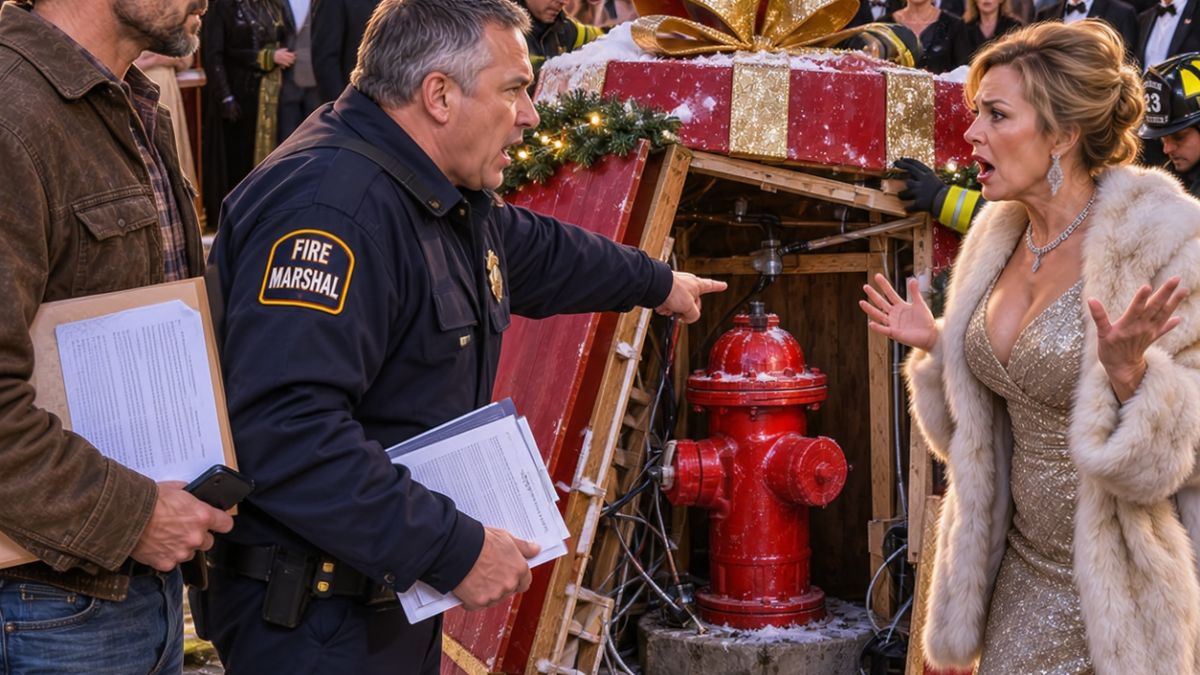
In its place stood a twelve-foot tower of Christmas presents.
Red.
Green.
Gold.
White lights.
Artificial snow.
Huge silk ribbon.
From a distance, beautiful.
Up close, dangerous.
The structure had a wooden frame.
Decorative panels screwed into place.
Heavy base blocks.
Internal bracing.
Two lockable service panels.
The hydrant sat directly inside.
Completely enclosed.
I walked around it.
No clear opening.
No quick-release access.
No fire-department side.
Nothing.
Temporary electrical cables crossed the ground nearby.
I could see where firefighters would normally approach.
Blocked.
I could feel anger moving through me.
But anger is not instruction.
So I did nothing physical.
No pry bar.
No screw gun.
No cutting.
If I damaged the structure, Sabrina could change the story.
Dispute becomes vandalism.
I wanted the story to remain simple.
She built over a hydrant after I told her not to.
I took out my phone.
Started at the survey marker.
One continuous recording.
Boundary.
Hydrant location.
Wood enclosure.
Locks.
Electrical cable.
Base blocks.
Vehicle plates.
Contractor logo.
Time.
Date.
Then I called Derek.
He answered quietly.
“You saw it.”
“Yes.”
“That isn’t my design.”
“What happened?”
“I submitted the alternate layout.”
“And?”
“She rejected it.”
“Did you design this enclosure?”
“Not like that.”
“Explain.”
“Our concept had an open-back decorative frame. Hydrant fully exposed from the service side.”
“This one is locked.”
“I know.”
“She changed it?”
“She brought in another crew last night.”
“Why?”
“Camera angle.”
Of course.
“Derek.”
“Yes?”
“Did you tell her it was unsafe?”
Silence.
“Yes.”
“In writing?”
Longer silence.
“Yes.”
“Keep it.”
He exhaled.
“Beckett.”
“Keep every message.”
“I intend to.”
I ended the call.
Then Sabrina appeared.
Same white coat.
This time she was smiling.
She looked at my phone.
“Collecting evidence?”
“Yes.”
“Very dramatic.”
“You locked a fire hydrant inside a wooden box.”
“I built a Christmas display.”
“Firefighters cannot connect hose to a Christmas display.”
“They can use another hydrant.”
“That one appears on your approved plan.”
“Plans can be adjusted.”
“Not by you.”
Her smile sharpened.
“This stays until after the gala.”
“I’m reporting it.”
“To who?”
“Fire marshal.”
She laughed.
“You think the county is going to destroy an entire community’s Christmas because you complained about decorations?”
“No.”
I pointed at the gift tower.
“I think they’re going to care that you covered emergency equipment.”
Her smile disappeared for half a second.
Then returned.
“Good luck.”
That night, I sent everything.
Fire marshal.
Water authority.
County safety office.
Photographs.
Survey.
Hydrant inspection records.
Fire plan.
Video.
Written statement.
I did not ask them to cancel the gala.
I did not demand the display be destroyed.
I asked for an inspection.
Then I went back to work.
At 4:38 that afternoon, my phone rang.
County fire marshal’s office.
“Mr. Roland?”
“Yes.”
“Are you stating that the hydrant identified on the Silverpine clubhouse response plan is currently fully enclosed?”
“Yes.”
“Can firefighters reach the operating connections without removing part of the structure?”
“No.”
“Is it locked?”
“Yes.”
Pause.
“Send us the closest photographs again.”
I did.
The next morning, an inspector arrived.
Woman named Dana Keller.
She had the county plan.
Clipboard.
Flashlight.
She walked straight to the tower.
Circled it once.
Then looked at me.
“The hydrant is inside this?”
“Yes.”
“Completely?”
“Yes.”
She looked at the locks.
Then the base blocks.
“That’s not acceptable.”
She kept inspecting.
And found more.
Electrical cables routed too close to wet ground.
Equipment staged in part of the designated fire lane.
Decorations narrowing access.
Temporary power distribution lacking clear separation in several areas.
She wrote.
Photographed.
Measured.
Then issued a corrective notice.
The hydrant obstruction had to be removed.
Fire lane restored.
Electrical concerns corrected.
Event safety conditions verified before occupancy.
Sabrina arrived while Dana was still there.
Two board members behind her.
“What is this?”
Dana introduced herself.
Sabrina barely listened.
“This display was approved.”
“By who?”
“The association.”
“I mean safety approval.”
“We have permits.”
“I’m reviewing the actual conditions.”
“The hydrant is temporarily decorated.”
“It’s inaccessible.”
“For three days.”
“If there’s a fire tonight, the fire department does not have three days.”
Sabrina crossed her arms.
“We have owner consent.”
I looked at her.
“No, you don’t.”
She ignored me.
Dana said:
“Produce it.”
“It’s in HOA files.”
“Bring it.”
“I’m not required to hand private association records to him.”
“Not to him.”
Dana pointed at herself.
“To me.”
Sabrina hesitated.
“I’ll have counsel respond.”
Dana wrote something else.
Sabrina’s voice rose.
“Do you have any idea who is attending this gala?”
Dana looked up.
“The code does not change based on invitations.”
“There are major business sponsors.”
“Okay.”
“County leaders.”
“Okay.”
“Three hundred guests.”
“Then three hundred people need compliant fire protection.”
Sabrina’s face tightened.
“Nobody is shutting down Christmas over a decoration.”
Dana replied:
“Then stop turning emergency equipment into decoration.”
I almost smiled.
Sabrina heard the same logic from two people in two days.
She liked it no better the second time.
Then she ordered security to remove me from the area.
Walt Henderson was the guard on duty.
Sixties.
Gray mustache.
Had worked Silverpine’s entrance for years.
Sabrina pointed at me.
“Escort him away.”
Walt looked at the boundary marker.
Then at me.
Then at Sabrina.
“Ma’am.”
“What?”
“He’s on his property.”
“I am directing you to remove him from the event area.”
Walt looked down again.
“This isn’t the event area.”
Sabrina stared.
“What did you say?”
“The marker is right there.”
She went rigid.
“Do your job.”
Walt answered:
“I’m not trespassing on his land to remove him from his own land.”
Silence.
It was the first public no Sabrina received from someone on her payroll.
She never forgot it.
After everyone left, Walt took a photo of the boundary marker.
Wrote the time on the back of his hand.
He later told me:
“I figured somebody was going to pretend they never saw where that line was.”
He was right.
That evening, an unmarked envelope appeared under my office door.
No return address.
Inside:
PROPERTY OWNER AUTHORIZATION.
My name.
My property.
Permission for temporary decorative use.
Statement confirming that the installation would not interfere with the fire-water system.
Signature:
Beckett Roland.
Not mine.
It looked close enough to fool someone who did not know my handwriting.
But the angle was wrong.
My B formed differently.
The last stroke in Roland leaned the other way.
Witness:
Someone I had never met.
I sat alone in my office staring at it.
Somebody had decided my no did not count.
That changed things.
The next morning, I went to the county permit office.
Requested the approved gala plan.
The original drawing showed the hydrant.
Clearly.
Bold note:
MAINTAIN FIRE DEPARTMENT CLEAR ZONE.
The installed version did not match.
Derek’s later field sheet showed the gift display over the hydrant.
Then a newer document appeared in the file with my alleged authorization.
But there was no corresponding fire-authority amendment approving an enclosure.
I copied everything.
Sent it to the fire marshal.
Then my phone rang.
Elise Hartwell.
Silverpine board secretary.
Forty-six.
Quiet.
Normally the kind of person you barely noticed while Sabrina spoke.
Her voice shook.
“Mr. Roland?”
“Yes.”
“I need to tell you something.”
“Go ahead.”
“The board did not approve enclosing the hydrant.”
I sat down.
“What did you approve?”
“Nothing like this.”
She explained.
Private planning session.
Several board members saw the design.
Asked Sabrina to keep hydrant access open.
Elise specifically objected twice.
The minutes later circulated by Sabrina’s office said the board unanimously supported the final layout.
“That isn’t what happened,” Elise said.
“Do you still have original notes?”
“Yes.”
“Emails?”
“Yes.”
“Preserve them.”
“I already did.”
Then she sent me one.
Derek to Sabrina:
HYDRANT MUST REMAIN ACCESSIBLE. RECOMMEND SHIFTING DISPLAY WEST. ALTERNATE LAYOUT ATTACHED.
Sabrina’s reply:
I TAKE RESPONSIBILITY. COVER IT FULLY. NO RED VISIBLE IN CAMERA FRAME.
I read it twice.
This was no misunderstanding.
No decorator mistake.
She knew.
I asked Elise:
“Why?”
Silence.
“I think it’s the sponsor.”
“What sponsor?”
“You should talk to Travis.”
“Who’s Travis?”
“Treasurer.”
She hesitated.
“And Beckett?”
“Yes?”
“Sabrina may be getting paid personally if this gala goes forward.”
The next day, December 23, I met Elise and Travis Greeley in an independent property-management office.
Travis was fifty-two.
Glasses.
Quiet.
The kind of man who stacked papers square before speaking.
He opened a folder.
“Silverpine has a sponsorship agreement.”
“How much?”
“Ninety-two thousand.”
“For the gala?”
“Yes.”
Luxury event company.
They wanted footage.
Professional photographs.
Model event package for upscale gated communities.
Silverpine’s entrance would be featured.
The sponsor approved a specific design.
Symmetrical.
Gift tower.
Host standing center.
No visible fire hydrant.
I looked at Travis.
“So that’s why she wouldn’t move it.”
“Yes.”
“Even though Derek had an alternate layout.”
“Yes.”
Then Travis turned another page.
“This is worse.”
Vendor:
Lockidge Lifestyle Consulting.
Owner:
Through a small LLC structure, Sabrina Lockidge.
Conditional fee:
$24,000.
Payment depended on delivering sponsorship milestones.
Including imagery and design compliance.
I stared.
“She personally gets twenty-four thousand if the sponsor gets the approved visuals.”
“Yes.”
“Did the board know?”
“No.”
Elise shook her head.
“I didn’t.”
Travis continued.
“There’s also twenty-seven thousand six hundred dollars taken from a reserve line for decoration and event infrastructure.”
“Board approved?”
“No.”
“How?”
“President authorization.”
“Can she do that?”
“Not at that amount.”
He closed the folder.
Now everything made sense.
The hydrant was not covered because Sabrina hated red.
Not only.
The hydrant interfered with a commercial image package.
That package supported a $92,000 sponsorship.
Her company stood to earn $24,000.
Safety had been placed on one side of a scale.
A photograph on the other.
The photograph won.
I asked:
“What do you want me to do with this?”
Travis said:
“Nothing publicly.”
Good answer.
Elise nodded.
“We need records preserved.”
“Fire marshal?”
“Yes.”
“Board?”
“Emergency meeting.”
I agreed.
Evidence first.
Rumors later never.
Derek called again that afternoon.
“I kept the messages.”
“All?”
“Yes.”
Including Sabrina instructing him to hide the hydrant.
Including rejection of alternate design.
Including:
NO RED EQUIPMENT VISIBLE IN ANY SPONSOR FRAME.
And:
COVER FULLY. I’LL HANDLE SAFETY QUESTIONS.
I told him:
“Give everything to the fire marshal.”
“I’m going to.”
“You may lose Silverpine.”
Derek laughed without humor.
“I already lost them.”
“What do you mean?”
“Sabrina fired my company this morning.”
“Why?”
“I objected again.”
I paused.
“I’m sorry.”
“I’m not.”
Then:
“I should’ve walked sooner.”
By the end of December 23, Fire Marshal Dean Armitage had the file.
Dean was fifty-four.
Broad.
Blunt.
Not impressed by money.
I had met him once years earlier during my hydrant installation.
He remembered the system.
He scheduled an on-site review before the gala opened.
Christmas Eve came cold and clear.
Silverpine looked incredible.
I have no problem admitting that.
Lights in every tree.
Clubhouse glowing.
Artificial snow.
Gold-lit pathways.
Music.
Gift tower.
Sponsor banner.
Sabrina had transformed the entrance.
That was exactly the danger.
People assume beautiful means controlled.
It does not.
I walked my boundary around late afternoon.
More decorations had crept into the emergency access zone.
I photographed them.
Around six, I saw Sabrina.
Champagne-colored dress beneath a long coat.
Staff around her.
I said:
“You still haven’t opened the hydrant.”
She turned.
“Not tonight.”
“You received the fire notice.”
“We’re handling it.”
“The box is locked.”
“It will be removed after the event.”
I showed her the approved plan.
“Why does your installation not match this?”
She barely looked.
“We have all necessary permits.”
“Your owner authorization has my name.”
“Yes.”
“I didn’t sign it.”
Her expression hardened.
“That’s between you and administration.”
“No.”
“That’s between me and whoever created it.”
Elise approached.
Hands visibly shaking.
But she stepped forward anyway.
“The board never approved covering the hydrant.”
Sabrina turned.
“Elise.”
“I have the original minutes.”
“You are board secretary because I appointed you.”
“I was elected.”
“I can have you removed.”
Elise swallowed.
Still spoke.
“The authorization is disputed. We should stop the event until fire clears everything.”
Sabrina’s face darkened.
“This conversation is over.”
At seven, guests began arriving.
Velvet.
Tuxedos.
Sequins.
Coats.
Champagne.
Photographers.
Valets.
The full lighting system came on.
So did snow machines.
Sound equipment.
Temporary heaters.
Piper Whitby, the catering and event-company representative, was moving through the venue.
She smelled hot plastic.
Near one distribution cabinet.
She opened the exterior panel.
Too warm.
Technicians checked.
Overloaded.
She told Sabrina:
“We need to shut down part of the decorative circuit.”
“No.”
“The cabinet is heating.”
“Then redistribute.”
“We need an electrical safety check.”
“Guests are arriving.”
“Exactly.”
“Do not darken the entrance.”
Piper stared.
“This is safety.”
“The effect depends on full illumination.”
Piper took out her phone.
Made a note.
Time.
Request.
Refusal.
Then assigned two supervisors to doors.
I respected her for that.
At approximately 7:08, thin smoke appeared.
Gray.
Curling from the temporary electrical cabinet.
A technician smelled it.
Cut several circuits.
The fire alarm activated.
Harsh electronic tone.
Music stopped.
Guests froze.
Piper started evacuation.
No panic.
Staff directed people outside.
Sabrina moved through the crowd.
“Minor technical issue.”
Piper said:
“Building clears until fire verifies.”
“Nobody is cancelling my gala over a little smoke.”
“The alarm is active.”
“Do you know how much money is standing outside?”
I was close enough to hear.
I said:
“Do you know why firefighters might want the hydrant?”
She glared at me.
At 7:14, the fire engine arrived.
Crew checked the facility plan.
One firefighter pointed toward my land.
“Hydrant should be there.”
Another looked.
There was only the giant Christmas present tower.
“Where’s the hydrant?”
Nobody answered immediately.
The fire itself—if you could call it that—had not developed beyond smoke from the electrical cabinet.
Technicians had isolated power.
But the fire department still had to verify conditions.
And they checked water supply.
Of course they did.
They walked toward the tower.
Found wooden panels.
Locks.
Base blocks.
Cables.
One firefighter looked at the plan.
Then at the structure.
“You’ve got to be kidding me.”
Dean was already on site.
He had come for the compliance inspection.
He ordered the area cleared.
Then authorized firefighters to open the enclosure.
Sabrina intercepted him.
“You cannot dismantle this display.”
Dean looked at her.
“Step back.”
“It cost tens of thousands.”
“Step back.”
“This belongs to Silverpine.”
“Doesn’t matter right now.”
“It absolutely matters.”
Dean held the plan.
“This is a mapped fire hydrant.”
“We have another water source.”
“Not the approved one for this location.”
She pointed at me.
“He’s been trying to sabotage this event for days.”
Dean looked at me.
I handed him:
Survey.
Hydrant installation record.
Maintenance.
Photographs.
Prior warnings.
He read quickly.
Then looked at Sabrina.
“My office issued a corrective notice.”
“We were working on it.”
“The hydrant is still inaccessible.”
“We have owner permission.”
“No, you don’t,” I said.
She snapped:
“Yes, we do.”
I produced the copy.
“My signature is disputed.”
Dean took it.
Looked.
Then:
“That document issue gets handled separately.”
Good.
He did not pretend to be a handwriting expert.
He looked toward firefighters.
“Open it.”
They started removing panels.
Screws.
Locks.
Heavy blocks.
Cable.
Artificial garland.
A section of decorative ribbon.
Guests stood nearby behind the safety perimeter.
Three hundred people dressed for photographs.
Watching firefighters unwrap a hydrant.
One firefighter checked his watch.
Two minutes.
Still not clear.
Three minutes.
Panel removed.
Hydrant visible.
Still blocked.
Four.
Base blocks.
Five.
Cable.
Six.
Still no hose attached.
The incident commander said:
“Six minutes.”
Nobody laughed.
He looked at Sabrina.
“In a working structure fire, six minutes is a long time.”
A younger firefighter wiped sweat from his forehead.
“I’ve never had to unwrap a Christmas present before connecting a supply.”
Nobody laughed at that either.
Because everyone understood.
The smoke incident was small.
They were lucky.
Luck is not a safety plan.
Dean inspected everything.
Hydrant.
Fire lane.
Electrical distribution.
Exits.
Temporary installations.
He read the original approval.
Compared it to actual conditions.
Then stopped.
He had seen enough.
Sabrina followed.
“We can remove the box now.”
Dean said:
“This is no longer just about the box.”
“The hydrant is open.”
“We need electrical systems verified.”
“They’re fine.”
“No.”
“Fire lanes restored.”
“They’re clear.”
“No.”
“Occupancy conditions confirmed.”
“You can do that while guests eat dinner.”
“No.”
Her face went pale.
“You’re not serious.”
“I am.”
“We have three hundred guests.”
Dean looked at her.
“Then you have three hundred reasons to take this seriously.”
She stared.
He asked:
“Who authorized a locked structure around this hydrant?”
“I did.”
“I’m HOA president.”
Dean replied:
“That wasn’t my question.”
She froze.
“Who authorized you to obstruct emergency equipment?”
Silence.
She looked toward board members.
Sponsors.
Guests.
Nobody answered for her.
Dean turned toward the incident commander and facility manager.
“No gala tonight.”
Sabrina’s mouth opened.
“Keep the event area closed until the hazards are corrected and cleared for occupancy.”
The courtyard went silent.
For several seconds, nobody moved.
Then Derek stepped forward.
Pale.
Phone in hand.
“Sir.”
Dean looked at him.
“I have messages.”
Sabrina turned.
“Derek.”
He ignored her.
“Messages showing who instructed us to cover the hydrant.”
That landed harder than the shutdown.
Sabrina crossed toward him.
“You signed a confidentiality agreement.”
Dean stepped between the conversation.
“Do not interfere.”
Derek held out the phone.
“I’ll send everything.”
Sabrina’s expression changed from anger to panic.
Guests were already being told to leave.
Decorative lights began switching off.
Snow machines stopped.
Music died.
The effect disappeared.
Piper supervised exits.
Professional.
Calm.
Guests collected coats.
Sponsors asked questions.
Sabrina tried to take control.
“This is Beckett Roland’s doing.”
People looked at me.
I did not raise my voice.
I held up my written warning.
“December twenty-second.”
Then the fire notice.
“December twenty-third.”
Then photographs.
“Hydrant remained covered.”
Derek showed messages.
Elise stepped forward.
“The board did not approve this.”
Travis joined.
“And there are financial issues connected to the event that require audit.”
Sabrina stared at him.
“What are you doing?”
“My job.”
The sponsor representative came forward.
“The sponsorship agreement requires compliance with safety and operating conditions.”
Sabrina said:
“We’ll reschedule.”
“That isn’t what I said.”
He requested a formal incident report.
The $92,000 sponsorship was now subject to review.
Piper documented her earlier electrical warning.
Dean stated that the disputed authorization and obstruction records would be referred appropriately.
He did not accuse Sabrina of forgery.
He did not announce criminal guilt.
He simply said evidence required investigation.
That mattered.
Real accountability should be precise.
A board member shouted:
“We need an emergency meeting.”
Another agreed.
Elise pulled out a prepared notice.
MOTION TO REMOVE SABRINA LOCKIDGE AS HOA PRESIDENT.
Sabrina saw it.
“You planned this.”
Elise’s voice still shook.
“No.”
“I prepared it after you ignored the fire notice.”
“Traitor.”
Elise flinched.
Then steadied.
“I told you not to cover the hydrant.”
People heard.
That was important.
Sabrina looked around the courtyard.
Three hundred guests.
The audience she wanted.
Except now they were watching a very different presentation.
No opening speech.
No sponsor toast.
No carefully framed entrance photograph.
Only fire-engine lights washing red and white across her champagne dress.
Above her, the sign still read:
SILVERPINE GRAND CHRISTMAS GALA
A NIGHT TO REMEMBER.
Nobody could argue with that.
Christmas morning, the board met remotely under emergency procedures.
Six voting members.
Elise presented original minutes.
Emails.
Safety warnings.
Travis presented finances.
$27,600 unauthorized reserve use.
$24,000 potential fee to Sabrina’s consulting company.
Undisclosed.
Sponsor contract.
Derek’s messages.
Fire marshal order.
Sabrina defended herself.
“I was trying to give this community something extraordinary.”
One board member replied:
“You concealed your financial interest.”
“The company earned its fee.”
“Did you disclose it?”
“I didn’t think it was necessary.”
“You were president.”
“The contract was beneficial.”
“That isn’t the question.”
Another member asked:
“Did you order the hydrant fully covered after the decorator warned you?”
She hesitated.
“I approved the final design.”
“Why?”
“Because it met sponsor requirements.”
There it was.
Elise asked:
“Even after safety objections?”
Sabrina looked toward the camera.
“I believed the risk was manageable.”
Silence.
One board member said quietly:
“You don’t get to decide that alone.”
Vote.
Five to one.
Removed.
Sabrina Lockidge was no longer president of Silverpine Estates.
Interim leader appointed.
Independent audit.
Sponsorship reviewed.
Her consulting company’s payment frozen.
Questioned authorization records forwarded to investigators.
No final determination yet.
But Sabrina no longer controlled the files.
That alone changed everything.
December 26, contractors removed every remaining obstruction around my hydrant.
Qualified technician inspected it.
Flow test.
Valves.
Connections.
Clearance.
Passed.
The HOA paid for cleanup of the area on my land.
Temporary cables removed.
Base blocks removed.
Decorative supports removed.
Survey boundary respected.
Then Silverpine sent me something I never expected.
A written acknowledgment.
The hydrant stood on private property.
Emergency access would remain unobstructed.
No future construction on my parcel without written authorization.
I filed it in the gray cabinet.
Of course I did.
By then, the gala was dead.
You can reopen a venue.
You cannot rerun Christmas Eve.
Nobody tried.
A few days later, Sabrina drove past my workshop.
Slowly.
The decorations were mostly gone.
Hydrant stood bright red in thin snow.
Open.
Ordinary.
She stopped.
Rolled down the window.
I was near the workshop door.
“I hope you’re happy.”
“No.”
That surprised her.
“You got what you wanted.”
“I wanted the hydrant left alone.”
“You cost me everything.”
I looked at her.
“No.”
She tightened her grip on the wheel.
“You filed the complaint.”
“Yes.”
“You knew they could shut us down.”
“I knew they could inspect.”
“You embarrassed me in front of everyone.”
“You covered emergency equipment after being told not to.”
“I was trying to build something beautiful.”
“I know.”
She looked at the hydrant.
“That thing ruined the whole design.”
That sentence told me she still did not understand.
“No.”
I walked a few steps closer.
“You risked three hundred people because you couldn’t stand seeing a red hydrant in your photos.”
Her face tightened.
“You don’t know what that sponsorship meant.”
“I do now.”
Silence.
“Twenty-four thousand dollars.”
Her eyes changed.
She realized I knew.
She rolled the window up.
Drove away.
Silverpine changed afterward.
Quietly.
No dramatic reinvention.
Just procedures.
Two signatures required for reserve payments.
Event contracts reviewed independently.
Conflicts disclosed.
Fire plans verified.
No temporary installation permitted within an emergency-access zone without documented safety review.
Elise remained secretary.
Her voice stopped shaking.
Travis became the most annoying treasurer Silverpine had ever had.
That was a compliment.
Walt Henderson received a written commendation for refusing to trespass on my property.
When I told him, he laughed.
“First award I ever got for not doing what my boss told me.”
Derek Pomeroy lost Silverpine as a client.
Then gained others.
Apparently a decorator willing to tell a wealthy client “no” became attractive to people who cared about competent contractors.
Piper sent me a Christmas card the next year.
Inside:
BEAUTIFUL PARTIES ARE BUILT ON BORING SAFETY.
I framed it in the workshop.
The investigation into the paperwork took longer.
That was appropriate.
People wanted a fast answer.
Who signed what.
Who created the owner authorization.
Whether Sabrina personally altered it.
Authorities did not rush.
Digital records.
Document comparisons.
Witness statements.
Board files.
I never pretended to know more than I knew.
My signature was not mine.
That was enough for me to dispute the document.
Who created it belonged to investigators.
The financial audit was clearer.
Sabrina had an undisclosed interest.
Reserve spending exceeded her authority.
The board pursued reimbursement and corrective action under its own rules.
The sponsorship payment did not arrive as originally planned.
The sponsor invoked contract review because the event failed safety and filming conditions.
Sabrina’s private fee never materialized.
That part mattered less to me than most people expected.
I did not care whether she lost $24,000.
I cared that firefighters could reach the hydrant.
Everything else was proof of motive.
Residents began coming by.
Silverpine residents.
Some apologized.
One man named Charles stopped near the fence while walking his dog.
“I thought you were being difficult.”
“I probably was.”
He smiled.
“No. I mean about the decoration.”
“I know.”
“Sabrina told us you were angry because the HOA wouldn’t buy your property.”
“That was new.”
“She said you wanted money.”
“I wanted clearance.”
He looked at the hydrant.
“Pretty ugly.”
I laughed.
“Yes.”
He smiled.
“But useful.”
“Exactly.”
That became the joke.
The ugly hydrant.
People decorated around it the next Christmas.
Not over it.
Silverpine put lights on nearby shrubs.
They left a wide clear zone.
Someone even placed a small sign nearby:
SANTA STOPS HERE.
FIRE DEPARTMENT DOES TOO.
KEEP CLEAR.
I approved of that.
Humor that respects the hydrant.
Good compromise.
I kept annual inspections.
Still do.
Every test.
Every maintenance record.
Every valve check.
The gray cabinet gained another folder.
SILVERPINE CHRISTMAS INCIDENT.
Inside:
Photos.
Survey.
Fire notices.
Board letter.
Safety reports.
I rarely open it.
The lesson is already in my head.
People think disasters begin with dramatic choices.
Sometimes they begin with aesthetic ones.
Move that.
Hide this.
Cover that.
It will only be temporary.
Nobody will notice.
We’ll fix it later.
Safety systems live in the world of boring permanence.
Clear exits.
Open hydrants.
Accessible lanes.
Dry electrical connections.
Labels.
Inspection tags.
Space.
None of it photographs well.
That is why it is easy to disrespect.
Sabrina respected what people could see.
Gold ribbon.
Sponsor wall.
Symmetry.
Lighting.
Photographs.
She treated everything invisible as optional.
The risk.
The response time.
The fire plan.
The property line.
The warning emails.
The board’s objections.
The disclosure rules.
Until all those invisible things became very visible.
Fire engine.
Smoke.
Locked box.
Six minutes.
Cancelled gala.
Audit.
Vote.
That is how systems work.
Ignore enough boring things and eventually reality becomes dramatic.
The six-minute delay haunted me most.
Nobody needed water that night.
The cabinet never became a structure fire.
Firefighters opened the tower as part of verifying access.
We were lucky.
But six minutes.
I thought about the plastics warehouse.
Eleven minutes.
Roof gone.
Firefighter hurt.
I remembered standing in the wet street at twenty-six.
That smell.
The chief yelling about blocked access.
I remember thinking:
Why would anyone put anything in front of a hydrant?
Years later I got my answer.
Because people assume an emergency will wait until after the event.
It does not.
One January afternoon Dean stopped at my workshop.
He was nearby.
Came in for coffee.
I asked:
“Were you really going to shut down the gala before the smoke?”
He nodded.
“Probably.”
“Because of the hydrant?”
“Hydrant plus access plus electrical.”
“So the smoke changed nothing?”
“It accelerated the demonstration.”
I smiled.
“That sounds like fire-marshal language.”
“It is.”
He drank coffee.
Then said:
“You know what bothered me most?”
“What?”
“Not the box.”
“No?”
“The warning.”
“What about it?”
“She had a chance to fix it.”
I nodded.
Dana’s corrective notice.
“Plenty.”
“She knew.”
“Yes.”
“That’s always worse.”
He looked toward the hydrant outside.
“People make mistakes.”
He shrugged.
“We work with mistakes every day.”
Then:
“It’s the choice after the warning that tells you what kind of problem you have.”
I remembered that.
Sabrina had opportunities.
Contractor warning.
My warning.
Alternate design.
Board objections.
Inspector notice.
Electrical warning.
Every time, she chose the image.
That was not one mistake.
It was a pattern.
Residents later asked why I did not simply unscrew the panels myself.
Because I could have.
I owned the land.
It was my hydrant.
I had tools.
Probably could have opened the enclosure in twenty minutes.
But that would have been the wrong move.
First, safety.
I did not know how the lighting had been wired inside.
Second, evidence.
If I destroyed the structure, Sabrina’s story becomes:
angry outsider destroys HOA Christmas display.
Third, authority.
Fire access is not personal theater.
The correct people needed to see the condition as installed.
So I documented.
Reported.
Waited.
Patience is not weakness.
Sometimes it is how you keep someone else from changing the subject.
The board eventually released an incident summary.
No sensational language.
I appreciated that.
It stated:
Emergency equipment had been obstructed.
Approved event conditions had not been maintained.
Temporary electrical concerns required review.
The event was suspended.
Financial and governance issues were separately examined.
Simple.
Factual.
Very different from Sabrina’s final public statement.
She posted online:
MY CHRISTMAS WAS DESTROYED BY PEOPLE WHO CHOSE TECHNICALITIES OVER COMMUNITY.
A resident replied:
THE FIRE HYDRANT WAS NOT A TECHNICALITY.
The post disappeared an hour later.
I never responded.
No need.
By spring, Silverpine installed updated emergency maps around the clubhouse.
Hydrant locations.
Fire lanes.
Shutoffs.
Emergency contacts.
Residents probably ignored them.
That was okay.
The people who needed the information had it.
Derek became part of the annual event review.
Not officially for Silverpine.
They hired a different company.
But he started speaking at industry meetings about what happened.
His lesson was simple:
“If a client asks you to cover emergency equipment, your answer is not ‘sign here.’ Your answer is no.”
Walt eventually retired.
Silverpine threw him a small party.
Someone gave him a plaque:
FOR KNOWING WHERE THE PROPERTY LINE WAS.
He brought it to show me.
I laughed for five minutes.
“You displaying that?”
“Absolutely.”
“Where?”
“Garage.”
“Perfect.”
Elise became vice president two years later.
I asked whether she had developed a taste for power.
She rolled her eyes.
“I developed a taste for minutes that match what happened.”
Good enough.
Travis remained treasurer.
Every large payment required documentation.
Residents complained about paperwork.
He did not care.
I liked him.
Piper’s company came back for a later Silverpine event after leadership changed.
Before accepting, she required an electrical inspection and emergency-access review.
The board agreed immediately.
That is what healthy organizations do.
They learn.
Not perfectly.
But enough.
Sabrina remained in Silverpine for a while.
I saw her occasionally.
Never spoke again after that roadside conversation.
She no longer held office.
No clipboard.
No staff following.
No one moving because she snapped her fingers.
Some neighbors avoided her.
Others remained friendly.
I did not care.
Removal from office was accountability.
Social exile was not my concern.
People are more than their worst decisions.
But worst decisions still have consequences.
A year later, Christmas Eve returned.
I closed the workshop early.
Snow had fallen lightly.
Hydrant stood red.
Ugly.
Perfect.
I walked over.
Brushed snow from the cap.
Not necessary.
Just habit.
Across the fence, Silverpine lights glowed.
Smaller event.
Music inside.
No giant entrance.
No twelve-foot gift tower.
People arrived.
Some waved.
I waved back.
Around seven-fifteen, I looked at the clock.
Remembered the engine.
The firefighter asking where the hydrant was.
Then looked outside.
There it stood.
Uncovered.
Nothing dramatic happened.
That was the best possible outcome.
Emergency systems are successful when nobody tells stories about them.
A hydrant that spends twenty years unused is not useless.
It is ready.
That distinction matters.
Sabrina wanted her event to become unforgettable.
She succeeded.
Just not for the reason she planned.
People remembered the Christmas Eve when firefighters had to dismantle a gift box to reach emergency water.
They remembered Dean asking who authorized the obstruction.
They remembered Sabrina answering:
“I’m the HOA president.”
And Dean saying:
“That wasn’t my question.”
That line spread around Silverpine.
Maybe because it captured everything.
A title explains who you are.
It does not explain what you are allowed to do.
President.
Owner.
Contractor.
Fire marshal.
Board member.
Each carries authority.
Each has limits.
Sabrina’s title allowed her to run meetings.
Approve certain routine matters.
Represent the association within defined authority.
It did not allow her to occupy my land.
Alter fire plans.
Ignore inspectors.
Hide financial conflicts.
Or decide that emergency water equipment was optional because it ruined a photograph.
Dean’s title came with actual statutory safety authority.
And still, he looked at records.
Asked questions.
Verified conditions.
That difference taught Silverpine more than any speech could.
Real authority does not need constant performance.
It works through procedure.
Sabrina performed power.
Dean exercised it.
I exercised ownership.
Elise exercised recordkeeping.
Travis exercised financial oversight.
Walt exercised judgment.
Derek finally exercised professional ethics.
Piper exercised event responsibility.
The situation changed because enough people stopped confusing obedience with cooperation.
That was the real turning point.
Not smoke.
Not the fire engine.
Not even the gala cancellation.
The first crack came when Derek said the alternate layout would work.
Then when Elise objected.
Then Walt refused to remove me.
Then Travis opened the books.
Then Piper documented the electrical warning.
By the time Dean arrived, Sabrina’s authority was already hollow.
All he did was apply the rule everyone else had been afraid to enforce.
Keep the hydrant clear.
It sounds embarrassingly simple.
It was.
Sometimes the simplest rules exist because somebody already learned the hard version.
Do not block exits.
Do not cover hydrants.
Do not overload temporary power.
Do not falsify consent.
Do not build on land you do not own.
Do not hide financial interests.
None of those rules are glamorous.
They prevent glamorous disasters.
I still work in industrial water systems.
Clients occasionally ask why I am obsessive about access.
I tell them:
“Because firefighters should never need tools to reach the tool they came to use.”
Sometimes I tell the Christmas story.
Usually they think I am joking.
Then I show the photograph.
Twelve-foot tower.
Ribbon.
Lights.
Fake snow.
Hydrant invisible.
I watch their expressions change.
That picture does more than any lecture.
Beauty can hide stupidity.
The association eventually gave me a copy of the final board resolution.
I filed it.
Hydrant access zone protected.
Property boundary recognized.
No HOA installation allowed on my parcel without written consent.
I read it once.
Then put it away.
I did not need a trophy.
The hydrant itself was enough.
Bright red.
Eight feet inside my line.
Annual test current.
Connections clear.
Nothing covering it.
By the second Christmas after the incident, a child from Silverpine stood near the fence with her father.
She pointed.
“Why can’t they decorate that?”
Her father said:
“Because firefighters need it.”
She looked at the hydrant.
“Even on Christmas?”
“Especially on Christmas.”
I smiled inside the workshop.
That was better than any policy document.
People sometimes ask whether I felt guilty about the gala being cancelled.
No.
But I felt bad for the guests.
They had done nothing wrong.
People dressed up.
Babysitters arranged.
Families visiting.
Sponsors traveled.
Staff worked.
Caterers prepared food.
Musicians rehearsed.
They lost an evening because one person repeatedly ignored warnings.
That is why I never celebrated the shutdown.
There is a difference between being relieved a dangerous event stopped and enjoying innocent people’s disappointment.
I wanted the hydrant open.
Nothing more.
Sabrina wanted a perfect photograph.
That difference decided everything.
Her photograph needed the hydrant hidden.
Reality needed it accessible.
Reality won.
Years later, when I think about Christmas Eve at 7:14, I do not remember Sabrina first.
I remember the firefighter.
Standing with the water map.
Looking at the glowing gift tower.
Asking:
“Where the hell is the hydrant?”
That question contained the entire absurdity.
A piece of life-safety equipment had stood in the same visible spot for eight years.
Inspected.
Mapped.
Maintained.
Then one person decided appearance mattered more.
And suddenly trained firefighters had to search for something designed specifically to be impossible to miss.
That is what happens when vanity gets authority.
Useful things become inconvenient.
Warnings become negativity.
Rules become technicalities.
People who object become enemies.
Until a real emergency asks whether the system works.
Systems do not care about your intentions.
Water either flows or it does not.
A fire lane is either open or it is not.
A hydrant is either reachable or it is not.
That night, ours was not.
For six minutes.
We were lucky enough for those six minutes to become evidence instead of tragedy.
That is why I never accepted Sabrina’s version that officials “ruined Christmas.”
The fire marshal did not create the violation.
The inspector did not create it.
I did not create it by reporting it.
Derek did not create it by saving messages.
Elise did not create it by preserving minutes.
The violation existed before anyone exposed it.
Dean said that to Sabrina directly when she tried blaming me.
“The event was stopped because of the safety conditions,” he told her, “not because someone reported them.”
I wish more people understood that sentence.
Reporting a danger does not create the danger.
Documenting fraud does not create fraud.
Showing a boundary does not create trespass.
The truth is already there.
Someone finally looked.
Sabrina’s perfect Christmas photograph never happened.
The sponsor footage did not get shot.
Her speech was never delivered.
Her $24,000 private fee did not get paid.
The board removed her.
The records went under review.
And the object she had tried hardest to hide became the centerpiece of the entire story.
The red hydrant.
By December 26, the fake presents were gone.
The wooden cage disappeared.
Locks removed.
Cables rerouted.
Base blocks hauled away.
Snow remained.
Hydrant stood exposed.
Quiet.
Ready.
Exactly where it had always been.
I stood beside it that afternoon.
No crowd.
No fire truck.
No HOA board.
Just cold air.
I put one hand against the metal.
Ridiculous, maybe.
But I thought about that warehouse from when I was twenty-six.
Eleven lost minutes.
Burned roof.
Injured firefighter.
Then I thought about the six minutes on Christmas Eve.
No real fire.
No injuries.
Lesson delivered for free.
Almost free.
Silverpine paid plenty in other ways.
I looked across toward the clubhouse.
Workers were taking down the last gala banner.
The entrance looked plain.
I preferred it.
Sometimes plain means safe.
Sometimes ugly means useful.
Sometimes the red thing ruining your photograph is the exact thing everyone will be grateful to see when the night goes wrong.
Sabrina Lockidge spent weeks trying to hide my hydrant because she believed it spoiled the image she wanted Silverpine to project.
In the end, the fire marshal shut down the gala, the board removed her as president, her private financial arrangement came under review, and the paperwork she assumed nobody would question became part of the investigation.
But none of that was the real victory.
The real victory was much smaller.
The next time a fire engine came through Silverpine’s gates, nobody had to search.
Nobody had to cut a lock.
Nobody had to unscrew a Christmas display.
Nobody had to move a ribbon.
The firefighter simply looked across the snow and saw exactly what was supposed to be there.
A bright red hydrant.
Open.
Clear.
Ready.
Because some things are too important to hide just because they ruin the picture.








