HOA Karen Bulldozed My Firebreak for 36 Christmas Parking Spaces—Then a Grass Fire Turned Her VIP Lot Into a $2 Million Disaster
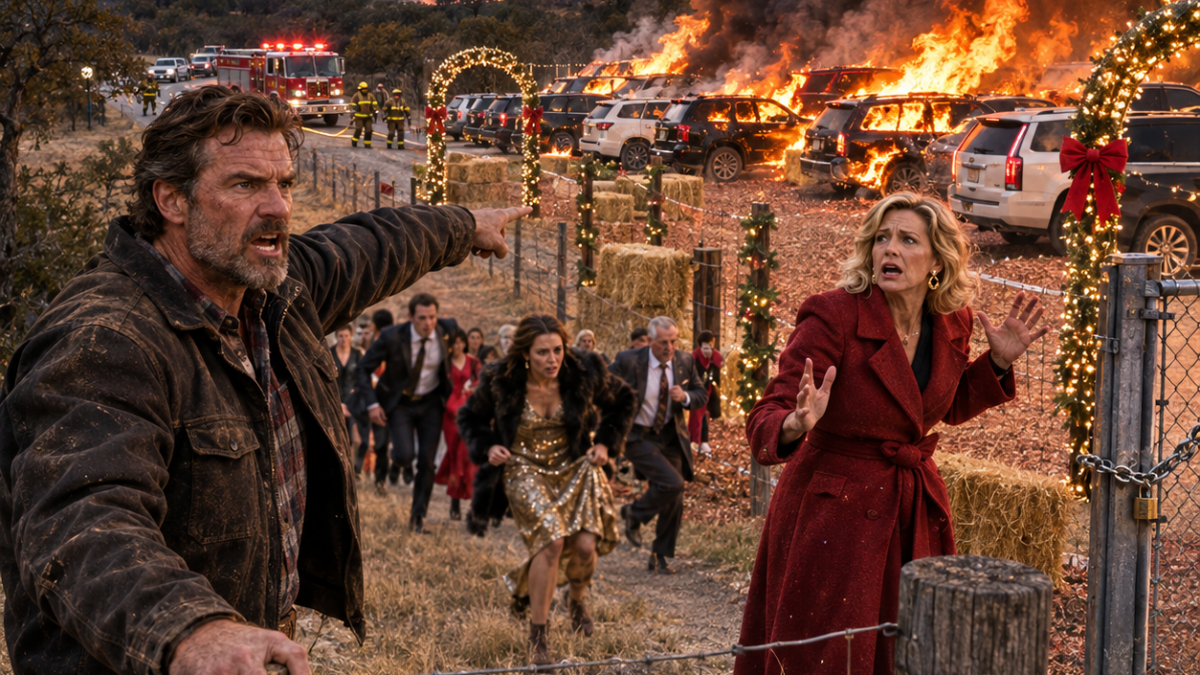
PART2:
A recorded agreement allowed emergency access and guaranteed that I would maintain its protective function.
It did not allow the HOA to pave it.
Landscape it.
Build on it.
Hold parties on it.
Or, as Lorna would discover, sell parking spaces on it.
I found the first red stake on the morning of December 21.
I had been walking the east fence after sunrise.
Cold morning.
Clear sky.
Wind already moving.
The regional drought had turned everything beyond irrigated yards the color of old straw.
I saw one wooden stake near the southern gate.
Bright red paint on top.
Then another.
Then another.
Straight line.
Construction layout.
I crouched.
Pulled the first one out.
A white luxury SUV stopped on the subdivision side of the fence.
Driver door opened.
Lorna Vickers stepped out.
Fifty-three.
HOA president for four years.
Real-estate broker before that.
Red wool coat.
PART3:
Dark sunglasses even though it was barely eight-thirty.
Rolled plans beneath one arm.
If you have ever met someone who mistakes authority for ownership, you already know Lorna.
She wasn’t stupid.
That would have made everything easier.
She understood procedure extremely well.
Especially when procedure benefited her.
She approached the fence.
“Reed.”
“Lorna.”
She looked at the stake in my hand.
“You’re removing our markers.”
“They’re on my land.”
“Temporary survey markers.”
“For what?”
Her smile widened.
“I was hoping to show you before you got dramatic.”
I should have known then.
Lorna unrolled a glossy plan across the hood of her SUV.
BRIER GLENN GRAND CHRISTMAS CELEBRATION.
Light tunnel.
Champagne garden.
Outdoor heaters.
Santa pavilion.
Live string quartet.
Sponsors.
Then, outlined in gold:
VIP PARKING — 36 RESERVED SPACES.
Exactly where my firebreak stood.
I looked at the plan.
Then at her.
“No.”
She laughed.
“I haven’t even explained it.”
“You drew thirty-six cars on my firebreak.”
“Temporary parking.”
“No.”
“Reed.”
“No.”
She tapped the plan.
“Christmas Eve only. Cars arrive around three, leave by ten.”
“Not happening.”
“Look at all that wasted land.”
There it was.
I stared at her.
“It isn’t wasted.”
“It’s gravel.”
“It’s a firebreak.”
“In December.”
I almost thought she was joking.
Then realized she wasn’t.
“Fires happen in December.”
“Maybe in California.”
“This is Texas.”
“Exactly. It’s Christmas.”
I looked beyond her toward dry grass bending under wind.
“Lorna, the county issued a red flag advisory yesterday.”
“That is not a red flag warning.”
“Not yet.”
She crossed her arms.
“You always do this.”
“Do what?”
“Turn everything into an engineering lecture.”
“You’re proposing parking on a fire corridor.”
“For one evening.”
“You cannot change the corridor’s use.”
“The HOA has access rights.”
“For emergencies.”
“We have legal counsel.”
“So do I.”
Her smile disappeared.
“We’re expecting more than two hundred guests.”
“Then find parking on property you own.”
“There isn’t enough.”
“Not my problem.”
That offended her.
Not the refusal.
The phrase.
She stepped closer to the fence.
“This event benefits the entire community.”
“Destroying a firebreak doesn’t.”
“Nobody is destroying anything.”
“You marked grading limits.”
“It needs leveling.”
“It is already graded.”
“For emergency vehicles. Not luxury cars.”
From behind me, I heard boots.
Holly Mercer, my ranch manager, had walked over.
Thirty-eight.
Former wildland fire crew member before she started managing ranch operations.
She understood the strip even better than I did.
She looked at Lorna’s plan.
Then at me.
Then quietly took out her phone.
Lorna saw.
“Are you recording me?”
Holly said, “Yes.”
Lorna rolled her eyes.
“Of course you are.”
I pointed at the plan.
“Take your stakes out.”
“No.”
“Then I will.”
“Reed, the association’s attorney believes our existing easement gives us sufficient authority.”
“Then your attorney should read it again.”
“You have until five this afternoon to sign the permission letter.”
“What permission letter?”
She handed me an envelope.
I opened it.
TEMPORARY USE AUTHORIZATION.
It would allow grading.
Temporary surface installation.
Lighting.
Vehicle access.
Event infrastructure.
It also contained a liability waiver protecting the HOA from claims arising from the temporary use.
I actually laughed.
“You want me to authorize this and release you from liability?”
“It’s standard.”
“No.”
“If you refuse, we’ll proceed under our existing rights.”
“You don’t have existing rights for this.”
“We disagree.”
“Then let a judge decide.”
“We don’t have time.”
“That sounds like your problem.”
Lorna rolled up the plans.
“You really want to be the man who ruins Christmas for ninety-four families?”
I looked at Holly.
Then back at Lorna.
“If your Christmas depends on thirty-six cars parked on a firebreak, you planned Christmas badly.”
Holly coughed to hide a laugh.
Lorna’s face hardened.
“You’ll regret making this difficult.”
She returned to her SUV.
I called my attorney before she reached the subdivision entrance.
The next morning, I woke to diesel engines.
Not one.
Several.
I stepped onto my porch.
A bulldozer was moving toward the firebreak.
Two dump trucks behind it.
Workers in reflective vests.
And beside the access opening stood a large temporary sign.
CHRISTMAS VIP PARKING
36 RESERVED SPACES
I stared at it.
My phone buzzed.
Email.
Brier Glenn Estates HOA.
NOTICE OF AUTHORIZED EMERGENCY LANDSCAPE MODIFICATION.
Emergency.
I opened it.
The HOA claimed the corridor required “surface correction and temporary accessibility improvements.”
At the bottom:
Any interference by adjacent property interests may constitute obstruction of an authorized association safety project.
I read that twice.
Then watched the bulldozer lower its blade.
The steel edge caught the compacted gravel.
Twelve years of maintained surface rolled forward in a gray wave.
Underneath, darker soil appeared.
“What the hell?”
Holly came running from the barn.
“I called Wade.”
“Who?”
“Contractor.”
A pickup stopped near the equipment.
A man climbed out.
Wade Pritchard.
Forty-nine.
Owner of Pritchard Earthworks.
I knew the name.
Good reputation.
Small local company.
I walked straight toward him with the recorded survey.
“Wade?”
He turned.
“You Reed?”
“Yes.”
“This your property?”
“Yes.”
His expression changed immediately.
He looked toward the subdivision.
“I was told this corridor was HOA controlled.”
“It isn’t.”
I handed him the survey.
He read.
Then looked at the bulldozer.
Raised one arm.
The operator stopped.
“What exactly did they hire you to do?” I asked.
“Grade temporary event parking.”
“By removing a recorded firebreak.”
He frowned.
“They told me this was obsolete.”
“Who?”
Before he answered, Lorna’s SUV arrived.
She stepped out holding a paper.
“Why has work stopped?”
Wade held up my survey.
“We may have a boundary problem.”
“We don’t.”
“This says—”
Lorna shoved the paper toward him.
“County approval.”
I looked.
COUNTY FIRE SAFETY MODIFICATION APPROVAL.
Signed:
Evelyn Grady
County Fire Marshal.
I knew Evelyn’s office.
I had dealt with them during ranch inspections.
The letterhead looked almost right.
Almost.
The spacing was wrong.
The document number had one digit too many.
The signature was darker than the body.
I photographed it.
Lorna snapped it back.
“You don’t have permission to photograph private association documents.”
“You handed it to a contractor on my property.”
“County approved the work.”
“I’ll ask the county.”
“You do that.”
I looked at Wade.
“Until then, I am telling you formally: you are on private property without my consent.”
Wade’s face tightened.
Lorna stepped between us.
“If you leave before this is finished, I will terminate the contract and withhold payment.”
Wade looked at her.
“Lorna—”
“You have an approval.”
“I want to verify it.”
“You want to get paid?”
Silence.
That moment mattered later.
Wade looked toward his employees.
Then toward me.
He knew.
Maybe not everything.
Enough.
He returned to the bulldozer.
The blade dropped.
I did not stand in front of it.
I did not touch anyone.
I did what engineering had taught me to do when somebody ignored a warning.
Document everything.
Holly filmed.
I photographed license plates.
Equipment numbers.
Workers.
Timestamps.
Survey markers.
The exact position of the original gravel.
I emailed the fire marshal.
Sheriff.
County planning.
My attorney.
Sent a written cease-and-desist to both the HOA and Pritchard Earthworks.
At 11:46, I received confirmation from Deputy Ellis Boone that a property complaint had been logged.
At 12:18, the fire marshal’s office said an inspector would review the situation.
At 1:03, my attorney filed for emergency relief.
None of that stopped the bulldozer.
Law moves at the speed of notice.
Machines move at the speed of diesel.
By afternoon, half the firebreak was gone.
Worse, trucks were delivering decorative mulch.
Pine arches.
Hay bales.
Temporary synthetic ground mats.
I stood there staring.
Holly walked up.
“They’re building a fuse.”
That was exactly what it looked like.
Bare ground had been replaced by combustible material connecting dry pasture to parked vehicles.
“Call Evelyn again.”
“I did.”
“Forecast?”
Holly held up her tablet.
The National Weather Service had upgraded conditions.
Red flag warning expected.
Relative humidity dropping.
Wind gusts forecast above thirty miles per hour.
I felt sick.
Wade approached after Lorna left.
He removed his cap.
“I told her.”
“What?”
“That removing this was stupid.”
“Her answer?”
He looked at the torn ground.
“She said fires don’t happen at Christmas.”
Holly and I looked at each other.
“Would you put that in writing?”
Wade’s head snapped up.
“I have employees.”
“That’s not an answer.”
“I have payroll.”
“I understand.”
“No, you don’t.”
He stepped closer.
“If she cancels this, I eat forty grand.”
“You may eat more than that if somebody gets hurt.”
His jaw tightened.
“I know.”
“Then stop.”
He looked toward the bulldozer.
For a moment I thought he would.
Then he put his cap back on.
“I’ll talk to my lawyer.”
He walked away.
By December 23, the transformation was complete.
Thirty-six rectangles.
Numbered.
Three rows.
Decorative hay between sections.
Pine garlands.
Lighting arches.
A temporary generator station.
And at the southern end, the emergency gate had a chain through it.
New padlock.
I stood staring at it.
Holly said:
“They locked the fire access.”
“Take pictures.”
“Already did.”
The HOA newsletter arrived at noon.
VIP parking SOLD OUT!
Each space had been bundled into a six-hundred-dollar sponsor package.
Thirty-six spaces.
$21,600.
That number caught my attention.
Parking alone had produced more than twenty thousand dollars.
Why had Lorna fought so hard for thirty-six spaces?
At five that evening, Brier Glenn held a rehearsal.
Music.
Lights.
Catering crews.
I stood outside my fence carrying the certified survey.
Lorna spotted me.
She was holding a microphone.
She smiled toward the crowd.
“Looks like our neighbor came to inspect the Christmas spirit.”
A few people laughed.
I should have left.
Instead, I raised the survey.
“You’re using land you don’t own.”
Lorna tilted her head.
“Some people would rather see thirty-six empty spaces than thirty-six families enjoying Christmas.”
Applause.
Not everyone.
Enough.
I raised my voice.
“You didn’t create thirty-six parking spaces.”
The microphone amplified her sigh.
I continued.
“You parked thirty-six cars where the firebreak used to be.”
Someone booed.
Actually booed.
Lorna smiled.
“Security?”
Two men approached.
I remained on my side of the boundary.
One said:
“You need to leave.”
“I’m on my ranch.”
“You’re disrupting the event.”
“I’m warning people.”
Lorna’s voice came over the microphone.
“He has been threatening this event for three days because he wants the association to pay him for access.”
That was the first outright lie she told publicly.
People looked at me differently.
Greedy rancher.
Extortion.
Suddenly my safety warnings had a motive.
I left.
At 10:17 that night, an anonymous email arrived.
No subject.
One attachment.
Construction invoice.
Payer:
EVERGREEN HOLIDAY LOGISTICS LLC.
Contractor:
PRITCHARD EARTHWORKS.
Scope:
Remove existing fire protection earthworks and restore appearance for VIP parking.
Restore appearance.
I stared at those words.
At the bottom of the email:
Find out who owns Evergreen before she blames you.
Holly came into my office.
“What?”
I showed her.
She read.
“Who sent it?”
“Anonymous.”
“Evergreen?”
“I don’t know.”
We searched public records.
Nothing obvious.
Registered agent company in Austin.
Mailing address in San Antonio.
Ownership hidden behind another LLC.
I forwarded everything to my attorney.
Then called the fire marshal again.
Christmas Eve arrived clear and windy.
By two in the afternoon, luxury vehicles began rolling into the VIP lot.
Porsche.
Range Rovers.
A restored Mercedes.
Large pickups.
Cadillac SUV.
Lexus.
BMW.
Thirty-six.
Every space filled.
Guests stepped out wearing expensive coats and holiday clothes.
Some carried wrapped gifts.
Others champagne.
Children ran toward light tunnels.
I hated how normal it looked.
How safe people believed they were.
Lorna stood beneath the main arch posing for photographs.
At one point I heard her say:
“This is what happens when you stop letting one stubborn rancher hold a community back.”
Holly was beside me.
“Don’t.”
“I’m not doing anything.”
“You’re making the face.”
“What face?”
“The lawsuit face.”
“I don’t have a lawsuit face.”
“You absolutely do.”
Then I saw the generator.
Large portable unit.
Running near the southern edge.
Exhaust pointed directly toward tall dry grass.
My stomach dropped.
I walked to the fence.
“Hey!”
Young event worker looked over.
“Move that generator.”
“What?”
“Exhaust is facing dry grass.”
He shrugged.
“This is where they told me.”
“Clear ten feet around it.”
“We’re not supposed to move anything.”
“Then shut it down.”
He laughed.
Not cruelly.
The laugh of someone who thinks an older man is overreacting.
“Talk to the event manager.”
“Where?”
He pointed.
Lorna.
Of course.
I called the fire marshal’s emergency line again.
Then grabbed a red extinguisher from my ranch utility truck.
Holly saw.
“Where are you going?”
“Checking the south line.”
“Don’t cross the boundary.”
“I won’t.”
At 5:26, the light was fading.
Wind gusted.
Music from the festival carried across the field.
At 5:31, Holly was near the horse barn.
She smelled smoke.
At 5:32, she saw it.
Thin gray line near the generator.
She called 911.
Then radioed me.
“Smoke. South lot.”
I was running before she finished.
By the time I reached the rise, the line was orange.
A grass fire under wind does not behave the way most people imagine fire behaves.
It does not respectfully grow outward from a center.
It searches.
Wind lays flame forward.
Grass ignites ahead.
Fragments move.
One patch becomes six.
Within moments, flames were moving toward the mulch.
The firebreak should have been there.
Bare mineral soil.
Nothing to burn.
Instead, flames hit decorative material.
The mulch caught.
Then hay.
I shouted:
“GET EVERYONE AWAY FROM THE CARS!”
Music stopped.
People turned.
Someone screamed.
Lorna ran toward the lot.
“Move the vehicles!”
I grabbed the nearest man trying to go back.
“Leave it!”
“My keys are inside!”
“Leave the car!”
Lorna shouted:
“Drivers! Get the cars out!”
I turned on her.
“Forget the cars! Get the people uphill!”
One hay bale ignited.
Then another.
Heat hit the first SUV.
Plastic trim warped.
Alarm began screaming.
A second alarm joined it.
Then a third.
People ran.
Heels slipping.
Champagne glasses breaking.
Children crying.
Holly reached the pedestrian exit and began funneling people toward my ranchyard upwind.
“KEEP MOVING! DO NOT STOP FOR PROPERTY!”
I heard sirens.
Relief.
Then the sirens stopped getting closer.
My radio crackled.
Holly shouted:
“South gate is locked!”
I looked.
Chain.
Padlock.
The emergency entrance they had closed to control VIP parking.
The first engine had reached it and could not enter.
Vehicles and temporary fencing narrowed the lane beyond.
The crew had to reroute north.
Minutes.
Only minutes.
But fire measures time differently.
The first car’s windshield failed.
Then the interior caught.
Black smoke rolled upward.
Tires began popping.
One after another.
Thirty-six expensive cars had become obstacles inside the very corridor intended to let firefighters move freely.
I found the incident commander at the north access.
“Water.”
He turned.
“I have two twenty-thousand-gallon ranch tanks on the west slope.”
“Connection?”
“Two-and-a-half-inch adapter at the pump house.”
“Access?”
I handed him a ranch map from my truck.
“North pasture road. Gate is open.”
He radioed units.
Then pointed at me.
“Now get out of my operation.”
“Yes, sir.”
That was the right answer.
Holly and I turned the horse pens into a gathering area.
Blankets.
Water.
Head count.
Guests arrived coughing.
Terrified.
One older man had fallen and twisted his ankle.
I carried him uphill.
A woman screamed that her husband had gone back.
Holly grabbed her shoulders.
“What’s his name?”
“Patrick!”
We shouted.
Two minutes later, Patrick emerged through smoke.
Alive.
Coughing.
Nothing else mattered.
Not cars.
Not lawsuits.
Not Lorna.
People.
I counted.
Again.
Again.
Again.
The fire tore through every parking row.
Twenty-five vehicles would later be declared total losses.
The remaining eleven suffered major heat and fire damage.
All thirty-six.
Exactly the number Lorna had been so proud to squeeze onto my firebreak.
Firefighters stopped the flames before they entered Brier Glenn’s homes.
Ninety-four houses remained standing.
That fact was the only Christmas miracle I cared about.
Then Lorna accused me.
Firefighters were still mopping up hot spots when she came toward Deputy Boone and me.
Her red wool coat was streaked black.
Hair loose.
Face pale.
She pointed at me.
“He threatened this.”
I stared.
“What?”
“He said something terrible would happen.”
Deputy Boone lifted a hand.
“Ma’am—”
“I saw him near the fire.”
“You saw me warning your staff.”
“He was carrying something red!”
“The extinguisher?”
“He threatened the event for days.”
I could not believe what I was hearing.
“You removed the firebreak.”
“I want him investigated.”
“Lorna.”
“Arson.”
People nearby turned.
She raised her voice.
“I want him investigated for arson!”
And suddenly all my warnings became evidence against me.
You said there would be fire.
There was fire.
Therefore maybe you started it.
I looked up.
On the ranch water tower, a small red camera light blinked through the smoke.
Four days of footage.
Construction entrance.
Boundary.
Part of the parking lot.
I said nothing.
Panic destroys evidence.
Anger does too.
Christmas morning smelled like burned rubber.
The thirty-six cars sat behind tape.
Black shells.
Melted windows.
Warped metal.
Insurance adjusters began calling before breakfast.
Preliminary loss estimate passed two million dollars.
Then Lorna released a statement.
The HOA had complied with all applicable safety procedures.
The source of the fire was unknown.
An adjacent landowner had made repeated threats concerning the event.
She never used my name.
She did not need to.
By noon, someone taped a sheet of paper to my ranch gate.
FIREBUG.
At two, a pickup slowed.
The driver shouted:
“You’re paying for my brother’s Range Rover!”
At four, two long-time hay customers canceled orders.
At five, my attorney received a preservation demand from the owner of the burned vintage Mercedes.
By evening, my name was poison inside Brier Glenn.
Holly wanted to post the construction video publicly.
“No.”
“They’re calling you an arsonist.”
“No.”
“We have proof she bulldozed it.”
“Not yet.”
“What do you mean not yet?”
“We have footage. Investigators need originals.”
“She’s destroying you in public.”
“Then she can do it while we build the case.”
Holly stared.
“You are infuriating.”
“I know.”
Lorna gave investigators a video the next day.
Short clip.
Me walking near the south edge about twenty minutes before smoke appeared.
Red object in hand.
Her lawyer described it as “an unidentified device.”
It was a fire extinguisher.
But the clip ended before I set it beside the fence.
Convenient.
Investigators asked me to come in.
I did.
No lawyer theatrics.
No refusal.
I gave them my phone.
Emails.
Warnings.
Videos.
Survey.
911 communications.
Everything.
Meanwhile, Holly reviewed water-tower footage frame by frame.
At 3:14 that afternoon, she called me.
“Come here.”
I walked into the security room.
She replayed footage from December 22.
Bulldozer.
Wade.
Lorna.
Then Wade stopped the machine.
Climbed down.
Pointed toward a fire-warning sign.
Pointed at the corridor.
Lorna grabbed the papers in his hand.
Threw them toward the cab.
Then made a sweeping motion.
Keep going.
No audio from the tower.
But the body language was unmistakable.
“She watched them remove it,” Holly said.
“I know.”
“No. She stood there while he argued.”
“I know.”
Then Deputy Boone arrived.
He removed his hat on the porch.
“Fire marshal has a preliminary origin.”
My stomach tightened.
“Where?”
“Generator zone.”
“Not ranch?”
“No.”
I closed my eyes.
Boone continued.
“No current evidence of intentional ignition.”
Holly exhaled.
“What caused it?”
“Still under investigation. Probable heat-related ignition associated with temporary equipment.”
The fire marshal meeting happened the following morning.
Evelyn Grady laid two maps side by side.
Before.
After.
Before: sixty-foot fuel-free corridor.
After: mulch, hay, temporary mats, cars.
She spoke carefully.
Fire investigators have to.
“The firebreak cannot be represented as a guarantee that fire would have stopped entirely.”
Lorna’s lawyer nodded immediately.
Evelyn continued.
“However, its removal materially increased continuity of available fuels and reduced defensive separation between the grass fire and the parking area.”
Then the emergency gate.
Chained.
“Response was delayed.”
Lorna’s attorney said:
“By minutes.”
Evelyn looked at him.
“In a wind-driven grass fire, minutes are operationally significant.”
He stopped smiling.
Then came the permit.
I had sent Evelyn the photograph Lorna showed Wade.
She placed it on the table.
“This document was not issued by my office.”
Silence.
Lorna said:
“That’s impossible.”
Evelyn looked directly at her.
“That is my name.”
“Yes.”
“That is a copy of my signature.”
“Then—”
“Copied from a 2021 fire inspection report for Alder Ridge Ranch.”
I looked up.
My ranch.
Evelyn continued.
“The permit number does not exist. The approval date does not correspond with an application. No fire-safety modification request for this corridor was submitted.”
Lorna’s lawyer whispered something.
Lorna went pale.
Evelyn said:
“This document is falsified.”
The room changed.
Property dispute became possible forgery.
Safety negligence became something else.
Then Wade called.
He asked to meet at my ranch.
He arrived with his attorney.
Sat at my kitchen table.
Cap in both hands.
“I screwed up.”
I said nothing.
“I should’ve walked.”
“Yes.”
He nodded.
“I told her the corridor was fire protection.”
“Will you say that under oath?”
“Yes.”
He opened his phone.
“I also have this.”
Audio recording.
Lorna’s voice.
Sharp.
Clear.
“I don’t care what the old fire plan says. I need thirty-six parking spaces by Christmas.”
Wade’s voice:
“If this corridor is what the rancher says, this could be a serious liability.”
Lorna:
“Then make it look like a parking lot, not a firebreak.”
Wade:
“I’m telling you—”
Lorna:
“Put the equipment to work. I’ll handle the paperwork.”
Silence after the recording.
Holly looked at me.
Wade stared at the table.
“Why record it?” I asked.
“Because I knew I was making a mistake.”
“That didn’t stop you.”
“No.”
At least he didn’t lie.
He handed copies to investigators.
Then Felicity Rusk showed up.
HOA treasurer.
Forty-seven.
Pale.
Terrified.
She carried a folder.
“I think I’m about to make my life very unpleasant.”
I let her in.
She spread meeting minutes across my kitchen table.
Original board minutes:
No vote on parking lot conversion.
No authorization to remove firebreak.
No contract approval for Evergreen.
Then a second set.
Created after the fire.
Minutes claimed unanimous approval.
Felicity’s name appeared.
“Yes,” vote.
She looked at me.
“I was in Florida.”
“You can prove it?”
“Airline records. Hotel. Credit-card charges.”
“Who had access to the minutes?”
“Lorna. Secretary. Management company.”
“Did secretary approve changes?”
“No.”
“How do you know?”
“She resigned yesterday.”
“Why?”
“She says Lorna ordered her to replace the file.”
My attorney began smiling.
Not happily.
The expression lawyers get when facts finally start lining up.
Then Felicity pointed toward Evergreen Holiday Logistics.
“Have you found the owner?”
“Not yet.”
“You should.”
Public filings led through two LLCs.
Registered agent.
Holding company.
Then beneficial ownership.
Lorna Vickers.
I sat back.
There it was.
Evergreen had been presented to the HOA as an independent event coordinator.
Instead, Lorna indirectly controlled it.
Approximately seventy-four thousand dollars in association event payments had gone to Evergreen.
The $21,600 in VIP parking revenue?
Evergreen account.
Not transparently recorded as HOA income.
No disclosed conflict of interest.
Suddenly, the parking lot made sense.
Thirty-six spaces weren’t about neighborliness.
They were inventory.
Six hundred dollars each.
On land she did not own.
Created by destroying a safety feature she had been warned to preserve.
Then, when everything burned, she pointed at me.
That was the part I could never forgive.
Not the money.
Not even the firebreak.
The accusation.
She had watched people run through smoke.
Watched thirty-six cars burn.
Knew firefighters had hit her locked gate.
And her first instinct after the danger passed was not:
What did I do?
It was:
Who can I blame?
Lorna hired a lawyer.
Then she attacked harder.
Formal demand letter.
I was liable.
I had failed to maintain the corridor.
I had “weaponized” fire warnings.
I had intentionally withheld assistance.
My attorney enjoyed responding to that one.
He attached:
My cease-and-desist.
My fire warning.
My emergency report.
My photographs.
My map given to the incident commander.
The ranch water access used by firefighters.
The evacuation assistance.
Then Wade’s audio.
Lorna’s lawyer stopped accusing me of withholding assistance.
The Brier Glenn homeowners called a special meeting in January.
Lorna refused to resign.
Of course.
Instead, she announced she would explain “the campaign against her.”
My name appeared on the agenda.
DIRECTLY AFFECTED LANDOWNER.
Holly said:
“She’s going to try to humiliate you.”
“She already has.”
“This will be different.”
“I know.”
We prepared three binders.
Binder one:
Property.
Certified survey.
Recorded easement.
Fire-corridor approval.
County documents.
Binder two:
Safety.
Forecasts.
Warnings.
Cease-and-desist.
Construction footage.
Wade’s audio.
Fire marshal findings.
Binder three:
Money.
Evergreen.
Invoices.
Parking revenue.
Ownership filings.
Board records.
Altered minutes.
I also brought one hard drive.
Original video files.
No edited clips.
The meeting hall was full before we arrived.
Car owners sat in front.
Some had been among the people calling me a firebug two weeks earlier.
Now they looked mostly tired.
Insurance companies were fighting over liability.
Some claims were delayed.
The owner of the Mercedes, a man named Patrick Sloan, sat with his arms folded.
That car had been restored with his father.
He had every reason to be angry.
Lorna sat behind the president’s table.
Red blazer this time.
Not Christmas red.
Power red.
She opened:
“The landowner who repeatedly threatened our event is here tonight.”
Murmurs.
I walked forward.
No answer.
Set the binder down.
Projection screen came on.
Certified survey.
I pointed.
“This red line is my property boundary.”
Next image.
Firebreak.
“You sold thirty-six parking spaces here.”
Lorna interrupted.
“The association has access rights.”
“Yes.”
I projected the easement language.
“For emergency access and fire protection.”
I looked at the audience.
“You paid to park on property the HOA did not own.”
People turned toward Lorna.
She leaned into the microphone.
“That is one interpretation.”
“No.”
I held up the county survey certification.
“That is a boundary.”
A few people laughed nervously.
I moved to the second binder.
Before-and-after photographs.
Firebreak.
Parking lot.
Then Wade’s dash camera video.
Full audio.
His warning.
Her response.
I don’t care what the old fire plan says.
I need thirty-six parking spaces by Christmas.
The room went completely silent.
Then:
Make it look like a parking lot, not a firebreak.
Lorna stood.
“This recording was made without my knowledge.”
Her attorney whispered urgently.
She ignored him.
I said:
“I’m not here to debate recording law. Wade’s attorney provided the recording to investigators.”
“You edited it.”
I played the full file.
Beginning.
End.
Timestamps.
No cut.
Wade himself stood near the rear wall with his attorney.
He raised one hand.
“It’s complete.”
Lorna stared.
Then Felicity walked forward.
She projected the original minutes.
Then the altered ones.
“My name says I voted yes.”
She looked directly at Lorna.
“I was in Florida.”
Someone shouted:
“What the hell?”
Another homeowner:
“Who changed them?”
Felicity answered:
“That is under investigation.”
Then Evergreen.
Payments.
Ownership.
Lorna’s name.
The crowd erupted.
Patrick Sloan stood.
The man whose Mercedes had burned.
“Did you own the company?”
Lorna gripped the table.
“My business interests are legal.”
“That isn’t what I asked.”
Her lawyer stood.
Patrick shouted:
“Did you personally make money from the lot where my car burned?”
Lorna did not answer.
That silence ended her presidency.
The removal vote followed the bylaws.
Notice.
Quorum.
Ballots.
Overwhelming.
Lorna tried to rule it invalid.
Association counsel—not her personal lawyer—confirmed it was valid.
Felicity was appointed interim board president.
Her first statement:
“Brier Glenn will preserve all records and cooperate fully with every investigation.”
Lorna grabbed her bag.
Walked toward the exit.
Deputy Boone stood near the door with a criminal investigator.
Not handcuffs.
Not that night.
Just notice that they needed to speak with her regarding the falsified fire marshal document and altered HOA records.
She stopped beside me.
“You think you won because you embarrassed me?”
I shook my head.
“No.”
I looked toward Patrick.
Then the other vehicle owners.
“I think they deserved to know what happened.”
She walked out.
The legal aftermath lasted months.
That is the part dramatic stories compress.
Depositions.
Insurance disputes.
Forensic accounting.
Surveys.
Motions.
Experts.
Fire modeling.
Emails.
Document preservation.
Lorna’s lawyers correctly argued one important thing:
She did not intentionally start the fire.
Nobody had proof of arson.
The most probable origin remained the temporary generator system.
My attorneys agreed.
Responsibility did not require pretending she struck the match.
That mattered.
Truth does not become stronger when you exaggerate it.
The real case was powerful enough.
She knew the corridor was a firebreak.
She was warned.
She removed it.
She replaced bare ground with combustible materials and vehicles.
Emergency access was locked and obstructed.
She used a falsified county approval.
She concealed a financial interest in the contractor.
She diverted parking revenue.
Then she altered or caused alterations to records used to justify the project afterward.
And when the fire occurred?
She blamed the man who warned her.
The civil cases eventually produced a compensation fund involving insurance proceeds, Evergreen assets, HOA-related coverage where applicable, and personal liability for misconduct not protected by ordinary association indemnification.
The exact amount varied by claim.
Vehicles.
Personal property.
Land restoration.
Emergency costs.
Legal expenses.
Evergreen collapsed under the obligations.
Lorna’s ownership interest and other assets became targets of collection.
The forgery and falsified-record issues proceeded separately through the criminal system.
Some charges were reduced.
Some resolved through plea negotiations.
No television courtroom confession.
No judge pounding a gavel while everyone applauded.
Real accountability was slower.
Ugly.
Expensive.
Permanent.
Lorna was barred from HOA leadership.
She lost her real-estate brokerage affiliation after its ethics review.
Evergreen was dissolved.
And Brier Glenn’s insurers refused to treat intentional deception as if it were an ordinary accident.
Wade Pritchard paid too.
He did not escape responsibility because he eventually told the truth.
His company had performed the work.
He had recognized the danger.
Then continued.
But cooperation mattered.
His insurer settled.
His license survived.
Wade adopted a written stop-work policy afterward giving his foremen authority to suspend any project when safety documents conflict with field conditions.
He came to see me once the following summer.
We stood beside the rebuilt firebreak.
He said:
“I should’ve shut the machine down.”
“Yes.”
“You don’t have to agree that fast.”
“You already know.”
He laughed bitterly.
Then said:
“I was afraid to lose forty thousand dollars.”
I looked across the valley.
“How much did it cost?”
He stared at the gravel.
“Almost everything.”
We shook hands before he left.
Not forgiveness exactly.
Respect for truth.
Felicity became president.
She hated being called president.
Her first HOA meeting lasted four hours because she opened the association books to homeowners.
Every vendor.
Every contract.
Every reimbursement.
Every related-party disclosure.
She created a rule requiring competitive bids above a certain amount.
Board-member conflicts had to be disclosed in writing.
Emergency access was inspected twice a year with the county fire department.
And every Christmas plan now went through a safety review.
Some residents complained.
They missed the “fun” leadership.
Felicity told them:
“Fun leadership burned thirty-six cars.”
Complaints decreased.
Patrick Sloan arrived at my ranch one spring morning carrying two pecan pies.
I recognized him from the meeting.
He held one pie toward me.
“My wife made these.”
“Why two?”
“One is apology pie.”
“What’s the other?”
“Insurance finally paid pie.”
I laughed.
He looked toward the firebreak.
“I called you a firebug.”
“I know.”
“I didn’t say it to you.”
“You posted it.”
He winced.
“You saw that?”
“Holly sees everything.”
Patrick nodded.
“I was angry.”
“Your father’s car burned.”
He looked surprised.
“You knew?”
“You mentioned it at the meeting.”
“Thirty-two years restoring that thing.”
“I’m sorry.”
He handed me the pies.
“I should’ve asked questions before blaming you.”
I accepted.
“That’s enough.”
He looked relieved.
Then smiled.
“Also, I hated that car by the end.”
I laughed.
“What?”
“Every time something broke, I had to order parts from Germany.”
“That sounds terrible.”
“My wife is thrilled.”
We ate pie on the porch.
That relationship would have been impossible three months earlier.
The anonymous email?
Felicity eventually admitted she sent it.
I asked why she hadn’t signed her name.
“Because I was afraid.”
“Of Lorna?”
“Yes.”
“You were treasurer.”
“That did not make me brave.”
She looked embarrassed.
I understood.
Systems like Lorna’s survive partly because everyone believes they are the only person afraid.
Once one person speaks, fear becomes less private.
Nearly a year after the fire, restoration was complete.
Sixty feet wide.
Bare gravel.
Mineral soil.
Drainage corrected.
Emergency lane open.
No mulch.
No hay.
No lights.
No parking stripes.
At the southern entrance stood a new sign.
FIRE PROTECTION CORRIDOR
NO PARKING
KEEP CLEAR
AUTHORIZED EMERGENCY ACCESS ONLY
Brier Glenn paid for it.
I insisted the sign remain simple.
Holly wanted:
THIS IS NOT WASTED LAND.
I vetoed it.
She threatened to make a smaller unofficial sign.
I believe she still might.
That December, the new HOA board invited me to walk the corridor with the county fire marshal before the Christmas season.
Felicity.
Evelyn.
Two firefighters.
Wade, surprisingly, attended as the contractor hired to maintain drainage outside the strip.
We checked the gate.
Opened fully.
No chain.
No padlock.
Tested truck clearance.
Good.
No fuel accumulation.
Good.
Then Felicity handed me the Christmas event plan.
I raised an eyebrow.
“Why am I seeing this?”
“Because we value your cheerful collaborative spirit.”
“Holly wrote that.”
“Maybe.”
Parking was entirely inside Brier Glenn.
No VIP section.
Shuttle van from a church lot.
Fire lanes marked.
Generators on approved noncombustible pads.
Extinguishers.
Emergency exits.
I handed it back.
“Looks fine.”
Felicity pretended to faint.
The Christmas Eve event happened.
Lights.
Music.
Children.
Food.
Nobody parked on my ranch.
Nothing burned.
That was enough.
Late that afternoon, I climbed the ridge above the eastern fence with Holly.
The sun was going down.
Brier Glenn lights came on one house at a time.
Ninety-four homes.
Warm windows.
Families.
Cars in driveways.
Ordinary Christmas.
Below us, the firebreak looked empty.
Just a pale strip between ranch and subdivision.
Holly shoved her hands into her jacket.
“Regret any of it?”
“Which part?”
“The fight.”
I thought.
Court.
Accusations.
Firebug note.
Lost customers.
Lawyers.
Months of being angry.
Then I looked at the corridor.
“No.”
“She looked at this and saw parking.”
“Yeah.”
“What did you see?”
I looked toward the homes.
“Ninety-four houses.”
Holly smiled.
“Very engineer answer.”
“Firebreak exists for something not to happen.”
“That’s hard to sell.”
“Exactly.”
We started walking back.
Then I stopped.
Looked once more at the empty gravel.
People think value is measured by what land produces.
Cattle.
Crops.
Buildings.
Rent.
Parking fees.
Something visible.
Something profitable.
That was Lorna’s mistake before it became everyone else’s disaster.
She saw sixty feet of emptiness and assumed emptiness meant waste.
Then she filled it.
Cars.
Mulch.
Hay.
Lights.
Money.
She made the land productive.
And on Christmas Eve, the valley learned what that emptiness had been producing all along.
Distance.
Access.
Time.
Safety.
Things nobody notices until they disappear.
Thirty-six cars were damaged because one woman believed every unused-looking piece of land should generate something she could count.
By the next Christmas, the most valuable strip of property I owned contained absolutely nothing.
And every person in Brier Glenn finally understood why.
Sometimes the land that saves you is the land you leave empty.








