HOA Karen Built a Two-Car Garage 5 Feet Onto My Driveway—72 Hours Later, the County Brought an Excavator
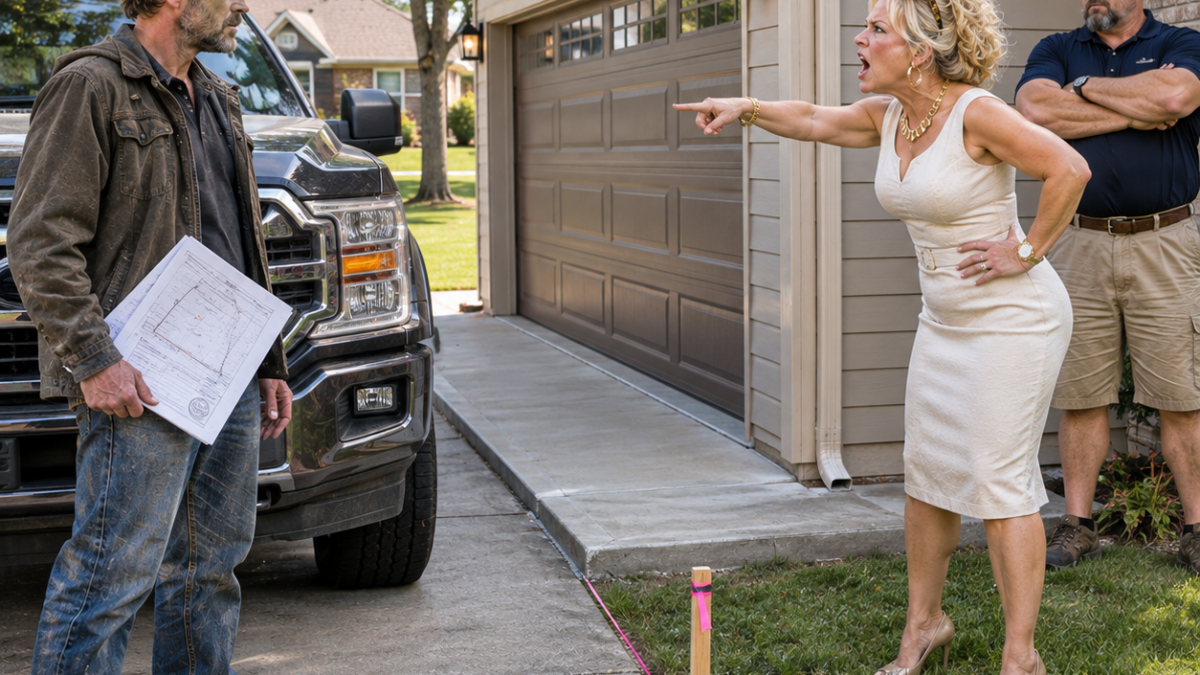
HOA Karen Built a Two-Car Garage 5 Feet Onto My Driveway—72 Hours Later, the County Brought an Excavator.
I came home from a five-day bridge inspection in Houston and found my HOA vice president’s brand-new two-car garage aimed directly at my driveway, with five feet of fresh concrete poured across the property line onto land I had paid for.
When I objected, Tammy Holcomb fined me for parking my own truck in front of the garage she had built illegally, fabricated an HOA approval meeting that never happened, aimed industrial floodlights into my daughter’s bedroom, and threatened to put a lien on the house where I was trying to rebuild our lives after my wife died.
Then a surveyor drove three steel markers into the ground, my cameras caught Tammy’s husband ripping every one of them back out, and a county inspector discovered something beneath the garage foundation that suddenly made our property-line fight dangerous to forty-seven families who had no idea what Tammy and Doug had built over.
The first thing Tammy Holcomb ever said to me about the garage was:
“Get your ugly truck off my garage exit before I have it crushed.”
She was standing in my driveway when she said it.
My driveway.
Not hers.
Mine.
She wore cream-colored heels, a teal wrap dress, a diamond necklace, and the expression of a woman who had already decided that any disagreement was simply evidence that the other person had failed to understand her authority.
Behind her, my black Ford F-250 sat exactly where I had parked it the previous evening.
Inside my property line.
On the concrete pad attached to my house.
And directly in front of the sixteen-foot roll-up door of the enormous garage her husband had constructed while I was out of town.
I looked at Tammy.
Then at the garage.
Then back at her.
“Ma’am, this is my driveway.”
She folded her arms.
“Your truck is blocking our exit.”
“Your garage is on my property.”
Her face barely changed.
“I don’t care whose name is on some piece of paper.”
I actually thought I had misheard her.
“You don’t care whose property it is?”
“Doug built the garage.”
“I noticed.”
“It’s finished.”
“That does not make it yours.”
She gave a little laugh.
The kind of laugh designed to tell you she had already moved beyond your objection.
“Move your junk, Garrett, or I’ll call the police and tell them you’re threatening me.”
I was fifty-one years old at the time.
Six-foot-two.
A civil and structural engineer who spent most of my professional life inspecting bridges, foundations, retaining systems, and construction failures across North Texas.
I knew exactly how far away Tammy was standing.
I knew how much concrete sat between us.
I knew where the recorded property line ran.
PART2:
And I knew that if I let anger make the next decision, the story would become about the large widower shouting at the elegantly dressed HOA vice president.
So I did the one thing Tammy did not expect.
I smiled.
“Call them.”
Her eyes narrowed.
“What?”
“The police.”
I pointed toward my truck.
“Call whoever you want.”
Then I picked up my coffee and walked back toward the porch.
That was three weeks after the garage appeared.
But if you want to understand why I reacted the way I did, you have to go back three years earlier.
Back before Blue Bell Ridge.
Back before Tammy.
Back before Doug.
Back before any of this mattered.
Three years before I saw that garage sitting against my driveway, I buried my wife.
Her name was Emily.
She was thirty-eight years old.
Colon cancer.
Fourteen months from diagnosis to funeral.
Our daughter Lily was seven.
At the funeral, rain started just before the minister finished speaking.
Not hard.
A soft Texas spring rain that made dark spots across the folding chairs and turned the grass around the cemetery glossy green.
People opened umbrellas.
Lily stood beside me holding my hand.
She had spent most of the service looking at the casket with an expression that frightened me more than crying would have.
She understood death in theory.
A pet hamster had died when she was four.
Her grandmother had explained heaven.
But a mother dying is not a theory to a seven-year-old.
It is a door in the house that never opens again.
When the rain started, Lily tugged my sleeve.
“Daddy?”
“Yeah, baby?”
“Is Mommy coming back after the rain stops?”
There are questions a father should have an answer for.
I did not have one.
I knelt beside her.
Put both hands around hers.
“No, sweetheart.”
She stared at me.
“Why?”
I swallowed.
“Because Mommy died.”
“I know.”
Then her little face tightened.
“But when does she come back?”
That was the moment I broke.
Not during the hospital.
Not when the doctor said there was nothing else they could do.
Not when I signed hospice paperwork.
Not when Emily stopped breathing.
At the cemetery.
In the rain.
Because my daughter believed death might be temporary if the weather changed.
I held her.
She cried.
I cried.
And when we finally went home, the house became impossible.
Every room smelled like Emily’s lotion.
Every cabinet contained something in her handwriting.
A grocery list taped inside the pantry.
A note on the refrigerator reminding me to call the plumber.
A prescription bottle beside the bathroom sink.
Her robe behind the bedroom door.
Her coffee mug.
Her pillow.
Even the kitchen faucet dripped exactly the way it had before she died.
Drip.
Drip.
Drip.
For years Emily had complained:
“Garrett, you inspect million-dollar bridges for a living and somehow cannot fix one faucet.”
I always told her:
“I can fix it.”
She would say:
“Then why haven’t you?”
Because it annoyed her.
That was the joke.
After she died, the sound became unbearable.
Drip.
Drip.
Nobody asking me to fix it.
Nobody rolling her eyes.
Nobody walking into the kitchen barefoot at six in the morning.
I replaced the entire faucet the second week.
The house became quieter.
That made it worse.
I stayed six months.
Long enough to understand I was not going to heal inside a building where every wall had a before and an after.
So I sold.
Packed what mattered.
Emily’s photographs.
Lily’s school projects.
Kitchen table.
Her mother’s cedar chest.
A blue ceramic bowl Emily loved for reasons I never understood.
I stored the rest.
Then Lily and I moved to Blue Bell Ridge.
Collin County.
Just north of McKinney.
Quiet subdivision.
Cul-de-sac.
Good schools.
Big backyard.
Pecan tree in one corner.
Two-car garage.
Double-wide driveway.
Nothing extraordinary.
That was exactly what I wanted.
Ordinary.
The day we moved in, Lily ran barefoot across the fresh-cut grass.
She tripped over a sprinkler head.
Fell.
Then laughed so hard she could not stand up.
I stood in the driveway holding the house key.
The metal teeth pressed into my palm.
And I thought:
This is the reset.
This is where we start over.
Tammy Holcomb arrived within an hour.
She came across the lawn carrying a basket of lemon muffins wrapped in clear cellophane.
Teal midi dress.
Diamond-drop earrings.
Gold bracelet.
Perfume strong enough to reach me before she did.
Something floral.
Sweet.
Expensive.
She smiled.
“Welcome to Blue Bell Ridge, sweetie.”
Sweetie.
I had known her twelve seconds.
“I’m Tammy.”
She handed me the basket.
“Vice president of the HOA.”
“Garrett.”
“I know.”
That should have bothered me.
Instead, I assumed the association had a move-in list.
“I’m basically the one who keeps this place running.”
She said that casually.
Like everybody knew.
Her eyes moved behind me.
Truck.
Toolbox.
Work boots.
Half-open moving boxes.
Then into the living room.
Not rudely enough to call it staring.
Enough that I noticed.
“Just you and your little girl?”
“My daughter.”
“Oh.”
Her expression softened artificially.
“I heard about your wife.”
I did not ask how.
“I’m sorry.”
“Thank you.”
“You’ll love it here.”
Doug came out a minute later.
Her husband.
Big guy.
Maybe six-three.
Heavy shoulders.
Flannel shirt despite warm weather.
Construction-callused hands.
Handshake a little too hard.
Some men shake hands like the other man’s pain tells them something important.
He looked toward my garage.
Then driveway.
“That’s a lot of wasted space on your side.”
I laughed.
“Wasted?”
“You barely use half that driveway.”
“We moved in forty-five minutes ago.”
He grinned.
“Fair enough.”
I forgot the comment.
I should not have.
The first week, Tammy’s messages started.
Friendly.
Always friendly.
Monday:
Hi Garrett! Just a tiny reminder that Blue Bell Ridge mailbox posts should remain 42–48 inches from grade. Yours looks a hair low. ❤️
Tuesday:
Friendly neighborhood note! Trash cans need to be fully screened by 8 p.m. pickup day 😊
Wednesday:
Lawn edge along sidewalk could use a little cleaner angle. Nothing major! Welcome again! 💕
By Thursday, five messages.
By Saturday, I muted her.
Day ten, I found an orange violation notice under my windshield.
PARKING OBSTRUCTION.
VEHICLE PARKED BEYOND APPROVED HOURS.
Fine:
$200.
My truck.
My driveway.
At my house.
I sat at the kitchen table after Lily went to bed and opened the CC&Rs.
Every page.
Then again.
No approved parking hours.
No overnight restriction.
No vehicle-time provision.
Nothing.
Tammy had invented the rule.
I called HOA president Preston Ridley.
He answered after several rings.
Older man.
Soft voice.
Always sounded apologetic even when saying hello.
“Preston, I received a violation for parking my truck in my driveway.”
“Well…”
He cleared his throat.
Once.
Twice.
Three times.
“Tammy handles most day-to-day enforcement.”
“That isn’t what I asked.”
“She’s very thorough.”
“Show me the rule.”
Silence.
“I’ll have to look.”
“I already did.”
Another pause.
“There isn’t one.”
“Well, Tammy may be relying on an interpretation.”
“Of what?”
More throat clearing.
I realized Preston was not the authority in that HOA.
He was the title.
Tammy was the authority.
That night Lily saw the notice.
“Daddy?”
“Yeah?”
“Did we do something wrong?”
She had her mother’s eyes.
Blue-gray.
Same serious expression when worried.
I knelt.
“No.”
“Then why do we have a bad letter?”
“Some people like making rules for everybody else.”
“Can they?”
“Not if the rules aren’t real.”
She thought about that.
Then nodded.
At the time, I had no idea how accurate that conversation would become.
Three weeks later, my engineering firm sent me to Houston.
Bridge inspection.
Five days.
Lily stayed with Helen, my mother-in-law, twenty minutes away.
Helen spoiled her relentlessly.
Pancakes every morning.
Ice cream despite my objections.
Bedtime at whatever hour she considered “reasonable,” which apparently meant whenever both of them became too tired to keep watching movies.
I kissed Lily goodbye on the porch.
“Be good.”
“I’m always good.”
Helen laughed behind her.
I looked at Helen.
She shrugged.
“She believes it.”
I drove south.
For five days, my brain was load bearings.
Concrete cracking.
Deck movement.
Inspection reports.
Nothing heavier than calculations.
When I came home Friday afternoon, the first thing I noticed was not the garage.
It was the shadow.
There was a shadow across my driveway that had never existed before.
Large.
Rectangular.
Too straight to come from a tree.
I slowed.
Turned into the cul-de-sac.
Then stopped.
Attached to the side of the Holcomb house was a brand-new two-car garage.
Six hundred square feet.
Fresh beige siding.
New shingles.
Sixteen-foot roll-up door.
And the garage door faced directly toward my driveway.
Not their side yard.
Not the street.
Not angled.
Directly across the property line toward my concrete.
The new apron extended out from their garage and merged into my driveway.
Except merge is too polite a word.
They had poured concrete over my land.
I could see where old concrete ended.
Fresh concrete began.
Five feet, maybe more.
Tire marks already pressed into the dusty surface.
Doug had been using my driveway while I was gone.
I shut the truck off.
Sat there.
One minute.
Maybe two.
Fresh concrete has a smell.
People who do not work around construction may not notice it.
Alkaline.
Dusty.
Mineral.
The scent drifted through my cracked window.
A drywall screw sat on my welcome mat.
Construction dust coated the edge of my driveway.
I walked next door.
Knocked.
Tammy opened.
White lace dress.
Rose-gold bracelets.
Glass of rosé.
“Oh.”
She smiled.
“You’re back.”
I pointed.
“The garage.”
She leaned against the doorframe.
“What about it?”
“It opens onto my driveway.”
“Oh, honey.”
She sipped wine.
“It’s not like you use all of it.”
I stared.
“I’d like to see the building permit.”
She laughed.
Short.
Practiced.
“Doug handles that kind of paperwork.”
Doug appeared behind her.
Sawdust on arms.
Dried concrete on neck.
“What’s up?”
“Your garage door opens onto my property.”
He folded his arms.
“Everybody shares around here.”
“Streets.”
“Driveways.”
“Fences.”
He smiled.
“That’s how neighborhoods work.”
“No.”
He glanced at Tammy.
“If you’ve got a problem, take it up with the HOA.”
Then the corner of his mouth lifted.
“Oh, wait.”
He spread his hands.
“That’s us.”
Tammy giggled.
Her bracelets clinked.
I said nothing.
That bothered them more.
I went home.
Opened laptop.
Collin County permit system.
Holcomb address.
Owner name.
Parcel.
Five years.
No permit.
No foundation inspection.
No framing inspection.
No electrical inspection.
No setback variance.
Nothing.
Doug had built a roughly six-hundred-square-foot attached structure in five days.
Foundation.
Electrical.
Roof.
Door.
No legal paperwork visible anywhere.
I took screenshots.
Created folder.
HOLCOMB.
That evening, Tammy posted on the neighborhood Facebook group.
Photograph.
Tammy and Doug.
Champagne glasses.
Garage behind them.
Caption:
Doug is so talented! Best hubby ever built me my dream garage! Blessed life, handy husband! ❤️❤️❤️
Forty-seven likes.
Twelve hearts.
One neighbor, Connie Marsh, used the raised-eyebrow reaction.
I saved the post.
Monday morning:
formal complaint.
Three pages.
Unpermitted structure.
Property-line encroachment.
Driveway use without consent.
Concrete apron over parcel boundary.
Permit-search result attached.
Hand delivered to Preston.
Three days later:
HOA letterhead.
Dear Mr. Sutherland:
The board has reviewed your complaint and determined no violation exists.
The improvement at 4417 Bluebell Ridge Drive was approved by the Architectural Review Committee on April 14.
Please refrain from filing frivolous complaints.
Future misuse of the complaint process may result in sanctions.
Respectfully,
Blue Bell Ridge HOA Board.
April 14.
I checked my calendar.
Wednesday.
Lily’s dentist appointment.
I remembered because she had cried about the fluoride taste for forty minutes.
No HOA meeting notice.
No board email.
No Architectural Review Committee notice.
Nothing.
I called Preston.
“Send me the April 14 minutes.”
“Well…”
Throat clearing.
“Tammy keeps those records.”
“I’m making a formal request under Section 12, paragraph four.”
Silence.
“You have ten business days.”
“I’ll see what I can do.”
He sounded frightened.
That told me more than refusal would have.
Three days later, Connie Marsh walked over while I was pulling weeds.
Sixty years old.
Retired school librarian.
Short silver hair.
Manila folder under arm.
Expression of somebody who had been waiting years to tell the right person something.
“Mr. Sutherland?”
“Garrett.”
“Connie.”
“I know.”
She nodded toward my porch.
“Coffee?”
I poured.
She sat in a lawn chair.
Opened folder.
“There was no meeting April 14.”
I stopped.
“You’re sure?”
“I’m on the Architectural Review Committee.”
“How long?”
“Six years.”
“Nobody approved the garage?”
“Nobody knew about the garage.”
She handed me photocopies.
Minutes.
Calendars.
Handwritten notes.
Some signatures.
“Tammy types whatever she wants.”
“Preston signs it.”
“Without reading?”
Connie took a sip.
“He stopped reading years ago.”
“Why?”
“Because she makes his life miserable when he doesn’t.”
She looked at me over the cup.
“The last homeowner who pushed her hard got four violations in a week.”
“Then?”
“Lien threat.”
“And?”
“Sold.”
“Where?”
“Frisco.”
Connie looked down.
“I should have said something sooner.”
“Why didn’t you?”
“I’ve got nowhere else to go.”
That answer stayed with me.
People think HOA abuse survives because everyone agrees.
Often it survives because everyone has a mortgage.
Children.
Jobs.
Retirement.
And nobody wants to spend $15,000 proving a woman with a clipboard invented a rule.
That week, I got two more violations.
Exterior paint.
$300.
Same color the house had when I bought it.
Lawn height.
$150.
Claim:
over four inches.
I got a tape measure.
Six locations.
Tallest blade:
three and one-half inches.
Photographed.
Timestamped.
Saved.
HOLCOMB folder got thicker.
Tammy continued inspection walks.
Champagne sequin cardigan.
Black skirt.
Gucci sunglasses.
Clipboard with pink heart sticker.
Old Larry Boone watched from his porch.
“There goes HOA Barbie.”
His wife slapped his arm.
I pretended not to hear.
Then Lily found the notices.
“Daddy?”
“Yeah?”
“Are we going to have to move again?”
I froze.
She sat on the kitchen floor.
Back against cabinets.
The question was not about Tammy.
It was about losing home.
Again.
I picked her up.
Set her on the counter.
“No.”
“Promise?”
“Yes.”
“Even if she sends more bad letters?”
“Even then.”
Lily looked toward the window.
At Holcomb garage.
“Why did they build it there?”
“I don’t know.”
“It’s dumb.”
Children are sometimes better consultants than attorneys.
“Yes.”
“It is.”
The next morning, I parked my truck on my driveway.
Exactly where the recorded line said I could.
Right in front of their garage exit.
6:58 a.m.
Horn.
Long blast.
Another.
Three short blasts.
Then Tammy.
“MOVE YOUR TRUCK!”
I poured coffee.
Looked outside.
Tammy stood on her porch wearing a cream silk nightgown.
Pearl necklace.
Hair already brushed.
Doug sat in his pickup inside the garage.
Engine running.
Could not exit without driving across my land where my truck sat.
I walked onto porch.
Coffee.
“Move it now or I’m calling the police.”
“That’s my property.”
“You’re blocking us.”
“No.”
“You can’t do this.”
“I’m parked in my driveway.”
“I have a doctor’s appointment.”
“Use your legal driveway.”
“We can’t.”
“That sounds like a design problem.”
She called police.
Two officers.
Eleven minutes.
Tammy met them at curb.
Perfect tears.
Not exaggerating.
Actual tears.
No red face.
No smeared makeup.
“Officer, he’s harassing us.”
“He blocked our garage.”
“We cannot leave our home.”
The older officer approached me.
“Sir?”
I handed him plat.
“That isn’t their driveway.”
He studied.
Looked at garage.
Property line.
Tammy.
Her tears stopped when he did not immediately agree.
“This appears civil.”
“I understand.”
“Maybe work it out neighborly.”
“I tried.”
They started leaving.
Younger officer hung back.
Quietly:
“If that structure is really over the line, get a survey.”
“Official.”
“Stamped.”
“That’s what sticks.”
I nodded.
Already planned.
That afternoon, Doug brought out a wheelbarrow.
Crushed limestone.
Dumped it across disputed strip.
One load.
Two.
Three.
Four.
Six inches deep.
Over my concrete.
Tammy sat nearby in turquoise wrap dress and kitten heels drinking iced tea.
“That’s our side now.”
I did not answer.
That evening, Doug mounted two industrial halogen lights.
One aimed at my bedroom.
One at Lily’s.
10:15 p.m.
They came on.
White glare flooded the room.
Lily came to my bedroom rubbing her eyes.
“Daddy.”
“What?”
“It’s too bright.”
I walked to her window.
Pulled curtain.
Light hit me full face.
Across property line:
garage glowing like a stage.
I carried Lily into my bed.
Her mother’s side.
Tucked her under blanket.
She was asleep in ten minutes.
I sat in the hallway.
Light under door.
Thin white stripe.
Opened HOLCOMB folder.
Not thick enough.
Next morning:
records.
All of them.
Not casual search.
Professional diligence.
Collin County appraisal.
Permit portal.
Plat.
GIS.
Secretary of State.
HOA filings.
I treated it like a contested foundation site.
First:
no permit.
Second:
setback violation.
Garage sat roughly eighteen inches from boundary.
Requirement:
five feet under applicable local standards referenced in the source documentation I was reviewing.
Third:
encroachment.
Concrete apron:
approximately five feet two inches onto my property.
Fourth:
meeting fraud.
I compared April 14 “minutes” against HOA calendar.
Two board members were in Gulf Shores.
Another board member was recovering from knee surgery in a hospital.
The meeting did not happen.
Tammy had typed minutes for an event that did not exist.
Preston had signed.
At one in morning, I sat in front of laptop.
Cold coffee.
Light from Holcomb halogens striping ceiling through blinds.
Down hall, Lily sleeping.
For first time in weeks, I smiled.
Not joy.
Recognition.
I had spent years inspecting failures.
Most failures begin long before collapse.
Bad assumptions.
Ignored specifications.
Unverified work.
Someone believes nobody will check.
Then someone checks.
I called Wade Callaway.
Surveyor.
Sixty-three.
Sunburned.
Patient.
Three decades in North Texas.
He arrived seven sharp.
Two-man crew.
Total station.
Tripod.
Orange vest.
Tammy noticed within four minutes.
Kitchen window opened.
She stood there in pink chiffon dress holding a mug.
BOSS LADY.
“What is that man doing on my lawn?”
Wade did not look up.
“Ma’am, I’m standing on the property line.”
“So technically I’m on his lawn.”
Window slammed.
Survey took three hours.
Result:
garage apron encroached five feet two inches.
Garage placement violated required side setback.
Boundary unmistakable.
Wade drove rebar markers.
Printed report from truck.
Stamped.
Signed blue ink.
Handed me three copies.
“Clean case.”
“How clean?”
“I’ve seen worse structures.”
He looked toward garage.
“Never seen worse placement.”
Attorney next.
Nolan Briggs.
Thirty-eight.
Lean.
Sharp.
Office in converted Victorian in downtown McKinney.
He read everything.
Survey.
Permit search.
Minutes.
Violations.
Then put pen down.
“Garrett.”
“Yes?”
“This is not a property dispute.”
“What is it?”
“A gift.”
I laughed.
He did not.
“Zero permits.”
“Structural setback.”
“Encroachment.”
“Governance records that appear fabricated.”
“Retaliatory violations.”
“You have cameras?”
“Not yet.”
“Get them.”
That afternoon, complaints went out.
County inspection.
HOA governance concerns.
Then cameras.
Three hardwired.
Cloud backup.
Timestamp.
Opposing angles.
Driveway.
Property line.
Front yard.
From then on, every movement had a clock attached.
Connie hosted five homeowners Thursday.
Vernon Hayes.
Wrong shade of beige.
Linda Tully.
Baby stroller on porch thirty minutes.
Raul Esperanza.
Unauthorized landscaping.
One rosebush.
Another couple.
Trash-can dispute.
Folders.
Everyone had folders.
That struck me.
Tammy had turned an entire subdivision into amateur archivists.
Connie said:
“For three years, I thought I was the only one.”
Vernon replied:
“That’s how she keeps it working.”
Nobody answered.
Because he was right.
Isolation is cheap control.
Records request followed.
Financials.
Minutes.
Enforcement actions.
Board correspondence.
Nolan handled.
Then Lily sat on the porch with math homework.
“Daddy?”
“Yeah?”
“Are the mean people going to stop?”
I sat beside her.
Warm concrete.
Pencil behind her ear.
“They just don’t know it yet.”
Two days after survey, markers disappeared.
All three.
Gone.
Not bent.
Pulled.
Thrown near Holcomb trash cans.
Doug stood in garage wiping hands with rag.
Grinning.
I opened camera feed.
2:14 p.m.
Doug walking toward boundary with claw hammer.
Yanking markers.
One.
Two.
Three.
Tammy behind him.
Coral wrap dress.
Gold hoops.
Arms crossed.
Watching.
Nodding.
I saved video in three places.
Emailed Nolan.
He called.
“Do not confront.”
“I wasn’t going to.”
“Good.”
“Are you smiling?”
“No.”
“You’re smiling.”
“A little.”
Tammy posted on Facebook that evening.
Sad to report our newest neighbor has been filing false complaints against longtime residents, harassing families, and attempting to reduce property values.
Signed:
Tammy Holcomb, Vice President.
Photograph of herself in white blazer.
Pearls.
Community sign.
Connie screenshot.
One word:
Evidence.
Then four new violations.
Window tint.
My windows were not tinted.
Driveway oil stain.
It was a shadow.
Fence modification.
No fence work.
Outdoor-light pollution.
My security cameras.
The irony was almost elegant.
Then lien threat.
$2,200 accumulated fines.
Thirty days.
I folded letter.
Added to file.
At 11:47 that night, my phone buzzed.
Motion.
Doug.
Portable concrete mixer.
Garage halogens on.
He backed toward disputed strip.
Poured fresh concrete.
Extended apron another two feet onto my land.
At midnight.
He troweled it smooth.
Stood admiring.
Every second recorded.
I saved.
Backed up.
Went to sleep.
Next morning, garage-warming party.
Pink balloons.
Champagne.
Cucumber sandwiches.
Tammy in red cocktail dress.
Pearl choker.
Doug in clean shirt.
Photographs.
Neighbors.
I sat on porch drinking water.
Said nothing.
The county inspector was coming Thursday.
Hector Fuentes arrived 9:15.
White F-150.
County seal.
Forty-five.
Stocky.
Clipboard.
Digital measuring equipment.
Nineteen years inspections.
He looked at garage the way a surgeon looks at an X-ray after already spotting the break.
Measured setback.
Wrote.
Measured encroachment.
Five feet two inches.
Wrote.
Walked inside.
Twelve minutes.
Framing.
Electrical.
Foundation.
Roof connections.
When he came out, pen moving faster.
“No permit.”
“Yes.”
“No inspections.”
“Yes.”
“Side setback is noncompliant.”
“Yes.”
“Electrical junction isn’t grounded.”
I nodded.
“Framing doesn’t meet what I’d expect for required wind loading here.”
I said nothing.
Then Hector stopped.
Looked at tablet.
Looked toward slab.
Then at me.
“Did you know there’s a secondary water main here?”
My stomach tightened.
“What?”
He rotated tablet.
Utility map.
Blue line.
Directly beneath foundation.
“That slab is over a subdivision water main.”
“How many houses?”
He checked.
“Potentially forty-seven on this section.”
I stared at garage.
Every part of my engineering brain came awake.
Expansive Texas clay.
Foundation movement.
Settlement.
Water main.
Loads.
“This foundation moves—”
“I know.”
Hector nodded.
“That’s what concerns me.”
Tammy emerged thirty seconds later.
Lavender floral dress.
Chandelier earrings.
Coach purse.
Phone recording.
“Excuse me, officer.”
Hector did not look amused.
“Ma’am, I’m not a police officer.”
“Oh.”
“I’m a county building inspector.”
Tammy smiled.
“There must be a misunderstanding.”
“My husband is an experienced builder.”
Hector looked at clipboard.
“Your husband built an approximately six-hundred-square-foot structure without permits or inspections.”
Tammy’s smile held.
“The garage is safe.”
“Electrical is not properly grounded.”
“We can fix that.”
“Setback is noncompliant.”
“Variance.”
“No variance on file.”
“We can file.”
“Foundation appears to be constructed over a water line serving numerous homes.”
The smile finally flickered.
Doug came around corner.
Hands open.
Casual.
“Come on, man.”
“It’s just a garage.”
“Nobody got hurt.”
Hector looked at him.
“Nobody being hurt yet is not an inspection standard.”
Then Doug made the mistake.
Wallet.
Back pocket.
Opened.
“Look, I know paperwork can get complicated.”
Hector stopped writing.
Doug continued:
“What if we just—”
Hector looked at wallet.
Then Doug.
“Sir.”
“Yes?”
“Are you attempting to offer me a financial incentive to disregard code violations?”
Doug’s grin disappeared.
“No.”
He closed wallet.
“I was just—”
“I am noting this interaction in my report.”
Wallet vanished so fast he nearly dropped it.
Hector finished in silence.
Walked to truck.
Returned with red placard.
Attached to garage.
RED TAG.
NO OCCUPANCY.
NO VEHICLE STORAGE.
NO ACCESS.
Tammy stood completely still.
Earrings stopped moving.
Phone lowered.
For first time, fear replaced performance.
That evening, emergency HOA session.
Tammy called board members personally.
Breakfast.
Lunch.
Promises.
She wanted retroactive approval.
Nolan had already sent each director a letter.
Falsified minutes.
Personal exposure.
Duty.
Recorded evidence.
Three of five withdrew support.
One called Nolan.
“I had no idea.”
That phrase appears often after bad systems collapse.
I had no idea.
Sometimes true.
Sometimes meaning:
I did not ask.
Tuesday.
County enforcement officer arrived.
Tammy opened door expecting somebody else.
White silk blouse.
Gold necklace.
He handed order.
Unpermitted structure.
Setback violation.
Encroachment.
Electrical.
Structural concerns.
Water main.
Failure to inspect.
Final page:
Structure must be demolished and site restored within seventy-two hours.
Owner responsible for cost.
Three days.
Tammy called community meeting Wednesday.
Subject:
URGENT — DEFENDING OUR COMMUNITY AGAINST GOVERNMENT OVERREACH.
Sixty homeowners showed.
Clubhouse.
Beige walls.
Fluorescent light.
Industrial carpet cleaner smell.
Connie second row.
Vernon back.
Nolan beside me.
Briefcase.
Tammy at podium.
White fitted dress.
Three strands pearls.
Pearl-drop earrings.
Diamond bracelet.
Rings.
She looked prepared for television.
“They’re trying to destroy our home.”
Voice trembling just enough.
“This isn’t about a garage.”
“This is an attack on our family.”
“Our neighborhood.”
“Our property values.”
“Our rights.”
A few people nodded.
I stood.
Room quieted.
Walked to front.
HOLCOMB folder thick now.
I placed it on table.
“I’m not giving a speech.”
Tammy folded arms.
“I’m going to show you what’s in this folder.”
Survey.
Stamped.
Five feet two inches.
Permit search.
Zero.
Meeting minutes.
April 14.
HOA calendar.
No meeting.
Board member vacation records voluntarily provided.
Another recovering from surgery.
Camera stills.
Doug pulling survey markers.
Camera video.
Doug pouring concrete at 11:47 p.m.
Violation notices.
Retaliatory timeline.
County inspection.
Water main.
I placed last page down.
Looked at room.
Then Tammy.
“You didn’t just build a garage too close to a line.”
“You poured five feet onto my property.”
“You created HOA minutes for a meeting that did not happen.”
“You filed violations against me after I complained.”
“You removed survey markers.”
“You poured more concrete after being told where the line was.”
“And the county says the foundation sits over a water line serving this neighborhood.”
Nobody moved.
I looked toward Lily’s empty seat in my mind.
She was with Helen that evening.
Good.
“You also aimed floodlights into my daughter’s bedroom after I parked my truck in my own driveway.”
That changed several faces.
Parents.
I continued.
“I moved here after my wife died.”
My throat tightened unexpectedly.
“I moved here because my daughter needed a home that did not feel like a hospital room with furniture.”
Tammy looked away.
“I am not asking for special treatment.”
“I am asking you to stop pretending my property is yours because I chose not to scream the first time you crossed the line.”
Connie started clapping.
One person.
Then Vernon.
Linda.
Raul.
More.
Within seconds, half room standing.
I did not want applause.
But I understood what it meant.
Not for me.
For people realizing somebody else had finally said the thing they had been thinking quietly.
The board voted.
Tammy removed as vice president.
Preston resigned.
Immediately.
He stood.
Muttered something about wanting more time for gardening.
Nobody tried stopping him.
Friday.
Seventy-two hours.
11:45 a.m.
Flatbed rolled onto Blue Bell Ridge.
Cat excavator.
Demolition crew.
Hard hats.
Neighbors came outside.
Porches.
Lawns.
Mailboxes.
Old Larry Boone brought a camping chair.
And beer.
“Larry.”
“What?”
“It’s eleven forty-five.”
“Retired.”
Apparently that answered everything.
Tammy sat inside pearl-white Lexus.
Windows up.
Gucci sunglasses.
Doug stood in yard.
Arms limp.
The excavator operator positioned boom.
Claw gripped ridge beam.
Pulled.
Roof separated.
Not explosion.
No dramatic collapse.
Construction comes apart differently when machine knows where to pull.
Shingles slid.
Studs cracked.
Sheathing folded.
The sound was enormous.
Concrete apron broke under hydraulic hammer.
Gray slabs.
Dust.
Halogen lights came down.
One bulb shattered.
Another remained hanging by wire.
By noon, the garage that had taken five days to build was mostly a pile.
By afternoon, it was sorted debris.
Metal.
Wood.
Concrete.
At the property line, the crew carefully removed the encroaching slab.
Restored grade.
Protected water main.
Wade returned later and confirmed boundary.
Connie came over carrying two Lone Stars.
Handed one to me.
“Three days.”
“Apparently.”
“Not bad for a quiet guy.”
I looked toward Tammy’s Lexus.
Diamonds.
Pearls.
Gold.
All catching sunlight through windshield.
A woman dressed perfectly with nowhere to drive.
I did not feel triumphant.
That surprised me.
I expected satisfaction.
Instead I felt tired.
Conflict consumes energy even when you win.
And the garage being gone did not bring Emily back.
It did not erase Lily asking if we had to move.
It did not make our first house feel safe again.
It simply gave me my driveway back.
That was enough.
The financial consequences came later.
Demolition.
Site restoration.
County fines.
Civil settlement for trespass and property damage.
The source records eventually put combined direct impact around eighty-one thousand dollars across demolition, fines, and settlement.
Doug also faced consequences over removal of survey markers.
Probation.
Community service.
Other enforcement.
The attempted wallet incident remained part of county report even without becoming the dramatic bribery prosecution neighbors predicted.
Reality is often less cinematic than rumor.
That matters.
Tammy’s HOA problems expanded.
State-level complaints concerning governance practices.
Falsified minutes.
Retaliatory enforcement.
Threatened liens.
The Holcombs eventually listed their house.
Motivated sale.
They moved.
Blue Bell Ridge did not collapse after Tammy left.
That fascinated some people.
For years, she had convinced residents her constant enforcement kept property values alive.
The lawns remained mowed.
Trash still got collected.
Nobody painted a house neon purple.
Civilization continued.
Board meetings changed.
Agendas posted.
Minutes available.
Specific CC&R provisions required for violations.
Response periods.
Recordings.
No more:
Because Tammy said so.
Connie and I helped establish a transparency committee.
I did not want to be HOA president.
People asked.
I declined.
I already had a full-time job and a daughter.
Also, anybody who wants authority immediately after fighting authority should ask themselves uncomfortable questions.
I preferred records.
Connie handled meetings better anyway.
Retired librarians are terrifying in procedural disputes.
They know how to find things.
We also started the Property Rights Awareness Fund.
That began because of Lily.
Specifically the night she came to my bedroom because Doug’s lights made hers too bright to sleep.
I kept thinking about families who could not afford Nolan.
Families receiving official-looking letters.
Fines.
Lien threats.
Legal language.
Not everyone is an engineer who enjoys digging through plats at one in morning.
Not everyone has surveyor friends.
Not everyone knows which document controls which boundary.
So neighbors contributed.
Twelve thousand dollars in first month.
Initial legal consultations.
Not lawsuits for every disagreement.
Just enough professional advice to tell someone:
Yes, this is enforceable.
No, this is not.
Here is your deadline.
Here is your right.
Here is where you should stop arguing on Facebook and start putting things in writing.
Vernon Hayes became volunteer coordinator.
The man once fined because his garage door was allegedly the wrong beige.
He loved spreadsheets.
Apparently oppression had been wasting a talent.
Three months after demolition, Blue Bell Ridge felt different.
Not physically.
Same roofs.
Same sidewalks.
Same entrance monument.
But people waved.
Stood outside longer.
Attended meetings without looking around before asking questions.
That is difficult to quantify.
Engineers like numbers.
Some changes do not fit columns.
October evening.
I sat on porch with beer.
Lily rode bicycle up and down driveway.
Same driveway.
No garage door.
No fresh concrete.
No gravel.
No floodlight.
Just clean surface.
She was ten then.
Helmet crooked.
Longer legs.
She made wide loops beneath sky turning pink at edges.
Crickets.
Mesquite smoke from Connie’s yard.
Country music somewhere down street.
Lily stopped in front of me.
Feet down.
“Daddy.”
“Yeah?”
“This is a good house.”
I looked at her.
Then house.
Pecan tree.
Driveway.
Garage.
Porch.
For months, home had become a legal concept.
Parcel.
Boundary.
Survey.
Ownership.
Lily reduced it back to what it was supposed to be.
“Yeah, baby.”
“It is.”
Emily would have handled Tammy differently.
At first.
She would have brought pie.
I am serious.
Emily believed food could solve an astonishing range of interpersonal conflict.
She would have walked next door.
Sat.
Talked.
Asked:
“What are we really doing here?”
Sometimes that worked.
Sometimes people need an exit ramp that lets them back down without embarrassment.
I am not as good at providing those.
But I think Emily would have been proud of the ending.
Not demolition.
She would probably have hated the spectacle.
She would have been proud of Connie.
Vernon.
The fund.
Neighbors no longer afraid.
She believed systems should make ordinary people safer, not more obedient.
That was one reason she loved my engineering work.
“You build things people trust without thinking about them.”
She said that once about a bridge.
I corrected her.
“I don’t build them.”
“I inspect.”
She waved me off.
“Same nerd family.”
That was Emily.
The year after Tammy left, the HOA wanted to replace entrance landscaping.
At old board meetings, that would have become three people making decision.
Now:
proposal published.
Three bids.
Public questions.
Vote.
Boring.
I almost cried from happiness.
Some people mistake transparency for inefficiency.
It can be slower.
Good.
Not every decision needs speed.
Doug built garage in five days.
Look how that went.
There is a concept in engineering called load path.
Every force needs somewhere to go.
Roof load.
Wind.
Live load.
Dead load.
Foundation.
Soil.
If load does not transfer safely, something fails.
Tammy’s neighborhood worked the same way.
Residents’ fears flowed into one person.
Complaints flowed into Tammy.
Authority flowed through signatures Preston barely read.
Nobody checked.
No redundancy.
No oversight.
No independent verification.
When one person became weak point, whole system distorted.
Our reforms added supports.
Records.
Notice.
Citation.
Appeal.
Multiple eyes.
That may sound bureaucratic.
It is.
So are bridge inspections.
Nobody complains about bureaucracy after a bridge collapses.
Property rights are similarly boring until someone pours concrete over yours.
I still keep the HOLCOMB folder.
It sits in filing cabinet.
Three inches thick by end.
Survey.
Letters.
Screenshots.
Violations.
Camera stills.
County report.
Photographs.
Some people who hear the story ask:
“Why didn’t you just smash the concrete yourself?”
Because that would have been stupid.
It would have destroyed evidence.
Potentially damaged utilities.
Escalated.
Made me look like aggressor.
Others ask:
“Why didn’t you block their garage immediately?”
Eventually I did, with my truck.
But even then, I stayed on my land.
That matters.
Good disputes are won at edges.
Know exactly where yours ends.
Do not cross theirs while defending it.
I learned that from work.
When investigating structural failure, assumptions are dangerous.
You do not say:
“This beam failed because contractor was incompetent.”
You say:
“This weld shows lack of penetration.”
“This bolt pattern differs from drawing.”
“This concrete sample tested below design strength.”
Facts.
Tammy loved adjectives.
Hostile.
Unsafe.
Frivolous.
Harassing.
Unneighborly.
I responded with nouns.
Survey.
Permit.
Camera.
Minutes.
Marker.
Water main.
Property.
Facts are hard to bully.
The most important piece of evidence was probably not the survey.
It was her own garage-warming Facebook post.
Why?
Because later, when explanations changed—
Temporary structure.
Community-approved improvement.
Existing accessory building.
Shared-use adaptation.
—there was Tammy, smiling beside it.
Dream garage.
Doug built me.
Public.
Timestamped.
Her words.
People underestimate their own posts.
I tell every homeowner who asks me for advice:
Do not argue online.
Screenshot.
Save.
Then leave.
Nothing destroys clarity faster than a 117-comment neighborhood thread.
Another question:
“Did you hate them?”
For a while.
Yes.
Especially the night Lily could not sleep.
Especially when Tammy made her wonder if we would lose another home.
But hate takes maintenance.
I did not have energy.
Single father.
Job.
School pickups.
Homework.
Lunches.
Emily’s death had already shown me how finite time is.
I was not giving Tammy years in my head after she left.
Boundaries remained.
Anger did not need to.
That distinction took me longer than the legal case.
One afternoon, maybe six months later, I found the old first violation notice while cleaning.
Truck parked beyond approved hours.
Two hundred dollars.
I laughed.
Not because funny originally.
Because absurdity becomes visible after fear leaves.
I showed Lily.
“Remember this?”
She looked.
“Not really.”
Good.
That made me happier than anything.
Children should not carry their parents’ property disputes as permanent memory.
She remembered the lights more.
And the excavator.
Of course.
“Big yellow claw.”
“Yes.”
“It ate their garage.”
“It demolished it.”
“Ate.”
“Fine.”
She was ten.
I lost.
Lily asked once:
“Were they bad people?”
That question stopped me.
I wanted easy answer.
Yes.
Instead:
“They did bad things.”
“Same thing?”
“No.”
“Why?”
“Because people can stop doing bad things.”
“Did they?”
“I don’t know.”
She thought.
“Mom would say give second chances.”
There it was.
Emily.
Through our daughter.
“Yes.”
“But Mom also locked the door at night.”
Lily grinned.
I laughed.
“Exactly.”
Compassion and boundaries.
Maybe that was the lesson.
Blue Bell Ridge Transparency Committee lasted longer than expected.
Most committees die after initial anger fades.
Connie refused.
Every quarter, she audited minutes against recordings.
Not because she distrusted new board.
Because trustworthy systems should survive trustworthy people too.
“That’s the whole point,” she said.
She was right.
Rules built only for bad leaders often loosen when a good leader arrives.
Then another bad one arrives later.
Better to keep the guardrails.
Property Rights Fund grew.
Four families helped by Christmas.
One false landscaping campaign.
One improper rental restriction.
One wheelchair-ramp dispute.
One lien threat based on fees owner had actually paid.
None viral.
All important.
Vernon told me:
“This feels more useful than retirement.”
He had spent forty years as electrician.
I said:
“You could volunteer wiring houses.”
“No.”
“Why?”
“People argue less about voltage.”
Fair.
Nolan remained our outside adviser.
He enjoyed telling people:
“Do not send that email.”
Probably half his value.
Angry homeowners write terrible emails.
I wrote several.
Drafts.
Never sent.
One began:
Dear Tammy, you have the legal comprehension of a decorative pillow.
Nolan laughed.
Then deleted.
“Funny.”
“Bad evidence.”
Right again.
Silence is not surrender.
It is often editing.
That phrase became something Connie printed for committee.
Small sign.
DOCUMENT EVERYTHING.
KNOW YOUR RIGHTS.
NEVER MISTAKE SILENCE FOR SURRENDER.
A little dramatic.
But homeowners liked it.
I kept a copy in garage.
The driveway became normal again.
That was harder than expected.
For months, every time I parked, I thought about boundary.
Then one day I didn’t.
That is when I knew conflict was ending.
Normal means you stop noticing the thing you fought to protect.
You just use it.
Lily drew chalk flowers across driveway one summer.
Pink.
Blue.
Yellow.
Right over place where Doug’s apron had been removed.
Rain eventually washed them away.
I took photograph first.
Not evidence.
Memory.
Maybe I had become addicted to documentation.
There are worse habits.
The Holcomb house sold.
New family moved in.
Married couple.
Two boys.
First week, husband knocked.
I opened.
He looked nervous.
“Hey.”
“Hey.”
“I’m Aaron.”
“Garrett.”
“I know.”
Of course he did.
“We bought next door.”
“Welcome.”
He looked toward property line.
Then said:
“I wanted to make sure we’re clear where everything is.”
I almost laughed.
“Come on.”
I brought survey.
Showed marker.
Driveway.
He nodded.
“No problem.”
Three days later, he brought six-pack.
We sat on porch.
No HOA politics.
Talked football.
His boys played with Lily’s old basketball hoop.
That was how easy it should have been.
Ask.
Know line.
Respect.
Move on.
The new family installed small shed two years later.
Permit.
Five-foot setback.
Aaron showed me plan before filing.
Not because required.
Neighborly.
“Any problem?”
“No.”
“You sure?”
“Yes.”
“Door faces my yard.”
“Fine.”
He laughed.
“I figured I’d ask.”
We both laughed.
History became joke.
That is another kind of healing.
I remained an engineer.
Work continued.
Bridge inspections.
Foundation disputes.
One project near Fort Worth involved an actual garage encroachment.
Only fourteen inches.
Both owners agreed to easement adjustment.
Solved in two weeks.
No floodlights.
No Facebook.
No excavator.
During meeting, I almost told them my story.
Didn’t.
Professionalism.
But I thought:
See?
Adults can do this.
Lily became teenager.
That changed every problem.
Property rights seemed easy compared to a thirteen-year-old with phone.
She grew taller.
Started resembling Emily more.
Sometimes painfully.
Same smile from side.
Same habit of tucking hair behind ear when reading.
One evening she found framed photograph of Emily.
“Do you think Mom would like this house?”
I looked around.
“Yeah.”
“Even after everything?”
“Especially after.”
“Why?”
“Because you’re here.”
Lily rolled her eyes.
“Dad answer.”
“What?”
“Cheesy.”
She was right.
Still true.
I no longer think of Blue Bell Ridge as reset.
That was what I thought first day.
You do not reset after losing someone.
Reset implies zero.
Clean slate.
Nothing before.
We did not erase Emily.
We carried her differently.
The house became chapter, not replacement.
Tammy almost took that stability from us through something as stupid as a garage.
That is why small property disputes can feel enormous.
It is never only concrete.
It is control.
Safety.
Home.
The place where child expects bed to still be tomorrow.
When Lily asked:
“Are we going to have to move again?”
That was the real damage.
Not five feet two inches.
Not fines.
Fear.
I think about Tammy’s first visit sometimes.
Muffin basket.
Perfume.
“Basically the one who keeps this place running.”
At first, helpful.
Then five messages.
Then invented fine.
Power rarely arrives announcing:
I intend to control you.
It arrives:
Friendly reminder! ❤️
That does not mean all reminders are abuse.
But people should notice escalation.
Advice becomes demand.
Demand becomes penalty.
Penalty becomes threat.
Threat becomes taking.
Boundaries matter early.
I should have challenged the first fabricated fine formally.
Instead, I muted thread.
Understandable.
But avoidance gave Tammy room.
People with authority learn from what nobody contests.
That is not victim-blaming.
Responsibility remained hers.
But lesson for me:
Correct bad assumptions while they are small.
A two-hundred-dollar invented parking rule is easier than six hundred square feet of concrete.
The county’s demolition order became legendary in neighborhood.
People exaggerate.
Some say garage lasted exactly seventy-two hours total.
Not true.
It existed longer before order.
The seventy-two hours was demolition deadline.
Others say county excavator arrived because I was structural engineer and “knew people.”
No.
I knew process.
That is different.
Others say Doug tried bribing inspector with cash.
Source interaction was a wallet gesture and implied financial incentive.
Hector documented it.
I did not need to make it bigger.
Facts were already enough.
That is another thing I learned after story spread among friends.
People improve stories until they become lies.
I resisted.
Why?
Because Tammy lost partly by inventing facts.
I was not going to imitate her in victory.
Five feet two inches.
That was enough.
Zero permit.
Enough.
Fake minutes.
Enough.
Removed markers.
Enough.
Midnight concrete.
Enough.
Water main.
More than enough.
You do not need fireworks when foundation is already cracked.
Emily would have appreciated that.
She hated exaggeration.
Once I told friends a fish I caught was five pounds.
She said:
“Four pounds, six ounces.”
I said:
“Close.”
She said:
“Then say close.”
That woman could ruin a story with accuracy.
I miss her every day.
The Property Rights Fund eventually helped enough families that we formalized nonprofit partnership rather than keeping money in neighborhood account.
Nolan insisted.
Good governance.
Again.
Not exciting.
Necessary.
I donated part of settlement.
Others contributed.
No fund named after me.
I refused.
Connie suggested Emily’s name.
I almost agreed.
Then decided no.
Emily had nothing to do with HOA fights.
Her memory belonged to Lily and me, not everybody’s brochure.
So it remained Property Rights Awareness Fund.
Simple.
Useful.
Emily’s name stayed where I wanted it.
On back of photographs.
In Lily’s middle name.
Inside home.
Not every loss needs public memorial.
The survey markers remain.
Bright caps replaced over time.
I know where they are even under grass.
Sometimes Aaron mows near them.
Careful.
Once his son asked:
“What are those?”
Aaron said:
“Most important metal sticks in Texas.”
I laughed from driveway.
Maybe.
The old spot where garage slab crossed my property has slightly different concrete color.
Repair patch.
You can see line in certain light.
I considered resurfacing driveway.
Didn’t.
Not for symbolism at first.
Expense.
Later, I liked it.
A scar.
Structures show repairs.
So do people.
Perfect surface often means nobody looked closely.
That patch tells history.
Lily once rode bicycle over it.
No thought.
That is what I wanted.
History visible to me.
Irrelevant to her.
At sunset, patch catches different shade.
I sometimes sit with beer and see where concrete changed.
Think about excavator.
Then Emily.
Then first moving day.
New key biting palm.
This is reset.
I was wrong.
It was continuation.
Everything is.
After Tammy left, someone asked:
“What finally beat her?”
They expected:
county.
Survey.
Attorney.
I said:
“Verification.”
They looked disappointed.
But that is answer.
Tammy’s entire system depended on claims not checked.
There is a meeting.
No.
There is a rule.
No.
There is approval.
No.
This is shared driveway.
No.
The grass is too tall.
No.
The stain is oil.
No.
The garage is legal.
No.
Residents harassed us.
No.
One by one.
Verification.
Truth does not always shout.
Sometimes it measures.
The tape showed three and one-half inches.
The survey showed five feet two inches.
County record showed no permit.
Calendar showed no meeting.
Camera showed marker removal.
Utility map showed water main.
Each fact was small.
Together, load-bearing.
In engineering, redundancy matters.
One component can fail without whole system collapsing.
My case had redundancy.
If Tammy disputed survey, permit remained.
If she disputed permit, cameras remained.
If she disputed retaliation, fake minutes remained.
If she disputed intent, physical encroachment remained.
If every HOA argument vanished, county safety issue remained.
That is why I slept better as file grew.
Not because I wanted revenge.
Because truth stopped depending on whether Tammy admitted anything.
You should never build your peace around an unreasonable person finally agreeing you are right.
They may never.
Build it around evidence.
Process.
Boundary.
Then let them keep their opinion.
Tammy never apologized.
Not to me.
Not to Lily.
Connie heard she blamed “bureaucrats” until day moved.
Maybe still does.
That is fine.
I did not need her remorse to reclaim driveway.
That realization was freeing.
People think closure requires conversation.
Sometimes closure is a stamped survey and an empty slab.
Doug never apologized either.
I saw him once during move.
He was loading boxes.
We looked at each other.
He said:
“You happy?”
I could have answered yes.
Could have said:
You did this.
Instead:
“I hope next place works out.”
He laughed bitterly.
“That’s it?”
“That’s it.”
He shook head.
“Unbelievable.”
Maybe he wanted fight.
Maybe guilt.
Maybe something he could carry away proving I was villain.
I gave none.
Then went inside.
Lily was making grilled cheese.
Poorly.
Kitchen full of smoke.
That problem mattered more.
Life is full of priorities.
The last time I thought seriously about Tammy was years later during bridge inspection.
Crew member misread old plan.
Temporary barrier installed two feet wrong.
I noticed.
He was embarrassed.
Expected anger.
I said:
“Move it before concrete.”
He did.
No drama.
I thought about Blue Bell Ridge.
Most mistakes are cheap when corrected before concrete cures.
That sentence applies beyond construction.
Tammy and Doug could have stopped at first conversation.
Garage built.
I came home.
I said:
It is on my land.
They could have checked.
Survey.
Apology.
Reposition.
Expensive.
But manageable.
Instead, each move hardened the mistake.
Fake approval.
Fines.
Gravel.
Lights.
Marker removal.
More concrete.
Smear post.
Lien threat.
Every action increased cost.
That is how pride turns errors into disasters.
People hate backing down because they think previous effort will be wasted.
So they invest more into wrong direction.
Engineers call similar thinking sunk-cost fallacy too, though economists claim it.
Humans do it everywhere.
Garage became monument to refusal to stop.
Then excavator removed monument in fifteen minutes.
There is poetry in that.
Emily would roll eyes at me calling it poetry.
“Concrete isn’t poetry.”
She would say.
Maybe.
But watching a wall built from stubbornness fold under hydraulic claw taught me more than some books.
Force eventually finds weakness.
Better to correct willingly.
Blue Bell Ridge remained good house.
Lily said so.
That matters more than title deed.
Years later, when she started driving, she learned in that same driveway.
My truck gone by then.
Smaller SUV.
She nearly backed into mailbox first day.
I yelled.
She cried.
Then we both laughed.
She practiced parking over old repair patch.
No garage blocking.
No line dispute.
Just father teaching daughter.
At one point:
“Dad, stop looking scared.”
“I’m not.”
“You look scared.”
“You are sixteen operating two tons of steel.”
“You inspect bridges.”
“Bridges don’t text while turning.”
“I’m not texting!”
“Good.”
Emily would have loved that.
Another ordinary moment in place we fought to keep ordinary.
That is the real ending.
Not demolition.
Not eighty-one thousand.
Not Tammy removed.
It is a teenager backing out of driveway.
Neighbors waving.
Connie grilling brisket.
Aaron’s boys shooting basketball.
Board posting minutes.
Nothing dramatic.
Rights protected so life can become boring again.
That is victory.
I still have the original house key.
The one from moving day.
Replaced locks years ago.
Key useless.
I keep it in desk.
Metal teeth.
When I hold it, I remember standing in driveway after Lily fell over sprinkler.
Thinking:
This is reset.
Now I think:
This is responsibility.
Home is not guaranteed because deed says yours.
You maintain it.
Protect it.
Share it when you choose.
Repair it when damaged.
Let people in carefully.
Push back when they cross line.
Property rights are not about being selfish.
They make generosity possible.
If something is not yours to keep, you cannot truly choose to share it.
Tammy called my driveway “wasted space.”
Doug said everybody shares.
But sharing without permission is taking.
That is the distinction he never understood.
A driveway being empty does not mean available.
A yard being wide does not mean public.
Someone having more than they need does not create your right to use it.
That sounds obvious until the person taking wears an HOA title.
Then people become confused.
Do not.
Titles do not move survey lines.
Votes do not relocate water mains.
Fake minutes do not become real because printed on letterhead.
And concrete does not become yours because it cures.
My favorite photograph from entire incident is not demolition.
It is not Tammy at meeting.
Not survey marker.
It is Lily on bicycle three months later.
Sunset.
Helmet crooked.
One foot down.
Driveway behind her.
No garage.
She is smiling.
You can see repaired strip if know where.
Nobody else would notice.
That photograph sits beside Emily’s on my desk.
Two most important women in my life.
One gone.
One growing.
The house between their stories.
Sometimes I wonder what Emily would have said about Tammy’s garage.
Honestly?
Probably:
“Take her muffins back.”
She had instincts.
I miss that.
If she had been alive, maybe entire thing would have ended sooner.
She might have talked to Tammy before escalation.
Or maybe Tammy would have hated her more.
Hard to know.
The dead do not give alternate timelines.
We give them imaginary dialogue.
What I know:
I did best I could.
Not perfectly.
I let some things go too long.
I enjoyed a few moments of Tammy losing more than I want to admit.
Human.
But I did not threaten.
Did not trespass.
Did not damage their property.
Did not lie.
Did not invent.
I stayed on my side.
Literally and legally.
That is what I am proud of.
Not winning.
Method.
Because someday Lily will know full story.
She will be old enough to read folder if wants.
I want her to see her father handled conflict without becoming person he fought.
That matters.
When Emily died, I worried constantly about raising a daughter alone.
Hair.
Periods.
Grief.
Dating.
School.
Everything.
I thought parenting meant having answers.
It does not.
Sometimes it means demonstrating process.
When somebody crosses your boundary:
Do not panic.
Do not surrender.
Do not become cruel.
Figure out facts.
Ask for help.
Stand.
That is lesson I hope she took without needing all details.
She already knew one part at ten.
“This is a good house.”
Yes.
It still is.
Connie eventually sold her place.
Moved closer to grandchildren.
At closing party, we gave her framed copy of first transparency committee minutes.
She cried.
Then said:
“You people are ridiculous.”
Vernon became new committee chair.
He runs meetings at exactly six.
Ends by seven.
“Electricians charge overtime.”
Even retired, he says.
Nolan still practices.
Whenever I call for unrelated question, first thing he asks:
“Anybody built another garage?”
“No.”
“Disappointing.”
Lawyers.
Wade surveyor retired.
His son took business.
Original survey remains recorded.
Three markers still there.
One replaced after landscaping.
Properly.
With permission.
That phrase feels good.
With permission.
Everything works better.
The Blue Bell Ridge Property Rights Fund eventually helped more than thirty families across Collin County obtain initial counsel.
Not all “won.”
Sometimes HOA was correct.
That was important.
One homeowner wanted fund to fight legitimate fence rule he had actually signed.
Attorney told him:
You’re wrong.
He got angry.
I told Vernon:
“That means fund works.”
Rights awareness includes learning limits.
We did not build anti-HOA machine.
We built truth machine.
Sometimes truth favors board.
Fine.
Fairness is not always getting your preferred result.
It is knowing rules before punishment.
Knowing evidence.
Knowing process.
That is all I asked from Tammy.
She could not give it because her power depended on improvisation.
I think about Preston too.
Easy to make him coward.
He was.
But also warning.
Passive leadership can enable as much damage as aggressive leadership creates.
He signed.
Did not read.
Let Tammy handle everything.
Avoided conflict.
Wanted garden.
People like Preston believe they are keeping peace.
Actually transferring authority.
If you hold a title, use it.
Or leave it.
He eventually did.
Too late.
But he did.
At one later neighborhood event, Preston returned as guest.
He approached me.
“Garrett.”
“Preston.”
“I owe you apology.”
I waited.
“I should’ve checked.”
“Yes.”
No comfort.
He nodded.
“I’m sorry.”
“Thank you.”
That was enough.
Sometimes accountability does not need speech.
He went to talk to Connie.
Probably harder apology.
Good.
Tammy never came back.
No need.
Doug’s old garage footprint became grass on their side after restoration.
New owners planted hydrangeas.
Blue.
Beautiful.
The property line looked ordinary.
No monument.
No sign saying HERE STOOD THE ILLEGAL GARAGE.
I liked that.
Neighborhood should not become museum of conflicts.
Learn.
Repair.
Move.
The driveway repair line fades gradually.
Weather.
Sun.
Tires.
Someday resurfacing will erase.
Maybe I will let it.
I once thought I needed scar visible.
Now maybe not.
Memory does not require damage staying permanent.
That is something grief also taught me.
Emily’s old robe eventually left bedroom.
It took four years.
I donated.
Felt guilty.
Then lighter.
Her grocery lists disappeared.
Not intentionally.
Tape dried.
Paper tore.
One fell behind cabinet.
I kept it.
Not all.
Just one.
Her handwriting:
milk
eggs
coffee
Lily snacks
tell Garrett fix faucet
I framed that.
Better memorial than formal portrait.
Lily laughed.
“Mom really wrote that?”
“Yes.”
“Did you?”
“Eventually.”
“After she died?”
“Unfortunately.”
“Dad!”
Emily would laugh too.
Home contains those layers.
Some painful.
Some ridiculous.
Tammy’s garage is one.
Not biggest.
Not even close.
That perspective came later.
During fight, it felt enormous.
After enough time, it is a story we tell with raised eyebrows.
“Remember when neighbor built garage onto our driveway?”
Lily says:
“Yeah, that was insane.”
Correct.
Then life keeps going.
That may be final lesson.
Do not let one abusive person become defining chapter of whole neighborhood.
Fight.
Fix.
Then reclaim ordinary.
Because if you spend next ten years telling Tammy story every dinner, Tammy still owns part of house in your head.
No.
She got zero square feet.
Not concrete.
Not memory.
I choose when to tell.
I choose ending.
My driveway today:
clear.
Truck parked.
No obstruction.
Pecan tree bigger.
Lily away at college now.
When she visits, she still parks crooked.
Some things engineering cannot solve.
One Christmas she pulled in too far.
I said:
“You’re across the line.”
She froze.
Then looked at me.
We both started laughing.
“Wrong line, Dad?”
“Wrong line.”
“Should I call a surveyor?”
“Get out.”
She kissed cheek.
Home.
That is where story belongs.
Not with Tammy’s pearls.
Not Doug’s hammer.
Not excavator.
With my daughter laughing in driveway nobody gets to take.
I spent career teaching younger engineers that drawings matter because concrete makes decisions expensive.
Measure first.
Verify.
Then build.
Doug reversed that.
Build first.
Assume.
Defend.
Escalate.
He turned a five-day shortcut into an eighty-thousand-dollar lesson.
But the worst cost was not financial.
It was trust.
One person abused neighborhood authority so thoroughly that everyone had to rebuild systems afterward.
Trust is infrastructure too.
Slow to build.
Easy to damage.
Expensive to restore.
Blue Bell Ridge restored it.
Connie.
Vernon.
Records.
New board.
Neighbors speaking.
That is why I call ending good.
Not because Tammy lost.
Because everyone else stopped being afraid.
If you only remember one image, do not remember excavator tearing roof.
Remember Connie sitting at my patio table.
Maxwell House.
Manila folder.
Saying:
“There was no meeting.”
That was moment power shifted.
One person decided silence had cost enough.
Then another.
Then five homeowners.
Then sixty.
Systems change when private doubts become shared facts.
That is how fear breaks.
Not all at once.
One folder at a time.
I still have hers copied.
Handwritten minutes.
Tammy’s writing.
Preston’s signatures.
Dates that did not match.
Boring papers.
Powerful.
Same with survey.
Three pages.
Stamp.
Five feet two inches.
Numbers can be beautiful when somebody has been gaslighting you.
They do not care about personality.
The line is where line is.
That certainty was gift.
When Wade handed report, I knew we were done arguing about whose driveway it was.
Everything after became consequence.
There is peace in getting past argument.
Some people never concede.
Fine.
Survey does not need concession.
County map does not need agreement.
Property law does not need Tammy’s blessing.
That is why I tell anyone in property fight:
Stop arguing from memory.
Measure.
Record.
Get document.
Because “I think” and “she says” are exhausting.
Five feet two inches is not.
The night before demolition, I barely slept.
Not excitement.
Stress.
I kept expecting injunction.
Delay.
Tammy somehow producing retroactive variance.
Nolan said no.
County order clear.
Still.
Humans fear last-minute reversal.
At 2 a.m., I walked outside.
Garage stood in dark.
Red tag visible under porch light.
No halogens.
County had required power disconnected.
The structure looked ordinary.
Almost nice.
That was strange.
A building can be attractive and still be wrong.
Good siding.
Straight roofline.
New door.
Wrong location.
No permit.
Unsafe foundation.
That is another metaphor I try not to overuse.
Surface can be excellent while structure fails.
Tammy cared surfaces.
Clothes.
Jewelry.
Landscaping.
Mailboxes.
Paint.
Meanwhile her governance foundation was missing.
Perfect.
Maybe too perfect.
But true.
I stood there thinking about Emily.
She would have said:
“Go to bed.”
So I did.
Next morning excavator came.
And seventy-two hours after county order, garage was gone.
Not because I yelled louder.
Not because I owned a bigger truck.
Not because I knew secret official.
Because five feet two inches of concrete does not become legal simply because someone rich, confident, connected, or dressed for brunch insists it belongs there.
They built it.
I measured it.
The records exposed it.
The cameras preserved it.
The county inspected it.
And in the end, the same driveway Tammy called “wasted space” became the place my daughter learned to ride a bicycle, learned to drive, came home from college, and once told me in the simplest words anyone ever used about the whole fight:
“Daddy, this is a good house.”
She was right.
It was.
It still is.








