HOA Karen Built a Guard Booth on My Ranch Road—Then a Federal Boundary Marker Exposed Her Hidden $14M Development Scheme
PART2:
SILVER CREST HILLS
AUTHORIZED ACCESS ONLY
Two men in black security uniforms stepped out before I had completely stopped.
One raised his palm.
“Permit.”
I rolled down my window.
“What permit?”
“Access permit.”
“This is Red Willow Road.”
“Yes, sir.”
“I’m aware. I’ve been driving it for forty years.”
He looked at a tablet.
“Vehicle registration?”
“For what?”
“New road-use policy.”
I stared at him.
Then at the barrier.
“Lift the arm.”
He remained polite.
“I can’t do that without authorization.”
“My ranch is on the other side.”
“Then we’ll need your registration and the three-hundred-dollar commercial-access fee.”
I actually thought I had misheard.
“Three hundred dollars?”
“Yes, sir.”
“To drive to my ranch?”
He shifted slightly.
“For commercial or agricultural access through the Silver Crest security zone.”
I looked past him.
Fresh survey stakes ran beside the shoulder.
Someone had graded around the booth overnight.
I had been down that road the previous evening.
Nothing.
Now an automated checkpoint.
A feed truck was ten minutes behind me.
“Call whoever gave you this order.”
The guard did.
Five minutes later, a company pickup came down from the Silver Crest side.
A broad-shouldered man in his late thirties stepped out.
Gray jacket.
Security company logo.
Printed policy in hand.
“Mr. Langford?”
“Yes.”
“Dee Halverson.”
He offered his hand.
I shook it.
“Supervisor?”
“Yes.”
“Then lift your gate.”
His eyes moved toward the booth.
“HOA policy says this portion of Red Willow Road is now within an expanded security perimeter.”
“Since when?”
“Effective today.”
“Who owns the road?”
“That’s an HOA question.”
“Then why are your employees charging me?”
He held out a form.
“If you register the ranch vehicles, most of this becomes routine.”
I took it.
Name.
Address.
License numbers.
Vehicle descriptions.
Insurance.
Then the last paragraph.
By signing, applicant acknowledges the authority of Silver Crest Hills Homeowners Association to manage, regulate, restrict, and impose conditions upon access through Red Willow Road.
I read that twice.
Dee offered a pen.
I handed it back.
“That isn’t registration.”
He frowned.
“What?”
“That’s surrender.”
“It’s standard access language.”
“It’s an admission that the HOA controls the road.”
“That’s the association’s position.”
“Not mine.”
Headlights appeared behind us.
White luxury SUV.
It came around the bend and stopped partly on the shoulder.
Karen Sloan stepped out.
Fifty-two.
Cream wool coat.
Phone already raised.
President of the Silver Crest Hills HOA.
I had met her twice.
Neither meeting had improved with time.
She walked toward the booth camera and raised her voice.
“Mr. Langford, you need to stop threatening our security staff.”
I had not moved from beside my truck.
Dee looked uncomfortable.
I understood immediately.
Karen was not speaking to me.
She was speaking to the camera.
Creating her version.
So I gave her nothing useful.
No shouting.
No finger in her face.
No attempt to push through the barrier.
I pulled out my own phone.
Photographed the booth.
Front.
Back.
Both concrete footings.
Barrier arm.
License-plate cameras.
Signs.
Fresh stakes.
Karen watched.
“What do you think you’re doing?”
“Taking pictures.”
“You cannot interfere with security infrastructure.”
“I’m standing on the road.”
“You are obstructing implementation.”
I crouched near the western shoulder.
Something metallic protruded through gravel.
Old.
Corroded.
A brass disk mounted to a rusted post.
Someone had pushed fresh fill around it.
I photographed that too.
Karen folded her arms.
“You may own your cattle, Mr. Langford.”
I stood.
“But you don’t own this road anymore.”
“Then showing me who does shouldn’t be difficult.”
Her smile tightened.
The feed truck arrived.
Eighteen tons.
Driver got out.
I explained.
The guards refused entry.
The driver waited almost forty minutes.
Then dispatch called him elsewhere.
He turned around.
Redelivery fee.
Lost morning.
Livestock-feed schedule disrupted.
I asked him for a written incident statement.
Saved my dash-camera footage.
Then sent Silver Crest a formal request:
Provide the recorded deed, easement, conveyance, or other legal instrument establishing HOA ownership or regulatory authority over Red Willow Road.
Karen did not send a deed.
She sent a deadline.
Forty-eight hours to register.
If I did not, ranch vehicles could be denied indefinitely.
As I drove home, I kept thinking about that old brass marker.
Through the corrosion I had seen stamped letters.
And part of a circular seal.
It did not look like any ranch corner monument I knew.
That evening, I spread everything across my kitchen table.
My grandfather’s deed.
Road documents.
Old hauling maps.
County maintenance letters.
Yellowed agreements.
Coffee went cold.
I did not call Karen.
I did not drive back with a tractor.
I did not cut the barrier arm.
For fifteen years before running the ranch full time, I had managed freight schedules for agricultural shippers.
I learned one rule that saved companies more often than yelling ever did.
The person with better records usually wins.
So I started records.
5:20 a.m.
Booth observed.
5:27.
Security demanded registration and fee.
5:34.
Form presented.
6:01.
Feed truck denied access.
Every photograph labeled.
Dash footage backed up twice.
Driver statement saved.
Invoices.
Redelivery cost.
Lost hours.
Next morning, another HOA notice arrived.
Red Willow Ranch now owed an annual commercial-access fee.
$2,400.
Payable in advance.
By afternoon, Silver Crest homeowners received a newsletter.
It described my ranch as a “hazardous trucking operation” creating safety concerns for families.
It included a photograph of my stock trailer taken at an angle that made it look like I was driving through the middle of a subdivision.
I was not.
Some residents believed it.
Others noticed something important.
Nobody remembered voting to acquire Red Willow Road.
Nobody remembered buying land.
Nobody remembered approving a guard booth.
I stayed off social media.
Instead, I drove to the county records office.
I spent most of the day there.
Silver Crest plats.
Recorded deeds.
Road agreements.
Every parcel transaction touching that corridor.
The development plat showed a strip along Red Willow Road shaded gray.
Label:
RESERVED ACCESS AREA.
That did not mean ownership.
There was no deed conveying the strip to Silver Crest.
No document giving the HOA exclusive control.
I photographed everything.
Then went to Tessa Oaks.
Tessa was a land-use attorney who had handled water and access disputes for half the valley.
She read my documents twice.
Then the HOA form.
Then Karen’s notices.
Finally she said:
“Promising.”
“Promising?”
“You were hoping for ‘we win.’”
“I was.”
“We’re not there.”
“Why?”
“Because access rights and ownership rights are not the same thing.”
“Do they own it?”
“I don’t see evidence they do.”
“Then remove the booth.”
“No.”
I stared at her.
“Tessa.”
“Do not touch it.”
“It’s blocking my ranch.”
“Do not drive around it.”
“I have cattle.”
“Document every loss.”
“I can move it with a loader in twenty minutes.”
“And in twenty-one minutes Karen becomes the victim.”
I hated that sentence.
Tessa leaned forward.
“The moment you physically take matters into your own hands, the story changes from ‘HOA built something where it may have no rights’ to ‘angry rancher destroys security structure.’”
I knew she was right.
“I’m not touching it.”
“Good.”
“What do we do?”
“Answer paper with paper.”
We demanded the legal basis for the fees.
I started saving freight losses.
Rental costs.
Delayed deliveries.
Then I hired Meredith Vale.
Licensed surveyor.
Twenty years of boundary work.
She came to the ranch that evening.
Spread my photographs across the kitchen table.
She ignored the property question initially.
Instead, she tapped the photograph of the booth.
“This is a terrible location.”
“For a booth?”
“For anything.”
She pointed.
“Tightest curve.”
“Yes.”
“Softest shoulder.”
“Yes.”
“Wetland right there.”
“Yes.”
“Where’s the straight stretch?”
“Hundred yards north.”
She looked at me.
“If your goal is traffic control, you build there.”
“Cheaper?”
“Much.”
“Safer?”
“Much.”
“So why here?”
That was the first time somebody asked the question I had not considered.
Later that night, a Silver Crest resident quietly forwarded me part of a construction-cost summary.
Security booth.
Glass.
Cameras.
Electrical.
Barrier.
Then:
SUBSURFACE STABILIZATION.
The amount was enormous compared with the visible structure.
Meredith looked at it.
“A little booth needs this?”
“Apparently.”
“On soft wetland-adjacent soil, maybe you spend more.”
“But?”
She tapped the number.
“But this looks like they built something more complicated than what we can see.”
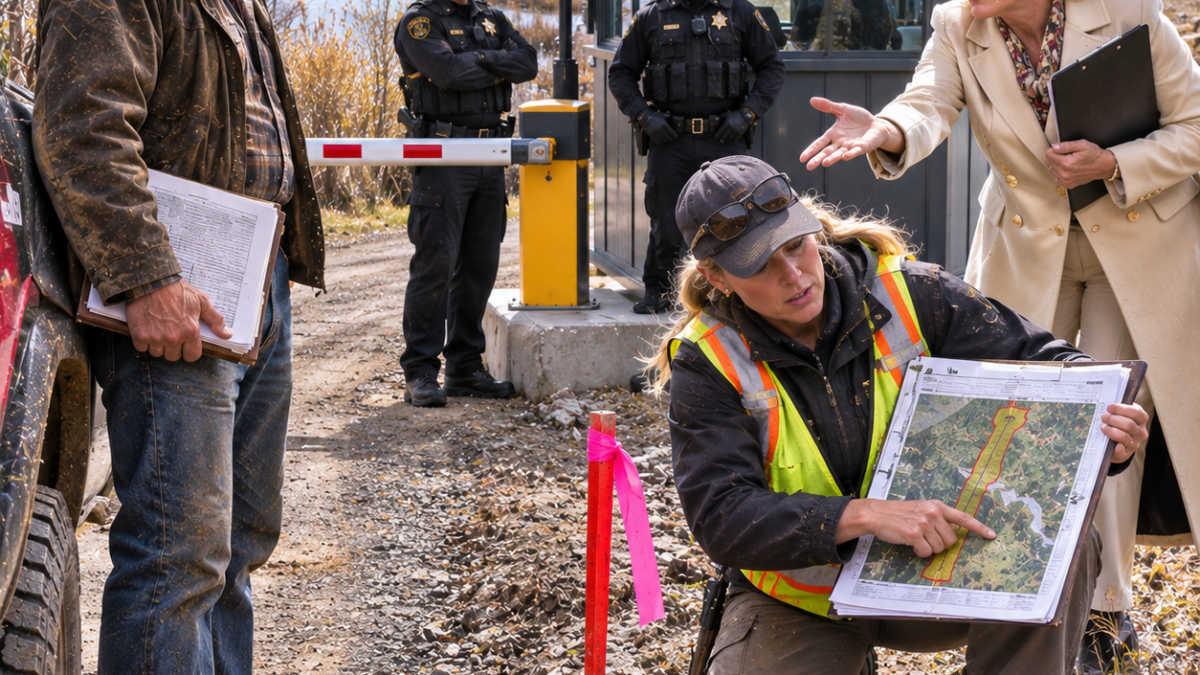
Three days after the booth appeared, Meredith started the survey.
She began nowhere near the dispute.
Verified monuments first.
County-accepted control points.
Then rebuilt the historical lines toward the booth.
Second station was barely set when Karen’s SUV arrived.
She walked straight toward the tripod.
“This survey is unauthorized.”
Meredith never looked away from the instrument.
“I’m working from lawful control points.”
“You’re on HOA property.”
“Then the recorded documents will show that.”
Dee and two guards stood near the booth.
Karen stepped closer.
“I know people on the state licensing board.”
Meredith adjusted a setting.
“I’m sure you do.”
“A surveyor who takes sides in neighborhood disputes may find her professional conduct reviewed.”
That finally made Meredith look up.
“Then you’ll want my notes to be extremely accurate.”
She went back to work.
I brought her old county road-maintenance logs.
Grading records.
Historical culvert locations.
Hauling maps.
The kind of paperwork ranch families keep because throwing anything away feels dangerous.
By late afternoon, Meredith had three concerns.
Silver Crest’s internal map did not match the county plat.
A historical monument appeared to have been covered with fresh fill after booth construction.
And the reconstructed boundary ran directly through both booth footings.
Still, she refused to sign a conclusion.
“If this touches federal ground, I verify federal records first.”
“Why federal?”
She pointed toward Black Alder.
“Because refuge boundaries have changed over time.”
Karen filed an emergency county complaint seeking to stop the survey.
Safety concerns.
Tessa answered within hours.
Meredith’s professional authorization.
Photographs.
Public-right-of-way locations.
No disturbance.
The county refused Karen’s request.
Small victory.
But it mattered.
At dusk, Meredith drove a red-topped pin beside the western footing.
Checked her instrument.
Checked the old plat.
Checked again.
Then said quietly:
“This is not HOA property.”
I stepped closer.
“Then whose road is it?”
She looked at me.
“I think we’ve been asking the wrong question.”
“What question should we ask?”
“Whose land is the booth sitting on?”
That night she ordered a certified 1964 conveyance.
When it arrived, we met at Tessa’s office.
Meredith unfolded the legal description.
There it was.
Federal acquisition.
A strip approximately twenty-eight feet wide.
Today managed by the United States Fish and Wildlife Service as part of the protective corridor surrounding Black Alder National Wildlife Refuge.
I stared.
“The federal government owns under the booth?”
“Yes.”
“What about my road?”
Meredith pointed lower.
The Red Willow Ranch access easement existed before the federal acquisition.
The United States had taken the strip subject to that easement.
My recorded right of passage had never been released.
Never extinguished.
Still valid.
So the picture became clearer.
I did not own that federal strip.
Silver Crest did not own it either.
But I had a recorded right to use the road.
And no county or federal file showed any authorization for Silver Crest to build a guard booth there.
For about five seconds I felt wonderful.
Then Meredith ruined it.
“You still cannot touch it.”
I groaned.
“Why not?”
“It isn’t your land.”
“But it blocks my easement.”
“That’s your civil access issue.”
“What about the booth?”
“Federal land issue.”
“So?”
“So let the federal agency deal with federal land.”
That distinction ended up saving me from making several stupid decisions.
I called Julian Mercer.
Refuge manager.
He was cautious.
Very cautious.
He had probably heard every version of:
My neighbor is violating federal law, please come destroy him.
I did not ask him to take my side.
I sent three things.
Parcel number.
Meredith’s preliminary survey.
Photograph of the brass marker.
Twenty minutes later, Julian called back.
Different voice.
“Mr. Langford.”
“Yes.”
“That marker.”
“What about it?”
“It appears to be one of ours.”
“The refuge?”
“Federal boundary monument.”
He scheduled field verification for the next morning.
Karen responded by holding a clubhouse meeting.
Projected image of my stock trailer.
She told residents I was using federal bureaucracy to attack their neighborhood.
Then she held up a county building permit.
“Fully approved.”
Tessa was sitting in the back.
She raised her hand.
Karen reluctantly acknowledged her.
Tessa asked:
“Does the county building permit grant Silver Crest the right to occupy land owned by the United States?”
Karen looked irritated.
“The permit speaks for itself.”
Tessa nodded.
“Yes.”
Then sat down.
It said nothing about federal land.
Because the county could not give Silver Crest property the county did not own.
Refuge staff inspected.
Initial conclusion:
Likely encroachment.
Karen changed stories immediately.
Now the booth was merely “a few feet off.”
Technical mistake.
Nothing more.
Meredith issued a written memo.
Entire booth.
Both concrete footings.
Part of approach.
Inside the area under federal review.
Not a few feet.
All of it.
Two days later, Julian personally came out.
He inspected the booth.
The fill.
The monument.
Then asked Dee for something none of us expected.
“Excavation records.”
Dee blinked.
“For the booth?”
“For everything dug under this site.”
Karen arrived as Julian was leaving.
He stopped beside her SUV.
“Mrs. Sloan?”
“Yes.”
“Who authorized the excavation beneath this location?”
Karen opened her mouth.
Then stopped.
For the first time, she had no immediate answer.
The federal notice arrived the next week.
Produce construction records.
Produce permits.
No expansion.
Leave the site undisturbed during verification.
I complied.
Karen changed tactics.
Another letter to homeowners.
Everett Langford wants to close community access.
Property values at risk.
Expansion threatened.
Within days, frightened residents gathered at my gate.
One man shouted:
“You’re holding everybody hostage over three hundred dollars.”
I could have shouted back.
Instead I opened the gate.
“Come inside.”
That confused them.
I took anyone who wanted the truth into my equipment barn.
On one wall:
County plat.
My easement.
Meredith’s survey.
Federal conveyance.
I walked through each.
A woman stared at the Silver Crest plat.
Then said:
“Wait.”
“What?”
“Our main entrance is here.”
She pointed to the paved highway north.
“Yes.”
“Red Willow Road isn’t our entrance.”
“No.”
“Most of us never use it.”
“No.”
She looked around.
“Then why are we paying guards to control it?”
Nobody had an answer.
Karen’s story began breaking.
So she tightened the booth.
Dee was ordered to log every vehicle.
Barrier stayed down.
Then a livestock hauler arrived carrying breeding heifers I had purchased months earlier.
Denied.
I rented a smaller trailer.
Used a backup route.
Four trips.
Several thousand dollars.
Entire day lost.
I documented every mile.
Tessa filed for emergency relief to protect my recorded access.
Meanwhile, Dee was starting to question his job.
He later told us Karen ordered him to delete camera footage from the booth’s construction period.
He hesitated.
Then noticed something.
Official paperwork said construction started on one date.
Guard-entry logs showed contractor crews entering days earlier.
Mostly at night.
His company retention policy required logs to be preserved.
So Dee quietly copied them.
He told nobody.
At eleven one night, he saw maintenance vehicles return.
Crew unloaded coils of pipe.
Equipment cases.
Carried them behind the booth toward the footings.
Dee asked the foreman:
“What are you doing?”
The foreman stared at him.
Then said:
“This part was never supposed to be in your security reports.”
Around the same time, another person started asking questions.
Leona Whitam.
Silver Crest treasurer for six years.
Leona knew the budget.
The board approved approximately $84,000 for a guard booth and camera system.
But when she totaled the invoices tied to the site—
more than $416,000.
She checked twice.
A huge portion was coded as drainage work associated with expansion.
No board minutes showed a proper vote.
Leona asked Karen.
Karen called it emergency-budget spending.
Then told her not to discuss it.
Next, Karen asked Leona to sign off on the unaudited expenses before the quarterly meeting.
Leona refused.
Karen also directed Grant Bellamy, the HOA’s contracted developer, to move construction files onto a storage platform controlled by his company.
That alarmed Leona.
Files sitting on someone else’s server could be altered.
She hired her own attorney.
Requested an independent audit.
Next morning, her accounting access was suspended for “routine maintenance.”
Fortunately, she had printed every invoice the night before.
Meanwhile, I noticed something in the ditch beside Red Willow Road.
Water.
Gray silt.
Strange because there had been no serious rain.
I did not step onto federal land to sample it.
Photographs.
Same position every morning.
Date.
Time.
Sent everything to Julian.
Meredith found an older topographic map.
1970s.
At the booth location was a symbol.
Environmental monitoring station.
It appeared nowhere on Silver Crest’s county drawings.
Julian checked refuge archives.
Confirmed.
An old wetland monitoring station had existed almost exactly where the booth now stood.
Now buried beneath construction.
That stopped feeling accidental.
Then Dee came to my ranch after dark.
Still in uniform.
“I need to tell someone something.”
I let him inside.
He admitted Karen had ordered him to erase night-construction logs.
“I kept copies.”
“Give them to me.”
He shook his head immediately.
“No.”
Good answer.
“Why?”
“Confidentiality.”
“And?”
“I don’t want evidence getting mishandled.”
I respected that.
I gave him Tessa’s number.
“Call your own lawyer too.”
He did.
Within days, Dee sat with federal investigators, his attorney beside him.
Then he repeated the foreman’s sentence.
The booth was not the real project.
It was supposed to keep people away from it.
Julian ordered a technical inspection.
Not dramatic.
No midnight raid.
Engineers.
Water-quality specialists.
Photographs.
Authority obtained before disturbing anything.
Then excavation.
The approved county drawings did not match what had been built below grade.
Under the footings:
A buried pipe.
Not on approved plans.
It connected drainage from the Silver Crest expansion toward the federally protected wetland.
Runoff that should have gone through erosion and sediment controls was being routed underground.
Past filters.
Past settling areas.
Directly toward protected habitat.
Initial samples suggested environmental harm.
Full damage assessment would take months.
Standing at that site, the reason for the strange booth location became obvious.
It covered the old monitoring station.
It concealed the outfall.
And its barrier controlled access by the people who regularly drove the road and were most likely to notice changes.
Ranchers.
Truck drivers.
Me.
The booth was camouflage.
When investigators asked about the pipe, Karen blamed Grant Bellamy.
“Developer decision.”
Grant answered through counsel.
Every design change, he said, had written approval from the HOA representative.
Former allies began pointing at each other.
I stopped caring about my $300 fee.
I gave investigators what I had.
Dash footage.
Construction photographs.
Historical ditch-maintenance records.
Those records helped engineers identify when conditions changed.
Dee’s logs showed contractor access during the same nights.
Leona’s invoices showed pipe specifications and lot numbers.
Everything started aligning.
At the next HOA meeting, Karen stood at the podium.
She accused me of manufacturing an environmental crisis to extort Silver Crest.
I waited.
Then brought two enlarged photographs to the front.
Same ditch.
Spring.
Clear water.
Current.
Gray silt.
I placed them side by side.
“I came here asking for my road back.”
The room stayed quiet.
“Now I want to know what you’ve been putting underneath it.”
No applause.
Something better.
Silence.
People thinking.
Afterward, residents gathered in the parking lot instead of around Karen.
Comparing dues.
Asking about $416,000.
A couple approached my truck.
“We believed the newsletter.”
“I know.”
“We’re sorry.”
I nodded.
Leona stood nearby.
Handed me her attorney’s card.
“If investigators need me, they go through counsel.”
Good.
Then Julian expanded the federal investigation.
Karen received formal preservation demands.
And that same evening, Grant Bellamy sent a demolition crew to the booth.
The paperwork called it voluntary corrective action.
Remove mistaken structure.
Problem solved.
Except the most important evidence was under the slab.
At 9:40 p.m., Dee called Tessa.
His guards had been ordered to support demolition.
Entire booth.
Foundation.
Everything.
Before dawn.
Tessa called me.
“Do not go there.”
“I’m already home.”
“Good.”
I had prepared for something like this.
Cameras on my own fence posts lawfully covered parts of the road.
Live footage showed equipment moving toward the booth.
I sent Tessa the video.
Contractor schedule.
Dee’s written information.
Federal attorneys went to a judge for an emergency preservation order.
Julian alerted the field unit.
By eleven, floodlights lit the booth.
Compact excavator.
Dump trucks.
Karen arrived.
She told crews:
“We are correcting our own mistake.”
She sounded confident again.
“No agency can stop us from removing association property.”
I stood well back on my side of the boundary.
Karen saw me.
“You planned this.”
I said:
“You had months to remove a gate.”
She glared.
“You chose tonight to destroy what’s underneath it.”
“Liar.”
She turned to Dee.
“Remove him.”
Dee did not move.
“Mrs. Sloan, he is on his own property.”
“I gave you an order.”
“I won’t carry out an order without legal basis.”
She stared at him as if a machine had malfunctioned.
The excavator bucket touched the edge of the slab.
Then vehicles arrived.
Officers carrying the court’s preservation order.
Work stopped.
Bucket froze inches above the foundation section covering the pipe.
Karen called it routine maintenance.
Special Agent Hollis Ror arrived to coordinate.
Lean.
Careful.
Every sentence sounded like he expected it to appear in an affidavit.
He asked for work orders.
Construction records.
Data.
Then Grant Bellamy made his choice.
Through counsel and in front of investigators, he said Karen had personally told him to complete demolition before the next federal inspection.
Karen announced she was leaving to contact her attorney.
No arrest.
Not yet.
Hollis did not manufacture drama.
He told everyone the preservation order controlled.
Destroying evidence would create its own problems.
By two in the morning, the site was quiet.
Excavator shut down.
Yellow evidence tape.
Federal technicians documented the broken slab edge.
Marked exposed pipe.
Officer remained until daylight.
I stayed at my fence longer than necessary.
Not celebrating.
Thinking about how close everything came to becoming crushed concrete.
Over the next days, the technical examination continued.
Pipe material.
Lot numbers.
Invoices.
Leona’s flagged payments.
Night crew logs.
Photos.
It was not accidental.
Designed.
Purchased.
Installed.
Organized.
Then Tessa called.
“We got interim access relief.”
“What does that mean?”
“The HOA cannot use this booth to charge or block your recorded easement while the dispute and federal investigation continue.”
I drove down later.
Barrier arm raised.
Still.
No one asking for $300.
Across the road, Karen sat in her SUV.
Phone in hand.
Giving orders to nobody.
“I thought getting through the gate would be the hard part.”
Tessa shook her head.
“We haven’t reached the money.”
She was right.
Leona found another file.
SILVER CREST HILLS
PHASE 3 ACCESS CERTIFICATION.
Hidden from most of the board.
The audit revealed a project nearly nobody had been told about in full.
Phase 3.
Approximately $14 million.
Luxury rental villas.
Private service center.
Construction loan.
The lender required several conditions before releasing money.
Two were critical.
Verified controlled road access.
Functional compliant environmental drainage.
Suddenly the booth made sense at another level.
It was not only a tollgate.
Not only camouflage for a drainage pipe.
It was evidence.
Manufactured evidence.
Security contract.
License-plate logs.
Exclusive signage.
Barrier arm.
Photographs of a managed entrance.
All packaged to tell a lender:
Silver Crest controls Red Willow Road.
The certification described HOA authority in language the recorded documents did not support.
That was why Karen wanted my signature on that first form.
By signing:
I acknowledge the HOA’s authority to manage and regulate Red Willow Road.
One rancher’s signature would have helped the fiction.
I had refused.
Every time one of my trucks crossed without paying, it contradicted the image of exclusive control.
I had become inconvenient.
Not because Karen cared about road safety.
Because my existence did not fit the financing package.
Leona found board minutes.
Edit history.
Key project descriptions changed after original budget approval.
She also found Karen’s instruction:
Use the phrase “exclusive controlled access” in lender materials before land rights had been verified.
Grant Bellamy, facing exposure, cooperated.
He turned over lender emails.
One from Karen asked him to ensure ranch traffic did not appear in photographs submitted with the access certification.
That email made me sit back when Tessa showed it to me.
“Why hide my trucks?”
“Because trucks using the road under an independent easement undermine the claim of exclusive control.”
Within two weeks, the lender issued formal notice of default relating to access conditions.
Remaining Phase 3 disbursements stopped.
Then I made my own legal move.
Not against federal land ownership.
I never claimed the federal strip.
That distinction mattered.
My action asked for:
Confirmation and protection of my recorded easement.
End to unlawful obstruction.
Recovery of documented losses.
Redelivery fees.
Trailer rentals.
Extra hauling mileage.
Lost workdays.
Costs caused by the barrier.
Nothing more.
Meredith’s survey and the old easement became key evidence in my case.
The federal investigation remained its own matter.
Over the following months, consequences arrived slowly.
The booth would be removed under a federal-approved plan.
Wetland damage had to be restored.
Drainage rebuilt.
Monitoring imposed.
Silver Crest Phase 3 financing stalled because lawful controlled access had never existed the way the lender had been told.
The HOA began claims against individuals and contractors to recover unauthorized spending.
Karen faced personal civil exposure and investigation into representations made in lender materials.
Residents called a special meeting.
Under the bylaws, they voted to remove Karen as president.
I attended.
She sat behind a folding table.
No booth.
No barrier arm.
No cameras giving her a stage.
A retired teacher stood.
“You charged us to protect our property.”
Karen looked at him.
“Why did you spend our money protecting a lie?”
She did not answer.
One week later, I received formal confirmation that my easement remained valid and the unlawful obstruction could not continue.
I thought the story was finally over.
Then Julian called.
“Can I come by?”
He sat at my kitchen table with a restoration proposal.
“The road can stay.”
I nodded.
“Your easement is valid.”
“I know.”
“No one is asking you to surrender it.”
“Good.”
He unfolded a map.
“But.”
There is always a but when a federal official unfolds a map.
He pointed.
Engineers believed the wetland would recover better if heavy agricultural traffic no longer crossed that corridor every week.
Then he traced another line.
A route across my own pasture.
South.
New gravel road.
New culverts.
Reconnect to the county highway.
“What are you asking?”
“Consider moving your primary heavy traffic.”
I stared.
“I just spent months fighting to keep that road.”
“I know.”
“And now you want me not to use it.”
“I want you to have the choice.”
That was different.
“How much?”
“Significant.”
“I’m not paying to fix someone else’s wetland damage by giving myself a new road.”
“Restoration settlement funds may cover a substantial portion.”
“May?”
“Subject to approval.”
“No.”
Julian nodded.
“Fair.”
“I want funding guaranteed.”
“Yes.”
“My easement remains recorded.”
“Yes.”
“Even if I voluntarily stop heavy use.”
“Yes.”
“Tessa reviews every word.”
“I expected that.”
I did not decide that night.
I walked the proposed route with Meredith.
Spring thaw conditions.
Grades.
Turning radii.
Culverts.
I called freight companies.
Asked experienced cattle-hauler drivers whether they could manage it.
I checked winter access.
Only then did I agree.
Not because someone forced me.
Because my right was secure.
And once I knew nobody could take that choice from me, I could make the choice that was better for the wetland.
That was what Karen never understood.
She thought control meant forcing somebody to comply.
I thought ownership and rights meant having the ability to decide responsibly.
The restoration took months.
Booth dismantled under supervision.
Concrete removed.
Unauthorized drainage corrected.
Wetland outfall eliminated.
Damaged soils treated.
Native sedges and grasses replanted.
Monitoring.
The total restoration program came to roughly $2.6 million.
Phase 3 remained stalled.
No lawful access package.
No clean environmental certification.
No construction loan release.
Inside Silver Crest, Leona and a coalition of residents rebuilt financial controls.
Independent audits.
Outside legal review before construction on disputed land.
Expense approvals requiring documentation.
And instead of simply raising dues to cover every loss, the new board pursued recovery against the individuals and companies responsible.
That mattered to me.
The residents had been lied to too.
They deserved accountability.
Dee left the security company.
I saw him once months later.
He was driving along the public road.
Slowed.
Raised a hand.
Kept going.
No dramatic reunion.
He had done the important thing when it mattered.
Protected records.
Refused an unlawful order.
Reported what he knew through proper channels.
Without him, the booth might have become a pile of rubble before investigators reached the pipe.
On the day the restoration was declared complete, I drove my old pickup down Red Willow Road.
Same curve.
No booth.
No guards.
No polished Silver Crest sign.
Native vegetation already coming back around the former footing locations.
Water beside the alders ran clear again.
Meredith stood along the road checking final monuments.
Julian had a restoration map spread across his hood.
The new ranch hauling route curved across my land in clean gravel.
He folded the map.
“You fought hard to keep this crossing.”
“Yes.”
“Any regret about moving most of your traffic?”
I looked toward my fields.
Then back at the wetland.
“No.”
He smiled.
“That surprises me.”
“It shouldn’t.”
“Why?”
“I wasn’t fighting for the privilege of running eighteen-ton trucks through a refuge forever.”
“What were you fighting for?”
“The right to choose.”
He nodded.
That was the whole thing.
Karen built a gate to decide who could pass.
She wanted me to sign that she controlled the road.
She charged money for access she did not own.
She used the booth to help create a paper trail suggesting the HOA had exclusive control.
And underneath that booth, somebody had hidden drainage infrastructure that bypassed environmental safeguards.
One building.
Three purposes.
Control ranch traffic.
Hide a pipe.
Convince a lender.
All because Karen believed if enough signs, cameras, contracts, and concrete said Silver Crest controlled Red Willow Road, eventually the paper fiction would become reality.
It almost worked.
The county permit looked official.
The security company was real.
The barrier was real.
The cameras worked.
The access forms had legal language.
The guards wore uniforms.
The invoices were paid.
But none of those things answered the simplest question.
What gave the HOA the right to build there?
The answer was:
Nothing.
The federal government owned the strip.
My easement predated federal acquisition.
Silver Crest had no ownership.
The county permit could not create federal property rights.
And the booth itself turned out to be sitting over the evidence of an entirely different violation.
I still have the first registration form.
The one Dee handed me before sunrise.
I keep it in my ranch office.
Sometimes I look at the last paragraph.
Applicant acknowledges the association’s authority to manage and regulate Red Willow Road.
One signature.
That was all Karen wanted from me that morning.
I used to think the $300 fee was the point.
Then I thought controlling ranch traffic was the point.
Then hiding the drainage pipe.
Then Phase 3 financing.
Eventually I understood the signature tied all of it together.
She needed reality to match the paperwork.
And I refused to help.
Years later, the new route across my pasture became normal.
Feed trucks prefer it.
Wider turns.
Better base.
No wetland curve.
Livestock haulers like the grades.
The old easement remains recorded.
I still use Red Willow Road occasionally with my pickup.
No one stops me.
No one charges me.
No one asks for an HOA permit.
At the former booth location, most people would never know anything happened.
Grasses.
Sedges.
A few boundary markers.
Cattails beyond.
That old federal brass monument was cleaned and reset where it could be seen.
I stop beside it sometimes.
The first morning, it was nearly buried.
Just a corroded piece of metal in dust.
I photographed it because it looked wrong.
That photograph changed more than I knew.
Not because the marker was magical.
Because it created a question.
Federal seal.
Why?
Then records.
1964 acquisition.
Then easement.
Then construction records.
Then excavation.
Then pipe.
Then invoices.
Then Phase 3.
Evidence rarely arrives as one giant revelation.
Usually it is a small thing that refuses to fit the story.
My small thing was a brass disk half buried beside a guard booth.
Leona’s was $416,000 spent on an $84,000 project.
Dee’s was night crews arriving before the official construction date.
Meredith’s was a booth built on the worst possible curve.
Julian’s was an excavation where an old monitoring station used to be.
Every person saw a different inconsistency.
Together, they became the truth.
Karen had one advantage for months.
Confidence.
She always had an answer.
Why the booth?
Safety.
Why the fee?
Maintenance.
Why the survey problem?
Technical mistake.
Why federal involvement?
Harassment.
Why $416,000?
Emergency drainage.
Why the pipe?
Developer decision.
Why the demolition?
Voluntary correction.
Why Phase 3?
Board-approved growth.
Every answer lasted until the next document arrived.
That is what I learned.
Confidence is fast.
Records are slow.
But records do not get tired.
The people of Silver Crest eventually learned the same lesson.
I was invited to one HOA meeting a year after Karen was removed.
I almost did not go.
Leona had become board president temporarily.
She stood at the front.
No flashy presentation.
Budget sheets.
Actual line items.
She said:
“Before we approve the new maintenance contract, outside counsel has verified ownership of every parcel where work will occur.”
People laughed.
Dark humor.
Then she looked toward me.
“Everett, anything?”
“I’m not a member.”
“Thank God.”
More laughter.
I stood anyway.
“I have one suggestion.”
“What?”
“If somebody ever proposes another overnight guard booth—”
The room laughed before I finished.
“Ask what’s underneath it.”
That line followed me around town for months.
I never wanted to become the rancher who “beat the HOA.”
That makes the story sound too simple.
The Silver Crest residents were not my enemy.
Most had no idea what Karen and Grant were doing.
Many believed they were paying for safer roads and responsible expansion.
When the financial records came out, they were furious because their own trust had been used against them.
The federal government was not my personal army either.
Julian reminded me of that repeatedly.
He did not protect my access because he liked me.
The court handled my access.
The refuge protected federal land because that was its job.
Meredith did not survey in my favor.
She surveyed where the lines actually were.
That distinction is why the result held.
The strongest people in the story were the ones willing to say:
I’m not on your side.
I’m on the evidence.
Meredith.
Julian.
Tessa.
Even Leona, once she stopped protecting the board and started protecting the books.
The largest consequence was never my road fee.
It was what nearly happened to Black Alder.
Runoff being routed past controls into protected wetland.
Gray silt where clear water had been.
A buried monitoring location.
A pipe nobody approved.
The site had been chosen because it was inconvenient and hidden.
Exactly where heavy equipment was least natural.
That should have been the first clue.
Nobody spends extra money building in a worse location without a reason.
The $416,000 total made sense only after we understood what was beneath the concrete.
Years later, engineers gave presentations about the restoration.
Sediment reduction.
Vegetation recovery.
Water quality.
Monitoring results.
I attended exactly one.
Half the graphs went over my head.
At the end, Julian asked:
“You understand any of that?”
“Water looks cleaner.”
“That was the simplified version.”
“Should’ve led with that.”
He laughed.
Then we walked outside.
Black Alder was loud with birds.
No barrier arm.
No floodlights.
No excavation.
Just habitat.
That was a better use of the ground.
Karen’s case and the related financial disputes moved more slowly.
There were civil claims.
Federal inquiries.
Lender disputes.
Recovery actions.
The people responsible had different levels of involvement.
That mattered.
I never wanted every contractor or board member treated as if they had designed the entire scheme.
Grant eventually cooperated.
Dee cooperated.
Leona cooperated from a different position.
Investigators followed evidence instead of neighborhood gossip.
Karen faced claims and investigative scrutiny tied to what she personally approved, represented, or directed.
The Phase 3 lender protected itself through its own remedies.
The HOA pursued money from parties responsible for unauthorized expenses rather than pretending every homeowner should simply absorb them.
That was how it should work.
No giant movie ending.
No single gavel solving everything in thirty seconds.
Documents.
Orders.
Reviews.
Settlements.
Restoration.
Time.
The one thing that ended quickly was Karen’s control over the HOA.
Residents removed her.
That was theirs to decide.
I remember the retired teacher’s question.
Why did you spend our money protecting a lie?
Karen never answered.
Maybe there was no answer that helped.
Phase 3 never got its promised road.
The project stalled indefinitely.
Silver Crest survived.
Property values did not collapse because one expansion stopped.
The neighborhood did not disappear.
Families continued living there.
The paved north entrance worked exactly like it always had.
That was another part of Karen’s fear campaign that aged badly.
She had convinced people my road was essential to their future.
Most residents barely used it.
It was essential to her financing package.
Not their daily lives.
That difference cost everyone months to understand.
I still run cattle.
Still complain about feed prices.
Still keep too many old files.
Tessa tells me I am now worse than my grandfather.
I consider that a compliment.
On my office wall, I have four things.
A photograph of the original booth.
Meredith’s red survey pin.
A copy of the 1964 federal conveyance.
And the first $300 access notice.
Visitors ask why I keep the notice.
I tell them:
“Because that was the cheapest part of the whole mistake.”
They usually laugh.
Then I explain.
Three hundred dollars was what Karen wanted me focused on.
If I had paid it and signed, maybe I would have grumbled and gone home.
Maybe the booth would have looked legitimate.
Maybe nobody would have surveyed.
Maybe nobody would have found the federal strip.
Maybe the pipe would have stayed buried.
Maybe Phase 3 would have received another round of financing.
Maybe gray silt would have kept moving into Black Alder.
I cannot know.
What I do know is that refusing to sign gave us time to ask questions.
The most important one was never:
Who owns the road?
It became:
Why is the booth here?
Then:
What is under it?
Then:
Who paid for it?
Then:
What were they trying to prove with it?
That is how the whole thing came apart.
One question at a time.
The last time I drove the old route with a cattle trailer, it was by choice.
Just one empty trailer.
No heavy load.
I wanted to see whether I could still make the curve.
I could.
Barely.
At the former booth site, I stopped.
Got out.
The brass marker stood clean now.
U.S. Fish and Wildlife Service boundary designation visible.
I rested one hand on the trailer fender.
Looked across the wetland.
Years earlier, Karen had stood in nearly the same place and told me:
You don’t own the road anymore.
Funny thing was, technically, she had accidentally touched part of the truth.
I did not own the federal strip.
Never claimed I did.
But neither did she.
And ownership had never been the only thing that mattered.
I had a right.
Recorded before the federal government acquired the land.
Protected afterward.
That right gave me access.
It did not give me the right to damage the refuge.
Once I understood that, choosing the alternate heavy-haul route stopped feeling like surrender.
It felt like exactly what rights are supposed to provide.
Choice.
Karen thought power meant making someone pass through your booth.
I learned something different.
Power is knowing the line.
Knowing what belongs to you.
Knowing what does not.
Protecting both.
And refusing to let someone use a uniform, a barrier arm, or a polished sign to convince you otherwise.
Julian once asked me whether I regretted fighting so hard for an easement I eventually chose to use less.
I gave him the same answer I would give now.
I never fought for a road.
I fought for the right to choose what happened on it.
Karen tried to take that choice before sunrise with a booth, two guards, and a $300 fee.
The survey gave it back with one red pin.
The federal map exposed the rest.
And once the concrete came up, so did everything she had tried to bury underneath it.








