HOA Karen Built a Bridge Over My Creek Using a Fake Easement—So I Sold the Creek Rights to the HOA She Hated Most
PART2:
Half a gardening book still tucked beneath the coffee table because I had never found the strength to move it.
Nora struggled too.
Quietly.
That was almost worse.
She never made scenes.
Never screamed.
Never blamed anyone.
She simply stopped drawing for a while.
Stopped asking friends over.
Started spending more time in her room.
One night, about a year after Elena died, I found Nora sitting on the floor beside a cardboard box of her mother’s gardening tools.
She held a little hand trowel.
Green handle.
Rust near the edge.
“Dad?”
“Yeah?”
“Do we have to stay here?”
I knew exactly what she meant.
Not the house.
The life.
I sat beside her.
“No.”
Six months later, I sold the Denver house.
There was one place Elena had always loved.
PART3:
Fourteen acres outside Castle Rock in Douglas County.
Linden Creek crossed the middle of it.
Rolling meadow.
Cottonwoods.
Red-tailed hawks.
Ridge views.
Small ranch house.
Detached workshop.
We used to drive there in summer when the previous owner allowed limited day access.
Elena called it our secret place.
We would sit by the creek with sandwiches while Nora threw pebbles into the water.
When that property came on the market, I bought it.
No negotiation.
No second showing.
I knew the watershed better than the real estate agent did.
I knew exactly what I was buying.
The deed included senior beneficial-use water rights dating to 1974.
Recorded.
Clean chain of title.
And the land included the creek corridor itself.
Not merely frontage.
The actual parcel through which Linden Creek flowed.
The original subdivision plats on both sides were even clearer.
Ridgecrest Meadows sat east of us.
Sagebrush Crossing sat west.
Both subdivisions had been deliberately platted around the creek corridor.
The waterway and a fifty-foot buffer on each side were excluded.
No shared recreation easement.
No pedestrian corridor.
No HOA governance.
Private.
That fact would eventually destroy Cheryl’s entire argument.
But when Nora and I moved in, I wasn’t thinking about deeds.
I was thinking about survival.
September.
Cottonwoods turning gold.
Nora chose the bedroom facing the creek.
By Sunday afternoon, she was kneeling at the bank planting marigolds and lavender with Elena’s old trowel.
“For Mom,” she said.
I watched from the kitchen.
For the first time in three years, our house felt like somewhere life could continue.
Then, on day three, Cheryl Branford arrived.
White Escalade.
Yoga pants.
Linen blazer with gold buttons.
Platinum-blond hair pulled into a bun so tight it looked painful.
She stepped from the vehicle carrying a wicker welcome basket.
Candle.
Crackers.
Bottle of local wine.
And a glossy Ridgecrest Meadows brochure.
“Garrett Holloway?”
“Yes.”
“Cheryl Branford.”
She extended her hand.
“President of Ridgecrest Meadows HOA.”
“Nice to meet you.”
She smiled.
“I wanted to personally welcome you.”
Ridgecrest Meadows was east of me.
About 140 homes.
Built in late eighties.
Middle-income families.
Mature trees.
Older houses.
Nothing wrong with it.
Sagebrush Crossing, on the western ridge, was newer.
Roughly two hundred homes.
Built around 2005.
Larger houses.
Newer clubhouse.
Walking trails.
The two HOAs hated each other.
Not normal sports-team rivalry.
Real institutional bitterness.
Drainage disagreements.
Shared green-space fights.
Fence placements.
Emergency-access disputes.
One lawsuit over a retaining wall.
Cheryl had been president at Ridgecrest for eight years.
Cal Whitfield had been president at Sagebrush for six.
They could disagree about sunrise.
I knew none of that yet.
Cheryl made small talk for four minutes.
Then she looked toward the creek.
“We’ve always considered Linden Creek part of Ridgecrest’s natural amenity system.”
I smiled politely.
“Have you?”
“Families have used it for decades.”
“Previous owner?”
“Very cooperative.”
“That’s good.”
“People walk dogs.”
She gestured.
“Children play in the shallows.”
“I see.”
“We’d like to maintain that tradition.”
There it was.
“I’m not comfortable with open access.”
Her smile changed.
Barely.
“Open?”
“Unrestricted.”
“Mr. Holloway, there’s actually an easement.”
I looked at her.
“Recorded?”
“Of course.”
“Send it.”
She seemed surprised by how quickly I asked.
“I’d be happy to.”
“Great.”
She lowered her sunglasses.
“Ridgecrest has had creek access since the subdivision was created.”
“Then the record should be easy to verify.”
That was the first moment she disliked me.
I saw it.
Three days later, an envelope arrived.
Ridgecrest letterhead.
Inside:
COMMUNITY ACCESS EASEMENT — LINDEN CREEK CORRIDOR.
Single page.
Reference number.
Legal description.
Perpetual pedestrian access.
Recreational and wellness purposes.
Notary stamp.
Cheryl’s cover note:
As discussed.
It looked official.
That is often enough for people.
But I work with recorded water and property rights.
Something was wrong.
The reference number format did not match Douglas County filings.
The legal description said things like:
“approximately fifty feet west of subdivision boundary.”
Real easements do not love the word approximately when survey coordinates are available.
The notary stamp lacked required commission information.
I went to county recorder Monday.
Clerk typed reference number.
Nothing.
Again.
Nothing.
She searched parcel.
Pulled deed.
Original plats.
Recorded instruments.
Nothing.
“No easement?”
I asked.
She shook her head.
“None.”
I had her search both subdivisions.
Still nothing.
Then she showed me the plat note.
The creek corridor had been expressly excluded.
No access rights.
No HOA claim.
No governance.
I sat in my truck afterward with the fake document on the passenger seat.
Diesel exhaust from a county maintenance truck drifted through my open window.
Magpie landed on hood.
Pecked at a bug.
I watched that bird for five minutes.
Methodical.
Patient.
Then I drove home.
Did not call Cheryl.
I scanned every county document.
Created folder.
Wrote certified letter.
No easement exists.
My property is private.
Ridgecrest residents do not have permission for recreational access.
Please keep residents off the creek corridor.
Four days later, Cheryl responded.
Not with evidence.
With an HOA violation notice.
OBSTRUCTION OF COMMUNITY ACCESS CREEK CORRIDOR.
$500 daily fine beginning in fifteen days.
I wasn’t in her HOA.
I called Nora into kitchen.
“Read this.”
She did.
Looked up.
“Can she fine us?”
“No.”
“Then why is she trying?”
Good question.
Same week, Ridgecrest newsletter appeared.
A neighbor slipped copy under my gate.
Sticky note:
Sorry. Thought you should see this.
Inside:
A new property owner is attempting to privatize a long-standing community natural resource.
No name.
Everyone knew.
Friday, Nora came home from school.
Quiet.
“What happened?”
“Nothing.”
“Nora.”
She dropped backpack.
“A kid on bus said you stole the creek.”
That landed harder than Cheryl’s fine.
“You know that isn’t true.”
“I know.”
“Then—”
“I know, Dad.”
She walked upstairs.
I stood there looking toward Elena’s lavender on bank.
That night I called Wallace Kemp.
Property attorney.
Castle Rock.
Late sixties.
Semi-retired.
Knew Douglas County land law like people know their own kitchen.
He read everything.
Fake easement.
County records.
Violation notice.
Then leaned back.
“She’s got nothing.”
“Good.”
“No easement.”
“I know.”
“No jurisdiction.”
“I know.”
“No standing.”
“I know.”
He held up violation.
“This is toilet paper with toner.”
I laughed.
Then he became serious.
“But people like this don’t stop because they’re wrong.”
“What stops them?”
“When continuing gets more expensive than stopping.”
I waited.
He slid folder back.
“Document everything.”
So I did.
Every letter.
Every footprint.
Every tire track.
Every email.
Every photograph.
Two quiet weeks passed.
I thought maybe Cheryl understood.
Then I came home from three days mapping stream flow near Pueblo.
Turned into drive.
Saw lumber.
Fresh cut.
Steel pylons.
Contractor truck.
Three workers.
One pylon already driven directly into creek bed.
Another going in.
And standing on east bank with clipboard:
Cheryl.
I got out.
Slowly.
One contractor looked at me.
Stopped measuring.
Cheryl didn’t.
“Morning.”
“What are you doing?”
“Pedestrian crossing.”
I stared at first pylon.
It had cracked the limestone shelf where Nora sat and sketched birds.
Water clouded around base.
“On my creek?”
“The board approved it.”
I looked toward contractor.
Then Cheryl.
“Your board approved construction on my property?”
“Unanimously.”
She said that like unanimous vote created jurisdiction.
“Cheryl, there is no easement.”
“I sent you the document.”
“You sent me a forgery.”
One worker lowered drill.
Cheryl finally looked directly at me.
“It is valid.”
“No filing.”
“Our attorney disagrees.”
“Give me recording number.”
She did not.
“County says nothing exists.”
Her jaw tightened.
“You’re obstructing established access.”
“No.”
“I own creek.”
She pushed sunglasses down.
“You bought property recently.”
“Yes.”
“Ridgecrest has been here decades.”
“Yes.”
“Communities develop rights through historic use.”
“Not this one.”
She stepped toward me.
“Touch one board on this bridge and I will fine you until you can’t afford to breathe in this neighborhood.”
I almost laughed.
“You cannot fine me.”
“We’ll see.”
I pulled out phone.
Photographed everything.
Pylons.
Truck plate.
Workers.
Lumber.
Cheryl.
Then called Wallace.
“They’re building.”
“Right now?”
“Yes.”
“Don’t touch them.”
“I’d like to.”
“I know.”
“Don’t threaten anyone.”
“Less satisfying.”
“Document.”
Cease-and-desist went out next morning.
Cheryl accelerated.
Within a week, my workshop-renovation permit—submitted before dispute—was suddenly flagged.
Additional site assessment.
Riparian review.
Residential compliance concerns.
I knew county processes.
This felt wrong.
Then I noticed name.
Planning commission.
Vance Branford.
Cheryl’s husband.
Interesting.
A week later, heavy rain hit.
Three inches in two days.
Water normally drained east from Ridgecrest through designed culverts.
Except somebody had constructed a temporary earthen berm near discharge.
Flow redirected south.
Toward me.
Lower meadow flooded.
Six inches.
Silt covered Nora’s memorial garden.
Marigolds gone.
Lavender flattened.
Nora stood at window.
Said nothing for an hour.
I walked berm next morning.
Fresh soil.
Machine cuts.
Not erosion.
Not accident.
I photographed.
Collected samples.
Pulled original drainage plans.
Unauthorized diversion.
Added it to file.
Bridge construction continued.
Ten days.
Cedar rails.
Pressure-treated deck.
Gravel trail from Ridgecrest cul-de-sac.
Then plaque.
Bronze.
BRANFORD COMMUNITY BRIDGE
CONNECTING NEIGHBORS SINCE 2024.
She named bridge after herself.
I stood on porch with coffee staring.
If it had been legal, it would have been beautiful.
Nice work.
Good proportions.
Clean railings.
Unfortunately, it sat on my land.
Residents began using it.
Joggers.
Dog walkers.
Children.
Cheryl posted photographs.
YOUR HOA DUES AT WORK — CREEK ACCESS RESTORED.
Restored.
Interesting word for something that never legally existed.
I installed trail camera in cottonwood.
Every crossing.
Timestamp.
Then noticed Sagebrush residents watching from opposite bank.
None crossed.
They knew better.
One evening, Cal Whitfield stood there.
President of Sagebrush.
Hands in jacket pockets.
Watching Ridgecrest families walk across my creek.
He looked toward bridge.
Then me.
Did not wave.
But I remembered him.
Next escalation hit Nora.
Thursday evening.
She came home from art program.
Hands shaking.
“What happened?”
She hesitated.
Then:
“Tiffany Branford.”
Cheryl’s daughter.
Junior.
“What did she do?”
“Said her mom says we’re going to lose property.”
My chest tightened.
“What exactly?”
“Maybe you should start packing.”
I went very still.
Nora stared at floor.
“She said county’s already involved.”
That night, I sat by creek.
For first time, I considered selling.
Seriously.
Nora deserved peace.
We had moved to heal.
Now she was being dragged into adult property war.
Then I remembered Elena.
Near end, after one especially awful oncology appointment, I had broken down in parking garage.
“I can’t do this.”
She leaned against car.
Weak.
Barely standing.
And said:
“Don’t fold. Don’t hide. Think clearly and do next right thing.”
I heard her voice that night.
So I stopped playing defense.
The bridge had been paid for somehow.
I wanted to know how.
A former Ridgecrest board member named Dale Percival agreed to request financial records.
He was still member.
Cheryl had forced him off board two years earlier.
“Why?”
I asked.
“I asked questions.”
Of course.
HOA treasurer Brenda Tate eventually produced spreadsheet.
Bridge cost:
$41,000.
Vendor:
G&V Custom Builds.
I searched Colorado Secretary of State.
G&V Custom Builds.
Registered owner:
Vance Branford.
Cheryl’s husband.
I stared at screen.
Then printed.
Ridgecrest residents had paid $41,000 for bridge built on my private land using fake easement by company owned by president’s husband.
No competitive bid.
No disclosed conflict I could find.
Wallace read paperwork.
“This is getting ugly.”
“How ugly?”
“Fiduciary duty ugly.”
“Criminal?”
“Potentially, depending on facts.”
I nodded.
“Keep digging?”
He sighed.
“You’re a hydrologist.”
“Occupational hazard.”
County recorder became second office.
I spent three hours going through original plats.
1987 Ridgecrest Meadows.
2005 Sagebrush Crossing.
Every easement.
Drainage.
Utilities.
Access.
The foundational documents were devastating.
Ridgecrest plat specifically said:
Parcels adjacent to creek corridor shall have no access rights, easement claims, or governance authority over excluded riparian zone.
Sagebrush had same exclusion.
Not vague.
Not implied.
Explicit.
Then I found something bigger.
Foothills Trail Development LLC.
Formed fourteen months earlier.
Registered member:
Vance Branford.
Other member:
Grayson Cole.
Commercial real estate investor owning land west of Sagebrush.
Business purpose:
Development and maintenance of recreational trail systems.
Then county long-range trails master plan.
Proposed multi-use trail from Castle Rock toward Sedalia.
Preferred route crossed Linden Creek.
Exactly where bridge stood.
Everything clicked.
The bridge was not only neighborhood amenity.
It was first physical segment of future trail corridor.
Vance’s company positioned to profit.
HOA money subsidizing infrastructure.
My land needed to complete route.
If I refused?
Pressure.
Fake easement.
Permit trouble.
Drainage trouble.
School harassment.
Exhaust me.
Make me sell or surrender.
I called Wallace.
“I found motive.”
“Tell me.”
I did.
Long silence.
Then:
“You don’t just have defense anymore.”
“What do I have?”
“A weapon.”
I did not like word.
But I understood.
Next call:
Cal Whitfield.
Sagebrush Crossing president.
He answered second ring.
“Cal?”
“Yes.”
“Garrett Holloway.”
“I know.”
“How?”
“I’ve been watching Cheryl build a bridge across your property.”
Fair.
We met at diner next morning.
Cal was mid-fifties.
Retired military logistics.
Quiet.
Solid.
Black coffee.
No menu.
I laid out everything.
Fake easement.
G&V contract.
Trail company.
Drainage diversion.
County pressure.
Cal listened.
When I finished:
“What do you want from me?”
“I want to sell Sagebrush creek rights.”
Coffee cup stopped halfway to mouth.
“What?”
Now, legal reality was specific.
I held senior beneficial-use water rights dating to 1974.
I controlled my parcel.
I could grant lawful riparian access by recorded easement.
That did not mean I could magically transfer “ownership of flowing water” in every broad sense people imagine.
Water law is more complicated than that.
But I could convey defined beneficial-use rights and a recorded access easement subject to legal review.
That was enough.
I proposed:
Exclusive riparian-access easement from Sagebrush western boundary.
Defined beneficial-use rights associated with my recorded water interest.
$35,000.
Money to conservation trust.
Permanent conservation restrictions attached to creek corridor.
No commercial development.
No uncontrolled access.
No Vance trail project.
Cal stared.
“Exclusive?”
“Yes.”
“Meaning Ridgecrest can’t use it?”
“Not without rights holder consent.”
He smiled slowly.
“She’s blocked us for six years.”
“I heard.”
“Called Sagebrush a budget subdivision at county meeting.”
“I heard that too.”
“And now you want us to control access?”
“Legally.”
“Why?”
“Because you didn’t build on my land.”
Fair distinction.
“And because I want conservation protection.”
Cal extended hand.
“Done.”
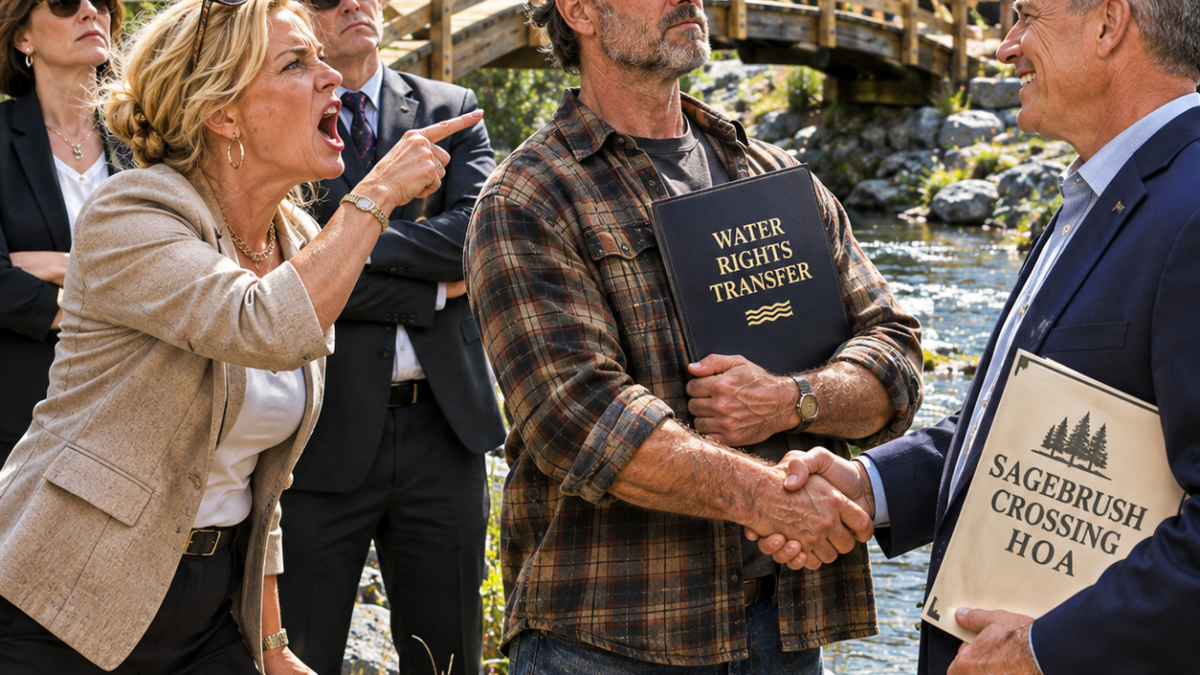
We shook.
Not final legal transfer.
Handshake starts discussion.
Lawyers finish it.
Next two weeks:
Wallace.
Water-right specialist Elaine Greer.
Title examination.
Survey.
Drafting.
Conservation trust provisions.
Recorded access.
Defined use.
Restrictions.
Every word reviewed.
No revenge document.
No sloppy loopholes.
I wanted something that would survive me.
Eventually signed.
Notarized.
Recorded.
Sagebrush Crossing now held exclusive access rights described in agreement.
Conservation restrictions blocked commercial trail development through creek corridor.
That morning I drove home with certified copy.
Saw Cheryl on bridge.
She had apparently learned something.
She marched toward me.
“Get off my bridge.”
I stopped.
Looked down.
Cedar boards.
My creek beneath.
“Your bridge?”
“Ridgecrest built this.”
“On my property.”
“The easement gives us rights.”
“There is no easement.”
“Oh, sweetie.”
She smiled.
“You Googled it?”
“No.”
“County recorder.”
That took smile down one degree.
She stepped closer.
“Touch one board and I’ll fine you until you can’t afford to breathe in this neighborhood.”
“I understand.”
“Good.”
“Then you should understand something too.”
She waited.
“I transferred creek-access rights this morning.”
Her expression froze.
“To who?”
“Sagebrush Crossing.”
Nothing.
No blink.
No movement.
I continued:
“Recorded.”
She opened mouth.
No sound.
“Exclusive access easement.”
Still nothing.
“The HOA you’ve been fighting for six years.”
That was the moment.
Not victory.
Just silence.
Cheryl Branford finally had nothing to say.
Then she recovered.
“You can’t do that.”
“Already did.”
“You can’t sell community rights.”
“They weren’t community rights.”
“This bridge establishes our use.”
“No.”
“We invested forty-one thousand dollars.”
“I know.”
“How do you know that?”
That was a beautiful question.
“I read your financial records.”
Her face changed.
“Who gave you—”
“Public and member-accessible documents.”
“You have no right—”
“G&V Custom Builds.”
Now she went pale.
I said:
“Vance owns it.”
She stared.
“Foothills Trail Development.”
Paler.
“Proposed county route.”
“Stop.”
“Drainage diversion.”
“Stop.”
I stepped closer.
“Now you know what file looks like.”
She turned.
Walked toward Ridgecrest.
Fast.
Not running.
Almost.
I expected attorneys next.
Instead, contractors.
Within a week, a second crew appeared.
Widened trail.
Added footings.
Solar lights.
Trying to make bridge look established.
Permanent.
Then Ridgecrest newsletter.
OUTSIDE PARTIES ATTEMPTING TO PRIVATIZE LONG-STANDING COMMUNITY ACCESS.
Emergency meeting.
Special assessment.
$800 per household.
Legal-defense fund.
Vote:
62 yes.
19 no.
Another $49,000 collected.
Total around $90,000 poured into bridge/access fight built on fake document.
Dale called afterward.
“Some retirees wrote checks tonight.”
His voice sounded exhausted.
“They trust her.”
That bothered me.
Whatever satisfaction I felt vanished.
Those people were being used.
Cheryl then filed agency complaints.
Health department.
Fire marshal.
EPA.
Runoff.
Hazardous materials.
Wetland destruction.
All false.
But inspections happened.
I cooperated.
Every one.
Property clean.
Workshop compliant.
Water-quality records strong.
One field officer pulled me aside.
“This looks retaliatory.”
“I know.”
“If you submit pattern complaint, we’ll document it.”
Card went into file.
Then camera theft.
2:14 a.m.
Visible creek camera removed.
Dark hoodie.
White sneakers.
Figure crossed bridge.
Unplugged housing.
Took unit.
Hidden camera captured it.
I could not conclusively identify person solely from gait and shoes.
So I did not claim I could.
I filed report.
Documented facts.
Deputy said:
“This isn’t first Branford-related complaint.”
Again:
Pattern.
Then Cheryl made biggest mistake.
Eminent-domain petition.
Seventy-three signatures.
Request county seize creek corridor for public recreational access.
Vance co-signed in capacity as planning commission member.
While his private trail-development company had financial interest in exact corridor.
Conflict.
Direct.
Documented.
Hearing set:
December 12.
Cheryl newsletter:
THIS IS OUR CREEK.
THIS IS OUR COMMUNITY.
ON DECEMBER 12, WE TAKE IT BACK.
I printed that too.
Ten days before hearing, Wallace and I assembled everything.
Original plat.
Fake easement.
County search.
Bridge contract.
G&V ownership.
Foothills Trail Development.
Master trail plan.
Drainage diversion.
Permit interference.
Agency complaints.
Camera theft.
Special assessments.
Recorded Sagebrush transfer.
Cal prepared his side.
Sagebrush acceptance.
Conservation trust.
114 homeowner support signatures.
Reporter notified.
Sharon Kessler.
Douglas County Herald.
The night before hearing, Nora sat beside me on porch.
Hot chocolate.
Bridge lights glowed over creek.
She pointed.
“Are they going to take it down?”
“Yes.”
“You sure?”
“No.”
She looked at me.
I smiled.
“But evidence is good.”
She sipped.
“Mom would hate that bridge.”
“Why?”
“She hated fake rustic stuff.”
I laughed.
That was true.
December 12.
Standing room only.
Ridgecrest arrived in force.
More than sixty residents.
Signs:
SAVE OUR CREEK.
COMMUNITY OVER GREED.
Many genuinely believed Cheryl.
That mattered.
Sagebrush brought around forty.
Quiet.
Cal front row.
Flannel.
Manila folder.
Reporter second row.
Deputy against wall.
Cheryl at petitioner table.
Charcoal blazer.
Hair perfect.
Leather binder with tabs.
Vance behind her.
Arms crossed.
She looked ready.
Commission chair Ron Dietrick called item.
Petition for eminent-domain consideration.
Linden Creek corridor.
Cheryl spoke first.
Smooth.
Five minutes.
Community wellness.
Historic use.
Property values.
Recorded easement.
Seventy-three signatures.
Public purpose.
She finished.
Applause from Ridgecrest side.
Commissioner Dietrick looked at me.
“Mr. Holloway?”
I walked to podium.
Accordion file.
No speech notes.
I put original 1987 Ridgecrest plat on projector.
Pointed to exclusion.
Read clause.
No access rights.
No easement claims.
No governance authority.
Room quiet.
Then fake easement beside official records.
Reference number.
No matching filing.
Approximate description.
Defective notary information.
“This document was never recorded with Douglas County.”
Murmurs.
“It does not appear anywhere in chain of title.”
More.
“It conflicts directly with Ridgecrest’s own founding plat.”
Cheryl shifted.
Next:
G&V Custom Builds.
$41,000.
Secretary of State registration.
Vance Branford.
Room got louder.
“No competitive-bid documentation has been produced to me.”
“No conflict disclosure appears in records we reviewed.”
“Ridgecrest residents paid for bridge built by company owned by HOA president’s husband.”
Someone behind Cheryl said:
“What?”
Next:
Foothills Trail Development LLC.
Vance again.
Grayson Cole.
County master trail plan.
Route.
Bridge location.
“The bridge is positioned exactly where Mr. Branford’s private trail-development company would need a creek crossing.”
Cheryl stood.
“That is completely—”
Dietrick interrupted:
“Mrs. Branford, sit down.”
She did.
Red face.
Then I showed drainage photographs.
Nora’s flooded garden.
Agency complaints.
Camera theft report.
Special-assessment records.
$49,000 additional.
Now some Ridgecrest residents stopped looking at me.
They looked at Cheryl.
Then final document.
Recorded transfer.
November 19.
I placed it under projector.
“On November nineteenth, I executed a recorded agreement granting Sagebrush Crossing exclusive riparian access rights to Linden Creek across the defined corridor, together with specified beneficial-use rights associated with my senior water interest.”
Silence.
Then eruption.
People talking.
Ridgecrest residents twisting toward Sagebrush.
Cal remained still.
I continued:
“The conveyance is subject to permanent conservation restrictions.”
“No commercial development.”
“No private trail scheme through the corridor.”
“And no Ridgecrest access unless granted by lawful rights holder.”
I looked at Cheryl.
“There was never a Ridgecrest easement to defend.”
“Your bridge now connects Ridgecrest to a creek corridor your HOA has no legal right to enter.”
That was the line.
Sharon Kessler wrote fast.
Commission chair removed glasses.
Ridgecrest homeowner stood.
“Cheryl, you said it was recorded!”
Another:
“You charged us eight hundred dollars!”
Another:
“My husband is retired!”
Cheryl looked around.
People she had mobilized now staring at her.
I requested:
Denial of eminent-domain petition.
Referral of questionable documents and financial matters.
Removal of bridge.
Restoration of creek bank.
Costs to responsible parties rather than innocent landowner.
Dietrick called recess.
Forty minutes.
Longest forty minutes of Cheryl’s life, I imagine.
I sat with Nora.
She had come after school with Dale.
“You okay?”
I asked.
“Yeah.”
She looked at Ridgecrest crowd.
“They’re mad.”
“At us?”
“No.”
Good.
Commission reconvened.
Dietrick read findings.
Eminent-domain petition denied unanimously.
No valid Ridgecrest easement established.
Petition compromised by undisclosed conflict concerns.
County referred forged-document allegations and HOA financial issues for investigation.
Vance asked to resign planning commission immediately.
He did.
Written note.
Right there.
Bridge ordered removed within thirty days subject to proper creek-restoration procedures.
Not because I won a shouting match.
Because documents failed.
Cheryl said nothing.
She closed binder.
Walked side exit.
Vance three steps behind.
Escalade gone before half room found coats.
Ridgecrest residents stayed.
That part mattered more.
They were angry.
Confused.
Some embarrassed.
An older couple stood near water fountain.
Harlan and Bonnie Westfield.
Fixed income.
Paid $800 assessment.
Bonnie was crying quietly.
I walked over.
“I’m sorry.”
She looked at me.
“We believed her.”
“I know.”
“Can we get money back?”
“I can’t promise.”
Wallace joined us.
Explained record-request and refund options.
Offered cost-level assistance for affected owners.
I realized then:
Winning against Cheryl was not same as punishing Ridgecrest.
Most residents had been deceived too.
Newspaper ran story Friday.
HOA PRESIDENT ACCUSED OF FORGING EASEMENT, FUNNELING FUNDS TO HUSBAND’S COMPANY.
Denver stations picked it up.
Ridgecrest emergency election January.
Cheryl removed:
91 to 2.
Two votes?
Cheryl and Vance.
I almost respected consistency.
Bridge came down late January.
Cold Saturday.
County-approved contractor.
Six hours.
Railings first.
Decking.
Crossbeams.
Pylons.
Bronze plaque:
BRANFORD COMMUNITY BRIDGE.
Loaded onto flatbed.
Gone.
Nora and I watched from porch.
Last truck pulled away.
She said:
“Mom would’ve liked this part.”
“Yeah.”
“She really would.”
In February, conservation restrictions finalized.
Creek corridor protected.
Fifty-foot buffer.
No commercial development.
No unauthorized structures.
Sagebrush built modest nature trail on its own lawful access side.
Permits.
Benches.
Interpretive signs.
Middle-school ecology program.
Cal kept it simple.
No monument to winning.
Good.
The $35,000 went into Elena Holloway Creek Conservation Fund.
Nora designed logo.
Red-tailed hawk over winding creek.
Fund provides small grants for stream monitoring, field trips, native planting.
I liked that better than keeping money.
Elena would have hated the idea of our secret place becoming weapon.
Making it teaching place felt better.
Ridgecrest elected Dale Percival president.
First action:
Financial audit.
Second:
Conflict-of-interest policy.
Third:
Letter to Cal proposing joint creek stewardship.
Cal accepted.
The two HOAs did not become friends.
That would be unrealistic.
But they stopped treating each other like rival kingdoms.
Sometimes maturity is merely reducing number of lawyers involved.
I never joined either HOA.
That was deliberate.
Months later, Cheryl’s legal problems continued.
Forgery allegations.
Financial self-dealing.
Government-report abuse.
Vance’s business conflicts.
Investigations took time.
I did not follow every hearing.
Did not need to.
My goal was never prison.
It was creek.
Nora.
Elena’s garden.
The bridge.
That was enough.
We restored flooded meadow.
Replanted lavender.
Marigolds.
Nora insisted on doing first row herself.
Same old trowel.
Elena’s.
She was fifteen by then.
Older.
Less fragile than I still imagined.
One evening, while we were planting, Nora said:
“Dad?”
“Yeah?”
“You almost sold.”
I stopped.
“How did you know?”
“You kept looking at listings.”
I laughed.
“Caught me.”
“Why didn’t you?”
I looked toward water.
“Your mom.”
She smiled.
“That sounds unfair.”
“To her?”
“She can’t argue back.”
True.
I corrected:
“You.”
Nora looked at me.
“I didn’t want to make you run from another home.”
She pushed soil around lavender.
“I would’ve gone.”
“I know.”
“But I’m glad we stayed.”
Me too.
Years later, people still tell bridge story like revenge fantasy.
HOA Karen builds bridge.
Owner sells creek to rival HOA.
Boom.
Funny.
But reality was more complicated.
I did not sell creek itself like used pickup.
I transferred specific recorded rights and access interests through lawyers under conservation terms.
Ridgecrest did not instantly lose some valid right.
They never had one.
Sagebrush did not become owner of my entire property.
They received defined legal rights.
The distinction matters.
Property law is boring until somebody lies about it.
Then precision becomes everything.
People also love idea that I picked Sagebrush purely to humiliate Cheryl.
Not entirely true.
Was rivalry satisfying?
Yes.
I am human.
But Cal had behaved differently.
He watched.
Did not trespass.
Did not invent paper.
Did not send contractors.
When offered lawful access, he brought a specialist.
Verified title.
Accepted conservation restrictions.
Paid fair amount.
That is why agreement worked.
Respect creates options entitlement destroys.
One spring morning, Cal and Dale met beside creek for stewardship inspection.
I joined.
Three men.
Three properties.
No shouting.
Cal pointed toward eroding bank.
“Need willow plantings.”
Dale nodded.
“Ridgecrest volunteers can help.”
I said:
“Keep them off saturated edge until May.”
Cal smiled.
“Hydrologist.”
“Unfortunately.”
Dale laughed.
That was it.
Problem solved.
No fake easement.
No $500 fines.
No bridge named after anybody.
Amazing.
The original bridge plaque eventually ended up in county evidence storage.
At least initially.
Dale later claimed he saw it at surplus auction.
I told him:
“Do not buy it.”
He said:
“No promises.”
I hope he didn’t.
Some monuments deserve forgetting.
I kept one thing.
Copy of forged easement.
Not framed.
Not displayed.
Folder.
Sometimes I show young hydrologists during training.
I ask:
“What’s wrong?”
They look.
Eventually someone notices notary.
Another reference number.
Another legal description.
Then I show real county document.
Lesson is simple.
Professional-looking paper is not authority.
Recorded rights matter because public record can be verified independently.
Cheryl’s whole campaign depended on people accepting visual credibility.
Letterhead.
Stamp.
Board vote.
Bridge.
Plaque.
Once enough physical things existed, she expected everyone to assume legal right must exist underneath.
It didn’t.
That is common psychological trick.
Build first.
Claim permission later.
Make reversal expensive.
Then accuse anyone who objects of wasting money.
That nearly worked.
By time bridge existed, Ridgecrest residents had already paid.
That created emotional investment.
When I challenged legality, some residents were not defending law.
They were defending $41,000.
Then $49,000 more.
People protect sunk costs.
Cheryl understood that.
Or instinctively exploited it.
Every escalation made residents feel they had to continue or admit previous payment was mistake.
That is how bad leadership traps communities.
Not only through fear.
Through pride.
The new Ridgecrest board eventually recovered portions of disputed spending.
Not all immediately.
Insurance.
Claims.
Settlements.
Those things take time.
But special-assessment refund plan was created.
Harlan and Bonnie got their $800 back.
Bonnie sent Christmas card.
Inside:
Thank you for not treating us like the enemy.
I kept that.
Because there was a point when I almost did.
That is easy in conflicts.
You see sixty people carrying SAVE OUR CREEK signs and think:
Them.
But many had only Cheryl’s version.
They believed creek was shared.
Believed easement existed.
Believed I had suddenly blocked something they had always legally owned.
Once documents were shown, most changed.
That is what evidence is for.
Not humiliation.
Correction.
Some people never apologized.
Fine.
I didn’t need apology from 140 households.
I needed people off my land until invited.
They stayed off.
Enough.
The creek improved after bridge removal.
Pylon holes restored.
Banks stabilized.
Native sedges planted.
Within one season, scars were hard to see.
One morning, a great blue heron landed where east pylon had been.
Nora called me from porch.
“Dad.”
I looked.
Bird stood motionless in shallows.
Then stabbed water.
Came up with small trout.
Nora whispered:
“Mom would like that too.”
We had started saying that too often.
But it helped.
The conservation fund expanded.
First year:
Three school grants.
Second:
Seven.
One middle school bought turbidity meters.
Another built native-plant nursery.
One class came to Linden Creek.
Twelve-year-olds.
Same age Nora when Elena died.
Teacher asked me to explain water rights.
I lasted three minutes before children looked dead inside.
So I changed approach.
“Who owns water?”
Hands.
“Government!”
“Landowner!”
“Everybody!”
“No one!”
All interesting.
I took cup.
Filled from creek.
“Can I own this?”
One boy said:
“You can hold it.”
Better answer.
We talked about use.
Priority.
Scarcity.
Responsibility.
Access.
How law tries to organize something that moves.
Then one girl asked:
“Why did that lady build bridge if she didn’t own land?”
I looked at teacher.
Teacher looked at me.
I said:
“She believed wanting access was same as having right.”
Girl frowned.
“That’s dumb.”
Children are efficient.
“Yes.”
Years after, Nora left for college.
Environmental design.
Not hydrology.
She said:
“One water nerd per family is enough.”
Fair.
Before leaving, she planted another row of lavender.
Creek house became quieter.
For first time since Elena died, quiet felt peaceful instead of empty.
I sat on porch evenings.
Listened to water.
No bridge lights.
No joggers.
No construction.
Sometimes Sagebrush walkers used their permitted trail on western bank.
Stayed inside corridor.
Waved.
That never bothered me.
Because difference was consent.
Cheryl once told me:
“Your property? Honey, I built this bridge.”
That sentence still fascinates me.
She believed construction created ownership.
She had spent money.
Therefore bridge hers.
Bridge hers.
Therefore crossing hers.
Crossing hers.
Therefore creek hers.
But law does not work like that.
If I build garage on your lot, I do not become owner because lumber was expensive.
Physical investment does not erase title.
That principle seems obvious.
Until somebody puts $90,000 into wrong assumption.
Another thing hydrology teaches:
Water remembers topography.
You can pile dirt.
Dig ditch.
Redirect temporarily.
But gravity keeps asserting itself.
Law is similar.
You can invent documents.
Build bridge.
Issue fines.
Call agencies.
But eventually original record reappears.
The water finds grade.
The deed finds daylight.
Cheryl mistook delay for victory.
Every week bridge stood, she thought claim strengthened.
Actually evidence strengthened.
Every invoice.
Every board email.
Every special assessment.
Every camera timestamp.
Every agency complaint.
She built case against herself.
I simply kept copies.
Wallace once told me:
“Your best skill isn’t hydrology.”
“What is?”
“Patience.”
Elena would have laughed at that.
She knew me before field work taught discipline.
I was not born patient.
But grief changes speed.
You learn some things cannot be forced.
Healing.
Creek restoration.
Legal process.
Teenage daughters.
All move on own schedule.
One evening, years after bridge case, I found Nora’s original marigold bed blooming again.
Volunteers had reseeded.
Orange flowers.
Lavender behind.
I sat on bank.
Thought about first day we moved.
Elena’s trowel.
Nora humming.
Future returning.
That was when I understood what I had actually fought for.
Not water rights.
Not creek.
Not beating HOA.
Continuity.
A place where memory could exist without being taken over by someone else’s plan.
Cheryl saw corridor.
Vance saw trail.
Developers saw route.
HOAs saw amenity.
I saw Elena.
None of that gave me unlimited moral superiority.
But deed did give me legal control.
And conservation easement gave creek future protection beyond my emotions.
That felt right.
I eventually updated estate plan.
When I die, Nora inherits house and surrounding land.
Conservation restrictions remain.
Sagebrush access remains as written.
No future owner can casually sell creek corridor to developer.
No HOA can claim surprise.
Everything recorded.
Clear.
That is best gift property owner can leave.
Not ambiguity.
Clarity.
If Cheryl had checked original plat before first visit, none of this happens.
Imagine.
She knocks.
“Mr. Holloway, we’d like creek access.”
“No.”
She says:
“Would you consider limited agreement?”
Maybe.
Perhaps educational access.
Seasonal trail.
Insurance.
Maintenance.
Something.
Instead she lied.
Once lie became foundation, everything above had to support it.
Fake easement.
Fines.
Bridge.
Vendor contract.
Trail company.
County pressure.
Drainage sabotage.
Assessment.
Agency complaints.
Eminent domain.
Each layer harder to retreat from.
That is why first dishonest shortcut matters.
People think small lie can be corrected later.
Usually next lie is easier than admitting first.
Then structure grows.
Eventually someone builds cedar bridge on it.
I still drive past Ridgecrest entrance sometimes.
New president.
Different sign.
Cheryl’s house sold.
Vance’s trail company dissolved.
Nobody calls creek stolen anymore.
Sagebrush and Ridgecrest jointly sponsor annual creek cleanup.
First year Dale invited me.
I declined.
Second year Nora made me go.
Twenty-five volunteers.
Trash bags.
Gloves.
Kids.
Cal and Dale argued about coffee quality.
Normal.
At end, group photo.
Someone asked me center.
“No.”
“Why?”
“It’s not my event.”
“But creek is yours.”
I smiled.
“Exactly.”
I stood back.
Let them take photo.
Maybe that is difference between ownership and domination.
Owning something does not require being center of everything involving it.
Cheryl needed center.
Plaque named after her.
Bridge.
Newsletter.
Meeting.
Petition.
Control.
Cal mostly wanted clean trail.
Dale wanted financial reports.
I wanted creek.
Good systems survive without personality cults.
Nora once asked if I regret selling rights to Sagebrush.
“No.”
“Even though you gave up control?”
“Some.”
“Does that bother you?”
“Less than it used to.”
She smiled.
“Growth.”
“Don’t start.”
But she was right.
I had transferred rights intentionally.
Not lost them.
That matters psychologically.
Consent again.
You can give up control without being controlled.
That became another lesson Elena never got to hear me learn.
The creek sounds exactly same now as before.
That is perhaps funniest part.
All those meetings.
Lawyers.
Fines.
Petitions.
Ninety thousand dollars.
County hearing.
News articles.
And Linden Creek just keeps moving.
Winter low flow.
Spring runoff.
Summer shallows.
Leaves falling.
Water slipping around stones.
Does not know Ridgecrest.
Does not know Sagebrush.
Does not know Garrett Holloway.
Does not care who had leather binder.
I find comfort in that.
Human conflicts feel enormous while inside them.
Landscape keeps scale.
Cheryl once threatened to fine me until I could not afford to breathe.
Today, I cannot remember exact amount she claimed.
Five hundred per day, maybe.
Doesn’t matter.
I remember Nora’s garden under silt.
I remember forged document.
I remember Cal’s face when I offered rights.
I remember Ridgecrest residents turning toward Cheryl at hearing.
I remember bridge coming down.
But most of all, I remember the heron landing where pylon used to be.
That is what remained.
Not fight.
Restoration.
People ask whether transferring rights to Cheryl’s rival HOA was petty.
A little.
I won’t pretend otherwise.
But it was also strategic.
Sagebrush had every incentive to defend legal access because they had been denied for years.
They also accepted conservation controls.
Their interests aligned with creek.
That was important.
Good agreements do not depend on everyone liking each other.
They depend on incentives and clear terms.
Another hydrology lesson.
Design for actual flow, not ideal behavior.
Cheryl designed everything around assumption she would remain in control.
Bad design.
The December hearing still circulates online in local clips.
People love moment I announce transfer.
You can see Cheryl freeze.
Comments call it:
Ultimate HOA revenge.
Checkmate.
Savage.
I dislike those words.
Real victory came later.
Clean water.
Protected buffer.
Refunds.
Better governance.
Nora thriving.
Revenge is satisfying for a minute.
Systems matter longer.
Still, I will admit something.
When Cheryl stood on that bridge and said:
“Get off my bridge.”
And I looked at creek beneath her feet.
My land.
My water rights.
My recorded deed.
Then told her:
“I sold the access rights to Sagebrush Crossing this morning.”
Watching silence hit her?
That felt good.
Very good.
Not because Sagebrush was her enemy.
Because for months she had treated records like inconveniences.
That morning, records became reality.
She built bridge on paper that did not exist.
I answered with paper that did.
Signed.
Reviewed.
Recorded.
Legal.
She had chosen appearance.
I chose title.
And in property disputes, appearance can stand for a while.
A bridge can look permanent.
A plaque can look official.
An HOA letter can look authoritative.
A notary stamp can look convincing.
But eventually somebody checks county records.
And when that happens, cedar boards, gold buttons, special assessments, and loud speeches become what they always were:
Decoration.
The creek belongs to whoever the law says has rights.
And the law, unlike Cheryl Branford, knows how to read a deed.








