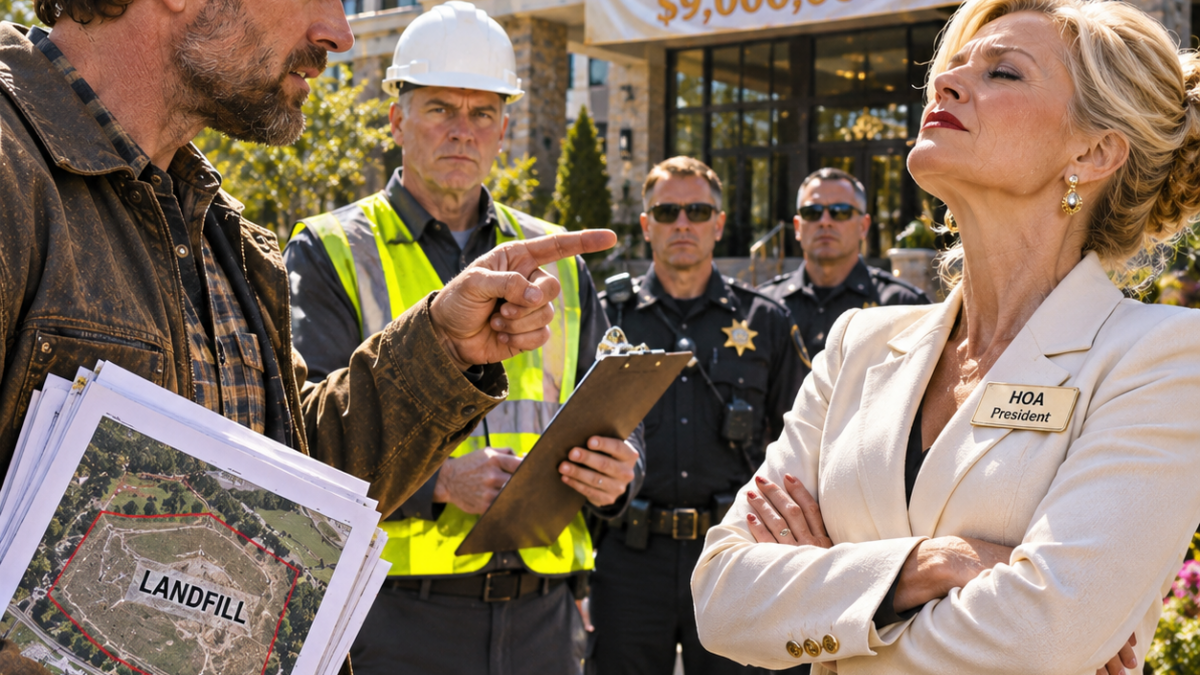
HOA Karen Built a $9M Hotel on My “Abandoned” Landfill—Then One Alarm Went Off Minutes Before the Grand Opening.
PART2:
“Could be the field gateway,” the technician said.
“Did you try remote reset?”
“Three times.”
“Power?”
“Unknown.”
“Last valid transmission?”
He gave me the timestamp.
Two days earlier.
“Any maintenance ticket?”
“No.”
I looked at the date.
I had not physically visited the site in eighteen months.
That was not neglect.
The place was supposed to be boring.
The landfill had closed in the late 1990s.
Final cap installed in 2001.
Clay.
Soil.
Vegetation.
Six passive gas vents.
Three monitoring wells.
Perimeter fencing.
Recorded land-use restrictions.
No buildings.
No excavation without environmental approval.
I paid the property taxes.
PART3:
Paid the monitoring contract.
Read the reports.
As long as the land stayed undisturbed, there was little reason to stand there personally every month.
I finished the job I was on.
Drove home.
Twenty-three days before the county condemned the hotel, I turned down the old gravel road.
And nearly drove past my own property.
The chain-link fence was gone.
So was the weathered metal sign that had read:
CLOSED LANDFILL
AUTHORIZED ENVIRONMENTAL ACCESS ONLY.
In its place stood a curved stone entrance framed by young pine trees.
Landscaping.
Lighting.
Flagpoles.
Beyond the gate rose a building I had never seen.
Six stories.
Glass façade.
Stone columns.
Wide balconies.
A circular arrival drive paved in pale stone.
A banner stretched across the front:
SILVER PINES GRAND
$9 MILLION LUXURY RETREAT
GRAND OPENING THIS MONTH.
I stopped my truck on the shoulder.
For several seconds, I simply stared.
Then I laughed once.
Not because anything was funny.
Because the alternative was probably smashing my head against the steering wheel.
I pulled out my tablet.
Opened my parcel map.
Forty-one acres.
Same legal description I had owned for twelve years.
I overlaid the satellite parcel boundaries.
The hotel sat across the line.
Not slightly.
Not landscaping.
Not a parking stall.
Most of the structure sat directly over the old waste cell.
My landfill.
I zoomed.
Eight acres, maybe more.
The foundation crossed the central capped area.
The underground parking ramp appeared to run through the eastern vent field.
I got out.
A contractor truck passed me.
No one stopped.
I walked toward the construction gate.
Two security guards stepped out.
Black polo shirts.
Radios.
“Invitation?”
“I don’t need one.”
The younger guard looked at me.
“Opening events are private.”
“I’m not here for the opening.”
“Then what are you here for?”
I pointed toward the building.
“My land.”
He blinked.
“What?”
“I own the property you’re standing on.”
The other guard laughed.
Not cruelly.
He genuinely thought I was joking.
“This is Silver Pines development.”
“No.”
“Yes, sir.”
“Call whoever is in charge.”
“You need to leave.”
“Call them.”
The older guard reached for his radio.
Ten minutes later, a white luxury SUV rolled down the drive.
A woman stepped out.
White blazer.
Cream trousers.
Silver-blonde hair.
Expensive shoes that had clearly never encountered actual mud.
She wore a badge clipped near her lapel.
PAMELA KETERING
PRESIDENT
SILVER PINES ESTATES HOA.
That was my first warning.
Not because she was an HOA president.
Because an HOA president should not have been the first executive responding to a hotel property dispute.
She looked me over.
Old Ford pickup.
Work boots.
Canvas jacket.
The same way people often look at subcontractors before deciding whether to acknowledge them.
“Mr. Norwood?”
“Yes.”
“I’m Pamela Ketering.”
“I gathered.”
“I understand you’re claiming some confusion regarding the property line.”
“No confusion.”
Her smile stayed in place.
“This parcel was abandoned for years.”
“Land doesn’t stop having an owner because nobody builds a gazebo on it.”
One guard looked down.
Trying not to smile.
Pamela did not.
“The community incorporated this neglected parcel into the Silver Pines improvement plan.”
“You incorporated private land?”
“The site had been unused.”
“It’s a closed landfill.”
“Yes.”
“And I own it.”
She opened a leather portfolio.
Pulled out a glossy site plan.
Spread it across the hood of a golf cart.
The Silver Pines development appeared in shades of green and gray.
The hotel footprint sat inside a large area marked:
RESORT EXPANSION ZONE.
My parcel number was missing.
She tapped the map.
“As you can see, the hotel is within the approved development boundary.”
I looked at her.
“Maps don’t transfer title.”
“This survey was accepted by the county.”
“Then somebody gave the county a bad survey.”
Her eyes cooled.
“Mr. Norwood, I don’t appreciate being accused of fraud.”
“I didn’t accuse you of fraud.”
“Good.”
“I said the survey is wrong.”
She folded the map.
“If you continue interfering with this project, our legal department will handle you.”
“Your legal department should start with the deed.”
“Security.”
I took out my phone.
Photographed the gate.
The hotel.
The banner.
The site map in her hands.
The guards.
The road.
Pamela’s expression hardened.
“You do not have permission to photograph private commercial property.”
“I’m standing on land I own.”
“You are trespassing.”
That word.
Trespassing.
On my landfill.
I almost argued.
Then remembered something I had learned doing environmental disputes.
The first person who gets emotional usually helps the other side.
So I stopped.
“All right.”
Pamela looked surprised.
I walked away.
Halfway to my truck, I saw the parking ramp.
Concrete.
New.
Smooth.
Descending underground.
I stopped.
Something felt wrong.
I went to the truck and pulled out a battered folder.
SITE CLOSURE PLAN — 2001.
Old engineering drawing.
Six steel landfill gas vents.
I found number three.
Eastern slope.
Exactly where the underground garage entrance now sat.
I looked at the hotel again.
No vent.
Not relocated nearby.
Gone.
I scanned the hillside.
Vent number two should have been visible near the landscaped berm.
Nothing.
Vent four should have stood near the southern edge.
Nothing.
That was the moment ownership stopped being the most urgent problem.
A landfill cap is not a lid you put over trash and forget.
Organic material keeps decomposing.
Sometimes for decades.
That decomposition creates gas.
Mostly methane and carbon dioxide.
Depending on what was buried, other compounds too.
This site had taken large amounts of demolition debris.
Gypsum drywall.
Under wet, low-oxygen conditions, that can contribute to hydrogen sulfide generation.
The closure design dealt with gas by giving it controlled pathways upward.
Six vents.
Open air.
Monitoring.
If somebody removed those pathways and put sealed rooms over them—
I stared at the hotel.
Glass.
Electrical systems.
Basement.
Parking garage.
Mechanical equipment.
Hundreds of future guests.
My anger disappeared.
Fear replaced it.
The next morning, I was waiting outside the county recorder’s office when Walter Sims unlocked the door.
Walter had worked there forever.
Thin glasses.
Gray cardigan.
Patience that should have qualified him for sainthood.
He saw me.
“Elias.”
“Morning.”
“You look unhappy.”
“I think someone built a hotel on my landfill.”
He stared.
“That sentence needs coffee.”
We pulled the file.
Deed.
Mine.
Taxes.
Paid.
Forty-one acres.
No transfer.
No sale.
No quitclaim.
No condemnation.
Nothing.
Then the closure restriction.
Recorded in 2001.
Land use prohibited residential or lodging construction over the waste cell without state environmental approval and appropriate engineering controls.
No approval attached.
I asked Walter for the hotel permit file.
He raised an eyebrow.
“That’s going to be downstairs.”
“I have time.”
The permit application listed the applicant:
Silver Pines Hospitality LLC.
Managing member:
Pamela Ketering.
That was interesting.
The HOA president was not merely supporting the hotel.
She owned part of it.
Attached survey.
I spread it on the table.
Eight-point-three acres of my parcel had been absorbed into the hotel site.
County GIS had been updated to match.
“Who changed this?”
Walter frowned.
“GIS updates from submitted surveys all the time.”
“But this didn’t transfer ownership.”
“No.”
“Then how did permit review miss it?”
He shrugged.
“Reviewer sees sealed survey. Parcel layer matches. Application moves.”
That was the mechanics.
A wrong line in software could not legally steal land.
But it could fool a process.
I checked the surveyor’s seal.
Leonard Gascill.
Name familiar.
I called a surveyor I knew.
“Leonard Gascill?”
“He retired.”
“When?”
“Four years ago.”
The hotel survey was dated eighteen months earlier.
That changed everything.
I requested the last legitimate boundary survey.
Walter brought it.
I laid both side by side.
Almost identical.
Bearings.
Monuments.
Notes.
Font.
Except one line.
On the original, the Silver Pines boundary stopped east of my parcel.
On the filed copy, the line had been extended through my land and redrawn to absorb 8.3 acres.
Not an accidental typo.
Someone had taken a legitimate survey and altered it.
I sat in my truck afterward with both copies spread across the dashboard.
A forged survey.
My landfill built over.
Gas vents missing.
Sensors offline.
This was no longer one bad decision.
It was a structure of bad decisions.
I started with paperwork.
Certified objection to building safety.
County permitting.
State environmental agency.
Construction lender.
Title insurer.
Silver Pines Hospitality.
Every letter included:
Deed.
Recorded land-use restriction.
Certified parcel map.
Legitimate survey.
Disputed survey.
No threats.
No accusations I could not prove.
Pamela answered politically.
Emergency HOA meeting.
Seventy-four homeowners packed into the Silver Pines clubhouse.
I attended.
She projected photographs of my landfill.
Weeds.
Rusty fence.
Warning signs.
Grass.
“This,” she said, “is what Mr. Norwood wants to preserve.”
People laughed.
Not all.
Enough.
“A worthless garbage pit.”
Then rendering of hotel.
Pool.
Restaurant.
Spa.
Jobs.
Tourism.
Pamela told residents the hotel could generate roughly $600,000 a year in shared economic benefits.
Property values would rise.
HOA programs would improve.
She said I was attempting to extort the development after “abandoning” the property for years.
Then she introduced a resolution.
The HOA would recognize the landfill parcel as neglected common property incorporated into the community improvement zone.
I stood.
Walked to the front.
Put my certified deed on the table.
Pamela stared.
“You are out of order.”
“I’ll be quick.”
She reached for the microphone.
I spoke first.
“An HOA cannot vote itself ownership of private land any more than a book club can vote itself ownership of the public library.”
A few people laughed.
Pamela’s face tightened.
“This man is disrupting—”
“If you already owned the land,” I said, “why did your developer need an altered survey to put the hotel on it?”
Silence.
That was the first crack.
Not because they believed me.
Because nobody had expected the word altered.
Pamela called it slander.
Threatened a $2 million lawsuit if I interfered again.
Security approached.
I left voluntarily.
But the question stayed behind.
The next morning, I called Dr. Hadley Brooks.
Hadley was forty-two, environmental geologist, and one of the least sentimental people I had ever met.
We had worked two remediation projects together.
When I said “closed landfill, missing vents, hotel,” she paused.
Then:
“Say that again.”
She drove out.
We spread historical plans across my truck tailgate.
She examined construction imagery.
Old satellite photos.
Aerial captures.
One month:
Vent two visible.
Next:
Gone beneath grading.
Vent three:
Visible.
Then parking ramp.
Vent four:
Replaced by building footprint.
By completion, four of six vents had disappeared.
Two monitoring wells were beneath landscaping or pavement.
Hadley folded her arms.
“They didn’t redesign the system.”
“No.”
“They erased it.”
“Looks like it.”
We inspected only areas I could legally access outside the active hotel footprint.
One surviving well had its communication wiring cut.
Another monitoring head was dead.
Near the eastern cap, soil texture changed sharply.
Original cap material dense.
Compacted.
New section loose.
Disturbed.
Excavated.
Backfilled.
Hadley crouched.
“They breached the cap here.”
“I know.”
“How deep?”
“Unknown.”
She stood.
“You need the state.”
“I already called.”
“Call again.”
Then we reviewed eighteen months of monitoring reports.
Every one had shown safe conditions.
No alarms.
No abnormal gas.
Hadley put three monthly reports side by side.
“Look.”
I looked.
Well number two.
Methane.
0.4.
Hydrogen sulfide.
Non-detect.
Temperature.
Same.
Pressure.
Same.
Month after month.
Digit for digit.
Only dates changed.
“That well stopped transmitting over a year ago.”
“I know.”
“So these numbers are copied.”
“Yes.”
She looked at me.
“Whoever buried the system also fabricated evidence that the system was still functioning.”
That was the second crack.
We filed an urgent inspection request.
Pamela responded within forty-eight hours with her own consultant report.
Safe.
No hazardous landfill conditions beneath the hotel.
Her attorney sent me a letter warning that defamatory statements could cause catastrophic investor losses.
I ignored it.
Hadley and I requested the full permit drawing set.
Architecture.
Mechanical.
Civil.
Foundation.
Environmental.
Revision history.
Two nights at my kitchen table.
Coffee.
Highlighters.
Old closure plans.
At 1:47 a.m. on the second night, Hadley stopped.
“Elias.”
I looked up.
She pointed at basement plan M-104.
“Where is vent four?”
I checked the original environmental drawing.
Vent four sat almost exactly beneath the new mechanical corridor.
On the permit plan?
Nothing.
Not moved.
Not rerouted.
Removed from the drawing as if it had never existed.
Hadley flipped through earlier revisions.
There.
Vent symbols.
Later revision.
Gone.
Later.
Gone.
Every trace erased.
At the location where landfill gas was supposed to vent to open atmosphere, the hotel now had a sealed service corridor full of air handlers, pumps, electrical panels, and floor penetrations.
Hadley leaned back.
“Someone made a conscious choice.”
I did not answer.
We then followed the money.
Silver Pines Hospitality LLC.
Pamela held a direct ownership stake.
Construction loan:
$6.9 million.
Private investors supplied the rest.
Then I found a footnote in a lender filing referencing a guarantee tied to an entity connected with the Silver Pines HOA.
That did not make sense.
Why would a homeowners association guarantee a commercial hotel?
I asked at the next open HOA meeting.
“Has HOA money been pledged to the hotel?”
Pamela immediately said I had no standing to inspect association finances because I was not a member.
Correct.
I was not.
But seventy-four people in the room were.
They started asking.
Dues had risen twice.
Maintenance reserve had fallen.
Why?
A retired accountant named Russell Kemper requested records under the bylaws.
Within a week, the homeowners discovered roughly $850,000 had moved from HOA reserves into a financial arrangement supporting the hotel.
No membership vote.
No proper disclosure.
Pamela called it an investment.
A short-term bridge.
Residents would be repaid with profit after opening.
I asked her one question.
“Did you tell the homeowners you personally owned part of the hotel before moving their money into it?”
Her face changed.
“The hotel is worth nine million dollars.”
“That wasn’t my question.”
“My investment has nothing to do with—”
“Then why use their reserves?”
She leaned toward the microphone.
“Your landfill is worth nothing.”
I waited.
Let the room quiet.
“Then why did you have to steal the land underneath it?”
That meeting ended badly for her.
I was banned from future HOA meetings.
Hotel security was instructed to keep me away from the site.
Her attorney sent another letter.
Then the board began turning.
Diane Whitlock asked Pamela for the resolution authorizing the $850,000 transfer.
Pamela produced one.
Five signatures.
Diane’s.
Two other board members.
Problem:
Diane said she never signed it.
The other two had not been in the county on the date shown.
One had airline records placing him in Denver.
Another had hotel receipts in Florida.
Three days later, an anonymous envelope appeared in my mailbox.
Inside:
Copy of that resolution.
I forwarded it to my attorney.
Graham Holloway.
Fifty-four.
Real-estate litigator.
Calm enough to make Dorian Vale look excitable.
He read it.
“This is not an HOA dispute anymore.”
“I know.”
My phone buzzed that evening.
Unknown number.
You are looking at the money. You should be looking at what she buried under the lobby.
I stared.
Could have been useful.
Could have been bait.
I forwarded it to Hadley and county investigators.
No reply from sender.
We stayed disciplined.
No breaking into the hotel.
No sneaking into basement rooms.
No amateur gas tests in enclosed spaces.
We built a lawful sampling plan.
Public right-of-way.
My remaining accessible property.
Chain of custody.
Accredited lab.
Hadley collected soil-gas samples.
Sealed.
Logged.
Delivered.
Eight days later, results.
Abnormal methane concentrations near the foundation.
Not enough to declare the entire hotel unsafe by themselves.
Enough to demand direct inspection.
I took the report to Grant Bellows.
Head of county building safety.
Fifty-seven.
Gray temples.
Known for personally checking anything likely to end up in court.
He read it twice.
“This is serious.”
“Yes.”
“But I’m not condemning a building on your consultant’s numbers.”
“I wouldn’t ask you to.”
He looked at me.
“You’re asking for official verification.”
“Yes.”
He nodded.
“That I can do.”
Pamela held a press event.
Hotel lobby.
Cameras.
Investors.
She accused me of sabotage.
Claimed I wanted $3 million to drop my objections.
I asked publicly:
“Produce the demand.”
She had none.
Then she pivoted.
“He wants to destroy a $9 million investment because he owns an old garbage pit.”
Some investors laughed.
I waited.
“The garbage pit has a legal owner.”
Silence.
“And your hotel has a forged survey.”
More silence.
“And a basement problem you cannot filter out with marketing.”
She ordered security to remove me.
I walked back to the public road.
No scene.
No argument.
That frustrated her more.
Meanwhile, Grant found the permit had never disclosed the recorded landfill land-use restriction.
If the county approved a permit based on missing or false environmental information, the permit itself might be defective.
Graham sent preservation demands.
Developer.
Contractor.
Consultant.
Design team.
Keep every email.
Every drawing.
Every change order.
Every report.
That night, a box truck backed up to the hotel service entrance.
Workers loaded file boxes.
They drove away.
Someone had forgotten how construction works now.
Electronic revisions lived on subcontractor servers.
You can move cardboard.
Metadata is harder.
Two days later, Hadley called me.
Her voice was different.
“Supplemental results came back.”
“What?”
“Methane and hydrogen sulfide along the utility trench.”
“How bad?”
“Bad enough that the trench may be acting as a pathway toward the mechanical corridor.”
I sat down.
“This isn’t just contaminated soil anymore.”
“No.”
She paused.
“The building may be trapping what the old system was designed to release.”
Before I hung up, Graham called.
Pamela had moved the grand opening forward forty-eight hours.
Friday.
Why?
We soon learned.
The anonymous source agreed to meet.
Coffee shop near the courthouse.
No private location.
No dramatic parking garage.
Her name was Shannon Morrow.
Thirty-eight.
Document control manager for the hotel project.
She sat across from me with two folders and shaking hands.
“I should’ve said something earlier.”
“Then say it now.”
She opened the first folder.
Email chain.
General contractor:
Dustin Varner.
Forty-nine.
Clean record.
Repeated warnings.
Building over landfill gas infrastructure could create accumulation risk.
Pause work.
Perform additional testing.
Redesign vents.
Three written warnings.
Pamela rejected all three.
“Why?”
Shannon swallowed.
“Bank draws.”
The loan released money at construction milestones.
Delay meant review.
Review meant questions.
Then she showed me the drawing revisions.
Original civil plan.
Gas vents.
Revision.
Fewer.
Final investor drawing.
None.
“Who ordered the vents removed?”
She pointed at an email.
Pamela.
Then Shannon placed a small digital recorder on the table.
“My state allows one-party recording. I was in the meeting.”
She pressed play.
Dustin’s voice.
Tense.
Professional.
“If we seal these vents without an engineered replacement system, landfill gas can migrate beneath the building.”
Then Pamela.
Clear.
Cold.
“I don’t care what that landfill used to be. I need the hotel open before the bank reviews our numbers.”
I felt nothing for a moment.
Not anger.
Just confirmation.
Shannon explained the real danger.
If the lender reviewed before opening, they would find:
Survey problem.
Landfill restriction.
Vents.
Fake monitoring.
HOA reserve money.
Pamela’s ownership conflict.
The entire project could freeze.
So she was racing the calendar.
Not construction.
Exposure.
Shannon had one more document.
Marketing instruction.
No grand-opening material was to mention the former landfill or gas-control system.
Approved:
Pamela Ketering.
Three weeks earlier.
I asked Shannon one thing.
“Do not edit anything.”
“I haven’t.”
“Keep originals.”
“Yes.”
“Give investigators full files, not selected pages.”
She nodded.
Graham arranged delivery.
Dustin Varner came forward two days later.
Admitted work continued after his objections.
Did not pretend innocence.
Did not blame everyone else.
He handed over his records.
Friday arrived.
Grand opening day.
Silver Pines Grand looked like a movie set.
Flowers.
Valet tents.
Ice sculptures.
Lighting.
Red carpet.
Digital countdown.
Nearly three hundred invited guests.
Investors.
Business owners.
County officials.
Press.
HOA residents.
Pamela stood at the entrance in a white evening gown.
Champagne flute.
Cameras.
She had designed the evening to make stopping the hotel socially impossible.
At 5:50, luxury cars filled the drive.
At 6:00, music started.
At 6:08, she raised a glass.
At 6:11, I saw county vehicles turn through the stone gate.
Grant Bellows.
State environmental team.
Fire marshal.
Building safety inspectors.
Gas detection equipment.
Pamela stopped mid-sentence.
Grant walked toward her.
She came down the steps.
“What is this?”
“Emergency safety inspection.”
“On whose authority?”
He showed the paperwork.
“No guests enter until we finish.”
Her eyes found me standing at the public roadside.
“He did this.”
Grant did not even look.
“Ma’am, the building is standing over a closed landfill. We need to know what is entering through the foundation.”
Pamela laughed.
Nervous now.
“We have a state-of-the-art air filtration system.”
Grant looked at her.
“Air filters do not stop soil gas from entering a basement.”
Then one detector near the lower-level access gave a sharp electronic alarm.
6:14 p.m.
Everyone heard it.
Not loud enough for the whole parking lot.
Loud enough for everyone near the doors.
Pamela’s face changed.
Grant ordered the lower mechanical doors opened.
Firefighters took control.
Inspectors entered in protective equipment.
Calibrated meters.
Slow measurements.
Utility vault.
Floor penetrations.
Pipe chases.
Mechanical corridor.
First methane reading.
Elevated.
Second.
Higher.
Then a sealed utility vault.
The detector stabilized.
6.8% methane by volume.
Grant stared at the display.
Anyone who works around methane knows why that number matters.
Methane becomes flammable in air over a certain concentration range.
That vault was inside it.
A motor.
Relay.
Switch.
Spark.
Wrong moment.
Wrong mixture.
Enough.
Then another room.
Hydrogen sulfide.
Twenty-eight parts per million.
Not instantly lethal.
Absolutely unacceptable for an occupied mechanical space.
Serious enough to trigger protective measures and investigation.
Grant ordered everyone out.
Staff.
Contractors.
Everybody.
Firefighters shut down nonessential electrical systems from a controlled location.
Entrances were blocked.
No guest crossed the threshold.
Pamela shoved a bound consultant report toward Grant.
“This says the building is safe.”
He opened it.
Compared locations.
“The report didn’t test these rooms.”
“It tested the site.”
“Before you changed the site.”
Dustin Varner stepped forward.
Investigators had asked him to attend.
“I warned them about the vents.”
Pamela turned.
“Dustin, do not—”
He looked at Grant.
“I sent three written notices.”
Grant nodded.
Already had them.
Then he turned to Pamela.
“Your ventilation system does not solve gas migrating through a compromised landfill cap.”
She called her attorney.
Then project manager.
Then the bank.
Each conversation shorter.
None changed the meter.
Grant issued the order.
Bright red placard.
He pressed it against the glass entrance.
UNSAFE STRUCTURE
OCCUPANCY PROHIBITED.
The champagne table sat ten feet away.
Glasses untouched.
The hotel had not hosted a single guest.
Nine million dollars.
No opening.
No certificate of occupancy.
Permit under review.
Pamela stared at the red notice.
Then at me.
“You destroyed my life’s work.”
I walked closer only because inspectors had asked me to identify former vent locations.
“I didn’t put gas beneath your hotel.”
“You caused this.”
“I warned you what you were building over.”
Cameras caught it.
For once, Pamela had invited them herself.
Guests began leaving.
No applause.
No shouting.
Just car doors.
Engines.
People avoiding eye contact.
A representative from the construction lender stepped aside.
Phone call.
Within minutes, remaining loan disbursements were suspended.
Then the state investigator approached Pamela.
Small portable speaker.
He played Shannon’s recording.
Dustin’s warning.
Then Pamela’s voice:
“I need the hotel open before the bank reviews our numbers.”
The color disappeared from her face.
The inspector said:
“We are no longer investigating only the building condition.”
That was the beginning of the end.
The next weeks separated the mess into three different problems.
Ownership.
Environmental safety.
Money.
Independent surveyor came first.
Original monuments.
Certified deeds.
Historical plats.
No ambiguity.
Hotel encroached on 8.3 acres of my property.
Leonard Gascill, the retired surveyor whose seal appeared on the filed plan, gave sworn testimony.
He had never prepared it.
Never signed it.
Never authorized his seal.
Forgery investigation followed.
State environmental team inspected the landfill.
Four of six vents removed or buried.
Two monitoring wells destroyed or covered.
Protective cap breached.
Waste disturbed.
Gas pathways redirected.
Structural engineers found another problem.
The hotel foundation had been constructed partly over disturbed landfill material without the engineering controls required for that type of site.
The building could not simply reopen after adding fans.
The title insurer began reviewing fraud exclusions.
The lender froze the loan.
Investors demanded audit.
The HOA finally understood what Pamela had done with its reserve money.
$850,000.
Locked inside a hotel that could not legally operate.
She called a special membership meeting.
I did not attend.
Russell told me about it later.
Pamela promised recovery.
Said regulators were overreacting.
Said environmental issues could be mitigated.
Said the hotel remained valuable.
Russell stood.
“Why did you use our reserve fund to support a project you personally owned?”
She talked around it.
He asked again.
No answer.
Recall vote.
Sixty-six of seventy-four owners voted to remove her.
Diane Whitlock became president.
First action:
Independent audit.
Second:
End HOA involvement in the hotel.
Third:
Pursue recovery of reserve funds.
Meanwhile, I filed civil action to confirm title, stop trespass, and require restoration of the landfill systems.
Then investigators found the financial link.
The forged HOA resolution had not stayed inside HOA files.
It had been submitted to the bank as part of the hotel financing package.
That mattered.
A fake internal document is one kind of problem.
A fake document used to secure millions in financing is another.
County prosecutor Celeste Pickett opened a criminal case.
Fraud.
Falsification.
Potential conspiracy depending on who had done what.
Pamela could no longer call this a zoning disagreement.
Three months after opening night, environmental and structural experts reached the same conclusion independently.
The hotel could not remain in its current configuration.
The foundation violated the recorded land-use restriction.
The cap had been penetrated.
Gas controls destroyed.
Waste disturbed.
Safe restoration required access beneath the structure.
The court ordered removal of the encroaching building portions and full environmental restoration.
In practice, that meant demolition.
Estimated cost:
$2.4 million.
On top of the $9 million already spent.
People kept asking me whether I was happy.
No.
Happy would have been returning to find grass.
Six vents.
Three wells.
My ugly fence.
Nothing more.
There is nothing satisfying about watching millions of dollars become waste.
Construction materials.
Labor.
Investment.
All of it could have built something legitimate somewhere else.
What I felt was relief.
Nobody had checked into the hotel.
Nobody had parked in the garage beneath that gas pathway overnight.
Nobody had flipped the wrong electrical switch at the wrong concentration.
The demolition began in early spring.
Controlled.
Slow.
Environmental plan.
Safety perimeter.
First, signage came down.
SILVER PINES GRAND.
A crane lowered it onto gravel.
Then glass balcony sections.
Interior fixtures.
Stone facing.
Pamela arrived with her attorney during one required record transfer.
She stood outside the fence.
Watched the building come apart.
For a while, neither of us spoke.
Then she said:
“You destroyed nine million dollars just to prove you owned a dump.”
I looked at her.
“No.”
She waited.
“You spent nine million dollars proving you thought you could ignore what was already under your feet.”
Her attorney touched her elbow.
She left.
That was the last conversation we ever had.
Demolition took months.
Hadley supervised environmental restoration.
Cap reconstructed.
Compacted clay.
Protective layers.
Vegetation.
All six gas vents rebuilt.
Correct locations.
Three monitoring wells replaced.
New communication hardware.
Independent verification.
The first day the sensors came online, I stood in my truck and watched the dashboard.
Vent one.
Online.
Two.
Online.
Three.
Online.
Four.
Five.
Six.
Wells.
All transmitting.
Real readings.
Not duplicated.
Not copied.
Not invented.
I laughed.
Hadley was standing outside.
“What?”
“Nothing.”
She looked at my phone.
“Data?”
“Yeah.”
“Exciting life.”
“You’re an environmental geologist.”
“Exactly why I’m qualified to judge.”
The criminal case moved slowly.
As they do.
Pamela faced charges related to fraudulent records and financing.
The developer entities became tied up in litigation.
Investors pursued claims.
The title company fought over coverage.
The HOA sued to recover money.
Assets connected to the disputed transactions were preserved by court order while everything worked through.
I did not follow every hearing.
I had land to restore.
That was enough.
By autumn, the hillside looked almost boring again.
Grass.
Fence.
Warning signs.
Six steel vents.
Three well heads.
No balconies.
No red carpet.
No stone gateway.
I installed a new sign at the entrance.
PRIVATE PROPERTY
CLOSED LANDFILL
ENVIRONMENTAL MONITORING AREA
AUTHORIZED ACCESS ONLY.
Nothing clever.
No mention of Pamela.
No mention of the hotel.
Land does not need revenge written on it.
The final evening of the restoration, I parked near the hill.
Sun dropping.
Wind moving through grass.
The vents made no dramatic sound.
They simply did their job.
That was the point.
A gas-control system is supposed to be boring.
A monitoring well is supposed to be boring.
A deed is supposed to be boring.
Safety is mostly boring until somebody replaces boring with profitable.
I walked the boundary.
Survey markers exactly where they had always been.
Forty-one acres.
Mine.
Not because I had shouted louder.
Not because the HOA finally agreed.
Not because Pamela lost.
Because recorded ownership had never changed.
That part fascinated me afterward.
Pamela spent eighteen months trying to create a different reality.
New survey.
New map.
New permit.
New building.
New financial structure.
New marketing.
New narrative.
She even changed what the county’s computer screen showed.
And for a while, that was enough to convince almost everyone.
Contractors came.
Concrete poured.
Banks funded.
Investors signed checks.
Homeowners applauded.
Reporters photographed the lobby.
A six-story building rose.
But underneath all of it were two stubborn things.
The deed.
And the landfill.
Neither cared about her confidence.
The deed still said I owned the land.
The landfill still produced gas.
You can forge a line on a survey.
You can delete a symbol from a drawing.
You can copy old numbers into a new report.
You can vote to call land “common property.”
You can tell three hundred people a hotel is safe.
But paper does not change title unless the law changes title.
And marketing does not stop decomposition.
That was what Pamela never understood.
She thought reality was something authority could manage.
The ground disagreed.
So did the detector.
6:14 p.m.
That was the moment everyone later remembered.
The alarm.
The inspectors.
The champagne.
The red condemnation notice.
People called it dramatic.
It was.
But the real story had happened quietly long before that.
A vent erased from a drawing.
A wire cut.
A number copied.
A signature placed where the signer had never been.
An eight-acre boundary shifted with a line.
An HOA reserve transfer nobody voted on.
One decision at a time.
That is how large disasters are usually built.
Not with one enormous act.
With smaller dishonesties stacked until the structure on top looks permanent.
The hotel looked permanent too.
Stone.
Glass.
Steel.
Nine million dollars.
It lasted less than the landfill vent that had stood there before it.
That old vent had done its job for almost twenty years.
Nothing glamorous.
Just let pressure out.
Sometimes I think that was the perfect symbol for the whole thing.
Pamela kept pressure contained.
Questions.
Money.
Environmental warnings.
Ownership.
Construction delays.
She sealed everything she did not want seen.
Eventually pressure found another path.
Shannon.
Dustin.
Russell.
Hadley.
Grant.
The lender.
The homeowners.
The court.
Truth behaves a lot like gas.
Block one pathway and it looks for another.
Seal every opening and pressure grows.
Eventually something detects it.
A year after demolition, I drove out one December morning after a cold front.
Frost on the grass.
The hotel site was almost impossible to recognize.
Young vegetation had taken.
Fence line clean.
Telemetry working.
A small county truck was parked at the gate.
New environmental technician checking equipment.
He was maybe twenty-five.
He looked at the hill.
Then at me.
“This is the hotel site?”
“Used to be.”
He looked around.
“I saw pictures.”
“Yeah.”
“Hard to believe.”
“That’s good.”
He checked vent four.
The one that had been buried beneath the mechanical corridor.
Instrument reading normal.
He wrote it down.
Then asked:
“You ever think about developing this land?”
I laughed.
“No.”
“Nothing?”
“Grass.”
He smiled.
“That’s not development.”
“Exactly.”
He finished his inspection and drove away.
I stood beside vent four.
Put my hand on cold steel.
Somewhere beneath my boots, decades-old waste continued doing what buried waste does.
Slowly changing.
Breaking down.
Producing gas.
Nothing evil.
Nothing dramatic.
Just chemistry.
Danger does not have to be malicious to be dangerous.
That was another lesson Pamela had missed.
She treated warnings like obstacles created by cautious people.
But environmental restrictions are often written in the language of people who already learned something the expensive way.
The 2001 closure plan existed because engineers understood what the ground required.
Open space.
Controlled venting.
Monitoring.
No lodging.
Pamela saw wasted land.
I saw a system doing exactly what it had been designed to do.
That difference cost nine million dollars.
People still occasionally ask whether I could have kept the hotel after winning the land case.
No.
And I never wanted it.
A few people thought I had become owner of a luxury resort because it sat partly on my parcel.
Property law is not that simple.
What I wanted was removal.
Restoration.
Clear title.
Safe ground.
That is what the court gave me.
No hotel.
No windfall.
Just my landfill back.
Sounds strange when I say it.
But ownership is not always about the value of what you possess.
Sometimes it is about the right to prevent someone else from turning your responsibility into their opportunity.
I was legally responsible for that closed landfill.
If gas migrated.
If groundwater changed.
If the cap failed.
My name was still connected to the property.
Pamela wanted the upside of the land without accepting the history underneath it.
That is not development.
That is borrowing tomorrow from people who do not know they are paying.
The new Silver Pines HOA board eventually recovered part of its lost reserve money.
Not all at once.
Legal process.
Insurance.
Settlements.
Asset recovery.
Russell stayed involved long enough to stabilize finances, then refused to run for president.
He told me:
“I’ve seen what happens to people who start enjoying that chair.”
Fair.
Diane served one term.
Published everything.
Budget.
Minutes.
Contracts.
Conflict disclosures.
Boring administration.
Again.
Boring was good.
Shannon left construction document management.
She later joined a compliance firm.
Dustin lost contracts because of his role in continuing work after the warnings.
He also testified fully.
I respected that.
Accountability is not the same as pretending you were innocent.
Hadley kept working with me.
Every year, she reviewed the monitoring data.
Once, two years after demolition, a sensor produced an unusual methane spike after heavy rain.
The system caught it.
We investigated.
Drainage issue near vent five.
Fixed in a week.
No headlines.
No luxury hotel evacuated.
No press conference.
Just maintenance.
That is what monitoring is supposed to do.
Pamela’s name disappeared from Silver Pines.
First from newsletters.
Then the clubhouse plaque.
Then conversations.
A new family eventually bought her old home after legal matters were resolved.
I heard she moved to another state.
I never checked.
People assumed I wanted to know what happened to her.
I did not.
The court handled what belonged to the court.
The prosecutor handled what belonged to the prosecutor.
I had spent enough of my life cleaning up after choices other people made.
I did not need to carry Pamela too.
What remained was the hill.
The fence.
The vents.
The truth.
And one photograph I kept.
Not the condemned hotel.
Not Pamela beside the red notice.
Not the demolition.
The photograph was taken before construction.
My property eighteen months earlier.
Grass.
Six vents.
Warning sign.
Nothing else.
Most people would consider it ugly.
I don’t.
It shows a problem being managed correctly.
There is beauty in that.
Not Instagram beauty.
Not resort-brochure beauty.
Something better.
Responsibility.
The last time I stood there at sunset, I thought about what Pamela had said beside the demolition fence.
“You destroyed nine million dollars just to prove you owned a dump.”
She had understood everything backward.
The landfill’s low market value had convinced her it had low importance.
Those are not the same thing.
A smoke detector costs less than a house.
That does not make the house more important when it is burning.
Six steel vents cost almost nothing compared with a hotel.
The hotel could not safely exist without respecting them.
My deed was just paper.
The forged survey was also paper.
The difference was truth.
The ground beneath Silver Pines had been telling the truth the entire time.
The vents were there because gas existed.
The restrictions were recorded because danger existed.
The sensors existed because conditions could change.
Pamela buried the vents.
Buried the monitoring wells.
Buried the ownership.
Buried the warnings.
Buried the financial risk.
She thought enough concrete would make all of it disappear.
Instead, the concrete trapped it.
And on opening night, one detector finally said out loud what the land had been saying for eighteen months.
Stop.
I looked across the hillside.
Six vents standing against the fading sky.
Three wells blinking small green status lights.
No hotel.
No cameras.
No investors.
Wind through grass.
My phone showed live telemetry.
Real numbers.
Changing.
Imperfect.
Honest.
I put it back in my pocket.
Locked the gate.
Then drove home.
Behind me, the old landfill kept breathing safely into the open air.
Exactly the way it was always supposed to.








