HOA Karen Built a $78,000 Pool on My Land—So I Let Her Finish It Before Handing Her the Survey
HOA Karen Built a $78,000 Pool on My Land—So I Let Her Finish It Before Handing Her the Survey
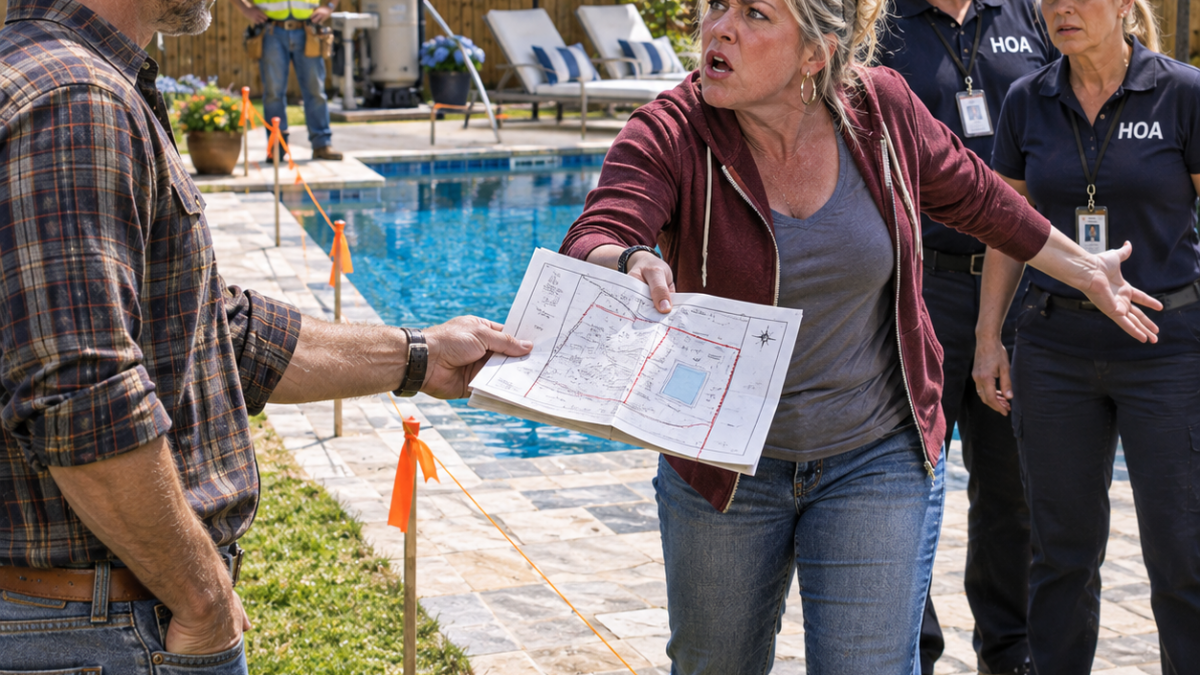
**“YOU ARE NOT STOPPING MY POOL, DANIEL! THAT FENCE HAS BEEN THE PROPERTY LINE FOR EIGHTEEN YEARS, AND I DON’T CARE WHAT YOUR LITTLE SURVEY SAYS!” HOA president Brenda Whitmore snapped as an excavator waited behind her to tear open the ground nearly twenty-seven feet inside my deeded property.**
**I warned her in writing, my attorney warned her, her own attorney told her to get an independent survey, and even the pool contractor made her sign a document accepting responsibility—but Brenda ordered the digging to continue anyway, convinced that being HOA president somehow made an old wooden fence more powerful than a recorded property line.**
**So I stopped arguing, watched her spend nearly $78,000 finishing the pool, waited until the water was sparkling and the board was admiring her new stone deck, then walked across the grass with the stamped survey in my hand—and when her attorney opened the permit packet beside it, he went pale and whispered, “Brenda, the pool may be the smallest problem you have.”**
My name is Daniel Lawson.
I was fifty-one when I bought a small farmhouse outside Franklin, Tennessee.
The property covered a little more than eleven acres.
Enough land for privacy.
Not enough to turn maintenance into a second career.
There was an old barn.
A workshop.
A creek near the back.
A broad field where the previous owner had once kept horses.
After twenty-eight years working as a civil engineer, it was almost exactly the kind of place I wanted.
My career had involved roads, municipal drainage systems, development projects, utility corridors, and construction plans.
That did not make me a land surveyor.
I never pretended it did.
But it taught me one lesson very early:
Never assume a fence is the legal boundary simply because everybody has treated it that way for years.
That lesson would eventually cost my neighbor almost $78,000 to learn.
My wife Rachel had died five years before I moved to the farmhouse.
Long illness.
Long goodbye.
Afterward, our Nashville house became too full of memories and somehow too empty at the same time.
My daughter Jennifer lived in Knoxville with her husband and children.
My son lived in Memphis.
I wanted somewhere quieter.
Somewhere they could visit.
Somewhere I could work on an old barn, keep a few animals, and stop feeling like every room belonged to a version of my life that no longer existed.
The Lawson place seemed perfect.
The only complication sat along the eastern edge.
Pinecrest Estates.
Around 170 expensive homes.
Stone entrance.
Clubhouse.
Walking trails.
Small lake.
Perfect lawns.
Private streets.
An HOA.
Fortunately, my property had existed long before Pinecrest.
The farmhouse was never annexed into the association.
My deed was clear.
PART2:
No Pinecrest covenants.
No architectural committee.
No monthly dues.
One narrow utility easement crossed the southeast corner.
Everything else belonged to me.
My realtor, Susan Parker, had emphasized that point.
“Best of both worlds.”
“What does that mean?”
“You’re close enough to have neighbors.”
“And?”
“Far enough away that nobody can tell you what color to paint the barn.”
I smiled.
“Red.”
“Then make it red.”
That sounded easy.
PART2:
It lasted about two weeks.
My closest Pinecrest neighbor was Frank Miller.
Sixty-nine.
Retired accountant.
Gray beard.
Friendly in that relaxed way people sometimes become after deciding most arguments are not worth the blood pressure.
I met him while repairing the barn door.
“You bought the Bennett place?”
“I did.”
“Planning horses?”
“Maybe chickens.”
“Good choice.”
“Why?”
“Horses eat money.”
That was our first conversation.
Then he looked toward the tall wooden privacy fence separating part of Pinecrest from my eastern field.
“You might want that checked someday.”
I stopped working.
“Checked?”
“The line.”
“What about it?”
Frank shrugged.
“George used to say the fence wasn’t on the real boundary.”
George Bennett was the previous owner.
Seventy-eight.
Now living with his daughter in Kentucky.
I called him.
He remembered immediately.
“The Pinecrest fence?”
“Yes.”
“Developer put it wrong.”
“How wrong?”
“Depends where you’re standing.”
That was not especially comforting.
George explained that when Pinecrest was built almost eighteen years earlier, the developer installed the privacy fence before all the final corner monuments were easy to locate.
He always believed parts of the fence wandered onto his land.
“Did you complain?”
“No.”
“Why?”
“It was grass.”
I closed my eyes.
George was one of those men who could probably discover a neighbor had accidentally built a shed six feet onto his land and decide moving it would be more trouble than it was worth.
“Did you ever have a survey?”
“Long time ago.”
“Still have it?”
“Somewhere.”
I made a mental note.
At the time, nothing urgent was happening.
Nobody was building.
The fence had stood for years.
I had a barn door hanging crooked, a tractor that needed service, and approximately five hundred other things demanding attention.
Then Brenda Whitmore drove onto my property.
White SUV.
Pinecrest parking sticker.
Dark sunglasses.
Clipboard.
She parked near my barn without asking.
I walked over.
“Can I help you?”
She stepped out.
“I’m Brenda Whitmore. President of Pinecrest Estates.”
“Daniel Lawson.”
“I know.”
That answer always bothers me when it comes from someone I have never met.
She looked toward the barn.
“You’re repainting?”
“Eventually.”
“What color?”
“Red.”
Her expression changed.
“Bright red?”
“Barn red.”
“Pinecrest restricts strong exterior colors visible from residential lots.”
I waited.
She seemed serious.
“I’m not in Pinecrest.”
“The visual impact still affects the neighborhood.”
“I’m sure it does.”
“You should submit your color before painting.”
“No.”
She blinked.
“No?”
“My barn isn’t in your HOA.”
“We try to cooperate with neighboring owners.”
“So do I.”
“Good. Then submit the color.”
“No.”
That ended the pleasant part of our relationship.
Three days later, I received a Pinecrest “courtesy notice.”
The grass along the eastern fence was too tall.
About ten inches.
Not my front lawn.
A strip of field next to their privacy fence.
I walked outside.
Looked at the grass.
Then at the fence.
Something caught my attention.
The fence did not run straight.
It curved.
Not dramatically.
Just enough.
My engineering brain started asking questions.
I pulled up the county parcel map.
Those online maps are not surveys.
Anyone who treats them like surveys deserves whatever problem follows.
But they are useful for orientation.
My recorded property line looked much straighter than Pinecrest’s fence.
I called Rebecca Hayes.
She had handled my closing.
Twenty years of property-law experience.
One of those lawyers who seemed happiest when two deeds contradicted each other.
“I need a survey.”
“What happened?”
“The HOA wants me to cut grass.”
Pause.
“That sounds expensive.”
“The grass?”
“The argument hiding behind the grass.”
She was right.
I hired James Walker.
Licensed surveyor.
Calm.
Thorough.
The sort of man who could spend six hours searching for an iron pin buried beneath weeds and consider it a productive day.
He started with my deed description.
Pinecrest’s subdivision plat.
Old monument references.
County records.
Field measurements.
First afternoon, he found an old corner monument.
Almost sixteen feet inside what everyone assumed was Pinecrest property.
Then another.
Then another.
On day two, he called.
“Daniel, you need to see this.”
We walked the eastern boundary.
The fence was wrong.
At the northern end:
About three feet onto my property.
Farther south:
Eleven feet.
Near Brenda Whitmore’s backyard:
Almost twenty-seven feet.
James stopped behind her house.
White home.
Large patio.
Hedge.
Deep lawn extending toward the old fence.
He placed two flags.
“Her real rear boundary is here.”
I stared toward the fence.
“That’s a lot of yard.”
“Twenty-six feet, eight inches at this point.”
There was nothing dramatic in that strip.
Grass.
Shrubs.
A small shed partly across the line.
No house.
No garage.
No swimming pool.
Yet.
“What should I do?”
James smiled.
“Talk to your attorney.”
Of course.
Rebecca reviewed everything.
Then gave exactly the advice I expected.
“Do not tear down fences.”
“I wasn’t planning to.”
“Do not threaten people.”
“Wasn’t planning to.”
“Do not walk around telling everyone their backyard belongs to you.”
“Rebecca.”
“I know you.”
We sent Pinecrest a polite notice.
Professional survey had revealed the fence encroached on my property.
We were open to practical solutions.
Move sections gradually.
Sell narrow strips where appropriate.
Grant landscaping licenses.
Record corrected boundary agreements.
Nobody needed to lose a garden.
Nobody needed a bulldozer.
Nobody needed to panic.
Frank called.
“Brenda is furious.”
“I figured.”
“She says your survey is wrong.”
“Did she hire another surveyor?”
“No.”
“Then she’s guessing.”
“That sounds like Brenda.”
Pinecrest’s attorney contacted Rebecca.
Charles Bennett.
He asked for James’s field data.
James provided it.
Charles did not accuse anyone of fraud or incompetence.
He said Pinecrest needed time to review older documents.
Reasonable.
Then Brenda sent me a fine.
$500.
Violation:
Unauthorized structures inside Pinecrest common buffer.
The structures?
My survey stakes.
I laughed.
Rebecca did not.
She called Charles.
The fine disappeared that afternoon.
That should have been a warning to Brenda that she was pushing authority she did not have.
Instead, she started telling residents I was trying to steal their yards.
I was not.
Robert and Linda Jenkins lived a few houses down.
Their flower garden extended around eight feet across the surveyed boundary.
They came to my farmhouse.
Linda looked worried.
“My roses are in that strip.”
“I saw them.”
“My mother planted some.”
“Then nobody is touching your roses.”
She nearly cried.
We agreed they could keep using the garden while Rebecca worked out the paperwork.
No rent.
No threats.
No drama.
That was how normal adults handled a boundary mistake.
Brenda chose something else.
She emailed Pinecrest residents claiming that because the fence had stood nearly eighteen years, it had become the legal community boundary.
Rebecca explained that long-standing boundaries can create complicated legal issues depending on facts.
But Brenda was treating a complicated doctrine like a magic spell.
Worse for her, old records showed the fence had not always been treated as unquestioned.
Some sections had been replaced.
Maintenance notes mentioned boundary uncertainty.
George had written to the developer years earlier complaining about the fence location.
Nothing was as clean as Brenda claimed.
Then Frank came over with coffee.
“Brenda’s getting a pool.”
I looked up.
“What?”
“Big one.”
“When?”
“Contractor starts next week.”
I stopped drinking.
Brenda’s backyard was where the fence error was widest.
I walked to the eastern field.
James’s orange survey flags remained visible.
Two days later, new stakes appeared inside Brenda’s yard.
Pool layout.
Excavation marks.
Paint.
I stood on my side and studied them.
Almost the entire deep end crossed my surveyed boundary.
Part of the shallow end.
Deck.
Pool equipment.
Most of the fence.
All on my parcel.
I called Rebecca.
She contacted Charles immediately.
Formal written notice:
Do not begin construction until boundary dispute is resolved.
Licensed survey indicates proposed pool encroaches substantially onto Daniel Lawson’s land.
Warning number one.
Then I walked to Brenda’s front door.
She answered.
No invitation inside.
“Your pool stakes cross my property.”
She folded her arms.
“Your survey is disputed.”
“Then get another survey before digging.”
“The HOA reviewed the historic boundary.”
“The HOA is not a surveying firm.”
“My permits are approved.”
“By the county?”
“Yes.”
“A county permit does not decide who owns the land.”
“You are not stopping my project.”
“I’m asking you to verify your boundary.”
“You’re trying to control my backyard.”
“No. I’m trying to keep your backyard in your backyard.”
She shut the door.
Warning number two.
I documented the conversation.
Rebecca sent another letter.
Charles responded that he had independently advised Brenda to obtain her own survey before starting.
Her own attorney.
Warning number three.
Then the excavator arrived.
I stood by the fence while the pool contractor marked the area.
Thomas Reed.
Different Thomas than anyone else involved.
Experienced pool builder.
I introduced myself.
“Thomas, there’s an active boundary dispute.”
His face changed.
“Brenda said it was resolved.”
“It isn’t.”
I handed him James’s survey.
He studied it.
Called his office.
The excavator stopped.
For about an hour, nothing moved.
Then Brenda arrived.
She and Thomas argued privately.
Eventually he came over.
“She says she accepts all responsibility and has documents showing ownership.”
“Did she show you another survey?”
“No.”
“You may want your attorney involved.”
He did.
His company drafted a change order requiring Brenda to certify she owned the construction area and would personally bear costs if the boundary dispute stopped or affected the project.
She signed it.
Warning number four.
Then she ordered excavation.
I could have gone to court that afternoon.
Rebecca told me so.
“We likely have enough for an injunction.”
I looked through the window toward the excavator.
“What happens if I don’t?”
She turned slowly.
“You mean let her build?”
“She’s been warned.”
“Yes.”
“By us.”
“Yes.”
“By Charles.”
“Yes.”
“By the contractor.”
“Yes.”
“She signed responsibility paperwork.”
“Yes.”
“And our survey is complete.”
“Yes.”
Rebecca studied me.
Then smiled.
“I know that look.”
“What look?”
“The engineer look.”
I made a decision.
I would not tell Brenda construction was safe.
I would not encourage the work.
I would not interfere with the contractor.
I would simply stop trying to save her from a choice she had repeatedly insisted on making.
At every major stage, Rebecca sent a short notice.
Boundary remains disputed.
Proceed at your own risk.
Excavation.
Steel.
Plumbing.
Electrical.
Concrete.
Stone deck.
Fence.
Pump house.
Outdoor shower.
Landscape lighting.
Brenda ignored every warning.
Frank thought I had lost my mind.
“You’re really letting her finish?”
“I’m not letting her do anything.”
“You know what I mean.”
“She knows where the surveyed line is.”
“Then why not stop her?”
“Because she thinks every warning is a bluff.”
Frank stared.
“You’re scary when you’re calm.”
I did not feel scary.
I felt sick.
The original pool estimate was around $58,000.
Then Brenda added upgrades.
Outdoor shower.
Fire feature.
More stone.
Better lighting.
Fence.
Equipment building.
Frank heard the final number was close to $78,000.
Every time another truck arrived, I hoped she would stop.
She never did.
Linda came over one afternoon carrying tomatoes.
She looked toward the construction.
“Are you really going to make her tear that out?”
“I don’t know.”
“She spent a lot.”
“I know.”
“She was warned.”
“Yes.”
Linda sighed.
“I like Brenda.”
“I know.”
“That’s hard.”
It was.
Feeling sorry for someone does not mean pretending consequences no longer exist.
Sometimes all you can do is warn a person honestly.
After that, they still get to choose.
Friday morning, water trucks arrived.
By evening, the pool was full.
Bright blue.
Saturday, Brenda held a small gathering for Pinecrest board members.
The whole backyard looked expensive.
Stone deck.
White lounge chairs.
Striped umbrella.
New fence.
Lights.
Finished landscaping.
Brenda stood beside the deep end with iced tea.
Smiling.
I walked across the grass carrying the final stamped survey.
She saw me.
Rolled her eyes.
“If you’re here to complain about construction noise again, Daniel, the work is finished.”
“I’m not here about noise.”
“Good. Maybe we can finally move on.”
I handed her the survey.
“What’s this?”
“The reason I stopped trying to stop you.”
Her smile disappeared.
She opened it.
First sheet:
Old fence.
Second:
Recorded boundary.
Third:
Fresh survey markers.
Her pool was not barely over.
Almost the entire structure sat inside my land.
Pool.
Deck.
Pump system.
Fence.
Outdoor shower.
Brenda looked at me.
“That’s impossible.”
“No.”
“This fence has been here for years.”
“Yes.”
“So this land is ours.”
“No.”
Her husband stopped smiling.
Thomas walked closer.
He saw the orange survey cap near a maple.
Then looked at me.
“You knew?”
Brenda whispered it.
“I knew.”
“You watched us build the entire thing?”
“Yes.”
Her face turned red.
“You let me spend seventy-eight thousand dollars on a pool you thought was yours?”
“No, Brenda.”
I looked around.
“I let you spend seventy-eight thousand dollars after I warned you not to build until the boundary was verified.”
Charles Bennett came through the side gate.
Brenda immediately handed him the survey.
He read it.
Then looked toward the pool.
Then at a county permit packet sitting on the patio table.
He picked it up.
His expression changed.
“Brenda.”
“What?”
“Do not touch anything else.”
“Why?”
Charles looked at me.
Then her.
“Because the pool may be the smallest problem you have.”
He opened the permit site plan.
I had never seen that version before.
The boundary shown there was not the old fence.
Not James’s real survey line.
A third line.
Conveniently shifted enough to put the entire pool inside Brenda’s apparent lot.
Charles frowned.
“Who prepared this?”
“My designer.”
Thomas stepped closer.
“We didn’t prepare that boundary.”
Charles pointed at the certification.
Property owner:
Brenda Whitmore.
Then:
Survey certification.
James Walker.
My surveyor.
I stared.
The stamp looked wrong.
So did the signature.
“Call James,” Charles said.
I did.
I photographed the page.
Texted it.
Five minutes later, James called.
His voice was completely different.
“That is not my stamp.”
Everyone stopped talking.
“James?”
“That is not my signature. I never certified that drawing.”
Brenda looked toward her husband.
Then Thomas.
Thomas took a step backward.
Now I understood Charles.
A pool on the wrong side of a boundary could become a civil property dispute.
A permit submitted with a false professional survey certification was something else.
Rebecca arrived.
Charles, to his credit, contacted the county instead of trying to bury it.
A building inspector came.
He compared James’s genuine survey to the permit drawing.
Then looked at Brenda.
“Where did this plan come from?”
“My designer.”
“Company?”
“Whitmore Property Solutions.”
I looked at her.
“Whitmore?”
Her husband answered.
“My brother’s company.”
Of course.
Paul Whitmore.
County inspector immediately suspended use of the pool while the permit issue was reviewed.
Brenda exploded.
“You cannot close my pool.”
“I can suspend a permit if supporting documentation may be fraudulent.”
“It already passed inspection.”
“Based in part on this site plan.”
Board members began quietly leaving.
Then the inspector noticed the equipment building.
It sat near a buried utility easement shown on James’s real survey.
Very near.
“Was this area excavated?”
Thomas nodded.
“About four feet.”
“Did you encounter pipe?”
“One old concrete line.”
“What happened to it?”
Brenda’s husband answered.
“We removed a section. It wasn’t active.”
The inspector looked at him.
“How did you determine that?”
Silence.
Frank had arrived by then.
“What concrete line?”
The inspector pointed.
“Possibly storm drainage.”
Pinecrest’s eastern drainage system moved toward my creek.
At least, according to older records, it was supposed to.
Then thunder rolled.
Everyone looked west.
Dark Tennessee storm clouds.
Frank checked his phone.
“Flash flood watch.”
The inspector looked at the equipment building.
“How much pipe did you remove?”
Thomas answered.
“Maybe fifteen feet.”
“Where did you redirect it?”
Nobody answered.
Because they had not.
They had simply cut it out.
Another thunderclap.
Heavy-rain warning.
The inspector called county stormwater immediately.
The storm arrived first.
Five minutes after the first heavy drops, water was running across Brenda’s new stone deck.
Mulch floated.
Gravel moved.
The pool surface disappeared beneath thousands of rain impacts.
Then we heard a strange bubbling beneath the yard.
Grass lifted.
Muddy water erupted beside the equipment building.
The inspector shouted:
“BACK UP!”
The hole widened.
The old concrete pipe had been active.
Rainwater from Pinecrest reached the missing fifteen-foot section and had nowhere to go.
Some entered the soil.
Some backed toward the neighborhood.
Robert Jenkins called first.
His yard was flooding.
Linda reported water coming under the patio door.
A street drain overflowed.
Then another.
The pool was no longer the problem anyone cared about.
I grabbed my rain jacket.
Rebecca caught my arm.
“Where are you going?”
“Robert’s house.”
“The ground around that pipe may be unstable.”
“I’m going around by the road.”
She followed.
Robert and Linda were moving towels across their kitchen.
Robert had recently undergone knee surgery.
He was carrying boxes.
“Put those down.”
“Important stuff.”
“What?”
“Kitchen things.”
“Then leave them.”
Thomas arrived with two workers.
The same contractor whose crew had cut the pipe was now helping move furniture and sandbags.
I did not tell him to leave.
People can make mistakes and still choose what kind of person they become afterward.
Firefighters brought portable pumps.
Neighbors helped.
For two hours nobody cared where my parcel ended and Pinecrest began.
That is the strange thing about emergencies.
Boundaries matter enormously before and after.
During the emergency, kindness should cross them quickly.
County stormwater engineer David Reynolds arrived.
He inspected the exposed concrete pipe.
“This is active.”
Brenda’s husband said:
“We were told it was abandoned.”
“By who?”
He looked toward Thomas.
Thomas immediately shook his head.
“Not me.”
David checked the neighborhood drainage map.
“This line carries runoff from at least three streets.”
Frank stared.
“Three?”
“Possibly four.”
That old pipe was one of Pinecrest’s main eastern drains.
During light rain, soil around the missing section apparently absorbed enough water to hide the damage.
This storm was different.
Too much volume.
The missing section became a blockage.
Water backed uphill.
County crews opened an emergency trench across Brenda’s brand-new landscaping and installed temporary flexible pipe.
Before entering my side, David asked:
“We need access.”
“You have it.”
Rebecca looked at me.
“Emergency access only?”
“Yes.”
Within twenty minutes, she had a written email documenting temporary county permission solely for restoring drainage and protecting homes.
No new property right.
No boundary change.
No unrelated HOA access.
Kindness and careful paperwork can exist together.
By morning, Robert and Linda had water damage in the back room.
Two garages got wet.
One basement took several inches.
Nobody was injured.
No home became unlivable.
That was the good news.
Brenda’s $78,000 backyard looked destroyed.
Brown water.
Mud.
Cloudy pool.
Fence leaning.
Yellow tape around the equipment building.
I thought I would feel satisfied.
I did not.
Destruction is less enjoyable when you see what it actually looks like.
Thomas stood near the fence.
“I should’ve walked away.”
“Maybe.”
“I had a permit.”
“I know.”
“Owner certification.”
“I know.”
“A survey-looking document.”
“I know.”
He looked at me.
“I also had your survey.”
“Yes.”
“That matters.”
“It does.”
He had stopped initially.
Then relied on Brenda’s written acceptance of responsibility.
Maybe that protected his company legally.
It did not make him feel better.
County issued a stop-use order.
No swimming.
No pump operation except inspection.
No additional landscaping.
Permit fraud review opened.
James came personally with his real survey stamp.
Wrong spacing.
Wrong license formatting.
Wrong signature.
Somebody had used his name.
Paul Whitmore finally appeared with an attorney.
He claimed a subcontracted drafting service had supplied the site plan.
Company name:
Southern Land Design.
County searched.
No active company under that exact name.
Paul suddenly became less certain about the name.
That did not help.
Then James found one of his survey stakes behind Brenda’s shed.
Pulled from the ground.
Another had disappeared.
The new pool fence had been installed almost directly over an old monument.
Again:
Could contractors have missed it?
Possible.
Could somebody have chosen not to see it?
Also possible.
Evidence first.
Pinecrest held an emergency meeting.
Brenda still occupied the president’s chair when it began.
Frank described the stormwater failure.
Then said:
“Daniel gave emergency crews immediate access.”
Several residents looked at me.
That mattered because Brenda had told people I was trying to steal community land and obstruct Pinecrest.
When a real emergency happened, I opened my property without hesitation.
Robert stood.
“My back room flooded.”
The room went quiet.
“Daniel spent three hours helping move furniture.”
People applauded.
I hated it.
I had not helped to win applause.
Frank moved to suspend HOA legal spending challenging my survey until Pinecrest obtained an independent survey.
Four yes.
Two no.
Brenda voted no.
Jennifer Collins proposed independent engineering review of every drainage easement touched by the pool work.
Five yes.
One no.
Brenda.
Frank looked at her.
“Why are you voting against an inspection after homes flooded?”
“This entire process has become an attack.”
“On what?”
“Me.”
The room changed.
Then Jennifer asked whether Brenda had disclosed that Whitmore Property Solutions belonged to her brother-in-law before Pinecrest hired the company for other neighborhood projects.
Brenda said everybody knew.
Frank:
“I didn’t.”
Susan Parker:
“Neither did I.”
Now we had another problem.
Whitmore Property Solutions had done Pinecrest landscaping plans.
Drainage drawings.
Common-area work.
Family relationships are not automatically wrongdoing.
But undisclosed family relationships around significant contracts matter.
The board ordered an audit.
Then suspended Brenda as president during the permit and financial review.
Four votes to two.
Frank became acting president.
He put his head in his hands.
That may have been the most honest reaction of the entire night.
The next two weeks were strangely peaceful.
No fines.
No threatening letters.
No pool parties.
I worked on the barn.
Bought six chickens.
Immediately discovered Susan had lied when she said chickens were easy.
They are feathered criminals.
One escaped toward Pinecrest.
Frank helped catch it.
Normal problems felt wonderful.
Then Pinecrest’s independent survey arrived.
Surveyor:
Laura Mitchell.
She checked everything from scratch.
Her conclusion matched James.
Differences measured in inches.
Not feet.
Brenda’s pool sat mostly on my land.
The boundary argument was over.
Frank called.
“So what do you want?”
That was harder than I expected.
I could demand removal.
Negotiate a sale.
Create an easement.
Maybe purchase the improvements myself.
Rebecca told me not to decide out of anger.
We separated problems.
Land.
Pool.
Drainage.
Permit fraud.
Each needed its own solution.
I offered Brenda a private meeting.
Lawyers present.
No HOA politics.
Discuss everything calmly.
She refused.
Charles called Rebecca afterward.
“I told her to go.”
“She still thinks the fence matters?”
“Yes.”
Then the county issued preliminary findings.
Pool site plan materially inaccurate.
Survey certification unauthorized.
Pool across boundary.
Pump building interfered with active drainage easement.
They still did not order immediate demolition.
Instead they demanded corrective plans.
One more chance for a practical settlement.
Then the HOA audit uncovered something else.
Whitmore Property Solutions had billed Pinecrest $42,000 two years earlier for an eastern stormwater modernization study.
Where was the report?
Nobody could find it.
Paul said Pinecrest had it.
Pinecrest records contained only a four-page summary.
No engineering drawings.
No flow calculations.
No pipe inspection.
Nothing resembling a $42,000 engineering package.
Then:
$28,500.
Eastern drainage relocation design.
No obvious relocation.
Then:
$61,000.
Phase One Eastern Drainage Work.
County engineers looked at the concrete pipe beside Brenda’s pool.
Decades old.
No phase-one replacement there.
So where had the money gone?
Forensic accountant traced some of it.
Whitmore Property Solutions transferred $38,000 to Blue River Excavation LLC.
Owner:
Paul Whitmore.
Not automatically illegal.
Companies subcontract to related companies.
The question was whether work existed.
James remembered disturbed soil farther south on my land.
Near the creek.
County asked permission to investigate.
I gave it.
Two hundred yards from Brenda’s pool, beneath cedar trees, crews found gravel under natural soil.
Then concrete.
A large storm pipe.
Much newer.
Manufacturer date:
Two years earlier.
Exactly when Pinecrest paid for the drainage project.
So work had happened.
On my property.
Without my knowledge.
I called George.
“Did you authorize a new drainage line two years ago?”
“No.”
“Absolutely sure?”
“I’m old, Daniel, not dead.”
Rebecca checked county records.
No permit.
No recorded new easement.
No construction agreement.
The new line ran across my property toward the creek.
Then stopped.
Capped.
About sixty feet short of connection.
Frank looked toward Brenda’s house.
“They were relocating the drainage.”
That appeared to be the plan.
Then the auditor found the old project presentation.
EASTERN DRAINAGE IMPROVEMENT PLAN.
It claimed Pinecrest had secured downstream property rights.
“From who?” Rebecca asked.
Then came the attachment.
LAND ACCESS AGREEMENT.
Owner:
George Bennett.
Signature:
George Bennett.
George looked at a copy.
“That is not my signature.”
Another questionable document.
First James’s certification.
Now George’s land agreement.
Both connected to Whitmore Property Solutions.
County engineer found another serious problem.
The new pipe sat lower than the old route.
If activated, it could carry a much larger volume toward the creek.
But the outlet lacked necessary erosion protection.
No headwall.
No basin.
No reinforced channel.
“If this had been opened during the storm,” David said, “you could have lost this slope.”
Then Frank found an old work order.
Final connection scheduled eighteen months earlier.
Canceled.
Reason:
DOWNSTREAM OWNER OBJECTED. HOLD UNTIL OWNERSHIP TRANSITION.
My chest tightened.
“Ownership transition?”
Then the email.
Brenda to Paul:
GEORGE WON’T COOPERATE FOREVER. ONCE PROPERTY CHANGES HANDS, WE FINISH THE CONNECTION BEFORE NEW OWNER UNDERSTANDS DRAINAGE LAYOUT.
Nobody spoke.
The pool was no longer the first time Brenda had contemplated moving forward on land she did not control.
She had been waiting for George to sell.
Then I bought the property.
County excavators uncovered a buried valve chamber.
Modern.
Powered.
Remote-controlled.
Supposedly the new pipe was unfinished.
Except another hidden junction showed it was already connected.
The valve was simply closed.
David checked the controller log.
It had received an activation command during the night of the flood.
Same storm.
The valve motor had jammed.
If it had opened, massive runoff might have been redirected through the unfinished downstream route and discharged above my creek bank.
Frank stared.
“Who activated it?”
David read the network history.
Pinecrest Estates.
President’s office.
User:
B. Whitmore.
Nobody spoke.
Then David immediately raised one hand.
“This proves a username. It does not prove who was sitting at the computer.”
Important.
Brenda might have used it.
Someone else might have.
Pinecrest used shared passwords.
Paul had vendor access.
Maintenance supervisors knew the same credentials.
Bad system.
Poor accountability.
But not proof Brenda personally clicked the command.
I wanted facts.
Not the most dramatic version.
County investigators preserved the office computer.
Brenda came to an interview with Charles.
She denied activating the valve.
Said she did not know it was physically ready.
Admitted writing the “new owner” email.
Claimed she meant Pinecrest should renegotiate once ownership changed.
The phrase looked terrible.
But one ugly email still did not prove who operated the valve.
Computer forensics eventually did something more useful.
The command occurred at 7:42 p.m.
Brenda’s account was active.
But six minutes earlier, a USB security key had been inserted.
The key belonged to Whitmore Property Solutions.
Clubhouse entry logs showed Paul Whitmore entered at 7:28.
Brenda did not.
Her home camera placed her at home around the same time.
Investigators focused on Paul.
He eventually admitted entering the clubhouse.
Brenda had called because stormwater was backing toward homes.
She asked whether he knew anything that might help.
Paul said he tried opening the hidden diversion valve.
He claimed he thought the new route was complete.
Then county investigators found an old email.
Project engineer to Paul:
DO NOT ACTIVATE DIVERSION VALVE UNTIL DOWNSTREAM HEADWALL AND EROSION BASIN ARE COMPLETE. SEVERE WASHOUT RISK.
Paul replied:
UNDERSTOOD.
His ignorance argument disappeared.
His explanation became panic.
Homes were flooding.
He believed opening the new line might reduce pressure.
He knew there was downstream risk.
He chose it anyway.
The motor jammed.
Pinecrest flooded through the old damaged line instead.
No good outcome existed because the drainage project had been left incomplete for years.
Why?
Money and poor oversight.
Pinecrest had originally approved a three-phase $210,000 modernization.
Phase One:
New pipe.
Done.
Phase Two:
Downstream erosion protection.
Not completed.
Phase Three:
Connection and activation.
Never properly finished.
Costs increased.
Instead of returning to the board for approval, Paul shifted funds between projects.
Vague invoices.
Some money used for unrelated landscaping.
Some for entrance improvements.
Some held as project-management reserves.
Yet Pinecrest was repeatedly told the system was close to completion.
Brenda’s responsibility was different.
She approved payments.
Knew the project was delayed.
Knew George objected to work across his land.
Failed to disclose family relationships adequately.
But investigators did not find evidence that she knew Paul had falsely represented Phase Two as nearly complete.
That distinction mattered.
Real life refused to give us one perfect villain.
Brenda abused her HOA authority and ignored facts she disliked.
Paul made separate technical and financial decisions.
Contractors made decisions.
Older boards failed to ask enough questions.
George had been too casual about boundaries.
I had delayed getting a survey even after Frank warned me.
Different choices stacked on one another until a swimming pool became the visible tip of a much older problem.
County eventually designed a permanent drainage solution.
The dangerous diversion line would be abandoned.
Original active storm route repaired.
Remote valve removed.
I granted a narrow permanent drainage easement limited to the real existing line.
Pinecrest had to maintain it.
No expansion without my written consent.
Rebecca made the agreement twelve pages.
Frank read it.
“Does a drain really require twelve pages?”
“With your HOA?”
“Good point.”
Then we returned to the pool.
Land beneath the pool and required setbacks appraised at $46,000.
Brenda offered $35,000.
I declined.
$42,000.
Rebecca said that might work if Brenda also paid my survey, legal, recording, and lot-adjustment costs.
I considered it.
Not because Brenda deserved a discount.
Because removing a nearly finished pool simply to punish her would create more waste.
We were almost ready to settle.
Then Charles called.
“Stop the land sale.”
The county had traced the fake survey plan.
Digital file originated at Whitmore Property Solutions.
Original version had shown James’s correct boundary.
Then someone moved the boundary twenty-six feet.
Almost exactly enough to fit Brenda’s pool.
User account:
Paul Whitmore.
Then investigators found an email sent before construction.
Paul:
SURVEY PUTS POOL OVER LAWSON LINE. I CAN ADJUST PERMIT SHEET TO OLD FENCE IF YOU WANT TO KEEP SCHEDULE. COUNTY PROBABLY WON’T CATCH PRIVATE BOUNDARY ISSUE.
Brenda replied fourteen minutes later:
USE FENCE LINE. DANIEL IS TRYING TO STEAL PROPERTY THAT HAS ALWAYS BEEN OURS.
I read it three times.
Any sympathy I had during negotiations became heavier.
She knew.
Maybe she sincerely believed the old fence created ownership.
Maybe she had convinced herself James was wrong.
But she knew a licensed survey placed the proposed pool across my deeded boundary.
Instead of ordering another professional survey, she told Paul to change the drawing.
Then:
Paul:
NEED SURVEY STAMP.
Brenda:
CAN’T JAMES SIGN?
Paul:
HE WON’T.
Brenda:
THEN USE THE PRIOR LAYOUT CERTIFICATION. NOBODY IS CHANGING THE NEIGHBORHOOD BOUNDARY OVER ONE NEW SURVEY.
Investigators did not prove Brenda personally fabricated James’s stamp.
Paul eventually admitted recreating the certification block.
But Brenda knowingly approved a site plan she knew did not match James’s survey.
That was no longer a misunderstanding.
The land sale stopped.
Brenda called me.
“Daniel, please.”
I stayed silent.
“I really believed the land was ours.”
“You were told to get another survey.”
“I know.”
“You didn’t.”
“I know.”
“You told Paul to move the permit line.”
Silence.
“Yes.”
“Why?”
She started crying.
Not dramatically.
Just exhausted.
“I wanted the pool finished before summer.”
That answer was so small compared with the damage.
Seventy-eight thousand dollars.
Flooded homes.
Permit investigation.
Fake certification.
Legal costs.
All because she wanted the project finished on schedule.
“You didn’t need to trust me, Brenda.”
Nothing.
“You only had to wait for facts.”
She hung up.
The county referred the permit issue for legal review.
James filed a professional complaint over misuse of his certification.
Paul’s company came under licensing scrutiny.
The pool remained closed.
Then Frank called early one Monday.
“Daniel, get over here.”
“What happened?”
“Bring Rebecca.”
County vehicles surrounded Brenda’s backyard.
Fire department too.
Brenda stood barefoot in her driveway wearing a robe.
The pool was almost empty.
Not drained.
Empty.
A long crack ran through the deep end.
One section of stone deck had dropped nearly six inches.
David Reynolds pointed toward the ground.
“Movement.”
Water was flowing beneath the pool.
Not stormwater.
Brenda’s house water was shut off.
Flow continued.
Pinecrest irrigation shut off.
Still continued.
Ground-penetrating equipment found a large buried structure beneath part of the deep end.
Something older than the subdivision.
I called George.
When I described the location, he became quiet.
“There used to be a springhouse there.”
“What?”
“Natural spring. Dad used it for livestock.”
When Pinecrest was developed, the spring was supposedly redirected through underground pipe toward my creek.
Supposedly.
County crews excavated.
Stone.
Old concrete.
Then an old pipe.
Broken.
Water had been moving beneath the pool foundation.
Thomas looked sick.
“That can undermine the shell.”
It already had.
Then crews found something else.
A rusted steel document box.
Sealed latch.
George became excited.
“My father used boxes like that for land records.”
The box sat physically inside my parcel.
County asked permission to open it.
I gave it.
Inside:
Old maps.
Photographs.
Handwritten agreements.
A deed attachment more than fifty years old.
James unfolded one map.
Stopped.
“What?”
He traced a line.
Not only my modern boundary.
A separate sixty-foot corridor extended behind Pinecrest.
The document showed an old water-access corridor retained by George’s family before the subdivision existed.
The corridor crossed what was now Pinecrest landscaping, walking trail, and part of the clubhouse parking area.
Frank went pale.
“Does Daniel own the clubhouse now?”
Rebecca immediately said:
“No.”
Everyone looked at her.
“A fifty-year-old paper does not magically transfer ownership of a neighborhood.”
Thank God somebody said it before the rumors started.
We needed chain-of-title research.
Was it ownership?
An easement?
Water rights?
Had it been exchanged later?
Old documents matter only when read with everything that came afterward.
Title researcher Karen Douglas spent a week in county archives.
James compared old monuments.
Pinecrest hired independent counsel.
The truth was less dramatic than the gossip.
My family did not own the clubhouse parking lot.
The earlier landowner had retained a sixty-foot drainage and water-access corridor.
The Pinecrest developer planned to exchange that corridor for another route before building.
Documents were prepared.
Never signed.
The developer built as if the exchange had happened.
Future plats copied the assumption.
The result was a title cloud.
Not instant ownership of everything sitting over the corridor.
That was enough trouble.
Lenders do not like unresolved fifty-year-old property rights beneath common areas.
Frank came to my house looking exhausted.
“So now what?”
“We fix it.”
“That’s all?”
“What do you want me to do? Put a toll booth in your clubhouse parking lot?”
He laughed.
First time in days.
Rebecca proposed a correction.
I would release whatever corridor rights still legally followed my parcel.
Pinecrest would pay surveying and title costs.
Modern drainage easement recorded properly.
Replacement route protected my creek.
No future expansion without written consent.
No giant payout.
No revenge.
Frank looked almost disappointed.
“You could probably demand more.”
“Probably.”
“Why don’t you?”
“Because current homeowners didn’t make a fifty-year-old paperwork mistake.”
The board approved unanimously.
Then the pool.
Engineers determined the cracked shell could not safely remain without major work.
Deep end partly failed.
Ground undermined.
Spring drainage needed correction.
Repair estimate:
Nearly $40,000.
On top of $78,000 already spent.
Brenda finally had no argument left.
She requested another meeting.
Rebecca’s office.
Charles beside her.
Frank attended for drainage issues.
Paul stayed away under attorney advice.
Brenda looked tired.
“I want to buy the strip.”
Rebecca placed the appraisal on the table.
“Forty-six thousand.”
Brenda nodded.
“I’ll pay it.”
I looked at her.
She continued.
“And Daniel’s survey and recording costs related to my parcel.”
Very different from the woman who fined me $500 over survey stakes.
“Why now?”
She looked directly at me.
“Because I was wrong.”
No qualification.
No speech.
Then:
“I believed the fence because I wanted to believe the fence.”
I said nothing.
“When your survey said something else, I treated it like an attack.”
She looked down.
“When Paul offered to change the permit drawing, I knew I should stop.”
That was the apology I needed.
Not because apology erased anything.
Because she finally identified the actual mistake.
She had chosen the answer she wanted instead of the answer supported by evidence.
I agreed to sell the necessary land under conditions.
County-approved lot adjustment.
Spring properly redirected by independent engineers.
Stormwater easement permanently protected.
Pool repaired without blocking drainage.
Fake certification investigation continued separately.
Buying the land could solve the property problem.
It could not erase the false paperwork.
Brenda agreed.
Paul eventually admitted Whitmore Property Solutions altered the permit drawing to use the old fence instead of James’s boundary.
He admitted recreating a survey-style certification after James refused to sign.
That cost him.
Professional review.
Civil penalties.
Restrictions on certain county-related design work.
Insurance involvement.
His drainage decisions created separate liability.
He admitted using the HOA computer during the storm to try opening the hidden diversion valve even though old emails showed he knew the downstream protection was incomplete.
Whitmore Property Solutions and its insurer paid a significant share of permanent drainage repairs and flood claims.
Pinecrest paid part too.
Earlier boards had approved projects without enough oversight.
Brenda’s role was narrower than Paul’s on some issues.
Investigators did not prove she created James’s fake stamp.
They did prove she knowingly told Paul to use the fence line after seeing the licensed survey.
She approved a permit drawing she had reason to know was false.
Her consequences included fines.
Corrected filings.
Legal costs.
Her resignation from the Pinecrest board.
She did not go to prison.
Some residents thought she should.
I disagreed.
Punishment should follow evidence.
Not community anger.
Pinecrest changed.
Frank became president.
He claimed he did not want the position.
That was one reason everyone trusted him.
Jennifer Collins took over finance.
Susan joined the board and complained the meetings were too long.
Major vendor contracts now required competitive bids.
Family relationships had to be disclosed.
No single board member could approve large payments.
No shared administrator accounts.
Boundary documents had to come directly from licensed professionals.
And Pinecrest could no longer issue any violation against property outside the HOA without written legal confirmation that it had authority.
Frank called that the Daniel Rule.
I told him to stop.
He refused.
Other boundary errors were resolved quietly.
Robert and Linda bought the strip containing part of their flower garden.
Another family moved its fence.
Two homeowners chose renewable landscaping licenses.
Nobody lost a house.
Nobody had roses bulldozed.
Nobody woke up to construction crews.
Those residents inherited a developer’s old mistake.
Once shown the facts, they worked with me.
That was the difference.
Brenda’s pool took almost six months to rebuild.
Engineers removed part of the deep end.
Stabilized soil.
Redirected the old spring safely.
Protected the active stormwater easement.
County inspected every stage.
Thomas handled the work at reduced profit.
His insurance covered some costs.
He told me:
“I should’ve stopped when I saw your survey.”
Maybe.
He had also been misled.
What mattered to me was that he learned from it.
When the pool was finally filled again, it was legal.
That word had become expensive.
Legal.
Brenda now owned the land beneath it because she had actually purchased it from me.
Permit matched the real line.
Survey certification genuine.
Drainage protected.
No one needed to pretend the old fence was magic.
Then Brenda surprised everyone.
The first people she invited over were Robert and Linda Jenkins.
Not the board.
Not her friends.
The couple whose house had flooded.
She apologized.
Showed them the final drainage inspection paperwork.
Robert nearly refused.
Linda made him go.
“She made enough bad decisions,” Linda told me later. “We don’t have to help her make another one by refusing every good decision.”
I liked Linda.
A week later, Brenda came to my farmhouse.
Carrying a folder.
I almost laughed.
The first time she had walked onto my land, she carried an HOA clipboard and tried to regulate my barn color.
Now the folder held:
Recorded lot adjustment.
Drainage easement.
Final survey.
She handed it to me.
“All correct?”
I checked.
“Yes.”
“You sure?”
“I can call James if you’d like.”
She laughed.
A real laugh.
First one I had ever heard from her.
Then she looked toward my barn.
“You still painting it red?”
“Eventually.”
She nodded.
“Make it very red.”
I almost asked whether Pinecrest approved.
I decided not to ruin the moment.
We never became friends.
We became neighbors.
That was enough.
Life quieted down.
I finished the barn.
Painted it the brightest traditional red I could find.
Bought twelve more chickens after promising myself I would never buy more chickens.
My grandson learned to collect eggs without being chased.
My granddaughter gave every chicken a human name.
The farmhouse finally started feeling like home.
One afternoon, Frank walked over while I worked near the eastern field.
Brenda’s pool was visible beyond the corrected fence.
Children swimming.
He pointed.
“You know, technically you could’ve ended up owning that.”
“Maybe.”
“You could’ve forced her to remove it.”
“Maybe.”
“You could’ve made Brenda miserable.”
“Probably.”
He looked at me.
“Why didn’t you?”
I thought about that.
“Because revenge is easy when somebody gives you a perfect opportunity.”
“And?”
“It usually leaves something broken afterward.”
I had wanted my boundary respected.
Drainage safe.
False paperwork corrected.
Brenda to understand rules applied to her too.
I got all of those things without destroying a pool simply because I had the leverage to do it.
That felt better.
I never regretted letting her finish before handing her the survey.
People criticize that part.
Maybe I should have sought an injunction the day the excavator arrived.
It would have saved money.
But it would also have let Brenda spend years claiming an aggressive neighbor stopped her project over a disputed line.
Instead, she got warning after warning.
My survey.
Rebecca’s letter.
Charles’s warning.
Thomas’s concern.
Written responsibility agreement.
She had every opportunity to pause.
She chose not to.
That choice made the truth impossible to dismiss later.
But the bigger lesson was one I did not expect.
Being right does not require cruelty.
Linda’s roses crossed my line.
I protected them.
Pinecrest needed emergency drainage access.
I opened the property.
The old corridor threatened clubhouse title.
I helped fix it.
Brenda eventually admitted she was wrong and proposed a legitimate solution.
I listened.
Boundaries and kindness can exist together.
I think they have to.
Kindness without boundaries eventually becomes entitlement.
Boundaries without kindness become punishment.
The difficult part is finding the place between them.
The final stamped survey still sits in my office.
Sometimes I look at it and remember walking across Brenda’s brand-new stone deck while she stood beside a sparkling illegal pool.
She had spent nearly $78,000 building something mostly on my land.
She thought the old fence was stronger than the evidence.
She thought my survey was an attack.
She thought finishing quickly mattered more than verifying facts.
The pool still exists today.
Brenda legally owns the land beneath it now.
The storm drain works.
The spring is protected.
The creek bank is safe.
The old title corridor is corrected.
Pinecrest no longer sends me violation notices.
And my barn is very, very red.
So yes.
The HOA president built an illegal pool on my property.
I warned her.
She ignored me.
I let her finish.
Then I handed her the survey.
But the best part was never watching her panic over a $78,000 mistake.
It was watching an entire neighborhood learn something that should have been obvious from the beginning.
A fence is not a deed.
Confidence is not evidence.
Authority is not ownership.
And when facts finally prove you wrong, the smartest thing you can say may also be the hardest.
I was wrong.








