HOA Karen Built a $180,000 Pool 15 Feet Onto My Property—So I Built a Legal 50-Duck Pond Beside Her Sun Deck.
HOA Karen Built a $180,000 Pool 15 Feet Onto My Property—So I Built a Legal 50-Duck Pond Beside Her Sun Deck.
The HOA president spent $180,000 building an infinity pool and teak sun deck fifteen feet across my property line, then smiled from her patio and told me the board had already “approved” an easement I had never signed.
I could have spent the next year screaming at lawyers, but then I discovered the 2.3 acres she wanted to control had never been rezoned with the subdivision—it was still agricultural land, which meant the same county that had no record of her pool would legally allow me to build a farm pond and keep up to one hundred birds.
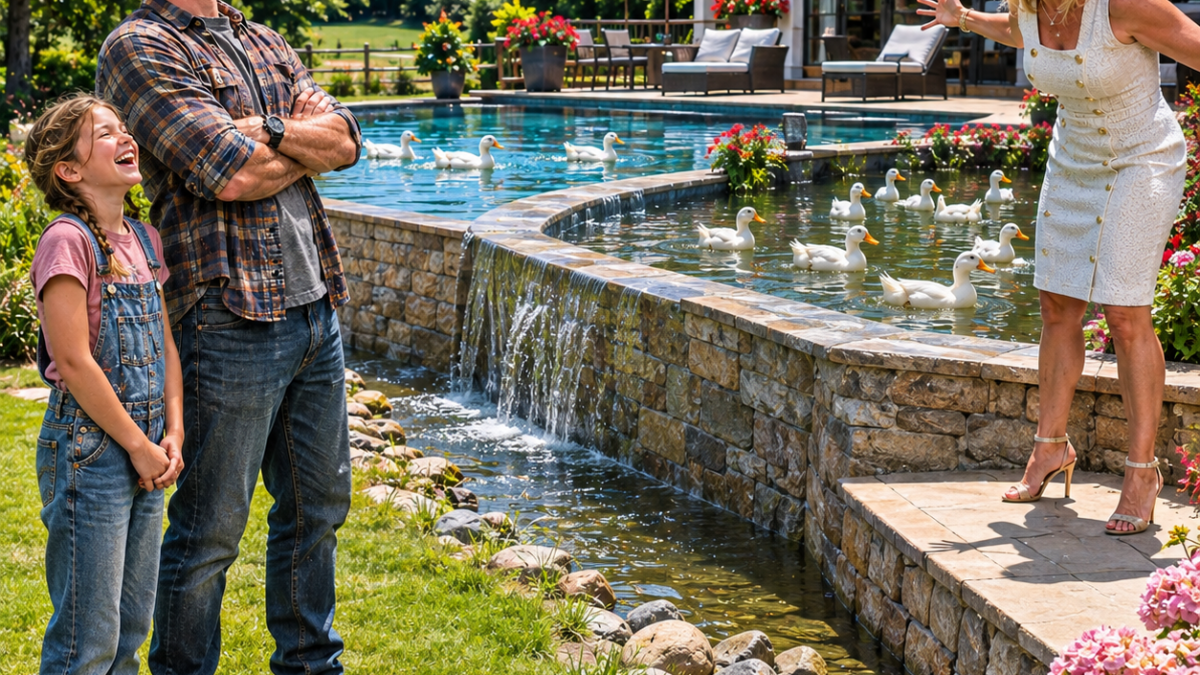
So I stopped arguing, filed every document correctly, dug a forty-by-sixty-foot pond twenty-five feet from her luxury deck, and one Thursday morning Brenda Hargrove opened her curtains to find fifty white Pekin ducks quacking at the sunrise from land she had spent months insisting should have belonged to her.
My name is Daniel Tillman.
I was forty-four when my daughter Ellie and I moved to Crestwood Meadows outside Franklin, Tennessee.
Technically, we didn’t live in Crestwood Meadows.
That distinction became the entire story.
The subdivision had eighty-six homes.
Perfect lawns.
Stone mailboxes.
Decorative streetlights.
A clubhouse that looked like somebody had copied it from a resort brochure.
Then, tucked against the eastern edge, was my parcel.
Two point three acres.
Older house.
Rolling grass.
Tree line behind it.
Red Tennessee clay underneath everything.
The parcel existed before the development.
It had never been annexed into the HOA.
Never added to the declaration.
Never subjected to Crestwood’s covenants.
The developer had simply built around it.
That was one reason I bought it.
The other reason was Claire.
My wife.
She’d been gone three years.
Ovarian cancer.
The kind that announces itself late and moves faster than your mind can understand.
One spring we were discussing replacing the kitchen floor.
By autumn, I was sitting beside a hospital bed holding her hand while a monitor made noises I still hear sometimes when the house gets quiet.
After she died, Ellie and I stayed in our Nashville home.
At first because moving felt impossible.
Then because leaving felt like betrayal.
Claire’s shampoo was still in the shower.
Her gardening gloves were in the mudroom.
PART2:
Her coffee mug remained in the cabinet where she’d left it.
For almost three years, every room reminded us who wasn’t there.
Eventually, the memories stopped feeling comforting.
They became walls.
So we sold.
Packed a U-Haul.
And drove south.
Ellie was nine.
She sat beside me with a stuffed rabbit in her lap.
When we pulled into the new driveway, she was out before I had shut off the engine.
She climbed into the trailer.
Came back carrying a cardboard box almost too heavy for her.
On the side, Claire’s handwriting:
GARDEN STUFF
Ellie carried it toward the porch carefully.
“Dad?”
“Yeah?”
“We’re planting these, right?”
I looked at the box.
Trowel.
Gloves.
Seed packets Claire had never gotten to use.
“Every single one.”
Ellie nodded.
PART3:
That first evening, we sat on the porch eating pizza from the box.
Cicadas screamed from the tree line.
The sky went pink over the pasture.
No hospital smells.
No empty rooms filled with ghosts.
Just grass.
Crickets.
Dirt.
For the first time in years, silence felt peaceful instead of cruel.
The next afternoon, a white Escalade drove up.
The woman behind the wheel didn’t knock.
She parked.
Got out.
Walked partway across my front yard while looking around as if she were assessing a hotel she’d just purchased.
Blond hair.
Large sunglasses.
Cream linen blazer despite the heat.
Clipboard.
Her name was Brenda Hargrove.
Fifty-one.
President of Crestwood Meadows HOA.
She smiled.
Too much.
“Welcome to Crestwood.”
“Thanks.”
She handed me a folder.
“Community standards.”
I didn’t take it immediately.
“I’m not part of Crestwood.”
Her smile paused.
I continued:
“This parcel predates the subdivision.”
“Yes.”
“So I’m not in the HOA.”
She gave a tiny laugh.
“Everyone here follows community standards.”
“I don’t.”
She stared.
Then:
“We’ll see about that.”
That was day two.
I should have recognized the warning.
Instead, I watched her drive away and went back to unpacking kitchen boxes.
I’m a landscape architect.
Twenty years.
Residential estates.
Commercial sites.
Drainage.
Retention ponds.
Planting plans.
Grading.
I’ve spent more hours reading plats and surveys than most people spend reading books.
So before buying the property, I knew exactly where every corner sat.
Iron pins.
Recorded bearings.
Distances.
I had a current survey.
I understood the zoning.
I also knew the old cedar fence line wasn’t perfectly aligned with the legal boundary.
So during the first two weeks, I rebuilt part of it.
Four-board cedar.
Straight.
Clean.
Entirely on my property.
Ellie helped.
Mostly by handing me screws and asking questions every forty seconds.
We planted Claire’s garden too.
Tomatoes.
Basil.
Sunflowers.
Ellie named the sunflowers after Disney princesses.
I refused to learn which was which.
She tested me daily.
That’s when Wade Prescott came over.
Sixty-two.
County surveyor, semi-retired.
Lived three lots inside Crestwood.
He leaned against my fence and watched me setting a post.
“You know where your line is?”
“Yes.”
“Good.”
He smiled.
“Was hoping somebody bought this place who understood land.”
That made me look at him.
“Why?”
His eyes moved toward Brenda’s house.
Huge two-story home overlooking my lower pasture.
“Watch yourself.”
“With Brenda?”
“You met her?”
“Unfortunately.”
Wade nodded.
“She pushed the Collins family out two years ago.”
“How?”
“Fines.”
“Pressure.”
“Lawyer letters.”
“They eventually sold.”
“I don’t belong to the HOA.”
Wade gave me a look.
“Didn’t stop her from acting like they did either.”
Two weeks later, first violation letter.
My fence.
Unapproved.
Architectural committee.
Wrong material.
I read it.
Filed it.
Did nothing.
Another week.
Truck.
“Commercial appearance.”
Then shed.
Then garden.
Every notice referenced HOA rules that did not apply to me.
I didn’t argue.
I dated them.
Saved envelopes.
Made copies.
Claire used to tease me for keeping paperwork.
She’d say:
“You’re the only man I know who files receipts for mulch.”
Turns out mulch receipts are training for war.
Then one morning before sunrise, I woke to diesel engines.
Not one.
Several.
I looked through the bedroom window.
Flatbed trailer backing down Brenda’s drive.
CAT excavator.
Concrete truck waiting on the street.
Another truck behind it.
I threw on jeans.
Walked outside.
The excavation started on Brenda’s lot.
Fine.
She wanted a pool.
Not my business.
Then the excavator moved farther.
Past the old landscaping.
Toward my cedar fence.
Bucket lifted.
One section of the fence disappeared.
Post.
Rail.
Post.
Pulled out.
Stacked on the grass.
I stood there holding coffee.
For a second, I thought maybe I’d misread the survey.
Impossible.
I walked closer.
Brenda’s husband Dwight stood beside the hole.
Licensed contractor.
Heavy build.
Hard hat.
Work boots.
Bluetooth headset.
Clipboard.
“Dwight.”
He barely looked at me.
“Morning.”
“Your excavation is across my line.”
“No.”
“Yes.”
He pointed toward pink stakes.
“HOA approved an easement.”
I almost laughed.
“What easement?”
“Board easement.”
“I’m not in the HOA.”
He shrugged.
“You’ll have to take that up with Brenda.”
Brenda sat on her patio.
Iced tea.
Sunglasses.
Watching.
I called:
“Brenda.”
She raised her glass slightly.
“The board approved it.”
I said:
“You cannot vote an easement onto somebody else’s deed.”
“If you’d attended the meeting, you’d know what was discussed.”
“I’m not a member.”
“That’s your choice.”
“No.”
“That’s the legal status of the parcel.”
She smiled.
“Your lot should’ve been incorporated years ago.”
There it was.
Not:
We made a mistake.
Not:
Let’s verify.
It should’ve been ours.
I went inside.
Pulled my deed.
Plat.
County GIS.
Survey.
Then walked the line with a hundred-foot tape.
Their excavation crossed roughly twelve feet onto my property.
The planned deck stakes reached farther.
Fifteen feet.
I photographed everything.
Time.
Date.
Excavator.
Removed posts.
Tire marks.
Crew.
License plates.
Stakes.
Called county recorder.
“Any easement filed against my parcel?”
She checked.
“No.”
“Anything pending?”
“No.”
“HOA access?”
“No.”
Good.
Certified letter to Brenda and Dwight.
Construction encroachment.
No easement.
Stop work.
Seven business days.
Restore damaged fencing.
Do not proceed.
Return receipt.
They both received it.
What happened next told me exactly who I was dealing with.
They accelerated.
Six o’clock the following morning, concrete trucks arrived.
Two.
By noon, pool shell was poured.
Kidney-shaped basin.
Infinity edge.
Part of it sitting on my property.
Brenda stood beside the wet concrete.
Arms crossed.
Smiling.
She thought concrete ended the conversation.
People do that.
They mistake expensive for permanent.
It isn’t.
A $180,000 mistake is still a mistake.
Sometimes it’s just more expensive to remove.
I called attorney Linda Chen.
Franklin.
Land-use and property disputes.
She reviewed:
Deed.
Survey.
Letters.
Photos.
HOA declaration proving my parcel excluded.
Then said:
“Don’t touch the pool.”
“I wasn’t planning to.”
“Don’t block contractors physically.”
“Document.”
“County complaint.”
“Independent survey.”
“Then demand removal.”
“Okay.”
She looked at me.
“And Daniel?”
“Yes?”
“Stop smiling.”
“I wasn’t.”
“You absolutely were.”
Maybe.
Meanwhile, Brenda started telling neighbors a different version.
I was the hostile newcomer.
The difficult single father.
The man refusing to “cooperate with community improvements.”
People who had waved at Ellie and me stopped waving.
Someone complained that my truck reduced neighborhood appearance.
Someone reported the shed.
Then anonymous code complaints started.
Junk storage.
Drainage.
Unlicensed business.
County code officer came out.
Calm guy.
Clipboard.
Walked entire property.
Looked at shed.
Truck.
Garden.
Drainage.
Then said:
“Everything looks fine.”
I asked:
“How many complaints?”
He gave me the government version of a smile.
“Enough that I know your address without looking.”
I added his report to the folder.
Brenda kept going.
Pool finished.
And I will admit something.
It was beautiful.
Dwight knew construction.
Turquoise tile.
Infinity edge.
Teak sun deck.
Cedar pergola.
Wet bar.
LED lights.
Expensive furniture.
At night, the pool glowed blue through the trees.
Only problem:
Fifteen feet of that luxury existed on my deed.
They held the first pool party Saturday.
Thirty people.
Music.
Wine.
Laughter.
I made dinner with Ellie.
Bass thumped through the open window.
She looked toward the sound.
“That’s loud.”
“Yep.”
Then:
“Is that their pool?”
“Partly.”
She frowned.
“What does partly mean?”
“Long story.”
I wasn’t giving my nine-year-old a lesson on encroachment litigation during spaghetti.
Later, Brenda apparently told guests:
“That old parcel should’ve been part of Crestwood from the beginning.”
Then:
“It’s only a matter of time.”
A board member heard her.
Tammy Solis.
Thirty-eight.
Two years on the board.
She knocked on my door the following afternoon.
Looked behind her before speaking.
“The easement vote never happened.”
I stared.
“What?”
“Brenda keeps saying the board approved one.”
“We didn’t.”
“Was there a motion?”
“No.”
“Minutes?”
“No.”
“She told us it had already been handled legally.”
I leaned against the doorframe.
Tammy swallowed.
“I have board minutes from the last three years.”
“Keep them safe.”
“I can copy them.”
“Do that.”
Then she left.
That was the first crack.
Next came Brenda’s attorney.
Four-page letter.
Prescriptive easement.
Repeated over and over.
Their argument basically said:
Community expected shared use.
Construction had occurred.
Therefore the area should be treated as easement property.
Linda read it.
Then laughed.
“Six weeks.”
“What?”
“They’re claiming prescriptive rights after six weeks.”
“That’s not how that works.”
“No.”
Her response was short.
Remove all encroachments within thirty days.
Restore property.
Or face civil claims for trespass, property damage, removal costs, and attorney fees.
Brenda responded by creating a Facebook group.
Concerned Neighbors of Crestwood Meadows.
Stock image of white fence.
Posts about “property values.”
“Community character.”
“East parcel maintenance.”
No name.
Everybody knew.
Then Ellie came home from the bus stop one Wednesday.
Dropped her backpack.
Didn’t speak.
“What happened?”
“Nothing.”
“Ellie.”
She looked at me.
“Brandon said we don’t belong here.”
I crouched.
“Why?”
“He said his mom said we’re ruining the neighborhood.”
Nine years old.
Trying to understand why adults she’d never met had opinions about whether she belonged in her own home.
I hugged her.
“You belong exactly where you are.”
That night, I sat outside alone.
Brenda’s pool glowed blue.
Claire’s garden tools were still in the shed.
The box labeled Mom’s garden stuff sat on a workbench.
And something in me shifted.
Not rage.
Clarity.
I was done trying to convince Brenda to respect boundaries voluntarily.
Next morning, I hired an independent licensed surveyor.
Not Wade.
I wanted no neighbor conflict.
Stamped survey.
Fresh pins.
Clear boundary.
Pool encroachment:
Confirmed.
Deck:
Fifteen feet.
Pergola overhang:
Two feet.
Saturday at seven, I started a privacy fence.
Six feet.
Pressure-treated posts.
Exactly on the surveyed boundary.
Straight line.
It cut through the area Brenda had treated as hers.
Three feet of her teak decking extended beyond it.
Dwight came outside.
“You can’t put that there.”
Pneumatic driver:
Pop.
Pop.
Pop.
I kept working.
“It’s on the property line.”
“You’re blocking our deck.”
“Your deck crosses my property.”
“You’ll hear from our attorney.”
“I already do.”
Finished Sunday.
Monday morning:
Three posts had been cut.
Cleanly.
Reciprocating saw.
Fresh sawdust.
I walked to a trail camera mounted near the corner.
Pulled card.
2:14 a.m.
Heavy man.
Work boots.
Saw.
Face partially shadowed.
Then one turn toward the camera.
Dwight.
I saved copies.
Three locations.
Photographed damage.
Called Linda.
Then went to county building department.
Asked for permits on Brenda’s address.
Clerk searched.
“No active permits.”
“Pool?”
“No.”
“Deck?”
“No.”
“Electrical?”
“No.”
“Pergola?”
“No.”
“Try again.”
She did.
Nothing.
That $180,000 pool had:
No building permit.
No plan review.
No electrical inspection.
No structural inspection.
No approved deck footing inspection.
No certificate.
Nothing.
Then I visited zoning.
My parcel:
AG-1.
Agricultural.
Unchanged for decades.
The subdivision developer had rezoned surrounding parcels.
Not mine.
I asked the clerk what AG-1 allowed.
She listed uses.
Agriculture.
Poultry.
Waterfowl.
Farm ponds.
I almost smiled.
“How many birds?”
She checked local requirements.
“Your acreage supports up to one hundred domestic fowl under the applicable rules, subject to health and setback requirements.”
I sat in my truck afterward.
Windows down.
Zoning printout beside me.
Then looked toward home.
My property had a low depression near the back.
Natural drainage.
Seasonal seep.
Wet even in summer.
I’m a landscape architect.
I’ve designed water features for homes where the koi cost more than my first car.
Retention basins.
Bioswales.
Natural filtration ponds.
Wetland gardens.
I knew exactly what could fit there.
A legal farm pond.
Not revenge.
Not technically.
A land-use choice.
A deeply satisfying land-use choice.
That night, I unrolled graph paper.
Forty by sixty feet.
Three feet at deepest point.
Eighteen-inch wading shelves.
Natural clay bottom reinforced where needed.
Vegetative buffers.
Cattails.
Soft rush.
Pickerel weed.
Overflow channel.
Two nesting islands.
Feeding stations.
Setback:
Twenty-five feet from Brenda’s side.
Compliant.
Visible from every chair on her sun deck.
Also compliant.
Monday, agricultural extension office.
Lorraine Kessler reviewed my plans.
“You’re establishing domestic waterfowl?”
“Yes.”
“Fifty Pekins.”
She looked at me.
“Why fifty?”
I kept a straight face.
“Seems manageable.”
She studied me.
Then smiled slightly.
“I’m not asking why you want fifty.”
“Good.”
We completed the paperwork.
Agricultural use documentation.
Pond requirements.
Waterfowl registration where applicable.
Health standards.
Setbacks.
Water management.
Everything.
Copies.
Then more copies.
If Brenda wanted paperwork?
I was going to have paperwork.
Saturday morning, mini excavator arrived.
Ellie sat on porch eating peanut butter toast.
I cut first bucket of soil.
Red clay.
Wet earth smell.
The depression was perfect.
Wade appeared Sunday with his tractor.
No speech.
Just started grading.
Ellie planted cattails.
Wildflowers.
She was more careful with spacing than some contractors I’ve hired.
Three days filling.
Water settled.
Pond cleared.
Thursday morning, I picked up fifty Pekin ducks from a farm supplier.
White.
Loud.
Unreasonable.
They quacked for the entire drive home.
Ellie heard the truck before she saw it.
Ran outside.
“ARE THOSE OUR DUCKS?”
“Apparently.”
She named the first one Quackers.
Naturally.
We opened transport crates.
Fifty white ducks waddled toward the pond in one confused mass.
Then:
Water.
Chaos.
Splashing.
Wings.
Quacking.
Ellie laughed so hard she fell into the grass.
I stood there watching her.
For a few seconds, I forgot Brenda existed.
That mattered.
We put a small sign near the drive.
TILLMAN FAMILY FARM
Ellie painted little duck silhouettes underneath.
That evening, I sat on the porch.
Sweet tea.
Fifty ducks floating twenty-five feet from Brenda’s teak sun deck.
Every permit and zoning document in a folder inside my house.
Sun went down.
Ducks kept talking.
I slept wonderfully.
6:30 next morning.
Feeding time.
Fifty Pekins greeted sunrise with the subtle restraint of a brass band falling down stairs.
Brenda’s sliding door opened.
Silence.
Then:
“What the hell is this?”
I turned.
Silk robe.
Hair rollers.
Coffee mug.
Face red.
“Morning.”
She pointed.
“At those.”
“Ducks.”
“I know they’re ducks!”
“Then we’re making progress.”
“You cannot have fifty ducks beside my pool.”
I tossed another handful of feed.
“It’s an agricultural pond.”
“You live in a subdivision!”
“No.”
“You live beside one.”
“That’s different.”
She marched toward the fence.
“They stink.”
“Sometimes.”
“They’re disgusting.”
“That’s subjective.”
“I spent a hundred eighty thousand dollars on this pool.”
I looked at the pool.
Then at my pond.
“You built part of that on my property.”
“I built this on mine.”
She stared.
I smiled.
“Looks like we both enjoy water features.”
That was when the war became about ducks.
Emergency HOA meeting.
New rule:
No livestock within five hundred feet of community property.
Passed unanimously.
Had no authority over me.
Animal control visited.
Looked at documents.
Counted birds.
“Legal.”
Left.
Health department called.
Fine.
Come inspect.
HOA attorney contacted Linda.
Then apparently advised Brenda that her association could not regulate livestock on property outside its jurisdiction.
Still not enough.
One morning, Brenda stood on her deck with an air horn.
Industrial.
She blasted it toward the pond.
Fifty ducks exploded.
Wings.
Water.
Noise.
Ellie dropped a plate inside the house.
I photographed.
Video.
Time.
Duration.
Ducks settled again in less than a minute.
Pekins are not strategic thinkers.
Brenda tried again.
I documented again.
Then she attempted to get my parcel rezoned.
She went to county zoning meeting with board allies.
Wade attended.
I didn’t.
I had counsel monitoring.
The commission chair listened.
Then explained she could not simply request somebody else’s agricultural parcel be rezoned because she disliked the lawful animals on it.
Motion went nowhere.
Wade called me afterward laughing.
“Best zoning meeting I’ve attended in twenty years.”
I walked down to the pond.
Moonlight.
Ducks asleep.
I thought:
Maybe we’re done.
We were not.
Brenda filed a health complaint.
Claimed:
Biohazard.
Groundwater contamination.
Danger to children.
Petition.
Thirty-four signatures.
I requested formal water testing.
And because drainage had now become an issue, I requested inspection of runoff from Brenda’s pool too.
Her pool discharged toward the storm system.
No obvious treatment.
No documented diversion.
Results came back.
My pond:
Within applicable standards.
Vegetation doing what I’d designed it to do.
Brenda’s pool discharge:
Chlorine levels above local stormwater limits.
No approved discharge setup located in county records.
I mailed her both reports.
Certified.
She didn’t respond.
Dwight did.
2:14 a.m.
Trail camera.
Again.
This time shovel.
He climbed over the fence.
Walked to pond berm.
Started digging.
Twenty minutes.
Channel.
Water found it.
Flowed downhill.
Onto Brenda’s lawn.
Under the edge of her deck.
Muddy pond water spreading beneath teak boards.
I watched the footage over coffee.
Then called Linda.
“Don’t touch anything yet.”
She said.
“We document first.”
So we did.
Survey.
Trespass.
Fence sabotage.
Pond-bank sabotage.
False complaints.
Air horn.
Encroachment.
Every piece.
Then Tammy Solis walked into the HOA office and resigned.
Attached six-page statement.
That was the real collapse.
According to Tammy:
The easement vote Brenda claimed?
Never happened.
Livestock amendment documentation?
Minutes did not match actual meeting.
Legal-fund approvals?
Some had been inserted after the fact.
Several recorded board motions did not correspond to meetings Tammy attended.
She had retained original notes and email versions.
Linda forwarded everything to appropriate authorities.
Brenda didn’t know Tammy had turned over documents.
She kept calling her.
Complaining about me.
Talking strategy.
Tammy documented the calls.
Then county inspections arrived.
First:
My pond.
Lorraine walked the perimeter.
Counted birds.
Checked bank stability.
Water.
Feed.
Shelter.
Fencing.
Vegetation.
Signed compliance.
Then smiled.
“Nice pond.”
“Thank you.”
Twenty minutes later, inspectors visited Brenda’s property.
The pool inspection took less than an hour.
Violation list took two pages.
No permit.
No electrical inspection.
No structural inspection.
No approved deck foundation.
Safety-barrier issues.
Encroachment.
Drainage and discharge problems.
Then the red tag.
DO NOT USE
Bright against her black iron gate.
Brenda stood on patio.
Arms crossed.
Dwight behind her.
Nobody spoke.
Three days later:
Formal stop-use and corrective order.
Then emergency HOA meeting.
Seventy-plus residents.
Clubhouse overflow.
Local reporter in back.
I carried one banker’s box.
That was enough.
Survey.
Photos.
Trail-camera video.
Permit search.
Zoning documents.
Pond approvals.
Water tests.
Tammy’s statement.
HOA minutes.
Linda stood beside me.
I spoke for eleven minutes.
No yelling.
First:
My parcel isn’t in HOA.
Second:
Survey.
Pool encroaches approximately fifteen feet.
Third:
No recorded easement.
Fourth:
No valid county permits found for pool construction.
Fifth:
My pond lies entirely within my parcel.
Sixth:
AG-1 zoning.
Seventh:
My waterfowl use documented and inspected.
Eighth:
Trail camera.
Dwight cutting my fence.
Then:
Dwight cutting my pond berm.
Room got quieter with each item.
Then Linda presented meeting records.
Side-by-side.
Recorded HOA minutes.
Contemporaneous emails and copies Tammy retained.
Dates didn’t match.
Votes recorded that witnesses said had never occurred.
Signatures repeated.
Language added.
Brenda tried interrupting.
Board chair stopped her.
“You’ll have your turn.”
Finally, I held up two photographs.
Left:
Brenda’s luxury pool.
Right:
My duck pond.
I said:
“This one crosses onto my land and was constructed without a county permit on record.”
Then pointed to pond.
“This one sits entirely on my property and passed inspection.”
Pause.
“The ducks have more paperwork than the pool.”
Silence.
Then someone laughed.
One person.
Then several.
Then applause.
I didn’t plan the line.
Probably shouldn’t have enjoyed it.
I did.
Motion to remove Brenda as president.
Vote:
71 to 4.
She stood.
Picked up purse.
Walked out.
Dwight followed.
No speech.
No screaming.
That was almost disappointing.
Outside, she was served with civil papers connected to the property dispute.
The larger investigations continued separately.
Six weeks later, court ruled on the encroachment.
Structures crossing my property had to be removed.
At the Hargroves’ expense.
That included part of:
Pool shell.
Deck.
Pergola.
Related work.
The contractors arrived on a Tuesday morning.
Jackhammers.
Excavator.
Three workers.
I stood on my porch.
Not celebrating.
Watching.
Teak deck came first.
Boards.
Rails.
Then concrete.
Crack.
Crack.
Dust.
Red clay underneath.
The same Tennessee dirt that had been there before Brenda arrived.
Dwight watched from his patio.
Brenda stayed inside.
Curtains closed.
Demolition alone cost tens of thousands.
Then came civil settlement.
Property damage.
Trespass-related losses.
Legal fees.
Restoration.
Documented damages.
Dwight faced contractor-license consequences tied to unpermitted work and other conduct.
Brenda faced separate consequences over falsified HOA records.
I didn’t dance.
Didn’t throw a party.
Didn’t send her duck eggs.
Thought about it.
Didn’t.
Then spring came.
Something unexpected happened.
Parents started stopping at my gate.
“Can the kids see the ducks?”
At first:
No.
Then:
Maybe.
Then Ellie said:
“Dad, they’re just ducks.”
She was right.
So I built a gravel path around the pond.
Small observation deck.
Benches.
Sign explaining waterfowl.
Plants.
Filtration.
No HOA ownership.
No easement.
Public access only when we opened it.
That distinction still mattered.
We partnered with local 4-H volunteers.
Waterfowl education.
Pond ecology.
Agricultural land use.
Kids learned how cattails filter nutrients.
Ellie became the youngest person helping with demonstrations.
Nine years old.
Could identify sixteen duck breeds.
Could explain nitrogen cycling better than half the adults.
She started selling duck eggs.
Four dollars a dozen.
College fund.
Claire would’ve approved immediately.
Probably would’ve raised the price.
The neighborhood eventually created Crestwood Duck Day.
Not my idea.
There were games.
Food.
Pond tours.
Kids feeding ducks under supervision.
The new HOA leadership helped sponsor it.
On my terms.
Written agreement.
Temporary access.
No claim to property.
Funny how easy cooperation becomes once nobody is pretending they own you.
One October evening, I sat on the observation deck.
Sunset turned water copper.
Fifty ducks floated across the pond.
Ellie stood at feeding station.
Quackers followed her like a dog.
I thought about Claire.
She would’ve loved it.
Not the lawsuit.
Not Brenda.
The pond.
The garden.
Ellie laughing.
Families walking the trail.
She always said landscapes should feel lived in.
Not merely designed.
Footsteps behind me.
Wade.
Two beers.
He handed me one.
Sat.
We watched quietly.
Then he raised the bottle.
“You did good, Tillman.”
I looked toward the space where Brenda’s pool had once crossed the boundary.
Grass now.
Fence restored.
Nothing dramatic.
“Yeah.”
Then looked at Ellie.
“We did.”
People sometimes tell the story like I built the duck pond purely to torment Brenda.
That’s not completely false.
But it isn’t completely true either.
I was angry.
Of course I was.
She tore down my fence.
Built across my property.
Lied about an easement.
Used the HOA to harass us.
Dragged my daughter into neighborhood gossip.
Then behaved as if money poured into concrete could change a deed.
So yes.
When I discovered agricultural zoning allowed fifty ducks twenty-five feet from her sun deck, I smiled.
I’m human.
But there’s a difference between retaliation and exercising your own rights lawfully.
I didn’t dump waste into her pool.
Didn’t damage her deck.
Didn’t trespass.
Didn’t blast music.
Didn’t poison anything.
Didn’t sabotage construction.
I filed forms.
Followed setbacks.
Built drainage.
Passed inspections.
When she tried every office she could think of, my paperwork held.
That was the point.
Brenda believed rules were weapons for powerful people.
She had spent years writing notices.
Calling inspectors.
Passing amendments.
Creating minutes.
Using procedure as intimidation.
So I gave her something she’d never expected.
Someone who respected procedure more than she did.
The pond was legal.
The ducks were legal.
The fence was legal.
Her pool?
Not so much.
The irony became impossible to escape.
She stood on a deck built partly on my property screaming that animals on my property were ruining her view.
One morning, she said:
“Get those disgusting birds away from my pool before I poison every one of them.”
I had my phone recording.
I said:
“They’re on my land.”
“I don’t care.”
“I paid one hundred eighty thousand dollars for this.”
I looked at the survey stake.
“Part of what you paid for is fifteen feet inside my property.”
She shouted something about me being a broke little farmer.
That one amused me.
I had spent twenty years designing estates worth more than her entire subdivision.
But that didn’t matter.
Money didn’t determine who was right.
Deed did.
Survey did.
Permit did.
She made another mistake that morning.
“You think everybody owes you something because your wife died.”
I stopped smiling.
Ellie was inside.
I hoped she hadn’t heard.
Brenda kept talking.
“Your lot should have belonged to Crestwood from the beginning.”
There.
Again.
Her real belief.
Not:
I made a boundary error.
Not:
The contractor misread a stake.
My property should have belonged to her community.
That’s why compromise never worked.
You can’t negotiate a boundary with someone who believes your side shouldn’t exist.
So I stopped trying.
The law handled the rest.
Months after everything ended, Tammy came by.
She apologized.
“I voted with Brenda for two years.”
“I know.”
“She intimidated everybody.”
“I know.”
“That doesn’t excuse me.”
“No.”
She nodded.
“I should’ve asked for documents.”
“Yes.”
“I should’ve checked the minutes.”
“Yes.”
She smiled slightly.
“You’re not going to make this easy.”
“You didn’t come here for easy.”
“No.”
She looked toward the ducks.
Then:
“I’m trying to do better.”
That mattered.
People like to divide stories into heroes and villains.
Reality is messier.
Tammy failed.
Then told the truth.
Wade stayed quiet for years.
Then helped.
Some neighbors believed Brenda because they had no reason not to.
Then changed their minds when they saw evidence.
Even Dwight wasn’t a cartoon.
He was a talented contractor who made terrible choices because the person closest to him convinced him rules were obstacles.
He knew better.
That’s why consequences mattered.
But understanding how somebody fails isn’t the same as excusing it.
The new HOA board is boring now.
Excellent.
Published minutes.
Actual votes.
No invented easements.
No anonymous smear groups run by leadership.
No rules aimed at one nonmember parcel.
My property remains outside the association.
Always will.
They ask before using the pond for events.
I say yes sometimes.
No sometimes.
Nobody argues.
The privacy fence remains along the boundary.
One section has a little gate.
Locked except when the pond is open.
Ellie painted a duck on it.
Brenda eventually sold.
A family with two kids bought her house.
First week, the father walked over.
He looked nervous.
“Mr. Tillman?”
“Daniel.”
“I wanted to talk about the pond.”
Here we go.
“Okay.”
“My daughter loves ducks.”
I laughed.
“That’s the problem?”
“Pretty much.”
He asked whether they could visit.
“Saturday mornings.”
“Bring old shoes.”
“Don’t feed bread.”
He nodded seriously.
Then:
“One more thing.”
“What?”
“Where exactly is the property line?”
Smart man.
I showed him.
Survey pins.
Recorded plat.
Fence.
We have never had a problem.
That’s how normal neighbors work.
Ask.
Verify.
Respect.
Nobody needs a $180,000 court lesson.
Quackers got older.
So did Ellie.
The original fifty ducks changed over the years.
Some died naturally.
Some went to other small farms.
We never kept exactly fifty forever.
But people still call it the fifty-duck pond.
Ellie is older now and deeply embarrassed by the name Quackers.
I remind her she chose it.
She denies everything.
Claire’s sunflowers grow near the house every summer.
Not the original plants, obviously.
Their descendants.
Ellie keeps collecting seeds.
Every spring, we plant them.
That’s the part of the property I care about most.
Not the boundary.
Not the duck pond.
Not where Brenda’s pool used to be.
The garden.
Because that’s why we came.
To start living again.
Brenda turned our first year into a legal war.
I resented her for that.
Then eventually realized she had accidentally pushed me into building something Ellie and I might never have built otherwise.
The pond became our place.
Then part of the community.
I would never thank Brenda for what she did.
That’s too simple.
Bad behavior doesn’t become good because something positive grows afterward.
But people can turn damage into something useful.
That’s different.
The morning the demolition crew finished, I walked to the boundary.
Brenda’s lawn was torn up.
Red clay everywhere.
Her infinity pool reduced back inside the lawful footprint after the encroaching sections were removed and reconstructed according to the final resolution.
My side?
Grass damaged.
Fence being restored.
Duck pond twenty-five feet away.
Quackers waddled over.
Bit my bootlace.
I laughed.
For months I’d imagined that moment would feel like victory.
It didn’t.
It felt like quiet.
No machinery after the crew left.
No air horn.
No lawyers calling.
No Facebook posts.
Just ducks.
And for the first time since moving in, I realized the conflict was actually ending.
Ellie came outside.
“Dad?”
“Yeah?”
“Can we add flowers by the observation deck?”
“What kind?”
“Mom’s.”
I looked at her.
“Sunflowers?”
She nodded.
So we did.
Now every summer, tall yellow flowers grow beside the pond.
Ducks underneath.
Kids on the trail.
The exact spot Brenda complained would destroy property values became one of the places neighbors liked most.
Funny how that works.
I kept every document.
Still do.
Original HOA violation.
False complaints.
Survey.
Permit search.
Pond records.
Water tests.
Trail-camera photographs.
Tammy’s statement.
Settlement.
Not because I expect another war.
Because paperwork tells the story without emotion.
Brenda once stood on her deck and told me:
“You’re nothing but a broke man playing farmer.”
Maybe.
I was a widower.
A father.
Landscape architect.
Man trying to start over.
For a while I probably was playing farmer.
Then fifty ducks showed up and made it official.
But titles didn’t matter.
Her title didn’t.
Mine didn’t.
The deed mattered.
The boundary mattered.
The truth mattered.
That’s what she never understood.
She thought being HOA president meant the board could vote reality into existence.
Vote an easement.
Vote livestock away.
Vote a property into compliance.
Vote minutes into a history that never happened.
But there are things a board vote cannot change.
A recorded deed.
A survey pin.
County zoning.
Property you do not own.
Brenda could call fifty meetings.
Hire ten lawyers.
Collect a hundred signatures.
None of those could move the line fifteen feet.
She tried.
The pool didn’t.
The fence didn’t.
The ducks certainly didn’t.
Sometimes Wade still comes by in the evening.
We sit on the observation deck.
He brings beer.
Ellie is usually somewhere with friends now.
The pond gets quiet at sunset.
Ducks settle.
Cicadas start.
And every once in a while Wade looks toward the Hargrove house and laughs.
“What?”
I ask.
He shakes his head.
“She spent one hundred eighty grand trying to improve her view.”
“Yeah.”
“You spent what on this pond?”
“Less.”
“Much less.”
“Much.”
He raises his bottle.
“And everybody likes yours better.”
I tell him that’s not the point.
He says it absolutely is.
Maybe both.
If you ask what ended Brenda Hargrove’s control of Crestwood Meadows, people will say:
The ducks.
That’s funnier.
But wrong.
The ducks were just white feathers floating on water.
What ended Brenda’s control was a stack of documents.
A survey she couldn’t move.
A permit search she couldn’t invent.
A zoning classification she couldn’t vote away.
Trail-camera footage she couldn’t explain.
Board minutes that didn’t match her story.
And eventually enough people willing to stop believing her simply because she held the clipboard.
The ducks just made sure she had to look at the consequences every morning.
And I admit:
They were very good at that.
Brenda built an unpermitted luxury pool fifteen feet into my property because she believed enough concrete could make the boundary disappear.
I built a legal pond twenty-five feet away because I knew boundaries don’t disappear just because someone dislikes them.
Her pool ended with jackhammers.
My pond ended with an observation deck, sunflowers, children feeding ducks, and my daughter laughing in a place that finally felt like home.
So if you ever drive past Crestwood Meadows and hear fifty ducks before you see them, don’t worry.
They’re not lost.
They’re exactly where they’re supposed to be.
On my land.








