HOA Karen Built 22 Luxury Homes on My Ranch While I Was Gone—Then Every Homeowner Had to Pay Me Rent
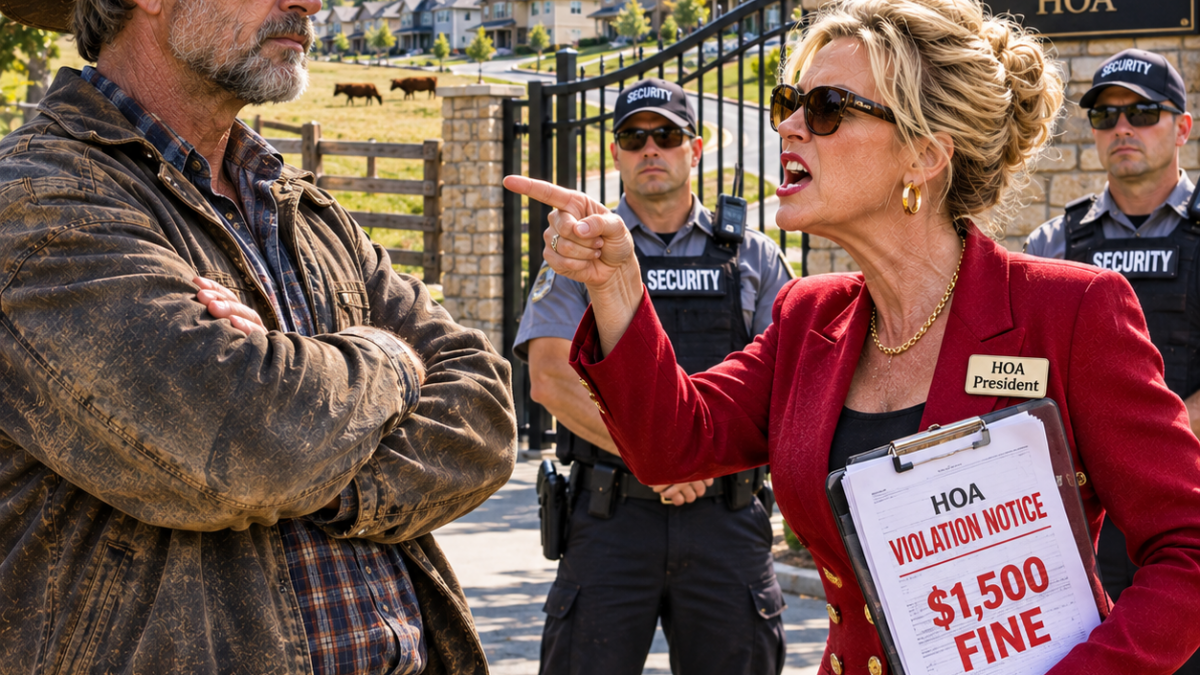
HOA Karen Built 22 Luxury Homes on My Ranch While I Was Gone—Then Every Homeowner Had to Pay Me Rent.
After twenty-four months working in Alaska, Leland Granger came home to Colorado and found an electric gate, twenty-two luxury houses, and an HOA president telling him he was trespassing on the ranch his father had spent forty years building.
The deed supposedly proving he had sold forty-two acres carried his real signature—but investigators soon discovered someone had copied it from an unrelated road permit, attached it to a fake power of attorney, and quietly moved his property line more than nine hundred feet.
When the court finally restored the land to Leland, he had enough leverage to put twenty-two innocent families out of their homes, but the choice he made instead turned the people who once cursed him into his tenants—and exposed the woman who had stolen his ranch.
For two years, Leland Granger pictured the same road whenever Alaska became too dark.
Not the highway.
Not an airport runway.
Not the gravel access roads that cut through the spruce forests where he had spent most of those twenty-four months supervising a federal watershed-restoration project.
He pictured Ash Creek Road.
A narrow strip of dirt his father had graded by hand decades earlier through the southeastern corner of Ash Creek Ranch.
It was never beautiful.
In spring, snowmelt turned the lower section soft enough to swallow a pickup tire.
In August, sage dust coated everything.
In winter, wind piled snow against the old stone fence until sometimes even the fence disappeared.
But it was home.
Leland was fifty-three years old when he finished the Alaska contract.
Broad-shouldered.
Quiet.
Sun-browned even after two northern winters.
He had spent most of his life outdoors and had acquired the habit of speaking only when silence stopped being useful.
His father, Calvin Granger, used to say:
“A man who talks while he’s angry usually gives the other fellow free ammunition.”
Leland had listened.
Most of the time.
Ash Creek Ranch covered a hundred sixty acres in Red Willow County, Colorado.
Open grass.
Creek bottom.
Cottonwoods.
One old horse barn.
A smaller equipment shed.
A two-story farmhouse that had been rebuilt twice after storms.
The southeastern pasture consisted of forty-two acres of the best grazing on the property.
Not because the grass grew better.
Because it stayed greener longer.
PART2:
Ash Creek curved along the lower edge and left enough moisture in the soil to carry cattle through dry summers.
Calvin had bought the first eighty acres when Leland was still a child.
Added forty more ten years later.
Then another forty after a neighboring family retired.
He did not inherit wealth.
He built acreage.
One loan.
One fence.
One winter at a time.
When Calvin died, Leland bought out his sister’s interest instead of splitting the property.
She lived in Denver.
She wanted cash.
He wanted the ranch.
Nobody argued.
The deed had been simple.
Clean.
Recorded.
Leland stored the original in his father’s steel safe behind the pantry.
He carried a certified copy in his truck whenever he traveled for long work assignments.
That habit seemed old-fashioned to friends.
After what happened, nobody made fun of it again.
He had left Colorado twenty-four months earlier for a project expected to last eighteen.
Then flooding damaged two remote work sites.
The contract extended.
PART3:
Then wildfire cleanup added another season.
The money was good.
Very good.
Enough to replace fencing, repair the barn roof, and maybe buy a small herd of registered Angus instead of rebuilding slowly from auction cattle.
Leland had arranged for a neighboring rancher named Earl Jensen to check the main house and keep weeds down.
No livestock remained except three horses boarded elsewhere.
Property taxes were on automatic payment.
Insurance stayed active.
Mail forwarded.
Nothing complicated.
Or so he believed.
The day he came home was bright and dry.
Late September.
Colorado sky so blue it looked artificial.
He turned off the county highway, rolled down his window, and smelled sage.
For the first time in months, his shoulders relaxed.
Then he hit the brakes.
An electric gate stood across Ash Creek Road.
Black iron.
Stone pillars.
Security keypad.
Camera.
Where his father’s cattle guard should have been.
Leland sat behind the wheel with one hand frozen on the steering wheel.
For several seconds, his mind tried to solve the scene as if he had accidentally taken the wrong turn.
Then he saw the oak trees.
Five of them.
Old.
Crooked.
Planted beside the road before he was born.
Same trees.
Beyond them:
Fresh asphalt.
Decorative lamp posts.
Concrete sidewalks.
Mailboxes lined in perfect rows.
And a large stone monument.
CEDAR RIDGE ESTATES
PRIVATE HOA COMMUNITY
Leland got out of his truck.
Walked toward the gate.
Looked through.
Houses.
Big ones.
Two stories.
Tile roofs.
Three-car garages.
Landscaping.
Fresh sod.
Children’s bicycles.
SUVs.
A man washing a black pickup.
A woman carrying groceries.
Leland counted.
One.
Two.
Three.
Seven.
Twelve.
Seventeen.
Twenty-two.
Twenty-two houses.
On land where cattle had grazed twenty-four months earlier.
His eyes found the old horse barn in the distance.
Tin roof still there.
Then the lone cottonwood near Ash Creek.
And finally the massive oak at the southeastern pasture.
It now stood inside somebody’s backyard.
There was no mistake.
These homes were on his ranch.
A white SUV came down the new road.
Stopped beside his truck.
The driver’s door opened.
A woman stepped out wearing a cream blazer, designer sunglasses, and heels that looked ridiculous on the edge of a ranch road.
Two security guards followed in a golf cart.
She walked directly toward him.
“Good afternoon.”
Leland did not answer.
“My name is Blythe Kessler.”
Still nothing.
“I’m president of Cedar Ridge Homeowners Association.”
Leland looked past her.
At the houses.
Then:
“What happened to my road?”
Her expression shifted.
Only slightly.
“I’m sorry?”
“This road.”
“My cattle guard.”
“My fence.”
“My pasture.”
Blythe removed her sunglasses.
“Do you have a visitor pass?”
Leland looked at her.
For the first time.
“No.”
“Then you cannot enter beyond the gate without authorization.”
“This is Ash Creek Ranch.”
“Not this portion.”
“Yes.”
“No.”
Her voice stayed pleasant.
That irritated him more than anger would have.
Leland pointed toward the barn.
“That barn belongs to me.”
“Your remaining ranch lies beyond the western boundary.”
“Remaining?”
Blythe sighed.
Like a teacher explaining something tedious.
“The southeastern parcel transferred almost two years ago.”
“To who?”
“Cedar Ridge Land Holdings.”
“I’ve never heard of Cedar Ridge Land Holdings.”
“Then you should speak with whoever handled your transaction.”
“I handled my transaction.”
“You clearly did not.”
One security guard shifted.
Leland turned toward him.
The man looked away.
“Who sold the land?”
Blythe smiled.
“According to the county?”
She lowered her sunglasses again.
“You did.”
That was the first moment Leland felt something colder than confusion.
Not panic.
Not yet.
Something instinctive.
The feeling a rancher gets when a horse stops before a bridge.
Something is wrong before you know what.
Blythe reached into a leather folder.
Pulled out a paper.
“Because you have entered a restricted access area without authorization, this is a violation notice.”
Leland took it.
$1,500.
UNREGISTERED VEHICLE.
UNAUTHORIZED ENTRY.
FAILURE TO COMPLY WITH COMMUNITY SECURITY.
He folded it once.
Put it in his shirt pocket.
Then asked:
“Do you know who my father was?”
Blythe blinked.
“No.”
“That explains some things.”
She straightened.
“Mr.—”
“Granger.”
“Mr. Granger, this matter was legally settled long before today.”
“No.”
She smiled.
“You may believe that.”
“I do.”
“Unfortunately belief does not override recorded documents.”
Leland nodded once.
“On that point, we agree.”
He started toward the gate.
One guard stepped in front.
“Sir.”
“I’m going to my barn.”
“You cannot enter.”
“My barn is on the other side.”
“You’ll need to use the western ranch entrance.”
“That adds six miles.”
“Yes.”
Leland stared at him.
Then Blythe.
“Open the gate.”
“No.”
“Open it.”
Blythe took out her phone.
“If you refuse to leave, I’m calling the sheriff.”
Leland turned.
Walked back to his truck.
Blythe smiled.
Too early.
He opened the driver’s door.
Reached inside.
Started the engine.
Then left it parked exactly where it was.
Blocking the entrance.
He leaned against the hood.
“Go ahead.”
Blythe frowned.
“Excuse me?”
“Call.”
She did.
Her voice changed for the dispatcher.
Urgent.
Concerned.
“There’s a hostile stranger at our gate.”
Hostile.
Leland looked at the twenty-two houses.
A few residents had stepped outside.
Phones appeared.
He said nothing.
Twenty minutes later, Sheriff Heath Barlow drove up.
Heath was fifty.
Weathered face.
Brown uniform.
The kind of sheriff who still knew the names of ranch families because he had grown up among them.
He got out.
Looked at Leland.
Then the gate.
Then back.
“Leland?”
“Morning, Heath.”
“When’d you get back?”
“Twenty minutes ago.”
Heath slowly looked toward the houses.
“That explain the face?”
“Somewhat.”
Blythe hurried over.
“Sheriff, thank you.”
She held out documents.
“This gentleman is refusing to leave private HOA property.”
Heath did not take her papers yet.
He looked at Leland.
“You got ID?”
Leland handed it over.
Then opened his glove box.
Certified deed.
Old plat.
Property-tax statement.
Heath read.
Then looked through the gate again.
Blythe said:
“The southeast section was transferred.”
Heath finally took her documents.
“Recorded?”
“Yes.”
“Who signed?”
“Mr. Granger.”
Leland said:
“No.”
Blythe snapped:
“It’s in the county record.”
Heath kept reading.
“This is not something I’m settling at a gate.”
Blythe frowned.
“He is trespassing.”
“He has documentation showing ownership of Ash Creek Ranch.”
“Outdated documentation.”
“Maybe.”
He handed the papers back.
“But there’s enough conflict here that I’m not arresting anybody for trespass based on what I’ve got.”
Blythe’s jaw tightened.
“He cannot enter Cedar Ridge.”
Heath looked at Leland.
“You got another route to your main house?”
“Yes.”
“Use it for now.”
Then to Blythe:
“And nobody touches any remaining ranch property until title is verified.”
“He has no remaining rights in this section.”
Heath gave her a long look.
“That’s what needs verifying.”
Leland drove away.
Not because Blythe won.
Because Calvin had taught him another rule.
When you do not understand the battlefield, stop walking.
The western entrance took twelve minutes.
He passed the old barn.
His father’s stone fence.
Then reached the farmhouse.
Inside, dust had collected along the windowsills.
Everything else looked right.
Earl had done what he promised.
Refrigerator running.
Water on.
No broken pipes.
Leland carried one duffel bag into the kitchen.
Then went to the pantry.
Pulled the steel safe open.
The original deed was exactly where he had left it.
Plastic sleeve.
Calvin Granger to Leland Granger.
One hundred sixty acres.
Legal description.
Recorded.
Leland laid it on the table.
Then put Blythe’s violation notice beside it.
Outside the kitchen window, the new neighborhood glowed after sunset.
Twenty-two sets of porch lights.
Streetlamps.
A row of roofs across the pasture.
Leland sat alone.
For the first time all day, he said aloud:
“I never sold a single acre.”
The kitchen gave him no answer.
He looked toward the lights.
“So who signed the papers?”
He was outside the Red Willow County Records Office ten minutes before it opened.
The clerk was young.
Probably twenty-five.
She entered the parcel number.
Then frowned.
“Mr. Granger?”
“Yes.”
“It shows a split.”
“When?”
“Twenty-one months ago.”
She turned the monitor.
Ash Creek Ranch.
Original 160 acres.
Then subdivision.
Forty-two acres transferred.
Cedar Ridge Land Holdings LLC.
Recorded sale amount:
$480,000.
Leland almost laughed.
“Four hundred eighty thousand?”
“That’s what it says.”
“That land was worth more than that before anybody built a house.”
The clerk looked uncomfortable.
“You’ll probably want certified copies.”
“Everything.”
She printed the deed.
Leland stared at the signature.
LELAND GRANGER.
It looked like his.
Not similar.
His.
Then the power of attorney.
Again:
LELAND GRANGER.
Notary stamp.
Authorization giving Cedar Ridge Land Holdings broad power to negotiate, transfer, subdivide, and convey the southeastern parcel.
Leland read the date.
His hands became still.
He knew exactly where he had been.
Three thousand miles north.
Alaska.
River drainage site.
Satellite camp.
He had payroll.
Flight logs.
Daily reports.
Employment records.
Photographs.
GPS-tagged project files.
On the day he supposedly signed away forty-two acres of Colorado ranch land, he had been standing beside a flooded channel in Alaska.
The clerk pointed.
“There’s another strange thing.”
“What?”
“Mailing address.”
Not the ranch.
Not Alaska.
A private commercial mailbox in Denver.
Every county notice concerning the split had gone there.
“Who owns it?”
“I don’t know.”
“Can you find out?”
“Not here.”
Property taxes complicated things further.
Leland’s automatic payments had continued.
When the county divided the parcel, excess payments from his original account did not generate an obvious warning.
Part of the money sat in suspense awaiting reconciliation.
The system had happily accepted his tax payments while somebody else sold his land.
By three that afternoon, Leland sat across from attorney Tessa Langford.
Forty-one.
Sharp.
Dark hair tied back.
Fifteen years handling title fraud, easement fights, mineral disputes, and boundary cases.
She read without interrupting.
Original deed.
Fraudulent transfer.
Power of attorney.
Alaska records.
Violation notice.
Then:
“If your signature was forged, this conveyance may be void.”
“May?”
“Lawyers say may before courts say is.”
“I never signed it.”
“I believe you.”
“Then why is this complicated?”
She leaned back.
“Because twenty-two families bought homes.”
“They bought stolen land.”
“Maybe.”
“No.”
“They did.”
“Leland.”
She waited.
“Those buyers probably have deeds.”
“Mortgages.”
“Title insurance.”
“They paid real money to people who appeared in the record to own the land.”
“That does not make the original transfer valid.”
“But it means we cannot pretend the houses aren’t there.”
“I’m not.”
“You cannot bulldoze them.”
“I don’t want to.”
“You cannot show up tomorrow demanding rent.”
“I haven’t.”
“Good.”
She tapped the document.
“We first prove the transfer was fraudulent.”
“Then quiet title.”
“Then sort out everything built on top of the fraud.”
Leland nodded.
“What do you need?”
“Everything from Alaska.”
“Done.”
“Original signature samples.”
“Done.”
“Your pre-departure paperwork.”
“I’ll look.”
“Developer records.”
“You get those?”
“With subpoenas if necessary.”
Then she said:
“And patience.”
Leland looked out the window.
“I’ve got less of that.”
“You’ll grow some.”
He almost smiled.
Tessa filed notice of title dispute that afternoon.
No additional construction.
No future sales without disclosure.
Then she began digging into Cedar Ridge Land Holdings.
The LLC had been formed twenty-three months earlier.
Registered agent:
Martin Vale.
The name meant nothing.
But Martin Vale’s office address matched a consulting company called Kessler Strategic Property Services.
Managing member:
Blythe Kessler.
Tessa rotated her laptop.
“Your HOA president’s name is not on the land-holding company.”
“But her company shares the agent.”
“Yes.”
“Coincidence?”
“I don’t bill clients for believing in coincidences.”
Certified originals arrived two days later.
Leland and Tessa spread them across a conference table.
Power of attorney.
Grant deed.
Parcel split.
Subdivision plat.
Road dedication.
Leland stared at his signature.
Then suddenly stopped.
“Wait.”
“What?”
“I’ve seen this.”
“You signed another document like it?”
“No.”
He leaned closer.
“This exact signature.”
He closed his eyes.
Before Alaska, a survey contractor had asked permission to use Ash Creek Road.
County drainage project.
Ninety-day temporary access.
Nothing more.
Leland had signed on the hood of the contractor’s truck.
Blue ink.
He remembered because rain had begun.
The bottom of the page got wet.
Tessa requested a copy.
It arrived the next morning.
She placed both signatures side by side.
Identical.
Not just similar handwriting.
Identical curves.
Pressure marks.
Spacing.
The exact weird upward hook Leland put on the final R.
Tessa whispered:
“They copied it.”
Someone had taken a legitimate signature from a harmless access permit.
Digitized it.
Placed it beneath entirely different language.
Then used it as the foundation for a sweeping power of attorney.
Leland stared.
“They used the road permit.”
“Yes.”
“To sell the ranch.”
“Forty-two acres of it.”
That changed the case emotionally.
A forged signature would have angered him.
Using a real one made it feel like burglary.
They had taken something he actually agreed to and weaponized it.
Tessa sent Blythe a preservation and demand letter.
By the next evening, Cedar Ridge held an emergency meeting.
Blythe stood beneath a chandelier.
Twenty-two homeowners filled the room.
Some were angry.
Most scared.
She told them:
“A man who voluntarily sold his property and disappeared for two years has returned hoping to exploit homeowners.”
Leland was not there.
He heard recordings later.
Blythe continued:
“He accepted payment.”
“He authorized subdivision.”
“Now he wants to use outdated ranch documents to extort families.”
Marla Brennan stood.
Fifty-seven.
Owner of house fourteen.
Paid almost eight hundred thousand dollars.
“How serious is this?”
Blythe smiled.
“Not serious.”
“Then why are we holding an emergency meeting?”
A few heads turned.
Blythe said:
“Because misinformation creates fear.”
She distributed glossy plats.
Clean lines.
Cedar Ridge subdivision.
Ash Creek Ranch shown well west.
Everything looked perfect.
Marla asked:
“Has an attorney reviewed title?”
“Multiple.”
“Then why is the county recording a dispute?”
“Standard legal tactic.”
“Can he take our houses?”
“No.”
Too quick.
That answer would bother Marla later.
At the time she wanted to believe it.
Two days later, Leland drove to the Cedar Ridge gate with formal notices for the HOA board.
Blythe was waiting.
Six guards.
A document.
“Sign this.”
“What is it?”
“Agreement that you will not enter Cedar Ridge property while the dispute is pending.”
“No.”
“It protects homeowners.”
“No.”
“You’re creating instability.”
“You built twenty-two houses on my ranch.”
“You sold it.”
“Then prove it.”
“We have.”
“No.”
“You have a paper with my stolen signature.”
One guard reached for Tessa’s folder.
Leland pulled it back.
The guard grabbed his wrist.
For one second, everybody froze.
Then Leland said:
“Look at my dashboard.”
The guard glanced.
Dash camera.
Red light.
Recording.
He released him.
Blythe’s calm disappeared.
“You have no rights here!”
Two homeowners walking dogs stopped.
Leland placed the notices on the hood of her white SUV.
“Then proving who owns the dirt underneath those houses should be easy.”
He left.
Three days later, the HOA mailed him a violation.
His grandfather’s stone-and-wire fence allegedly violated Cedar Ridge aesthetic standards.
$500 per day until removed.
Leland brought it to Tessa.
She read.
Then laughed.
“That’s bold.”
“Can they do it?”
“No.”
“Good.”
She responded:
Mr. Granger is not an HOA member.
Ash Creek Ranch is not subject to your declaration.
Your association lacks authority to regulate his fence.
Any attempt to remove it will be treated as intentional destruction of property under active litigation.
The fines stopped accumulating on paper.
Blythe never formally withdrew them.
Saturday morning, a car pulled up to Leland’s farmhouse.
Marla Brennan stepped out.
No anger.
No blazer.
Jeans.
Sweater.
She stood on the porch.
“I need to ask you something.”
“Come in.”
“I don’t want coffee.”
“Didn’t offer.”
That surprised a laugh out of her.
She sat at the kitchen table.
“My husband and I put almost everything we had into that house.”
Leland nodded.
“We moved here to retire.”
“I understand.”
“Do you?”
“Yes.”
She looked at him.
“You keep saying the land is yours.”
“It is.”
“If you win, what happens to us?”
“I don’t know yet.”
“That scares me.”
“I know.”
“Blythe says you want to destroy the neighborhood.”
“She lies.”
“How do I know you don’t?”
Leland stood.
Went to a cabinet.
Brought out an old photo album.
Opened it.
Photographs from three years earlier.
The forty-two-acre pasture.
Cattle.
Stone fence.
Ash Creek.
The lone oak.
He turned the album toward her.
Marla’s face changed.
“That tree…”
“Recognize it?”
“It’s in my backyard.”
Leland nodded.
She turned the page.
Cattle trail.
Curve.
Same shape as her driveway.
Then a photograph of Calvin Granger repairing the stone fence.
Date written beneath.
Marla touched the edge.
“This was all yours.”
“Still is unless a judge says otherwise.”
She sat quietly.
Then:
“Blythe told us Cedar Ridge bought raw land from an investment company.”
“That investment company got it from me on paper.”
“But you were in Alaska.”
“Yes.”
Marla left without asking him to drop the case.
That mattered.
That night, Leland found an envelope wedged inside his screen door.
No name.
Inside:
An old Cedar Ridge planning map.
Dated before construction.
The neighborhood stopped well before Ash Creek pasture.
In blue ink:
COMPARE EASTERN RANCH BOUNDARY.
THEY MOVED IT.
Tessa hired Aubrey Pritchard.
Licensed surveyor.
Forty-six.
Known across western Colorado for two things.
Precision.
Bad manners when people interfered with precision.
She pulled:
Historic section corners.
Original ranch descriptions.
County monument notes.
Prior boundary surveys.
Subdivision plats.
Then installed a GPS base station and began walking the property.
For three days she measured.
Leland followed.
Not because she needed help.
Because he needed to see.
Fourth morning:
“Tessa needs to come.”
“Why?”
“Because somebody moved your ranch nine hundred feet.”
The new development plat had shifted the eastern boundary.
Not inches.
Not survey ambiguity.
More than nine hundred feet.
That shift swallowed exactly the forty-two acres.
On the ground, several historic monuments were missing.
Some buried during grading.
Some apparently removed.
Then Aubrey found one.
Behind house nine.
Flower bed.
Eighteen inches beneath mulch and imported topsoil.
Granite.
Set in concrete.
Carved notch.
Matched the 1950s survey notes exactly.
Leland watched her brush soil away.
“That’s it?”
“That’s one anchor.”
“Enough?”
“Combined with everything else?”
She smiled.
“Somebody has a terrible week coming.”
The original planning records contained another revelation.
Cedar Ridge had never been approved to expand onto Ash Creek Ranch.
The developer filed a new subdivision plat at the same time as the suspicious deed.
The fake deed made the plat look legitimate.
The recorded plat then made later title searches look legitimate.
Each false document supported the other.
Homebuyers saw a clean subdivision map.
Lenders saw recorded title.
Title examiners saw a grant deed.
Nobody stepped far enough backward to ask whether Leland had actually signed.
Blythe learned Aubrey was surveying.
Security blocked her.
A guard parked a pickup over the tripod position.
Aubrey said:
“Move it.”
“No.”
“I’m conducting a court-related licensed survey.”
“Private road.”
“I know where I’m standing.”
The guard revved the engine.
Across the street, Marla stepped outside.
Phone raised.
“Do it again.”
The guard looked at her.
“You recording me?”
“Yes.”
“Stop.”
“No.”
That was the first visible break between homeowners and Blythe.
Friday morning, Tessa stood before Judge Harriet Calloway.
She did not ask the court to decide ownership yet.
Too early.
She asked for preservation.
Stop further construction.
Stop future sales.
Prevent destruction of physical evidence.
Maintain utilities for existing residents.
Permit survey access.
Judge Calloway reviewed the deed.
Alaska records.
Aubrey’s preliminary survey.
Then issued temporary restrictions.
Outside court, Blythe approached Leland.
“You can’t afford this.”
Leland looked toward the mountains.
“What?”
“Litigation.”
“You’re fighting a development worth tens of millions.”
“Probably.”
“My attorneys can bury you.”
Leland looked at her.
“I don’t need millions to prove what’s mine.”
Then he walked away.
That night, Aubrey noticed the notary.
The transfer carried a seal from a woman named Patricia Rowe.
Her commission had been issued in a county two hundred miles away.
Tessa checked state records.
At the supposed signing date:
Expired.
The notary authority had ended months earlier.
The seal should not have existed.
Civil dispute became potential crime.
Tessa subpoenaed originals.
Forensic document examiner in Denver analyzed Leland’s signature.
The report came eleven days later.
Transplanted image.
Toner halo.
Identical stroke pattern.
No natural pressure variation.
Baseline mismatch.
Copied.
Not signed.
Leland’s Alaska records finished the picture.
Flight logs.
Employment contract.
Daily work sheets.
Supervisor affidavit.
Payroll.
Satellite-site photographs.
He was nowhere near Colorado when he supposedly executed the power of attorney.
Then Wesley Crane called.
HOA treasurer.
Sixty-one.
Nervous.
Wanted to meet outside town.
He arrived at a highway diner carrying a banker’s box.
Tessa opened it.
Ledgers.
Invoices.
Wire-transfer records.
Wesley stared at his coffee.
“I should’ve done this sooner.”
“Why didn’t you?”
“Blythe threatened me.”
“With what?”
“Removal.”
“Reputation.”
“She said if I challenged her financial decisions publicly she’d make sure every owner believed I had stolen from the association.”
“Did you steal?”
“No.”
“Then why were you afraid?”
Wesley looked at her.
“Have you ever watched someone destroy another person without technically lying?”
Tessa did not answer.
The ledgers showed nearly $1.8 million moving through consulting fees, development charges, amenity planning, and administrative costs related to Cedar Ridge expansion.
Several intermediary companies traced to people close to Blythe.
Cousin in Arizona.
Former business partner.
Consulting firm at the same office as Cedar Ridge Land Holdings’ agent.
Then Sterling Pike’s role became clear.
The developer had approached Leland three years earlier.
Polished pickup.
Expensive boots.
Offer for the southeast pasture.
Leland declined before Sterling finished his pitch.
Sterling left smiling.
Apparently he did not stop wanting the land.
His own title consultant had later warned him about irregularities in Cedar Ridge Land Holdings’ ownership chain.
Months before the first house sold.
He developed anyway.
Sold anyway.
And Pike Development Group paid advisory fees to entities linked to Blythe.
Leland read the summary twice.
Then:
“So they knew.”
Tessa said:
“At least some people knew enough that they should have stopped.”
“They sold twenty-two houses.”
“Yes.”
“To families.”
“Yes.”
“On land they knew might not belong to them.”
“Yes.”
That was when Leland’s anger changed.
Until then, Blythe had taken from him.
Now he understood she had also used twenty-two families as insulation.
Once homes existed, every attempt to reclaim his land could be framed as an attack on innocent owners.
Build first.
Create victims.
Then dare the real owner to enforce his rights.
Sterling called him personally.
Warm voice.
“Leland.”
“Sterling.”
“We need to resolve this.”
“Agree.”
“I’m prepared to make you a very significant offer.”
“For what?”
“The disputed acreage.”
“Independent appraisal?”
“Let’s not get bogged down in mechanics.”
“Then no.”
“Listen to the number first.”
“I already told you no three years ago.”
“This is different.”
“Yes.”
“Now you already built on it.”
Silence.
Sterling lowered his voice.
“You cannot undo twenty-two houses.”
Leland answered:
“I don’t have to undo the houses.”
“What does that mean?”
“I have to undo the lie.”
Sterling’s warmth disappeared.
“Take the money.”
“No.”
“You’re making a mistake.”
“Not my first.”
Leland hung up.
That night, Tessa found another payment.
FINAL LAND ACQUISITION CLEARANCE.
Made weeks after the first homes had already closed.
Why would a project with supposedly clean title still be paying to “clear” acquisition after buyers had moved in?
Because somebody knew the ownership problem remained unresolved.
Then Blythe made her most reckless move.
She targeted Calvin’s barn.
Old red boards.
Tin roof.
Slight lean.
Tools still hanging where Calvin left them.
Handwritten ranch maps inside an iron cabinet.
Blythe announced the barn posed a safety hazard to Cedar Ridge residents.
She produced an engineering report.
Consultant stamped.
No interior inspection.
No county condemnation.
Yet she hired a demolition crew.
The plan appeared designed to slide around Judge Calloway’s preservation order by labeling destruction an emergency safety action.
At dawn Tuesday, diesel engines woke Leland.
He ran outside.
Excavator beside the barn.
Six HOA guards.
Blythe.
And Sterling Pike.
Leland stopped outside the swing radius.
Pulled out his phone.
Photographed everything.
Then:
“Show me the permit.”
A guard moved toward him.
“Stay back.”
“Show me the county demolition permit.”
Blythe said:
“Fully approved.”
“Show me.”
The operator hesitated.
One guard lunged for Leland’s phone.
Marla appeared.
Then two other owners.
All recording.
The excavator bucket dropped once.
Barn door splintered.
Roof edge tore.
Then Sheriff Heath Barlow’s cruiser came over the hill.
Two deputies behind.
“SHUT IT DOWN!”
Engine stopped.
Heath demanded paperwork.
The foreman handed over one sheet.
Not county permit.
HOA letter.
Signed:
Blythe Kessler.
The foreman looked at Heath.
Then Blythe.
“You told me this was county-approved.”
“It is.”
Heath held up the paper.
“This is HOA stationery.”
The foreman’s face drained.
He told his crew:
“Load up.”
Blythe shouted:
“You’re under contract!”
He answered:
“Not for this.”
While they loaded the excavator, Tessa called the court clerk.
Violation of preservation order.
Evidence destruction.
Sanctions motion.
The following afternoon, Leland inspected the damaged barn.
Door ruined.
Roof section torn.
Inside:
Calvin’s iron cabinet.
Still bolted to the rear wall.
He opened it.
Oilcloth bundles.
Original 1950s boundary survey.
Road agreements.
Neighbor acknowledgments.
Water rights decree.
Survey notes.
Every line matched Aubrey’s findings.
Leland ran his hand over Calvin’s handwriting.
Tessa looked over his shoulder.
“Your father just entered the lawsuit.”
Leland smiled for the first time in days.
“He always did hate being left out.”
That evening, homeowners packed the clubhouse.
Marla stood.
“Why did the HOA try to tear down a building protected by court order?”
Blythe answered:
“Sterling Pike advised the structure presented a development hazard.”
Sterling was present.
He stood immediately.
“No.”
Blythe turned.
“What?”
“My company did not authorize demolition after the court order.”
“You told me the barn needed to go.”
“I told you it complicated site access.”
“You approved the engineer.”
“I reviewed a report.”
“You said—”
“I did not authorize demolition.”
For the first time, Blythe and Sterling turned on each other publicly.
Homeowners watched.
Everything they had been told depended on confident people presenting one story.
Now those same people could not agree whose idea anything had been.
Later that night, Tessa received a call.
Joanna Reese.
Former closing coordinator.
She had worked on Cedar Ridge transactions.
Quit abruptly.
Now she was ready to testify.
“I kept something.”
“What?”
“A memo.”
“What kind?”
“Title review.”
Tessa sat up.
“What does it say?”
“That title was defective.”
“When?”
“Before the first closing.”
“Who received it?”
Silence.
Then:
“Blythe.”
Court case moved slowly after that.
Discovery.
Depositions.
Expert reports.
Insurance lawyers.
Lenders.
Title companies.
Twenty-two homeowners hiring their own counsel.
One attempted resale collapsed because no title company would insure the transfer while the land beneath the house remained disputed.
Two lenders demanded documentation.
Fear spread.
People who had shouted at Leland now arrived at his gate.
“Can the bank take our house?”
“I don’t know.”
“Will we lose everything?”
“I don’t know.”
“Are you going to evict us?”
“No decision has been made.”
Some expected anger.
Leland gave none.
He knew what it was like to look at something you believed belonged to you and suddenly be told the paper underneath it might be false.
Their fear resembled his.
That mattered.
Marla came one gray afternoon.
Sat on the porch steps.
“Blythe lied to us.”
“Yes.”
“We believed her.”
“Yes.”
“You could take everything.”
“I don’t know what the court will allow.”
“But if you win?”
Leland looked toward Cedar Ridge.
Twenty-two roofs.
Children’s bikes.
Patio furniture.
Someone grilling dinner.
“You want me to say I’m not angry.”
“No.”
“I am.”
“I know.”
“You want me to say the land doesn’t matter.”
“No.”
“It matters.”
“I know.”
Marla nodded.
Then:
“I’m asking if there is any answer where we don’t lose our houses and you don’t lose your ranch.”
That question stayed with him.
He met Tessa.
Asked:
“What are the options?”
She explained.
If title restored:
Damages.
Potential claims against structures.
Possible negotiated purchase.
Land sale.
Ground leases.
Court-supervised remedies.
Nothing automatic.
Nothing simple.
Leland said:
“I won’t sell.”
“Fine.”
“I won’t tear the houses down.”
“Good.”
“Then?”
Tessa looked at him.
“You could lease the ground.”
He frowned.
“They own houses.”
“They may own improvements subject to resolution.”
“You own land if we win.”
“Long-term ground leases are common in some places.”
“Not ranches.”
“No.”
“But legal.”
“Yes.”
“Could owners sell later?”
“If structured correctly.”
“Mortgage lenders?”
“Need consent.”
“Title insurers?”
“Will want settlement.”
“Rent?”
“Negotiated.”
Leland sat for a long time.
Then:
“Draft something.”
Fifty years.
Renewal rights.
Fixed increases.
Capped escalation.
Owners retain use and transfer rights in homes.
Recorded leasehold.
Shared infrastructure rules.
Ground rent.
Not revenge pricing.
Tessa hired appraisers.
Ran comparable land values.
Considered infrastructure.
Eventually:
$850 per home per month.
Twenty-two homes.
$18,700 monthly.
$224,400 annually.
Some owners exploded when they saw it.
“Extortion.”
“We already bought the land.”
“No,” Marla said during one meeting.
“We paid somebody for land they did not own.”
A man named Brent stood.
“Why should we pay him for fifty years because somebody else committed fraud?”
Marla turned.
“Because the alternative is pretending the court can give us land he never sold.”
“He’s profiting.”
“He lost forty-two acres of working ranch use for two years while we lived on it.”
Brent looked at Leland.
“You’re really going to become our landlord?”
Leland answered:
“No.”
“You’d pay ground rent.”
“What’s the difference?”
“I don’t care what color your shutters are.”
“I don’t care how tall your grass is.”
“I don’t want your clubhouse.”
“I don’t want to inspect your Christmas lights.”
“I want legal recognition that the dirt under your houses is mine.”
Silence.
“And I’m offering you a way to keep the houses.”
Nobody applauded.
Good.
This was not a victory rally.
It was people deciding which loss they could live with.
Meanwhile Blythe fought to keep control.
She warned homeowners:
LELAND GRANGER INTENDS TO TURN CEDAR RIDGE INTO HIS PRIVATE RENTAL EMPIRE.
By then people read her letters differently.
Wesley disclosed the $1.8 million.
Owners demanded audit.
Special meeting petitioned.
Blythe threatened lawsuits.
Nobody backed down.
Then Joanna Reese produced the memo.
The quiet-title trial filled the courthouse.
Owners.
Lawyers.
Three title insurers.
Two mortgage lenders.
District attorney investigators in back.
Blythe sat at defense table.
Navy suit.
Rigid.
Sterling Pike sat elsewhere.
His lawyers had begun cooperating.
Tessa opened simply.
Ownership first.
Calvin’s deed.
Transfer to Leland.
Tax history.
Original surveys.
Decades of clean title.
Then Aubrey.
Nine-hundred-foot boundary shift.
Granite monument beneath house nine’s flower bed.
Historical record.
Iron-cabinet survey.
She projected overlay.
All twenty-two homes sat inside the forty-two acres taken from Ash Creek Ranch.
Defense suggested the monument could have moved.
Aubrey looked at the attorney.
“It’s a granite block set in concrete.”
“Could someone relocate it?”
“With excavation equipment.”
“Is that possible?”
“Anything is possible.”
“But?”
“A seventy-year-old granite monument does not walk nine hundred feet by itself.”
Even Judge Calloway almost smiled.
Forensic examiner followed.
Copied signature.
Toner halo.
Identical strokes.
Alaska records.
Expired notary commission.
Then Joanna Reese.
She described the internal title concern raised before any home sale.
She produced the memo.
INSUFFICIENT EVIDENCE CEDAR RIDGE LAND HOLDINGS HOLDS VALID TITLE TO SUBJECT 42-ACRE TRACT.
At bottom:
Electronic acknowledgment.
BLYTHE KESSLER.
Then her instruction:
PROCEED WITH SCHEDULED CLOSINGS.
On Joanna’s printed copy:
Blythe’s handwriting.
RESOLVE TITLE ISSUE AFTER SALES COMPLETE.
Nobody moved.
Leland looked toward Marla.
She closed her eyes.
That note meant Blythe knew.
Not after house twenty-two.
Not after house ten.
Before the first owner received a key.
She knew title might fail.
She sold anyway.
Tessa called Blythe.
“Why did you not stop the project?”
“Legal counsel advised we could proceed.”
“Which counsel?”
“Our development attorneys.”
“Name one.”
Blythe paused.
“I don’t remember which individual.”
“Email?”
“Verbal.”
“Meeting notes?”
“Not that I have.”
“Did you write this?”
Tessa displayed:
RESOLVE TITLE ISSUE AFTER SALES COMPLETE.
Blythe stared.
“It appears to be my handwriting.”
“What did you mean?”
“That outstanding administrative issues could be handled later.”
“Was title an administrative issue?”
“I believed it was curable.”
“By what?”
No answer.
“Did Leland Granger ever agree to sell?”
“I was told he had.”
“By who?”
Another pause.
Tessa stopped.
Sometimes the best cross-examination is knowing when the silence is stronger.
Two weeks later, Judge Calloway ruled.
The deed purporting to transfer the forty-two acres was forged.
It conveyed no valid title to Cedar Ridge Land Holdings.
No valid interest passed through that fraudulent transfer.
The county was ordered to correct records.
Ownership confirmed:
Leland Granger.
Ash Creek Ranch.
Forty-two acres included.
Protective orders remained while rights concerning the twenty-two homes were resolved.
Damages and liability reserved.
Blythe stood.
“This ruling destroys twenty-two families!”
Judge Calloway told her to sit.
Leland turned.
He had been quiet for months.
This time he spoke.
“You built twenty-two homes on land you never owned.”
Blythe stared at him.
“You made twenty-two families pay for your lie.”
The gallery went silent.
Outside, twenty-two homeowners stood on the courthouse lawn.
Waiting.
Leland had won title.
Now he had power.
That frightened him more than he expected.
He could make demands.
Delay.
Push.
Seek removal.
Force insurers into larger settlements.
Make developers pay until nothing remained.
He could use the same innocent homeowners Blythe had used.
He did not want to become another person treating families as leverage.
Tessa organized a settlement conference.
Hotel conference room.
Long table.
Leland.
Marla and owner committee.
Lenders.
Title insurers.
Attorneys.
No Blythe.
No Sterling.
Their liability proceeded elsewhere.
Leland’s offer lay in front of every person.
Twenty-two individual ground leases.
Fifty years.
Renewal rights.
$850 monthly.
Fixed increase formula.
Hard cap.
Recorded leasehold interests.
Owners retain homes.
Mortgages remain valid after lender modifications.
Future sales permitted.
Maintenance allocated clearly.
Title companies would fund transition costs and a portion of initial rent while pursuing reimbursement from responsible parties.
One insurer’s representative said:
“This is cheaper than litigating twenty-two total-loss claims.”
Leland looked at him.
“Good to know compassion has a spreadsheet.”
The man looked embarrassed.
Marla almost smiled.
Three owners resisted.
Brent hardest.
“I paid eight hundred fifty thousand dollars.”
“To who?”
“Pike.”
“Then take that up with Pike.”
“I shouldn’t have to rent land under my house.”
“You shouldn’t.”
Leland leaned forward.
“And I shouldn’t have come home to twenty-two houses on my cattle pasture.”
Brent looked down.
Nobody liked the truth.
That was why it helped.
Leland continued:
“I’m not asking you to pretend this is fair.”
“It isn’t.”
“Not to you.”
“Not to me.”
“The question is what we do now.”
Over the next weeks:
Insurers negotiated.
Lenders approved.
Owners compared alternatives.
Years of litigation.
Frozen resale.
Potential structural-remedy fights.
Or clear leases protecting occupancy.
One by one, they signed.
Marla first.
She came to Leland’s porch with a cashier’s check.
First month.
$850.
She held the envelope for a second.
“Two years ago, they told us the land was ours.”
Leland took it.
“Today we at least know who owns it.”
She smiled.
“Yes.”
Then:
“Do you hate looking at our houses?”
Leland looked across the pasture.
“Some mornings.”
“I’m sorry.”
“You didn’t build them.”
“I bought one.”
“You bought what somebody told you was for sale.”
She nodded.
Then drove home.
Twenty-one more agreements followed.
Every home remained occupied.
No family evicted.
No demolition.
No massive lump-sum ransom.
Ground rent began.
$18,700 per month.
$224,400 a year.
Leland did not patrol streets.
No violation letters.
No architectural committee.
Owners managed their own association.
When Marla asked whether he cared about new mailbox colors, he said:
“Paint them fluorescent orange if rent clears.”
She laughed.
“Don’t tell the design committee.”
“I just did.”
Blythe still had not accepted reality.
She called a final emergency HOA session.
Prepared statement.
Sterling Pike was to blame.
She had been deceived.
She had protected homeowners.
She arrived early at clubhouse.
A few people came.
Mostly curiosity.
Outside, two residents were removing the old Cedar Ridge entrance sign where new agreements required revised property identification.
A sheriff’s cruiser pulled in.
Heath Barlow stepped out.
Arrest warrant in his hand.
Inside, Blythe stood behind podium.
“I have devoted years to protecting this community from predatory outside interests—”
Doors opened.
Heath entered with two district-attorney investigators.
Blythe stopped.
“Heath?”
He walked to podium.
“Blythe Kessler?”
“You know who I am.”
“I do.”
“I have a warrant for your arrest.”
The room changed.
Nobody spoke.
She looked around.
“This is Sterling Pike’s mess.”
Heath said:
“You can discuss that with your attorney.”
“You can’t arrest me in front of my homeowners.”
“I can arrest you anywhere the warrant is valid.”
She looked toward board members.
“Do something.”
Nobody moved.
Then Marla stepped forward.
Placed her ground lease on the table.
Blythe stared.
Marla said quietly:
“You charged us to protect our homes.”
Then:
“You were the reason we almost lost them.”
Heath handcuffed Blythe.
Walked her through the same clubhouse doors where she had once promised Leland would be “dealt with.”
Nobody followed outside.
Sterling’s reckoning came separately.
His late cooperation did not erase his role.
Criminal charges matched evidence.
Pike Development faced claims from title insurers and lenders.
Receiver took control of remaining assets.
Recovered money and frozen accounts went toward restitution subject to court orders.
Months later, Blythe went to trial on charges prosecutors could prove.
Forgery.
Fraud.
Financial offenses connected to Cedar Ridge.
Convicted.
Prison.
Restitution.
Financial penalties.
People online later added charges she never faced.
Leland hated that.
Truth had won his ranch back.
He was not interested in improving it for entertainment.
The old HOA structure was dissolved through proper procedure.
Owners formed a replacement association for shared roads, drainage, landscaping, and clubhouse management.
Marla helped lead it.
Wesley stayed treasurer long enough to rebuild financial transparency.
Then resigned.
“No more boxes of secrets,” he told Leland.
Leland did something nobody expected with his ground rent.
He could legally keep it.
Instead he worked with owners and lenders to establish a maintenance reserve.
A percentage of rent funded:
Interior roads.
Drainage.
Shared landscaping.
Storm repairs.
Infrastructure.
Brent, the owner who had accused him of extortion, visited later.
“You didn’t have to do that.”
“No.”
“Why?”
“Because I own the ground.”
“And?”
Leland looked at him.
“I don’t want my ground maintained badly.”
Brent laughed.
“Fair.”
Then:
“I was wrong about you.”
Leland shrugged.
“Probably not completely.”
“What does that mean?”
“I was angry.”
“I still am sometimes.”
Brent nodded.
“Me too.”
They shook hands.
By spring, Leland restored the remainder of Ash Creek Ranch.
Fence rebuilt on Aubrey’s true boundary.
Wood posts.
Wire.
Survey markers protected.
No electric HOA gate blocking ranch access.
No guards asking for visitor passes.
No fines.
He bought a small herd of Black Angus.
The first morning he released them into the western pasture, he stood beside his father’s barn.
Door repaired after Blythe’s demolition attempt.
Original iron cabinet still inside.
A calf wandered toward the fence.
Beyond it stood Cedar Ridge.
Twenty-two houses.
A woman watered flowers.
Somebody started a mower.
Children rode bicycles.
Ranch and neighborhood existed side by side.
Not the way Leland would have chosen.
But lawfully.
Early summer, he sat on the porch with a folder.
Twenty-two leases.
His phone chimed.
Monthly deposits cleared.
$18,700.
He did not smile at the money.
He looked toward the pasture.
Marla drove past.
Slowed.
Rolled down her window.
“Leland.”
“Morning.”
“Question.”
“That sounds dangerous.”
She smiled.
“Do you ever wish none of the houses had been built?”
He looked toward Cedar Ridge.
House nine where Aubrey found the granite monument.
House fourteen where Marla lived.
The oak inside her backyard.
Driveways following old cattle trails.
A neighborhood occupying land his father once rode on horseback.
He took his time.
“I wish they’d asked me first.”
Marla nodded.
That answer was enough.
She drove on.
Leland sat there.
Thought about the day he returned.
The black gate.
Blythe’s laugh.
$1,500 violation.
Twenty-two houses.
“According to the county, you did.”
He remembered that sentence.
The confidence.
The assumption that a recorded lie became truth if it sat there long enough.
The truth had taken months.
Attorneys.
Surveyors.
Forensic experts.
A sheriff.
A judge.
Owners.
Insurers.
Lenders.
Investigators.
A dead father’s documents.
One granite monument buried beneath a flower bed.
Truth was slow.
But it arrived.
There were people who told Leland the ending proved he had become rich from fraud.
He disliked that version.
He had not asked for twenty-two houses.
He had not invested in them.
He had not chosen to become the ground owner beneath a neighborhood.
The rent was not a jackpot.
It was the legal structure that allowed him to retain land he never sold while innocent people retained homes they had paid for.
Everybody lost something.
Leland lost uninterrupted use of forty-two ranch acres.
Owners lost the belief that they owned the ground outright.
Title insurers lost money.
Lenders spent months restructuring documents.
Developers lost assets.
Blythe lost freedom.
But nobody innocent lost a roof.
That mattered most.
One afternoon, Ellie Dawson from house seven came to the ranch.
Thirty-two.
Single mother.
Two children.
She held an envelope.
“Rent.”
“You can pay electronically.”
“I know.”
She handed it over anyway.
“I wanted to say something.”
Leland waited.
“When this started, I hated you.”
“I know.”
“You knew?”
“Your Facebook post was public.”
Her face turned red.
“Oh.”
“You called me a land pirate.”
“I was upset.”
“Creative phrase.”
She laughed nervously.
Then became serious.
“I thought you wanted our houses.”
“No.”
“I know now.”
Her eyes filled.
“My husband died before we moved.”
“The house was supposed to be a fresh start.”
“When the title froze, my daughter asked if we were going to be homeless again.”
Leland looked away.
“I’m sorry.”
“No.”
“That’s why I came.”
“You didn’t do that.”
“Blythe did.”
“Pike did.”
“Whoever forged those papers did.”
“You could have made it worse.”
“But you didn’t.”
Leland took the envelope.
“I’m not giving you a discount.”
She laughed through tears.
“I didn’t ask.”
“Good.”
Then:
“Your kids can fish Ash Creek as long as they stay this side of the cattle fence.”
She looked surprised.
“Seriously?”
“Yes.”
“Thank you.”
“That isn’t part of the lease.”
“I figured.”
She left.
That evening two children appeared near the creek with cheap fishing poles.
Leland watched from his porch.
For the first time, the houses looked less like theft.
Not harmless.
Not forgotten.
But human.
That became part of healing.
Fraud happens on paper.
Consequences live in kitchens.
Mortgage payments.
School districts.
Retirement savings.
Children’s bedrooms.
People like Blythe and Sterling had treated homes as units.
Closings.
Inventory.
Revenue.
Once title problem surfaced, they treated homeowners the same way they had treated Leland.
Leverage.
Leland refused.
That was why the ending worked.
Not because every owner suddenly loved paying rent.
They did not.
Some complained every month.
One sent checks with MEMO: STILL MAD.
Leland deposited them anyway.
But contracts were clear.
Records honest.
Nobody woke wondering whether a forged deed would erase their home.
That certainty was worth something.
A year later, the state updated notary-verification procedures following several unrelated fraud cases, including Cedar Ridge.
Red Willow County improved notification rules on parcel splits.
Not foolproof.
Nothing is.
But better.
Tessa told Leland:
“You accidentally became a case study.”
“I prefer cattle.”
“I know.”
“Cattle don’t file motions.”
“They create other paperwork.”
“That comes out one end.”
She stared.
“Thank you for that.”
Leland smiled.
He paid her final bill.
Large.
Worth every dollar.
One day, years later, a young real-estate attorney visited Ash Creek Ranch.
Wanted to interview him for a continuing-education seminar on title fraud.
Leland said:
“I’m not a lawyer.”
“That’s why I’m here.”
“What do you want to know?”
“What saved you?”
Leland expected:
Forensic analysis.
Survey.
Alaska records.
Instead he thought of Calvin’s safe.
The original deed.
Temporary road permit.
Iron cabinet.
Old boundary maps.
He answered:
“Not throwing old paper away.”
The attorney laughed.
Leland did not.
“I’m serious.”
“We think digital records are reality.”
“They’re evidence.”
“Same as paper.”
“If the original evidence disappears, lies get easier.”
He pointed toward Cedar Ridge.
“Somebody created a clean-looking chain.”
“LLC.”
“Deed.”
“Power of attorney.”
“Plat.”
“Closings.”
“Mortgages.”
“Every new document made the first lie look more legitimate.”
“What broke the chain?”
“Something older.”
“Original deed.”
“Survey monument.”
“My father’s records.”
“My location.”
“Facts that existed before they invented theirs.”
The attorney wrote that down.
Later, Leland wished he had added one more.
People.
Marla recording security.
Wesley bringing ledgers.
Joanna keeping a memo.
Aubrey refusing intimidation.
Heath refusing an easy trespass arrest.
Tessa refusing shortcuts.
Even the homeowners eventually refusing Blythe.
Paper matters.
People have to decide to use it.
That is the part fraudsters misunderstand.
They assume everyone stays isolated.
One homeowner scared of losing a house.
One rancher angry about land.
One treasurer ashamed.
One employee afraid.
One sheriff uncertain.
One surveyor blocked.
If everyone stays alone, powerful lies survive.
The case changed when people compared what they knew.
Leland’s deed.
Marla’s backyard oak.
Wesley’s ledger.
Joanna’s memo.
Aubrey’s monument.
The same truth from different directions.
Eventually Blythe could not stand in the middle and control the story.
There were too many witnesses.
Too many records.
Too many facts.
Leland never removed Calvin’s old stone fence.
The HOA violation demanding it come down stayed pinned to the barn wall.
Not because Leland treasured it.
Because it made him laugh.
$500 per day for a fence built decades before Cedar Ridge existed.
One afternoon Marla saw it.
“You kept that?”
“Yes.”
“Why?”
“Interior decoration.”
“You’re strange.”
“Twenty-two homeowners pay me ground rent.”
“I’m allowed hobbies.”
She laughed.
Then pointed at the original $1,500 vehicle violation from the day he came home.
“You should frame that too.”
“No.”
“Why not?”
“Too much ego.”
“Whose?”
“Mine if I start making trophies.”
He put both papers back in a folder.
That distinction mattered.
Leland did not want his identity built around defeating Blythe.
He had been a rancher before her.
Would be one after.
Ash Creek Ranch was not interesting because somebody tried to steal part of it.
It was interesting because Calvin Granger built something worth preserving.
Fence.
Barn.
Creek rights.
Grass.
A son stubborn enough to come home.
By the third spring after the case, calves grazed near the true boundary.
Cedar Ridge children sometimes stood on the other side of the fence watching.
One boy asked Leland:
“Are those your cows?”
“Yes.”
“Is this your land?”
“Yes.”
“My dad says our house is on your land.”
“Yes.”
The boy frowned.
“How can our house be yours?”
“The house isn’t mine.”
“The dirt is.”
“That’s weird.”
“Yes.”
“My dad pays you?”
“Yes.”
“Why?”
“Because somebody sold him dirt they didn’t own.”
The boy thought.
“That’s stealing.”
Leland leaned on the fence.
“Pretty much.”
“Did my dad steal it?”
“No.”
“Then why does he pay?”
“Because he wants to keep using it.”
The boy nodded.
Then:
“Can I pet the cow?”
“No.”
“Why?”
“They’re cattle.”
“That’s not an answer.”
“It is on a ranch.”
The boy eventually left.
Leland smiled.
Kids understand property better than adults sometimes.
If you ask permission.
No problem.
That had been the entire tragedy.
Nobody asked.
Sterling Pike had asked once.
Leland said no.
Instead of respecting no, somebody built a system designed to turn no into irrelevant.
That was what stayed with him.
Not Blythe’s laugh.
Not prison.
Not rent.
The casual belief that if enough money was involved, consent became an obstacle rather than a requirement.
Twenty-two homes.
Tens of millions in mortgages.
Roads.
Utilities.
HOA.
Once all that existed, how could one rancher possibly say:
This ground is mine?
That was the strategy.
Make the violation too large to undo.
Leland’s final answer was better than demolition.
He refused to let scale erase ownership.
But he also refused to let ownership destroy people who were not responsible.
Ground leases.
Some called it compromise.
Leland did not.
Compromise would mean giving up part of his title.
He did not.
Compromise would mean homeowners surrendering houses.
They did not.
He called it:
“Cleaning up somebody else’s mess without pretending it never happened.”
That was less poetic.
More accurate.
Years later, Cedar Ridge’s new association invited him to an annual picnic.
He almost declined.
Marla said:
“Come.”
“I have work.”
“You always have work.”
“That’s because I own a ranch.”
“You also own the ground under the picnic.”
“Technically.”
“Then attend your own dirt.”
He went.
Children.
Food.
Music.
No podium.
No security guards.
No Blythe.
Brent handed him a beer.
“Landlord.”
“Tenant.”
They clinked bottles.
That joke would have caused a fight years earlier.
Now it was just history with the sharpest edges worn down.
Marla introduced him to a new owner who had bought house five.
The woman said:
“Our title package has fourteen pages explaining the ground lease.”
“Good.”
“I read all fourteen.”
“Better.”
“Your lawyer wrote it?”
“Yes.”
“She hates commas.”
“Correct.”
The new owner laughed.
Then said:
“I almost didn’t buy.”
“Why’d you?”
“Everything was clear.”
Leland looked toward Tessa, who happened to be at the picnic because Marla had invited her too.
Clear.
That was the ending he wanted.
Not free land.
Not forgotten fraud.
Clarity.
After everything, Cedar Ridge became one of the most over-documented residential sections in the county.
Every ground lease recorded.
Every boundary known.
Every mortgage acknowledging the land structure.
Every future buyer told before signing.
No hidden LLC.
No copied signature.
No nine-hundred-foot wandering boundary.
Boring.
Safe.
One late afternoon, Leland drove the ranch road alone.
He stopped where the black electric gate had once blocked him.
The gate was gone from his access route.
A separate Cedar Ridge entrance remained nearby, redesigned to respect the boundary.
His cattle guard had been restored.
He parked.
Stepped out.
The old oaks cast long shadows.
Beyond them:
Twenty-two houses.
The first day back, those houses looked like an army occupying his pasture.
Now he saw individual things.
Marla’s wind chimes.
Ellie’s kids’ bikes.
Brent’s ridiculous bronze mailbox.
The oak behind house fourteen.
A basketball hoop.
A dog asleep on a porch.
Lives.
That did not make the theft acceptable.
It made the solution necessary.
Leland thought of Calvin.
His father would have been furious.
Probably less forgiving.
Calvin once spent six months arguing with a neighbor about three fence posts.
But Leland liked to think even he would understand.
“You keep the land,” he imagined Calvin saying.
“Make them pay fair.”
“And don’t punish kids for grown men being crooks.”
Maybe.
Dead parents become easier to reason with.
They cannot correct your memory.
Leland went home.
On the porch sat the steel folder box containing twenty-two signed leases.
His phone chimed.
Rent payments.
Routine now.
Not victory.
Income from something he never asked to become.
He opened the folder.
Marla Brennan.
House 14.
Brent Holloway.
House 3.
Ellie Dawson.
House 7.
Twenty-two names.
People who once thought they owned everything.
Then feared they owned nothing.
Now held lawful rights nobody could quietly erase.
He closed the folder.
Walked toward the barn.
Calves bawled from the pasture.
Wind moved through cottonwoods beside Ash Creek.
The ranch stretched west.
A hundred eighteen acres still open.
Forty-two supporting a neighborhood.
All legally his.
People ask whether he got revenge.
He says no.
Revenge would have been tearing down the houses.
Watching families lose everything.
Forcing Blythe to see the destruction she caused.
He could have wanted that.
For a while, part of him did.
Justice turned out different.
Blythe answered for what prosecutors could prove.
Sterling answered for his role.
Insurance companies paid claims.
County records were corrected.
Homeowners kept roofs.
Leland kept title.
Then each month twenty-two deposits arrived reminding everybody that a forged signature could create years of chaos but could not become truth merely by surviving long enough.
That was enough.
The last time a reporter asked Leland to summarize the story, she expected something angry.
He thought for a moment.
Then said:
“I left my ranch for twenty-four months.”
“When I came home, there were twenty-two houses on land I never sold.”
“They told me I had no rights.”
“They fined me for driving on my own road.”
“They told twenty-two families I was the thief.”
He looked toward Cedar Ridge.
“The court found otherwise.”
The reporter asked:
“And now?”
“Now the houses stay.”
“The families stay.”
“The ranch stays.”
“And every one of those homes pays ground rent.”
“Do you like that ending?”
Leland looked toward the old oak that had once stood alone in open pasture and now shaded Marla Brennan’s backyard.
“No.”
The reporter seemed surprised.
“No?”
“I like that nobody innocent had to lose everything.”
“That’s different.”
She asked:
“What would the perfect ending have been?”
Leland did not hesitate.
“They would’ve asked me first.”
That was the whole story.
Before forged documents.
Before the electric gate.
Before twenty-two mortgages.
Before the HOA.
Before lawsuits.
Before arrests.
Before rent.
One developer came to a rancher and asked to buy forty-two acres.
The rancher said no.
Everything that followed came from people deciding no was not an answer they were required to respect.
It cost them millions.
It nearly cost twenty-two families their homes.
And in the end, the ground still belonged to the same man who had owned it all along.
Leland Granger returned after twenty-four months and found a neighborhood where his cattle should have been.
They thought the houses made the theft permanent.
They thought paperwork made the lie legitimate.
They thought twenty-two innocent buyers would make the real owner too afraid to fight.
They were wrong.
The houses stayed.
The families stayed.
But every deed, every lender, every insurer, and every homeowner finally had to acknowledge the one thing Blythe Kessler had laughed at when Leland first returned.
Ash Creek Ranch had never stopped being his.
And now, on the first of every month, twenty-two rent payments say so.








