HOA Karen Built 18 Luxury Tents Beside My Runway—Then the FAA Shut Down Her Entire Resort
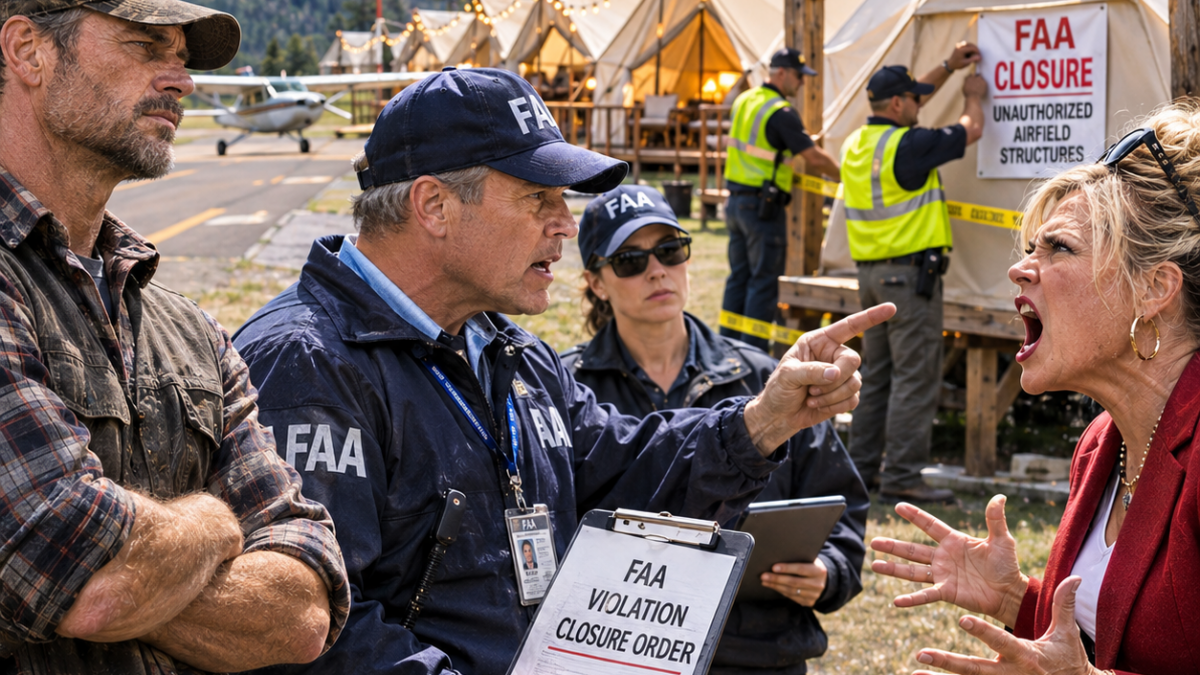
PART2:
Small aircraft used it when weather shut the larger regional airport.
More importantly, relief pilots used it.
When winter storms buried mountain roads, Red Willow became the fastest way to get medicine, food, blood, and emergency equipment into several isolated communities.
Graham never made much money from those flights.
That was not why he kept the field open.
He had spent eleven years restoring it because some places had value beyond what they could earn per acre.
That morning, he had a relief flight due at 6:25.
Wade Larkin was bringing insulin, antibiotics, and several boxes of dialysis supplies for a clinic one valley west.
Graham had been outside checking runway lights before Wade arrived.
Everything was normal until he saw the canvas.
At first, he assumed a film production had rented the neighboring field.
Commercial crews occasionally came through the county.
Wide landscape.
Mountains.
Sunrise.
He had once watched a pickup-truck advertisement being filmed from the airport fence.
But no production company had called him.
And the canvas did not belong in the neighboring field.
It belonged on Red Willow.
PART3:
Graham put down his coffee.
Got into his utility truck.
Drove toward the western apron.
The closer he got, the worse it became.
Not temporary tents.
Luxury tents.
Raised wooden platforms.
King-size beds.
Small decks.
String lights.
Brass plaques.
Stone pathways.
Decorative fencing.
The project looked as though somebody had taken an expensive travel magazine and dropped it directly into an aircraft operating area.
A timber arch had been installed near the old grass run-up zone.
SKY LANTERN RETREAT.
Below it:
LUXURY STAYS ABOVE THE CLOUDS.
Graham stopped the truck.
Killed the engine.
For a while, he said nothing.
Two tents sat dangerously close to the taxiway.
Not near in the casual sense.
Near in the aviation sense.
Close enough that an aircraft wing could enter the space around them while turning.
One tent platform stood where pilots occasionally swung wide during taxi.
A row of tall wooden poles had been placed along the edge of the movement area.
Workers were stringing decorative cable between them.
A resort shuttle idled on gravel near the taxiway.
Three guests stood beside the runway beacon taking pictures.
A woman in a white robe held a coffee mug while posing beneath the windsock.
Graham felt something cold move through him.
Not anger.
Not yet.
Aviation people learn that fear can be useful if you make it specific.
Where are the hazards?
Who is moving?
What needs to stop first?
His handheld radio crackled.
“Red Willow traffic, Relief Five-One-Seven, eight miles east, inbound Runway Two-Seven.”
Wade.
Graham grabbed the radio.
“Five-One-Seven, Red Willow. Hold position outside the pattern.”
Pause.
“Red Willow, say again?”
“Do not enter the pattern. Uncontrolled personnel and vehicles near taxiway and runway environment.”
Another pause.
Wade’s voice sharpened.
“Copy. I have visual on structures west side. Is that new?”
“Yes.”
“Graham, I have people walking inside your protected area.”
“I know.”
Wade circled.
Graham looked toward the shuttle van.
The driver had moved forward another twenty feet.
“Five-One-Seven, divert to Mountain South.”
“That’s forty miles.”
“I know.”
“Cargo is medical.”
“I know.”
Silence.
Then:
“Copy. Diverting Mountain South.”
Graham watched the aircraft bank away.
Hours.
The supplies would still get there.
Eventually.
But not when promised.
Not when the clinic expected them.
Behind him, a golf cart hummed.
White roof.
Silver trim.
Two security guards in black polo shirts riding behind.
Odessa Crowley drove.
Graham had known her by reputation before he ever spoke to her.
Fifty-one.
President of Silver Birch Estates.
Polished.
Controlled.
The kind of woman who could turn a neighborhood picnic into a branding opportunity.
Silver Birch sat directly east of Red Willow.
One hundred and twelve expensive homes.
Stone entrance.
Private restaurant.
Spa.
Clubhouse.
Residents had moved there knowing an airport existed next door.
The runway predated every home in the subdivision.
That had not stopped Odessa from complaining about aircraft noise.
Or hangar appearance.
Or fuel trucks.
Or Graham’s old maintenance pickup.
She had once asked him whether he could “schedule aviation activity more tastefully around outdoor dining hours.”
He thought she was joking.
She wasn’t.
The golf cart stopped.
Odessa stepped out wearing a cream blazer, navy trousers, and low-heeled shoes that did not belong anywhere near a working airport.
She held a sealed envelope.
“Graham.”
He looked at the tents.
Then her.
“What is this?”
She handed him the envelope.
“Your operational adjustment.”
He opened it.
Invoice.
$9,000.
AVIATION ACTIVITY ADJUSTMENT FEE.
Underneath:
Noise mitigation.
Tourism disruption.
Guest experience compensation.
Graham read it twice.
“You’re charging me nine thousand dollars?”
“For the opening period.”
“To operate my airport.”
“Within a premium residential tourism environment.”
He looked around slowly.
“This is my land.”
Odessa smiled.
“The zoning has evolved.”
“Who gave you permission to build eighteen tents on my airport?”
She reached into the golf cart.
Pulled out a laminated map.
Tapped it.
The western apron.
Taxiway.
Run-up grass.
Part of the safety area.
All shaded green.
RETREAT EXPANSION ZONE.
Graham leaned closer.
His taxiway had vanished.
Runway protection areas were not labeled.
The old grass run-up strip had been replaced by tourism symbols.
Someone had not merely interpreted the airport differently.
They had erased pieces of it.
“This map is wrong.”
“It was used for the permit.”
“Who made it?”
“Our planning team.”
“Whose survey?”
“Graham, the county approved the temporary use.”
“The county does not own my land.”
Odessa sighed.
“You have treated this property like a private hobby for years.”
“It is a public-use airport.”
“Privately owned.”
“Yes.”
“And surrounded by a community that has changed.”
“The runway hasn’t.”
She glanced toward the sky where Wade had disappeared.
“You see?”
“See what?”
“Planes can go somewhere else.”
Graham stared at her.
“My resort can’t.”
That sentence stayed with him.
Not because it was clever.
Because of the word.
My.
Her resort.
Not the HOA’s.
Not the neighborhood’s.
Hers.
Graham took out his phone.
Photographed the tents.
Their coordinates.
Poles.
Cables.
Pathways.
Shuttle.
Guests.
The timber arch.
Security.
Every hazard.
Odessa watched.
“What are you doing?”
“Documenting.”
“You don’t need to make this adversarial.”
“I diverted medical cargo because your shuttle was parked beside my taxiway.”
“That driver has been instructed.”
“Guests are standing next to the runway beacon.”
“They were told where the photography areas are.”
“There should not be a photography area there.”
She smiled faintly.
“That is the old way of thinking.”
Graham looked at her.
“In aviation, the old way of thinking is usually called surviving.”
He returned to the office.
At the front gate, he found another surprise.
A large white sign bolted to his own post.
RED WILLOW AIRFIELD
CLOSED TO AIR TRAFFIC
He had not issued it.
He pulled over.
Photographed.
Did not remove it.
That took restraint.
A lot.
He spent the rest of the morning doing the part nobody sees in stories.
Phone calls.
County planning.
Insurance.
Airport users.
Pilots.
Fuel supplier.
Emergency management.
He issued temporary restrictions through proper aviation channels.
He did not pretend the runway environment was normal.
That mattered.
If Odessa had created a hazard, Graham still had a duty to respond safely.
Being the victim did not release him from responsibility for aircraft operations.
The following morning, he went to county planning.
A clerk named Miranda Shaw opened the Sky Lantern Retreat file.
Temporary-use permit.
Eighteen units.
Restaurant expansion.
Outdoor events.
The permit described the glamping site as:
FORMER AVIATION PROPERTY NO LONGER IN ACTIVE OPERATION.
Graham felt his jaw tighten.
He pointed.
“That is false.”
Miranda looked uncomfortable.
“I’m just showing you what was submitted.”
“Who said it wasn’t active?”
She turned pages.
Land-use agreement attached.
Silver Birch Estates HOA.
Site-use authorization.
Map.
Signature blocks.
“Where is my authorization?”
“This package represents that the HOA has use rights.”
“They don’t.”
“Do you have proof?”
“I own the airport.”
“I understand.”
“No, I mean I literally own the parcel.”
“You’ll need to submit the recorded deed, survey, and evidence of aviation use.”
Graham stared.
“My runway is visible from space.”
Miranda smiled apologetically.
“I know.”
“So you need evidence the airport is still an airport?”
“For the permit appeal, yes.”
Bureaucracy has a strange dignity.
It can be infuriating and still correct.
The county could not revoke a permit simply because Graham walked in angry.
It needed records.
He returned home.
Pulled eleven years of flight logs.
Fuel records.
Hangar leases.
Maintenance invoices.
Airport directory listings.
Emergency-use correspondence.
Weather reports.
Training schedules.
Photos.
Everything proving Red Willow never stopped operating.
By evening, Odessa had already released a video.
Professional lighting.
Music.
Drone shots.
She stood beneath Sky Lantern’s timber arch.
Talked about tourism.
Jobs.
Property values.
Mountain luxury.
Then the tone shifted.
She called Red Willow:
“An outdated, underused aviation relic occupying land better suited for responsible community growth.”
She said Graham was blocking local progress for “personal reasons.”
Within hours, notes appeared on his hangar door.
SHUT IT DOWN.
PEOPLE LIVE HERE NOW.
PLANES DON’T BELONG NEXT TO A RESORT.
Graham photographed every note.
Then threw them away.
He hired Hollis Brenner.
Thirty-nine.
Property and land-use lawyer.
Hollis read everything in one sitting.
His first instruction:
“You are not touching those tents.”
“They’re on my land.”
“I know.”
“I could remove them.”
“Eventually, maybe.”
“I could have a crew pull every platform in two days.”
“And Odessa gets video of the angry pilot destroying occupied vacation tents.”
Graham said nothing.
Hollis leaned back.
“You want to be right or look right?”
“Both.”
“Then wait.”
Hollis sent preservation demands.
Land-use agreements.
Survey data.
Permit applications.
Electronic submission metadata.
Construction records.
Emails.
Photos.
Contractor correspondence.
Then a cease-and-desist.
No additional construction.
No expansion.
No interference with aviation operations.
No representation that Red Willow was closed.
Two days later, Odessa arrived alone at Graham’s hangar.
No security.
No cameras.
Her voice was softer.
“I think we’re making this more difficult than it needs to be.”
Graham continued cleaning a spark plug.
“Maybe.”
“I can offer you sixty thousand dollars.”
“For?”
“Close the runway six months.”
“No.”
“You haven’t heard the terms.”
“I heard close the runway.”
“Temporarily.”
“Medical flights use it.”
“There are alternatives.”
“Forty miles away.”
“People adapt.”
Graham put down the plug.
“My runway is not for rent.”
Odessa looked disappointed.
Then her tone changed.
“The FAA may not see things the way you do.”
Graham watched her.
“What does that mean?”
“There have been concerns about safety.”
“What concerns?”
“Structures. Public exposure. Uncontrolled movement.”
“You built those.”
She smiled.
“Federal regulators tend to focus on airport operators.”
Then she left.
That afternoon, Graham received official notification.
Safety complaint.
FAA.
Hazards near runway.
Failure to control public access.
Risk to neighboring residents.
Complainant:
Odessa Crowley.
Graham sat in his office.
Read it twice.
Then laughed once.
Not because it was funny.
Because he finally saw the strategy.
She was creating danger.
Then reporting him for failing to prevent it.
The next real danger came the following day.
A flight instructor named Beth Carter was taxiing a Cessna toward Runway Two-Seven when she stopped abruptly.
Decorative cable.
A long strand of black outdoor lighting wire had been strung between two wooden posts near the resort.
Wind pushed the center section toward the taxiway.
Not touching.
Yet.
Beth radioed Graham.
He drove out.
Cable bowed.
Oscillated.
Another gust could tear a connector loose.
Propeller.
Landing gear.
Wing.
Any one of those could turn decorative lighting into an accident report.
Graham went to resort office.
Manager called Odessa on speaker.
“Take the cable down.”
Odessa’s voice came through.
“No.”
“It is entering the aircraft movement area.”
“It was installed by professionals.”
“Take it down.”
“The lighting package is engineered.”
“Odessa.”
“Graham, you don’t have authority over my resort.”
“It is on my airfield.”
“That’s disputed.”
“People can die while lawyers dispute.”
She refused.
Graham did what an airport operator was supposed to do.
Restricted affected area.
Issued notice.
Cancelled flight lessons.
Diverted operations.
The decision cost money immediately.
Fuel sales lost.
Charter moved elsewhere.
Instruction cancelled.
Then Odessa released another video.
Graham shutting his runway.
Graham standing beside warning cones.
Graham’s empty apron.
Narration:
The airport owner has chosen to disrupt regional travel in an attempt to undermine Sky Lantern Retreat.
Graham watched once.
Stopped.
His insurer called.
That mattered more.
Occupied structures within operational airport property had changed risk profile.
The insurance company wanted a written hazard-management plan.
Seventy-two hours.
Without coverage, Graham’s business could effectively die.
He sat alone in the hangar that night.
Rain against metal roof.
An airplane engine cooling behind him.
For the first time, fear moved beyond anger.
Odessa could win without ever proving ownership.
If the insurer walked.
If pilots stopped coming.
If the FAA imposed restrictions.
If customers moved permanently.
A business can die while a lawsuit is still deciding who was right.
Hollis arrived carrying takeout.
“You need to eat.”
“Not hungry.”
“Eat anyway.”
Graham opened the box.
Chicken.
Rice.
He stared at it.
Hollis said:
“Listen carefully.”
“Okay.”
“The FAA is going to examine you too.”
“I know.”
“No, I mean they are not your personal cavalry.”
“I know.”
“If you failed to control hazards once you knew they existed, they can say so.”
“I know.”
“You need to be cleaner than Odessa.”
Graham looked up.
“Cleaner?”
“Every operational decision documented.”
He nodded.
“Every restriction justified.”
“Yes.”
“Every pilot notified.”
“Yes.”
“Every photograph preserved.”
“Yes.”
“If something is unsafe, close it even if closing hurts your argument.”
That last one mattered.
Because Graham wanted to keep flying.
Wanted to prove Odessa could not stop him.
That impulse could become exactly the negligence she was accusing him of.
He nodded.
“Safety first.”
“Always.”
Help came from Wade.
The relief pilot.
He returned with a cockpit camera memory card.
The aborted approach was recorded.
Clear view.
Tents.
Guests.
Shuttle van.
People near beacon.
Resort banners partly covering warning signage.
Wade gave written statement.
No exaggeration.
He had diverted because of uncontrolled people and vehicle near the operating area.
Graham added:
radio logs.
time.
weather.
cargo documentation.
He did not dramatize the delay.
Medical supplies arrived later from Mountain South.
Hours late.
Not lost.
No patient died.
Facts were enough.
A few nights later, six Silver Birch homeowners came to the hangar.
They were angry.
Not violent.
Scared.
Aircraft noise.
Property values.
Children.
One said:
“We were told you plan to increase cargo flights.”
“No.”
“Odessa said you’re bringing larger aircraft.”
“No.”
“She said your fuel storage isn’t compliant.”
“It is.”
“You’re telling us she lied?”
Graham considered.
“I’m telling you to ask for the document behind every claim.”
He poured coffee.
Showed them noise-abatement routes.
Operations history.
Runway dimensions.
Accident record.
Emergency role.
One woman softened.
Another didn’t.
Then Barbara Haynes spoke.
Seventy-two.
Retired teacher.
She said:
“I don’t care about airplanes either way.”
Everyone looked.
“But Odessa told us dues would drop once the resort was fully operational.”
Graham stopped.
“How?”
“She said the HOA would receive a profit share.”
“When?”
“Board dinner.”
“Written?”
“No.”
“Amount?”
“She called it a dividend.”
Something clicked.
This was not merely development enthusiasm.
There was money.
Hollis followed.
Lighting contractor.
Operations manager Russell Dorsey.
At first, cautious.
Then he admitted his crew had warned Odessa in writing that poles and cable runs were too close to active aircraft areas.
Her response:
JUST BUILD IT. THAT RUNWAY WON’T BE IN USE MUCH LONGER.
That sentence moved things.
Not proof of the entire scheme.
Evidence of intent.
Then Hollis found the letter.
County permit attachments.
Supposedly from Graham.
RED WILLOW AIRFIELD DECOMMISSIONING NOTICE.
Gradual closure.
Transition to tourism.
Signature looked like Graham’s.
Email wrong.
Reference number unknown.
Graham had never signed it.
Hollis immediately sent preservation notice.
Original.
Electronic source.
Metadata.
Submission records.
No accusation of forgery yet.
Copies can mislead.
They needed source.
Then came Dia Mercer.
Thirty-seven.
HOA records manager.
She asked to meet at a diner two towns away.
Graham and Hollis went.
Dia would not bring files.
Not yet.
She was scared.
But she described a meeting.
Odessa.
Board members.
Investors.
Odessa had said an FAA inspection might be exactly what the resort needed.
Inspectors would see hazards.
Insurance would rise.
Flights would be restricted.
Graham’s revenue would fall.
Eventually he would sell.
Hollis said:
“Did she say she created the hazards?”
“No.”
“Did she discuss tents and cables?”
“Yes.”
“What exactly?”
Dia looked toward window.
“She said conflict was useful.”
Graham felt sick.
There was the plan.
Not a planning mistake.
Pressure.
Odessa had built close enough to aviation activity that conflict was inevitable.
Then she filed the complaint.
Weaponized federal oversight against the property she was occupying.
Hollis asked:
“Would you testify?”
Dia shook her head.
“Not yet.”
“Would you cooperate if formally requested?”
Long pause.
“Yes.”
Good enough for now.
Graham did something Odessa did not expect.
He welcomed the FAA inspection.
No delay request.
No attack.
No attempt to minimize.
He organized everything into three binders.
One:
AIRPORT OPERATIONS AND SAFETY RESPONSE.
Two:
UNAUTHORIZED RESORT ENCROACHMENTS.
Three:
LAND, PERMITS, AND LEGAL RECORDS.
Every page dated.
Indexed.
Source noted.
He created a separate daily hazard log.
What he saw.
What he did.
Why.
Aircraft affected.
Who notified.
No emotional commentary.
No speculation.
Aviation thinking.
Facts.
Then the FAA confirmed on-site inspection.
Odessa accelerated.
Grand opening.
Champagne.
String quartet.
Ribbon.
Influencers.
Hundreds of reservations.
Restaurant.
Spa.
Events lawn.
She stood beneath Sky Lantern arch and announced:
“Not one tent will move.”
The crowd applauded.
Two days later, her lawyers demanded Graham cease aviation operations near the resort because he now knew guests were present.
They sought court restrictions.
It was elegant in a vicious way.
Build beside runway.
Then argue runway is dangerous because people are beside it.
Graham’s insurer tightened deadline.
Complete written risk plan.
Seventy-two hours.
Odessa came to Red Willow with a silver-haired investor.
She offered $1.25 million for everything.
Land.
Runway.
Hangars.
Fuel system.
Office.
Graham knew it was low.
Far below replacement value.
But Odessa knew he was under pressure.
“If FAA finds serious violations,” she said, “you may not have another buyer.”
Graham surprised her.
“Put it in writing.”
She smiled.
Thought he was bending.
“I will.”
“List every buyer entity.”
Her smile flickered.
“Of course.”
“Every partner.”
“Yes.”
“Every contingency.”
“Yes.”
Graham nodded.
“Send it.”
After they left, Hollis asked:
“You selling?”
“No.”
“Then why ask?”
“I want names.”
Hollis smiled.
“Good.”
That evening, Graham found something else.
Resort emergency evacuation diagram.
Restaurant east exit.
Fire apparatus route.
The route crossed an old gravel path.
That path entered Red Willow’s taxiway.
He stared.
The resort’s fire safety plan depended on access across his airport.
Again.
No easement.
No permission.
Then he found same gravel line on an old airfield drawing.
Different symbol.
He didn’t recognize it.
He requested historic records.
In meantime, insurer deadline.
Graham delivered plan.
Affected area restricted.
Pilots notified.
Diversions.
Physical barriers where possible.
Ground escort.
Daily inspection.
Resort access documented.
Emergency contacts.
He had no way to magically remove structures without legal process, but he could demonstrate active risk control.
Then independent survey.
Joan Puit.
State-licensed.
Quiet.
Precise.
Her team used recorded monuments.
County plats.
Historical control points.
GPS.
Result:
All eighteen tents were inside Graham’s property.
Not touching line.
Not straddling.
Inside.
Several poles, anchors, and paths intruded farther into aircraft movement areas.
Odessa called survey fraudulent.
Publicly.
No evidence.
Just accusation.
Joan told Graham:
“Ownership answers only one part.”
“What other part?”
“Airport land can have obligations.”
Graham knew public-use airports carried regulatory requirements.
But Red Willow’s ownership history was old and messy.
Joan continued:
“You told me previous owner accepted federal money.”
“Years ago.”
“How many?”
“I don’t know.”
“Find out.”
Graham requested federal archive records.
County index referenced 1997 improvement project.
Drainage.
Infrastructure.
Land acquisition.
He filed urgent request.
While waiting, Hollis examined company records.
Sky Lantern Retreat did not belong simply to HOA.
Crowley Horizon Hospitality LLC.
Managing member:
Odessa Crowley.
Major contracts ran through it.
Not HOA.
Vendors.
Reservations.
Financing.
Then an investor brochure surfaced.
SKY LANTERN EXPANSION — PHASE 2.
Up to forty lodging units.
Luxury villas.
Walking trails.
Event center.
Contingent on cessation of airfield operations.
There it was in polished print.
The airport’s death was not an unfortunate consequence.
It was part of growth plan.
The federal package arrived a week later.
Large rolled maps.
Grant agreements.
Property maps.
Graham spread them across workbench.
Previous owner had accepted federal assistance.
Drainage improvements.
Aviation infrastructure.
Acquisition of protective land near runway.
In return, the owner accepted binding obligations.
The parcel beneath Sky Lantern was part of federally assisted aviation property.
Dedicated for airport use unless proper federal release or approval occurred.
No such release existed.
Graham sat back.
For the first time since tents appeared, he felt something close to relief.
Not victory.
Structure.
The situation had a framework bigger than Odessa.
She had assumed county tourism zoning could erase aviation use.
It could not.
Even if she eventually bought the land, she could not simply decide federal obligations vanished with deed transfer.
Owning dirt and controlling its regulatory future were different things.
Joan compared:
County property record.
FAA airport layout plan.
Resort permit plan.
The resort plan omitted aviation information.
Runway safety areas.
Dedicated parcel.
Active taxiway.
Not one small error.
Pattern.
County building inspector Mason Whitlock became involved.
At first reluctant.
The permit file looked thick.
Stamped.
Approved.
Professional.
Then he reviewed fire access.
The restaurant and spa had conditional approval based on fire apparatus route.
That route crossed Graham’s airport.
No lawful permission.
Lighting electrical installation differed from plan.
Several life-safety assumptions depended on access rights the resort did not possess.
The resort was not suffering from one bad tent location.
Its permit foundation was cracking.
Odessa requested private meeting.
Restaurant.
No lawyers.
She slid check across table.
$200,000.
Five-year land permission.
Withdraw complaints.
Graham looked at check.
Then her.
“You went from sixty thousand to two hundred.”
“You’re being compensated for inconvenience.”
“You called the FAA.”
“Because safety matters.”
“You built the hazards.”
“That’s your interpretation.”
He pushed check back.
“You can’t buy the right to ignore aviation safety.”
Odessa’s eyes hardened.
“Think carefully.”
“I have.”
“This place could be worth nothing in six months.”
“Then why are you offering two hundred thousand?”
She had no answer.
Graham stood.
Left.
Inspection morning arrived clear.
No storm.
No excuses.
Senior FAA compliance specialist Evelyn Sutter drove in at 7:12.
Forty-six.
Two technical specialists with her.
Field forms.
Measuring equipment.
Camera.
Graham met them.
Odessa arrived minutes later with attorney, resort manager, operations staff, investor representative.
Press conference energy.
Odessa opened:
“Red Willow is unsafe and should be closed immediately.”
Evelyn looked at her.
“We haven’t started.”
That set tone.
Three hours.
Documents.
Coordinates.
Distances.
Tents.
Poles.
Cables.
Guest paths.
Shuttle routes.
Signage.
Runway environment.
Airport layout.
They asked Graham what he knew and when.
He answered with log.
Every restriction.
Every closure.
Every pilot notice.
Every attempt to get hazards removed.
No embellishment.
Odessa tried shifting blame.
“He allowed guests to remain beside active aviation.”
Graham handed demand letters.
“He kept flying.”
Graham handed restriction logs.
“He knew about the tents for weeks.”
Graham handed photographs from first morning.
Time stamped.
Wade handed cockpit footage.
Lighting contractor’s warning email.
Joan’s survey.
Then 1997 file.
Evelyn read.
Walked back toward tents.
Stopped beside closest one.
Turned to Odessa.
“Who authorized you to use this land for commercial lodging?”
Odessa’s attorney immediately produced HOA land-use agreement.
Evelyn examined.
Then Graham’s deed.
Then survey.
“The HOA does not own this parcel.”
Attorney said:
“We maintain contractual rights.”
“From whom?”
No clear answer.
Evelyn pointed toward 1997 federal map.
“This parcel is also identified as federally obligated aviation land.”
Odessa said:
“The county approved tourism use.”
“County land-use approval does not automatically release federal airport obligations.”
Odessa’s attorney stepped in.
“We dispute applicability.”
Evelyn nodded.
“That will be reviewed.”
No drama.
No victory speech.
Just review.
That was worse for Odessa.
Because review meant records.
Within an hour, FAA team documented serious concerns.
Unauthorized non-aviation use of obligated land.
Structures near active aviation areas.
Lack of appropriate federal review.
Public access problems.
Hazard management.
They also documented Graham’s mitigation efforts.
Not perfect.
But active.
Immediate.
Recorded.
The inspection did not condemn Graham’s entire airport.
It did exactly what Odessa had miscalculated.
It separated cause from response.
Then county arrived.
Mason.
Fire marshal.
Permit staff.
FAA findings gave them reason to examine the resort file again without treating Graham as a disgruntled neighbor.
Fire access.
Land rights.
Electrical deviations.
Conditional approvals.
Occupancy.
By late afternoon:
Eighteen tents could not continue operating at current location.
Their land-use basis was invalid.
Emergency access route lacked lawful right.
Restaurant and spa approvals depended on conditions that were not actually satisfied.
County suspended operation of Sky Lantern Retreat pending correction and lawful permitting.
Guests escorted from tents.
Restaurant stopped mid-service.
Spa closed.
Front desk turned arrivals away.
Odessa stood in parking apron watching employees move luggage.
She approached Evelyn.
“This resort represents millions in investment.”
Evelyn answered:
“Investment value does not replace lawful land-use rights or safety requirements.”
Odessa turned toward Graham.
“You destroyed this.”
Graham said:
“I didn’t build eighteen tents on an airport.”
“You wanted this.”
“No.”
He pointed toward FAA vehicle.
“You called them.”
For once, Odessa had nothing.
Consequences moved fast.
Reservations cancelled.
Corporate retreat cancelled.
Suppliers demanded payment assurances.
Lender requested report.
Insurance questioned coverage.
Then one investor representative called Hollis.
“Does Mr. Vale know the airport is in Phase 2?”
That sentence opened final door.
Dia Mercer came forward formally.
Not rumor.
Documents.
Within her legal access.
Investor presentation.
Sky Lantern Expansion Phase 2.
Runway area converted to resort park.
Luxury villas.
Event center.
Walking trails.
Date:
Months before Odessa’s first purchase offer.
Internal financial model assumed Red Willow operations would cease after regulatory pressure.
One slide:
AVIATION CONFLICT EXPECTED TO ACCELERATE ACQUISITION OPPORTUNITY.
Graham read it twice.
Hollis said:
“That is ugly.”
Another slide modeled airport buyout at discounted value after “operational restrictions and insurance pressure.”
There it was.
Not merely greed after conflict.
Planned pressure.
Tents were leverage.
Hazards were leverage.
Complaint was leverage.
Public campaign was leverage.
Then fatal flaw.
Even acquisition would not automatically free the federally obligated land.
Odessa’s plan depended on buying an airport and treating it like ordinary real estate.
It wasn’t.
The regulatory commitments survived ownership changes unless properly released.
Hollis filed suit.
Trespass.
Injunction.
Damages.
Restoration.
Business losses.
Survey costs.
Infrastructure damage.
He forwarded questionable decommissioning letter and financing materials for separate investigation.
Important distinction.
Property case did not need to decide every fraud question.
Those could be examined separately.
Lender froze disbursements.
Crowley Horizon defaulted on conditions requiring lawful site control.
Vendors terminated.
Travel companies cancelled.
Cash flow died.
Silver Birch homeowners demanded meeting.
Clubhouse packed.
Odessa stood front.
Tried familiar story.
Graham sabotaged.
FAA overreach.
County bureaucracy.
Hostile pilot.
Then homeowners asked:
“Why is a private company in your name operating the resort?”
“Where is our profit-sharing agreement?”
“Who approved Phase 2?”
“When did the board vote to acquire an airport?”
“Why did you tell us FAA inspection would shut him down?”
“Why were tents built before land rights were confirmed?”
Odessa’s answers became longer.
Less clear.
Dia sat in back.
Eventually stood.
“I kept the records.”
Silence.
She described internal meetings.
No accusation beyond documents.
Board suspended Odessa’s authority.
Independent review.
Then replacement process.
The community she had used as political cover no longer wanted her speaking for it.
Court proceedings took months.
No cinematic one-day resolution.
Lawyers.
Motions.
Evidence.
Inspections.
Experts.
But core ownership was simple.
Graham owned land.
HOA did not.
Crowley Horizon had no valid right.
Federal aviation obligations applied.
Unauthorized structures had to go.
Court ordered end of encroachment.
Restoration under approved plan.
Graham entitled to pursue proven damages.
Forgery and financial questions remained separate.
Odessa lost HOA presidency.
Crowley Horizon lost financing.
No lawful operating site.
No permit path without major redesign and federal process.
Resort collapsed.
Then came liquidation letter.
Tents and platforms would be sold.
Graham could bid.
Everyone assumed he would buy them cheap.
Resell.
Make money.
Maybe install one as trophy behind hangar.
Instead, Graham purchased several through lawful sale.
Platforms too.
Then donated them.
Regional mountain search-and-rescue organization.
They needed temporary sleeping shelters during wildfire seasons and winter deployments.
Far from any runway.
Properly permitted.
Safe.
When volunteers asked why, Graham shrugged.
“They’re good tents.”
One laughed.
“You hate these tents.”
“I hate where they were.”
That difference mattered.
Objects are not guilty.
Placement is.
Odessa came once more.
Windy autumn afternoon.
No blazer.
No golf cart.
She asked Graham to support reduction in financial liability.
He listened.
She said:
“You have your airport.”
“Yes.”
“The resort is gone.”
“Yes.”
“I’ve lost enough.”
Graham considered.
Then:
“You had so many chances to stop.”
Her face tightened.
“I thought we could make something valuable.”
“You tried to make my airport fail.”
“I was trying to protect investment.”
“You created hazards.”
“I never wanted anyone hurt.”
“That doesn’t make it safe.”
She looked toward runway.
“You could’ve sold.”
“You could’ve asked.”
“I did.”
“After you built.”
Silence.
He continued:
“You didn’t want a deal. You wanted a surrender.”
Odessa said nothing.
Graham declined to withdraw claims.
She left.
Red Willow did not reopen fully the next morning.
That would have been satisfying.
Also irresponsible.
Graham repaired ground.
Removed anchor damage.
Restored drainage.
Checked pavement shoulders.
Reestablished restricted areas.
Updated signage.
Reviewed access controls.
FAA compliance work continued.
Insurance reevaluated.
Flight procedures updated.
He did everything slowly enough that nobody could say victory mattered more than safety.
Months later, full operations resumed.
Opening morning, local pilots brought coffee and donuts.
No ribbon.
Graham refused.
Wade lined up for Runway Two-Seven.
Smooth approach.
Touched down.
Rolled.
Turned onto taxiway where two tents once stood.
Nothing there now.
Grass.
Proper markings.
Clear space.
Wade shut down near hangar.
Climbed out.
“So.”
“What?”
“You selling?”
Graham looked toward runway.
Mountains beyond.
“No.”
“Still?”
“Especially now.”
Wade grinned.
“You’re stubborn.”
“Expensive lesson.”
Years later, people told the story wrong.
They said FAA came and “closed Karen’s resort on the spot.”
Not exactly.
FAA inspection identified federal and aviation concerns.
County authorities suspended resort operation based on land-use, access, and permit problems.
Different authorities.
Different roles.
That mattered to Graham.
They said Graham tricked Odessa into calling the FAA.
No.
She called because she thought federal scrutiny would crush him.
He cooperated because hiding would have made her story stronger.
They said every resort structure was illegal solely because it sat too close to runway.
No.
Some hazards were aviation-specific.
But the bigger problem was ownership, federally obligated land, missing approvals, and a permit package built on assumptions that were false.
They said Graham “destroyed” Sky Lantern.
He didn’t.
He documented.
Restricted.
Reported.
Preserved.
Cooperated.
The project collapsed under facts already there.
That distinction mattered because Graham had spent years in aviation learning a simple rule:
Never lie to yourself about the condition of the aircraft.
If the gauge is bad, it is bad.
If the weather is below minimums, it is below minimums.
If the runway is blocked, it is blocked.
Wishful thinking kills pilots.
Odessa approached development in opposite direction.
If she needed the airfield to be inactive, she called it inactive.
If she needed tourism zoning, she drew tourism zoning.
If she needed a decommissioning letter, one appeared.
If she needed guests to be safe near aircraft, she called the lighting engineered.
If she needed FAA pressure, she created conditions for FAA pressure.
Reality became a document she expected somebody else to obey.
That works sometimes.
Until a regulator measures.
A surveyor checks.
A pilot records.
An insurer asks.
A clerk pulls an old file.
A county inspector follows an emergency route on a map and discovers it crosses land nobody had permission to use.
Then paper meets ground.
Ground usually wins.
The old 1997 airport property map hangs framed in Graham’s office now.
Not because it is beautiful.
It isn’t.
Faded.
Technical.
Boxes.
Lines.
Notes.
The parcel beneath the former tents is shaded.
FEDERALLY OBLIGATED AVIATION PROPERTY.
Visitors ask why it matters.
Graham tells them:
“Because everybody forgot about it except the filing cabinet.”
That line usually gets a laugh.
He means it.
Records can be boring enough to survive people.
Odessa’s glossy brochures disappeared.
Website taken down.
Timber arch sold.
Instagram account abandoned.
But the 1997 file remained.
No music.
No drone shots.
No branding.
Just obligations.
Graham eventually learned more about how Red Willow had received the federal assistance.
Previous owner, Samuel Keene, had fought for it.
Spring runoff had repeatedly damaged drainage near runway.
He needed improvements.
Federal grant helped acquire protective strip and stabilize airport.
In exchange, aviation use had to be preserved under the agreement.
Samuel had probably never imagined somebody would one day try to build king-size beds beside the taxiway.
But the promise he signed outlived him.
That fascinated Graham.
Aviation is full of promises between people who never meet.
A mechanic signs a logbook so a pilot years later knows work was done.
A controller clears one aircraft because another pilot follows an instruction.
An airport accepts public money and promises land will remain available to aviation.
Systems work when promises remain visible.
Odessa’s plan depended on invisible promises being forgotten.
They weren’t.
Silver Birch changed too.
Not dramatically.
HOA survived.
Different president.
Resort was not rebuilt.
The restaurant eventually reopened under a separate operator after compliant access and permitting issues were solved using land the association actually controlled.
Spa reopened smaller.
No glamping tents.
No Phase 2.
Aviation complaint section was removed from newsletters.
One homeowner, Barbara Haynes, still visited Red Willow.
She brought cookies during winter relief season.
Graham once asked:
“You even like airplanes?”
“No.”
“Then why are you here?”
“I like watching you prove Odessa wrong.”
“That’s not healthy.”
“I’m retired.”
Fair.
Dia left HOA records job.
Went to work for a property-management company with better controls.
She later testified in separate financial proceedings.
Crowley Horizon’s books received scrutiny.
Some claims resulted in civil findings.
Some questions never became dramatic criminal headlines.
Graham was fine with that.
Not every wrong becomes a felony.
Not every bad decision deserves prison.
He wanted restoration.
Damages.
Truth in record.
Safety.
He got enough.
His insurer renewed.
Premium increased temporarily.
Then normalized after hazards removed and compliance documented.
The airport lost customers during dispute.
Some returned.
Some didn’t.
Business recovered slowly.
That part annoyed people who wanted a perfect ending.
Graham preferred reality.
Winning a case does not refund time automatically.
It does not restore every customer.
It does not erase stress.
It does not make months of restricted operations disappear.
He had losses.
He carried them.
Compensation covered documented portions.
Not everything.
Life moved anyway.
The donated glamping shelters became famous in a different way.
One was used during a wildfire response west of Gunnison.
Another sheltered volunteer medics during a three-day blizzard search.
A rescue captain sent Graham a picture.
Former Sky Lantern tent.
Snow outside.
Cots.
Wet boots.
Coffee.
Caption:
THIS THING IS ACTUALLY USEFUL NOW.
Graham printed it.
Put it beside 1997 map.
One winter morning, Wade landed with emergency antibiotics.
Actual relief flight.
Snow closed road pass.
He taxied.
Shut down.
Handed box to county health worker.
Nothing unusual.
No cameras.
No applause.
Graham watched truck leave toward mountains.
That was the victory.
Not Odessa losing.
The runway doing what it was supposed to do.
Quietly.
Aviation safety is at its best when nothing happens.
No collision.
No excursion.
No incident.
No headline.
People arrive.
People leave.
Cargo gets where needed.
Boring.
Graham had come to love boring more with age.
He sometimes walked west side where tents once stood.
You could still see faint rectangular differences in grass for a while.
Platforms had blocked sun.
Stone paths compressed soil.
Restoration took time.
By third summer, most traces vanished.
Wildflowers returned.
One brass anchor fitting surfaced after heavy rain.
Graham found it.
Held it.
Could have kept.
Instead tossed into scrap bucket.
Not every artifact needs a shrine.
His own part in the story changed him too.
Before Sky Lantern, Graham hated conflict so much he sometimes mistook avoidance for patience.
He would absorb inconvenience rather than call lawyer.
Fix neighbor’s mistake himself rather than argue.
Let HOA newsletters complain.
Let noise comments slide.
He believed competence spoke for itself.
Mostly, it does.
But competence without documentation can become invisible.
Odessa taught him that by accident.
Now Red Willow’s records were meticulous.
Property maps digitized.
Federal obligations indexed.
Emergency plans current.
Access boundaries marked.
Contractors briefed.
Neighbor coordination documented.
Not because he became paranoid.
Because memory is weak and paper lasts.
One afternoon, young flight instructor asked why small sign near western edge read:
AVIATION PROPERTY — NO COMMERCIAL GROUND USE WITHOUT WRITTEN AUTHORIZATION.
“Long story?”
Graham said:
“Eighteen tents.”
The instructor laughed.
“No, seriously.”
“Seriously.”
“You let them build eighteen tents?”
“I didn’t.”
“You didn’t notice?”
“I noticed at 5:40 in the morning after they were there.”
“What did you do?”
“Cancelled a landing.”
“That must’ve sucked.”
“It did.”
“Then?”
“Paperwork.”
The instructor looked disappointed.
“That’s it?”
“Mostly.”
“No showdown?”
“FAA measured things.”
“That’s less exciting.”
“It was exciting enough for me.”
At county aviation safety meeting, Graham was once asked to speak about encroachment disputes.
He refused keynote.
Agreed to panel.
The moderator asked:
“What was the most important decision you made?”
People expected:
Hiring lawyer.
Calling FAA.
Getting survey.
Finding 1997 grant.
Graham said:
“Diverting Wade’s flight.”
The moderator looked surprised.
“Before you knew who owned what?”
“I knew there were people and a vehicle where they shouldn’t be.”
“Why was that most important?”
“Because if I had let him land to prove the airport was still active, I would’ve risked people to win an argument.”
He paused.
“Then Odessa would’ve been right about me.”
That was the line he cared about.
Being wronged does not give permission to become reckless.
In fact, injustice tempts people to do exactly that.
Prove yourself.
Push back.
Refuse to yield.
Sometimes yielding operationally is how you protect your larger position.
He closed areas.
Cancelled flights.
Lost money.
Because safety was not a negotiating tactic.
It was the point.
That log later protected him.
Odessa expected inspectors to see hazards and stop there.
Instead they asked:
Who created them?
Who controlled them?
Who responded?
When?
How?
Graham had answers.
Not because he anticipated every lawsuit.
Because aviation taught him to record decisions.
One day, years later, Graham saw Odessa again.
Denver airport.
Irony.
He was waiting near baggage claim.
She was standing beneath flight information board.
Older.
Hair shorter.
No blazer.
They saw each other.
Both considered walking away.
Odessa approached.
“Graham.”
“Odessa.”
Silence.
She looked toward arrivals.
“You still have Red Willow?”
“Yes.”
“Still public use?”
“Yes.”
“Relief flights?”
“Yes.”
She nodded.
“I saw something online about your rescue tents.”
He almost smiled.
“They weren’t mine originally.”
“I know.”
She looked embarrassed.
“I wanted to build something.”
“I know.”
“I really believed the airport was holding the area back.”
“I know.”
“That doesn’t excuse…”
She stopped.
Graham waited.
She said:
“I convinced myself once you sold, everything would work.”
“Federal land obligations wouldn’t.”
“No.”
“Did you know then?”
“No.”
He believed her.
That was perhaps worst part.
She had been willing to destroy a business before understanding basic constraints on property she wanted.
Not because she was unintelligent.
Because confidence outran due diligence.
“I should have stopped after you said no,” she said.
Graham looked at her.
“Yes.”
The simplicity seemed to hurt more than anger.
No lecture.
No forgiveness speech.
Just yes.
She nodded.
Walked away.
Graham watched aircraft climb beyond terminal windows.
He felt no victory.
No hatred.
Just distance.
That surprised him.
For a long time, Odessa had occupied too much mental space.
Eventually she became what she always should have been.
A person who once caused a serious problem.
Not the center of his life.
Red Willow remained.
That was enough.
At fifty-one, Graham finally repainted Hangar One.
Neighbors joked it had taken two decades.
The airport looked almost respectable.
He hated that.
The office roof no longer leaked.
Weather computer updated.
Runway lights LED.
Old fuel pump replaced.
Wade retired from full-time flying but still came through.
Barbara died at eighty.
Her daughter donated a bench near observation fence.
Not near runway.
Properly outside protected area.
Plaque:
WATCH THE PLANES.
DO NOT MOVE THE AIRPORT.
Graham laughed for five minutes when he first saw it.
The county approved the bench.
Officially.
Every time he passed, he thought Barbara would’ve enjoyed that.
The resort story became local folklore.
People exaggerated.
One version claimed Graham landed a plane between the tents.
False.
One said guests had to dive out of the way of wings.
False.
One claimed FAA arrested Odessa.
Very false.
Graham corrected people when he could.
Why?
Because truth was entire reason he won.
You cannot spend months insisting records matter and then enjoy false version because it makes you look better.
He had not won by being dramatic.
He had won by refusing drama when facts were stronger.
One spring, a college aviation class visited.
Students asked about land-use obligations.
Graham showed 1997 file.
A student asked:
“What if she had bought the airport before inspection?”
“She would’ve bought federal obligations too.”
“She couldn’t just close it?”
“Not automatically.”
“What if she paid back grant money?”
“Still requires proper process. Depends on agreements and approvals.”
“So ownership isn’t absolute?”
“No ownership is absolute.”
Student looked surprised.
Graham continued:
“You own a house, you still have building codes.”
“Right.”
“You own a car, you still follow road law.”
“Right.”
“You own an airport that accepted public money, you may carry obligations you didn’t personally negotiate.”
The student nodded.
“Odessa didn’t understand that?”
“No.”
“Why not?”
Graham looked toward runway.
“Because she only researched the answer she wanted.”
That sentence stuck with class instructor.
Later used in lecture.
Graham wished she hadn’t credited him.
He disliked becoming quotable.
But it was true.
Odessa wanted:
tourism land.
She found map that made tourism land.
She wanted:
airport inactive.
She found letter saying airport inactive.
She wanted:
FAA pressure.
She reported hazards.
She wanted:
low purchase price.
She built model assuming pressure.
At each stage, she treated desired outcome like evidence.
Then inspectors came who had no emotional investment in outcome.
They measured.
That is the beautiful thing about measurement when done honestly.
A runway distance does not care who is HOA president.
Property monument does not care how much resort cost.
Federal grant agreement does not care how many reservations exist.
A wingtip does not care whether decorative cable was expensive.
Reality is rude that way.
It refuses branding.
Graham eventually stopped referring to the tents as “Odessa’s resort.”
He called it “the encroachment.”
Less satisfying.
More accurate.
Sky Lantern had been real business.
Employees.
Vendors.
Guests.
Some innocent people lost jobs.
That bothered him.
He had never wanted staff hurt.
One restaurant manager later emailed.
“I blamed you at first.”
Graham replied:
“I understand.”
She wrote:
“I saw the permit file during liquidation.”
No further explanation.
Sometimes truth changes people privately.
No apology needed.
The restaurant manager found another job.
Lighting contractor survived.
County improved review procedures for permits adjacent to airport property.
New checklist:
Verify land ownership or lawful access.
Coordinate with airport authority where applicable.
Review federal land-use obligations.
Confirm emergency access rights.
Graham saw checklist once.
Smiled.
Systems learning.
That was better than revenge.
His attorney Hollis eventually moved to Denver.
At goodbye lunch, Hollis said:
“You realize the smartest thing you did was not touch the tents.”
“I know.”
“You wanted to.”
“I wanted to drag them into her swimming pool.”
Hollis laughed.
“That would’ve been a terrible exhibit.”
“Good video.”
“Terrible exhibit.”
Graham raised coffee.
“To exhibits.”
“To boring evidence.”
They drank.
Years after full reopening, another storm shut mountain pass.
County called.
Medical supplies.
Wade was retired.
Young pilot named Jenna Morales flew relief.
She approached Red Willow at dawn.
Graham stood near hangar with radio.
“Red Willow traffic, Relief Two-Four, five east.”
Graham looked west.
Clear taxiway.
No tents.
No shuttle.
No cable.
No guests.
Windsock steady.
“Relief Two-Four, Red Willow. Runway Two-Seven clear.”
The aircraft descended.
Touched pavement.
Rolled smoothly.
Turned.
Graham felt something in his chest ease even after all those years.
He helped unload boxes.
Insulin.
Antibiotics.
Blood-test supplies.
County worker loaded into truck.
Gone within seven minutes.
Jenna asked:
“You’re the guy with the glamping story?”
Graham sighed.
“Yes.”
“My instructor told it.”
“Probably wrong.”
“She said an HOA built a resort on your runway and called the FAA on you.”
“Close enough.”
“What did you do?”
Graham looked at empty western grass.
“Made sure the FAA had somewhere safe to stand when they came.”
Jenna laughed.
Then realized he was serious.
That was his final understanding of the whole thing.
Odessa believed inspection meant punishment.
She believed authority was something you pointed at your opponent.
Graham treated inspection differently.
A chance to put facts on the ground and let someone independent look.
That requires confidence of another kind.
Not the confidence that you will win.
The confidence that if the truth is uncomfortable, you will accept that too.
If FAA had found Graham negligent, he would have had to fix it.
If survey had shown some land was not his, he would have had to accept it.
If federal obligations cut against him, same.
That is what separated his position from Odessa’s.
He did not need every fact to favor him.
He needed every fact examined.
Odessa needed only the facts that supported her plan.
In the end, that difference destroyed Sky Lantern Retreat.
Not because the FAA hated resorts.
Not because pilots were more important than tourists.
Not because federal government swooped in to save a sympathetic man.
Because eighteen commercial lodging structures had been built on land the resort did not lawfully control, inside an airport environment carrying aviation obligations and safety requirements that could not be erased by a glossy map.
The irony remained almost too perfect.
Odessa filed the complaint.
She wanted inspectors.
She wanted measurements.
She wanted a federal record of hazards.
She got all three.
She simply assumed they would stop measuring before reaching her tents.
They didn’t.
Now Red Willow’s western edge is open grass again.
No timber arch.
No brass tent names.
No string lights.
No spa shuttle.
Just runway signs and wind.
On clear evenings, Graham sometimes stands outside Hangar Three and watches sunset turn mountains orange.
You can still see faint lines where the platforms once sat if the grass is dry enough.
Not many.
Time repairs soil better than people expect.
Above his desk hangs the old $9,000 invoice.
Framed.
Not because he paid it.
He didn’t.
Underneath, he added one typed line:
AVIATION ACTIVITY ADJUSTMENT FEE — UNPAID.
Wade says that’s petty.
Graham says it’s documentation.
Both are probably right.
Beside it hangs the 1997 map.
That one matters.
Every now and then, someone asks which document “won.”
Was it the deed?
Survey?
FAA layout?
Federal obligation?
Cockpit video?
Lighting email?
Safety log?
Graham always says:
“All of them.”
Because power built on paper is rarely defeated by one page.
You build record.
Layer by layer.
Who owns?
Who authorized?
Who knew?
Who warned?
Who acted?
Who profited?
What did the rules actually require?
Then eventually, if you’re lucky, somebody independent lays it all out and asks the question Odessa never thought she would have to answer.
Who gave you permission?
She had a map.
A permit.
A resort company.
An HOA title.
An investor.
An attorney.
A lender.
Eighteen tents.
Hundreds of reservations.
A restaurant.
A spa.
A ribbon.
A crowd.
And no answer.
Graham had one runway.
One deed.
One old federal file.
And enough patience not to let anger make him reckless.
Years earlier, Odessa had stood beside his taxiway and told him airplanes could go somewhere else because her resort could not.
She had it backward.
The tents could go anywhere they were lawfully permitted.
The runway could only be where it had always been.
And when the final Sky Lantern platform disappeared on a flatbed, Red Willow remained exactly where the old maps said it belonged.
Open.
Clear.
And still flying.








