HOA Karen Brought a Road Grader and the Sheriff to Take My Lake Road—Then He Found a Rusty Rail Under the Gravel and Asked Why Her “County Road” Sat on a Railroad Bed
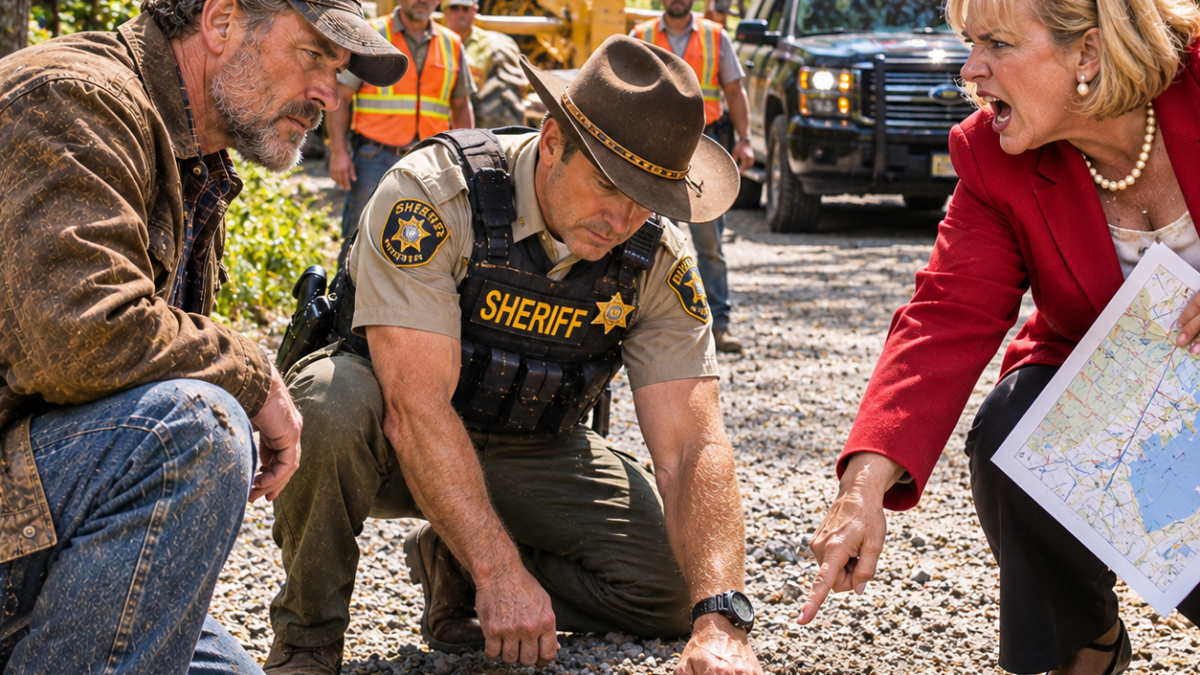
HOA Karen Brought a Road Grader and the Sheriff to Take My Lake Road—Then He Found a Rusty Rail Under the Gravel and Asked Why Her “County Road” Sat on a Railroad Bed.
Karen called the sheriff because she thought one glossy HOA map would be enough to make him cut the lock off my lake road and hand twenty-three years of private access over to her neighborhood.
Instead, Sheriff Bell crouched beside my gate, brushed gravel away with his hand, and uncovered the rusted head of an old railroad rail running directly beneath the road Karen insisted had always been public.
Four days later, she rushed through a land purchase to make the road hers anyway—but the century-old deed she never bothered to read proved the railroad had sold that ground long before her HOA existed.
My name is Tom Mercer.
For twenty-three years, I drove the same narrow gravel road from my house down to Lake Arden without once wondering what was buried underneath it.
I knew every curve.
Every drainage dip.
Every maple whose roots pushed against the shoulder.
Every place the gravel washed thin after a hard Tennessee summer storm.
My wife June and I had rebuilt the road together after we bought the property.
Not from scratch.
The road was already there.
We added stone.
Cleared brush.
Repaired the culvert.
Set two cedar posts at the top and hung a steel farm gate between them.
June complained about the brass chain because it was too heavy.
I told her heavy chains lasted.
She told me stubborn men lasted too, unfortunately.
That was June.
She’d been gone four years by the time the trouble started.
Cancer.
Fast at the end.
The road still carried pieces of her.
Halfway down, under an old maple, she had planted daylilies.
At the lake, beside the dock, stood a wooden bench she’d painted green.
My grandchildren called it Grandma’s Bench.
My grandson Sam swept pine needles off it every time he visited because June once paid him a quarter for doing it.
The road didn’t lead to anything public.
No boat ramp.
No county parking.
No picnic area.
It led to my dock.
My boat shed.
My shoreline.
And that green bench.
PART2:
Which was why the letter taped to my mailbox on a Monday morning made absolutely no sense.
OAK HOLLOW HOMEOWNERS ASSOCIATION.
NOTICE OF UNAUTHORIZED OBSTRUCTION OF PUBLIC LAKE ACCESS.
I read it at the kitchen table.
Then read it again.
According to the HOA, I had placed a gate across an “historic public route” leading to Lake Arden.
The board demanded removal within seven days.
If I refused, the association intended to restore access for residents, maintenance contractors, and guests.
I laughed.
Then stopped laughing.
Oak Hollow sat uphill from my property.
Newer subdivision.
Large homes.
Stone entrances.
Private tennis court.
Forty-something houses wrapped around the upper side of the lake.
My property wasn’t part of it.
Never had been.
PART3:
Their common lake parcel sat north of mine.
It had its own route down.
Steep.
Narrow.
Not ideal for trailers.
But theirs.
I walked outside carrying the letter.
The gate stood where it had stood for twenty-three years.
Cedar posts.
Steel.
Brass chain.
Nothing mysterious.
I called Karen Voss.
President of Oak Hollow HOA.
She answered immediately.
“Tom.”
“You sent me a road notice.”
“Yes.”
“You sent it to the wrong house.”
“No.”
“My property isn’t in Oak Hollow.”
“This doesn’t involve membership.”
“It has your HOA logo on it.”
“It concerns a public roadway.”
I looked down my gravel lane.
“What public roadway?”
“The lake road you’re blocking.”
“My road?”
“The historic county access route.”
“No.”
“According to our records, yes.”
“What records?”
“We have maps.”
“Send them.”
“You can review them at the clubhouse.”
“Email them.”
“Come to the clubhouse.”
“Why?”
“Because before we release association records, we need written acknowledgement that you won’t interfere with restoration work.”
I laughed again.
“So I have to agree you’re right before you show me why you’re right.”
Her voice cooled.
“You can’t own a road just because you spread gravel on it, Tom.”
“Correct.”
That stopped her.
I added:
“I own it because it’s part of the land I bought.”
“You may want to verify that before making threats.”
“I haven’t threatened anybody.”
“Your gate is the threat.”
“No, Karen. It’s a gate.”
Silence.
Then:
“The board intends to proceed.”
I hung up.
I knew why they wanted my road.
Oak Hollow’s common lake parcel sat on a steep grade.
The previous winter, a delivery truck hauling dock materials had slid backward halfway down their access lane.
Nobody got hurt.
But photographs circulated.
Residents complained.
The board began talking about “safer lake access.”
My road was gentler.
Wide enough for a truck.
Passed near their north boundary.
If they could use it, they could avoid spending a lot of money cutting a new road through their own hillside.
I understood the temptation.
I had spent thirty-eight years repairing farm equipment.
I knew the value of an easy route.
What I didn’t understand was deciding another man’s route belonged to you before bothering to ask.
That night I opened the metal file cabinet in my office.
Deed.
Closing papers.
Survey.
Title policy.
The survey showed the gravel road inside my boundary.
Farther east, a dashed line ran through a shallow depression.
OLD LAKE ROAD.
I’d seen that note before.
Never cared.
Old wagon paths were everywhere around Lake Arden.
Logging roads.
Timber roads.
Rail spurs.
Farm cuts.
Most had disappeared into woods decades earlier.
My deed was harder.
Metes and bounds.
Compass directions.
Iron pins.
Book references.
One description covered the main house parcel.
Then there was a second tract.
Narrow.
Mentioned an old railway parcel.
Referenced another deed by book and page.
When June and I bought the place, our attorney handled it.
I trusted him.
Now I wanted to understand it.
I emailed Karen the survey.
I wrote:
Please identify the public road you contend crosses my property and provide the recorded document establishing public use.
Two days later, she replied with a tax map.
Gray line.
Roughly followed my road.
Someone had typed:
LAKE ACCESS.
No surveyor seal.
No deed reference.
No legal width.
No date.
I called the county mapping office.
A man named Steve answered.
I explained.
He said:
“Tax map?”
“Yes.”
“Tax maps help locate parcels.”
“Do they establish road ownership?”
“No.”
“Public rights?”
“Not by themselves.”
“I have a survey.”
“Bring it to records. Compare it to road plans and deeds.”
Useful.
Not dramatic.
But useful.
I planned to go the next morning.
Then my neighbor Walt brought over a mower that wouldn’t start.
I’d promised to fix it.
Walt was seventy-six.
Bad left knee.
Had lived around the lake his whole life.
While we unloaded the mower, he noticed orange paint on my gate post.
“What are they marking?”
I stared.
Fresh orange stripe.
Another mark on the maple beside the road.
I photographed both.
Then called Karen.
“You sent somebody onto my property.”
“Planning crew.”
“You marked my gate.”
“Only preliminary.”
“You need permission.”
“Nobody has taken anything.”
“Planning on my land still needs permission.”
“The proper authorities can decide that.”
I thought she meant meetings.
Letters.
Maybe court.
I didn’t think she’d send machinery.
That was my mistake.
Walt pointed east.
“My uncle used to call that the wagon cut.”
“What?”
“The old road.”
We walked slowly toward the shallow hollow.
Leaves.
Brush.
Low banks.
You could see a worn depression if you knew where to look.
“Used to go to the lake?”
“Think so.”
“You remember cars?”
“Not cars.”
“Wagons?”
“I was little.”
I wrote down exactly what he remembered.
And what he didn’t.
I wasn’t turning a seventy-six-year-old man’s childhood memory into a property line.
But now I had a place to investigate.
At the county records office, a clerk named Denise found an old road sheet.
Faded.
Copied too many times.
It showed two routes descending toward the lake.
One labeled wagon road.
Another beside a rail spur.
They ran near each other uphill.
Then separated near a stone culvert.
That caught my attention.
My road crossed a stone culvert.
Denise found the earlier deed referenced in mine.
But there was a problem.
The original included a folded drawing.
The online scan didn’t.
“Can we get it?”
“Yes.”
“When?”
“Older attachments are stored separately.”
“How long?”
“Few days.”
I must have looked frustrated.
She added:
“I’m not saying somebody hid it.”
“I know.”
“We just have old records.”
“I know.”
She gave me the clearest road sheet available.
I called Pete Lawson.
Local surveyor.
Good reputation.
I told him:
Tax map.
Old road.
Railbed.
HOA claim.
He said:
“Don’t trust any answer from me until I measure.”
I liked him immediately.
“Can you come?”
“Next week.”
“Sooner?”
“I’ll see.”
Then he added:
“Old wagon roads and abandoned railbeds get confused all the time. Especially when someone gravels one and the other grows over.”
That sentence stayed with me.
I knew a railroad had once crossed the property.
Near the boat shed, I’d found rotten ties years earlier.
One bent spike.
I kept it in a coffee can.
The previous owner told me most rails had been removed long before he arrived.
I’d never seen track under my gravel road.
Why would I look?
A road was a road until somebody claimed it wasn’t yours.
Friday, my daughter Laura brought Sam over.
He was nine.
He saw the orange paint.
“Grandpa, are we building something?”
“No.”
“Then what’s that?”
“Someone thinks they can use our road.”
He frowned.
“Will we still get to Grandma’s bench?”
“Yes.”
I said it quickly.
Then realized keeping that promise might take work.
We walked down.
Sam carried the little brush June had given him.
He swept the bench.
I stood near the dock looking uphill.
From below, the road’s shape looked different.
Raised bed.
Gentle grade.
Stone culvert.
Built more carefully than a simple wagon trail needed to be.
I photographed it.
Sent everything to Pete.
He replied:
CULVERT MAY BE IMPORTANT. NEED FIELD MEASUREMENTS.
Monday morning, I woke to diesel.
Heavy.
Closer than it should have been.
By the time I reached the gate, a grader sat outside.
Blade wide enough to scrape away the stone edging June and I had laid by hand.
A worker was shoveling gravel from beside the latch post.
Karen stood near a pickup.
Folder in hand.
And behind them—
Sheriff Bell.
Karen had called him.
She told dispatch I was obstructing a public road while an authorized crew attempted to reopen county access.
Sheriff Daniel Bell was in his late fifties.
Quiet man.
Had been with the county forever.
He didn’t walk toward me demanding keys.
He told the crew:
“Stop.”
Then looked at Karen.
Then me.
“Let’s hear both versions.”
Karen held up her tax map.
“Historic county road.”
I brought out my deed.
Survey.
County road sheet.
Bell looked at Karen’s map first.
Then mine.
He said:
“Tax map isn’t a court order.”
Karen responded:
“It reflects county records.”
“It reflects mapping information.”
The foreman explained where they intended to widen the entrance.
While he talked, Bell noticed the fresh scrape beside my cedar post.
Something rusty showed through the gravel.
He crouched.
Brushed stones away with his fingertips.
A narrow metal edge appeared.
Rust.
Flat top.
He cleared another few inches.
Then looked at me.
“Tom.”
“Yeah?”
“Did you put this here?”
“No.”
“Know what it is?”
I crouched.
My stomach tightened.
Rail.
Old railroad rail.
Buried directly beneath my gravel road.
Karen said:
“Abandoned railroad.”
Bell looked uphill.
Then at the county sheet.
He traced the wagon route.
Then the rail route.
“If this is the old county wagon road…”
He pointed toward the stone culvert downhill.
“…why does it cross on a railroad bed?”
Karen folded her map.
Too quickly.
Her thumb covered the bottom corner.
Bell noticed.
So did I.
He stood.
“This needs a survey.”
Karen said:
“The railway was abandoned.”
“That doesn’t tell me who owns the underlying ground today.”
“We have county access rights.”
“Then bring me the recorded document.”
“You can see the route.”
“I can see two possible routes.”
He turned toward the foreman.
“Equipment stays outside the gate.”
Karen’s voice rose.
“Sheriff, he’s blocking public access.”
Bell looked at her.
“My office is not transferring title at the roadside.”
That ended the morning.
Not the dispute.
He made sure I understood.
“Tom, I’m not ruling that you’re right.”
“I know.”
“Preserve that rail.”
“I will.”
“Don’t dig more.”
“Okay.”
“Get the survey done.”
“Already scheduled.”
The grader backed away.
Foreman apologized.
He showed me his work order.
It described:
CLEAR AND REOPEN EXISTING COUNTY LAKE ROAD.
He texted me a copy.
Then left.
Karen stayed.
After Bell drove away, she reached into her folder.
Removed another envelope.
“You seem very impressed by that piece of rail.”
I said nothing.
“You should find out what it actually proves.”
She handed me a purchase agreement.
Seller:
Heritage Rail Lands LLC.
Buyer:
Oak Hollow Homeowners Association.
Property:
Narrow former railway corridor running toward Lake Arden.
Closing:
Friday.
Four days away.
Attached strip map.
Karen had highlighted the corridor.
It ran under my road.
Near the bottom of the cover page she had written:
ONCE THIS SALE CLOSES, YOUR GATE WILL STAND ON ASSOCIATION PROPERTY.
I looked up.
She was already walking away.
The sheriff had stopped her from taking the road as “public.”
Now she intended to buy it privately.
I carried the purchase agreement inside.
Put it beside my deed.
Same old book reference.
Same railway language.
Different conclusions.
My deed used the old rail record to describe something I owned.
Her seller used it to describe something they claimed to own.
Both could not be right.
I called Denise.
“Sale closes Friday.”
She immediately understood.
“I’ll flag the request as time-sensitive.”
“Can you find the drawing?”
“We’ll try.”
“That’s all I can ask.”
Then Pete.
I sent the purchase agreement.
He read while we spoke.
“This language matters.”
“What?”
“The seller is conveying whatever interest it still holds.”
“Meaning?”
“They’re not warranting that they own every foot shown on that sketch.”
“So Karen’s buying something they may not own.”
“Possibly.”
“She says once it closes, my gate is theirs.”
“Her seller isn’t saying that.”
That was the first crack.
Not enough.
But a crack.
Pete moved my survey appointment to Tuesday afternoon.
Deposit:
$650.
I paid it.
Then called Heritage Rail Lands.
A woman transferred me to Scott Marlow.
I said:
“You’re selling land beneath my private lake road.”
“That your position?”
“Yes.”
“Do you have supporting documents?”
“Yes.”
“Send them.”
I did.
Deed.
Survey.
County sheet.
Photographs of rail.
Culvert.
Gate.
I requested the closing pause until title was verified.
Scott replied that evening.
His company had purchased a portfolio of leftover railway properties from another corporation.
The lake strip appeared on an old inventory.
He sent the inventory page.
No dedicated deed.
No chain of title.
Just:
Map number.
Corridor.
Location.
I asked:
“Show me the deed proving you still own the portion crossing my parcel.”
He said he’d ask records.
I reread their purchase agreement.
Cash sale.
Buyer responsible for due diligence.
Seller made limited assurances.
Property sold subject to competing claims.
And one clause:
Closing may occur earlier by mutual consent.
That bothered me.
Karen said Friday.
Nothing prevented tomorrow.
I emailed Scott:
Please confirm no deed will be signed while this ownership dispute is under review.
He didn’t answer.
Laura came after work.
Saw my kitchen buried in paper.
“Dad.”
“I’m fine.”
“Did you call a lawyer?”
“Waiting on the drawing.”
She sat across from me.
“You don’t have to understand every word before asking someone who does.”
I looked at her.
She smiled.
“You spent four hours rebuilding a twenty-dollar mower carburetor because you didn’t want to buy a replacement.”
“That mower runs.”
“This isn’t a mower.”
She was right.
I called Anne Porter.
Property lawyer.
County office downtown.
She fit me in the next morning.
Anne started with my deed.
Not Karen’s purchase agreement.
That mattered.
She traced the main parcel.
Then the second tract.
“This part is important.”
“Railroad?”
“Yes.”
“Do I own it?”
“Maybe.”
I frowned.
“That’s not comforting.”
“Comfort isn’t what you’re paying me for.”
Fair.
She continued.
“The deed clearly says you acquired two tracts. The exact boundaries of the railway tract depend on that older deed and drawing.”
“What does the rail prove?”
“That the road may physically follow the old railbed.”
“Ownership?”
“No.”
I liked her more for saying it.
“People love one dramatic piece of evidence.”
She tapped the photograph.
“But a rusted rail doesn’t replace chain of title.”
“What do we need?”
“Original railway deed. Attachment. Seller’s chain. Current survey.”
She sent preservation letters to:
HOA.
Heritage Rail Lands.
No entry.
No clearing.
No disturbance.
Title dispute exists.
Then she told me to find my original closing file.
June and I had put our oldest papers in a bank safe deposit box.
I drove there.
Inside:
Closing envelope.
Title policy.
Some family documents.
June’s mother’s watch.
I left the watch.
Took the property file.
My title policy insured both tracts.
Anne helped notify the insurer.
Not magic.
Not instant victory.
But now the problem had somewhere to go besides my kitchen table.
Tuesday at 2:00, Pete arrived with a younger assistant named Aaron.
They started at the gate.
Measured exposed rail.
Road centerline.
Boundary pins.
Then followed the grade downhill.
At the stone culvert, Pete crouched for several minutes.
“Railroad builders liked gentle grades.”
“Wagons didn’t?”
“Wagons could tolerate steeper paths.”
We looked east toward the hollow Walt remembered.
Sharper descent.
More natural cut.
Walt appeared carrying an old photograph.
His father beside a truck.
Trees behind.
Two tracks visible.
One rough and low.
One raised.
“Year?”
Pete asked.
“Don’t know.”
“Location?”
“Near the old landing.”
Pete copied it.
Then told Walt:
“This helps.”
Walt smiled.
“But?”
“Not boundary proof.”
Walt nodded.
“Fair enough.”
Near the lower bend, Aaron found another rust patch.
They exposed nothing beyond what was already loose.
Measured.
The two rail remnants aligned.
Toward the culvert.
Toward the raised roadbed.
Pete then walked the eastern hollow.
Found an old cut.
Matched its curve to the county road sheet.
By 5:00 he had a preliminary conclusion.
“Your gravel road follows the old railroad bed through this section.”
“And the county road?”
“Farther east.”
“So Karen mixed them up.”
“Her first map appears to.”
“Is the rail parcel mine?”
“Still need the old drawing.”
Fine.
Careful answer.
That was what I wanted.
Even when I hated waiting.
At 5:14, Denise called.
“We found the book.”
“And drawing?”
“Still folded inside.”
I stood.
“When can I see it?”
“Tomorrow morning.”
I arrived before they opened.
While waiting, I asked Denise to search for new filings under Heritage Rail Lands.
She typed.
Stopped.
Then leaned closer.
“There was a deed recorded yesterday.”
My stomach dropped.
“What deed?”
She turned the monitor.
GRANTOR:
HERITAGE RAIL LANDS LLC.
GRANTEE:
OAK HOLLOW HOMEOWNERS ASSOCIATION.
Recorded:
4:16 p.m.
While Pete and Aaron had been measuring my road.
Three days ahead of the closing date Karen gave me.
After Heritage had my warning.
After Oak Hollow had Anne’s letter.
They closed anyway.
“Does recording mean county verified they owned it?”
“No.”
“Then what does it mean?”
“We record properly submitted documents. We don’t adjudicate title.”
She printed it.
The description used the broad rail corridor.
And covered:
My road.
Part of my boat shed area.
Near shoreline.
My phone buzzed.
Email from Oak Hollow’s attorney.
Attached:
New deed.
Demand:
Remove gate within ten days.
Vacate association property.
Any continued use requires HOA written permission.
I stared through the records office window.
My truck sat outside.
Boat hitch on the rear.
The same truck I used to pull Sam down to the dock.
Karen now believed I needed her permission.
Then Denise returned.
Carefully carrying a thick old volume.
She placed it on a padded stand.
Opened to the referenced page.
Inside:
Folded paper.
Yellowed.
She unfolded it gently.
Two routes.
Clearly separate.
COUNTY WAGON ROAD.
OLD RAILWAY LINE.
The railway route crossed the stone culvert.
Ran along the gentle raised bed.
Widened near the lake into what had once been a timber-loading spur.
Around that widened section:
Solid boundary line.
Parcel number.
Deed reference.
My heart started pounding.
“That’s the attachment?”
“Yes.”
I took out my deed.
Second tract.
Same reference.
Same transfer.
The original written deed showed:
Railway company as seller.
Harold Price as buyer.
Harold Price.
Former owner in my property’s chain.
Long before June and I bought the place.
I didn’t declare victory at the counter.
I had learned too much by then.
I requested:
Full copy.
Margins.
Stamps.
Folds.
Certification.
Nothing cropped.
Nothing summarized.
Anne called before I reached the parking lot.
“This matters.”
“So I own it?”
“Slow down.”
I laughed despite myself.
“We trace the parcel forward.”
Pete met me immediately.
He placed the old drawing beside his field measurements.
Didn’t just eyeball it.
Distances.
Angles.
Culvert.
Bends.
Known corners.
After almost an hour, he pointed near the lake.
“This second tract is why your deed looked strange.”
“What do you mean?”
“Your main parcel alone leaves out part of the rail corridor.”
He pointed again.
“The separate railway purchase puts it back.”
“So Heritage sold something already sold decades ago.”
“That’s what the records appear to show.”
“Can you put it on the ground?”
“Yes. Need another field visit.”
“Do it.”
The cost kept growing.
I stopped caring about the short-term number.
A correct survey would outlive me.
Laura might need it.
Sam might someday.
Friday, Pete returned.
Near the lower curve, Aaron found an old concrete marker buried beneath leaves.
Pete measured.
Didn’t assume.
Then checked:
Upper line.
Culvert.
Rail alignment.
Marker.
All consistent within the tolerances of old records.
He separately located the wagon road.
East.
Different route.
The thing Karen originally called public access never ran beneath my present gravel road.
Her claimed “county road” and my railbed were two separate pieces of history.
The following week Pete delivered his report.
Disputed gravel road lies within railway parcel formerly conveyed to Harold Price.
Parcel subsequently conveyed through successive owners into Tom and June Mercer’s title.
Boat shed included.
I read it sitting on June’s green bench.
Folded it carefully.
Put it back in the envelope.
Walt came down.
“Was I right?”
“About the wagon road? Mostly.”
He smiled.
“What does mostly mean?”
“Your memory told us where to look.”
“And?”
“Measurements did the deciding.”
He nodded.
“I can live with that.”
He handed me a copy of the HOA petition.
Residents were asked to support:
REOPENING HISTORIC COUNTY ROAD.
Nothing about:
Purchasing railway property.
Nothing about:
Taking title to my road.
Nothing about:
Making homeowners pay for a private land acquisition.
Karen had told different audiences different stories.
To residents:
Public road.
To Heritage:
Private railway purchase.
To me:
Association land.
Whichever version got her closer.
My title insurer accepted the defense under my policy.
Anne filed the title action.
We asked the court to:
Determine ownership.
Remove the HOA’s competing claim.
Prevent disturbance of gate.
Prevent excavation.
Preserve exposed rail and evidence.
Oak Hollow agreed temporarily not to alter anything before hearing.
Karen didn’t admit fault.
Didn’t matter.
The grader stayed away.
Discovery began.
County responded:
No accepted public county road followed my gravel route.
The old wagon-road question remained separate.
Anne kept it that way.
“We don’t need to own every path in Tennessee.”
She said.
“We need them to stop claiming the one you do own.”
Heritage produced its purchase file.
The source of their mistake became clear.
Years earlier, someone compiled an inventory of leftover railway corridors.
The map showed a broad strip.
But the compiler failed to account for every parcel the railroad had previously sold.
The lake strip was one of those omissions.
Heritage later bought the remaining railway assets.
Its internal inventory mistakenly included land no longer owned by the railroad’s successor.
Scott’s emails were in the file.
My warning.
Anne’s warning.
Survey concern.
And then another email.
Heritage had offered to delay closing.
Karen forwarded that message to Oak Hollow treasurer Dennis Cole.
Her note said:
Proceed. We need to establish control of the route before Mercer hardens his position.
That hurt her.
Not because it proved she knew every deed.
It didn’t.
But it proved she knew ownership was seriously disputed.
And chose speed anyway.
Then she used the newly recorded deed as though recording had cured the defect.
A week before hearing, Oak Hollow offered settlement.
I could keep using the road.
Lifetime.
No charge.
All I had to do was sign an acknowledgement:
OAK HOLLOW HOA OWNS THE ROAD CORRIDOR.
I brought it to Anne.
She read one paragraph.
Then looked at me.
“They want you to give them what they’re afraid they didn’t buy.”
We declined.
The hearing arrived Thursday morning.
I wore the jacket I’d worn to my granddaughter’s school concert.
Laura came.
Walt came.
Pete came with survey tubes.
Sheriff Bell came because he’d witnessed the original confrontation.
Karen sat with HOA counsel.
Neat suit.
Stack of binders.
No grader this time.
Judge Evelyn Hart started with Sheriff Bell.
He described the call.
Reported public obstruction.
Crew waiting.
Tax map.
My deed.
Survey.
Fresh scrape.
Then:
Rail.
“Why did you stop the work?”
“Because physical evidence at the site didn’t match the story I had been given closely enough for me to treat it as a settled public road.”
“Did you decide title?”
“No.”
“Did you tell Mr. Mercer he owned everything?”
“No.”
“What did you do?”
“Kept the peace and told both parties to resolve the ownership issue properly.”
Pete testified next.
Three drawings.
County road sheet.
Railway parcel attachment.
Modern survey.
He explained:
Wagon road here.
Railbed here.
Stone culvert.
Recovered marker.
Rail remnants.
Raised grade.
Distance measurements.
HOA attorney asked:
“Could someone have dumped old rail under the road as scrap?”
Pete nodded.
“One loose rail? Certainly.”
The attorney smiled.
Then Pete continued.
“But scrap would not explain two aligned rail sections, the engineered grade, the culvert position, the recorded railway drawing, the historic parcel corners, and the measured distances all matching the same corridor.”
Smile disappeared.
Anne presented chain of title.
Railway company.
To Harold Price.
Then later owners.
Then June and me.
Every conveyance carried the separate tract forward.
Heritage’s broad asset inventory did not.
A missing entry on an internal list did not erase an earlier recorded sale.
Karen testified.
She said she relied on:
HOA mapping.
Historic references.
Heritage Rail Lands.
She believed the road corridor remained available.
Anne asked:
“Why did your first notice call it a public county road?”
“Our understanding evolved.”
“When did it evolve?”
“When we found the railway ownership information.”
“After Sheriff Bell found rail?”
“Yes.”
“Why did the HOA close three days early?”
“We had already invested time and money.”
“After receiving Mr. Mercer’s deed?”
“Yes.”
“After receiving counsel’s warning?”
“We believed our seller.”
“Your seller offered to delay.”
Karen paused.
“Yes.”
“But you instructed your board to proceed.”
“We needed clarity.”
“Buying disputed land creates clarity?”
“Our deed strengthened our position.”
There.
Not ownership.
Position.
Dennis Cole testified next.
He was the HOA treasurer.
He admitted the board knew Heritage was selling only whatever interest it still possessed.
No promise of clear ownership of every foot.
Judge Hart asked:
“Then why proceed?”
Dennis looked toward Karen.
Then down.
“We thought recording the deed would improve our negotiating position.”
“With whom?”
“Mr. Mercer.”
“Negotiating for what?”
Pause.
“Access.”
The courtroom became very quiet.
Finally, Heritage’s attorney called Scott.
He brought a corrected inventory.
After reviewing the old deeds, Heritage had removed the disputed lake railway parcel from its claimed holdings.
Judge Hart asked:
“Does Heritage Rail Lands currently contend it owned the portion crossing Mr. Mercer’s road when it executed the HOA deed?”
Scott looked at the old railway sale.
Then answered:
“Based on the records now confirmed, no.”
Karen turned toward her attorney.
He kept looking at his papers.
Judge Hart pulled the two deeds closer.
The old railway conveyance.
The new HOA deed.
Then she began with the oldest document.
That was appropriate.
Because everything Karen had done depended on pretending history started when her board found a map.
It didn’t.
The railroad had already sold the land.
Decades before Oak Hollow existed.
Decades before Karen became HOA president.
Decades before June and I laid gravel over the old railbed.
The judge found that the railway parcel had been conveyed into my chain of title long before Heritage acquired the railroad’s remaining assets.
Heritage therefore had no ownership interest in that portion to convey to Oak Hollow.
The HOA’s deed did not defeat the earlier recorded conveyance.
The competing claim was ordered corrected.
My gate stayed.
My road stayed.
My boat shed stayed.
Karen did not get her lake route.
But that wasn’t the end.
Oak Hollow homeowners started asking questions.
How much did the purchase cost?
Why did the board close early?
Why were residents told it was a public road if the HOA was secretly buying it?
Why had legal warnings been ignored?
Walt brought the petition to an HOA meeting.
Held it up.
“You told us this was about reopening a county road.”
Karen said:
“That was our understanding at the time.”
Another homeowner asked:
“Then why were you spending HOA money buying railroad land?”
Karen tried to move on.
Nobody let her.
Dennis eventually disclosed the amount spent on:
Purchase deposit.
Surveying.
Legal fees.
Contractor mobilization.
Planning.
All for land Oak Hollow didn’t own afterward.
Residents weren’t happy.
The board commissioned an independent review.
Not because I demanded it.
I didn’t.
I wanted my road.
They wanted answers about their money.
Karen lost the presidency at the next election.
No dramatic arrest.
No handcuffs.
No television cameras.
Just homeowners deciding they no longer trusted someone who repeatedly treated uncertainty like permission.
Oak Hollow eventually improved its own lake access.
On its own land.
Engineered switchbacks.
Retaining wall.
Better drainage.
A stabilized trailer approach.
Expensive.
Exactly what they’d tried to avoid.
Their contractor stopped by my place once.
“Your road would’ve been easier.”
“I know.”
“Cheaper too.”
“I know.”
He laughed.
“Can’t blame them for wanting it.”
“Didn’t blame them for wanting it.”
He understood.
Wanting is different from taking.
The exposed rail near my gate stayed visible for a while.
Sam loved it.
“Is that a real train track?”
“Piece of one.”
“Trains went to our dock?”
“Close.”
He imagined steam locomotives.
I told him it was probably timber traffic.
Less exciting.
He disagreed.
To a nine-year-old, any rail under Grandpa’s road is treasure.
Eventually Pete recommended protecting the exposed section from repeated tire damage.
I installed a small recessed cover beside the shoulder.
Nothing fancy.
You can still lift it and see rusty steel underneath.
I kept the old spike too.
Coffee can finally upgraded to a little shadow box.
Laura teased me.
“You’re becoming sentimental.”
“Your mother caused that.”
One evening, she and Sam came for supper.
Afterward we drove to the lake.
Gate open.
Truck rolling slowly over gravel.
No HOA signs.
No grader.
No orange paint.
We stopped at June’s bench.
Sam swept it.
Still does.
He doesn’t get quarters anymore.
Inflation.
Sometimes people ask what saved the road.
The deed?
Yes.
The survey?
Yes.
Title insurance?
Helped.
The old railway drawing?
Absolutely.
But the moment everyone remembers is Sheriff Bell brushing gravel away.
Rust under gray stone.
Karen holding her map.
The sheriff asking:
“If this is the wagon road, why are we standing on a railroad bed?”
That rail did not prove ownership by itself.
Anne made sure I understood that.
Pete made sure I understood that.
Bell made sure he didn’t overstep.
That was important.
The rail didn’t win the case.
It stopped a mistake long enough for the real evidence to be found.
Without it, Karen’s crew might have cut my gate.
Graded the entrance.
Moved stone.
Changed the physical road before anyone examined the old records.
Instead, one strip of rust created doubt.
And sometimes doubt is exactly what you need when someone else is moving too fast.
Karen’s biggest mistake wasn’t wanting the road.
It wasn’t even buying the bad deed.
Her biggest mistake was treating every uncertain document as though it said exactly what she wanted.
Tax map?
Public road.
Old railway inventory?
Seller owns it.
Recorded deed?
HOA owns it.
Petition?
Residents approve.
None of those statements survived careful examination.
I learned the opposite lesson.
When Pete said he didn’t know, I let him measure.
When Anne said the rail wasn’t enough, I let her trace deeds.
When Denise said the drawing would take time, I waited.
When the title insurer asked questions, I answered.
Slow felt terrible.
But slow kept me from making Karen’s mistake.
Certainty before evidence.
A year later, Heritage Rail Lands sent me a letter.
Apology.
They had corrected their internal inventory to remove the parcel.
No grand admission.
No villainy.
Their mistake was exactly what Scott had eventually said.
An old asset map carried forward land that had been sold generations earlier.
That’s how property errors survive.
Someone copies a line.
Next person copies that copy.
Then a map acquires confidence it never earned.
Until somebody opens the original book.
I sent Denise a thank-you card.
She called afterward.
“Nobody thanks records clerks.”
“You found my road.”
“No.”
She laughed.
“The record found your road.”
Fair.
Sheriff Bell came by once the next summer.
Not official.
He was checking something nearby and stopped.
We walked to the gate.
I lifted the little cover over the rail.
He looked down.
“Still there.”
“Where’s it going?”
He smiled.
“You know, people tell that story like I solved the case.”
“You stopped the grader.”
“I saw rusty metal.”
“You asked the right question.”
He shrugged.
“Sometimes that’s enough.”
Then he said:
“Karen still mad?”
“Probably.”
“Good.”
He grinned.
I laughed.
Oak Hollow’s new board eventually contacted me.
Not with a demand.
A request.
Their maintenance crew occasionally needed access near the north boundary for shoreline inspection.
Could they use the first hundred feet of my road twice a year?
Written agreement.
Insurance.
Advance notice.
No trailers.
No permanent rights.
I read it.
Sent it to Anne.
She made a few changes.
I signed.
People found that strange.
“After everything, you let the HOA use your road?”
Yes.
Because they asked.
Because it made sense.
Because the terms were clear.
Because permission doesn’t weaken ownership when everyone understands what permission means.
June would have appreciated that.
She was kinder than I was.
Also smarter.
One fall evening, I sat on her bench after Sam went home.
Lake flat.
Leaves turning.
I could barely see Oak Hollow’s roofs through the trees.
Their new access road curled down their hillside.
Expensive.
Safe.
The way it should have been built from the beginning.
I thought about Karen’s first phone call.
“You can’t own a road just because you spread gravel on it.”
She had been right.
Just not in the way she thought.
Gravel didn’t make the road mine.
Neither did twenty-three years of driving it.
Neither did the gate.
Neither did June’s flowers.
Ownership came from the recorded transfers beneath all of that.
Railroad to Harold Price.
Price through later owners.
Eventually June and me.
Paper nobody had bothered to unfold in decades.
The road itself remembered too.
Under the gravel.
Under the tire marks.
Under years of repairs.
The grade.
The culvert.
The iron.
Physical evidence matching the record.
That combination was what mattered.
Karen tried three different stories.
First:
It was public.
Then:
It belonged to the railroad.
Finally:
The HOA bought it.
All three collapsed for the same reason.
She started with the answer she wanted and searched backward for something that looked like proof.
I started with a question.
Whose road is this?
And kept following the records until they answered.
Years later, Sam is old enough to fish without me tying every knot.
He still likes Grandma’s Bench.
One afternoon, he asked:
“Grandpa, what would’ve happened if the sheriff didn’t see the rail?”
I thought about it.
“Probably would’ve taken longer.”
“Would they have taken the road?”
“No.”
“You sure?”
I looked uphill.
At the gate.
Then at the lake.
“Eventually the deeds would’ve mattered.”
“But they might’ve cut the gate.”
“Yes.”
He considered that.
“So the rail saved it.”
“Not exactly.”
“What did?”
I smiled.
“Everybody stopping long enough to check.”
He didn’t like that answer.
Too boring.
Kids want buried rail to be magic.
Adults often do too.
But the truth was better.
No single heroic discovery saved my road.
It took:
A sheriff willing not to overreach.
A clerk willing to pull an old folded drawing.
A surveyor willing to say “I don’t know yet.”
A lawyer who refused shortcuts.
A neighbor who admitted his memory had limits.
A title policy we’d almost forgotten.
And a chain of deeds written by people who had been dead for decades.
That’s how property survives bad claims.
Not through shouting.
Through records.
Karen called the sheriff because she believed authority would make her map real.
Instead, he found a rail.
The rail led to the old drawing.
The drawing led to the railway deed.
The deed led through the chain of title.
And the chain ended exactly where my road had been all along.
With me.
The last time I saw Karen was at the county store two years later.
She was buying garden soil.
I was buying mower blades.
We saw each other near the register.
She looked away first.
Then changed her mind.
“Tom.”
“Karen.”
“That road still locked?”
“Sometimes.”
“You know Oak Hollow’s new access cost almost three hundred thousand dollars.”
“I heard.”
“You could’ve saved everyone money.”
“Probably.”
She frowned.
“That doesn’t bother you?”
“No.”
“Why not?”
“Because it wasn’t my bill.”
She stared.
Then said:
“You never understood community.”
I picked up my mower blades.
“No, Karen.”
I looked at her.
“I understood boundaries.”
We left it there.
At home, I drove through the gate.
Closed it behind me.
Not because I feared anyone.
Because cattle gates work better closed.
Halfway down, tires passed over the buried rail.
The old stone culvert came into view.
Then the lake.
Then June’s green bench.
Still standing.
Still ours.
Karen had called the sheriff to take my lake road.
She thought the question was whether my gate could block an old public route.
The sheriff found the first clue beneath a few inches of gravel.
The survey found the old railbed.
The county records found the wagon road somewhere else.
And the oldest deed found the truth Karen’s brand-new paperwork couldn’t change.
Her HOA had rushed to buy my road.
The problem was simple.
The railroad had already sold it generations before she arrived.








