HOA Karen Brought 3 Lawyers to Take My 140-Acre Farm—Then They Saw My Federal Judge’s Robe and Went Pale
PART3:
The HOA claimed my entire farm sat inside its covenant boundary.
According to the letter, I owed:
Two years of assessments.
Late fees.
Compliance penalties.
Legal charges.
Total:
$11,248.
I read the paragraph twice.
Then a third time.
It threatened a lien.
I called the HOA office.
Candace answered personally.
“Willow Ridge Estates.”
“Candace Marrow?”
“Yes.”
“This is Elliot Granger.”
Pause.
“Mr. Granger.”
“I received your letter.”
“Good.”
“I don’t belong to your HOA.”
Another pause.
Then:
“Everyone in this valley benefits from Willow Ridge.”
“That wasn’t my statement.”
“Your parcel falls inside the community covenant area.”
“No, it doesn’t.”
“Our counsel disagrees.”
“Send me the recorded covenant.”
“You already received the relevant information.”
“No. You sent me your interpretation.”
Her voice hardened.
“Mr. Granger, I strongly advise you to pay before this becomes expensive.”
“It already sounds expensive.”
“We can file a lien.”
“Then send me the covenant.”
She hung up.
I sat there holding the phone.
I had spent three decades watching people make poor decisions in litigation.
One of the most common was assuming confidence equaled evidence.
Candace had confidence.
I wanted evidence.
Two weeks later, a white utility truck entered my south pasture.
A man wearing an orange vest began spraying fluorescent markings through the grass.
I walked down.
“Morning.”
He turned.
“Morning.”
“What are you marking?”
“Park boundary.”
I looked around.
“What park?”
He pointed toward Willow Ridge.
“HOA community park.”
I laughed.
Then realized he wasn’t joking.
“This is my pasture.”
He checked his tablet.
“Parcel map says HOA expansion area.”
“Your parcel map is wrong.”
He looked uncomfortable.
“I’m just working from the order.”
“Who gave it?”
“Willow Ridge management.”
“Stop.”
“I need authorization.”
“You have authorization.”
“From who?”
“The owner.”
He stared at me.
I pointed at myself.
“Me.”
That finally got his attention.
He stopped.
To his credit, he didn’t argue.
I called the sheriff’s office.
Deputy Lewis arrived.
Looked at my deed.
Looked at the contractor’s paperwork.
Then shook his head.
“This is a civil boundary dispute.”
“I understand.”
“I can stop anybody from committing an obvious trespass after notice.”
“Good.”
“But I’m not deciding ownership standing in a pasture.”
“Fair.”
He looked toward the painted line.
“Talk to counsel.”
I almost told him I had been counsel.
Then a judge.
Instead I nodded.
Because he was right.
My daughter Hannah came home that weekend.
She was thirty-two.
Commercial real-estate attorney.
Much smarter than I had been at thirty-two and absolutely unwilling to let me forget it.
She spread Candace’s papers across my kitchen table.
Then stopped.
“Dad.”
“What?”
“This isn’t random.”
“I know.”
“No.”
She looked toward me.
“I mean this is organized.”
She pulled out a preliminary site diagram.
Willow Ridge Community Park.
But beyond the park was another notation.
PHASE TWO ACCESS.
She enlarged it.
A proposed road crossed my pasture.
“Who’s developing Phase Two?”
“I don’t know.”
“Find out.”
I looked at her.
She sighed.
“Sorry. Judicial reflex.”
“Runs in the family.”
She searched county planning records.
The name appeared within minutes.
Pike Development Group.
Warren Pike.
I knew the name.
He had approached me three times over the previous decade.
First offer:
$4 million.
Then:
$6.5 million.
Final:
$9 million.
All for the farm.
I refused every one.
Not because the numbers were bad.
Because I had promised my father I would keep the land.
Hannah stared at the screen.
“They need your south pasture for road access.”
“That explains the park.”
“And maybe the HOA claim.”
I looked toward Willow Ridge.
Candace wasn’t trying to regulate my barn.
She was trying to create a paper trail.
If the HOA could claim authority over my farm, Warren Pike could potentially claim an easier path through it.
That changed the entire matter.
Hannah said:
“Call your own attorney.”
“I can handle it.”
She gave me a look.
“Dad.”
“What?”
“You are a federal judge.”
“I know.”
“Which means you should know better than anybody that you do not represent yourself in a property fight.”
She was right.
I hated that.
I retained Martha Keene, a land-use attorney who had never appeared in my courtroom.
That was intentional.
No conflict.
No favors.
No ambiguity.
Martha requested the recorded instruments supporting Willow Ridge’s claim.
The HOA delayed.
Then delayed again.
Then Candace made her biggest mistake.
She decided to turn a legal dispute into theater.
Thursday morning.
I had a ceremony downtown at ten.
A new group of attorneys was being admitted to federal practice, and I had agreed to administer the oath.
At 8:30, I showered.
Dressed.
White shirt.
Tie.
Then put on my judicial robe.
I was adjusting the collar when I heard gravel crunch outside.
Not one vehicle.
Several.
I looked through the front window.
Three white SUVs.
Then more cars.
Neighbors.
Phones already out.
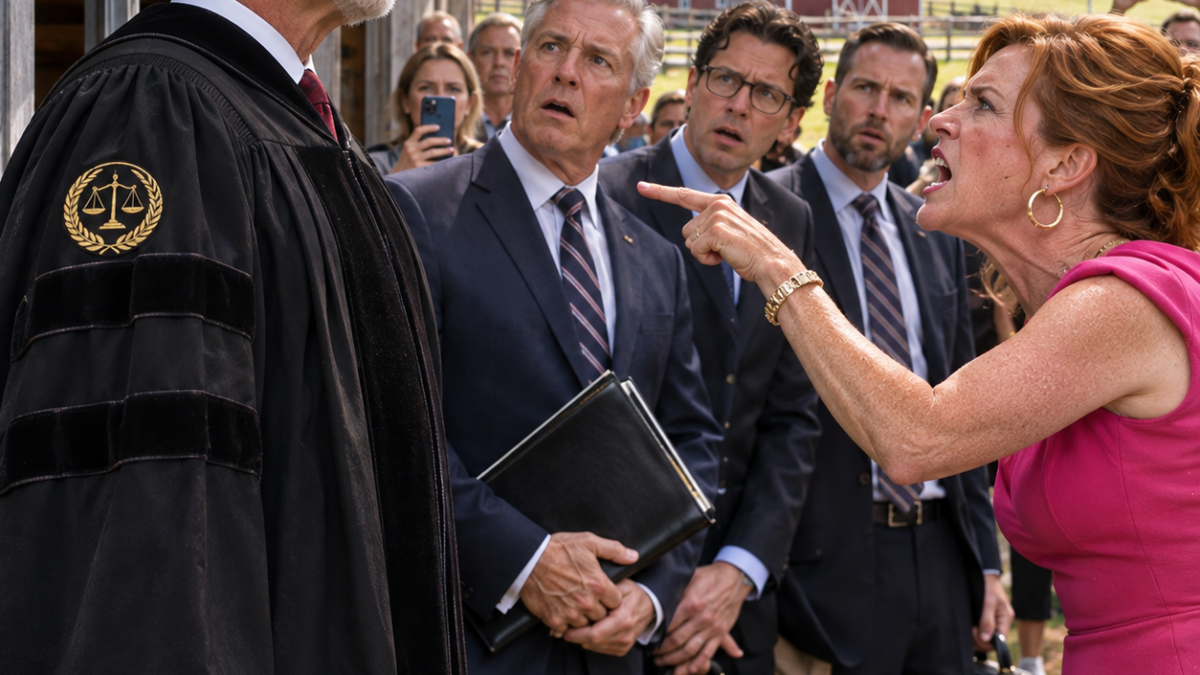
Candace stepped from the lead SUV.
Pink dress.
Pearl necklace.
Hair perfect.
Three men climbed from the vehicles behind her.
Navy suits.
Leather briefcases.
Lawyers.
I recognized one immediately.
Grant Aldridge.
Civil litigator.
Experienced.
Polished.
Had appeared before me twice.
The other two were Neil Pemberton and Ross Delaney.
They had been in my courtroom too.
Behind them came fifteen or so Willow Ridge residents.
Some curious.
Some excited.
One woman was already livestreaming.
Candace marched up the porch steps.
Pounded the door.
Hard enough to shake the glass.
I took a breath.
Then opened it.
She started before she looked at me.
“Elliot Granger, you have no right to occupy HOA property!”
I stared at her.
“Good morning, Candace.”
“This land belongs to Willow Ridge.”
“No.”
“You are trespassing.”
“I live here.”
“Not for long.”
Grant stepped forward.
His eyes were on the folder.
Not me.
“Mr. Granger, I’m Grant Aldridge, counsel for Willow Ridge Estates.”
“I know who you are.”
He looked up.
His expression froze.
His eyes moved from my face.
To the robe.
Back to my face.
Color drained from him.
Neil looked.
Then Ross.
Ross’s folder slipped from his hand.
Papers scattered across the porch.
Candace spun.
“What are you doing?”
Nobody answered.
Grant swallowed.
“Judge Granger.”
Candace looked at me.
Then at him.
“What?”
Neil whispered:
“Oh, hell.”
She snapped:
“What is wrong with all of you?”
Grant turned slightly toward her.
“Ms. Marrow, we need to speak privately.”
“No.”
“Immediately.”
“Why?”
His voice lowered.
“That is Judge Elliot Granger.”
She stared.
“Judge?”
“United States District Court.”
The neighbors went silent.
Then phones lifted higher.
Candace looked at my robe.
Finally saw it.
Really saw it.
“You’re a judge?”
“Yes.”
Her expression changed rapidly.
Confusion.
Disbelief.
Then suspicion.
“You never said that.”
“You never asked.”
Grant closed his eyes.
I stepped onto the porch.
“Before anybody gets carried away, I want something understood.”
The lawyers looked at me.
“So does everybody recording.”
Several phones adjusted.
“I am not acting as a judge.”
Pause.
“This is my private property.”
I pointed toward the driveway.
“I am a landowner involved in a dispute with an HOA. Nothing about my office gives me additional property rights, and nothing about my position changes the process.”
Grant visibly relaxed a little.
That mattered.
I continued.
“My attorney is Martha Keene. Future communications go through her.”
Candace regained some confidence.
“Good. Then take these.”
She grabbed Grant’s folder.
Pulled out papers.
“Foreclosure notice.”
I looked at Grant.
“Foreclosure?”
His discomfort returned.
“Notice of claimed lien and proposed enforcement proceedings.”
Candace snapped:
“He has thirty days to vacate.”
Grant immediately said:
“That is not precisely what the document says.”
I almost smiled.
Candace glared at him.
“You told me—”
“I advised that there was a process.”
She turned back to me.
“Your farm is subject to the covenant.”
“Show me.”
She pulled out another document.
“Here.”
Page nine.
Recorded declaration.
Dated:
July 17, 1987.
Property description included my acreage.
Then I saw the signature.
Robert Granger.
My father.
Not typed.
Handwritten.
Notarized.
I stopped.
Everything around me went quiet.
Candace smiled.
“There.”
I looked up.
“Where did you get this?”
“Our records.”
“Answer the question.”
“Warren’s title team located it.”
There it was.
Warren.
Grant looked at Candace.
“Warren Pike?”
She seemed to realize she had said too much.
But I was looking only at the signature.
Robert Granger.
I said:
“My father died in 1983.”
Nobody spoke.
Candace’s smile vanished.
I repeated:
“He died on November 4, 1983.”
Grant took the document from me.
Looked at the date.
Then signature.
Then date again.
His face changed completely.
Neil stepped closer.
“Grant.”
“I see it.”
Ross picked his papers up.
“What?”
Grant showed him.
Ross whispered:
“Jesus.”
From the driveway, Maggie Doyle spoke.
Maggie had lived across County Road 6 for fifty years.
She was eighty-one.
She stepped forward.
“Robert died in eighty-three.”
Candace spun.
“This doesn’t concern you.”
Maggie laughed.
“I carried flowers at his funeral.”
One of the neighbors said:
“Wait.”
Another:
“So who signed it?”
Candace pointed at the document.
“It is notarized.”
Grant said quietly:
“Candace.”
“What?”
“Stop talking.”
Her face flushed.
“I’m your client.”
“Yes.”
“Then defend me.”
“I need to understand where this document came from.”
“I told you.”
“You told us it was genuine.”
“It is.”
“Your supposed signer was dead.”
“That doesn’t mean—”
Neil interrupted.
“Yes.”
Everyone looked at him.
He continued:
“That means we have a serious problem.”
Candace stared at the three lawyers.
“You’re scared because he’s a judge.”
Grant’s expression hardened.
“No.”
He held up the covenant.
“I’m concerned because the document we were instructed to rely upon may be fraudulent.”
That sentence changed the mood completely.
I said:
“I’m preserving this copy.”
Grant nodded.
“Agreed.”
Candace grabbed for it.
He pulled it away.
“What are you doing?”
“Preserving evidence.”
“Give it to me.”
“No.”
“You work for the HOA.”
“At this moment, I am telling you not to touch that document.”
The crowd began murmuring.
Candace’s control was slipping.
She looked toward the road.
Then said:
“Warren gave it to me.”
Grant stared.
“What?”
“Warren Pike.”
More phones rose.
“He said his title people verified everything.”
Grant looked toward Neil.
Neil looked toward Ross.
Nobody liked where this was going.
I stepped inside.
Took my phone.
Called Martha.
Not the Marshals.
Not another judge.
Not anybody connected to my office.
My lawyer.
“Martha.”
“What happened?”
“Candace is standing on my porch with three attorneys and a covenant supposedly signed by my father in 1987.”
“Okay.”
“He died in 1983.”
Silence.
Then:
“Nobody leaves with the original paperwork.”
“I have a copy.”
“Photograph everything.”
“Already being recorded by half the neighborhood.”
“That helps.”
“What next?”
“I’ll call the county recorder and district attorney.”
“Good.”
“And Elliot?”
“Yes?”
“Go to your ceremony.”
I looked at the crowd.
“You’re joking.”
“No.”
“You hired me to keep you from doing stupid things.”
“Apparently.”
“Let me work.”
She hung up.
Grant had already called his firm’s general counsel.
That was smart.
Within twenty minutes, the three attorneys formally withdrew from any attempt to serve or enforce the disputed covenant until authenticity could be verified.
Candace was furious.
“You can’t abandon me on his porch!”
Grant replied:
“We are not going to advance a document we now have reason to believe may be fraudulent.”
“He intimidated you!”
“No.”
Grant pointed at the date.
“Your document did.”
That line was better than anything I could have said.
I left for the courthouse.
Still in my robe.
Hannah met me there.
She had already seen the video.
Of course she had.
“Dad.”
“I know.”
“You opened the door dressed like that?”
“I was leaving for work.”
“You looked like you planned it.”
“I did not.”
“Internet doesn’t care.”
She showed me her phone.
Thousands of views already.
FEDERAL JUDGE SHOCKS HOA LAWYERS TRYING TO FORECLOSE FARM.
I groaned.
“This is exactly what I didn’t want.”
“You do understand how objectively funny this looks.”
“No.”
“It is very funny.”
“Your grandfather would disapprove of you.”
“He would think it’s hilarious.”
She was right.
The ceremony took forty minutes.
I swore in twenty-three new attorneys.
Before administering the oath, I added one sentence I hadn’t planned.
“Your professional obligation is not to the client’s desired outcome. It is to the law and to the truth.”
Several people smiled.
Grant Aldridge probably would not have.
By noon, Martha had the county recording history.
No 1987 covenant affecting my farm had ever been recorded.
No annexation.
No signed declaration.
No HOA obligation.
Nothing.
The document Candace had brought was not merely suspicious.
It wasn’t in the official chain of title at all.
The county clerk, Susan Tran, prepared a certified statement.
My deed remained clean.
That should have ended the property claim.
Instead it opened a much larger question.
Who created the fake covenant?
The district attorney’s office began investigating.
So did the state real-estate fraud unit once they learned the same document had apparently been used in communications involving financing for Willow Ridge’s proposed expansion.
Martha discovered Pike Development had a preliminary plan for two hundred additional homes west of the existing neighborhood.
There was one major problem.
Road access.
My farm.
Specifically thirty-two acres of south pasture.
Warren Pike had tried buying it.
I refused.
Then suddenly an HOA covenant appeared claiming Willow Ridge controlled it.
That was not coincidence.
Two days later, investigators executed warrants through the normal court process.
Not my court.
I had nothing to do with them.
I made that very clear.
Because the last thing I wanted was anybody saying Judge Granger used his office to settle a private land fight.
I recused myself from anything remotely connected to the matter.
The investigation belonged to other judges.
Other prosecutors.
Other agencies.
What investigators found in Warren’s office became the real story.
Draft covenants.
Property maps.
Scanned historical signatures.
Notary templates.
Emails discussing acquisition problems.
And a color map of my farm.
My south pasture outlined in red.
Beside it:
PRIMARY ACCESS CORRIDOR.
One email from Warren to Candace read:
WE NEED HOA CONTROL ON PAPER BEFORE COUNTY REVIEW.
Another:
GRANGER WILL NOT SELL DIRECTLY.
Then:
CLEAN UP THE MEMBERSHIP ISSUE.
Candace replied:
I CAN HANDLE HIM.
She had apparently believed that.
The three attorneys cooperated.
Grant provided his intake communications.
Neil turned over title materials.
Ross produced emails showing the firm had repeatedly asked for certified recording information.
Candace had supplied what appeared to be copies.
None of the lawyers had independently checked the father’s death date before arriving.
Embarrassing?
Absolutely.
Professional negligence?
Potentially.
Participation in the forgery?
Investigators found no evidence of that.
That distinction mattered.
People online wanted villains.
Three evil lawyers.
One evil HOA president.
Corrupt developer.
Reality was messier.
The lawyers had been careless.
Candace had been aggressive.
Warren had financial motives.
But allegations had to be proven individually.
That was the kind of distinction I’d demanded from lawyers in my courtroom for thirty years.
I wasn’t going to abandon it simply because I was angry.
The HOA board called an emergency meeting.
Hannah and I attended.
Not because we had to.
Because residents asked.
Candace sat at the front.
No pink dress this time.
Gray suit.
Attorney beside her.
Different attorney.
Grant’s firm had withdrawn.
The clubhouse was packed.
A homeowner named Paul Becker stood first.
“Did you know the covenant was fake?”
Candace’s attorney whispered something.
She said:
“On advice of counsel, I will not discuss the investigation.”
Another resident stood.
“Did you give it to the lawyers?”
Same answer.
Then Maggie Doyle stood.
She wasn’t a member of Willow Ridge.
Nobody stopped her.
“You called Robert Granger’s son a trespasser on Robert’s own farm.”
Candace stared.
Maggie continued.
“I watched that family work that land before your subdivision existed.”
Applause.
The board voted to suspend Candace pending investigation.
Then residents demanded an independent audit.
That revealed other issues.
Not all criminal.
But enough to destroy trust.
Unapproved consulting payments.
Developer-sponsored “community planning” expenses.
Legal bills associated with the attempted land claim.
Communications between Candace and Pike Development that had never been disclosed to the full board.
Within two weeks, Candace was removed as president.
Several board members resigned.
The development expansion froze.
Without guaranteed access, Warren’s two-hundred-home plan couldn’t proceed under its existing design.
Then came charges.
Not dramatic arrests on my porch.
No black SUVs roaring across the pasture.
Just process.
Warrants.
Interviews.
Grand-jury proceedings.
Filings.
Eventually Warren Pike faced charges tied to fraudulent documents and attempted property-related deception.
Candace faced charges related to her role in using and distributing those materials.
The final legal outcomes took far longer than the internet wanted.
Real cases do.
Some counts survived.
Some changed.
Some were resolved through pleas.
Civil lawsuits followed.
Professional complaints were filed regarding the lawyers’ failure to verify the documents they had tried to enforce.
The farm stayed mine through all of it.
That was the important part.
County records confirmed it.
My grandfather’s deed.
My father’s estate.
My deed.
Continuous tax records.
Surveys.
Every legitimate piece of paper told the same story.
The fake covenant was loud.
The real records were boring.
Boring won.
The fluorescent paint across my pasture faded by midsummer.
I refused to let anyone remove it immediately.
Hannah thought that was strange.
“Why keep it?”
“Reminder.”
“Of Candace?”
“No.”
“Warren?”
“No.”
“Then what?”
I pointed at the orange line.
“That somebody can draw a line on your property without changing where the boundary actually is.”
She smiled.
“That sounds like something you’d say from the bench.”
“Unfortunately.”
Eventually the rain erased it.
The proposed park sign disappeared too.
Warren’s Phase Two plans vanished from the county agenda.
Willow Ridge elected a new board.
The new president was a retired high-school principal named Diane Mercer.
Her first letter to me began:
Dear Judge Granger—
I crossed out Judge.
Wrote Elliot.
Sent it back.
She laughed when she saw me later.
The association formally acknowledged in writing that Granger Farm was not and had never been subject to Willow Ridge covenants.
No dues.
No architectural control.
No lien authority.
No easement.
No community park.
No road.
I framed that document.
Not because I needed proof.
Because I enjoyed the sentence.
Hannah said that was petty.
She was right.
Then something unexpected happened.
Willow Ridge residents began visiting.
Not in groups.
One at a time.
A woman brought apple pie.
Another brought peach preserves.
Paul Becker brought whiskey.
Maggie said that was more appropriate.
One man stood awkwardly at my gate holding a casserole.
“My wife made this.”
“Thank you.”
“I believed Candace.”
“A lot of people did.”
“She told us you were refusing to pay dues.”
“I wasn’t supposed to pay dues.”
“I know.”
“She said you were trying to block a park for children.”
“I was blocking a road for a developer.”
He looked toward the pasture.
“I’m sorry.”
I accepted the casserole.
“You didn’t forge anything.”
“No.”
“Then we’re fine.”
He looked relieved.
The strange thing was, most Willow Ridge residents had never wanted my farm.
They wanted stable property values.
A safe neighborhood.
Reasonable dues.
Candace had convinced them those goals required controlling the land next door.
Once she was gone, the supposed war disappeared.
Children started waving when I drove the tractor past the subdivision.
Someone asked if I would let the elementary school tour the barn.
I said yes.
Then another class came.
Then another.
Soon Hannah accused me of secretly becoming a petting zoo.
“I am not running a petting zoo.”
“You have twenty-nine children brushing one cow.”
“Educational agriculture.”
“Petting zoo with constitutional protections.”
I ignored her.
The federal courthouse story followed me longer.
Attorneys who appeared before me tried very hard not to mention it.
Most failed.
One young lawyer began an oral argument with:
“Good morning, Your Honor. I assure the Court my documents were all signed by living people.”
The courtroom exploded.
I gave him thirty seconds to enjoy himself.
Then made him argue.
Grant Aldridge appeared before me again almost two years later.
Different matter.
Different client.
He requested reassignment because of the history between us.
I granted it.
No hesitation.
Not because I thought I couldn’t be fair.
Because public confidence matters as much as private confidence.
Afterward he sent me a handwritten note.
Judge Granger,
I should have verified the chain of title before stepping onto your porch.
I won’t make that mistake twice.
Grant.
I kept that too.
People often ask what the lawyers looked like when they recognized me.
Yes.
They went pale.
Especially Ross.
Yes.
One dropped papers.
Yes.
Candace genuinely seemed to believe I had somehow dressed as a judge to frighten her.
That part still makes Hannah laugh.
But the internet version gets the lesson wrong.
The story isn’t:
Don’t mess with a federal judge.
I hate that version.
Because if Candace had done exactly the same thing to a retired mechanic, a schoolteacher, or a widow living alone, it would have been just as wrong.
My robe didn’t make the deed valid.
My title didn’t make the covenant fraudulent.
The lawyers should have stopped when they discovered the dead man’s signature whether the person standing in front of them wore a robe or overalls.
The sheriff should have respected the boundary either way.
The county recorder should have protected the chain of title either way.
Property rights don’t become more real because the owner has an impressive job.
That may have been the most uncomfortable lesson in the entire affair.
Candace listened only after discovering I was somebody she feared.
She should have listened when I was simply the farmer saying:
This land is mine.
A year after everything ended, Hannah and I stood beside the south pasture at sunset.
The proposed park was gone.
The road alignment was gone.
Cattle grazed where the surveyor had painted lines.
The old barn threw a long shadow across the grass.
Hannah said:
“Grandpa would’ve enjoyed watching Candace discover who you were.”
I smiled.
“He would’ve been furious I answered the door in my robe.”
“Why?”
“He thought judges looked ridiculous.”
She laughed.
“He was not wrong.”
We stood quietly for a while.
Then she said:
“Would you ever sell?”
I looked toward the oaks.
Maybe ten years earlier, the answer would have been immediate.
Never.
Now I thought about it.
“Maybe someday.”
She looked surprised.
“Really?”
“Yes.”
“What changed?”
“Nothing.”
“Then why?”
“Because refusing Candace and Warren wasn’t about making sure the farm never changes.”
I looked at her.
“It was about making sure the choice stays ours.”
That was the real inheritance.
Not 140 acres.
Choice.
Grandpa chose to buy it.
Dad chose to keep it.
I chose not to sell.
Maybe Hannah would make another choice someday.
That would be hers.
What Candace and Warren tried to steal wasn’t just dirt.
It was the right to decide.
I eventually placed the farm into a family conservation trust.
Not because of the HOA.
At least not entirely.
The trust protected the historic barn, the oak grove, the cemetery, and most of the pasture from high-density development while allowing agricultural use to continue.
Hannah helped draft it.
She complained about my edits.
I complained about her commas.
Tradition.
The farmhouse remained unchanged.
The barn remained visually unappealing according to Candace’s original notice.
I considered repainting it.
Then found the HOA’s old approved palette.
Beige.
Tan.
Gray.
I bought red paint.
Very red.
Hannah caught me halfway through.
“Dad.”
“What?”
“That color is aggressive.”
“Historically appropriate.”
“It looks like a fire engine.”
“Excellent.”
She shook her head.
“Federal judges are supposed to have dignity.”
“Not on Saturdays.”
We finished painting by sunset.
I kept one thing from Candace’s stack of papers.
The fake foreclosure notice.
It sits in my study beside the certified county statement confirming there had never been a recorded Willow Ridge covenant on my land.
One document tried to manufacture authority.
The other simply recorded reality.
I show them occasionally to young lawyers.
Especially when I lecture about professional responsibility.
I ask one question:
“What should Grant Aldridge have done before driving to my farm?”
Somebody always answers:
“Checked whether you were really a federal judge.”
I shake my head.
Wrong.
“Verified the document.”
That’s the answer.
Not my identity.
Not my reputation.
Not my job.
The document.
Because titles distract people.
Mine distracted Candace.
Hers distracted residents.
Warren’s wealth distracted the HOA board.
Three lawyers carrying briefcases distracted fifteen neighbors into assuming the foreclosure must be real.
But authority does not become legitimate because it arrives in an expensive suit.
A signature does not become genuine because it has a notary stamp.
A covenant does not become binding because an HOA president waves it in your driveway.
And a farm does not stop belonging to the Granger family because somebody draws a park over it on a map.
My father died in 1983.
That simple fact destroyed their 1987 covenant.
Four years.
One date.
That was all.
Candace arrived believing she had three lawyers, a foreclosure notice, a crowd, and a developer behind her.
I happened to open the door wearing a judicial robe.
That frightened them.
But it wasn’t what saved the farm.
The truth did.
My father couldn’t have signed that covenant.
My family had never joined Willow Ridge.
The county had never recorded it.
The developer had no right to the pasture.
And I had never agreed to surrender a single acre.
The robe made them look twice.
The records made them leave.








