HOA Karen Booted My Truck Inside My Locked Ranch Garage—Then Her Own Lawyer Found Out the Road Was Mine
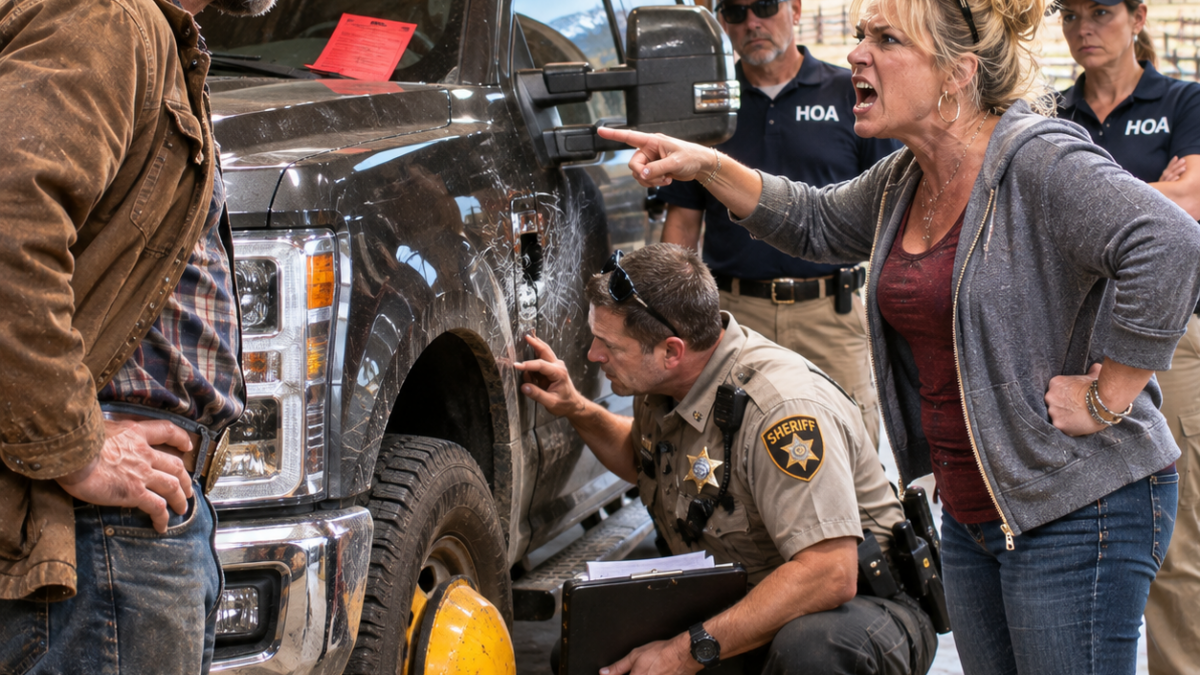
HOA Karen Booted My Truck Inside My Locked Ranch Garage—Then Her Own Lawyer Found Out the Road Was Mine
**“YOU CAN’T LOCK OUT AN ENTIRE NEIGHBORHOOD OVER A PARKING DISPUTE, JACK—OPEN THIS GATE RIGHT NOW!” HOA president Patricia Nolan screamed as eighty-three Silver Creek homeowners stood behind the steel gate at the edge of my Colorado ranch.**
**I handed her attorney a photograph of my F-350 sitting inside my locked private garage with a bright yellow Silver Creek wheel boot clamped to the front tire, and his voice dropped when he asked, “Your people actually entered his building to do this?”**
**Then a man from the county clerk’s office pushed through the crowd carrying an old easement Patricia clearly had never read, and when her attorney opened it and looked toward the road crossing my ranch, his face went pale.**
At 7:05 that Tuesday morning, the steel gate had been closed for less than twenty minutes.
That was apparently enough time for half of Silver Creek Estates to hear that I had “locked them out.”
Cars were already lining the neighborhood side of Mercer Lane.
Parents had children in the back seats.
A delivery van sat behind two SUVs.
Someone had arrived in pajama pants.
Another homeowner was filming.
Patricia Nolan stood at the front of the crowd wearing jeans, a pale sweater, and the expression of a woman who believed volume could rewrite a deed.
Behind her stood Silver Creek’s attorney, Charles Bennett.
Unlike Patricia, Charles was not shouting.
He was reading.
That made him much more interesting.
The sign attached to my gate said:
PRIVATE RANCH ROAD
HOA OPERATIONAL ACCESS REVOKED
Patricia stabbed one finger toward it.
“You have no right to do this.”
“I own the road beneath that gate.”
“Silver Creek has used this road for sixteen years.”
“Residents have.”
“That’s the same thing.”
“No.”
She turned toward Charles.
“Tell him.”
Charles kept reading the documents in his hands.
Patricia’s anger shifted slightly.
“Charles?”
He finally looked up.
“You told me Silver Creek owned this section.”
“We maintain it.”
“That wasn’t what I asked.”
“We have permanent access.”
“For residents.”
Patricia pointed at me.
“He is doing this because of a parking dispute.”
I almost laughed.
A parking dispute.
That was what the whole thing had become in her version of history.
I reached into my jacket and handed Charles the photograph.
My truck sat in the middle of my detached ranch garage.
Concrete floor.
Tool cabinets.
Workbench.
Closed walls.
Nothing about the scene remotely resembled a community road.
Around the front tire was a bright yellow wheel boot.
A red violation sticker stretched across the windshield.
SILVER CREEK PARKING ENFORCEMENT.
OVERSIZED VEHICLE.
UNPAID FINES.
REMOVAL FEE: $750.
Charles stared at the picture.
Then at Patricia.
“They entered his garage?”
Nobody answered.
Somebody behind Patricia said:
“What garage?”
Another homeowner moved closer.
Patricia folded her arms.
“This response is completely unreasonable.”
I looked at her.
PART3:
“No. Entering my locked garage at two in the morning to boot my truck was unreasonable.”
I pointed toward the gate.
“This is the response.”
That was when county clerk employee Mark Ellis pushed through the crowd carrying the second easement.
“You need to see this.”
Charles took it.
Read the first page.
Then the second.
His face changed.
Patricia saw it immediately.
“What?”
Charles did not answer.
He looked through the gate toward Mercer Lane, the paved road that crossed the northern section of my ranch before reaching Silver Creek.
Then he looked at me.
“Mr. Mercer, how much of Silver Creek’s daily traffic actually crosses your property?”
“More than they realized.”
That morning was when everything changed.
But the yellow boot had not started the fight.
The fight had started four months earlier, when I bought Mercer Ranch and still believed Silver Creek Estates was simply the nice neighborhood beyond my cattle fence.
My name is Jack Mercer.
I was forty-nine when I bought the ranch from my uncle William’s estate.
Technically, I had the first option to purchase it.
William Mercer had owned the place for nearly forty years.
When he died, his will gave me the right to match a fair appraisal before the family estate offered the ranch to anyone else.
I did not hesitate.
Mercer Ranch was 142 acres outside Fort Collins, Colorado.
Twenty-eight cattle when I took over.
Two barns.
Machine shed.
Four-bedroom ranch house.
Spring-fed pond.
A detached garage large enough to make any man who enjoys machinery behave irresponsibly.
Forty feet wide.
Sixty feet deep.
Two roll-up doors.
Long workbench.
Tool cabinets.
Space for my F-350, an old Ford Bronco, a tractor, welding equipment, spare hydraulic parts, and enough half-finished projects to guarantee I would never be bored.
Uncle William called it the cathedral.
“A man needs somewhere peaceful,” he used to say.
By the time I reached forty, I understood exactly what he meant.
For twenty-three years, my brother David and I had run an agricultural equipment business.
Tractors.
Hay equipment.
Hydraulic systems.
Farm trucks.
Anything ranchers broke when they could not afford to wait two weeks for dealership service.
The business did well.
David’s sons eventually joined us.
That allowed me to step back to three days a week and spend more time at the ranch.
That was supposed to be my quieter life.
Then there was Silver Creek.
The subdivision sat along my eastern boundary.
About two hundred homes.
Stone entrance.
Pool.
Clubhouse.
Walking trails.
Private roads.
Nice place.
Most of the people were nice too.
My uncle’s ranch existed decades before Silver Creek.
He never joined the HOA.
The property line was clear.
Ranch on one side.
Silver Creek on the other.
But the two properties shared one important thing.
Mercer Lane.
When Silver Creek had been built sixteen years earlier, the developer needed a route to the county highway.
My uncle granted a recorded easement over a narrow section along the northern edge of his ranch.
Silver Creek residents could drive through permanently.
The HOA contributed to maintenance.
William paid the remaining share because he used it too.
Nothing strange about that.
My first visitor after moving in was Frank Miller.
Sixty-seven.
Retired firefighter.
White beard.
Baseball cap from Arizona even though I later learned he had never been to Arizona.
He brought a pie his wife had made.
“Welcome back.”
“You remember me?”
“I remember your uncle yelling at you for driving a tractor into his fence.”
“I was fourteen.”
“You still hit the fence.”
Fair.
Frank looked toward my cattle.
“You keeping them?”
“Yes.”
“Good.”
“Why?”
He looked toward Silver Creek.
“Patricia wanted the ranch sold.”
That was the first time I heard her name.
“Who’s Patricia?”
Frank laughed.
“You’ll know soon.”
He was right.
Patricia Nolan had been Silver Creek HOA president for six years.
Before that, architectural committee.
Before that, neighborhood safety.
Frank described her as a woman who believed rules proved civilization was functioning.
I did not have a problem with rules.
Farm equipment needs rules.
Livestock gates need rules.
Workshops need rules.
The problem starts when somebody forgets where their rules stop.
Patricia visited during my second week.
White SUV.
SILVER CREEK COMMUNITY SERVICES printed on the side.
A man sat beside her wearing a gray polo.
She stayed outside my front gate and called me.
I walked down.
“Jack Mercer?”
“That’s me.”
“Patricia Nolan. Silver Creek HOA president.”
We shook hands.
She looked past me.
“You’re operating livestock?”
“Yes.”
“How many?”
“Twenty-eight.”
“Your uncle usually kept fewer.”
“Sometimes.”
“We’ve already had resident concerns about odor.”
I looked toward the closest Silver Creek home.
Nearly half a mile away.
“Already?”
“We’re being proactive.”
I have learned that proactive is often a word people use before fixing a problem nobody has.
She introduced the man.
Scott Wallace.
Supervisor of Silver Creek Community Services.
Not police.
Not sheriff.
Private HOA patrol and maintenance.
Scott started explaining Silver Creek’s rules.
Commercial vehicles.
Trailers.
Visible equipment.
Outdoor storage.
Oversized trucks.
When he finished, I asked:
“What does any of that have to do with my ranch?”
Patricia smiled.
“Mercer Ranch has visual impact on Silver Creek.”
“I’m sure it does.”
“We ask neighboring properties to respect community standards.”
“Ask?”
“Yes.”
“Then no.”
Scott looked at Patricia.
Her smile disappeared.
“You may want to review the road agreement.”
“I already did.”
That surprised her.
“The HOA has broad safety authority connected to Mercer Lane.”
“It has driving rights and certain maintenance rights inside the easement.”
“Correct.”
“My garage isn’t Mercer Lane.”
Silence.
“My barn isn’t Mercer Lane. My pasture isn’t Mercer Lane. My cattle aren’t Mercer Lane.”
Patricia put her sunglasses back on.
“I’m sure we’ll work this out.”
They left.
A week later, the first violation arrived.
OVERSIZED COMMERCIAL VEHICLE VISIBLE FROM COMMUNITY ROAD.
$250.
The vehicle was my personal Ford F-350.
Parked beside my barn.
On my ranch.
I called management.
Jennifer Collins answered.
She checked my address.
Long pause.
“Mr. Mercer, your parcel isn’t listed as a Silver Creek property.”
“I know.”
“I’ll cancel this.”
“Thank you.”
Done.
Two weeks later:
UNAPPROVED AGRICULTURAL TRAILER.
$300.
Canceled.
TRACTOR STORED IN VIEW OF HOA RESIDENCES.
Canceled.
LIVESTOCK NOISE.
Canceled.
EXTERIOR LIGHTING.
Canceled.
Every notice followed the same pattern.
Issue.
Challenge.
Cancel.
I began wondering why anyone kept sending them.
Frank eventually told me.
“Patricia wants the ranch to transition.”
“Transition into what?”
“Residential development.”
“Not happening.”
“Silver Creek is almost built out. Your ranch could give them another entrance.”
“I’m not selling.”
“That should solve it.”
It should have.
Instead, Scott started driving Mercer Lane more often.
Slowly.
Sometimes stopping.
One afternoon I caught him photographing my equipment shed.
“Can I help you?”
“Documenting conditions.”
“On my property?”
“I’m standing on the easement.”
Technically true.
“What conditions?”
“Possible violations.”
“Of Silver Creek rules?”
“Yes.”
“I’m not in Silver Creek.”
“Patricia says road safety authority gives us enforcement rights when nearby property affects the corridor.”
“The shed is three hundred feet from the road.”
“Still visible.”
“Visibility isn’t road safety.”
Scott shrugged.
“I just document.”
That became his favorite sentence.
Then the HOA attorney sent a warning claiming Silver Creek could regulate hazards and “incompatible uses” within fifty feet of Mercer Lane.
I pulled the recorded easement.
No such language.
That was when I called Rebecca Hayes.
Rebecca had handled the ranch purchase.
Property attorney.
Sharp.
Patient.
Dangerously calm when other people were being stupid.
I emailed her the HOA letter.
She called ten minutes later.
“They’re stretching.”
“How far?”
“Very.”
“Can they regulate my truck?”
“No.”
“Cattle?”
She laughed.
“No.”
“What can they regulate?”
“Physical obstructions inside the recorded road easement. Maintenance issues. Things actually connected to their access.”
“I have no obstruction.”
“I know.”
“Then what are they doing?”
“Testing you.”
That was not technically legal terminology.
It was accurate.
How many notices would I tolerate?
How many small demands would I obey?
How much authority could they create simply because I got tired of arguing?
Rebecca sent a formal letter.
Mercer Ranch was outside Silver Creek.
No HOA authority over my vehicles.
Barns.
Agricultural operations.
Garage.
Equipment.
Trailers.
Any future alleged violation must identify a specific recorded legal right.
Everything stopped for almost a month.
That was the peaceful stretch.
I moved cattle.
Fixed fence.
Worked at the equipment shop with David.
Robert Jenkins from Silver Creek brought his grandson to see the calves.
Susan Parker bought eggs from me every Friday.
I told her six chickens did not make me an egg farmer.
She said:
“That makes them exclusive.”
I liked those people.
That distinction became important later.
A neighborhood is not the same thing as the person running its HOA.
Then Patricia invited me to a board meeting.
I almost skipped it.
Frank said:
“You should hear what she’s telling people.”
So I went.
About sixty residents.
Patricia presented something called the Northern Safety Corridor Plan.
Mercer Lane sat in the middle.
Proposed:
Wider shoulders.
Pedestrian lighting.
Walking path.
Emergency turnaround.
And restrictions on “non-residential vehicle storage” near the corridor.
That was me.
I raised my hand.
“What does non-residential vehicle storage mean?”
“Large trucks, trailers, machinery.”
“On HOA property?”
“Near the corridor.”
“How near?”
“Up to one hundred feet.”
I laughed.
Not loudly.
Enough.
Patricia frowned.
“This road carries hundreds of residents.”
“I know.”
“We need standards.”
“Then regulate the road.”
“That’s what we’re doing.”
“No. You’re trying to regulate my land next to the road.”
People looked at one another.
“If you want another hundred feet of easement, ask me.”
The room shifted.
Patricia said:
“We already possess sufficient safety rights.”
Rebecca had told me not to litigate property law in a clubhouse.
So I said:
“Send the documents to my attorney.”
And sat down.
Frank leaned over.
“She hated that.”
“I noticed.”
The next morning Scott arrived with two employees and measuring wheels.
“What are you doing?”
“Safety survey.”
“Inside the easement?”
“We need setback measurements.”
“You can measure the easement. You’re not measuring my pasture.”
Scott sighed.
“Jack, you make everything difficult.”
“That’s interesting coming from the man trying to measure somebody else’s ranch.”
They left.
Then Silver Creek passed its overnight parking policy.
No oversized vehicles within fifty feet of Mercer Lane.
Rebecca read it and emailed:
AN HOA POLICY CANNOT REWRITE YOUR DEED.
I ignored it.
Most nights my F-350 was inside the garage anyway.
Which made what happened next even more absurd.
One Thursday I got home around eleven after helping David replace a hydraulic pump.
I drove into the detached garage.
Parked beside the Bronco.
Closed the roll-up door.
Locked the side door.
Went to bed.
At 6:30 the next morning, I opened the garage.
Got into my truck.
Put it in reverse.
It would not move.
I thought I had forgotten the parking brake.
Then I saw yellow metal.
Wheel boot.
Silver Creek.
$750 removal fee.
I sat there staring.
The truck was not on Mercer Lane.
Not beside Mercer Lane.
Not outdoors.
It was inside my locked garage.
Then I noticed the side door.
Slightly open.
Lock scratched.
Cold feeling in my stomach.
I checked the camera over the workbench.
Offline.
Exterior camera still worked.
2:14 a.m.
Silver Creek Community Services SUV entered through my ranch gate.
Scott Wallace got out.
Paul Norton followed.
They approached the garage.
Scott tried the side door.
Locked.
Paul returned to the SUV.
Came back carrying something.
Three minutes later, they were inside.
Twenty-one minutes passed.
They came out.
Scott carried the yellow boot case.
I watched it three times.
My anger was cold.
Not yelling anger.
The kind that makes everything become very clear.
I called Rebecca.
“Don’t remove the boot.”
“Why?”
“Evidence.”
Then I called the sheriff.
Deputy Laura Mitchell arrived.
Photographed everything.
Lock.
Door.
Boot.
Tag.
Truck.
Garage.
Video.
“Did you authorize them to enter?”
“No.”
“Any HOA right to enter this building?”
“No.”
“Emergency?”
“No.”
“Contact before entry?”
“No.”
She looked at the boot.
“This is not normal parking enforcement.”
“No.”
Then Scott showed up.
The boot apparently had GPS tracking.
He saw the patrol vehicle.
Walked into my driveway.
Laura asked:
“Did you enter this garage last night?”
“We performed an enforcement action.”
“Inside the building?”
“The vehicle remained in continuing violation.”
“That wasn’t my question.”
Then Patricia arrived.
Of course.
Folder in hand.
“Jack, I asked you repeatedly to comply.”
I looked at her.
“You authorized this?”
“I authorized enforcement.”
“Inside my garage?”
“You moved the vehicle inside to avoid enforcement.”
For a second I admired how confidently she said it.
“So because I park my truck inside my own building, your people are allowed to break in?”
“Nobody broke in.”
I pointed at the lock.
“How did they enter?”
Scott said nothing.
Laura asked Patricia for the legal authority.
She handed over the new parking policy.
Laura read it.
“Where does this authorize entry into private buildings?”
Patricia said:
“Our attorney advised us continuing violations remain enforceable.”
“Is Mr. Mercer a member of your HOA?”
Patricia hesitated.
“He benefits from our road system.”
Not an answer.
Then Rebecca arrived.
Walked into the garage.
Saw the boot.
Saw the scratched lock.
Looked at me.
“You were not exaggerating.”
“I wish I was.”
She turned to Patricia.
“Remove it.”
“After penalties are paid.”
Rebecca almost smiled.
Laura interrupted.
“Until I finish documenting this, nobody touches the boot.”
Scott objected.
“That is Silver Creek equipment.”
Laura looked at him.
“It is currently attached to another man’s vehicle inside another man’s building after an entry he says was unauthorized.”
Silence.
Frank arrived.
Saw the boot.
Stopped.
“Inside the garage?”
“Yes.”
He looked at Patricia.
“I voted for a road parking rule.”
“You voted for corridor standards.”
“No. You told us this applied to trucks parked along Mercer Lane.”
Patricia said nothing.
Rebecca asked which attorney approved garage enforcement.
Charles Bennett.
She called him.
Speakerphone.
Explained.
Long silence.
Then:
“They did what?”
Patricia turned pale.
Charles ordered all enforcement on Mercer property stopped until he reviewed everything.
That should have ended the morning.
It did not.
Laura noticed fresh mud under the workbench.
Scott and Paul had gone farther into the garage than the truck.
We pulled the local memory card from the disabled interior camera.
Final image before power loss:
Scott near my tool cabinets.
Paul near the back wall.
Beside my locked ranch-records cabinet.
“What was he doing there?” I asked.
Scott shrugged.
“Walking around.”
Then Frank noticed a paper on my workbench.
Silver Creek letterhead.
PROPERTY TRANSITION ASSESSMENT — MERCER RANCH.
Map.
My 142 acres divided into future residential lots.
Walking paths.
Road extensions.
Second Silver Creek entrance.
And Mercer Lane widened into a boulevard.
Consultant:
Northern Plains Development Group.
Client:
Silver Creek Estates HOA.
Frank stared.
“The board never approved this.”
Patricia called it preliminary.
“Paid from what?” Frank asked.
“Planning funds.”
“We do not have planning funds for Jack’s ranch.”
That was when the fines stopped looking random.
Truck.
Trailer.
Cattle.
Equipment.
Road setbacks.
Maybe someone wanted ranching to become uncomfortable enough that selling seemed easier.
Then orange cones appeared outside.
Dump truck.
Small excavator.
Survey stakes twelve feet beyond the recorded roadway.
Patricia called it drainage maintenance.
Rebecca compared the stakes with the easement.
“She’s widening it.”
The ribbon attached to one stake said:
PHASE ONE — NORTH ACCESS EXPANSION.
Not maintenance.
Expansion.
Then Frank’s phone rang.
He listened.
Looked at Patricia.
“The management office just sent me the purchase proposal.”
“What proposal?” I asked.
Northern Plains had offered Silver Creek $1.8 million for exclusive cooperation rights related to a future 240-home development.
MERCER RIDGE.
On my ranch.
I had never agreed to sell.
At the bottom:
OWNER COMPLIANCE STRATEGY CURRENTLY UNDERWAY.
Rebecca looked toward the boot inside my garage.
The picture became very clear.
Then Laura got another call.
The road contractor had entered through a locked ranch service gate.
Using a key.
I ran back to my file cabinet.
Fresh scratches.
Inside:
Empty key hook.
Spare north-gate key missing.
Beside it:
A photocopy of my deed.
Not made by me.
The boot had not been the only reason they entered my garage.
They had gone in for access.
Laura froze the scene.
Crime technician.
Fingerprints.
Evidence sleeves.
Road crews ordered out.
The excavator operator took one look at the real easement and called his company.
They packed up immediately.
Charles Bennett arrived.
He looked like a lawyer discovering his client had summarized the situation very creatively.
“I was not told anyone planned to enter your garage.”
“I assumed.”
“I did not approve road expansion outside the recorded easement either.”
Rebecca asked:
“Did you know about Northern Plains?”
“I knew they were interested if the ranch was ever sold.”
If.
That word mattered.
Frank asked about the $1.8 million proposal.
Charles had never seen it.
The HOA’s own attorney did not know.
Neither did the treasurer.
Neither did multiple directors.
Frank called an emergency meeting.
Meanwhile, Laura requested Silver Creek’s boot-enforcement records.
Scott resisted.
Then we learned Silver Creek Community Services was not an independent contractor.
It was an LLC created and controlled by the HOA.
Patricia was one of its managers.
Scott finally admitted Patricia personally approved the garage action.
Patricia said she approved enforcement, not forced entry.
Scott said:
“You told us if he hides the truck inside, go inside.”
Charles closed his eyes.
Then Scott mentioned “the property kit.”
Everybody stopped.
“What property kit?” Laura asked.
Scott declined to answer without counsel.
By afternoon, the inventory appeared anyway.
Bolt cutters.
Universal gate keys.
Slim-jim tools.
Lock-bypass equipment.
Temporary padlocks.
Traffic-control keys.
Some might have legitimate uses.
None belonged inside my private garage.
The yellow boot came off by noon.
I paid nothing.
Every parking fine disappeared.
Patricia called it an administrative pause.
Frank called it finally reading the deed.
I preferred Frank’s version.
That evening the clubhouse was packed.
Frank asked Patricia:
“Do you have a private consulting contract with Northern Plains?”
Silence.
Then:
“Yes.”
“How much?”
“Forty-eight thousand annually.”
Noise erupted.
“Success payment tied to Mercer Ranch?”
Her face tightened.
“One hundred twenty-five thousand.”
A woman yelled:
“You were fining him while they were paying you?”
Patricia stood.
“My consulting work is separate.”
It was not.
Her company was Nolan Community Strategies LLC.
The contract had been signed six months earlier.
While she was issuing violations.
Pushing road restrictions.
Approving “corridor standards.”
Frank asked whether she disclosed it.
No.
Recused herself?
No.
Told the board Northern Plains had suggested applying pressure?
No.
Then the emails came out.
Northern Plains vice president Douglas Price to Patricia:
NEW OWNER MAY BE MORE FLEXIBLE AFTER OPERATIONAL PRESSURE.
Patricia:
WHAT KIND OF PRESSURE?
Douglas:
ROAD COMPLIANCE. VISUAL STANDARDS. ACCESS MODERNIZATION. NUISANCE CONCERNS. NOTHING IMPROPER. JUST MAKE HOLDING AGRICULTURAL USE LESS COMFORTABLE.
Another:
SCOTT: MERCER IGNORES ALL NOTICES. NEED STRONGER ENFORCEMENT OR HE WILL NEVER NEGOTIATE.
PATRICIA: ESCALATE WITHIN ROAD AUTHORITY.
SCOTT: HE PARKS INSIDE GARAGE NOW.
PATRICIA: THEN ROAD AUTHORITY IS NOT ENOUGH.
That line stayed with me.
Not enough.
The board suspended Patricia that night.
Four votes.
She walked out quietly.
Frank became acting president and looked miserable about it.
I trusted him more because of that.
For several weeks, Silver Creek became normal.
No patrol.
No survey crews.
No fake violations.
Residents asked me honest questions.
Would I ever sell?
Maybe someday.
Would I consider a safer road shoulder?
Yes.
Could they buy a hundred-foot corridor?
No.
Frank eventually asked for six feet along one narrow section.
Drainage.
Winter shoulder.
Fair price.
No development rights.
No future widening.
I said yes.
He laughed.
“Patricia tried for months to force a hundred feet.”
“You asked for six.”
“That’s it?”
“That’s it.”
Then the forensic accountant found Scott’s private spreadsheet.
File name:
RANCH PRESSURE.
Columns:
Violation.
Owner response.
Escalation.
Selling temperature.
My garage incident was labeled:
VEHICLE ACCESS ESCALATION.
Then:
PROPERTY KEY ACQUIRED — NORTH GATE.
Timestamp:
2:31 a.m.
That was enough to expand the criminal investigation.
Paul Norton cooperated.
He admitted opening my file cabinet.
Taking the key.
Copying my deed.
He said Scott told him the key was “HOA access property.”
It wasn’t.
Paul also confirmed Scott called Patricia before entering.
Phone records:
Six-minute call at 1:58 a.m.
Then a text from Scott:
GOING INSIDE TO SECURE VIOLATION AND ACCESS DOCS.
Patricia replied:
DO WHAT IS NECESSARY. NO DAMAGE.
Her lawyer argued that she thought “inside” meant inside my fenced property.
Scott said she knew it meant the garage.
That dispute would be for investigators.
Silver Creek did not wait.
Scott was fired.
Paul eventually terminated.
Community Services dissolved.
No more HOA patrol unit.
No more property kits.
No more boots.
Then Northern Plains finally did something normal.
They sent me an offer.
$8.4 million.
Directly.
No HOA.
No pressure.
No violations.
I considered it.
Anyone would.
Then I looked across the pasture.
Uncle William had taught me equipment repair there.
My father taught me to ride there.
My nephews brought their children now.
“No.”
They increased it.
$9.2 million.
“No.”
And then, like normal adults, they stopped asking.
For almost a month.
One Saturday I heard engines on Mercer Lane.
Lots of engines.
Fifteen trucks.
Excavators.
Concrete mixers.
Survey vehicles.
Northern Plains logos.
The lead driver handed me a work order.
MERCER RIDGE SITE ACCESS — PHASE ONE.
“You’re on the wrong property.”
“We were told acquisition closed yesterday.”
My blood went cold.
“What acquisition?”
He pointed around him.
“This ranch.”
Rebecca arrived.
Northern Plains site manager Thomas Reed showed us the recorded deed.
SPECIAL WARRANTY DEED.
Seller:
MERCER AGRICULTURAL HOLDINGS LLC.
Buyer:
NORTHERN PLAINS DEVELOPMENT GROUP.
Property:
All 142 acres.
Price:
$9.5 million.
My name appeared at the bottom.
Signature.
Not mine.
The county clerk confirmed the deed had been electronically recorded.
Then Rebecca checked the seller company.
Created thirteen days earlier.
Registered organizer:
Nolan Community Strategies LLC.
Patricia.
The closing file listed Scott Wallace as access coordinator.
Notary:
Lisa Norton.
Paul’s sister.
And Northern Plains had already wired a $2 million deposit into the fake seller company.
For a while, on paper, the county system showed Northern Plains as owner of my ranch.
Someone had booted my truck inside my garage.
Then used information taken from that garage to help sell the ground beneath the building.
The judge issued an emergency order that afternoon.
No construction.
No resale.
No new easements.
No borrowing against the land.
No changes in possession.
I stayed.
Northern Plains stayed out.
Then the scheme began unraveling.
The fake company claimed I had transferred the ranch into it first.
I had not.
The title company had asked for direct verification.
Someone created an email address pretending to be me.
Attached:
My driver’s license.
Where had they gotten it?
My purchase folder.
Inside the same cabinet Paul entered.
The fake seller refused a video call.
Supplied a notarized authorization instead.
Lisa Norton’s seal.
Lisa denied ever meeting me.
Then admitted her notary seal had disappeared from her house for three days.
Paul knew where she kept it.
The scam used a lot of real things.
Real ranch.
Real legal description.
Real license image.
Real notary seal.
Real company filings.
Real road documents.
Wrapped around one critical lie.
My consent.
The $2 million deposit started moving.
The bank froze roughly $1.3 million.
About $700,000 had already left.
$125,000 to Nolan Community Strategies.
Exactly Patricia’s success fee.
$180,000 to Scott’s company.
$75,000 to an account connected to Douglas Price.
$40,000 to Paul.
Other amounts scattered elsewhere.
Then investigators found Scott’s text to Patricia.
JACK WILL NEVER SIGN. WE HAVE ENOUGH TO MOVE ANYWAY.
Her reply:
DO NOT PUT THAT IN WRITING.
Another message from Patricia:
ONCE RECORDED, NORTHERN PLAINS WILL DEFEND ITS POSITION.
Rebecca read that twice.
“They thought complexity would beat you.”
She was right.
Once a major developer had a recorded deed, lawyers, construction contracts, lenders and millions already committed, maybe I would decide fighting was too expensive.
Maybe I would sell simply because defending ownership became exhausting.
That was the real pressure strategy.
Not proving they were right.
Making resistance costly.
Northern Plains eventually stopped defending the deed.
Their attorney told the judge:
“We do not intend to retain property from an owner who never authorized the sale.”
Good.
The fake transfer was voided.
Then the transfer into Northern Plains was voided.
My ownership restored.
Clear title.
Northern Plains sued the people who had taken its money.
Patricia resigned from Silver Creek.
No speech.
One short message saying the controversy was harming the community.
Frank read it to me.
“I finally agree with her.”
I regretted saying it almost immediately.
Anger can make cruelty sound clever.
I did not want to live that way.
Then the case became frightening.
A financial investigator discovered Silver Creek Community Services had been paying monthly storage fees for years.
Location:
My ranch.
A locked container near my northern barn.
I knew the container.
It had been there since Uncle William’s time.
I assumed it held old fencing materials.
The invoices listed a fake company.
Mercer Agricultural Services.
Mailing address:
Silver Creek clubhouse.
Manager:
Scott Wallace.
Investigators opened it with my permission.
At the front:
Traffic cones.
Road barriers.
Signs.
Normal equipment.
At the back:
Wheel boots.
Files.
Copies of deeds.
Driver’s licenses.
Vehicle registrations.
Gate keys.
One key labeled:
MERCER NORTH.
Mine.
Another:
MERCER GARAGE.
I had never given them a garage key.
Then a folder:
NORTHERN PROJECTS.
My ranch was not the only highlighted property.
Five-acre parcel owned by an elderly couple.
Vacant church land.
Horse property.
Each file contained:
Potential violations.
Access issues.
Pressure opportunities.
Acquisition value.
This was not a one-time mistake.
It was a system.
Then investigators opened a fireproof safe.
More than $80,000 cash.
Blank notary forms.
Copied signatures.
And an envelope with my name.
JACK MERCER — FINAL PRESSURE.
Inside:
Photograph of my house taken through the kitchen window at night.
Photograph of David’s truck outside his home.
Photograph of Rebecca leaving her office.
Typed page.
STEP ONE — FREEZE RANCH OPERATIONS THROUGH ENFORCEMENT.
STEP TWO — CONTROL ACCESS AND TITLE.
STEP THREE — FAMILY LEVERAGE IF OWNER REFUSES.
For the first time, I felt fear instead of anger.
Then Laura’s phone rang.
David’s truck had been found twelve miles away.
Driver’s door open.
Engine running.
Phone on the seat.
David missing.
Nothing about the ranch mattered after that.
I tried calling him even though I knew the phone was in the truck.
Voicemail.
Again.
Voicemail.
I wanted to drive every county road myself.
Laura stopped me.
“If whoever wrote family leverage wants a reaction, you driving around alone may be exactly what they expect.”
So I stayed.
Barely.
Convenience-store video showed David forty minutes before the truck was found.
A white utility van followed him.
A man approached him near the pumps.
Handed him paper.
The clerk identified the man.
Paul Norton.
Paul was supposed to be cooperating.
Now his phone was off.
Home empty.
Deputies found the folded paper in David’s truck.
Three words:
WILLIAMS EQUIPMENT BARN.
Old leased building fifteen miles north.
David and I knew it.
So did Scott.
Deputies went.
No lights.
No sirens until they were close.
David’s jacket was outside.
Inside, he was sitting against a post.
Wrists tied loosely in front.
Bruise near his temple.
Cut on one wrist.
Alive.
Angry.
Paul was there.
So was Steven Cole, the broker involved in the fake ranch transaction.
Steven had a handgun in his waistband.
He never reached for it.
Both surrendered.
When I finally saw David, I hugged him hard enough that he complained.
“You’re crushing me.”
“Good.”
He explained later.
Paul approached him saying he had evidence proving Scott organized the forged sale.
He wanted David to meet Steven at the old barn.
David thought he was helping.
At the barn, Steven wanted David to call me.
Convince me to stop cooperating.
Negotiate directly with Northern Plains.
David refused.
Steven took his phone.
Paul tied him.
That was their “family leverage.”
Not some sophisticated criminal operation.
Desperation.
Still criminal.
Still dangerous.
Still unimaginably far from an HOA parking rule.
Investigators later pieced together roles carefully.
Steven helped structure the false seller transaction.
Scott supplied access and identity documents.
Paul took the gate key, copied documents, helped with the paperwork and later lured David.
Patricia connected the fake company structure and accepted money.
Douglas Price pushed the acquisition aggressively from inside the development side despite warning signs.
Not everybody knew every detail.
Enough people knew enough pieces and chose not to ask the question that might have stopped everything.
David came home that evening.
We sat around my kitchen table until midnight.
Rebecca.
Frank.
Susan.
Robert.
David.
Me.
For the first hour, nobody talked about deeds.
We talked about cattle prices.
David’s sons.
A broken irrigation pump.
Susan’s terrible coffee.
Ordinary conversation felt like medicine.
The next morning, I made my decision about Silver Creek.
Not revenge.
Structure.
No more assumptions.
No private patrol.
No developer.
No surveyor.
No contractor.
No maintenance crew.
Nobody entered Mercer Ranch beyond whatever a recorded document specifically allowed.
Everything written.
Everything mapped.
That was when Rebecca reviewed every old road document again.
And found the second easement.
The first was the one everyone knew.
Permanent residential access.
Silver Creek homeowners had the legal right to drive Mercer Lane across a narrow part of my ranch.
I could not simply revoke it.
I did not want to.
Families had bought homes relying on it.
But the second document covered something different.
HOA operational access.
Maintenance vehicles.
Security patrol.
Contractors.
Construction equipment.
Service gates.
It was not permanent.
It was a five-year renewable license Uncle William had signed.
Renewable only in writing.
It had expired three years earlier.
Silver Creek simply kept using it because William never complained.
That meant homeowners still had their road.
But the HOA organization no longer had general rights to send patrol SUVs, contractors, survey crews or construction equipment through the additional ranch access points.
Which brought us back to Tuesday morning.
The steel gate.
Patricia shouting.
Eighty-three homeowners.
Charles holding the second agreement.
Patricia stared.
“So what happens now?”
Charles looked at me.
“That depends on Mr. Mercer.”
For the first time since I bought the ranch, Silver Creek actually had to ask.
I looked past Patricia.
At the parents.
Children.
People trying to get to work.
Residents who had never entered my garage.
Never forged my signature.
Never taken developer money.
I unlocked the residential gate.
“Homeowners can use the permanent road.”
Frank nodded.
Patricia said nothing.
“What about HOA maintenance?” Frank asked.
“No.”
“For how long?”
“Until we write a new agreement.”
Three days later, Frank came alone.
No patrol unit.
No folder of invented authority.
No developer.
“Can Silver Creek have a new service-access agreement?”
“Yes.”
Five-year license.
Normal-hour maintenance.
Snow equipment whenever needed.
Emergency access anytime.
No private patrol enforcement on ranch property.
No development traffic.
No surveys outside the road without permission.
No widening.
No new utilities.
No ranch-gate access without written consent.
And one line Rebecca insisted on:
UNDER NO CIRCUMSTANCES MAY HOA PERSONNEL ENTER ANY RANCH BUILDING WITHOUT THE OWNER’S EXPRESS PERMISSION OR A TRUE EMERGENCY AUTHORIZED BY LAW.
Frank read it.
“You really needed that?”
“Yes.”
He laughed.
Then signed.
Silver Creek paid one dollar per year.
I did not want rent.
I wanted boundaries.
The investigations took more than a year.
Patricia faced criminal and civil consequences connected to the fraudulent transaction, developer payments, conflicts of interest, and false-document scheme.
Investigators did not blame her for everything Scott or Steven did.
That mattered.
There was no evidence she ordered David to be held at the barn.
Scott faced more serious fraud-related consequences tied to identity records, property access, false authorizations and the fake seller structure.
Steven faced charges connected to the transaction and what happened to David.
Paul cooperated extensively.
That affected his sentence.
It did not erase what he had done.
Northern Plains dismissed every claim to the ranch.
Most of its frozen deposit was recovered.
The rest became part of restitution and civil litigation.
Front Range Closing Services settled too.
One of its own employees had specifically asked for direct confirmation from me.
Management accepted substitute paperwork instead.
That mistake cost them.
The county added enhanced identity verification to any future transfer involving Mercer Ranch.
Rebecca joked:
“If you ever sell, they’ll probably make you prove you’re alive three times.”
“Not a problem.”
“Why?”
“I’m not selling.”
“Never say never.”
“Never.”
Silver Creek changed completely.
Frank became president because everybody smarter than him avoided the job.
Jennifer remained involved.
Susan joined an ethics committee and immediately announced she hated committees.
Community Services disappeared.
No HOA patrol company.
No wheel boots.
No property access kits.
Real security handled the entrance.
If a crime happened, call the sheriff.
If an HOA violation happened inside Silver Creek, management sent a letter.
Nobody pretended a homeowners association was a police department.
New conflict rules required directors to disclose money received from developers, contractors, vendors or security companies.
Major contracts needed multiple signatures.
And any development conversation involving property outside Silver Creek had to begin by contacting the actual property owner.
That rule existed because of me.
I liked it.
The six-foot road shoulder project eventually happened too.
Silver Creek still had legitimate drainage problems.
Winter snow still made one narrow section uncomfortable.
Patricia’s misconduct did not make those needs imaginary.
Frank asked.
Engineers measured.
Rebecca reviewed.
Fair price.
Clear easement.
Six feet.
No hidden development rights.
I said yes.
Construction took four weeks.
The road became safer.
Frank and I stood beside it after completion.
“Patricia could have done this two years ago.”
“She wanted a hundred feet.”
“I asked for six.”
“And paid for six.”
He shook his head.
“Normal negotiation is strangely easy.”
“Amazing.”
David recovered.
For a while, he was quieter.
Eventually he admitted he felt stupid for following Paul.
I told him:
“You could have been more careful.”
“I know.”
“But trusting somebody does not make you responsible for what they do afterward.”
He looked at me.
“That sounds like something Rebecca told you.”
“It probably is.”
Then he surprised me.
“If you ever want to sell this place, sell it.”
“What?”
“You keep talking like Uncle William gave you a sacred duty.”
“He wanted the ranch protected.”
“He also wanted us alive.”
That stayed with me.
For months, I had started treating keeping Mercer Ranch like an obligation.
David reminded me that land should serve a life.
A life should not become prisoner to land.
I kept it.
But because I wanted it.
Not because I believed I was forbidden to ever change my mind.
That was healthier.
The yellow wheel boot eventually came back to my garage.
Legally this time.
After the criminal case, Charles asked if I wanted it released from evidence.
I said yes.
Frank thought I had lost my mind.
I mounted it on the wall above my workbench.
Below it, I hung the original violation tag.
OVERSIZED VEHICLE
UNPAID FINES
REMOVAL FEE: $750
Then beneath that I added a small wooden sign:
THIS BOOT COST THEM AN HOA PATROL COMPANY.
David laughed for nearly a minute.
Petty?
Maybe.
I had earned one joke.
People usually think the craziest part of the story is an HOA putting a wheel boot on my pickup inside my own locked ranch garage.
It was crazy.
It was also unbelievably stupid.
But the boot itself did not change everything.
My response did.
I did not smash it off.
I did not threaten Scott.
I did not stand in my driveway screaming at Patricia.
I photographed it.
Called the sheriff.
Called my attorney.
Saved the video.
Checked the deeds.
Checked the easements.
Asked Silver Creek to show exactly what authority it claimed.
One question led to another.
Why were they inside my garage?
Why was the camera disabled?
Why was Paul near my file cabinet?
Where was my spare key?
Why had they copied my deed?
Why was an excavator entering my ranch?
Why was there a development map on my workbench?
Why did Northern Plains have an “owner compliance strategy”?
Why was Patricia being paid by the developer?
Why did Scott keep a file called RANCH PRESSURE?
Why was my driver’s license copied?
Why did a fake company carry the Mercer name?
Why did the county suddenly show someone else owning 142 acres I had never sold?
Why did eighty thousand dollars in cash, copied signatures and private keys sit inside a container secretly rented on my property?
And why was there an envelope labeled FINAL PRESSURE containing photographs of my family?
If I had paid the $750 and quietly removed the boot, maybe none of those questions would have been asked.
Maybe another violation would have arrived.
Another survey.
Another road expansion.
Another “safety” policy.
Another excuse to make ranching harder.
Until one day defending my own property felt more exhausting than selling it.
That was what the pressure strategy depended on.
Fatigue.
But there was another lesson I cared about just as much.
The answer was not punishing all of Silver Creek.
The homeowners did not break into my garage.
They did not take my key.
They did not forge my signature.
They did not create Mercer Agricultural Holdings.
They did not hold David in an old barn.
Most of them had no idea any of it was happening.
So I left their permanent residential road alone.
I helped improve the dangerous section.
Emergency vehicles still had access.
Robert and his grandson still came to see the calves.
Susan still showed up every Friday for six eggs and continued calling them exclusive.
Frank still complained about being president.
Some things should survive a conflict.
Kindness is one of them.
But kindness works better beside boundaries.
Every ranch gate is locked now.
Every access agreement is written.
Every road right is mapped.
Every outside contractor knows where Silver Creek ends and Mercer Ranch begins.
And whenever Silver Creek needs something on my land, the conversation starts with the one phrase Patricia should have used before any of this happened.
“Can we?”
Most of the time, my answer is yes.
That is the part people never expect.
The HOA booted my truck inside my own locked ranch garage.
My response changed everything.
But the biggest change was not the forged deed being erased.
It was not Patricia losing power.
It was not Scott’s patrol company disappearing.
It was not even the steel gate.
It was Silver Creek finally learning the difference between having a neighbor and having authority over him.








