HOA Karen Blocked the Only Road to My Lake Cabin for Her Private Party—Then 12 Boat Owners Handed Me Receipts Saying She’d Sold Them Access to My Private Ramp
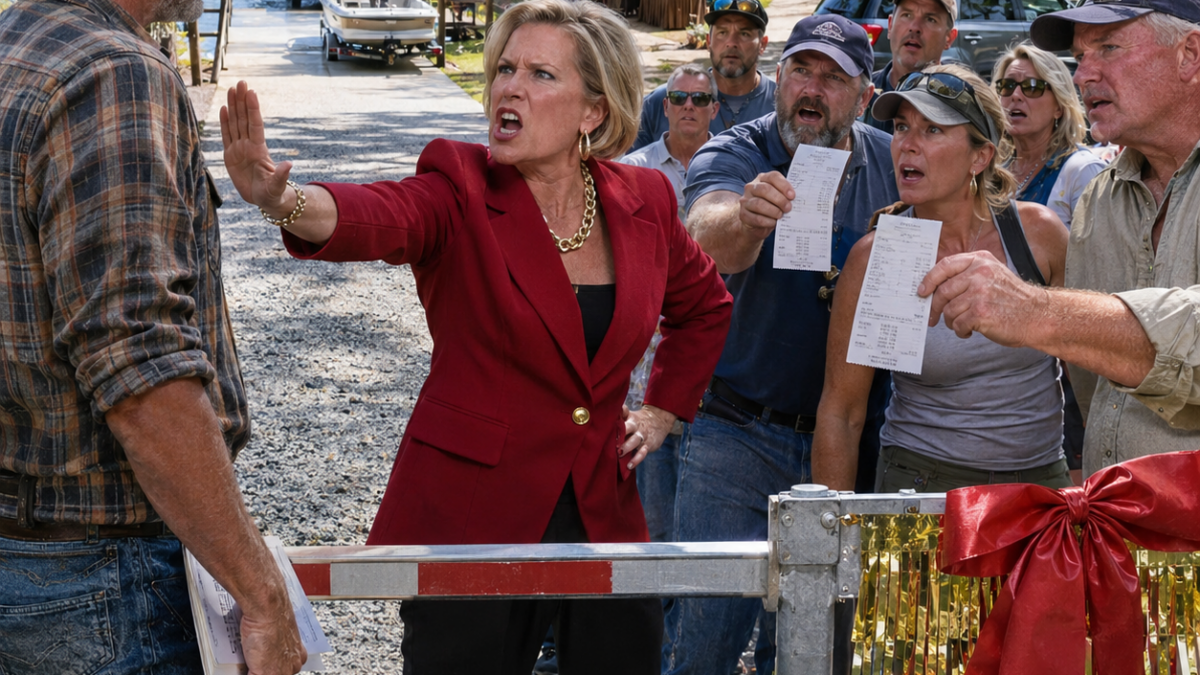
HOA Karen Blocked the Only Road to My Lake Cabin for Her Private Party—Then 12 Boat Owners Handed Me Receipts Saying She’d Sold Them Access to My Private Ramp.
The first guest asked me to unlock my boat ramp while HOA president Linda Shaw was still blocking the only road to my cabin with flower barrels, fencing, and a white party tent.
I was standing behind my locked steel gate with groceries I had carried half a mile because Linda had decided her husband’s birthday mattered more than my right to drive home—and three men with empty boat trailers were waiting for a service she had promised them in my name.
Then one of those men handed me a printed receipt that said BOAT RETRIEVAL INCLUDED — RAMP OWNER PAID, and I realized Linda hadn’t just borrowed my road for a party; she had sold access to property I never gave her permission to use.
My name is Ray Miller.
I was sixty-five when Linda Shaw decided my lake road belonged to her party.
Not permanently.
At least that was what she told me at first.
Nine days before the event, she knocked on the open door of my workshop while I was replacing a worn wheel on an old mower.
“Ray?”
I looked up.
Linda stood outside holding a folder against her chest.
She was president of the Oak Ridge Lake Association, though everybody called it the HOA.
Technically, the association controlled the newer houses around the north side of Lake Mercer.
My cabin sat downhill from most of them.
Older property.
Separate parcel.
Private boat ramp.
The association had limited written permission to use the upper portion of my gravel road because their clubhouse sat between the county road and my cabin.
That permission had existed for years.
It let residents drive to the clubhouse.
It did not give them ownership of the road.
And it certainly did not include my ramp.
“What do you need?” I asked.
Linda smiled.
“Small favor.”
Those words should make every property owner nervous.
“What kind?”
“Ed’s birthday is Saturday.”
Her husband.
I nodded.
“We’re having a little gathering at the clubhouse.”
“How little?”
“Nothing crazy.”
“That wasn’t the question.”
She laughed.
“Maybe forty people.”
I set the mower wheel down.
“Cars?”
“A few.”
“How many?”
“Nothing large.”
“Linda.”
“Maybe fifteen or twenty at different times.”
I looked toward the gravel road.
PART2:
It ran from the county pavement, passed my workshop, curved beside the clubhouse, then continued another half mile to my cabin.
Near the bottom, a short private branch turned toward my concrete boat ramp.
My daughter Rachel was bringing my grandchildren Saturday.
Since my wife June died, those visits had become something I protected carefully.
The kids fished.
We fixed little things around the cabin.
We launched the boat if the weather cooperated.
My granddaughter checked the apple trees every visit even when I told her apples did not become ripe just because she wished harder.
“My daughter’s coming Saturday,” I said.
“Fine.”
“Keep the road open.”
“Of course.”
“And nobody parks on the ramp branch.”
Linda gave me the kind of smile people give when they think you’re making a simple request sound complicated.
“Ray, I’m asking about a few cars.”
“I know.”
“I’m not taking over the lake.”
“Good.”
She laughed and left.
The next morning, I emailed her anyway.
PART2:
I had learned that verbal agreements were excellent until somebody needed to remember them differently.
My message said:
A few party vehicles may use the gravel shoulder near the clubhouse Saturday. The main road must remain open to my cabin at all times. The boat-ramp branch must remain clear. This permission does not include use of my private ramp.
Linda replied with one symbol.
Thumbs up.
I printed the exchange.
Put it beside the workshop radio.
Then went back to the mower.
Two days later, a delivery truck came down the road carrying white fence panels.
The driver stopped outside my workshop.
“You Ray?”
“Yes.”
“Where do you want the event entrance?”
“What event entrance?”
He unfolded a plan over his steering wheel.
A thick line crossed my gravel road just above the clubhouse.
Another crossed below it.
Between them:
Tables.
Tent.
Check-in station.
Decorative fencing.
My cabin sat beyond the lower line.
I pointed.
“This closes my road.”
The driver frowned.
“Mrs. Shaw said this section was closed Saturday.”
“No.”
“She said all traffic would be diverted.”
“Not mine.”
The man’s face changed immediately.
He wasn’t argumentative.
Just tired.
“I put things where people tell me.”
“I understand.”
I photographed the plan.
“Don’t place fencing across the road.”
He called his office.
A few minutes later, the panels went onto the clubhouse lawn instead.
Linda arrived that afternoon.
“You embarrassed my delivery crew.”
“I stopped them blocking my home.”
“The fencing is temporary.”
“So is a locked bathroom door. It still stops you going through.”
She crossed her arms.
“The drawing was preliminary.”
“Then fix it.”
“You’re making a fuss over nothing.”
I brought out my phone.
Showed her the photograph.
“Road stays open.”
“We already agreed.”
“Then fix the plan.”
She left.
That night, I pulled out my property folder.
Deed.
Survey.
Road-use agreement.
The association’s right was narrow and clear.
Oak Ridge could use the upper lane to reach the clubhouse and common dock area.
Neither party could obstruct the other’s lawful access.
The marked route ended at the clubhouse entrance.
My private ramp branch was separately shown.
No association right.
I photographed the page.
Sent it to Linda.
No speech.
Just:
Please give this to whoever is setting up Saturday.
I should have copied every board member.
I didn’t.
At the time, I still thought dealing directly with the president was the neighborly way to handle a birthday party.
That gave Linda room to tell everyone else a different version.
Thursday afternoon, my neighbor Bill came by with a folding chair that needed welding.
He watched me inspect the cracked leg.
“My brother’s coming to Linda’s party.”
“Good for him.”
“By boat.”
I looked up.
“From West Landing?”
“Yep.”
West Landing was the public launch on the other side of the lake.
Good concrete ramp.
Large parking area.
About fourteen miles away by road.
Bill held out his phone.
“Linda says you’re handling trailers.”
I set the chair down.
“What does that mean?”
He showed me the invitation.
Photograph of the clubhouse.
Gold lettering.
Birthday details.
Then:
BOAT ARRIVAL INSTRUCTIONS
Launch at West Landing.
Leave vehicle and trailer.
Shuttle service provided.
Evening boat retrieval at Miller Ramp.
My ramp.
I called Linda while Bill stood there.
“You told guests they could retrieve boats from my ramp?”
“It’s just a few.”
“You never asked.”
“I assumed you’d help.”
“Why?”
“You let people use the ramp.”
“I let Bill use it.”
Bill raised one hand.
“True.”
“I let the fire department use it once for training. That doesn’t mean you can sell it.”
Linda sighed.
“Fine. I’ll change the instructions.”
“Send me the corrected version.”
“I’m busy.”
“So am I.”
I texted her after the call.
My ramp is not part of your event. Do not direct boats, trailers, guests, or shuttle vehicles there.
Bill called his brother immediately.
That mattered later.
His brother saved the original invitation.
Then contacted Linda asking where he should retrieve his boat instead.
Her answer?
Follow the printed instructions.
No correction ever came.
Friday morning, I locked the ramp gate.
Normal procedure.
The steel gate stood across the private branch, well away from the main road.
Traffic to my cabin could still pass.
I hung the usual sign.
PRIVATE RAMP
PERMISSION REQUIRED
Then took a photograph showing:
Locked gate.
Sign.
Open main road.
I didn’t know that photograph would become evidence.
That afternoon, a young woman walked down from the clubhouse carrying a clipboard.
“Mr. Miller?”
“Yes.”
“I’m Kelly. Event company.”
“What can I do for you?”
“Ramp key.”
“No.”
She checked her sheet.
“It says retrieval from five to eight.”
“Who wrote that?”
“Mrs. Shaw.”
I showed Kelly my email.
She read it.
Then read it again.
“This says no ramp.”
“Correct.”
She drew a line through something on her clipboard.
“I’m not sending anybody down here without permission.”
“Thank you.”
“Can you show me where the delivery van can turn without entering your yard?”
I did.
She thanked me.
The setup worker was asking better questions than the HOA president.
Saturday morning, I still had nothing from Linda.
I called once.
No answer.
Texted:
Road stays open. Ramp remains locked.
Then drove into town.
I needed groceries.
Prescription.
And two children’s life jackets.
My granddaughter had outgrown hers.
Her little brother wanted the same color because apparently life jackets were now a matter of sibling justice.
I was gone less than two hours.
When I returned, a man in a black polo stood across my road.
Behind him were two large wooden barrels full of flowers.
White decorative fence panels stretched from each barrel toward the ditch.
A sign said:
PRIVATE EVENT.
He raised one hand.
“Guest parking is at the church.”
“I live down there.”
“All vehicles are being diverted.”
“My cabin is down there.”
He checked a clipboard.
“Name?”
“Ray Miller.”
He found it.
His expression changed.
“Mrs. Shaw said you were aware.”
“Call her.”
He did.
Music carried faintly through his phone while he listened.
Then he handed it to me.
Linda sounded irritated.
“Ray.”
“You blocked my road.”
“You can park at the church.”
“No.”
“It’s one afternoon.”
“My groceries are in the truck.”
“Someone can help carry them.”
“You do not get to decide whether I walk home.”
“Everything is already set up.”
I looked beyond the barrels.
The white tent extended into the road.
One entire row of legs stood on gravel.
Tables beneath it.
Moving two barrels wouldn’t solve anything.
“You put the tent in the traveled lane.”
“There’s space.”
“Not for my truck.”
“You’re being impossible.”
“No. I’m trying to drive home.”
I took photographs.
Then called the sheriff’s non-emergency number.
Explained:
Private party.
Only vehicle access to residence blocked.
No emergency.
No violence.
No threat.
Dispatcher said a deputy would come when available.
I wasn’t going to ram a flower barrel.
I wasn’t going to start dragging tables.
I parked safely near the county road.
Took the cold groceries out.
And walked.
Half a mile isn’t far until you’re carrying:
Milk.
Chicken.
Vegetables.
Prescription.
Two bags of groceries.
Two life jackets.
And you’re sixty-five with a shoulder that already aches.
Halfway down, I called Rachel.
“Don’t come yet.”
“Dad, we’re packing now.”
“Road’s blocked.”
“What?”
“Linda’s party.”
“I’ll come help.”
“Keep the kids home until I get this sorted.”
My granddaughter had apparently already packed her tackle box.
That bothered me more than the groceries.
Linda’s party had become more important than my family’s Saturday because she had simply decided it would.
I reached the ramp branch.
Set the bags down.
Changed hands.
Then heard engines.
Three pickup trucks with empty boat trailers rolled slowly toward me from the clubhouse direction.
Interesting.
My truck couldn’t get through the party.
But trailer traffic could reach my ramp.
The oldest driver got out.
Gray beard.
Baseball cap.
“Mr. Miller?”
“Yes.”
“Linda said you’d unlock.”
“No.”
His face fell.
“We need to get the boats out.”
“From where?”
“HOA dock.”
“Take the trailers back to West Landing.”
He looked confused.
“She said you had an arrangement.”
“I don’t.”
“Linda said you were paid.”
That stopped me.
“Paid?”
He reached into his truck.
Handed me a printed parking pass.
Across the bottom:
BOAT RETRIEVAL INCLUDED.
RAMP OWNER PAID.
My address was printed underneath.
I looked at him.
“What’s your name?”
“Don Harris.”
“Don, I haven’t received one dollar.”
He looked at the grocery bags.
Then back toward the blocked road.
“I believe you.”
He turned to the other drivers.
“Shut the trucks off.”
Then he picked up my milk.
“What are you doing?”
“Carrying this.”
“You don’t have to.”
“Looks like somebody should.”
He carried groceries to my cabin.
That changed the whole tone.
When we returned, nobody was demanding the ramp.
They were asking what Linda had done.
Don explained:
Guests launched boats at West Landing.
Parked vehicles there.
A shuttle service later moved their trucks and trailers across town.
Boats remained tied at the HOA dock.
At party’s end, they were supposed to load at my ramp.
“Why not just return to West Landing?” I asked.
“Linda says it’s closed.”
“I drove past it this morning.”
“She sent a message.”
He showed me.
PUBLIC LAUNCH CLOSED THIS AFTERNOON.
ALL BOAT RETRIEVAL MUST USE MILLER RAMP.
IF OWNER OBJECTS, INFORM HIM ACCESS WAS PREPAID.
Then an attachment.
Receipt.
$600.
PRIVATE RAMP EVENT ACCESS.
Payee line implied:
R. MILLER.
I stared.
“Who paid?”
“Boat owners.”
“How much each?”
“Fifty.”
“How many?”
“Twelve boats.”
There it was.
$600.
Not an accidental line on an invitation.
A paid service.
Linda had:
Promised my ramp.
Moved guests’ trailers.
Claimed the public alternative was closed.
Charged twelve people.
Issued paperwork saying I had been paid.
Then told them not to leave until I provided the service.
I asked Don to send everything.
He did.
Another man said:
“Can we just pay you instead?”
“No.”
“Why?”
“You already paid someone.”
“But if we pay—”
“Then Linda still took your first payment by lying about me.”
He understood.
I called West Landing.
County worker answered.
“Are you open?”
“I’m looking at the ramp right now.”
“Any closure today?”
“No.”
I put him on speaker.
Don lowered his head.
The younger driver let out a long breath.
West Landing would remain open until its normal closing time.
Nobody was trapped.
But moving twelve trailers back, moving families, crossing the lake—
Mess.
I looked at my ramp.
Good concrete.
Calm water.
Plenty of daylight.
I could help these people without giving Linda ownership.
“First thing,” I said, “my road gets opened.”
Don nodded.
“Then?”
“We figure out the safest way to get everyone home.”
“I’ll help move tables.”
“Don’t touch anything until the deputy comes.”
We walked uphill.
Linda stood beside a gift table.
Her smile disappeared when she saw me with Don.
“Ray, there are people waiting.”
“I know.”
“The ramp needs opening.”
“My road needs opening.”
She spread her arms.
“We can’t dismantle a party.”
“You built it in my access lane.”
“Can we discuss this quietly?”
Don raised his phone.
“You told us West Landing was closed.”
“There was a crowding concern.”
“You wrote closed.”
Linda looked toward the clubhouse.
I asked:
“Where is the $600?”
“Event charge.”
“The receipt says I was paid.”
“It covers several services.”
“Then why is my name on it?”
No answer.
Don spoke quietly.
“We came to celebrate your husband’s birthday.”
Linda looked at him.
“We didn’t come to help you take another man’s road.”
Her husband had been standing near the food table.
He stopped talking.
Then a sheriff’s cruiser appeared beyond the flower barrels.
Deputy Reed stepped out.
He looked at:
Tent.
Blocked road.
Trailer line.
Flower barrels.
“Who called?”
“I did.”
Linda stepped forward too.
“This is an association event.”
Reed nodded.
“Okay.”
“He agreed to help and now he’s refusing.”
I handed him my printed email.
Few cars okay.
Road open.
Ramp branch clear.
No ramp use.
Then the recorded road agreement.
He read both.
Asked Linda:
“Do you have written permission to close this lane?”
She held up the event drawing.
Reed said:
“That’s a setup plan.”
“It shows the event area.”
“I’m asking for permission from the road owner.”
“The association has road rights.”
“How far?”
“To the clubhouse.”
He looked toward my cabin.
“Does Mr. Miller have another vehicle route home?”
Silence.
He pointed at the tent.
“Then this needs to clear the traveled lane.”
Linda stared.
“Moving it ruins the party.”
Kelly stepped forward.
“We don’t need to move the entire tent.”
Everyone looked at her.
“We can remove the side section.”
She pointed.
“Move two tables onto lawn. Fold these fence panels. Open enough road width.”
Linda looked furious.
Kelly continued:
“I told Mrs. Shaw yesterday this section was a problem.”
That was new.
Reed asked Kelly to coordinate the crew.
Forty minutes.
Tables moved.
Guests carried chairs.
Tent side loosened.
Posts removed from gravel.
Fence panels folded away.
Don and the other drivers helped where Kelly directed.
I did not.
My shoulder was already throbbing.
I photographed everything.
Before.
During.
After.
When finished, Reed walked the lane.
My pickup could pass.
An ambulance could pass.
Basic access.
Something that never should have disappeared.
I called Rachel.
“Road’s open.”
“Can we come?”
I looked at the trailers.
“Give me an hour.”
“Dad, you don’t have to save Saturday.”
“I still want to see the kids.”
Then I showed Reed the $600 receipt.
Don showed the message about West Landing.
Reed asked me:
“Were you paid?”
“No.”
“Did you approve ramp use?”
“No.”
He asked Don for his information.
Then gave us a report number.
Linda said:
“The receipt may have been worded badly.”
Reed told her:
“Keep every payment record and message connected to this event.”
No arrest.
No dramatic threat.
Just preservation.
Documentation.
Useful.
Before opening the ramp, I gathered the boat owners.
“I’ll let you retrieve your boats today.”
Don nodded.
“Thank you.”
“Because you were given bad information.”
Everyone listened.
“I am not taking payment.”
Silence.
“This does not mean Linda had permission.”
Don asked:
“Want that written down?”
Best question anybody asked all day.
“Yes.”
Kelly gave us a clean sheet.
I wrote:
On this date, Ray Miller states he did not authorize the advertised party ramp arrangement and received no payment for ramp access. As a one-time accommodation, he is allowing the undersigned boat owners to retrieve their boats today.
Each owner read it.
Signed.
Then I unlocked the gate.
One trailer at a time.
Slow.
No crowding.
No shouting.
I stood where I could see the ramp.
Don directed vehicles from the turnout.
One man had never backed his new trailer down a narrow ramp.
His wife stood beside him waving both arms in opposite directions.
Finally he stopped.
Put his forehead on the steering wheel.
I walked over.
“Straighten out.”
He looked embarrassed.
“Nobody’s timing you.”
Three attempts later, his boat was loaded.
He leaned out the window.
“I thought you were going to be the difficult one.”
“Who told you that?”
He gave me a tired look.
No need to ask.
The last boat came out near late afternoon.
My shoulder barely moved.
Don wrapped the chain through the gate for me.
I put the lock on.
That mattered.
I had opened the ramp.
I closed the ramp.
My choice both times.
Rachel finally arrived with the children.
My granddaughter jumped out wearing the new life jacket.
“Are we boating?”
“Not today.”
She looked disappointed.
My shoulder needed rest.
Afternoon was mostly gone.
So we fished from shore.
Rachel sat beside me.
“You should get that shoulder checked.”
“I will.”
“Did you eat?”
I realized I hadn’t.
She went to make sandwiches.
The kids argued over who saw the first fish.
Not the Saturday I’d planned.
But ours again.
Then Bill came down holding his phone.
“See what Linda posted?”
Neighborhood page.
Photograph:
Ramp open.
Another:
Me beside a trailer.
Another:
Don helping close the gate.
Caption:
THANK YOU TO MILLER RAMP FOR PROVIDING PAID BOAT SERVICE FOR ED’S CELEBRATION!
Below it, a resident asked:
Will this arrangement be available for the summer dinner?
Linda replied:
Board is working on a regular schedule.
I stared.
Helping her guests had become proof that she’d been right.
I wanted to walk straight back to the clubhouse.
Instead, I told Bill:
“Save it.”
Rachel read the response I drafted.
I received no payment and did not approve the advertised arrangement. I permitted one-time boat retrieval after guests were given inaccurate information. Miller Ramp remains private and requires my permission.
Rachel nodded.
“Send that.”
Then:
“Leave out the other things you’re thinking.”
Smart daughter.
Sunday morning, I copied everything.
Original email.
Event plan.
Road agreement.
Locked-gate photo.
Don’s receipt.
False West Landing message.
Signed boat-owner statement.
Linda’s post.
I sent it to every HOA board member.
Not just Linda.
By noon, board member Susan Hale called.
“Mr. Miller?”
“Yes.”
“I’ve reviewed your documents.”
“Okay.”
“Linda told us this was a payment disagreement.”
I laughed.
“She said you wanted more money after accepting the arrangement.”
“I accepted nothing.”
“I can see that.”
Then Susan said:
“There’s something else.”
The board had received an access map before the event.
Linda showed the ramp branch as part of HOA’s permitted route.
“Send it.”
She did.
I laid it beside mine.
Same property.
Same curves.
Same clubhouse.
Same shed.
One difference.
The thick dashed HOA access line on my recorded copy stopped at the clubhouse.
On Linda’s version—
It continued down my private branch.
All the way to the ramp.
Someone had extended it.
Then Susan sent another document.
Work order.
Approved Friday.
REMOVE OWNER-INSTALLED GATE OBSTRUCTING ASSOCIATION ACCESS.
PRESERVE GATE FOR COLLECTION.
Scheduled:
Monday.
7:00 a.m.
I stared at it.
Linda wasn’t borrowing my ramp for Saturday.
She was already planning to remove my gate Monday morning.
I called the contractor.
“Rick?”
“Yes?”
“Are you scheduled at Miller Ramp?”
“Tomorrow. Seven.”
“I own the gate.”
Pause.
“What’s your name?”
“Ray Miller.”
“Mrs. Shaw said the board already settled this.”
“They haven’t.”
“You have documents?”
“Yes.”
“Send them.”
I emailed:
Deed.
Road agreement.
Map.
Statement denying permission.
Copied Susan.
Ten minutes later:
“Job’s on hold.”
“Thank you.”
“I don’t cut disputed gates.”
“Good policy.”
“Sorting out property fights costs more than gate removal pays.”
Working man’s logic.
Then Rick said:
“I’d still like to look at it tomorrow.”
“Why?”
“If the map she gave me is wrong, I want to know.”
Monday morning, I was at the ramp at 6:45.
Folding chair.
Folder.
No tools.
No truck blocking the gate.
I’d already updated Deputy Reed’s report.
Rick arrived.
One helper.
Measuring wheel.
No saw.
No cutting equipment.
He examined the gate.
Ran a finger over an old weld.
“This didn’t go in last week.”
“No.”
“How old?”
“Eleven years.”
He photographed the hinges.
Posts.
Weathering.
Compared the maps.
Then Linda arrived fast enough to throw gravel.
“Why isn’t it down?”
Rick turned.
“Access dispute.”
“The board approved it.”
“The board doesn’t own his gate.”
Linda looked at me.
“You can’t sell access and then block it.”
“I didn’t sell anything.”
“You opened the gate.”
“Once.”
“For your guests.”
She said:
“Exactly.”
I held up the signed sheet.
“One-time retrieval. No payment. No permission for future use.”
Rick read it.
Then told Linda:
“I won’t remove the gate without settled rights, written owner permission, or a court order.”
“I’ll hire someone else.”
“That’s your choice.”
“But don’t use my company’s name on a completed work order.”
He left.
Linda remained.
“You’re going to make every homeowner pay.”
That finally got me.
“You blocked my road for your husband’s birthday.”
She stared.
“You sold my ramp after I said no.”
Nothing.
“You lied to your guests.”
Silence.
“And now you’re trying to remove my gate.”
I pointed uphill.
“Stop pretending this started with the neighborhood.”
She drove away.
The gate stayed.
But I no longer trusted promises.
I drove to county records.
Requested the recorded road agreement.
Complete copy.
Attached map.
Stamped.
The dashed access line ended at the clubhouse.
Exactly like mine.
No later amended map.
No recorded extension.
The version Linda called a county map did not match county records.
Then I hired Ben Harris.
Property attorney.
Plain office.
Crowded bookshelf.
Peppermint bowl that looked untouched since 1998.
He read the recorded agreement first.
Then Linda’s map.
“Do you know who changed it?”
“No.”
“Good.”
“Good?”
“Means you don’t accuse anybody of something you can’t prove.”
I nodded.
“Say what we know.”
He pointed.
“This version was sent by Linda.”
Then the certified copy.
“This is what county records contain.”
“That’s enough?”
“Enough to demand they stop.”
He sent formal notice.
No gate removal.
No sale of ramp access.
No representation that HOA rights included private branch.
If association refused—
Court.
Retainer:
$1,500.
That money had been meant for my workshop roof.
Linda’s party had now delayed my roof.
My shoulder still hurt.
I stopped at the clinic.
Strain.
Rest.
Medication.
Bill came later.
Saw me favoring the arm.
“I’ll finish the mower wheels.”
“I can do it.”
“Let later be later.”
While he worked, I called Don.
Asked for the original payment request.
He sent it.
HOA event account.
Not donation.
Package:
TRAILER TRANSFER + PRIVATE RAMP RETRIEVAL.
Don had requested a refund.
Linda told him:
Service provided.
“You opened the gate,” Don said.
“So she says we got what we paid for.”
“She didn’t provide it.”
“I know.”
Then he said:
“I’ll come to the board meeting.”
“You don’t have to.”
“You could have sent all twelve of us back across the lake.”
“Yes.”
“You didn’t.”
Pause.
“I’m not letting her use that against you without saying so.”
For the first time, I felt like this wasn’t just me versus Linda.
Tuesday, Susan called.
Emergency board meeting that evening.
Linda had changed her explanation.
Now she said the extended map line showed a proposed route.
Not an existing right.
I asked Susan:
“Did the gate-removal work order say proposed?”
“No.”
“Did Linda’s email to the board?”
“No.”
Ben told me:
“Bring the pages.”
“Anything else?”
“Let the documents talk.”
The clubhouse looked smaller without the tent.
Flower barrels still sat on lawn.
Fence panels stacked behind the building.
Bill came with me.
Don and his wife came.
Kelly stood near the back wall.
Linda sat at the board table.
She began:
“This weekend’s misunderstanding occurred because the ramp arrangement was not communicated clearly.”
Misunderstanding.
Convenient word.
Susan asked me to explain.
I read my first email.
A few cars.
Road open.
Ramp branch clear.
No ramp use.
Then Linda’s thumbs-up.
I laid down the certified map.
Then the board version.
Don explained:
$50 payment.
$600 total.
False closure message.
Call to West Landing.
One-time retrieval.
Kelly explained:
She warned Linda Friday that I had refused ramp access and the road couldn’t be blocked.
Linda said:
“I was trying to cover event costs.”
Susan asked:
“Did you tell guests Mr. Miller was paid?”
“That was how the package was described.”
“Did you know he had refused use of the ramp?”
Linda looked at me.
“He lets other people use it.”
Susan repeated:
“Did you know he had refused?”
Pause.
“Yes.”
The room changed.
Then Kelly raised her hand.
“I brought something.”
She handed Susan an email chain.
Friday.
Kelly:
Ray Miller has refused ramp access. Road must remain open. We should revise boat retrieval and tent layout.
Linda:
Leave pickup plan as issued. Ray will open the ramp once guests are there. Keep lower vehicle opening clear.
I understood immediately.
That was why trailers could reach my gate while I had to carry groceries.
It wasn’t an accident.
Linda expected the guests to pressure me.
Susan turned the page.
One more line.
THE GATE IS SCHEDULED FOR REMOVAL MONDAY, SO THIS WILL NOT BE A PROBLEM FOR FUTURE EVENTS.
Linda reached for the paper.
“That needs context.”
Susan moved it away.
Then placed it beside the removal order.
“We need to decide whose plan we’re defending.”
Linda said:
“You’re making this worse than it was.”
Don stood.
“You lied to us.”
Linda turned.
“Everyone got home.”
“Because he helped us.”
Silence.
Then Susan put the original birthday invitation beside the $600 receipt.
“These people paid the association for something the association had no right to sell.”
Board member Tom leaned forward.
“Linda.”
“What?”
“Did you extend the line on the map?”
She hesitated.
“I marked the route I believed the association should be able to use.”
Tom stared.
“You sent it to us as existing access.”
“I expected Ray to be reasonable.”
That phrase.
Reasonable.
Meaning:
Eventually say yes.
I stood.
My shoulder hurt when I pushed against the chair.
I waited before speaking.
“I opened my ramp because those boat owners hadn’t done anything to me.”
Linda looked away.
“That was my decision.”
I pointed at the signed page.
“You don’t get to turn kindness into permission for the next party.”
Nobody spoke.
“You asked me about a few cars.”
I continued.
“I said yes.”
“Then every time I said no to something else, you told somebody I’d agreed.”
Road.
Ramp.
Payment.
Gate.
“You closed my road. Sold my ramp. Changed the map you showed the board. Scheduled my gate to be removed.”
I sat back down.
“That is not a misunderstanding.”
Susan called for a vote.
Cancel gate-removal order.
Stop advertising Miller Ramp.
Refund all $600 to boat owners.
Passed over Linda’s objection.
Second vote:
Full file to association counsel and Deputy Reed.
Linda temporarily loses independent authority to approve event payments and property work orders.
Passed.
Linda gathered her papers.
“You’re going to understand what this costs when the bills arrive.”
Tom answered:
“We’re looking at the bills you created.”
She left.
No applause.
Good.
This wasn’t entertainment.
These homeowners paid dues.
Several had just learned how little documentation their board had reviewed before authorizing work on someone else’s property.
Tom approached me afterward.
“I voted for the gate job.”
“I know.”
“I should’ve asked for the complete agreement.”
“Yes.”
He waited.
I didn’t tell him it was fine.
It wasn’t.
Then he said:
“I’ll help fix it.”
I shook his hand.
That mattered.
The next morning, Susan sent Rick the canceled work order.
He replied:
Job closed. Company will not return without Ray Miller’s written permission or court order.
Saved.
The HOA sent residents a formal correction.
Miller Ramp is private.
No party arrangement had been approved by the owner.
No future event may use it without permission.
Another important correction.
The twelve boat owners received their $50 refunds.
Don sent me a screenshot.
Under it:
THIS TIME THE RECEIPT TELLS THE TRUTH.
I laughed.
Then forwarded it to Ben.
The board wanted to settle.
Ben advised against relying only on new promises.
“Boards change.”
“I know.”
“People forget.”
“I know.”
“Recorded rights don’t.”
We proposed a written clarification.
HOA access ends at clubhouse as shown on recorded map.
Association cannot block my road.
Cannot remove or interfere with ramp gate.
Cannot sell or promise use of my ramp.
Permission granted to individual neighbors does not create general HOA rights.
Most board members agreed.
Linda didn’t.
She still held her elected board seat while removal procedures moved forward.
Through counsel, she claimed years of occasional neighbor use had created broader rights.
Ben asked:
“Who used it?”
I pulled old calendars.
Messages.
Photos.
Bill:
Can I launch Saturday?
Me:
Sure. Call before coming.
Fire department:
Training request.
Approved one day.
Neighbor with trailer problem.
Permission.
Family friend when public ramp crowded.
Permission.
Each event looked exactly like what it was.
Neighbors asking.
Owner saying yes.
Permission does not become ownership because you’re generous more than once.
Still, the argument meant more time.
More bills.
I began watching the gate.
That bothered me.
For eleven years, the gate had just existed.
I knew where the key was.
I knew who came through.
Now every slowing vehicle made me look out the window.
Home had become something I monitored.
That’s when I told Ben:
“File.”
“You sure?”
“Yes.”
The association had improved.
The immediate work was canceled.
But I wanted something another president couldn’t vote away.
Court action followed.
Access rights.
Road.
Ramp.
Gate.
It took weeks.
During that time, no one touched anything.
The clubhouse held another meeting.
Every vehicle stayed on their property.
I noticed.
Fairness meant noticing when people started doing things correctly too.
At the hearing, the judge had:
Recorded road agreement.
Certified map.
Linda’s altered version.
My party email.
Her reply.
Invitation.
$600 receipts.
Don’s messages.
West Landing confirmation.
Signed one-time-retrieval sheet.
Kelly’s email.
Gate-removal work order.
Board minutes.
No shouting needed.
Ben explained:
HOA has access from county road to clubhouse.
My cabin lies farther down private lane.
Ramp is separate private branch.
My first email specifically excluded the ramp.
Linda’s lawyer said the boat retrieval proved a working access arrangement existed.
Ben handed the judge the signed guest statement.
No payment.
No authorization.
One-time accommodation.
Judge read it.
Then looked at Linda.
“Did Mr. Miller authorize removing the ramp gate?”
“The board approved removal.”
“That was not my question.”
She paused.
“No.”
“Did he sign any amendment extending the HOA access route?”
“No.”
“Does the recorded map contain this additional line?”
“No.”
“Who drew it?”
Linda answered:
“I did.”
“Why?”
“To show the intended route.”
“Intended by whom?”
Silence.
Her lawyer spoke.
Judge stopped him.
“I asked Mrs. Shaw.”
Linda said:
“The association.”
Judge looked back at the original agreement.
“The landowner did not agree?”
“No.”
That narrowed everything.
By the end, the court confirmed:
HOA access stopped at the clubhouse route shown in recorded documents.
No right extended to my ramp branch.
No right to remove my gate.
No right to block my vehicle access.
No right to offer the ramp to others without my permission.
And the sentence I read twice:
Mr. Miller’s voluntary one-time assistance to event guests did not expand or alter the association’s property rights.
Kindness did not cost me ownership.
That sentence was worth the entire headache.
We also asked for documented expenses.
Attorney bills.
Other recoverable costs.
I did not invent some enormous number for emotional distress.
The court allowed what it found supported under the agreement and applicable claims.
Not everything.
My clinic bill wasn’t shifted to Linda.
The judge did not find enough evidence tying the shoulder strain legally to defendants.
Fair enough.
I wanted evidence to matter when it helped me.
That meant accepting when it limited me too.
The association later handled recovery from Linda separately.
Refunds.
Event expenses.
Gate-work costs.
Legal costs attributable to unauthorized actions.
Homeowners weren’t forced to pretend her husband’s birthday party had been a legitimate community project.
Deputy Reed’s report stayed in the file.
No dramatic courthouse arrest.
No screaming scene.
No patrol car waiting outside.
I didn’t need one.
I got:
Binding order.
Reimbursement.
Corrected records.
My gate.
My road.
My ramp.
That was enough.
Linda was eventually removed from the board according to the association’s rules.
Susan did not insult her.
Tom didn’t make some grand speech.
They presented:
Unauthorized promises.
False payment representation.
Modified map.
Gate-removal order.
Email showing Linda expected guests to pressure me.
Members voted.
Done.
The board changed its processes.
Any project touching land outside HOA ownership required:
Complete recorded agreement.
Owner identification.
Written permission.
No one-person approval of event payments and contractor work.
Meeting records available to members.
Dull reforms.
Perfect.
A neighborhood shouldn’t require a roadside confrontation to figure out whether someone has the right to drive home.
Susan gave me the hardest apology.
She came by while Bill and I were finally repairing the workshop roof.
My shoulder had mostly healed, so naturally Bill still refused to let me lift anything awkward.
Susan waited until I climbed down.
“I keep thinking about my vote.”
“The gate work?”
“Yes.”
“If I hadn’t called you Sunday…”
“The contractor might have arrived.”
She nodded.
“I approved something I shouldn’t have.”
“Then you helped stop it.”
“After approving it.”
I took off my gloves.
“Remember both.”
She looked at me.
I didn’t say:
It’s okay.
Because it wasn’t.
It had cost me money.
Peace.
Sleep.
And for a while, trust in people slowing near my gate.
But Susan had called after realizing her own vote was wrong.
She sent me the map.
She sent the work order.
She voted to correct it.
That honesty mattered too.
Near the end of summer, Don called.
“Fishing Saturday?”
“Where?”
“Lake.”
“Which ramp?”
He laughed.
“West Landing.”
“Good answer.”
“I figured I’d ask if you wanted to come.”
I looked at my little boat under its cover.
“Maybe.”
We met there.
No party passes.
No shuttle.
No fake receipts.
Just two men who met because somebody lied to both of us and later discovered we actually got along.
That afternoon, Rachel brought the grandchildren to my cabin.
She drove straight down the open road.
No barrels.
No fencing.
No tent.
Parked beneath June’s apple trees.
My granddaughter climbed out already wearing the life jacket I’d bought the morning of Linda’s party.
“Are we actually going today?”
“We’re actually going.”
My grandson ran toward the ramp.
“Gate’s locked!”
“That’s usually how gates work.”
I took out the key.
The green paint needed touching up.
A small patch of rust showed near one post.
Ordinary problems.
Mine.
I unlocked it.
My grandson held the gate while I backed the trailer down.
Rachel stood with the children.
Lake flat behind them.
When the boat floated free, my granddaughter climbed aboard.
Then looked back uphill.
“Grandpa?”
“Yeah?”
“Why did that lady think she could use your ramp?”
Children ask questions adults spend months turning into legal briefs.
I thought.
“Because I had said yes to some smaller things before.”
“So?”
“Exactly.”
She waited.
“I said yes to parking.”
“Okay.”
“I said yes when neighbors asked to launch sometimes.”
“Okay.”
“But saying yes once doesn’t mean somebody can decide for you next time.”
She thought about that.
“Like if I let Tommy use my markers?”
“Yes.”
“He can’t take them forever.”
“Exactly.”
She nodded.
Satisfied.
Property law for nine-year-olds.
Maybe judges should try markers.
We pushed away from shore.
The cabin grew smaller.
The ramp stayed behind us.
Private.
Not because I hated neighbors.
Not because I needed control over everything.
Because boundaries make generosity possible.
If every yes becomes permanent entitlement, eventually people stop saying yes.
That was what Linda never understood.
She thought because I let Bill use the ramp, she could promise it.
Because I let the fire department train there, she could sell it.
Because I let the boat owners out once, she could call that proof of an arrangement.
Because the HOA used the upper road, she could extend the line on a map.
Every favor became evidence that the boundary shouldn’t exist.
Wrong.
A favor means something precisely because you had the right to say no.
Years later, people still tell the party story as though the most dramatic part was me carrying groceries half a mile.
It wasn’t.
Or the tent blocking the road.
Not really.
Or the deputy forcing the setup crew to move tables.
Useful, but not the heart of it.
The moment I remember most was Don holding that receipt.
BOAT RETRIEVAL INCLUDED.
RAMP OWNER PAID.
Six words.
I had never been paid.
That receipt exposed the difference between what Linda had asked me and what she had sold everybody else.
To me:
A few cars.
To guests:
Guaranteed ramp access.
To the board:
Existing HOA route.
To the contractor:
Gate obstructing association rights.
To the event crew:
Owner will cooperate once guests arrive.
Different story for every audience.
Same goal.
Make her husband’s party work.
Then make the access permanent afterward.
That was why the Monday work order mattered so much.
The party wasn’t the end.
It was the test run.
She expected guests at my locked gate to pressure me into opening it.
Then she planned to use that opening as proof of access.
Then remove the gate.
Then make the next event easier.
One concession at a time.
I almost helped her.
Not because I was weak.
Because the boat owners were innocent.
That’s why the signed one-time permission became important.
Don understood before I did.
“Want us to write this down?”
Yes.
Write it down.
Kindness and boundaries can exist on the same sheet of paper.
I kept that page.
It’s in the road folder now.
Beside:
Recorded agreement.
Certified map.
Court order.
Linda’s altered version.
Refund confirmation.
The workshop roof eventually got repaired.
Dark green ramp gate got fresh paint.
My shoulder healed.
The apple trees kept producing more fruit than I could use.
Rachel still comes Saturdays.
Kids got older.
Granddaughter no longer needs me to tie every fishing knot.
My grandson became better at backing trailers than the man whose wife waved him into confusion during Linda’s party.
Life returned to ordinary.
That’s the best ending a property dispute can have.
Not revenge.
Ordinary.
Drive home.
Unlock your gate.
Launch your boat.
Invite people when you want.
Say no when you don’t.
One autumn afternoon, a new HOA president called.
Susan.
“Ray?”
“Yes.”
“We’re planning the fall picnic.”
I waited.
“We’ll keep everything on the clubhouse lawn.”
“Good.”
“And cars in the marked lot.”
“Better.”
“One question.”
I laughed.
“Here we go.”
“Can the fire department use the upper turnout for an equipment demonstration?”
“When?”
“Saturday.”
“Does it block the lane?”
“No.”
“Send me the layout.”
“I already emailed it.”
I opened it.
Clear road.
No ramp.
No private branch.
I replied:
Looks fine.
Susan wrote:
Thank you.
That was it.
No deputy.
No lawyer.
No $600 receipt.
No work order.
Permission works very well when people actually ask for it.
The green gate is still there today.
Sometimes unlocked.
Sometimes locked.
Depends on whether I’m expecting somebody.
The road stays open to my cabin.
The HOA uses the access it actually owns.
No more.
No less.
And every time I turn down that road, I remember coming home from town with groceries in the truck and finding flower barrels where my access should have been.
Linda thought one afternoon wouldn’t matter.
That was her first mistake.
Then she thought the guests she had trapped would force me to give her what I had already refused.
That was her second.
Her third was assuming that because I helped those guests anyway, she could rewrite kindness as consent.
She couldn’t.
The receipt said I’d been paid.
The records said I hadn’t.
The altered map said the HOA had access.
The recorded map said it didn’t.
Linda said opening the ramp once proved agreement.
Twelve signatures said otherwise.
In the end, the party didn’t cost me my road.
It cost Linda control of the HOA.
And the same guests she had sent to pressure me became the witnesses who helped prove she never had permission in the first place.








