HOA Karen Blocked My Fish Market’s Ice Trucks—Then 23 Restaurants Sued Her for $1.6 Million
PART2:
A market full of fish nobody can deliver is not much of a market.
The Friday before Harbor Week was always brutal.
Twenty-three restaurants under contract.
Tourists arriving.
Lobster dinners.
Seafood festivals.
Private events.
Wedding receptions.
Every kitchen in Gull Haven wanted more than normal.
I was on the floor at four that morning.
Fourteen employees.
Cod.
Haddock.
Scallops.
Lobster.
Two rooms running below forty degrees.
Nola Beckwith, my operations manager, was already yelling numbers across the packing tables.
Nola was thirty-six and ran quality control like the health department had assigned her personally to protect every customer from stupidity.
She never rounded temperatures.
Never guessed at weights.
Never wrote “approximately” when a scale could give her the real number.
That morning she looked at the clock.
“Brock should be here in six.”
“He will.”
Brock Havlin had delivered our ice for eleven years.
If his truck was scheduled for 5:12, it arrived at 5:12.
At 5:11, I heard the diesel.
Then brake lights flashed through the receiving doors.
That wasn’t normal.
The truck should have continued straight down the service road.
I stepped outside.
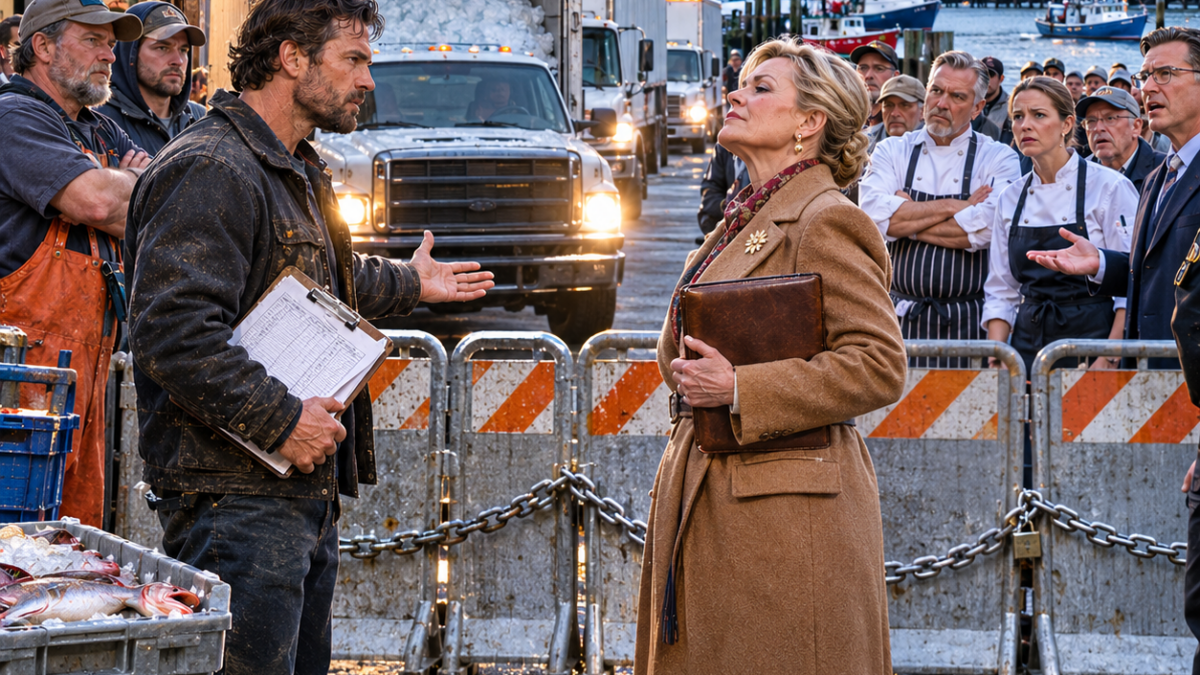
Six steel barricades stretched across the lane.
Chained end to end.
Two private security guards stood beside them wearing Windward Bluff jackets.
And on an easel:
HOA RESTRICTED ACCESS
COMMERCIAL ICE DELIVERIES PROHIBITED
Above the wharf, Windward Bluff rose along the ridge.
Large shingled homes.
Ocean porches.
Manicured landscaping.
People who had paid a lot of money for a view of a harbor that had been working long before their houses existed.
Standing in Brock’s headlights was Kendra Wickliffe.
Fifty-one.
Camel coat.
Leather folder.
President of the Windward Bluff HOA.
She smiled when she saw me.
That smile told me the barricades were not a surprise.
“Kendra.”
“Morning, Judson.”
“What is this?”
“Temporary commercial traffic restriction.”
“Move it.”
“The association has received repeated complaints.”
“From who?”
“Residents.”
“About?”
“Truck weight. Noise. Road damage. Early-morning commercial disruption.”
I looked at Brock’s truck.
Eighteen tons of flake ice.
Then back at her.
“This road is part of the harbor service corridor.”
“The HOA maintains it.”
“Maintenance doesn’t mean ownership.”
“Our attorneys disagree.”
“Mine won’t.”
She opened the folder.
“Then maybe we can avoid lawyers.”
She handed me a contract.
I read the first page.
If Pier 7 wanted continued commercial delivery access, I had to agree to use an HOA-approved cold-chain provider.
Monthly coordination fee.
Routing control.
Schedule approval.
The provider name was blank.
I looked at Kendra.
“You want the HOA choosing who supplies my ice?”
“We want responsible logistics.”
“No.”
“Judson.”
“No.”
“You haven’t read all of it.”
“I read enough.”
I handed it back.
“My market isn’t in your HOA.”
“The road crosses a shared service area.”
“And the harbor operating agreement guarantees access to licensed wharf businesses.”
Kendra nodded toward the guards.
One of them pulled the chain tighter.
Then clicked a padlock through the final link.
“No ice crosses this road until you sign.”
I stared at her.
Behind Brock, another truck appeared.
Then another.
By six, four trucks had tried to reach the market.
All turned away.
I called each driver myself.
“Can you come through the side lane behind the net sheds?”
Brock said:
“Not loaded.”
“Culvert?”
“Weight limit.”
“What if I send smaller trucks?”
“You’d need to transfer eighteen tons somewhere.”
No time.
No legal transfer area.
No good option.
By seven, not one pound of fresh ice had reached Pier 7.
Inside, Tyler, one of our younger packers, held up a half-filled scallop box.
“You want us to stretch yesterday’s reserve?”
I checked the bins.
Not enough.
Maybe enough for a fraction of the route.
“Pack only what meets standard.”
He looked worried.
“What about the rest?”
“Cold room.”
“We’ll miss deliveries.”
“I know.”
Nola came over.
“You sure?”
“Yes.”
Nothing left this market without enough ice.
I knew what that choice meant.
By lunch, I would be losing money.
By dinner, my customers would be furious.
But shipping seafood without a safe cold chain is the kind of mistake that destroys a business faster than missing one day.
Through the loading-bay window, I could see Kendra standing beside the barricades.
Checking her watch.
Still smiling.
She thought time was working for her.
Then my phone started ringing.
Sylvie Noridge.
Chef and co-owner of Tidewater House.
Biggest restaurant account on my route.
She didn’t say hello.
“Did you send this?”
“Send what?”
“The suspension notice.”
“What suspension notice?”
“Judson, all twenty-three of us got it.”
I stopped.
“What does it say?”
“That Pier 7 may suspend deliveries because of operational problems.”
“I didn’t send anything.”
Silence.
“Are you sure?”
“Sylvie.”
“Fine.”
“Forward it.”
The email looked official.
It referenced delivery disruptions.
Suggested restaurants prepare alternative sourcing.
No signature.
No sender I recognized.
But somebody had my customer list.
Twenty-three restaurants.
Every major account.
I called Sylvie back.
“I didn’t write this.”
“Then who did?”
“I don’t know yet.”
“Are we getting our order?”
“Not until I have ice.”
She exhaled.
“Harbor Week starts tonight.”
“I know.”
“I have two hundred covers.”
“I know.”
“Fix it.”
Then she hung up.
I found Nola.
She already had the numbers.
Cold rooms safe.
Inventory safe.
That was not the problem.
“The ice is the bottleneck,” she said.
“Exactly.”
She looked toward the road.
“She knew that.”
I did not answer.
But yes.
Kendra didn’t need to spoil anything.
She only needed to block the material that made delivery possible.
The fish stayed safe.
My contracts failed anyway.
That was elegant in the ugliest possible way.
I split the staff.
Team one:
Cold rooms.
Temperature logs.
Lot checks.
Team two:
Call every backup ice supplier between Portland and Bar Harbor.
Team three:
Call each restaurant individually.
Explain order status.
No vague language.
No promises we couldn’t keep.
And I gave one rule.
“Nothing gets rounded.”
Nola nodded.
“No guessed times.”
“No guessed temperatures.”
“No invented explanations.”
“Correct.”
“If we don’t know something?”
“We write that we don’t know.”
She smiled.
“That I can do.”
At 9:40, a courier walked into receiving.
Envelope.
Windward Bluff letterhead.
Invoice:
COMMERCIAL TRAFFIC SAFETY VIOLATION.
$18,000.
Additional penalties for every truck attempting access.
I laughed once.
Then called the Harbor District.
The clerk pulled the corridor file.
The service lane sat inside a shared zone.
Windward Bluff handled maintenance on one stretch under an old agreement.
But licensed wharf businesses had protected access rights.
“Can you remove the barricades?”
“We need legal review.”
“How long?”
“Several days.”
“I don’t have several days.”
“I understand.”
“No, you don’t.”
I regretted that immediately.
She wasn’t the person blocking my road.
“Sorry.”
“I get it.”
Police arrived before noon.
Two officers.
They photographed everything.
Spoke to me.
Spoke to Kendra.
Took the guards’ names.
But without a court order and with competing claims over road authority, they would not cut the chain.
Kendra waited until the cruiser started leaving.
Then said loudly:
“The police just recognized our authority.”
One officer was still close enough to hear.
I called:
“Officer?”
He turned.
“Could you put that statement in your report?”
Kendra glared.
He took out his notebook.
Wrote it down.
That tiny moment mattered later.
I didn’t know how much.
By early afternoon, the only backup supplier willing to attempt the route canceled.
His driver had sat two hours above the coast road.
He had other customers.
Couldn’t wait forever.
Nola brought me a laptop.
Automatic cold-room logs.
Every temperature.
Every minute.
“Back these up.”
“Already did.”
“Off-site copy?”
“Yes.”
“Camera footage?”
“Downloading.”
“Ice schedules?”
“Saved.”
“Drivers turned away?”
“Building the list.”
“I want name, time, truck, load, dispatch contact.”
She stared.
“Are you expecting court?”
“I’m expecting somebody to lie.”
That was enough.
At 4:03, an anonymous email arrived.
One sentence:
IF THE RESTAURANTS STOP TRUSTING YOU, YOUR MARKET IS FINISHED.
Attached spreadsheet.
My customers.
All twenty-three.
Contact names.
Weekly volumes.
Normal delivery days.
That was not public.
I called Sylvie.
“Did you get anything weird today?”
“Besides losing half my menu?”
“Customer list information.”
“No.”
I showed Nola.
Her face changed.
“Someone planned this.”
“Yes.”
Saturday morning, the next attack came.
Windward Bluff residents received an email bulletin.
So did several restaurant managers.
It claimed Pier 7 had been storing seafood below acceptable standards.
Attached video:
Open fish boxes on a steel packing table.
Not enough ice visible.
Technically real footage.
Completely misleading.
The camera frame did not show the cold rooms ten feet away.
Did not show HOLD tags.
Did not explain nothing in those boxes had left the building.
Then Kendra forwarded it.
Her message:
PUBLIC SAFETY MUST COME BEFORE PRIVATE PROFITS.
I read it twice.
Then understood.
The road argument was over.
She was attacking trust.
By ten, four restaurants wanted independent inspection before accepting any future deliveries.
Three had stopped answering me and started calling competitors.
Nola said:
“We need to answer this.”
“Yes.”
“Publicly.”
“No.”
“Why?”
“Because angry looks guilty.”
“She’s lying.”
“I know.”
“So say that.”
“No.”
I picked up my phone.
“We need someone who hates everybody equally.”
Nola frowned.
“Who?”
“Bryce Elwood.”
State food-safety inspector.
Forty-eight.
Had inspected Pier 7 for years.
Never complimented us once.
Perfect.
He arrived that afternoon.
No friendliness.
No sympathy.
He brought his own thermometer.
Checked cold rooms.
Reviewed logs.
Opened held boxes.
Checked equipment.
Inspected lot tags.
Then asked:
“Did any product leave without required ice?”
“No.”
“Any temperature excursion?”
“No.”
He checked records himself.
His preliminary finding:
No evidence Pier 7 sold spoiled seafood.
Holding product rather than shipping without adequate ice was the correct food-safety decision.
It was exactly what I needed.
And still terrible for business.
Because correct safety practice did not put seafood on a restaurant plate.
That evening another letter reached the restaurants.
Windward Bluff letterhead.
Kendra announced a solution.
CROWN CURRENT LOGISTICS.
Cold-chain delivery.
Ice.
Refrigerated transport.
Immediate capacity.
“Temporary emergency partner.”
Rates nearly three times normal.
Nola sat beside me.
“How do they have twenty-three-account capacity available overnight?”
I didn’t answer.
She tapped the rate sheet.
“Trucks.”
“Yep.”
“Drivers.”
“Yep.”
“Ice.”
“Yep.”
“Exactly the services we suddenly can’t access.”
I looked at her.
“Yep.”
Nobody keeps that much idle capacity unless they expected customers.
Late that night, Sylvie called.
Her voice was flat.
“The restaurants hired counsel.”
I sat up.
“For what?”
“Losses.”
“Against who?”
“Whoever caused them.”
“That includes me?”
“Right now?”
Pause.
“Probably.”
Then she hung up.
Monday morning, I walked into Tidewater House.
Back dining room.
Twenty-three restaurant owners and managers around a square of tables.
No one touched the coffee.
At the head sat Sylvie.
Beside her:
Daphne Meyer.
Commercial litigator from Portland.
Forty-four.
Expression that suggested she had never believed anyone simply because they sounded offended.
One by one, the restaurants described losses.
Canceled seafood tasting.
Eighty covers.
Weekend lobster festival.
Refunded deposits.
Emergency purchases from New Hampshire.
Staff paid for events that never happened.
Private dinners canceled.
Substitute menus.
Daphne slid one page toward me.
Preliminary total:
$1.6 million.
I looked at the number.
If all of it landed on Pier 7, I would not survive the year.
I did not argue.
I opened my laptop.
Ice schedule.
Brock arrival.
Barricade footage.
Four rejected trucks.
Dispatch calls.
Temperature logs.
Held product.
Bryce Elwood’s inspection.
Restaurant notification times.
Every canceled packing slip.
Every backup supplier call.
I walked them through everything.
Daphne did not react until I finished.
Then:
“There is a legal difference between failure to perform and being intentionally prevented from performing.”
I breathed.
But she raised one finger.
“I’m not saying you’re clear.”
Fair.
“I need intent.”
The side door opened.
Brock walked in.
Still wearing his work jacket.
He looked uncomfortable.
“I should’ve said this Friday.”
Everyone turned.
“Kendra walked from cab to cab.”
“What did she say?”
“She told us no delivery would get through until Judson signed.”
He put his phone on the table.
“And she gave us these.”
Photo.
Crown Current business card.
I looked at him.
“When?”
“Before six.”
Dash-camera footage showed it.
Kendra in Brock’s headlights.
Barricades behind her.
She told the drivers the blockade would continue.
Then handed out Crown Current numbers.
Sylvie pulled up her email.
First Crown Current offer:
6:50 a.m.
The fake notice about Pier 7 supposedly suspending service did not appear until after eight.
Crown Current was selling the solution before the restaurants knew a crisis existed.
The room changed.
Not dramatically.
Quietly.
People stopped looking at me.
Started looking at the timeline.
Daphne said:
“Preserve everything.”
She looked around.
“Every Crown Current offer.”
“Every Pier 7 contract.”
“Every cancellation.”
“Every refund.”
“No deleting texts.”
“No rewriting notes.”
“If we proceed, feelings do not prove damages.”
“Records do.”
For the first time since Friday morning, I left a meeting with twenty-three restaurants potentially on my side.
When I got back to Pier 7, Kendra had filed in court.
Windward Bluff sought a temporary order restricting commercial loading activity at the market on public-safety grounds.
She moved first.
Again.
But there was something about Pier 7 she had not learned.
The wharf still held a valid commercial-water receiving permit.
We used trucks because trucks were cheaper.
Not because the road was our only route.
Across Gull Haven Bay, an ice plant operated at Calder Point.
Food-grade certified.
Served fishing vessels.
I drove there Monday afternoon.
Met the plant manager.
Capacity?
Enough if we split loads.
Protection during transport?
Insulated totes.
Could we load workboats?
Yes.
By evening, I had chartered two small cargo boats.
Nola built a separate receiving station.
Source records.
Temperature checks.
Sanitized handling.
Document everything.
Tuesday at six, the first boat bumped against Pier 7.
Workers passed insulated ice totes up from the deck.
Slow.
Expensive.
Beautiful.
By noon, we packed our first complete shipment in four days.
I rode in the van to Tidewater House.
Sylvie met me in the kitchen.
I placed the entire cold-chain log on her counter.
She read it.
Checked a box herself.
Temperature good.
She signed.
One delivery.
Not salvation.
But proof.
Kendra could block a road.
She could not block the Atlantic.
Word reached Windward Bluff fast.
Three HOA representatives came to the pier that evening.
Claimed the waterfront fell under a weekend activity zone.
Harbor staff removed them.
The HOA had no authority over permitted commercial operations on Pier 7.
So Kendra attacked the boats.
Letters from HOA counsel went to both charter owners.
Threats of litigation.
One owner backed out.
Couldn’t risk his vessel.
Our water capacity fell by half.
I transferred excess inventory to licensed cold storage in Rockport.
Extra trucks.
Extra labor.
Storage fees.
Lab testing.
Transfers.
Nola started a separate ledger.
Every rescue cost.
Every receipt.
Every hour.
Months later, those pages mattered enormously.
Wednesday evening, I stood at the end of the pier watching the last boat.
Then looked uphill.
Crown Current trucks were rolling past the barricades.
The chain had been lowered for them.
They carried ice to a private Windward Bluff reception.
Brock’s truck?
Still blocked.
That was the moment the safety argument died for me.
This was never about truck weight.
It was about whose trucks.
I told Daphne:
“I want to know who owns Crown Current.”
“Good.”
“Can we find out?”
“Lawfully.”
“Yes.”
“Then maybe.”
The HOA’s own available records showed a service contract with Crown Current signed during Harbor Food Week.
There was a bonus clause.
More commercial customers transferred to Crown Current?
Higher compensation.
I read it twice.
“Why is an HOA getting involved in commercial customer transfers?”
Daphne said:
“Excellent question.”
“Answer?”
“Not yet.”
Restaurant invoices produced more.
Crown Current pricing jumped on the exact day the barricades appeared.
Twenty-four-hour deadlines.
Two-year exclusivity.
One owner was told the deal vanished if he consulted Pier 7 first.
Pressure.
Not coincidence.
Then Gordon Telfair walked into my market.
Crown Current’s owner.
Fifty-five.
Tall.
Easy smile.
He shook my hand.
“You have a good operation.”
“Thanks.”
“Cold rooms are impressive.”
“What do you want?”
He smiled.
“Direct.”
“I’m busy.”
“I’d like to buy your restaurant delivery contracts.”
“All twenty-three?”
“Yes.”
“For?”
“Transfer fee.”
“And then?”
“We keep customers supplied.”
I looked at him.
“Why do you care about seafood?”
“I care about logistics.”
“Why these customers?”
He smiled.
“A customer without ice is a customer looking for a supplier.”
There it was.
I refused.
By evening, Crown Current cut prices on selected plans.
Just enough to tempt desperate restaurants.
The twenty-three began splitting.
Some wanted to fight.
Others couldn’t afford principles while kitchens sat empty.
Sylvie held the group together by phone.
One owner at a time.
“Two years is two years.”
“You sign today because you’re scared, you’ll still be paying when the barricades are gone.”
Friday, Daphne sent me state corporate records.
Crown Current connected through:
BLUE LANTERN HOLDINGS.
Ownership behind it unclear.
Then formal preservation demands went out.
A former Crown Current business partner eventually provided documents through counsel.
Profit-sharing agreement.
Commission schedule.
Service proposal.
Daphne verified them against lawful records before showing me.
Then she sat down.
“Kendra has a financial interest.”
I looked at her.
“In Crown Current?”
“Indirectly through Blue Lantern.”
“How much?”
“Enough to matter.”
Then she showed me the commission schedule.
Bonus if Crown Current captured a defined group of commercial customers from a competitor.
Attached exhibit.
Twenty-three names.
Every restaurant supplied by Pier 7.
I felt cold.
The $18,000 fine had never been the point.
The barricades were a sales tactic.
Create shortage.
Break contracts.
Make restaurants panic.
Offer replacement.
Collect long-term customers.
Profit.
The HOA was the weapon.
Crown Current was the beneficiary.
And Kendra stood between them.
“She created the problem,” I said.
Daphne nodded.
“And arranged to sell the solution.”
“Yes.”
“Illegal?”
“Slow down.”
I hated lawyers.
“A financial interest proves motive.”
“But?”
“Not automatically intentional interference.”
“What do we need?”
“Cause.”
“Knowledge.”
“Intent.”
“And damages tied directly to the conduct.”
We kept building.
Then Kendra announced a gala.
Sunday night.
Windward Bluff.
Crown Current presented as the community’s chosen logistics partner.
Business owners.
Investors.
Residents.
Gordon scheduled to sign contracts.
She intended to turn victory into a public event.
I did not plan to crash it.
Daphne filed for emergency protection of the service corridor instead.
Operating agreement.
Dash cam.
Rejected-truck logs.
Driver statements.
Storage records.
Everything.
Saturday night, Daphne got a call.
A board member had attended the private meeting where Kendra first proposed the barricades.
And had kept notes.
Sunday morning, emergency hearing.
Daphne presented the access agreement.
Protected commercial deliveries.
Documented obstruction.
No evidence of safety enforcement being applied equally.
Judge issued temporary relief.
Commercial access could not be obstructed while the case proceeded.
Order served.
Harbor District crew prepared to remove barriers.
That night Windward Bluff glowed like a cruise ship.
Garden lighting.
White tents.
Stage overlooking the harbor.
Huge Crown Current logo.
Gordon waiting with contracts.
Kendra in a white suit holding champagne.
I arrived with Sylvie and Daphne.
No shouting.
No protest signs.
Daphne handed the order to the event manager.
Kendra saw us.
Perfect.
She raised her voice.
“Apparently Mr. Vale has decided to disrupt another community event.”
People turned.
I opened a folder.
Didn’t answer the insult.
Four ice-truck schedules.
Crown Current emails.
Service-corridor agreement.
Canceled restaurant events.
Then I asked one question.
“If this was only about protecting your road, why did a company you financially benefit from start offering replacement contracts to exactly twenty-three of my customers within hours of your barricades going up?”
The garden went silent.
Kendra’s face changed.
First time I saw it.
Not anger.
Fear.
“That is misleading.”
Daphne said:
“Which part?”
“I have investments.”
“Did you disclose this one to the board?”
Kendra looked toward the stage.
Gordon stepped forward.
“This isn’t the place—”
Sylvie called from beside me:
“It became the place when you tried to sign our restaurants tonight.”
Several owners were there.
They started asking questions.
Why twenty-three?
Why immediate capacity?
Why did Crown Current get access through the same road Pier 7’s suppliers could not use?
Kendra said:
“We offered a better solution.”
Daphne answered:
“A voluntary solution is offered alongside the existing option.”
Then pointed toward the harbor.
“You removed the existing option first.”
Kendra had no answer.
At the bottom of the hill, the Harbor District crew began removing barricades.
Police officer standing by.
One chain.
Then another.
Steel dragged aside.
Brock’s truck idled at the top.
Eighteen tons of ice.
Last barrier moved.
He rolled forward.
Down the service road.
Into Pier 7.
I didn’t cheer.
I called Nola.
“Receiving ready?”
“Yes.”
“Documentation?”
“Yes.”
“Temperature station?”
“Yes.”
Only then did I breathe.
At the gala, Gordon postponed all contract signings.
Guests started leaving.
Kendra told a local reporter:
“Every board decision was properly approved.”
That sentence followed her.
Darin Ellsworth heard it.
HOA treasurer.
Sixty-one.
Quiet woman.
Minutes keeper.
She walked away from the lights.
Called Daphne.
“There was no board vote.”
One week later, twenty-three restaurants filed suit.
Defendants included:
Kendra Wickliffe.
Commercial entities tied to the Crown Current arrangement.
Windward Bluff HOA for the court to determine organizational responsibility.
Important distinction:
The restaurant group did not accuse every homeowner on the bluff of wrongdoing.
The lawsuit focused on the people and entities responsible.
Damages were built restaurant by restaurant.
Refunds and canceled-event compensation:
$480,000.
Emergency purchasing and alternative transport:
$310,000.
Lost net profits from canceled events:
$620,000.
Labor, storage, handling, mitigation:
$190,000.
Total claimed:
$1.6 million.
Kendra called it opportunism.
Her lawyers argued seafood had remained safe.
That part was true.
Daphne never claimed otherwise.
Her answer was simple.
The case was not about rotten fish.
It was about delivery.
A cold room full of safe seafood does nothing for a restaurant whose dinner service starts at six and never receives it.
Then Darin produced the minutes.
Board meeting.
Nine days before the blockade.
Kendra proposed restricting commercial ice trucks.
Other board members rejected it.
They warned it could hurt wharf businesses.
Invite lawsuits.
No resolution passed.
Then Darin’s handwritten note:
FINANCIAL INTEREST? K.W. REFUSED DISCLOSURE.
Two days later, Kendra issued instructions to HOA security on her own authority.
Barricades.
She used association guards.
Association letterhead.
Association road-maintenance role.
To carry out something the board had voted against.
That changed everything.
The HOA’s insurer sent a reservation-of-rights notice.
Intentional self-serving conduct outside authorized duties might not be covered.
Windward Bluff called an emergency meeting.
Kendra was removed as president.
That did not end the lawsuit.
Discovery kept going.
Then came the recording.
Business meeting.
Kendra.
Gordon.
Other Crown Current partners.
Her voice clear.
Calm.
“Once they lose their ice, they’ll sign anything.”
Nobody in the conference room spoke after Daphne played it.
Even Gordon stared at the table.
Five months after the first barricade appeared, the case reached trial.
The restaurants proved their individual contracts.
Their losses.
No double counting.
No speculation where documents didn’t support a number.
Pier 7’s logs became crucial.
Cold-room data showed we had not shipped unsafe seafood.
The holds were real.
The temperatures were real.
The mitigation was real.
Nola’s rescue ledger showed every extra dollar we spent trying to keep damage from spreading.
Boat charters.
Rockport storage.
Transfer labor.
Testing.
Alternative routing.
Brock’s dash cam showed ice trucks arriving exactly when scheduled.
Then being turned away.
Corporate documents showed Kendra’s financial motive.
Board minutes showed she lacked the authority she claimed.
The audio showed intent in her own words.
The court ultimately accepted the losses that were adequately proven and entered judgment totaling $1.6 million against Kendra and the related commercial parties within the scope of responsibility the court found.
Not an HOA fine.
Not a dramatic punishment because a judge disliked her.
A civil judgment tied to documented business losses caused by proven interference.
Kendra’s share followed the normal collection process.
Personal assets.
Available lawful funds.
Commercial parties responsible for their portions.
Crown Current lost contracts quickly.
Restaurant owners wanted nothing to do with it.
But I still had one problem.
Kendra was gone.
The barricades were gone.
What if someone else tried something similar five years later?
The twenty-three restaurants were asking the same question.
So we met again at Tidewater House.
Same back room.
Different atmosphere.
Sylvie said:
“I don’t ever want one road to control all of us again.”
Neither did I.
We created Harbor Cold Cooperative.
Pier 7 plus twenty-three restaurants.
Independent food-grade ice contract.
Backup storage near the pier.
Two delivery routes.
Road.
Water.
Either could carry enough capacity to cover the other in an emergency.
No single gate.
No single vendor.
No single person could stop the entire chain.
We invested together.
Then something almost poetic happened.
Crown Current’s business deteriorated.
Some equipment was eventually auctioned through lawful proceedings.
Refrigerated trucks.
Ice-storage units.
Harbor Cold Cooperative bought several.
Not because I wanted trophies.
Because the price was good.
Nola laughed when the first Crown Current refrigeration unit arrived at Pier 7.
“You realize what that is?”
“A compressor.”
“Judson.”
“Yes.”
“Kendra bought that to take our customers.”
“And now it keeps their seafood cold.”
She stared.
“Can I enjoy this?”
“Quietly.”
She did.
A clear autumn morning months later, I stood at the end of Pier 7.
One white ice truck came down the service road.
At the same time, one of our contracted cargo boats approached from the bay.
Both carrying food-grade ice.
Both part of the new system.
Sylvie stood beside me.
“You think she imagined this?”
“Who?”
“Kendra.”
“No.”
“She tried to make twenty-three restaurants depend on Crown Current.”
I watched the boat come alongside.
“All she did was teach twenty-three restaurants to become partners.”
Up on Windward Bluff, the old restrictive notice had disappeared.
New association rules recognized the commercial-access protections already contained in the harbor agreement.
No barricades.
No commercial “coordination fee.”
No HOA-approved cold-chain provider requirement.
Just the road doing what the road had always been supposed to do.
Serve the harbor.
A reporter asked me later:
“What part of the outcome mattered most?”
He probably expected:
$1.6 million.
I shook my head.
“The money paid for losses.”
“Then what?”
I looked toward Pier 7.
Crew packing boxes.
Ice going in.
Vans leaving.
Boat unloading.
“The important part is nobody can do it again the same way.”
That was true.
The lawsuit mattered.
Kendra losing the presidency mattered.
Crown Current collapsing mattered.
But systems mattered more.
We changed ours.
No single supplier.
No single access route.
No single point where one person could put six steel barricades and turn twenty-three restaurants against a fish market before breakfast.
Years later, people still ask me how close Pier 7 came to failing.
Closer than I like to admit.
The first two days were the worst.
Not because fish spoiled.
They didn’t.
Because trust almost did.
Wholesale seafood runs on trust.
Chef calls at eleven.
Needs forty pounds of scallops by four.
You say yes.
At four, they arrive.
Every time that system breaks, even for reasons outside your control, your customer begins thinking:
Maybe I need somebody else.
Kendra understood that.
That was what made her plan dangerous.
She did not need Pier 7 closed forever.
She needed us unreliable for one week.
Maybe less.
Long enough for restaurants to sign two-year agreements with Crown Current.
Long enough to make me look unsafe.
Long enough for panic to become paperwork.
She almost succeeded.
If Brock had not kept his dash camera…
If Nola had not logged every temperature…
If Sylvie had accepted Crown Current immediately…
If Darin threw away those board minutes…
If we had shipped fish without enough ice…
Any one of those choices might have changed everything.
That is the part people miss.
Court cases are rarely won by one perfect piece of evidence.
Usually they are built from ordinary people doing boring things correctly.
Driver keeps dash cam.
Manager saves temperature log.
Treasurer keeps minutes.
Restaurant preserves invoice.
Inspector writes exactly what he saw.
Nobody rounds a number.
Nobody changes a time.
Nobody invents a dramatic version.
Truth becomes powerful when enough small records line up.
Kendra thought the barricades gave her power.
They gave us timestamps.
She thought the fake safety bulletin would destroy us.
It brought in a state inspector.
She thought Crown Current’s early offers would capture our customers.
They proved preparation.
She thought the HOA title would protect her.
The board minutes proved the board had rejected her plan.
She thought nobody would discover Blue Lantern.
Corporate records did.
And she thought the restaurants were too desperate to stay together.
That was her biggest mistake.
For a few days, we nearly broke apart.
Then the pressure did the opposite.
It made everybody look at the same problem.
Pier 7 did not need to own the ice plant.
The restaurants did not need to own the fish market.
We just needed redundancy.
Agreements.
Records.
Alternatives.
The same things Kendra’s plan had tried to remove.
Harbor Cold Cooperative still exists.
We hold an annual drill.
One route unavailable.
How fast can we shift?
What happens if the road closes because of a storm?
What if the harbor freezes?
What if one storage unit fails?
Boring questions.
Very boring.
I love them.
Nola became the cooperative’s operations director.
She pretended she didn’t want the title.
Then redesigned the entire incident-response system in three weeks.
Sylvie stayed on the board.
Still argues about everything.
Good.
Brock still delivers ice.
Whenever he reaches the old barricade location, he taps his horn once.
First time, I asked why.
“Habit.”
“You didn’t do that before.”
“New habit.”
Fair.
Windward Bluff changed too.
New president.
Outside review of commercial agreements.
Conflict-of-interest disclosures.
Presidential authority narrowed.
Board votes recorded.
No vendor arrangement where an officer held a financial interest without full disclosure and recusal.
Again:
Boring.
Exactly what responsible governance looks like.
I saw Kendra once afterward.
Two years later.
Grocery store.
She saw me beside the seafood counter.
Which felt almost too obvious.
“Judson.”
“Kendra.”
She looked at the display.
“Your market still supplies them?”
“Some.”
She nodded.
Then:
“I never wanted Pier 7 gone.”
I looked at her.
“What did you think would happen?”
“I thought you’d sign.”
“The HOA contract?”
“Yes.”
“And give Crown Current access to my customers.”
“It would have stabilized things.”
“For you?”
Her jaw tightened.
“For everyone.”
“No.”
I kept my voice level.
“It stabilized your investment.”
She looked away.
“Crown Current was a legitimate business.”
“I never said it wasn’t.”
“The road had real maintenance problems.”
“Maybe.”
“You act like every concern was invented.”
“No.”
She looked surprised.
I continued.
“If the road needed weight limits, you could have proposed weight limits.”
“If trucks needed schedules, propose schedules.”
“If repairs were needed, bill whoever the agreement says pays.”
I looked at her.
“You didn’t do that.”
Silence.
“You blocked only my suppliers.”
She said nothing.
“Then opened the road for Crown Current.”
Still nothing.
Finally:
“I thought the restaurants would switch quickly.”
There it was.
“And once they lost their ice…”
She stopped.
She remembered the recording.
I didn’t need to finish the sentence.
She left.
No apology.
I didn’t need one.
The harbor had already moved on.
One October morning, years after the case, I arrived at four.
Same floor.
Different employees.
Same smell of salt and diesel.
Nola was checking a digital panel.
“Road route good?”
“Yes.”
“Water backup?”
“Ready.”
“Storage?”
“Eighty-six percent.”
“Any issues?”
“One.”
“What?”
She pointed toward a new packer.
“He keeps rounding temperatures.”
I stared at him.
“Absolutely not.”
Nola smiled.
“Thought you’d say that.”
Some lessons become culture.
That one did.
By five, first ice truck arrived.
No barricades.
By 5:12, flake ice was pouring into the receiving bin.
I stood watching.
That exact time still means something to me.
5:12.
The minute Brock stopped behind the chain.
The minute I thought I was dealing with a road dispute.
I wasn’t.
I was dealing with someone who understood my business well enough to attack the one thing between safe inventory and deliverable inventory.
Ice.
Kendra never touched a fish.
Didn’t need to.
She tried to control the condition under which the fish could move.
That is what made the scheme work.
And what eventually made the lawsuit so strong.
Twenty-three restaurants did not sue because one woman annoyed them.
They sued because contracts failed.
Events were canceled.
Purchases were replaced at higher cost.
Labor was wasted.
Customers were refunded.
Revenue disappeared.
Every one of those losses had a receipt.
That is where the $1.6 million came from.
Not outrage.
Documentation.
That distinction matters to me.
Stories get exaggerated.
People say:
“Kendra got fined $1.6 million for blocking a truck.”
No.
Four trucks were blocked that first morning.
Then a wider commercial scheme unraveled.
Twenty-three businesses documented actual losses.
A court looked at evidence.
Responsibility was assigned.
That is far less dramatic.
And far more important.
Because if the case had only been about anger, we might have lost.
Nola’s cold-room logs showed we protected the product.
Brock’s dash cam showed the trucks were intentionally stopped.
The restaurant records showed direct consequences.
Corporate records showed motive.
Board minutes showed Kendra acted without proper authority.
And her own recorded voice showed intent.
“Once they lose their ice, they’ll sign anything.”
That sentence stayed with me.
Not because it was clever.
Because it revealed how she saw people.
Not customers.
Not neighbors.
Pressure points.
Make someone desperate enough and they’ll sign.
Maybe sometimes they do.
But sometimes twenty-three restaurant owners sit around a table, compare records, and realize the person making them desperate is the same person offering the rescue.
Sometimes the fish market finds a boat.
Sometimes the treasurer saves minutes.
Sometimes the driver keeps his camera running.
Sometimes the entire harbor gets tired of being manipulated at the same time.
Kendra tried to control one road.
In response, we built two routes.
She tried to give one company control of twenty-three customers.
In response, those customers built their own cooperative.
She tried to make everybody dependent.
She accidentally taught us redundancy.
That may be the part I appreciate most now.
Not the judgment.
Not the removed barricades.
The system afterward.
If the service road disappeared tomorrow because a storm washed it into the harbor, Pier 7 would still deliver.
If the water route shut down, trucks would cover it.
If one ice supplier failed, another contract activates.
If one storage unit breaks, backup capacity takes over.
Nobody gets to hold the entire chain hostage with one padlock.
Not again.
At the end of most workdays, I walk down the pier.
Sometimes Sylvie visits.
Sometimes Brock.
Sometimes nobody.
The harbor sounds the same as it always did.
Gulls.
Engines.
Lines knocking against masts.
Forklifts.
Diesel.
People yelling from boats.
Above us, Windward Bluff still looks expensive.
Lights coming on in the big houses.
I don’t resent the people up there.
Most of them had no idea what Kendra was doing.
Some were embarrassed afterward.
Some apologized.
Some never did.
Fine.
A neighborhood is not one president.
Just like a market is not one owner.
Organizations fail when people confuse the title with the whole institution.
Kendra used Windward Bluff’s name.
Its guards.
Its letterhead.
Its road-maintenance role.
That didn’t mean every Windward Bluff homeowner blocked my ice.
The court understood that.
So did Daphne.
That was why the lawsuit separated individual conduct from organizational responsibility.
I respected that.
It would have been easy to say:
Sue everyone.
Make the HOA pay.
But easy is not the same as accurate.
The woman who made the decision needed to answer for the decision.
The commercial parties that benefited needed to answer for their role.
The HOA had to answer only to the extent the law and facts supported.
That is what real accountability looks like.
Messy.
Specific.
Documented.
Not vengeance.
One winter morning, a young restaurant owner came to the market.
New place.
Had joined Harbor Cold Cooperative.
He asked:
“Is the Kendra story true?”
“Depends which one.”
“They say she blocked all your ice because you wouldn’t pay an HOA fee.”
“Partly.”
“And then twenty-three restaurants sued her for $1.6 million?”
“Yes.”
“Because of fish?”
“No.”
He frowned.
“Because of ice?”
“No.”
He looked confused.
“Then what?”
“Because she interfered with twenty-three businesses to make money from the replacement.”
He nodded slowly.
“That makes more sense.”
“Real stories usually do.”
He looked toward the cold room.
“So what would you have done differently?”
I thought about it.
“Backup route sooner.”
“Anything else?”
“Ask who profits.”
He waited.
I looked at him.
“When someone creates a crisis and immediately has the perfect solution ready, ask who gets paid if you accept it.”
That was the lesson.
Not that HOAs are always bad.
Not that private roads never need rules.
Not that businesses deserve unlimited truck access wherever they want.
The lesson was conflict of interest.
Transparency.
Records.
And the danger of using authority to manufacture demand.
Kendra tried to turn a neighborhood board into a sales department.
The harbor nearly paid for it.
We didn’t.
Years after the judgment, Harbor Week still fills Gull Haven.
Tidewater House still buys from us.
Most of the original twenty-three restaurants do.
A few sold.
A few changed menus.
New businesses joined the cooperative.
The system grew.
Every Harbor Week Friday, I arrive early.
At 5:12, I usually glance toward the service road.
No chain.
No guards.
No camel coat.
Ice truck rolls in.
And sometimes, at almost the same moment, a small cargo boat comes around Calder Point carrying backup stock just because we scheduled a test run.
Road and water.
Two routes.
No single failure point.
Nola says I’m obsessive.
She is correct.
But obsession kept us alive once.
I stand there while the ice falls into the receiving bin.
Cold vapor in the morning air.
Crew moving.
Fish packed.
Labels printed.
Trucks leaving one by one.
Twenty-three restaurants once stood on the edge of suing my market into the ground because someone else had blocked four trucks.
Five months later, those same restaurants were standing beside me in court.
Years later, they were my partners.
Kendra tried to use dependency against us.
That was the one thing she permanently changed.
We stopped being dependent.
She blocked my ice.
She nearly broke my contracts.
She put a $1.6 million loss in motion.
But in the end, the thing she could never barricade was what happened after everyone finally compared notes.








