HOA Karen Blocked My Fish Market Truck and Demanded I Sign Away My Road Rights—Then Her Caterer Told Her It Was Carrying Her Wedding Dinner
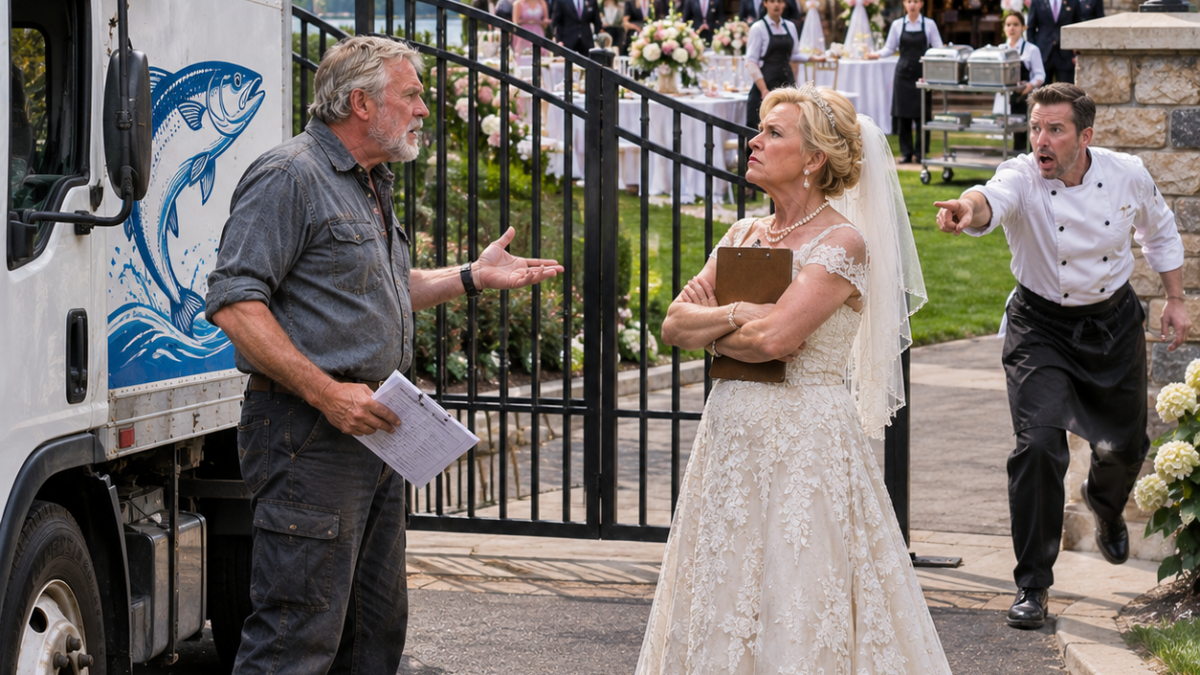
HOA Karen Blocked My Fish Market Truck and Demanded I Sign Away My Road Rights—Then Her Caterer Told Her It Was Carrying Her Wedding Dinner.
The HOA president stood in front of my refrigerated fish truck wearing a wedding veil and told security not to open the gate unless I signed away a road right my family had used for thirty-two years.
Behind her, three hundred feet away, white tablecloths, flower arches, kitchen carts, and an entire wedding reception waited for a seafood delivery she had personally ordered through her caterer.
But when the caterer came running down the clubhouse steps, looked at the truck she had been fighting for weeks to keep off the road, and said five words that made every guard turn toward her, I realized the delivery was about to become the least comfortable part of her wedding day.
“Do not open that gate.”
Diane Mercer stood beside the guard booth in a pale ivory dress with a short wedding veil pinned into her hair.
One hand held her phone.
The other held the same commercial access form I had refused to sign three times.
Behind me, the cooling unit on Bennett’s Fish Market truck hummed steadily over a load of fresh fish and shrimp worth far more than I wanted sitting on the side of a road.
My driver, Luis, remained inside the cab.
I had told him not to argue.
Not with security.
Not with Diane.
Not with anyone.
If the gate stayed closed, he was supposed to call me.
This time, I had come with him.
“We’re delivering to the clubhouse kitchen,” I said.
Diane held out the form.
“Sign this, and you can proceed.”
“I’m not signing away our access rights.”
“Then you can turn around.”
I unfolded the delivery sheet.
“Read the destination.”
“I know where the truck is going.”
“No,” I said. “I don’t think you do.”
She did not take the paper.
Behind her, a florist’s van rolled through the other side of the entrance.
The guard, Sam, moved a cone for it.
Then he looked back toward us.
Luis stayed where he was.
Good man.
He had worked for us four years and hated conflict more than he hated getting up at four in the morning.
I pulled out my phone and called the caterer.
“We’re stopped.”
“I’m coming.”
I hung up.
Diane pointed toward the road behind me.
“You’re creating a scene on my wedding day.”
I looked at our truck.
Engine idling.
Cooling unit running.
Not one horn.
Not one raised voice.
Then I looked at the locked gate.
“We’re trying to complete a delivery.”
She turned toward Sam.
“Do not open it.”
PART2:
A door slammed near the clubhouse.
Someone came running down the steps.
White chef’s jacket.
Dark apron.
Phone in one hand.
Owen Hail.
The caterer.
He slowed when he saw us.
Then looked at Diane.
“Why is my order still out here?”
Diane waved toward me.
“He refuses to comply with the access rules.”
Owen stopped beside her.
Then he looked at the truck.
The blue fish painted on the side.
BENNETT’S FISH MARKET.
His face changed.
“Diane.”
“What?”
“That’s your dinner.”
For the first time since I had known her, Diane Mercer had absolutely nothing to say.
She looked from Owen to the truck.
Then at the delivery sheet still in my hand.
“No.”
“Yes,” Owen said.
“We ordered through you.”
“And I ordered through him.”
Owen took the delivery sheet from me.
He held it where she could read it.
HAIL CATERING.
CLUBHOUSE KITCHEN.
WEDDING BOOKING.
Two o’clock delivery.
Fish.
Shrimp.
Shellfish.
Everything his kitchen crew had been waiting for.
Through the gate, two workers stood beside the service entrance with empty carts.
Diane’s eyes moved down the page.
Then toward the clubhouse.
Her voice dropped.
“Bring it through the guest entrance.”
Owen stared at her.
“The guest entrance has stairs.”
“Then unload here.”
I looked toward the shoulder.
Cars were coming in from the county highway.
There was barely enough room for the truck to sit safely.
“You want us to unload seafood into traffic?”
Diane’s face tightened.
“I want the food delivered.”
“So do I.”
I pointed at the gate.
“That’s why we came.”
She turned toward Sam.
“Open it.”
Sam reached for the control.
Then stopped.
“What about the form?”
Diane looked back at me.
“You still need to sign.”
And there it was.
Even with her own wedding dinner sitting in a refrigerated truck ten feet away, Diane still wanted my signature more than she wanted the food.
I unfolded the access application.
Pointed to the final paragraph.
“This says the HOA can withdraw our road access whenever it chooses.”
“It’s a standard form.”
“Beth told you to stop using it.”
Owen lowered the delivery sheet.
“Diane, this has nothing to do with dinner. Let them through.”
“It has everything to do with how this property is managed.”
I checked my watch.
Then wrote the time on the delivery sheet.
Diane noticed.
“What are you writing?”
“Our arrival time.”
“You’re early.”
“We’re ready early.”
“What are you trying to prove?”
“Nothing.”
I capped the pen.
“I’m recording how long the truck waits.”
Nine days earlier, none of this had anything to do with wedding dinners.
It started with ice.
My daughter Rachel called me while I was cleaning fingerprints from the front display case.
“Dad?”
“Yeah?”
“The ice supplier says security won’t let him through.”
I stopped wiping.
“What?”
“They want a permit.”
“What permit?”
“He doesn’t know.”
“Who’s at the gate?”
“Diane.”
I set the cloth down.
Through the loading door, I could see the supplier’s truck waiting near the bend.
The road ran from the county highway past the HOA clubhouse and down toward my market beside the public marina.
Part of the road near the clubhouse belonged to the association.
Our market property did not.
And Bennett’s Fish Market had a recorded right to use that road.
Customers.
Employees.
Service vehicles.
Deliveries.
My father had made certain of it thirty-two years earlier when the neighborhood development changed the old road layout.
That road right came with the market.
It was not permission.
It was not a courtesy.
It was not something an HOA president could cancel because she disliked trucks.
Diane Mercer had been HOA president for six months.
She had complained about our deliveries for almost exactly six months.
I walked up the road.
Diane stood beside the supplier cab with a clipboard.
“Commercial vehicles need approval now.”
“Since when?”
“The board is improving traffic management.”
“This truck comes every Tuesday.”
“Then I’m sure you can arrange a better delivery time.”
The driver, Joel, looked at his watch.
Three more stops before lunch.
Every minute he spent sitting there cost somebody money.
“Open the gate, Diane.”
“You need to submit a delivery schedule.”
“I sent one in April.”
“That was informal.”
“It listed every regular delivery.”
“It wasn’t an application.”
Joel switched off his engine.
That little motion irritated me more than Diane’s clipboard.
A driver had work to do.
He was not paid to sit beside flower beds while two people argued over a right recorded before half those houses existed.
I called Beth Palmer.
The HOA property manager.
Beth listened.
Then asked to speak with Diane.
A minute later, the gate opened.
Joel drove through.
I thought the problem had been handled.
Then, when he handed me the delivery sheet, I saw an added line.
WAITING CHARGE — $45.
I signed.
He had waited.
Not his fault.
But I copied the sheet.
My name is Paul Bennett.
I was sixty-three years old, and I had spent more than half my life working behind that market counter.
My father started Bennett’s Fish Market in a narrow building with a concrete floor, an old chest freezer, and a hand-painted sign.
Local freshwater fish when we could get it.
Other seafood brought in through regular suppliers.
Shellfish.
Shrimp.
Whatever our restaurant customers needed.
The market existed before the neighborhood.
Before the clubhouse.
Before the stone landscaping.
Before Diane Mercer had ever heard the phrase “commercial access policy.”
When developers built the residential community uphill, they needed to adjust the road.
Dad agreed.
But he insisted on one thing.
Our access stayed with the property.
In writing.
Recorded.
I used to make fun of him for keeping documents.
Everything went into a metal filing cabinet.
Road agreements.
Utility records.
Invoices.
Old permits.
I once told him half the building would burn before those papers did.
He tapped the cabinet.
“People remember things differently when land gets expensive.”
After he died, I kept the cabinet.
Rachel handled most of our ordering and bookkeeping now.
She had come back when my wife got sick.
Then stayed after we lost her.
She was slowly taking over more of the business.
Above Rachel’s desk hung a photograph of her at twelve years old standing on a milk crate so she could reach the scale.
I wanted to leave her a working market.
Not a business where she had to ask a neighborhood president for permission every time shrimp arrived.
That afternoon, I found Dad’s road agreement.
The language was plain.
Our property retained access for customers, service vehicles, and deliveries.
The association could maintain the road.
It could make reasonable safety rules.
It could not eliminate our access.
I scanned the document.
Sent it to Beth.
Copied Diane.
Copied the general board email.
Beth replied that she had received it.
Diane sent her own reply.
Rights must be balanced against the quiet enjoyment of our residences.
I almost answered:
People who buy houses beside a fish market should expect an occasional fish truck.
Rachel caught me typing.
“Don’t.”
“She needs to hear it.”
“No. Send the delivery schedule again.”
“She already has it.”
“Then she’ll have it twice.”
That was Rachel.
Less satisfying.
More useful.
I sent the schedule again.
Then asked for the written rule Diane claimed she was enforcing.
No one sent one.
The next morning, our refrigerated truck returned late from a restaurant delivery.
Luis came into the office holding a sheet of paper.
“Guard gave me this.”
Across the top:
TEMPORARY COMMERCIAL ACCESS APPLICATION.
License plate.
Company.
Insurance.
Delivery times.
None of that bothered me.
The final paragraph did.
By submitting the application, the applicant acknowledged that commercial access was permissive and could be withdrawn by the HOA at any time.
I read it twice.
Rachel pulled out the recorded agreement.
“They want us to ask for something we already own.”
“That’s how I read it.”
Luis stood near the door.
“Guard said we’d get a sticker if we fill it out.”
“Did you sign anything?”
“No.”
“Good.”
“I told him you handle the paperwork.”
“That’s what I pay you for.”
Luis smiled slightly.
He was good with customers.
Good with the truck.
Good with heavy deliveries.
Arguments were another matter.
Diane had managed to put him in the middle of one every time he went to work.
I asked which guard gave him the form.
“Sam.”
I wrote the name down.
Then emailed Beth.
Attached the form.
Asked whether the board had approved it.
Her answer came after closing.
I cannot find this form among the board’s approved documents. Please do not sign it until I can confirm its status.
That should have ended the matter.
It did not.
Thursday morning, orange cones appeared near the clubhouse.
Commercial vehicles were directed toward the guard station.
White chairs were being carried inside.
A florist van sat near the kitchen.
Workers measured the lawn for a fabric-covered arch.
I walked up.
Diane stood on the clubhouse porch giving instructions.
“This road is going to be busy next Saturday,” she said when she saw me.
“What happens next Saturday?”
“A private event.”
I looked at the florist truck.
“Commercial vehicles look fine when you want them.”
“These are approved vendors.”
“Then approve ours.”
“That depends on whether you cooperate.”
She pointed toward the guard station.
“Submit your application.”
“Beth told me not to sign it.”
“Beth handles administration.”
“And who handles property rights?”
“The board handles policy.”
“Then show me the board vote.”
She turned away.
“I don’t have time for this.”
I photographed the cones.
The sign.
The trucks.
Then walked back to the market.
Rachel was on the phone.
When she hung up, she handed me an order sheet.
“Hail Catering.”
I knew Owen Hail.
He had bought seafood from us for years.
“Big order.”
“Wedding.”
“Where?”
She pointed.
Clubhouse.
I looked back up the hill.
“The private event.”
“Looks like it.”
“Maybe Owen can get us on the vendor list.”
I called him.
He was setting up another event.
He listened while moving around a kitchen.
“I already listed Bennett’s as our seafood supplier.”
“Send the delivery details again.”
“I will.”
“Make sure they understand it’s our truck.”
“That’s obvious.”
“Apparently not.”
The order sheet had his catering company.
Booking number.
Quantities.
Delivery time.
No bride’s name.
No groom’s name.
We did not need to know who was getting married.
We needed to know what food they wanted and where to put it.
Friday, Owen forwarded the full kitchen schedule.
Bennett’s Fish Market.
Truck description.
Two o’clock.
Clubhouse kitchen.
Diane was included on the email.
Rachel looked at me.
“She has it.”
I nodded.
That was where I made my mistake.
I treated being copied on an email like proof the problem had been solved.
It was not.
Over the weekend, I tried to keep the road argument from swallowing the business.
Mrs. Walker came in.
She lived alone.
Always bought one small piece of fish.
My wife used to tuck a lemon wedge inside her package.
I still did.
She waited while Rachel handled another access call.
“Should I come back?”
“No. What are we cooking?”
She told me.
Then asked:
“Are you going to be closed because of the road?”
“No.”
“My son says maybe I should shop somewhere easier.”
That sentence stayed with me.
A business rarely disappears because of one dramatic event.
Sometimes it loses customers one inconvenience at a time.
One blocked truck.
One uncertain delivery.
One regular customer deciding another store is easier.
Monday, I went to an attorney.
Grace Ellis.
I brought everything.
Road agreement.
Application.
Photos.
Beth’s email.
Joel’s waiting fee.
Grace read the last paragraph of the application twice.
“Do not sign this.”
“I haven’t.”
“Good.”
She read the road agreement as a whole.
Then looked at me.
“Your access appears pretty clear.”
“Can Diane impose reasonable truck rules?”
“Reasonable safety rules are one thing.”
She tapped the application.
“Turning an existing recorded access right into revocable permission is another.”
Grace sent a formal letter asking the HOA to stop interfering with deliveries and withdraw the form.
I paid her.
Money I had planned to spend replacing an old drain cover behind the market.
When I returned, I wrote the legal expense beside Joel’s forty-five-dollar waiting charge.
I did not like that list.
I needed it.
Tuesday, Beth called.
“The board received Grace’s letter.”
“Good.”
“Two members asked Diane to explain the application.”
“Will our trucks pass?”
“They should.”
“Beth.”
Pause.
“I’ll issue written instructions to the security company.”
“Copy me.”
She did.
Regular market access to continue.
No driver required to sign away existing rights.
I printed the message.
Put it in Luis’s cab.
He smiled.
“Something I can show them.”
“If they stop you, call me.”
“No arguing?”
“No arguing.”
Friday afternoon, we started preparing Owen’s wedding order.
Rachel checked every box.
Luis checked the truck.
I tested the cooling unit.
Fuel.
Doors.
Temperature.
Then I called Owen.
“Two o’clock?”
“Two.”
“Kitchen crew ready?”
“They’ll have carts.”
“Gate knows?”
“I sent everything again.”
Rachel printed that email too.
Then she looked through the office window.
“Dad.”
A flatbed had stopped near the gate.
Workers were unloading heavy barriers.
I walked up.
Sam stood beside a folding table.
He looked tired when he saw me.
“I was hoping you’d come.”
“What changed?”
He handed me a fresh instruction sheet.
Saturday Event Access.
Every commercial vehicle displaying BENNETT’S FISH MARKET branding was to be held outside the gate until I personally signed the temporary commercial access application.
Not every unapproved vehicle.
Not every supplier.
Us.
My business by name.
Diane’s signature sat at the bottom.
I photographed it.
Then Sam turned the page.
Second instruction.
Do not release Bennett’s truck even if clubhouse kitchen staff request entry.
Only Diane could approve the truck.
I photographed that too.
“Who brought this?”
“Mrs. Mercer.”
“Today?”
“Yes.”
“Did you get Beth’s instructions?”
Sam pointed toward the booth.
“They’re in the shift folder.”
“Those say our access stays open.”
“I know.”
He looked toward the barriers.
“I asked my supervisor which instructions I’m supposed to follow.”
Finally.
Common sense.
“Ask him to answer in writing.”
Beth picked up while I was still there.
I read both instructions.
Including the sentence telling security not to release our truck even if the kitchen asked.
“Send me the pictures.”
I did.
“Did the board approve this?”
“Not that I know.”
“I need something better than that tomorrow.”
Her voice changed.
“I understand.”
Back at the market, Rachel had a voicemail from Owen.
He wanted to confirm everything.
I called him.
This time, I stopped saying we were having a small access issue.
I read him Diane’s instruction word for word.
Silence.
Then:
“I’ll speak to the event coordinator.”
“Who?”
“Diane is the client. Megan is coordinating setup.”
I stopped.
“Diane?”
“Yes.”
I still did not understand.
I assumed Diane was handling the event for somebody else through the HOA.
“Send Megan the actual gate instruction.”
“I will.”
“And tell them I am not asking Luis to force his way through security.”
“Of course.”
“We’ll have the order ready. But if they refuse access, you need another pickup plan.”
“I understand.”
Grace called before five.
Beth had forwarded the same photographs.
Grace was sending another notice to the board and security company.
“Document everything tomorrow.”
“I will.”
“Do not sign that application to get through one time.”
“I won’t.”
“If they block you, call the non-emergency number so the obstruction is recorded.”
“You think police will open the gate?”
“No.”
She was direct.
“An officer may not decide a property-access dispute on the shoulder of the road. But a neutral record helps.”
I looked at the seafood order.
“Tomorrow is a long time to wait for a judge.”
“Yes.”
Then Grace said something I appreciated.
“You need a practical plan for the food as well as a legal plan for the road.”
Letters did not keep seafood cold.
Rachel called a local refrigerated delivery service.
Booked.
Another company.
Unavailable until late afternoon.
We considered leaving our truck outside overnight.
No secure lot.
No.
Every workaround cost money.
And none fixed next week.
Still, we kept looking.
Our customer had ordered a wedding meal.
We were going to do everything reasonable to deliver it.
Six o’clock.
Beth emailed.
Security company notified.
Supervisor scheduled Saturday.
Board vice president Tom Avery had told Diane the application could not be used to stop market deliveries.
I read it.
Called Beth.
“Has Diane agreed?”
“She hasn’t replied.”
“Then don’t tell anyone this is settled.”
“I won’t.”
Owen said Megan had told him all approved wedding vendors would be admitted.
But we were on the approved list.
Our truck description was on the schedule.
Diane had both.
And security still had written orders to stop us.
That told me something important.
This was no longer a misunderstanding.
We closed the market at seven.
Luis stayed.
We checked the truck together.
Cooling unit.
Fuel.
Door seals.
I told him to keep the road documents separate from the delivery papers.
“If they ask about the wedding, show the delivery sheet.”
“And if they ask about the gate form?”
“Call me.”
He nodded.
Then smiled weakly.
“My wife says I should wear a body camera to deliver fish.”
I laughed.
Mostly for him.
“I’m going with you.”
That helped.
After Luis left, Rachel sat at her desk rubbing her eyes.
“I’m sorry.”
“For what?”
“You came back to help run a fish market.”
“I know.”
“Not fight an HOA gate.”
Rachel looked at the old photograph of herself standing on the milk crate.
“You didn’t tell me to go find another job when I couldn’t reach the scale.”
“That’s different.”
“Let me do my part.”
She created a folder on the computer.
Wedding date.
Order.
Road agreement.
Beth’s instructions.
Diane’s instructions.
Every email.
Then Rachel printed one sheet listing exactly who received which document and when.
That one-page timeline would eventually matter more than anything angry I could have said.
Saturday morning, I arrived before opening.
White ribbon had been tied around the gatepost.
Beyond it stood a welcome sign.
DIANE & RICHARD.
I stopped.
Read it again.
Diane.
The bride.
I sat in my pickup staring at that sign.
Suddenly Owen’s calls made sense.
His client.
Her coordinator.
Her clubhouse event.
The woman trying to keep our seafood truck off the road was the woman paying the caterer for the food inside it.
I photographed the sign.
Then drove through in my pickup.
Sam waved me down.
“Morning, Paul.”
“Supervisor coming?”
“Eleven.”
“What are the instructions?”
He frowned.
“Still conflicting.”
I did not ask him to invent an answer.
At the market, I showed Rachel.
She leaned closer.
“Her wedding?”
“Yes.”
She looked toward the cooler.
“Does she know we’re the supplier?”
“Wrong question.”
Rachel nodded.
Receiving a document did not prove she had read it.
I called Owen.
Kitchen noise.
Metal trays.
People talking.
“I saw the sign.”
“What sign?”
“This is Diane’s wedding.”
“Yes.”
“Does she personally understand Bennett’s is supplying the seafood?”
“I told Megan your company is on every sheet.”
“That’s not what I asked.”
Owen paused.
“I’ll try to tell Diane directly.”
“Please.”
At twelve-thirty, Owen called back.
“Megan says your delivery is approved.”
“Did she tell Diane it was us?”
“She said she would.”
I closed my eyes.
“Owen, the guard instruction does not say unapproved vendors.”
“I know.”
“It says Bennett’s Fish Market.”
“I know.”
“I need you to understand that.”
“I do.”
He sounded worried.
“If there’s a problem, call me. I’ll walk out.”
Good.
At one, the security supervisor came down to the market.
Carl.
Dark jacket.
Company logo.
I showed him the access agreement.
Beth’s instructions.
Diane’s instructions.
He read everything.
“Our company cannot adjudicate land rights.”
“I don’t want you to.”
I pointed to Beth’s email.
“I’m asking you not to enforce a form your own client’s property manager says was never approved.”
Carl nodded.
“Diane is giving instructions personally at the gate.”
“Will your guards open it?”
“I’m going to talk to her.”
I offered to go.
He asked me to let him speak first.
I did.
One-thirty.
Rachel called Beth.
Beth was driving in.
Tom, the vice president, was coming too.
Four people now had the power or authority to solve a gate problem that should never have existed.
The gate remained closed.
At one-forty-five, I told Luis:
“Load up.”
Everything had stayed refrigerated until the last reasonable moment.
We loaded the order.
Checked labels.
Hail Catering.
Clubhouse kitchen.
Wedding number.
Luis drove.
I rode passenger.
Documents on my lap.
Two minutes later, we reached the gate.
Diane stood there in her wedding dress.
The rest you know.
She demanded the form.
I refused.
She refused the gate.
Owen came running.
Then told her:
“That’s your dinner.”
And still she refused to let the truck through without my signature.
Carl stepped out of the booth.
Phone in hand.
He looked at Diane.
“Mrs. Mercer.”
“What?”
“We’ve been instructed not to collect that access form.”
“By whom?”
“Our company.”
“I hired your company for this event.”
“We’re providing event security.”
He pointed at the application.
“We’re not collecting signatures on road-right agreements.”
Diane stepped forward.
“Then I’ll handle it myself.”
Carl did not argue.
Instead, he told Sam to move a cone so waiting cars could safely clear the highway.
That small decision mattered more than winning an argument.
Owen opened a message on his phone.
“I sent your coordinator the supplier name three times.”
“I don’t read every kitchen email.”
“You didn’t have to read every email.”
He held up the schedule.
“You had to read the vendor sheet.”
Her face tightened.
I saw what was happening.
Every piece of evidence made Diane less willing to back down because backing down meant admitting she had created the problem herself.
I turned to Owen.
“The food is safe.”
He nodded.
“Cooling unit’s running?”
“Yes.”
“How long can you hold?”
“A while.”
“Kitchen is ready.”
“Then keep the loading area clear.”
“I will.”
I called Rachel.
“Still stopped.”
“Owen there?”
“Yes.”
“Food okay?”
“Yes.”
“Cooler space is open if you have to return.”
Good.
A gray sedan pulled in behind the waiting vehicles.
Beth.
Tom arrived less than a minute later.
He walked directly to Carl.
Then to Diane.
“Why is the market truck stopped?”
Diane held up the application.
“He won’t complete the paperwork.”
Tom stared at her.
“We told you not to use that paperwork.”
“You told me it needed review.”
Beth stepped closer.
“No. I issued written instructions that regular market access was to continue.”
“This is my wedding.”
Tom’s voice softened.
“I know.”
Then:
“Go inside, Diane. We’ll handle the delivery.”
He had handed her an exit.
A graceful one.
She could walk into her wedding.
Truck comes through.
Food delivered.
Argument handled Monday.
For a moment, I thought she might take it.
Instead, she pointed at me.
“If he gets a permanent sticker, every commercial vehicle in the county will start using this road.”
“I don’t want a sticker.”
Beth held out her hand.
“Give me the application.”
Diane kept it.
Tom looked at Carl.
“The market has access. Open the gate.”
Carl looked at Beth.
Beth nodded.
Sam pressed the control.
The gate started moving.
Nobody cheered.
I folded the unsigned application.
Put it back in my folder.
Climbed into the truck.
Luis let out a breath.
“You okay?”
“Yes.”
“Drive slow.”
We passed Diane without saying a word.
Owen met us at the kitchen.
Two workers brought carts.
We moved the sealed boxes directly inside.
Rachel joined by speakerphone while Owen checked quantities.
Fish.
Shrimp.
Shellfish.
Everything there.
Temperature good.
Packaging good.
No spoilage.
Owen signed the delivery sheet.
Then beneath the delivery time, he wrote:
Delivery delayed at HOA access gate.
I had not asked him.
He handed me the paper.
“My staff will confirm it.”
“Thank you.”
Luis closed the truck.
I told him:
“Head back.”
“You coming?”
“I’ll walk.”
He looked toward the gate.
“Will they let me out?”
That question bothered me.
Luis was not afraid of long drives.
Heavy boxes.
Bad weather.
He was worried about whether a gate would open on a road he drove every working day.
Carl heard him.
“I’ll walk up with the truck.”
Luis nodded.
I watched them leave.
Then turned to Owen.
“Dinner okay?”
“We’ll adjust.”
“You lost time.”
“I have good people.”
His kitchen crew moved quickly.
No shouting.
No panic.
They had enough time.
Good.
I had never wanted Diane’s guests to go hungry.
I wanted our road rights respected.
Those were different things.
Owen removed his glasses and rubbed his eyes.
“I should’ve pushed harder yesterday.”
“So should I.”
“You warned us.”
“I should’ve demanded a direct answer instead of accepting another ‘we’ll tell her.’”
He nodded.
Then went back to work.
On my walk downhill, a man in a dark suit came through the clubhouse side door.
“Mr. Bennett?”
I stopped.
“Yes?”
“I’m Richard.”
The groom.
He looked toward the kitchen.
“Megan told me there was a delivery issue.”
“The order is inside.”
“I wanted to thank you for staying.”
I did not know how much he understood about what had happened.
I had no intention of explaining his bride’s behavior to him outside his wedding.
“You hired a good caterer.”
He nodded.
“Do I owe you anything extra?”
“Owen and I will handle the invoice.”
Richard held out his hand.
I shook it.
That was all.
At the market, Rachel had put a chair beside her desk.
“Sit down before you tell me.”
I sat.
Luis had already explained most of it.
Rachel laid the delivery sheet beside the unsigned application.
One paper showed the job we completed.
The other showed what Diane had tried to make us surrender in exchange for doing it.
“You didn’t sign?”
“No.”
Rachel copied everything.
I wrote a timeline while the details were fresh.
Luis wrote his own statement.
Then I paid him extra for the delay.
He protested.
“You were working.”
“I was sitting in the truck.”
“Because I asked you to.”
He accepted.
Before leaving, he said:
“You came with me.”
“What?”
“When she stopped us.”
He shrugged.
“You came with me. That helped.”
After closing, I called Grace.
Left a message.
Delivery completed.
Form unsigned.
Gate opened only after Beth and Tom intervened.
I did not call the matter settled.
I had learned that lesson.
Music drifted faintly downhill from the wedding.
People clapped.
Dinner was happening.
Good.
Then Owen called.
“The food went over well.”
“Glad to hear it.”
Pause.
Then his voice changed.
“Diane wants me to remove your supply charge from my bill.”
I stopped cleaning the counter.
“What?”
“She says you deliberately delayed delivery to pressure her.”
I looked at the clock.
Wedding dinner served.
Guests happy.
And Diane was already rewriting what happened.
“What did you tell her?”
“That I was standing at the gate.”
“Are you paying us?”
“Under our normal terms.”
“Then save her message.”
“Already done.”
Sunday morning, I tried not to touch the file.
Coffee.
Trash.
Alarm check.
Normal things.
Nine-thirty.
Beth called.
“The security company wants a written explanation.”
“For what?”
“Conflicting instructions.”
“That sounds reasonable.”
“It is.”
“They’re not accepting another event assignment until the HOA clarifies who has authority to direct guards.”
Even better.
Board meeting Monday.
Grace agreed to come.
She wanted the precise sequence.
Only what we personally saw.
Rachel’s one-page timeline became three.
Initial ice-truck delay.
Commercial access form.
Beth’s written instructions.
Diane’s Friday restrictions.
Wedding delivery.
Owen’s signed receipt.
Monday morning, a restaurant customer called.
Rachel covered the phone.
“They’re asking whether we’re still allowed to use the road.”
I looked at her.
“Who told them we aren’t?”
The customer sent a screenshot.
Diane had posted in the neighborhood online group.
BENNETT’S FISH MARKET delivery admitted as a special exception during private event.
Future commercial access under review due to disruptive conduct.
Our business name in bold.
Rachel put the phone down.
“People share this.”
“I know.”
This was bigger now.
A blocked truck cost time.
A rumor that we could not deliver cost customers.
I called the restaurant owner.
“Your delivery is coming at the normal time.”
“So your road access is okay?”
“Our recorded access remains in force.”
“All right.”
“We’ll be there.”
Then I made sure we were.
That afternoon, Beth sent the board agenda.
Commercial Access Policy and Saturday Incident.
Diane attached a proposal.
Permanent weekday delivery bans during some of our busiest hours.
Weekend deliveries requiring HOA president approval.
Annual commercial access fee.
I read it.
Then handed it to Rachel.
“She couldn’t get your signature.”
“No.”
“So now she wants the board to create the same control.”
“Yes.”
We went to the meeting with Grace.
Luis came after his route.
Clean work shirt.
Handwritten notes.
Owen arrived carrying his phone and the vendor schedule.
I had not asked either man to attend.
The room was nearly full.
Diane started.
She described a commercial truck arriving without proper clearance.
A business owner refusing a simple safety form.
Confronting security.
Using a wedding delivery to pressure the association into granting an exception.
Grace waited.
Then asked:
“Mrs. Mercer, did you receive a supplier schedule identifying Bennett’s Fish Market before the wedding?”
“I received numerous schedules.”
Owen stood.
“I brought the one you answered.”
He handed his phone to Beth.
The room became quiet.
Beth read.
Friday afternoon.
Megan had sent:
BENNETT’S FISH MARKET.
Truck description.
Two o’clock.
Clubhouse kitchen.
Underneath was Diane’s reply.
Tell the caterer to arrange another vehicle if Bennett refuses the form.
I looked at Owen.
He shook his head.
“Nobody sent that to me.”
Tom leaned forward.
“So the delivery issue wasn’t unexpected.”
Diane said nothing.
“You knew the wedding food was coming from Bennett’s.”
“I knew they were listed.”
“And you made access depend on Paul signing the form anyway.”
Diane opened her mouth.
Grace placed Dad’s recorded road agreement on the table.
“Before this board votes on anything, you need to decide whether you are correcting what happened or choosing to continue it.”
Tom pushed Diane’s new policy proposal away.
“We’re not voting on new restrictions until counsel reviews the recorded access.”
Diane looked around the room.
“You cannot let one business control the road.”
Grace remained calm.
“The agreement does not give Bennett’s Fish Market control of the road.”
Then she tapped the document.
“It gives the market access.”
Another tap.
“And it does not give the association unilateral power to erase that access.”
Beth went back to Owen’s phone.
“This message was sent at 4:16 Friday.”
Owen nodded.
“Yes.”
“You never received the instruction to arrange another truck?”
“No.”
Diane folded her arms.
“Then Megan failed to do her job.”
Rachel spoke.
“Who was supposed to pay for another truck?”
Everyone looked toward her.
Diane stared.
Rachel placed our delivery sheet on the table.
“You knew which business was supplying the food.”
Nobody interrupted.
“You knew the truck.”
She pointed.
“You knew the arrival time.”
Another pause.
“You did not contact us to arrange another vehicle.”
Rachel looked directly at Diane.
“You waited at the gate with a form you knew we had already refused.”
Diane said:
“I expected cooperation.”
Rachel’s voice stayed level.
“That wasn’t a delivery mistake.”
The room went quiet.
“That was planned.”
Grace opened the recorded agreement.
“Paul cooperated.”
She listed it.
Provided delivery schedules.
Provided insurance information.
Provided truck details.
Provided the road agreement.
Arrived before scheduled time.
Stayed with the load.
Completed the delivery.
“He was not required to surrender a property right in order to deliver your wedding dinner.”
Tom asked Luis to speak.
Luis stood.
Notes shaking slightly in his hands.
He told them exactly what happened.
Where he stopped.
What Diane held.
What I told him.
Cooling unit running.
No intentional blocking.
No threats.
One board member asked:
“Did Paul ever threaten to leave with the food unless the gate was opened?”
Luis shook his head.
“No.”
“What did he say?”
“He called the market and told Rachel to keep cooler space available in case we had to return.”
“Why?”
“To keep the order safe.”
Owen stood next.
“I accepted the order.”
He handed over the signed sheet.
“Everything was delivered in good condition.”
Then he looked at Diane.
“You hired me to provide your wedding dinner.”
She looked down.
“Paul supplied what I ordered.”
He paused.
“I will not change my records to say he caused the problem.”
That was the first moment I saw something shift.
Not guilt.
Not apology.
Recognition.
Everyone around Diane had begun refusing to rewrite reality for her.
Beth also had Carl’s security report.
Conflicting instructions.
Beth’s directions.
Diane’s directions.
Supervisor’s calls.
Final note:
Security personnel were instructed not to collect the disputed access application. Mrs. Mercer continued personally requesting the signature as a condition of entry.
Tom read that aloud.
The board took a break.
Called its attorney.
Grace joined the call.
I stayed beside Rachel.
Luis sat down.
“I hate talking in rooms like this.”
“You did fine.”
“I thought I’d forget something.”
“That’s why we wrote it down.”
Owen had another job.
Before leaving, he handed Rachel the complete message chain.
“I sent everything.”
“Thank you.”
“I like being able to call a supplier and know he’ll do what he says.”
He glanced at me.
“I’m not losing that over this.”
When the board returned, Tom spoke first.
“Diane’s proposed commercial access restrictions will not be adopted tonight.”
Diane started to object.
Tom raised one hand.
“You may have your objection entered into the minutes.”
Then:
“The association’s attorney has advised us to honor the market’s recorded access rights and withdraw the temporary application immediately.”
Diane leaned forward.
“You’re giving up control.”
“No.”
Tom shook his head.
“We’re recognizing an agreement the association already has.”
The board voted to suspend Diane’s commercial restrictions.
Good.
Not enough.
Grace explained what we needed.
A written correction to security.
A correction to residents.
A correction wherever Diane had publicly claimed our delivery was a special favor.
A clear process for legitimate road closures.
If maintenance required temporary restriction, we needed notice and an alternative arrangement.
Grace put it plainly.
“No one is asking this association to let a refrigerated truck drive through a construction trench.”
A few people smiled.
“We are asking you to stop treating a recorded access right as a favor granted by whoever happens to be president.”
That sentence mattered.
The board agreed.
I left feeling better.
But I did not put the folder away.
We had received reassuring emails before.
Saturday showed me the difference between an email and an agreement everybody was willing to follow.
The next morning, Luis stood beside the loading door.
“Should I call before the gate?”
“Only if there’s trouble.”
He nodded.
Then did not move.
“What?”
“I really don’t want another morning like Saturday.”
“Neither do I.”
I walked outside.
Watched him drive uphill.
Sam was working.
He stepped out.
Checked traffic.
The gate opened before Luis reached it.
No paperwork.
No phone call.
No Diane.
Luis raised one hand through the windshield.
Kept driving.
I went inside.
Rachel looked up.
“Through?”
“Through.”
She smiled.
Then returned to her orders.
That ordinary moment did more for me than the entire board meeting.
Over the next two weeks, lawyers finalized the written agreement.
The HOA formally acknowledged Bennett’s Fish Market’s existing road rights.
No annual fee.
No special sticker.
No president approval.
No commercial access application for deliveries already protected by the recorded agreement.
Emergency closures and legitimate maintenance could still happen.
Of course.
Roads need repair.
Emergencies do not check property documents first.
But the property manager would provide reasonable notice and work with us on access when possible.
Most importantly, no single board member could create a new rule at the guard booth.
Grace made sure the agreement bound the association itself.
Not just Tom.
Not just Beth.
Not just whoever happened to like us.
I had no interest in repeating the same fight after the next election.
The association published a correction in the same neighborhood group where Diane had named our business.
It stated that Bennett’s Fish Market had arrived for a scheduled wedding delivery.
That the truck’s access was not a special exception.
That the market possessed existing recorded access rights.
And that the claim of disruptive conduct was withdrawn.
Rachel printed the correction.
Then emailed it to the restaurant owner who had called.
His response?
His next order.
That was the correction she cared about.
We submitted documented expenses.
Joel’s forty-five-dollar waiting charge.
Luis’s additional paid time.
Legal expenses directly related to stopping the interference.
No bill for irritation.
No fake emotional damages.
No exaggerated claim for lost business we could not prove.
The association reimbursed the agreed costs.
We did not get some enormous courtroom award.
There was no dramatic judge’s ruling.
We did not need one.
I wanted three things.
Access protected.
Our business name corrected.
Costs caused by the interference covered.
That was what we got.
At a later homeowners meeting, Diane was removed as HOA president.
I did not attend.
Rachel called while I was replacing the worn loading-area drain cover I had postponed because the legal bill had eaten that money.
“They voted her out.”
I tightened a fastener.
“What do you think?”
“I think Luis won’t catch a cart wheel in this drain anymore.”
“Dad.”
“I know what you mean.”
“Are you glad?”
I sat back.
“Yes.”
There had been a consequence.
That mattered.
But I was also ready to spend an entire day thinking about seafood instead of Diane Mercer.
Tom became interim president.
Beth became the main contact for road access.
Diane remained a homeowner.
She still drove the road.
Attended meetings.
Had the same right as anybody else to raise legitimate concerns.
What she no longer had was the authority to decide whether my truck could turn its wheels.
Owen paid our invoice on time.
His disagreement with Diane over the wedding bill stayed between them.
He told me only one thing.
“I kept your delivery charge exactly where it belonged.”
A few weeks later, he placed another big order.
Rachel answered.
“What venue?”
He told her.
“Any gates?”
Owen laughed loudly enough that I heard him from the counter.
“No gate. Huge loading dock. I checked.”
We all started checking more after that.
Not because every venue was difficult.
Because fewer assumptions made better business.
One Thursday afternoon, Richard walked into the market.
I recognized him before he reached the counter.
He looked around at the display.
Then at me.
“Mr. Bennett?”
“Paul.”
“Do you have a minute?”
I stepped around the counter.
“I wanted to apologize.”
“You already thanked us on the wedding day.”
“I didn’t know all of it then.”
I nodded.
He looked toward Rachel’s office.
“The dinner was good.”
“Glad to hear it.”
“People still talk about the seafood.”
“I’ll tell Owen.”
“And your driver.”
“I will.”
Richard hesitated.
“I’m sorry you were put in that position.”
I did not ask what had happened between him and Diane after the wedding.
Not my business.
Instead, I said:
“The guests didn’t block our truck.”
He nodded.
“No.”
He bought enough fish for two people.
I wrapped it exactly the way I wrapped Mrs. Walker’s.
He paid.
Before leaving, he rested one hand on the package.
“I’m glad you didn’t take it out on everyone.”
“Wouldn’t have fixed the gate.”
He gave me a small smile.
Then left.
Diane never came to apologize.
Eventually, I stopped expecting her to.
An apology would have been nice.
It was not necessary.
The road agreement mattered more.
The next month, Rachel started managing delivery planning without asking me to review every change.
I noticed she had added a new section to large orders.
Receiving contact.
Direct phone number.
Written loading instructions.
Gate code or access details.
Nothing complicated.
Just fewer assumptions.
She also stopped making Luis carry the entire dispute file in the truck.
One Friday, he walked into the office holding the thick folder.
“Can this stay here now?”
Inside:
Road agreement.
Beth’s emails.
Diane’s application.
Wedding schedule.
Security instructions.
I looked at Rachel.
She took it.
“Yes.”
Luis grinned.
“Good.”
“Why?”
“I’d like the space for my lunch.”
We put the folder in Dad’s metal filing cabinet.
Right beside the original road agreement he had saved thirty-two years earlier.
For most of my life, I thought Dad kept too much paper.
Now I understood why.
A business needs more than a building.
More than inventory.
More than equipment.
More than a truck.
It needs promises people can rely on.
Customers need to know their order will arrive.
Drivers need to know the road they used yesterday will still be open tomorrow.
Suppliers need to know they can unload.
And a daughter inheriting her father’s market should not inherit uncertainty that somebody else can erase with a clipboard.
That spring, Mrs. Walker came in on a Tuesday.
The ice truck was parked at the loading door.
Through the front window, I saw another delivery vehicle climb the road toward the clubhouse.
The gate opened.
Truck kept moving.
Mrs. Walker put her purse on the counter.
“The road seems easier now.”
“It is.”
“My son still wants me to buy fish somewhere closer.”
“What did you tell him?”
She looked down at the piece I was wrapping.
“I told him you know how much I need.”
I smiled.
Tucked in a lemon wedge.
Same way my wife used to.
After Mrs. Walker left, Rachel came from the office carrying the next day’s orders.
She set them beside me.
Then took the pencil from my hand.
“I’ve got these, Dad.”
For years, that sentence would have made me check every page anyway.
That morning, I let go of the pencil.
Outside, Luis closed the doors of the refrigerated truck.
Started the engine.
Pulled away from the loading area.
The truck climbed the road my father had protected on paper decades earlier.
Past the clubhouse.
Toward the gate.
I watched through the window.
No cones.
No clipboard.
No temporary application.
No HOA president standing in front of the truck deciding whether a recorded right counted that day.
The gate opened before Luis even stopped.
He drove through.
Kept going.
Rachel turned to the next order.
I went back to the counter.
And for the first time in months, Bennett’s Fish Market felt exactly like what my father had intended it to be.
A business.
Not a permission request.








