HOA Karen Blocked My 17-Year-Old Shop Road and Called the Sheriff—Then He Read the 1926 Railroad Easement and Asked What Gave Her the Right to Charge Me
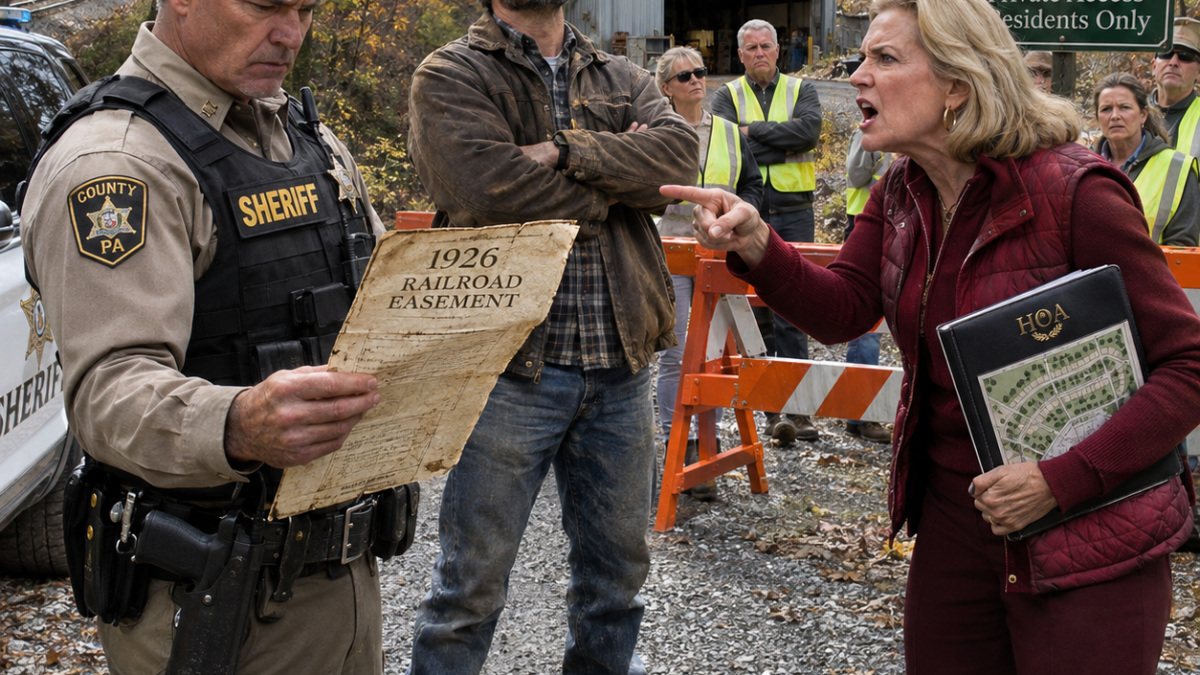
HOA Karen Blocked My 17-Year-Old Shop Road and Called the Sheriff—Then He Read the 1926 Railroad Easement and Asked What Gave Her the Right to Charge Me.
Cynthia Morrow called the sheriff to have Porter Latham arrested for driving his own truck down Switchback Lane, then stood beside twelve HOA volunteers and announced that the road had belonged to Hawthorne Ridge for years.
Sheriff Amos Ridgely quietly unfolded a railroad easement from 1926, traced one paragraph with his finger, and asked Cynthia to show him the document that gave her association the right to charge the actual landowner $2,500 just to reach his own machine shop.
What Porter didn’t know yet was that Cynthia did have a railroad permit—but she had been showing everyone only three of its four pages, because the missing appendix would expose a $147,600 access scheme and another HOA road she had been paid to keep closed.
Monday morning came cold and gray over Blackstone, Pennsylvania.
Fog sat low in the hollows, thick enough that the freight line at the bottom of the ridge appeared and disappeared between the trees.
Porter Latham had driven that route for seventeen years.
He could have made it half asleep.
County Road 12.
Past the shuttered feed mill.
Left beside the old stone culvert.
Then Switchback Lane.
Twenty-four feet of gravel curling beside the railroad corridor toward the thirty-two acres where Porter ran Latham Industrial Fabrication.
He was forty-six years old and had spent most of his adult life making things that needed to work.
Machine brackets.
Custom frames.
Repair assemblies.
Steel platforms.
Nothing glamorous.
But if a quarry conveyor broke or a packaging plant needed a part nobody stocked anymore, Porter could usually make it.
That Monday, his flatbed carried three pallets of laser-cut steel brackets for a food-processing company outside Pittsburgh.
He had been on the road since 4:30 a.m.
All he wanted was coffee.
Then he turned onto Switchback Lane and hit the brakes.
Orange barricades crossed the road.
Two rows.
Behind them stood a brand-new sign nearly eight feet tall.
Forest green.
White letters.
HAWTHORNE RIDGE HOA
PRIVATE ACCESS
AUTHORIZED RESIDENTS ONLY
Porter sat behind the wheel.
“What the hell?”
A woman stepped from beside the sign.
Cynthia Morrow.
Of course.
Fifty-one.
President of the Hawthorne Ridge Homeowners Association.
Quilted navy vest.
Perfect hair.
Leather portfolio tucked under one arm.
PART2:
Twelve residents stood behind her in matching reflective safety vests.
Some carried phones.
One had a handheld radio.
Porter slowly rolled down his window.
Cynthia smiled.
Not warmly.
“Mr. Latham.”
“Cynthia.”
“You’ll need to turn around.”
“Why?”
“This road is closed to commercial traffic.”
Porter looked at his flatbed.
Then back at her.
“This road goes to my shop.”
“We’re aware.”
“Then move the barricades.”
Her smile disappeared.
“The association has taken formal control of Switchback Lane.”
Porter stared at her.
“You bought the railroad?”
PART3:
A couple volunteers chuckled.
Cynthia did not.
“This corridor has been maintained by Hawthorne Ridge for years.”
“That’s not what I asked.”
“We pay for gravel.”
“Sometimes.”
“We pay for drainage.”
“Sometimes.”
“We installed safety lighting.”
“Without asking me.”
“Because somebody had to.”
Porter shut off the engine.
The truck idled down into silence.
He climbed out.
The temperature had barely reached forty.
Steam drifted from his coffee cup in the console behind him.
“What exactly do you want?”
Cynthia opened the portfolio.
“Commercial usage fee.”
“Excuse me?”
“Two thousand five hundred dollars annually.”
Porter laughed once.
Nobody else did.
“To drive to my own business?”
“To use community-maintained access.”
“This isn’t your road.”
She pulled out another page.
“And all vehicles over ten thousand pounds gross weight will be prohibited.”
Porter looked at the flatbed.
Almost every commercial delivery to his shop weighed more than that.
“So I pay you twenty-five hundred dollars and still can’t use my truck.”
“Correct.”
“That’s an impressive deal.”
“You’ve had years of free access.”
“I’ve owned this ground seventeen years.”
That caused a ripple among the volunteers.
Cynthia lifted her chin.
“You own a parcel adjoining the corridor.”
“No.”
Porter pointed beneath their feet.
“I own the land under it.”
“Not according to our records.”
“Then your records are wrong.”
One volunteer muttered something.
Cynthia turned toward him.
Quiet returned immediately.
That was the first thing Porter noticed.
They weren’t just supporting her.
They were accustomed to obeying her.
She produced a laminated color map.
Across Switchback Lane, bold red lettering read:
PRIVATE COMMUNITY ACCESS.
Cynthia held it up.
“Do you see this?”
“I see somebody owns a color printer.”
A man behind her laughed before catching himself.
Cynthia’s face tightened.
“This is the association access map.”
“Not a deed.”
“It was prepared by our land-use consultant.”
“Still not a deed.”
“Mr. Latham, I understand you bend metal for a living.”
Porter waited.
“But real estate law is slightly more complicated than your line of work.”
There it was.
He had learned years ago that the fastest way to tell whether someone had a strong argument was to wait and see how quickly they insulted his occupation.
Porter nodded.
“Then you won’t mind explaining it to the sheriff.”
Cynthia smiled.
“Gladly.”
She pulled out her phone.
Dialed 911.
Her voice changed immediately.
Suddenly breathless.
Urgent.
“Yes, this is Cynthia Morrow, president of Hawthorne Ridge.”
Pause.
“We have a hostile individual trying to force a heavy commercial vehicle through a restricted residential access point.”
Porter stared at her.
Nobody was moving.
“He is refusing to leave.”
Porter took out his own phone.
Started recording.
Cynthia continued.
“We have twelve volunteer safety personnel here, and we’re concerned he may attempt to drive through the barricade.”
Porter walked back to his truck.
Removed the keys.
Placed them on the hood.
Then called county dispatch himself.
“My name is Porter Latham.”
He gave the location.
“I’m the driver involved in the call you just received.”
The dispatcher asked if anyone was injured.
“No.”
“Any weapons?”
“No.”
“Are you trying to drive through the barricades?”
“No. Engine’s off. Keys are sitting on my hood.”
Cynthia glared.
Porter continued.
“This is a property-access dispute. I’ll remain here until law enforcement arrives.”
Twenty-one minutes later, a county sheriff’s cruiser rolled down Switchback Lane from the opposite side.
Sheriff Amos Ridgely stepped out.
Fifty-seven.
Gray at the temples.
Heavy coat.
The slow movements of someone who had spent thirty years discovering that rushing rarely made an argument clearer.
Cynthia reached him before his door fully closed.
“Sheriff.”
“Morning.”
“I want him arrested.”
Amos looked past her toward Porter.
“For what?”
“Trespassing.”
“On what property?”
“Our road.”
She pointed at the sign.
“He refuses to leave.”
Amos glanced at the flatbed.
Engine off.
Keys visible on hood.
Porter standing beside it with both hands outside his pockets.
Then at the twelve residents filming.
“Anybody threatened?”
Cynthia answered:
“His vehicle is the threat.”
Amos looked at Porter.
“Your turn.”
Porter walked to the cab.
Reached behind the seat.
Pulled out a thick folder.
After Cynthia’s first threatening letter three weeks earlier, he had gone to the recorder’s office.
Not because he expected a fight like this.
Because his father had taught him something about land.
When somebody tells you what you own, check the paper before checking your temper.
Porter handed Amos the folder.
“Certified deed.”
Amos opened it.
“Survey.”
Next page.
“Railroad easement.”
Cynthia smiled.
“You can read all the antique paperwork you want, Sheriff.”
Amos didn’t look up.
“That road belongs to Hawthorne Ridge.”
He kept reading.
Porter watched his finger move slowly down a yellowed typewritten document.
Date:
June 18, 1926.
The original Pittsburgh & Western Rail Company had been granted a limited access easement over a strip of what was now Porter’s land.
The purpose was explicit.
Inspection.
Maintenance.
Repair.
Railroad operation.
The corridor ran beside the tracks because maintenance crews needed access to switches, drainage, signal equipment, and the spur below the ridge.
Ownership of the ground remained with the underlying property owner.
That was now Porter.
The railroad held specified rights.
Nothing in the document mentioned a subdivision.
Nothing mentioned residents.
Nothing mentioned an HOA.
Nothing gave some future board authority to turn the lane into a private neighborhood street.
Amos placed the easement on the hood of his cruiser.
Then Cynthia’s glossy map beside it.
“Mrs. Morrow.”
“Yes?”
“Your association isn’t named anywhere in this.”
Her smile slipped.
“Because it predates the development by almost a century.”
“That’s generally how old documents work.”
A volunteer coughed to hide a laugh.
Cynthia shot him a look.
Amos traced one paragraph.
“This says the railroad holds access for specific operational purposes.”
“Correct.”
“And Mr. Latham owns the underlying parcel?”
Porter handed him the deed.
Amos checked.
“Appears so.”
Cynthia crossed her arms.
“That doesn’t change community rights.”
“What community rights?”
“We’ve maintained the road for years.”
“Show me the grant.”
“We spent over one hundred eighty thousand dollars improving this corridor.”
“That’s not what I asked.”
“We resurfaced it.”
“Show me the easement.”
“We installed lighting.”
“Show me the agreement.”
“We maintain the drainage.”
Amos looked up.
“Mrs. Morrow, mowing your neighbor’s lawn doesn’t transfer his deed to you.”
Several volunteers looked away.
Cynthia’s face reddened.
“This is more complicated than that.”
“I’m sure it is.”
Amos closed the folder.
“I’m not deciding ownership today.”
Cynthia immediately said:
“Then arrest him for trespassing until a judge does.”
“No.”
She blinked.
“No?”
“He appears to be standing on property he owns.”
“Our neighborhood has used this road for years.”
“That may matter in civil court.”
“It matters now.”
“My authority matters now.”
His voice remained calm.
“And I am not arresting a man for trespassing on land his deed appears to include when you haven’t produced a recorded document proving exclusive HOA control.”
Cynthia’s mouth opened.
Porter removed another page.
“There’s also this.”
Amos took it.
A 2009 access agreement issued by the railroad.
Porter had purchased the machine-shop tract the year before.
The railroad granted him permission to use Switchback Lane in connection with his business so long as he did not obstruct rail operations.
It had never been revoked.
Amos read it twice.
Then handed it back.
“So he also has written railroad permission.”
Cynthia’s jaw tightened.
“A private industrial agreement does not override community safety.”
A heavyset volunteer near the back finally spoke.
“Cynthia?”
She ignored him.
“Cynthia, why haven’t we ever seen the railroad easement?”
She turned.
“Because it isn’t relevant.”
“Seems pretty relevant.”
Another volunteer lowered his phone.
Cynthia faced Amos again.
“Family safety matters more than dusty technicalities.”
Amos’s expression changed slightly.
“Property documents aren’t technicalities because they’re old.”
His radio crackled.
Dispatch.
A railroad maintenance truck was scheduled to travel the corridor that afternoon.
Amos listened.
Then looked at the barricades.
“These need to move.”
Cynthia stared.
“Excuse me?”
“The railroad has maintenance access.”
“The truck can use the shoulder.”
“No.”
“Residents put these here for safety.”
“And the railroad has an existing easement.”
Cynthia looked at the twelve volunteers.
Nobody moved.
Then at Amos.
“You are ordering me to remove HOA property?”
“I’m telling everyone here not to interfere with documented railroad operations.”
Silence.
Finally:
“Move them.”
Four volunteers reluctantly dragged the orange barricades aside.
Porter picked up his keys.
He thought the confrontation was over.
Then Cynthia smiled.
Not defeated.
Almost relieved.
“Since we’re sharing documents…”
She reached into her portfolio.
Pulled out a crisp stapled agreement.
“Perhaps everyone should see this.”
The volunteers looked back.
Cynthia held the document high.
Railroad letterhead.
Dated 2018.
“This is the actual agreement that matters.”
Amos stopped walking.
Cynthia continued.
“The railroad granted the original Hawthorne Ridge developer permission to use Switchback Lane.”
Scattered applause.
One resident said:
“There it is.”
Cynthia looked directly at Porter.
“The railroad gave us access.”
Porter stepped closer.
Amos glanced at the first page.
He did not declare anyone victorious.
“Take it to your attorney.”
“It’s valid.”
“Then a judge can interpret it.”
Cynthia smiled at Porter.
“Your old paper isn’t going to save you.”
Porter wasn’t listening anymore.
He had noticed something.
The document was three pages.
But on page one:
CONTENTS
- Authorization
- Corridor Conditions
- Insurance Requirements
- Appendix B — Special Limitations
Porter counted again.
Three pages in Cynthia’s hand.
Page four missing.
“Where’s Appendix B?”
Cynthia’s eyes flicked down.
“What?”
“Page four.”
“This is the full agreement.”
“Table of contents says four.”
“Administrative attachment.”
“Then show it.”
Her face hardened.
“You don’t have authority to demand railroad documents.”
“No.”
Porter nodded.
“But a judge does.”
For the first time that morning, Cynthia looked uncertain.
Only for a second.
Then she turned away.
“Meeting tonight.”
She pointed at the residents.
“Seven o’clock. Clubhouse.”
As Porter finally drove toward his shop, twelve volunteers stared after him.
He didn’t feel victorious.
Because if the 2018 railroad permit genuinely granted Hawthorne Ridge permanent access, Porter had a larger problem than an arrogant HOA president.
That evening, fifty-four homeowners packed the clubhouse.
Porter wasn’t invited.
Cynthia played the confrontation video on a large screen.
But not all of it.
The clip began with Porter beside his truck.
Then Amos reading documents.
Then Cynthia’s 2018 permit.
Gone was the portion where Amos explained that Porter owned the underlying property.
Gone was the comparison between the old easement and the HOA map.
Gone was Amos refusing to arrest him.
Cynthia stood beneath the screen.
“Hawthorne Ridge is under attack.”
Residents murmured.
“Mr. Latham is attempting to shut down our emergency secondary exit.”
A woman raised her hand.
“Can he?”
“Not legally.”
Another:
“Then why did the sheriff make us move the barricades?”
“Because the sheriff didn’t want to resolve a civil issue on the roadside.”
Technically true.
Conveniently incomplete.
Cynthia continued.
“If fire, flooding, or a crash closes our primary entrance, Switchback Lane is our only alternate route.”
That frightened people.
Fear works faster than title research.
Most residents had been shown a glossy sales brochure when buying.
Two access points.
Main entrance.
Switchback secondary access.
Few remembered exact closing documents.
Fewer had asked whether the secondary route belonged to the HOA.
Cynthia passed around a petition.
PROTECT HAWTHORNE RIDGE ACCESS.
Signatures filled the pages.
Then she announced something else.
“Until this matter is resolved, commercial industrial trucks will be considered a nuisance threat to resident safety.”
That hit Porter two days later.
A supplier called.
“Porter, we’ve got an issue.”
“What?”
“Driver says Hawthorne volunteers told him Switchback is closed to heavy trucks.”
“It isn’t.”
“They showed him signs.”
“What signs?”
“Commercial traffic prohibited.”
Porter closed his eyes.
“When’s delivery?”
“Supposed to be Thursday.”
“I need that steel.”
“I know.”
An $86,000 fabrication contract depended on it.
Delay meant penalties.
Possibly losing the customer.
Porter could have placed his own barricades.
He owned the ground.
He could have locked residents out and forced the issue.
Instead he called Audra Fisk.
Thirty-nine.
Easement attorney.
Sharp enough that county clerks stopped making casual statements when they saw her coming.
Porter placed the documents on her desk.
1926 easement.
2009 agreement.
2018 three-page permit.
She read silently.
Then looked at the table of contents.
“Where’s page four?”
“Exactly.”
“Do we know it’s missing from Cynthia’s copy or just yours?”
“I saw hers.”
“Three pages?”
“Yes.”
“Filed with the HOA lawsuit yet?”
“No lawsuit yet.”
Audra leaned back.
“Then we find the railroad’s copy.”
She circled Appendix B.
“This decides everything.”
Meanwhile Cynthia introduced a new HOA charge.
COMMUNITY ACCESS PROTECTION ASSESSMENT.
Every home.
New legal fund.
Residents paid.
Most thought they were defending the neighborhood from Porter.
One of those residents was Ellis Paddock.
Sixty-three.
Retired insurance adjuster.
One of the twelve men in a safety vest at the barricade.
He walked into Porter’s machine shop on Thursday afternoon.
Porter was grinding a steel weld.
Ellis waited until the machine stopped.
“You Latham?”
“Depends who’s asking.”
“Ellis Paddock.”
Porter removed his gloves.
“I remember.”
“You embarrassed us.”
Porter looked around.
“Didn’t realize you came for therapy.”
Ellis’s face reddened.
“I paid good money for access to that road.”
“To who?”
“The HOA.”
“For what?”
“Permanent secondary access.”
“Show me the document.”
Ellis hesitated.
“What?”
“Recorded easement.”
“I have a certificate.”
“From the railroad?”
“HOA.”
“Deed?”
“No.”
“Recorded right?”
“It came with our property package.”
“Then show me where it was recorded.”
Ellis opened his mouth.
Nothing.
Porter pulled an old county plat from a drawer.
Unrolled it across the workbench.
“Want to see something?”
Ellis stepped closer.
At the west edge of Hawthorne Ridge:
OLD MILL GATE
PERMANENT COMMUNITY ACCESS.
Ellis frowned.
“That’s closed.”
“Why?”
“Always has been.”
“Why?”
“Cynthia said it was removed from the plan.”
Porter pointed.
“County record didn’t remove it.”
Ellis stared.
“There’s a trucking yard there.”
“Now we’re getting somewhere.”
The old access route connected directly to a county road.
No railroad.
No Porter.
No disputed easement.
A legal community road.
Yet it had been blocked for years.
“Who owns that land?”
Ellis asked.
“According to the plat, HOA common property.”
Ellis went quiet.
“Then why are we fighting you?”
Porter looked at him.
“Excellent question.”
The railroad entered the fight two days later.
Della Crowhurst arrived in a white company truck.
Forty-four.
Supervisor of land access and operations.
Clipboard.
Measuring wheel.
Hard hat.
Porter had hoped she’d immediately declare him right.
She didn’t.
Good professionals rarely deliver emotional victories on demand.
“Show me everything.”
He did.
1926 easement.
2009 agreement.
2018 copy.
Della read all three.
Then walked Switchback Lane.
Measured clear widths.
Drainage.
Distances to the signal cabinet.
Access to the spur.
Near the upper bend, she stopped beside a concrete pillar Hawthorne Ridge had installed the previous year.
Solar-powered access lighting and wiring entered the base.
Della measured.
Again.
Her expression tightened.
“This shouldn’t be here.”
Cynthia had arrived with two board members.
“It’s on community-maintained road.”
Della didn’t look up.
“It’s inside railroad operational clearance.”
“We’ve had it for a year.”
“Silence isn’t a permit.”
Cynthia bristled.
“The railroad never objected.”
Della stood.
“The railroad not noticing something does not convert it into approval.”
Then Della said something Porter didn’t expect.
“Our preliminary archives indicate the development may have had temporary use permission at one point.”
Cynthia smiled instantly.
“Exactly.”
Della raised a finger.
“I said may.”
She looked at Porter.
“Your agreement doesn’t give you exclusive control either.”
“I know.”
“You can’t obstruct railroad rights.”
“I don’t.”
“Good.”
Then to Cynthia:
“And neither can you.”
The company would search its archives.
Until then:
No new obstruction.
Keep corridor clear.
Cynthia heard only one useful word.
Temporary.
Time.
Within a week, she called an HOA board vote.
New automated gate.
License-plate recognition.
Residents only.
Placed directly across Switchback Lane.
Approved in under ten minutes.
Treasurer Shelby Dugan raised her hand.
“Cost?”
Cynthia said:
“Necessary safety infrastructure.”
“How much?”
“We’ll discuss finances later.”
The vote passed.
A resident who had begun doubting Cynthia quietly emailed the engineering drawing to Porter.
He printed it large.
Spread it under shop lights.
Something immediately looked wrong.
The gate footing sat across the railroad maintenance approach.
The swing arm would block the signal cabinet.
Any specialized repair vehicle needing to reach that equipment would need a registered Hawthorne Ridge license plate.
Porter almost laughed.
Then didn’t.
Blocking railroad signal maintenance wasn’t funny.
He marked dimensions.
Photographed existing conditions.
Sent everything to Della.
Two days later she called.
“Porter.”
“Yeah.”
“Don’t touch anything.”
“Wasn’t planning to.”
“Signal maintenance operation is scheduled next week.”
“Okay.”
“That gate goes where their drawing says, our equipment can’t reach the cabinet.”
“Have you told Cynthia?”
“Formal notice going out today.”
“Think she’ll stop?”
Della paused.
“I’ve met her.”
That answered it.
Cynthia filed first.
HOA lawyers sought emergency court relief limiting Porter’s commercial trucks.
They argued:
Residents had used Switchback Lane for years.
The 2018 railroad permit showed lawful access.
Heavy industrial traffic endangered families.
Emergency access must be preserved.
Fifty-four homeowner signatures attached.
Judge Ingrid Vale heard the case.
Fifty-eight.
Precise.
No patience for speeches disguised as law.
Audra represented Porter.
She opened with ownership.
Then the 1926 railroad easement.
Then Porter’s 2009 permission.
Finally Cynthia’s 2018 document.
“Your Honor, this copy is incomplete.”
HOA counsel stood.
“Page four is an administrative appendix.”
Audra looked at him.
“Then produce it.”
“We are obtaining archival materials.”
Judge Vale studied the first page.
“Your own exhibit references Appendix B.”
“Yes, Your Honor.”
“Where is it?”
“Not material to temporary relief.”
Judge Vale’s expression said she would decide what was material.
She refused to declare HOA ownership.
But she also refused to hand Porter unrestricted control.
Status quo.
No new barriers.
No obstruction of railroad operations.
Existing proven access preserved until full hearing.
Resident rights to be determined later.
Balanced.
Cynthia walked outside and told homeowners:
“We won.”
They cheered.
Porter didn’t.
His supplier still wouldn’t deliver.
His insurer wanted written clarification.
Legal bills grew.
The $86,000 contract slipped closer to default.
That night, Audra sat across from him in his office.
“Stop thinking about Cynthia.”
“Hard.”
“Try.”
“She’s killing my business.”
“Then focus on the document.”
She tapped the 2018 permit.
“Nothing else matters as much as Appendix B.”
Porter looked again.
At the bottom of page three:
THIS AUTHORIZATION IS SUBJECT TO ALL CONDITIONS LISTED IN APPENDIX B.
He had read past it repeatedly.
Tiny font.
Now it looked enormous.
“Where is it?”
“Railroad archive.”
“When?”
“Soon.”
Porter made one more attempt at compromise.
Temporary agreement.
Railroad clear.
Business deliveries allowed.
Resident traffic continues while documents reviewed.
No new gate.
Nobody loses access.
Cynthia rejected it within hours.
Her written reply:
THE HOA WILL NOT SURRENDER CONTROL OF ITS GATEHOUSE OR COMMUNITY ROAD.
Not safety.
Not access.
Control.
Then the archive arrived.
Audra called Porter before noon.
“Get here.”
“Good?”
“Just come.”
The complete 2018 permit sat on her table.
Four pages.
Railroad signature.
Developer signature.
Official file.
Real.
For a moment, Porter’s stomach dropped.
“So she was right.”
Audra shook her head.
“Read page four.”
Appendix B.
The permit had been issued during a landslide.
Hawthorne Ridge’s main road had partially collapsed.
For twelve months, construction vehicles, contractors, and controlled development traffic could use Switchback Lane.
Conditions:
Temporary.
Nontransferable without written railroad approval.
No permanent homeowner rights.
No property interest created.
No prescriptive right.
No assignment to future HOA residents.
Automatically terminated when the main entrance reopened or twelve months elapsed.
Whichever came first.
Behind Appendix B was another letter.
Dated 2019.
PERMIT TERMINATED.
Porter read it twice.
Then a third time.
“Cynthia knew?”
“Not proven.”
“She’s been showing everybody pages one through three.”
“That proves possession of an incomplete copy.”
“She sold access.”
Audra slid another document forward.
An old Hawthorne Ridge promotional mailing.
LIFETIME SECONDARY ACCESS CERTIFICATE.
Guaranteed use of Switchback Lane.
Price:
$3,600.
Forty-one residents purchased one.
Porter grabbed a calculator.
147,600.
“For paper.”
“Essentially.”
“Railroad didn’t issue it.”
“No.”
“Not recorded.”
“No.”
“Doesn’t bind me.”
“No.”
Porter leaned back.
“She’s done.”
Audra shook her head.
“Not yet.”
“What?”
“We can prove the permit expired.”
“Yes.”
“We can prove the certificates didn’t create property rights.”
“Yes.”
“We need to prove Cynthia knew.”
Porter hated that she was right.
If Cynthia had misunderstood the permit, she could claim incompetence.
Bad governance.
Negligence.
But fraud required more.
He resisted the urge to publish everything.
Instead, the complete permit went to:
Audra.
Railroad.
HOA counsel.
Court.
Formal notice demanded Hawthorne Ridge stop claiming exclusive ownership.
Two nights later, Porter’s phone rang.
Unknown number.
“Mr. Latham?”
“Yes.”
“It’s Shelby Dugan.”
HOA treasurer.
Porter sat up.
“What can I do for you?”
“I saw Appendix B.”
Silence.
“I didn’t know.”
“I believe you.”
“You shouldn’t.”
“Why?”
“Because I should have asked.”
Fair.
Then Shelby lowered her voice.
“The access certificates aren’t the biggest problem.”
Porter waited.
“What is?”
“Old Mill Gate.”
“What about it?”
“Cynthia’s being paid to keep it closed.”
Porter sat completely still.
Shelby explained.
Five years earlier, the HOA board allowed a logistics company to use the Old Mill Gate property as a freight staging yard.
Shipping containers.
Truck parking.
Temporary storage.
The area belonged to Hawthorne Ridge.
The recorded plat still showed the community-access corridor.
But Cynthia had told residents the old road was unusable and legally abandoned.
It wasn’t.
The HOA collected rent from the logistics company.
$96,000 annually.
Porter said:
“The HOA gets that money?”
“Yes.”
“Then why would Cynthia hide it?”
“There’s more.”
Shelby had kept financial copies.
Because Cynthia had begun restricting what statements board members received.
A consulting company received $48,000 a year.
TRANSPORT ACCESS ADVISORY SERVICES.
Five years.
$240,000.
Shelby eventually searched corporate records.
The consulting company had ownership ties to Cynthia.
“Any reports?”
“None I’ve seen.”
“Studies?”
“No.”
“Meetings?”
“No.”
“Contracts?”
“Basic agreement.”
“Who approved it?”
“Cynthia.”
Porter leaned back.
Now the structure appeared.
Old Mill Gate was the neighborhood’s legal route.
But closing it allowed a commercial lease.
Residents then became dependent on Switchback Lane.
Cynthia sold forty-one families $3,600 “lifetime” access certificates for a temporary railroad permit that had already ended.
When Porter objected, she created a protection assessment to finance the fight.
And while residents stared east toward Porter’s road, almost nobody asked what happened to the entrance they already owned.
Switchback wasn’t the prize.
It was the distraction.
Porter could have closed the road.
Demanded immediate exclusion.
Punished every resident who had shouted at him.
He didn’t.
Because most homeowners had been lied to too.
Instead, he invited Ellis and several resident representatives into his shop.
Saturday morning.
Coffee.
Donuts.
Complete railroad file on the workbench.
Ellis arrived carrying his lifetime certificate.
Porter opened Appendix B.
“Read.”
Ellis did.
Slowly.
Temporary.
Twelve months.
No homeowner rights.
Terminated.
His face went pale.
Then red.
He turned his expensive embossed certificate over.
No railroad signature.
No recording information.
No property owner consent.
Nothing.
“$3,600.”
Porter nodded.
“For this.”
“Looks nice.”
Ellis glared.
“Not helping.”
Porter unrolled the subdivision plat.
Pointed to Old Mill Gate.
Ellis stared.
“That road exists?”
“Roadbed does.”
“Cynthia said county removed it.”
“County map disagrees.”
Another homeowner asked:
“Can it reopen?”
“Survey first.”
Porter hired a licensed firm.
They worked from public rights, planning records, and areas legally accessible to them.
Old Mill Gate connected to the county road.
Existing roadbed.
Repairable.
The logistics operation physically occupied part of the corridor.
But the recorded access hadn’t vanished.
Porter called Della.
Railroad wanted residents transitioned away from Switchback if they lacked lawful railroad permission.
Nobody wanted a sudden closure.
They developed an interim traffic plan.
Railroad operations protected.
Porter’s business access protected.
Resident transition staged safely.
No one stranded.
Ellis went door to door.
The same man who had once stood in a safety vest blocking Porter’s truck now carried Appendix B through Hawthorne Ridge.
Signatures accumulated.
Demand:
Full HOA meeting.
Full permit.
Full financial records.
Old Mill Gate explanation.
Cynthia responded with fear.
Porter wants your road.
Porter wants lower property values.
Porter is dividing the neighborhood.
Porter refused to argue online.
Instead he made one public offer.
“If Hawthorne Ridge can confirm its recorded right to Old Mill Gate, Latham Industrial will provide engineering assistance at no charge to help design safe reopening improvements.”
That changed the conversation.
Why would the villain offer free engineering to restore the HOA’s own road?
Then Shelby delivered the old board minutes.
Five years earlier.
Resolution approving use of Old Mill Gate property for commercial staging.
Bylaws required supermajority membership approval for substantial conversion of common property.
No vote existed.
Audra traced records.
Lease.
$96,000 annual rent.
Five years.
Consulting fees.
$240,000.
No substantiated deliverables located.
Again, she warned everyone:
“Questions are not convictions.”
Porter respected that.
But homeowners had questions.
Many.
The next HOA meeting was packed.
Standing room only.
Cynthia began with prepared remarks.
“Outside agitators—”
Ellis stood.
Held his certificate above his head.
“You sold us access to a road we didn’t own.”
Silence.
Cynthia looked at him.
“And you rented out the road we actually did own.”
Murmurs became shouting.
Cynthia raised her voice.
“Sit down.”
“No.”
“I said sit down.”
Ellis didn’t.
“You charged me $3,600.”
“The certificate reflected community infrastructure rights.”
“Railroad says it didn’t.”
“We have legal counsel.”
“Appendix B says it expired.”
Cynthia looked around.
Then made her last move.
“The new Switchback gate will be installed tomorrow.”
The room fell quiet.
A board member said:
“Judge said no new obstruction.”
“It’s a safety control.”
Shelby spoke:
“It blocks railroad maintenance.”
Cynthia snapped:
“The railroad can coordinate with us.”
That evening, a neighbor sent Porter a photograph.
Concrete truck.
Excavator.
Gate equipment.
Work lights.
Staged beside Switchback Lane.
Porter called Audra.
Then Della.
“She’s doing it.”
Before dawn, Audra filed emergency papers.
Violation of status quo.
Imminent obstruction of railroad operations.
Della worked through the night on technical measurements.
Specialized maintenance trucks required full corridor width.
The planned gate blocked signal-equipment access.
The railroad temporarily paused a scheduled maintenance operation rather than risk equipment conflict.
That written delay became evidence.
Porter organized everything.
Set one:
1926 easement.
Deed.
2009 agreement.
Set two:
Complete 2018 permit.
Appendix B.
2019 termination.
Set three:
Old Mill Gate plat.
Survey.
Commercial lease.
Board minutes.
Consulting payments.
Set four:
Cynthia’s gate drawing.
Railroad clearance report.
Maintenance delay.
Set five:
Resident certificates.
Ellis receipt.
HOA assessments.
No speeches.
Paper.
Judge Vale convened the hearing.
Cynthia testified first.
Porter dangerous.
Industrial trucks unsafe.
Families dependent on Switchback.
Emergency exit threatened.
Audra waited.
Then stood.
“Mrs. Morrow, do you agree the 2018 railroad permit was temporary?”
Cynthia shifted.
“It was part of a broader access arrangement.”
“Yes or no.”
“Our counsel interpreted—”
“Did you receive Appendix B?”
“I don’t recall.”
Audra held up board records.
“Your email address received the complete permit package in 2018.”
Cynthia’s lawyer objected.
Judge allowed foundation questions.
Audra continued.
“Did you sell residents permanent access certificates after the railroad terminated the permit?”
“We sold community participation rights.”
“Rights to what?”
“Secondary access.”
“Created by whom?”
“The HOA.”
“Can an HOA create a property right across land it doesn’t own?”
Cynthia looked toward counsel.
Audra shifted.
“Let’s discuss Old Mill Gate.”
Cynthia stiffened.
“That road was unusable.”
“Because?”
“Commercial occupation.”
“Authorized by whom?”
“Board.”
“Full membership vote?”
“The board had authority.”
“Bylaw section 7.4 requires supermajority approval.”
Cynthia said nothing.
Audra presented the commercial lease.
“Ninety-six thousand dollars annually?”
“Revenue benefited the community.”
“While residents paid $3,600 each for alternate access?”
Silence.
“And while your related consulting company received forty-eight thousand dollars per year?”
“Those were legitimate services.”
“What services?”
“Access consulting.”
“Reports?”
“I don’t personally maintain every report.”
“Studies?”
“Ask staff.”
“Deliverables?”
“Ask the company.”
“You’re connected to the company?”
“Through an investment.”
A murmur rolled through the gallery.
Judge Vale looked at HOA counsel.
Then at the restoration plan Porter had prepared with surveyors, railroad staff, and independent engineering support.
Reopen Old Mill Gate in stages.
Preserve emergency access.
Clear shipping-container obstruction.
Restore legal roadway width.
Stop construction of any railroad-blocking gate.
Maintain Porter’s business access.
Protect rail operations.
No neighborhood stranded.
Judge Vale turned pages slowly.
Then ruled.
No new Switchback gate.
Immediate preservation of railroad clearance.
No further sale of Switchback access certificates.
All financial and governance records preserved.
A supervised process to restore Old Mill Gate.
And because evidence suggested serious conflicts of interest and risk to common property, an independent manager would temporarily oversee the access-restoration process and relevant financial records.
Cynthia stood.
“This HOA does not need an outsider managing our property.”
Judge Vale looked over her glasses.
“These measures exist to protect the homeowners.”
“Our board was elected.”
“If the common property had been managed transparently, Mrs. Morrow, we would not be here.”
Cynthia sat.
Her lawyer didn’t look at her.
Outside, residents waited.
Local camera crew too.
Cynthia came through the doors.
Saw Porter.
Stormed toward him.
“You think you’ve taken our road?”
Porter looked at her.
No anger.
“No, Cynthia.”
Behind her, Ellis waited.
Porter said:
“I helped your neighbors get their real road back.”
Ellis turned away from Cynthia.
Then Shelby.
Then another homeowner.
Then another.
The people who had once formed a barricade on her command walked toward their cars.
For the first time, nobody stood behind Cynthia.
Restoration of Old Mill Gate began that afternoon under a court-supervised schedule.
Then engineers found another problem.
At the western end of Hawthorne Ridge stood an elaborate stone arch.
Massive.
Decorative.
Bronze plaque.
CYNTHIA MORROW COMMUNITY ENTRANCE PLAZA.
Built several years earlier.
Cost hundreds of thousands.
It stood partly inside the access width required to reopen Old Mill Gate.
Cynthia’s monument blocked Cynthia’s hidden road.
Engineers explored whether it could remain.
It couldn’t.
After approvals, workers dismantled the obstructing section.
Stone by stone.
The bronze plaque came off last.
Placed into a storage crate.
Ellis sent Porter a photograph.
No caption.
Didn’t need one.
The logistics company cooperated in a negotiated exit from the access corridor.
Containers removed.
Trucks relocated.
Roadbed cleared.
Drainage repaired.
Connection inspected.
Signs installed.
On the opposite ridge, the railroad adjusted Switchback Lane.
Its own access-control measures.
Railroad-operated.
Not HOA.
Porter kept using the lane under his 2009 agreement.
Exactly as before.
No gatehouse.
No annual $2,500 fee.
No twelve volunteers.
No HOA ownership sign.
The audit came months later.
Some expenses were legitimate.
Some poorly documented.
Some unrelated charges had been mixed together.
But the $240,000 in consulting payments linked to Cynthia’s company lacked sufficient support for the claimed services.
Civil proceedings followed.
After litigation and supervised settlement, repayment was ordered for the amounts determined to have been improperly received.
The forty-one access-certificate purchasers received compensation under a resolution plan.
The protection assessment ended.
Cynthia lost the presidency.
The removal vote wasn’t close.
Shelby remained treasurer.
At the first transparent budget meeting, every account statement went onto a projector.
Residents asked questions for almost three hours.
Nobody complained.
After years of polished summaries, boredom felt reassuring.
Four months after the orange-barricade morning, Old Mill Gate reopened.
No ceremony at first.
Just inspection.
County approval.
Emergency vehicle test.
Then ordinary traffic.
Residents drove through slowly.
Some honked.
Some waved.
The sign read:
HAWTHORNE RIDGE
COMMUNITY ACCESS
No Cynthia name.
No lifetime certificate.
No railroad claim.
Just the road the subdivision had possessed all along.
A week later, Ellis drove down Switchback Lane.
Pulled into Porter’s shop.
He carried a box of donuts.
Porter looked at it.
“Bribe?”
“Peace offering.”
“Acceptable.”
They sat beside the workbench.
Ellis shook his head.
“I stood out there in that vest.”
“Yep.”
“I believed her.”
“Yep.”
“Didn’t ask for one document.”
“Nope.”
“Just saw the map.”
Porter poured coffee.
“It was a nice map.”
Ellis laughed.
“That’s what gets me.”
“What?”
“The sign. The laminated map. The certificate. The meetings.”
He looked embarrassed.
“She always looked like she had proof.”
“Confidence photographs well.”
Ellis nodded.
“I learned something.”
“Expensive lesson?”
“$3,600 worth.”
“What?”
“Confidence isn’t the same thing as a deed.”
Porter lifted his coffee.
“Now that’s worth framing.”
Months later, freight trains still moved below the ridge.
The sound returned to background noise.
Steel wheels.
Low horn.
Porter’s trucks used Switchback Lane.
Railroad crews came through when needed.
Hawthorne residents used Old Mill Gate.
Nobody fought over orange barricades.
The world did not end.
Property values did not collapse.
Families were not stranded.
The great emergency Cynthia had warned about disappeared once the correct road reopened.
One morning, Porter drove his old pickup toward the shop.
Fog hung over the tracks.
No barricades.
No HOA sign.
At the upper ridge, he could see the new Old Mill Gate entrance.
Ellis stood nearby talking to a contractor.
Porter stopped.
Ellis walked over.
“Quiet.”
“Nice, isn’t it?”
“Funny.”
“What?”
“We spent years fighting for the wrong road.”
Porter looked back toward Switchback Lane.
A freight train moved slowly beneath the hill.
“You didn’t lose a road.”
Ellis waited.
“You found the one someone kept hidden.”
Ellis looked toward the open entrance.
Then the patch of gravel where Cynthia’s archway once stood.
“Think she ever understood that?”
“Doesn’t matter.”
Porter drove on.
He had never wanted to destroy Hawthorne Ridge.
Never wanted to strand residents.
Never wanted their money.
He wanted to drive to work.
That was all.
Yet the dispute taught him something his machine shop already had.
When a part fails, don’t start by hitting it harder.
Find the load.
Find the crack.
Find what the system is actually carrying.
Cynthia’s entire system depended on residents looking at Switchback Lane.
She needed them afraid of losing it.
Afraid enough to pay for certificates.
Afraid enough to pay legal assessments.
Afraid enough to stand in safety vests beside barricades.
Afraid enough not to ask what happened to Old Mill Gate.
Porter had spent weeks thinking Switchback was her prize.
It wasn’t.
It was her cover.
The real money sat behind the road she told everyone no longer existed.
That was why she fought so hard.
Not because Porter threatened her neighborhood.
Because his questions threatened the story holding her system together.
One sentence ended that story.
Where is Appendix B?
Simple.
Almost boring.
No courtroom shouting.
No dramatic confession.
Just a missing page.
Page four said the railroad permit was temporary.
That one fact turned glossy certificates into worthless promises.
Then another question followed.
Where is Old Mill Gate?
One question exposed the permit.
The next exposed the money.
That became Porter’s favorite part of the story whenever somebody asked.
They usually wanted to hear about the sheriff.
“Did he really embarrass her?”
“No.”
“Did he arrest her?”
“No.”
“Did she scream?”
“Some.”
“Did you shut the neighborhood road?”
“No.”
“Then what’s the good part?”
Porter would usually look at them.
“The sheriff read the paperwork.”
People always seemed disappointed.
But that was the truth.
Nothing dramatic defeated Cynthia.
Documents did.
A 1926 easement.
A 2009 agreement.
A 2018 permit.
A missing Appendix B.
A 2019 termination letter.
An old subdivision plat.
Board minutes.
Lease records.
Invoices.
The law didn’t care how large Cynthia’s sign was.
It didn’t care that twelve volunteers wore matching vests.
It didn’t care that residents had paid $180,000 maintaining gravel.
It didn’t care that a glossy certificate said lifetime.
Rights weren’t created because someone printed them in bold letters.
Years later, Porter still kept the original confrontation folder behind his truck seat.
The documents were worn at the corners now.
Amos Ridgely retired two years after the case.
At his retirement dinner, Porter attended quietly.
At one point Amos walked over.
“Still driving that road?”
“Every day.”
“HOA charging you?”
“Should I start sending them checks?”
Amos laughed.
Then shook his head.
“You know what I remember?”
“What?”
“That sign.”
“Private access?”
“Eight feet tall.”
“Something like that.”
“They really believed the size helped.”
Porter smiled.
Amos said:
“People think authority looks like a sign, a badge, a title.”
He tapped Porter’s shoulder.
“Most days it looks like the document nobody bothered to read.”
That sounded like something Amos should have put on his retirement plaque.
Porter told him so.
The railroad later replaced several old access documents with modern agreements.
Clearer language.
Digital records.
Marked corridors.
Della said disputes became less frequent when everyone could find the same map.
No surprise.
Hawthorne Ridge rewrote its bylaws too.
Any common-property lease required full disclosure.
Any contract with a board member or related company required independent review.
Financial statements available to every member.
No access fee without recorded legal basis.
No private certificate claiming property rights unless reviewed by counsel.
Boring rules again.
Useful ones.
Shelby once told Porter:
“We used to think transparency meant publishing the annual budget.”
“What does it mean now?”
“Showing people the thing you hope they don’t ask about.”
Porter liked that answer.
Cynthia eventually sold her Hawthorne Ridge home.
No dramatic moving day.
No shouting.
She simply left.
The bronze plaque from the demolished archway remained in HOA storage for months.
Someone suggested auctioning it.
Nobody bid.
Eventually the association removed her name and recycled the bronze into a smaller plaque mounted near Old Mill Gate.
It read:
HAWTHORNE RIDGE COMMUNITY ACCESS
RESTORED 2026
No person’s name.
Better.
Porter saw it one morning.
Ran his hand across the metal.
Then drove back down the hill.
At his shop, sparks flew beneath welding helmets.
Machines hummed.
Steel arrived on schedule.
The $86,000 contract that nearly failed had been completed after Audra sent the supplier documentation confirming access.
The customer stayed.
Business survived.
Switchback Lane returned to being what it had always been.
A gravel corridor serving multiple lawful purposes.
Porter’s land.
Railroad rights.
Porter’s permitted business access.
Nothing more.
Nothing less.
That phrase mattered.
Because Cynthia’s mistake was treating use as ownership.
The HOA used the road.
Therefore, she said, they controlled it.
They maintained it.
Therefore, they owned it.
Residents depended on it.
Therefore, Porter had to surrender.
But dependence doesn’t create title.
Maintenance doesn’t create ownership automatically.
Confidence doesn’t create an easement.
And a temporary permit doesn’t become eternal because someone hides the page containing the expiration date.
The final time Porter spoke publicly about the dispute was at a county property-rights workshop Audra convinced him to attend.
He hated microphones.
He stood behind one anyway.
Someone asked:
“What should a property owner do when an HOA claims rights over a road?”
Porter thought about that first morning.
Orange barricades.
Cynthia.
Sheriff.
Twelve phones recording.
Then answered:
“Don’t start with the argument.”
The room quieted.
“Start with the recorder.”
A few people laughed.
He wasn’t joking.
“Get the deed. Get the plat. Get every easement. Read every page.”
He paused.
“Especially the page somebody didn’t give you.”
That line did get a laugh.
Then he added:
“And remember the people inside the HOA may have been lied to too.”
That was important.
Ellis had blocked him.
Then helped him.
Shelby had sat on the board.
Then opened the books.
Residents had signed Cynthia’s petition.
Then signed the demand for transparency.
They weren’t all enemies.
They were homeowners who trusted the wrong paperwork.
Porter could have punished them.
Instead, he helped reopen the road that belonged to them.
That made the ending satisfying in a way revenge never would have.
Nobody lost a home.
Nobody lost safe access.
The railroad kept its corridor.
Porter kept his business road.
The HOA recovered Old Mill Gate.
Improper fees were addressed.
And Cynthia lost the one thing she valued most.
Control over the story.
On cold mornings, freight trains still hum beneath Blackstone Ridge.
Fog still hangs in the hollows.
Porter still turns onto Switchback Lane almost without thinking.
Sometimes he remembers the old eight-foot sign.
PRIVATE HOA ACCESS.
He remembers Cynthia saying:
“That road is ours.”
He remembers Amos placing the 1926 easement on the hood of the cruiser.
Then the sheriff’s quiet question:
“What gives your association the right to lock the man who owns this ground out of it?”
At the time, Porter thought that was the question that would end the fight.
It wasn’t.
The real question was smaller.
Where is page four?
Because page four proved the HOA’s railroad permission had expired years earlier.
And that missing page led everyone toward the other road.
Old Mill Gate.
The entrance Cynthia had hidden behind shipping containers while residents paid her to defend access they never legally owned.
In the end, Cynthia called the sheriff because she wanted a badge to validate her map.
Instead, the sheriff read the easement.
The railroad read its permit.
A judge read Appendix B.
Residents read their own plat.
And once everyone finally started reading the same documents, the empire Cynthia had built around one gravel lane collapsed without Porter ever needing to move a single barricade himself.
She had spent years convincing fifty-four families that the most important road in Hawthorne Ridge was the one she claimed belonged to them.
The truth was much simpler.
They already had a road.
She had just made sure they never looked at it.








