HOA Karen Auctioned My Mother’s Sapphire Necklace Over Fake Fees—Then the Sheriff Found 17 More Victims and $480,000 in Stolen Heirlooms
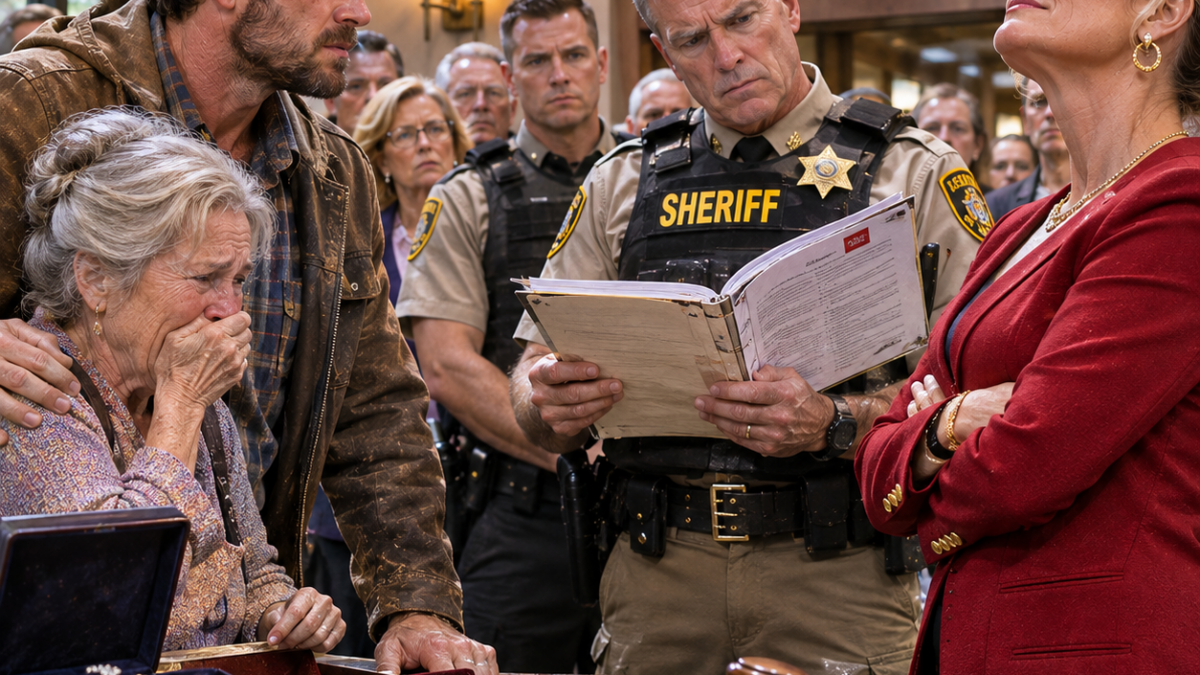
PART3:
No police cruiser.
Mabel opened the door before he reached it.
She wore gray slacks and a pale cardigan.
Her hair was pinned neatly.
She looked composed.
Too composed.
“What happened?”
“Come with me.”
She led him down the hallway to her bedroom.
On the dresser sat a walnut jewelry box Walter had given her decades earlier.
The lid was open.
Porter looked inside.
Empty velvet.
Not completely empty.
A small pearl earring had been left in one corner.
Everything else—
Gone.
He turned.
“What was in here?”
Mabel sat on the edge of the bed.
“Twelve pieces.”
“Which pieces?”
“My wedding rings.”
His jaw tightened.
“Dad’s watch?”
She nodded.
“The pocket watch from Grandpa?”
“Yes.”
“The sapphire necklace?”
Another nod.
Porter stared at the empty box.
That necklace mattered.
Walter had given it to Mabel on their twenty-fifth wedding anniversary.
Not because they had been wealthy.
They hadn’t.
Walter had saved for almost a year.
Years later, when the clasp wore loose, Mabel—who had spent most of her working life repairing watches—fixed it herself under a magnifier.
She filed one tiny notch in the clasp so she could identify the repair.
Porter had watched her do it.
“Did somebody break in?”
“No.”
“Who took them?”
Mabel pointed toward the kitchen.
There was an envelope on the table.
Briar Glen Estates Homeowners Association.
Porter opened it.
FINAL COLLECTION NOTICE.
His mother allegedly owed:
Maintenance assessments.
Violation penalties.
Administrative surcharges.
Processing fees.
Records fees.
Access fees.
Total:
$11,640.
He read the number again.
“What is this?”
“I don’t know.”
“You owe them eleven thousand dollars?”
“No.”
“You sure?”
Mabel gave him the look mothers reserve for sons who have just asked a stupid question.
She reached for a folder.
Inside:
Bank receipts.
Canceled checks.
Electronic payment confirmations.
Every legitimate charge Briar Glen had sent her.
Paid.
Stamped.
Organized by year.
Mabel had been a watchmaker.
Precision was religion.
Porter looked back at the HOA letter.
Near the bottom:
PERSONAL PROPERTY RECOVERY ACTION COMPLETED.
“What the hell is personal property recovery?”
Mabel folded her hands.
“They came Tuesday.”
Porter looked up.
“Who?”
“Two men.”
“Inside your house?”
“Yes.”
“How?”
“They said they were with the HOA.”
“You let them in?”
“They had paperwork.”
“What paperwork?”
“They said I had failed to comply with a financial inspection.”
“Mom.”
“I thought it was something about road contributions.”
“What did they do?”
“They asked me to sit in the kitchen.”
Porter felt cold.
“They went into your bedroom?”
“Yes.”
“And took jewelry?”
Mabel nodded.
“They said it would be inventoried until the fees were resolved.”
“Did you sign anything?”
“No.”
“Did they show a court order?”
“I don’t know what one looks like.”
Porter shut his eyes.
Then opened them.
“Did they have police?”
“No.”
“Sheriff?”
“No.”
“Court officer?”
“No.”
“Just HOA people?”
“Yes.”
He picked up the letter again.
No court case number.
No judgment.
No writ.
No sheriff’s levy.
Nothing.
Just HOA letterhead.
Porter knew enough to know this wasn’t normal debt collection.
HOAs might have lawful remedies depending on covenants and state law.
Liens.
Collection suits.
Maybe foreclosure in certain circumstances.
But walking into an elderly woman’s bedroom and carrying off wedding jewelry because a board claimed she owed fees?
That smelled like theft wearing office clothes.
“Get your coat.”
“Where are we going?”
“HOA office.”
Briar Glen’s administration office sat beside the clubhouse.
Glass doors.
Stone facade.
Perfect shrubs.
Cynthia Braddock received them in a conference room with two security guards posted outside.
Fifty-four.
Dark hair.
Tailored cream jacket.
Gold earrings.
She had been HOA president almost six years.
She sat at the head of the table as though holding court.
“Mrs. Huxley.”
Mabel sat beside Porter.
Cynthia looked at him.
“And you are?”
“Porter Huxley. Her son.”
“I’m afraid this is an account matter.”
“I’m afraid you took my mother’s jewelry.”
Cynthia smiled faintly.
“We recovered assets.”
“From her bedroom.”
“Under association policy.”
“Show me.”
Cynthia opened a binder.
Removed a photocopy.
PERSONAL PROPERTY RECOVERY PROCEDURE.
Internal policy.
Board approval notation.
No court reference.
No Mabel signature.
No acknowledgement.
Porter read it.
“This isn’t legal authority.”
“It is an association policy.”
“That isn’t what I said.”
“Your mother has unpaid obligations.”
“She has receipts.”
“Receipts don’t necessarily reflect penalties.”
“Show us the violations.”
Cynthia slid over an account statement.
Porter read.
$2,400 — failure to cooperate with property inspection.
$3,900 — access recovery assessment.
$1,840 — records management costs.
Several smaller penalties.
Almost all posted on one day.
“What inspection?”
Cynthia looked at Mabel.
“She failed to provide timely access.”
Mabel whispered:
“Nobody asked me.”
Cynthia ignored her.
Porter asked:
“Where are the notices?”
“In the file.”
“Show me.”
“This is not a discovery proceeding, Mr. Huxley.”
“Where is my mother’s jewelry?”
“Transferred.”
“To where?”
“Baird Auction Group.”
Mabel looked up sharply.
“Auction?”
Cynthia turned toward her.
“The assets will be liquidated Saturday to satisfy the outstanding balance.”
Mabel’s face changed.
“My necklace?”
“Yes.”
“My husband gave me that.”
Cynthia gave a short laugh.
“Sentimental value doesn’t pay HOA fees, Mrs. Huxley.”
Porter stopped moving.
The guards outside shifted.
Mabel lowered her eyes.
That was the moment the dispute changed for Porter.
Before that, he wanted the jewelry back.
After that, he wanted every document Cynthia had ever touched examined under a light.
He leaned forward.
“Give me the legal instrument authorizing you to seize personal property.”
“I’ve given you the policy.”
“Court judgment.”
“Not required under our process.”
“Sheriff’s levy.”
“Not required.”
“Signed consent.”
Cynthia slid another sheet toward him.
Porter looked at it.
It purported to authorize recovery and liquidation of personal property.
Signature:
MABEL HUXLEY.
Porter stared.
Then looked at his mother.
“Is that yours?”
Mabel leaned close.
“No.”
Cynthia sat back.
“Mrs. Huxley, please be careful about making accusations.”
Mabel looked at the page.
“My handwriting doesn’t look like that.”
Porter photographed everything.
Cynthia’s eyes narrowed.
“You cannot photograph association records without authorization.”
“Too late.”
“Security can remove you.”
Porter stood.
“We’re leaving.”
Cynthia smiled.
“Good.”
Then added:
“If you interfere with Saturday’s auction, you will be barred from the property.”
Porter helped his mother stand.
At the door, he turned.
“What time?”
“Ten.”
“We’ll be there.”
In the parking lot, Porter called the Rutherford County Sheriff’s Office.
Not the HOA.
Not Facebook.
Not a neighborhood group.
Law enforcement.
He reported suspected theft of his mother’s property.
That night, Mabel and Porter sat at the kitchen table.
They built an inventory.
Twelve pieces.
Descriptions.
Photographs.
Appraisals.
Serial numbers where available.
Identifying marks.
Mabel’s wedding band.
Walter’s gold ring.
Her father’s Hamilton pocket watch.
Two gold bracelets.
A ruby brooch.
A pair of pearl earrings.
Three small rings.
A diamond pendant.
And the sapphire necklace.
Near midnight, Porter opened Baird Auction Group’s online catalog.
The first section read:
BRIAR GLEN DELINQUENCY RECOVERY SALE.
He stopped breathing.
Lot 1.
Sapphire and diamond necklace.
Starting bid:
$800.
Photograph.
His mother’s necklace.
He enlarged it.
Clasp partly visible.
Then noticed the walnut box included in the lot photos.
On one corner:
A red sticker.
H18.
“What does H18 mean?”
Mabel leaned closer.
“I don’t know.”
Neither did Porter.
Then his phone buzzed.
Message from HOA administration:
WITHDRAW YOUR POLICE COMPLAINT BY 9:00 A.M. SATURDAY OR ALL PROPERTY WILL BE SOLD AS SCHEDULED.
Porter took a screenshot.
Then another.
Friday morning, he was at Mabel’s bank when the doors opened.
The teller printed years of payment history.
Everything matched her receipts.
He laid the HOA’s new charges beside them.
All manufactured in one burst.
No prior inspection notices.
No hearing correspondence.
No documented appeal opportunity.
No vendor invoice supporting “records management.”
The amount looked less like debt and more like a target someone had reverse-engineered.
By 10:15, Porter sat across from Harlan Whitaker.
Sixty.
Quiet.
Real-estate and property attorney.
Thirty years in practice.
Harlan read everything.
Then said:
“Do not confront anyone again.”
“Why?”
“Because if this is what it looks like, the stupidest thing we could do is warn them how much we know.”
“They’re auctioning it tomorrow.”
“I know.”
Harlan sent formal notices to:
HOA.
Baird Auction Group.
Cynthia’s counsel.
Disputed ownership.
Demand to halt sale.
Preservation of property.
Preservation of records.
Notice of criminal report.
Cynthia replied within an hour.
Her email stated the association had broad authority to interpret its governing rules.
And then:
If Mrs. Huxley wishes to retain sentimental property, she may register as a bidder and purchase it.
Porter read that twice.
“She wants my mother to buy her own necklace.”
Harlan said:
“Yes.”
Porter stared.
Harlan added:
“Don’t give her the reaction she wants.”
That afternoon, Porter drove to Baird Auction Group.
Franklin Baird met him in a small office lined with framed auction posters.
Forty-nine.
Polished.
Professional.
Cautious.
Porter explained.
Franklin opened the consignment file.
Inventory.
Certificate of seizure.
Release authorization.
Mabel’s supposed signature.
Porter looked closely.
His mother wrote like a machinist measured steel.
Small letters.
Upright.
Consistent.
The signature on the release leaned dramatically to the right.
Loops.
Flourishes.
Nothing like hers.
And the form itself displayed a print timestamp from two days earlier.
“How could she sign this months ago if it was printed Tuesday?”
Franklin’s face changed.
Only slightly.
“I can’t discuss client documents.”
“You showed it to me.”
“I’ve shown enough.”
“Where’s the original?”
“You need to speak to the HOA.”
“Your company is selling stolen property tomorrow.”
Franklin closed the file.
“Mr. Huxley, you need to leave.”
Porter stood.
“You received Harlan Whitaker’s notice.”
“Yes.”
“So you know ownership is disputed.”
Franklin said nothing.
“Tomorrow you won’t be able to say nobody warned you.”
At Briar Glen, security guards now stood at the clubhouse.
Porter’s name had been placed on a barred-entry list.
He called Deputy Eliza Danvers.
Thirty-six.
Assigned investigator.
Her specialty:
Electronic evidence.
Property records.
Financial files.
“Send me everything.”
He did.
Then mentioned the red H18 sticker.
Eliza went quiet.
“What?”
“Nothing yet.”
“What does it mean?”
“I don’t know.”
“Then why’d you stop talking?”
“Because the documents the HOA sent us don’t mention H18.”
Porter straightened.
“Can you get a clearer picture?”
“I’ll send it.”
Saturday morning arrived.
At 8:47, Cynthia posted a video to the Briar Glen resident portal.
She stood beside the clubhouse fireplace.
Behind her:
COMMUNITY RECOVERY AUCTION.
She told residents the association would no longer tolerate owners refusing to meet financial obligations.
Mabel watched from her kitchen.
Then shut off the tablet.
She went to the bedroom.
Put on her church coat.
Picked up her folder.
Porter said:
“Mom.”
“I’m going.”
“They barred me.”
“They didn’t bar me.”
“Security may stop you.”
“Then they can stop a seventy-six-year-old woman carrying receipts.”
Porter almost smiled.
Almost.
They drove together.
The auction had already begun seating buyers.
Around eighty people.
Residents.
Collectors.
Estate dealers.
Online bidders.
Coffee station.
White tablecloths.
A raised platform.
Mabel’s sapphire necklace glittered under professional lighting.
She stopped.
Porter felt her arm tighten.
“That’s it.”
“I know.”
“Walter chose that color because he said it matched my eyes.”
Porter looked at her.
“We’re getting it back.”
“You don’t know that.”
“No.”
He swallowed.
“But we’re not leaving.”
The guards saw him.
One stepped forward.
Then saw Mabel.
Her coat.
Her trembling hands.
The folder.
They hesitated.
Mabel walked between them.
Porter followed.
Franklin Baird stood on stage.
Cynthia sat in the first row.
He introduced Lot One.
“Fine sapphire—”
Mabel stood.
“My name is Mabel Huxley.”
Heads turned.
Franklin stopped.
“That necklace belongs to me.”
Cynthia rose instantly.
“Mrs. Huxley—”
“I did not authorize its sale.”
Whispers.
Cynthia reached the microphone.
“This owner is attempting to disrupt a lawful collection.”
Mabel held up her receipts.
“I paid everything I was billed.”
Cynthia held up the $11,640 account statement.
“These records say otherwise.”
Mabel answered:
“Those charges appeared after I paid.”
Cynthia signaled security.
“Remove her.”
The guards approached.
Porter stepped between them.
No shove.
No threat.
He looked at both men.
“You can argue money.”
Then pointed toward Mabel.
“You don’t get to humiliate my mother.”
Neither guard moved.
Porter looked at Franklin.
“You received formal notice yesterday that this property is disputed.”
Franklin said:
“I’m aware.”
“Sheriff’s office has an open report.”
“I’m aware.”
“Then don’t sell it.”
Cynthia shouted:
“Proceed.”
Franklin looked at her.
Then at Mabel.
Then at the audience.
For a long moment, Porter thought he would stop.
Instead:
“Opening at eight hundred.”
Porter felt sick.
Bids rose.
$1,200.
$2,500.
$4,000.
Online bidder.
$6,300.
$8,000.
Then:
$9,400.
Anonymous online account.
Franklin paused.
“Sold.”
Gavel.
Mabel didn’t cry.
That made it worse.
An assistant lifted the necklace from the display.
Placed it on a tray marked COMPLETED.
Porter saw several people clap politely.
His mother watched strangers applaud the sale of Walter’s gift.
Franklin moved to Lot Two.
Mabel’s rings.
Then the clubhouse doors opened.
Sheriff Amos Carney entered.
Gray hair at the temples.
Fifty-seven.
Deputy Eliza Danvers beside him.
Two additional deputies followed.
Amos didn’t storm the stage.
Didn’t shout.
He walked calmly down the aisle.
“Mr. Baird.”
Franklin stopped.
“Yes, Sheriff?”
“Pause the sale.”
Cynthia stood.
“You have no authority to interfere with association financial proceedings.”
Amos looked at her.
“I’m verifying property connected to an active theft complaint.”
“This is civil.”
“Maybe.”
He looked at Franklin.
“No property leaves this room until we verify ownership.”
Cynthia held up her policy packet.
Amos took it.
Read.
“Court order?”
“Not required.”
“Judgment?”
“Our policy—”
“Sheriff’s levy?”
“No.”
“Signed owner consent?”
Cynthia pointed toward the release form.
Amos looked.
Then at Mabel.
“Mrs. Huxley, did you sign this?”
“No.”
Cynthia said:
“She’s confused.”
Mabel looked at her.
“I repaired watches under a magnifying glass for forty-three years. I know my own signature.”
That quieted the room.
Amos instructed Franklin to preserve every item.
Franklin nodded.
He looked pale now.
Then Amos noticed the walnut jewelry box.
He turned it.
Saw the red sticker.
H18.
His thumb paused.
“Eliza.”
She came over.
He pointed.
“H18.”
She looked toward the registration table.
There, beneath a clipboard, was a stack of delivery receipts.
Eliza picked them up.
H1.
H2.
H3.
H4.
Sequential.
All the way through H18.
Amos looked at a young auction assistant.
“Where are the other boxes?”
The young man’s eyes flicked toward the door behind the stage.
Tiny movement.
Enough.
Franklin stepped forward.
“Sheriff, those are internal inventory numbers.”
Amos looked at him.
“I asked where the boxes are.”
Cynthia said:
“This is absurd.”
Eliza pulled another paper.
Shipping manifest.
Eighteen residential addresses.
Amos looked slowly toward Cynthia.
“Mrs. Braddock.”
She said nothing.
“How many homes did your association remove property from?”
Silence.
Every person in the clubhouse was now watching her.
The auction never resumed.
The sheriff’s office documented everything currently displayed.
Won lots were frozen.
Online buyers were notified the goods would not be released.
Cynthia leaned toward Franklin twice.
Porter couldn’t hear the first comment.
He heard the second.
“Take the catalog offline.”
Franklin stared at her.
“No.”
“Now.”
“The sheriff is standing right there.”
That was the first time Porter saw fear replace Cynthia’s confidence.
By late afternoon, investigators had enough preliminary evidence to seek judicial authorization for a broader search.
The storage room behind the stage was opened under warrant.
Inside a locked steel cabinet:
Eighteen boxes.
Red labels.
H1 through H18.
Mabel:
H18.
The other seventeen matched addresses on the manifest.
Inside:
Wedding rings.
Military medals.
Pocket watches.
Coin collections.
Brooches.
Bracelets.
Family jewelry.
Silver.
Keepsakes.
One box contained a Purple Heart and three letters tied with faded ribbon.
Another held a wedding set still in its original 1960s box.
The total emotional value couldn’t be calculated.
The paperwork tried anyway.
Appraisals.
Estimated auction values.
Potential recovery.
Every file contained an alleged HOA debt.
A man billed $4,200 for roof repairs to a roof never repaired.
A widow fined $6,700 for landscaping violations with no inspection.
A retired teacher charged thousands for “administrative noncompliance.”
An elderly veteran assessed a “security restoration fee.”
The pattern was too similar.
Deputies began contacting owners.
Some thought they’d been burglarized.
Others knew the HOA had removed items but were afraid to fight.
Clara Bledsoe was seventy-two.
She sat at her dining table while Eliza recorded her statement.
Months earlier, two men wearing shirts marked BRIAR GLEN COMMUNITY SAFETY had arrived.
They told her the HOA was conducting an emergency property inventory.
Clara lived alone.
She had participated in a neighborhood program that allowed designated personnel to enter during emergencies.
So she let them in.
Afterward:
Wedding rings gone.
Late husband’s gold watch gone.
She called Cynthia.
Cynthia said the items had been placed in secured storage against unpaid violations.
Clara called every week.
Nothing returned.
Then investigators noticed something darker.
The targets weren’t random.
All eighteen lived alone or spent long periods away.
Several were elderly.
Several rarely attended HOA meetings.
Some didn’t use the online resident portal.
One had been hospitalized when her first certified notice was delivered.
The HOA marked her:
FAILED TO RESPOND.
Another had been traveling for his brother’s funeral.
FAILED TO RESPOND.
Another had no email.
FAILED TO RESPOND.
Then warnings followed.
Making false accusations against the association may result in recovery of legal costs.
Silence had been engineered.
Eliza wrote in her working notes:
This is not an accidental collection error.
It is a selection process.
The consent forms were worse.
Eighteen.
Different names.
Supposed signatures.
Same notary stamp.
Same commission number.
Same stamp placement.
Identical ink pressure.
Investigators found the notary.
Retired.
Commission surrendered months before the documents were supposedly signed.
Forgery entered the case.
Then Eliza found a spreadsheet behind the final storage box.
Eighteen collections.
Estimated value:
More than $480,000.
Beside many high-value items:
PRIVATE BUYER.
Two nights later, Porter received a call.
“Mr. Huxley?”
“Yes.”
“My name is Etta Mulroney.”
He recognized the surname.
Former HOA accountant.
“I need to talk.”
“About my mother?”
“About all of them.”
“Tell me.”
“Not on the phone.”
Porter called Harlan.
They arranged the meeting at Harlan’s office.
Etta was sixty-one.
Small woman.
Nervous hands.
She brought no stolen documents.
Just her own notes and memory.
Three months earlier, Cynthia ordered her to enter unusual charges on selected accounts.
“Processing fees.”
“Compliance fees.”
“Special access costs.”
Etta asked for board minutes.
None.
Invoices.
None.
Contracts.
None.
Cynthia told her:
“Presidential directive.”
Etta refused.
Soon afterward, her system access disappeared.
Then she was fired.
But that wasn’t the worst part.
Years earlier, Briar Glen had created a voluntary Emergency Property Assistance Program.
Reasonable idea.
Residents living alone could authorize a designated contact to enter during:
Burst pipes.
Falls.
Medical emergencies.
Storm damage.
The enrollment list included:
Who lived alone.
Who traveled often.
Who had mobility issues.
And consent signatures authorizing narrowly defined emergency entry.
Etta looked at Porter.
“Cynthia used the list.”
“As what?”
Her eyes filled.
“A catalog.”
The original signatures were copied.
Placed onto different forms.
Forms supposedly authorizing HOA seizure of personal belongings for unpaid fees.
Contractors then entered homes under the guise of “owner-approved inventory.”
Porter felt sick.
He did not ask Etta for copies.
Did not tell her to send anything.
He called Eliza.
Harlan arranged the interview.
Sheriff Amos Carney and District Attorney Bridget Norwood joined.
From that point forward, Etta dealt directly with investigators.
Warrants followed.
HOA accounting system.
Bank statements.
Gate-entry records.
Email.
Contracts.
The timeline became visible.
Debts appeared shortly before property was removed.
Not months earlier.
Not after a lengthy collection process.
Just in time.
Justification first.
Theft second.
Cynthia felt pressure.
So she called an emergency HOA meeting.
Porter attended.
Mabel did too.
Cynthia stood in a navy suit and told residents:
“One angry family is attempting to destroy this association.”
Some nodded.
She said:
“Mrs. Huxley owed legitimate charges.”
Mabel did not shout.
She simply walked out after the meeting.
Then visited Clara Bledsoe the next afternoon.
Two old women sat at a kitchen table.
Coffee between them.
Mabel told Clara about Walter.
The necklace.
The auction.
The strangers applauding.
Then said:
“I was embarrassed.”
Clara looked down.
“So was I.”
Mabel reached across the table.
“The shame isn’t ours.”
That sentence did what Porter’s anger couldn’t.
Clara called Eliza.
Then another victim came forward.
Then another.
Within days, all seventeen other families were cooperating.
Mabel told Porter:
“I don’t want revenge.”
“What do you want?”
“My necklace.”
“I know.”
“And I want everyone else to get their memories back too.”
Eliza next examined auction history.
One buyer appeared repeatedly.
Not an individual name.
Hollow Crest Holdings.
It won many of the highest-value items.
Often below appraisal.
Porter had another discovery of his own.
While Harlan examined Mabel’s HOA obligations, Porter went to the county register of deeds.
Her parcel predated Briar Glen.
The subdivision had grown around it.
Recorded documents gave her road access.
But no covenant joinder.
No instrument making her property part of the HOA.
Her contributions toward road upkeep had been voluntary service payments.
Not HOA assessments.
Harlan pulled the original plat.
Then the version in Briar Glen’s management system.
Different.
Someone had digitally included Mabel’s parcel inside the HOA boundary.
Added a note:
OWNER AGREED TO FULL ASSOCIATION GOVERNANCE.
No recorded agreement supported it.
Porter attended the next open meeting.
Certified county records in hand.
Cynthia saw him.
“Not again.”
Porter stood.
“My mother’s house isn’t in your HOA.”
Laughter from a few Cynthia supporters.
Then Porter placed the plat on the projector.
Original county record.
Mabel parcel outside the covenant boundary.
Cynthia snapped:
“She receives community services.”
“That’s not membership.”
“She uses our road.”
“Recorded easement.”
“She pays fees.”
“Voluntary maintenance contributions.”
Cynthia’s jaw tightened.
Porter asked:
“Where is her signed joinder?”
No answer.
“Where is the recorded amendment?”
Nothing.
Then he asked the question that changed the mood:
“If someone altered the HOA map to add one property you don’t control, how many other people have been paying fines under rules that don’t apply to them?”
The room erupted.
Cynthia produced an old board resolution.
It allegedly expanded HOA authority over adjacent parcels.
A board member named Gerald Whitcomb leaned closer.
Seventy.
Retired civil engineer.
Quiet man.
He read the vote count.
Then looked at Cynthia.
“I was at this meeting.”
She ignored him.
Gerald continued.
“This says I voted yes.”
Cynthia said:
“According to the minutes.”
“No.”
He stood.
“I voted against this exact proposal.”
The room quieted.
Gerald looked at other longtime owners.
“And this document wasn’t part of the final minutes.”
Cynthia accused Porter of creating confusion.
Gerald replied:
“No. He brought a certified record.”
He called for an independent audit.
For the first time in almost six years, Cynthia told the room to settle down—
And nobody did.
Eliza meanwhile traced Hollow Crest Holdings.
Registered agent unrelated.
Mailing address:
A suite previously used by one of Cynthia’s consulting firms.
Bank subpoenas followed.
Auction proceeds Cynthia claimed were entering HOA accounts—
Often didn’t.
Some money moved through outside business accounts.
Hollow Crest repeatedly purchased high-value lots.
Then transferred property to a commercial storage facility two towns away.
Its financial manager was Cynthia’s longtime business associate.
Shared loans.
Transfers.
Business connections.
Several stolen pieces had already been photographed for private resale.
At the sheriff’s office, Amos and Eliza built the sequence on a whiteboard.
- Create fake debt.
- Generate false consent.
- Enter home.
- Remove property.
- Deliver to auction house.
- Auction creates apparently legitimate transaction record.
- Hollow Crest buys best pieces cheaply.
- Property moves toward private resale.
The auction wasn’t merely disposal.
It was laundering.
The independent HOA audit revealed motive.
Reserve fund shortage:
Approximately $318,000.
Money had flowed into overpriced renovation and maintenance contracts linked to businesses connected to Cynthia.
Annual audit approaching.
Cynthia needed money.
And explanations.
Fake delinquency collections gave her both.
A reason reserve accounts should be receiving money.
And actual valuables that could be sold elsewhere.
Mabel was never one isolated target.
She was number eighteen.
Franklin Baird came back for another interview.
He insisted:
“I relied on HOA documentation.”
Eliza placed an email before him.
From a previous homeowner.
Months earlier.
I NEVER AUTHORIZED SALE OF MY PROPERTY.
Franklin had sold that lot anyway.
Another warning followed later.
Another disputed owner.
Sale still happened.
His defense weakened.
Then investigators found Cynthia’s message:
Do not use owner names in public catalog. Use property codes only.
Another:
High-value lots go to pre-registered buyer regardless of room interest.
Franklin stopped talking.
His lawyer took over.
Then Franklin began cooperating.
Cynthia tried another strategy.
Blame Etta.
HOA counsel sent Etta a letter demanding she accept responsibility for the eighteen recovery files.
Impossible.
Every one had been created after her termination.
Then Cynthia sent a notice to all Briar Glen households suggesting serious misconduct by “former accounting personnel.”
No name.
Everyone knew.
Porter drove to Etta’s house.
“Don’t answer online.”
“She’s blaming me.”
“I know.”
“She’ll make them believe her.”
“Then don’t fight on her ground.”
Etta stared at him.
Then said:
“I have something.”
“What?”
“A backup.”
Every Friday, Etta had performed a routine accounting database backup.
Her final one was stored on an external archive drive.
She had never opened it after being fired.
She was afraid.
Eliza took it into evidence.
Digital comparison began.
The live HOA server showed certain entries associated with Etta’s old account.
The backup showed the history.
All eighteen special fee files were created after Etta was gone.
Sessions logged under a senior administrative account.
That account belonged to:
Cynthia Braddock.
Worse:
In the three weeks before the investigation intensified, someone using Cynthia’s credentials had attempted to reassign transaction history to Etta’s deactivated profile.
Then deleted records connecting Cynthia to original entries.
On the live system, the edits nearly worked.
On Etta’s untouched backup, nothing vanished.
Dates.
Device identifiers.
Original user.
Edit history.
All preserved.
And the records showed several fake debts had been altered only after the corresponding jewelry had already arrived at Baird Auction.
That destroyed any claim of innocent bookkeeping error.
The debt was rewritten to justify the theft after the theft had already occurred.
The case crossed a line.
Bridget Norwood spent the weekend with investigators preparing warrants.
Monday morning, Amos called Porter.
“We located the storage site.”
Porter stood in his shop.
“Most of it?”
“A lot.”
“The necklace?”
“Never left Baird.”
Porter closed his eyes.
“Can Mom get it?”
“Not yet.”
“Evidence.”
“Yes.”
“She’ll understand.”
That evening, Briar Glen held Cynthia’s special meeting.
Every chair filled.
Residents stood along walls.
Cynthia wore white.
She stepped behind the podium.
“The association is under attack.”
Porter sat beside Mabel.
Clara Bledsoe on Mabel’s other side.
Cynthia continued:
“What began as an ordinary collection dispute has been distorted into accusations of criminal misconduct.”
Some supporters applauded.
She announced that internal review had identified accounting irregularities.
Implied a former employee was responsible.
Then opened questions.
Porter stood.
He didn’t give a speech.
“Who gave you the right to sell my mother’s sapphire necklace?”
Cynthia smiled.
“Mr. Huxley, owners have obligations—”
“Who gave you the right?”
“Your mother accumulated debt.”
“Then why were seventeen other homes missing jewelry too?”
The room shifted.
Cynthia froze.
Clara stood.
“My wedding rings were taken.”
Another man near the wall rose.
“My father’s medals.”
A woman behind him:
“My mother’s bracelet.”
Another:
“My coin collection.”
Then another.
The silence Cynthia had relied upon for months shattered.
The clubhouse doors opened.
Sheriff Amos Carney walked in.
Eliza beside him.
Two deputies behind.
He stopped at the front.
“Mrs. Braddock.”
Cynthia gripped the podium.
“What is this?”
“I need you to step away.”
“This is a private association meeting.”
“We have a warrant.”
Her face changed.
“For what?”
Amos told her.
Charges relating to theft.
Fraud.
Forgery.
Property scheme.
Cynthia stared at the room.
Then at Porter.
“This is because of him.”
Nobody answered.
“You are allowing one family to destroy this community.”
Mabel stood.
Cynthia looked at her.
For the first time, the two women faced one another without a desk, microphone, or binder between them.
Eliza stepped forward.
“Mrs. Braddock, turn around please.”
Cynthia refused.
Amos repeated the instruction.
She finally stepped away from the podium.
Eliza placed her in handcuffs.
By the book.
No drama.
No cheering.
As Cynthia passed Mabel, she stopped.
“All this over one necklace.”
Mabel looked directly at her.
“No.”
Her voice was soft.
“It was never just a necklace.”
Cynthia stared.
Mabel continued:
“You took what people trusted you to protect.”
Cynthia had no answer.
Porter did not celebrate.
He stood beside his mother.
Watched Cynthia leave through the same clubhouse doors where she’d once ordered guards to keep him out.
Before midnight, Briar Glen’s remaining board members suspended her authority.
Independent forensic audit authorized.
Records preserved.
Accounts reviewed.
Residents demanded answers.
Late that night, Amos visited Mabel’s house.
“They found the Hollow Crest storage unit.”
Porter leaned forward.
“And?”
“Many items still boxed.”
Mabel asked:
“Mine?”
“Most of yours never left Baird.”
He explained that some pieces had been transferred elsewhere and would require tracing.
Then Eliza sent an approved evidence photo.
Box:
H18.
Inside:
Sapphire necklace.
Porter zoomed.
Clasp.
Tiny filed notch.
He handed the phone to Mabel.
Her thumb touched the screen.
“There.”
“What?”
“My mark.”
She smiled.
Then cried for the first time.
The investigation lasted months.
Authorities ultimately identified eighteen owners targeted in the property-recovery operation.
Appraised value:
More than $480,000.
Most recovered.
Some still traced through dealers.
The reserve-fund shortfall was connected to other questionable transactions under investigation.
At trial, prosecutors didn’t rely on outrage.
They relied on records.
Victim statements.
Ownership photographs.
Serial numbers.
Bank statements.
Notary records.
Emails.
Auction data.
Hollow Crest transfers.
HOA server logs.
Etta’s backup.
Etta testified.
She walked the jury through timestamps.
Showed how the false fees appeared.
Showed how transaction history was later altered.
Franklin Baird faced separate consequences for continuing sales despite ownership warnings.
His cooperation helped investigators recover property.
It did not erase what he had done.
Cynthia was convicted on multiple theft and fraud counts.
The court imposed a lengthy prison sentence, restitution, and asset forfeiture tied to the crimes.
Fake assessments against Mabel and other victims were voided.
The community removed Cynthia permanently.
A new board took over.
Independent auditing.
Dual authorization for significant transfers.
Stricter vendor review.
Protected financial records.
The Emergency Property Assistance Program was suspended until redesigned.
Residents’ personal information could no longer be treated like an HOA president’s private database.
And the map?
Corrected.
Mabel’s parcel was formally removed from the HOA’s internal governance map.
No more invented authority.
Spring came gray and cool.
One morning, the sheriff’s property office called Mabel.
Porter drove her.
She wore the same church coat she had worn to the auction.
They sat at a metal table.
A property clerk brought out verified items.
Mabel’s gold rings.
Walter’s ring.
Her father’s antique pocket watch.
She picked it up.
Wound it.
Tick.
Tick.
Tick.
Mabel smiled.
Then the sapphire necklace.
She held it in both hands.
Turned the clasp.
Found the tiny filed notch.
Same as ever.
Porter asked:
“Want me to put it on?”
She nodded.
He stepped behind her.
Fastened the necklace.
There was a small mirror on the wall.
Mabel looked at herself.
No reporters.
No clubhouse audience.
No auctioneer.
No applause.
Just an old woman getting back something nobody had ever possessed the right to take.
A few weeks later, the eighteen families gathered at the county library.
Not a celebration exactly.
A recovery meeting.
Clara Bledsoe received her wedding rings.
She slid them onto her finger immediately.
Her husband’s watch came back too.
A veteran received his father’s medals.
Another family got part of a coin collection.
Some victims were still missing items.
Compensation claims continued.
But now nobody wondered whether they had imagined what happened.
Mabel thanked Amos.
He shook his head.
“You made the report.”
She looked at Porter.
“He did.”
Amos smiled.
“He refused to let it disappear.”
Porter said:
“You found the boxes.”
Amos shrugged.
“I noticed a sticker.”
H18.
Tiny red square.
The detail that opened seventeen other files.
That summer, Porter sat with Mabel on her porch.
The sapphire necklace rested at her collarbone.
Down the lane, the Briar Glen clubhouse was preparing chairs for its first fully open board meeting under new leadership.
Porter asked:
“What was the worst part?”
Mabel thought.
“The auction.”
He nodded.
Then she shook her head.
“No.”
“What?”
“The worst part was thinking maybe nobody would believe me.”
Porter looked at her.
“You had receipts.”
“That doesn’t mean people listen.”
She touched the necklace.
“Watching strangers bid on Walter’s gift hurt.”
Her voice softened.
“But what hurt more was someone trusted to look after a neighborhood using that trust to choose people she thought nobody would defend.”
Porter looked toward the clubhouse.
That was the real crime underneath everything.
Not jewelry.
Not fees.
Selection.
Cynthia had chosen people who lived alone.
People less likely to attend meetings.
People who might be intimidated by legal-looking letters.
People who might assume an HOA president knew the rules better than they did.
Then she turned their silence into evidence against them.
No response.
No objection.
No appeal.
Therefore guilt.
That mechanism had worked until Mabel called her son.
One phone call.
Not because Porter had special power.
He didn’t.
He was an industrial technician.
He fixed systems.
And once he looked at Cynthia’s system, he did what he always did with broken equipment.
He traced the failure backward.
Missing jewelry.
Fake debt.
False signature.
Auction.
Red sticker.
Seventeen boxes.
Forged consent.
Emergency-access list.
Shell buyer.
Reserve shortfall.
Digital edits.
Every gear connected.
Months later, people in Briar Glen would tell the story differently.
Some said Porter brought down the HOA president.
He didn’t.
Some said the sheriff saved everyone.
Closer.
Some said Mabel’s necklace exposed the whole thing.
Almost.
The truth was that Cynthia’s operation collapsed because too many small pieces of evidence finally met each other.
Mabel kept receipts.
Porter kept photographs.
Etta kept a backup.
Clara kept asking questions.
The notary kept her retirement record.
The bank kept transfers.
The auction server kept emails.
The computer kept timestamps.
Cynthia had controlled the meetings.
The letters.
The internal map.
The fees.
The board narrative.
But she never controlled every record.
That was her mistake.
The new HOA board eventually placed a notice in the clubhouse.
Not dramatic.
Just one paragraph:
NO ASSOCIATION OFFICER, EMPLOYEE, CONTRACTOR, OR BOARD MEMBER MAY REMOVE PERSONAL PROPERTY FROM A RESIDENCE AS A COLLECTION REMEDY WITHOUT LAWFUL PROCESS AND INDEPENDENT LEGAL REVIEW.
Porter read it once.
Then said:
“Feels like that shouldn’t need to be written.”
Mabel replied:
“Most rules exist because somebody proved they did.”
Fair.
The walnut jewelry box stayed in Mabel’s bedroom.
She removed the red H18 sticker.
Then changed her mind.
She placed it inside the lid instead.
Porter asked why.
“Reminder.”
“Of Cynthia?”
“No.”
“Of what?”
Mabel smiled.
“That small things matter.”
The filed notch.
The receipts.
The sticker.
The backup.
Small things.
Cynthia had believed scale protected her.
Big HOA.
Big clubhouse.
Formal policies.
Security guards.
Legal letters.
Auction company.
But the case did not break because somebody produced one giant confession.
It broke because a sheriff picked up an old woman’s jewelry box and asked a simple question:
Where are the other numbered boxes?
Years afterward, Porter still thought about the auction.
The bright lights.
The gavel.
The necklace held up like merchandise.
Mabel standing with receipts.
Cynthia smiling.
He remembered how powerless he felt when the gavel came down at $9,400.
For a few seconds, it looked as though authority belonged entirely to Cynthia.
She had the room.
The microphone.
The guards.
The policy.
The auctioneer.
Then the doors opened.
Not because Porter had won.
Because the evidence had finally arrived.
That distinction mattered.
Cynthia Braddock believed she was auctioning an old woman’s jewelry to cover an $11,640 debt she had manufactured on paper.
What she was really putting under the lights was her entire system.
The fake debts.
The false signatures.
The stolen heirlooms.
The seventeen silent victims.
The shell buyer.
The missing reserve money.
And eventually—
Her own freedom.
One summer evening, Mabel sat on the porch winding her father’s recovered pocket watch.
Tick.
Tick.
Tick.
Porter looked at the necklace.
“Still wear it often?”
“Every Sunday.”
“Afraid to?”
“Of what?”
“Losing it again.”
Mabel smiled.
“No.”
She closed the watch.
“Things can be stolen.”
She looked toward the clubhouse.
“Truth is harder.”
Porter laughed.
“That sounds like something Dad would’ve said.”
“No.”
Mabel adjusted the sapphire at her throat.
“Walter would’ve used fewer words.”
“What would he say?”
She thought.
Then smiled.
“Keep your receipts.”
Porter laughed so hard the neighbors probably heard him.
And somewhere beyond the trees, inside a clubhouse no longer controlled by Cynthia Braddock, eighteen families were finally being treated like homeowners instead of inventory.
The necklace had started the fight.
The red H18 sticker opened the door.
But it was the seventeen boxes behind that door that proved what had really happened.
Cynthia hadn’t built a collection system.
She had built a theft operation behind HOA letterhead.
And when Sheriff Amos Carney asked one quiet question about those numbered boxes, the entire thing finally came apart.








