HOA Guards Forced My 71-Year-Old Father Into Their SUV—Five Minutes Later, U.S. Marshals Boxed Them In
PART2:
The kind who had once driven ninety miles back to a hardware store because a cashier accidentally gave him twenty dollars too much change.
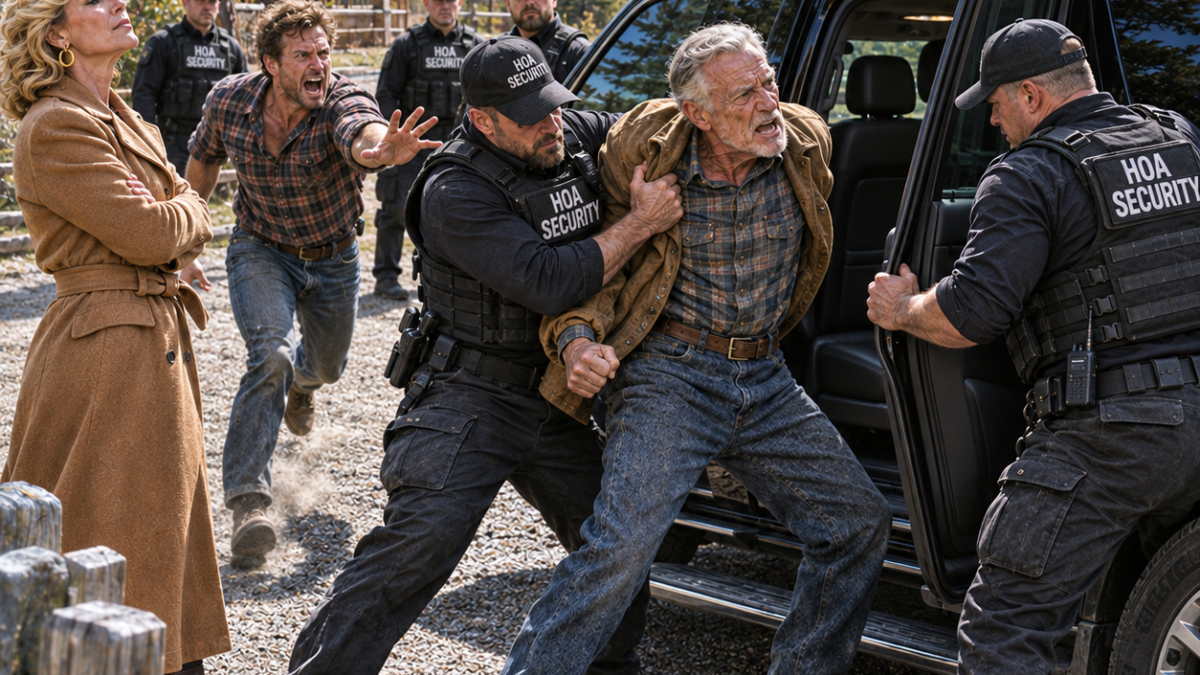
Now two men had him by the arms.
A third held the SUV door.
And Orson was not resisting.
He simply looked at Wesley.
Then at his watch.
Old steel watch.
Scratched face.
He had worn it for decades.
“Five minutes,” he said.
Wesley stared.
“What?”
Darlene laughed.
“You think someone is coming to save you in five minutes?”
Orson said nothing.
He looked at her once.
Then back at Wesley.
Five minutes.
The guards pushed him into the SUV.
Door slammed.
Locked.
Wesley reached for his phone.
Darlene smiled.
“Go ahead.”
She actually said it.
PART3:
As if she wanted him to call.
As if whatever authority she believed she held was finally about to be confirmed by someone real.
Wesley dialed 911.
“My father has just been forced into a private security vehicle on our property.”
The dispatcher asked for the address.
He gave it.
“Are they law enforcement?”
“No.”
“Do they have a warrant?”
“No. They have an HOA form.”
“What is your father’s age?”
“Seventy-one.”
“Is he injured?”
“I don’t know.”
“Do not follow the vehicle if they leave. Give me the plate.”
Wesley read it.
Then the SUV began moving.
Slowly at first.
Down the gravel road.
Darlene followed in her silver sedan.
Wesley’s chest tightened.
“Dad!”
No answer.
The black SUV reached the bend.
Wesley dialed a second number.
A number Orson had taped inside the kitchen cabinet only days earlier with one instruction:
If something happens before Tuesday morning, call this.
A woman answered on the second ring.
“This is Wesley Harrow. They took my father.”
Pause.
Then:
“Vehicle?”
He gave the description.
“Direction?”
“South gate.”
“Do not pursue.”
“Who is this?”
“Stay where you are, Mr. Harrow.”
“What’s happening?”
“Stay where you are.”
The line ended.
Wesley stood frozen.
One minute.
Then two.
The SUV moved toward the junction where the gravel road met the county highway.
Third minute.
Wesley could still see the dust.
Fourth minute.
Two vehicles appeared at the far end of the road.
No lights.
No sirens.
One dark sedan.
One black utility vehicle.
They moved with precision.
The first crossed the road sideways.
The second closed behind the SUV.
Brakes.
Dust.
Doors opened.
Men and women stepped out wearing body armor.
Large yellow letters across the front:
U.S. MARSHALS.
“Federal Marshals! Turn off the engine!”
Wesley stopped breathing.
Inside the SUV, Travis turned.
Darlene climbed out of her sedan.
She took three angry steps forward.
Then froze.
A deputy marshal raised one hand.
“Ma’am, stay where you are.”
She opened her mouth.
For once, nothing came out.
Exactly five minutes after Orson checked his watch, armed federal officers had surrounded the vehicle carrying him.
And that was only the beginning.
Twelve days earlier, none of this had seemed possible.
Life on the Harrow property had been quiet.
Wesley was thirty-nine.
Land surveyor.
Small business owner.
He lived with his father on twenty-seven acres of meadow and pine in the Colorado high country, outside the official boundary of Granite Hollow Estates.
The family had owned the property for decades.
Before the subdivision.
Before the clubhouse.
Before the ornamental entrance walls.
Before anybody had painted the words GRANITE HOLLOW COMMUNITY across a stone monument and begun acting as though the mountain belonged to a committee.
The Harrow property included a private gravel road winding from the county highway through their acreage.
When Granite Hollow was developed, the builder negotiated one limited easement.
Fire trucks.
Ambulances.
Emergency access only.
That was it.
The agreement did not transfer ownership.
Did not create public access.
Did not give the HOA control.
For years, everyone understood that.
Then Darlene Whitcomb became president.
She arrived at the Harrow house one afternoon carrying a leather folder.
Pleasant voice.
Professional smile.
“I just need a signature.”
Wesley should have known.
He was in the garage cleaning a survey prism when she approached.
“Signature for what?”
“Boundary confirmation.”
“What boundary?”
“Community safety map update.”
She said it casually.
Routine.
Administrative.
She followed Wesley into the kitchen.
Orson was sitting near the window reading.
Darlene placed the document on the table.
Wesley opened it.
He was a surveyor.
He read land descriptions for a living.
That probably saved them.
The first page looked harmless.
Updating access documentation.
Clarifying emergency routes.
Confirming historical use.
Then he reached the legal description.
The easement was wider.
Much wider.
The original emergency road was approximately sixteen feet across.
Darlene’s paper described a corridor almost sixty feet wide in sections.
Worse, the attached map shaded several acres as “Granite Hollow Controlled Access Property.”
Wesley looked up.
“This isn’t a boundary confirmation.”
Darlene smiled.
“It clarifies existing rights.”
“No.”
“The developer has used that corridor for years.”
“Emergency vehicles have.”
“Community access has evolved.”
“Property law doesn’t evolve because you say it does.”
Her smile thinned.
“Wesley.”
“No.”
He pushed the paper back.
“I’m not signing this.”
Darlene’s tone changed.
Not much.
Enough.
“Refusing may expose your family to liability.”
“For what?”
“Obstructing emergency access.”
“We have never blocked emergency access.”
“You installed a gate.”
“The gate is unlocked for fire department access.”
“Your interpretation.”
“The recorded easement.”
From the doorway, Orson said:
“Where did you get the map?”
Darlene turned.
Orson walked closer.
His eyes settled on the bottom right corner.
Survey reference code.
File number.
Date.
Something changed in his expression.
Wesley noticed.
“What?”
Orson did not answer him.
He asked Darlene again:
“Who prepared this?”
“Independent survey company.”
“Name?”
“It’s in the packet.”
Orson picked up the map.
His thumb rested on the reference code.
“You’re sure?”
“Yes.”
He gave it back.
Darlene tucked everything into her folder.
“You have forty-eight hours to reconsider.”
“There’s nothing to reconsider,” Wesley said.
She smiled again.
“I think there is.”
After she left, Wesley turned to his father.
“What was that?”
Orson looked through the window toward her car.
“That file number.”
“What about it?”
“I’ve seen it before.”
“Where?”
“County records.”
“When?”
“A long time ago.”
That answer frustrated Wesley.
Orson had worked for the county records division for thirty-four years.
Not glamorous.
But critical.
Recorded plats.
Easements.
Title references.
Property transfers.
Survey corrections.
Boundary adjustments.
He knew the county archive better than most attorneys.
He retired six years earlier.
Wesley said:
“You think the map is fake?”
“I think it is wrong.”
“Same thing?”
“No.”
Orson looked at him.
“Never call something fraud before you can prove the chain.”
Old records-office rule.
Wesley had heard it since childhood.
Three days later, Darlene held a special HOA meeting.
Granite Hollow had sixty-two homes.
She stood beneath a projector screen and announced that the Harrow family was obstructing a “critical community infrastructure expansion.”
She presented the disputed map as established fact.
Residents saw a broad highlighted corridor connecting the subdivision to the county road.
Darlene explained that Granite Hollow faced increasing traffic and emergency-access problems.
Then came the money.
Special assessment.
$5,000 per household.
Sixty-two homes.
Total:
$310,000.
Legal work.
Traffic studies.
Engineering.
Security.
Land-use consulting.
The vote passed.
Easily.
Most residents did not ask for contracts.
Why would they?
Their president told them the project protected property values.
The next week, neighbors began stopping at the Harrow gate.
Some polite.
Some not.
One man said:
“Why can’t you just cooperate?”
Wesley showed him the recorded plat.
The man barely looked.
Another woman accused them of endangering children by blocking an “evacuation route.”
“It’s not blocked.”
“Darlene says it is.”
“Darlene is wrong.”
“She has lawyers.”
“So do maps.”
The woman left angry.
That night, Orson opened the metal cabinet in his study.
He removed an old certified county extract.
Placed it beside Darlene’s map.
Original survey file:
1997-0418.
Original archived version:
Harrow ownership.
Limited emergency easement.
Darlene’s version:
Expanded corridor.
Additional control language.
Different legal description.
Wesley frowned.
“How does this happen?”
Orson pointed.
“Look at the code.”
One character had been altered.
Small enough to miss.
Then another.
Two pages appeared to have been substituted into a digital copy.
Wesley felt cold.
“Can someone just replace county records?”
“Not lawfully.”
“But can they?”
Orson gave him a look.
“Anything can be altered. The question is whether the history survives.”
“What history?”
“Submission logs. Stamps. Prior scans. Archived microfilm. Clerk notes. Metadata.”
He leaned back.
“Paper has ancestors.”
Wesley smiled despite himself.
“Only you would say that.”
“I spent thirty-four years with paper.”
They requested the archive.
Two versions existed.
That was when Orson finally told Wesley part of the truth.
Years earlier, before retirement, Orson had flagged an attempted boundary amendment involving the Harrow land.
It had been submitted by a firm connected to a mortgage company under investigation for inflated property valuations.
The amendment would have expanded access rights over the Harrow acreage.
Orson rejected it.
Procedurally incomplete.
No owner approval.
No lawful basis.
The mortgage company later collapsed during a federal fraud investigation.
Wesley stared.
“You never told me.”
“It was work.”
“It involved our land.”
“It went nowhere.”
“Apparently not.”
Orson was quiet.
Then:
“No.”
The old proposal had resurfaced.
Different wrapper.
Same underlying legal description.
Wesley hired Mallory Fitch.
Denver real-estate litigation attorney.
Known for reading every footnote.
Mallory reviewed both versions.
Then sat back.
“This is not normal.”
Wesley said:
“That’s comforting.”
“I didn’t say illegal yet.”
“My father would like you.”
She smiled.
“Your father is right.”
The public digital file contained substituted pages.
But no clean approval trail.
No owner authorization.
No valid recording entry supporting the expanded rights.
Then Mallory found something else.
A development transaction.
Granite Hollow had been negotiating with a luxury development company.
Not for a road.
For land rights.
The package included development control over acreage the HOA did not own.
Harrow acreage.
Draft deal value:
$12.6 million.
Wesley stared at the number.
“Twelve point six?”
Mallory nodded.
“And the buyer needs clean title.”
“Which Darlene doesn’t have.”
“Correct.”
“What happens if I sign her paper?”
Mallory slid the document across.
“You provide owner confirmation.”
Wesley felt sick.
His signature would not magically transfer all ownership.
But it could make the HOA’s title story far stronger.
Or at least expensive to unwind.
Orson tapped the map.
“She wanted you to validate the replacement record.”
Wesley looked at his father.
“If I had signed just to get her off our backs—”
“You didn’t.”
“But if I had?”
Orson’s expression softened.
“That is why people create pressure.”
Darlene had another personal reason.
Mallory uncovered a consulting agreement.
A company tied to Darlene would receive a success fee if the development deal closed.
Maximum fee:
$480,000.
Wesley read the number twice.
Granite Hollow homeowners had each paid $5,000 believing they were funding safety.
Meanwhile, Darlene had nearly half a million dollars riding on the land transfer.
Now the fight made sense.
Fines.
Threats.
“Safety” rhetoric.
Security.
Pressure.
It was not about emergency access.
It was about getting signatures before the buyer’s title review collapsed.
Wesley and Mallory sent formal notice of a title dispute to every party.
Certified maps attached.
Original easement.
Archive history.
Within days, the buyer froze the transaction.
That was when Darlene became dangerous.
Inside the HOA, treasurer Nora Styles was already worried.
Fifty.
Careful.
Quiet.
The kind of board member who read financial reports but rarely challenged the president in public.
The $310,000 assessment was disappearing fast.
Security expenses.
Legal retainers.
Land-use consulting.
One firm had no meaningful history.
Another was connected to Travis Reddick.
Nora asked Darlene for the contracts.
Darlene refused.
“Confidential.”
“They’re HOA funds.”
“They’re legal strategy.”
“Board members should see them.”
Darlene leaned forward.
“You need to decide whether you’re on this board or working against it.”
Nora went home afraid.
Then did something important.
She began preserving everything she could lawfully access.
Invoices.
Emails.
Payment approvals.
Contracts.
Meanwhile, Granite Hollow Security set up a checkpoint on Harrow land.
Orange cones.
Folding table.
Four uniformed guards.
Travis told Wesley:
“Vehicles using this route may be detained for compliance.”
Wesley stared.
“Detained?”
“Temporary verification.”
“This is private property.”
“Community safety corridor.”
Wesley called the sheriff.
A county deputy arrived.
Looked at the cones.
Looked at Travis.
Then said:
“You are private security.”
“Yes.”
“You do not have authority to stop vehicles here.”
“We have an HOA contract.”
“That does not give you police power.”
Travis packed up.
No argument.
But before leaving, he looked at Orson.
Long.
Uncomfortable.
Orson recognized him.
Later, inside the house, Orson said:
“I know that man.”
“From where?”
“Old federal case.”
Wesley stared.
“What?”
“Not personally.”
“Explain.”
Years earlier, Travis had managed security and document transport for a lending company later investigated in connection with inflated property certifications and fraudulent loan packages.
Orson had assisted federal investigators by verifying archival property records.
Travis’s name appeared in the administrative material.
Orson did not know if Travis had committed a crime then.
He refused to assume.
But the coincidence bothered him.
Now the same man was running security for an HOA using altered land records linked to the same type of fraud.
Wesley said:
“This is insane.”
Orson answered:
“No.”
“What do you mean no?”
“Insane would be random.”
That night, an unknown caller phoned the house.
Orson answered.
Male voice.
Calm.
“Stop talking to investigators.”
Orson said nothing.
The man mentioned a specific interview.
A meeting almost nobody knew about.
Then hung up.
Wesley stood nearby.
“What interview?”
Orson sat.
His hands were steady.
Too steady.
“What interview?”
His father looked at him.
“Federal investigators contacted me weeks ago.”
Wesley’s stomach dropped.
“Why?”
“They are reviewing record manipulation connected to several transactions.”
“Darlene?”
“I don’t know how much they have.”
“You’ve been meeting federal investigators?”
“Yes.”
“And didn’t tell me?”
“I was instructed not to discuss details.”
“I’m your son.”
“I know.”
“That doesn’t bother you?”
“It bothers me very much.”
Orson picked up the phone.
“But not enough to compromise an investigation.”
He reported the threatening call.
The next day, Mallory discovered the $12.6 million development agreement.
Two days later, the buyer formally warned Granite Hollow:
No clean title.
No closing.
Darlene’s $480,000 success fee was suddenly in danger.
She called Travis.
They met behind closed blinds.
No one in the Harrow family knew exactly what was said.
Later, investigators would recover enough messages to reconstruct the point.
Orson was the problem.
His sworn statement contradicted the replacement survey.
His knowledge of archive history made him dangerous to the deal.
And federal investigators believed him.
Darlene needed him to “clarify.”
That meant retract.
Change wording.
Create uncertainty.
Anything that allowed the buyer to continue.
She sent Orson a letter demanding he appear at the HOA office.
Mallory answered:
No.
He was not a member.
Not subject to HOA authority.
And any matter involving federal testimony would be handled through counsel and proper authorities.
Darlene called Travis.
“Tomorrow morning he comes in.”
Travis hesitated.
Cameras.
Sheriff.
Federal attention.
Darlene believed they could describe everything as a compliance meeting.
She did not use the word kidnapping.
People often believe a crime becomes legal if they call it something administrative.
Meanwhile, Orson received different instructions.
From Deputy U.S. Marshal Maren Gable.
Forty-one.
Professional.
Controlled.
She coordinated witness transport.
Orson had become a protected federal witness because of the threatening call and evidence that people connected to the investigation were monitoring him.
Maren told him:
A team would arrive at ten.
Do not meet privately with anyone connected to Granite Hollow.
Keep documents ready.
If anything unusual happens, call the emergency contact.
What Orson did not know was that the Marshals Service team had another mission that morning.
Federal arrest warrants had already been approved.
One for Travis Reddick.
Investigators believed he had participated in a wider interstate fraud scheme involving falsified property documentation and had intimidated at least one person cooperating with federal authorities.
Another warrant had also been approved.
Darlene Whitcomb.
Fraud-related conduct.
Witness pressure.
Financial transactions crossing state lines.
The marshals were staged nearby.
They were not waiting because of an HOA argument.
They were preparing to execute federal warrants.
At 9:55, Orson’s bag sat by the farmhouse door.
Wesley was in the garage.
At 9:56, engines approached.
Not federal vehicles.
Granite Hollow Security.
Black SUV.
Pickup.
Four guards.
Darlene’s sedan.
Wesley walked toward the gate.
Travis stepped out.
“Where’s Orson?”
“What do you want?”
“HOA compliance meeting.”
“No.”
Travis produced paper.
HOA COMPLIANCE DETENTION AUTHORIZATION.
Wesley read it.
No judge.
No court seal.
No statute.
Signed only by Darlene.
He almost laughed.
“This is a neighborhood form.”
“It authorizes us to transport him.”
“No.”
Darlene approached.
“He is interfering with community interests.”
“He is not going anywhere with you.”
The farmhouse door opened.
Orson came outside.
Darlene saw him.
Something flickered across her face.
Not surprise exactly.
Unease.
Orson looked ready.
Coat.
Folder.
Watch.
Darlene said:
“Take him to the office.”
Wesley stepped between them.
Travis shoved him.
Two guards grabbed Orson.
He said clearly:
“I do not consent.”
Loud enough for cameras.
“I am not going voluntarily.”
Darlene crossed her arms.
“Bring him.”
One guard twisted his collar.
SUV door opened.
Orson checked his watch.
“Five minutes.”
Then everything happened exactly as Wesley would replay it for years.
The SUV moving.
Emergency call.
Dust.
Unmarked cars.
Federal officers.
Five minutes.
At the roadblock, Deputy Marshal Maren Gable approached the SUV.
Weapon ready but controlled.
“Driver, shut off the engine.”
The driver complied.
“Hands visible.”
Travis began:
“This is a private HOA matter.”
Maren ignored the label.
“Is Orson Harrow inside?”
Orson answered from the back.
“Yes.”
“Did you enter this vehicle voluntarily?”
“No.”
That was enough to change the immediate scene.
Marshals opened the door.
Removed guards one by one.
Orson stepped out.
His collar was twisted.
One sleeve pulled.
Otherwise standing.
Maren asked:
“Any injuries?”
“My shoulder hurts.”
“Medical will check you.”
Wesley had run as far as officers allowed.
When they waved him forward, he grabbed his father.
Orson hugged him back.
Harder than Wesley expected.
The calm had been survival.
Not absence of fear.
His heart pounded.
Then federal agents turned to Travis.
One deputy read the arrest warrant.
Travis went pale.
Darlene recovered her voice.
“I am the president of Granite Hollow Estates.”
Maren looked at her.
“And?”
“I need to explain what happened.”
“You’ll have an opportunity.”
“This was a civil meeting.”
Maren opened another folder.
Darlene’s expression changed before her name was even spoken.
“Darlene Whitcomb.”
Silence.
Maren continued.
Federal arrest warrant.
Darlene’s mouth closed.
She looked toward Orson.
Then Wesley.
Then Travis.
For the first time, she understood.
The federal government had not arrived because Wesley called 911.
They were already coming.
Her name had been signed by a real federal judge before she ever drove up the Harrow road that morning.
Darlene tried to separate herself from Travis immediately.
“I told him only to request a meeting.”
Travis heard.
He turned in handcuffs.
“You told us to bring him in.”
Darlene stared.
He continued.
“You said he doesn’t leave that property unless he comes with us.”
An investigator wrote it down.
County deputies arrived soon afterward.
Federal charges were one matter.
Forcing a man from his own property created state issues too.
Unlawful detention.
Trespass.
Potential assault.
Separate tracks.
Separate courts.
Maren spoke with Wesley near the pine line.
She could not disclose everything.
Enough.
His father had been scheduled for protected transport.
Federal officers were nearby because of preexisting warrants.
When Wesley called the emergency number, they diverted immediately.
Wesley looked at Orson.
“So you knew?”
Orson shook his head.
“I knew they were supposed to arrive around ten.”
“You knew they were that close.”
“I hoped.”
“Why didn’t you fight?”
Orson looked toward the black SUV.
“Four men.”
Then at Wesley.
“I wanted to get out alive.”
That answer stayed with Wesley.
Online, people would later tell the story differently.
The old man who knew Marshals were coming.
The secret federal witness who calmly let HOA guards take him.
As if he had planned it.
As if he was fearless.
He wasn’t.
He was seventy-one.
Outnumbered.
He did not know whether the guards might take his phone.
Turn somewhere else.
Hurt him.
He stayed calm because panic would not help.
In the weeks that followed, the federal case widened.
Phones were seized under warrants.
Computers imaged.
Bank records subpoenaed.
Emails recovered.
Nora Styles cooperated.
The $310,000 special assessment had not been used the way residents believed.
Money flowed to Granite Hollow Security.
Land-use consultants.
Businesses tied to people in the scheme.
Approximately $260,000 was eventually identified as having been moved through improper or undisclosed transactions.
Then investigators found the most dangerous document of all.
Ownership confirmation.
Wesley Harrow’s name.
Electronic signature.
Statement claiming he consented to transfer of use rights over the disputed land.
Wesley stared at it.
“I never signed this.”
Mallory looked at him.
“You’re certain?”
“Absolutely.”
“Did you ever receive this through an electronic signature platform?”
“No.”
“Any similar document?”
“No.”
Digital forensics traced the workflow.
Created through an administrator account associated with Darlene’s office.
The signature had been placed electronically.
Not Wesley.
Not authorized.
If accepted by lenders and the developer, it would have suggested the Harrow family voluntarily supported the transfer.
And if the deal later collapsed?
Darlene could point at Wesley’s forged approval.
An escape hatch.
Federal prosecutors began constructing the case in three parts.
Land.
Money.
Witness intimidation.
Land:
Original 1997 survey.
Archive history.
Invalid replacement pages.
No lawful Harrow consent.
Money:
$310,000 assessment.
Payments to connected entities.
Darlene’s $480,000 success-fee interest.
Security contracts.
Witness intimidation:
Threatening call.
Demand letters.
Security harassment.
Forced transport of Orson.
The development company withdrew.
The $12.6 million deal died.
Without clean title, lenders would not touch it.
Darlene never received the $480,000 fee.
Granite Hollow residents slowly learned what their money had funded.
Not a road.
Not emergency access.
A pressure campaign.
The HOA held emergency meetings.
Darlene was no longer at the podium.
Nora stood instead.
Her voice shook during the first presentation.
She admitted she had seen warning signs.
Unusual invoices.
Missing contracts.
Pressure.
She had stayed quiet too long.
One resident shouted:
“Why didn’t you tell us?”
Nora looked at him.
“Because I was afraid.”
The room became quiet.
She continued.
“That’s not an excuse.”
Wesley respected her more for that sentence than any attempt to make herself a hero.
The board received the financial report.
Sixty-two families.
Five thousand dollars each.
People realized their own money had helped pay the security firm that dragged Orson into the SUV.
Some cried.
Some became angry.
A man who had confronted Wesley at the gate stood in the back staring at the floor.
He had accused the Harrows of selfishness.
Now he learned the “community project” had been tied to a private $12.6 million transaction and a hidden personal fee.
The association voted.
Fifty-seven households supported removing leadership tied to the scheme.
Five opposed.
New board.
Independent audit.
Contracts frozen.
Granite Hollow Security terminated.
The federal trial began months later in Denver.
By then, the story had become bigger than Granite Hollow.
Prosecutors showed the jury the original survey.
Then the altered version.
A records expert explained chain of custody.
How legitimate filings enter the archive.
How page substitutions leave traces.
How the replacement language lacked proper approval history.
Orson watched from the gallery.
His entire working life had been built on details most people considered boring.
Stamps.
Index numbers.
Dates.
File references.
Now those details were the difference between ownership and theft.
Nora testified about money.
$310,000 collected.
Invoices.
Darlene’s pressure.
Payments to Travis-related entities.
Contracts never properly disclosed.
Then the digital expert.
Wesley’s forged signature appeared on a large screen.
The expert walked jurors through metadata.
Creation time.
Administrator account.
Document workflow.
Email.
Upload history.
Wesley took the stand.
“Did you sign this?”
“No.”
“Did you authorize anyone to sign it?”
“No.”
“Did you consent to transfer rights over your family’s property?”
“No.”
Mallory testified about the legal effect.
The forged confirmation did not magically make the HOA owner.
But it could have misled buyers and lenders.
It could have made the dispute far more expensive.
It could have provided apparent support for a transaction that had no legitimate foundation.
Then Travis testified.
By then, he had chosen to cooperate under an agreement.
The defense attacked him hard.
Self-interest.
Reduced consequences.
Changing stories.
All fair.
But prosecutors had his messages.
One from Darlene the night before:
BRING ORSON IN TOMORROW. HE DOES NOT GET TO REFUSE THIS AGAIN.
Another:
WE NEED THE CLARIFICATION BEFORE THE DEAL DEADLINE.
Travis admitted Darlene wanted Orson pressured to withdraw or soften his prior statement.
The defense said:
Meeting.
Not abduction.
Compliance.
Not kidnapping.
Then prosecutors played security video from the Harrow property.
Orson:
I do not consent.
Wesley:
You have no authority to take him.
Darlene:
Take him.
Then Travis grabbing him.
The words compliance became harder to defend.
On the final day of testimony, Orson walked slowly to the witness stand.
Gray suit.
Steel watch.
Same one.
The prosecutor asked:
“Did you voluntarily enter the SUV?”
“No.”
“Did you agree to go to the HOA office?”
“No.”
“Were you afraid?”
Pause.
“Yes.”
The defense attorney stood.
“Mr. Harrow, you knew federal officers were expected that morning, correct?”
“Yes.”
“You believed help might be nearby.”
“I hoped.”
“Yet you did not physically fight the guards.”
“No.”
“If you truly believed you were being abducted, why didn’t you fight?”
Orson looked at him for several seconds.
Then answered:
“Because I was seventy-one years old and there were four of them.”
The courtroom went still.
He continued.
“I wanted to get out of that car alive.”
No dramatic speech.
No clever line.
Just truth.
The jury found Darlene guilty on federal fraud-related counts and obstruction of a witness. The forced detention of Orson was handled through separate state proceedings, while Travis faced accountability for his own role in the intimidation scheme.
The $12.6 million development transaction was dead.
The $480,000 success fee never paid.
The Harrow land remained Harrow land.
Civil court confirmed the valid ownership records.
The forged documents could not be used again.
Then came the money.
Investigators and accountants spent months tracing the association funds.
Roughly $260,000 had moved through improper transactions.
Other portions remained.
Recovery orders.
Restitution.
Reconciliation.
Eventually, under an approved plan, the full $310,000 special assessment was returned to the sixty-two households.
Every family received its $5,000 back.
Some homeowners came to the Harrow gate afterward.
Not all.
A small group.
Handwritten letters.
Apologies.
One woman said:
“I believed what Darlene said.”
Wesley answered:
“I know.”
“She made you sound like you were trying to hurt everyone.”
“I know.”
“I’m sorry.”
Wesley did not say:
It’s okay.
Because it had not been okay.
He said:
“Next time, ask to see the map.”
The woman nodded.
Orson stood beside him.
Then said:
“Never give one person all the power to decide what is true just because they’re holding the microphone.”
Nobody laughed.
They understood.
Granite Hollow changed.
New board.
Open contracts.
Financial oversight.
Outside audit.
No private “compliance detention.”
That phrase became a joke after the lawsuits ended.
A dark one.
The Harrow gate stayed.
So did the private road.
Emergency easement remained exactly what it had always been.
Fire.
Ambulance.
Real emergency.
Nothing more.
One morning that autumn, Wesley and Orson stood near the gate.
No guards.
No cones.
No HOA signs.
Wind moved through the pines.
Orson held the steel watch in his hand.
Wesley looked at it.
“I still don’t understand.”
“What?”
“Five minutes.”
Orson smiled.
“You’ve asked before.”
“You never really answered.”
“What do you want to know?”
“Did you actually know they would arrive in exactly five minutes?”
Orson looked down the road.
“No.”
Wesley laughed.
“You said it like you knew.”
“I knew the protection team was scheduled for ten.”
“That’s all?”
“That was enough.”
“You weren’t sure?”
“No.”
Wesley thought about the SUV.
His father’s collar twisted.
Darlene laughing.
“Were you scared they wouldn’t get there?”
Orson put the watch back on.
“Yes.”
That surprised Wesley.
His father rarely admitted fear.
“Then why tell me five minutes?”
Orson looked at him.
“Because you looked like you were about to do something stupid.”
Wesley laughed.
“What?”
“You were going to fight four guards.”
“Probably.”
“And then what?”
“I don’t know.”
“Exactly.”
Orson rested a hand on his shoulder.
“I needed you alive too.”
Wesley looked away.
That part never made the viral version.
People loved the timing.
Five minutes.
U.S. Marshals.
HOA president in handcuffs.
It sounded like revenge delivered by a stopwatch.
The truth was quieter.
Orson was waiting for lawful help.
Wesley was trying not to make the situation worse.
Federal agents were doing work that had begun months earlier.
And Darlene had simply chosen the worst possible morning to believe her own power was real.
Then Wesley’s phone buzzed.
Email.
Granite Hollow Board.
FORMAL WITHDRAWAL OF ALL PROPERTY CLAIMS AGAINST HARROW PARCEL.
He opened it.
Read aloud.
The association acknowledged the original recorded survey.
Recognized the limited emergency easement.
Disclaimed any ownership or control beyond those recorded rights.
All fines void.
All prior enforcement notices withdrawn.
Orson listened.
“So that is that.”
Wesley looked at him.
“After all this?”
“Yes.”
“That’s your reaction?”
“What do you want me to do?”
“I don’t know. Celebrate?”
Orson opened the gate.
“I have coffee.”
Wesley smiled.
They walked home.
Years later, Wesley would still think about how close everything came to being different.
If he had signed Darlene’s “routine boundary confirmation.”
If Orson had ignored the old file number.
If Mallory had not traced the development deal.
If Nora had kept quiet.
If the archive had not preserved an older copy.
If federal investigators had not already been watching the financial network.
If Orson had fought in the driveway.
If Wesley had chased the SUV and crashed.
If the marshals had been ten minutes farther away.
Bad schemes often survive because they need only one person to surrender.
Darlene’s strategy depended on that.
Get Wesley’s signature.
Get Orson’s retraction.
Get residents to approve money.
Get security to obey.
Get everyone to accept the version of reality she placed on a projector.
For a long time, it worked.
Until too many people stopped surrendering at once.
Wesley read the map.
Orson read the archive.
Mallory read the title chain.
Nora read the invoices.
Federal investigators read the money.
And eventually a jury read everything.
Darlene had believed four guards and one black SUV would silence a seventy-one-year-old man before the deal deadline.
Instead, the SUV became evidence.
The “detention authorization” became evidence.
The text messages became evidence.
The forged electronic signature became evidence.
The $310,000 assessment became evidence.
The hidden $480,000 success fee became evidence.
And the five minutes she laughed at became the five minutes that ended her control over Granite Hollow.
Not because Orson had magical timing.
Not because the HOA accidentally picked on a secret federal agent.
He wasn’t one.
He was a retired county records employee who understood that paper has history.
That signatures have origins.
That property lines do not move because powerful people want them to.
And that when someone is desperate enough to force an old man into an SUV, the real story usually began long before the car door opened.
Darlene Whitcomb spent months trying to convince sixty-two families that the Harrows were standing in the way of progress.
In the end, the truth was simpler.
The Harrows were standing in the way of someone selling land that did not belong to her.
And on one bright Tuesday morning in the Colorado high country, Orson looked at his watch, said “five minutes,” and let the people with real authority finish what the HOA never had the power to start.








