HOA Guards Dragged My Wife Across Our Own Property—Then Her Navy SEAL Husband Came Home in Dress Blues and Asked Who Signed the Order
PART2:
“I can handle Vivian Stroud.”
“That’s exactly what worries me.”
Paige laughed.
“Go honor your dead friends.”
He did not laugh at that.
Instead he touched her cheek.
“I’ll be back before lunch.”
That was the plan.
At 7:41 a.m., Paige was unlatching the wide iron gate at the southern entrance when three black SUVs came around the bend.
Ridgecrest Hollow HOA logos were printed on the doors.
They did not slow until they reached her driveway.
Paige set her coffee on the fence post.
The first SUV stopped partly across the entrance.
The second pulled behind it.
The third remained farther back.
Doors opened almost together.
Six men stepped onto the gravel.
Black security uniforms.
Radios.
Utility belts.
No police insignia.
No county markings.
Private guards.
PART3:
The last person out of the first SUV was Coulter Vane.
He was in his early forties, broad through the shoulders, square jaw, close-cut hair.
He had spent enough years working private security that he had adopted the posture of someone who expected physical presence to settle arguments before words became necessary.
Paige had met him once before.
He had attended an HOA meeting where Vivian complained about the Bellamy property.
He had said almost nothing.
That morning he walked directly toward the gate.
No greeting.
No explanation.
“Mrs. Bellamy.”
“Mr. Vane.”
“This entire area south of the residence is now under association security control.”
Paige stared at him.
“No, it isn’t.”
“You’re ordered to leave the corridor.”
“You’re standing on my driveway.”
“The corridor has been transferred.”
“No.”
Coulter glanced toward his men.
“Do not make this difficult.”
Paige pulled her phone from her pocket.
“Give me the legal order.”
“You were notified.”
“Give me the order.”
“The association has authority.”
“Show me.”
Coulter pointed beyond the gate.
Orange survey stakes had appeared during the previous week.
Some stood nearly twenty feet inside the Bellamy boundary.
Paige had photographed them.
Measured them.
Compared them against the county plat.
Sent formal written objections.
“Those stakes don’t move my deed,” she said.
Coulter’s jaw tightened.
Paige pointed toward the metal sign bolted beside the gate.
PRIVATE PROPERTY — NO HOA JURISDICTION
“That should make this simple.”
Coulter walked to the sign.
For a moment Paige thought he was going to read it.
Instead he grabbed the edge with both hands and ripped it from the post.
One screw held.
Metal bent.
Then tore free.
The sign hit the road with a hollow clang.
Paige’s heart began beating faster.
“What are you doing?”
“That sign is no longer valid.”
“According to who?”
“President Stroud.”
Paige raised her phone.
Camera recording.
“Say that again.”
Coulter looked toward the lens.
“Turn that off.”
“No.”
“Recording security operations is prohibited.”
“On my property?”
“You are interfering with an authorized inspection.”
“Produce a court order.”
No answer.
“County authorization.”
Nothing.
“Recorded deed transfer.”
Coulter’s eyes hardened.
“Mrs. Bellamy, this is your last warning.”
Paige spoke clearly for the camera.
“My name is Paige Bellamy. I am standing on property owned by my husband and me. This property is not part of Ridgecrest Hollow HOA. I have asked Mr. Coulter Vane to produce legal authority for his presence here, and he has not.”
Coulter tilted his head.
Two guards moved.
Paige stepped backward.
“Do not touch me.”
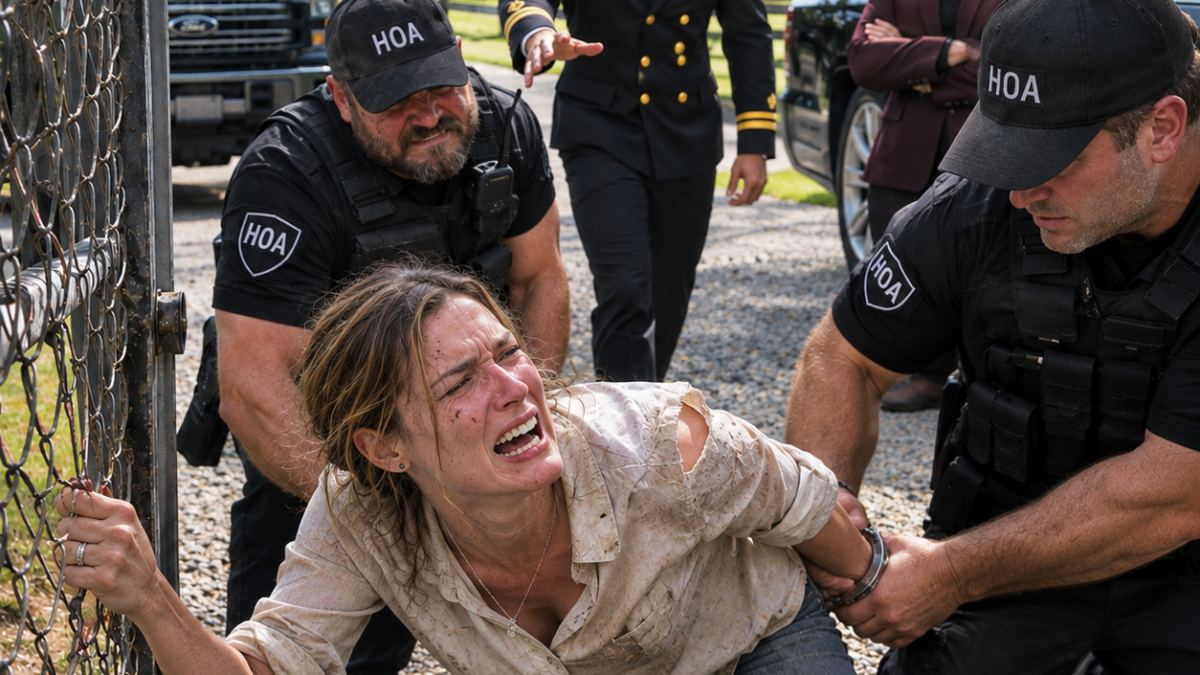
One man took her left wrist.
Hard.
The second caught her right arm above the elbow.
Paige twisted instinctively.
“Get your hands off me!”
Her phone nearly fell.
She grabbed the iron gate with her free hand.
Her wedding ring caught against a section of chain link.
The guards pulled.
Pain shot through her finger.
She screamed.
Her grip broke.
Her shoes scraped over loose gravel.
One knee hit first.
Then the other.
Sharp stone tore through the fabric.
Her blouse ripped at the elbow.
Her phone bounced once but remained in her hand.
The guard holding her wrist tightened his grip.
“Stop resisting.”
“This is my land!”
They dragged her another several feet.
Her knee burned.
Blood appeared immediately.
A third guard stood nearby.
He did not intervene.
Two others watched the road.
Coulter walked behind them.
“This didn’t have to happen.”
Paige looked up.
“Call the police.”
“You are the trespasser.”
Then the rear window of the third SUV lowered.
Vivian Stroud sat inside.
Black blazer.
Pearl earrings.
Perfect hair.
Engine running.
She looked at Paige on the gravel the way someone might inspect a landscaping crew.
Paige could hardly believe it.
“Vivian!”
Vivian leaned slightly toward the window.
“You were warned.”
“They’re assaulting me!”
“You chose not to cooperate.”
“This is my property.”
Vivian smiled.
“You don’t own anything we haven’t already claimed.”
The sentence sounded rehearsed.
That frightened Paige more than the guards did.
Because it meant this was not a misunderstanding.
They had come expecting resistance.
Expecting to remove her.
Paige struggled to sit up.
The guard holding her shoved her shoulder downward.
She shouted:
“Reed!”
He could not hear her.
He was miles away.
But she had sent him a message when the SUVs arrived.
They’re here. Six guards. They won’t leave.
He had been forty minutes from the memorial hall.
Then he saw the second message.
They’re touching me.
Reed turned the truck around.
He did not call Paige because he did not want her attention on a phone if people were physically confronting her.
He called 911 first.
Reported a possible assault and trespass in progress.
Then drove.
Fast.
Not recklessly.
Every lesson he had learned about controlled movement fought against the fear sitting in his chest.
He knew what uncontrolled anger could do.
He knew what it looked like from the outside.
Vivian knew too.
She was counting on it.
At 8:09, Reed’s dark pickup came around the final curve.
Paige heard the tires before she saw him.
The truck braked outside the gate.
Driver’s door opened.
Reed stepped out.
Deep navy dress uniform.
Ribbons across his chest.
Gold SEAL trident above them.
For a few seconds, the entire scene stopped.
Coulter turned.
One guard released pressure on Paige’s shoulder.
Vivian’s smile disappeared.
Reed took in everything.
The ripped sign.
The SUVs.
Paige’s phone on the gravel.
Blood on her knees.
One guard gripping her wrist.
Another behind her.
He closed the truck door.
Walked toward them.
Coulter stepped forward.
“You need to remain outside the security area.”
Reed did not look at him.
His eyes stayed on Paige.
“Take your hands off my wife.”
The guard holding her hesitated.
Looked at Coulter.
Reed stopped several feet away.
“Now.”
No yelling.
No threat.
The lack of yelling made the command heavier.
Coulter said:
“Military rank has no authority over HOA security.”
Reed finally looked at him.
“I didn’t say it did.”
Vivian climbed out of the SUV.
She smoothed the front of her blazer.
“A costume full of medals doesn’t override a board decision.”
Reed ignored her.
“Release Paige.”
One guard let go.
Then the second.
Paige swayed when she stood.
Reed caught her under one arm.
His eyes went to the red marks around her wrist.
Then the torn knees.
“You okay?”
“I’m fine.”
“No.”
“I’m standing.”
“Different thing.”
She held his sleeve.
“Don’t.”
He knew what she meant.
Don’t give them what they want.
Reed turned toward Coulter.
One quiet question.
“Who signed the order authorizing you to drag a landowner across her own property?”
Coulter’s mouth opened.
Closed.
He looked at Vivian.
That was the first moment Paige saw his confidence falter.
Vivian walked to her SUV.
Opened a leather folder.
Pulled out a page.
“Your wife did.”
Paige stared.
Vivian held up the document.
At the bottom:
PAIGE ELEANOR BELLAMY
Signature.
Notary stamp.
Agreement granting Ridgecrest Hollow HOA control over an expanded access corridor.
Paige’s face went cold.
“That isn’t my signature.”
Vivian looked almost sympathetic.
“You signed it.”
“No.”
“Your name is there.”
“I didn’t sign that.”
Reed held out his hand.
Vivian did not give him the original.
Only angled it so he could see.
He read the date.
Then looked at Paige.
Her eyes widened.
They both remembered.
Savannah.
His cousin’s wedding.
Hotel.
Photographs.
Family.
Hundreds of miles away.
“You weren’t even here that day,” Reed said.
Vivian shrugged.
“Take it up with your lawyer.”
Reed looked at Coulter.
“Where does that document authorize physical restraint?”
Coulter recovered enough to step closer.
“You are obstructing lawful security work.”
“What arrest authority do you have?”
Coulter frowned.
“Security can remove intruders.”
Reed pointed past him.
Toward the farmhouse.
“That is our home.”
Then toward Paige.
“She owns this ground.”
“You’re the intruders.”
Vivian lifted her phone.
“Record him.”
Coulter pulled his own phone.
One guard activated a body camera.
Vivian’s voice grew louder.
“Everyone stay calm. Mr. Bellamy is a military-trained individual behaving aggressively.”
Reed looked at her.
He understood instantly.
She needed footage.
Not truth.
A moment.
One shove.
One raised hand.
One sentence she could send to Navy command.
Coulter moved close.
Chest to chest.
Then drove his shoulder into Reed.
Hard enough to move him back one step.
Reed’s hands stayed open.
At his sides.
“Back away.”
Coulter smirked.
“What are you going to do?”
“Wait for deputies.”
The answer disappointed him.
Paige retrieved her phone.
She began narrating.
“Eight fourteen a.m. Southern gate, Bellamy property. Coulter Vane just shoved Reed Bellamy. Reed has not struck anyone.”
Vivian shouted:
“Look how intimidating he is!”
Paige almost laughed.
Then pain in her knees reminded her not to.
Reed called 911 again.
“Situation ongoing. My wife has been physically restrained and dragged across private property. Private security remains on site.”
Vivian walked toward the SUV.
Paige read each license plate aloud to dispatch.
All three.
Character by character.
Vivian stopped.
Turned.
Then kept walking.
Deputies arrived eighteen minutes later.
Sheriff’s office.
Two vehicles.
The first deputy separated everyone.
The second photographed Paige’s injuries.
Vivian produced the agreement.
Notary stamp.
Signature.
She demanded Paige be removed from “HOA-controlled property.”
The deputy looked at the farmhouse.
Then at Paige.
Then the document.
“We’re not removing a resident from her own home based on a copy of a disputed agreement.”
Vivian’s face tightened.
“She surrendered the corridor.”
“She says she didn’t.”
“She’s lying.”
“That’s for investigation.”
Reed gave them his dashboard footage.
His truck camera had been running.
It showed him arriving.
Coulter blocking him.
Coulter shoving first.
Reed’s hands staying down.
Paige handed over her phone video.
The deputies collected names.
Then one younger guard caught Paige’s attention.
Wesley Broderick.
Mid-twenties.
His face had gone pale.
He kept looking at her wrist.
Then at Coulter.
Paige heard Coulter speak quietly.
“When they ask, she fell.”
Wesley did not answer.
Another guard’s body camera had recorded more than Coulter realized.
Vivian lowered her SUV window as she left.
She looked directly at Reed.
“By tomorrow, the Navy will know what kind of man you are.”
Reed watched the vehicle disappear.
Then looked at Paige.
She shook her head.
“I’m sorry.”
“For what?”
“They’ll come after your career.”
Reed looked at the blood on her knees.
“They already came after our home.”
Five days earlier, none of this had seemed possible.
Paige had been checking the southern fence after noticing orange stakes inside their boundary.
At first she assumed county utility marking.
Then she found old markers removed.
New ones deeper into Bellamy land.
A survey crew worked farther south.
Tripod.
Laser.
Reflective vests.
She approached.
“Who hired you?”
The crew leader looked uncomfortable.
“Ridgecrest Hollow.”
“This isn’t Ridgecrest property.”
He handed her a drawing.
HOA seal.
Proposed road.
Thirty-six feet wide.
It cut through Bellamy land.
Not along the existing easement.
Through it.
Paige knew the deed.
Fourteen acres purchased privately years earlier.
Never joined HOA.
No covenant.
No membership requirement.
One recorded exception:
A twelve-foot emergency access corridor.
Fire vehicles.
Emergency use to reach wooded land behind Ridgecrest Hollow.
That was it.
No commercial traffic.
No permanent construction.
No exclusive possession.
No authority to remove the owners.
The proposed road tripled the width.
Thirty-six feet.
Wide enough for construction trucks.
Tour buses.
Commercial traffic.
Paige photographed the drawing.
Then called Vivian.
“Why is your survey crew on my land?”
“Planning.”
“You don’t have rights to plan a road through my property.”
“We have access rights.”
“Twelve feet.”
“Access rights evolve with community needs.”
“No.”
“Paige.”
“Your easement does not evolve.”
That road was the key to Vivian’s $8.2 million resort expansion.
New amenities.
Upscale clubhouse.
Commercial parking.
Resort center.
Investors.
The practical route for construction and future guest traffic crossed Bellamy land.
Without it, financing conditions failed.
Vivian first offered $25,000 for a permanent corridor.
Paige laughed.
Not because access had no price.
Because $25,000 was an insult.
The road would pass within sight of her bedroom.
Heavy vehicles.
Commercial guests.
Permanent change.
“No.”
Vivian returned weeks later.
$60,000.
Paige refused again.
Vivian sat at the kitchen table.
The same table where Paige and Reed ate breakfast.
“You should think about your neighbors.”
“I am.”
“No, you’re thinking about yourself.”
“It’s our land.”
“Your refusal could kill a project that benefits every household.”
“Then build it somewhere else.”
“You’re becoming an enemy of this community.”
Paige leaned back.
“I’m not in your community.”
That was the sentence Vivian never forgave.
Reed had been away often.
Training.
Assignments.
Long periods where Paige managed everything herself.
Before his latest rotation he said:
“If they cross the line, call law enforcement.”
Paige wanted records first.
She sent formal objection.
Deed.
Plat map.
Existing easement.
Vivian never replied.
Instead, according to what Wesley later disclosed, Vivian met privately with Coulter.
Investors were coming.
The land had to appear uncontested.
“If she refuses to move?”
Coulter asked.
Vivian answered:
“Remove her.”
The night before the assault, Paige received an HOA notice.
MANDATORY INSPECTION — SOUTHERN CORRIDOR
At bottom:
Her electronic name.
Authorization.
She had not signed.
She emailed immediately.
I do not consent. You do not have authority to enter or control my property.
No answer.
Then the guards came.
That afternoon, Reed drove Paige to a clinic.
Bruised wrist.
Abraded knees.
Finger strain where wedding ring caught.
Nothing broken.
Everything documented.
Photographs.
Medical notes.
The torn blouse sealed in a bag.
Paige felt ridiculous doing it.
Like someone pretending to be in a crime show.
Reed said:
“Evidence doesn’t become less important because preserving it feels dramatic.”
She looked at him.
“You sound like a manual.”
“Occupational hazard.”
Then he reported the incident through his chain of command.
Before Vivian could.
He provided facts.
Private property dispute.
Wife assaulted.
He arrived in uniform because en route to memorial service.
He claimed no military authority.
Used no weapon.
Made no threat.
Called civilian law enforcement.
Offered footage.
The next morning, Vivian filed her complaint anyway.
She accused Reed of using his Navy SEAL status to intimidate civilians.
She attached a short clip.
Reed ordering guards to release Paige.
Nothing before.
No dragging.
No ripped sign.
No shove.
The unit requested his written statement.
He submitted everything.
Dashboard footage included.
One senior chief watched it.
Then asked:
“You ever touch them?”
“No.”
“Threaten them?”
“No.”
“Tell them Navy gave you authority?”
“No.”
“Good.”
That did not make complaint disappear instantly.
But Vivian’s plan required Reed to behave worse than he had.
He didn’t.
That evening Paige apologized.
Again.
“I hate this.”
“What?”
“My property fight is at your command.”
Reed sat across from her.
“You didn’t bring this to our door.”
“They crossed it.”
Outside, headlights moved.
Workers arrived.
Two signs installed.
RESTRICTED HOA DEVELOPMENT ZONE
UNAUTHORIZED ENTRY PROHIBITED
On Bellamy land.
Someone padlocked the side gate to the back pasture.
Paige photographed everything.
Then wrote another demand.
Stop trespassing.
Remove signs.
Remove locks.
Preserve records.
Neighbors began hearing different versions.
Vivian held an emergency HOA meeting.
She told residents Paige attacked guards.
Reed arrived “in military uniform to threaten civilian staff.”
She played edited clip.
Some people believed her.
Why wouldn’t they?
They knew Vivian.
They did not know Paige well.
Ridgecrest Hollow had spent years hearing that the Bellamy land was “the access problem.”
Then photographs of Paige’s knees circulated.
So did deed records.
Someone asked:
“Are the Bellamys even HOA members?”
No.
That question changed the room.
Vivian responded with violation threats against residents sharing “false association information.”
That was when treasurer Nadine Wexler began looking harder at the books.
Nadine was fifty-five.
Quiet.
Methodical.
She believed in HOA governance.
She believed boards could manage shared obligations fairly if documents mattered more than personalities.
That made what she found worse.
$96,000.
Paid to Coulter’s security company over a short period.
Invoices:
AREA MONITORING
SCENE CONTROL
CONSTRUCTION SAFETY
Nadine searched board minutes.
Approvals incomplete.
Some absent.
Amounts divided.
Descriptions vague.
She printed everything she was entitled to access.
At the same time, Paige hired Celia Grayson.
Real-estate attorney.
Patient enough to frighten aggressive people.
Celia listened without interrupting.
Then made a list.
“Original deed.”
Paige handed it over.
“Certified copy later.”
“Plat.”
“Yes.”
“Easement.”
“Yes.”
“HOA amendment.”
“Copy.”
“Need certified recorded version.”
“Notary.”
“What about notary?”
“Verify commission.”
“Medical records.”
“Yes.”
“Videos—original files, not edited exports.”
Reed nodded.
“Dash camera intact.”
“Good.”
“Torn clothing?”
Paige pointed to bag.
Celia looked at her.
“Excellent.”
Paige almost laughed.
“I don’t feel excellent.”
“You don’t have to.”
Then Coulter made another mistake.
Email.
To Reed.
Security will return to complete the work if your family does not voluntarily vacate the corridor. Any cameras installed near the restricted area will be confiscated.
Reed forwarded it to Celia.
She read twice.
“This is not a lawful order.”
“I know.”
“It is, however, a lovely written threat.”
That was Celia’s version of enthusiasm.
Then she checked the notary.
Commission expired fourteen months before the amendment date.
She set down her pen.
Looked at Paige.
Then Reed.
“This isn’t a boundary disagreement anymore.”
“What is it?”
“Someone manufactured legal authority.”
County recorder produced certified filings.
Amended easement.
Paige supposedly agreed to:
Expand corridor from 12 feet to 36.
Grant HOA exclusive control during construction.
Never obstruct association personnel or contractors.
If genuine, those terms explained why Coulter believed—or claimed to believe—he could remove Paige.
But original easement contained none.
Notary commission expired.
And signature date?
Savannah.
Reed’s cousin’s wedding.
Hotel receipts.
Credit-card records.
Photographs.
Dozens of guests.
Paige had been four hundred miles away.
She signed sworn declaration:
Never signed amendment.
Never authorized another person.
Celia explained:
“Recorder accepts documents that appear proper.”
“So they recorded a fake?”
“They recorded a document presented as valid.”
“That means it’s legally valid?”
“No.”
“Thank God.”
“Recording isn’t magic.”
Then Reed noticed the signature style.
Paige Eleanor Bellamy.
Full middle name.
Loops.
Old form.
Paige stopped signing that way years earlier.
Now she used:
Paige E. Bellamy.
But one old document had the full style.
Original home purchase contract.
Copy previously given to HOA.
Why?
Months earlier, Vivian requested it for a “routine community safety review.”
Paige found email.
There.
Friendly.
Professional.
Please provide purchase contract and deed.
The same source containing exact signature later appearing on forged amendment.
Celia’s expression became colder.
“Save that email in three places.”
Wesley called two days later.
Unknown number.
Celia answered.
His voice low.
He admitted Coulter instructed guards to treat Bellamy rights as already terminated.
Vivian wanted Paige removed before investors arrived.
He was scared.
Coulter controlled jobs.
Contracts.
Threatened lawsuits.
Celia told him not to steal documents.
Not to secretly access anything beyond his rights.
Preserve what he lawfully had.
Speak to investigators.
Then Reed asked the question that opened the financial side.
“If they needed a road, why not keep offering money?”
Paige stared.
“Because they didn’t have time.”
They spread project schedule across kitchen table.
Investor inspection.
Funding release.
Corridor verification.
Forced removal scheduled exact morning inspection team would confirm access.
Vivian needed not just a road.
She needed appearance of undisputed ownership before money moved.
Nadine called that night.
“You’re looking at a forged easement.”
Celia said nothing.
Nadine continued:
“You need to look at who gets paid if it closes.”
Next afternoon she arrived carrying a canvas tote.
Budget records.
Invoices.
Minutes.
Development agreements.
The $8.2 million project depended on confirmed access.
Developer Russell Baird.
Experienced builder.
Funding in stages.
Land rights first.
No material disputes.
If Paige stood at gate protesting, financing could stop.
Then Nadine placed one page on table.
BLUE ORCHARD CONSULTING
Land settlement fee:
$940,000
Payable when access transaction closed.
Paige looked at Reed.
“Who owns it?”
Nadine swallowed.
“Vivian has an ownership interest.”
Silence.
Nearly one million dollars.
Undisclosed.
Paid if the corridor was delivered.
Security firm had already received $96,000.
Celia said:
“Investigators determine criminal conclusions.”
Paige stared at the page.
“They dragged me because I was standing between her and nine hundred forty thousand dollars.”
Celia answered carefully.
“The documents indicate a financial incentive tied directly to successful delivery of the corridor.”
Paige stood.
“I’m going to her house.”
Reed caught her hand as she reached for keys.
“No.”
“She watched them drag me.”
“I know.”
“She smiled.”
“I know.”
“I want her to know we found it.”
“She’ll know.”
“When?”
“When everybody knows.”
That landed.
Paige sat.
She did not want a private argument anymore.
She wanted the record.
Vivian learned subpoenas and document requests were coming.
She tried removing Nadine as treasurer.
Called Coulter.
Demanded internal papers collected.
Developer Russell Baird received Celia’s warning letter.
His answer to Vivian:
Resolve land dispute before final review or closing will be delayed indefinitely.
Vivian panicked.
Coulter called.
“They still have cameras.”
“Then finish what you started.”
That sentence would become important later.
The second confrontation came on a bright afternoon.
No uniform this time.
Reed wore jeans.
Work shirt.
He was replacing a gate hinge bent during first attack.
Paige had installed a second camera.
Cloud upload.
Audio.
Redundant storage.
She told Reed:
“I feel ridiculous.”
“Good.”
“Why good?”
“Paranoia is when danger isn’t real.”
She looked at him.
“That is not comforting.”
At 4:07, two box trucks and a security SUV arrived.
Coulter stepped out.
Different guards.
Fresh faces.
He announced:
“Site securing operation.”
Paige held up Celia’s legal notice.
“Leave.”
“Cameras come down.”
“No.”
“They’re pointed at restricted area.”
“They’re on my property.”
Coulter walked over.
Took notice.
Tore it in half.
Dropped pieces in dirt.
Vivian’s black SUV appeared.
She remained near fence filming.
“Do not allow the Bellamys into the southern acreage.”
Paige stared toward new camera.
It recorded every word.
Coulter took a pry bar.
Went toward camera mount.
Paige warned:
“That is private property.”
He jammed bar beneath bracket.
Metal bent.
Reed set down his wrench.
Walked over.
Coulter grinned.
“Where’s your fancy uniform now, soldier?”
Reed looked at him.
“I never needed it to know where my property line is.”
Coulter shoved him.
One guard lunged toward Paige.
Grabbed her arm.
This time Reed moved.
He caught the man’s wrist.
Enough pressure to stop him dragging Paige.
Nothing more.
The instant Paige was free, Reed released.
No punch.
No pursuit.
Paige hit house alarm.
Called 911.
Same men.
Same conduct.
Camera damage.
Physical force.
Then Coulter shouted something he could not take back.
“Vivian paid good money to make sure you disappear from this site!”
Paige turned.
Phone up.
“Paid you to protect property?”
Coulter froze.
“Or paid you to remove me?”
His face changed.
Vivian screamed from SUV:
“Everybody stop talking!”
Too late.
Camera kept recording.
Sheriff Harlan Beckett arrived with deputies.
Already knew names.
Paige showed footage.
Coulter claimed Reed attacked first.
Harlan watched.
Coulter shove.
Guard seize Paige.
Reed intervene only after.
Then Wesley stepped forward.
Asked to speak privately.
He confirmed Vivian’s original instruction.
Remove Paige.
Clear site.
He told Harlan where company stored radio and message logs so investigators could preserve them lawfully.
Coulter was arrested for conduct captured during second incident.
He twisted toward Vivian while deputies guided him to cruiser.
“You promised me nobody would find the second contract!”
Silence.
Vivian’s face changed.
For first time, she had no prepared sentence.
The arrest spread through Ridgecrest Hollow by morning.
Owners demanded special meeting.
Nadine moved Paige and Celia be invited.
Russell Baird attended because his $8.2 million project now rested on disputed—and possibly fabricated—land rights.
Clubhouse overflowed.
Vivian took podium first.
“One family has held our community hostage.”
Murmurs.
She described Paige as obstructionist.
Reed as military bully.
Then doors opened.
Paige.
Reed beside her.
No uniform.
Dark jacket.
Celia behind.
Paige’s knees had healed.
Marks around wrist faint.
People looked down as she walked.
Some had watched from porches the first day.
Some had believed Vivian’s edited video.
Vivian snapped:
“She is not a member of this association.”
Celia said:
“Correct.”
That quieted room.
“And that is exactly why this association never possessed jurisdiction to remove her from her own land.”
Vivian demanded her video played.
Celia agreed.
“One condition.”
“What?”
“Play all footage.”
Screen showed Paige at gate.
Coulter tearing sign.
Guards seizing her.
Dragging.
Wedding ring catching.
Blood.
Vivian’s voice from SUV.
Remove her.
Get her out before inspection.
Then Reed arriving.
Ordering release.
No strike.
No threat.
A resident stood.
“Why did your video start after they grabbed her?”
Vivian said:
“Her footage may be edited.”
Celia switched screen.
Two documents.
Original easement:
12-foot emergency fire access.
Amendment:
36-foot corridor.
Exclusive control.
No obstruction.
Then notary record.
Commission expired fourteen months earlier.
Then Savannah evidence.
Wedding photograph.
Paige beside Reed.
Same date amendment supposedly signed locally.
Hotel receipt.
Time.
Location.
Celia said:
“Criminal responsibility will be decided by investigators and courts.”
Important.
“But the document this association relied upon has serious defects and is expressly denied under oath by the property owner.”
Russell Baird leaned forward.
He asked for originals.
His financing depended on that amendment.
Vivian changed strategy.
“Coulter exceeded authority.”
Paige stared.
Vivian continued:
“Security was hired only for routine protection.”
Paige stood.
“Then why were they paid to make sure I disappeared before your inspection?”
Vivian laughed.
“You have no proof.”
Nadine stood.
Bound folder.
Placed it on table.
Contract addendum.
Not shown to full board.
Blue Orchard Consulting:
$940,000 fee.
Conditional upon delivery of 36-foot corridor free of obstruction.
Related security addendum:
Coulter’s firm responsible for ensuring land handed over on schedule.
Vivian’s signature appeared as HOA president.
Separate signature connected Blue Orchard beneficial ownership to her financial interest.
Room erupted.
Celia raised a hand.
“Let documents speak.”
Nadine explained what she found.
No proper disclosure.
Incomplete approvals.
$96,000 to Coulter’s security company.
Then investigators’ verified recording.
Internal communication lawfully obtained.
Coulter:
“Paige is still at gate.”
Vivian’s recorded voice:
“Get the woman out of sight before the inspection team arrives.”
Coulter:
“What if she refuses?”
Vivian:
“I don’t care how you do it. Get her off that property.”
Silence.
Not theatrical.
Shock.
Russell Baird stood.
Buttoned jacket.
“My company cannot rely on legal access representations presently under serious dispute.”
Vivian turned toward him.
“Russell.”
“Funding and approval review is suspended immediately.”
“You know what this does to the project.”
“Yes.”
“Hundreds of homeowners—”
“My company requires valid land rights.”
He gathered documents.
“If irregularities are confirmed, we will terminate.”
The $8.2 million project began dying in front of her.
Vivian clutched podium.
Paige stepped forward.
“You sent six men to my gate.”
Vivian stared.
“They dragged me across my own land because you thought nobody could stop you.”
Paige’s voice did not rise.
“Now everybody knows what you were protecting.”
Board members called for suspension.
Formal removal proceedings.
Vivian shouted:
“Betrayal!”
No one stood.
She tried leaving.
Sheriff Harlan waited outside.
He told her investigators required statement regarding:
Recorded easement.
Financial arrangements.
Security instructions.
She looked past him.
Saw Reed beside Paige.
No dress blues.
No ribbons.
No trident.
Same calm man.
That mattered.
Vivian had spent weeks trying to make uniform the story.
Uniform had never been story.
After meeting, investigation widened.
Security logs.
Financial transfers.
Recorded land documents.
Notary history.
Camera footage.
Dashboard footage.
Emails.
Invoices.
Timeline.
Wesley gave independent statement.
Coulter eventually gave information too.
Not out of sudden courage.
Evidence was closing.
Sheriff’s office referred suspected offenses to prosecutors:
Assault.
Unlawful restraint.
Trespass.
Forgery.
Conspiracy to commit fraud.
Different people faced different exposure.
Celia filed emergency civil motion.
Stop construction.
Stop occupation.
Stop reliance on disputed amendment.
Court hearing.
Vivian’s attorney insisted Paige approved.
Judge asked:
“Original signed document?”
Problems.
“Valid notary record?”
Problems.
“Evidence Paige appeared before notary?”
None convincing.
Reed testified.
Opposing attorney asked:
“Chief Bellamy, did you wear your Navy SEAL uniform to intimidate security staff?”
Reed looked toward judge.
“I wore my dress uniform because I was on my way to a Navy memorial.”
“Did you use your status?”
“No.”
“You ordered guards to release Mrs. Bellamy.”
“My wife.”
“Yes.”
“I told private security officers to stop holding my wife on our property.”
“Would you agree your appearance was intimidating?”
Reed paused.
“My uniform gave me no authority over those men, and I claimed none.”
Then:
“But their uniforms gave them no authority over my wife.”
Judge issued temporary order.
HOA could not rely on disputed amendment to occupy or build.
No interference with Bellamys’ lawful use.
Evidence preservation.
Not final criminal judgment.
Emergency protection.
Enough.
Russell Baird completed his legal review.
Access guarantee failed.
Project agreement terminated.
$8.2 million investment gone.
Blue Orchard’s $940,000 fee:
never paid.
HOA members formally removed Vivian as president.
Accounts access revoked.
Independent auditor retained.
Residents demanded answers.
Some demanded Vivian personally repay every dollar.
New board refused to make conclusions before audit.
That was important.
Paige appreciated it.
They were finally learning not to turn anger into authority.
Then prosecutors obtained warrant for Vivian.
Forgery and conspiracy allegations.
Charges tied to role in forced removal.
Deputies served at her home.
No television cameras.
No cheering crowd.
Handcuffs.
Vivian reportedly repeated:
“I built this community.”
A detective later placed contract addendum in front of her.
“You didn’t only authorize a development.”
He pointed to security provision.
“You authorized the operation that removed the owner.”
Legal proceedings took months.
Not one dramatic day.
Discovery.
Hearings.
Motions.
Plea discussions.
Separate cases.
Coulter prosecuted for assault and unlawful restraint tied to security conduct.
Other defendants made procedural choices based on evidence against them.
Civil case proceeded separately.
At sentencing, court considered Vivian’s role in manufactured land document, undisclosed financial interest, and campaign of force.
She received thirty months in prison on offenses established through proceedings.
Restitution ordered for amounts court recognized.
Barred from representing HOA again.
Financial assets subject to obligations established by judgments.
Paige did not celebrate.
That surprised neighbors.
One asked:
“You’re not happy?”
Paige said:
“I’m relieved.”
“Same thing.”
“No.”
It wasn’t.
Happiness would have been none of it happening.
Relief was what came after surviving it.
Civil case addressed Paige’s injuries.
Trespass.
Gate damage.
Other proven harms.
Responsible parties held liable according to evidence and applicable penalties.
Paige and Reed deliberately did not target innocent Ridgecrest residents.
Celia argued:
“Responsibility should follow conduct.”
Paige agreed.
She had spent too much time being treated as part of a collective she had never joined.
She would not reverse it and pretend every homeowner was Vivian.
The illegal development signs came down.
Survey markers reset.
Official deed restored as controlling boundary.
Gate straightened.
New hinge.
Fresh paint.
Paige installed sign herself.
Metal.
Bolted into post.
PRIVATE PROPERTY
OWNERSHIP IS NOT UP FOR VOTE
Reed stood nearby.
“You know that’s provocative.”
“I learned from the best.”
“Who?”
“Vivian.”
He laughed.
Months later, Reed prepared for another Navy ceremony.
Paige watched him put on dress blues.
Same ribbons.
Same trident.
She remembered the first morning.
Two guards.
Blood.
Gravel.
Then dark pickup.
“They thought that uniform was why they lost,” she said.
Reed adjusted his cuff.
“No.”
Paige looked at him.
“They did.”
“They were afraid of what it represented.”
He shook his head.
“Paige, I came home.”
“That mattered.”
“Yes.”
“But you already said no before I got there.”
She was quiet.
“You kept deed.”
“Sent objections.”
“Recorded.”
“Preserved evidence.”
“Called police.”
“Went to court.”
“You walked into clubhouse.”
He smiled slightly.
“The uniform was what I happened to be wearing when I got the message.”
That hurt in a good way.
Because part of Paige had carried humiliation from the gravel.
Those seconds.
Pinned.
Looking at Vivian smiling.
Believing someone had taken reality itself.
Reed reached for her healed hand.
“You never have to prove you’re strong by doing all of it alone.”
They walked outside.
Gate.
Fourteen acres.
Fence line.
Pasture.
Woods.
Everything ordinary again.
A vehicle slowed on road.
Driver read sign.
Kept going.
Paige closed gate.
Latch clicked.
She touched the chain-link section where wedding ring had caught.
“They dragged me across this line because they thought it belonged to them.”
Reed put his hand beside hers.
“They were wrong about land.”
She looked at him.
“They were wrong about you.”
Then:
“And they were wrong about what this uniform meant.”
Paige locked gate.
For a while, she thought that was ending.
It wasn’t.
Because legal victory does not instantly restore a sense of safety.
The first time an unfamiliar SUV slowed near property, Paige’s stomach tightened.
She wrote plate number.
Then realized it was delivery driver looking for next address.
At night, she checked gate camera twice.
Then three times.
Reed noticed.
He did not tell her:
Stop worrying.
He knew fear does not respond to embarrassment.
Instead he asked:
“Want another camera on east line?”
She looked at him.
“I don’t want to turn this place into a prison.”
“Then don’t.”
“What if—”
“You choose security because it helps, not because Vivian gets to live here in your head.”
That irritated her.
Because he was right.
Paige kept two cameras.
Not eight.
Cloud storage.
Motion alerts.
Then stopped checking every hour.
Gradually.
The southern field became a field again.
Not disputed corridor.
New board contacted Bellamys.
Not to negotiate road.
To apologize.
Nadine came.
Claire, another board member.
Two homeowners Paige barely knew.
They sat on porch.
No lawyers.
Nadine said:
“We failed you.”
Paige did not automatically absolve them.
“How?”
Nadine answered honestly.
“We trusted Vivian too long.”
Another member said:
“We treated the development like it was already inevitable.”
Claire:
“We stopped asking who owned what because we assumed lawyers had checked it.”
Paige looked at Reed.
Then back.
“The first time your people crossed my line, I sent deed.”
“We know.”
“You had evidence.”
“We know.”
“And you let her tell everybody I was the problem.”
Nadine nodded.
“Yes.”
Silence.
That mattered.
No:
Mistakes were made.
No passive voice.
“We did.”
Paige appreciated it.
Eventually she said:
“What changes?”
New board adopted safeguards.
No president alone could approve significant land-use representations.
External counsel review for easements.
Direct verification with property owners.
Notary validation.
Conflict-of-interest disclosures.
Security contractors limited clearly.
No private security allowed to make legal determinations about ownership or detention.
Two-person approval for extraordinary expenditures.
Independent review of consultant relationships.
Paige listened.
“Good.”
One board member asked:
“Will you come to meetings?”
“No.”
They looked surprised.
“I am not joining the HOA.”
Reed smiled into his coffee.
Paige continued:
“I’ll talk when something affects my land.”
Fair.
They accepted.
The twelve-foot fire easement remained.
That was important too.
Paige never tried to eliminate legitimate emergency access because Vivian abused it.
Fire department still had right during actual emergencies.
The corridor remained narrow.
Unpaved except where necessary.
No commercial traffic.
No permanent resort road.
Ownership stayed Bellamy.
One wildfire season, county firefighters used it.
Paige opened gate herself.
Engines passed.
Reed stood beside her.
She watched the trucks go.
“Does this bother you?”
“A little.”
“Want me to stay?”
“No.”
She shook her head.
“This is what easement is for.”
That distinction restored something.
Not every access request was theft.
Not every uniform was danger.
Not every institution behaved like Vivian.
The fire trucks returned after midnight.
One captain thanked her.
Paige almost laughed.
“Don’t thank me. It’s recorded access.”
Still.
Legitimate use happening correctly mattered.
Coulter’s company collapsed.
Contracts canceled.
Insurance problems.
Legal exposure.
Some guards found other jobs.
Wesley left private security entirely.
Months later he asked Paige to meet.
Public coffee shop.
He looked nervous.
“I should have stopped them first day.”
“Yes.”
“I knew it felt wrong.”
“Yes.”
“I was scared of losing job.”
Paige stirred coffee.
He waited.
She did not rescue him from discomfort.
Then:
“You told investigators.”
“Eventually.”
“You gave them logs.”
“Yes.”
“You helped stop second attack.”
“I didn’t stop it.”
“You stepped forward.”
He looked down.
“I’m sorry.”
Paige believed him.
That did not erase first morning.
Forgiveness, if it came, would not change history.
She said:
“I hope next time somebody tells you authority matters more than what you see in front of you, you remember my knees.”
His eyes filled.
“I will.”
That was enough.
Paige’s wedding ring had been repaired.
Bent slightly.
Jeweler asked if she wanted replacement.
“No.”
He reshaped it.
Tiny scratch remained.
Reed noticed.
“Want new one?”
“No.”
“Insurance would cover it.”
“I said no.”
He smiled.
“Copy.”
Some scars should not be romanticized.
But some objects gain history.
The ring had been there when they married.
When Reed deployed.
When Paige bought acreage.
When she held gate.
When guard pulled.
She wanted same ring.
Not because violence improved it.
Because violence had not earned right to replace it.
That difference mattered.
Navy complaint against Reed closed without adverse finding after full material reviewed.
Vivian’s edited clip could not survive complete footage.
One commander told him privately:
“You handled it correctly.”
Reed replied:
“My wife handled it correctly.”
“Take compliment.”
“Yes, Master Chief.”
Paige teased him later.
“So your fancy uniform survived?”
“Barely.”
“You looked terrifying.”
“I looked like I was late for a memorial.”
“You were.”
That part had weighed on him.
He missed ceremony.
A friend’s memorial.
The family understood.
Still hurt.
Paige said:
“I’m sorry.”
“Stop apologizing.”
“You missed something important because of me.”
“No.”
“Reed.”
“Because six people were dragging my wife.”
He took her hand.
“Words matter.”
She remembered that.
Words mattered in deeds too.
Twelve feet.
Emergency.
Temporary.
Exclusive.
Thirty-six.
One changed word could change land.
That was why forgery had been so powerful.
Vivian did not need to move fence physically at first.
She moved language.
Once paper said HOA controlled corridor, security behaved as though it did.
Contractors behaved as though it did.
Investors almost funded as though it did.
Recorded falsehood began producing physical reality.
Paige became obsessed for a while with understanding how close they came.
Celia warned her:
“Don’t spend your life reverse-engineering evil.”
“I need to know.”
“Know enough to protect yourself.”
“What if Russell’s inspectors had come before Reed?”
“They still would’ve seen dispute.”
“What if guards got me off property?”
“Your deed remained.”
“What if they built road?”
“We’d seek emergency relief.”
“What if funding closed?”
“More complicated.”
Paige stared.
“That’s what bothers me.”
“Of course.”
Celia leaned back.
“But they didn’t succeed.”
“Because Reed arrived.”
“No.”
Paige looked at her.
“Because you recorded.”
“Objected.”
“Had deed.”
“Called law enforcement.”
“Because Wesley eventually talked.”
“Nadine checked books.”
“Reed controlled himself.”
“Evidence survived.”
“Courts acted.”
She smiled.
“Stories like to find one hero.”
“Reality is usually paperwork plus several people finally doing their jobs.”
Paige laughed.
“That’s terrible storytelling.”
“It’s excellent law.”
Ridgecrest project site remained undeveloped for years.
Without Bellamy road, original resort configuration failed.
Some residents blamed Paige.
A man confronted her at grocery store.
“You cost this neighborhood millions.”
Paige looked at him.
“I didn’t forge an easement.”
“You could’ve sold.”
“Yes.”
“For sixty thousand.”
“Yes.”
“You should have.”
“That’s your opinion.”
“You don’t care about property values.”
Paige smiled.
“I care a lot about property values.”
He frowned.
“My property.”
Then walked away.
She did not need him to agree.
Reed admired that.
“You’re getting mean.”
“I’m getting efficient.”
New board eventually proposed a smaller project on land it actually controlled.
No Bellamy corridor required.
Less ambitious.
Less expensive.
Legal.
Residents approved.
Paige saw construction trucks using the public entrance.
She stood at gate.
Reed beside her.
“You mad?”
“No.”
“Really?”
“Why would I be?”
“Development.”
She shrugged.
“Their land.”
That was the entire principle.
She was not anti-HOA.
Anti-road.
Anti-progress.
She was against somebody else deciding ownership was a community vote.
Years later, a podcast requested interview.
Paige declined.
Then another.
Reed asked why.
“I don’t want to be Navy SEAL wife in headline forever.”
“You are my wife.”
“Yes.”
“You married poorly.”
“Obviously.”
She laughed.
But the point mattered.
People liked the image.
Dress blues.
Trident.
Hired guards.
Release her.
It was cinematic.
It was not the heart.
Reed could have been an accountant wearing khakis and Bellamy deed would still be Bellamy deed.
The uniform did not create ownership.
Force did not create HOA authority.
Her husband’s service record did not make her property rights more valid than another person’s.
Paige once told a reporter who kept insisting on SEAL angle:
“If Reed had been a plumber, Vivian would still have forged my signature.”
The reporter did not use that quote.
Too inconvenient.
Reed loved it.
He wrote it on sticky note.
Put on refrigerator.
Paige threw it away.
The public hearing remained the moment neighbors remembered.
Not Reed at gate.
Paige walking through clubhouse doors.
No uniform needed.
Celia carrying documents.
Nadine’s folder.
Full video.
That was the reckoning.
Because Vivian built power through controlled fragments.
Edited video.
Selected minutes.
Private addenda.
Hidden ownership.
Forged clause.
Public hearing assembled whole sequence.
Truth became visible because pieces finally shared one room.
Paige began speaking occasionally to local property-rights groups.
Not political speeches.
Practical.
First point:
Get certified deed.
Second:
Understand easements.
Third:
Private security is not police merely because uniforms look official.
Fourth:
Do not assume recorded document is authentic just because county stamp exists.
Fifth:
Preserve originals.
Sixth:
When angry, do not give opponent footage they want.
At that line, people asked Reed.
“How did you stay calm seeing your wife on ground?”
He usually paused.
Then answered:
“I wasn’t calm.”
That surprised them.
“I was furious.”
“Then how—”
“Feeling and action are different.”
He would explain.
Training does not eliminate anger.
It gives you habits around it.
Scan.
Identify.
Control hands.
Call authorities.
Protect person.
Do not escalate.
Vivian wanted performance.
Violent SEAL.
She did not get it.
Paige once asked:
“Would you have hit Coulter if he didn’t release me?”
Reed thought.
“If necessary to stop immediate harm.”
“That sounds lawyerly.”
“I’ve met Celia.”
“No, really.”
He looked at her.
“I would’ve done what was reasonably necessary to get you safe.”
She nodded.
“That’s different from wanting to hit him.”
“Yes.”
“Did you want to?”
Reed smiled.
“Very much.”
Paige laughed so hard she cried.
That laughter helped more than she expected.
The darkest memory remained Vivian’s smile.
Not Coulter.
Not gravel.
Vivian.
Watching.
Certain.
Paige talked about it once with therapist after nightmares continued.
“I felt like she had already decided reality.”
“What do you mean?”
“She had paper.”
“Guards.”
“Cars.”
“Survey stakes.”
“Everyone acted like it was done.”
“And you?”
“I knew it wasn’t.”
“But?”
“For maybe ten seconds, on ground, I thought knowing didn’t matter.”
Therapist nodded.
“And now?”
Paige thought.
“Knowing mattered because I kept proving.”
That became recovery.
Not telling herself it never happened.
Learning evidence could catch up.
Slowly.
Celia warned against turning every conflict into documentation war.
“You do not need certified mail to ask neighbor to move garbage can.”
Paige smiled.
“Are you sure?”
“Yes.”
She relaxed eventually.
The Bellamy property became home again.
Reed retired later.
Not immediately.
When he finally did, they threw a small gathering.
No HOA.
Family.
Friends.
Some Navy people.
Wesley not there.
Nadine invited.
Celia came late.
Gate open voluntarily.
Someone joked:
“Where’s security?”
Paige pointed at Reed.
“He’s unemployed now.”
Reed raised beer.
Everyone laughed.
Later, after guests left, Paige stood by southern fence.
The twelve-foot easement crossed quietly.
Grass.
No pavement.
No thirty-six-foot road.
Reed joined her.
“Thinking?”
“Dangerous.”
“About what?”
“How much paper it took to prove dirt was ours.”
He nodded.
“Property law.”
“No.”
“People.”
They walked.
Orange survey stakes gone.
Original markers restored.
One county monument reset properly.
Fence repaired.
The land looked almost unchanged.
But Paige knew every foot differently now.
She knew where twelve feet began.
Where thirty-six-foot lie would have run.
Where guards stood.
Where Coulter tore sign.
Where Reed’s truck stopped.
Memory maps are more detailed than surveys.
A few years after case, Paige found one of old orange stakes in barn.
Probably picked up during cleanup.
She held it.
Thought about keeping.
Then threw it away.
Reed asked:
“No museum?”
“No.”
“Good.”
“I kept documents.”
“Of course.”
“Those matter.”
“Apparently enough to send somebody to prison.”
She looked at him.
“Don’t say it like that.”
“Like what?”
“Like we sent her.”
He understood.
Evidence did.
Prosecutors did.
Court did.
Vivian’s own decisions did.
Paige did not want revenge ownership either.
Responsibility belonged where it belonged.
That was why she insisted neighbors not be targeted financially.
Some wanted class-wide assessments to pay settlements.
Celia structured claims toward liable actors and entities according to law.
HOA still incurred costs.
Audits.
Legal defense.
Project loss.
Governance changes.
Innocent residents could not be completely insulated from consequences of leadership they elected.
But Paige refused simplistic punishment.
One resident told her:
“You’re nicer than I’d be.”
“I’m not being nice.”
“What then?”
“Specific.”
Specificity had saved her.
Twelve versus thirty-six.
Emergency access versus exclusive control.
Original signature versus copied one.
Valid notary versus expired.
Edited clip versus complete.
$96,000 payments.
$940,000 fee.
$8.2 million project.
Dates.
Specificity turns outrage into evidence.
She learned that.
Nora? No, wrong story—we must stay with Paige/Reed. Need continue enough length. We can expand on project aftermath, military framing, trust, final emotional. Need no accidental name bleed. Continue.
Russell Baird eventually requested a private meeting.
Paige hesitated.
Celia said:
“You can decline.”
She accepted.
Not at her house.
Celia’s office.
Russell arrived alone.
No development packet.
He looked older than he had at public hearing.
“I owe you an apology.”
Paige said:
“You didn’t drag me.”
“No.”
“You didn’t forge the document.”
“No.”
“Then for what?”
“I relied too heavily on Vivian’s representations.”
“That’s business.”
“It was bad business.”
He folded his hands.
“My company required proof of uncontested access.”
“You were shown a recorded amendment.”
“Yes.”
“And accepted it.”
“We had counsel review title.”
“Did anybody call me?”
Silence.
That was answer.
Russell nodded.
“No.”
“Why?”
“We believed HOA was authorized representative.”
“Of land it didn’t own?”
“When you say it like that—”
“How else should I say it?”
He looked down.
“Fair.”
Paige did not humiliate him.
She wanted one lesson.
“If your project depends on somebody giving up land, speak to that somebody.”
He nodded.
“I will.”
“Not their HOA president.”
“Yes.”
“Not a consultant.”
“Yes.”
“Owner.”
“Yes.”
That meeting helped more than Paige expected.
Because her nightmare was systems accepting Vivian’s fiction.
Russell admitting his company should have verified directly restored some faith.
The developer was not secret mastermind.
He wanted project.
Accepted documents.
Failed to ask enough.
That mattered.
Not everyone had equal guilt.
Reed liked that Paige refused flattened villains.
“Harder story.”
“More accurate.”
“People prefer simple.”
“People preferred Vivian’s simple story too.”
Good point.
Blue Orchard Consulting was dissolved after proceedings.
Its $940,000 success fee never paid.
Paige sometimes wondered what Vivian imagined she would do with money.
Move?
Invest?
Buy another property?
She stopped.
Celia’s advice.
Do not reverse-engineer evil.
Enough.
Coulter’s story ended differently.
He had not invented forged easement.
But he chose force.
Twice.
He ordered lies.
Threatened cameras.
Accepted money under security contracts.
Eventually legal consequences followed based on his acts.
Paige heard details only when necessary.
She did not attend every hearing.
Reed did not either.
At some point, accountability must belong to system.
They could not organize lives around watching defendants lose.
One autumn morning, repair crew came to replace gate.
Original could have been repaired.
Paige wanted it repaired, not replaced.
“Why?” Reed asked.
She touched bent section.
“Because it’s ours.”
“You’re sentimental.”
“Says man with twenty-year-old coffee mug.”
“My mug is tactical.”
“It says World’s Okayest Husband.”
“Exactly.”
Gate straightened.
Hinges.
Paint.
The chain-link section where ring snagged remained slightly distorted.
Worker offered replace.
Paige said:
“No.”
Reed looked at her.
“You sure?”
“Yes.”
Unlike ring, she did not want distortion as symbol.
She wanted it because replacing whole panel felt wasteful.
That pleased her.
Ordinary reason.
Not trauma.
Recovery again:
Objects returning to ordinary meaning.
Gate became gate.
SUV became vehicle.
Uniform became Reed’s work clothes.
Security camera became wildlife camera too.
One morning it caught a fox.
Paige watched clip twice.
Then smiled.
First time in years camera footage did not mean danger.
She sent Reed screenshot.
Intruder.
He replied:
Call HOA security.
She laughed out loud.
Humor is dangerous near scars until day it isn’t.
Ridgecrest Hollow eventually installed a sign at its own boundary:
PRIVATE COMMUNITY — HOA RULES APPLY WITHIN RECORDED ASSOCIATION PROPERTY
Paige saw it.
Called Nadine.
“Who wrote that?”
“Lawyer.”
“Good lawyer.”
“Very expensive sentence.”
“Worth it.”
Boundaries became literal.
Useful.
Vivian had acted as though HOA influence expanded wherever community goals required.
New leadership needed reminder:
Authority has map.
Paige still did not attend social events much.
Not out of resentment.
She never had before.
She liked her land.
Garden.
Horses? Source doesn’t mention, avoid adding. She liked pasture, woods, quiet.
Reed built small bench near southern fence.
Paige asked:
“Why there?”
“Good view.”
“Of disputed corridor?”
“Historical tourism.”
She threw glove at him.
He ducked.
They sat anyway.
One evening he said:
“You know what bothered me most?”
“What?”
“When Vivian called my uniform a costume.”
Paige raised eyebrow.
“Really?”
“No.”
She hit his shoulder.
He smiled.
“What actually?”
“She thought if she could make me react, everything she did to you would disappear.”
Paige looked at ground.
“That’s what she tried.”
“She wanted different headline.”
“Violent SEAL threatens civilians.”
“Instead of guards drag woman off her land.”
“Yes.”
Reed said:
“People do that.”
“What?”
“When facts are bad, change subject.”
Paige remembered Navy complaint.
For weeks, every conversation tried to become Reed.
His training.
His uniform.
His temperament.
Anything except Paige’s deed and guards’ hands.
That tactic almost worked socially.
Some residents said:
Maybe Reed scared them.
As if fear after assault retroactively authorized assault.
Full video destroyed that.
Reed had no magical calm.
He was disciplined.
That was enough.
Years later, a young sailor asked him privately about incident after hearing gossip.
“What did you do?”
“Called police.”
The sailor laughed.
“No, really.”
“Really.”
“You’re a SEAL.”
“So?”
“If somebody grabbed your wife—”
“You think the job is to turn every problem into combat?”
The sailor looked embarrassed.
Reed softened.
“Your training should increase options.”
“Not decrease them.”
That became advice he repeated.
Strength is not needing to use every capability you possess.
Vivian misread his restraint as weakness at first.
Then tried provoking.
She assumed control meant making others move.
Reed understood control differently.
Control meant deciding what you would not do.
Paige liked that idea.
Applied it to herself.
She did not join every argument.
Did not reply to every rumor.
Did not demand every resident apologize.
Did not spend civil case seeking fantasy damages.
Did not use Vivian’s imprisonment as entertainment.
That restraint protected her too.
At final civil resolution, Celia asked:
“Anything else you want?”
Paige looked at list.
Medical.
Property damage.
Gate.
Legal fees.
Other provable losses.
Court protections.
“No.”
“You could pursue broader claims.”
“Would that improve our life?”
“Maybe financially.”
“Would it keep this going?”
“Yes.”
Paige looked at Reed.
He did not decide.
Her choice.
“Enough.”
Celia nodded.
“Enough is allowed.”
That sentence stayed.
Winning does not require maximizing punishment.
Sometimes enough is enough.
By the fifth anniversary, property value had increased anyway.
Irony.
The failed resort had not destroyed Ridgecrest.
Homes remained expensive.
People lived.
Children grew.
Mail got delivered.
No economic apocalypse.
Vivian had framed project as future itself.
Without it, she said neighborhood would stagnate.
It did not.
Another lesson:
Leaders often call their preferred plan inevitable so opposition sounds irrational.
Paige had been told:
Everyone benefits.
No alternative.
You must cooperate.
Project dies without you.
Then it died.
Life continued.
That did not mean project was inherently bad.
It meant it was optional.
Vivian confused importance with entitlement.
Paige never did.
She and Reed eventually allowed county to improve the twelve-foot emergency easement surface.
Fire department requested small stabilization.
They received plans.
Survey.
Written scope.
No widening beyond allowed terms.
Paige signed.
Nadine joked:
“You signed an easement document?”
Paige smiled.
“Voluntarily.”
“Want me to notarize?”
“No offense, but I’m checking commission first.”
They laughed.
The signature looked like Paige E. Bellamy.
Initial.
Not copied old loops.
She noticed.
So did Reed.
No need to say.
That small signature carried more emotional weight than the 36-foot forged document ever did.
Because consent.
Real.
Freely given.
One spring, after heavy rain, Reed found Paige standing beside fire lane.
“What?”
“Nothing.”
“You’re staring.”
She pointed.
County crew had installed new marker.
Twelve-foot corridor clearly marked.
“Looks good.”
“You okay?”
“Yes.”
She was.
That surprised her.
The place had been weaponized once.
Now it simply served purpose.
That was healing.
Vivian’s thirty-month sentence eventually ended.
Paige knew because reporter called.
“Any comment on her release?”
“No.”
“Do you forgive her?”
“No comment.”
“Do you think she served enough time?”
“That’s court’s decision.”
“Would you be afraid if she returned?”
Paige paused.
“No.”
Reporter wanted more.
Paige gave none.
After call, Reed asked:
“Are you afraid?”
Paige thought.
“Not of her.”
“What are you afraid of?”
“Systems believing someone like her again.”
“That’s why systems changed.”
“Systems forget.”
“Then people remind them.”
She looked toward files.
Celia had encouraged digitizing everything.
Cloud.
Safe deposit.
Property binder.
Paige was ready.
Not obsessed.
Ready.
Reed said:
“You realize you’re becoming the old lady who tells every new neighbor about deeds.”
“I’m fifty-seven.”
“Old lady energy.”
She smiled.
“Get off my land.”
He laughed.
The Bellamy story became part of Ridgecrest institutional memory.
New board orientation included:
Jurisdiction map.
Conflict-of-interest rules.
Private property access.
Security limits.
Document verification.
Not Paige’s name.
Good.
She did not want monument.
She wanted procedure.
One new president called to introduce himself.
“I wanted you to know I’ve reviewed Bellamy boundary.”
“Why?”
“So there’s never confusion.”
“Great.”
“Anything else you need from us?”
“No.”
“Okay.”
Five-minute call.
Perfect.
Reed later said:
“You sounded disappointed.”
“I was waiting for fight.”
“That’s trauma.”
“I know.”
“No fight is good.”
“I know.”
She smiled.
“Boring is underrated.”
Indeed.
The most important morning came years later.
Reed dressed for retirement ceremony.
Not memorial.
His own.
Paige watched.
Dress blues.
Trident.
Ribbons.
He was older.
More gray.
Same careful movements.
She walked over.
Straightened collar.
Again unnecessary.
“Remember last time?”
“Which last time?”
“When you left dressed like this and came home to six idiots.”
“Vaguely.”
She laughed.
“They thought uniform saved me.”
He looked at her in mirror.
“You saved yourself.”
“We saved each other.”
“Better.”
She touched trident.
“Does this ever feel heavy?”
“Physically?”
“No.”
He understood.
“Sometimes.”
Then:
“But it doesn’t belong in our property file.”
She smiled.
Exactly.
His service mattered.
But not to deed.
Not to Paige’s right to stand on her own driveway.
That was perhaps strongest lesson.
People treated the uniform as twist.
Navy SEAL husband returns.
But if rights depend on spouse’s rank, they are not rights.
Paige deserved protection before Reed arrived.
Her deed mattered before trident entered frame.
The guards were wrong before they recognized who her husband was.
Reed never wanted anyone to miss that.
At retirement reception, a friend joked:
“Paige, now you’ve got full-time security.”
She replied:
“No.”
Room laughed.
Reed pointed:
“See what I live with?”
Later, they drove home.
No ceremony following.
No black SUVs.
Paige opened gate.
Reed carried garment bag inside.
Uniform returned to closet.
He changed into jeans.
Then repaired fence.
That image pleased Paige more than medals.
The man existed without uniform.
So did she.
They made dinner.
Ordinary.
Years accumulated.
Celia retired.
Nadine moved.
Some homeowners sold.
New families arrived with no memory of Vivian.
One knocked on Bellamy door asking if the fire lane could be used for jogging.
Paige blinked.
“No.”
“Oh. I thought it was neighborhood trail.”
“It’s emergency easement on private land.”
“Sorry.”
“No problem.”
Young man left.
That was it.
No security guards.
No forged documents.
No court.
Just question.
Answer.
Respect.
How astonishing that felt.
Paige told Reed.
He smiled.
“Progress.”
One evening they found original bent PRIVATE PROPERTY sign in barn.
The one Coulter tore down.
Metal crease.
Screw hole ripped.
Reed held it.
“Keep?”
Paige looked at new sign outside.
“No.”
“You sure?”
“Recycle.”
He nodded.
They did.
That surprised Paige.
For years she thought old sign was evidence of what happened.
Now evidence had done its job.
Keeping every damaged object became another way of letting that morning occupy space.
She did not need it.
The new sign was better.
Not because shinier.
Because it stood unchallenged.
She kept one thing.
The torn blouse.
Not in evidence bag anymore.
She considered throwing away.
Then cut a small square from ripped sleeve and placed it inside property binder.
Reed asked:
“Why that?”
“Because paperwork doesn’t remember skin.”
He understood.
Everything else went.
Paige later spoke at a legal aid fundraiser.
Her story used to explain property fraud and coercive HOA conduct.
She kept Reed out of title.
Organizer wanted:
Navy SEAL Wife Fights HOA
Paige crossed it out.
Wrote:
When a Recorded Document Isn’t Real: What One Property Owner Learned About Forged Easements
Organizer sighed.
“Less exciting.”
“More useful.”
They used hers.
She told audience:
“First thing everyone asks me is what my husband did.”
Then:
“The better question is what documents existed before anyone touched me.”
She described original easement.
12 feet.
Emergency only.
Then fake.
36 feet.
Exclusive control.
That difference changed behavior of people who never checked.
“A forged document doesn’t have to be legally valid to hurt you.”
“It only has to be believed long enough.”
That line got quiet.
Because true.
Celia had taught her.
False paper can create temporary reality.
Security acts.
Contractors build.
Investors fund.
Residents vote.
Until challenged.
Paige encouraged:
Know deed.
Save records.
Challenge early.
Call authorities when physical force begins.
Do not assume HOA’s confidence equals jurisdiction.
Do not assume private security has police powers.
Verify notary.
Preserve original metadata.
And if somebody tries provoking you into changing subject, return to document.
Afterward, an older woman came up.
“My HOA says it owns a drainage strip behind my house.”
Paige did not give legal advice.
“Have a lawyer review deed.”
Woman nodded.
Paige thought:
Good.
Not:
Fight them.
Not:
They’re corrupt.
Review.
Facts first.
That evolution mattered.
Her story did not turn her into enemy of every HOA.
It turned her into enemy of assumptions.
One winter, Reed pulled old dashboard-camera file.
Why?
Technology migration.
Drive failing.
He copied data.
Paige walked in.
Screen showed first confrontation.
Reed paused.
“Want me to skip?”
She looked.
Guards.
Her body on gravel.
She could watch now.
Not easily.
But watch.
Then Reed entering.
Uniform.
She noticed something she had forgotten.
His left hand trembling slightly when he reached for her after guards released.
“Your hand.”
“What?”
“You were shaking.”
He watched.
“Yeah.”
“You looked so calm.”
“I wasn’t.”
That broke something open.
For years Paige had remembered Reed as solid figure arriving.
Unafraid.
Unshaken.
Almost symbolic.
But there on video:
Tiny tremor.
Human.
He had been terrified too.
“Why didn’t you tell me?”
“You had enough.”
She took his hand.
“You don’t have to prove strength by carrying everything alone.”
He smiled.
“Where have I heard that?”
“Smart woman.”
They laughed.
Then copied file.
Closed it.
No need to watch again.
The final property hearing came years earlier, but Paige remembered judge’s wording more than sentence.
No construction.
No occupation.
No reliance on disputed amendment.
No interference with lawful use.
Not dramatic.
Edges.
Law restores boundaries through sentences.
She had once thought justice would feel like Vivian apologizing.
Instead justice looked like:
Survey marker returned.
Gate opens with her key.
Fire lane remains twelve feet.
No commercial road.
Blue Orchard receives zero.
Project gone.
Security contract gone.
Court order filed.
Neighbor asks permission.
Small things.
Real things.
When Reed’s father visited, he stood at gate.
Read sign.
“Ownership is not up for vote.”
Then laughed.
“That Paige?”
“Yes.”
“Sounds like her.”
Paige came outside.
“You have issue?”
“No, ma’am.”
He saluted jokingly.
She threw dish towel.
Family life reclaimed trauma by teasing it gently.
That mattered.
There is danger in building identity around the worst day.
Paige refused.
She gardened.
Managed property.
Helped daughter? Source doesn’t mention children; avoid. She handled daily life. Reed retired. They traveled occasionally. These are expansions but not unsupported? Since creative expansion okay, but user wants key characters recognizable. We can keep generic.
She remained Paige Bellamy.
Not victim.
Not “SEAL wife.”
Not HOA crusader.
Woman who owned fourteen acres.
Loved quiet.
Hated paperwork until paperwork saved her.
Reed remained Reed.
Husband.
Sailor.
Later retiree.
Not avenging weapon.
Their marriage changed.
Paige stopped hiding conflicts to avoid distracting him from duty.
That had been her pattern.
“I can handle it.”
She had told herself that while Vivian escalated.
Reed eventually said:
“You don’t protect me by keeping me uninformed.”
“I didn’t want to pull you away.”
“Tell me anyway.”
“I can decide whether I need to come.”
Fair.
She agreed.
He, in turn, stopped giving commands disguised as concern.
“Call police first.”
“Don’t engage.”
Paige sometimes needed partner, not procedure.
They learned.
Trauma can improve communication without making trauma a gift.
They never said:
Everything happens for reason.
Some things happen because people choose badly.
Then survivors make something useful afterward.
Different.
One spring morning, Paige stood at southern gate with coffee.
Same kind.
She deliberately set mug on post.
Reed noticed from porch.
“Trying to recreate?”
“No.”
“Looks suspicious.”
She opened gate.
A county truck approached.
Scheduled easement inspection.
Driver stopped outside.
Rolled window.
“Mrs. Bellamy?”
“Yes.”
“We’re here for fire-access inspection. Written notice should’ve—”
“I got it.”
“Permission to enter corridor?”
She smiled.
“Yes.”
He waited.
She opened fully.
Truck entered.
Twelve-foot lane.
No guards.
No force.
No assumptions.
Paige picked up coffee.
Still warm.
For a second, memory overlapped.
Black SUVs.
Coulter.
Metal sign hitting road.
Her knees.
Vivian’s smile.
Then present returned.
County worker waved.
Paige waved back.
That was perhaps her real ending.
Same gate.
Different process.
Authority that knew its limit.
Consent spoken aloud.
Nothing taken.
No one dragged.
No uniform required.
Later that afternoon, Reed found her replacing one loose screw in sign.
“You okay?”
“Yeah.”
“Thinking?”
“About first morning.”
He came beside her.
She pointed across land.
“They thought if they had enough people, enough paper, enough confidence, ownership would change.”
Reed nodded.
“It didn’t.”
“No.”
“Even when I was on ground.”
“No.”
“It felt like it did.”
“I know.”
She tightened screw.
Then:
“That’s what I want people to understand.”
“What?”
“A lie can become physically powerful without becoming true.”
Reed looked toward fence.
Six guards had made false document feel real.
But reality survived.
Deed.
Easement.
Dates.
Video.
Money trail.
Witnesses.
It survived long enough.
Paige stood.
Brushed dirt from jeans.
“Come on.”
“Where?”
“Dinner.”
They walked toward house.
Gate behind them.
The land rolled south.
No road.
No resort traffic.
No orange construction stakes.
The twelve-foot fire corridor remained exactly what recorded document said it was.
Limited.
Specific.
Real.
Vivian had wanted thirty-six feet.
Exclusive control.
A million-dollar fee.
She had spent association money and private force trying to turn those things into reality.
In the process she lost presidency.
The project.
Money.
Freedom.
But Paige did not consider those the final proof she won.
The proof was quieter.
She could stand on her driveway without permission.
She could close gate.
She could open it.
She could say yes.
She could say no.
And neither answer required her husband’s rank.
Years earlier, lying on gravel with blood running down her knees, she had looked up at Vivian and believed for several terrible seconds that no one could stop her.
Paige later realized the feeling came from a trick.
Vivian had arranged every visible symbol of authority on one side.
Six uniforms.
Three SUVs.
HOA seal.
Survey stakes.
Recorded paper.
Black blazer.
Confidence.
Against one woman with coffee and phone.
It looked unequal.
It was unequal.
Just not in way Vivian thought.
Because Paige had something less visible.
Title.
Deed.
Original easement.
Truth.
And eventually enough people willing to examine them.
Reed’s arrival mattered because he protected her in the moment.
His restraint mattered because he refused to help Vivian rewrite story.
But gold trident never changed property line.
That line had already been recorded.
That was why Reed always corrected people.
When someone said:
“Those guards picked wrong woman to mess with because her husband was a Navy SEAL.”
He answered:
“They picked the wrong property to steal because it wasn’t theirs.”
Sometimes he added:
“And they picked the wrong woman because Paige kept receipts.”
Paige hated that.
Mostly because it was true.
On their final walk along southern boundary that autumn, wind moved through grass.
Reed touched one survey marker.
Original position.
“Still here.”
Paige looked.
“Unlike Vivian.”
He smiled.
“You’re terrible.”
“Thirty months gave me time to work on jokes.”
Reed gave her look.
She grew serious.
“I don’t like what happened to her.”
“You don’t?”
“I don’t enjoy prison.”
“Okay.”
“I understand why court did it.”
“Yes.”
“But I’m not glad somebody’s life collapsed.”
Reed thought.
“You’re glad she couldn’t keep doing it.”
Paige nodded.
“That.”
That was justice to her.
Stop conduct.
Repair harm.
Make record.
Prevent repeat.
Not worship punishment.
One evening, long after headlines faded, someone painted graffiti on Ridgecrest sign.
Nothing to do with Bellamys.
Teenagers.
HOA emailed neighboring owners politely asking whether cameras caught anything.
Paige checked.
Her camera did.
Two blurry teenagers.
She sent clip.
No lecture.
No suspicion that every request concealed scheme.
Trust rebuilt by ordinary interactions.
New board replied:
Thank you, Mrs. Bellamy.
That was it.
No demand.
No threat.
Reed said:
“Look at you cooperating with HOA.”
“Don’t spread it around.”
They laughed.
At end of day, Paige closed gate.
Latch clicked.
Same sound after case.
She always noticed.
Ownership made sound.
Not mystical.
Metal.
Her hand.
Her choice.
She sometimes touched the scar on ring.
Then let go.
Reed once asked:
“You going to replace that ring eventually?”
“No.”
“What if it breaks?”
“Then fix it.”
“You know jewelry doesn’t last forever.”
“Neither do we.”
He frowned.
“That got dark.”
“Sorry.”
“Very romantic.”
She smiled.
Ring survived because it was repaired.
Gate survived because repaired.
Marriage survived deployments because repaired repeatedly.
Community survived Vivian because rebuilt governance.
Land did not need repair.
Only boundaries people tried moving.
Maybe that was lesson.
People imagine strength as never bending.
Metal bends.
People bend.
Systems bend.
Survival often depends on whether something can be restored before break becomes permanent.
Paige’s knees healed.
Wrist healed.
Trust took longer.
But healed enough.
The southern gate remained.
New sign.
Fresh bolts.
The old wording:
PRIVATE PROPERTY — OWNERSHIP IS NOT UP FOR VOTE
Some neighbors thought it dramatic.
Fine.
Paige earned one dramatic sign.
One morning Reed came outside in dress blues for final formal Navy event of his career.
Paige leaned on gate.
He stopped.
“What?”
She smiled.
“Nothing.”
“That face means something.”
“I was thinking about the first time you came through here in that uniform.”
“Bad day.”
“Very.”
He stepped closer.
She straightened collar.
Again.
“You know what I remember?”
“What?”
“You didn’t punch him.”
Reed laughed.
“That’s your romantic memory?”
“I married wisely.”
“Debatable.”
“You let evidence do it.”
“Do what?”
“Hit harder.”
Reed shook his head.
“Celia has corrupted you.”
“Definitely.”
He kissed her.
Walked to truck.
Then paused.
“Lock gate behind me?”
Paige smiled.
“My gate?”
“Your gate.”
“Our gate.”
“Fine.”
He drove out.
Paige swung gate closed.
No guards.
No SUV.
No forged order.
No one telling her to move.
She fastened latch.
Clicked lock.
Picked up coffee.
Still hot.
Beyond fence, road disappeared around bend.
Inside it were fourteen acres Vivian Stroud once believed could become hers through enough pressure, enough paperwork, and enough hired force.
Vivian had been wrong about what Reed’s uniform meant.
It did not turn him into law enforcement.
It did not give him ownership.
It did not grant him special civilian authority.
And it never needed to.
The deed already said whose land it was.
Vivian was wrong about Paige too.
She mistook calm for weakness.
Paper trail for hesitation.
Refusal to fight physically for inability to fight at all.
Most of all, she mistook control for ownership.
She thought six guards could create a boundary.
A forged signature could create consent.
A recorded document could create truth.
A security contract could create police power.
A title like HOA president could create jurisdiction.
A development deal could make a private owner’s no temporary.
None of it did.
For a while, it created fear.
Noise.
Bruises.
Confusion.
Costs.
It nearly created a road.
But reality survived.
Twelve feet remained twelve feet.
Fourteen acres remained fourteen acres.
A forged signature remained forged.
A private guard remained private.
A uniform remained a uniform.
And no matter how many people Vivian paid to stand on Paige Bellamy’s driveway, the land never stopped belonging to Paige.
The last person to touch that gate every evening was still its owner.
And this time, when Paige locked it, nobody on the other side dared tell her otherwise.








