HOA Gave My Dad 48 Hours to Leave His Farm—Then They Invited the Wrong Manager
HOA Gave My Dad 48 Hours to Leave His Farm—Then They Invited the Wrong Manager
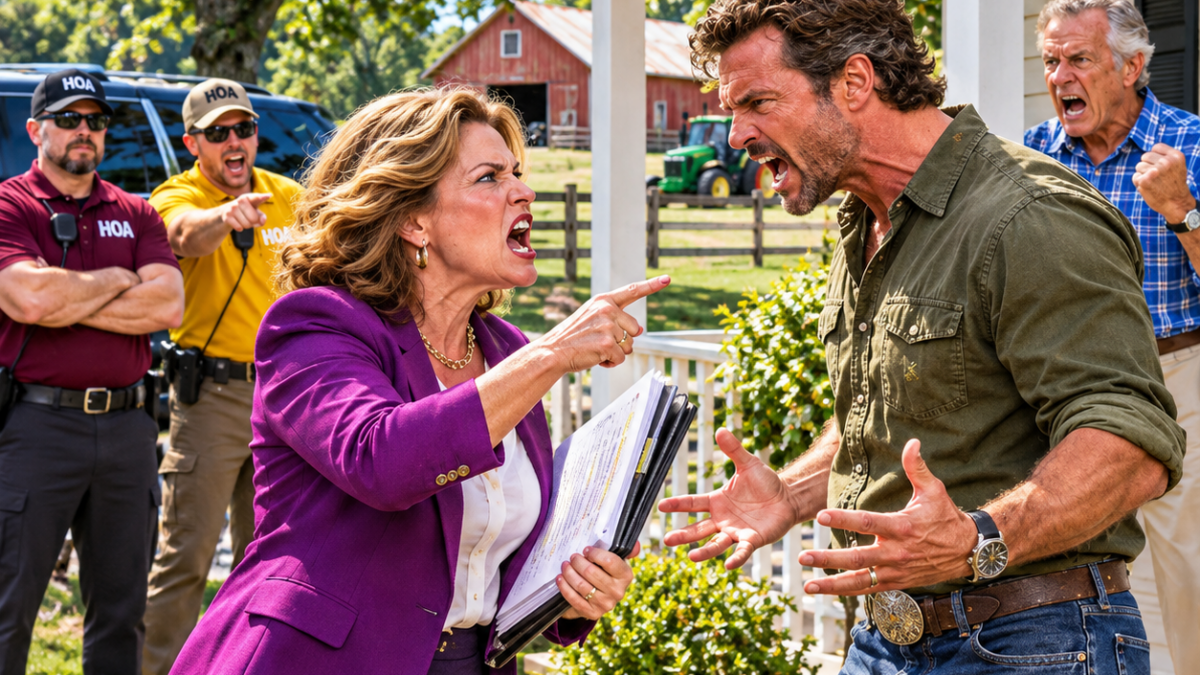
**“YOUR 48 HOURS ARE OVER, MR. BROOKS—HAND OVER THE KEYS OR THE PROPERTY MANAGER WILL TAKE CONTROL OF THIS FARM TODAY!” HOA president Linda Whitmore shouted from our driveway.**
**Dad had owned those seventy-eight acres for more than thirty years, yet the HOA had created a fake default, a fake transfer, and paperwork calling him an unauthorized occupant in his own farmhouse.**
**Then the regional manager Linda had invited opened her folder, studied one parcel number, and quietly told the sheriff, “Nobody removes this farmer.”**
Three black SUVs rolled through Dad’s front gate at 9:12 on Friday morning.
Linda Whitmore stepped out of the first one looking like a woman arriving to collect something she had already won.
Behind her came two Westfield Meadows board members, community manager Robert Lane, and a sheriff’s cruiser.
Dad stood beside me on the porch.
Sixty-eight years old.
Work boots.
Faded jeans.
Coffee in one hand.
Not a single moving box anywhere.
Linda looked almost disappointed by that.
“Mr. Brooks has refused to vacate,” she announced as the sheriff’s deputy walked toward us. “The property has already transferred into the Westfield expansion portfolio. We’re here to complete possession.”
Deputy Michael Turner looked at her.
“Do you have a court eviction order?”
Linda’s smile tightened.
“The regional property manager has the transfer documents.”
“That wasn’t my question.”
She ignored him and looked toward the road.
The second black SUV stopped.
Then the third.
A tall man in a gray jacket stepped out.
REGIONAL PROPERTY MANAGEMENT was stitched over the pocket.
Linda’s confidence returned instantly.
“Mr. Bennett.”
The man looked toward Dad.
Then at the farmhouse.
Then the red barn.
Then the pasture beyond it.
Linda hurried toward him and handed him a thick folder.
“We have an occupant refusing to leave transferred development property.”
Dad took a sip of coffee.
“Occupant?”
I almost laughed.
Linda did not.
The manager opened the folder.
His name was Andrew Bennett.
He read the first page.
Then the second.
Then the survey.
His expression changed.
“Where did you get this parcel number?”
Linda pointed toward Robert Lane.
“Your acquisition office provided everything.”
Andrew looked at Robert.
Robert looked uncomfortable.
Andrew checked another page.
Then another.
Finally he closed the folder.
PART2:
“My company does not own this farm.”
Linda stared.
“What?”
“Summit Community Asset Management does not own Brooks Farm.”
“You manage the Westfield expansion portfolio.”
“We manage portions of it.”
“This farm was transferred into that portfolio after default.”
Andrew opened the folder again.
“Show me the recorded deed.”
Linda pointed to one of the documents.
Andrew studied it.
Then slowly shook his head.
“You invited the wrong manager.”
Dad lowered his coffee.
Linda’s face went tight.
“What is that supposed to mean?”
“It means I’m not here to remove Mr. Brooks.”
Andrew looked toward Deputy Michael.
“Nobody removes this farmer based on these documents.”
Then he walked back to his SUV.
Linda followed.
“Andrew, there has obviously been a filing error.”
He ignored her, opened his own briefcase, and removed a large development map.
He spread it across the hood.
I stepped closer.
So did Dad.
Westfield Meadows was shaded blue.
Brooks Farm was green.
Between them ran a thick red boundary.
PRIVATE AGRICULTURAL BUFFER.
NO HOA AUTHORITY.
Dad looked at Linda.
“Well.”
Andrew pointed farther east.
Twenty-seven new homes stood behind our tree line.
Several were visible from the driveway.
He looked at the map.
Then at the houses.
Then back at Linda.
“If these documents are what I think they are, those homes may be using roads and utilities across property your HOA never had authority to touch.”
One of Linda’s board members leaned close and whispered something.
Linda’s face lost even more color.
Andrew asked:
“What?”
She looked toward the eastern pasture.
Then said five words.
“Those houses are already sold.”
That was the moment I understood the forty-eight-hour notice had never really been about removing Dad because of an HOA debt.
They needed him gone because too much had already been built behind him.
My name is Daniel Brooks.
Brooks Farm sits in northern Tennessee.
Dad bought the first sixty acres when he was thirty-four.
Back then, it was not impressive.
Brush.
Rock.
An old farmhouse with a leaking roof.
A red barn leaning badly enough that neighbors joked one strong storm might finish it.
Dad saw something else.
A future.
He cleared pasture.
Repaired the house.
Straightened the barn.
Dug a pond.
Planted oaks beside the driveway.
Years later, he bought eighteen additional acres from a retiring neighbor.
Seventy-eight acres total.
Cattle.
Hay.
Chickens.
Creek bottom.
Woods.
Rolling pasture.
My mother, Susan, planted peach trees behind the farmhouse and grew a vegetable garden so large she spent half the summer giving food away.
Dad always said kindness worked best when nobody kept score.
That was how my parents lived.
If a neighbor needed hay, Dad helped.
If somebody had a bad month, Mom found an excuse to send eggs, tomatoes, soup, or canned vegetables without embarrassing them.
But Dad taught me another lesson too.
Kindness did not mean surrender.
You could help someone without giving them ownership over what you had built.
That lesson became important when Westfield Meadows arrived.
I had already moved to Knoxville by then.
I worked as a civil engineering technician.
Maps.
Drainage plans.
Survey data.
Road projects.
Nothing glamorous.
But I knew how property lines worked.
Westfield started east of Dad’s farm on land formerly owned by a timber company.
The original plan called for roughly seventy homes.
Clubhouse.
Walking trails.
Community pond.
Wide entrance from State Route 41.
No reason for anybody to cross Dad’s property.
At first, Dad liked having neighbors.
He helped a little boy search for a lost dog near the creek.
During a heavy storm, mud blocked part of Westfield’s construction entrance, and Dad let trucks temporarily turn around in an unused corner of his eastern pasture.
Thirty days.
No money.
No complicated negotiation.
Just neighborly permission.
That decision would later become the source of one of the ugliest documents I ever saw.
For the first few years, Westfield barely bothered us.
Its first HOA president, George Nelson, understood where Westfield ended.
He occasionally stopped at the farm to buy eggs.
Then George moved.
Linda Whitmore became president.
The first violation letter complained about Dad’s eastern pasture fence.
Wrong color.
Dad called me laughing.
“Apparently cows need designer fencing now.”
I checked the subdivision plat.
Brooks Farm was not in the HOA.
I wrote back politely.
The next letter complained about the red barn.
Then tractor noise.
Then chickens.
Then hay bales visible from a walking trail.
Every response I sent asked the same thing.
Provide the recorded covenant making Brooks Farm subject to Westfield Meadows.
Linda never did.
Instead, her language became more aggressive.
“Expanded community jurisdiction.”
“Development transition district.”
“Integrated agricultural boundary.”
Official-sounding phrases that meant nothing in the deed records.
I went to the county office.
William Brooks still owned every acre.
No HOA declaration.
No transfer.
No development district.
Nothing.
I sent Linda copies.
The letters stopped for three months.
Then Linda came to the farm.
She brought Robert Lane.
Dad invited them onto the porch.
He even offered coffee.
Linda refused.
She opened a folder.
Westfield wanted to expand west.
Another ninety homes.
Emergency road.
Utilities.
Stormwater.
The easiest route crossed twelve acres of Dad’s eastern pasture.
Dad asked:
“What are you offering?”
Linda smiled.
“This isn’t necessarily a purchase discussion.”
Dad looked at me.
“What kind of discussion is it?”
Linda slid over a photocopy.
Temporary Development Access Agreement.
Dad’s signature at the bottom.
I remembered the original immediately.
The thirty-day truck turnaround after the flood.
But Linda was trying to interpret that temporary permission as “historical integration” between Brooks Farm and Westfield.
I actually laughed.
Dad did not.
He leaned back.
“Then let your lawyers enjoy themselves.”
Linda stood.
“The expansion will happen whether you cooperate or not.”
That was the first moment the whole thing stopped feeling ridiculous.
I hired Rebecca Collins.
Rebecca reviewed everything.
Her answer was simple.
Brooks Farm was private.
The thirty-day access agreement was temporary.
Westfield had no development rights.
She sent Linda formal notice.
Stop HOA violations.
Stop claiming jurisdiction.
No entry without permission.
Any purchase must be negotiated with William Brooks.
Six quiet weeks followed.
Then orange survey stakes appeared six hundred feet inside Dad’s pasture.
Dad pulled them out.
The next morning, new stakes appeared.
I installed cameras.
Two nights later, a survey crew entered from the Westfield side.
I called their company.
The owner sounded horrified when I sent the deed.
He had been told Westfield Development Partners controlled the land.
He apologized and stopped the work immediately.
That became a pattern.
Surveyors.
Contractors.
Utility crews.
People holding work orders.
Most were not villains.
Most had simply been handed paperwork saying the land belonged to someone else.
Rebecca obtained Westfield’s phase-two concept map.
Twelve acres of Brooks Farm were shaded FUTURE COMMUNITY LAND.
Not “proposed acquisition.”
Not “owner negotiation.”
CONTROLLED BY WESTFIELD DEVELOPMENT GROUP.
False.
We forced the county file to be corrected.
Then Dad received a $7,800 HOA assessment.
Five years of dues.
Fines.
Administrative fees.
And my favorite phrase:
Agricultural incompatibility charges.
Dad read it twice.
“I’m a farmer.”
“Apparently that’s the incompatibility.”
Rebecca challenged it.
Westfield’s attorney withdrew the assessment two weeks later and called it an administrative error.
We thought Linda might finally stop.
Instead, she escalated.
Dad called me months later while I was at work.
“Daniel.”
His voice sounded strange.
“What happened?”
“This one says I have to leave.”
I drove to the farm.
The certified notice sat on his kitchen table.
WESTFIELD MEADOWS.
NOTICE TO VACATE — 48 HOURS.
According to the letter, Brooks Farm had been transferred into the Westfield Expansion Land Portfolio after “default and acquisition proceedings.”
Dad was described as an unauthorized occupant.
His own farmhouse.
Unauthorized.
The notice said a regional property manager would arrive after forty-eight hours to inspect, secure, and prepare the land for development.
Dad looked at me.
“Did I lose the farm?”
“No.”
I checked the property records.
Still William Brooks.
Rebecca checked court filings.
No foreclosure.
No lawsuit.
No judgment.
No deed transfer.
No eviction.
Nothing.
Westfield’s own attorney denied preparing the notice.
At the bottom appeared another company name.
Summit Community Asset Management.
A large regional property manager.
Rebecca called.
Summit had no eviction file under Dad’s name.
No possession order.
No Brooks Farm acquisition.
But a regional manager was scheduled to visit Westfield on Friday.
Exactly when the forty-eight hours expired.
Requested by Linda Whitmore.
Purpose:
TRANSFER ACTIVATION AND LAND CONTROL CONFIRMATION.
Rebecca told Dad:
“Do not pack anything.”
He looked toward the window.
“I buried Susan here.”
“I know.”
“I’ve lived here thirty-four years.”
“I know.”
“I’m not leaving because Linda printed a letter.”
Friday morning came.
Dad woke at five.
Fed chickens.
Checked cattle.
Made coffee.
At 8:30, Linda arrived.
Two board members.
Robert.
Deputy Michael.
No court order.
Michael made it clear he was there only to keep peace.
Then at 9:12, Andrew Bennett arrived.
And Linda’s whole plan began breaking apart.
When Andrew unfolded the original Summit boundary map and said Brooks Farm was not part of the management portfolio, Linda tried to blame the acquisition office.
Then Andrew pointed at the twenty-seven Westfield Ridge houses.
That was when excavators appeared.
Two machines came through the eastern boundary.
Bulldozer behind them.
Temporary fencing truck.
One bucket dropped beside Mom’s peach trees.
Dad ran.
I ran after him.
The excavator tore through the old fence.
A branch snapped from one of Mom’s trees.
Then Rebecca shouted.
“Daniel!”
She had Linda’s transfer packet open.
“This isn’t twelve acres.”
“What?”
“There’s another legal description.”
The first page covered the eastern twelve.
The second added sixty-six more.
Farmhouse.
Barn.
Pond.
Pasture.
Woods.
Even the family cemetery.
They were claiming all seventy-eight acres.
Andrew ran toward the excavator.
The operator stopped inches from another peach tree.
Deputy Michael shut the site down.
The foreman showed us his orders.
According to them, Westfield Development Partners legally controlled Brooks Farm and clearing could begin because the “occupant surrender deadline” had expired.
Dad stared at him.
“Occupant?”
The foreman looked embarrassed.
“That’s what the paperwork says.”
Andrew compared the contractor packet to Linda’s documents.
One parcel number had been altered.
One digit.
Enough to make Brooks Farm look like part of the approved Westfield property.
The crew left.
Dad walked to Mom’s damaged peach tree.
One branch lay on the ground.
He touched it.
Said nothing.
Andrew apologized.
Dad shook his head.
“You didn’t drive the excavator.”
“No.”
“You didn’t send it?”
“No.”
“Then help us find who did.”
Andrew nodded.
“I will.”
That was when I started respecting him.
He did not defend bad paperwork because his company’s name appeared on it.
He checked.
Admitted what he did not know.
And asked questions.
Andrew explained Summit’s actual role.
They managed completed sections of Westfield for investors.
They did not own Brooks Farm.
They did not authorize Linda to evict private landowners.
Linda had requested Andrew because he was the regional manager responsible for accepting troubled developments into long-term management.
If she could get him to sign an acceptance form after Dad left, Summit’s name would make the transfer look legitimate.
She had invited him to validate the story.
Instead, he became a witness against it.
The fake deed Linda brought looked frighteningly convincing.
County formatting.
Parcel description.
Notary section.
Recording number.
Dad’s signature.
Rebecca checked the number.
It belonged to an unrelated utility easement filed years earlier.
The deed itself had never been recorded.
The county confirmed Dad still owned the entire farm.
When Rebecca printed the record, Dad folded it carefully.
“I knew I still owned it.”
“I know.”
“I just wanted to see my name.”
I understood.
After enough official-looking letters tell you your home is not yours, even truth starts feeling like something you need to hold.
The Westfield board called an emergency meeting.
Linda did not attend.
Robert did.
Residents packed the clubhouse.
A woman asked:
“Is Brooks Farm part of the HOA?”
Robert paused.
“No.”
That one answer changed the room.
Another resident asked why the HOA president had sent an eviction-style notice to somebody outside the HOA.
Robert called the expansion process complicated.
Jennifer Reed stood.
“Did HOA money pay for any of this?”
Treasurer Peter Walsh checked the records.
More than $46,000 had gone to Ridgeway Development Services.
Invoices included:
BOUNDARY INTEGRATION.
AGRICULTURAL PARCEL COMPLIANCE.
TRANSFER PREPARATION.
OCCUPANT TRANSITION.
Dad laughed when I told him that phrase.
“Occupant transition.”
Ridgeway’s owner?
David Whitmore.
Linda’s husband.
Peter found no board vote approving the full contract.
Only an executive authorization carrying Linda’s signature and Robert’s.
Robert stared at it.
“I never signed that.”
A smaller landscaping authorization existed with Robert’s real electronic signature.
The signature on the larger Ridgeway contract was identical.
Later examination confirmed it had been copied.
Another real signature placed on another document.
Linda was suspended.
Ridgeway payments were frozen.
An independent audit began.
Then Andrew’s warning about the twenty-seven houses came back.
County surveyors spent three days marking the boundary.
The houses themselves were mostly on legitimate lots.
Good.
Nobody wanted families thrown out.
But the road behind them crossed nearly four hundred feet into Dad’s eastern twelve acres.
So did storm drains.
Street lights.
Water.
Power.
Fiber.
A utility vault sat on Dad’s land.
No easement.
No permission.
Nothing.
Dad looked at the paved road.
“When did they build this?”
“Less than a year ago.”
The answer explained why Linda needed him gone.
Too much had already crossed the boundary.
Westfield Development Partners produced a document called the Brooks Agricultural Integration Agreement.
Permanent road.
Water.
Sewer.
Electrical.
Drainage rights.
Dad’s signature.
Again.
This one supposedly dated three years earlier.
Dad remembered signing one Westfield document around then.
Temporary drainage permission.
A storm had flooded part of the subdivision.
He let workers place a pump hose across the pasture for six days.
Rebecca found the original.
Same signature.
The examiner confirmed it.
Copied.
A six-day drainage favor had become permanent utilities.
Dad sat at the kitchen table.
“I need to stop helping people.”
“No.”
He looked at me.
“You need to stop helping people who turn kindness into ownership.”
He nodded.
The county stopped all new Westfield Ridge construction.
Existing homeowners could remain.
Existing utilities stayed temporarily.
Nobody wanted to punish people who bought homes in good faith.
Then the audit found money.
Westfield Development Partners had paid Ridgeway $215,000 over eighteen months.
One invoice stood out.
BROOKS PARCEL FINALIZATION — SUCCESS FEE.
$75,000.
Paid two days before Dad got the forty-eight-hour notice.
The contract defined success as:
Owner possession sufficiently displaced to permit development activation.
Dad stared.
“They didn’t need to buy it.”
Rebecca nodded.
“They needed you gone.”
If Dad left, the farmhouse looked surrendered.
Contractors could move.
Summit could be shown vacant property.
Then every false document became easier to believe.
The forty-eight hours were about speed.
Get the owner out before anyone checked.
Andrew found more in Summit’s archived emails.
Three months earlier, Linda had asked a junior employee whether Summit could activate management once an owner vacated development land.
The employee said only after a legal transfer.
Linda asked:
“What if owner leaves before recording catches up?”
Then another email appeared.
Linda to David:
Summit visit must happen immediately after Brooks exits.
David:
Manager only needs vacant property and signed file.
Linda:
What if he questions deed?
David:
Use Ridgeway packet. Once management starts, county will follow.
That was why Andrew mattered.
They wanted Summit’s authority without Summit’s knowledge.
Andrew looked furious.
“She wanted my signature.”
Rebecca nodded.
“She wanted your company’s name.”
That was the scheme in one sentence.
Borrow authority.
Borrow signatures.
Borrow company names.
Borrow official-looking numbers.
Then make the lie look too large for one farmer to fight.
Dad stayed.
That broke their timing.
Then the situation got darker.
Surveyors appeared beside our family cemetery.
Mom’s grave.
Dad’s parents.
Two older relatives.
Their work order came from Ridgeway.
A new corridor crossed the western half of the farm.
WESTFIELD REGIONAL CONNECTOR — PHASE 3.
Phase 3 would add roughly 160 homes.
Thirty-one acres of Brooks Farm.
The proposed road went directly through the cemetery.
Then Andrew called.
“Daniel, don’t let anybody touch that cemetery.”
“What happened?”
“Summit just received a demolition schedule.”
Farmhouse.
Barn.
Equipment shed.
Chicken house.
Fencing.
Well.
And “memorial burial area.”
The cemetery was scheduled for relocation before noon the next day.
Dad stood beside Mom’s maple tree while Rebecca read the document.
His name appeared on the approval.
He had never approved anything.
The signature looked different this time.
Too smooth.
Probably digitally reconstructed rather than copied from one old page.
The county had no cemetery relocation permit.
No farmhouse demolition permit.
No ownership transfer.
Deputy Michael arranged patrol.
Andrew stayed.
At Dad’s kitchen table, he explained why Linda had chosen him.
Andrew was Summit’s transition manager.
When a development had incomplete infrastructure, disputed property, or unfinished common assets, he reviewed everything before Summit accepted management.
If Dad left and Andrew signed, the false acquisition suddenly gained institutional credibility.
Dad listened.
“So they needed me gone because an empty house doesn’t argue?”
Rebecca looked at him.
“Yes.”
Dad smiled faintly.
“Then staying home was smart.”
Investigators obtained Ridgeway records.
One internal document was titled:
BROOKS VACANCY PLAN.
Step One:
Increase HOA pressure.
Step Two:
Create financial default record.
Step Three:
Issue final possession notice.
Step Four:
Schedule manager inspection after vacancy.
Step Five:
Activate site clearing.
Step Six:
Complete land control recording.
The recording was last.
Not first.
They wanted to create physical reality before legal reality.
Another email:
David:
Brooks will leave if notice sounds final.
Linda:
He keeps checking county records.
David:
Then county record must be last step, not first.
Linda:
Risky.
David:
Only if he stays.
Dad read that line.
“They really thought I’d leave.”
For a moment, he looked more hurt than angry.
Then another message.
Linda:
48 hours is aggressive.
David:
Needs to happen before Andrew visit.
Linda:
What if William calls sheriff?
David:
No court order means they will call it civil.
They were counting on confusion.
No sheriff would physically evict Dad without an order.
But they did not need police to remove him if they scared him into leaving voluntarily.
Dad admitted something to me later.
“For five minutes, I thought about packing.”
That shocked me.
“What stopped you?”
He looked toward Mom’s maple tree.
“Your mother would’ve laughed at me.”
I smiled.
“She would have.”
Meanwhile, the twenty-seven Westfield Ridge houses still had a real access and utility problem.
Dad refused to use them as leverage.
“We’re not shutting off somebody’s water.”
Rebecca agreed.
The county created temporary emergency access for the existing homes.
No new construction.
No additional connections.
No phase 3.
That kept families safe while ownership was sorted out.
Then Westfield Development Partners sent Richard Coleman.
Richard admitted the company believed Brooks Farm had accepted compensation.
Their accounting showed a $310,000 acquisition payment.
Dad asked:
“Where’s my money?”
Nobody knew.
Rebecca traced the receiving account.
BROOKS AGRICULTURAL HOLDINGS LLC.
Sounds legitimate.
It was not Dad’s company.
It had been created sixteen months earlier.
Owner:
David Whitmore.
Dad looked at the screen.
“He paid himself for my land.”
That was essentially what the records showed.
Westfield Development Partners sent $310,000 believing it was acquiring land rights from an entity representing Dad.
Instead, David controlled the entity.
The money split afterward.
Some to Ridgeway.
Some to David.
Some to another company:
Whitmore Land Investments.
That company owned forty acres west of Dad’s farm.
Land that would become enormously more valuable if phase 3 crossed Brooks Farm.
Now the motive was no longer vague.
David was not just helping a developer.
He stood to profit personally.
A seven-year-old consultant report made it even clearer.
WESTERN EXPANSION FEASIBILITY.
Dad described as:
AGING OWNER WITH LIKELY SUCCESSION TRANSITION.
Full Brooks acquisition unlocks approximately 230 additional units.
Final note:
OWNER RESISTANCE RISK HIGH WHILE WILLIAM BROOKS REMAINS IN POSSESSION.
Dad laughed bitterly.
“Nice to be rated.”
The cemetery corridor suddenly looked even uglier.
It was the shortest route from Westfield toward David’s forty acres.
Mom’s grave was not part of some unavoidable planning problem.
It was simply in the way of somebody else’s profit.
The court issued a protective order.
No construction.
No demolition.
No survey.
No cemetery work.
Nothing on Brooks Farm without Dad’s consent or court approval.
For the first time, he slept properly.
Then the developer did something sensible.
They asked.
Not demanded.
Not fabricated.
Asked.
Would Dad grant a narrow permanent easement for the existing road and utilities serving the twenty-seven families?
Fair market payment.
Legal costs covered.
Fence repair.
Privacy buffer.
No expansion.
Dad considered it.
“What happens to those families if I say no?”
Rebecca explained the county could maintain temporary access while everything was redesigned.
Dad nodded.
“I don’t want twenty-seven families living with uncertainty because David lied.”
But he had conditions.
Existing road width only.
Existing twenty-seven homes only.
No phase 3.
No commercial construction.
No future streets.
No additional wastewater connections.
Recorded clearly.
Publicly.
The developer agreed in principle.
It was the first time the entire situation began looking solvable.
Then Andrew called again.
“Daniel, get your dad away from the eastern field.”
I ran toward the barn.
Dad was loading feed.
“What now?”
Before I could answer, the ground cracked.
Not an explosion.
A deep underground break.
Water began bubbling through the pasture.
The earth dropped several inches near the illegal utility road.
Then water surged harder.
The utility vault tilted.
Another line broke.
The smell arrived.
Sewage.
The twenty-seven houses started losing water and sewer service.
County crews rushed in.
An engineer compared the actual underground route to the approved plan.
“They’re not where they should be.”
The pipes ran almost two hundred feet deeper into Brooks Farm than the approved map showed.
And they did not stop at the twenty-seven houses.
They continued toward the unapproved phase-three area.
A worker opened a collapsed junction box.
Inside were capped future connections.
OAKRIDGE LANE.
PINECREST DRIVE.
WHITMORE BOULEVARD.
Dad looked at me.
“Whitmore?”
One line pointed directly toward David’s forty-acre parcel.
They had already installed future infrastructure for a development that did not legally exist.
Across Dad’s land.
Before they had even created the fake transfer.
Then an engineer traced another pipe.
South.
Toward Dad’s pond.
“What does that one do?” Dad asked.
The engineer studied the valve diagram.
His face changed.
“Storm and wastewater overflow.”
“Where does it end?”
He looked toward the water.
“The pond.”
Dad’s cattle drank there.
The creek below the pond crossed our farm.
Environmental crews arrived before noon.
The cattle were moved immediately.
Frank helped set temporary tanks.
Dad stood beside the pond watching technicians take samples.
For the first time since the fake eviction letter, he looked genuinely shaken.
“I should’ve checked.”
“How?”
“I walk past it every day.”
“You can’t see underground pipes.”
He knew that.
Guilt rarely listens to logic.
Preliminary tests showed elevated bacteria near the hidden discharge point.
Not catastrophic raw-sewage contamination.
Thank God.
But evidence of repeated overflow.
The county closed the pond temporarily.
Then records from the buried junction box revealed the installation date.
Eleven months earlier.
Before Linda’s serious letters.
Before the fake deed.
Before the forty-eight-hour notice.
They had installed underground infrastructure first.
Then created paperwork afterward.
That destroyed any claim that contractors merely relied on an existing transfer.
The pipes predated the transfer story.
Ridgeway had ordered the work.
The contractor had been told everything was inside Westfield-controlled property.
Again, workers used false information.
Dad did not blame them.
By then, he had become very good at separating the people holding shovels from the people writing orders.
Sheriff’s investigators searched Ridgeway’s storage office.
They found maps.
Payment records.
Draft agreements.
Copies of Dad’s tax documents.
Photos of the farmhouse.
Pictures of Dad leaving for church.
One note said:
OWNER USUALLY GONE SUNDAYS 8:20–11:30.
I stared at it longer than I should have.
They had studied his routine.
Not constantly.
Enough.
Enough to know when survey crews could enter unseen.
Enough to know when utility work could happen.
Another folder:
BROOKS TRANSITION.
Inside was the forty-eight-hour notice before it was sent.
Handwritten beside it:
MUST VACATE BEFORE SUMMIT INSPECTION.
Another:
IF HE REMAINS, ESCALATE DEFAULT NARRATIVE.
Default narrative.
That explained the fake $7,800 assessment.
Create debt.
Create default.
Create transfer.
Create eviction.
Then tell everyone the story as though each stage naturally followed the last.
The accounting records were even worse.
The $75,000 success fee was only part of Ridgeway’s incentive.
Another $250,000 bonus would be paid if Brooks Farm became available for phase-three development within sixty days.
The forty-eight-hour deadline was only the first clock.
Everybody was racing toward a much larger payout.
Richard Coleman looked sick when he saw the contract.
He produced emails showing Westfield Development Partners had been told Dad was a willing seller.
David had written:
Owner has agreed in principle but wants low public profile.
Another:
Possession date should precede final recording to avoid tax delay.
Another:
Family wants quiet transition.
Dad laughed bitterly.
“Very private sale. I didn’t even tell myself.”
Richard apologized.
Dad looked at him.
“You still should’ve called me.”
Richard nodded.
“Yes.”
That mattered.
Being lied to does not erase every responsibility.
One phone call to the landowner could have stopped millions of dollars of bad decisions.
The pond testing eventually brought better news.
Repeated overflow had occurred.
Cleanup was necessary.
But the creek downstream had not reached dangerous contamination levels.
The cattle showed no signs of illness.
A veterinarian recommended monitoring.
Dad sat down when he heard it.
Then whispered:
“Thank God.”
Not the fake eviction.
Not the bulldozers.
Not the cemetery.
That was the most emotional moment.
The animals were okay.
The creek was okay.
The pond could recover.
The county ordered environmental remediation.
The illegal overflow line was removed.
Contaminated sediment near the discharge point was taken out.
Aerators were installed.
Weekly testing continued.
A month later, the pond was cleared for normal use.
Dad waited another week anyway.
“Safe today doesn’t mean I need to rush.”
That sounded exactly like him.
Then the legitimate easement was completed.
Not a fake one.
Dad sat with Rebecca.
Westfield Development Partners sat across the table.
Everybody discussed the exact strip.
Survey.
Width.
Road.
Utility lines.
Maintenance.
Emergency shutoff.
Privacy buffer.
Payment.
Existing twenty-seven homes only.
No future development rights.
No phase 3.
No hidden pipes.
No expansion.
No Whitmore Boulevard.
Dad added one final condition.
Every homeowner using that road had to receive written notice saying their access crossed Brooks Farm under a recorded easement.
The HOA did not own the land.
Rebecca smiled.
“No confusion later.”
“Exactly.”
The agreement was recorded properly.
Publicly.
Dad signed the real document himself.
Jennifer brought him a pie afterward.
“You saved our road.”
Dad shook his head.
“I made your road legal.”
That was better.
Phase 3 collapsed.
Without Brooks Farm, the route to David’s forty acres became impractical.
Westfield Development Partners redesigned future plans around land it actually controlled.
Mom’s cemetery stayed exactly where it was.
Farmhouse stayed.
Barn stayed.
Pond stayed.
Peach trees stayed.
That mattered more to Dad than any money.
The criminal investigation took longer.
Fake deed.
Copied signatures.
Fraudulent company.
$310,000 payment.
$75,000 success fee.
Hidden infrastructure.
False possession notice.
Forged management approvals.
Surveillance notes.
Illegal wastewater line.
Different pieces led to criminal allegations, civil cases, settlements, and financial claims.
Linda was permanently removed from the HOA.
David’s companies lost their Westfield contracts.
Ridgeway shut down.
Brooks Agricultural Holdings disappeared after the fraud became public.
Whitmore Land Investments eventually sold the forty acres west of Dad.
The new owner came to the farmhouse before doing anything.
Knocked.
Sat on the porch.
Asked.
He wanted a small equestrian property.
No subdivision road.
No utility corridor.
No cemetery relocation.
Dad said he had no problem with it.
Twenty minutes.
That was all.
Two years of fake paperwork could have been avoided by twenty minutes of normal human behavior.
The Westfield HOA changed too.
Peter Walsh eventually became president.
New rules.
No family-connected contracts without disclosure.
No private property shown as HOA land without verified recorded rights.
No land acquisition without independent title review.
No management signature accepted without confirmation.
And no HOA notice could use words like VACATE, SURRENDER, or POSSESSION unless an actual legal process supported it.
Dad joked that last one should be called Linda’s Rule.
Nobody laughed very hard.
Some things take time.
Andrew Bennett returned six months later.
No SUVs.
No gray jacket.
No thick folder.
Just coffee.
Dad met him on the porch.
“You here to take possession?”
Andrew smiled.
“Only of one cup.”
They talked for almost an hour.
Andrew told Dad the case changed Summit’s policy.
Any disputed property entering management now required direct owner verification and independent title confirmation.
“Your farm changed our procedure.”
Dad looked pleased for about half a second.
“Good.”
Then:
“Maybe the next farmer won’t get forty-eight hours.”
The damaged peach tree survived.
The broken branch never returned.
But new growth appeared the next spring.
Andrew had brought Dad another peach sapling.
Dad planted it beside Mom’s old trees.
He called it “the manager.”
“Why?”
“Showed up late. Turned out useful.”
Andrew laughed harder than anybody.
The civil settlement came nearly a year after the notice.
Dad received compensation for the permanent easement, damage to the pasture, fence restoration, environmental cleanup, legal expenses, and unauthorized use of the property.
It was enough money that he could have retired.
Sold the cattle.
Moved closer to me.
Bought something smaller.
He did none of those things.
He repaired the barn roof.
Bought a better tractor.
Replanted part of the eastern pasture.
Then donated money to an agricultural legal-aid group helping older farmers understand deeds, easements, and development agreements.
I asked why.
“Not everybody has a son who reads maps for a living.”
That was Dad.
Somebody almost used his kindness to take his farm.
His response was to help another farmer protect theirs.
He did change one thing.
No temporary access agreement went unsigned without Rebecca looking at it first.
Contractor.
Neighbor.
Utility company.
Anybody.
Kindness stayed.
The paperwork improved.
That was probably the right lesson.
Frank still came on Saturdays.
Jennifer still bought eggs.
The twenty-seven Westfield Ridge houses remained behind the eastern trees.
Dad never blamed those families.
They had been lied to too.
Some became his strongest supporters.
One helped repair fencing.
Another donated trees for the privacy buffer.
Westfield teenagers helped clean trash from the creek.
Dad gave them lemonade afterward.
That was how the relationship healed.
Small actions.
Not speeches.
One afternoon, I asked him whether he regretted letting Westfield’s trucks use the pasture years earlier.
He thought for a while.
“No.”
That surprised me.
“They used your kindness against you.”
“They tried.”
“So why not regret helping them?”
Dad looked toward the eastern field.
“Because helping somebody when they need help is still right.”
Then he looked at me.
“The mistake would be believing kindness means I have to stay quiet when they cross the line.”
I never forgot that.
Kindness is not weakness.
Boundaries are not cruelty.
You can help a neighbor and still require permission.
You can forgive somebody and still record an easement properly.
You can let a truck turn around for thirty days without giving away seventy-eight acres.
Today the red barn still stands.
Mom’s peach trees still grow behind the farmhouse.
The pond is clean.
The cattle drink from it again.
The cemetery remains beneath the maple tree.
The eastern road serves exactly twenty-seven houses under the narrow easement Dad chose to grant.
Nothing more.
No phase 3.
No 230-unit expansion.
No Whitmore Boulevard.
No hidden wastewater connection.
No development portfolio swallowing the farm.
And the county deed still says:
William Brooks.
Owner.
Seventy-eight acres.
People remember different pieces of the story.
Some remember the fake forty-eight-hour eviction.
Some remember the excavators coming through the pasture.
Some remember the cemetery demolition schedule.
Some remember the hidden wastewater pipe.
Westfield residents usually remember Andrew Bennett.
Linda invited him because she believed he would help take control of the property.
She expected him to arrive after Dad had already left.
An empty farmhouse.
A thick folder.
A few signatures.
A management company accepting the property.
Once Summit’s name appeared on the transition, everyone else might have assumed the transfer was legitimate.
But Dad stayed.
And Andrew checked.
He looked at the parcel number.
Checked the deed.
Compared the map.
Asked who had signed what.
Then he said the sentence that broke the entire plan.
“My company does not own this farm.”
Sometimes a very large lie survives because everybody assumes someone else already checked it.
The developer trusts Ridgeway.
The contractor trusts the developer.
The HOA trusts Linda.
The management employee trusts the uploaded file.
The county clerk trusts the parcel number.
The homeowner trusts the closing packet.
The bulldozer operator trusts the work order.
Then one person asks:
Where is the deed?
Who owns this parcel?
Who signed this?
Why does this number not match?
Why is a farmer standing on land you call vacant?
Linda had counted on nobody asking those questions until Dad was gone.
She was wrong.
The farm survived because Dad refused to leave.
But it also survived because, once the truth was visible, enough people chose to stop pretending they did not see it.
Andrew.
Rebecca.
Deputy Michael.
Peter.
Frank.
Jennifer.
Even Richard Coleman, once he realized his company had been misled.
Not everybody was a hero.
Not everybody was a villain.
Some were careless.
Some were greedy.
Some were fooled.
Some became brave only after the truth became uncomfortable.
What mattered was what they did next.
Dad is seventy now.
His knees bother him.
He still owns a tractor he should have replaced ten years ago.
Every morning he walks past Mom’s maple tree before checking the cattle.
Inside the barn office, the original forty-eight-hour notice hangs in a cheap frame.
I asked him why.
“To remember what they did?”
“No.”
“To stay angry?”
“No.”
“Then why keep it?”
Dad smiled.
“Because it gave me forty-eight hours to leave.”
He looked toward the farmhouse.
The red barn.
The pond.
The pasture beyond it.
“And I’m still here.”








