HOA Gave Me 48 Hours to Leave My Island Cabin—Then I Found Out Why They Needed Me Gone Before Monday.
PART2:
The occasional wealthy man’s speedboat that cost more than my entire island.
During weekdays I worked from a shop at Crestwater Marina.
At night or on weekends, I went home by skiff.
Most people thought living on an island sounded romantic.
They imagined coffee on the dock.
Sunsets.
Loons.
Fishing.
Those parts existed.
They forgot hauling groceries in rain.
Frozen fuel lines.
Windstorms.
Boat repairs when the boat was your car.
Snow.
Ice.
And the fact that if you forgot milk, you did not walk two minutes to a store.
Still, I loved it.
The quiet especially.
PART3:
My father had died when I was twenty-seven.
My mother moved south after that.
I had no wife.
No children.
No secret fortune.
Just work, friends, the island, and more peace than I deserved.
Across the lake sat Silver Pine Shores.
Seventy-four expensive houses.
Community marina.
Clubhouse.
Private beach.
Landscaped walking trails.
Matching docks.
Architectural standards.
Stone entrance monument on the county road.
The development had existed in some form since the 1980s, but most of the large homes were newer.
I knew some residents because they owned boats.
Good people, mostly.
When an engine fails in the middle of a lake, nobody cares whether the mechanic owns nicer property than they do.
I had repaired pontoon motors for doctors.
Bass boats for contractors.
Jet skis for teenagers whose fathers were furious.
Once I rebuilt an antique Johnson outboard for a retired judge who paid me partly in smoked trout.
My relationship with Silver Pine Shores itself was different.
Especially after Blythe Renshaw became HOA president.
Blythe was fifty-two.
Silver hair.
Perfect posture.
White jackets.
Expensive sunglasses.
A voice that somehow sounded amplified even when she wasn’t holding a microphone.
She had been president for nine years.
People joked that Silver Pine did not have elections.
It had confirmations.
Blythe controlled meetings.
Vendor contracts.
Special assessments.
Community events.
Security.
Marina policies.
She liked calling the HOA “an eight-million-dollar community enterprise.”
That phrase always bothered me.
People lived there.
It was not a corporation.
But Blythe talked about property values the way some people talk about religion.
Anything threatening value was immoral.
Anything increasing value justified itself.
My island had annoyed her for years.
Not because it looked bad.
Honestly, most Silver Pine residents liked it.
The cabin was cedar.
I kept the shoreline natural.
At night, one porch light glowed across the water.
People said it looked peaceful.
Blythe saw something else.
Uncontrolled land.
Land within sight of her community that she could not regulate.
Our first argument happened six years before the eviction.
She came to the island in a pontoon boat with two board members.
No appointment.
I met them at the dock.
“Mr. Allison.”
“Wade’s fine.”
“We’d like to discuss shoreline coordination.”
“What’s that?”
She smiled.
“A cooperative framework between the island and Silver Pine Shores.”
“I don’t know what that means.”
“It would be beneficial for you to follow our shoreline standards.”
“Why?”
“Consistency.”
“With houses a mile away?”
“The lake is one visual environment.”
I laughed because I thought she was joking.
She was not.
She wanted:
approved dock lighting,
approved shoreline vegetation,
limits on exterior equipment,
rules about visible fuel containers,
permission before construction.
I said no.
She said:
“You may find cooperation advantageous.”
I said:
“I already own the island.”
That ended the meeting.
For a while.
Then came letters.
Not fines exactly.
Advisories.
Requests.
Notices.
One claimed my work skiff created “commercial visual intrusion.”
Another asked me to remove two blue fuel cans because they were visible from Silver Pine’s common pier through binoculars.
I mailed that one back with a handwritten question:
WHY ARE YOU WATCHING MY GAS CANS WITH BINOCULARS?
No answer.
Eventually the letters stopped.
I assumed Blythe had found somebody else to bother.
Then came Friday.
6:12 a.m.
I woke to an engine.
Not a fishing boat.
Too deep.
Too aggressive.
High-performance V8.
I lay still for a moment.
Thin morning fog covered the lake.
Then came hammering.
Four hard strikes against my front door.
I sat up.
“What the hell?”
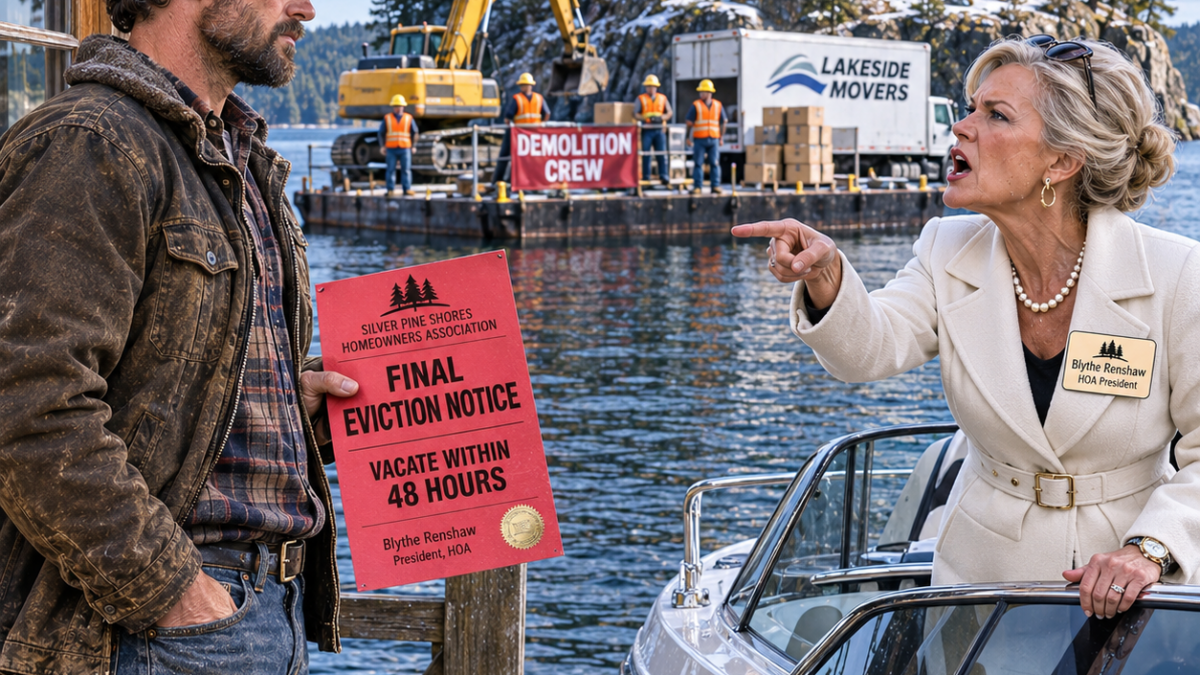
By the time I reached the porch, a man in an HOA security jacket was running down my dock.
At the end waited a white speedboat.
Blythe stood at the stern.
White jacket.
Silver hair.
Megaphone.
Of course she had a megaphone.
I looked at my door.
Bright red paper.
Three large words:
FINAL EVICTION NOTICE
Below:
VACATE WITHIN 48 HOURS
I read it again.
Then again.
The document claimed Crestwater Island now fell within Silver Pine Shores’ “Expanded Shoreline Protection and Emergency Management Zone.”
It said continued occupancy was unauthorized.
It ordered all personal belongings removed.
It warned remaining structures could be cleared as obstructions after the deadline.
Signed:
BLYTHE RENSHAW
President.
Silver Pine Shores Homeowners Association.
I walked to the dock.
“Blythe.”
She lifted the megaphone.
“Good morning, Mr. Allison.”
“Come back here.”
“The notice explains everything.”
“No, it doesn’t.”
“You have forty-eight hours.”
“This island is mine.”
“The association now holds shoreline management authority.”
“No.”
Her smile appeared even through the mist.
“You should speak to counsel.”
“I’m going to speak to the sheriff.”
“You’re welcome to.”
“I never joined your HOA.”
“This is no longer an HOA membership matter.”
“Then what is it?”
“Community safety.”
I laughed.
“Community safety needs my bedroom?”
She lowered the megaphone briefly.
“You’ve resisted cooperation for years.”
“Because you have no authority here.”
“We’ll see.”
She raised the megaphone again.
“Anything remaining after the deadline may be removed.”
I stared.
“You’re threatening to demolish my cabin?”
“I’m informing you of procedure.”
“On what legal basis?”
“Read your notice.”
I almost tore it from the door.
Then stopped.
Something caught my eye.
Near the bottom.
Faint blue stamp.
DOCUMENT REVIEW
CRESTWATER COMMUNITY BANK
I frowned.
I had never borrowed from Crestwater Community Bank.
Never mortgaged the island.
Never held an account there.
Why was a bank stamp on an HOA eviction notice?
Blythe’s boat engine started.
I called:
“Why does the bank care about my cabin?”
The smile disappeared.
Only for a second.
Then:
“Sunday morning, Mr. Allison.”
The boat pulled away.
I photographed the notice before touching it.
Front.
Back.
Nail locations.
Door.
Boat.
Registration number.
Time.
Weather.
Then I carefully removed the paper and slid it into a clear plastic sleeve from my workshop.
Dad had been a claims adjuster.
He drilled one lesson into me:
If something feels wrong, document it before you change it.
At 7:03, I called the moving company named in the notice.
“Morning. I’m calling about a job Sunday on Crestwater Island.”
The dispatcher searched.
“Yes.”
“What are you moving?”
“Residential contents.”
“Who authorized it?”
“Silver Pine Shores.”
“Who owns the contents?”
Pause.
“The work order says association-acquired property.”
I laughed once.
“I’m the owner.”
Longer pause.
“Sir, you’ll need to talk to whoever hired us.”
“When does your crew arrive?”
“Eight a.m.”
I wrote it down.
Next call.
North Channel Safety Solutions.
Marine contractor.
They had reserved an equipment barge.
Hydraulic lifting arm.
Demolition tools.
Crew of six.
Arrival:
8:30 Sunday.
Same morning.
The operations clerk told me:
“We were informed the owner is delaying handover.”
“I am the owner.”
Silence.
“Excuse me?”
“I have not sold anything.”
The woman became cautious immediately.
“I’m going to have my manager call you.”
At 8:16, the manager did.
I told him the island was privately owned and disputed.
He asked me to send a deed.
I did.
He said:
“Until we clarify, we’re not touching anything.”
That was the first reasonable sentence I heard all morning.
Then he added something worse.
“The contract was executed Tuesday.”
I stopped.
“Tuesday?”
“Yes.”
The eviction notice was Friday.
Blythe hired the demolition contractor three days before giving me forty-eight hours.
The deadline was theater.
She had already planned what happened after it expired.
I called the bank.
Receptionist answered.
I mentioned the review stamp.
Silence.
“What document?”
“An HOA eviction notice.”
“Could you hold?”
Transfer.
Risk department.
Voicemail.
I left my information.
Before noon, another problem appeared.
I motored to the commercial marina for gasoline.
Owner was Bill Carter.
Sixty.
Beard.
Knew me ten years.
He came out before I tied off.
“Wade.”
“What?”
His face looked uncomfortable.
“Got an email.”
He handed me a printed page.
Silver Pine Shores had issued a “shoreline safety advisory.”
It claimed Crestwater Island contained a structurally hazardous unauthorized building.
Businesses were advised not to service the location until remediation was complete.
“You believe this?”
Bill shook his head.
“Doesn’t matter what I believe.”
“Then what?”
“Silver Pine is forty percent of my winter fuel contract.”
There it was.
Blythe could not legally stop me from buying gasoline.
She could pressure the people selling it.
I nodded.
“Do what you need to.”
“Wade—”
“It’s fine.”
“No, it isn’t.”
“No.”
I loaded every spare gas can I owned into the skiff.
“It really isn’t.”
I drove into town.
County records office.
Certified deed.
Original survey.
Tax history.
Everything clean.
My name.
My parcel.
Eleven-point-six acres.
Separate from Silver Pine Shores.
Then the clerk found something new.
A filing submitted months earlier.
SILVER PINE EMERGENCY SHORELINE MANAGEMENT PLAN
Glossy map.
My island shaded orange.
Label:
EVACUATION SUPPORT ZONE
I stared.
“What does this do?”
The clerk shrugged.
“It was recorded as supplemental association material.”
“Does that give them ownership?”
“No.”
“Rights?”
“Recording a map doesn’t create rights.”
“Then why accept it?”
“Records offices record documents that meet filing requirements. We don’t adjudicate every claim printed inside them.”
Important distinction.
A filed document could look official without making its underlying claim true.
I called Blythe.
She answered.
“Mr. Allison.”
“County says you don’t own my island.”
“I never said we owned it.”
“You said I was illegally occupying community property.”
“I said the association has management rights.”
Different story.
Within hours.
“Emergency use rights,” she continued.
“Show me.”
“You’ll see them.”
“What use?”
“Evacuation staging. Shoreline safety.”
“My cabin has been there longer than half your houses.”
“It obstructs the site.”
“What site?”
“The emergency zone.”
“Why does the bank need it empty?”
Silence.
Then:
“You seem confused.”
“Explain.”
“You need counsel.”
She hung up.
So I found somebody who understood old lake-property records.
Owen Hartley.
Independent surveyor.
Fifty-seven.
Blunt enough to offend people professionally.
He spread my deed across a table.
“Boundary’s fine.”
“Good.”
“Don’t celebrate.”
He pointed near the bottom.
Reference.
Shoreline Access Agreement, 1984.
I had seen the line before.
Never thought about it.
Attachment missing from my copy.
Owen frowned.
“This matters.”
“Why?”
“Could be nothing.”
“Could be?”
“Easement.”
I felt my confidence drop.
For the first time that day, the situation stopped being simple.
“What if there is one?”
“Then we read exactly what it says.”
“That could give Silver Pine rights?”
“Possibly.”
“To evict me?”
“Slow down.”
“Could it?”
“Not likely from what this reference suggests.”
“Likely is not no.”
“No.”
He looked at me.
“Property law punishes people who get emotionally attached to absolute statements.”
I disliked him slightly.
Which meant he was probably useful.
“Find it.”
“I’ll request archive retrieval.”
“How long?”
“Could be days.”
“I have forty-eight hours.”
“That red paper isn’t a court order.”
“They hired demolition.”
Owen looked up.
“Then you need a lawyer before you need me.”
I returned to the island at dusk.
Someone had installed a camera near my dock.
Bolted to an old mooring piling.
Lens pointed directly toward the cabin.
HOA patrol boat sat twenty yards away.
Security guard waved.
I shouted:
“What is that?”
“Monitoring equipment.”
“For what?”
“Site preparation.”
“This is private property.”
“We’re outside the shoreline.”
“You mounted a camera aimed at my front door.”
“Call the office.”
I filmed it.
Camera.
Piling.
Patrol boat.
Guard explaining the purpose.
Then emailed a written demand for removal.
That night, an anonymous email arrived.
No signature.
One sentence.
Ask Blythe why the bank needs your cabin empty by Monday.
I read it five times.
Then Silver Pine held an emergency HOA meeting.
I knew because a homeowner texted me.
Blythe was telling residents I threatened the community insurance plan.
I went.
Not invited.
Not a member.
Didn’t care.
Clubhouse packed.
Almost seventy people.
Large screen showed aerial photos of my island.
Red words across each:
UNAPPROVED STRUCTURE
EVACUATION OBSTRUCTION
COMMUNITY FINANCIAL RISK
Blythe stood beneath the screen.
“This is not about one man.”
Of course.
“It is about seventy-four families.”
Also of course.
“The association has a duty to protect emergency access, financing stability, insurance coverage, and shoreline safety.”
I walked through the back doors.
People turned.
Blythe stopped.
I carried my deed.
Survey.
Photos.
Nothing more.
She frowned.
“This is a private association meeting.”
“I’ll be quick.”
“You are not a member.”
“Correct.”
I raised the deed.
“Which recorded document gives your association the power to evict me?”
Silence.
Blythe smiled.
“The board operates under emergency shoreline authority.”
“Show me the document.”
“We are not conducting a legal proceeding.”
“Then stop pretending that red paper is one.”
Murmurs.
She pointed toward security.
“Remove him.”
Two guards approached.
I did not resist.
As they escorted me toward the doors, Blythe moved immediately to the next agenda item.
“Supplemental shoreline safety expenditure.”
Amount:
$410,000.
That stopped me.
A retired homeowner named Gordon Fisk raised his hand.
“What happened to the assessment we paid for marina repairs?”
Blythe responded smoothly.
“Separate fund.”
Gordon frowned.
“Four hundred ten thousand for what?”
“Emergency shoreline infrastructure.”
She turned.
“Laurel?”
At a side table sat the treasurer.
Laurel Dunn.
Forty-six.
Dark hair.
Glasses.
Stack of financial reports.
Blythe said:
“Please confirm that expenditures are properly categorized.”
Laurel stared at the papers.
Too long.
Then:
“Yes.”
But she would not look at Blythe.
Twenty minutes later, Laurel found me in the parking lot.
She stood between two trucks.
“You need a lawyer.”
“I’m getting one.”
“Good.”
“What’s going on?”
She looked toward the clubhouse.
“I’m not sure.”
“You signed the budget.”
“I signed reports.”
“Same thing?”
“No.”
Her voice became quieter.
“I thought I was protecting the homeowners.”
“From what?”
She shook her head.
“I don’t know anymore.”
“Why evict me?”
“Maybe that isn’t the actual goal.”
“What is?”
She swallowed.
“Don’t use my name.”
“Laurel—”
“Not until you have counsel.”
She walked away.
At midnight, the HOA newsletter hit every Silver Pine email inbox.
Apparently I had become:
the private island owner blocking essential shoreline safety improvements.
By morning, letters were taped to the marina bulletin board.
One called me selfish.
Another said:
SEVENTY-FOUR FAMILIES MATTER MORE THAN ONE CABIN.
A Realtor warned that the dispute could lower property values.
I sat on my porch reading screenshots.
For about twenty minutes, I considered leaving.
Not giving them the island.
Just temporarily.
Stay with a friend.
Let lawyers handle it.
Avoid becoming the villain in seventy-four households.
Then I looked at the red notice.
Forty-eight hours.
Blythe wanted me scared enough to disappear.
I decided I would not spend the weekend trying to prove I was a good person.
I would figure out why she needed the island.
A contractor I knew helped.
Tommy Reeves.
I had rebuilt his twin outboards the previous summer.
He called.
“You see the shoreline bid?”
“No.”
“I did.”
He forwarded a cost sheet associated with the $410,000 expenditure.
I opened it.
Read.
Then called him.
“Where’s demolition?”
“Exactly.”
The estimate did not describe cabin demolition as the primary purpose.
Instead:
Access Facility Preparation Supporting Credit Inspection.
Credit inspection.
Not emergency evacuation.
Not safety.
Credit.
That afternoon, I met Miriam Vale.
Forty-one.
Property attorney.
Fifteen years handling shoreline disputes.
She read Blythe’s red notice.
Then placed it on her desk like it smelled bad.
“This is not an eviction order.”
“I know.”
“No.”
She looked at me.
“I need you to really understand that.”
“I do.”
“This cannot lawfully remove you.”
“But contractors can still show up.”
“Yes.”
“And destroy the cabin.”
“Yes.”
“So technically being right doesn’t help after my roof is in the lake.”
“Correct.”
I liked her immediately.
She drew two columns on a legal pad.
PROPERTY
MONEY
“We deal with both.”
First:
Emergency court order.
No demolition.
No removal.
No entry.
Second:
Find out why the HOA is connecting your island to financing.
“I want to investigate myself.”
“No.”
“I know the lake.”
“No.”
“I know contractors.”
“No.”
“I know marinas.”
She sighed.
“Clean evidence only.”
“Fine.”
“No trespassing.”
“Fine.”
“No pretending to be somebody else.”
“Fine.”
“No recording where illegal.”
“Fine.”
“No stealing records.”
“I wasn’t going to.”
“You had the face.”
“What face?”
“The one men get when they think breaking into an office is investigation.”
“I repair engines.”
“That did not answer me.”
I smiled.
“Fine.”
I went to North Channel’s yard.
Met the operations manager.
Showed the deed.
Court dispute.
Formal notice.
He gave me written confirmation of the job.
Scheduled Sunday.
Contract signed Tuesday.
Three days before notice.
That email mattered.
By evening, I had turned the island into a record of itself.
Photographs.
Video.
Foundation.
Roof.
Furniture.
Tools.
Dock.
Workshop.
Boat.
Shoreline.
Survey stakes.
Three backups.
Saturday morning, Miriam filed emergency papers.
By noon, Judge Adeline Cross signed a temporary preservation order.
Nobody could demolish, remove, alter, or enter the disputed property without court authorization.
I read the order twice.
For the first time in twenty-four hours, I breathed normally.
Blythe responded within an hour.
Community bulletin:
WADE ALLISON’S LAWSUIT MAY FORCE EMERGENCY ASSESSMENTS ON EVERY SILVER PINE HOMEOWNER.
Then Laurel sent me a message.
Board asked bank to accelerate loan.
Loan.
There it was again.
I emailed Crestwater Community Bank.
Risk Management.
Attached:
deed,
survey,
red notice,
blue stamp,
court order.
Twenty minutes later, my phone rang.
“Mr. Allison?”
“Yes.”
“Russell Daker. Director of Risk Management.”
His tone was not friendly or hostile.
Serious.
“I need to ask you something directly.”
“Okay.”
“Silver Pine Shores does not own Crestwater Island?”
“No.”
“Any part?”
“Not to my knowledge.”
“Do they control any buildings there?”
“No.”
“Have you authorized your cabin or island for use in an association financing transaction?”
“No.”
Silence.
Long.
“What?”
Russell exhaled.
“You need to come to the bank.”
“When?”
“Tomorrow morning.”
“Sunday?”
“Yes.”
“That bad?”
“Bring your attorney.”
That bad.
The bank conference room had glass walls and terrible coffee.
Russell had a thick binder.
Miriam sat beside me.
He opened the file.
“Silver Pine Shores is applying for a refinancing facility.”
“How much?”
“Three point four million dollars.”
My eyebrows rose.
“Why?”
“I can’t discuss every detail.”
He turned pages.
“I can discuss anything involving your property.”
Collateral package included:
marina revenue,
association accounts,
common facilities,
and something described as:
EMERGENCY ACCESS FACILITY — CRESTWATER ISLAND
Photograph attached.
My cabin.
My porch.
My dock.
I stared at it.
Someone had photographed my home and put it inside a loan package as though the HOA controlled it.
Russell said:
“The bank scheduled final collateral inspection early next week.”
I understood before he finished.
“They need me gone.”
“Yes.”
“Why?”
“If an appraiser arrived and found you living there claiming private ownership, it would create an immediate title and collateral problem.”
I sat back.
“They weren’t trying to take the island permanently.”
Miriam said:
“They were trying to create the appearance of uncontested control long enough for inspection.”
Russell nodded.
That was worse in a different way.
Blythe did not need to win legally.
Not yet.
She needed a clean photograph.
Empty cabin.
No boat.
No owner.
Association representatives walking the appraiser through the property without objection.
I pointed toward the blue stamp.
“Your bank approved this?”
“No.”
Russell’s voice hardened.
“Absolutely not.”
He examined the eviction notice.
“That stamp came from our underwriting package.”
“How?”
“Likely scanned or copied from an internal page.”
“So somebody used your review mark to make this look bank-approved.”
“Yes.”
He closed the binder.
“The credit process is suspended effective now.”
My shoulders relaxed.
Russell continued:
“We will require original title documentation for any claimed island rights.”
“No internal maps?”
“No.”
“Board resolutions?”
“No.”
“Marketing material?”
“Definitely no.”
Miriam almost smiled.
For the first time, Blythe’s forty-eight-hour clock stopped belonging to Blythe.
One hour later, she called.
Voice warm.
Almost friendly.
“Wade.”
“Blythe.”
“This has become unnecessarily unpleasant.”
“Your demolition crew made it unpleasant.”
“I’m prepared to resolve things.”
“How?”
“Eighty-five thousand dollars.”
“For?”
“Three months’ temporary use.”
I stayed quiet.
“You remain owner.”
“What use?”
“Emergency shoreline operations.”
“Put it in writing.”
Pause.
“What?”
“Email the offer.”
“That’s unnecessary.”
“No.”
“Wade, I’m trying to help you.”
“Then write it down.”
Her warmth vanished.
“You’re playing games.”
“No.”
“You have no idea what you’re threatening.”
“Write the offer.”
She hung up.
Miriam laughed when I told her.
“Good.”
“What?”
“People who refuse to write offers often know why.”
Then she showed me another problem.
Silver Pine publicly claimed assets around eight million dollars.
Healthy reserves.
Strong community.
If that was true, why desperately borrow $3.4 million?
Laurel called that night.
Rain hit my cabin roof.
Her voice shook.
“If the loan doesn’t close, an old obligation comes due.”
“What obligation?”
“I can’t explain everything on the phone.”
“Then meet me.”
“No.”
“Laurel.”
“Not yet.”
“Why?”
“Because my signature is on some of it.”
Then she disconnected.
I sat in the dark.
The island was not the target.
It was collateral.
The loan was not the end.
It was a cover.
Sunday morning, Blythe sent another newsletter.
Now I was personally responsible for delaying the association’s refinancing.
At the marina, several residents confronted me.
One man shouted:
“Do you want everybody assessed twenty grand?”
A woman said:
“Why can’t you cooperate?”
Another:
“It’s one cabin.”
I put down the fuel nozzle.
“What is your HOA worth?”
Nobody answered.
“Blythe says eight million.”
A man nodded.
“Then why does an eight-million-dollar association need my island to borrow three point four million?”
Silence.
A woman frowned.
“What do you mean?”
“Ask your board.”
That ended the confrontation differently than Blythe hoped.
Her next offer came through counsel.
$250,000.
I read the first page and almost accepted before Miriam stopped me.
“Read the confidentiality clause.”
I did.
Then the acknowledgment.
I would allow existing HOA island-use records to remain in the loan file.
I would not dispute historical association management assertions.
I would not disclose related financial information.
I looked up.
“They’re buying validation.”
“Yes.”
“But they leave me alone.”
“Yes.”
“Quarter million.”
“Yes.”
“That’s a lot of money.”
“It is.”
I took the agreement home.
Put it on my kitchen table.
Looked around.
Cabin I rebuilt.
Wood stove.
Dad’s old fishing rod.
Window facing the lake.
For $250,000, I could secure everything I wanted.
No eviction.
No demolition.
No fight.
All I had to do was let Blythe use a lie involving my property to complete whatever financial transaction she needed.
I slept badly.
At 5:40 a.m., I emailed Miriam.
NO.
By breakfast, Blythe told the community I had rejected a quarter-million-dollar compromise because I wanted more.
She omitted the part where my signature would legitimize her loan package.
That day, two North Channel employees stepped onto my dock.
Court order clearly barred access.
I filmed them.
Names.
Boat registration.
Time.
One said:
“We’re just inspecting.”
I replied:
“You’re violating a court order.”
They left.
I sent the video to Miriam.
She responded:
GOOD. DO NOT ARGUE WITH THEM.
I stopped defending myself publicly.
Instead, I called Gordon Fisk.
Retired homeowner.
The man who questioned the $410,000.
“Can HOA members inspect financial records?”
He said, “Certain ones.”
“Then do it.”
“Why?”
“Because your board keeps saying I’m threatening your money.”
“And?”
“You should probably see the money.”
Gordon understood.
He organized homeowners.
Formal records request.
Contracts.
Loan resolution.
Reserve statements.
Vendor agreements.
Board authorizations.
Blythe denied it.
Commercial confidentiality.
That denial broke Laurel.
She met us in a diner forty miles away.
Not because anybody was following her.
Because she felt safer.
She brought reconciliation sheets.
Miriam stopped her immediately.
“Do you have authority to possess these?”
“Yes.”
“Originals?”
“No. Copies made in my role as treasurer.”
“Have you altered anything?”
“No.”
“Deleted anything?”
“No.”
“Good.”
Laurel looked sick.
“I signed reports.”
“Which?”
“Monthly reserve summaries.”
“Accurate?”
“I thought they were.”
“And now?”
She shook her head.
“Some transfers don’t match completion records.”
“How much?”
“I don’t know yet.”
We went line by line.
One company appeared repeatedly.
North Channel Safety Solutions.
Same contractor hired to demolish my cabin.
Payments for:
shoreline reinforcement,
dock stabilization,
emergency erosion work,
breakwater repair,
storm mitigation.
Some work was real.
I had seen the marina seawall.
Others had no completion records.
One payment duplicated another project description.
Miriam searched business records.
North Channel’s managing partner had shared ventures with Blythe for years.
A property development company.
Charter boat business.
Not proof of theft.
But a conflict worth examining.
We built a timeline.
Over eighteen months:
approximately $1.86 million transferred into shoreline-related contracts.
Some documented.
Some questionable.
The marina expansion had run far over budget two years earlier.
Instead of disclosing the full overrun, the board shifted costs.
Then shifted again.
Reserve balance printed in homeowner summaries stopped matching actual cash availability.
The $3.4 million refinancing would restructure those obligations and refill liquidity before the hole became obvious.
The island made the collateral package stronger.
Blythe needed:
cabin empty,
inspection completed,
loan approved,
cash restored.
Then she could tell everybody refinancing had solved a temporary issue.
My eviction was not about my cabin.
It was about Monday morning.
One bank inspection.
One photograph.
One financial illusion surviving another week.
Miriam looked at the $410,000 board authorization.
“This can still leave.”
“What?”
“Bank froze the new loan.”
“Yes.”
“Existing HOA accounts aren’t frozen.”
My stomach tightened.
“So North Channel gets four hundred ten thousand anyway?”
“If payment processes.”
“Can we stop it?”
“Court.”
Gordon and eleven other homeowners agreed to join.
Now the case changed.
I was not only a private landowner seeking protection.
HOA members themselves wanted financial oversight.
Record access.
Preservation.
Audit.
Laurel agreed to testify.
That terrified her.
She might face consequences for signing documents she had not verified.
She did it anyway.
“I kept telling myself Blythe understood the numbers.”
Laurel stared at her coffee.
“She always had an explanation.”
Miriam said:
“That does not excuse you.”
“I know.”
“But telling the truth now matters.”
Laurel nodded.
“I’m done protecting the wrong people.”
Blythe learned.
Immediately revoked Laurel’s system access.
Ordered her to surrender the HOA computer.
Laurel forwarded the demand to counsel.
Miriam added it to the emergency petition.
Sunday night, Owen called.
“I found the 1984 agreement.”
“Good?”
“No.”
My chest tightened.
“How bad?”
“Come in.”
At midnight, Owen placed a certified yellowed document on Miriam’s table.
Signed.
Recorded.
Valid.
It granted residents of the original shoreline development a twelve-foot strip along the southern edge of Crestwater Island for emergency boat landing.
I read it.
Again.
Again.
For two days, I had said:
The HOA has no rights on my island.
That was wrong.
They had one.
Limited.
Real.
Recorded.
Blythe obtained a copy before sunrise.
By breakfast, every Silver Pine homeowner had received a triumphant email.
RECORDED DOCUMENT CONFIRMS ASSOCIATION RIGHTS ON CRESTWATER ISLAND
Some supporters backed away.
Gordon called.
“Is it real?”
“Yes.”
“So Blythe was right?”
“Partly.”
“That’s not comforting.”
“No.”
Miriam sat me down.
“This is where people ruin their own cases.”
“How?”
“They discover one fact hurts them and start pretending it doesn’t exist.”
“I’m not doing that.”
“Good.”
“What exactly does the agreement allow?”
“Emergency boat landing.”
“Cabin?”
“No.”
“Dock?”
“Probably not. Need survey.”
“HOA control of island?”
“No.”
“Eviction?”
“Absolutely not.”
I stared at the document.
“So we acknowledge it.”
Miriam watched me.
“You understand Blythe will use that admission?”
“I don’t care.”
“We can litigate interpretation.”
“No.”
I shook my head.
“If they have legitimate emergency access, they have it.”
“You’re sure?”
“I don’t want to beat her by lying better.”
That sentence changed how Miriam treated me after that.
Owen surveyed the island Monday morning.
Precise location of the twelve-foot strip.
Southern shore.
Natural landing area.
Hundreds of feet from the cabin.
Did not touch my dock.
Did not cross my workshop.
Did not include half the island.
Then he overlaid the HOA’s map.
Blythe had shaded nearly the entire southern half.
Cabin included.
The actual easement:
twelve feet.
The bank submission:
huge operational zone.
Not interpretation.
Expansion.
Blythe tried to fix it with a board resolution.
LAKE SAFETY OPERATION ZONE
Passed internally.
Declared wider emergency authority.
Miriam stared at it.
“You cannot vote yourself more land.”
I laughed.
“That feels obvious.”
“You’d be surprised how many lawsuits begin with something obvious.”
We sent the real survey and Owen’s affidavit to the bank.
Then came the final decision.
What remedy?
Cabin protection alone?
Not enough.
The HOA still held millions.
Payments could continue.
Records could disappear.
Loan representations required investigation.
Association members themselves wanted protection.
Miriam proposed receivership.
I knew the word.
Not the mechanics.
“Meaning what?”
“Court appoints an independent person to control HOA assets temporarily.”
“Take over the HOA?”
“Financially and operationally where ordered.”
“What happens to residents?”
“Nothing dramatic if done properly.”
“Utilities?”
“Paid.”
“Marina?”
“Runs.”
“Landscaping?”
“Runs.”
“Staff?”
“Depends.”
“Blythe?”
“No longer controls money.”
That was why she would fight.
Silver Pine listed around eight million dollars in collective HOA-controlled assets and facilities.
Marina interests.
Reserve accounts.
Common land.
Equipment.
Cash.
Receivables.
Contracts.
Blythe had treated that number as proof of her power for years.
Now homeowners wanted a stranger appointed to protect it from her.
Late Sunday evening, my phone buzzed.
Blythe.
Text.
You can keep the cabin. But if you take my association from me, everyone will pay.
I read it twice.
Then replied:
That’s exactly why the association needs someone who isn’t you.
Monday morning, the courtroom was packed.
Judge Adeline Cross was sixty.
Small glasses.
Gray hair cut short.
Reputation for hating theatrics.
Perfect.
Blythe arrived with her attorney and several board members.
Dark suit.
White blouse.
Calm.
She carried the 1984 agreement like a winning card.
I sat with Miriam.
Five binders.
Land rights.
Eviction.
Loan.
Contractors.
Financials.
Judge entered.
Everyone stood.
She sat.
“Let’s make something clear.”
Her voice was quiet.
“I am not interested in who dislikes whom.”
Good start.
“I am not interested in social-media claims, newsletters, marina gossip, or neighborhood politics.”
Better.
“I am interested in recorded rights, court orders, contracts, money, and evidence.”
Blythe’s attorney went first.
He argued emergency rights.
Community safety.
Historical access.
He called the red eviction notice an “administrative communication.”
Miriam wrote something.
Turned her pad toward me.
ADMINISTRATIVE COMMUNICATION WITH DEMOLITION BARGE
I nearly laughed.
Blythe testified briefly.
“I acted to protect seventy-four households.”
“Did you believe the island formed part of the community emergency plan?”
“Yes.”
“Did a recorded agreement support that belief?”
“Yes.”
Her lawyer displayed 1984 agreement.
Then made what he thought was the decisive argument.
“Mr. Allison is not even an HOA member.”
Judge looked at Miriam.
She stood.
“Correct.”
Pause.
“My client is not an HOA member.”
Blythe smiled.
Miriam continued:
“That is why the HOA cannot evict him under HOA authority.”
Smile gone.
“He is a private landowner whose home was threatened with demolition by an association he never joined.”
She gestured toward homeowners behind us.
“The co-petitioners, however, are members.”
Gordon.
Others.
“They seek protection of association assets and enforcement of their rights to inspect records.”
Miriam looked back at the judge.
“One claim does not depend on membership.”
“The other does.”
“And both parties with standing are sitting in front of you.”
Then Owen’s survey appeared on screen.
Twelve-foot strip.
Southern shoreline.
Cabin nowhere near it.
Judge leaned forward.
“Counsel, is the cabin within the recorded emergency landing?”
Blythe’s attorney hesitated.
“Not within the original surveyed footprint.”
“Then what authority allowed your client to order it removed?”
“The association interpreted its emergency powers—”
“That is not my question.”
Silence.
The judge repeated.
“What recorded authority permitted demolition of the cabin?”
None.
Then came the bank declaration.
Russell described the loan package.
Expanded island-control representation.
Photo of my cabin.
Bank stamp misuse.
Suspension of underwriting.
Judge asked:
“Did Crestwater Community Bank authorize the HOA to use its review stamp on an eviction notice?”
“No.”
“Did the bank determine Silver Pine Shores owned the cabin?”
“No.”
“Did the bank determine it controlled the entire island?”
“No.”
Miriam presented the demolition contract.
Signed Tuesday.
Eviction notice Friday.
Deadline Sunday.
Inspection Monday.
Sequence.
Judge studied the dates.
“Mrs. Renshaw’s association hired demolition before notifying the property owner?”
“Yes.”
Blythe’s attorney said:
“Contingency planning.”
Miriam replied:
“Planning for a result before providing the supposed opportunity to avoid it.”
Then Laurel took the stand.
She looked terrified.
Hands shaking.
But she spoke.
Monthly reports.
Transfers.
Reserve summaries.
Missing completion records.
North Channel.
She admitted mistakes.
That mattered.
People trust witnesses more when they admit where they failed.
“I signed things I should have verified.”
Judge asked:
“Why?”
“I trusted the president’s explanations.”
“That was your responsibility as treasurer?”
“No.”
“What changed?”
Laurel looked toward Blythe.
Then us.
“I realized the island was being used in a loan package and I had never seen a board document establishing ownership.”
She swallowed.
“So I started checking other things.”
Miriam introduced payments.
Approximately $1.86 million requiring audit.
Then the $410,000 payment waiting to leave.
Judge looked at Blythe’s counsel.
“Completion records?”
He shuffled.
“Several projects are ongoing.”
“All of them?”
“No.”
“Supporting invoices?”
“Some.”
“Independent verification?”
“Not compiled today.”
Judge looked directly at Blythe.
“Can you demonstrate that association funds are secure during investigation?”
Blythe answered herself.
“I have run Silver Pine Shores successfully for nine years.”
Judge Cross’s expression did not change.
“That was not my question.”
Blythe stopped.
“I have never allowed this community to fail.”
“Again.”
The judge folded her hands.
“I am not asking for a description of your reputation.”
Silence.
“I am asking what independent safeguard currently prevents disputed transfers, preserves records, and protects approximately eight million dollars in association assets while serious questions regarding authority and expenditures are examined.”
Blythe looked toward her attorney.
He had nothing.
That was the moment.
Not the survey.
Not the bank.
Not Laurel.
The absence.
No safeguard.
Every control led back to the same board.
Every disputed payment could still be approved by the people whose decisions were under review.
Judge Cross took a recess.
Twenty-three minutes.
Longest twenty-three minutes of my life.
Blythe sat across the aisle.
She did not look at me.
Gordon whispered:
“If we lose?”
Miriam said:
“We still have cabin protection arguments.”
“I mean the money.”
“Then you continue through ordinary litigation.”
Gordon nodded.
I stared at my hands.
I suddenly wanted to be home.
Not victorious.
Home.
Cabin.
Coffee.
Lake.
Then the bailiff called us back.
Judge Cross returned.
She began with the island.
Recorded emergency landing was valid.
I remember Blythe lifting her chin.
Then:
“It is limited.”
The twelve-foot strip did not authorize possession.
Did not authorize expansion by unilateral board resolution.
Did not authorize demolition of my cabin.
Temporary order protecting the property would remain.
Blythe’s expression tightened.
Then the judge moved to the HOA.
“The evidence before this court raises substantial questions concerning financial controls, disputed expenditures, document preservation, and proposed transfers.”
People behind us stopped moving.
“Protection of the cabin alone is insufficient.”
Blythe turned toward her attorney.
“Given the request of association members with direct financial interests, and the demonstrated risk that association funds may continue to move while these matters remain under investigation…”
I knew before she finished.
“…the court appoints Franklin Sutter as temporary receiver for Silver Pine Shores Homeowners Association.”
A sound moved through the courtroom.
Not cheering.
Shock.
Judge continued.
“All association accounts, financial approvals, material contracts, controlled common assets, and relevant records will be subject to receiver supervision.”
Blythe’s face went white.
“Essential operations will continue.”
No homeowner would lose services.
The HOA would not disappear.
The community would not be dissolved.
Then:
“Mrs. Renshaw and relevant board officers will surrender account credentials, financial records, contracts, keys, and managed assets as directed by the receiver within forty-eight hours.”
Forty-eight.
I looked at Blythe.
Friday morning, she had hammered:
VACATE WITHIN 48 HOURS
onto my door.
Monday morning, a judge gave her the same deadline.
Not to leave her house.
To surrender control of an eight-million-dollar HOA.
Franklin Sutter stood.
Fifty-five.
Court-certified financial administrator.
Gray suit.
No visible interest in drama.
He walked toward Blythe’s table.
“Mrs. Renshaw, I’ll need initial banking credentials today.”
She stared at him.
“This association is mine.”
The courtroom went still.
Franklin responded quietly.
“No, Mrs. Renshaw.”
He glanced toward the homeowners.
“It belongs to its members.”
That sentence did more damage to her than anything I could have said.
Silver Pine did not collapse.
That surprised some residents.
Blythe had spent years making herself seem indispensable.
Within twenty-four hours, electricity still worked.
Marina still opened.
Trash pickup happened.
Landscaping crews worked.
Insurance remained active.
Bills got paid.
The community discovered something uncomfortable.
Its survival had never depended on one president.
Franklin required dual review for expenditures.
Then found the $410,000 North Channel transfer scheduled for Wednesday.
He suspended it.
North Channel’s lawyer threatened breach.
Franklin replied:
Provide completion documentation.
Nothing dramatic.
Just paperwork.
Money stopped moving.
The demolition barge was canceled.
Moving company canceled.
Security camera disappeared from my mooring.
The red notice became evidence.
I signed an agreement confirming the legitimate 1984 emergency landing.
Twelve feet.
Southern shore.
Emergency use.
Free.
Always.
If a family needed rescue from the lake, they could land.
If fire crews needed staging, they could use it.
No fee.
No fight.
But the agreement made something equally clear.
No ownership.
No cabin rights.
No dock rights.
No collateral.
No expansion without landowner consent.
Miriam asked:
“Why give them free access after all this?”
“Because that part was always legitimate.”
“You could demand compensation.”
“It’s for emergencies.”
She nodded.
“Fair.”
I had been wrong when I said the HOA had no rights at all.
I wanted that admitted too.
Winning should not require pretending your side never made an incorrect assumption.
Franklin’s audit went deeper.
Some North Channel work was legitimate.
That also mattered.
The marina seawall existed.
Dock reinforcements had been completed.
Storm repairs had been performed.
But not everything matched.
Duplicate descriptions.
Advance payments.
Missing completion reports.
Invoices approved before inspections.
Costs shifted between accounts.
The old marina expansion had blown its budget badly.
Blythe concealed the scale.
Then moved money.
Adjusted reporting.
Covered one gap with another.
The refinancing was supposed to reset the balance sheet.
Not necessarily steal $3.4 million and run.
Reality was messier.
She had built a financial structure depending on new money arriving before old problems became visible.
My island strengthened the loan.
The fake control zone strengthened my island’s apparent value.
The empty cabin would strengthen the visual story.
One lie supporting another.
Then Franklin found an old engineering report.
Three years earlier.
Silver Pine hired consultants to evaluate emergency lake access.
Recommendation:
upgrade the community boat landing inside Silver Pine Shores.
Cheaper than using my island.
Closer to homes.
Already HOA property.
No title dispute.
No cabin.
No demolition.
Blythe shelved it.
Why?
Because upgrading an existing landing created no new collateral asset.
My island did.
That answered the question I asked her from my dock:
Why would an HOA need a cabin nearly a mile from its nearest house?
It did not.
The financing plan did.
Blythe’s immediate punishment was not prison.
No dramatic handcuffs.
No reporters chasing her down courthouse stairs.
Investigations take time.
Civil claims take time.
Audits take time.
Her immediate consequence was smaller and, for her, probably worse.
She could not sign a check.
Could not hire a contractor.
Could not issue a community directive.
Could not threaten a marina with HOA business.
Could not approve payments.
Could not call herself the financial voice of seventy-four homeowners.
When the forty-eight-hour deadline arrived, Franklin went to the HOA office.
Blythe sat behind the president’s desk.
She delayed.
Asked questions.
Challenged authority.
Read the order again.
Franklin waited.
Eventually, she removed a ring of keys.
Dropped them on the desk.
Soft metal sound.
Nothing cinematic.
Then passwords.
Account information.
Files.
Contract binders.
Access cards.
She signed the transfer acknowledgment.
Walked out.
Nine years of control ended with keys on a desk.
A week later, I returned from town in my skiff.
Weather clear.
Lake flat.
The cabin looked exactly as it had before.
That mattered.
At the door sat an envelope.
Receiver letterhead.
Inside:
Formal confirmation that all plans to remove or demolish my cabin were canceled.
Emergency rights limited to recorded boundary.
No future HOA access outside that boundary without my consent or court authority.
I placed the letter beside the window.
Then took the red eviction notice from my evidence folder.
Held both.
One red.
One white.
One created to frighten.
One created to clarify.
Forty-eight hours.
I thought about how close it came.
If I had panicked.
If I had left.
If the contractor had arrived before court.
If I had accepted $250,000.
If Laurel stayed silent.
If Gordon trusted the newsletters.
If Russell at the bank treated my email as annoying.
If Owen never found 1984 agreement.
If I denied that agreement after finding it.
Any one of those choices might have changed the ending.
People later said I defeated an eight-million-dollar HOA.
I didn’t.
I defended one island.
The HOA’s own records did the rest.
Months passed.
Franklin remained receiver while the audit continued.
Residents grew impatient.
Then calmer.
For the first time, they saw full financial reports.
Actual reserves.
Actual obligations.
Actual vendor contracts.
Some were angry.
Some embarrassed.
Some defended Blythe.
“She built this community.”
Maybe.
“She increased property values.”
Probably.
“She got things done.”
Definitely.
None of those statements answered whether she had the right to use my property in a loan application.
Competence in one area does not purchase immunity in another.
That became the real argument around Silver Pine.
Not whether Blythe had ever done good things.
Whether good results excused hidden methods.
Gordon visited my island one afternoon.
First time.
He tied his pontoon to the emergency landing instead of my dock.
I laughed.
“You can use the dock.”
“Thought I should respect the paperwork.”
“Dangerous habit.”
He brought beer.
We sat on the porch.
“Residents hated you.”
“I noticed.”
“Some still do.”
“Also noticed.”
He smiled.
“Then they saw the settlement offer.”
“How?”
“Court discovery.”
“Ah.”
“Quarter million.”
“Yes.”
“You turned that down?”
“Yes.”
“Are you stupid?”
“Possibly.”
He laughed.
Then became serious.
“I would’ve taken it.”
“So would most people.”
“Why didn’t you?”
I looked at the lake.
“Because the money was buying my signature more than my silence.”
He nodded.
“If I signed that agreement, they could tell the bank their island records were uncontested.”
“And you keep the cabin.”
“Yes.”
“Still tempting.”
“Very.”
“Do you regret it?”
I thought.
“No.”
Not because I was heroic.
Because once I understood what the signature did, I knew every morning in the cabin afterward would feel different.
I would know what I helped hide.
That kind of money changes things.
So does refusing it.
Laurel faced scrutiny too.
She had signed inaccurate summaries.
She did not get to become a perfect whistleblower because she eventually told the truth.
That would have been dishonest.
Independent counsel reviewed her conduct.
She cooperated.
Produced records.
Accepted responsibility.
She resigned as treasurer.
Months later, she came to my repair shop.
“I’m sorry.”
“For what?”
“I signed things.”
“You thought they were right.”
“I stopped checking.”
“That’s different.”
“Not enough.”
I respected that answer.
“What are you doing now?”
“Bookkeeping for a dental practice.”
“Less exciting.”
“God, I hope so.”
We laughed.
She said:
“I kept telling myself I was protecting people from panic.”
“About the reserve?”
“Yes.”
“Why?”
“Blythe said if homeowners saw the real numbers, property values would fall.”
“And?”
“I believed stability mattered more than transparency.”
She paused.
“That’s how it starts, I think.”
“What?”
“Deciding people can’t handle the truth.”
That sentence stayed with me.
Blythe had done that constantly.
Homeowners did not need to know the overrun.
Homeowners did not need to see contracts.
Homeowners did not need to understand the island.
The bank did not need every nuance of ownership.
I did not need to participate in deciding what happened to my own property.
She believed managing information was the same as managing reality.
Eventually reality objected.
The receivership lasted longer than anyone expected.
That was inconvenient.
Every unusual expense required review.
Some residents complained bureaucracy had replaced Blythe’s decisiveness.
Franklin told them:
“Correct.”
At a community meeting, one man demanded:
“So now we need court approval for everything?”
Franklin replied:
“No. You need documented authority for significant transactions.”
“That slows us down.”
“Yes.”
“Is that supposed to be good?”
“Right now?”
Franklin looked at the audit binders.
“Yes.”
People laughed.
Blythe challenged parts of the receivership.
Her attorneys argued it was too broad.
Some restrictions were later narrowed.
That was normal.
Receivership is not punishment for personality.
It is asset protection.
As controls improved, authority gradually returned to elected representatives.
New board.
Independent accountant.
Conflict-of-interest policy.
Competitive vendor rules.
Dual signatures.
Member-access rights.
Quarterly reporting.
Loans above a threshold required homeowner approval.
The emergency landing agreement was recorded properly.
My island removed from all collateral listings.
Crestwater Community Bank never closed the $3.4 million refinancing in its original form.
Silver Pine eventually restructured obligations through a smaller, transparent financing plan after updated audits.
It hurt.
Dues increased.
Some projects were postponed.
But nobody lost a house.
The marina stayed open.
The world did not end.
Residents discovered knowing the real numbers was painful but survivable.
That may have been the most valuable lesson.
North Channel became its own legal problem.
Some contracts held up.
Others did not.
Certain payments were challenged.
Repayment claims followed.
Authorities reviewed whether false representations were intentional.
I stayed mostly out of that.
My evidence mattered.
My fight was never to send everybody to prison.
It was to keep people from dismantling my home.
The strangest part happened the next summer.
Silver Pine upgraded its own emergency boat landing.
Exactly what the three-year-old engineering report recommended.
Cost far less than the island project.
I watched construction from my boat.
Concrete.
New dock.
Emergency lighting.
Medical cabinet.
Fire equipment.
Gordon called.
“You see it?”
“Yes.”
“Apparently we had a perfectly good solution.”
“You had an expensive solution too.”
“True.”
The emergency strip on my island remained.
But almost nobody needed it.
That was fine.
Rights can exist without being abused.
Blythe moved out of Silver Pine Shores the following year.
I heard that through customers.
Somebody bought her lake house.
No idea where she went.
I never asked.
Then one afternoon, two years after the eviction notice, a white speedboat arrived at my shop.
Not hers.
Different owner.
But for one second, hearing the engine made my stomach tighten.
That surprised me.
Memory is physical.
The driver climbed out.
Young guy.
Needed lower-unit repair.
Normal.
I fixed it.
That night, I sat on the cabin porch thinking about how calmly I always told the story.
The truth was I had been terrified.
Not of Blythe personally.
Of speed.
She had already hired movers.
Already booked demolition.
Already planned bank inspection.
The machinery was moving faster than legal reality.
That is how people lose things even when they are right.
A crane can destroy a cabin in two hours.
A lawsuit can take two years.
Being legally correct after your home is gone feels different from stopping the machine before it arrives.
Miriam taught me that.
“Rights require timing,” she said once.
I hated the sentence because it was true.
Another thing bothered me.
If I had been poorer?
No attorney.
No time off.
No knowledge of contractors.
No ability to fuel my own boat when the marina got pressured.
What then?
What if the red paper landed on somebody’s door who believed official-looking seals?
What if they simply left?
I began volunteering twice a month with a county property-rights clinic.
Nothing dramatic.
Mostly helping people organize documents before meeting attorneys.
Deeds.
Notices.
Maps.
Contracts.
I always told them:
“Do not assume paper is valid because it looks expensive.”
Then:
“Do not assume paper is invalid because you hate what it says.”
Read it.
Verify it.
Both lessons came from my island.
Owen reminded me of the second one.
Years later, he still teased me.
“You were very confident nobody had rights.”
“I was.”
“You were wrong.”
“Partly.”
“Best kind.”
“What?”
“Wrong enough to learn, right enough to keep the cabin.”
He smiled.
Owen retired eventually.
Before he did, he gave me a framed survey.
The island.
Actual twelve-foot emergency strip highlighted.
No orange fantasy zone.
No HOA shading.
Just boundaries.
At the bottom, he wrote:
LAND DOES NOT CARE WHAT PEOPLE WISH THE LINE SAID.
I hung it in the workshop.
Miriam saw it.
“Surveyors are unbearable.”
“Lawyers are jealous.”
“Correct.”
Gordon became Silver Pine board president for one term.
One.
He refused a second.
“Why?”
“People complain about everything.”
I laughed.
“You’re shocked?”
“Somebody emailed me because ducks were too loud.”
“What did you do?”
“Told her to contact the ducks.”
“Strong leadership.”
Under Gordon’s board, financial reports were public to members.
No megaphones.
No emergency bulletins about me.
One Christmas, the board sent me a card.
I opened it cautiously.
Inside:
THANK YOU FOR MAINTAINING THE EMERGENCY LANDING.
Below, handwritten by Gordon:
WE HAVE NO CURRENT PLANS TO EVICT YOU.
I called him.
“You’re an idiot.”
“That’s President Idiot.”
“Former president.”
“Even better.”
The cabin aged.
So did I.
I replaced the dock after a spring storm.
New roof.
New stove.
Added solar backup.
Never enlarged the cabin much.
Didn’t need to.
People sometimes asked what the island was worth.
More than before.
Lake property increased dramatically.
Developers sent letters.
I ignored most.
One offered seven figures.
I considered it longer than expected.
That surprised me.
After everything, people assumed I would die clutching the deed.
Maybe.
Maybe not.
The lesson was never:
Never sell.
The lesson was:
I decide.
That difference is everything.
If I sell tomorrow, Blythe still would have been wrong.
Ownership is not proven by refusing every offer forever.
Ownership is the right to say yes or no without somebody forging the circumstances around you.
On the fifth anniversary of the forty-eight-hour notice, I found the original red paper in a fireproof file.
Faded.
Still ugly.
I considered burning it.
Then didn’t.
I carried it to the porch.
The same door stood behind me.
I could still see faint marks from the nails.
Four tiny scars in cedar.
I had never filled them.
Not deliberately.
Just never bothered.
The lake was calm.
Silver Pine lights reflected on the far shore.
Their upgraded emergency dock glowed green.
I read Blythe’s notice again.
VACATE WITHIN 48 HOURS.
The arrogance was remarkable.
Not because she thought she could win eventually.
Because she believed putting a deadline on paper created the authority underneath it.
Then I remembered Judge Cross.
Forty-eight hours to surrender records.
Keys.
Credentials.
Control.
People love symmetry.
I do too.
But I learned something later.
The judge’s order was not satisfying because Blythe got the same deadline.
It was satisfying because one forty-eight-hour order came from a person pretending authority.
The other came from a court after evidence.
That difference was the entire story.
Authority is not volume.
Not letterhead.
Not an embossed seal.
Not seventy-four frightened homeowners.
Not a megaphone across water.
Not even money.
Authority has a source.
A boundary.
A process.
Blythe spent years believing control was enough.
It wasn’t.
One summer evening, a rescue boat actually used the 1984 landing.
First genuine emergency I had seen there.
Storm came fast.
Small sailboat capsized.
Two adults and a teenage boy pulled from water.
County rescue brought them to the southern island strip because it was the nearest safe landing.
I heard engines.
Ran down.
Nobody asked permission.
They did not need to.
That right existed.
I helped carry blankets.
Made coffee.
Boy was shaking badly.
His mother kept thanking me.
“Don’t thank me.”
“But this is your island.”
“Emergency landing is yours too.”
That felt good.
Not because the HOA had won some point.
Because the old agreement made sense.
Whoever owned the island in 1984 had chosen to give shoreline families a place to survive if something went wrong.
A decent decision.
Blythe took that twelve-foot act of generosity and tried turning it into half an island.
That is how rights become conflicts.
Not because boundaries are selfish.
Because somebody decides the boundary is inconvenient.
After the rescue left, I walked the strip.
Twelve feet.
That was all.
Enough to save people.
Not enough to steal a cabin.
The original document had balanced both.
It took forty years and one HOA president to forget that balance.
Years later, Judge Cross retired.
Miriam attended a county bar dinner honoring her and sent me a photo.
I asked:
“Did you tell her she saved my cabin?”
Miriam replied:
NO. JUDGES HATE BEING TOLD THEY SAVED THINGS. THEY APPLY LAW.
I wrote:
LAW SAVED MY CABIN?
She replied:
EVIDENCE HELPED.
That was more accurate.
Evidence.
The red notice.
Bank stamp.
Demolition contract dated early.
Loan package.
Survey.
1984 agreement.
Expanded HOA map.
Payments.
Treasurer records.
Homeowner requests.
One fact stacking onto another until a story Blythe controlled became a record she could not.
That is why I still keep documents.
Too many, probably.
Receipts.
Surveys.
Contracts.
Engine logs.
Miriam says I am becoming my father.
I consider that acceptable.
Every now and then somebody online retells the story.
Usually the title says something like:
HOA Karen Gave Man 48 Hours to Leave Island—Judge Seized Her $8 Million Empire!
They make Blythe sound like a cartoon villain.
Sometimes they make me a retired Navy SEAL.
I am not.
One version said I secretly owned the bank.
I definitely do not.
Another said I bought the HOA at auction.
Also no.
Reality was better.
I was a marine mechanic who knew enough to photograph a notice before tearing it down.
Laurel was a frightened treasurer who eventually stopped signing blindly.
Gordon was a homeowner stubborn enough to ask where his money went.
Owen found an old agreement that hurt my case in one way and saved it in another.
Russell at the bank took a suspicious email seriously.
Miriam knew which questions to ask.
Judge Cross looked past personalities and protected assets while evidence was sorted.
No secret power.
No billionaire revenge.
Just people doing the next correct thing.
That was enough.
The last time I talked publicly about it was at a Silver Pine homeowner meeting years later.
They invited me because new residents kept asking why an island emergency easement appeared in their property disclosures.
I stood at the back.
No suit.
No speech prepared.
A young father asked:
“Do you resent us for what happened?”
“No.”
“Even though residents protested against you?”
“Yes.”
“Why?”
“Most of you were being told I was threatening your homes.”
Another woman asked:
“Did you ever consider suing every homeowner?”
“No.”
“Why?”
“You didn’t nail the notice to my door.”
Someone laughed.
I continued.
“An association is not automatically its worst president.”
The room went quiet.
“Your money was at risk too.”
Gordon nodded from the front.
I added:
“If anything, the whole mess happened because too many people treated HOA leadership and homeowners as the same thing.”
I pointed toward the board.
“They’re representatives.”
“Not owners of your community.”
That sentence sounded familiar.
Franklin had said it to Blythe.
The association belongs to its members.
That principle protected them.
The same principle protected me.
My island belonged to me.
Their common assets belonged collectively to them.
Blythe confused administration with ownership in both directions.
She thought controlling something meant possessing it.
That was her real mistake.
Not the bank.
Not the cabin.
Not even the money.
Power had become property in her mind.
The judge corrected that in one morning.
I returned to the island afterward.
Evening.
Lake orange with sunset.
I tied up at the dock.
Carried groceries inside.
Nothing dramatic.
I made pasta.
Fixed a sticking cabinet hinge.
Read on the porch.
Around ten, Silver Pine lights went dark one house at a time.
Mine stayed on.
One porch light.
Same as before.
Sometimes I still touch the four nail marks in the door.
Not because I am angry.
Because they remind me how quickly a place can feel threatened.
Friday morning:
Leave.
Sunday morning:
Demolition.
Monday:
Inspection.
The plan had compressed my entire life into a deadline designed by somebody else.
Then everything reversed.
Not magically.
Not instantly.
One document.
One phone call.
One witness.
One hearing.
That is the part I remember.
Blythe gave me forty-eight hours because she believed urgency would make me surrender before I could understand what was happening.
Instead, urgency made me start asking questions.
Why the bank stamp?
Why a demolition contract before the eviction?
Why did a wealthy HOA need a $3.4 million emergency loan?
Why did the loan file contain my house?
Why did the real easement say twelve feet while the HOA map showed half my island?
Why was $410,000 about to leave?
Why were there missing completion records?
Why had a cheaper community landing plan been buried?
One question uncovered the next.
By Monday, the cabin was almost the smallest part of the case.
That is what people using intimidation often misunderstand.
They think pressure narrows your attention.
Sometimes it does.
Sometimes pressure makes you look harder.
Blythe wanted me staring at the red notice.
I started looking behind it.
Behind the notice was the bank stamp.
Behind the stamp was the loan.
Behind the loan was the collateral.
Behind the collateral was the financial hole.
Behind the financial hole were contracts.
Behind the contracts were records homeowners had never seen.
By the time we reached court, Blythe was no longer trying to explain why I should leave an island.
She was trying to explain why anyone should trust her with eight million dollars.
And she could not.
Today, Crestwater Island remains private.
The southern twelve-foot strip remains a lawful emergency landing.
Silver Pine Shores remains across the lake.
Their homes are still beautiful.
Their marina still works.
Their HOA still exists.
No receivership lasts forever.
Control was eventually returned after safeguards were rebuilt.
The community survived knowing the truth.
So did I.
The red notice promised that after forty-eight hours anything left on my island could be treated as an obstacle.
The cabin was still there forty-eight hours later.
Still there forty-eight days later.
Still there forty-eight months later.
I never became part of Silver Pine Shores.
Never paid HOA dues.
Never signed their covenants.
Never gave them my cabin.
And I never tried to erase the one legitimate right they did possess.
Because defending your property does not mean pretending nobody else has rights.
It means insisting everybody’s rights stop where the documents say they stop.
Twelve feet meant twelve feet.
Not half an island.
Emergency landing meant emergency landing.
Not collateral.
An HOA presidency meant stewardship.
Not ownership.
An $8 million association meant seventy-four homeowners had something worth protecting.
It did not mean one woman had an $8 million empire.
That was the part Blythe learned too late.
The court did not take her property.
It took away her ability to treat everybody else’s property as if it were hers.
And every time I come home across Crestwater Lake and see the cabin appear through the pines, I remember that Friday morning.
The speedboat.
The megaphone.
The red paper.
The four hammer marks.
Blythe telling me the clock had started.
She was right about one thing.
A clock had started.
She just never imagined it was counting down on her.








