HOA Fined My Boat Dock and Sent Workers to Tear It Apart—So I Locked 700 Feet of Their “Community Shoreline” Behind My Gate
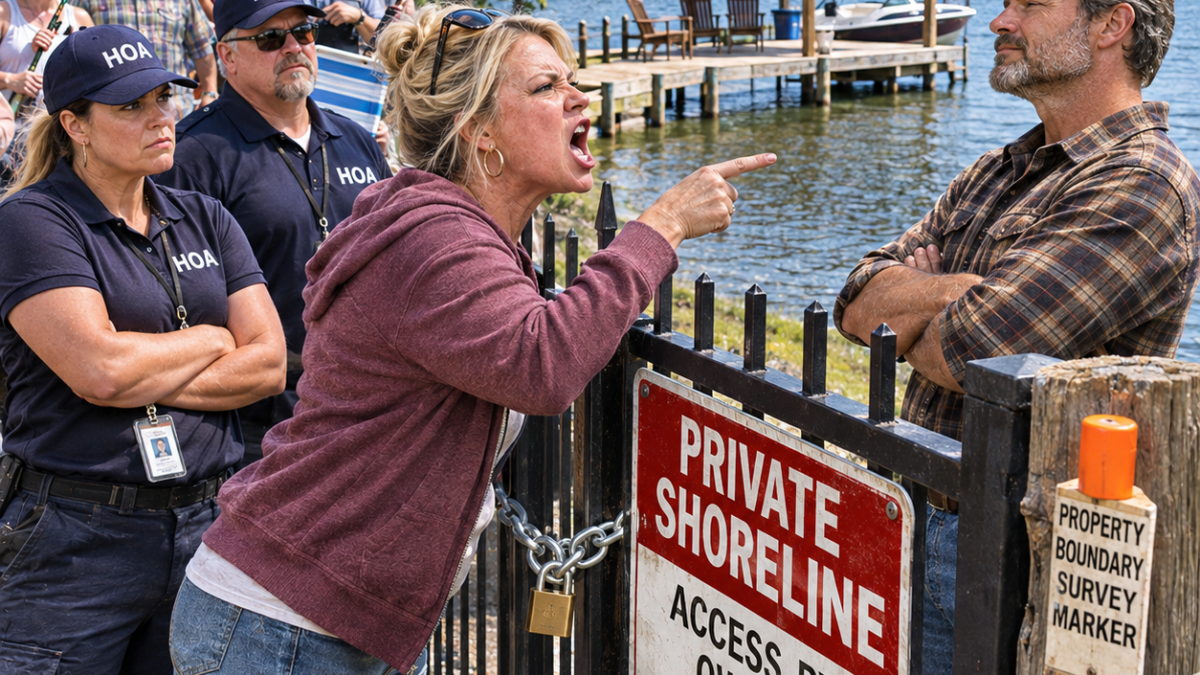
HOA Fined My Boat Dock and Sent Workers to Tear It Apart—So I Locked 700 Feet of Their “Community Shoreline” Behind My Gate
**“THIS DOCK WILL BE CORRECTED TODAY, WHETHER YOU LIKE IT OR NOT!” HOA president Diane Whitmore shouted from the end of my private pier while an HOA maintenance worker pulled a cordless saw from his bag and a work barge idled twenty feet offshore.**
**I told her one last time that Pine Hollow Estates did not own my property, but before her own marine contractor could stop him, the HOA worker buried the saw into a support brace, the outer platform dropped toward the lake, and Diane suddenly found herself grabbing my arm to keep from falling into the water.**
**Then my attorney arrived with a certified survey, handed it to Diane’s lawyer, and watched his face change as he realized the dock was only the beginning—because almost 700 feet of the “community shoreline” Pine Hollow had used for decades might never have belonged to the HOA at all.**
My name is Daniel Harper.
And three months before an HOA president nearly fell through the dock she was trying to destroy, I thought buying a lake house outside Chattanooga, Tennessee, would make my life quieter.
I was fifty-four.
I had spent twenty-six years building a heating and air-conditioning company from one truck into a business large enough that my employees could finally handle most of the daily work without calling me every thirty minutes.
My wife, Rachel, had died four years earlier after a long illness.
Our son lived in Atlanta.
Our daughter lived in Nashville.
Both had families of their own.
The house where Rachel and I had raised them had become too large after she was gone.
Four bedrooms.
A dining room nobody used.
A backyard full of projects we had once planned to finish together.
I wanted something smaller.
Simpler.
Somewhere I could wake up, drink coffee beside the water, and stop feeling as if every room held an unfinished conversation.
That was how I found Clearwater Lake.
The property sat on four acres at the western edge of a neighborhood called Pine Hollow Estates.
The house itself had grown from an old 1960s cabin into a comfortable two-story lake house.
Wide porch.
Tall trees.
A small gravel beach.
Almost seven hundred feet of shoreline.
And an old boat dock that looked as if it had survived three wars and lost two of them.
I loved it immediately.
The boards were faded.
One ladder was rusted.
Two support posts leaned slightly.
A covered section protected a small fishing boat from rain.
It needed work.
But it was mine.
At least, that was what every legitimate document said.
My realtor had warned me that the property had an unusual relationship with Pine Hollow.
The final half mile of my driveway used a privately maintained road controlled by the neighborhood.
Because of that, the previous owners had agreed to contribute toward road maintenance.
I did not trust verbal explanations when it came to property.
So before closing, I hired Rebecca Hayes.
Rebecca was the kind of attorney who could make a five-word easement clause feel like a crime scene.
She traced the deed.
The subdivision declarations.
The old plats.
Every recorded restriction she could find.
Then she sat across from me and said:
“You share their road.”
“Okay.”
“You do not share their HOA.”
“That sounds perfect.”
“No Pine Hollow dues beyond the road contribution. No voting rights. No architectural committee. No residential covenants on your house.”
“So they leave me alone?”
Rebecca smiled.
PART2:
“That depends less on the documents than you might hope.”
I should have remembered that.
The first month was nearly perfect.
I drank coffee on the porch while fog moved across Clearwater Lake.
Sometimes the water looked silver.
Sometimes deep blue.
On certain mornings, the opposite shore disappeared completely.
My closest neighbor was Robert Jenkins.
Sixty-eight.
Retired from a paper company.
Knew everything about fishing and almost nothing about minding his own business.
On my second day, he walked over carrying two rods.
“You bass fish?”
“Badly.”
“That’s all right. Fish are forgiving.”
We became friends quickly.
Robert lived inside Pine Hollow.
That created funny differences between us.
His mailbox color was regulated.
Mine was not.
He needed approval to repaint shutters.
I could technically paint my house orange.
I had no intention of doing that.
But knowing I could made me strangely happy.
Then I met Susan Parker.
Retired elementary-school principal.
Walked every morning with her dog, Buddy.
The first time I saw Susan, she was crossing my backyard.
“Morning,” she called.
“Morning.”
Then she kept walking.
Ten minutes later, another couple passed along the lake.
Then a man carrying a fishing pole.
Then two teenagers.
By noon, I realized there was a worn trail running through my shoreline.
I asked Robert.
“Oh. Everybody walks there.”
“On my property?”
“George never minded.”
George Bennett was the previous owner.
Eighty-one years old.
He had lived there thirty-four years.
I called him.
“George, did Pine Hollow residents walk your shoreline?”
“All the time.”
“Was there an easement?”
“No.”
“Written agreement?”
“No.”
“You just let them?”
“Sure.”
“Why?”
“They were neighbors.”
That was George.
Generous to the point of being dangerous to future owners.
But I did not mind.
People waved.
Nobody left trash.
Children fished from the bank.
Older residents sat beneath a giant sycamore near my dock.
Rachel would have liked that.
So I let it continue.
That decision would become very important later.
About six weeks after moving in, I decided to repair the dock.
Nothing dramatic.
Replace rotten decking.
Install a safer ladder.
Repair damaged flotation sections.
Add a railing.
For anything structural, I hired Thomas Reed, a licensed dock contractor.
Thomas checked county requirements before touching a board.
We applied for the required maintenance permit.
County approved it.
Simple.
Legal.
Then Diane Whitmore arrived.
White luxury SUV.
Dark sunglasses.
Blue folder.
The type of entrance that announced somebody had come not to ask a question, but to deliver a conclusion.
She stepped out while Thomas and I were unloading lumber.
“Daniel Harper?”
“That’s me.”
“I’m Diane Whitmore, president of Pine Hollow Estates.”
“Nice to meet you.”
She pointed toward my dock.
“What are you doing?”
“Repairing it.”
“Who approved that?”
“The county.”
“I mean Pine Hollow.”
“I’m not in Pine Hollow.”
Her face barely moved.
“Everyone on this shoreline falls under our lakefront standards.”
“That isn’t what my deed says.”
“This isn’t about your deed.”
That sentence immediately bothered me.
Property disputes are almost always about the deed.
Diane opened her folder.
Dock roof too dark.
Rail style unapproved.
Structure eight feet too long.
Covered boat area larger than Pine Hollow standards allowed.
I read the list.
Then handed it back.
“Those rules apply to your members.”
“They apply to community shoreline.”
“This shoreline is mine.”
“Clearwater Lake is shared.”
“Yes.”
She smiled as if I had just proven her point.
“Exactly.”
“The lake is shared. My backyard isn’t.”
Thomas looked away because he was trying not to laugh.
Diane noticed.
She did not appreciate it.
“You need to stop construction.”
“No.”
“You’re refusing an HOA directive?”
“I’m refusing a directive from an HOA I don’t belong to.”
“We’ll see.”
Two days later, certified mail arrived.
UNAPPROVED DOCK MODIFICATION.
Fine:
$1,500.
Continuing penalty:
$100 per day.
And at the bottom:
Failure to comply may result in a lien.
I laughed at first.
Then I called Rebecca.
She read the notice.
“They can’t lien your property just because they want to.”
“So I ignore it?”
“No.”
That surprised me.
“Why?”
“Because stupid paperwork can still create expensive problems.”
She sent Pine Hollow a formal response.
Daniel Harper’s property was not subject to the residential declaration.
Pine Hollow had no architectural authority over his dock.
County had approved the repair.
Withdraw the fine.
Stop threatening liens without a legal basis.
A few days later, Pine Hollow’s attorney responded.
Charles Bennett.
His letter was calm.
Professional.
Which somehow made it more irritating.
The HOA now claimed something different.
Maybe my house was outside Pine Hollow’s covenants.
But my shoreline, Charles wrote, belonged to a separate “community lakefront use zone” created when the subdivision was developed.
Rebecca searched the county records.
Nothing.
Old subdivision documents.
Nothing.
Then Charles sent a map.
My shoreline appeared in light blue.
Very official-looking.
Except it had no recording stamp.
No surveyor certification.
No deed references.
No parcel numbers.
It was a planning map.
Not a legal instrument.
Rebecca called Charles.
I sat across from her.
“Where was this recorded, Charles?”
Pause.
“No, I understand what it shows.”
Pause.
“I’m asking where the restriction was recorded.”
Longer pause.
Rebecca smiled.
“That is not the same thing.”
Another pause.
“I’ll wait.”
She hung up.
“Well?”
“He’s looking.”
“You think he’ll find something?”
“Maybe.”
“You don’t sound worried.”
“I’m always worried. That’s why people pay me.”
Instead of producing a recorded restriction, Pine Hollow sent another violation.
Fine now:
$1,800.
Then another $500 for “unauthorized shoreline obstruction.”
The obstruction?
My lumber.
Sitting on my grass beside my dock.
I called Diane.
“Why are you still fining me when your own lawyer can’t show you have authority?”
“Our lawyer is handling it.”
“Then stop adding penalties until he finishes.”
“The violations continue every day.”
“According to rules I’m not under.”
“You benefit from Pine Hollow.”
“How?”
“Our roads.”
“I pay road maintenance.”
“Our security.”
“I don’t use it.”
“Our shoreline.”
She stopped.
Then corrected herself.
“The community lakefront environment.”
I almost laughed.
That phrase meant absolutely nothing.
“Diane, I’m not trying to fight you.”
“Then comply.”
“No. Not fighting you does not mean obeying rules that don’t apply.”
Silence.
Then she said something that changed the whole dispute.
“George never gave us problems.”
I looked toward the water.
“What exactly did George allow you to do?”
“Community use.”
“What kind?”
“Walking. Fishing. Shore access.”
“Anything else?”
Pause.
“Events.”
I called George again.
“Did Pine Hollow hold events on your property?”
He laughed.
“Oh, sure.”
“Once?”
“Every summer, maybe.”
“How many people?”
“Fifty sometimes.”
“George.”
“What?”
“You let an HOA hold picnics in your backyard?”
“They cleaned up.”
Anything else?
Christmas boat-parade judges used the dock.
Children’s fishing day.
Neighborhood gatherings.
George had shared almost everything.
Without an easement.
Without payment.
Without worrying what came after him.
Rebecca became interested immediately.
“Did he ever sign permanent access rights?”
“No.”
We verified it.
No recorded walking easement.
No fishing rights.
No event rights.
No dock rights.
No beach rights.
Only decades of generosity.
Rebecca sent another letter.
Until ownership questions were settled, I would continue allowing normal pedestrian shoreline access as a courtesy.
That should have calmed things.
Instead, Diane treated it as proof she could keep taking more.
The following Saturday, I woke to voices.
Twenty people were setting up near my dock.
Tables.
Coolers.
Fishing rods.
Banner.
PINE HOLLOW JUNIOR FISHING DAY.
Nobody had asked me.
Susan saw my face first.
“Oh, Daniel.”
“Morning.”
She hesitated.
“Did someone reserve my backyard?”
Her smile vanished.
“Diane said it was community shoreline.”
Of course she did.
Parents began noticing.
One man started folding his chair.
I raised a hand.
“No. The kids are already here. Let them fish.”
Diane arrived ten minutes later.
“I knew you’d be reasonable.”
That bothered me more than it should have.
“Diane, this is the last event you schedule on my property without asking.”
“This event has been here twelve years.”
“Then George gave permission for twelve years.”
“It’s tradition.”
“Tradition isn’t ownership.”
Children were nearby, so we kept our voices low.
Diane leaned closer.
“You’re making yourself extremely unpopular.”
“I bought a house, Diane. I didn’t enter an election.”
She walked away.
I let the fishing continue.
Not for her.
For the fourteen children standing beside the water.
A little boy named Caleb caught his first bass.
His father took a photograph.
The boy smiled so wide that for a few minutes I forgot the whole argument.
Rachel would have loved it.
She used to say adults should never make children carry adult conflicts.
So I handed out bottled water.
Helped untangle line.
Gave one girl an old tackle box when hers broke.
Susan watched me.
“You know this makes Diane look worse.”
“I’m not trying to make anyone look bad.”
“I know.”
Monday morning, my fine reached $3,900.
That ended my patience.
Rebecca filed a formal dispute.
Then she hired a surveyor.
James Walker spent two full days finding old pins, shoreline markers, subdivision corners and deed calls.
On the third day, he asked me to meet him by the lake.
He pushed an orange flag into the ground near the path.
Then another.
Then another.
“What am I looking at?”
“Your boundary.”
“I know the dock is mine.”
He looked at me.
“I don’t think you understand yet.”
We walked south.
The Pine Hollow shoreline trail followed us.
Flag.
Flag.
Flag.
Almost the entire trail was inside my parcel.
The sycamore where residents rested?
Mine.
Fishing platform?
Mine.
Gravel beach?
Mine.
Picnic area?
Mine.
Then James reached a wooden staircase leading from the Pine Hollow clubhouse down toward the water.
“This is interesting.”
“What?”
“The top of those stairs starts on association property.”
“And?”
“The bottom ends on yours.”
I stared at him.
“How much shoreline does Pine Hollow actually own along here?”
“Very little.”
That changed everything.
The neighborhood had lake views.
Plenty of them.
But its easiest western shoreline access existed almost entirely because George Bennett had let residents cross his land for decades.
Now the same association using my property for walking, fishing, picnics and events was fining me for repairing my own dock.
Rebecca studied the survey.
“Do nothing yet.”
“What are you thinking?”
“I want to know exactly what they claim before we show them exactly what they don’t own.”
Pine Hollow did not wait.
Two mornings later, Thomas called before sunrise.
“Daniel, go to the dock.”
“Why?”
“Now.”
I pulled on shoes and ran outside.
A work barge was approaching.
Four men in orange vests.
Small crane.
Second boat behind it.
PINE HOLLOW MAINTENANCE printed along the side.
I walked onto the dock.
“What are you doing?”
One worker held up paperwork.
“Removal order.”
“From who?”
“Pine Hollow Estates.”
He explained they had been hired to dismantle the unapproved dock extension and store the material until I paid the fines.
“County order?”
“No.”
“Court order?”
“No.”
“Then don’t touch my dock.”
The marine contractor stopped.
Immediately.
“I was told the HOA controls shoreline structures.”
“They lied to you.”
Then another boat rounded the point.
Diane.
Two Pine Hollow maintenance workers.
She stepped onto the dock.
“You were given notice.”
“Get off.”
“The association has the right to correct continuing violations.”
“Show me a court order.”
She had none.
“Everyone off my property.”
Diane looked at the contractor.
“Continue.”
He did not move.
“I need clarification before I touch anything.”
“We’re paying you.”
“And he says he owns it.”
“I do own it.”
Diane glared at me.
“You owe more than four thousand dollars.”
“No.”
“This dock will be corrected today.”
Then one of Pine Hollow’s own maintenance workers moved past us.
Cordless saw in hand.
Thomas shouted from shore:
“DON’T CUT THAT!”
The blade hit a support brace.
Wood snapped.
The covered section shifted.
The worker jumped backward.
The outer platform dropped several inches.
A steel cable tore loose.
Everybody froze.
Then another board split.
The dock tilted.
Diane screamed.
One foot disappeared between moving boards.
She grabbed my arm.
I caught her jacket.
Thomas rushed forward.
Another deep crack came from beneath the dock.
The outside section tore partly free.
My boat, still tied underneath, slammed sideways.
For a few seconds, nobody knew whether the entire covered section would collapse.
We got Diane back toward shore.
The maintenance worker crawled away on his hands and knees.
The marine contractor ordered everyone off.
Thomas called 911.
Fire department arrived.
Sheriff’s deputy.
Rescue crew.
Diane’s ankle was cut.
The maintenance worker bruised his wrist and knee.
A snapped cable opened my palm.
Nobody went into the water.
That was luck.
Deputy Laura Mitchell took statements.
The marine contractor told the truth.
Diane had assured his company Pine Hollow possessed legal authority to remove noncompliant shoreline structures.
He had stopped when I challenged ownership.
The man who actually cut the brace was not his employee.
He worked directly for Pine Hollow.
Laura asked Diane whether she had authorized cutting.
“I directed our staff to enforce the violation.”
“That wasn’t my question.”
Diane looked toward Charles Bennett, who had just arrived.
He advised her to stop answering until he reviewed everything.
Fair.
Then Rebecca arrived.
She handed Charles the certified survey.
Then my deed.
Then county dock permit.
Then fine letters.
Then photographs of Pine Hollow’s employee cutting the support.
Charles read silently.
Finally:
“This is bad.”
Rebecca nodded.
“That’s one word.”
Diane called from the ambulance bumper:
“So what?”
Charles turned toward her.
“Did you know the survey was completed?”
“She never gave me one.”
“I sent it to the HOA yesterday,” Rebecca said.
Frank Miller, Pine Hollow’s treasurer, had arrived.
He spoke quietly.
“I saw it.”
Diane turned.
“You saw what?”
“The survey.”
“When?”
“Yesterday afternoon.”
“Why didn’t you call me?”
“I emailed the board.”
“I didn’t see it.”
Frank looked directly at her.
“That doesn’t make it disappear.”
That was the first moment Pine Hollow’s board stopped behaving like one solid wall behind its president.
County declared my dock unsafe until engineers could inspect it.
My boat had to be moved.
The same contractor Pine Hollow hired offered to tow it without charge.
I accepted.
He had done exactly what a responsible professional should do once ownership became disputed.
He stopped.
Not everyone inside a bad situation is a bad person.
Three days later, the damage estimate arrived.
Dock:
About $38,000.
Boat:
Almost $9,000.
Towing.
Storage.
Engineering.
Legal fees.
All because somebody decided enforcement should happen before ownership was proven.
Pine Hollow’s insurer opened a claim.
My insurer opened one.
The contractor’s insurer did too.
Everybody wanted to know who gave the cutting order.
A written work order surfaced.
REMOVE NON-COMPLIANT EXTENSION IF HOMEOWNER REFUSES VOLUNTARY CORRECTION.
No court order.
No county removal authorization.
No owner consent.
Just Pine Hollow.
Charles temporarily withdrew the dock fine.
Rebecca read the word twice.
“Temporarily?”
“They’re trying to preserve the legal argument.”
“They almost put Diane in the lake.”
“That does not automatically settle an easement question.”
“Lawyers are amazing.”
“Thank you.”
“That wasn’t a compliment.”
To Charles’s credit, he told the board to suspend all fines while the shoreline issue was reviewed.
The board voted five to one.
Diane voted no.
Then rumors started.
I pushed Diane.
I intentionally weakened the dock.
I refused rescue help until she signed paperwork.
Susan came over furious.
“I heard you pushed her.”
“I pulled her up.”
“I know.”
“Then why are you angry?”
“Because people are stupid.”
Fair.
The social media argument bothered me less than one sentence repeated several times.
Why should one man control our lake?
I didn’t.
The lake was shared.
People could boat.
Fish.
Swim.
Use public or community access points.
But shoreline is land.
Somebody owning land beside water does not suddenly make the ground public because other people like walking on it.
A few days later, a little girl named Chloe came to my door with her mother.
She had attended fishing day.
She gave me a drawing.
My dock.
A fish.
A stick figure labeled Mr. Daniel.
At the top:
THANK YOU FOR LETTING US FISH.
I had to look away for a second.
Her mother apologized.
“We thought it belonged to Pine Hollow.”
“I know.”
Most residents did.
That was the real pattern.
George’s permission had lasted so long that everyone forgot there was a person giving it.
I did not close the shoreline yet.
I put up two signs.
PRIVATE PROPERTY
ACCESS BY OWNER’S PERMISSION
Simple.
Robert read one.
“Probably should’ve been here twenty years ago.”
“George would hate it.”
“George let fifty people picnic in his yard.”
“Fair.”
Then Rebecca found old records.
Annual permission letters.
George had written them over the years.
Pine Hollow residents may walk and fish provided the association maintains the trail.
Another letter allowed the summer picnic.
Another allowed fishing day.
Another let boat-parade judges use the dock.
Written permission.
That was important.
Because it proved Pine Hollow’s use had not started as some independent right.
Everybody understood George was letting them use his land.
Then Rebecca found Diane’s emails.
2020:
George has always allowed shoreline use. Treat as established community access unless he objects.
Allowed.
Then 2022:
A board member asked whether Pine Hollow should formalize the arrangement before George sold.
Diane replied:
No need to create unnecessary legal issues. Long use should protect us.
I read that twice.
“So she knew?”
Rebecca nodded.
“She knew enough to understand ownership might become a problem after George sold.”
That changed everything.
Diane had not simply inherited a misunderstanding.
She knew the shoreline belonged to George.
She knew access had been based on permission.
She chose not to formalize anything because she hoped decades of use would eventually become stronger than that permission.
Then I arrived.
And when I behaved like an owner rather than George, she started fining me.
Pine Hollow formally claimed a permanent recreational easement.
Walking.
Fishing.
Events.
Dock use.
Beach use.
They offered to waive my fines if I signed paperwork recognizing those rights.
I laughed.
“They’re forgiving fines they probably couldn’t issue in exchange for permanent rights to my land?”
Rebecca nodded.
“It’s ambitious.”
I refused.
Instead, I offered something generous.
One-year temporary license.
Free.
Walking and fishing.
No unscheduled events.
No dock use.
No structures.
No permanent claim.
Diane rejected it.
Rebecca explained why.
“If they accept permission, they weaken their argument that they never needed permission.”
That was the moment my kindness became dangerous.
Every resident who crossed because I allowed it could later be pointed to as evidence Pine Hollow had some historic right.
So I gave thirty days’ notice.
After thirty days:
General automatic shoreline access would end unless the HOA accepted a written license.
Emergency access remained guaranteed.
Individual residents could ask permission.
Children’s events could be discussed.
But Pine Hollow could no longer treat my property like automatic community land.
Frank called.
“I understand.”
“You do?”
“Yes.”
“Diane?”
“Furious.”
“She says I’m holding the neighborhood hostage?”
“Yes.”
“I’m offering free access.”
“I know.”
“Then how am I holding anyone hostage?”
“You’re asking the wrong person.”
Susan came over.
“Am I banned?”
“Not yet.”
“Afterward?”
“You can ask.”
“Every morning?”
“For now.”
She thought about it.
Then shook her head.
“No.”
“What?”
“If everyone else loses automatic access, I shouldn’t get special treatment because we’re friends.”
I respected that.
She changed her walking route.
That mattered.
Fairness is easy until it costs convenience.
The community meeting drew more than a hundred people.
Diane introduced me:
“Mr. Harper has decided to terminate historic lake access.”
I stood.
“That isn’t accurate.”
I showed the license proposal.
Free.
One year.
Walking and fishing.
Residents became confused.
Most had never seen George’s permission letters.
They thought Pine Hollow owned access.
An older man named Harold Price spoke.
“I’ve lived here twenty-two years. George always told us we could walk there.”
“Exactly.”
Harold stopped.
Then nodded.
“He told us.”
“Yes.”
Meaning:
Permission came from him.
He could give it because the property was his.
The room changed.
Then Diane claimed Pine Hollow had invested more than $250,000 maintaining my shoreline.
Frank turned toward her.
“I’m treasurer. Where did that number come from?”
“Historic records.”
“I’ve never seen it.”
A special audit followed.
Actual documented spending:
About $68,000 across nearly twenty years.
Then one invoice appeared.
$18,500.
Whitmore Marine Services.
Shore stabilization and dock reinforcement.
My shoreline.
My dock.
Work I had never seen.
The company belonged to Diane’s brother-in-law, Paul Whitmore.
That did not automatically mean fraud.
But the board asked for photos.
Work orders.
Material receipts.
Nothing appeared.
Then another questionable invoice.
And another.
My property dispute had just become the edge of a financial problem inside Pine Hollow.
On day thirty, I closed the shoreline.
Fence and gate at both ends.
PRIVATE SHORELINE
ACCESS BY WRITTEN PERMISSION ONLY
The dock:
NO HOA ACCESS
By 8:00 Saturday morning, nearly fifty residents gathered.
Fishing poles.
Beach chairs.
Paddleboards.
Coolers.
Diane arrived with Charles.
The gate was locked.
She pointed at me.
“YOU CAN’T BAN AN ENTIRE NEIGHBORHOOD FROM THE LAKE!”
“I’m not banning you from Clearwater Lake.”
I pointed at the water.
“The lake is right there.”
Then I pointed to the ground.
“I’m banning Pine Hollow from my shoreline.”
Someone behind her whispered:
“Forever?”
I looked at Diane.
“That depends on what happens next.”
Charles read the survey again.
His face grew less confident with every page.
Finally he lowered it.
“Diane.”
“What?”
“His shoreline isn’t inside Pine Hollow.”
“I know where his house is.”
“I’m not talking about the house.”
He pointed at the boundary markers.
“I’m talking about the land.”
Then he pulled her aside.
I heard one sentence.
“You need to stop treating use like ownership.”
Before Diane could answer, somebody shouted:
“Boat!”
A fishing boat was drifting toward shore.
Fast.
No one seemed to be steering.
Then we saw a man collapsed near the console.
Robert ran toward the gate.
“Daniel!”
I already had the key.
Emergency.
No argument.
I opened it.
Robert and I sprinted toward the water.
The boat hit rocks twenty yards from shore.
The man inside rolled onto the floor.
Susan shouted from the bank:
“It’s Harold!”
We reached him.
Breathing weakly.
Then he stopped.
I started CPR.
Someone called 911.
County ambulance used my driveway because it was the fastest route.
Paramedics shocked Harold once.
Then again.
Pulse returned.
Weak.
But there.
They loaded him.
The ambulance left.
Everyone stood silent.
Charles looked at me.
“This is exactly why permanent emergency access needs to be documented.”
I nodded.
“Agreed.”
For one second, I thought Diane might finally understand.
Then:
“Which is why you need to remove these gates.”
I stared at her.
“No.”
“Someone almost died.”
“And emergency crews got through immediately.”
“These gates could cost lives.”
“They didn’t.”
“You’re blocking community access.”
Rebecca stepped forward.
“Emergency access can be documented without giving Pine Hollow recreational rights.”
Diane shook her head.
“That’s unacceptable.”
Frank finally lost patience.
“Then what is acceptable?”
“Permanent access.”
“To land we don’t own?”
“We have twenty years of use.”
“With permission!”
He pointed toward the road where Harold’s ambulance had disappeared.
“Daniel opened his property in an emergency without asking for anything. Stop pretending safety is the issue.”
That was the moment the crowd began turning.
Not against Pine Hollow.
Against Diane’s argument.
Then her phone rang.
She answered.
Listened.
“What?”
Frank’s phone rang too.
He went pale.
The auditor had found seven Whitmore Marine Services invoices.
Total:
$146,000.
Shoreline stabilization.
Dock repair.
Trail maintenance.
Lake-access work.
Most supposedly performed on my land during the previous six years.
I had never seen the company there.
George did not remember it.
Thomas saw little evidence most of the claimed work had happened.
Then Frank looked directly at Diane.
“The auditor found checks.”
“What checks?”
“Payments from Pine Hollow to Whitmore Marine.”
“That’s normal.”
“No.”
He held out the records.
“One $24,000 payment went to Whitmore Marine. Three days later, almost the same amount moved out.”
Diane’s face tightened.
“Where?”
Frank answered slowly.
“An account belonging to you.”
Nobody said anything.
Diane finally claimed the transfers were reimbursements for administrative expenses.
Frank asked:
“Why would your brother-in-law’s company reimburse you personally for HOA work?”
“Accounting convenience.”
Charles closed his eyes.
That answer did not help.
At the emergency board meeting that night, the audit became clearer.
Whitmore Marine was a real company.
It did real marine work.
That distinction mattered.
But several Pine Hollow invoices contained no photographs.
No work logs.
No material records.
No subcontractors.
Two claimed workdays fell during severe storms.
A $31,000 erosion repair supposedly occurred on my property after one storm.
George still had the receipt from the actual contractor he hired.
Cost:
$6,800.
Same shoreline.
Same week.
Different company.
Pine Hollow paid Whitmore Marine $31,000 for work George had already paid someone else to perform.
Then the bank records.
After Pine Hollow paid large shoreline invoices, Whitmore Marine transferred money to Diane.
About $61,000 total across several transfers.
Not all $146,000.
That difference mattered.
Some vendor payments might have covered real expenses.
But secret transfers to an HOA president required explanation.
Diane stopped answering financial questions without counsel.
Her right.
The board suspended her financial authority.
Five votes.
Payments to Whitmore Marine frozen.
Unanimous.
My shoreline remained closed.
A few days later, Harold came home.
He thanked me.
“You opened the gate.”
“It was an emergency.”
He smiled.
“Exactly.”
Then:
“Keep it closed.”
I stared.
“You nearly died there.”
“And you opened it when it mattered. That proves emergency access doesn’t require everybody owning your backyard.”
I laughed.
“You should run for president.”
“No.”
“Good answer.”
The shoreline case went to court.
Pine Hollow asked Judge Harold Collins to declare a permanent recreational easement across my land.
George testified by video.
Charles asked:
“Did residents use your shoreline for many years?”
“Yes.”
“Did you stop them?”
“No.”
“Did Pine Hollow maintain the trail sometimes?”
“Yes.”
“Hold events?”
“Yes.”
“Did you consider the shoreline part of the community?”
George smiled.
“No.”
Charles paused.
“But you allowed community use.”
“Yes.”
“For decades?”
“Yes.”
He looked satisfied.
Then Rebecca stood.
“Mr. Bennett, could you have told Pine Hollow residents to stop using your shoreline?”
George looked almost confused by the question.
“Of course.”
“Why?”
He shrugged.
“Because it was mine.”
That was the whole case.
Then Rebecca showed the permission letters.
The annual walking permission.
Fishing permission.
Event permission.
Dock-use permission.
Diane’s email saying George “allowed” community use.
The judge did not rule immediately.
He encouraged settlement.
By then Diane no longer controlled the board.
Pine Hollow offered to withdraw the fines permanently.
Pay dock damage.
Recognize my title.
In exchange:
Permanent recreational easement.
I said no.
Instead:
Five-year renewable license.
Walking daylight hours.
Fishing in designated sections.
No unapproved events.
No dock use.
Emergency access always guaranteed.
HOA insurance.
Trail maintenance.
Rent:
One dollar per year.
Frank stared.
“One dollar?”
“I don’t want their money.”
“Then what do you want?”
“Clarity.”
Most board members supported it.
Then some residents objected.
They wanted permanent rights.
A petition appeared.
OUR LAKE, OUR SHORE.
Wrong.
The lake was shared.
My shore was not.
The night before the community vote, my southern gate disappeared.
Not opened.
Gone.
Hinges cut.
Post damaged.
Chain in the grass.
Fresh tire tracks.
Dozens of footprints.
Someone had physically reopened the trail.
An anonymous community post appeared:
THE SHORELINE IS OURS AGAIN.
Frank immediately told residents not to enter.
Susan called me.
“People are walking down there.”
Six residents.
I approached.
“Folks, please leave.”
One man, Gary Thompson, refused.
“My family has walked this shore eighteen years.”
“I understand.”
“You can’t erase that.”
“I’m not erasing your memories.”
“You’re blocking our rights.”
“I’m blocking access to my land until there’s an agreement.”
Laura arrived.
She explained the situation.
Most people left.
Nobody was arrested.
Good.
Then she found black plastic near the cut gate.
Later, a doorbell camera showed a white Ford F-250 at 3:20 that morning.
Logo on the side:
WHITMORE MARINE SERVICES.
Paul denied ordering vandalism.
Then an employee named Jason Reed contacted the sheriff.
Paul had told him to remove the gate.
Jason said he believed Pine Hollow had legal access rights.
He cut the hinges.
Just before Paul gave him the instruction, Paul received a phone call.
Dashboard showed the caller.
Diane.
Her attorney said it was a family call.
Possible.
Timing was not content.
Then Judge Collins ruled.
Pine Hollow had failed to establish a permanent recreational easement.
George’s written permissions defeated the argument that residents had used my shoreline without consent.
The HOA could not convert decades of generosity into ownership.
The dock fines were invalid.
Withdrawn permanently.
Frank called.
“Congratulations.”
“Thanks.”
“So. The one-dollar license.”
I looked toward the cut gate.
“No.”
Silence.
“What?”
“I offered free access after they fined me.”
“I know.”
“I offered a written license after they tried to dismantle the dock.”
“I know.”
“I offered five years after they sued me.”
“I know.”
“Now someone cut down my gate.”
Frank exhaled.
“I understand.”
That response mattered.
Every time I tried to create a reasonable structure, somebody treated it as weakness.
So I changed my answer.
Pine Hollow Estates, the organization, would never again receive automatic recreational access to my shoreline while I owned the property.
Not for one dollar.
Not free.
Not through an HOA license.
Emergency services:
Always.
Individual neighbors:
Could ask.
Friends:
Invited.
Kids:
Could fish if I allowed it.
But Pine Hollow as an institution was done.
That was when the title became true.
They fined me over my boat dock.
I banned the HOA from my shoreline.
And somehow, the story still was not finished.
The same afternoon, the auditor found a new Whitmore Marine invoice.
Dated two days before my gate disappeared.
EMERGENCY SHORELINE ACCESS RESTORATION.
$14,500.
The HOA board had never approved it.
Whitmore Marine had been frozen as a vendor.
Yet the invoice had already been paid.
Using Diane’s old administrative account.
Then two more transfers appeared.
$38,000.
$52,000.
Same old credentials.
More than $100,000 moved after Diane’s authority had been suspended.
Then the bank stopped a wire for nearly $300,000.
Recipient:
Clearwater Shore Holdings LLC.
Created eleven days earlier.
Manager:
Diane Whitmore.
Registered agent:
Paul Whitmore.
Business purpose:
Acquisition and management of lakefront property.
Attached to the failed $300,000 wire was a purchase agreement.
Buyer:
Clearwater Shore Holdings.
Seller:
Pine Hollow Estates HOA.
Property:
Western Community Shoreline Parcel.
My land.
They were attempting to sell property Pine Hollow did not own.
The proposed sale price almost exactly matched the blocked transfer.
Rebecca read deeper.
The document said Clearwater Shore Holdings would acquire all historic recreational, shoreline, dock and access interests.
Then she understood.
“They may not be trying to buy your deed.”
“What are they buying?”
“Whatever Pine Hollow claims it has.”
The judge had already ruled the HOA had no permanent easement.
But the apparent plan was to move those supposed “historic rights” into a private company controlled by Diane and Paul.
Then the company could continue fighting me even if the Pine Hollow board wanted peace.
One text message later recovered made that nearly explicit.
Paul:
SHORE COMPANY SOLVES ACCESS PROBLEM.
Diane:
ONLY IF DEED ISSUE CAN BE SEPARATED.
Paul:
IF HOA SELLS HISTORIC RIGHTS, NEW ENTITY CAN FIGHT HARPER WITHOUT BOARD POLITICS.
There it was.
The shoreline fight had outgrown the HOA.
Diane eventually resigned completely.
Whitmore Marine lost its Pine Hollow contract.
Financial and property investigations continued.
The bank locked Pine Hollow’s outgoing transfers behind dual authorization.
No single officer could move large amounts again.
Civil insurance claims resolved sooner.
Pine Hollow’s insurer acknowledged that its maintenance employee caused the physical dock damage under an HOA work order.
The dock was rebuilt.
Stronger.
Boat repaired.
Towing and storage covered.
Engineering covered.
Legal costs became part of settlement.
No giant jackpot.
I never wanted one.
I wanted my dock back.
I wanted my title respected.
I got both.
Thomas rebuilt the covered section.
Same basic appearance.
New supports.
Fresh deck boards.
Safe railings.
County inspection passed.
Every time he mentioned that no Pine Hollow architectural approval was required, he smiled.
The HOA formally withdrew every dock fine.
Not reduced.
Not waived as an act of mercy.
Withdrawn because they never had the authority to issue them.
I framed the final letter.
It said my property lay outside Pine Hollow’s residential covenants and my dock was governed by county and lake regulations.
Rebecca had said almost exactly that in her first letter.
It took months, tens of thousands of dollars, a damaged dock, a lawsuit, an audit and a cut gate for everyone else to arrive at the same sentence.
The financial cases took more than a year.
Paul eventually faced fraud-related charges involving false or unsupported invoices and unauthorized transfers.
Diane faced charges connected to financial misconduct, unauthorized system use, and the attempted Clearwater Shore Holdings transaction.
Some charges were later reduced through plea arrangements.
Restitution became part of the outcome.
Whitmore Marine repaid substantial amounts through civil settlement and insurance.
Nobody walked from an HOA meeting directly into prison.
Real cases are slower.
Documents are challenged.
Lawyers argue.
Insurance companies negotiate.
Evidence has to survive scrutiny.
That was fine with me.
Jason Reed, the employee who physically cut my gate, cooperated fully.
He showed investigators the work order Paul had given him.
He genuinely believed he was restoring access Pine Hollow had authority to use.
The most serious consequences focused higher up.
Months later, Jason came to my house.
“I owe you an apology.”
“You already gave the sheriff everything.”
“I still cut your gate.”
“Yes.”
“I should’ve checked.”
“Yes.”
He looked surprised.
Then I told him something Rachel used to say.
“Learning from a mistake matters more than pretending you never made one.”
Jason offered to pay for the gate.
I declined.
Settlement had already covered it.
He left looking relieved.
Frank was eventually elected Pine Hollow president.
Properly this time.
Residents chose him.
He complained for a week.
Then reorganized half the HOA.
New rules.
Any vendor connected to a board member required full disclosure and competitive bids.
No single officer could approve large payments.
Old access credentials were disabled immediately after leadership changes.
Any property claim had to be supported by a recorded deed, easement or formal legal opinion before Pine Hollow spent money trying to enforce it.
Rebecca loved that rule.
Frank added another.
If Pine Hollow wanted to use somebody else’s land, permission had to be written.
No “historic understanding.”
No assumption.
No tradition treated as ownership.
Simple.
Then everybody asked me the same thing.
“Will you reopen the shoreline?”
No.
Not to Pine Hollow.
That answer stayed permanent.
The association no longer had automatic trail access.
Fishing platform private.
Dock private.
Beach private.
Instead, Pine Hollow improved its eastern lake access.
Better stairs.
Fishing deck.
Benches.
Lights.
Kayak rack.
Something interesting happened.
Residents started liking it.
The eastern area was smaller than my shoreline.
But it was theirs.
No title dispute.
No owner to negotiate with.
No uncertainty if I sold.
Their dues improved property the HOA actually controlled.
Healthier for everyone.
Susan still visited.
By invitation.
Robert still fished from my dock.
By invitation.
Harold still sat beneath the big sycamore.
By invitation.
Sometimes neighborhood children fished.
Usually a parent asked.
Most of the time I said yes.
That confused people who assumed banning Pine Hollow meant I hated Pine Hollow residents.
I did not.
My problem had never been with children fishing.
Or Susan walking Buddy.
Or Robert carrying too many rods.
My problem was an organization treating permission as ownership.
One summer Susan asked:
“Could we do another kids’ fishing day?”
I thought about it.
“Yes.”
Her face brightened.
“But not as a Pine Hollow event.”
“What does that mean?”
“I invite the families.”
“No HOA banner?”
“No.”
“No board table?”
“No.”
She smiled.
“Fine.”
Caleb came back.
The boy who had caught his first bass during the argument the year before.
This time he helped a younger child bait a hook.
I watched them from the dock.
Thought about Rachel.
Kindness had returned.
But now kindness had boundaries.
That made it stronger.
Not weaker.
George Bennett eventually visited.
His daughter drove him.
We sat on my porch overlooking the shoreline he had shared for decades.
I told him everything.
The fines.
Dock collapse.
Survey.
Lawsuit.
Gate.
Invoices.
Audit.
George listened.
Then said:
“I probably made things too easy for them.”
I shook my head.
“You were being kind.”
“Same thing sometimes.”
“No.”
He looked at me.
“Your kindness wasn’t the problem.”
“What was?”
“People forgot it belonged to you.”
George smiled.
“Rachel would’ve liked you.”
He had never met my wife.
“How do you know?”
“Because you’re stubborn in a polite way.”
I laughed.
That sounded exactly like something Rachel would have said.
People later told this story like it was revenge.
HOA fined me for my boat dock, so I banned them forever from my shoreline.
Technically true.
They fined me.
Threatened a lien.
Sent people to dismantle my dock.
Damaged it.
Sued for permanent recreational rights.
Rejected free access because accepting permission weakened their ownership claim.
Someone cut down my gate.
People tied to former leadership used HOA money in an attempt to move disputed shoreline claims into a private company.
So yes.
Pine Hollow Estates lost automatic access for good.
But that was not the real ending.
The real ending was clarity.
Clearwater Lake was shared.
My land was not.
Emergency access stayed guaranteed.
Neighbors could remain friends.
Children could fish.
People could sit beneath the sycamore.
Susan could walk down.
Robert could bring his cooler and talk too much.
All they had to do was ask.
The word that disappeared from the old relationship was entitlement.
George had given permission.
Residents became accustomed to it.
Then Pine Hollow began treating permission like permanence.
Diane treated permanence like ownership.
Eventually she tried to enforce HOA rules against the actual owner.
That is how favors become fights.
Someone forgets where the favor began.
The private-property sign still stands by my southern gate.
Later, I added a smaller sign underneath.
Two words.
PLEASE ASK.
Not:
KEEP OUT.
Not:
TRESPASSERS PROSECUTED.
Just:
PLEASE ASK.
Because asking acknowledges something important.
There is another person here.
Another owner.
Another boundary.
And a choice.
Most people ask now.
Most of the time, I say yes.
Pine Hollow Estates itself does not ask anymore.
They already know the answer.
The HOA fined me for repairing my own boat dock.
Then they learned that the shoreline they had treated like community property for almost twenty years had always depended on one homeowner’s permission.
And when they pushed one time too many, I closed the gate on the association for good.








