HOA Karen Fined Me $250 a Day for My Legal Dock—Then She Cut My Lock in Front of 60 Guests and Exposed a $48,000 Secret Account
HOA Karen Fined Me $250 a Day for My Legal Dock—Then She Cut My Lock in Front of 60 Guests and Exposed a $48,000 Secret Account
The HOA president fined me $250 every day for a dock that had been legally permitted for fifteen years, then threatened to put a lien on my house when I refused to tear it down.
So I read all 112 pages of her own rulebook, discovered that the shoreline she had been selling $40 lake-access tickets to actually belonged to my lot, and built the exact six-foot fence her rules required around the land she thought she controlled.
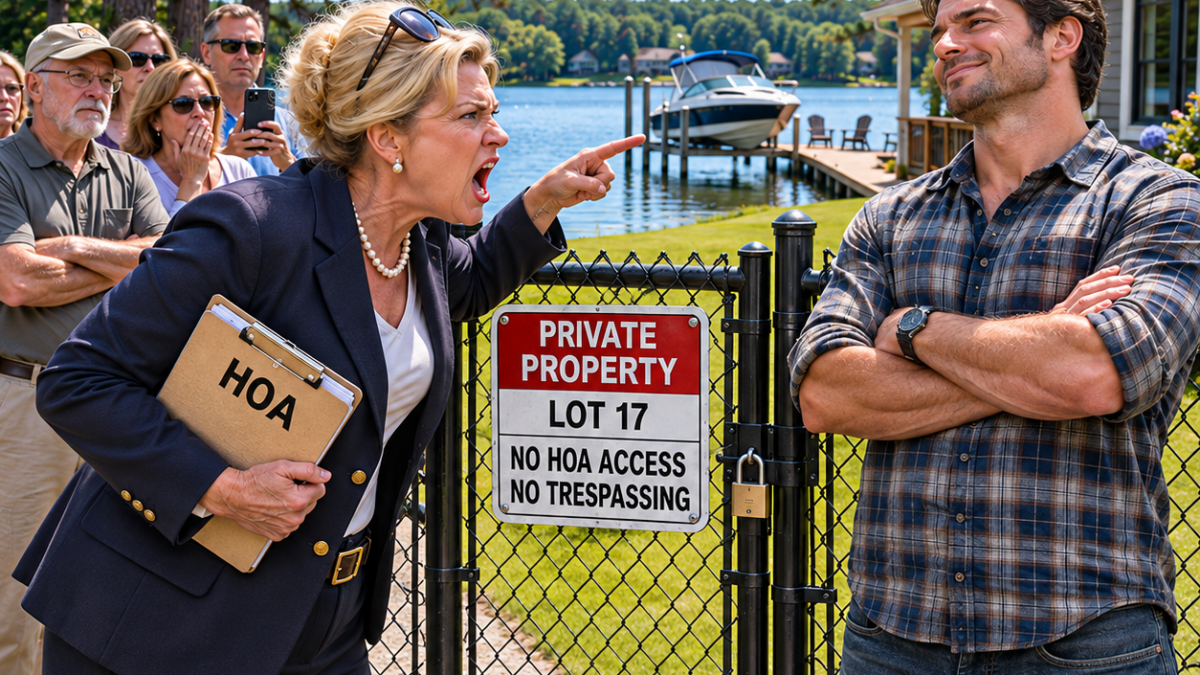
Three days later, Gail Whitaker arrived with sixty neighbors, a pontoon boat, a cash box, and a pair of bolt cutters—then a sheriff’s deputy watched her cut my lock, step onto my property, and expose a secret account that had been collecting money from land she never owned.
My name is Ethan Brooks.
Eight months before all of that happened, I thought buying a house on Lake Marin was the best decision I’d ever made.
I was forty-seven.
Divorced.
My daughter was in college.
For the first time in nearly twenty-five years, I wasn’t choosing a house based on school districts, commute times, or how many bedrooms somebody else needed.
I wanted one thing.
Water.
Not a swimming pool.
Not a decorative pond.
A real lake.
Something quiet enough that I could wake before sunrise, make coffee, walk outside barefoot, and sit somewhere nobody needed anything from me.
Lake Marin was exactly that.
Lakeshore Pines Estates wrapped around the eastern side of the lake.
Tall pines.
Older homes mixed with newer ones.
Small marina.
Clubhouse.
Walking trails.
And tucked between two larger properties was Lot 17.
My house.
Green lawn sloping gently toward the water.
A narrow strip of shoreline.
And a cedar dock extending about thirty feet into the lake.
The dock looked old in the best possible way.
Weathered boards.
Boat lift.
Small bench at the end.
A little ladder down into the water.
The previous owner, Arthur Penn, told me it had been built fifteen years earlier.
“County approved.”
He slapped one of the posts.
“Never gave me trouble.”
That sounded good enough at closing.
I asked my inspector.
He confirmed the structure appeared sound.
The title report showed shoreline rights.
PART2:
The county property file mentioned an approved dock.
Nothing unusual.
I bought the house.
Three weeks later, I bought a twenty-foot blue-and-white family boat.
Not luxury.
Not commercial.
Not even especially fast.
Just enough to fish, cruise the lake, and occasionally embarrass myself trying to dock when neighbors were watching.
The first Saturday I took it out was one of those mornings you remember because nothing went wrong.
Water like glass.
Coffee in a travel mug.
Sun coming through mist.
Nobody calling.
Nobody emailing.
No traffic.
I took the boat around the lake twice.
Then tied it to my dock.
Sat on the bench.
And thought:
This is why I bought the place.
Three weeks later, I found a bright yellow envelope taped to my front door.
Not mailed.
Taped.
In large letters:
PART3:
NOTICE OF VIOLATION
I assumed lawn issue.
Trash bin.
Something minor.
Then I read:
UNAUTHORIZED DOCK STRUCTURE
DAILY FINE: $250 UNTIL REMOVAL
I laughed.
Out loud.
Because the dock had been standing there fifteen years.
The house listing had literally included it.
The county had records.
I called the HOA office.
Treasurer answered.
Phil Norton.
Sixty-ish.
Soft voice.
Always looked nervous at neighborhood meetings.
“Lakeshore Pines HOA.”
“Phil, Ethan Brooks.”
Pause.
“Lot 17?”
“Yes.”
Another pause.
That told me he knew.
“I got a violation notice about my dock.”
“Yes.”
“There’s a mistake.”
Silence.
“The dock has a county permit.”
Phil lowered his voice.
“It’s Gail’s decision.”
“What does that mean?”
“I just send the notices.”
“Who’s Gail?”
“You’ve met Gail Whitaker.”
I had.
Briefly.
HOA president.
Navy blazer.
Silver HOA badge clipped to the lapel.
Clipboard.
She had welcomed me to Lakeshore Pines during my first week.
Asked whether I’d reviewed the community standards.
I said yes.
She said:
“We take compliance seriously here.”
At the time, I thought she meant people kept lawns trimmed.
Phil continued:
“She says the dock lacks architectural approval.”
“It predates the HOA’s current architectural policy.”
“I know.”
“County permit.”
“I know.”
“Then why are you sending me a $250-a-day fine?”
Quiet.
Then:
“It’s Gail’s decision.”
That phrase would follow me for months.
I emailed Gail.
Attached the county parcel record.
Photograph of the dock.
Closing documents.
Asked politely for the violation to be withdrawn.
She responded three hours later.
One sentence.
County authorization does not supersede community architectural requirements.
I wrote back:
Please provide the specific covenant provision requiring retroactive removal of a pre-existing permitted dock.
No reply.
Five days later, second yellow envelope.
Fine balance:
$1,250.
Then another.
$2,500.
By the time two weeks passed:
$3,750.
The third letter said:
FAILURE TO PAY WITHIN TEN DAYS MAY RESULT IN LIEN ENFORCEMENT AGAINST PROPERTY.
That’s when I stopped laughing.
Harold Miller noticed me reading the letter at the mailbox.
He lived across the street with his wife, Betty.
Late seventies.
Married fifty-two years.
Harold waved.
“Trouble?”
I held up the envelope.
“Dock.”
He groaned.
“Gail.”
Betty came onto the porch carrying iced tea.
“Come sit.”
I did.
Harold looked at the notice.
“Two-fifty a day?”
“Apparently.”
He handed it to Betty.
She shook her head.
“She fined us over the mailbox.”
“What was wrong with it?”
“Blue.”
“What color was required?”
Betty looked at Harold.
“Also blue.”
I laughed.
Harold didn’t.
“Wrong shade.”
“You’re serious?”
“Six hundred dollars.”
“Did you pay?”
“Eventually got reduced.”
Betty added:
“She fined Mrs. Thompson for a wind chime.”
“Wind chime?”
“Noise violation.”
“How loud?”
Betty smiled.
“Less loud than Gail.”
That was my first clue I wasn’t dealing with ordinary enforcement.
Gail wasn’t trying to fix problems.
She was trying to establish control.
The following Saturday, around seven in the morning, I heard movement behind my house.
Footsteps.
I looked through the kitchen window.
Gail.
On my lawn.
Standing near the dock.
Clipboard.
Camera.
Taking photographs.
I walked outside.
“Morning.”
She turned.
No embarrassment.
No apology.
“Ethan.”
“You need something?”
“Documenting the violation.”
“You’re on my property.”
“I am performing official association duties.”
“I didn’t give you permission.”
She took another photo.
I moved between her and the dock.
“Please leave.”
Her eyes narrowed.
“This structure must be removed.”
“No.”
“Your boat also violates community standards.”
I looked at it.
“My boat?”
“Commercial-grade appearance.”
It was a twenty-foot bowrider with a blue stripe.
“What does commercial-grade appearance mean?”
“Excessive profile.”
“That isn’t a real thing.”
“It is under our lakefront aesthetic policy.”
I laughed.
Wrong move.
Gail’s mouth tightened.
“Your dock is an eyesore.”
“It looks like every other dock.”
“Not every property has docking rights.”
“I do.”
“You do not have architectural approval.”
“Yes, I do.”
She froze.
“I submitted the application three months ago.”
Before closing, Arthur’s realtor had told me to send an updated ownership request for continued dock approval.
I had.
Email.
Photos.
County permit.
Everything.
Gail said:
“We have no record.”
“I have the sent email.”
“No approval exists.”
“I sent it to the address listed in the handbook.”
“Then you should’ve followed up.”
I stared at her.
She smiled.
That smile was the moment I stopped believing this was a clerical problem.
“Leave my property.”
“Excuse me?”
“You’re trespassing.”
“I am the HOA president.”
“And you’re standing on land I own.”
“I have authority to inspect common shoreline areas.”
“This isn’t common shoreline.”
Her expression changed.
Very slightly.
That mattered later.
She turned.
Walked back toward the road.
Then called over her shoulder:
“Remove the dock and boat or face the consequences.”
I watched until she left.
That night, I made coffee.
Sat at the kitchen table.
Opened the Lakeshore Pines governing documents.
One hundred twelve pages.
Covenants.
Architectural rules.
Lake regulations.
Community standards.
Easements.
Amendments.
Most people sign HOA documents without reading beyond the first ten pages.
I had skimmed them.
Now I read every word.
Page one.
Page two.
Page seventeen.
Twenty-five.
Thirty-one.
Then I stopped.
Article 4.
Section 2.
LAKEFRONT LOT RIGHTS
Owners of lots directly bordering Lake Marin retain exclusive riparian and access rights associated with their deeded shoreline, including maintenance and use of permitted docks and personal watercraft, subject to county regulation and applicable recorded easements.
I read it again.
Exclusive.
Not community.
Not HOA controlled.
Owners.
I pulled out my deed.
Lot 17.
Lakefront.
Then Article 9.
PRIVATE LOT ENTRY
No association member, guest, contractor, officer, or agent may enter a privately owned lot without prior written consent except in emergency circumstances expressly provided by law.
I smiled.
Gail had already violated that.
Then Rule 14.
Property owners could install boundary fencing.
Black chain link.
Maximum six feet.
Approved automatically if placed entirely inside surveyed property lines.
Private property signage recommended where public or community easements terminate.
I leaned back.
Then kept reading.
There was one more section.
The HOA maintained a “courtesy shoreline walking easement” along certain lakefront parcels.
Not ownership.
A limited access right.
Conditional.
Subject to recorded agreements.
I needed mine.
Monday morning, I went to the county records office.
The clerk pulled Lot 17.
Thick old file.
A county inspector named Tom Delgado happened to be there reviewing another lake permit.
The clerk asked him to help.
He looked at my address.
“Dock?”
“Yes.”
Computer.
Typing.
Then:
“Permit issued 2009.”
“Still valid?”
“Structure was inspected.”
“Any violations?”
“None.”
“Any renewal requirement?”
“No.”
“Can you print that?”
“Sure.”
He did.
Official county letterhead.
Permit number.
Inspection date.
No unresolved violations.
Then I asked for the original survey.
The county copy was incomplete.
So I called Arthur Penn.
Previous owner.
Seventy-seven.
Sharp as ever.
He laughed when I explained Gail.
“She finally came for the dock?”
“You knew?”
“She tried ten years ago.”
“What happened?”
“I told her to read the deed.”
“Why didn’t she fine you?”
Arthur shrugged.
“Maybe she liked me better.”
Then he went into a closet.
Returned with a dusty accordion folder.
Survey.
Title attachments.
Easement documents.
He spread them across his dining table.
The survey showed exactly what I needed.
Twenty-foot strip of shoreline.
Grass.
Water’s edge.
Dock connection point.
All inside Lot 17.
Mine.
The HOA had one limited right.
A courtesy easement across the upper shoreline path.
Arthur explained:
“They used to carry liability insurance naming me as an additional insured.”
“For the walking path?”
“Yes.”
“In exchange, I allowed residents through.”
“Still active?”
Arthur laughed.
“Ask them for the insurance certificate.”
I did.
Nothing.
Then Arthur handed me a letter from six years earlier.
Insurance canceled.
No renewal documentation.
Under the easement language, failure to maintain insurance allowed the owner to suspend access after written notice.
I drove home with my pulse racing.
Then Harold gave me the detail that turned a property dispute into something much bigger.
He came over that evening.
“Ethan.”
“Yeah?”
“You know Founders Day?”
“No.”
“Annual lake picnic.”
“Okay.”
“Gail sells tickets.”
“How much?”
“Forty dollars.”
“For food?”
“Supposedly lake access and picnic package.”
“Where?”
Harold pointed past my house.
“Your shoreline.”
I stared.
“What?”
“Every summer.”
“How long?”
“Three years at least.”
“On this lot?”
“Yes.”
“How?”
“Arthur never cared.”
That wasn’t the same as ownership.
Harold continued:
“They bring the association pontoon.”
“Tables.”
“Coolers.”
“People launch from your dock.”
My stomach dropped.
“People use my dock?”
“Used to.”
“Did Arthur authorize it?”
“Probably informally.”
I called Arthur.
He sighed.
“Gail asked once if residents could use the lawn for a picnic.”
“And?”
“I said okay.”
“Once?”
“Yes.”
“Did you authorize ticket sales?”
Silence.
“What ticket sales?”
There it was.
The next fine hearing was already scheduled.
I went prepared.
Binder.
County permit.
Survey.
Easement.
Printed emails.
Photos.
Rulebook.
The clubhouse meeting room had five folding chairs.
Gail.
Phil.
Two other board members.
Me.
I placed everything on the table.
Gail barely looked.
I started with the permit.
“County confirms the dock was permitted in 2009 and remains compliant.”
I slid it forward.
Gail pushed it back with one finger.
“That piece of paper means nothing in this community.”
Silence.
Phil stopped writing.
I stared.
“It’s a county permit.”
“We have separate standards.”
“Your standards explicitly defer permitted lakefront structures to county regulation.”
“I disagree.”
“Then read Article 4.”
“I know the covenants.”
“Apparently not.”
One board member shifted uncomfortably.
I showed the survey.
“Dock sits entirely inside Lot 17.”
Gail crossed her arms.
“The shoreline is a community amenity.”
“No.”
“It is.”
“Recorded document?”
“Our board has always treated it that way.”
“That doesn’t transfer title.”
She leaned forward.
“Mr. Brooks, you are becoming unnecessarily adversarial.”
I almost laughed.
“You fined me $3,750 for a legal dock.”
“Because you refuse compliance.”
“I submitted approval.”
“No record.”
I held up the sent email.
Her jaw tightened.
Then I showed Article 9.
“Also, you entered my property without permission.”
She smiled.
“Official inspection.”
“Your rules don’t provide that exception.”
Silence.
Then the board voted.
Three to zero.
Fine upheld.
I wasn’t surprised.
What came next surprised me.
Gail pulled out a typed resolution.
“The board additionally recognizes the Lake Marin shoreline corridor as a community amenity subject to association control.”
I stared.
“You just wrote that?”
“It was prepared by counsel.”
“Recorded?”
“Not necessary.”
“Owner approval?”
“Not necessary.”
“You can’t vote my property into common ownership.”
She looked me directly in the eyes.
“If you don’t like it, sue us.”
Phil looked sick.
I packed my binder.
Didn’t argue.
That evening, I called attorney Priya Nair.
Real-estate litigator.
Recommended by Arthur.
She read the documents in twenty minutes.
Then leaned back.
“The fines are garbage.”
“Good.”
“Procedurally defective.”
“No proper notice of the alleged rule.”
“No valid architectural basis.”
“The county permit undercuts them.”
“The board can’t simply declare your deeded shoreline common property.”
“Great.”
I expected:
Let’s sue.
Instead, Priya smiled.
“Gail likes strict compliance?”
“Yes.”
“Give her strict compliance.”
I waited.
She opened the rulebook.
“Rule 14.”
“Fence?”
“Yes.”
“Six-foot black chain link permitted.”
“Correct.”
“Entirely inside survey line?”
“Yes.”
“Automatic approval?”
“Yes.”
Then Article 9.
“No entry without written consent.”
“Yes.”
Then the easement.
“Insurance condition expired.”
I nodded.
Priya smiled wider.
“Revoke it.”
I laughed.
“You’re serious?”
“Completely.”
“You want me to fence the shoreline?”
“Your yard.”
“I’m not blocking the lake itself.”
“Correct.”
“You are controlling access through land you own.”
She tapped Gail’s resolution.
“She wants the handbook enforced literally.”
“Let’s help.”
Priya drafted a certified notice.
Formal revocation of the courtesy easement due to lapse of required insurance.
Effective immediately.
Any entry onto Lot 17 required written permission.
No community function could occur there without a separate license agreement.
Sent certified.
Email.
Hand delivered.
Phil signed for it.
Later, he told me Gail opened the envelope.
Read the first paragraph.
Threw it into the trash.
“He’s bluffing.”
That was her response.
Four days later, a fence crew arrived at my house.
Truck.
Posts.
Concrete.
Rolls of black chain link.
Six feet high.
Exactly as Rule 14 permitted.
I handed the foreman the survey.
Then the HOA rule page.
“Everything inside this line.”
He nodded.
“We’ll laser it.”
Every post measured.
Every footing concrete.
No easement crossed outside my parcel.
No public lake access blocked elsewhere.
Just my lawn.
My shoreline.
My dock.
By noon, neighbors were watching.
Phones.
Curtains.
Harold came over smiling.
“Gail’s going to have a stroke.”
“Hopefully not.”
“Metaphorically.”
Betty brought lemonade.
I installed three signs.
PRIVATE PROPERTY
NO ENTRY WITHOUT OWNER CONSENT
One on gate.
Two at ends.
Then a heavy padlock.
Legal.
Clean.
Boring.
Perfect.
At 2:13 p.m., a community email arrived.
From Gail.
MANDATORY FOUNDERS DAY LAKE PICNIC
Saturday.
11:00 a.m.
“Community shoreline.”
Guests welcome.
Tickets:
$40.
Location?
My lot.
I stared.
Then laughed.
Priya did not laugh.
“Send final notice.”
We did.
Certified.
Email.
Copy to board.
Copy to insurer.
Lot 17 is private property.
The courtesy easement is suspended.
No event authorization has been granted.
Any entry will constitute trespass.
Gail replied in three minutes.
Two words.
Nice try.
I forwarded that to Priya.
Then called the sheriff’s non-emergency line.
Deputy Kyle Brennan listened.
“Have you given written notice?”
“Yes.”
“Certified?”
“Yes.”
“Signs?”
“Yes.”
“Fence inside your line?”
“Yes.”
“If they enter anyway?”
“Call us.”
“They’re planning an event.”
“What time?”
“Eleven.”
He paused.
“I’ll be nearby.”
Saturday was beautiful.
Of course.
Blue sky.
Warm.
Calm water.
Perfect picnic weather.
I made coffee at nine.
Walked to my dock.
Sat on the bench.
Feet over the water.
My boat beside me.
Fence behind me.
I felt more peaceful than I had since the first fine arrived.
At 10:45, engines.
Then voices.
Gail led the procession.
White SUV.
Pickup truck towing the HOA pontoon boat.
Another truck with folding tables.
Coolers.
Benches.
Phil’s car.
Neighbors walking behind.
About sixty people.
Families.
Kids.
Guests.
Everyone carrying picnic gear.
They turned the corner.
Stopped.
Six feet of black chain link.
Locked gate.
Private property signs.
The entire group went silent.
Gail got out.
Her face changed.
First confusion.
Then disbelief.
Then rage.
She marched toward the gate.
“What is this?”
I stood.
Walked over from the dock.
“Fence.”
“You cannot block HOA shoreline access.”
“I didn’t.”
“You absolutely did.”
I held up the handbook.
“Rule 14.”
She stared.
I read:
“Private lots may be enclosed with black chain-link fencing up to six feet in height.”
Then Article 9.
“No member or guest may enter a privately owned lot without written consent.”
I looked at her.
“I’m the owner.”
“I’m not giving consent.”
Sixty people went silent.
Harold covered a smile with his hand.
Gail turned toward Phil.
“Open it.”
Phil didn’t move.
“Phil.”
“It has a lock.”
“Then get the cutters.”
He stared.
“Gail…”
“Get the bolt cutters.”
He whispered:
“I don’t think that’s a good idea.”
She shoved past him.
Walked to the HOA truck.
Climbed into the bed.
Pulled out large bolt cutters.
Neighbors started talking.
Someone said:
“Is she serious?”
Betty:
“Apparently.”
I raised my phone.
Recording.
“Gail.”
She turned.
“I’m recording.”
“Good.”
“You received written notice.”
“I don’t care.”
“Cutting that lock is destruction of private property.”
“This is HOA property.”
“No.”
“It isn’t.”
She positioned the cutters.
I said:
“If you enter after cutting it, that’s trespass.”
She sneered.
“I’m president of this HOA.”
Then squeezed.
Metal snapped.
Padlock dropped.
People gasped.
Gail shoved the gate open.
Stepped onto my lawn.
One step.
Two.
Three.
Four.
Five.
Then a patrol SUV rolled up behind the crowd.
Deputy Brennan stepped out.
“Ma’am.”
Gail stopped.
“Step back.”
She turned.
“Officer, thank God.”
Kyle walked toward the gate.
Looked at the broken lock.
Then at me.
“You Ethan Brooks?”
“Yes.”
“Written notice?”
I handed him a copy.
He read.
Then looked at Gail.
“Mrs. Whitaker?”
“Yes.”
“You received this?”
She lifted her chin.
“It’s invalid.”
“That wasn’t my question.”
“Yes.”
“You were told not to enter?”
“The HOA has legal rights.”
“Do you have a court order?”
“No.”
“Recorded active easement?”
Silence.
“Owner consent?”
“No.”
He looked at the cutters.
“Did you cut the lock?”
Gail said:
“I exercised association authority.”
Kyle sighed.
“That’s a yes.”
Then he delivered the line Lakeshore Pines repeated for months afterward.
“Ma’am, the law doesn’t have a blazer exemption.”
Harold laughed.
Several others did too.
Gail’s face went red.
Kyle issued citations for criminal trespass and property damage.
Not handcuffs.
No dramatic arrest.
Just paperwork.
Which somehow humiliated Gail more.
She signed with shaking hands.
Dozens of neighbors watched.
I said nothing.
Didn’t need to.
Then Betty stepped forward.
She was holding a printed picnic ticket.
“Gail.”
Gail looked.
Betty held it up.
“We paid forty dollars each.”
Silence.
“You told us this shoreline belonged to the HOA.”
Another neighbor:
“Where’s the money going?”
Gail snapped:
“Event expenses.”
Phil made a sound.
Not quite a laugh.
Not quite a cough.
Everyone looked at him.
His face had gone pale.
Kyle asked:
“Something you want to say?”
Phil stared at Gail.
She stared back.
That look was enough.
Then Phil said:
“She told me to use a separate account.”
Gail shouted:
“Phil.”
Too late.
“What account?”
Kyle asked.
Phil swallowed.
“Founders Day.”
“How much?”
“Not just Founders Day.”
The crowd shifted.
Phil’s voice shook.
“Lake access passes.”
“Guest permits.”
“Private events.”
Gail stepped forward.
“Stop talking.”
Deputy Brennan put one hand out.
“Ma’am.”
Phil continued.
“About forty-eight thousand dollars over three summers.”
The crowd exploded.
Forty-eight thousand.
Collected from residents and guests.
For access to shoreline the HOA didn’t own.
Gail said:
“That money funded community programming.”
Phil shook his head.
“Not all of it.”
Everyone went quiet again.
“What does that mean?”
Betty asked.
Phil looked like he might be sick.
“I don’t know where all of it went.”
Gail screamed:
“You handled the books!”
“Yes.”
“And you told me to move the ticket revenue out of the normal operating account.”
Silence.
I looked at Priya’s number on my phone.
Didn’t call.
Not yet.
Kyle did.
He contacted the sheriff’s supervisor.
The picnic was canceled.
Nobody cut another lock.
Nobody launched the pontoon.
Some residents were angry at me initially.
Kids disappointed.
Food packed.
Guests invited.
I understood.
Then people started asking the right questions.
Why had Gail told them the shoreline belonged to the HOA?
Why were tickets required?
Why was the money in a separate account?
Why had the HOA fined me over a dock it had been using for its own events?
That final question mattered.
My dock was supposedly illegal.
But for three summers, the association had apparently allowed paying guests to use it.
You cannot logically claim a dock is an unauthorized eyesore while selling access to it.
Priya loved that point.
“This gets better every hour.”
“For us?”
“For evidence.”
Within a week, everything accelerated.
HOA insurer reviewed the courtesy easement.
Discovered required liability coverage naming Lot 17 hadn’t been maintained for years.
Access formally suspended.
County opened inquiry into ticket revenue.
HOA bank statements subpoenaed.
Priya demanded immediate cancellation of my fines.
Refunds.
Attorney fees.
And records for every lake-access event.
Gail sent angry emails.
Then stopped sending anything after her attorney became involved.
Emergency HOA meeting.
All 120 homeowners notified.
Clubhouse couldn’t hold everyone.
People stood along walls.
Priya attended.
I brought:
County permit.
Survey.
Deed.
Arthur’s easement agreement.
Insurance lapse.
Gail’s violation letters.
My approval email.
Certified revocation notice.
Video of Gail cutting the lock.
The room was silent by the time we finished.
Then Phil spoke.
He admitted the account existed.
Ticket money had been deposited there.
Forty-eight thousand over three summers.
Some had paid for events.
Food.
Boat fuel.
Rentals.
But records did not support the full amount.
Thousands lacked clear documentation.
The county audit would determine what happened.
Gail sat near the front with counsel.
No navy blazer.
No HOA badge.
That surprised me.
Without those two things, she looked smaller.
Not physically.
Just ordinary.
The board opened removal vote.
Question:
REMOVE GAIL WHITAKER AS HOA PRESIDENT?
Results:
96 yes.
12 no.
Remaining ballots abstained or weren’t returned.
She was removed.
Barred from board service under the amended governance rules approved later.
Phil resigned as treasurer shortly afterward.
Not because he’d stolen everything.
The audit did not support that.
Because he’d known enough to question it and hadn’t.
Harold Miller became interim president.
His first official act was withdrawing every fine against me.
Second?
Reviewing historic fines.
Mailbox colors.
Wind chimes.
Decorative planters.
Minor nonsense.
Where fines had been imposed without valid procedure, refunds were issued.
Betty received her mailbox money back.
She framed the check.
I’m serious.
Hung it near the kitchen.
“Why?”
I asked.
“So Harold remembers I was right.”
Marriage.
The audit took months.
Some lake ticket money was legitimate event spending.
Some was not documented.
A portion had been used for expenses never properly authorized.
The association recovered money and restructured accounting controls.
Gail faced separate consequences from the trespass and property-damage case.
Not the dramatic prison sentence people online imagined.
Court.
Fines.
Restitution.
Legal costs.
Public embarrassment.
Sometimes consequences are boring.
Boring still counts.
My biggest victory wasn’t any of that.
It came three days after the removal vote.
I went outside near sunset.
Gail stood on the public side of my fence.
No blazer.
No badge.
Just jeans and a gray sweater.
She looked toward the lake.
I almost stayed inside.
Then walked down.
Stopped at the gate.
She didn’t look at me.
“I thought I was protecting the community.”
I said:
“No.”
She turned.
“You don’t know what I was trying to do.”
“You were protecting your authority.”
Her face tightened.
“Someone has to maintain standards.”
“Standards aren’t ownership.”
“You made everyone choose sides.”
“No.”
I looked at the broken-lock marks still visible on the gate.
“You did.”
She stared.
Then:
“Are you happy?”
That question surprised me.
I thought.
“No.”
And I meant it.
I hadn’t bought a lake house to become the man who fenced out sixty neighbors.
I wanted peace.
Coffee.
Boat.
Sunrise.
I didn’t enjoy children being turned away from a picnic.
I didn’t enjoy retirees finding out they’d been misled.
I didn’t enjoy watching Phil crumble.
Winning a dispute can still feel ugly.
Gail looked at the water again.
Then walked away.
I never had another meaningful conversation with her.
A few months later, she sold her house.
Moved.
People expected me to keep the fence closed forever.
I didn’t.
Because the fence had never been about punishing the neighborhood.
It was about proving a boundary.
Once everyone understood the boundary, I didn’t need to weaponize it.
I met with Harold.
Priya.
HOA insurer.
We wrote a proper shoreline-access agreement.
Actual written agreement.
Clear.
Specific.
Insurance maintained.
Hours.
Maintenance obligations.
No paid ticketing without owner approval.
No events without permission.
No use of my dock by association watercraft unless scheduled.
Liability terms.
Revocation provisions.
Every detail.
Then I signed.
Not because the HOA demanded it.
Because I chose to share.
That difference mattered.
The first Saturday after the agreement became effective, kids came down to the shoreline.
Families.
Coolers.
Fishing rods.
No cash box.
No tickets.
Harold sat beside me near the dock.
Betty handed me iced tea.
A boy jumped from the end of the dock.
Splash.
His mother apologized.
I laughed.
“It’s a dock.”
She smiled.
The lake sounded normal again.
That evening, I removed one PRIVATE PROPERTY sign.
Kept the one on the gate.
Not as a threat.
Reminder.
Sharing isn’t the same as surrendering ownership.
Permission means something only if refusal is possible.
That was the lesson Gail never understood.
She believed access that had existed for years automatically became entitlement.
Arthur had allowed neighbors across his land.
Generous.
Gail transformed generosity into “community property.”
Then monetized it.
Then used HOA authority to punish the new owner when he questioned her.
That’s how boundaries disappear.
Not always through dramatic theft.
Sometimes through repetition.
People use something long enough that they start believing access equals ownership.
It doesn’t.
Harold eventually convinced me to join the lake committee.
I refused three times.
Then Betty asked.
I joined.
That woman had influence.
The first meeting was painfully boring.
Insurance certificates.
Dock inspections.
Boat speeds.
Swimming-zone markers.
Exactly how governance should feel.
Boring.
Predictable.
Documented.
One member asked:
“What should we do if an owner doesn’t agree with a proposed shoreline event?”
Harold looked at me.
I said:
“Ask someone else.”
They laughed.
I wasn’t joking.
Private property isn’t an obstacle to be defeated.
It’s a boundary to be respected.
If someone says no, make another plan.
We added that philosophy to the new event policy in more formal language.
No board officer could authorize use of a privately owned parcel without written permission from the deeded owner.
Simple.
Obvious.
Apparently necessary.
My dock remains.
Same cedar.
Same boat lift.
I’ve replaced six boards.
Stained it once.
County inspector came after the scandal and confirmed again:
Fully compliant.
I considered mailing Gail a copy.
Didn’t.
Growth.
Arthur visited one summer.
I invited him.
He stood at the dock.
Looked at the fence.
Then laughed.
“You actually fenced it.”
“Her rules.”
“Beautiful.”
We sat on the bench.
I told him everything.
The ticket money.
Bolt cutters.
Deputy.
Audit.
Arthur shook his head.
“I should’ve put things in writing.”
“You couldn’t know.”
“I let them picnic here because I liked the neighbors.”
“That wasn’t wrong.”
“No.”
He looked toward the shoreline.
“But I never told them where generosity ended.”
That sentence stayed with me.
Sometimes good boundaries protect generosity.
Without them, kindness becomes expectation.
Expectation becomes entitlement.
Entitlement eventually becomes:
We own this.
People thought the story was about revenge.
Headlines online made it sound that way.
HOMEOWNER LOCKS HOA OUT OF LAKE.
Funny.
But technically wrong.
I never locked anyone out of the lake.
Lake Marin had public and community access elsewhere.
I locked them out of my yard.
The fact that Gail had built community events around my yard without permission was her mistake.
That distinction mattered.
I wasn’t hoarding water.
I was enforcing a property line.
And once the HOA acknowledged it, I reopened access under legitimate terms.
Some people online were disappointed by that.
They wanted me to keep the gate locked forever.
Punish everyone.
“No lake for you.”
That’s not who I am.
Sixty neighbors didn’t fine me.
Gail did.
Most people attending the picnic genuinely believed they’d paid for lawful access.
Betty certainly did.
Punishing them would’ve repeated Gail’s mistake.
Using rules to control people because I could.
I didn’t want her power.
I wanted my rights.
Huge difference.
The $250 daily fine?
Voided.
The amount had reached more than $6,000 by the time it disappeared.
Priya got legal fees reimbursed through settlement.
The HOA adopted a rule requiring independent review before any property lien based on covenant fines.
Good.
Nobody should risk a home because one president dislikes a dock.
Phil eventually apologized.
He came to my house.
No binder.
No nervous treasurer voice.
Just Phil.
“I should’ve stopped her.”
“Yes.”
He winced.
I didn’t soften it.
“You sent the letters.”
“I know.”
“You knew my permit existed.”
“Yes.”
“You knew the shoreline wasn’t clearly HOA property.”
“Yes.”
He looked down.
“I was afraid.”
“Of what?”
“Gail.”
I waited.
“She ran everything.”
“If I questioned charges, she’d say I wasn’t supporting the board.”
“If I questioned rules, she’d threaten to replace me.”
“I kept telling myself I was just doing paperwork.”
I looked toward the lake.
“Paperwork can take somebody’s house.”
He nodded.
“I know now.”
I believed he regretted it.
That didn’t erase responsibility.
But it mattered.
He volunteered later on the financial review committee under the new board.
No signing authority.
Just reconstruction.
Sometimes accountability doesn’t mean exile.
Sometimes it means doing the boring work required to repair what you helped break.
Harold served as president for eighteen months.
Then refused reelection.
His campaign slogan had basically been:
“I Don’t Want This Job.”
Probably why people trusted him.
The new president, Denise Carter, was an accountant.
Her first meeting lasted forty-five minutes.
Nobody yelled.
No blazers.
No badges.
Wonderful.
The shoreline agreement gets renewed annually.
Insurance certificate sent automatically.
No lapse.
Founders Day continued.
But it moved to a combination of public marina property and my shoreline only when I agree.
No $40 lake-access tickets.
Residents bring food potluck-style.
Kids use my dock.
Arthur attended one year.
He sat beside me watching everyone.
“You realize this is what Gail thought she was protecting.”
“Maybe.”
He shook his head.
“No.”
“She wanted credit for controlling it.”
That’s probably true.
Community isn’t created by declaring everything communal.
It’s created when individual people choose to contribute something.
A lawn.
A table.
Food.
Time.
Trust.
Choice is the foundation.
Remove choice and generosity becomes extraction.
I learned that because of a dock.
Years later, I still occasionally find the old yellow violation letters.
I kept them in a folder.
$250 PER DAY
REMOVE UNAUTHORIZED STRUCTURE
It makes me laugh now.
The HOA spent three years charging people money to stand beside the same “unauthorized” dock.
That’s almost impressive.
I keep the broken padlock too.
Harold gave it back after the case concluded.
One side cut clean through.
It sits in my workshop.
Not displayed.
I’m not that dramatic.
But sometimes I see it.
Remember Gail’s hands shaking around the bolt cutters.
She thought breaking that lock would restore control.
Instead, it ended it.
Not because the lock was special.
Because she crossed a clear line after receiving clear notice.
Physical boundaries are useful that way.
Paper rules can be twisted.
Words argued.
Meetings manipulated.
A locked gate is simple.
This side.
That side.
Permission.
No permission.
Gail had spent years blurring those distinctions.
Then she met one she could physically see.
And cut through it.
In front of sixty witnesses.
And a camera.
Not her best decision.
Betty still tells the story better than I do.
Her version includes:
Gail screaming.
Phil sweating.
The donut somebody dropped.
There was no donut.
Betty insists there was.
I stopped correcting her.
Good storytelling deserves some freedom.
My daughter came home after graduation and saw the fence.
She asked:
“Dad, why does your lake house look like a prison?”
I explained.
She stared.
“You built a six-foot fence because the HOA told you your dock was ugly?”
“Technically.”
“You need hobbies.”
“I have a boat.”
“Clearly not enough.”
Then we walked down.
Sat on the dock.
She looked at the water.
“Are you keeping the fence?”
“Yes.”
“Why?”
I thought.
“Because the gate matters.”
She looked at me.
“That sounds metaphorical.”
“I hate that you know me.”
She laughed.
The gate does matter.
It’s unlocked most days now.
But it’s mine to unlock.
That’s the whole point.
Sometimes people think property rights are about exclusion.
Often they’re about consent.
The right to say yes means very little if you aren’t allowed to say no.
I say yes now.
Neighbors use the path.
Kids fish.
People sit near the shoreline.
But nobody arrives assuming.
They ask.
That one change fixed more than every new bylaw combined.
“Ethan, picnic Saturday?”
“Sure.”
“Boat launch okay?”
“Not before eight.”
“Can the kids swim off the dock?”
“Yes.”
Simple.
Respect makes generosity easy.
Entitlement makes generosity disappear.
The most ironic part?
My relationship with the HOA improved after I locked them out.
Because once the boundary was clear, there was nothing to fight over.
No pretending.
No “community amenity” language.
No vague authority.
Lot 17 was mine.
The HOA had certain negotiated access.
Everyone knew where the line stood.
Conflict likes ambiguity.
Gail had used ambiguity as power.
Clarity killed that power.
I think about her sometimes.
Not angrily.
Mostly with disbelief.
If she had simply withdrawn the fine after seeing my permit, none of the rest might have happened.
No fence.
No criminal-trespass citation.
No public exposure.
Maybe the ticket account would’ve continued.
Maybe residents would’ve kept paying forty dollars for access to land the HOA didn’t own.
Her need to win created the investigation that ended her presidency.
That’s common with controlling people.
They don’t lose because somebody is stronger.
They lose because they cannot tolerate one small no.
My first no was simple.
The dock stays.
She could’ve walked away.
Instead:
Fine.
Fine.
Fine.
Lien threat.
Private inspection.
Fake resolution.
Event.
Bolt cutters.
Every escalation was a choice.
People later said I trapped her.
No.
I warned her repeatedly.
Priya’s certified letter couldn’t have been clearer.
Private property.
No consent.
Do not enter.
Gail cut the lock anyway.
That’s not a trap.
That’s somebody seeing a stop sign and accelerating because they dislike being told where the road ends.
I still get up early.
Coffee.
Dock.
Lake.
The dream I bought the house for.
Sometimes fog covers the water.
Boat rocks quietly.
Pines reflect near shore.
On mornings like that, all the HOA drama feels impossibly stupid.
Thousands of dollars.
Meetings.
Attorneys.
Police.
Audits.
Over cedar boards and a strip of grass.
But it wasn’t really about the dock.
It was about whether a rulebook applies only downward.
Gail believed rules were tools she used on residents.
Fine Ethan.
Inspect Ethan.
Declare Ethan’s shoreline common.
Tell Ethan to sue.
Then I used the same rulebook.
Fence.
Private-property clause.
Easement condition.
Written notice.
Suddenly she hated technical compliance.
That’s when I understood.
People who genuinely believe in rules accept them when rules limit their own power too.
People who only believe in control call rules unfair the moment they cut the other direction.
One summer evening, several years later, Harold and Betty sat with me near the water.
Kids splashing from the dock.
Neighbors grilling farther up.
Someone had music playing softly.
Betty said:
“This is nicer than Gail’s picnics.”
Harold nodded.
“No forty-dollar tickets.”
I smiled.
“That’s probably helping.”
Betty looked toward the gate.
“Do you regret it?”
“What?”
“The fence.”
I thought.
“No.”
“Even though it’s mostly open?”
“Especially because it’s mostly open.”
She understood.
Harold didn’t.
His face said so.
Betty explained:
“He wants everyone to know he could close it.”
I laughed.
“That sounds worse.”
She smiled.
“But that’s basically it.”
Not as a threat.
As a boundary.
Freedom to share requires freedom not to.
The old dock turned twenty years old recently.
Inspector says it’ll need major work eventually.
I plan to rebuild.
Same footprint.
New cedar.
Updated lift.
And yes, I’ll submit the HOA architectural form.
Not because Gail was right.
Because legitimate procedures are useful when everybody follows them.
Denise laughed when I delivered the application.
“You realize I’m approving this immediately.”
“Read it first.”
“You have the county plans?”
“Everything.”
She flipped through.
“Drainage?”
“It’s a dock.”
“I’m traumatized by this community.”
Fair.
Two weeks later, official approval arrived.
One page.
No drama.
I framed that one.
Put it in the workshop next to the broken lock.
Not for revenge.
Comedy.
Sometimes boring paperwork is beautiful.
The lake hasn’t changed.
That’s what I love most.
Presidents come and go.
Boards change.
Rules are amended.
Neighbors move.
Boats get sold.
Docks age.
Lake Marin just sits there.
Water doesn’t know who is HOA president.
It doesn’t care about ticket accounts.
It doesn’t understand fines.
It simply meets the shoreline wherever the shoreline legally exists.
My property line runs to that edge.
That’s what the survey always said.
Gail couldn’t change it by repeating “community amenity.”
Authority doesn’t work by repetition.
Ownership doesn’t change because somebody says it loudly.
And rules don’t become law because the person holding the clipboard likes them.
The last Founders Day Gail ran ended with sixty people standing outside my fence, staring at a locked gate.
The first Founders Day under the new agreement ended differently.
Gate open.
No tickets.
Harold grilling hamburgers.
Betty organizing desserts.
Kids jumping off my dock.
Phil carrying folding chairs.
Neighbors talking.
I sat near the water.
My daughter called.
I told her where I was.
She said:
“So you locked them out of the lake and then let them back in?”
“No.”
“What?”
“I locked them out of my yard.”
“Same difference.”
“No.”
“Dad.”
“It matters.”
She laughed.
“You’re impossible.”
Maybe.
But it does matter.
I never wanted to own the lake.
I never claimed I did.
I owned one strip of shoreline.
One dock.
One gate.
And the right to decide what happened on my property.
Once the HOA respected that, sharing became easy.
That’s the part viral versions of the story often leave out.
Revenge feels satisfying for a moment.
Respect lasts longer.
I didn’t beat Gail by becoming more controlling than she was.
I beat the situation by forcing everyone—including me—to recognize the boundary.
Then I opened the gate.
On my terms.
That’s why the story doesn’t end with a padlock.
It ends with children jumping off the dock.
Neighbors sharing food.
A legal agreement sitting in a file.
And a gate that spends most days unlocked.
Rules can protect people.
Rules can also become weapons.
The difference is usually the person holding them.
Gail believed being president meant she could rewrite ownership, ignore permits, monetize someone else’s land, and cross a locked gate because the word HOA appeared on her blazer.
She learned otherwise.
Not because I shouted louder.
Not because I had more power.
Because I finally read every page she assumed nobody else would read.
Then I followed it.
Exactly.
She fined me $250 a day for a dock that was already legal.
So I built the fence her handbook allowed.
Posted the signs her handbook required.
Revoked the easement her paperwork had failed to maintain.
Locked my gate.
And waited.
Gail called it defiance.
I called it compliance.
Then she cut the lock.
Five steps later, the deputy arrived.
And for the first time since I’d moved to Lakeshore Pines, the woman who always demanded everyone follow the rules discovered that the rules had a property line too.








