HOA Fined Me $100,000 for My Barn—Then My Surveyor Proved Their Entire Company Building Was Sitting on My Land
HOA Fined Me $100,000 for My Barn—Then My Surveyor Proved Their Entire Company Building Was Sitting on My Land
The HOA president came to my farm with a $100,000 final demand and a demolition contractor, pointed at the red barn my grandfather had built nearly fifty years earlier, and told me I had seventy-two hours to tear it down because it supposedly sat too close to Cedar Ridge property.
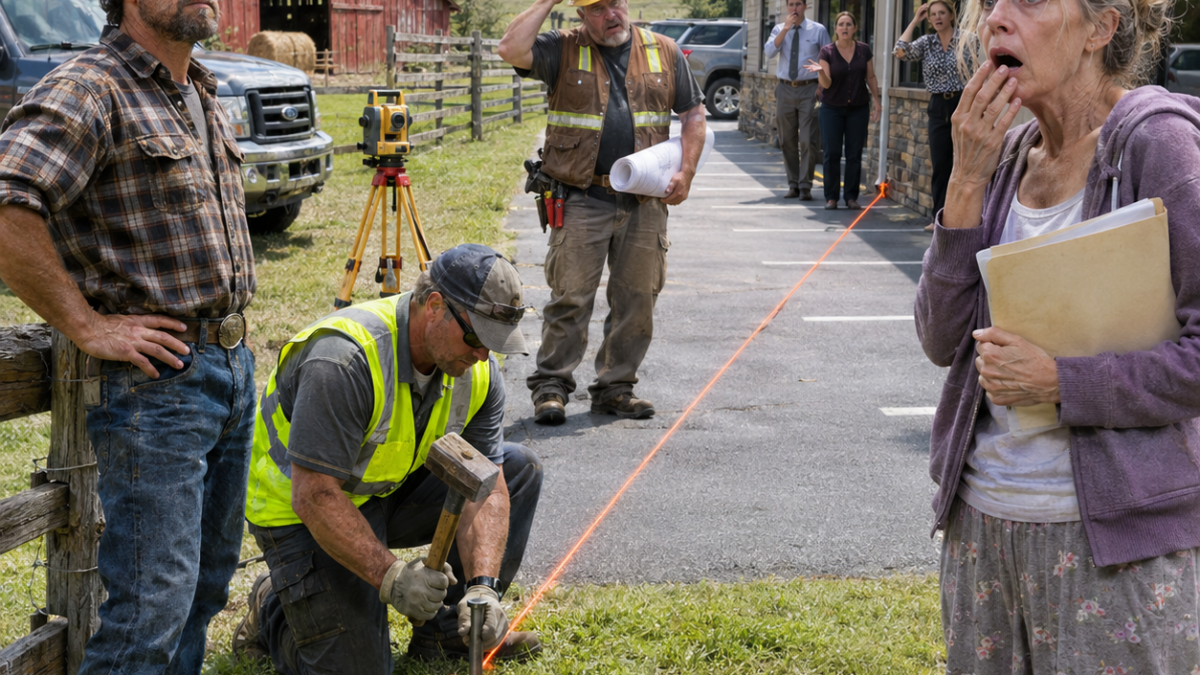
Before anyone could touch a board, my surveyor drove an iron pin into the grass, stretched a bright orange line across the employee parking lot, and continued straight through the wall of the HOA’s management building—thirty-eight feet of the structure was standing on land that legally belonged to me.
Then he unfolded another survey and told Patricia Dawson there was something even larger hidden beneath the property line, and for the first time since she started fining me, the woman who had spent a year telling me where my land ended stopped talking.
My name is Nathan Lawson.
Lawson Farm covers ninety-one acres in western North Carolina.
My grandfather bought the first sixty acres in 1968.
Back then, the road was gravel.
There were more cattle than houses.
At night, the hills went dark except for porch lights and the occasional headlights of somebody coming home late from town.
My father added acreage over the years whenever a neighboring owner wanted to sell.
By the time the farm came to me, it included two hayfields, a creek, a pond, several sheds, a farmhouse, and a large red barn sitting near the eastern ridge.
If you saw the barn from the road, you probably would not call it beautiful.
The boards were scarred.
The roof had been replaced twice.
One wall leaned just enough that visitors occasionally asked whether it was safe.
It was.
My grandfather built the frame from oak beams thick enough that two men could barely lift them.
Dad later reinforced several joints with steel brackets.
That barn survived ice storms.
Heavy snow.
High winds.
A hurricane that dropped a tree across the back roof.
And decades of my family treating it like the center of the farm.
I learned to stack hay there.
Dad taught me how to repair a mower on the concrete pad inside.
Mom stored old Christmas decorations in the loft because the farmhouse attic was too small.
After Grandpa died, Dad and I found his first tractor manual inside a wooden drawer behind the workbench.
The pages were yellow.
Grease-stained.
Half the notes in the margins made no sense to me.
I kept it anyway.
To everybody else, it was an old barn.
To me, it was one of the places where my family history still felt physical.
You could put your hand against one of those oak beams and know your grandfather had put it there.
That mattered.
Cedar Ridge Estates came much later.
About fourteen years before everything happened, a development company bought several hundred acres east of us.
The land had belonged to a timber family.
The developers built nearly two hundred homes.
Walking trails.
Pool.
Tennis courts.
Clubhouse.
Landscaping.
The usual promises about luxury living in the country.
The subdivision stopped at our eastern boundary.
For several years, nobody bothered us.
My father was still alive then.
PART2:
He got along with most Cedar Ridge residents.
If a kid’s ball came over our fence, Dad threw it back.
If somebody asked permission to walk near the creek, he usually said yes.
Once, after a storm dropped several trees across Cedar Ridge’s main road, Dad let emergency vehicles use our old farm lane for an afternoon.
He believed in being a good neighbor.
But Dad had another rule.
Being generous does not mean giving people ownership.
I did not fully understand how important that distinction was until after he died.
The first time I heard from Patricia Dawson, she sent me a letter.
Not a phone call.
Not a visit.
A violation notice.
It said my barn violated Cedar Ridge’s visual standards.
I laughed.
Lawson Farm was not inside Cedar Ridge.
Not one acre.
The subdivision had been built beside our farm.
I called the number.
A woman from Cedar Ridge Community Services answered.
After I gave her my name, she transferred me to Patricia.
She introduced herself as HOA president.
I explained what I assumed was a mistake.
“My barn is not part of Cedar Ridge.”
“The barn is visible from Cedar Ridge homes.”
“Yes.”
“That means it affects community appearance.”
“So?”
“We have standards for adjacent structures that materially affect property values.”
“Your HOA covenants apply to my property?”
“They can apply to structures impacting the community.”
“That doesn’t sound right.”
Her voice changed slightly.
Professional became colder.
“You may want to discuss it with our management company.”
“I already know who manages my farm.”
Pause.
“Who?”
“Me.”
That conversation did not go well.
Two weeks later, another notice came.
This one demanded I repaint the barn.
Cedar Ridge’s approved colors:
Beige.
Gray.
Brown.
The barn had been red longer than Cedar Ridge had existed.
I showed the letter to Dad.
He was seventy-one then.
He sat at the kitchen table with a coffee mug in one hand and read the page slowly.
Finally he said:
“Tell them they can paint their houses whatever color they want.”
That was Dad’s complete legal analysis.
I liked it.
I mailed Cedar Ridge a copy of the Lawson Farm deed and the county parcel map.
The letters stopped.
Almost a year passed.
Then Dad died.
I do not remember much about the first months afterward in a clean sequence.
Grief does strange things to time.
I fed cattle.
Repaired fences.
Cut hay.
Paid bills.
Slept badly.
Got up.
Did it again.
Dad had always been part of the farm.
Suddenly every room contained an absence.
The barn was hardest.
His work gloves still hung beside the tool cabinet.
I left them there.
Some people throw everything away after someone dies.
Some people box it up.
I needed those gloves on that nail.
Maybe it was strange.
I did not care.
During that year Cedar Ridge expanded north.
Forty-six new homes.
The closest houses now sat near my eastern field.
The HOA also built a large management and maintenance center near our boundary.
Stone front.
Wood siding.
Office space.
Equipment bays.
Employee parking.
Maintenance yard behind it.
I watched construction from a distance.
There was a fence between us.
Survey stakes appeared to stay east of that fence.
At least I thought they did.
The building opened.
Six months later, Patricia came back into my life.
New letter.
My barn supposedly violated a fifty-foot community setback.
I read it twice.
The barn was nearly fifty years old.
Cedar Ridge was fourteen.
Even if their setback applied to surrounding property—which I doubted—it seemed absurd that a subdivision could arrive and suddenly make an old agricultural building illegal.
I hired Rebecca Hayes.
Rebecca specialized in property disputes and had the personality of somebody who considered vague language a personal insult.
She reviewed my deed.
County zoning.
Historical plats.
Cedar Ridge covenants.
Her conclusion was simple.
“They have no authority over your barn.”
“Good.”
“But there is something strange.”
“What?”
“Their attorney isn’t claiming you belong to the HOA.”
“What are they claiming?”
“An old development agreement.”
Cedar Ridge produced a document supposedly signed by my father nine years earlier.
It granted the developer control over a one-hundred-foot “landscape transition area” along our eastern boundary.
Appearance.
Structures.
Landscaping.
Access.
Dad’s signature appeared at the bottom.
I stared at it.
It looked real.
That bothered me.
Dad had occasionally worked with the original developers.
Maybe he had agreed to something I did not know about.
Rebecca did not assume.
“Do you have his records?”
“Boxes.”
“How many?”
“You don’t want to know.”
For three nights I searched filing cabinets.
Dad kept everything.
Diesel receipts.
Fence wire.
Vet bills.
Tractor parts.
Hardware-store receipts for individual screws.
Finally I found a folder labeled:
CEDAR RIDGE.
Inside were old letters.
One agreement immediately caught my eye.
Nine years earlier, Cedar Ridge construction had damaged several trees near our boundary.
The developer asked Dad for temporary permission to enter a narrow strip and restore landscaping.
Thirty days.
Nothing else.
Dad signed.
Same signature as the HOA’s permanent landscape agreement.
Not similar.
Same.
Tiny loop.
Same angle.
Same strange mark below the final letter.
Rebecca put both papers side by side.
“I think they copied this.”
A document examiner confirmed it.
The signature on Cedar Ridge’s supposed permanent agreement was an exact image copied from Dad’s thirty-day landscaping permission.
Not handwriting that looked similar.
An image.
Copied.
Pasted.
That changed the dispute.
Rebecca demanded Cedar Ridge withdraw everything.
Their attorney said he needed to investigate.
Patricia apparently did not share his patience.
New violation.
Barn color.
Another.
Barn setback.
Another.
Visible agricultural equipment.
Another.
Unapproved storage.
Then hay bales.
Hay bales.
On a farm.
The fines started at fifty dollars per day.
Then one hundred.
Then two hundred fifty.
Rebecca disputed every one.
Cedar Ridge kept adding them.
I asked my nearest Cedar Ridge neighbors whether anybody had actually complained.
Susan Parker, a retired nurse, lived in the closest house.
She looked at me like I had asked whether the moon bothered her.
“I like the barn.”
“You do?”
“It’s the only thing that makes Cedar Ridge still feel like we live in the country.”
Frank Wilson said his grandchildren liked watching my cattle.
Nobody knew of any complaints.
Then Susan showed me the HOA newsletter.
Patricia had written an article:
PROTECTING CEDAR RIDGE PROPERTY VALUES FROM INCOMPATIBLE NEIGHBORING USES.
No names.
But it mentioned:
Barns.
Machinery.
Livestock odor.
Agricultural storage.
Then:
Future redevelopment opportunities.
Rebecca stopped at that phrase.
“Redevelopment of what?”
“Not my farm.”
“You sure?”
“I’m not selling.”
A month later Patricia requested a meeting.
I agreed.
I still believed there was a version of this problem adults could solve by talking.
The meeting happened at Cedar Ridge Community Services.
The very building I later discovered crossed my property line.
Patricia sat with Daniel Foster, Cedar Ridge’s community manager.
Daniel seemed less aggressive.
Mostly administrative.
Patricia brought a proposal.
Cedar Ridge wanted twenty-two acres of my eastern land.
It included the barn.
The offer was not insulting.
I was not interested.
“We’re not selling.”
Patricia folded her hands.
“Keeping agricultural structures this close to a premium residential community will create continued conflict.”
“Only if you keep sending me letters.”
She ignored that.
Then she showed me the long-term plan.
Walking trails.
Pickleball courts.
Second pool.
Parking.
Maybe townhomes.
Every expansion needed land.
My land.
Suddenly the barn fines looked different.
If maintaining the barn became expensive enough, maybe selling twenty-two acres would look easier.
I asked:
“If I sell, what happens to the fines?”
Patricia did not answer directly.
“They can be resolved as part of the transaction.”
There it was.
I said no again.
She smiled.
“You may want to think carefully.”
“I already did.”
The fines accelerated.
Thirty thousand dollars.
Then forty.
Then more.
Rebecca kept challenging them.
Cedar Ridge kept adding new names.
Continuing architectural noncompliance.
Failure to cure.
Legal administration.
Community impact.
The balance reached sixty-two thousand.
Then Cedar Ridge hired surveyors.
I found them near the eastern fence.
One man crossed into my pasture.
I walked over.
He apologized immediately.
The work order said:
Boundary marking for future compliance enforcement.
I explained the property was under legal dispute.
He stopped.
Before leaving, he looked at the old fence.
“Your fence doesn’t appear to line up with the county monument.”
“What does that mean?”
“Your recorded corner may be farther east.”
“How far?”
He shrugged.
“Could be several feet. Could be more.”
That was the first time I seriously questioned the fence.
It had been there since I was a kid.
I assumed fence meant boundary.
But farms are full of fences built around trees, hills, creeks, convenience.
Not always legal lines.
I hired Thomas Reed.
Thomas had surveyed land in the county for more than twenty years.
He started with our deed.
Then old plats.
County monuments.
Historical surveys.
He spent two full days walking the eastern side.
On the third afternoon:
“Nathan, come out here.”
I found him near the Cedar Ridge management building.
He had uncovered an old iron pin.
Almost forty feet east of my fence.
I looked at him.
“That’s the corner?”
“Yes.”
“You’re sure?”
“I still need to finish everything, but yes.”
My stomach tightened.
The fence was not forty feet onto Cedar Ridge property.
It was forty feet inside mine.
Thomas followed the recorded boundary north.
Across grass.
Into the Cedar Ridge employee parking area.
Through a landscaping wall.
Then beneath the corner of the management building.
I stared at the stone wall.
“How much?”
“Let me finish.”
Rebecca told me not to say anything yet.
Evidence first.
Argument later.
That was difficult because Cedar Ridge kept fining me.
Then the final demand arrived.
Exactly $100,000.
Not $99,850.
Not $100,120.
An even one hundred thousand dollars.
The letter said I had to:
Pay.
Bring the barn into compliance.
Remove it.
Or face “all available legal remedies.”
Then the alternative.
Sell the eastern twenty-two acres to a Cedar Ridge affiliated company.
The sale would resolve all compliance obligations.
Rebecca read it.
“They finally said the quiet part out loud.”
I should have been furious.
Instead, I became calm.
Thomas’s final survey was due the next morning.
I called.
“You done?”
“Almost.”
“What did you find?”
Pause.
“You’re going to want Rebecca there.”
That is never a comforting sentence.
The next morning Patricia arrived before I called her.
Two board members.
Daniel Foster.
And a man carrying demolition-company paperwork.
No bulldozer yet.
Just preparation.
Patricia handed me the final demand.
“Seventy-two hours.”
“To do what?”
“Remove the barn voluntarily.”
I pointed toward the demolition representative.
“Why bring him if I supposedly have seventy-two hours?”
“We’re preparing options.”
Rebecca arrived.
Then Thomas.
Survey rolls under one arm.
Orange marking flags in his truck.
Patricia looked annoyed.
“What is this?”
“My survey.”
She smiled.
“We already know the barn violates the setback.”
Thomas looked at me.
“Can I show them?”
“Please.”
He started at the old iron pin.
Drove a bright marker into the ground.
Then pulled an orange survey line north.
Across my grass.
Across the edge of Cedar Ridge’s paved parking lot.
Between parked maintenance trucks.
Through a row of decorative shrubs.
Straight into the wall of Cedar Ridge Community Services.
Daniel stopped.
“Wait.”
Thomas kept walking.
He moved around the building.
Measured again.
Checked his notes.
Then said:
“Approximately thirty-eight feet of this building extends onto Lawson Farm.”
Patricia laughed.
One short nervous sound.
“That is impossible.”
Thomas handed Rebecca the certified survey.
“County monument. Original plat. Deed calls. Two historical surveys. They match.”
Daniel took the map.
His face changed.
The building was not alone.
Employee parking extended onto me.
Most of the equipment yard.
A private service road.
Part of the drainage basin.
Patricia pointed toward my barn.
“This does not change his violations.”
Rebecca held up the $100,000 letter.
“It changes the conversation.”
Thomas said:
“There’s more.”
He took us behind the management building.
Concrete drainage basin.
Wooded slope.
A metal access cover partly buried beneath mulch.
“The recorded plat shows no utility easement here.”
Daniel frowned.
“That’s our stormwater vault.”
Thomas shook his head.
“Your stormwater plan shows the vault somewhere else.”
Daniel opened the Cedar Ridge utility map on his tablet.
The buried line traveled west.
Toward Lawson Farm.
Not east into Cedar Ridge.
Patricia looked at him.
“What line?”
Daniel looked genuinely confused.
“That shouldn’t be there.”
Patricia told him to stop talking.
Too late.
The line pointed downhill toward my creek.
Farther west:
My old farm well.
The well supplied the barn and livestock tanks.
Thomas asked:
“Did you ever grant Cedar Ridge underground utility rights?”
“No.”
County Public Works scheduled an inspection.
Patricia said Cedar Ridge would commission its own survey.
Fair.
I expected that.
What I did not expect happened that evening.
My barn camera sent an alert.
White pickup near the eastern gate.
Three men.
One in a Cedar Ridge maintenance shirt.
One with bolt cutters.
One holding orange marking paint.
Then another truck arrived.
Same demolition company Patricia had brought that morning.
Small excavator on a trailer.
The maintenance worker cut the chain on my gate.
Attached a notice to my barn.
UNSAFE STRUCTURE.
ACCESS PROHIBITED.
The seventy-two-hour deadline was not twelve hours old.
I called Rebecca.
Then sheriff.
I drove toward the barn and stopped where my cameras could still record everything.
The demolition supervisor began unloading.
I stepped out.
“This is private property.”
Everybody turned.
“The sheriff is coming.”
The Cedar Ridge employee said:
“Emergency safety authorization.”
“Show me the county condemnation.”
He could not.
The demolition supervisor looked at him.
“You said the county condemned this.”
“The HOA has equivalent authority.”
“No,” I said.
The supervisor immediately stopped unloading.
Smart man.
Headlights came through the cut gate.
Patricia.
She got out with another folder.
Rebecca arrived behind her.
Patricia claimed “updated legal guidance” allowed Cedar Ridge to secure dangerous structures.
Rebecca asked to see it.
Patricia refused.
My phone rang.
Thomas.
“I found the construction survey.”
“Good time.”
“Nathan, do not let anybody touch that barn.”
“I’m working on it.”
“No. Listen. The original approved plan had the Cedar Ridge management complex completely inside Cedar Ridge.”
“And?”
“The construction version moved the entire complex west.”
“How far?”
“About forty feet.”
I looked at the office beyond my field.
“That matches our survey.”
“Yes.”
“So somebody knew.”
“Maybe.”
Then the sentence that changed everything.
“The construction version is signed by Patricia Dawson.”
I stared at her.
Patricia stood twenty yards away holding paperwork demanding demolition of my grandfather’s barn.
Before I could speak, the demolition supervisor pointed toward the woods.
“Is that supposed to happen?”
Ground near the creek was sinking.
At first slowly.
Then faster.
Grass folded inward.
Dark opening formed.
Water rushed below.
The hole widened.
By the time Deputy Michael Grant reached us, nearly three feet of earth had dropped.
A large black pipe appeared.
Running under my property.
Michael ordered everyone away.
Patricia began explaining Cedar Ridge had nothing to do with the collapse.
Then another section caved in.
The demolition supervisor loaded his excavator back onto the trailer.
“I was hired to remove a barn. Not work beside a collapsing utility trench.”
Reasonable.
County Public Works arrived.
Andrew Collins, lead inspector, examined the exposed pipe.
“This isn’t stormwater.”
Daniel looked at him.
“Our map says it is.”
“Your map is wrong.”
Eighteen-inch pipe.
Pressure inside.
Something actively moving through it.
Andrew ordered upstream valves closed.
Cedar Ridge maintenance could not tell him where the right valve was.
That frightened me more than the collapse.
They had infrastructure beneath my farm and apparently did not understand their own system.
Patricia insisted old development agreements gave Cedar Ridge utility rights.
Rebecca reminded her:
The agreement using Dad’s signature had already been proven copied.
Michael asked:
“Do you have a recorded easement?”
Patricia said the HOA attorney would respond.
Michael looked at the exposed pipe.
“That’s not an answer.”
Thomas arrived with the old construction survey.
Original approved plan:
Management center completely east of Lawson boundary.
Later construction drawing:
Moved west almost forty feet.
Signature:
Patricia Dawson.
She said she had signed many development documents before becoming HOA president.
That surprised everyone.
“What was your job?” Thomas asked.
“Development liaison.”
“For who?”
“Cedar Ridge Development Group.”
Daniel looked stunned.
“You never told the board.”
Patricia snapped that her former job was irrelevant.
Thomas tapped the plan.
“It’s relevant if you approved this.”
Patricia argued site plans change during construction.
Thomas agreed.
“Correct. But when a revised footprint crosses private property, you need a deed, an easement, or an ownership agreement.”
“There must be one.”
There must be.
That phrase became familiar.
There must be a document.
There must be a right.
There must be an agreement.
But nobody could produce one.
The county found the shutoff.
Pressure dropped.
Andrew traced smaller branches.
One toward Cedar Ridge.
One toward my creek.
One toward the management center.
Another disappearing beneath my barn pasture.
That line eventually led almost six hundred feet west.
Toward my pond.
Behind brush, county crews found a pump-control box.
Cedar Ridge markings.
The system had been drawing water from my pond automatically whenever Cedar Ridge’s storage tank dropped below a set level.
I stared.
“How long?”
Equipment looked several years old.
Daniel stood beside me.
“I didn’t know.”
I believed him.
Daniel had joined Cedar Ridge after the management center was built.
Not everybody connected to an organization knows what happened before they arrived.
The pond water supplied:
Irrigation.
Maintenance-equipment washing.
Emergency pool refill.
During summer, it saved Cedar Ridge thousands of dollars.
No permission.
No payment.
No easement.
Thomas looked toward the barn.
“You got fined a hundred thousand dollars because they said you were too close to their property.”
“Yes.”
He pointed at the pump.
“While they were taking water from yours.”
The irony might have been funny if it had not been so expensive.
County disconnected the pump.
Then Cedar Ridge held an emergency meeting.
Clubhouse packed.
Rumors everywhere.
Daniel opened with confirmed facts.
Independent survey showed the management center crossed the Lawson boundary.
Unauthorized infrastructure existed on Lawson Farm.
No recorded easement had been found.
Barn enforcement under legal review.
Patricia stood.
She claimed Cedar Ridge had historical use rights.
Thomas whispered:
“Fourteen years is historical now.”
I almost laughed.
Then Susan Parker stood.
“If our office has been sitting on Nathan’s property for eleven years, why were we fining him because his barn was too close to us?”
Silence.
Patricia said the issues were separate.
Susan shook her head.
“They don’t feel separate.”
Then Frank Wilson stood.
“Did the board know your husband’s company wanted Nathan’s land?”
Patricia’s face changed.
I looked at Rebecca.
“What company?”
Frank projected a state business record.
DAWSON COMMUNITY DEVELOPMENT LLC.
Owner:
Mark Dawson.
Patricia’s husband.
Created two years earlier.
Business purpose:
Land acquisition.
Residential development.
Rebecca asked:
“Any connection to Cedar Ridge’s expansion plan?”
Patricia:
“No.”
Then Laura Mills, HOA treasurer, interrupted.
“That isn’t true.”
The room erupted.
Laura projected an email.
Six months earlier, Patricia sent the board a proposal for western expansion.
New courts.
Parking.
Pool.
Townhomes.
Development partner listed at the bottom:
Dawson Community Development LLC.
My twenty-two acres were central.
Rebecca leaned close.
“Now the fines have a financial context.”
Then financial records.
Cedar Ridge had paid almost $84,000 over eighteen months to:
WESTERN BOUNDARY CONSULTING.
Owner:
Mark Dawson.
Invoices:
Boundary compliance.
Land-acquisition strategy.
Agricultural transition.
Barn resolution.
Barn resolution.
That phrase sat there like a confession.
Laura opened the consulting contract.
Monthly fee.
Plus success bonus if Cedar Ridge acquired at least fifteen acres of Lawson Farm.
Bonus:
$125,000.
Patricia’s husband stood to receive $125,000 if I sold.
Patricia had spent months increasing financial pressure against the land he wanted.
Susan said quietly:
“So Nathan gets a $100,000 barn fine while Mark gets $125,000 if Nathan gives up.”
Rebecca answered carefully.
“That is what the documents appear to show.”
Patricia called it defamatory.
Daniel said:
“We need independent counsel.”
That changed the room.
Cedar Ridge suspended all enforcement against Lawson Farm.
Five yes.
Patricia:
No.
Western Boundary payments frozen.
Patricia:
No.
Her authority over land, legal, and enforcement matters suspended.
She left before the meeting ended.
I expected satisfaction.
Mostly I felt tired.
Two weeks of relative calm followed.
County stabilized the collapse.
Barn remained safe.
Pond pump removed.
Thomas completed full survey.
Total Cedar Ridge encroachment:
Approximately 0.84 acres.
Part of office building.
Seventeen parking spaces.
Most of equipment yard.
Service road.
Drainage basin.
Utilities.
Less than one acre.
But critical infrastructure.
Rebecca asked:
“What do you want?”
Not:
How much can we demand?
What outcome?
“I don’t want their building.”
“You technically own the land beneath part of it.”
“I know.”
“You could force a serious conversation about removal.”
“Daniel works there. Maintenance staff work there. Residents depend on it. Tearing down part of the office punishes people who didn’t create the problem.”
“So?”
“Correct the boundary. Fair payment for the occupied land. Compensation for past use. Remove unauthorized utilities. No expansion. All barn fines gone.”
Rebecca smiled.
“That is annoyingly reasonable.”
Independent HOA counsel proposed nearly the same.
A settlement looked possible.
Then the financial audit started.
The $100,000 balance had not accumulated naturally.
Regular disputed fines had reached about $34,000.
Then Patricia’s administrator account added:
$25,000 Architectural Impact Assessment.
$20,000 Community Value Protection Fee.
Legal Reserve Allocation.
Continuing Harm Charge.
None existed in adopted rules.
The total had been manually pushed to exactly:
$100,000.
Who entered the adjustments?
Administrator:
P. Dawson.
Patricia.
Then auditors found three more outside properties with “enforcement profiles.”
Horse farm north.
Wooded tract south.
Family home near main entrance.
All outside the HOA.
All beside future expansion zones.
One had already sold.
Thomas Parker.
Twelve acres near the south entrance.
Buyer:
Dawson Community Development.
Rebecca contacted him.
Thomas said Cedar Ridge sent him years of notices.
Old workshop.
Gravel driveway.
Fence.
Tree debris.
He repeatedly said he was outside the HOA.
Then Patricia offered:
Sell and the problems disappear.
Thomas was caring for his sick wife.
He was exhausted.
He sold.
That angered me differently.
Not because Thomas made the wrong decision.
He made the decision he needed.
Because somebody may have understood exactly how tired he was.
Pressure is most effective when people are already carrying something heavy.
Then Daniel called.
“We found a room.”
“What room?”
“Inside the management building.”
A locked records room connected to Patricia’s old project office.
Board authorized opening.
Rebecca and I went.
Boxes.
Boundary maps.
Expansion proposals.
Photographs of neighboring properties.
Tax estimates.
Owner information.
My folder:
LAWSON EAST ACQUISITION.
Thick.
Photographs of the barn.
Maps of pond.
Tax records.
Notes about Dad’s death.
Mortgage information from public filings.
Estimated legal-defense cost.
Then one highlighted sentence:
PRESSURE INCREASES SALE LIKELIHOOD AFTER 75K EXPOSURE.
My stomach turned.
Another:
TARGET 100K BEFORE FINAL OFFER.
The fines were modeled.
Not enforcement.
Pressure.
A spreadsheet listed neighboring owners.
Age.
Debt.
Family circumstances.
Resistance level.
Estimated acquisition cost.
Future Cedar Ridge project.
The barn was never the problem.
Land was.
Thomas called from behind the maintenance garage.
He had found old aerial photographs.
Before Cedar Ridge construction, our original farm fence sat almost exactly on the deed line.
After the management building was constructed, the fence appeared forty feet west.
Somebody moved it.
During construction.
Dad likely assumed workers replaced it in the same place.
Contractor report:
FENCE RELOCATION — WEST SITE.
Authorized by:
Patricia Dawson.
The same woman later used the new fence to claim my barn violated a setback.
Rebecca summarized it perfectly.
“She moved the line, then enforced against you using the line she moved.”
Then Thomas found another note on the old site plan.
PHASE B — FUTURE STORAGE.
A second building planned even farther onto Lawson Farm.
Daniel checked Cedar Ridge capital budget.
New maintenance warehouse.
Construction starting Monday.
Four days away.
Authorization packet included:
Nathan Lawson.
Signature.
Not mine.
Dated six weeks earlier.
Rebecca went pale.
“This is recent.”
Then I remembered.
I had signed one Cedar Ridge document recently.
Temporary thirty-day license allowing employees to keep using the disputed parking area while we negotiated.
Kindness with paperwork.
Rebecca pulled it up.
My signature.
Same size.
Same slant.
Same digital pattern on the warehouse authorization.
Copied.
The temporary agreement meant to keep Cedar Ridge operating peacefully had provided a fresh image of my signature.
Daniel stared.
“I emailed the license directly to Patricia’s old administrative account.”
The fake warehouse document also granted Cedar Ridge permanent rights to:
All currently occupied and proposed maintenance land.
Building.
Parking.
Road.
Equipment yard.
Everything across the boundary.
If accepted, it could make it appear I had voluntarily cured the problem after discovering it.
Daniel’s phone rang.
Security.
Somebody had entered the records building using Patricia’s old access code.
Carrying boxes toward the loading area.
Who?
Mark Dawson.
Her husband.
The man with the $125,000 success bonus.
We ran toward the office.
Fire alarm.
Smoke.
Mark stood beside the rear door holding a cardboard box.
Then flames appeared behind him.
Rebecca shouted:
“Everybody out!”
Sprinklers activated.
Employees evacuated.
Fire department came.
Nobody hurt.
Most of building survived.
The project room did not.
Mark told Deputy Michael Grant he entered to retrieve private Western Boundary files.
Daniel said Mark had no authorization after contracts were frozen.
A firefighter emerged carrying a melted trash bin.
Burned papers.
Remains of a bottle.
Nobody accused Mark immediately.
Being near a fire does not prove you started it.
But timing looked terrible.
The box Mark dropped contained:
My survey.
Fake warehouse authorization.
Western Boundary invoices.
Development maps.
One showed my eastern twenty-two acres already divided into future lots.
Lot 301.
302.
303.
The barn was replaced by:
COMMUNITY RECREATION CORE.
Pool.
Parking.
My family barn already erased from their future.
Daniel said security saw Mark removing records before the alarm.
So he had not been rescuing them from a fire.
His lawyer arrived.
He stopped answering.
Cedar Ridge had something Mark apparently forgot.
Off-site server backup.
Every night.
Burning paper did not erase digital files.
The next morning Rebecca arrived at my barn with two coffees.
“You’re going to hate these.”
“That’s becoming your greeting.”
First email:
Two years old.
Patricia to Mark.
LAWSON STRATEGY.
Patricia:
Normal purchase offers unlikely. Nathan is emotionally attached to inherited structures.
Mark:
Barn?
Patricia:
Barn strongest target. Highly visible from north section.
Mark:
Build compliance record first. Acquisition offer after cost becomes uncomfortable.
I read it three times.
No misunderstanding.
No overzealous rule interpretation.
Plan.
Next exchange:
Mark:
Need exposure high enough that sale looks cheaper.
Patricia:
Target?
Mark:
75 minimum. 100 gets attention.
Exactly.
$100,000 was chosen before my fines ever reached it.
Rebecca showed me a spreadsheet.
WESTERN ACQUISITION MODEL.
My land value.
Legal-defense estimates.
Fine tolerance.
Emotional resistance.
Projected probability of sale.
My row:
SALE PROBABILITY 70% ABOVE $100K ENFORCEMENT EXPOSURE.
I laughed.
Rebecca smiled.
“You disappointed the model.”
Humor helped.
Then Thomas Parker’s file.
OWNER CARE BURDEN REDUCES RESISTANCE.
His sick wife had been turned into an acquisition variable.
That line made me angrier than anything about my barn.
Financial investigators found Western Boundary Consulting had received over $180,000.
Dawson Community Development bought properties after Cedar Ridge pressure.
Patricia controlled enforcement.
Mark controlled consulting and acquisition.
Then Daniel found the original management-center construction emails.
Why had the building shifted west?
Drainage problem.
Original site required retaining walls and deeper foundation work.
Expensive.
Moving the building forty feet west onto higher ground saved almost $240,000.
Problem:
Higher ground belonged to Lawson Farm.
Project engineer warned Patricia.
REVISED FOOTPRINT CROSSES LAWSON BOUNDARY APPROXIMATELY 36–40 FEET.
OWNER AGREEMENT REQUIRED BEFORE CONSTRUCTION.
Patricia:
PROCEED PENDING BOUNDARY ADJUSTMENT.
Engineer:
NO RECORDED AGREEMENT RECEIVED.
Patricia:
TEMPORARY FENCE POSITION REFLECTS PRACTICAL BOUNDARY. LEGAL CLEANUP CAN FOLLOW.
Practical boundary.
The fence she later moved.
They built first.
Planned to fix ownership later.
Never did.
Eleven years later, Patricia used the false line to fine my barn.
Independent counsel called another emergency meeting.
Patricia could attend.
She could not lead.
Certified survey displayed.
Original construction plan.
Changed plan.
Patricia’s approval.
Then acquisition emails.
Barn strongest target.
Sale looks cheaper.
100 gets attention.
Residents stopped looking at me.
They looked at Patricia.
First board vote:
Erase the entire $100,000 balance.
Not suspend.
Not negotiate.
Delete.
Unanimous.
I did not cheer.
I exhaled.
That number had followed me for almost a year.
Gone in thirty seconds.
Second vote:
Terminate Western Boundary Consulting.
Unanimous.
Third:
Remove Patricia as HOA president.
Permanent.
Five yes.
One abstention.
She stood afterward.
For a moment, I thought she might apologize.
Instead:
“Eventually you will understand everything I did was meant to protect Cedar Ridge property values.”
Susan answered from the audience.
“You tried to take somebody else’s property to protect ours.”
Patricia left.
The barn was safe.
But the property problem remained.
Cedar Ridge still had nearly an acre of critical infrastructure on my land.
The next morning we negotiated.
Three options.
Move everything.
Buy occupied land.
Permanent easements.
Moving the building would cost millions and disrupt residents.
I did not want that.
We focused on selling only the occupied 0.84 acres.
Not twenty-two acres.
Not the barn.
Not the pond.
Only what they already physically depended on.
Fair commercial price.
Past-use compensation.
Legal and survey fees.
Drainage reconstruction.
No pond access.
No expansion.
Permanent markers.
And:
“Move the fence.”
Daniel nodded.
“Done.”
That mattered more than money.
For years the false fence made the false boundary look true.
I wanted the earth itself corrected.
Board approved.
Collapsed utility trench repaired.
Illegal pond connection removed.
Stormwater redirected.
County tested creek and pond.
No dangerous contamination.
Barn inspection officially closed.
No violation.
No hazard.
No color issue.
No setback.
Just a barn.
I repainted one side that fall.
Red.
Very red.
Then investigators issued the fire report.
Accelerant had been used inside the project-office trash container.
Security footage placed Mark there.
Phone location matched.
Receipt showed a small solvent purchase earlier that afternoon.
Legal process still mattered.
But fire was no longer assumed accidental.
Digital evidence tied Mark to the fake warehouse authorization too.
Less than four hours after I signed the temporary parking license, a file appeared on his laptop:
LAWSON PERMANENT AUTHORIZATION.
My signature image extracted from the temporary agreement.
Metadata:
M. Dawson.
Draft email:
ONCE WAREHOUSE STARTS, OCCUPIED AREA BECOMES OPERATIONALLY PERMANENT. LAWSON CHALLENGE BECOMES COMPENSATION ISSUE RATHER THAN POSSESSION ISSUE.
Rebecca translated.
“Build first. Make it expensive to undo later.”
That strategy existed everywhere.
Move fence.
Build office.
Lay pipes.
Create parking.
Start warehouse.
Change physical reality before owner can stop it.
A retired project engineer named William Harper contacted Rebecca.
He had saved old project records because he had opposed the boundary change eleven years earlier.
Binder.
Original emails.
Handwritten notes.
William had told Patricia:
The old Lawson fence could not legally replace the deed boundary.
She asked whether construction could begin while lawyers resolved it.
He advised against it.
Mark wrote in the margin:
BUILD. RESOLVE LATER.
Three words.
The entire philosophy.
William looked at me.
“I should have contacted your father.”
I asked:
“Why didn’t you?”
He looked ashamed.
“I told myself it was the developer’s legal problem.”
He did not make excuses.
I believed his apology.
That mattered too.
People sometimes see wrongdoing and assume somebody else will fix it.
That is how small violations become permanent systems.
Eventually Cedar Ridge and I finalized the settlement.
The HOA bought 0.84 acres at fair commercial value.
Not cheap pasture value.
Commercial land already occupied by necessary infrastructure.
They paid compensation for:
Years of unauthorized use.
Pond water.
Fence damage.
Utility collapse.
Surveying.
Legal costs.
Restoration.
The $100,000 fine stayed permanently void.
Cedar Ridge formally disclaimed the fake transition agreement using Dad’s copied signature.
Outside-property enforcement language was removed from HOA policy.
No Cedar Ridge rule could ever apply to Lawson Farm without a separately recorded agreement.
I signed.
This time voluntarily.
My signature meant what I intended it to mean.
That felt surprisingly important.
County recorded the corrected line.
Workers removed the false fence.
New fence went up on the true boundary.
Permanent markers installed.
For the first time since childhood, Lawson Farm’s physical fence matched its legal property line.
Thomas and I walked it afterward.
Near the northern corner, his locator beeped.
He stopped.
“What?”
“Another underground structure.”
I laughed.
“Of course.”
County excavated a concrete vault.
Inside:
Electrical controls.
Old survey markers.
Steel cabinet.
Maps.
Not the management center.
Not Cedar Ridge North.
Something much bigger.
CEDAR RIDGE WEST — MASTER EXPANSION.
More than three hundred future homes.
School site.
Commercial lots.
Roads.
Recreation complex.
And in the center:
Lawson Farm.
All ninety-one acres.
No barn.
No pond.
No farmhouse.
Streets.
Lots.
At bottom:
LAND CONSOLIDATION REQUIRED BEFORE PUBLIC LAUNCH.
Another sheet:
ACQUISITION PRIORITIES.
Parker Parcel — Complete.
North Horse Farm — Active.
Lawson Parcel — Pressure Phase.
South Woods — Pending.
The eastern twenty-two acres were never the real finish line.
They wanted the whole farm eventually.
Then Rebecca opened:
LAWSON FINAL ACTION.
Date:
Next Monday.
Four days away.
First line:
IF OWNER REFUSES ACQUISITION SETTLEMENT, INITIATE ENVIRONMENTAL ENFORCEMENT THROUGH CONTAMINATED WELL FINDING.
I stared.
“What contaminated well?”
Next page:
Laboratory report.
LAWSON FARM WELL.
Chemical contamination.
Unsafe for livestock use.
Except I had tested my well independently two months earlier.
Clean.
County inspector checked lab number.
Real laboratory.
Real report.
That was worse.
If the report itself was real, how could my clean well produce contaminated results?
Chain-of-custody form.
Technician:
Robert Jenkins.
Real employee.
Real collection.
Then somebody noticed the sample description.
LAWSON FARM WELL — EAST SERVICE POINT.
I had no east service point.
My main well sat west of the barn.
Livestock well south.
Nothing east.
Thomas looked at old underground utility map.
A capped riser existed near Cedar Ridge’s hidden line.
Label:
LAWSON EAST WELL TEST.
It was not connected to my well.
It was connected to Cedar Ridge maintenance water.
Someone had created a fake sampling point.
The laboratory did not lie.
The technician did not lie.
The sample really was contaminated.
The deception happened before the bottle reached the lab.
Robert Jenkins met us.
He had been hired by Western Boundary Consulting.
Mark Dawson personally escorted him to the capped riser.
Told him:
“That’s the Lawson East well.”
Robert sampled it.
Labeled exactly as instructed.
Sent it.
Result:
Contaminated.
He looked horrified.
“I thought I was testing an agricultural well before a land transfer.”
Rebecca asked:
“What did Mark call the job?”
Robert checked his notebook.
“Pre-acquisition environmental compliance.”
There it was.
The plan was not to poison my actual well.
More sophisticated.
Create a legitimate contaminated result and falsely describe the source as mine.
Then Cedar Ridge could claim:
Agricultural runoff.
Unsafe farm practices.
Threat to residents.
County review.
Insurance complications.
Higher operating costs.
Lower property value.
Dawson Community Development could offer to buy.
Projected reduction:
28%.
They were pricing the damage before executing it.
The final-action folder explained pressure stages.
Barn fine had never been about red paint.
The setback had never been about safety.
The $100,000 balance had been selected.
Fence had been moved.
Building knowingly placed across my line.
Pond used without permission.
Signature copied.
Neighbor profiles created.
And if all that failed:
Make my farm appear environmentally unsafe.
The fake test point still contained the same chemicals shown in the lab report.
Source:
Cedar Ridge maintenance runoff mixed with equipment-cleaning chemicals.
Nothing reached my actual well.
That was the best news I received all year.
My main well:
Clean.
Livestock well:
Clean.
Pond:
Clean.
I stood beside the barn holding the new test reports and felt something in my body finally release.
For months every discovery had uncovered another threat.
This time, we discovered the threat before it reached its intended effect.
Everything unraveled because Thomas found one old iron pin.
One boundary marker.
That pin exposed the false fence.
The false fence exposed the shifted building.
The building exposed the parking lot.
The service road.
The drainage system.
Pond pump.
Underground vault.
Expansion maps.
Fake signatures.
Pressure model.
Contaminated test point.
All because somebody decided my property line could be treated as a suggestion.
The civil and criminal investigations moved faster after that.
Not instantly.
Real investigations do not wrap up by the next commercial break.
Emails.
Server backups.
Bank records.
Surveys.
Digital metadata.
Laboratory records.
Fire evidence.
Contractor instructions.
William Harper’s old binder.
Patricia’s lawyers blamed some acts on Mark.
Mark’s lawyers blamed some on Patricia.
Rebecca told me:
“Stop assigning roles yourself.”
She was right.
Evidence could separate responsibility.
Mark eventually admitted through counsel that he entered Cedar Ridge’s records office to remove company documents after contracts were frozen.
He denied intending to burn the entire room.
Investigators still tied his conduct to the fire strongly enough for serious charges.
Patricia faced her own documented actions.
Dad’s copied signature agreement.
Management-center relocation.
Fence relocation.
Manual fine increases.
Acquisition emails.
Barn pressure strategy.
Outside-property enforcement.
Financial relationships with Mark’s companies.
She could not plausibly describe the $100,000 as ordinary enforcement when her own messages said:
100 gets attention.
Residents hated that most.
Their HOA had been turned into a land-acquisition weapon.
Their dues paid consultants related to Patricia’s family.
HOA notices pressured owners who were not HOA members.
Then Patricia’s family businesses stood to profit if those owners sold.
Cedar Ridge replaced management controls.
New attorney.
New auditors.
New rules.
No enforcement outside recorded HOA boundaries.
No family-related vendors without full disclosure.
No property acquisition without independent legal review.
No invented fine categories.
No large manual account adjustments without board approval.
No electronic owner signature accepted without direct verification.
I liked that one.
Other neighboring properties were reviewed.
Thomas Parker received legal assistance over the unsupported pressure surrounding his earlier sale.
His actual purchase contract had been voluntarily signed, which made completely undoing the transaction difficult.
Reality mattered.
Still, Dawson Community Development eventually paid a settlement over misleading pressure and unsupported enforcement.
Thomas told me:
“I might have sold anyway. My wife was sick.”
Then he looked at the ground.
“What bothers me is learning they were counting on me being tired.”
I understood.
North horse farm owner had an enforcement file prepared.
Never used.
South Woods belonged to an older woman named Margaret Lewis.
Marked:
Pending.
She had never received a notice.
Now she never would.
Cedar Ridge recorded a formal statement:
The HOA claimed no enforcement authority over any neighboring parcel outside its recorded subdivision boundary.
Public.
Permanent.
Future presidents could not revive Patricia’s “adjacent property standards” under a different name.
The 0.84-acre sale closed.
I could have demanded something outrageous.
Rebecca told me I had serious leverage.
But Cedar Ridge residents had already paid enough for Patricia and Mark’s decisions.
I wanted a strong fair price.
Not revenge pricing.
They paid it.
Compensation.
Restoration.
Legal costs.
Pond use.
Utility damage.
Everything.
Permanent boundary marker went into concrete near the eastern fence.
Thomas kicked it lightly.
“Hard to argue with that.”
“Apparently people can argue with anything.”
He laughed.
“Fair point.”
The barn stayed exactly where my grandfather built it.
New Cedar Ridge board sent a formal letter.
Every allegation withdrawn.
No repainting requirement.
No relocation.
No demolition.
No setback violation.
No HOA authority.
One sentence:
CEDAR RIDGE ACKNOWLEDGES THAT THE LAWSON BARN PREDATES THE SUBDIVISION AND IS NOT SUBJECT TO CEDAR RIDGE HOA COVENANTS.
I framed it.
Not because I needed to remember who won.
After almost a year of being told my barn was a problem, I wanted one official page saying what had always been obvious.
My barn.
My land.
Then I repainted the whole thing.
Red.
Same traditional red Dad used.
Not neon.
Not ridiculous.
Just red.
Frank Wilson helped.
Susan brought lemonade.
Daniel Foster brought a ladder.
Laura Mills, the HOA treasurer, painted part of one wall.
At one point, I looked around.
Half the people helping me paint came from Cedar Ridge.
That mattered.
The HOA had never truly been my enemy.
A system can be bad without every person inside it being bad.
Once the system changed, neighbors became neighbors again.
That was the outcome I wanted.
Cedar Ridge rebuilt its stormwater infrastructure entirely inside its corrected boundary.
Illegal pond connection removed.
Fake East well test point dismantled under county supervision.
Old expansion vault emptied and filled.
Maintenance warehouse relocated fully onto Cedar Ridge land.
Before construction started, Daniel called me.
“Would you like to inspect the stakes?”
I laughed.
“You’re asking me to approve your building?”
“No. I’m asking you to confirm it is nowhere near yours.”
I appreciated that.
The Cedar Ridge West master expansion died too.
Without Lawson Farm and several neighboring parcels, the three-hundred-home concept no longer worked.
Another developer eventually acquired the remaining legitimate rights and designed a smaller project on property they actually owned.
Once they contacted me about road access.
Offered money.
I said no.
They said:
“Thank you for considering it.”
Then redesigned the road.
That simple.
No fine.
No copied signature.
No contaminated water report.
No fire.
Question.
Answer.
Normal behavior can feel amazing after you see the alternative.
The criminal cases took more than a year.
I will not pretend everyone disappeared into prison forever.
Real life is more complicated.
There were charges.
Negotiations.
Restitution.
Business restrictions.
Court orders.
Civil settlements.
Mark faced the most serious consequences connected to fraudulent paperwork, financial misconduct, the records-room fire, and the acquisition scheme.
Patricia faced consequences tied to abusive enforcement, false documents, governance misconduct, and her documented role in the pressure strategy.
Dawson Community Development eventually dissolved.
Western Boundary Consulting disappeared.
Patricia never held another Cedar Ridge position.
Mark’s surrounding land projects collapsed.
The neighboring forty-acre tract eventually sold to Robert Miller.
He turned it into a small tree farm.
First time we met, Robert walked up to my fence.
“Can I repair the shared drainage ditch?”
He asked.
That word still mattered.
We fixed it together.
No dispute.
No lawyers.
No copied signatures.
Rebecca probably would have preferred paperwork.
Dad’s old files still sit in the barn office.
Now mine sit beside them.
Deed.
Survey.
Boundary settlement.
Pond tests.
Well tests.
Cedar Ridge letter.
Recorded easements.
New map.
Everything organized.
Susan once saw the filing cabinet.
“You have enough paperwork to start your own HOA.”
“Never.”
She laughed.
“Good answer.”
Farm life slowly became ordinary again.
Hay.
Rain.
Fence repairs.
Broken equipment.
Cattle finding creative ways through gates.
Normal problems.
Good problems.
One broken tractor belt is easier than a fake $100,000 barn fine.
The barn became a gathering place again.
Not intentionally.
Frank came by.
Daniel visited.
Susan brought her grandchildren to see cattle.
One Sunday several Cedar Ridge families helped clean trash along the creek after heavy rain.
They asked permission.
Rebecca had created a simple one-page form.
I used it.
Everyone laughed.
Kindness with boundaries.
Dad would have understood.
You can be generous without giving yourself away.
Looking back, one mistake I made early was thinking Cedar Ridge’s letters were too ridiculous to matter.
They were ridiculous.
But ridiculous paperwork can still become a record.
One wrong document.
Then another.
Then ten.
Then somebody new sees all that paper and assumes somebody must have verified it.
That was how the false boundary survived eleven years.
People saw a fence.
Saw an office.
Saw maps.
Assumed the line had been checked.
Nobody checked until Thomas Reed did.
That is why people laugh when they hear the short version of my story.
The HOA fined me $100,000 because of my barn.
They claimed it violated a setback.
Damaged property values.
Created community harm.
Then my surveyor proved their own management building was thirty-eight feet across my property line.
Not a mailbox.
Not a shed.
A whole office.
Parking.
Equipment yard.
Road.
Drainage infrastructure.
Utilities.
And records proved Patricia had known about the boundary problem since construction.
The same woman who authorized moving Cedar Ridge’s building onto my land later fined me because my barn stood too close to the false line created by the fence she helped move.
That irony alone would have made a good story.
But it went deeper.
The barn fine was part of a land-pressure strategy.
The $100,000 target was chosen deliberately.
Her husband stood to receive a $125,000 success bonus if enough of my farm was acquired.
My pond had been used.
My signature copied.
Neighboring owners profiled.
My father’s signature copied.
A new warehouse authorization fabricated.
The fence moved.
An office knowingly built across the line.
And when all of that failed, somebody prepared an environmental attack using a real contaminated sample taken from a fake “Lawson well” that did not exist.
They were prepared to damage the value of the whole farm until selling looked easier than staying.
Every part of it began from one belief.
That my boundary was negotiable even when I said it was not.
Today, a permanent metal survey marker sits beside the eastern fence.
Nothing beautiful about it.
Metal cap.
Concrete.
I pass it while mowing.
Sometimes I stop.
Because it reminds me of something.
A boundary is not hostility.
It is information.
This is yours.
That is mine.
We can still be neighbors.
We can help.
Share.
Cooperate.
Give permission.
Sell.
Refuse.
But choice matters.
Cedar Ridge still exists.
Pool crowded every summer.
Children walk the trail.
Management center still operates.
Now legally, on the land Cedar Ridge bought from me.
Daniel still works there.
Susan still waves.
Frank still complains about his knees.
Kids still point at the red barn.
Nobody sends me letters about its color.
And every evening when the sun falls behind that barn, I sometimes remember the morning Patricia stood in my field with a demolition contractor and a $100,000 demand.
She thought the biggest problem on that property was my barn.
Then Thomas Reed stretched one orange survey line across the grass.
Across the parking lot.
Straight through Cedar Ridge’s own building.
And suddenly everybody could see whose property line had actually been crossed.








