HOA Fined Me $100,000 for My Barn—Then I Proved Their Company Was Built Across My Property Line
HOA Fined Me $100,000 for My Barn—Then I Proved Their Company Was Built Across My Property Line
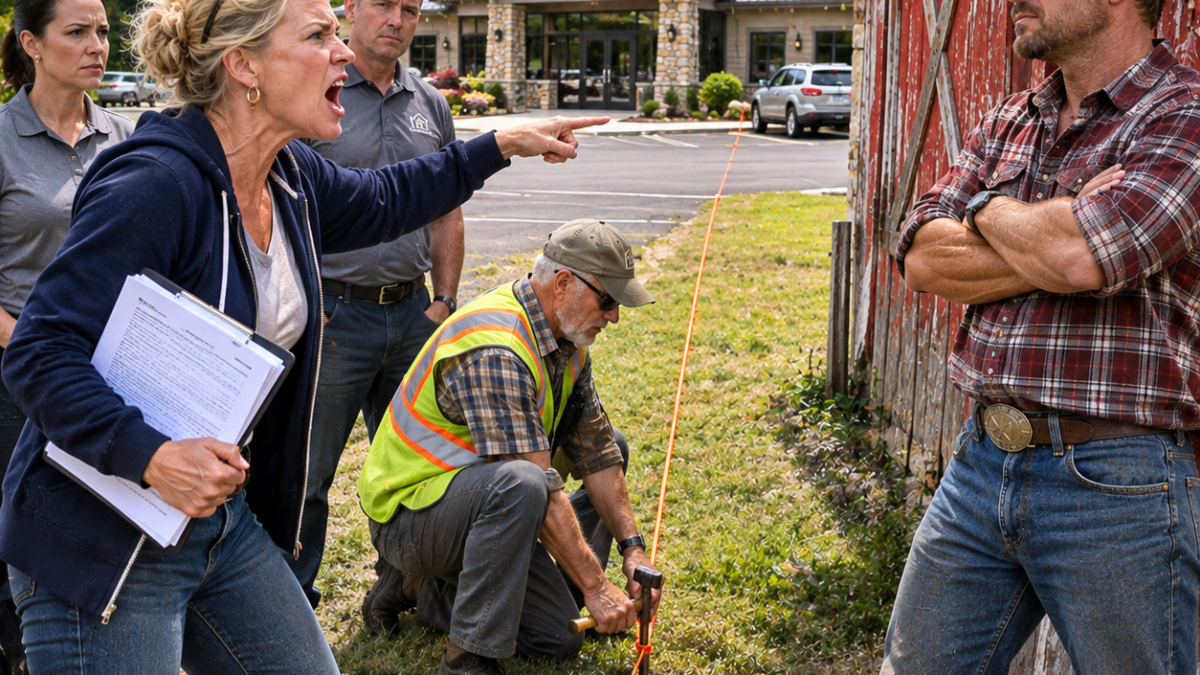
**“YOU HAVE 72 HOURS TO REMOVE THAT BARN, NATHAN—AFTER THAT, CEDAR RIDGE WILL USE EVERY ENFORCEMENT OPTION AVAILABLE AGAINST YOUR PROPERTY!” HOA president Patricia Dawson said as she handed me a final bill for exactly $100,000.**
**Then my surveyor drove an iron pin into the grass, stretched an orange line across the road, and ran it straight through the side of Cedar Ridge’s own management building.**
**Patricia was still insisting my fifty-year-old barn violated her boundary when my surveyor unfolded a second map and quietly said, “The building isn’t the only thing they put on your land.”**
My name is Nathan Lawson, and Lawson Farm covers ninety-one acres in western North Carolina.
My grandfather bought the first sixty acres in 1968.
Back then, there was no Cedar Ridge Estates.
No clubhouse.
No tennis courts.
No stone entrance sign.
No HOA president carrying folders onto my property and telling me what color my barn could be.
There were pastures.
Woods.
A creek.
A small pond.
A farmhouse.
A few sheds.
And the red barn my grandfather built near the eastern ridge.
That barn was almost fifty years old by the time Patricia decided it had become a problem.
It was not fancy.
The boards were scarred.
The metal roof had been replaced twice.
One wall leaned just enough that visitors sometimes asked whether it was safe.
It was.
Grandpa had framed it with heavy oak beams.
Dad later reinforced parts of the structure with steel brackets.
The barn survived ice storms, heavy snow, wind, and a hurricane that dropped a tree across the rear roof.
It also held most of my childhood.
I learned to stack hay there.
Dad taught me to rebuild a mower carburetor beside the south door.
Mom stored Christmas decorations in the loft because the farmhouse attic was too small.
When Grandpa died, we found his first tractor manual in a wooden drawer behind the workbench.
To Patricia, it was an incompatible structure.
To me, it was family history with a roof.
Cedar Ridge came decades later.
A developer bought hundreds of acres east of us and built nearly two hundred homes.
Pool.
Clubhouse.
Walking trails.
Tennis courts.
Then a second section closer to my eastern field.
For years, Dad got along with everyone.
If a child’s ball crossed the fence, he returned it.
If somebody asked permission to walk near the creek, he usually said yes.
When a storm blocked Cedar Ridge’s road, Dad let emergency vehicles use our farm lane for an afternoon.
But he understood something that became very important later.
Being generous is not the same as giving something away.
PART2:
The trouble started after Patricia Dawson became HOA president.
Patricia was in her early fifties.
Organized.
Polished.
Always carrying a folder.
Always speaking like every sentence had already been approved by somebody more important than you.
The first letter said my barn violated Cedar Ridge visual standards.
I laughed.
Lawson Farm was not inside Cedar Ridge.
Not one acre.
The subdivision had been built beside us.
I called the management office.
Patricia eventually came on the line.
“Your barn is visible from Cedar Ridge homes.”
“So?”
“Our covenants allow us to address incompatible structures affecting community appearance.”
“Your covenants apply to my farm?”
“They can apply to adjacent impacts.”
“That doesn’t sound legal.”
Her tone changed.
“You should discuss it with community management.”
“I already know who manages my property.”
“Who?”
“Me.”
Two weeks later, another letter arrived.
This one demanded that I repaint the barn.
Approved colors:
Beige.
Gray.
Brown.
The barn was traditional red.
I showed the letter to Dad.
He was seventy-one then, sitting at the kitchen table drinking coffee.
He read the whole thing.
Then said:
“Tell them they can paint their houses whatever color they want.”
That was Dad’s legal opinion.
I liked it.
I sent Cedar Ridge a copy of our deed and county parcel map.
The letters stopped.
For almost a year.
Then Dad died.
For months, I moved through the farm on autopilot.
Feed cattle.
Repair fence.
Cut hay.
Pay bills.
Sleep.
Repeat.
His work gloves still hung beside the barn tool cabinet.
I left them there.
Around that same time, Cedar Ridge expanded.
Forty-six new homes went up near my eastern field.
Then the HOA built a large management and maintenance center near the boundary.
Stone and wood offices in front.
Equipment storage behind.
Employee parking.
Service road.
Drainage basin.
I watched construction from a distance.
There was an old fence between us.
Survey stakes appeared to stay east of it.
I assumed the building was on Cedar Ridge property.
That assumption cost me a lot of time.
Six months after the building opened, Patricia sent another letter.
My barn supposedly violated a fifty-foot community setback.
Rebecca Hayes became my attorney.
She reviewed my deed.
County zoning.
Cedar Ridge’s declarations.
Old plats.
Her conclusion was simple.
“They have no authority over your barn.”
She sent a formal response.
Cedar Ridge’s attorney replied with something unexpected.
He did not claim Lawson Farm belonged to the HOA.
Instead, he said an old development agreement gave Cedar Ridge control over a one-hundred-foot landscape transition zone along my eastern property.
Rebecca asked for the agreement.
They sent it.
My father’s name was on it.
His signature too.
According to the document, Dad had given Cedar Ridge permanent control over appearance, landscaping, access, and structures near the boundary.
I stared at the signature.
It looked real.
That bothered me more than anything Patricia had done.
Dad had worked with the original developer occasionally.
Maybe he had signed something I never knew about.
Rebecca did not guess.
She asked for Dad’s records.
Dad kept everything.
Diesel receipts.
Fence wire.
Tractor parts.
Veterinary invoices.
Even boxes of screws.
For three nights, I searched old filing cabinets.
Then I found a folder labeled:
CEDAR RIDGE.
Inside was a nine-year-old agreement.
The developer had damaged several trees during construction and asked Dad for temporary permission to enter a narrow strip of Lawson Farm.
Thirty days.
Landscaping work only.
That was it.
Dad’s signature sat at the bottom.
Same signature Cedar Ridge had placed on its supposed permanent agreement.
Not similar.
Same.
Same tiny loop.
Same mark under the final letter.
Rebecca put the documents side by side.
“I think they copied this.”
A document examiner confirmed it.
The signature on Cedar Ridge’s permanent agreement was an exact copied image from Dad’s thirty-day temporary permission.
That should have ended everything.
It did not.
Patricia sent more violations.
Barn color.
Setback.
Visible equipment.
Unapproved agricultural storage.
Hay bales.
The fines started at fifty dollars per day.
Then one hundred.
Then two hundred fifty.
Rebecca disputed every one.
Patricia kept adding them.
I asked the Cedar Ridge residents closest to the farm whether they had complained.
Susan Parker, a retired nurse, lived nearest the barn.
She looked confused.
“I love that barn.”
Frank Wilson said his grandchildren loved watching my cattle.
Nobody I spoke with had filed complaints.
Then Susan showed me a Cedar Ridge newsletter.
Patricia had written an article about protecting property values from “incompatible neighboring uses.”
Barns.
Machinery.
Livestock smells.
Then one phrase caught Rebecca’s attention.
Future redevelopment opportunities.
“Redevelopment of what?”
I did not know.
Lawson Farm was not for sale.
Patricia requested a meeting.
We met inside Cedar Ridge Community Services—the same office I would later learn was standing on my land.
She showed me a purchase proposal.
Twenty-two acres of my eastern property.
Including the barn.
The offer was not terrible.
I still said no.
Patricia folded her hands.
“Keeping agricultural structures this close to a premium residential community will create ongoing conflict.”
“You mean your fines?”
“I mean incompatible land use.”
“Do the fines disappear if I sell?”
She did not answer.
Then she described Cedar Ridge’s long-term plans.
Walking trails.
Pickleball courts.
Second pool.
More parking.
Possibly townhomes.
All of it required land.
My land.
I finally understood why the barn had suddenly become so offensive.
I refused the offer.
The fines accelerated.
Thirty thousand.
Then more.
Rebecca sent another warning.
Patricia kept going.
Then something happened that changed the entire dispute.
Cedar Ridge hired a survey company.
One surveyor crossed my eastern field.
I walked over.
“What are you doing?”
He showed me the work order.
Cedar Ridge wanted the boundary marked for future compliance enforcement.
I explained that the land was under legal dispute.
The surveyor stopped immediately.
Before leaving, he looked at my old fence.
“Your fence doesn’t look like it matches the county monument.”
“What does that mean?”
“The corner pin may be farther east.”
“How far?”
He shrugged.
“Could be a few feet. Could be more.”
Farm fences are not always property lines.
They follow trees.
Terrain.
Convenience.
Sometimes somebody rebuilds them without a survey.
I had grown up believing that fence marked the boundary.
Maybe it did not.
I hired Thomas Reed.
Thomas had surveyed property in the county for more than twenty years.
He started with my deed.
Then the original plat.
Then historical surveys.
Then county monuments.
He spent two days walking the eastern boundary.
On the third afternoon, he called.
“Nathan, you need to come here.”
I found him near Cedar Ridge’s management building.
He had uncovered an old iron pin nearly forty feet east of my fence.
“You’re sure?”
“This matches the deed call and the historical surveys.”
My stomach tightened.
The fence was not on the property line.
It sat almost forty feet inside Lawson Farm.
Thomas followed the recorded boundary north.
The line crossed the edge of Cedar Ridge’s employee parking lot.
Then landscaping.
Then a retaining wall.
Then straight beneath the corner of the management building.
I stared at it.
“How much of their building is on me?”
“Let me finish the survey.”
Rebecca told me to stay quiet.
Evidence first.
Argument later.
That was difficult because Patricia kept sending fines.
Continuing architectural noncompliance.
Five hundred dollars per day.
Failure to cure.
Legal administration.
Community impact.
By summer, Cedar Ridge claimed I owed more than sixty thousand dollars.
Then came the final demand.
Exactly:
$100,000.
Not $99,800.
Not $100,240.
Exactly one hundred thousand.
The letter gave me three choices.
Pay.
Remove or alter the barn.
Or sell the eastern twenty-two acres to a company affiliated with Cedar Ridge.
Rebecca stared at the document.
“They finally said the quiet part out loud.”
The next morning, Patricia arrived at my farm.
Two board members.
Community manager Daniel Foster.
And a representative from a demolition company.
Patricia handed me the final demand.
“You have seventy-two hours to voluntarily remove the structure.”
I looked toward the demolition representative.
“Then why is he here before the seventy-two hours even starts?”
“We’re preparing enforcement options.”
Rebecca pulled into the driveway.
Then Thomas arrived behind her.
Patricia looked annoyed.
“What is he doing here?”
“My survey.”
“We already know where the boundary is.”
Thomas looked at me.
“Can I show them?”
“Please.”
He started at the iron corner monument.
Drove a metal pin into the grass.
Then stretched a bright orange line north.
Across the ground.
Across Cedar Ridge’s parking lot.
Between parked maintenance trucks.
Toward their office.
The line reached the wall.
And kept going.
Thomas walked around the other side.
“Approximately thirty-eight feet of this structure extends onto Lawson property.”
Daniel stopped.
Patricia laughed once.
Nervously.
“That’s impossible.”
Thomas handed Rebecca the certified survey.
“County monument. Original deed calls. Historical surveys. All match.”
Daniel studied the page.
His face changed.
The building was not the only thing.
Seventeen employee parking spaces crossed the line.
Most of the equipment yard.
Part of the private service road.
A drainage basin.
Patricia pointed at my barn.
“This has nothing to do with his violations.”
Rebecca raised the $100,000 letter.
“It changes the conversation.”
Then Thomas said:
“There’s more.”
Behind the maintenance garage sat a concrete drainage structure.
A metal access cover was partly hidden under mulch.
Thomas pointed.
“The original plat shows no utility easement here.”
Daniel opened Cedar Ridge’s utility maps.
The line beneath that cover did not match what Thomas found on the ground.
It ran west.
Toward Lawson Farm.
Patricia stopped talking.
Thomas asked whether I had ever authorized Cedar Ridge utilities under my property.
“No.”
The line pointed toward my creek.
My lower hayfield.
Eventually toward areas near the farm water system.
Public Works agreed to inspect it the next morning.
Patricia left.
That evening, a motion alert hit my phone.
Eastern barn.
I opened the camera.
White pickup.
Three men.
One wearing Cedar Ridge maintenance clothing.
One carrying bolt cutters.
One holding orange marking paint.
I called Rebecca.
Then the sheriff.
On camera, they cut the chain on my gate.
They posted a notice on the barn.
UNSAFE STRUCTURE.
ACCESS PROHIBITED.
Then a second truck arrived.
The same demolition company Patricia had brought that morning.
A small excavator sat on the trailer.
The seventy-two-hour deadline had been running less than twelve hours.
I drove toward the barn.
Stopped far enough away to keep the camera recording.
The demolition supervisor looked at the notice.
“County condemned it?”
The Cedar Ridge maintenance man said there was emergency authority.
I stepped out.
“This is private property.”
Everyone turned.
“The sheriff is coming.”
The maintenance man said Cedar Ridge had declared the barn an immediate hazard.
“Show me the county order.”
He could not.
The demolition supervisor immediately stopped unloading.
“Smart man,” I told him.
Then headlights came through the cut gate.
Patricia.
She stepped from her SUV holding another folder.
Rebecca arrived seconds later.
Patricia claimed she had updated legal guidance authorizing Cedar Ridge to secure dangerous structures affecting the subdivision.
Rebecca asked to see it.
Patricia refused.
Then Thomas called.
His voice came through my phone.
“Nathan, don’t let anybody touch that barn.”
“I’m trying.”
“No. Listen. I found the original Cedar Ridge construction survey.”
Rebecca moved closer.
“What does it show?”
“The approved management building was inside Cedar Ridge.”
I looked at Patricia.
“And the building they actually constructed?”
“Shifted west about forty feet.”
Exactly what our survey showed.
Rebecca asked:
“Who authorized the construction version?”
Thomas answered.
“Patricia Dawson.”
The same woman standing twenty yards away holding a paper saying my barn had to come down.
Then the demolition supervisor pointed toward the woods.
“Is that supposed to be happening?”
The ground near the creek began sinking.
At first slowly.
Then three feet of earth collapsed.
Water rushed underground.
A large black pipe appeared inside the hole.
Deputy Michael Grant arrived.
He ordered everyone away.
County Public Works followed.
Inspector Andrew Collins examined the exposed pipe.
“This isn’t stormwater.”
Daniel stared.
“That’s what our map says.”
“Your map is wrong.”
The pipe was almost eighteen inches wide.
Pressurized.
Something was actively moving through it.
Patricia claimed Cedar Ridge had rights from the old agreement with Dad.
Rebecca reminded everyone Dad’s signature had been copied.
Michael asked:
“Do you have a recorded easement for this line?”
Patricia said the HOA attorney would answer.
Michael looked at the hole.
“That’s not an answer.”
Then Thomas arrived with the old construction plans.
The original approved drawing placed everything east of my boundary.
Eight months later, a revised plan shifted the entire management complex approximately forty feet west.
Patricia’s name appeared under:
PROJECT REPRESENTATIVE.
I looked at her.
“You worked for the developer?”
She hesitated.
“Development liaison.”
That mattered.
Patricia had not inherited a boundary mistake as HOA president.
She had been involved in the development that created it.
The revised construction plan crossed private land.
Any legitimate change required a deed, easement, or written agreement from Dad.
None existed.
Then crews shut off the buried line.
Pressure dropped.
Branches of the system ran through my field.
One toward Cedar Ridge’s storage tank.
One toward my creek.
One toward irrigation.
Another beneath my pasture toward my pond.
The next day, county crews traced it.
Near the pond they found a hidden pump-control box.
Inside:
CEDAR RIDGE markings.
The pump had automatically pulled water from my pond whenever the subdivision’s storage tank fell below a certain level.
Years.
No payment.
No permission.
No easement.
Cedar Ridge used that water for landscaping, maintenance washing, and emergency pool refill.
Daniel looked genuinely shocked.
“I didn’t know this existed.”
I believed him.
He had joined Cedar Ridge after construction.
That became a lesson throughout the whole fight.
Not everyone connected to the organization knew what Patricia had done.
Thomas looked toward my barn.
“They fined you a hundred grand for being too close to them.”
“Apparently.”
He pointed toward the pump.
“While they were pulling water from you.”
The irony might have been funny under different circumstances.
Then Cedar Ridge held an emergency meeting.
The clubhouse was packed.
Residents had heard about the survey.
The pipe.
The pond pump.
Patricia stood and claimed Cedar Ridge had historical use rights.
Rebecca explained that historical use was not the same thing as ownership or a recorded easement.
Then Susan Parker stood.
“If our management building has been sitting on Nathan’s land for eleven years, why were we fining him for having a barn too close to us?”
Patricia said the issues were separate.
Nobody seemed convinced.
Then Frank Wilson stood.
“Did the board know your husband’s company wanted Nathan’s land?”
I looked at Rebecca.
That was new.
Patricia’s husband, Mark Dawson, owned Dawson Community Development LLC.
The company had been formed two years earlier.
Its business included land acquisition and residential development.
Patricia said Mark’s company had nothing to do with Cedar Ridge’s expansion.
Then treasurer Laura Mills interrupted.
“That’s not true.”
She pulled up an email.
Six months earlier, Patricia had circulated a proposal for western expansion.
Second pool.
New courts.
Parking.
Townhomes.
Development partner:
DAWSON COMMUNITY DEVELOPMENT LLC.
Mark’s company.
And right in the middle of the concept map:
my twenty-two acres.
My barn.
Rebecca whispered:
“Now the fines have a financial context.”
Then Laura opened financial records.
Cedar Ridge had paid almost $84,000 to Western Boundary Consulting.
Owner:
Mark Dawson.
Invoices included:
Boundary compliance.
Land acquisition strategy.
Agricultural transition.
Barn resolution.
That phrase stayed with me.
Barn resolution.
Then Laura found the contract.
Western Boundary Consulting received a monthly fee.
Plus a success bonus if Cedar Ridge acquired at least fifteen acres from Lawson Farm.
$125,000.
The room went silent.
Patricia’s husband stood to collect a $125,000 bonus if I sold enough land.
Patricia had spent months increasing fines against that same land.
Daniel finally said:
“We need independent counsel.”
That sentence changed everything.
The board voted to suspend all enforcement against Lawson Farm.
Five yes.
One no.
Patricia voted no.
They froze Western Boundary payments.
Then suspended Patricia’s authority over land acquisition, enforcement, and legal matters pending review.
I expected satisfaction.
Mostly, I felt tired.
Two weeks later, Thomas completed the full survey.
Total encroachment:
Approximately 0.84 acres.
Part of the management building.
Seventeen parking spaces.
Equipment yard.
Service road.
Drainage infrastructure.
Water system.
Less than one acre.
But critical infrastructure sat on it.
Rebecca asked what I wanted.
“Do you want them to move the building?”
“No.”
She looked surprised.
Daniel worked there.
Employees worked there.
Residents depended on the office.
Tearing it apart would punish people who had not created the problem.
“I want a corrected boundary. Fair payment. Compensation for past use. Remove the fake fines. Remove the illegal pipes. And no future development on my land.”
Rebecca nodded.
“That’s reasonable.”
Cedar Ridge’s new independent attorney proposed essentially the same solution.
For the first time, the dispute looked solvable.
Then the financial audit began.
Auditors discovered my $100,000 balance had not grown naturally.
Ordinary disputed fines had reached around $34,000.
Then somebody manually added:
Architectural Impact Assessment — $25,000.
Community Value Protection Fee — $20,000.
Legal Reserve Allocation.
Continuing Harm.
The account was deliberately pushed to exactly $100,000.
Administrator:
P. DAWSON.
Patricia.
The board had never approved those categories.
Some did not exist in any rule.
Then auditors found three other properties outside Cedar Ridge with similar enforcement profiles.
Horse farm to the north.
Wooded parcel to the south.
Family home near the entrance.
Every one sat beside land shown on Cedar Ridge’s future expansion map.
One family had already sold.
Thomas Parker owned twelve acres near the south entrance.
Cedar Ridge had fined him over an old workshop.
Driveway gravel.
Fence.
Tree debris.
He repeatedly told them he was not in the HOA.
Then Patricia offered to make the problems disappear if he sold.
Thomas was caring for his sick wife.
He did not have the energy to fight.
He sold.
Buyer:
Dawson Community Development.
The notices stopped.
That made me angry in a new way.
Not at Thomas.
He made the choice he needed for his family.
What bothered me was the possibility that somebody understood how exhausted he was and treated that exhaustion like a business opportunity.
The audit expanded.
Then Daniel called.
“We found a locked file room.”
Inside Patricia’s old project office were boundary maps.
Development proposals.
Photographs.
Neighbor profiles.
And a thick folder.
LAWSON EAST ACQUISITION.
Inside:
Photographs of my barn.
Maps of the pond.
Property tax estimates.
Mortgage information.
Notes about Dad’s death.
Estimated legal defense costs.
Then one highlighted line:
PRESSURE INCREASES SALE LIKELIHOOD AFTER 75K EXPOSURE.
Another:
TARGET 100K BEFORE FINAL OFFER.
The fines were not simply enforcement.
They were modeled pressure.
The barn had never really been the problem.
The land was.
Then Thomas found aerial photos proving something even worse.
Before Cedar Ridge built its management center, my family fence sat almost exactly along the real deed line.
After construction, the fence had moved approximately forty feet west.
Somebody physically relocated it onto Lawson Farm.
Dad likely assumed the construction crew replaced the fence where it had been.
They had not.
Then Thomas found the contractor record.
FENCE RELOCATION — WEST SITE.
Authorized by:
Patricia Dawson.
Rebecca stared.
“She moved the line, then later enforced against you using the line she moved.”
That was exactly it.
The contractor file also showed a future structure behind the management building.
PHASE B — FUTURE STORAGE.
The footprint extended farther into my farm.
Daniel checked Cedar Ridge’s current capital budget.
New maintenance warehouse.
Construction starting the following Monday.
On my property.
The land authorization contained my signature.
I had never signed it.
But this signature looked current.
Then I remembered.
After the survey dispute began, Rebecca and I created a temporary thirty-day license allowing Cedar Ridge workers to keep using the disputed parking area while negotiations continued.
A limited kindness.
Specific.
Written.
Signed by me.
Daniel pulled up my real temporary license.
Same signature.
Exact digital pattern.
Somebody had copied it onto a document claiming I granted Cedar Ridge permanent rights to all land currently occupied or proposed for maintenance use.
Not just the warehouse.
Building.
Parking lot.
Road.
Equipment yard.
Everything.
The fake agreement could make it look as if I had voluntarily solved their encroachment after discovering it.
Then Cedar Ridge security called.
Somebody had entered the records building using Patricia’s old access code.
The person was carrying boxes toward the rear loading area.
Security checked the camera.
Mark Dawson.
Patricia’s husband.
Owner of Western Boundary Consulting.
Owner of Dawson Community Development.
The man waiting for the $125,000 acquisition bonus.
Daniel ran toward the building.
Rebecca and I followed.
The fire alarm began screaming.
Smoke rolled through the rear hall.
Mark stood near the loading door holding a box.
Then flames appeared behind him.
Sprinklers activated.
Employees evacuated.
Firefighters arrived.
Nobody was injured.
That mattered.
The fire was contained mostly to Patricia’s old project room and the storage area.
Mark said he entered because some files belonged to his consulting company.
Daniel said Mark no longer had permission after the contracts were frozen.
That did not explain the fire.
A firefighter carried out a melted trash bin containing burned papers and the remains of a small container.
Investigators took over.
Rebecca reminded me that Mark being present did not automatically prove he started the fire.
Evidence first.
Always.
The box Mark dropped contained copies of my survey.
The fake warehouse authorization.
Western Boundary invoices.
Development maps.
One map showed my twenty-two acres already divided into future Cedar Ridge parcels.
Lot 301.
Lot 302.
Lot 303.
The barn sat where a future pool and parking area were drawn.
Then Cedar Ridge’s server backup gave us what paper could not hide.
Emails.
Two years earlier:
Patricia:
“Normal purchase offer unlikely. Nathan is emotionally attached to inherited structures.”
Mark:
“Barn?”
Patricia:
“Strongest target. Highly visible from north section.”
Mark:
“Build compliance record first. Acquisition offer after cost becomes uncomfortable.”
Another exchange:
Mark:
“Need exposure high enough sale looks cheaper.”
Patricia:
“What target?”
Mark:
“75 minimum. 100 gets attention.”
Exactly.
The $100,000 number had been chosen before my account ever approached it.
There was even a Western Acquisition Model.
My property value.
Estimated legal defense cost.
Projected fine tolerance.
Probability of sale.
Under my name:
SALE PROBABILITY 70% ABOVE $100K ENFORCEMENT EXPOSURE.
Rebecca smiled faintly.
“You disappointed the model.”
I laughed.
I needed that.
Then Daniel found the original construction email that explained why Cedar Ridge’s building had crossed onto my land in the first place.
The approved location had drainage problems.
Building there required expensive retaining walls and deeper foundation work.
Moving the building about forty feet west placed it on higher ground.
Savings:
Approximately $240,000.
But that higher ground belonged to Lawson Farm.
A project engineer warned Patricia:
REVISED FOOTPRINT CROSSES LAWSON BOUNDARY APPROXIMATELY 36–40 FT. OWNER AGREEMENT REQUIRED.
Patricia replied:
“Proceed pending boundary adjustment.”
The engineer followed up.
“No recorded agreement received.”
Patricia answered:
“Temporary fence position reflects practical boundary. Legal cleanup can follow.”
There was the philosophy.
Build first.
Fix ownership later.
Except they never fixed it.
Eleven years passed.
Then Patricia used the false fence line to claim my barn was too close to Cedar Ridge.
The independent attorney called another board meeting.
This time Patricia did not lead it.
The certified survey went on the screen.
Management building across the line.
Approved construction plan.
Revised plan.
Patricia’s authorization.
Then the acquisition emails.
Barn strongest target.
Sale looks cheaper.
100 gets attention.
Nobody defended her after that.
The board voted first on my $100,000 balance.
Void.
Entirely.
Every unsupported adjacent-property fine deleted.
Unanimous.
For almost a year, that number had followed me.
Then it disappeared in less than a minute.
Second vote:
Terminate Western Boundary Consulting.
Unanimous.
Third:
Remove Patricia Dawson as HOA president.
Permanent.
Susan Parker looked at Patricia and said:
“You tried to take somebody else’s property to protect ours.”
Patricia left without answering.
But removing Patricia did not solve the physical problem.
Cedar Ridge still had a building on my land.
So we negotiated.
I agreed to sell only the 0.84 acres already occupied by the management complex.
Not the twenty-two acres.
Not the barn.
Not the pond.
Not another foot.
Cedar Ridge would pay full commercial value.
Past-use compensation.
Survey costs.
Legal expenses.
Restoration.
Unauthorized pond-water use.
The drainage system had to be rebuilt entirely inside Cedar Ridge’s corrected boundary.
No future expansion onto Lawson Farm.
No water access.
No automatic utility rights.
And the fence had to move back to the real line.
The board agreed.
That is what reasonable conflict resolution looks like.
Identify what happened.
Pay fairly.
Put the solution in writing.
Move on.
Then investigators completed the fire report.
The records-room fire had not started accidentally.
An accelerant had been used.
Security footage put Mark inside before the alarm.
A receipt showed solvent purchased that afternoon.
Metadata from Mark’s laptop also showed that less than four hours after I signed my temporary thirty-day access license, a file called LAWSON PERMANENT AUTHORIZATION had been created.
My signature image had been extracted from the temporary agreement.
Inserted into the warehouse authorization.
Author metadata:
M. Dawson.
Then investigators found a draft email on Mark’s laptop.
“Once warehouse starts, occupied area becomes operationally permanent. Lawson challenge becomes compensation issue rather than possession issue.”
Build first.
Argue later.
Same strategy as the management center.
Same strategy as the fence.
Same strategy as the pipes.
Patricia’s lawyers argued Mark made some decisions independently.
Mark’s lawyers argued Patricia controlled HOA enforcement.
Maybe parts of both were true.
Rebecca reminded me not to assign legal responsibility simply because they were married.
Let the evidence separate their roles.
Fair enough.
Then a retired Cedar Ridge engineer named William Harper contacted us.
He had worked on the management building eleven years earlier.
He brought copies of the original project records.
Including handwritten notes from a meeting.
Patricia had asked whether the old Lawson fence could be treated as the accepted boundary through use.
William told her no.
She asked whether construction could begin anyway while lawyers handled ownership.
He advised against it.
Mark had written three words in the margin.
BUILD. RESOLVE LATER.
William looked ashamed.
“I should have contacted your father.”
I could have been angry.
Instead, I appreciated that he admitted it.
People see problems and convince themselves somebody else will handle them.
That is how small problems survive long enough to become big ones.
The final land settlement eventually came together.
Cedar Ridge purchased the occupied 0.84 acres.
Fair commercial value.
Additional compensation for years of unauthorized use.
The false landscape agreement using Dad’s signature was formally disclaimed.
No Cedar Ridge rule could ever apply to Lawson Farm unless I separately signed and recorded an agreement.
The old fence came down.
New fence went up on the real line.
Permanent monuments were installed.
The barn stayed where it had always been.
Cedar Ridge sent me a formal letter.
It acknowledged that the barn predated the subdivision and did not violate HOA rules because Lawson Farm was not subject to Cedar Ridge covenants.
I framed it.
Not because I needed proof.
Because after nearly a year of hearing that my barn was somehow Cedar Ridge’s problem, I wanted one official sheet saying what had always been obvious.
My barn.
My land.
Then I repainted it.
Red.
Same traditional red Dad used.
Frank Wilson helped.
Susan Parker brought lemonade.
Daniel Foster brought a ladder.
Laura Mills, the HOA treasurer, painted part of one wall.
At one point, I looked around and realized half the people helping me came from the neighborhood whose HOA had fined me.
That mattered.
The HOA itself had never been my enemy.
A system can be abused without every person inside it being bad.
Once the abuse stopped, neighbors became neighbors again.
The illegal pond connection was removed.
Cedar Ridge rebuilt its stormwater system inside its legal boundary.
The planned warehouse was canceled.
A smaller one was later built completely on Cedar Ridge property.
Before construction, Daniel called.
“You want to look at the survey stakes?”
I laughed.
“You’re asking me to approve your building?”
“No. I want you to confirm it’s nowhere near yours.”
I appreciated that.
Then Thomas found one final concrete vault inside the woods.
Inside were old survey markers, electrical equipment, and maps.
Cedar Ridge West.
More than three hundred future homes.
Commercial lots.
School site.
Roads.
Recreation.
And in the center:
Lawson Farm.
My entire ninety-one acres drawn as if it already belonged to the project.
Barn gone.
Farmhouse gone.
Pond gone.
Everything replaced by streets and lots.
One document listed acquisition stages.
Parker Parcel — Complete.
North Horse Farm — Active.
Lawson Parcel — Pressure Phase.
South Woods — Pending.
The twenty-two acres were only the beginning.
Then Rebecca opened a folder titled:
LAWSON FINAL ACTION.
Next Monday.
Four days away.
“If owner refuses acquisition settlement, initiate environmental enforcement through contaminated well finding.”
I stared.
“What contaminated well?”
Inside was a real laboratory report.
LAWSON FARM WELL.
Chemical contamination high enough to make water unsafe for livestock.
But my well had been independently tested two months earlier.
Clean.
The laboratory was real.
The sample was real.
The technician was real.
So how did they get contaminated Lawson Farm water?
Chain-of-custody records solved it.
The technician had been hired by Western Boundary Consulting.
Mark met him near Cedar Ridge’s maintenance center.
Then walked him to a capped pipe in the woods.
“This is Lawson East Well.”
Except I had no east well.
That capped riser belonged to Cedar Ridge’s maintenance-water network.
The technician collected exactly what Mark told him to collect.
He did nothing wrong.
The laboratory tested the sample honestly.
The lie happened before the bottle reached the laboratory.
The planning documents explained why.
If a contaminated report became public, Cedar Ridge could claim my agricultural operations threatened nearby residents.
County review.
Possible well restrictions.
Insurance issues.
Higher operating costs.
Lower property value.
Projected reduction:
Twenty-eight percent.
Then Dawson Community Development could offer to buy the farm cheaper.
They had calculated the damage before the damage even existed.
That was the moment everything became clear.
The barn was never too red.
It was never too close.
The fines were never really about neighborhood appearance.
The $100,000 was a pressure number.
The building crossing my boundary was not an innocent surveying accident.
The fence had been deliberately moved.
My pond had been used.
My father’s signature had been copied.
Then mine.
Neighboring landowners had been profiled.
And when ordinary pressure might fail, somebody had prepared environmental pressure too.
All of it started unraveling because Thomas found one old iron property pin.
One point in the ground.
After that:
The false fence.
The thirty-eight-foot encroachment.
Parking lot.
Service road.
Hidden water line.
Pond pump.
Fake agreement.
Family contracts.
Acquisition model.
Copied signature.
Warehouse authorization.
Expansion map.
Contaminated test point.
Every lie depended on people assuming the visible boundary must be the real one.
The criminal and civil cases took more than a year.
I will not pretend everybody disappeared into prison for life.
Real cases are slower.
Charges.
Negotiations.
Restitution.
Court orders.
Business restrictions.
Mark faced the most serious consequences connected to fraudulent documents, financial misconduct, the file-room fire, and the land-acquisition operation.
Patricia faced consequences tied to unsupported enforcement, copied documents, governance misconduct, and the pressure strategy.
Their exact legal outcomes mattered less to me than one simple fact.
Their paperwork stopped controlling my life.
Western Boundary Consulting disappeared.
Dawson Community Development eventually dissolved.
Patricia never held another Cedar Ridge position.
The surrounding parcels Mark hoped to combine were sold separately.
Cedar Ridge West died.
Without Lawson Farm and the other neighboring properties, the giant expansion no longer worked.
A smaller developer later proposed a project entirely on property it actually owned.
One day they called me.
“Would you consider selling road access?”
“No.”
“Understood. Thank you.”
They redesigned the road.
That simple.
No fine.
No fake signature.
No environmental report.
No moved fence.
A question.
An answer.
Sometimes normal behavior feels incredible after you have seen the alternative.
The neighboring Parker family received help reviewing what had happened to them.
Thomas Parker told me he probably would have sold eventually anyway because his wife was sick.
Then he said something I still remember.
“What bothered me wasn’t selling. It was learning they were counting on me being tired.”
I understood.
Nobody wants the worst season of their life turned into somebody else’s acquisition strategy.
Cedar Ridge adopted new rules.
No enforcement outside the recorded HOA boundary.
No family vendor contracts without full disclosure.
No land acquisition without independent legal review.
No special fine categories unless they actually existed in adopted rules.
No large manual account changes without board approval.
No electronic owner signature accepted without direct verification.
That last rule became my favorite.
When the final boundary settlement was recorded, Thomas and I walked the eastern line.
He stopped near one new monument.
Metal cap.
Concrete.
Permanent.
He kicked it lightly.
“Hard to argue with that.”
I looked at him.
“People can argue with anything.”
He laughed.
“Fair point.”
The barn still stood behind us.
Red.
Solid.
Exactly where Grandpa built it.
Cedar Ridge’s management office still stood too.
Now legally.
On land the HOA had purchased from me.
Nobody had to demolish a functioning office.
Nobody had to move seventeen parking spaces.
Nobody had to punish employees or residents for decisions they did not make.
That outcome mattered to me.
I could have tried to squeeze Cedar Ridge because I had leverage.
Rebecca told me my position was extremely strong.
But I did not want revenge pricing.
Residents had already paid enough for Patricia and Mark’s choices.
I wanted fair market value.
Past use.
Restoration.
Legal costs.
Clear boundaries.
Then move on.
Dad would have understood.
The farm eventually became ordinary again.
Hay.
Rain.
Broken tractor belts.
Fence repairs.
Cattle escaping through gates they definitely knew they were not supposed to use.
Normal frustrations.
Good frustrations.
One broken tractor belt is much easier than a fake $100,000 barn bill.
The barn became a gathering place again.
Frank stopped by.
Daniel came sometimes.
Susan brought her grandchildren to see the cattle.
One Sunday, several Cedar Ridge families asked if they could help clean trash from the creek.
I gave them permission.
Written permission.
Rebecca created a one-page form.
Everyone laughed.
I used it anyway.
Kindness with boundaries.
That was the lesson Dad had understood before I did.
You can be generous without giving yourself away.
Looking back, the biggest mistake I made early was assuming Cedar Ridge’s letters were too ridiculous to matter.
They were ridiculous.
But paperwork creates history.
One wrong document becomes two.
Two become ten.
Then somebody new looks at the pile and assumes all those papers must mean somebody verified something.
That was how the false boundary lasted.
People saw the fence.
Saw the management office.
Saw old Cedar Ridge paperwork.
Assumed the line had been checked.
Nobody checked.
Until Thomas did.
That is why people laugh when I tell them the short version.
The HOA fined me $100,000 for my barn.
They said it violated a setback.
Said it damaged community appearance.
Said it harmed property values.
Then my surveyor proved their management company building stood thirty-eight feet across my property line.
Not a mailbox.
Not a shed.
Their office.
Part of the parking lot.
Equipment yard.
Road.
Drainage system.
Utilities.
And records showed Patricia had known about the boundary problem since construction.
The same person who approved moving the building onto Lawson Farm later fined me for having a barn too close to the false boundary created by the moved fence.
That alone would have been enough.
But it was not really a barn dispute.
It was a land strategy.
The $100,000 number had been chosen.
Her husband stood to receive a $125,000 success bonus if Cedar Ridge acquired enough of my property.
My pond had been used without permission.
My father’s signature had been copied.
Mine was copied later.
A future warehouse authorization was fabricated.
Neighboring landowners were profiled.
One vulnerable owner had already sold.
And when fines might not work, an environmental enforcement plan waited behind them.
All because somebody looked at my farm and stopped seeing a family property.
They saw inventory.
Today, one permanent survey marker sits beside the eastern fence.
I pass it every time I mow that section.
It is not impressive.
Just metal set in concrete.
But sometimes I stop.
Because that little marker reminds me what the entire fight was really about.
A boundary is not hostility.
A boundary is information.
This is yours.
That is mine.
We can still help each other.
We can still share.
We can still be good neighbors.
But choice matters.
Cedar Ridge still exists.
The pool fills with children every summer.
The management office still operates.
Daniel still works there.
Susan still waves when I pass.
Frank still complains about his knees.
Kids walking the community trail still point toward my red barn.
Nobody sends me letters about its color anymore.
And every time I see that barn against the evening sky, I remember the morning Patricia stood in my pasture with a demolition contractor and a $100,000 bill.
She thought the biggest property problem that day was my barn.
Then Thomas stretched one orange survey line across the grass, through Cedar Ridge’s parking lot, and straight into the wall of her own company building.
And for the first time in years, everyone could see exactly whose property had really been crossed.








