HOA Drilled a 640-Foot Commercial Well on My Farm With a Forged Easement—Then My Groundwater Attorney Hit Them With a $3.2 Million Judgment
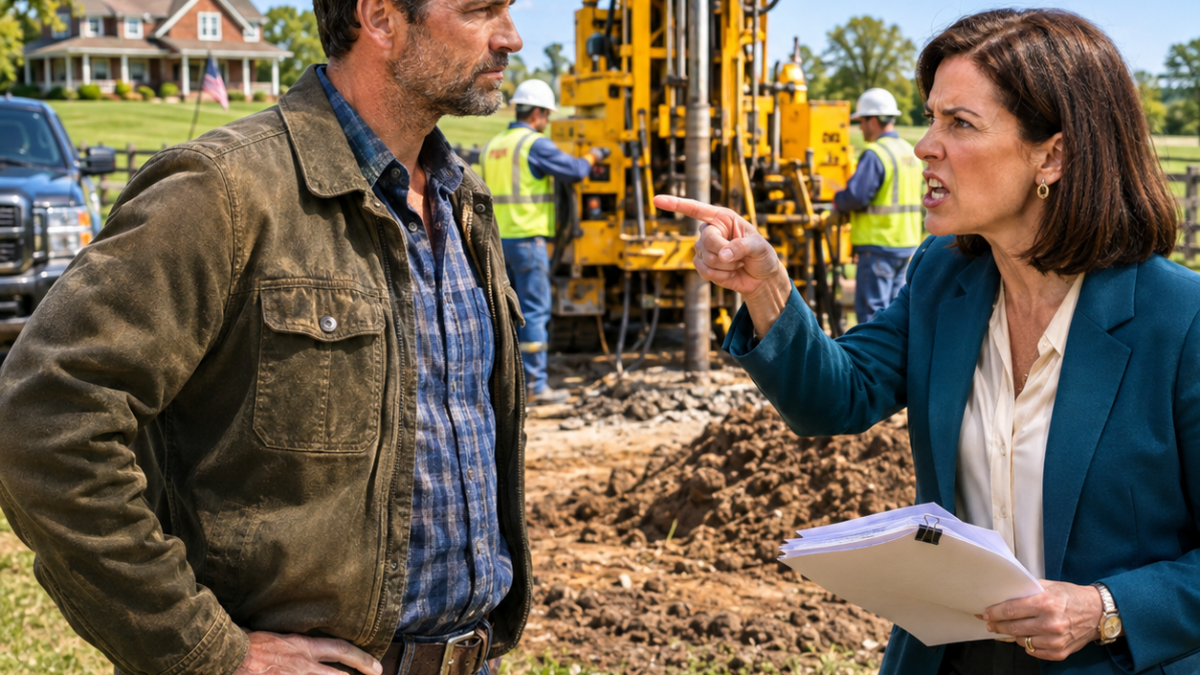
HOA Drilled a 640-Foot Commercial Well on My Farm With a Forged Easement—Then My Groundwater Attorney Hit Them With a $3.2 Million Judgment
At 5:42 one morning, I woke to an HOA drilling rig tearing into the pasture my grandfather had protected for sixty-three years, while its president smiled at me and said the water beneath my farm now belonged to “the community.”
Three days later, my cattle troughs were dry, my seventy-two-year-old neighbor’s well had collapsed, and three hundred homeowners were being told I was the selfish farmer trying to keep their children thirsty.
But when my groundwater attorney uncovered a forged easement, a secret contract for forty million gallons a year, and a dead notary’s seal on the paperwork, the woman who thought she had stolen a well discovered she had actually drilled straight into a $3.2 million judgment.
At 5:42 in the morning, the sound that woke me was so deep I felt it before I understood it.
My bedroom window rattled.
The water glass on my nightstand trembled.
For half a second I thought an eighteen-wheeler had missed the county road and come through my fence.
Then came the second vibration.
Longer.
Mechanical.
A low diesel roar followed by a metallic grinding sound that had no business existing anywhere on Warren Ridge before sunrise.
I sat up.
My dog, Blue, was already standing beside the bed with his ears forward.
“What the hell?”
The noise came again.
I pulled on jeans, shoved my feet into work boots without socks, and walked onto the back porch.
Cold March air hit me in the face.
Then I saw the floodlights.
Bright white beams were cutting across my south pasture.
A drilling mast stood against the gray predawn sky.
For a moment, my brain refused to accept what my eyes were telling it.
There was a drilling rig on my farm.
Not beside it.
Not on the county road.
On it.
Past my fence.
Past the survey markers.
Past the old cottonwood my grandfather had used as the southern boundary reference for nearly half a century.
I ran.
Blue followed me.
By the time I reached the pasture gate, six people were inside.
Two pickup trucks.
A water tanker.
The rig.
Orange safety cones.
A portable generator.
PART2:
And standing beside all of it in a white quilted vest and perfectly clean riding boots was Veronica Thorne.
President of Stonebridge Estates Homeowners Association.
She held a paper coffee cup in one hand.
The other hand rested against her hip.
She smiled when she saw me.
“Morning, Caleb.”
I looked at the drilling mast.
Then at her.
“What are you doing?”
“Please don’t start.”
I almost laughed.
“You’re drilling on my land.”
“It’s not that dramatic.”
The rig hammered again.
The ground vibrated beneath my boots.
“Feels pretty dramatic.”
A thick steel drill stem disappeared into my pasture.
Fresh mud had already spread around the pad.
Blue barked.
One of the workers stepped back.
Veronica lifted her coffee.
“Relax, Caleb.”
PART3:
That word.
Relax.
People usually tell you to relax when they know they’re doing something they shouldn’t.
“This is for the community.”
She said it almost kindly.
Like I was an unreasonable child.
I pointed at the rig.
“Turn it off.”
“We have authorization.”
“No, you don’t.”
“We do.”
“From whom?”
She reached inside a leather folder and pulled out several stapled pages.
“Your family.”
“My family?”
She extended the papers toward me.
I grabbed them.
At the top was a county recording stamp.
PROPERTY UTILITY ACCESS EASEMENT.
Warren Ridge Farm.
The signature line at the bottom read:
ELI WARREN.
My grandfather.
I read it once.
Then again.
The document supposedly granted Stonebridge’s predecessor “reasonable surface access for utilities serving adjacent residential development.”
That wording bothered me immediately.
Electric.
Sewer.
Water lines crossing land.
Maybe maintenance access.
But nothing about groundwater extraction.
Nothing about drilling.
Nothing about owning water beneath the farm.
I looked at Veronica.
“This doesn’t authorize a well.”
Her smile remained.
“Our attorney disagrees.”
“Then your attorney needs to learn what the word access means.”
“Caleb.”
She lowered her voice.
“Stonebridge has almost three hundred homes now. Municipal rates have gone through the roof. People are paying outrageous water bills.”
“Not my problem.”
Her eyes sharpened.
“Exactly.”
“What?”
“That’s always your position.”
“I’ve never had a conversation with you about your water bills.”
“You refuse to participate in the community.”
“I don’t live in Stonebridge.”
“You benefit from the roads.”
“I use the county road.”
“You benefit from property values.”
“I run cattle.”
“You sit on two hundred and sixty acres beside one of the fastest-growing neighborhoods in the county and pretend nothing around you affects anyone else.”
I looked at the drill.
“None of that gives you permission to drill a six-inch hole into my pasture.”
She checked her watch.
“We’ve been advised otherwise.”
“By who?”
She smiled.
“Counsel.”
“Name.”
“That isn’t necessary.”
“It is if his advice ends with drilling equipment trespassing on my farm.”
The foreman stood about thirty feet away.
Tall man.
Gray beard.
Neon vest.
His name patch said HANK.
He wasn’t looking at Veronica.
He was looking at me.
And there was something in his expression I didn’t understand yet.
Concern.
Maybe guilt.
I walked toward the rig.
Hank stepped between us.
“Sir, please don’t come inside the safety perimeter.”
“Then shut it down.”
“I can’t do that.”
“This is my land.”
He looked toward Veronica.
She nodded toward the papers.
“We’ve got authorization.”
I held them up.
“Have you read this?”
Hank’s jaw tightened.
“That’s between you and the client.”
“Who’s the client?”
Veronica answered.
“Stonebridge Estates.”
Hank looked at her.
For half a second.
That was the first lie I caught.
Not because I knew the truth.
Because Hank reacted.
Small reaction.
But real.
I filed it away.
I called the sheriff.
Deputy Sam Ortega arrived twenty-three minutes later.
By then daylight had begun appearing over the ridge.
Sam had known my family for years.
Not well.
But enough.
He’d responded when trespassers cut my north fence during deer season.
He had once helped my neighbor Walt Eddings get cattle off the county highway after a storm knocked a tree across his fence.
He climbed out of his cruiser.
Looked at the rig.
Then looked at me.
“Morning, Caleb.”
“Not especially.”
Veronica walked toward him before I could.
She had the easement ready.
“Deputy, this gentleman is interfering with lawful utility construction.”
I stared at her.
Sam took the papers.
“You’re drilling?”
“We’re installing a community water source.”
“On his farm?”
“Under an existing recorded easement.”
Sam read.
His brow furrowed.
He looked at me.
“You recognize this signature?”
“It looks like my grandfather’s.”
“Looks like?”
“I don’t know yet.”
Veronica sighed loudly.
“His family signed the easement. It’s recorded. This is a civil property dispute.”
Sam looked uncomfortable.
That was not what I wanted to see.
He walked toward the rig.
Talked with Hank.
Checked the county recording stamp.
Then came back.
“I can’t determine easement scope out here.”
“Then stop them until someone can.”
“I don’t have authority to shut down work based on competing interpretations of a recorded document unless there’s a clear crime or immediate safety issue.”
“They’re trespassing.”
“Maybe.”
“Maybe?”
Veronica folded her arms.
“You can’t stop us, Caleb.”
Sam looked at her.
“Ma’am, let’s not make this worse.”
She smiled.
“I’m not making anything worse.”
The rig started again.
I felt the vibration in my chest.
Sam lowered his voice.
“Get an attorney.”
“They can drill while I do that?”
“If a judge issues an injunction, no.”
“And until then?”
He looked toward the easement.
“I’m sorry.”
I had never felt powerless on my own land before.
Angry, yes.
Frustrated.
Worried.
But not powerless.
There is something uniquely violating about standing on ground your family has worked for generations and watching strangers tear into it while government tells you the paperwork looks close enough to let them continue.
My grandfather, Eli Warren, bought that land in 1961.
He was twenty-nine.
He had twenty-three dollars in his checking account after closing.
That’s family legend.
Maybe it was twenty-eight.
Maybe twelve.
The point was he had almost nothing.
Warren Ridge wasn’t impressive then.
Rocky pasture.
Scrub oak.
A half-collapsed barn.
No indoor plumbing.
The original farmhouse leaned east so badly my grandmother claimed sunlight got in without using windows.
Grandpa rebuilt everything.
Fence by fence.
Roof by roof.
Field by field.
The first well was his obsession.
He couldn’t afford a professional drilling crew.
So he dug an old-style shallow well with his brother and two neighbors.
Years later, after he installed a deeper well, he preserved the original stone wellhouse.
“Why keep that thing?” I asked once.
I was maybe twelve.
He looked at me like I’d asked why we kept family photographs.
“Because that’s where the farm became possible.”
Then he told me something I didn’t understand until decades later.
“Land can be sold, Caleb.”
He put his hand on my shoulder.
“Water is a trust.”
I laughed.
“How can water be a trust?”
“You’ll figure it out.”
Grandfathers love saying things that take thirty years to understand.
Grandpa died in 1994.
I was twenty-eight.
My father inherited Warren Ridge.
Then I did.
By then the city had moved outward.
Subdivisions swallowed cornfields.
Shopping centers replaced pasture.
In 2004, developers bought the property east of us.
Within three years, Stonebridge Estates had 142 houses.
By the time Veronica became HOA president, it had nearly three hundred.
At first, we coexisted.
Their residents jogged along my fence.
Kids stopped to look at calves.
Sometimes balls came over.
Once, a teenager climbed through to retrieve a drone and got chased halfway back by my bull.
I made him lemonade afterward.
There were conflicts.
Dust.
Farm equipment on the county road.
Occasional cattle smells.
Roosters from Walt’s place.
Normal rural-suburban friction.
Then Veronica took over.
She treated Warren Ridge like a development defect.
She complained about my fencing.
Called my equipment “visual blight.”
Sent me a letter requesting I paint my barn “a neutral earth-compatible tone.”
The barn was already brown.
Not designer brown.
Actual weathered wood.
She once asked whether I would consider removing two grain bins because they “disrupted the community skyline.”
I told her the cows had filed an appeal.
She did not find that funny.
But water had never been part of it.
Not directly.
That changed after two dry summers.
Stonebridge was connected to a regional water district.
Rates rose.
Then drought surcharges hit.
Rumors spread that Stonebridge’s board wanted an independent water source.
I assumed they meant buying additional municipal capacity.
I never imagined they meant drilling through my pasture.
By nine that morning, the rig had reached almost seventy feet.
I took photographs.
Videos.
GPS coordinates.
Every truck.
Every license plate.
Every person.
Then I called Priya Sandoval.
Priya specialized in groundwater and land-use law.
That’s a very particular kind of attorney.
Most people don’t know they exist until water becomes valuable enough to fight over.
I knew her because she’d handled a pipeline easement case for my cousin.
She answered on the third ring.
“Caleb?”
“How busy are you?”
“That’s never how good calls start.”
“An HOA is drilling a well on my farm.”
Silence.
“Say that again.”
I did.
She asked ten minutes of questions without interrupting.
Exact location.
Documents.
County.
Depth.
Equipment.
Who claimed the easement.
Whether pumping had begun.
Then she said, “Do not touch that rig.”
“I wasn’t planning to.”
“Do not block access.”
“Why not?”
“Because if that easement is remotely valid, they’ll ask a judge to portray you as interfering with utility rights.”
“So I just watch?”
“You document.”
“They’re drilling deeper every minute.”
“I know.”
“Priya.”
“Caleb, listen to me.”
Her voice changed.
Attorney voice.
Calm enough to make panic feel embarrassing.
“Take photographs every hour. Video noise, discharge, vehicles, workers. Preserve every communication. Don’t threaten anybody. Don’t remove stakes.”
“Fine.”
“And find out who owns the groundwater beneath Warren Ridge.”
I was quiet.
“What do you mean?”
“You own land. That does not automatically answer every water-right question.”
“It’s my well.”
“That’s not what I asked.”
I looked toward the drill.
For the first time that morning, I felt something colder than anger.
Uncertainty.
“I don’t know.”
“Then that’s where we start.”
I barely slept that night.
The rig shut down around ten.
Security lights remained.
I could see them from my bedroom.
At 6:18 the next morning, someone knocked on my front door.
Walt Eddings stood outside.
Seventy-two.
Lean.
White mustache.
Denim jacket.
He held a mason jar.
The water inside was cloudy brown.
“Caleb.”
“What happened?”
“My well.”
He held up the jar.
“Started coughing air around two.”
My stomach tightened.
“Dry?”
“Almost.”
Walt’s farm bordered mine to the northwest.
His well had supplied that house since 1983.
“Pump okay?”
“Pump’s fine.”
“Did you check pressure?”
“I checked everything.”
His hands were shaking.
“I’ve pulled water from that ground forty years.”
I looked toward the south pasture.
The rig had restarted.
Walt followed my eyes.
“That thing?”
“I don’t know yet.”
He stared.
Then said something strange.
“Your granddad told me this would happen.”
I looked at him.
“What?”
“Not exactly this.”
“What did he say?”
Walt rubbed his jaw.
“Back when the first developers came sniffing around.”
“When?”
“Early nineties.”
I stepped closer.
“What did he say?”
Walt thought.
“He said someday the water would be worth more than the grass above it.”
My skin prickled.
“And?”
“He said he’d made sure nobody could take it.”
“What does that mean?”
“I don’t know.”
“You never asked?”
Walt gave me a tired look.
“Your granddad said mysterious nonsense like it was a hobby.”
That was true.
At 7:03, Priya pulled into my driveway.
Dark blue SUV.
Black suit pants.
Mud boots.
She was forty-seven, compact, sharp-eyed, and walked like every minute already owed her money.
She shook Walt’s hand.
Took one look at his jar.
“Keep that.”
He frowned.
“As evidence?”
“Exactly.”
She spread the easement across my kitchen table.
Read every word.
Then read it again.
“Where’s the recording information?”
I pointed.
“1998.”
She stopped.
“What?”
“That’s when it was recorded.”
She looked at the signature.
ELI WARREN.
Then at me.
“Caleb.”
“Yeah?”
“When did your grandfather die?”
“October 1994.”
Priya didn’t blink.
I stopped breathing.
She rotated the paper toward me.
At the bottom:
Executed this 12th day of May, 1998.
Eli Warren.
My chair scraped backward.
“No.”
Priya pointed.
“Your grandfather supposedly signed this three years and seven months after his death.”
Walt whispered, “Son of a bitch.”
I looked at the signature again.
It looked right.
That was what scared me.
Grandpa’s looping E.
The sharp W.
The long downward stroke on the second r.
“Someone copied it.”
Priya nodded.
“Likely from a deed or recorded instrument.”
She examined the notary block.
“This gets better.”
“What?”
“If this signature is forged, someone notarized a dead man’s signature.”
I sat down.
Outside, the drill hammered deeper.
Priya looked toward the window.
“How far are they now?”
“I don’t know.”
“Let’s find out.”
We walked to the field.
Veronica was not there.
Hank was.
Priya introduced herself.
“I represent Caleb Warren.”
Hank’s expression became guarded.
“Okay.”
“We dispute this access.”
“You’ll need to speak to the client.”
“Who is the client?”
“Stonebridge.”
Priya stared at him.
“Stonebridge HOA?”
He hesitated.
“That’s who hired us.”
“Who signed the drilling contract?”
“I don’t handle contracts.”
“Who filed the permit?”
“Office.”
“What depth are you drilling?”
Hank looked away.
“Planned depth.”
“Which is?”
“Ma’am—”
Priya stepped closer.
“You’re drilling on disputed land under a document signed by a man who’d been dead nearly four years.”
That hit him.
He looked at me.
Then toward the rig.
“That’s not what we were told.”
Priya handed him a cease-and-desist letter.
“Now you’ve been told.”
He read the first page.
“Do I shut down?”
“Yes.”
He looked toward his trailer.
“I need to call my company.”
“Do that.”
For twenty minutes, the rig stopped.
Then Veronica arrived.
She climbed out of her SUV.
Read Priya’s letter.
Laughed.
Actually laughed.
“You hired a lawyer?”
Priya held out her hand.
“Priya Sandoval.”
“I know who you are.”
“Good.”
Veronica handed the letter back.
“Our counsel confirms the easement is valid.”
“The signer died in 1994.”
Veronica’s expression changed for less than a second.
Then recovered.
“Then perhaps the recording date is clerical.”
“No.”
“You don’t know that.”
“We’ll find out.”
Veronica turned to Hank.
“Continue.”
He looked uncomfortable.
“Ms. Thorne—”
“Continue.”
“My office said—”
“I spoke with your owner.”
That surprised him.
“He instructed you to continue.”
Hank looked at Priya.
She said, “If you continue after receiving written notice of a disputed forged instrument, you’re preserving our damages beautifully.”
Hank’s jaw tightened.
Then Veronica said, “Your company gets paid when the job is finished.”
That decided it.
The rig restarted.
Priya watched.
No visible emotion.
Then she took out her phone.
“Who are you calling?” I asked.
“Everybody.”
By noon, she had notified the county recorder, water resources division, state environmental agency, and Stonebridge’s legal counsel.
At 2:30, she filed for emergency injunctive relief.
At four, she subpoenaed the original easement.
By sunset, the rig had passed three hundred feet.
That was when Hank found me.
I was fixing a temporary water tank near the barn for Walt.
Hank came alone.
No vest.
No hard hat.
He kept looking over his shoulder.
“Mr. Warren.”
“Caleb.”
He held an envelope.
“I need you to take this.”
“What is it?”
“Don’t say I gave it to you.”
“Then maybe you shouldn’t.”
“I’ve got a daughter.”
His voice cracked slightly.
“She’s starting college.”
I waited.
“I can’t lose my job.”
“Then why are you here?”
“Because this isn’t what they told us.”
I took the envelope.
“What did they tell you?”
“Community domestic well.”
“That’s what Veronica told me.”
“It’s not.”
My stomach tightened.
Hank looked toward the pasture.
“Did anyone tell you how deep we were ordered to drill?”
“No.”
“Six hundred forty feet.”
“Is that unusual?”
“For three hundred houses?”
He gave a humorless laugh.
“That’s commercial depth in this basin.”
I stared.
“Commercial?”
He nodded.
“High-capacity pump.”
“How high?”
“Two thousand gallons a minute, design max.”
My mouth went dry.
“Why?”
“Read the permit.”
He handed me the envelope.
Then walked away.
Inside were copies.
Drilling application.
Specifications.
Pump design.
Depth schedule.
And one line that changed everything.
PROPOSED USE: COMMERCIAL BULK EXTRACTION.
Applicant:
Stonebridge Water Holdings LLC.
Not Stonebridge Estates HOA.
I searched the registered agent.
Leonard Pike.
Stonebridge HOA treasurer.
I called Priya.
“They’re not drilling for the neighborhood.”
“What?”
I read the permit.
There was silence.
Then she said, “Send me everything.”
“Commercial extraction.”
“I heard you.”
“Who the hell are they selling to?”
“We’re going to find out.”
On the third morning, I turned on the kitchen faucet.
It coughed.
Spat brown water.
Then stopped.
I stared.
Tried again.
Nothing.
I went to the well pressure gauge.
Almost zero.
My stomach dropped.
Outside, cattle were crowded around the trough.
Empty.
I opened the supply valve.
Nothing.
A farm without water isn’t inconvenient.
It’s dying.
Cattle need water.
Horses need water.
Equipment needs water.
You can survive a power outage.
You can postpone planting.
You cannot negotiate with thirst.
I called every bulk water hauler within forty miles.
By afternoon, two tankers were feeding temporary storage bladders.
It cost me $4,700 that day.
The next day would cost nearly the same.
Walt’s well went fully dry.
His wife, Carol, started hauling drinking water in five-gallon jugs.
Dr. Alan Reyes arrived that afternoon.
Priya had used him in previous groundwater litigation.
Hydrogeologist.
Fifty-nine.
Quiet.
Wire-rim glasses.
He looked more like a high-school science teacher than someone capable of destroying a multimillion-dollar water project in court.
He measured static levels in my well.
Then Walt’s.
Then two monitoring points.
He looked at the rig.
“How long has it been pumping?”
“Testing started yesterday.”
“Rate?”
“Unknown.”
He frowned.
“Let’s find out.”
Hours later, he returned.
His face was grim.
“Your water table is down thirty-one feet.”
“In three days?”
“Yes.”
“From that well?”
“I need formal testing before I say causation under oath.”
“Alan.”
He looked at me.
“Yes.”
Walt swore.
Dr. Reyes continued.
“They’ve intersected the same confined aquifer supplying both domestic wells.”
“Can it recover?”
“If they stop.”
“How long?”
“Depends on drawdown and recharge.”
“Best guess.”
“Months for partial recovery.”
“And worst?”
“Years.”
That evening, Stonebridge held an emergency HOA meeting.
Walt went.
I didn’t.
Priya told me not to.
“Let them talk.”
Walt secretly recorded the entire thing.
Three hundred homeowners packed into the clubhouse.
Veronica stood beneath a projector screen.
Behind her was a photograph of me.
My farm.
My face.
She told them Stonebridge was facing a “water security crisis.”
Then announced a special assessment.
$4,800 per household.
People exploded.
“What for?”
“Why?”
“We already pay water bills!”
Veronica raised her hands.
“This is for long-term independence.”
Someone shouted, “What does Caleb Warren have to do with it?”
Veronica looked at my picture.
“The adjacent landowner has chosen litigation over cooperation.”
Walt’s recording captured boos.
Then Veronica said:
“Mr. Warren has more water beneath his property than his farm could use in generations, yet he would apparently rather see Stonebridge families pay escalating rates than share.”
The room changed.
That was deliberate.
She turned theft into selfishness.
Someone asked, “Does he own the water?”
Veronica answered, “That’s what his attorney claims.”
Not yes.
Not no.
Then:
“We have a valid easement.”
Lie.
“We are building this well for you.”
Bigger lie.
“And now he wants to shut it down.”
Technically true.
But she never mentioned Clear Crest.
Never mentioned Stonebridge Water Holdings.
Never mentioned commercial extraction.
Never mentioned forty million gallons.
That night, my phone began ringing.
Homeowners.
Some angry.
Some pleading.
One man said, “You have hundreds of acres. Why do you need all that water?”
I hung up.
Someone painted GREEDY on my roadside mailbox.
I washed it off.
A woman stopped at my gate with two children in the back seat and asked me why I was “trying to make the neighborhood run dry.”
I told her the neighborhood was still connected to municipal water.
She looked confused.
“They told us we could lose service.”
“They lied.”
She drove away unsettled.
The fight felt heavier after that.
It is one thing to battle an HOA president.
Another to become the villain in three hundred households.
That evening, I walked to the old stone wellhouse.
I hadn’t entered in years.
Not because it was dangerous.
Because it belonged too strongly to Grandpa.
The stone walls still held his handprints in places where he’d set mortar.
A rusted pump handle remained mounted on the side.
Inside, shelves held old tools.
Pipe fittings.
A coffee can filled with bolts.
His handwriting was still visible on the wall:
CHECK VALVE — 1988.
I sat on an overturned bucket.
For the first time since this started, I felt tired.
“What did you do, Grandpa?”
Nothing answered.
Obviously.
Then I remembered Walt.
He said Grandpa made sure nobody could take the water.
I started looking.
Old filing cabinet.
Empty.
Shelf.
Nothing.
Wooden box.
Rust.
Then I noticed one stone near the back wall didn’t match the mortar around it.
I pulled.
Loose.
Behind it was a cavity.
Inside sat a rusted metal document box.
My hands started shaking before I opened it.
Grandpa had always been theatrical.
Apparently death hadn’t cured him.
Inside were papers sealed in waxed cloth.
At the top was an envelope.
CALEB.
I stopped breathing.
My name.
Grandpa had written my name.
I opened it.
Inside:
If anyone ever comes after the water, this is for you.
That was all.
Underneath was a recorded instrument dated 1993.
GROUNDWATER PROTECTION DECLARATION AND RESTRICTIVE COVENANT.
I read slowly.
Warren Ridge.
Aquifer rights.
Third-party extraction.
Commercial withdrawal.
Written consent required.
Runs with the land.
Binding successors.
Recorded county instrument number.
My pulse accelerated.
I photographed it.
Sent it to Priya.
She called four minutes later.
“Where did you get this?”
“Grandpa.”
“Your dead grandfather is becoming my favorite client.”
“Is it valid?”
“I need to pull the official recording.”
“Priya.”
“If the county copy matches this?”
“Yes?”
She laughed.
Not a polite laugh.
A dangerous attorney laugh.
“Caleb, your grandfather just handed us the case from the grave.”
The county record matched.
Recorded September 14, 1993.
It did more than protect my well.
It created a restrictive groundwater covenant tied to the land.
No commercial extraction from beneath Warren Ridge without written consent of the owner.
No transfer of groundwater for off-site sale.
Any utility easement was explicitly subordinate.
And there was another document.
A hydrogeological preservation agreement signed by adjoining landowners.
Including Walt’s father.
That helped establish shared reliance on the aquifer.
Priya filed supplemental papers that night.
Emergency hearing.
Forty-eight hours.
I thought we’d make it.
Then at 2:06 in the morning, floodlights woke me again.
The rig was running.
At night.
I stepped onto the back porch.
A tanker truck entered through the temporary access road.
Not a water-hauling truck I recognized.
White.
Polished.
Company logo:
CLEAR CREST BEVERAGE COMPANY.
My skin went cold.
I grabbed my phone.
Walked through the dark along the north fence.
Kept trees between me and the drill pad.
The tanker backed toward a temporary pumping manifold.
A hose connected.
Water began flowing.
Not test water.
Not drilling discharge.
Clean aquifer water.
My family’s water.
Into a commercial tanker.
I recorded.
License plate.
Company name.
Hose.
Flow meter.
Then Leonard Pike arrived.
HOA treasurer.
He carried a clipboard.
He signed something.
Veronica stood beside him.
She had an envelope in one hand.
Cash?
Documents?
I couldn’t tell.
Then a flashlight hit my face.
“Caleb!”
Veronica marched toward the fence.
“What are you doing?”
“Recording.”
“You cannot film private operations.”
“You’re standing on my farm.”
“This area is under easement.”
“Not for commercial water.”
Her face changed.
I held up my phone.
“Clear Crest?”
Leonard froze.
Veronica recovered.
“It’s a test transfer.”
“At two in the morning?”
“Delete that.”
“No.”
“Delete it.”
She came closer.
“Now.”
“Why?”
“Because you’re interfering in an HOA contractual matter.”
I smiled.
“You mean Stonebridge Water Holdings?”
Her eyes narrowed.
“How do you know that name?”
That told me enough.
I kept recording.
She stepped closer to the fence.
“I am done with you.”
“Good.”
“I will bury you in fines.”
“I don’t live in your HOA.”
“Liens.”
“Can’t.”
“Lawsuits.”
“Already there.”
“You think this farm makes you untouchable?”
“No.”
She lowered her voice.
“I can make this property so expensive to keep that you’ll beg a developer to take it.”
My thumb checked the recording icon.
Still red.
She continued.
“I know what taxes on two hundred sixty acres cost.”
“Keep talking.”
She stopped.
I turned the screen toward her.
“Still recording.”
Her face changed.
She grabbed for the phone through the fence.
I stepped back.
Leonard said, “Veronica, stop.”
She turned on him.
“Shut up.”
Then she pulled out her own phone.
Called the sheriff.
I almost admired the confidence.
Deputy Ortega returned.
Veronica marched toward him.
“He is trespassing inside a restricted construction zone and recording proprietary operations.”
Sam looked at me.
“Caleb?”
I handed him my phone.
“Watch.”
He watched the video.
Clear Crest truck.
Hose.
Leonard.
Veronica.
Then her threat.
Sam’s jaw tightened.
He replayed one part.
He looked at the rig.
Then at Veronica.
“Ma’am.”
“Yes?”
“I’m taking a copy of this as evidence.”
Her expression faltered.
“Evidence of what?”
“That will depend on the investigation.”
“This is civil.”
“Maybe yesterday.”
He looked toward the tanker.
“I’m not comfortable calling it that anymore.”
For the first time, I saw fear.
Not anger.
Not annoyance.
Fear.
Priya went to war at sunrise.
Emergency subpoenas.
Clear Crest contract.
Notary journals.
Stonebridge bank accounts.
Stonebridge Water Holdings incorporation records.
Communications between Veronica and Leonard.
State water inspector Tina Brooks arrived that afternoon.
She inspected the drill site.
Reviewed the permit.
Then called someone at the state office.
Her expression hardened.
“No commercial export permit.”
I stood beside her.
“None?”
“Not pending.”
“Could the drilling permit cover it?”
“No.”
“They’re filling tankers.”
“I saw the video.”
“What does that mean?”
“It means if water is being removed for off-site commercial sale, they may have multiple regulatory problems.”
Priya asked, “Can you order an administrative stop?”
Tina nodded.
“For export activity.”
“What about drilling?”
“Judge can do more.”
The temporary state order stopped tanker loading.
The rig continued drilling.
Veronica had one last window.
And she used it.
The emergency hearing began Friday morning.
Judge Evelyn Marsh presided.
Sixty-two.
Silver hair.
No patience.
The courtroom was packed.
Stonebridge homeowners filled the back benches.
Some glared at me.
Others looked confused.
Veronica sat beside attorney Martin Bell.
Leonard sat behind them.
Priya placed two boxes on our table.
“You’re enjoying this,” I whispered.
“No.”
“You smiled.”
“Lawyers smile when documents become cooperative.”
Judge Marsh entered.
Everyone stood.
Stonebridge argued first.
Martin Bell portrayed the project as an emergency community infrastructure investment.
He called the easement valid.
He described the commercial permit language as “future contingency planning.”
Priya wrote something on a legal pad.
She slid it toward me.
LIE #1.
I nearly laughed.
Bell continued.
He argued groundwater withdrawal was incidental to utility access.
Judge Marsh interrupted.
“Counsel, how can withdrawing groundwater be incidental to accessing a surface utility corridor?”
Bell paused.
“The easement must be read broadly.”
“Broadly enough to create a well?”
“Yes, Your Honor.”
“Broadly enough to sell water off-site?”
Bell hesitated.
“We dispute that characterization.”
Priya stood.
“We have video of a Clear Crest tanker being filled.”
Bell sat.
Judge Marsh looked at Priya.
“Let’s talk about the easement.”
Priya approached the clerk.
“Plaintiff’s Exhibit Four.”
Original document.
She asked the county records custodian to verify recording.
Then asked one question.
“What date was the easement executed?”
“May 12, 1998.”
“And Eli Warren died when?”
My grandfather’s death certificate appeared on screen.
“October 9, 1994.”
The courtroom went completely silent.
Bell stood.
“Your Honor, we acknowledge an apparent discrepancy—”
Priya turned.
“A dead man did not make a clerical error by signing four years after his funeral.”
Judge Marsh stared at the document.
Priya continued.
“And then there’s the notary.”
She enlarged the stamp.
“Commission number 44918.”
A state notary records supervisor testified remotely.
“Who held that commission?”
“Harold Benton.”
“Commission expiration?”
“1997.”
“Anything else relevant?”
The witness paused.
“Mr. Benton died February 3, 1997.”
Someone in the courtroom whispered, “Jesus.”
Priya looked at the judge.
“So in 1998, Stonebridge’s easement was signed by a landowner dead since 1994 and notarized by a notary dead since 1997.”
Judge Marsh took off her glasses.
Bell looked like he wanted to disappear under the table.
Priya wasn’t finished.
She introduced Grandpa’s 1993 groundwater covenant.
County records confirmed it.
Recorded.
Valid.
Running with the land.
Judge Marsh read the language herself.
“No commercial extraction without written consent of the Warren Ridge owner.”
She looked at Bell.
“Do you have written consent?”
“No, Your Honor.”
“Then why are we here?”
Bell started to answer.
Priya said, “Because this is not actually an HOA water-security project.”
Veronica turned toward Leonard.
Priya displayed the corporate filing.
STONEBRIDGE WATER HOLDINGS LLC.
Registered agent:
Leonard Pike.
Then the Clear Crest contract.
Forty million gallons annually.
Twenty years.
Escalating purchase rate.
Minimum annual payment.
$410,000 initial deposit.
The courtroom erupted in whispers.
Stonebridge homeowners were seeing it for the first time.
One woman behind me said, “They told us this was ours.”
Priya walked toward Leonard.
He had been called as a witness because he signed corporate documents.
He took the stand sweating.
“Mr. Pike, are you treasurer of Stonebridge HOA?”
“Yes.”
“Registered agent of Stonebridge Water Holdings?”
“Technically.”
“Technically?”
“It was an administrative role.”
“Did the HOA board authorize creation of this LLC?”
“I believe so.”
“Where are the minutes?”
“I don’t know.”
“Did homeowners know?”
“I can’t speak for them.”
“Did you sign the Clear Crest contract?”
He swallowed.
“I may have.”
Priya handed him the document.
“Is that your signature?”
“Yes.”
“Did Clear Crest deposit $410,000?”
“I’d need to check.”
Priya displayed a bank statement.
“Let me help.”
Deposit.
$410,000.
Stonebridge Water Holdings.
She leaned toward him.
“Where did that money go?”
Bell objected.
Overruled.
Leonard wiped his forehead.
“Project expenses.”
“Which?”
“Drilling.”
“Stonebridge homeowners were separately assessed $4,800 each.”
Silence.
Priya continued.
“Nearly $1.4 million collected from homeowners.”
People gasped.
“So why did this private LLC need homeowner money if Clear Crest was funding development?”
Leonard looked at Veronica.
Priya noticed.
“Please look at me.”
He did.
“Did homeowners know Clear Crest would receive forty million gallons annually?”
“No.”
“Did they know about Stonebridge Water Holdings?”
“No.”
“Did they know you were selling groundwater from beneath Mr. Warren’s property?”
Bell objected.
Judge Marsh overruled.
Leonard whispered, “No.”
Priya placed a printed text message in front of him.
“Is this from Veronica Thorne?”
He read.
His face collapsed.
DON’T LET THE FARM GUY FIND A COVENANT. WE NEED THE HOLE FINISHED BEFORE HE GETS A JUDGE.
The courtroom went silent again.
Priya asked, “What covenant was she referring to?”
Leonard’s lips moved.
No sound.
“Mr. Pike?”
He looked at the judge.
“I want a lawyer.”
Bell closed his eyes.
Judge Marsh called recess.
In the hallway, Veronica found me near a vending machine.
No cameras.
No homeowners close enough to hear.
For the first time since I’d known her, she didn’t look angry.
She looked tired.
“Caleb.”
I turned.
“What?”
“We can end this.”
“Talk to Priya.”
“Not lawyer to lawyer.”
“Then no.”
She stepped closer.
“Name your price.”
I stared at her.
“What?”
“The farm.”
“No.”
“The water rights.”
“No.”
“Access.”
“No.”
“Three million.”
I almost laughed.
“You don’t have three million.”
“The contract does.”
There it was.
She realized what she’d said.
Too late.
I looked at her.
“How much are you personally getting?”
Her expression changed.
“That’s irrelevant.”
“Consulting fee?”
She said nothing.
I thought of Grandpa.
Walt’s dry well.
Cattle drinking from hauled tanks.
Three hundred homeowners writing checks based on lies.
“Drop the case,” she whispered.
“No.”
“Five million.”
“No.”
“Everyone has a number.”
I looked her in the eye.
“Some things aren’t for sale.”
“Everything is.”
“No.”
I shook my head.
“Water isn’t.”
We returned to court.
Dr. Reyes testified.
Charts showed the aquifer.
My well.
Walt’s.
The new 640-foot well.
Drawdown cone.
Pumping effects.
He explained that the commercial well created severe localized depletion.
Thirty-one-foot water-table decline in seventy-two hours.
My domestic well failure.
Walt’s failure.
Potential effects on surrounding properties.
Priya asked, “How long to recover?”
“If pumping remains stopped, meaningful recovery could begin within months.”
“Full recovery?”
“Based on current modeling, potentially up to eight years.”
Murmurs.
“Permanent damage?”
“Possible if long-term high-volume extraction occurs.”
Then Tina Brooks testified.
No export permit.
No commercial authorization.
No completed environmental review.
Clear Crest had been told the seller possessed lawful extraction rights.
They did not.
That mattered.
Clear Crest cooperated immediately.
They terminated the agreement.
Demanded their deposit back.
And handed investigators every communication.
One email from Veronica was especially damaging:
FARM OWNER HAS NO VALID CLAIM TO SUBSURFACE WATER. EASEMENT SECURED.
Another:
WE NEED FIRST COMMERCIAL LOAD OUT BEFORE INJUNCTION RISK.
The judge read that one twice.
Then came Veronica.
Her lawyer did not want her to testify.
She insisted.
That told me she still thought she could talk her way back into control.
Bell asked:
“Why did you pursue the well?”
“For Stonebridge residents.”
“Did you intend to harm Mr. Warren?”
“No.”
“Did you believe the easement valid?”
“Absolutely.”
“Did you forge it?”
“No.”
“Did you know it was forged?”
“No.”
“Did you personally benefit?”
“No.”
Priya stood.
“Ms. Thorne, did Stonebridge homeowners pay a $4,800 special assessment?”
“Yes.”
“For the well?”
“Yes.”
“How much was collected?”
“I don’t know exactly.”
“Approximately $1.38 million?”
“If that’s the math.”
“It is.”
Priya held up the Clear Crest contract.
“Did Clear Crest also pay $410,000?”
“To the project entity.”
“Stonebridge Water Holdings?”
“Yes.”
“Owned by whom?”
“It was structured for the HOA’s benefit.”
“That wasn’t my question.”
Veronica’s jaw tightened.
“Leonard Pike was the organizer.”
“Who was entitled to consulting fees under Schedule C?”
Silence.
Priya handed her the page.
“Would you read the name?”
Veronica stared.
“Ms. Thorne?”
“Veronica Thorne.”
“And the fee?”
She didn’t answer.
Judge Marsh said, “Read it.”
“$180,000 upon commencement.”
Someone behind me cursed.
Priya continued.
“And annually?”
“$75,000.”
“For how long?”
Silence.
“Ms. Thorne.”
“Twenty years.”
The courtroom exploded.
Judge Marsh slammed the gavel.
“Order.”
Priya waited.
Then asked quietly:
“So homeowners paid for the well.”
“Yes.”
“Clear Crest paid for water access.”
“Yes.”
“And you personally stood to receive up to $1.68 million over the contract term.”
Bell objected.
Math.
Judge overruled.
Veronica’s voice hardened.
“It was compensation for project administration.”
“Did homeowners approve it?”
“No.”
“Did the board?”
“We discussed—”
“Minutes?”
Silence.
“Any vote?”
“No.”
“Did homeowners know the project was commercial?”
“No.”
“Did Caleb Warren consent?”
“No.”
“Did you know his groundwater covenant existed?”
Veronica stared at her.
Priya displayed the text.
DON’T LET THE FARM GUY FIND A COVENANT.
“Yes or no?”
Veronica’s face went pale.
“I had heard rumors.”
“So you rushed drilling.”
“No.”
“You ordered night operations.”
“Schedule requirements.”
“You loaded a Clear Crest tanker at two in the morning.”
“Testing.”
“Before an export permit existed.”
“Administrative delay.”
“You threatened Mr. Warren when he recorded it.”
“He was harassing us.”
Priya played the video.
Veronica’s own voice filled the courtroom.
DELETE THAT VIDEO, CALEB, OR I’LL BURY YOU IN FINES AND LIENS UNTIL YOU LOSE THIS FARM.
Nobody moved.
Priya stopped the video.
“No further questions.”
Judge Marsh called another recess.
When she returned, she did not look happy.
Judges rarely deliver speeches like television.
This one came close.
She said the case showed “extraordinary disregard for property rights, water law, and basic fiduciary responsibility.”
She declared the 1998 easement void as fraudulent.
She issued a permanent injunction prohibiting Stonebridge HOA, Stonebridge Water Holdings, Veronica, Leonard, or agents from extracting groundwater beneath Warren Ridge.
She ordered the commercial well capped and remediated at defendants’ expense under state supervision.
Then damages.
My emergency water costs.
Well rehabilitation.
Crop loss.
Livestock impact.
Engineering expenses.
Property restoration.
Walt’s related claim was addressed separately.
The court awarded compensatory damages totaling $1.1 million.
Then Judge Marsh discussed punitive damages.
Intentional conduct.
Continued drilling after notice.
Commercial motive.
Forged instrument.
Threats.
Effort to complete pumping before judicial review.
Her voice became colder.
“Two million one hundred thousand dollars.”
I didn’t understand immediately.
Then Priya whispered, “$3.2 million total.”
Veronica’s knees seemed to soften.
She grabbed the table.
Bell put one hand under her elbow.
She pulled away.
Judge Marsh continued.
Insurance coverage was not before the court.
That problem arrived later.
Stonebridge’s insurer denied coverage for the intentional misconduct portions.
That terrified homeowners.
They thought they would lose houses.
Pay assessments.
Carry Veronica’s wrongdoing.
For a week, Stonebridge descended into chaos.
The entire board resigned except Sharon Bellamy, who had joined only four months earlier and had voted against the well assessment.
Leonard resigned before investigators could demand it.
Veronica was recalled by an overwhelming homeowner vote.
The district attorney opened a criminal investigation involving forgery, fraud, and financial misconduct.
The state notary office traced the forged seal.
A document service contractor connected to Leonard had copied old records.
The details came out slowly.
Ugly.
Pathetic.
Far less sophisticated than I’d imagined.
People often assume big fraud requires genius.
Usually it requires confidence, weak oversight, and enough people too uncomfortable to ask questions.
Stonebridge homeowners had been lied to too.
That became important.
Some neighbors wanted me to pursue the HOA for every dollar.
Legally, I could.
Priya explained options.
Association assets.
Liens.
Collection.
Potential assessments.
I looked at her.
“You mean the homeowners.”
“The association is the legal defendant.”
“They didn’t know.”
“Some board actions bind them anyway.”
“Can we collect from Veronica and Leonard first?”
“We can pursue individual liability where the judgment allows.”
“Do it.”
“Caleb, recovery might be slower.”
“I don’t care.”
She studied me.
“You were publicly called selfish for a week.”
“I remember.”
“Your mailbox was vandalized.”
“Also remember.”
“People threatened you.”
“They believed a lie.”
“Not all of them apologized.”
I looked toward Stonebridge from my kitchen window.
“Doesn’t matter.”
“Why?”
“Because Grandpa didn’t write that covenant to punish three hundred families.”
Priya smiled faintly.
“You know you’re making my life harder.”
“That’s what I pay you for.”
The first homeowner meeting after Veronica’s removal was held in a high-school auditorium because the clubhouse was too small.
They invited me.
I almost refused.
Walt said, “Go.”
“Why?”
“Because half of them still think you’re sitting on an underground ocean laughing.”
So I went.
Three hundred homeowners.
Angry.
Embarrassed.
Afraid.
A man in the second row stood before anyone introduced me.
“Are you going to take our houses?”
“No.”
The room quieted.
I hadn’t even reached the podium.
Another voice.
“Can the HOA survive the judgment?”
“I don’t know.”
“Are you collecting from us?”
“Not if I can avoid it.”
Then I walked to the microphone.
I brought Grandpa’s covenant.
Not the original.
A copy.
I held it up.
“This isn’t a weapon.”
People watched.
“My grandfather wrote this because he believed groundwater should stay tied to the land depending on it.”
I looked around.
“You were told I wanted your children thirsty.”
Some people looked down.
“That was a lie.”
“You were never losing municipal service.”
A woman raised her hand.
“We were told rates would double.”
“Could be. I don’t know.”
“Then what were we supposed to do?”
“Ask where your money was going.”
That hurt.
I could see it.
I softened.
“So should I.”
“What?”
“I saw Stonebridge growing for twenty years. I knew wells mattered. I never talked to you about water because I assumed your HOA was your problem.”
Silence.
“Maybe neighbors should talk before lawyers do.”
A man near the aisle stood.
“Would you sell Stonebridge water?”
Priya, sitting beside Walt, looked at me sharply.
I smiled.
“Depends.”
Murmurs.
“Not commercial extraction.”
I held up Grandpa’s covenant.
“That stays.”
“But domestic backup?”
People leaned forward.
“I’d consider a controlled sharing agreement.”
The room became silent.
One woman cried.
I continued.
“Fair price. Metered. Drought limits. Aquifer monitoring. No resale. No private LLC. No hidden consulting fee.”
Someone laughed.
Then more.
Tension broke.
“You would do that after what happened?”
I looked at the woman.
“You didn’t drill the well.”
She started crying harder.
That was the beginning.
Months of negotiation followed.
Groundwater engineers.
Attorneys.
State regulators.
The new Stonebridge board.
We created something Grandpa might have approved.
A shared emergency domestic-water agreement.
Not ownership.
Not extraction rights.
A limited backup connection.
Stonebridge remained on municipal water.
If emergency supply was ever needed, Warren Ridge could provide controlled volumes within aquifer-safe thresholds.
Independent metering.
Annual public reporting.
Environmental review.
No commercial resale.
No unilateral drilling.
And one clause I insisted on:
Any child in Stonebridge could visit the farm’s old wellhouse during the annual water conservation day.
Priya laughed when I proposed it.
“What legal function does that serve?”
“None.”
“Then why is it in the contract?”
“Grandpa would’ve liked it.”
“That’s not law.”
“Put it in.”
She did.
Dr. Reyes monitored recovery.
After seven weeks, my well stabilized enough to stop hauling most water.
Walt’s recovered more slowly.
Then one morning he called.
“Get over here.”
I drove across.
He stood at his kitchen sink.
Opened the faucet.
Clear water ran.
He stared at it.
Then cried.
Walt Eddings was not a man who cried easily.
He filled a glass.
Held it up.
“Forty years.”
I put one hand on his shoulder.
“Drink.”
He did.
Then handed me one.
“Your granddad saved our asses.”
“Again.”
The unauthorized well was capped under state supervision.
They removed the rig.
Restored the pasture.
The scar remained.
A circular patch where soil color was different.
I left it.
Didn’t reseed for months.
I wanted to see it.
Not out of anger.
Memory.
Veronica’s criminal case moved forward.
She eventually pleaded guilty to fraud-related charges and conspiracy involving the forged property document.
Leonard cooperated.
His testimony reduced his sentence.
He admitted the idea had begun as a way to reduce Stonebridge’s water costs.
Then Clear Crest entered.
Money transformed the plan.
Their consultant estimated the aquifer could support commercial bottling.
Veronica saw opportunity.
Leonard created the LLC.
They convinced themselves the old easement could be “interpreted” broadly.
When someone discovered Grandpa’s old signature on another document, the forged easement followed.
Each step made the next one easier.
That’s how people cross lines.
Rarely one giant leap.
Usually one smaller compromise after another.
Veronica sold her house to satisfy part of the judgment.
Her personal assets were attached.
Stonebridge Water Holdings was dissolved.
Clear Crest recovered most of its deposit through litigation against Veronica and Leonard rather than the homeowners.
Insurance covered some negligent administrative portions but not intentional wrongdoing.
The final settlement structure protected homeowners far more than anyone initially expected.
Not perfectly.
Some association reserves were lost.
Homeowners paid legal costs.
But nobody lost a house.
That mattered to me.
One afternoon, almost a year after the drilling, Veronica appeared at my gate.
I almost didn’t recognize her.
No white vest.
No polished SUV.
She drove an older sedan.
Her hair was pulled back.
She stood outside the gate.
I stayed on the other side.
“What do you want?”
“Five minutes.”
“You have two.”
She looked toward the pasture.
“The well?”
“Capped.”
“I know.”
“Then?”
She swallowed.
“Did you ever consider taking the Clear Crest deal yourself?”
I laughed.
“That’s why you came?”
“No.”
She looked embarrassed.
“I’ve wondered.”
“Why?”
“Because it was a lot of money.”
“Yes.”
“You could’ve made more than the judgment.”
“Probably.”
“And you said no.”
“I said no before anyone asked.”
“Why?”
I looked toward the stone wellhouse.
“You wouldn’t understand.”
“Try me.”
So I told her.
Grandpa.
First well.
1993 covenant.
Water is a trust.
She listened.
Then said, “That’s sentimental.”
I smiled.
“There you go.”
She almost smiled too.
Almost.
Then her face changed.
“I didn’t start out trying to steal anything.”
“I believe that.”
She seemed surprised.
“You do?”
“Most people don’t.”
She looked down.
“I wanted lower water bills.”
“Then what?”
“Clear Crest offered money.”
“Then?”
“The board wanted upgrades.”
“Then?”
“I thought if the project succeeded, nobody would care how.”
I nodded.
“That’s usually how it happens.”
She looked at me.
“Do you hate me?”
“No.”
That surprised her more.
“I was furious.”
“Past tense?”
“Mostly.”
“How?”
I thought about it.
“Hating you would mean you still own part of my day.”
She looked away.
“I lost everything.”
“No.”
Her eyes came back.
“You lost things.”
“What’s the difference?”
“You’re alive.”
I pointed toward Stonebridge.
“So are the people you lied to.”
Then toward my pasture.
“The aquifer is recovering.”
Then toward Walt’s farm.
“His water came back.”
I stepped closer to the gate.
“Consequences aren’t the same as ending.”
She stared at me.
“I don’t know what to do now.”
“That’s between you and whoever you become next.”
She nodded slowly.
Then walked away.
I never saw her again.
Three years after the judgment, water conservation day became a tradition.
Forty-two children from Stonebridge came the first year.
Seventy-one the second.
I showed them the stone wellhouse.
Told them Grandpa dug the first one with hand tools.
One boy looked into the capped opening.
“Is this where all the water is?”
“No.”
“Where is it?”
“Under us.”
“Like a lake?”
“Not exactly.”
Dr. Reyes had prepared a simple aquifer model.
Layers of gravel.
Sand.
Clay.
Rock.
We poured blue-dyed water through.
The children watched it move slowly.
One girl asked:
“Who owns it?”
I paused.
Adults love making ownership complicated.
Kids make you answer the real question.
“Legally?”
She nodded.
“Different people have different rights.”
“That’s not an answer.”
Her mother looked horrified.
I laughed.
“You’re right.”
I crouched.
“My grandfather would say we don’t really own it.”
“Then who does?”
“People who come after us.”
She frowned.
“That doesn’t make sense.”
“It will.”
Grandpa would have loved her.
That evening, I sat beside the stone wellhouse.
The pasture had healed.
Grass covered the drill scar.
Cattle moved along the western fence.
The sun dropped behind Walt’s property.
I still carried Grandpa’s note in my wallet.
Not the original anymore.
Priya made me put that in a safe.
The copy had worn soft at the folds.
If anyone ever comes after the water, this is for you.
For years, I thought he meant the covenant.
The legal document.
The protection.
The thing that won the case.
But that wasn’t all.
He left me a responsibility.
That was the part I nearly missed.
If water is a trust, defending it means more than saying no.
It means knowing when to share.
Knowing when not to sell.
Knowing the difference between use and exploitation.
Between community and profit disguised as community.
Between ownership and stewardship.
I once asked Priya whether the $3.2 million judgment was the biggest groundwater case she’d handled.
“Not remotely.”
That hurt my ego.
Then she smiled.
“But yours was the strangest.”
“Dead notary?”
“Dead notary, dead landowner, HOA, beverage company, midnight tanker, hidden box.”
“When you say it like that, it does sound ridiculous.”
“It was.”
She sipped coffee.
“You know the money isn’t why you won.”
“What do you mean?”
“The judgment?”
“No.”
She looked toward the wellhouse.
“You won because you didn’t let Veronica make the homeowners your enemies.”
I thought about that.
“They hated me.”
“Some did.”
“They painted my mailbox.”
“One idiot did.”
“They called me selfish.”
“And then?”
“We made the water agreement.”
“Exactly.”
She smiled.
“You broke the story she needed.”
“What story?”
“That this was you versus them.”
That was true.
Veronica’s entire strategy depended on division.
Farmer versus families.
Private property versus community.
Old land versus new homes.
Water holder versus thirsty children.
Simple stories are powerful.
Especially false ones.
Reality was more complicated.
The homeowners needed affordable water.
I needed my aquifer protected.
Walt needed his well restored.
Clear Crest wanted product.
Veronica wanted money and control.
Leonard wanted profit without accountability.
The state wanted lawful extraction.
The court wanted evidence.
Nobody’s need erased anybody else’s rights.
That was what Veronica never understood.
Or maybe refused to understand.
Years later, people still hear pieces of the story and ask me the same question.
“Did the HOA really drill a commercial well on your farm?”
Yes.
“Did they really use your dead grandfather’s signature?”
Yes.
“Was the notary really dead too?”
Yes.
“Did they really try to sell forty million gallons a year?”
For twenty years.
“Did they really collect $4,800 from every homeowner?”
Yes.
“And you got $3.2 million?”
A judgment.
Not a lottery ticket.
Some money went to attorneys.
Experts.
Restoration.
Well rehabilitation.
Taxes.
Monitoring.
Walt’s separate damages.
People love the number because numbers make justice feel measurable.
But the number isn’t what I remember.
I remember 5:42 in the morning.
Bedroom glass shaking.
Floodlights.
The drill mast.
Veronica saying:
This is for the community.
I remember standing beside Deputy Ortega while he told me it looked civil.
I remember Walt holding brown water in a mason jar.
I remember Priya asking when Grandpa died.
I remember seeing 1998 next to a dead man’s signature.
I remember Hank’s shaking hands.
The envelope.
The words COMMERCIAL EXTRACTION.
I remember opening my kitchen faucet and hearing air.
If you’ve never heard an empty water line on a farm, you don’t know how frightening silence can sound.
I remember cattle standing over a dry trough.
Walt hauling jugs.
Three hundred homeowners booing my photograph because they had been told I wanted children thirsty.
I remember the stone wellhouse.
The loose rock.
The tin box.
Grandpa’s handwriting.
I remember Priya smiling when she found the covenant.
The water table dropping thirty-one feet.
The Clear Crest tanker arriving at two in the morning.
Veronica telling me she’d bury me in liens.
My phone still recording.
I remember Judge Marsh reading the forged easement.
The dead notary.
Leonard asking for a lawyer.
Veronica whispering:
Name your price.
And I remember my answer.
Some things aren’t for sale.
Water is one of them.
The most important moment came later.
After the judgment.
After the headlines.
After the homeowners learned they’d been lied to.
After I had every reason to tell Stonebridge to solve its own problems forever.
I chose not to.
Not because they deserved a favor.
Not because I had forgotten what happened.
Because revenge is a terrible water policy.
Grandpa hadn’t protected Warren Ridge so I could become the next person deciding who deserved to drink.
He protected it so nobody could turn necessity into private leverage.
That included me.
The legal water-sharing agreement still exists.
Stonebridge has only used it twice.
Once during a municipal main break.
Once during a contamination advisory.
Both times the meters recorded every gallon.
Both times the aquifer monitoring stayed within safe limits.
Both times the association paid exactly what the agreement required.
No more.
No less.
Every annual report is public.
Children still visit the farm.
Dr. Reyes still complains that they break his aquifer model.
Priya still sends me a bill every time I ask a “quick legal question.”
Walt is eighty now.
His well still runs clear.
He sits on my porch most Sundays.
We drink coffee.
Argue about cattle prices.
Complain about our knees.
One evening, we watched storm clouds build over the ridge.
Walt said, “Eli would’ve been proud.”
I looked at him.
“Of the lawsuit?”
“Hell no.”
“The covenant?”
“No.”
“The judgment?”
“Caleb.”
“What?”
He pointed toward Stonebridge.
“The agreement.”
I thought about that.
“Maybe.”
“He would’ve told you not to let them have one drop at first.”
I laughed.
“Then he would’ve thought about it.”
“Then?”
“He would’ve made them pay fair.”
“Definitely.”
“And put something annoying in the contract.”
“Annual water day.”
Walt grinned.
“That’s your granddad.”
Rain started.
Slowly.
Dark spots appeared in the dust.
Then more.
Within minutes, the pasture turned silver beneath it.
I could smell wet soil.
The smell farmers spend their lives waiting for.
Somewhere beneath us, water moved through rock too slowly for us to notice.
Recharge.
Recovery.
Patience.
I pulled Grandpa’s note from my wallet.
Walt looked at it.
“You still carry that?”
“Yeah.”
“What’s the rest say?”
“What rest?”
“You only ever told me the first line.”
I unfolded the paper.
There was another sentence on the back.
I’d read it hundreds of times.
But I rarely shared it.
Water remembers who protects it.
Walt stared.
“Sounds like Eli.”
“Doesn’t make literal sense.”
“Most good things don’t at first.”
Rain drummed against the porch roof.
I looked toward Stonebridge.
Porch lights glowed.
Children ran through yards.
Sprinklers stayed off because nobody needs sprinklers in rain.
Beyond them stood the water tower connected to the municipal system.
Below all of us, the aquifer rested in darkness.
No property lines.
No HOA boundaries.
No fences.
Just water moving where geology allowed it.
Grandpa’s sentence finally made sense to me.
Water doesn’t remember names.
It doesn’t remember judgments.
It doesn’t know who won.
It remembers through consequence.
Pump too much, and the level drops.
Protect recharge, and it rises.
Poison it, and contamination remains.
Guard it, and somebody you may never meet gets to turn on a faucet decades later.
That’s the kind of memory he meant.
I spent most of my fight proving the water beneath Warren Ridge was legally protected.
It took me longer to understand the law was only the beginning.
A deed can tell you what you own.
A judgment can tell someone what they owe.
A court can stop a drill.
But none of those things can tell you what kind of person to become once you win.
That part is yours.
Veronica thought power meant being able to take something because nobody could stop her.
For three days, she was almost right.
The rig drilled.
The aquifer dropped.
My well failed.
Neighbors turned against me.
She had documents, contractors, money, and the confidence of someone who had never been forced to hear the word no.
Then an old piece of paper in a stone wellhouse changed everything.
But Grandpa’s covenant didn’t create my rights.
It reminded everyone those rights had existed all along.
That’s an important difference.
A bully doesn’t become wrong only when you find the document proving it.
They were wrong before that.
The document just makes consequences easier.
I still live on Warren Ridge.
I probably always will.
The drilling pad is grass now.
If you didn’t know where to look, you’d never find it.
I know.
Every spring, that patch comes in slightly darker.
Maybe the soil was disturbed.
Maybe I imagine it.
I don’t mow it first.
I leave it a little taller.
A scar doesn’t have to stay ugly to remain useful.
Sometimes it can become a marker.
A reminder of the morning strangers drilled six feet into my family’s farm and told me the ground beneath my boots belonged to someone else.
They made it to 640 feet.
They found the aquifer.
They filled one tanker.
They collected almost $1.4 million from people who trusted them.
They signed a twenty-year contract worth millions.
They had a forged easement.
A dead man’s signature.
A dead notary’s stamp.
An HOA president convinced nobody could stop her.
Then my attorney opened Grandpa’s tin box.
And suddenly, everything they had buried came back to the surface.
The court called the result a $3.2 million judgment.
The newspaper called it one of the county’s biggest groundwater property cases in years.
Stonebridge homeowners called it a disaster.
Veronica probably called it the day her life collapsed.
I call it something simpler.
A lesson.
Land can be bought.
Power can be abused.
Documents can be forged.
Communities can be lied to.
Water can even be stolen for a while.
But sooner or later, somebody has to answer for what they took.
And every time I walk past that old stone wellhouse and hear clear water moving through the pipes again, I remember the sentence Grandpa left behind for me.
Water remembers who protects it.








