HOA Drained My Ranch Well for 80 New Homes—Then Every Tap in Their Estate Went Dry
HOA Drained My Ranch Well for 80 New Homes—Then Every Tap in Their Estate Went Dry
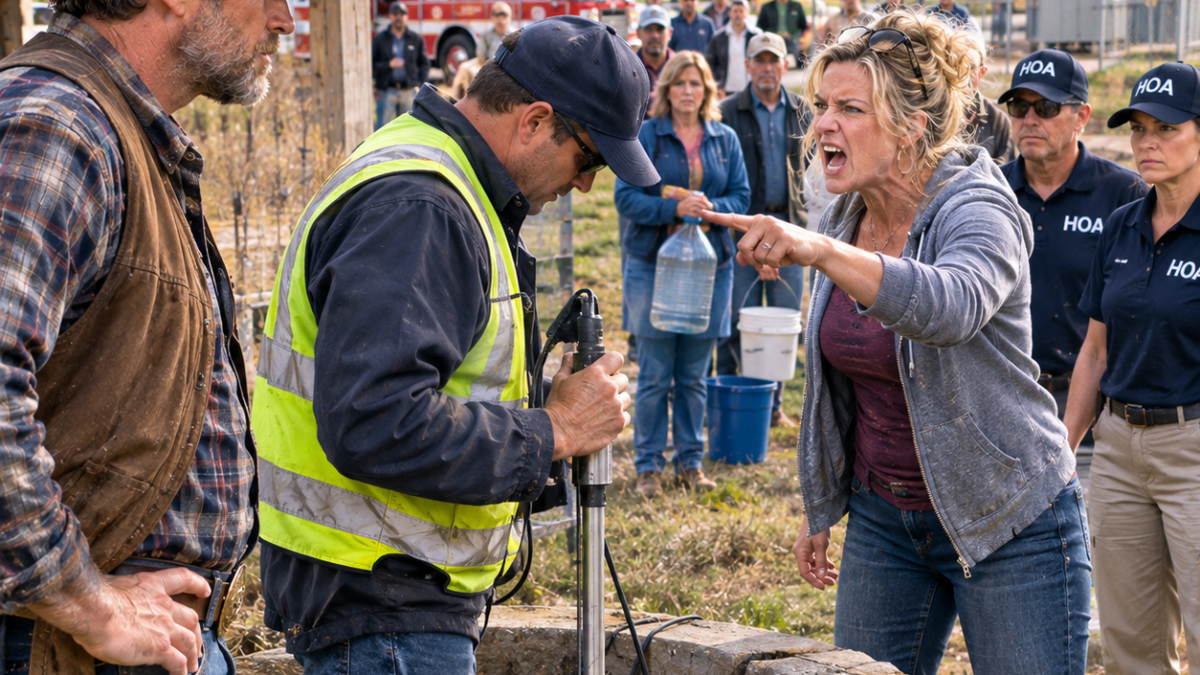
**“WE HAVE EIGHTY FAMILIES DEPENDING ON THIS WATER, DANIEL—YOUR RANCH WELL DOES NOT GET TO STAND IN THE WAY OF AN ENTIRE COMMUNITY!” HOA president Karen Whitmore snapped as a county inspector lowered a measuring line nearly three hundred feet into the dry well beside my Montana cattle pasture.**
**For seventy-one years, that well had supplied my family, my barns, my orchard, and every cattle trough on Lawson Ranch without a serious failure—until Willow Creek Estates built eighty homes beside me and quietly converted an old monitoring bore into a high-capacity production pump pulling hundreds of gallons a minute from the same aquifer.**
**Then a utility worker admitted they had been running that hidden pump for three months, the inspector asked Karen how many millions of gallons she had taken, and before she could answer, every faucet, toilet, shower, sprinkler, and fire hydrant inside Willow Creek Estates began going dry.**
At 6:14 on a Wednesday morning, eighty houses lost water almost simultaneously.
Not low pressure.
Not brown water.
Nothing.
Kitchen faucets coughed air.
Showers stopped while people still had soap in their hair.
Toilets would not refill.
Coffee makers sat empty.
Sprinkler systems died before sunrise.
And the neighborhood fire hydrants had lost enough pressure that a tanker truck from the county fire department was already parked near the clubhouse.
Across the road, I stood beside the stone wellhouse my grandfather had built in the 1950s and watched county water inspector David Reynolds slowly pull a measuring line back out of my well.
Karen Whitmore stood ten feet away.
“How long until the water comes back?”
David ignored her.
The reading mattered more.
Thomas Reed, my well contractor, looked over his shoulder.
I knew that expression.
Bad.
David finally turned toward me.
“When did your ranch well stop producing?”
“Last night.”
Karen looked at me.
“Your well too?”
Too.
That word almost made me laugh.
Mine had failed first.
That was why the county was there.
For seventy-one years, Lawson Ranch had depended on that well.
Then Willow Creek Estates appeared along my eastern fence.
Eighty homes.
Clubhouse.
Walking paths.
Landscaped pond.
Stone entrance.
And a neighborhood water system everybody kept telling me was completely separate from mine.
David walked across the road into Willow Creek’s utility enclosure.
Well A.
Well B.
Storage tank controls.
PART2:
Then one additional electrical panel.
Unlabeled.
He opened it.
High-capacity pump controller.
His face changed.
“What is this?”
Karen answered too quickly.
“Emergency stabilization.”
David followed the wiring.
Then the buried pipe.
Toward an old groundwater monitoring bore near my property boundary.
He looked at the technician standing beside the panel.
“Is that monitoring bore being used for production?”
Silence.
David asked again.
The technician finally said:
“Temporarily.”
Karen stepped forward.
“We had an emergency.”
David kept his eyes on the worker.
“When did you convert it?”
The worker swallowed.
“About three months ago.”
Karen snapped:
“Do not say another word.”
Too late.
David opened his notebook.
Then he asked the question Karen clearly did not want answered.
“How much water have you been pulling?”
That was when homeowners began walking toward us carrying bottles, buckets and empty containers.
And that was when five months of strange water problems finally started making sense.
My name is Daniel Lawson.
I was fifty-six when Willow Creek Estates finished the last of its eighty houses outside Bozeman, Montana.
My family had owned Lawson Ranch since my grandfather returned from military service and bought the first eighty acres.
Over the years, the family added more.
Just under two hundred acres by the time the property came to me.
We ran cattle.
Not hundreds.
Usually forty to sixty head.
Enough to keep me working without turning the ranch into a factory.
There was a small apple orchard my mother planted.
Two barns.
Machine shed.
Hay field.
Old ranch house.
And Rusty, my border collie, who believed every vehicle entering the property existed for him personally to investigate.
My wife Rachel had died six years earlier.
Too fast.
My daughter Jennifer lived in Idaho with her husband and children.
My son David worked construction in Missoula.
They visited often.
Most days, though, the ranch belonged to me, Rusty, and whatever cattle had decided to create a problem before breakfast.
Water was the center of all of it.
People who have never lived on agricultural land often think land is the valuable part.
It isn’t.
Water is.
Land without reliable water is simply an expensive place to watch things die.
Our main well sat beside the stone pump house.
Granddad built it in the fifties.
The well had been deepened twice.
Pump replaced several times.
Casing inspected.
Water tested annually.
I kept maintenance records going back decades.
It had never failed seriously.
The eastern side of the ranch used to border open pasture owned by the Collins family.
Then Robert Collins died.
His children sold.
Mountain Ridge Communities bought the land.
First plan:
Forty-six homes.
Then sixty.
Eventually eighty.
The development became Willow Creek Estates.
There was no Willow Creek.
Barely even a seasonal drainage ditch.
Frank Miller, one of the first residents, discovered that after moving in.
He came to my fence one morning.
“You got an actual creek over here?”
“No.”
He looked back at his neighborhood.
“Then I’ve been lied to.”
Frank was sixty-eight.
Retired electrical utility worker.
Moved from Colorado with his wife Linda.
He became my favorite neighbor because he understood three things immediately.
Ask before entering somebody else’s property.
Close a gate after you pass through it.
And cattle are not decorations.
Most Willow Creek residents were perfectly normal people.
Susan Parker brought her grandchildren to see calves.
Robert Jenkins bought eggs from me every Saturday even though the grocery store sold them cheaper.
I told him that.
He said:
“Yours have personality.”
I told him eggs did not have personality.
He bought them anyway.
The HOA was different.
Karen Whitmore became president before the last houses even sold.
She owned one of the larger homes overlooking my northern pasture.
Our first conversation was about cows.
Of course it was.
White SUV.
Gravel lane.
Stopped near the barn without calling first.
I walked out.
“Can I help you?”
“I’m Karen Whitmore, Willow Creek HOA president.”
“Daniel Lawson.”
She pointed toward the pasture.
“Do those cattle stay here year-round?”
“Some do.”
“We’ve had odor concerns.”
I looked toward the subdivision.
“They’ve been here longer than the houses.”
Her smile tightened.
“We’re trying to protect property values.”
“So am I.”
That confused her.
I pointed at the herd.
“Healthy cattle protect mine.”
No laugh.
Then:
“Would you consider planting more trees along the boundary?”
“No.”
“Why?”
“That’s grazing field.”
“The view is very agricultural.”
I stared at her.
“It’s a ranch.”
That was our beginning.
Not war.
Not even a real argument.
Just two people looking at the same land and seeing different things.
I saw home.
Karen saw something that needed improvement.
Then I found the wet patch.
Fifty yards from the old wellhouse.
Near my eastern fence.
At first, I assumed one of my buried stock lines had cracked.
I shut off pasture water.
Still wet.
Checked irrigation.
No leak.
The patch grew for three days.
Rusty thought it was excellent.
I did not.
I called Thomas Reed.
Thomas had worked on our wells for years.
Early sixties.
The kind of man who answered every question with another question.
“Pressure change?”
“No.”
“Pump running more?”
“Not that I noticed.”
“Neighbors drilling?”
“New subdivision.”
“How many wells?”
“I thought they had a community system.”
Thomas looked at me.
“That water still comes from somewhere.”
Good point.
He inspected my pump.
Pressure tank.
Piping.
Nothing obvious.
Then he asked when we last measured static water level.
“Two years ago.”
“Number?”
“Ninety-two feet.”
He dropped the line.
Waited.
Read.
“Hundred fourteen.”
Twenty-two feet lower.
I stared.
“Bad?”
“Maybe.”
“That’s helpful.”
“Groundwater changes.”
“Twenty-two feet?”
“Could be dry weather. Nearby pumping. Recharge. Construction drainage. Lots of things.”
He told me not to panic.
So I did not.
That matters.
The first water drop did not prove Willow Creek had done anything wrong.
Aquifers move.
Rainfall changes.
Two legal wells can affect each other.
I had no evidence.
Thomas suggested monthly readings.
April:
114 feet.
May:
121.
Early June:
134.
Now even Thomas stopped looking relaxed.
“Twenty feet in two months is fast.”
“Could Willow Creek do that?”
“If they’re pulling from the same aquifer.”
I went to the county water office.
Public records showed Willow Creek had two permitted production wells.
A and B.
Both on HOA property.
Both approved.
Hydrogeology report said they could support eighty homes within certain pumping limits.
Nothing suspicious.
I felt better.
Then I asked Karen whether the HOA had noticed any water changes.
“No.”
“Any extra pumping?”
“No.”
“Any well problems?”
“No.”
“Would you share total monthly usage?”
“Why?”
“To see whether our levels are reacting together.”
“That information belongs to Willow Creek.”
“I’m not asking for individual bills.”
“Our system is permitted.”
“I know.”
“Then this sounds like a county issue.”
Maybe she was right.
So I waited.
Another month.
Then one cattle trough stopped filling.
The float worked.
Pipe worked.
The well could no longer maintain pressure when the house and barn used water simultaneously.
That had never happened.
Thomas measured again.
151 feet.
We lowered the pump deeper.
Expensive.
Necessary.
Then Frank called.
“Daniel, weird question.”
“Go ahead.”
“You having water trouble?”
“Yes.”
Silence.
“How bad?”
“Why?”
“Our newsletter says Well B is down.”
That was the first time anyone inside Willow Creek admitted a problem.
The newsletter called it routine mechanical service.
Residents were told to reduce lawn irrigation temporarily.
Mechanical failures happen.
Nothing sinister.
But Thomas had a question.
“If B is down, what’s feeding eighty houses?”
“Well A?”
“Not comfortably.”
Then the wet patch near my fence disappeared.
Completely dry.
Thomas came back with utility locating equipment.
He found a buried line I did not own.
It ran from Willow Creek toward the boundary.
County utility maps showed an old monitoring bore there.
Monitoring wells are normal during development.
They measure groundwater.
What was strange was the large buried line attached to it.
Monitoring wells do not usually need supply pipes.
Then Frank found an HOA invoice.
BLUE RIVER UTILITY SERVICES.
$84,000.
EMERGENCY WATER STABILIZATION EQUIPMENT.
Pump controls.
Underground connection.
Storage integration.
Frank had access because he sat on the finance committee.
“What does emergency water stabilization mean?” he asked.
“I was hoping you knew.”
We kept digging legally.
No trespassing.
No touching equipment.
No accusations.
My well kept dropping.
164 feet.
172.
Thomas lowered the pump as far as the casing safely allowed.
“This buys time.”
“How much?”
“Depends how fast it falls.”
I started rationing.
Shorter showers.
No unnecessary orchard irrigation.
Check cattle troughs constantly.
Fix every tiny leak immediately.
I bought two large storage tanks.
Then Susan Parker came over.
She saw the brown grass in part of the orchard.
“You okay?”
“Water trouble.”
Her face changed.
“Is it because of us?”
“I don’t know.”
That was still the truth.
Next morning, she returned with six cases of drinking water.
I laughed.
“I have drinking water.”
“Take it.”
“Susan—”
“Take it.”
So I did.
Robert brought two fifty-gallon containers.
Frank helped install a temporary tank connection.
Those people lived inside Willow Creek.
They might have been drawing from the same aquifer.
They still showed up to help me.
That distinction became important.
The conflict was never ranch versus neighborhood.
It was about decisions.
Then Karen sent me a formal HOA letter.
My ranch was not in Willow Creek.
Yet the HOA asked me to stop discussing “unverified water depletion claims” because I could create panic and damage property values.
I called her.
“I have not accused Willow Creek of anything.”
“You’ve told residents your well is dropping.”
“Because it is.”
“You’re implying our system caused it.”
“I’m saying there may be a connection.”
“Our system is permitted.”
“Permitted wells still influence groundwater.”
“That sounds like an accusation.”
“It sounds like geology.”
She did not like that.
Then she said something I remembered later.
“We have eighty families depending on our water, Daniel. We are not going to let one ranch well interfere with that.”
One ranch well.
As if mine were the inconvenience.
Not the warning.
I called Rebecca Hayes.
Property attorney.
She gave me six instructions.
Document.
Do not threaten.
Do not touch HOA infrastructure.
Do not shut anything off.
Do not accuse without proof.
Measure everything.
So we did.
Thomas installed a digital water-level monitor.
Now we had daily data.
Something strange appeared.
Slow decline during most of the day.
Much faster decline between about 11 p.m. and 4 a.m.
Every night.
Thomas showed me the graph.
“Something is pumping hard overnight.”
“Willow Creek?”
“Could be.”
“Could be someone else?”
“Yes.”
We needed evidence.
At 11:32 one night, Frank called.
“Come outside.”
“Why?”
“Just come outside.”
I rode the ATV to the eastern fence.
Frank stood on Willow Creek’s walking path.
Behind the clubhouse, we heard mechanical noise from the utility enclosure.
Then rushing water through a large pipe.
Frank pointed.
“That only happens at night.”
“How do you know?”
“My dog wakes me up.”
Fair.
Then a Blue River truck pulled in.
Two workers entered.
One checked a controller.
The next morning:
My well had dropped seven feet overnight.
Rebecca submitted the data to the county.
Inspection scheduled.
Two days before the inspection, Willow Creek’s attorney sent a letter.
The HOA denied responsibility.
Fine.
But one sentence mattered.
THE ASSOCIATION HAS IMPLEMENTED TEMPORARY SUPPLEMENTAL PUMPING CONSISTENT WITH EMERGENCY WATER SERVICE NEEDS.
Supplemental pumping.
First time I saw those words.
I called the attorney.
“Is Willow Creek running a third production well?”
“You should ask the county.”
Fair.
Then Sunday night happened.
1:18 a.m.
Water pressure alarm.
I checked the monitor.
212 feet.
At ten o’clock it had been 193.
Nineteen feet.
Three hours.
Thomas came immediately.
By the time he arrived:
Kitchen faucet failed.
Barn line failed.
Cattle troughs stopped.
My ranch well had dropped below safe pump operation.
Thomas shut it down before the motor burned out completely.
At three in the morning, I stood beside the stone wellhouse listening to silence.
No pump.
No water moving.
Nothing.
On a ranch, that may be one of the most frightening sounds there is.
Then lights appeared across the eastern fence.
Three Blue River utility trucks entered Willow Creek.
Mechanical hum.
Loud.
Thomas looked toward them.
“They’re pumping now.”
I called the county emergency line.
David Reynolds told me not to touch anything.
He would arrive at sunrise.
I spent the next two hours hauling stored water to cattle.
Frank came before dawn.
Susan followed.
Robert too.
Nobody asked which side they were on.
Thirsty animals do not understand HOA politics.
At 5:40, Frank’s phone buzzed.
LOW WATER PRESSURE.
Then:
SYSTEM FAILURE.
By six:
Willow Creek faucets were dying.
At 6:07, David arrived.
And within the hour, the entire story was breaking open.
The converted monitoring bore was running a high-capacity pump.
The technician admitted the night cycle had been roughly four hundred gallons per minute.
Five hours most nights.
Sometimes six.
Thomas laughed once in disbelief.
“Four hundred?”
David looked furious.
“That is not temporary stabilization.”
Karen said they had emergency authority.
David asked for the permit.
She did not produce one.
Frank asked what “water committee” had approved it.
Karen claimed there was one.
Frank stared.
“I’m on finance. There is no water committee.”
Residents gathered.
People in bathrobes.
Parents.
Older homeowners.
Empty bottles.
One woman yelled:
“Why do we have no water?”
David raised his voice.
“The county is arranging emergency distribution. Stop all outdoor water use. Do not repeatedly restart private pumps. We are assessing the system.”
Then he turned to me.
“Do you have livestock water?”
“About a day.”
“We’ll include the ranch in emergency deliveries.”
Karen objected.
“County water is for the subdivision.”
David looked directly at her.
“Emergency water is for people and animals affected by the failure.”
Good answer.
I did not want Willow Creek families punished.
Children still needed toilets.
Older residents needed drinking water.
Fire hydrants mattered.
My cattle needed troughs.
This was not the time for revenge.
Then David examined the converted bore casing.
An old identification plate was still underneath newer hardware.
Thomas recognized it.
“That isn’t a Willow Creek monitoring number.”
“What is it?”
He looked toward my wellhouse.
“That belongs to the old Lawson groundwater study.”
My grandfather had drilled test bores decades earlier when improving the ranch well.
I knew almost nothing about them.
Old records showed several exploration holes along the eastern field.
The county immediately shut down the supplemental pump until ownership could be determined.
Then we searched.
One capped bore near the orchard.
Another near the eastern boundary.
Thirty feet from the HOA utility enclosure.
Surveyor James Walker located the old monuments.
The result was not subtle.
The property line ran east of the bore.
The converted production bore sat seven feet inside my ranch.
Part of Willow Creek’s utility fence crossed fourteen feet onto my land.
A buried supply pipe crossed my property without an easement.
Karen arrived as James marked the boundary.
“What are those?”
“Property markers,” Rebecca said.
“That utility area belongs to Willow Creek.”
“Part of it apparently doesn’t.”
“That’s impossible.”
James kept surveying.
Karen looked at me.
“You’re using the emergency to claim our well.”
“You’ve been pumping from my land.”
“We didn’t know.”
“Then why are you arguing before the survey is finished?”
She had no answer.
Then we found an old development note.
LAWSON TEST BORE RETAINED. DO NOT CONNECT WITHOUT OWNER AGREEMENT.
No owner agreement existed.
Worse:
Blue River had warned Karen three months earlier that the supplemental bore might be outside Willow Creek’s utility parcel.
Their engineer recommended a survey before conversion.
Karen’s written reply:
PROCEED. WE CAN RESOLVE PAPERWORK AFTER SYSTEM IS STABLE.
She knew enough to stop.
She did not.
That night David called.
“We found the pumping logs.”
“How bad?”
“Thirty-four million gallons.”
I sat down.
“Say that again.”
“More than thirty-four million gallons over three months.”
From a bore physically located on my ranch.
Then another issue.
Willow Creek’s groundwater permit limited total withdrawals based on aquifer testing.
The supplemental pumping had never been included.
Some nights, the neighborhood effectively doubled its draw.
Then Frank called.
Ground collapse near the clubhouse.
Landscaped common area dropped almost four feet.
Pavement around Well A cracked.
County crews returned.
Then the soil beside Willow Creek’s pump building dropped again.
Pipe broke.
Water sprayed briefly.
Thomas suddenly pointed across my pasture.
Cattle running.
Toward the creek.
I turned.
The ground beside my old stone wellhouse was sinking too.
Six inches.
Then more.
A crack opened through the dirt.
Thomas grabbed my arm and pulled me back.
The wellhouse did not collapse.
But one corner settled.
Stone foundation cracked.
Interior pipe snapped.
The building leaned slightly toward the pasture.
Seventy years of family history suddenly looked tired.
Karen protested when David ordered every Willow Creek production pump shut down.
“You’re leaving eighty families without water!”
“No,” he said. “We’re giving them emergency water until we know whether pumping is making the ground unstable.”
Tankers came.
Portable tanks.
Fire backup.
Agricultural delivery for the cattle.
And for one strange night, my ranch driveway became part of the water distribution route for the same neighborhood whose HOA had helped drain my well.
Frank apologized every time another HOA vehicle crossed.
“Stop.”
“I hate this.”
“Families need water.”
“I know.”
“Then stop apologizing for people who didn’t cause it.”
Most homeowners had no idea.
They paid dues.
Turned on faucets.
Trusted whoever ran the system.
That was not the same as knowingly taking thirty-four million gallons from my land.
The geotechnical engineer, Laura Mitchell, refused to make dramatic claims.
I respected her immediately.
The ground was not collapsing because an underground lake had become an empty cave.
Groundwater does not usually work that way.
But rapid pressure changes could cause loose soils and disturbed trenches around old utility sites to settle.
Willow Creek’s enclosure had poor construction fill.
My wellhouse had decades of buried repair trenches.
Heavy pumping could have contributed.
She would not say it caused everything until testing supported it.
Facts first.
That became important.
By the next day, Willow Creek had no working permanent source.
Neither did I.
The water emergency exposed something good.
Susan organized residents into shifts helping elderly homeowners carry containers.
Robert connected a temporary tank to my barn line.
Linda cooked meals for county crews.
Frank’s grandson Tyler helped refill cattle troughs.
Rusty followed him everywhere until Tyler decided ranch work was apparently the best thing in the world.
Rachel used to say:
“People reveal themselves fastest when plans fall apart.”
She was right.
Karen disappeared for almost two days.
Attorneys.
The HOA board placed the water system under county supervision.
Blue River could not operate anything without written approval.
Then Karen turned over documents.
Rebecca found Blue River’s original proposal.
Willow Creek Well B had been losing production.
Well A could cover indoor demand but struggled during irrigation season.
Blue River offered three options.
Repair B.
Drill a new permitted well.
Or temporarily convert the old monitoring bore while permits and property rights were confirmed.
The proposal included one clear warning:
SUPPLEMENTAL BORE MAY LIE OUTSIDE HOA UTILITY PARCEL. BOUNDARY VERIFICATION AND OWNER CONSENT REQUIRED BEFORE PRODUCTION CONVERSION.
Karen received it.
Blue River followed up.
Did Willow Creek obtain consent?
Her reply:
OWNERSHIP BOUNDARY IS DISPUTED. PROCEED UNDER EMERGENCY NECESSITY. WE WILL RESOLVE DOCUMENTATION LATER.
There was no misunderstanding left.
She knew permission might be required.
She pumped first.
Planned to ask later.
Then another question emerged.
Where had thirty-four million gallons gone?
Eighty houses used water.
Obviously.
But neighborhood consumption did not match.
Nearly eleven million gallons seemed unaccounted for.
Pressure testing found a major leak.
Maybe two million gallons.
Still not enough.
Then county technicians traced a “future phase connection” leaving the Willow Creek storage tank.
It ran north.
Under a maintenance road.
Into a Mountain Ridge construction yard.
At the end stood a one-million-gallon blue storage tank.
Nearly full.
Flow meter showed Willow Creek had been filling it for months.
Mountain Ridge said it was construction water.
Dust control.
Future development work.
Could have been legitimate if permitted.
It wasn’t.
Willow Creek’s groundwater approval allowed water for homes and fire protection.
Not wholesale construction exports.
Then came the contract.
Karen had signed it.
Willow Creek sold more than eight million gallons to Mountain Ridge.
About $96,000 in bulk-water payments.
Money went into HOA reserves.
Not Karen’s pocket.
At first.
The board minutes mentioned a construction-water partnership.
No detailed volumes.
No discussion of the disputed bore.
Three directors voted yes.
Two absent.
Jennifer Collins came to my ranch personally.
“I thought we were selling surplus stored water.”
“Did you know it came from the supplemental bore?”
“No.”
“Did you know my well was dropping?”
“Not when we voted.”
“Did Karen?”
Jennifer looked away.
“I don’t know.”
Then Blue River’s own internal messages surfaced.
Engineer:
DO NOT COMMIT EXPORT VOLUMES UNTIL SUSTAINABLE YIELD CONFIRMED.
Supervisor:
HOA CLIENT HAS DIRECTED CONTINUATION.
Client contact:
Karen.
One evening she came to my ranch alone.
No attorney.
No folder.
“I owe you an apology.”
I said nothing.
“I knew there was a boundary question.”
“Yes.”
“I didn’t know for certain the bore was yours.”
“You chose not to find out.”
“Yes.”
That surprised me.
No excuse.
Then:
“I thought we would use it only briefly while Well B was repaired.”
“What changed?”
She looked away.
“The developer offered to buy bulk water.”
“And you agreed.”
“The reserve fund was short. Road repairs were coming.”
“You knew your system was already struggling.”
“I thought the bore had enough capacity.”
“Based on what?”
“Blue River.”
Then I asked the question that mattered.
“Why did you tell me nothing unusual was happening?”
Long silence.
“Because I was afraid you would force us to shut it down.”
“You mean the thing that should have been shut down?”
“Yes.”
That was the first honest conversation we had.
Karen said:
“Every bad decision after the first one was about protecting the first one.”
That was probably true.
She could have stopped when the boundary warning arrived.
Didn’t.
Stopped when my well began dropping.
Didn’t.
Stopped when Well B failed.
Didn’t.
Stopped when bulk sales increased pumping.
Didn’t.
Each delay made admitting the earlier mistake harder.
Rachel used to say:
“The cheapest time to tell the truth is the first time.”
I told Karen.
She nodded.
“I know.”
County orders followed.
Supplemental bore shut permanently.
Well A offline pending inspection.
Well B repaired under supervision.
Bulk-water sales stopped.
Tankers continued.
Then something remarkable happened.
My well began recovering.
Four feet.
Then three.
Then five.
Twenty-two feet in one week.
Not normal level yet.
But climbing.
Willow Creek’s old supplemental bore rose almost identically.
The connection between them was undeniable.
Then the geotechnical report arrived.
Old fill.
Leaking pipes.
Rapid groundwater changes.
No simple cartoon explanation.
The excessive pumping likely made the instability worse.
But it could not be blamed for every crack.
That distinction mattered.
I could say Willow Creek’s pumping contributed directly to my well failure.
I could not honestly claim they alone created every inch of ground settlement.
Facts first.
Then the audit found another payment.
$40,000.
Recipient:
WHITMORE COMMUNITY PLANNING LLC.
Karen’s private company.
Mountain Ridge had paid her to coordinate construction-water access.
Not disclosed to the full HOA board.
Worse:
Her contract included milestone compensation tied partly to water volume.
More water delivered.
More money.
Now her motive changed.
She was not only trying to help HOA reserves.
She had personal income connected to keeping the pumping arrangement alive.
Frank called an emergency meeting.
Packed clubhouse.
He presented the bulk-water contract.
Then Karen’s private consulting contract.
She did not deny it.
Jennifer asked:
“Did you tell us you were being paid by Mountain Ridge?”
“No.”
Susan:
“Did your compensation increase when more water was delivered?”
Karen’s attorney objected to the wording.
Frank read the agreement.
The room changed.
A homeowner shouted:
“You told us to stop watering our lawns while you sold water to a developer!”
Karen stood.
“I was trying to stabilize HOA finances.”
Someone yelled:
“And yours?”
Frank immediately stopped the room.
Good.
Anger can turn facts into cruelty.
The board suspended Karen.
Five yes.
One abstention.
Frank became acting president.
He looked miserable.
Then at 2:17 the next morning, my alarm went off.
This time, the water level was rising.
Too fast.
Forty feet in twenty minutes.
Thomas answered immediately.
“That cannot be natural.”
Outside, water was forcing upward through the soil near my eastern fence.
Mud bubbling.
Then ground broke.
Clear water sprayed several feet into the air.
Frank came running from Willow Creek.
David Reynolds arrived.
“This is pressurized.”
The underground supply line from the supplemental bore to Willow Creek had ruptured.
But the pumps were supposed to be locked out.
County control center showed no authorized restart.
Then someone noticed the utility gate standing open.
Inside:
Supplemental pump controller active.
Manual override.
Full capacity.
Closed downstream valve forcing pressure backward.
David killed the pump.
Only three people were listed with physical security access.
Blue River lead technician.
Former maintenance manager.
Karen.
Security camera showed someone in a dark rain jacket entering at 1:56.
Key card used:
Karen Whitmore.
Then deputies stopped Karen’s SUV two miles away.
Inside:
HOA water records.
Pump-control equipment.
Manual override key.
It looked terrible.
But this is where patience mattered.
Karen denied restarting the pump.
She explained her husband Richard sometimes used her key card.
He knew the gate code.
He had helped move utility equipment.
Where was Richard?
Not home.
His pickup later appeared at a Blue River equipment yard.
Phone left inside.
Camera showed Richard getting into a Mountain Ridge truck.
Driver:
Douglas Price.
Operations director involved in the bulk-water deal.
Then a Blue River service ticket appeared.
1:41 a.m.
Emergency pump test.
Authorized:
R. Whitmore.
Richard.
He admitted signing it.
Douglas told him they needed proof the supplemental bore could recover enough water to resume construction supply.
The county had already shut the pump down.
Richard knew.
He claimed he thought a test was different from production.
David nearly laughed.
“A four-hundred-gallon-per-minute test is still pumping.”
Richard denied entering the utility enclosure.
He said he gave Karen’s physical key to Douglas because Douglas claimed Blue River needed it.
Blue River denied requesting any test.
The service ticket was fake.
Created from an inactive contractor login.
Douglas eventually surrendered.
He admitted everything about that night.
Fake service ticket.
Karen’s security key.
Unauthorized entry.
Manual restart.
Trying to prove the bore could still produce enough water for Mountain Ridge.
Karen had not known.
That surprised everyone.
Including me.
She had done plenty wrong already.
But she had not secretly restarted the pump that night.
That mattered.
Frank said:
“I almost hated her for that.”
“Good thing you waited.”
Anger likes fast villains.
Truth often needs more time.
The county finally completed its groundwater analysis.
The supplemental bore on my ranch had pumped roughly thirty-four million gallons in ninety-three days.
Aquifers do not belong gallon-by-gallon to the dirt directly above them.
Underground systems are shared.
But hydrogeologists found a strong drawdown cone from that bore extending beneath my main ranch well.
That was why our levels moved almost together.
The HOA had not sucked an underground private tank dry.
But its high-volume pumping had directly contributed to my well failure.
My pump motor was damaged from running near dry conditions.
Insurance disputes began.
Willow Creek blamed Blue River.
Blue River blamed HOA instructions.
Mountain Ridge said Willow Creek sold water as though the arrangement were legal.
Karen pointed out the board approved bulk sales.
The board said nobody told them the bore was sitting on my ranch.
Everybody knew one piece.
Nobody wanted the bill.
Rebecca smiled.
“That is why insurers exist.”
Then stopped smiling.
“And lawyers.”
My insurer paid immediate repair costs and pursued recovery later.
Thomas installed a new pump motor.
Repaired wiring.
One morning, water finally returned to my kitchen faucet.
Clear.
Strong.
I stood there turning it on and off like a child.
Rusty stared.
Maybe I had lost my mind.
You do not appreciate water until air comes out where water should be.
Still, I kept cattle partially on tanker support.
The aquifer needed recovery.
Willow Creek imposed strict restrictions too.
No lawn watering.
No pool filling.
No car washing.
Indoor use only.
Most people cooperated.
Children made signs.
SAVE OUR WATER.
One showed a cartoon cow.
LEAVE SOME FOR ME.
I kept that one.
Frank proposed a permanent monitoring station at the property boundary.
Public data.
My well.
Willow Creek A.
Willow Creek B.
Aquifer level.
Pump hours.
I agreed.
Transparency was cheaper than suspicion.
For almost a month, things improved.
Then the monitoring graphs showed something new.
Every night around 3 a.m.:
Small downward pulse.
Again.
Again.
Something else was pumping.
Not Willow Creek.
Their logs matched.
Supplemental bore physically disconnected.
Well A offline.
Well B normal.
The signal came from north.
Mountain Ridge’s future development site.
County inspectors found their one-million-gallon construction tank still filling.
New pipe.
No meter.
It led to a recently drilled exploratory geotechnical bore.
Not permitted for production.
Yet somebody had installed a high-capacity submersible pump.
Flow meter:
More than nine million gallons.
Another unpermitted bore.
Same aquifer system.
Site manager claimed he believed the water came from their licensed construction well.
Paperwork listed:
Richard Whitmore.
Not Karen’s husband.
Different man.
Mountain Ridge regional vice president.
Same last name.
Pure coincidence.
For about five seconds, everybody felt relieved.
Then we saw what he had approved.
“Future community supply source.”
What community?
The site manager handed over a plan.
Another 160 homes.
North of Willow Creek.
And a future water network connecting Willow Creek, the new project and several production wells.
One proposed line crossed the eastern edge of my ranch.
No permission.
No easement.
No agreement.
Project title:
WILLOW CREEK PHASE 2 WATER DISTRICT.
Frank stared.
“There is no Phase 2.”
“Not yet.”
Then Rebecca found a draft operating agreement naming Willow Creek HOA as future manager.
Signature block:
Frank Miller, HOA President.
Blank.
Frank had never seen it.
Then the ground vibrated.
Lightly.
Enough that everyone felt it.
One drilling crew reported pressure loss.
Then another.
David ordered the pump killed.
Technician hit emergency stop.
A cracking sound came from beyond the berm.
We ran.
Ground around the new bore split.
Mud.
Water.
Drilling pad dropped nearly three feet.
Pump casing bent sideways.
Then Thomas pointed toward my ranch.
Dust cloud rising near the orchard.
Robert Jenkins called.
“Daniel, your cattle are running.”
“From what?”
“I don’t know.”
Then I heard metal crashing through his phone.
Fence breaking.
Robert shouted:
“The ground just opened!”
By the time we reached the ranch, a sixty-foot section of pasture beside the orchard had sunk into a long trench.
Fence collapsed into it.
Water collecting below.
Thomas stopped me from getting closer.
David studied the old maps.
“This may not be random.”
“What is it?”
Thomas answered.
“The new bore may have connected two underground water zones.”
I stared.
He simplified it.
“Think of two soaked sponges separated by clay. One has higher pressure. One lower. Punch through that clay in the wrong place and water starts moving between them.”
“And that drops our wells?”
“Yes.”
“How badly?”
“We don’t know.”
My favorite sentence again.
Then the Willow Creek storage alarm sounded across the road.
Pressure dropping.
Again.
Only this time, everybody understood we were no longer dealing with one hidden pump.
This was regional.
County declared groundwater emergency.
Every high-capacity well in the affected area shut down.
Tankers returned.
Portable storage.
Fire backup.
Families carrying containers.
But this time, nobody blamed me.
Three months earlier, Karen had told me not to spread “unverified depletion claims.”
Now homeowners were checking groundwater graphs on their phones and asking why anyone had been allowed to pump tens of millions of gallons without a regional study.
Nine days later, the hydrogeology report arrived.
Mountain Ridge’s exploratory bore had been drilled deeper than design allowed.
It penetrated a clay layer separating two water-bearing zones.
Then the casing had been sealed improperly.
Groundwater had started moving around it even when the pump was off.
Heavy overnight pumping increased the pressure imbalance.
Eventually, the seal failed.
That contributed to the regional pressure collapse.
The sunken trench on my ranch was caused by a combination of old irrigation trenches, loose fill and changing groundwater pressure.
Again:
Complicated.
No giant underground cave.
No single movie-villain lever.
Bad decisions stacked on weak systems.
Mountain Ridge was ordered to abandon the defective bore.
Seal the deeper section.
Restore the clay barrier as well as technically possible.
Install long-term monitoring.
Then the county finally asked the question that should have come before any of this.
How much water could the entire area sustainably support?
Not just my ranch.
Not just eighty Willow Creek homes.
Everything.
The answer changed the future.
There was enough groundwater for Lawson Ranch and the existing eighty homes if pumping stayed within normal conservation limits and Willow Creek’s legitimate wells operated properly.
There was not enough proven sustainable capacity for another 160 homes on the same aquifer without major new infrastructure.
Mountain Ridge’s Phase 2 could not move forward as designed.
Frank read the report.
“So Karen dried Daniel’s ranch for eighty homes and Mountain Ridge nearly broke the aquifer for another hundred sixty.”
David corrected him.
“Not exactly.”
Frank sighed.
“I knew you were going to say that.”
Different mistakes.
Same groundwater system.
Willow Creek’s unauthorized pumping directly contributed to the original drawdown and my well failure.
Mountain Ridge’s later defective bore created a separate regional pressure failure.
Same lesson.
Water planning cannot be done one property at a time when everyone is pulling from the same underground system.
The final solution was regional.
Willow Creek entered a groundwater-management agreement with neighboring well owners.
Including me.
High-volume pumping increases required review.
Data shared.
Limits transparent.
The supplemental bore on my ranch would never produce for Willow Creek again.
Equipment removed.
Pipe disconnected.
HOA fence moved back to its actual boundary.
Survey markers restored.
The county could keep the bore as a monitoring point.
No production.
No private operator.
Just measurement.
I liked that.
The hole that had helped create the crisis would now help prevent another.
Rebecca negotiated compensation.
Well repairs.
Emergency water costs.
Damage to the stone wellhouse.
Monitoring equipment.
Legal costs.
Property encroachment.
Insurance from Willow Creek.
Insurance from Blue River.
Later contributions from Mountain Ridge.
Karen’s consulting company became part of another settlement.
I did not become rich.
I did not want to.
I wanted the ranch put back where it had been.
The old wellhouse was rebuilt using as much original stone as possible.
Thomas reinforced the foundation.
Installed modern monitoring.
When normal water finally returned, I filled one glass at the kitchen sink.
Clear.
Cold.
No air.
No weak pressure.
I drank it slowly.
Best glass of water I have ever had.
Willow Creek recovered too.
Well B became primary.
Well A came back later at a lower approved rate.
Irrigation controls improved.
Low-flow fixture incentives.
Drought-resistant landscaping.
No bulk-water sales.
None.
Their permit existed for homes and fire protection.
That was all it would do.
Then came Karen’s consequences.
Some Willow Creek residents wanted handcuffs.
They wanted one simple villain.
Reality was less satisfying.
Investigators found she had disclosed some consulting activity to management, but not to the full board.
She accepted money from Mountain Ridge tied partly to water-delivery milestones.
She helped approve bulk-water arrangements while holding that financial interest.
She knew the supplemental bore might be outside HOA land.
She ordered pumping before owner consent.
Serious.
But investigators found no evidence she intended to destroy my well.
No evidence she deliberately targeted cattle.
And no evidence she personally restarted the pump during the later nighttime incident.
Consequences had to fit what could be proven.
Karen dealt with civil claims.
Disclosure violations.
Financial settlement.
HOA action.
Her consulting company lost the Mountain Ridge contract.
She repaid part of the money.
She resigned permanently.
New bylaws prohibited board members from privately receiving money from companies doing HOA business without full disclosure and recusal.
Douglas Price faced the unauthorized nighttime restart.
Fake service ticket.
Utility access.
Control tampering.
Violation of the county shutdown.
Richard, Karen’s husband, faced consequences for giving Douglas the security key and participating in the fake request.
Both eventually accepted responsibility through negotiated legal outcomes and financial penalties.
Richard lost major landscaping contracts.
Douglas lost his position at Mountain Ridge.
Blue River changed too.
No temporary production conversion without:
Written permit verification.
Ownership confirmation.
Sustainable-yield review.
Obvious rules.
Most important rules sound obvious after somebody ignores them.
Mountain Ridge’s Phase 2 was reduced drastically.
Either connect to a larger regional water system or build fewer homes supported by proven supply.
The cheap solution—
Drill deeper.
Pump harder.
Move forward.
Was gone.
That cost millions.
Probably prevented another crisis.
Frank became official HOA president.
He complained instantly.
Susan told him:
“The people who desperately want power make us nervous now.”
Fair.
His board created a public dashboard.
Well levels.
Pump hours.
Storage.
Costs.
Usage.
No more mysterious line items called “emergency stabilization.”
If something moved water, residents could see what it was.
Then Willow Creek offered to buy the little patch around my supplemental bore.
Frank explained:
“We’d use it only as emergency monitoring.”
“No.”
Not angry.
Just no.
He nodded.
“Fair.”
I allowed the county to monitor it.
That was enough.
Months later, Karen came back to the ranch.
No badge.
No board papers.
No attorney.
Nothing in her hands.
“I wanted to apologize.”
I opened the gate.
She looked toward the repaired wellhouse.
“I knew that bore might be outside Willow Creek.”
“Yes.”
“I kept telling myself the emergency made it okay.”
“I know.”
“When your well started falling, I should have stopped.”
“Yes.”
“I didn’t because the developer agreement was already moving.”
“Yes.”
She looked down.
“And because I was making money.”
That was the first time she said it that plainly.
I respected the truth more than another excuse.
Then she said:
“I kept telling myself eighty families mattered more than one ranch.”
I looked toward the pasture.
“That was the wrong math.”
“I know.”
“Those eighty families never asked you to drain my ranch.”
She nodded.
That was the lesson.
Karen had used “the community” as justification for decisions the community did not understand.
Good leadership does not say:
“I did this for everyone.”
While hiding the cost from everyone.
Before leaving, she told me she was moving.
Some neighbors had become cruel.
Her family could not walk through Willow Creek without arguments.
I did not celebrate.
She had made serious mistakes.
That did not mean her children deserved years of punishment from strangers.
“I hope the next place goes better,” I said.
She looked surprised.
“After everything?”
“After everything.”
Kindness does not mean pretending damage never happened.
Sometimes it means recognizing when consequence has become enough.
We never became friends.
We did not need to.
The ranch slowly became normal again.
Most of the orchard survived.
Several younger trees did not.
I replanted them.
Cattle returned to their usual pasture rotation.
Rusty continued chasing tanker trucks long after tanker trucks stopped arriving.
My grandchildren visited that summer.
My grandson noticed all the monitoring gauges near the wellhouse.
“Why do you have so many?”
“Because Grandpa learned not to guess.”
True.
For decades, I trusted the well because it had always worked.
Willow Creek trusted its system because water came out when people turned faucets.
Mountain Ridge trusted plans because engineers drew them.
A resource can feel endless right until the moment it is not.
One evening, Frank sat with me on the porch.
Willow Creek lights came on across the fence.
Normal.
Quiet.
“Do you hate us?”
“No.”
“Even after we drained your well?”
“The neighborhood didn’t.”
He looked at me.
“The HOA did.”
“Some people running the HOA did.”
That distinction mattered.
The title sounds simple.
HOA drained my ranch well for eighty new homes.
Then every tap in their estate went dry.
That happened.
Willow Creek converted a high-capacity bore on my property without proper approval.
Thirty-four million gallons came through it in ninety-three days.
My well dropped more than a hundred feet.
My pump failed.
Cattle troughs stopped.
The orchard dried.
Then Willow Creek’s own system collapsed and eighty families lost water.
But the ending was never going to be me standing beside a working ranch faucet while families across the road suffered.
That would be revenge.
Not justice.
When Willow Creek went dry, I opened my driveway to tanker trucks.
Willow Creek residents helped fill my cattle troughs.
County crews protected both sides.
Frank shared the data.
Susan organized volunteers.
Engineers repaired the system.
The HOA stopped selling water.
Mountain Ridge redesigned its future around what the land could actually support.
And we all developed one new habit.
Every month, Willow Creek sends me its groundwater report.
Every month, I send mine.
If either side sees a strange drop, somebody makes a phone call before the problem becomes an emergency.
Frank jokes that the ranch and HOA now have the healthiest relationship in Montana because neither side trusts the other enough to stop measuring.
Maybe he is right.
There is a new sign beside my rebuilt stone wellhouse.
LAWSON RANCH
GROUNDWATER MONITORING SITE
Frank added a smaller one underneath.
PLEASE DO NOT DRAIN THE NEIGHBORHOOD.
I left it.
After everything, we earned one joke.
The water still runs.
The cattle still drink.
Willow Creek’s faucets work.
The future development is smaller.
The monitoring bore is used only for data.
And everybody finally understands something my grandfather probably knew without ever needing an engineering report.
You can build roads wherever zoning allows.
You can build houses wherever the county allows.
You can build pools, clubhouses, sidewalks and beautiful stone entrances.
But you cannot order more water into the ground just because your plans require it.








