HOA Drained My Hydropower Reservoir—Then the Exposed Lakebed Revealed Their Secret
HOA Drained My Hydropower Reservoir—Then the Exposed Lakebed Revealed Their Secret
“STOP TOUCHING THAT VALVE, DANIEL! WE LOWERED THIS RESERVOIR FOR COMMUNITY SAFETY, AND IF YOU INTERFERE WITH AN HOA EMERGENCY ORDER, YOU’LL BE THE ONE LIABLE WHEN SOMEBODY GETS HURT!” Patricia Wallace shouted as I stood beside the cut lock on my own dam.
By the time I reached the water, my 32-acre hydropower reservoir had dropped almost twenty-eight feet, my turbine was silent, and tire tracks crossed mud that had been underwater the day before.
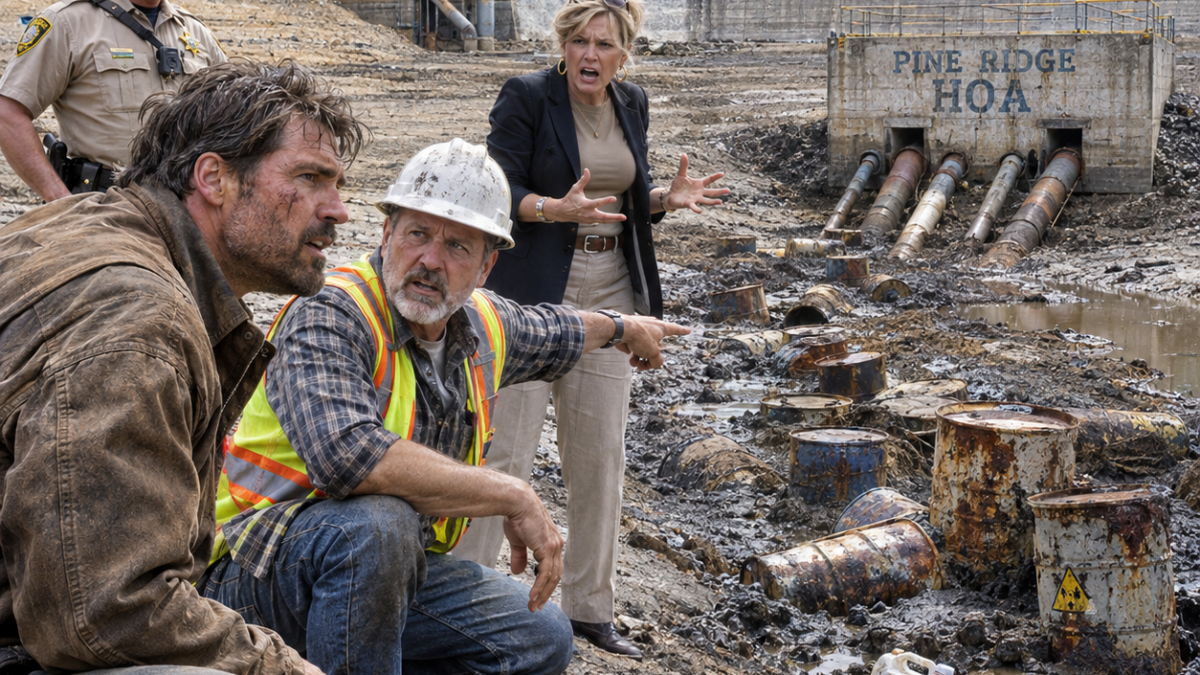
Then the falling water exposed a concrete chamber marked PINE RIDGE HOA—and county engineer Thomas Reed found a pipe beneath it that was built to send something into my reservoir.
My name is Daniel Foster, and before that morning, I thought the biggest problem Pine Ridge Estates could create was another ridiculous letter about water levels.
I was wrong.
Very wrong.
The reservoir sits on sixty-seven acres in western Virginia that my grandfather bought more than fifty years ago.
Back then, Pine Ridge did not exist.
There were farms, timber, two gravel roads, and a creek that flooded every spring.
Grandpa looked at that creek and saw power.
Not corporate power.
Actual power.
He built a small private dam that created a reservoir covering roughly thirty-two acres when full.
Water passed through a turbine house below the dam and returned to the creek downstream.
The system was modest, but it produced enough electricity for our farm, pumps, workshop, and eventually a second building Dad rented to a cabinet maker named William Parker.
To our family, that reservoir was never decoration.
It was infrastructure.
It was flood control.
It was electricity.
It was fish, deer, summer evenings, rowboats, and three generations of work.
Grandpa taught me the turbine system before I was old enough to drive.
He also taught me something I never forgot.
“Water only looks quiet,” he told me. “Never forget how much power is sitting behind that wall.”
So when the property became mine, I treated the dam accordingly.
Annual inspections.
Updated controls.
A reinforced spillway.
Water-level records.
Maintenance logs.
I never confused private ownership with the right to be careless.
If my dam failed, water would not stop politely at my property line.
Then Pine Ridge Estates arrived.
A developer bought hundreds of acres east of us and built what was marketed as luxury country living near a private lake.
That wording became a problem almost immediately.
PART2:
The “lake” in their advertising photos was mostly my reservoir.
Pine Ridge had its own smaller golf-course pond, but the developer loved using elevated photographs of my water in brochures.
Dad noticed.
The original developer contacted him and clarified everything.
Pine Ridge had no ownership interest.
No boating rights.
No fishing rights unless Dad personally allowed it.
No water rights.
No authority over the dam.
For years, there was no serious problem.
Some residents became friends.
Dad occasionally let children fish from a safe section of shoreline.
When a Pine Ridge resident named Robert Hayes lost his dog near the woods, Dad helped search until almost midnight.
That was how my family handled boundaries.
A gate protected property.
It did not replace basic decency.
Then Patricia Wallace became HOA president.
Patricia was organized, energetic, and obsessed with making Pine Ridge look more expensive.
Her first year brought new landscaping, security cameras, upgraded entrance signs, golf-course improvements, and eventually something called a Pine Ridge Community Water Notice.
It arrived in my mailbox.
The notice said my reservoir level needed to remain within neighborhood appearance standards because low water could reduce Pine Ridge property values.
I read it twice.
Then laughed.
I called the management office.
Susan Grant, the community manager, apologized and said it was probably an error.
I accepted that.
Two months later, another notice complained that noise from my turbine discharge disturbed residents using a nearby walking trail.
My turbine house existed before Pine Ridge.
I answered politely.
No HOA jurisdiction.
No violation.
No change.
Then came a third letter.
Patricia requested that I keep the reservoir at least ninety percent full on summer weekends because Pine Ridge homeowners expected a “premium waterfront view.”
That time I called her directly.
“You understand this is a working hydropower reservoir?”
“Yes.”
“I lower and raise it based on rainfall, turbine operations, inspections, downstream flow, and safety.”
“Our residents purchased lake-view homes.”
“They purchased homes overlooking my reservoir.”
She paused.
Then said something I remembered later.
“That distinction is becoming less useful.”
I should have paid more attention to that sentence.
I told Patricia that if Pine Ridge wanted formal recreational access, we could discuss a paid agreement.
She said homeowners should not have to pay for something they had enjoyed visually for years.
I told her looking at my water was still free.
She did not laugh.
For almost a year, the letters stopped.
Then Pine Ridge began upgrading its golf-course pond.
They enlarged it.
Installed fountains.
Improved landscaping.
During a dry summer, Patricia contacted me and asked whether the HOA could buy water from my reservoir during drought conditions.
That was the first sensible request she had made.
I told her maybe.
But we would need an engineer because removing water could affect turbine output, reservoir stability, and downstream flow.
She said that sounded unnecessarily complicated.
I told her water usually was.
No agreement followed.
That should have ended it.
Then I noticed something odd.
Pine Ridge’s golf pond stayed unusually full during drought.
My reservoir dropped faster than expected.
Not enough to create an emergency.
Enough to make me notice.
I checked turbine use.
Normal.
Rainfall.
Low, but not low enough.
Spillway.
Fine.
Dam.
Fine.
No obvious leak.
I hired Thomas Reed, the county engineer who occasionally consulted privately on water systems.
He inspected the property.
Nothing obvious.
“Could be seepage.”
“It’s never lost this much.”
“Old reservoirs change.”
Fair.
Autumn rain returned.
Water levels recovered.
I let it go.
Then it happened again the next summer.
Pine Ridge’s pond remained full.
My reservoir dropped.
This time I installed additional sensors.
The data gave us something strange.
The biggest losses happened between midnight and four in the morning.
Not every night.
Usually once or twice a week.
Thomas looked at the graph.
“That doesn’t look natural.”
“What does it look like?”
“Pumping.”
We searched again.
Nothing.
The Pine Ridge shoreline was steep and heavily wooded.
Thomas suspected somebody could have installed a buried intake farther inland.
I requested utility plans from the HOA.
Patricia refused.
“Internal HOA infrastructure is private.”
“We’re investigating water disappearing from my reservoir.”
“You have no proof Pine Ridge has anything to do with that.”
Technically, she was right.
So I did not accuse her.
I installed cameras.
For two months, nothing.
Then one camera caught a Pine Ridge maintenance truck entering the trees at 2:13 in the morning.
It remained near the reservoir for roughly twenty minutes.
My water-level sensor showed an accelerated drop during those same twenty minutes.
That was enough for my attorney, Rebecca Hayes.
Rebecca sent Pine Ridge a formal demand.
No water was to be removed from my reservoir without authorization.
The HOA also needed to disclose any pipes, pumps, valves, or infrastructure connected to it.
Their attorney responded.
“No HOA-owned system withdraws water from Mr. Foster’s reservoir.”
Rebecca looked at the sentence.
“HOA-owned.”
I understood immediately.
“What about contractor-owned?”
“Exactly.”
We asked again.
No meaningful answer.
Then the mysterious water loss stopped.
Completely.
For six months, my reservoir behaved normally.
Pine Ridge’s golf pond dropped during dry weather.
Suspicious?
Absolutely.
Proof?
No.
So I kept records.
That decision mattered later.
The next major conflict came after three days of heavy rain.
I lowered the reservoir before the storm peak arrived, giving it additional storage capacity.
The dam performed exactly as designed.
Pine Ridge residents saw exposed shoreline for several days.
Patricia sent me a complaint about mud, appearance, and property values.
I explained the drawdown was for flood safety.
She said Pine Ridge should be consulted before major reservoir changes.
“No.”
That was the first time I stopped trying to sound diplomatic.
“The dam protects people downstream. I am not waiting for an HOA vote before operating it safely.”
“You’re being difficult.”
“I’m being responsible.”
Soon Pine Ridge’s newsletter referred to my reservoir as a “shared community resource.”
It was not.
Residents began asking whether a lake partnership was coming.
Frank Wilson, an older Pine Ridge homeowner who loved machinery, called me.
“Daniel, did you agree to something?”
“No.”
“They’re telling people there’s going to be a lake partnership.”
“There isn’t.”
Rebecca sent another formal correction.
The newsletter disappeared.
Then Patricia offered to buy the reservoir.
Not all my land.
Just the reservoir.
Dam.
Turbine house.
Shoreline rights.
Water.
I refused.
She increased the offer.
I refused again.
She called that financially emotional.
I called it ownership.
A year later Pine Ridge announced Ridgeview Commons.
A new clubhouse.
Event lawn.
Expanded golf facilities.
Luxury rental cottages.
Larger pond.
Beach area.
The project sat downhill from my reservoir.
Construction crews eventually appeared near my eastern shoreline.
One survey team carried a map showing a proposed buried line running toward my water.
I stopped them.
They said Pine Ridge had hired them to locate an emergency corridor.
“For what?”
They did not know.
Rebecca contacted Patricia.
Patricia said it was only a stormwater-protection concept.
Nothing would enter my land.
The surveying company withdrew as soon as they realized I had never granted access.
Another contractor given incomplete information.
That became a pattern.
Then Pine Ridge created a “lake safety committee.”
I was not on it.
Thomas was not on it.
Nobody from the county was on it.
Nobody responsible for operating my dam was on it.
Still, they issued recommendations.
Reservoir never above eighty-eight percent before heavy rain.
Never below eighty-five percent during summer.
Thomas laughed.
“They want you to operate a working reservoir inside a three-percent range?”
“Apparently.”
“That’s not reservoir management.”
Rebecca formally informed Pine Ridge that the committee had no authority.
Patricia answered that the HOA had a legitimate community safety interest.
Interest?
Yes.
Authority?
No.
That distinction became the center of everything.
Then one Friday morning my turbine output suddenly dropped.
Not gradually.
Dropped.
I checked the control panel.
Water pressure was falling.
I drove toward the dam.
The reservoir was already down four feet.
Impossible.
I had been there the previous afternoon.
My normal outlet controls had not changed.
Then I saw tire tracks.
They led toward an older emergency drawdown valve on the east side of the dam.
The valve was protected by a locked steel box.
The lock was gone.
Cut.
The valve was open.
Water was pouring through the bypass channel.
I shut it and called the sheriff.
Deputy Michael Grant arrived.
He photographed the lock.
We checked security cameras.
At 4:41 that morning, a Pine Ridge maintenance truck appeared near the dam.
Another angle showed two figures walking toward the emergency valve.
Too far away to identify clearly.
Michael contacted Pine Ridge.
Patricia arrived with maintenance supervisor Richard Bell.
Richard looked nervous.
Patricia looked annoyed.
She said the HOA had acted under emergency authority after receiving a warning that my reservoir threatened Ridgeview Commons.
“What warning?”
She handed Michael a document.
EMERGENCY WATER RISK NOTICE.
Signed by Thomas Reed.
Twenty minutes later Thomas arrived.
He looked at the paper.
Then Patricia.
“I didn’t write this.”
The confidence on Patricia’s face finally shifted.
The signature looked real.
Thomas opened an older county inspection on his phone.
Same signature.
Exact shape.
Exact position.
Copied.
Patricia said she had relied on the document in good faith.
Maybe.
But nobody had called me.
Nobody had called Thomas.
Nobody had called the county.
And there was no major rain coming.
By then the reservoir had dropped eight feet.
I thought that was the crisis.
Then Thomas asked,
“How long was the bypass open?”
I checked sensor history.
“Almost four hours.”
His face tightened.
“At that rate you’re going to expose the lower lakebed.”
The water kept retreating.
Old stumps emerged.
Rocks I had not seen since childhood.
The turbine shut down completely as head pressure collapsed.
Patricia insisted we should keep the reservoir low until the Pine Ridge safety team completed its review.
I told her Pine Ridge’s safety team was never touching my controls again.
Michael agreed.
The cut lock and false emergency notice went into evidence.
Before Patricia left, I noticed something strange.
She looked across the falling water.
Not shocked.
Not worried.
Watching.
Almost waiting.
That bothered me.
By late afternoon the reservoir had dropped nearly twenty feet.
Closing the bypass stopped the rapid loss, but the water could not simply return.
Thousands upon thousands of gallons were already downstream.
Thomas suggested we inspect the exposed lakebed while we had the opportunity.
We walked the eastern side carefully.
That was when I saw tire tracks.
Not ours.
Older tracks.
Preserved beneath the water.
Heavy equipment had once crossed part of the lakebed.
But I had never intentionally lowered the reservoir enough for trucks to reach that area.
Thomas followed them.
The tracks led toward Pine Ridge’s shoreline.
Then we saw concrete.
At first, just one edge.
Then a roof.
A steel hatch.
Buried pipes.
And faded lettering.
PINE RIDGE HOA.
I stopped.
“What the hell is that?”
Thomas crouched beside one of the exposed lines.
“Something that’s been here a while.”
One pipe ran toward Pine Ridge’s golf pond.
Another ran toward the Ridgeview Commons area.
A third connected toward drainage infrastructure.
Then Thomas uncovered a fourth.
Larger.
Pointed toward the deepest part of my reservoir.
He examined the fittings.
“This one is reversed.”
“What does that mean?”
“It wasn’t built to pull water out.”
He looked toward the lakebed.
“It was built to discharge into the reservoir.”
Patricia returned with an attorney while we were still examining it.
She called the chamber an abandoned stormwater system from the original developer.
Thomas asked for plans.
None appeared.
Then he noticed the mud.
A dark strip ran from the pipe across the exposed lakebed.
Different color.
Different texture.
Not natural clay.
Thomas raised his hand.
“Nobody walks down there.”
I looked at him.
“Why?”
“Because if that line carried what I think it carried, we test the mud first.”
The county environmental office came out.
As the water continued draining away from the shoreline, something else appeared farther into the reservoir.
Metal.
At first I thought it was an old piece of equipment.
Then another appeared.
And another.
Barrels.
Rows of them.
Dozens.
Half buried in sediment.
Some old steel drums.
Some newer plastic containers.
They followed the same dark strip leading from Pine Ridge’s hidden discharge system.
A county worker approached one carefully.
He wiped mud from the side.
Then immediately stepped backward.
“Everybody off the lakebed.”
Michael looked at him.
“What did you see?”
The worker pointed.
A faded red hazard symbol.
“These are chemical waste containers.”
Within minutes, yellow tape went up.
My reservoir became an environmental scene.
By dark, crews had counted forty-three visible containers.
More appeared later.
Samples were taken from water.
Mud.
Sediment.
The hidden pipe.
Downstream areas.
Until testing came back, I could not restart the turbine.
Could not refill quickly.
Could not move the barrels.
Could not fish.
Could not let livestock drink near the affected areas.
For decades, the reservoir had powered my farm.
That night the turbine house was silent.
William Parker switched his cabinet shop to backup electricity.
I told him I would cover the cost.
“No.”
“William—”
“You’ve got enough going on.”
“I’m serious.”
“So am I.”
That almost broke me more than Patricia had.
When a problem becomes enormous, people assume only attorneys and engineers matter.
Sometimes the small kindness at the edge keeps you standing.
The next morning Pine Ridge emailed residents.
The message said the reservoir had been lowered because of an “emergency water safety concern” and that testing was underway after the discovery of “historic industrial materials.”
Historic.
Rebecca noticed immediately.
“They’re already separating themselves from the barrels.”
The message did not mention the cut lock.
Did not mention the copied county notice.
Did not mention Pine Ridge’s truck at my dam.
Did not mention the concrete structure carrying Pine Ridge’s name.
Frank called.
“Residents think Patricia discovered the barrels.”
“She didn’t.”
“I know.”
“Don’t spread theories.”
“Even good ones?”
“Especially good ones.”
Then Frank remembered something.
Years earlier, Pine Ridge had installed a buried pump system near the golf pond because summer evaporation kept lowering it.
That could explain one pipe.
Maybe two.
Not the discharge line.
Not the drums.
The HOA finally produced historical utility records.
The hidden chamber was missing from every official plan.
So was the line entering my reservoir.
Thomas compared the documents to what physically existed.
“Some of this system is older.”
“How old?”
“Maybe around Pine Ridge’s original development.”
“And the fittings?”
“Some are much newer.”
The laboratory results made things worse.
The reservoir water was not immediately dangerous to touch.
Good.
But sediment around the barrels contained petroleum compounds, solvents, and treatment chemicals associated with equipment cleaning, pool maintenance, and landscaping.
Highest levels were beside the hidden discharge line.
The county obtained authority to inspect the chamber.
When crews opened it, the smell was chemical and oily.
Inside were four valves.
Golf pond.
Ridgeview Commons.
Old drainage ditch.
Reservoir.
The reservoir valve was not rusted.
Not forgotten.
Fresh grease.
New bolts.
A county technician stared at it.
“This system is active.”
Patricia said old infrastructure was sometimes maintained for safety.
The technician requested maintenance records.
Then he sampled residue from inside the discharge line.
Its chemical profile closely resembled the contaminated sediment.
Not absolute proof yet.
Enough to keep digging.
Then they opened a side panel.
Behind it sat a digital flow meter.
Still powered.
Still logging.
Three years of data.
Dates.
Times.
Volumes.
Most activity happened between one and four in the morning.
I thought about my water sensors.
The mysterious nighttime losses.
The Pine Ridge maintenance truck.
Thomas traced the plumbing.
Then looked at me.
“I think this system works both directions.”
“What does that mean?”
“They can pull clean water from your reservoir through one line.”
He pointed toward the discharge.
“And send maintenance water or runoff back through another.”
Clean water out.
Dirty water back in.
The logs showed hundreds of thousands of gallons moving through the system over three years.
Eventually, Thomas calculated that the total water taken over a longer period was in the millions.
Frank stood beside me.
“We watered our golf course with your reservoir.”
“Looks that way.”
“And sent this back?”
“Some of it.”
He looked sick.
“Daniel, I’m sorry.”
“Don’t.”
“What?”
“You didn’t build it.”
That distinction mattered.
The residents had paid dues.
Used golf facilities.
Trusted management.
Their children had nothing to do with hidden valves.
Responsibility belongs to the people who make the decisions.
Not everybody with the same mailing address.
Susan Grant helped decode old maintenance records.
One buried work-order category appeared.
DIS7.
Description:
SEDIMENT MANAGEMENT RETURN.
The contractor?
Valley Environmental Services.
Owner?
David Wallace.
Patricia’s brother.
Rebecca did not jump to conclusions.
Family connection was evidence worth examining.
Not proof by itself.
Then the invoices arrived.
Pine Ridge had paid Valley Environmental Services more than $420,000 over six years.
Pond cleaning.
Stormwater management.
Golf-course water recovery.
Pool backwash handling.
Sediment control.
And one repeated charge:
RESERVOIR RETURN MANAGEMENT.
Sometimes $9,000.
Sometimes $18,000.
Sometimes more.
Before Patricia became president, approvals came through older management.
Afterward, the initials changed.
P.W.
Patricia Wallace.
Still not enough by itself.
Maybe she believed the work was legal.
Then Thomas found a four-month-old invoice.
DIS7 VALVE REPLACEMENT.
The supposedly abandoned discharge valve we had just found recently maintained.
The HOA board had never specifically approved a private reservoir-discharge system.
Broad categories like “water management” had hidden the expenses.
Then investigators traced the newer barrels.
One supplier had sold them four years earlier.
Buyer:
Valley Environmental Services.
Now we had a direct connection.
But the next question was obvious.
Why dump chemical waste into a reservoir when legal disposal existed?
Because legal disposal cost money.
Valley had charged Pine Ridge separately for proper waste disposal.
Investigators contacted the waste facility named on receipts.
Several receipt numbers belonged to other customers.
Three did not exist.
Others listed different quantities.
Someone had been billing Pine Ridge for legal disposal while evidence suggested material had been buried or discharged into my reservoir instead.
The sheriff opened a fraud investigation.
Pine Ridge’s board suspended Patricia’s environmental authority.
Then the county uncovered something that explained her obsession with keeping my reservoir full.
Old parts of the lakebed contained a deliberately shaped disposal trench.
Drainage directed toward the hidden chamber.
Some infrastructure dated back to Pine Ridge’s original construction.
But the newer dumping clearly did not.
An old construction foreman confirmed that the original chamber had started as a temporary system during development.
An intake line was described to workers as an emergency drought connection.
The original discharge area handled muddy construction water.
Temporary.
Supposedly.
Then investigators found the electronic record showing when the dormant system came back to life.
Six years earlier.
REACTIVATE WATER RECOVERY SYSTEM.
Approved by Patricia.
Attached email:
David: “Old reservoir connection still usable. Huge savings versus municipal supply.”
Patricia: “Is it permitted?”
David: “Legacy system. Developer installed it.”
Patricia: “Do we have rights?”
David: “Been there forever. Nobody challenged.”
There it was.
Not confusion.
A question.
Do we have rights?
And instead of verifying the answer, they used the system anyway.
Another exchange:
Patricia: “Can it handle golf maintenance runoff?”
David: “Return side can move water back.”
Patricia: “Any issue?”
David: “Only if tested.”
Nobody spoke after Rebecca read that sentence aloud.
Then came the message that explained the water-level pressure.
David: “Sediment trench nearing capacity.”
Patricia: “Can we remove?”
David: “Costly.”
Patricia: “Then keep level high.”
I felt something cold in my stomach.
All those letters.
The appearance standards.
The summer minimum.
The complaints when I lowered the reservoir before storms.
Property values were not the only reason.
High water hid the trench.
High water hid the barrels.
High water hid the chamber.
And three days before Patricia drained the reservoir, David had messaged her again.
“Dark sediment showing near east shelf after last drawdown.”
Patricia: “How bad?”
“If level drops another ten feet, drums visible.”
“Weather report?”
“Dry.”
Then Patricia wrote:
“Then we need controlled exposure before Daniel sees it.”
Thomas understood immediately.
“They wanted to lower it themselves.”
“Why?”
“So David’s crew could reach the site first.”
Remove barrels.
Move evidence.
Clean the trench.
Then claim it had been a safety drawdown.
The plan failed because Richard Bell opened the old bypass too far.
The valve stuck.
The reservoir dropped faster than expected.
My sensors alerted me before Valley’s crew could enter.
Sheriff.
Engineer.
Me.
Witnesses everywhere.
They had tried to hide the lakebed.
Instead, they uncovered it for us.
Richard Bell eventually cooperated.
Patricia had ordered him to open the bypass.
He had asked for authorization.
She handed him the fake emergency notice with Thomas’s copied signature.
He believed it.
Richard admitted cutting my lock.
Then Rebecca asked the crucial question.
“What were you supposed to do after the water dropped?”
Richard looked at his attorney.
Then said,
“David had a crew waiting.”
“For what?”
“To remove the newer drums.”
Richard had also preserved messages.
Patricia at 4:12 a.m.:
OPEN EAST BYPASS. CALL WHEN SHELF APPEARS.
Then:
DO NOT LET DANIEL SEE CREW UNTIL DAVID CLEARS RETURN AREA.
And Richard had saved a photograph David told him to delete.
A barrel exposed during an earlier low-water event.
David’s response:
KEEP THIS OFF HOA SYSTEM.
Patricia:
DELETE PHOTO AFTER HE CONFIRMS SITE COVERED.
That was when Pine Ridge removed Patricia as president.
Valley lost its HOA contracts.
I thought we had reached the deepest part of the story.
Then cleanup workers found a locked concrete box beneath the disposal trench.
Inside:
sealed containers.
Waterproofed paper records.
A hard drive.
Development maps.
Ridgeview Commons.
Luxury cottages.
Golf expansion.
Roads.
A restaurant.
Private marina.
And in the middle of the map:
my reservoir.
Not labeled private property.
Not labeled Foster Reservoir.
COMMUNITY WATER ASSET.
My shoreline was divided into future lots.
My turbine house was marked for removal.
My dam was labeled:
PINE RIDGE CONTROL STRUCTURE.
Rebecca stared at the map.
“They weren’t just stealing water.”
“No.”
“They planned to claim the reservoir.”
Then Michael opened another document.
Purchase agreement.
Seller:
Daniel Foster.
Buyer:
Pine Ridge Lake Holdings LLC.
My signature sat at the bottom.
I had never signed it.
Behind it was a deed transferring my dam, reservoir, turbine house, and thirty-two acres of shoreline.
Thomas looked at the legal description.
His expression changed.
“This has been recorded.”
Rebecca checked county records.
He was right.
Three weeks earlier, somebody had filed a deed claiming my reservoir now belonged to Pine Ridge Lake Holdings.
Laura called.
She had found the company registration.
Owner:
David Wallace.
Then the next bomb dropped.
David had already used that fake ownership as collateral for a $3.8 million private real-estate loan.
North Valley Capital believed his company had purchased my reservoir for $2.2 million.
“Ask them where my two million went.”
They did.
The closing file showed a wire to:
Foster Hydroelectric Holdings LLC.
I had never heard of it.
Rebecca searched state records.
The company had been created seven months earlier.
Owner:
David Wallace.
He had used my family name to manufacture a fake seller.
Fake seller.
Fake buyer.
Fake signature.
Fake deed.
Real lender.
Real money.
The $2.2 million supposedly paid to me went into David’s shell company and then out again.
Some to Valley Environmental Services.
Some to Pine Ridge Lake Holdings.
Some into investment accounts tied to David.
North Valley froze the remaining loan funds.
Their attorney, Jennifer Sloan, came to meet us.
She did not pretend they had done everything right.
“We should have caught this.”
Rebecca asked,
“Did anyone call Daniel?”
“No.”
“Meet him?”
“No.”
“Verify the supposed seller company independently?”
“We relied on the closing package.”
“Provided by?”
Jennifer exhaled.
“David.”
The lender had been deceived.
It had also failed basic verification.
Both could be true.
Their appraisal valued the developed reservoir property at $5.6 million.
The plan showed rental cabins.
Event center.
Restaurant.
Fishing docks.
My turbine house converted into a visitor center.
My dam road turned into a community trail.
The engineering report claimed my hydropower system produced little useful electricity.
I nearly laughed.
The turbine powered my farm and two workshops.
It was not underutilized.
It was inconvenient to David’s real-estate plan.
They wanted reservoir levels high for waterfront development.
High water hid the waste.
High water also made luxury cottages look better.
My reservoir had become three things in their scheme.
Free water.
Waste disposal.
Real-estate scenery.
Hydropower was the thing getting in the way.
Then investigators discovered they were still trying to manufacture paperwork after the investigation began.
A fake utility easement was submitted granting Pine Ridge permanent rights to my water, dam, roads, electricity, discharge system, and emergency controls.
The document was dated four years before the company filing it even existed.
That mistake exposed it immediately.
Someone had also used a compromised law-firm filing account.
The login traced back through Pine Ridge’s old management server to Valley Environmental Services.
Before investigators could search Valley’s office, the building caught fire.
Firefighters contained it.
Burned computers.
Shredded records.
Empty containers.
Fortunately, David’s system had an offsite backup.
People who build complicated frauds apparently forget that computers make copies.
The backup contained a folder:
LAKE DISTRICT FINAL.
Inside were current development plans.
The project was still alive.
Luxury cottages.
Marina.
Restaurant.
Event center.
Golf expansion.
And a new hydropower control building.
Thomas opened the engineering drawings.
Then stopped.
“They want remote control.”
“Of what?”
“Everything.”
The new system would connect reservoir valves, turbine flow, intake, discharge, and water-level management directly to Pine Ridge’s network.
“They weren’t planning to just own the reservoir,” Thomas said.
“They wanted to operate it.”
Then came another false report.
A supposed dam inspection claiming my spillway foundation was failing.
Thomas looked at the photos.
“That’s not your dam.”
Somebody had used photographs of a different structure.
Why?
The construction schedule explained it.
If the dam could be declared unsafe after Pine Ridge “acquired” it, emergency reconstruction could begin faster.
Contractor:
Wallace Infrastructure Group.
Another David-connected company.
Estimated contract:
$4.7 million.
He was preparing to steal my reservoir, then pay his own company millions to rebuild a dam that did not need rebuilding.
Michael called.
“Daniel, where are you?”
“At Rebecca’s.”
“Stay there.”
“What happened?”
“We found equipment records.”
Thomas took the phone.
“What equipment?”
“A remote dam-control package.”
“Planned?”
“No.”
“Purchased?”
“Yes.”
“Where?”
“Pine Ridge maintenance yard.”
Inside a locked storage building, deputies found motorized valve controls, industrial network equipment, sensors, remote panels, and actuators.
All labeled for my dam.
Installation drawings matched my property.
A work order sat on one crate.
INSTALLATION DATE: TOMORROW, 5:30 A.M.
Emergency dam modernization.
Authorized by Thomas Reed.
Except Thomas had never authorized it.
His signature had been copied again.
Then Michael’s radio crackled.
Two trucks had just entered the north access road to my reservoir.
Not tomorrow.
Tonight.
We drove behind sheriff’s vehicles.
When we reached the dam, floodlights were already on.
Workers stood beside the turbine house.
A crane was parked near the controls.
One electrical cabinet had already been opened.
And someone had attached a motorized actuator to the same emergency bypass valve Patricia used the first time.
Michael ordered everybody to stop.
Most workers did immediately.
They had paperwork.
They believed they were performing emergency repairs.
Then one man ran toward my control building.
Michael shouted.
The man reached the panel.
Hit a large red switch.
The emergency release gate began opening.
Water thundered through the bypass.
At the same moment, my turbine screamed.
The workers had disconnected part of the normal control system.
Thomas shouted for everybody to clear the building.
He ran to the mechanical turbine shutoff.
I helped him turn the heavy manual wheel.
The system fought us.
Then moved.
The vibration weakened.
The turbine slowed.
Finally—
silence.
The reservoir was still draining.
But the turbine was no longer destroying itself.
The man had locked himself inside the control room.
Michael ordered him out.
For nearly a minute, nothing.
Then the lock clicked.
The door opened.
David Wallace stepped outside.
Patricia’s brother.
Owner of Valley Environmental Services.
Owner of Pine Ridge Lake Holdings.
The man connected to the hidden plumbing, disposal records, fake seller company, fraudulent financing, and plans to seize control of my dam.
He raised his hands.
I wanted answers.
Rebecca stopped me.
“Not here.”
She was right.
The dam came first.
Contractors helped reverse the unauthorized actuator under Thomas’s supervision.
The bypass slowly closed.
The reservoir lost several more feet.
Not catastrophic.
By two in the morning, it was stable.
Thomas checked everything.
Dam stable.
Spillway stable.
Turbine damaged.
But repairable.
Repairable.
That one word felt better than any legal victory.
Most contractors cooperated.
They had been handed an emergency order with copied official signatures.
They believed they were preventing a dam failure.
Again, people with tools were not necessarily people constructing the lie.
David went with deputies.
Pine Ridge held an emergency meeting the next day.
Laura Bennett told residents exactly what happened.
Unauthorized crew.
Fake emergency order.
Remote dam-control equipment.
Emergency bypass opened.
Turbine damaged.
Nobody hurt.
Frank stood and said,
“We got lucky.”
He was right.
A dam is not landscaping.
It is not a pool pump.
It is not something an HOA president gets to operate because a committee voted.
One bad decision around moving water can kill people.
The HOA unanimously banned its board members, contractors, employees, and managers from entering my dam property or claiming operating authority unless a real emergency agency had legal authority and I or an authorized engineer was involved.
Every remaining Wallace-connected contract was terminated.
The months after that were expensive and slow.
My turbine needed a bearing replacement.
Sensors.
New control components.
The unauthorized actuator came off.
Thomas helped design stronger physical lockouts.
Tamper alarms.
Camera coverage.
Automatic alerts.
The controls stayed local.
No Pine Ridge computer would ever operate my dam.
Environmental cleanup took nearly three weeks with the reservoir low.
Eventually sixty-eight containers were removed.
Thirty-one newer ones were traced directly to Valley purchases.
Older material came from different periods.
Investigators separated everything carefully.
Not every buried object was Patricia’s.
Not every old piece of debris was criminal.
That mattered.
Evidence was already strong enough.
It did not need exaggeration.
The main reservoir water eventually tested safe.
The worst contamination had been concentrated in the eastern disposal trench.
The fish population needed time and some restocking.
Shoreline restoration followed.
Rain returned.
The reservoir began refilling slowly.
Then came the day Thomas cleared me to restart the turbine.
We stood inside the powerhouse.
I opened the system.
Water moved.
The low mechanical hum returned.
Then steady vibration.
Power output climbed.
I stood there listening.
Thomas looked at me.
“You okay?”
“Yeah.”
I nearly cried anyway.
Not because electricity is emotional.
Because that sound belonged there.
Hydropower.
Farm.
Workshop.
Responsibility.
Not illegal water pumping.
Not chemical disposal.
Not a luxury development plan.
Not fraud.
My grandfather’s reservoir was doing its real job again.
The fake deed was eventually declared void.
Completely.
My ownership chain was clear.
No sale.
No consent.
No legitimate transfer.
North Valley released every claim against my property and pursued the parties that created the fraudulent transaction.
The fake utility easement was rejected.
No Pine Ridge water rights.
No dam rights.
No road rights.
No discharge rights.
No emergency authority.
Patricia faced legal consequences tied to the unauthorized draining, false documents, environmental concealment, contract approvals, and her messages.
David faced a broader case involving financial fraud, false property records, environmental dumping, the fraudulent loan, fake companies, and the attempt to take control of my dam.
Richard Bell’s situation was treated differently.
He had cut my lock.
That mattered.
He had entered private dam property.
That mattered.
But he had also been handed a fabricated emergency notice, preserved evidence, surrendered his phone, saved the barrel photograph, and explained the plan.
Different choices deserve different consequences.
I let the courts handle the rest.
I had spent enough time trying cases in my head.
Pine Ridge changed too.
Laura Bennett became president.
Frank joined the board.
Susan stayed as community manager.
Environmental vendors had to be independent.
Large contracts required public board approval.
Family connections had to be disclosed.
No more vague “water management” invoices hiding six-figure systems.
The golf pond got a legal recycling setup.
Ridgeview Commons was redesigned with its own water and stormwater infrastructure.
The lake safety committee disappeared.
Good.
My reservoir did not need an HOA lake committee.
It needed engineers.
Pine Ridge recorded a formal statement acknowledging that the HOA had no ownership, recreational right, water right, dam authority, or management authority over my reservoir.
Residents could still look at it.
That part remained free.
Frank joked that the HOA should adopt a rule:
LAKE VIEWING PERMITTED AT NO CHARGE.
I told him Patricia probably would have found a way to assess a viewing fee.
It was the first time I laughed about any of it.
A year after the reservoir was drained, the water was full again.
Green shoreline.
Fish.
Birds.
Turbine running.
William’s workshop back on hydropower.
I tried paying him for the backup electricity he used during the shutdown.
He refused.
So I replaced the old loading door on his shop without asking.
He complained for three days.
Then thanked me.
Kindness does not need a committee either.
Pine Ridge residents also stopped calling the reservoir “our lake.”
That little change meant more than people might think.
Foster Reservoir.
Daniel’s reservoir.
The reservoir.
Children still waved.
Jennifer still brought her kids to fish when she asked first.
Frank still visited the turbine house.
Respecting property boundaries did not make us worse neighbors.
It made being neighbors easier.
The following summer, Laura asked whether Pine Ridge residents could organize a cleanup along the public creek downstream.
She asked.
I said yes.
People came with trash bags.
Families picked up fishing line, bottles, and storm debris.
At lunch, everyone sat beneath trees eating sandwiches.
Nobody talked about lawsuits.
Nobody talked about Patricia.
Nobody talked about deeds.
For a few hours, we were just neighbors taking care of water that actually belonged to everyone.
That felt right.
There was one thing I kept.
The old concrete structure where the hidden system had been discovered.
Thomas asked whether I wanted it destroyed.
At first, yes.
Then I changed my mind.
The pipes were removed.
The chamber was filled and sealed.
But we left a small piece of concrete above the high-water line.
The faded words PINE RIDGE HOA were barely visible.
Beside them, I installed a metal plate.
PRIVATE RESERVOIR.
NO WATER RIGHTS CONVEYED.
Thomas laughed.
“You like permanent records now.”
“Yes.”
“Can’t blame you.”
The final settlement covered verified losses.
Cleanup.
Water theft.
Lost power production.
Turbine damage.
Legal expenses.
Shoreline restoration.
Pine Ridge paid the share supported by evidence.
David’s companies and insurers handled additional portions.
North Valley pursued its own financial losses.
County penalties stayed separate.
I did not demand some fantasy number because I wanted revenge.
I wanted repair.
Grandpa taught me that without ever saying those exact words.
Broken fence?
Fix it.
Failed machine?
Repair it.
Someone wrongs you?
Make the damage right without becoming the same kind of person.
The ridiculous Pine Ridge development map was withdrawn.
No luxury cottages reached my shoreline.
No marina.
No restaurant.
My turbine house never became a visitor center.
The dam remained a dam.
Ridgeview Commons eventually opened smaller and entirely on land Pine Ridge actually controlled.
Its own pond.
Its own utilities.
Its own water.
Exactly how it should have been from the beginning.
Frank once asked me if I regretted ever being friendly with Pine Ridge residents.
“No.”
He looked surprised.
“After everything?”
“Patricia drained my reservoir. David used it. The entire neighborhood didn’t.”
He nodded.
That distinction matters to me.
Blaming everybody is easy.
Separating responsibility takes more work.
Fairness usually does.
The title of this story makes what happened sound simple.
The HOA drained my hydropower reservoir.
Then the exposed lakebed revealed their secret.
That is true.
They opened my emergency bypass using a copied county notice.
The water dropped.
My turbine stopped.
The lakebed appeared.
And underneath it we found hidden pipes, chemical barrels, illegal water systems, false disposal records, fake companies, a forged property transfer, millions in fraudulent financing, and a plan to take control of my dam.
All because the water disappeared.
Patricia thought lowering the reservoir would give David’s crew time to remove evidence before I saw it.
Instead, she exposed everything in front of witnesses.
For years, their secret had been protected by depth.
Mud.
Paperwork.
Titles.
Assumptions.
People believing somebody else must have checked.
Once the reservoir fell, those protections disappeared.
The lakebed did not care what Patricia’s newsletter called the reservoir.
It did not care about David’s LLC.
It did not care that somebody had filed a fake deed.
The barrels were physically there.
The pipes were there.
The chamber was there.
Reality was there.
That is the lesson I kept.
Water can hide things.
Paperwork can hide things.
Authority can hide things.
But hidden is not the same as gone.
Eventually something changes.
A water level falls.
A worker asks a question.
A signature gets compared.
A file gets opened.
And suddenly whatever somebody spent years burying is sitting in daylight.
Today, Foster Reservoir is full.
The turbine runs.
The creek moves below the dam.
Livestock drink safely downstream.
Kids occasionally fish from the section I allow.
Across the eastern hills, Pine Ridge is still there.
Still expensive.
Still beautiful.
Still mostly filled with ordinary people living ordinary lives.
And every morning, when I pass the dam controls, I check the water level.
Not because I am afraid anymore.
Because Grandpa was right.
Water only looks quiet.
There is always more power underneath than people think.








