HOA Chairwoman Gave Me 45 Days to Tear Down My Farm Fence—Then I Found What Her $420,000 Security Wall Was Sitting On
PART2:
The first time Lenora spoke to me, she asked if I would consider replacing the farm fence with “something more visually compatible with Aldercrest.”
I told her no.
The second time, she asked whether I would stop parking my manure spreader where residents could see it from the clubhouse road.
I told her no again.
The third time, she offered to buy 1.7 acres along my western-eastern boundary for an entrance project.
The price was insulting.
I said no.
Two months later, she returned with a slightly better number.
Still no.
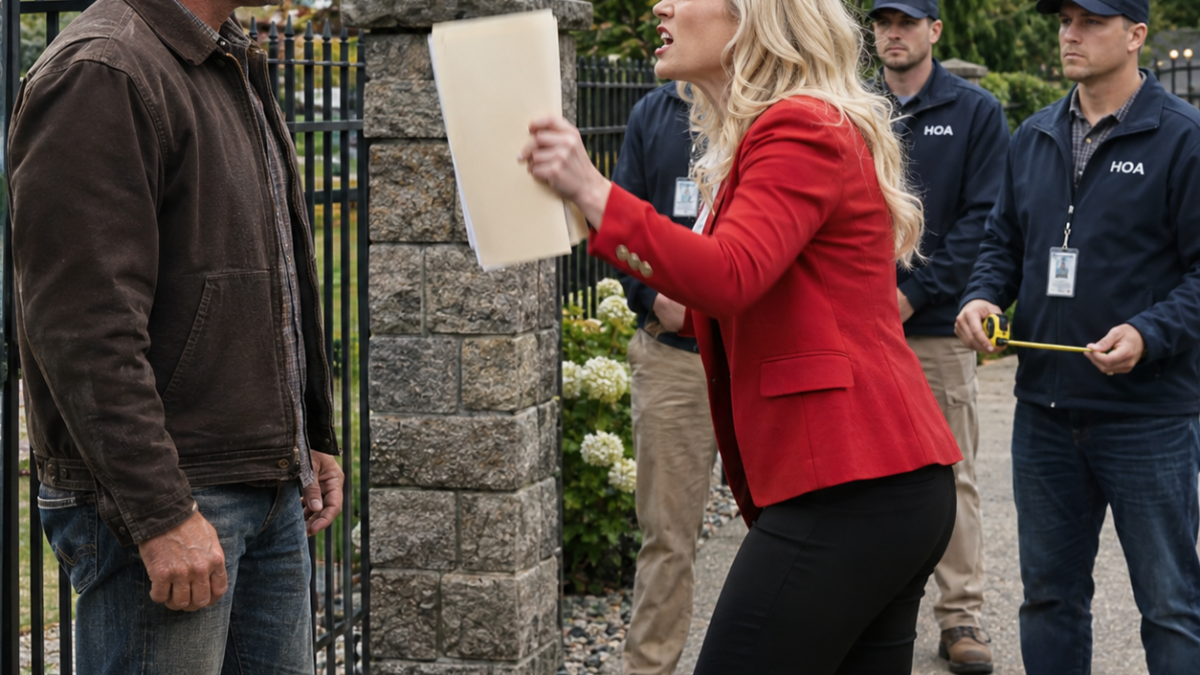
Then, one Monday morning, I walked outside with coffee and saw three strangers measuring my fence.
One had a clipboard.
One had a camera.
The third was tying bright orange flags to my posts.
I stepped off the porch.
“Can I help you gentlemen?”
The youngest looked uncomfortable.
“We’re with Aldercrest Estates, sir.”
“No, you’re standing on Vaughn Farm.”
“We’re conducting a compliance inspection.”
I nearly laughed.
“What exactly am I complying with?”
He handed me a paper.
Across the top:
NOTICE OF NON-COMPLIANCE — RESOLUTION 31F.
Apparently my fence was illegal.
Too tall.
Wrong material.
No architectural approval.
I looked at the steel posts.
PART3:
Same height they had been twenty years ago.
“When did this rule pass?”
“Friday.”
I looked at him.
“Three days ago?”
“Yes, sir.”
“And you’re inspecting my fence Monday morning?”
Nobody answered.
That told me plenty.
By two that afternoon, a black SUV rolled into my driveway.
Lenora stepped out wearing a cream blazer and sunglasses.
She smiled like we were meeting for lunch.
“Garrett.”
“Lenora.”
“I assume you received your notice.”
“I did.”
“Wonderful.”
She pointed toward my fence.
“Forty-five days.”
“For what?”
“To remove that monstrosity.”
“It’s been there twenty years.”
“And now it violates community standards.”
“I’m not in your community.”
“You are adjacent to Aldercrest.”
“That is not the same thing.”
She lowered her sunglasses.
“Refuse, and the penalty is three hundred dollars per day.”
I actually laughed.
“Three hundred?”
“Every day.”
“And if I don’t pay?”
“We pursue collection.”
“On a farm that is not part of your HOA.”
Her smile tightened.
“Our counsel has reviewed the matter.”
“Of course they have.”
“And if necessary, we will pursue a lien.”
That stopped being funny.
Not because I believed she could legally place one.
Because people can create enormous problems with paperwork even when the paperwork is wrong.
Lenora knew that.
I looked past her.
Less than half a mile away stood Aldercrest’s clubhouse.
Around it:
Eight-foot black steel fence.
Solid privacy sections.
Automated vehicle gates.
Pedestrian gates.
Security cameras.
Stone columns.
The association had spent $420,000 installing it the previous year.
I pointed.
“Does Resolution 31F apply to that?”
She followed my hand.
Then laughed.
“Don’t be ridiculous.”
“Why?”
“That is association infrastructure.”
“Does the resolution say association infrastructure is exempt?”
“You really want to play amateur attorney?”
“No.”
I smiled.
“I just want to read your rule.”
She tilted her head.
“I encourage you to read every word.”
Then she got back into her SUV.
That evening, I did.
Twenty-seven pages.
Most were predictable.
Fence finishes.
Gate heights.
Wall setbacks.
Architectural-review requirements.
Definitions.
Enforcement.
Then page two.
Covered structures included:
“Any permanent fence, gate, wall, or perimeter barrier located upon a privately owned lot or association-controlled tract.”
I read it twice.
Association-controlled tract.
The clubhouse property was association-controlled.
No exception.
Maximum fence height under the new rule:
Six feet.
Clubhouse barrier:
Eight.
Permitted materials:
Decorative steel picket, masonry, approved composite.
Large sections of clubhouse barrier:
Solid industrial steel.
Privacy-panel restriction:
Maximum thirty percent opaque area.
Clubhouse wall:
Nearly one hundred percent opaque in several sections.
Automated gate restrictions:
Required setback and architectural approval under 31F.
The HOA gate predated the resolution and had never been resubmitted.
Lenora had written a rule to attack my fence and accidentally written the same rule against the most expensive fence her HOA owned.
I laughed for about thirty seconds.
Then stopped.
Because something still bothered me.
Why?
Why was she willing to create a legal mess over my fence?
The answer came seven days later.
My neighbor Earl Patterson stopped beside my mailbox.
“You hear about Aldercrest’s new entrance?”
“What entrance?”
“They want a second boulevard off State Route 8.”
I frowned.
“Where?”
He pointed directly toward the strip Lenora had tried to buy.
My strip.
One-point-seven acres.
“Stone columns,” Earl said. “Fountains. Landscaping. Supposed to run straight to the clubhouse.”
I walked inside.
Pulled the development map Lenora had shown me during her second purchase offer.
There it was.
Proposed entrance alignment.
Straight through my eastern field.
Straight across the fence she suddenly wanted removed.
That was when the rule stopped looking stupid.
It became useful.
If my fence disappeared, the boundary looked less fixed on the ground.
If any replacement required HOA architectural approval, Lenora controlled the timing.
If she could burden me with daily fines and legal expense, maybe her next purchase offer would become harder to refuse.
I requested board records.
Two hundred pages arrived.
Resolution 31F had passed three to two.
No resident hearing.
No advance mailed notice.
That mattered because Aldercrest’s own bylaws required advance written notice before retroactive architectural restrictions could affect existing structures.
I found no notice.
I filed an appeal.
Lenora scheduled it for Wednesday at eight in the morning.
She sat at the center of a polished mahogany table.
Two board members beside her.
Recording device in front.
“Mr. Vaughn.”
She smiled.
“Ready to cooperate?”
I placed a folder down.
“I’m ready to ask questions.”
I showed her eleven Aldercrest fences that violated 31F.
No notices.
“Why mine?”
“Those properties are under review.”
“Since when?”
“Confidential.”
I opened the resolution.
Read the definition.
Then placed a photograph of the clubhouse barrier on the table.
“Eight feet.”
Lenora rolled her eyes.
“Again?”
“Industrial steel.”
“It’s security infrastructure.”
“Show me the exemption.”
“Mr. Vaughn—”
“Solid panels.”
One board member started turning pages.
I continued.
“Automated gates.”
Silence.
“The clubhouse sits on association-controlled land?”
“Yes.”
“Fence is a permanent perimeter barrier?”
“Yes, but—”
“Does Resolution 31F apply equally to every covered tract?”
Lenora slapped the table.
“THE RULE APPLIES TO EVERY PROPERTY UNDER OUR AUTHORITY. NO EXCEPTIONS.”
I stopped.
Looked at the recorder.
Then at her.
“Thank you.”
Her expression changed.
“For what?”
“For clarifying.”
I collected my papers.
Outside, I sat in my truck and replayed the recording.
Clear as church bells.
No exceptions.
But I knew contradiction alone would not stop her.
She could call an emergency meeting.
Amend 31F.
Create a clubhouse exemption.
Pretend she had meant one all along.
So I started researching the barrier itself.
County plats.
Original Aldercrest subdivision documents.
Land transfers.
Development maps.
Thirty-year-old filings.
By late afternoon, I had three maps across my kitchen table.
The clubhouse fence sat close to an old access route that predated Aldercrest.
On the glossy modern HOA map, the area appeared to be ordinary clubhouse property.
On the original plat, it did not.
A narrow strip ran from Old Mill Road behind the clubhouse toward what used to be county-maintained land.
I called my attorney, Carl Benton.
“Carl, I need you to look at something.”
Twenty minutes after I emailed the documents, he called back.
His voice had changed.
“Where did you find this plat?”
“County records.”
“Does Lenora know about it?”
“Not from me.”
“Good.”
“What is it?”
“Maybe nothing.”
“You don’t sound like nothing.”
“I need the original dedication.”
“For what?”
“Garrett, do not confront Lenora.”
“I wasn’t planning to.”
“I mean it.”
“Carl.”
Pause.
“If the original dedication language says what I think it says, Aldercrest may not have had the right to block that strip.”
I looked toward the clubhouse.
Black security wall.
Automated gate.
Cameras.
$420,000.
“What happens if you’re right?”
Carl answered:
“Then your fence may be the least important fence in this dispute.”
The original dedication arrived the next morning.
Recorded twenty-nine years earlier.
The land that later became Aldercrest had once belonged to Havenbrook Development Company.
Before subdivision approval, the county required a secondary emergency-access corridor.
Thirty feet wide.
Running from Old Mill Road through what later became the clubhouse tract.
The dedication language was simple:
“Perpetual nonexclusive access corridor reserved for emergency, public-safety, utility, and municipal-service purposes. No permanent structure, gate, wall, landscaping feature, or obstruction shall prevent continuous access without formal vacation by county authority.”
I read it twice.
Then:
“Carl.”
“I know.”
“Did the county ever vacate it?”
“Searching.”
Two hours later:
No.
No abandonment.
No vacation resolution.
No relocation.
Nothing.
The corridor still existed.
And Aldercrest had built part of its $420,000 security barrier directly across it.
Not just fence.
A solid steel panel section.
Landscaped berm.
Stone monument.
Camera pole.
When I drove by after lunch, I finally understood what I was looking at.
The old access corridor had effectively disappeared inside Aldercrest’s security design.
Unless you had the original plat, you would never know it existed.
I called Carl.
“They buried it.”
“Visually.”
“Can they do that?”
“Not without county action.”
“Maybe they got approval under another file.”
“Maybe.”
“Do you believe that?”
“No.”
Neither did I.
We requested the clubhouse security permit.
Approved eighteen months earlier.
Applicant:
Aldercrest Estates HOA.
Authorized representative:
Lenora Vance.
Project cost:
$420,000.
Site plan attached.
I put the permit drawing beside the old plat.
The access corridor was missing.
Not shifted.
Not labeled abandoned.
Gone.
The permit plan showed ordinary association property where the recorded corridor should have been.
Carl said:
“That concerns me.”
“Because?”
“People make mistakes. But survey bases generally don’t make thirty-foot recorded access corridors vanish by accident.”
The plan had been prepared by Barlow Civil Design.
I called them.
A project engineer named Sophie Dray answered.
I explained who I was.
Asked whether their original files showed the emergency corridor.
Long silence.
Then:
“I need to call you back.”
She did.
Forty minutes later.
“Our base survey does show it.”
“Your permit set doesn’t.”
“I know.”
“Why?”
“I’m looking at revision history.”
Another silence.
“Mr. Vaughn, I think you should speak through counsel.”
That told me plenty too.
Carl contacted Barlow formally.
They preserved files.
Revision history showed an original site plan labeled the thirty-foot corridor.
Then a later PDF version, issued after a client review meeting, removed the notation.
A comment bubble in the archived project file read:
“CLIENT STATES ACCESS EASEMENT ABANDONED — DO NOT SHOW ON FINAL SITE EXHIBITS.”
Client contact:
L. Vance.
I sat back.
“Lenora told them it was abandoned.”
Carl nodded.
“She represented that.”
“Did anyone verify?”
“Apparently not.”
“Does that make the engineer innocent?”
“Not my decision.”
“What did Lenora use as proof?”
“That’s the interesting part.”
There was no vacation document.
Instead, she had provided a letter on Aldercrest letterhead stating:
“Legacy emergency corridor superseded by modern internal road system and no longer operative.”
Signed:
Lenora Vance, HOA Chairwoman.
I stared.
“She declared it gone herself?”
“She represented it as no longer operative.”
“That sounds like lawyer language for declared it gone herself.”
Carl smiled.
“Close enough.”
I asked the county fire marshal to review the recorded corridor.
His name was Owen Sharpe.
He arrived two days later.
Walked the route.
Measured.
Looked at the steel wall.
Then at me.
“Why am I here?”
I handed him the plat.
He read.
Looked back at the barrier.
Then:
“Oh.”
That was not the reaction Aldercrest wanted from the fire marshal.
He called county planning.
Planning called engineering.
Engineering pulled subdivision approvals.
By four that afternoon, Aldercrest received a formal notice requiring immediate review of an obstruction across a recorded emergency-access corridor.
Lenora called me at 4:17.
I answered.
“Garrett.”
Her voice had lost its cheerful tone.
“What have you done?”
“Read the plat.”
“You reported the clubhouse?”
“I asked the county to verify a recorded access corridor.”
“You are retaliating.”
“No.”
“You’re threatening a four-hundred-twenty-thousand-dollar security installation because of your fence.”
“Lenora.”
“What?”
“You threatened me with three hundred dollars a day because of my fence.”
Silence.
Then:
“This is different.”
“Why?”
“Our barrier protects hundreds of residents.”
“My fence protects my farm.”
“Our security system was professionally designed.”
“So was the plat.”
“You have no idea what you’re interfering with.”
That sentence caught my attention.
“What am I interfering with?”
She stopped.
Then:
“Goodbye, Garrett.”
Click.
I called Carl.
“She said something strange.”
“What?”
“You have no idea what you’re interfering with.”
“Maybe anger.”
“Maybe.”
But I had learned not to ignore phrases that felt too specific.
The next clue came from the entrance project.
Aldercrest residents began sending me board packets.
Lenora had spent months promoting what she called the Grand Western Arrival.
Two landscaped lanes.
Stone gateway.
Reflecting pool.
Decorative bridge.
Direct access from State Route 8.
Estimated cost:
$3.6 million.
The project required my 1.7 acres.
Why?
According to the traffic study, Aldercrest lacked adequate secondary access for increasing resident and clubhouse traffic.
I read that sentence three times.
Lacked adequate secondary access.
Except a recorded thirty-foot emergency/public-service corridor already existed.
On HOA land.
And Aldercrest itself had blocked it.
I called the transportation consultant.
“Did the HOA tell you about the Old Mill emergency corridor?”
“What corridor?”
Exactly.
The consultant’s study said:
“Existing site conditions provide no viable western emergency or secondary-access connection within association-controlled property.”
False.
Very false.
That conclusion justified pursuing a new western entrance across my farm.
I sent the old plat.
Consultant called back.
“This changes the analysis.”
“How much?”
“The entire secondary-access section.”
I asked:
“Who provided your property information?”
“Aldercrest.”
“Specifically?”
“Chairwoman’s office.”
Of course.
Then I found the financing.
The $3.6 million entrance was not being paid from reserves.
Aldercrest had applied for a $4.2 million infrastructure loan.
Western entrance.
Clubhouse road upgrades.
Gate redesign.
Landscape improvements.
Traffic modernization.
Loan package included the consultant study.
And a board certification signed by Lenora:
“No practical secondary access exists across current association-owned property.”
I sat at my kitchen table.
Read it again.
She had blocked an existing access corridor.
Removed it from the security-wall site plan.
Then told a lender the HOA had no secondary access on its own land.
Then used that absence to justify a multimillion-dollar project requiring my farm.
That was no longer a fence argument.
It was a manufactured problem.
Carl said:
“Careful.”
“I’m careful.”
“You’re angry.”
“Also true.”
“Do not call her.”
“I won’t.”
“Do not accuse her publicly of bank fraud.”
“I wasn’t going to.”
“You were thinking it.”
“Yes.”
“Stop thinking where I can hear it.”
The county scheduled a compliance hearing on Aldercrest’s security barrier.
Lenora responded by calling an emergency board meeting.
Three days before that meeting, I received another violation notice.
Resolution 31F.
Daily fines scheduled to begin after my forty-five-day period expired.
I forwarded it to Carl.
He answered:
“Good.”
I called.
“Good?”
“Selective enforcement.”
“She’s escalating.”
“Yes.”
“You sound happy.”
“I like evidence with dates.”
At the board meeting, Lenora packed the room.
Residents.
Security committee.
Property manager.
Counsel.
I sat in the back with Carl.
She opened with a presentation about threats to neighborhood security.
Then showed a photograph of my farm fence.
I almost admired the audacity.
She said:
“A noncompliant neighboring barrier has complicated our western-access planning and created uncertainty around the association’s long-term entrance strategy.”
I looked at Carl.
He whispered:
“She just connected the two.”
“On record?”
“On record.”
Lenora continued.
“The board has attempted repeatedly to resolve Mr. Vaughn’s obstruction voluntarily.”
I raised my hand.
She ignored me.
I kept it up.
Residents started looking.
Finally:
“Mr. Vaughn.”
“You offered to buy my land.”
“This is not the forum.”
“Twice.”
“Your point?”
“I refused.”
“Yes.”
“Then you passed a fence rule three days before inspecting only my fence.”
Murmurs.
Lenora said:
“Resolution 31F applies community-wide.”
“Does it apply to the clubhouse?”
Her jaw tightened.
“We’ve discussed this.”
“Your recorded answer was yes.”
Carl placed a transcript on the table.
Lenora’s attorney reached for it.
Then I said:
“And apparently the county agrees.”
That changed the room.
Lenora went still.
Board member Marcus Doyle turned.
“What does that mean?”
I looked at him.
“There is a recorded thirty-foot emergency-access corridor beneath part of your security barrier.”
Silence.
Lenora spoke quickly.
“It’s obsolete.”
Marcus looked at her.
“Was it legally vacated?”
“It was superseded.”
“That wasn’t my question.”
Good question.
Another board member, Cynthia Bell, asked:
“Why wasn’t it on the security-fence permit?”
Lenora looked toward counsel.
Counsel looked at her.
That was interesting.
“The engineering consultant prepared the plans.”
Carl said quietly:
“After receiving written direction from the chairwoman’s office that the corridor was abandoned.”
The room erupted.
Lenora’s face changed.
“Who gave you confidential project records?”
Carl answered:
“Records were produced through the county review process.”
“Those are privileged.”
“Engineering site plans submitted for permitting are not automatically privileged because they are inconvenient.”
Several people laughed.
Lenora slapped the table.
“This is exactly why outside property owners should not interfere in association business.”
I stood.
“You sent inspectors onto my farm.”
Silence.
“You threatened $300 daily fines.”
More silence.
“You threatened a lien.”
I looked around.
“I didn’t join your business. You brought it to my gate.”
That line ended up in three neighborhood Facebook groups by midnight.
I wish it hadn’t.
I hated becoming content.
The board did something Lenora had not expected.
They tabled enforcement of Resolution 31F.
All enforcement.
Not only mine.
Pending legal review.
Then Marcus Doyle made a second motion.
Independent review of the western entrance project.
Passed three to two.
Lenora voted no.
One week later, the county fire marshal issued his determination.
Aldercrest’s barrier unlawfully obstructed the recorded emergency corridor.
The HOA had options.
Remove the obstruction.
Modify the barrier with an approved emergency gate.
Or petition the county to formally vacate or relocate the corridor, which would require technical review and could be denied if emergency access remained necessary.
The cheapest solution was a gate.
Not an ordinary gate.
A compliant, fail-safe emergency-access assembly integrated into their existing security system.
Estimate:
$86,000 to $130,000.
Lenora called that outrageous.
I found that interesting from someone who had threatened me with $109,500 a year in fence fines.
But the barrier was only beginning.
Independent counsel reviewed 31F.
Their conclusion:
Aldercrest had no covenant authority over Vaughn Farm.
None.
My property was never annexed.
Never subjected to the declaration.
Never voluntarily accepted architectural control.
The notice against me was invalid.
The fine threat was invalid.
The lien threat, if carried out, would likely expose the association to serious liability.
The eleven Aldercrest owners whose fences violated 31F were a separate issue.
And because Lenora had stated on the record that the rule applied without exception to all association-controlled property, the clubhouse barrier itself remained covered unless the rule was amended properly.
Residents loved that part.
The board did not.
They suspended Resolution 31F entirely.
My fence stayed.
Then the lender called.
Not me.
Aldercrest.
Infrastructure loan underwriting had discovered the independent access review.
The lender froze approval.
Reason:
Material inconsistency in transportation and property-access representations.
Lenora said the problem was temporary.
It wasn’t.
The transportation consultant withdrew the statement that no secondary association-controlled access existed.
His amended report said:
“A recorded emergency/service corridor exists across the clubhouse tract and was omitted from prior materials supplied by the client.”
That sentence was devastating.
Because the new entrance was financially justified in part as necessary to solve a problem Aldercrest had created by blocking its own corridor.
The $4.2 million financing package had to be resubmitted.
Then independent board counsel found another document.
Five years earlier.
Before Lenora became chairwoman.
Aldercrest commissioned a reserve and emergency-access study.
Recommendation number four:
“Maintain Old Mill emergency corridor free of permanent obstruction for fire and municipal access.”
Cost:
Minimal.
Lenora had received that study when she joined the board.
Her initials appeared on the distribution acknowledgment.
Carl showed me.
“She knew the corridor existed.”
“Five years ago.”
“Yes.”
“And later told the fence engineer it was abandoned.”
“Yes.”
“And told the traffic consultant no secondary route existed.”
“Yes.”
“And told the bank the same thing.”
Carl raised one finger.
“Again. We state facts. Prosecutors and regulators choose adjectives.”
“I know.”
“You keep making the face.”
“What face?”
“The felony face.”
“I don’t have one.”
“You do.”
The HOA treasurer resigned first.
Not because he was accused of wrongdoing.
He said he had approved too many expenses based on summaries from Lenora’s office and no longer trusted the process.
Then the property manager turned over emails.
That was when we learned why Lenora wanted my 1.7 acres so badly.
Not just traffic.
Not just a prettier entrance.
Aldercrest’s clubhouse property had an expansion problem.
Lenora wanted to convert part of the clubhouse complex into an event center.
Weddings.
Corporate retreats.
Holiday galas.
Private rentals.
Projected annual revenue:
$680,000.
But county conditions required two reliable access routes for the increased event occupancy.
The Old Mill corridor could satisfy emergency access if restored.
But it was narrow.
Functional.
Not glamorous.
It reached an older road lined with utility structures and a municipal maintenance yard.
Guests would never enter there.
Lenora wanted a grand entrance.
Fountains.
Stone walls.
Landscaping.
Something that made Aldercrest look like a resort.
My land was in the way.
Internal email:
LENORA VANCE TO ARCHITECT:
Vaughn strip is the only alignment that creates the arrival sequence we need. Do not design around Old Mill. Old Mill undermines the premium positioning.
Another:
LENORA TO PROPERTY MANAGER:
Once the farm barrier is removed, we can reopen negotiations from a stronger position. He is sentimental about that fence. Compliance pressure may help separate emotion from economics.
I read that one twice.
“Compliance pressure.”
Carl nodded.
“She wrote the motive herself.”
“She passed 31F to pressure me into selling.”
“That appears to be a reasonable inference.”
“The old fence was leverage.”
“Yes.”
“My father built that fence.”
Carl looked at me.
“I know.”
That was when I became angrier than I had been during the $300-a-day threat.
Lenora had understood exactly what the fence meant to me.
Then deliberately turned that attachment into pressure.
Not aesthetics.
Not safety.
Leverage.
The board called another emergency meeting.
This one had standing room only.
Lenora arrived with a private attorney.
Aldercrest’s association counsel sat separately.
That told everybody something.
Marcus Doyle chaired.
Lenora objected.
He overruled her.
Independent counsel presented the timeline.
Old Mill corridor recorded.
No vacation.
Emergency study recommending preservation.
Security-wall permit omitting corridor after Lenora’s representation.
Traffic report prepared without corridor information.
Loan application stating no practical association-controlled secondary access.
Resolution 31F.
Inspection of my farm three days later.
Emails referencing “compliance pressure.”
Western entrance dependent on my 1.7 acres.
Then Marcus asked Lenora:
“Did you intentionally use Resolution 31F to pressure Garrett Vaughn into selling property?”
Her lawyer answered.
“My client will not respond to questions involving potential civil claims.”
The room exploded.
Residents understood what that meant emotionally even if it meant nothing legally.
Marcus waited.
Then:
“Did you know the Old Mill corridor existed when you certified the loan package?”
Same answer.
“Did you instruct Barlow Civil to remove it from the permit exhibit?”
Same answer.
Cynthia Bell made the motion.
Remove Lenora Vance as chairwoman.
Board vote:
Four to one.
Lenora voted against.
Residents laughed.
She left through the same automated security gate that was now subject to county correction.
That part felt almost too neat.
Real consequences took longer.
A forensic review followed.
Not because of me.
Because once lenders and insurers discover one material representation problem, they start checking everything.
The $420,000 security project had cost overruns.
$63,000 in change orders.
Two change orders approved without full-board vote.
One vendor had previously done private landscaping work at Lenora’s home.
Not automatically illegal.
Worth reviewing.
The entrance-design contract went to a firm whose managing partner was a longtime business associate of Lenora’s husband.
Again:
Not automatically fraud.
But disclosure requirements existed.
Disclosure had not happened.
The HOA insurer opened a governance review.
The lender demanded updated certifications.
County planning suspended consideration of the event-center expansion.
And Resolution 31F disappeared.
Formally repealed.
One resident asked whether I wanted reimbursement for legal fees.
I did.
Aldercrest’s insurer ultimately covered most of them.
The HOA sent me a written withdrawal:
All notices issued to Garrett Vaughn regarding Resolution 31F are void and rescinded. Aldercrest Estates asserts no architectural-control jurisdiction over Vaughn Farm.
I framed that.
Not in my living room.
I’m not insane.
It hangs in the farm office beside the tax map.
Then came the security wall.
The county did not order Aldercrest to tear down all $420,000 worth.
That would have been unnecessary.
Stories people told later said I “forced the HOA to demolish its fence.”
Not true.
Reality was more satisfying.
They had to modify it.
The solid section across Old Mill corridor came out.
Stone monument partially rebuilt.
Berm cut back.
A twenty-four-foot emergency gate installed.
Fire-department override.
Knox access.
Fail-safe opening.
Signs.
Annual inspection.
Total cost:
$118,600.
Plus engineering.
Plus legal.
Plus permit corrections.
When workers cut the opening, Earl Patterson parked his truck beside my field and watched.
“You should sell tickets.”
“No.”
“Popcorn?”
“No.”
“Commemorative T-shirts?”
“Earl.”
He smiled.
“Rules are rules.”
I laughed despite myself.
The best part came two months later.
The fire department tested the corridor.
Gate opened.
Engine came through.
Old Mill Road connected exactly as the original plat intended.
No problem.
No drama.
No need for my farm.
The transportation consultant updated the access analysis.
For emergency requirements, Aldercrest already had a functional secondary route once it stopped blocking it.
The proposed grand western entrance became optional.
Not required.
Optional projects are much harder to finance when they cost millions and require purchasing farmland from someone who has no intention of selling.
Aldercrest withdrew its offer.
I did not sell the 1.7 acres.
The field stayed.
The fence stayed.
The cattle remained unimpressed by the entire affair.
Lenora fought her removal.
Claimed political retaliation.
Claimed selective document interpretation.
Claimed the access corridor had become obsolete through nonuse.
County counsel disagreed.
Her private attorney argued historical-use issues.
Nothing restored her chairmanship.
She sold her house nine months later.
I learned from Earl.
Of course.
Earl knows everything within six miles and half of what happens outside that radius.
“Moving truck’s there.”
“Good for her.”
“You want to wave?”
“No.”
“You’re no fun.”
“I’m farming.”
“You’re drinking coffee.”
“That’s agricultural administration.”
After Lenora left, Aldercrest elected Marcus Doyle president.
First thing he did was call me.
“Garrett.”
“Marcus.”
“I’d like to reset the relationship.”
“You’re not getting the 1.7 acres.”
He laughed.
“I expected that.”
“Then continue.”
“We need to talk about fence maintenance near the shared boundary.”
“My fence?”
“Yes.”
“What about it?”
“Nothing.”
I waited.
“We want to pay half the vegetation clearing on our side so vines don’t damage it.”
I looked at the phone.
“Who are you and what have you done with the HOA?”
He laughed.
“We’re trying something radical.”
“What?”
“Staying on our property.”
“Bold.”
It worked.
Over time, Aldercrest became what it should have been from the beginning.
A neighbor.
Not an authority over me.
Their residents walked the trails.
Used the clubhouse.
Complained about dues.
Argued over pool hours.
Normal HOA problems.
My farm remained outside.
I repaired the eastern fence the following spring.
Several lower panels needed work.
I replaced three posts.
One was part of the section my father and I installed together.
I almost left it.
Sentimental.
Rot had started at the base.
Steel lasts a long time.
Not forever.
I pulled it out.
The concrete footing came up with red clay attached.
I stood there longer than necessary.
Then installed a new post in the exact same spot.
Earl watched from his tractor.
“Thought you’d never replace that one.”
“Needed it.”
“Your dad would approve.”
“He’d complain I used too much concrete.”
“That too.”
The new post looked different.
Cleaner.
No rust.
But the line remained.
That mattered more.
One year after the dispute, the county asked me to attend a landowner workshop.
I said no.
They asked again.
I still said no.
Then Carl volunteered me.
I called him.
“I hate you.”
“You’re welcome.”
The workshop was about rural land adjacent to planned communities.
Surveys.
Recorded access.
Drainage.
Easements.
Boundary enforcement.
HOA expansion.
The county planner asked me to explain what I learned.
I stood in front of thirty property owners.
Said:
“Keep your documents.”
That was my presentation.
The planner looked at me.
“Could you expand?”
“Fine.”
I held up a copy of the old Aldercrest plat.
“Keep old documents too.”
People laughed.
Then I told them what mattered.
Do not assume a fence line proves title.
Do not assume a glossy development map includes every recorded right.
Do not assume a board resolution reaches property outside the declaration.
Do not ignore certified notices.
Document selective enforcement.
And never accept the phrase “everyone knows” when a recorded document can answer the question.
Afterward, an older farmer approached.
“My subdivision neighbor wants to widen a drainage easement.”
“Get your deed.”
“They say it’s standard.”
“Get your deed.”
“They say their attorney reviewed it.”
“Get your attorney.”
He smiled.
“I see the theme.”
Good.
Years passed.
The black security barrier remained around Aldercrest.
Except now, if you drive along Old Mill Road, you can see the emergency gate.
Twenty-four feet wide.
Bright access signage.
Every year, the fire department tests it.
Every year, it opens.
Aldercrest residents probably barely notice.
That is what good infrastructure becomes.
Boring.
Reliable.
Forgotten.
The grand western entrance never happened.
Instead, Aldercrest upgraded the existing main entrance for less than half the projected cost.
No fountains.
No reflecting pool.
Still looked nice.
Property values did not collapse.
Residents did not flee because they lacked a ceremonial boulevard across my farm.
The clubhouse event center was scaled back.
The old corridor handled emergency access.
Everyone survived.
That was perhaps the funniest part.
Lenora had created a crisis around something nobody actually needed.
My fence did not threaten Aldercrest.
My farm did not threaten property values.
The old emergency corridor did not threaten security once properly gated.
The only thing standing in the way of her plan was the fact that my land belonged to me.
She treated that as a design problem.
That was her mistake.
I still have Resolution 31F.
First page.
Original notice.
Three-hundred-dollar daily fine threat.
I keep it in a folder marked:
ALDERCREST — VANCE.
Behind it is the photograph of their $420,000 barrier.
Behind that:
Old plat.
Emergency dedication.
Permit revision.
Transportation report.
Email about “compliance pressure.”
And the final letter withdrawing every claim against my farm.
The documents tell a story Lenora never intended to create.
Start:
“Tear down your fence.”
End:
“We acknowledge we have no authority over your fence.”
There are worse ways to spend a year.
Not cheaper.
But worse.
Sometimes people ask whether I regret not selling the 1.7 acres when Aldercrest first offered.
No.
The money would have been useful.
Farm money is always useful.
Equipment breaks with extraordinary creativity.
Diesel prices do what they want.
Property taxes never become sentimental.
Still no.
My father built that fence because he believed boundaries were not hostile.
They were clarity.
You stay there.
I stay here.
We cooperate where cooperation makes sense.
Neither person needs to control the other.
Lenora saw a boundary as an obstacle.
That is why every solution she created required weakening one.
Remove Garrett’s fence.
Erase the old corridor.
Hide it from the permit plan.
Pretend it does not exist in the traffic study.
Pressure him to sell.
Build the new entrance.
Once you look at the whole sequence, it is almost elegant.
Wrong.
But elegant.
One removed line created the argument for another removed line.
Except records survived.
The thirty-year-old plat survived.
The dedication survived.
The board study survived.
Her emails survived.
My fence survived too.
One fall morning, almost ten years later, I was drinking coffee on the porch when a truck stopped by the gate.
Young man.
Clipboard.
For one second, I had an unpleasant memory.
Then he waved.
“Mr. Vaughn?”
“Yes.”
“County survey crew.”
“What for?”
“Routine monument verification along Old Mill.”
I smiled.
“Come on in.”
He paused.
“You sure?”
“Yes.”
Then I pointed toward the farm road.
“But stay on this side of the fence.”
He laughed.
I did too.
The steel line ran east across the pasture exactly where my father and I had put it.
Some original posts.
Some replacements.
No orange compliance flags.
No HOA notices.
Just fence.
Across the distance, Aldercrest’s black security barrier caught the morning sun.
And in the middle of it, the emergency gate sat exactly where the old plat said access had to remain.
Lenora had once told me:
“Rules are rules.”
She was right.
She just never expected anyone to read all of them.








