HOA Bulldozed My Private Road Overnight and Billed Me $85,940—Then 600 Homeowners Learned I Owned Their Only Exit
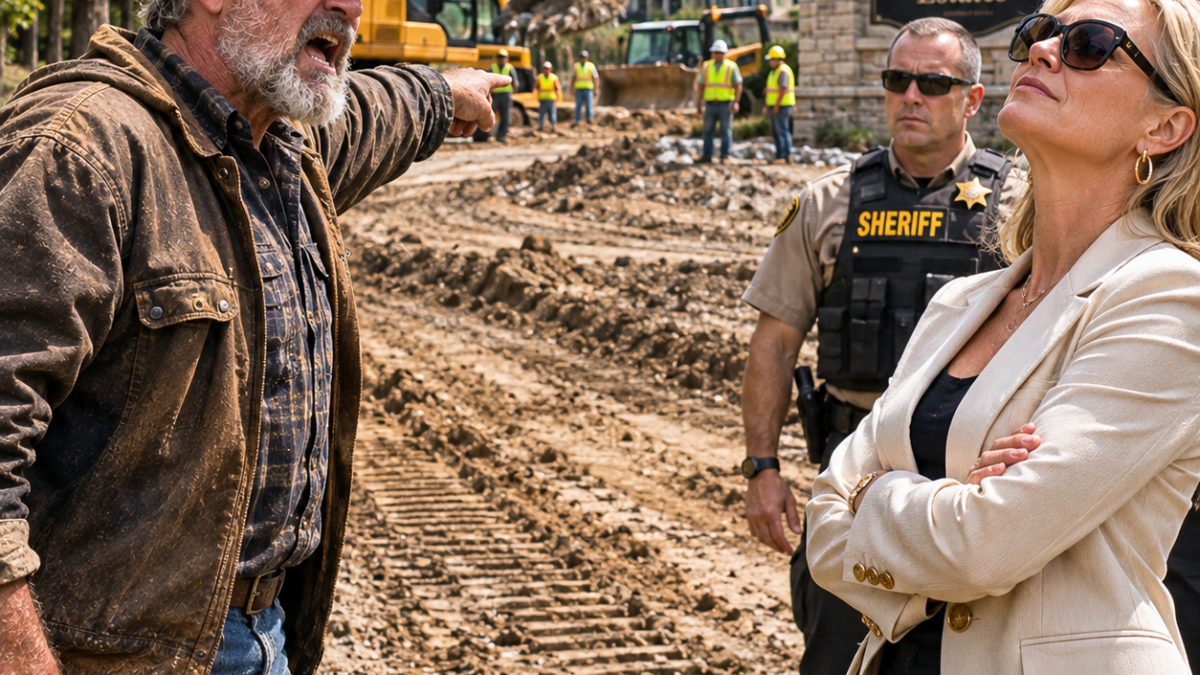
PART2:
But the one thing none of us ever changed was Elliott Lane.
It ran along the southern edge of the land for roughly a quarter mile.
Gravel.
Packed dirt.
Oak roots pushing through in places.
Too narrow for two large trucks to pass comfortably.
Perfectly adequate for a tractor, pickup, or anyone who actually belonged there.
Granddad used it to access the back pasture.
My father used it to haul firewood.
I used it mostly when I wanted to avoid the main driveway or get to the old equipment shed.
It connected our acreage to a county road, but it was not a county road.
That distinction would eventually become worth millions of dollars.
At 6:08 that morning, I didn’t care about millions.
I cared about the tree that had just fallen.
I shoved my feet into work boots without socks, pulled on a jacket, and ran out the back door.
The noise was coming from the southern boundary.
I cut through the trees.
Branches slapped my face.
Mud kicked up behind my boots.
Another backup alarm.
Then I heard metal twisting.
I broke through the tree line.
And stopped.
For several seconds, my brain simply refused to process what I was seeing.
Elliott Lane was gone.
Not damaged.
Gone.
Three yellow bulldozers were cutting through it.
An excavator had ripped out the drainage ditch.
Dump trucks were lining up to drop crushed stone.
Men in reflective vests were carrying surveying poles.
A grader moved through the middle of the property like it had every legal right in the world to be there.
But what I saw next made everything else disappear.
A hundred-year-old white oak lay across the ground.
Granddad called it the climbing tree.
I had a scar on my right knee from falling out of it when I was nine.
My father had carved my initials into one of the lower branches.
Underneath that tree was blue steel.
Crushed blue steel.
I started walking toward it.
Then running.
“No.”
The roof had collapsed.
The windshield was gone.
The hood folded.
The bed twisted.
My grandfather’s 1968 Ford F-100 was barely recognizable.
He bought that truck used in 1972.
Drove it until my father inherited it.
My father kept it another twenty years.
When Granddad died, the truck came to me.
For three years I had been restoring it.
Engine rebuilt.
Transmission rebuilt.
Original color matched.
Seats reupholstered.
Chrome polished.
I had spent hundreds of hours on that truck.
It was not worth a fortune.
That wasn’t why it mattered.
The steering wheel still had a worn patch where Granddad rested his left hand.
There was a dent inside the tailgate from the time my father dropped a hydraulic jack.
There were things money does not repair because money never created them.
The tree had crushed it almost flat.
“HEY!”
My voice came out raw.
An equipment operator looked over.
“SHUT IT DOWN!”
The grader kept moving.
I ran directly into its path.
The operator hit the brakes.
A foreman stepped down from an excavator.
Big man.
Gray beard.
Neon-yellow vest.
Hard hat marked HOLLIS PAVING & CONSTRUCTION.
He walked toward me with the tired irritation of someone dealing with a homeowner complaining about dust.
“You need to move.”
I pointed at the truck.
“You need to shut every machine off.”
“We’re working.”
“You’re working on my property.”
He sighed.
“Sir—”
“My property.”
He took a cigarette from his pocket.
“Take it up with Oak Creek.”
I stared.
“What?”
“Oak Creek Estates.”
My anger sharpened.
Three years earlier, a corporate developer called Hanover Residential had bought most of the farms surrounding my land.
Within eighteen months, fields became Oak Creek Estates.
Six hundred homes.
Luxury subdivision.
Stone entrance.
Artificial lake.
Clubhouse.
Pool.
Tennis courts.
Little ornamental trees supported by stakes.
The marketing language called it “an exclusive master-planned community blending modern convenience with natural Georgia beauty.”
They had removed most of the natural Georgia beauty to build it.
But I had stayed out of their way.
They mostly stayed out of mine.
Until that morning.
“The HOA hired you?”
The foreman nodded.
“South access project.”
“There is no south access project.”
He pointed toward Elliott Lane.
“There is now.”
I stepped closer.
“That is a private farm road.”
“Work order says HOA right-of-way.”
“Who signed it?”
He pulled a folded sheet from a plastic pouch.
“Briley Rivera.”
Of course.
I knew the name.
Everybody near Oak Creek did.
Briley Rivera was HOA president.
Early forties.
Former real-estate agent.
Current full-time neighborhood monarch.
She had once sent me a letter asking whether I would “voluntarily landscape” the trees along my property boundary because homeowners paid premium prices for views.
I replied that the trees were already landscaping.
She sent another letter.
I ignored it.
The foreman lit his cigarette.
“Look, man, I’m not here to fight with you. We have permits.”
“No, you don’t.”
“You want to see them?”
“Yes.”
He handed me copies.
I saw the problem almost immediately.
There was an easement map.
My parcel number.
A proposed road corridor.
County stamps.
Survey markings.
It looked official.
Very official.
Too official for a construction foreman to question.
But I knew that drawing.
Granddad had shown it to me years earlier.
Hanover Residential had approached him when Oak Creek was still being planned.
They wanted Elliott Lane.
They offered $80,000 for a permanent access easement.
Granddad refused.
They offered $140,000.
He refused.
They offered $250,000.
He told them to stop calling.
The developer then submitted a proposed easement plat to the county during preliminary planning.
Proposed.
Not executed.
Not granted.
No signature.
No recorded easement.
I held the paper.
“This was never approved.”
The foreman shrugged.
“I’m telling you what we were given.”
“Who gave you authorization to cut trees?”
“HOA.”
“To destroy my truck?”
“It was inside the work zone.”
My vision narrowed.
“That truck was under a private carport.”
“Sir—”
“You tore down the carport.”
He looked uncomfortable.
That told me he knew.
I pulled out my phone.
“I’m calling the sheriff.”
“Go ahead.”
I did.
While waiting, I walked the damage.
Fifteen mature trees already down.
Drainage trench destroyed.
One section of fencing flattened.
My truck crushed.
Roughly four hundred feet of road excavated.
And machines still idling on my land.
I ordered them off again.
The foreman refused.
“We stop without written direction, my company eats the delay cost.”
“You’re going to eat something much larger if you continue.”
He looked at me.
“You threatening me?”
“No.”
I pointed toward the destroyed truck.
“I’m explaining the value of evidence.”
Twenty minutes later, a sheriff’s deputy arrived.
Young guy.
Maybe twenty-eight.
Deputy Collins.
He listened.
Looked at the maps.
Looked at the equipment.
Looked at me.
Then a white Range Rover came down the half-destroyed lane.
Briley Rivera stepped out.
She wore white tennis clothes under a quilted vest despite the cold.
Designer sunglasses.
Hair perfect.
Leather binder tucked beneath one arm.
She walked toward the deputy without acknowledging me.
“Officer, thank goodness.”
Collins turned.
“I assume you’re with the HOA?”
“President.”
She smiled.
“This is simply a misunderstanding.”
I laughed once.
She glanced at me.
“Mr. Elliott is understandably emotional because of construction disruption.”
“Construction disruption?”
I pointed at the truck.
“You destroyed my grandfather’s pickup.”
She looked toward it.
Barely.
“That vehicle was abandoned inside a designated improvement corridor.”
“Abandoned?”
“It was not operable.”
“It was being restored.”
“Then perhaps it shouldn’t have been stored on a public access route.”
I stepped toward her.
Deputy Collins raised one hand.
“Everybody stay calm.”
Briley opened her binder.
“Here.”
She handed him the easement document.
The same proposed plat.
“This grants Oak Creek Estates permanent ingress and egress.”
I said, “No, it doesn’t.”
Collins looked between us.
Briley pointed toward a stamp.
“County-recorded.”
“Proposed plat.”
She ignored me.
“The HOA’s counsel reviewed it.”
“Give me the attorney’s name.”
She looked at me.
“Excuse me?”
“Your lawyer.”
“That is privileged.”
“Convenient.”
Collins held up the paper.
“Mr. Elliott, do you have documentation showing this is private?”
“Yes.”
“At the house?”
“Yes.”
Briley smiled.
“Officer, we cannot have construction shut down every time a neighboring landowner disputes infrastructure.”
“Neighboring landowner?”
I felt my temper slipping.
“This infrastructure is inside my parcel.”
Briley lowered her sunglasses enough to look directly at me.
“Alan, Oak Creek needs a second entrance.”
There it was.
Not right-of-way.
Not legal easement.
Need.
“You should have negotiated.”
“We tried.”
“No.”
She corrected herself.
“The developer tried.”
“And failed.”
“The community situation has changed.”
“My deed hasn’t.”
She gave me the kind of smile people use when they have already decided resistance is childish.
“You’re being unreasonable.”
I looked at Deputy Collins.
“They are actively destroying private property.”
He seemed miserable.
Property disputes are poison to patrol officers.
Too many deeds.
Too many maps.
Too many civil claims.
“I can’t establish title on the roadside.”
“You can establish whether they have permission.”
“She has documents.”
“Forged by omission.”
Briley gasped theatrically.
“Careful.”
I stared at her.
“Is the signature page missing because you forgot to print it, or because it never existed?”
For the first time, something moved behind her sunglasses.
Fear.
Small.
Gone immediately.
Collins exhaled.
“This needs to go through civil court.”
I could not believe it.
“They cut down my trees.”
“I understand.”
“They destroyed a truck.”
“You can document damages.”
“They are trespassing right now.”
“And they’re claiming an easement.”
“Which I’m telling you is false.”
“Then you need a judge.”
He handed the paperwork back.
“I’m not comfortable arresting contractors when they have facially valid documents and a contract.”
Briley almost smiled.
That was when I knew she had counted on exactly this.
Confusion.
Speed.
Paper that looked official.
Build first.
Litigate later.
By the time anybody stopped her, the road would exist.
Collins left.
I stood watching the cruiser disappear.
Briley stepped closer.
Her perfume smelled like jasmine.
I remember that because I hated the smell for years afterward.
“Don’t embarrass yourself,” she said quietly.
“What?”
“Six hundred families need this road.”
“You should have thought about that before building six hundred houses with one exit.”
Her face hardened.
“That wasn’t my decision.”
“This isn’t my problem.”
“It is now.”
She leaned closer.
“By Monday, residents will be using this road.”
“No.”
“Yes.”
“No one will drive through my land.”
She smiled.
“You’re going to stop six hundred homeowners?”
“If necessary.”
“Alan.”
Her voice became patronizing.
“This is bigger than you.”
I looked at my crushed truck.
“No.”
Then back at her.
“You just made it exactly my size.”
She walked away.
The machines restarted.
I did something people later criticized me for.
I let them finish.
Not because I agreed.
Not because I gave permission.
Because I understood evidence.
I filmed everything.
Every truck.
Every machine.
Every tree.
Every worker.
Every survey stake.
I emailed the construction company a written trespass notice.
Certified electronic delivery.
I sent Briley and the entire HOA board the same.
I posted NO TRESPASSING notices.
They continued.
That mattered.
For forty-eight hours, I watched them pave my land.
There are few forms of anger colder than watching someone knowingly destroy something you love while telling you they have the right.
Four lanes of asphalt.
Not road-width.
Subdivision-width.
Curbs.
Drainage.
Lighting.
Landscaping beds.
A brick entrance monument.
OAK CREEK ESTATES
SOUTH GATE
Gold lettering.
On my land.
I photographed every brick.
Wednesday night, I barely slept.
I sat beside Granddad’s ruined truck.
The tree had been removed.
The truck remained.
I put my hand on the crushed roof.
I remembered riding beside him when I was eight.
No seatbelt.
Windows down.
He would let me shift.
My grandmother would have killed him if she knew.
“You always know where your line is,” he once told me while showing me the property boundary.
I was maybe twelve.
“What line?”
“Your land.”
“Why?”
“Because everybody eventually meets someone who thinks what’s yours belongs to them more.”
At twelve, I thought he was talking about fences.
At forty-seven, I understood.
Thursday morning, the machines left.
Elliott Lane had become a beautiful four-lane road.
Fresh asphalt.
Striping.
Curbs.
Lights.
Briley had spent roughly $85,000 improving property she did not own.
At 11:20, the mail arrived.
Certified envelope.
Oak Creek Estates HOA.
I almost threw it aside.
Then opened it.
Invoice.
Road improvement assessment:
$85,240.
Debris removal:
Included.
Violation—abandoned vehicle:
$500.
Violation—interference with authorized contractors:
$200.
Administrative fee:
$0.
Total:
$85,940.
At the bottom:
Payment due within fourteen days.
Failure to pay may result in collection action, lien enforcement, and recovery of legal expenses.
Then a note:
Dear Mr. Elliott,
As a courtesy, Oak Creek Estates has completed substantial infrastructure improvements adjacent to and benefiting your property.
Because these improvements materially increase your property value and correct longstanding aesthetic deficiencies, responsibility for associated costs rests with the benefited property owner.
Sincerely,
Briley Rivera
President
I read it.
Then again.
Then started laughing.
Not because it was funny.
Because rage had reached somewhere beyond shouting.
They destroyed my road.
Crushed my grandfather’s truck.
Cut my trees.
Built their gate on my land.
Then billed me.
I called the best property lawyer I knew.
Dash Powell.
His real name was Dashiell, which he hated.
He was fifty-six.
Atlanta litigator.
Specialized in land-use fights, developer disputes, easements, condemnation, and the kind of property cases where everyone arrives convinced a century-old piece of paper makes them king.
I had used him once for a boundary disagreement.
He answered.
“Alan.”
“I need you.”
“How bad?”
“HOA bulldozed my road.”
Silence.
“Your road?”
“Yes.”
“Accident?”
“No.”
“Do they claim an easement?”
“Yes.”
“Do they have one?”
“No.”
Another silence.
Then:
“Come here.”
I arrived forty minutes later.
Photos.
Video.
Deed.
Granddad’s original correspondence with Hanover.
The proposed easement plat.
Invoice.
Dash read silently.
Then removed his glasses.
“She gave this to law enforcement?”
“Yes.”
He tapped the alleged easement.
“This?”
“Yes.”
“She knew it wasn’t signed?”
“I think so.”
Dash smiled.
Not a friendly smile.
The kind that explains why people hire him.
“Oh.”
“What?”
“This is excellent.”
“They destroyed my property.”
“I know.”
“My truck.”
“I know.”
“And you’re smiling.”
“Because they didn’t make a complicated mistake.”
He leaned back.
“They made a simple one repeatedly.”
He pulled up the county recorder database.
Parcel map.
My boundary.
Elliott Lane.
Then the proposed easement.
He enlarged it.
“No execution page.”
“I know.”
“No recorded grant.”
“I know.”
“Developer application denied.”
“I know.”
“HOA isn’t even party to the proposal.”
I stopped.
“What?”
He pointed.
The original applicant was Hanover Residential.
The easement, if executed, would have benefited Hanover’s development parcel.
It never was.
Oak Creek HOA had no direct legal document at all.
Dash looked at me.
“Briley has less than nothing.”
“She has asphalt.”
“Yes.”
He smiled again.
“On your land.”
“I want an injunction.”
“Eventually.”
“I want them stopped.”
“They’re finished.”
“I want that gate torn down.”
“Eventually.”
I stared.
“What are you thinking?”
Dash stood.
“First question: Why?”
“I know why.”
“Traffic.”
“Yes.”
“No.”
He walked to a large county map.
“Six hundred homes. Main gate here.”
Highway 41.
Ravine east.
Creek drainage west.
My property south.
“One legal entrance,” he said.
“Yes.”
“That’s bad planning.”
“Developer got variances.”
Dash sat again.
“Why build this now?”
“Maybe congestion.”
“No.”
He pointed at the calendar.
“October.”
“So?”
“Government construction season.”
He began searching county transportation notices.
Highway work.
Utility notices.
Road closures.
Then stopped.
“Oh.”
“What?”
He turned the monitor.
COUNTY DOT INFRASTRUCTURE REPLACEMENT
HIGHWAY 41 / OAK CREEK BOULEVARD
Project start:
Monday, 4:00 a.m.
Expected duration:
Eight months.
Full vehicular closure at Oak Creek Boulevard during initial utility replacement.
I stared.
Monday.
Four days away.
“The front entrance closes.”
Dash nodded.
“How long has this been public?”
He checked.
“Six months.”
My anger changed shape.
“She knew.”
“Almost certainly.”
“She didn’t tell me.”
“She didn’t need to tell you.”
“She didn’t tell her residents.”
Dash looked at me.
“That’s the interesting question.”
We searched HOA meeting minutes.
Oak Creek had posted summaries online.
Traffic mitigation.
Infrastructure update.
Emergency planning.
Nothing about an eight-month closure.
Then we found an internal board notice accidentally attached to an older PDF.
County required Oak Creek to secure an alternative temporary access route before closure.
The developer had explored three options.
One crossed commercial property.
Too expensive.
One required a bridge.
Impossible on schedule.
Third:
Elliott parcel.
My land.
Dash leaned back.
“Now we know.”
Briley had promised an exit.
Maybe to the board.
Maybe to the residents.
Maybe both.
She had waited until days before closure.
Then simply built one.
“She thought I’d sue.”
“Yes.”
“Court takes months.”
“Yes.”
“And once residents start using it—”
“She argues necessity.”
My stomach tightened.
Dash nodded.
“She creates facts on the ground.”
“Can she?”
“She can try.”
“Would a judge give them an easement?”
“Maybe temporary emergency relief if six hundred homes literally have no usable vehicular exit.”
I stood.
“So she wins by trespassing fast enough.”
“No.”
Dash’s eyes sharpened.
“Only if you let residents establish use before Monday.”
I looked at him.
He pointed to the plat.
“Alan.”
“What?”
“You own the road.”
“I know.”
“You own fifteen feet beyond the new gate.”
I stared.
He zoomed in.
The brick monument.
The electronic gate equipment.
Landscaping.
All inside my boundary.
“They built their South Gate on my parcel.”
“Yes.”
“They spent eighty-five thousand dollars building me a road.”
“Approximately.”
“And now they’ve invoiced you for your own road.”
He smiled.
“We need to be careful.”
“What does that mean?”
“No traps.”
“No traps?”
“You cannot intentionally create a dangerous traffic condition.”
“Fine.”
“No obstructing emergency services.”
“Obviously.”
“No threats.”
“Fine.”
“No touching HOA property outside your boundary.”
“Fine.”
“But inside your boundary?”
He looked at me.
“You may secure your land.”
That Friday, we began.
Not secretly.
Legally.
Surveyor first.
Licensed.
Emergency request.
He marked every corner.
Confirmed fifteen-foot buffer.
Then fencing contractor.
We did not destroy the road.
The road belonged to me.
Instead, we installed an industrial gate exactly inside my property line.
Steel bollards.
Deep concrete footings.
Heavy horizontal gate.
Commercial lock.
Reflective markings.
Emergency removable barrier available under controlled access.
Dash insisted on that.
“Ambulance needs through, we open.”
“Agreed.”
“Fire department?”
“Immediately.”
“Residents?”
“No.”
“Good.”
We placed a sign:
PRIVATE PROPERTY
NO PUBLIC OR HOA EASEMENT
AUTHORIZED ACCESS ONLY
I parked my John Deere behind the gate.
Not as the actual barrier.
Mostly because I knew it would photograph well.
Dash rolled his eyes.
“You are enjoying yourself.”
“A little.”
“Don’t.”
“I’m allowed a little.”
“You’re a plaintiff now.”
“I’m still a person.”
He hired two off-duty law-enforcement officers through a licensed security company.
No weapons theatrics.
No intimidation.
Documentation.
Body cameras.
Log sheet.
Dash prepared cease-and-desist letters for every HOA director.
Notice of title.
Survey.
Affidavit from county records office.
Demand for preservation of documents.
Notice of claim against HOA insurer.
Notice to Hollis Paving.
By Sunday, the whole thing was ready.
Oak Creek residents did not know.
That bothered me.
I asked Dash:
“Should we warn them?”
“The HOA should.”
“They won’t.”
“No.”
“Six hundred families wake up Monday trapped.”
“Not trapped.”
He corrected me firmly.
“Their HOA failed to secure access.”
“Semantics.”
“Important semantics.”
“What about emergencies?”
“We’ve coordinated with county fire and EMS. Emergency access will be permitted if needed.”
I nodded.
Dash continued.
“The county also has a temporary emergency service route over the construction zone.”
“So nobody dies because of this.”
“No.”
“Good.”
“Commuters, however…”
He smiled.
“…may have a very educational morning.”
Monday.
4:00 a.m.
I stood on my porch with coffee.
Far north, diesel engines.
Backup alarms.
Concrete barriers moving.
The county closed Oak Creek Boulevard.
At 5:41, headlights appeared.
Silver Mercedes.
It rolled down the brand-new road.
Fast.
Then brakes.
The driver stopped twenty feet from my gate.
He sat.
Horn.
One security officer walked forward.
Pointed toward the sign.
The driver lowered his window.
“What the hell is this?”
“Private property.”
“This is Oak Creek South Gate.”
“Not according to the deed.”
“I have a flight.”
“I’m sorry.”
“Open it.”
“Cannot.”
Another vehicle arrived.
Escalade.
Then BMW.
Tesla.
Lexus.
SUV.
SUV.
SUV.
By 6:10, there were thirty vehicles.
By 6:30, the line extended deep into the subdivision.
People got out.
Phones.
Shouting.
Nobody knew what was happening.
Some blamed me immediately.
Others called the HOA.
Then Briley arrived.
White Range Rover.
She drove across landscaping to reach the front.
Door flew open.
No tennis outfit.
Trench coat over pajamas.
Hair barely controlled.
She marched toward the gate.
“What did you do?”
I was standing beside the tractor.
“Good morning.”
“Open this gate.”
“No.”
“This is Oak Creek property.”
“No.”
She grabbed the bars.
“You cannot block a designated community exit.”
I held up the survey.
“This is my land.”
“You gave implied consent by allowing construction.”
I laughed.
“I sent you six written trespass notices.”
“Those were disputed.”
“You received them.”
“That doesn’t matter.”
“It will.”
She looked at the traffic behind her.
Horns.
People shouting.
A man yelled:
“BRILEY! WHAT’S GOING ON?”
She turned.
“Everything is under control!”
I almost admired it.
Six hundred homes.
One legal entrance closed.
Her unauthorized backup route locked.
And she still said under control.
She turned back.
“Open it.”
“No.”
“I’ll call police.”
“Please.”
She did.
Sheriff’s office arrived fifteen minutes later.
This time, not Deputy Collins.
Lieutenant Miller.
Gray hair.
Twenty-five years experience.
Two deputies.
Dash arrived simultaneously.
Perfect suit.
Briefcase.
He looked at the traffic.
“Impressive.”
“You told me not to enjoy it.”
“I’m enjoying it professionally.”
Briley ran toward Miller.
“Arrest him.”
The lieutenant looked at her.
“For?”
“Blocking public egress.”
Dash stepped forward.
“Lieutenant.”
“Counsel?”
“Dash Powell. Representing Mr. Elliott.”
He handed over documents.
“Certified deed.”
“Survey.”
“County affidavit.”
“Title report.”
“Notice confirming no recorded easement.”
Miller read.
Briley interrupted.
“I gave your deputy the easement last week.”
Dash smiled politely.
“You gave Deputy Collins a three-year-old unsigned proposed easement application.”
“That is false.”
He handed Miller another page.
“County clerk certification.”
Briley’s face changed.
Residents gathered.
One man stepped forward.
Tall.
Suit.
“Briley.”
She ignored him.
“Briley.”
“What?”
“Is this road legal?”
“Yes.”
Dash said, “No.”
The man looked at him.
“Who are you?”
“Attorney for the landowner.”
The man looked at Briley again.
“Did the HOA acquire an easement?”
“We had rights.”
“That was not my question.”
More residents gathered.
A woman in scrubs pushed forward.
“I have surgery at eight.”
Another man:
“My kids need school.”
Someone else:
“Why didn’t you tell us Highway 41 was closing?”
That question hit.
Briley froze.
The crowd changed.
Not anger at me anymore.
Suspicion.
The man in the suit said:
“You knew?”
Briley looked around.
“The DOT notice was preliminary.”
Dash spoke calmly.
“Published six months ago.”
The crowd erupted.
“You knew six months?”
“What?”
“She told us South Gate was approved!”
“Approved by who?”
Briley raised her voice.
“I secured an alternative route.”
I pointed at my gate.
“You stole one.”
She glared.
The woman in scrubs looked horrified.
“You bulldozed his land?”
Briley said:
“He refused to cooperate with public necessity.”
I laughed.
“You never asked me.”
“We knew you would say no.”
Silence.
Even she realized it.
Dash looked at Miller.
“Did everybody hear that?”
A dozen phones were recording.
Yes.
They heard it.
The suited man stepped forward.
“My name is Jonathan Hale. HOA treasurer.”
Dash nodded.
“Mr. Hale.”
Jonathan looked at Briley.
“Did the board authorize construction without an executed easement?”
She hesitated.
“We authorized the South Gate project.”
“That’s not what I asked.”
“Jonathan—”
“Did you tell Hollis Paving we owned the access?”
“We had equitable rights.”
“Did you show us the signed easement?”
Briley’s eyes darted.
I knew.
There was more.
Jonathan turned toward Dash.
“We were given a copy.”
“Signed?”
“I thought so.”
“Do you have it?”
“Digital board packet.”
Briley said sharply:
“That document is privileged.”
Jonathan looked at her.
“The hell it is.”
He opened his phone.
Minutes later, the digital packet was on Dash’s screen.
There it was.
An easement.
Granddad’s name.
Signature.
My stomach dropped.
“That isn’t his signature.”
Dash zoomed in.
Briley said:
“There. Proof.”
I knew Granddad’s handwriting.
He signed Harrison with an oversized H and compressed the rest.
This signature was clean.
Generic.
Wrong.
Dash looked at me.
“You have comparison samples?”
“Hundreds.”
Jonathan looked sick.
“Briley.”
She stepped backward.
“It came from Hanover.”
Dash’s expression changed.
“Who at Hanover?”
“I don’t remember.”
Miller intervened.
“Nobody delete anything.”
Briley looked at him.
“This is civil.”
“It may not stay civil if signatures are forged.”
The crowd went quiet.
Then I remembered the invoice.
I walked to my truck.
Brought it.
Handed it to Jonathan.
“Your HOA also billed me.”
He read.
His face turned red.
“Eighty-five thousand?”
“Yes.”
“You charged him?”
Briley said:
“The improvements benefit his parcel.”
Jonathan looked at her as if seeing a stranger.
“You spent reserve money on a road we didn’t own.”
“We needed the exit.”
“You destroyed his truck.”
“It was debris.”
I stepped toward her.
Dash touched my arm.
Not worth it.
Jonathan looked at the residents.
Then said:
“I want an emergency board meeting.”
Briley snapped:
“You can’t call one without the president.”
“I’m calling one as treasurer.”
“You don’t have authority.”
A woman behind him shouted:
“REMOVE HER!”
Others joined.
Briley looked genuinely frightened.
Not by me.
By them.
Six hundred people had trusted her.
She had told them the new exit was legal.
She had hidden the closure.
She had spent their money.
Now their Monday morning was sitting behind a steel gate.
Lieutenant Miller looked at Dash.
“We need a solution.”
“Yes.”
“Public safety.”
“Emergency access already arranged.”
“Regular access?”
“Negotiable.”
Briley laughed bitterly.
“He’s extorting us.”
Dash looked at her.
“No.”
He opened his briefcase.
“We offered terms Friday.”
Jonathan frowned.
“To who?”
Dash looked at Briley.
Her face changed.
“Friday?”
Jonathan asked.
Dash handed him a certified-delivery receipt.
Temporary license proposal.
Eight months.
Reasonable monthly payment.
Full indemnification.
HOA responsible for restoration.
Compensation for trees and vehicle to be negotiated separately.
Jonathan read.
“You rejected this?”
Briley said nothing.
“When?”
“Saturday.”
“You never told the board.”
“I was protecting our position.”
Jonathan laughed.
No humor.
“You had a legal temporary-access offer before the closure?”
“Yes.”
“And you rejected it?”
“It admitted we lacked an easement.”
“You did lack an easement!”
The crowd exploded again.
That was the betrayal.
Not merely bulldozing my land.
Briley had been given a legal off-ramp.
A way to protect six hundred families.
She rejected it because accepting would mean admitting she had been wrong.
Pride had become infrastructure policy.
Dash handed Jonathan a second document.
“Offer remains open for ninety minutes.”
Briley stared.
“What?”
Jonathan read.
Temporary emergency license.
Eight months.
HOA pays land-use fee.
HOA pays insurance.
HOA funds full restoration after county work.
Independent appraisal determines tree loss.
Truck damage handled separately.
No admission by residents.
No permanent easement created.
Reasonable.
Expensive.
But survivable.
Jonathan looked at Dash.
“How much?”
“Two hundred fifty thousand for eight months.”
Briley laughed hysterically.
“Extortion.”
Dash shook his head.
“Approximately fifty-two cents per home per day.”
Jonathan did the math.
Several residents did too.
It was far less dramatic than millions.
That was intentional.
I did not want to punish six hundred homeowners for what their board president had done.
I wanted my land protected.
My damage repaired.
And no permanent right created by theft.
Jonathan looked at me.
“You’ll open the gate?”
“After signature and proof of insurance.”
“Today?”
“Yes.”
“What about the truck?”
“Separate claim.”
“Trees?”
“Separate claim.”
“Briley?”
I looked at her.
“That’s your problem.”
The crowd began murmuring.
A woman said:
“Sign it.”
Another:
“Sign it now.”
Jonathan called the remaining board members.
Two were already in the traffic jam.
They walked forward.
Emergency meeting.
Right there.
Three board members.
Residents watching.
Phones recording.
Briley objecting.
The board voted to suspend her authority pending investigation.
Unanimous except Briley.
She screamed that the meeting was invalid.
Dash said they could litigate that later.
The temporary license was approved.
Insurance confirmation arrived forty-three minutes later.
At 7:52, I unlocked the gate.
Before opening, I stood in front of the crowd.
I had not planned a speech.
I said:
“I’m not angry at you.”
Somebody laughed bitterly.
I continued.
“I know you need to get to work.”
The doctor in scrubs nodded.
“I know your kids need school.”
Silence.
“But this land belonged to my grandfather before Oak Creek existed.”
I pointed toward the crushed truck visible beyond the trees.
“They came here without permission.”
“They cut down trees my family grew up under.”
“They destroyed property.”
“They were told to stop.”
“And then they billed me.”
A few people shook their heads.
“This gate isn’t here because I hate your neighborhood.”
I looked at Briley.
“It’s here because somebody decided six hundred homeowners needed my property more than I deserved the right to say no.”
Nobody spoke.
“That doesn’t become legal because a lot of people benefit.”
Then I opened the gate.
Cars began moving.
Slowly.
Residents drove past.
Some looked embarrassed.
Some waved.
Some did not look at me.
The doctor rolled down her window.
“Thank you.”
I nodded.
Jonathan stopped.
“We’ll make this right.”
“I hope so.”
Then Briley’s Range Rover approached.
She was driving.
Miller had not arrested her.
Not yet.
Forgery needed investigation.
She slowed beside me.
Window down.
Her face looked different without confidence.
“You think you won.”
I leaned toward the window.
“No.”
She frowned.
“I think you lost.”
She drove away.
By noon, the story was everywhere.
Videos.
Local news.
Then national sites.
HOA BUILDS ROAD ON MAN’S LAND.
HOMEOWNER BLOCKS SECRET HOA EXIT.
$85,000 ROAD FIASCO.
I hated most headlines.
They made it look funny.
Parts were funny.
The invoice was objectively insane.
But the crushed truck was not.
Neither were the trees.
Neither was the forgery.
Neither was the fact that six hundred families had been placed at risk because one person refused to admit she needed permission.
The investigation uncovered more.
A lot more.
Hanover Residential had never issued a signed easement.
The fake signature originated from a document Briley emailed to Hollis Paving.
Metadata led to her personal laptop.
She had taken Granddad’s signature from a public comment letter he submitted years earlier.
Then pasted it onto a scanned easement.
That turned the story criminal.
Forgery.
Fraud.
False statement to law enforcement.
Potential insurance fraud.
The paving contractor was not charged criminally.
They had relied on paperwork they reasonably believed valid.
But their insurer paid heavily.
The HOA’s insurer initially denied coverage for intentional conduct.
That created chaos.
Then discovery began.
Emails surfaced.
Briley had known about the DOT closure seven months earlier.
She had delayed telling homeowners.
Why?
Because she was running for reelection as HOA president.
Her campaign—yes, apparently HOA presidents had campaigns—promised “zero disruption” during the county project.
She had told residents:
South Gate approval secured.
It was not.
She had told the board:
Elliott negotiations are complete.
They were not.
She had told the paving company:
Easement recorded.
It was not.
Then, eleven days before construction, she emailed a friend:
Once the asphalt is down, he can scream all he wants. No judge is going to strand 600 families over some old farmer’s driveway.
I read that sentence in Dash’s office.
The room went very quiet.
“He planned it.”
Dash corrected me.
“She.”
“She planned to use residents as leverage.”
“Yes.”
That changed the case.
It also changed how residents saw me.
At first, some blamed me.
I received emails.
One said:
You endangered children to prove a point.
Another:
You could have just let people use the road.
Another:
This land should be condemned for community access.
I understood the anger.
People woke up believing they had an exit.
Then found a gate.
I became the visible obstacle.
Briley’s lies were invisible.
Then the emails came out.
Public opinion flipped.
A resident named Jennifer Lang emailed me:
I owe you an apology.
I was one of the people screaming at the gate Monday.
I believed Briley.
She told us you had been paid for the easement and were trying to extort us twice.
My husband and I are sorry.
Another:
My daughter was late to school and I blamed you. Now I see we were used.
Another:
Thank you for opening the road after the temporary agreement. You did not have to.
I answered some.
Not all.
There were hundreds.
The HOA held an emergency election.
Briley was removed.
Jonathan became interim president reluctantly.
His first act was publishing every board document relating to South Gate.
His second was commissioning an independent audit.
That audit found the road fiasco was not Briley’s only problem.
She had paid a consulting company owned by her brother-in-law.
Approved landscaping contracts without competitive bids.
Used HOA legal funds for personal defamation threats against residents who criticized her online.
Charged travel expenses for a “community leadership conference” that turned out to be a resort weekend.
Not millions.
Not glamorous corruption.
Small abuse.
Repeated.
Exactly the kind that thrives when nobody wants the headache of fighting it.
Susan Matthews, one of the homeowners, became the loudest critic.
She was seventy-one.
Retired teacher.
Had lived in Oak Creek since the first phase opened.
She invited me to the clubhouse.
I declined twice.
Then agreed.
The room was packed.
I expected hostility.
Instead, applause.
That made me uncomfortable.
“I didn’t come for that.”
The applause stopped.
Susan stood.
“We owe you.”
“No.”
“You could have demanded a permanent fortune.”
“I demanded a temporary license.”
“You could have closed us completely.”
“Emergency access existed.”
“You know what I mean.”
I did.
She continued.
“Briley told us you were some lunatic trying to hold the neighborhood hostage.”
I smiled.
“I was angry.”
“You had reason.”
Jonathan stood.
“We want to discuss restoration.”
Dash sat beside me.
Lawyers present.
Smart.
The board agreed to:
Pay for the Ford restoration if technically possible.
Compensate me for lost trees based on arborist valuation.
Restore drainage.
Remove the brick South Gate structure after the eight-month license expired.
Remove all asphalt if I wanted.
Replant native trees.
Pay my legal fees.
Withdraw the $85,940 invoice.
That last item got a laugh.
I said:
“I was thinking of framing it.”
Jonathan smiled.
“I would.”
We settled civil claims six months later.
The truck was the hardest part.
Insurance wanted to total it.
Dash warned me.
“The market value is low.”
“I don’t care.”
“They don’t pay sentimental value.”
“I want the truck.”
So I fought.
Not for a gigantic check.
For restoration.
The frame had to be replaced.
Cab sourced from another donor truck.
Original engine salvaged.
Original dashboard repaired.
Steering wheel saved.
Tailgate saved.
The dent from my father’s hydraulic jack remained.
I insisted.
The restoration shop owner asked:
“You want us to fix it?”
“No.”
“It’s damaged.”
“It’s history.”
He understood.
The truck returned eighteen months later.
Blue.
Bright.
Not exactly the same.
Nothing rebuilt ever is.
I drove it down Elliott Lane.
The temporary asphalt still existed then.
The county project had run two months late.
Oak Creek residents used my road under the license.
Something unexpected happened during those ten months.
I got to know them.
Not all six hundred.
Enough.
People waved.
A teenager riding his bike once stopped to ask about the truck.
A nurse brought me cookies at Christmas.
One man helped me clear a fallen pine after a storm.
The doctor who had been trapped in the traffic became a friend.
Her name was Maya Patel.
Trauma surgeon.
She told me:
“I hated you for about twenty minutes.”
“Only twenty?”
“Then Briley started talking.”
“Understandable.”
She laughed.
Oak Creek stopped feeling like an invading army.
It became what it should have been from the beginning.
Neighbors.
The difference between a neighbor and an occupier is permission.
That simple.
When the DOT finally reopened the main entrance, we closed South Gate.
Temporarily.
The HOA had a decision.
They could restore my property completely.
That was the agreement.
I surprised everyone.
“I’ll sell a permanent emergency-only easement.”
Jonathan stared.
“You will?”
“Emergency only.”
“No commuter traffic?”
“No.”
“Fire, ambulance, disaster evacuation?”
“Yes.”
Dash looked at me.
We had discussed it.
The price was symbolic.
Far lower than market.
The HOA would fund maintenance.
The gate would remain locked electronically except for emergency services.
Why?
Because during those months, I had seen the flaw.
Six hundred homes truly should not depend on one exit.
That was not the residents’ fault.
Briley had been wrong to steal a solution.
That did not mean the underlying safety problem was imaginary.
Rights and responsibility can coexist.
I could protect my land and still help my neighbors.
But this time, they asked.
This time, we negotiated.
This time, my signature was real.
That mattered.
We removed most of the four-lane asphalt.
Restored the original width of Elliott Lane.
Replanted oak, dogwood, and pine.
The brick monument came down.
I kept one brick.
Dash asked why.
“Reminder.”
“Of?”
“Paperwork.”
He laughed.
Briley’s criminal case lasted almost two years.
She eventually pleaded guilty to multiple charges related to forgery and fraud.
No dramatic television trial.
No screaming courtroom collapse.
Plea.
Restitution.
Probation conditions.
A period of incarceration.
Loss of professional licenses.
Civil judgment.
The details mattered less to me than people expected.
By then, I had the truck back.
The trees were growing.
The road was mine.
The neighborhood had new leadership.
The damage could not be erased.
But it had stopped spreading.
The original deputy, Collins, came by one afternoon.
I was repairing a fence.
He looked embarrassed.
“I owe you an apology.”
I put the hammer down.
“You followed what you thought was policy.”
“I should’ve called a supervisor.”
“Yes.”
He nodded.
“I know.”
“That’s enough.”
He looked toward the road.
“I saw paperwork and assumed the person holding it knew more than the guy yelling.”
I laughed.
“I was yelling.”
“You were.”
He smiled.
Then became serious.
“I won’t make that mistake again.”
That mattered.
Accountability is not humiliation.
Sometimes it is somebody saying:
I got it wrong.
Next time I’ll do better.
Granddad would have respected that.
Three years after the bulldozers came, the new oak trees were taller than I was.
Not replacements.
I hated when people called them that.
You cannot replace a hundred-year-old oak with a sapling any more than you can replace a grandfather with a restored truck.
You can plant something new.
Different.
Living.
That is what restoration actually means.
One Saturday morning, a group from Oak Creek came over for a tree-planting day.
Families.
Kids.
Teenagers.
Jonathan.
Susan.
Maya.
Even the former paving foreman showed up.
His name was Rick.
The first time I saw him, he had told me to step away from my own road.
Now he was carrying a shovel.
“Hope you don’t throw me off the property.”
“I’m considering it.”
He laughed.
“I should’ve shut down.”
“Yes.”
“My boss told me permits were valid.”
“I know.”
“I still should’ve listened when you said it was your land.”
I nodded.
“Yes.”
He planted two dogwoods.
That is how some things heal.
Not by forgetting.
By putting hands into the same ground for a better reason.
At lunch, kids ran around the truck.
I watched them carefully.
One boy touched the old dent in the tailgate.
“What happened?”
“My dad dropped a jack.”
“Why didn’t you fix it?”
“Because he died.”
The boy looked horrified.
I laughed.
“Not from the jack.”
His mother covered her face.
“Alan.”
“What?”
The boy laughed.
I pointed at the dent.
“It reminds me he was here.”
He nodded like that made perfect sense.
Children understand certain things faster than adults.
That evening, after everyone left, I drove the Ford to the southern end of the property.
The sun was setting.
Oak Creek beyond the trees.
Lights coming on.
The emergency gate stood closed.
Small sign:
EMERGENCY ACCESS ONLY
PRIVATE PROPERTY
No gold lettering.
No fake ownership.
No arrogance.
Just an agreement.
I parked beneath one of the new oaks.
Turned off the engine.
For a while I sat there with both hands on the wheel.
Granddad’s worn patch remained.
The restoration shop had offered to replace the wheel.
I refused.
I ran my thumb across it.
“You were right.”
Nobody answered.
Granddad had been dead eight years.
Still, some conversations continue.
Everybody online remembered the morning six hundred homeowners discovered their exit was sitting on somebody else’s land.
They remembered the traffic.
The gate.
Briley screaming.
The invoice.
The forged easement.
Those were the viral parts.
But that was never the part I carried with me.
I remembered the bulldozer.
The oak falling.
The truck beneath it.
The confidence of people who believed an unsigned piece of paper mattered more than a man standing on his own soil saying no.
That was the real story.
Briley did not lose because I had a better lawyer.
Though I did.
She did not lose because I built a stronger gate.
Though it helped.
She lost the moment she decided another person’s rights were merely an obstacle between her and the result she wanted.
Everything after that was consequence.
There is a dangerous kind of thinking that appears in governments, companies, HOAs, families, everywhere.
It sounds reasonable at first.
We need this.
Therefore you should give it.
We benefit.
Therefore you should cooperate.
Most people agree.
Therefore your objection is selfish.
And if you still say no?
Then somebody eventually decides permission is optional.
That is where everything breaks.
Oak Creek needed another emergency route.
That was true.
They did not own one.
That was also true.
Both facts mattered.
Briley believed only the first one did.
The better solution had always existed.
Ask.
Negotiate.
Pay fairly.
Respect the answer.
Then find another lawful path if the answer is no.
Instead, she bulldozed.
I sometimes think about what would have happened if I had slept later that morning.
If I had been traveling.
If I had not known the easement proposal.
Maybe residents would have driven over Elliott Lane for months before I understood.
Maybe necessity arguments would have become stronger.
Maybe litigation would have taken years.
Maybe I would have sold rather than fight.
That was what she expected.
Not that the law favored her.
That exhaustion would.
That is how petty power survives.
It counts on ordinary people being too busy to resist.
Work.
Children.
Mortgages.
Medical bills.
Aging parents.
People pay bad fines.
Accept bad decisions.
Sign bad agreements.
Not because they believe they are right.
Because they want the problem to stop.
My grandfather was different.
So was I, eventually.
But I had money for a lawyer.
Savings for surveyors.
Time.
Knowledge.
That made me think about everyone who does not.
That was why, after the case ended, I funded a small local legal-aid grant for property disputes and abusive HOA enforcement.
Nothing huge.
No foundation with my name.
Just money routed through an existing nonprofit.
Dash helped.
He complained.
“You realize this will create more work for lawyers.”
“I thought lawyers liked money.”
“We prefer rich clients.”
“Try character.”
“Never heard of it.”
The grant helped homeowners review liens, covenants, and fines before things became catastrophes.
One woman stopped an improper foreclosure.
Another veteran got penalties waived after an HOA tried to fine him over accessibility modifications.
A retired couple discovered they had been charged fees the bylaws did not authorize.
None of those stories went viral.
Good.
The most useful justice rarely does.
Years later, I still receive messages about Oak Creek.
People ask whether the story was worth it.
Financially?
Yes.
The settlement paid for restoration, legal fees, damages, and more.
Emotionally?
Harder.
I would trade every dollar to have the oak back.
To have the original truck roof untouched.
To erase the sound of that tree falling.
Winning is not the same as being made whole.
Courts can assign value.
Insurance can issue checks.
Contractors can replant.
But some damage becomes part of the land’s history.
Maybe that is not always bad.
One of the saplings planted after the dispute now stands where the climbing tree fell.
I attached a small metal plaque near the base.
Not about the HOA.
Not Briley.
Not court.
It says:
HARRISON ELLIOTT
1929–2018
HE TAUGHT US TO KNOW WHERE THE LINE WAS.
Visitors think it means property lines.
It does.
And more.
Know the line between need and entitlement.
Between negotiation and coercion.
Between leadership and control.
Between helping a community and believing the community gives you permission to sacrifice whoever stands outside it.
Briley crossed every one.
Oak Creek learned.
So did I.
Because I had almost crossed a line too.
That Monday morning, watching expensive cars pile up, some part of me enjoyed their panic.
I told myself:
Let them suffer.
They live in the neighborhood that did this.
Then I saw the surgeon in scrubs.
Parents with children.
People who had been lied to.
They were not Briley.
Their inconvenience was not justice.
That realization is why the temporary license became reasonable instead of punitive.
I could protect my rights without becoming what I hated.
That mattered more than the money.
Maybe Granddad would have understood.
Probably after calling me soft.
One evening, Jonathan came by.
Years had passed.
He was no longer HOA president.
Oak Creek had term limits now.
Another reform.
We sat near the truck.
He handed me a beer.
“You know what’s funny?”
“What?”
“Property values went up.”
I laughed.
“Despite my ugly gravel road?”
“Despite everything.”
“You mean my land didn’t destroy civilization?”
“Apparently not.”
“What about the loss of South Gate prestige?”
“Devastating.”
We laughed.
Then Jonathan became serious.
“I still think about that morning.”
“Me too.”
“I was furious at you.”
“I remember.”
“I thought you were some lunatic who blocked six hundred people.”
“Understandable.”
“Then I saw that invoice.”
I smiled.
“That was a masterpiece.”
“Eighty-five thousand dollars.”
“Plus five hundred for my truck.”
He laughed.
“I still have a copy.”
“So do I.”
“Frame yours?”
“Kitchen wall.”
He shook his head.
Then said:
“She almost got away with it.”
I looked toward the road.
“Yes.”
“That bothers me.”
“Should.”
“If the county closure had been two months later, maybe she could’ve pressured you legally.”
“Maybe.”
“If you didn’t have Dash—”
“Maybe.”
“If you didn’t know the land records—”
“Maybe.”
He drank.
“That’s terrifying.”
I nodded.
“Power usually looks strongest when nobody checks the paperwork.”
We sat quietly.
The emergency gate remained closed.
Beyond it, Oak Creek was calm.
No traffic.
No shouting.
Just lights through trees.
Jonathan said:
“We’re better neighbors now.”
“Yes.”
“Cost us a lot.”
“Education is expensive.”
“You sound like your grandfather.”
“That is increasingly worrying.”
He laughed.
After he left, I walked Elliott Lane.
Gravel again.
Narrow.
Tree shadows.
Exactly how Granddad liked it.
Not exactly.
Nothing returns exactly.
But close.
The asphalt was gone except where needed for the emergency connection.
Grass had come back.
Young trees lined the edges.
The land had healed around the scar.
Near the county road, I stopped at the boundary marker.
Small steel pin.
Barely visible.
Fifteen feet.
That tiny distance had changed everything.
The HOA thought its brick gate stood on community property.
It stood fifteen feet inside mine.
Fifteen feet separated arrogance from legal reality.
I stood there thinking about how often life works that way.
A signature missing from one page.
A boundary marker hidden beneath leaves.
A sentence buried in bylaws.
A person willing to ask one more question.
Facts do not need to be dramatic.
They only need to be true.
Briley had believed speed would become legitimacy.
Build fast.
Create dependency.
Force acceptance.
She forgot one thing.
You cannot pave permission into existence.
You cannot bulldoze consent.
You cannot manufacture ownership with concrete, curbs, signs, or confidence.
And you cannot make somebody else’s property yours simply because six hundred people would find it useful.
The following morning, I started the Ford.
The old engine caught.
Deep rumble.
I drove toward the house.
Past the oak saplings.
Past the repaired fence.
Past the emergency gate.
Sunlight came through the pines.
For a second, I imagined Granddad beside me.
Left arm out the window.
Cap low.
Telling me I was driving too fast even though he had once driven the same road twice as fast with me standing on the seat.
I smiled.
“You’d have hated the asphalt.”
I could almost hear him.
Waste of good gravel.
The truck rolled on.
Back toward the house.
Back across fourteen acres that still belonged to my family not because we were rich enough, angry enough, or connected enough to keep them—
but because ownership means something.
Permission means something.
No means something.
And the day a community decides those things only matter when they are convenient is the day neighbors stop being neighbors and start becoming people who believe need is the same thing as entitlement.
Oak Creek learned that lesson the hard way.
So did Briley Rivera.
She bulldozed my private road overnight because she believed by sunrise the argument would already be over.
Instead, she built the evidence herself.
She poured it in asphalt.
Lined it with curbs.
Put streetlights over it.
Built a brick gate fifteen feet inside my boundary.
Then mailed me an $85,940 invoice documenting exactly what she had done.
All I had to do was let the facts catch up.
And when they finally did, six hundred homeowners discovered the road they had been promised was never theirs.
It was mine.
The land was mine.
The choice was mine.
And when they finally asked instead of taking, I opened the gate.
Not because they had beaten me.
Because that was the difference between their mistake and my response.
They believed power meant taking what you could force someone to surrender.
My grandfather taught me something better.
Real strength is knowing exactly where the line is—
and having enough character not to cross it.








