HOA Bulldozed My 2,000-Foot Private Road While I Was Away—Then Their $14M Project Lost Its Only Legal Access
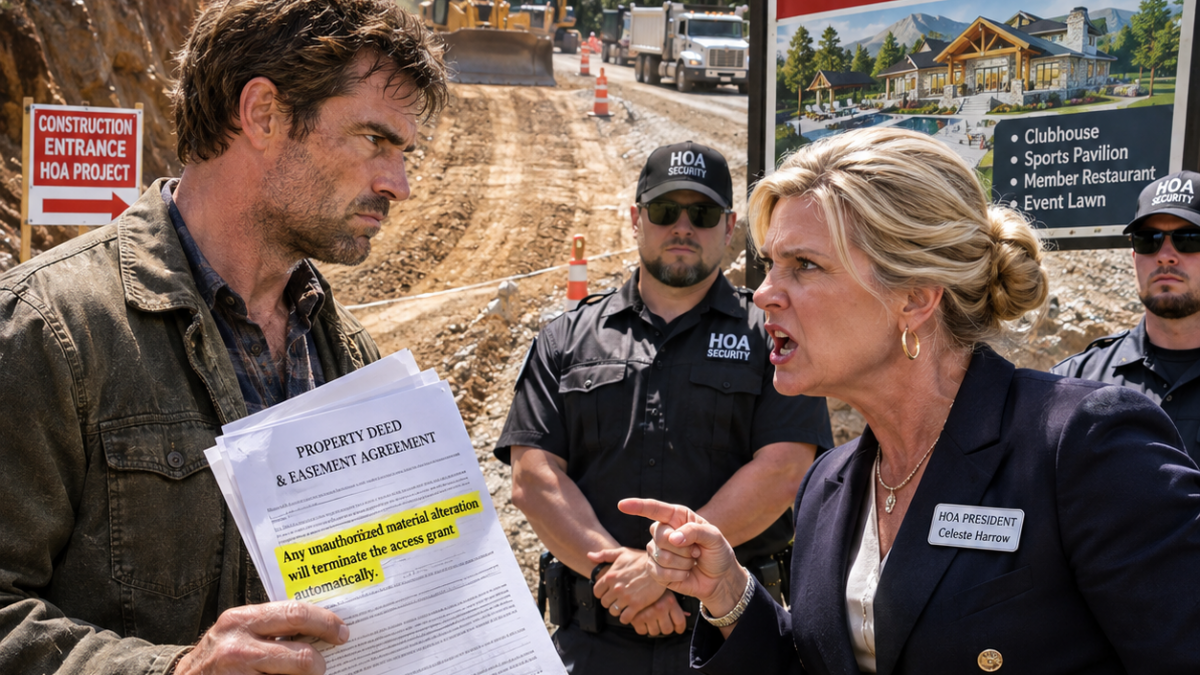
HOA Bulldozed My 2,000-Foot Private Road While I Was Away—Then Their $14M Project Lost Its Only Legal Access.
Graham Whitaker came home after twelve days away and discovered the private road his family had maintained for generations was not damaged, blocked, or partially widened—it had been bulldozed into a twenty-eight-foot construction corridor for an HOA’s $14 million clubhouse project.
HOA President Celeste Harrow stood beside the fresh dirt and told him the road was “community access now,” never realizing the old 2007 easement in Graham’s truck contained one sentence saying that unauthorized widening, relocation, or excavation automatically terminated the association’s right to use it.
By the following week, eleven dump trucks and two concrete mixers were idling outside Graham’s locked gate, the project’s lender had frozen its next draw, and Celeste was finally learning that she had not bulldozed her way into a wider easement—she had bulldozed the only legal access her entire $14 million development had.
Graham Whitaker knew something was wrong before he reached the property line.
His truck was still climbing the last rise toward Whitaker Ridge when the landscape stopped matching the memory in his head.
Graham had driven that hill thousands of times.
Rain.
Snow.
Darkness.
Fog.
With trailers.
Without trailers.
At twenty years old in his father’s old Ford.
At fifty-one in the diesel pickup he owned now.
He knew every bend in the road.
Every oak.
Every drainage cut.
Every place water collected after a summer storm.
So when the tree line suddenly looked thinner and the shadows fell across open dirt where they should have landed over gravel, his foot eased off the accelerator before he consciously understood why.
Then he reached the top.
And stopped.
Whitaker Ridge Road was gone.
Not washed out.
Not damaged.
Gone.
For more than fifty years, the private lane had been fourteen feet wide.
A narrow gravel road running roughly two thousand feet through Graham’s land before reaching the forty-two-acre tract behind the ridge.
His grandfather had planted oaks beside it.
His father had dug drainage ditches along both sides by hand and machine.
The Whitaker family had graded it.
Graveled it.
Cleared snow from it.
Repaired washouts.
Paid for culverts.
It belonged to Graham.
PART2:
A limited access easement allowed Silver Crest Estates to use a portion of it under specific conditions.
But the road itself remained Whitaker property.
Now the oaks were gone.
The drainage ditches had been flattened.
The shoulder banks were cut back.
Boundary stakes lay in a pile near the woods like discarded lumber.
And the road was almost twice its original width.
Twenty-eight feet in places.
Wide enough for a concrete mixer and a dump truck to pass each other without slowing down.
Fresh grader tracks cut across raw soil.
Tree roots had been ripped from the hillside.
The road’s center line had been shifted at several bends.
A new turn radius had been carved into Graham’s pasture.
And near the entrance stood a banner so large it looked like it belonged outside a shopping mall.
SILVER CREST SUMMIT CENTER
$14 MILLION COMMUNITY EXPANSION
Below the words was an architectural rendering.
Massive clubhouse.
Sports pavilion.
Member restaurant.
Event lawn.
Stone terraces.
Outdoor fireplaces.
Glass walls facing the mountains.
Graham stared at it for a long time.
Then he looked past the banner toward the forty-two acres beyond his ridge.
He understood immediately.
Silver Crest had owned that parcel for years.
Beautiful land.
But difficult land.
Steep slopes boxed it in to the north and west.
A ravine cut across the south.
PART3:
The only flat approach capable of carrying construction equipment came from the east.
Across Graham’s property.
Across Whitaker Ridge Road.
The HOA had tried to negotiate wider access months earlier.
Graham had said no.
Apparently Celeste Harrow had decided that no was temporary.
A white Range Rover appeared less than five minutes later.
Two black HOA security SUVs followed.
They stopped on the newly widened corridor.
Celeste stepped out.
Mid-fifties.
Blond hair pulled into a smooth knot.
Cream jacket.
Dark trousers.
A leather folder under one arm.
She looked around at the destruction with the satisfaction of someone arriving to inspect a completed improvement.
Not a trespass.
“Graham.”
He shut his truck door.
“Celeste.”
“You’re back early.”
“No.”
He looked at the road.
“I’m back exactly when I said I’d be.”
Her eyes flickered.
That told him she had known his schedule.
He had spent twelve days three states away inspecting a municipal infrastructure project for one of his consulting clients.
Celeste had waited until he was gone.
Graham pointed down the corridor.
“What happened to my road?”
Celeste smiled slightly.
“It was upgraded.”
“By who?”
“The association.”
“Who gave you permission?”
“Our counsel reviewed the easement.”
“That wasn’t my question.”
She opened the leather folder.
Pulled out a colored site plan.
“The association has full authority over the access corridor.”
Graham did not take the paper.
“How wide is the recorded easement?”
Celeste hesitated for less than a second.
“Wide enough for community use.”
“How wide?”
“Graham, this has already been reviewed.”
“How wide?”
Her smile disappeared.
“The road required modernization.”
“That’s not a number.”
One security guard shifted closer.
Graham ignored him.
Celeste pointed toward the new grade.
“You should actually be thanking us. The road is safer now, and these improvements increase the value of your land.”
Graham looked at the cut drainage bank.
Then the exposed roots where his grandfather’s oaks had stood.
Then at the pile of wooden boundary stakes.
“You lowered the grade.”
“Four feet at the upper bend.”
“You removed both drainage banks.”
“They were outdated.”
“You moved the center line.”
“To improve turning radius.”
“You cleared my trees.”
“Necessary.”
“You widened fourteen feet to nearly twenty-eight.”
“Graham—”
“Who gave you written permission?”
Celeste folded the map.
“HOA counsel has confirmed our authority.”
She said it with the confidence of someone repeating a sentence she had never personally tested.
Graham did not argue.
That unsettled her.
No shouting.
No threat.
No demand that the security guards leave.
He simply walked the length of the bulldozed corridor.
Photographing.
Tree stumps.
Grader tracks.
Survey stakes.
Drainage cuts.
Fresh fill.
Equipment.
The company logo painted on the side of a motor grader.
He photographed tire tracks showing heavy trucks had already been using the road for days.
Then, near the old fence line, he saw a piece of rusted steel half buried beneath churned soil.
He crouched.
Brushed dirt away.
Survey monument.
Stamped code.
Graham recognized it immediately.
Because 2007 was when his father, Daniel Whitaker, had signed the access agreement with Silver Crest’s original developer.
That easement had been discussed at the Whitaker kitchen table for months.
Graham had been twenty-six.
His father had made him read every draft.
Again.
Again.
Again.
“Never let somebody summarize land paperwork for you,” Daniel used to say.
“Read what they signed.”
The original developer had wanted to purchase a wide strip of Whitaker land outright.
Daniel refused.
Eventually they negotiated a narrow access easement over the existing road.
Fourteen feet.
Exact alignment.
Exact grade.
Drainage protections.
Limited traffic rights.
No commercial intensification without separate written consent.
And one clause Daniel had insisted on against the developer’s objections.
Paragraph Eleven.
Graham walked to his truck.
Behind the driver’s seat sat a fireproof document box bolted to the floor.
Inside were certified copies of the deed, survey, easement, title documents, and several family records.
He pulled out the 2007 agreement.
Found Paragraph Eleven.
Read it once.
Then again.
The grant of access would remain valid only so long as the roadway stayed within its recorded width, grade, and alignment.
No relocation.
No material regrading.
No excavation beyond ordinary maintenance.
No widening without written property-owner consent.
Then the sentence underneath.
Any unauthorized material alteration would automatically terminate the access grant.
Graham looked through the windshield.
Twenty-eight feet of raw dirt.
Four-foot grade cut.
Center line shifted.
Drainage destroyed.
Trees removed.
The HOA had not simply damaged his road.
It had very possibly terminated its own easement.
And if that easement died, so did the only recorded legal access to the $14 million Summit Center parcel.
Graham took out his phone.
Called Mason Price.
Mason had represented the Whitaker family in property matters for almost fifteen years.
“Graham.”
“I’m home.”
“How was Tennessee?”
“Fine.”
“What’s wrong?”
Graham looked at the road.
“They bulldozed Whitaker Ridge.”
Silence.
“How much?”
“Basically all of the construction corridor.”
“What do you mean?”
“Fourteen feet is twenty-eight. Grade shifted. Banks gone. Trees gone.”
“Any written permission from you?”
“No.”
“Any amendment?”
“No.”
“Any condemnation?”
“No.”
“Pictures?”
“Taking them.”
“Don’t confront anyone.”
“I already talked to Celeste.”
“What did you say?”
“Asked who gave permission.”
“And?”
“She says counsel approved it.”
Mason exhaled.
“Of course.”
Graham opened Paragraph Eleven.
“Do not send them a demand letter yet.”
Another silence.
“Why?”
“I want to know whether the easement still exists.”
Mason understood immediately.
“Read me Eleven.”
Graham did.
When he finished, Mason said:
“Touch nothing.”
“No gate?”
“Not yet.”
“No equipment blocking?”
“No.”
“No digging?”
“No.”
“What if they keep using it?”
“Let them.”
Graham looked toward the Summit Center banner.
“You’re serious?”
“If the easement terminated automatically, every truck crossing after that becomes a different problem.”
“So why let them?”
“Because right now we need facts more than satisfaction.”
That was Mason.
Always irritating at the moment he was most useful.
Graham walked the road a second time.
Video this time.
Narrating.
Date.
Time.
Weather.
Location.
Old boundary markers.
Depth of grading.
Removed drainage.
Equipment IDs.
Distances.
He measured from surviving monument to new road edge.
Recorded GPS coordinates.
He photographed the pile of removed stakes.
Then drove home.
The next morning, construction resumed.
Dump trucks.
Excavators.
Concrete mixers.
Celeste interpreted Graham’s silence exactly as Mason expected.
She told the Silver Crest board that the “Whitaker issue” had been resolved.
Graham learned that later.
At the time, he stayed away.
The Summit Center project had already been delayed six months because the HOA had no construction entrance wide enough for heavy equipment.
The existing fourteen-foot easement could support ordinary subdivision access.
It could not legally or physically support the traffic Celeste wanted without a new agreement.
Two months earlier, she had emailed Graham.
The association offered money for a permanent thirty-foot construction easement.
Graham refused.
Not because the money was too low.
Because the widened road would destroy the drainage system protecting the lower slope and would run too close to an area he used for equipment access.
His answer had been written.
No.
Celeste had never mentioned that refusal to the board.
Instead, she waited until Graham left town.
Owen Carile, the site manager for the grading contractor, later explained what happened.
His company had originally been hired for routine road maintenance.
Light grading.
Fresh gravel.
Drainage cleanup.
When the crew mobilized, the HOA provided entirely different drawings.
Road widening.
Tree clearing.
Four-foot grade reduction.
Center-line relocation.
Bank removal.
Heavy-truck turning radius.
Owen asked whether the owner had approved.
Celeste’s written response:
OWNER IS AWAY. HOA CONTROLS THE EASEMENT. PROCEED.
That email did not surface until later.
But the decision was already there.
Graham hired Evelyn Straoud.
Licensed surveyor.
Twenty-seven years in the county.
Evelyn reconstructed the original road using:
2007 survey.
Recorded legal description.
GPS control.
Remaining monuments.
Historic aerial photographs.
Pre-construction drone images.
She spent two days onsite.
On the second afternoon, she stood beside Graham with a tablet.
“This isn’t maintenance.”
“How far off?”
“In sections, they widened beyond the easement by more than ten feet.”
“Center line?”
“Shifted completely outside the recorded corridor in three places.”
“Entrance?”
She zoomed.
“Almost a new road.”
Graham looked toward the raw dirt.
“That bad?”
“This is a brand-new construction corridor using pieces of the old road.”
Mason pulled title on the forty-two-acre Summit Center parcel.
One sentence controlled everything.
LEGAL ACCESS:
Subject to Easement Instrument 2007-1846.
No second road.
No separate recorded access.
No public frontage.
No alternative easement.
The entire parcel’s legal vehicular access depended on the Whitaker easement.
If Paragraph Eleven had been triggered, Summit Center would become a $14 million construction project sitting on land that no longer had recorded road access.
Permits.
Financing.
Insurance.
Title coverage.
All could be affected.
Mason said:
“We still need intent.”
“Why?”
“Because they’ll argue reasonable maintenance.”
“They cut twenty-eight feet.”
“I know.”
“They moved the road.”
“I know.”
“They removed trees.”
“I know.”
“What more do you need?”
“Their own words.”
They got them that afternoon.
Celeste emailed Graham.
Formal HOA letterhead.
The association intends to complete the widening and modernization of the access corridor regardless of your objections because such work is necessary to serve the Summit Center parcel and falls within association authority.
Graham forwarded it.
Mason called.
“She just handed us intent.”
“Meaning?”
“We no longer need to argue the contractor accidentally overbuilt.”
He paused.
“She says it was deliberate.”
Mason spent three days tracing the easement.
Original drafts.
Recorded version.
Developer correspondence.
Survey.
Maintenance provisions.
Daniel Whitaker had negotiated it carefully because the slope below the road was erosion-prone.
The agreement also expressly barred major intensification of commercial or construction traffic without new written consent.
Celeste had violated almost every limitation at once.
Then Mason sent preservation notices.
Every email.
Every text.
Construction drawing.
Machine GPS record.
Invoice.
Work order.
Meeting minute.
Equipment dispatch.
Title file.
Permit application.
Graham’s old refusal.
Everything preserved.
Celeste called Graham directly.
No polite tone.
“You are threatening fourteen million dollars of community investment.”
“I’m protecting my road.”
“If you interfere with Summit Center, we will sue you for every dollar of delay.”
“Have you read Paragraph Eleven yet?”
Pause.
“I’ve read the easement.”
“Eleven?”
“Our counsel reviewed everything.”
“That wasn’t my question.”
“You’re trying to extort the association.”
“No.”
“What do you want?”
“My land restored.”
“Don’t be ridiculous.”
Graham ended the call.
The next morning, Mason filed formal notice.
Unauthorized widening.
Unauthorized excavation.
Unauthorized relocation.
Termination under Paragraph Eleven.
Trespass notice.
Effective immediately.
Graham rebuilt the boundary.
Not with concrete.
Not a trench.
Not wrecked equipment.
One steel gate.
Placed exactly on the surveyed property line.
Heavy chain.
Padlock.
Sign:
PRIVATE PROPERTY
PROJECT ACCESS TERMINATED
Nothing else.
The following morning, eleven dump trucks and two concrete mixers lined up outside it.
Engines idling.
Owen Carile stood near lead truck.
He refused to force gate.
Celeste arrived thirty minutes later.
Security with bolt cutters.
Graham stood on other side with Mason and Evelyn.
Cameras recorded.
Celeste pointed.
“Cut it.”
Owen said:
“No.”
She turned.
“I wasn’t talking to you.”
The security chief stepped forward.
Mason raised one hand.
“Before anyone touches that chain, I want you aware the gate is inside Mr. Whitaker’s property and your actions are being recorded.”
Celeste laughed.
“You cannot terminate a road by hanging a sign.”
Mason said:
“We didn’t.”
He held up easement.
“You did.”
Her face changed.
“Open it.”
“No.”
“I’ll have a court order by dinner.”
Graham said:
“Bring the entire recorded easement.”
Three hours later, the HOA filed for emergency injunction.
Its lawyers argued Graham had illegally blocked a longstanding community road.
Then Celeste produced something nobody on Graham’s side had seen.
A plat.
Dated 2007.
Showing a thirty-foot easement.
If genuine, it could destroy Graham’s case.
Evelyn studied it.
Then again.
“Wrong.”
“How?”
“Font.”
She pointed.
“Coordinate notation.”
Another.
“These survey symbols weren’t used by the county that year.”
Then she noticed parcel number.
Looked it up.
That parcel ID had not been created until years after the plat’s printed date.
Impossible.
Mason did not call it forged.
Not yet.
He called Grant Hollis.
County planning engineer.
Grant searched official archives.
No thirty-foot plat.
Never approved.
Never recorded.
Only valid filing:
Fourteen feet.
Instrument 2007-1846.
Then a bigger problem appeared.
Summit Center’s county permit required at least twenty feet of all-weather legal access suitable for fire apparatus and heavy construction.
The valid easement gave fourteen.
How had the permit been approved?
Mason dug into county application file.
Owner Access Certification.
Submitted by Silver Crest.
Affirming permanent legal access greater than twenty-four feet.
Signature:
Celeste Harrow.
Graham stared at it.
“She certified they had something they never had.”
Mason nodded.
“This is no longer just a road fight.”
Emergency hearing came quickly.
HOA attorney argued delay cost tens of thousands per day.
Concrete schedule.
Steel delivery.
Labor.
Equipment.
Financing.
Mason ignored the money.
He put original easement beside Evelyn’s survey.
Fourteen feet.
Exact alignment.
Exact restrictions.
Then Paragraph Eleven.
Association counsel called widening reasonable improvement.
Mason read language.
No unauthorized widening.
No unauthorized relocation.
No material regrading.
No exception for “reasonable.”
Judge refused immediate order forcing Graham to reopen.
Instead:
Preserve status quo.
No further access pending full hearing.
The gate stayed closed.
That was Graham’s first legal victory.
For Celeste, it was disaster.
Because the dump trucks stayed outside.
Concrete mixers left.
Owen reassigned machines.
Deliveries cancelled.
Then Mason contacted Rebecca Sloan.
Construction-loan manager.
Not to threaten.
To notify.
Recorded access disputed and may have terminated.
Rebecca did not care about HOA personalities.
Her bank had lent millions secured partly by Summit Center parcel.
Her question:
Can the bank legally reach the collateral if default occurs?
Nobody could answer with certainty.
Loan agreement required:
Permanent legal vehicular access.
Valid permits.
Clean title coverage.
No material easement dispute.
All three were now questionable.
Rebecca froze the next draw.
Then demanded proof.
Celeste sent thirty-foot plat.
Title insurer rejected it.
No recording number.
No county file.
Rebecca asked for original instrument.
Celeste sent 2007 easement.
Fourteen feet.
Restrictions.
Termination clause.
Funds remained frozen.
Contractors started calling.
Steel supplier cancelled upcoming shipment.
Concrete subcontractor invoked delay provision.
Owen shifted crews elsewhere.
Graham did not sabotage one machine.
Did not threaten one driver.
A gate and a deed were enough.
Celeste changed tactics.
First offer:
$75,000.
Open road ninety days.
Graham refused.
Second:
$150,000.
Refused.
Then:
Buy road.
“How much?” Graham asked.
“Four hundred thousand.”
For a moment, Celeste thought he might accept.
Graham placed another document on table.
Restoration estimate.
The widening had destroyed drainage banks supporting hillside.
Removed mature trees.
Cut into stable slope.
Changed runoff.
Simply returning the land to its previous condition could cost several hundred thousand dollars.
“This isn’t about price.”
“Everything has a price.”
“No.”
“You’re being emotional.”
“You trespassed, destroyed the road, and now want to purchase what you already took.”
She leaned forward.
“You’re going to kill Summit Center over a gravel lane.”
Graham looked at her.
“No.”
“You already did that.”
Her face hardened.
Then she announced association would claim prescriptive easement.
Mason almost laughed.
Prescriptive rights generally depend on adverse use without permission for required legal period.
Silver Crest had used road under explicit written permission.
Its own 2007 easement defeated idea that historical use had been hostile.
Celeste kept making arguments that contradicted previous ones.
Rebecca called Mason directly.
“Are you seeking a judicial determination that the project has no legal access?”
“Yes.”
Silence.
“We were told this was temporary maintenance dispute.”
“It isn’t.”
That call shifted everything.
Bank began full review.
Loan application.
Title certification.
Permit file.
Access representations.
If lender had received inaccurate information when loan originated, exposure went beyond construction delay.
Celeste desperately needed movement.
She tried declaring Whitaker Ridge emergency route.
Grant Hollis checked.
No designation.
The original easement had a narrow emergency provision for access to an old pump station.
Nothing authorizing general construction traffic.
Celeste was blending different rights together.
Ordinary passage.
Emergency pump access.
Heavy construction.
She treated them as interchangeable.
They weren’t.
Then she ordered Owen to bring bulldozer and force gate.
Owen refused in writing.
His contract gave no authority to breach barrier on disputed private property.
More importantly, he forwarded the email that would haunt Celeste:
Owner is away. HOA controls the easement. Proceed.
The date was before Graham returned.
Before any misunderstanding could be claimed.
Celeste had known Graham was gone.
Had known she lacked new signed permission.
Had told contractor to proceed anyway.
Mason expanded claims.
Trespass.
Destruction of property.
Tree removal.
Survey monument interference.
Drainage damage.
Restoration.
Legal expenses under easement provisions.
Graham told him:
“No extras.”
“What?”
“No dramatic claims we can’t prove.”
“I know.”
“I want exactly what happened.”
“That’s what we’re doing.”
“No revenge numbers.”
Mason smiled.
“You’re less fun than most plaintiffs.”
“Good.”
Meanwhile, Silver Crest investigated alternate routes.
North:
Neighboring landowner.
Would require easement purchase.
He knew their desperation.
Price high.
West:
Steep terrain.
Retaining wall.
Bridge.
Major grading.
New environmental and county review.
Millions.
Months.
Possibly more than year.
The $14 million project could not absorb it easily.
Celeste told homeowners access issue was “administrative.”
But idle excavators sitting behind a locked gate told another story.
Rumors spread.
Board treasurer began asking.
Rebecca demanded meeting with entire board.
Not Celeste alone.
That was the moment control shifted.
At emergency board meeting, Rebecca placed original easement on table.
“Which of you approved destruction of the only recorded access securing our loan?”
Silence.
No hand.
One director asked:
“Celeste, did Graham refuse a request for widening before this work began?”
She hesitated.
That hesitation mattered.
Board secretary searched minutes.
No vote approving major widening.
Only routine road maintenance budget.
Then invoice surfaced.
Filed under maintenance.
Scope:
Road widening.
Tree clearing.
Regrading.
Construction access preparation.
The phrase “maintenance” had hidden what the work really was.
Rebecca explained:
No more money until permanent legal access proven.
If not cured within contractual period:
Potential default.
Title insurer reserved rights because access issue resulted from post-policy actions by insured party itself.
Celeste tried turning room against Graham.
“He is holding this entire community hostage.”
Mason distributed timeline.
2007 easement valid.
Celeste requested thirty-foot easement.
Graham refused in writing.
Graham leaves town.
Contractor asks about consent.
Celeste says proceed.
Road widened.
Termination clause triggered.
Only then Graham gates property.
Read in order, hostage narrative collapsed.
Then Graham added the most damaging document.
Celeste’s own offer from two months earlier asking him to grant a new permanent thirty-foot easement.
If she genuinely believed HOA already had thirty feet, why had she tried to buy it?
Nobody had good answer.
Especially Celeste.
Full hearing arrived.
Night before, Evelyn completed overlay.
Original road.
Legal easement.
Bulldozed road.
At Summit Center entrance, the new corridor did not merely exceed easement.
A significant portion sat entirely outside it.
On Graham’s land.
Never subject to access right.
Ever.
In court, HOA counsel argued easement should be interpreted broadly enough to let parcel remain useful.
That upgrading road was necessary.
Mason stood.
Read text.
Exact width.
Exact alignment.
No relocation without consent.
No major grading without consent.
No intensified construction traffic.
Automatic termination.
Evelyn testified.
Overlay projected.
Historical corridor in one color.
Recorded easement in another.
Bulldozed road in third.
The third color wandered away from first two like someone had drawn entirely different road.
Owen testified.
Yes, he asked whether Graham approved.
Yes, Celeste told him owner was away.
Yes, he was told HOA controlled corridor.
Then Mason introduced thirty-foot easement offer from two months earlier.
“If Mrs. Harrow believed she already possessed a thirty-foot right-of-way, why did she offer to purchase one?”
Celeste’s attorney attempted distinction.
Temporary construction access.
Permanent rights.
But email language was clear.
She knew existing easement insufficient.
Grant Hollis testified county permit remained contingent on legal access.
If easement terminated, project access compliance had to be reconsidered.
Judge ruled.
Measured.
No theatrics.
No insult.
No accusation beyond record.
Whitaker Ridge Road remained Graham’s private property.
Association’s access rights existed only under 2007 conditional easement.
Association performed material unauthorized widening, relocation, regrading, and excavation.
Those actions triggered termination provision.
The easement no longer provided lawful access to Summit Center parcel.
Courtroom went silent.
The $14 million project still existed physically.
The forty-two acres still belonged to association.
Foundations still sat behind ridge.
But legal road in and out was gone.
Not taken by Graham.
Terminated by association’s own conduct.
Rebecca received ruling within hour.
Funding freeze became formal suspension pending cure.
County issued stop-work review.
Owen arranged removal of equipment possible under temporary controlled permission.
Graham allowed one extraction window.
Why?
Because he had no interest in holding contractor machines hostage.
Ownership was not leverage for revenge.
Equipment left.
Gate closed.
Celeste asked Graham afterward:
“Are you satisfied?”
He said:
“I told you not to turn my road into yours.”
Nothing else.
Consequences multiplied.
Material price locks expired.
Subcontractors filed delay claims.
Crews reassigned.
Financing costs continued.
Alternate access estimates climbed.
Board calculated:
Road restoration.
Destroyed trees.
Drainage rebuild.
Legal expenses.
Contractor delays.
Potential redesign.
Alternate route.
Interest.
Possible permit rework.
Celeste’s authority to sign contracts suspended.
Board asked her to step down pending internal investigation.
She refused first.
Then lost support.
The owner access certification she had personally signed went under separate county and legal review.
No dramatic arrest.
No handcuffs.
No need.
Her consequence was watching the project she forced through someone else’s land stop because of choices she documented herself.
The HOA later offered Graham a large settlement if he would grant a new easement.
He refused again.
Board representative asked:
“Even after Celeste is gone?”
“Yes.”
“Why?”
“Drainage.”
“We can engineer it.”
“Not where you want it.”
“What about more money?”
“This isn’t a money problem.”
He used the land.
That was enough.
The alternate route cost estimate came back.
Millions.
Retaining structures.
Bridge.
Land purchase.
Permits.
Schedule.
Summit Center could not be finished anywhere near original budget.
Project shelved indefinitely.
Silver Crest still owned forty-two acres.
Could develop something smaller later.
Could seek new route.
Could negotiate elsewhere.
But not through Whitaker land without Graham’s consent.
Settlement eventually came.
HOA pays restoration.
Road returned to original fourteen-foot corridor.
Drainage banks rebuilt under proper engineering.
Survey monuments reset.
Land graded outside easement restored.
Trees compensated and replanted where appropriate.
Substantial portion of Graham’s legal and property costs covered.
No new easement.
No construction access.
When machines returned to Whitaker Ridge one last time, they arrived to narrow road.
Twenty-eight feet became fourteen.
Extra cut filled.
Banks rebuilt.
Ditches restored.
Survey stakes returned to exact positions.
New gravel.
New drainage stone.
New oak saplings where older trees had been removed.
Graham watched.
Strange feeling.
The same type of machinery that destroyed road now repaired it.
Machines had never been enemy.
Instructions were.
Summit Center banner disappeared.
No replacement.
Celeste left board permanently.
Internal review found she authorized work beyond any board approval, concealed Graham’s earlier refusal, and described major reconstruction as routine maintenance.
Separate review continued into access certification.
Again, no need to exaggerate.
The truth was already serious enough.
Months later, Graham drove Whitaker Ridge Road.
Narrow.
Quiet.
One large vehicle at a time.
Exactly as his father intended.
He stopped near a new monument Evelyn installed.
Across ridge, unfinished Summit Center foundation sat exposed.
A $14 million plan stalled.
Not because Graham had more power than HOA.
Not because he sabotaged construction.
Not because he blocked a road he had no right to block.
Because Celeste convinced herself another person’s ownership was an inconvenience that could be bulldozed before anyone stopped her.
The old easement gave Silver Crest something valuable.
Limited access.
Celeste wanted more.
Instead of negotiating after Graham said no, she took it.
The instant her crew materially altered the road, she triggered the clause her lawyers had apparently never treated seriously.
They bulldozed the easement itself.
People later told story differently.
Some said Graham trapped construction crews.
No.
He allowed controlled removal.
Some said he destroyed community road.
No.
Road was private.
Some said HOA lost land.
No.
Association still owned forty-two acres.
It lost access right.
Some said judge “gave” road to Graham.
No.
It had always belonged to him.
Court merely recognized consequence of existing contract.
That distinction mattered.
Graham disliked stories where land rights became revenge fantasy.
Real property disputes are slower.
More boring.
Often decided by phrases buried in twenty-year-old documents.
But boring does not mean weak.
Paragraph Eleven sat unread for years.
No dramatic formatting.
No bold letters.
No warning label.
One sentence.
Unauthorized material alteration terminates access.
Celeste had equipment.
Money.
Security.
Contractors.
Board title.
$14 million plan.
Graham had one sentence his father negotiated in 2007.
His father had known development changes people.
Not necessarily makes them evil.
Makes them ambitious.
Today a narrow subdivision road.
Tomorrow a construction route.
Then deliveries.
Then events.
Then commercial traffic.
Daniel Whitaker did not want family land slowly transformed by each “reasonable improvement.”
So he wrote limits.
Exact.
Celeste thought exactness was outdated.
The court disagreed.
After settlement, board invited Graham to meeting.
Not to apologize only.
To discuss future neighbor relations.
He attended once.
New president, Malcolm Reed, said:
“We need to rebuild trust.”
Graham nodded.
“What do you need from us?”
“Read your documents.”
Some nervous laughter.
Graham continued.
“Before you tell someone what rights you have, verify them.”
Malcolm nodded.
“What else?”
“If owner says no to new access, no means plan needs changing.”
A director said:
“What if project benefits entire community?”
“Then community can pay to build it somewhere it has rights.”
Silence.
“That’s not anti-community.”
He looked around room.
“That’s ownership.”
The meeting became calmer after that.
Summit Center never revived in original form.
Years later, Silver Crest built smaller recreation center inside existing developed area.
No mountain event lawn.
No restaurant overlooking ridge.
No forty-two-acre expansion.
Cost much less.
Residents used it.
Life continued.
That may have been best ending.
The neighborhood was not destroyed because Celeste lost.
Home values did not collapse.
Families did not suffer forever.
An overreaching project failed.
Community adapted.
Graham appreciated that.
He never wanted Silver Crest ruined.
He wanted his land left alone.
One evening, Evelyn stopped by.
They walked repaired road.
“You know,” she said, “this is actually better drainage than before.”
Graham looked at new ditch.
“It cost enough.”
She laughed.
At old oak line, new saplings stood protected by tubes.
Small.
“Think you’ll live long enough to see these as big as old ones?”
“Probably not.”
“That bother you?”
“No.”
“Why?”
“My grandfather planted originals.”
She understood.
Some restoration is for next person.
The fireproof document box stayed behind Graham’s truck seat for years afterward.
Deed.
Easement.
Surveys.
Court order.
Settlement.
His daughter once asked:
“Why carry all that?”
“Habit.”
“You think someone is going to bulldoze it again?”
“No.”
“Then put it in office.”
Graham shook his head.
“No.”
She laughed.
“Dad.”
“What?”
“Paranoid.”
“Prepared.”
She rolled eyes.
The phrase became family joke.
But Graham knew memory is not enough.
Land changes hands.
Board members change.
Stories get summarized.
“Community road.”
“Old access.”
“Shared corridor.”
Each simplification can slowly erase conditions.
Documents prevent that.
Years after case, Silver Crest sold forty-two-acre Summit Center tract to conservation buyer.
No major development.
Steep slopes remained.
Graham saw elk once near unfinished foundation area after concrete was removed.
He stood beside road.
Watched them.
Thought how strange expensive plans become.
Renderings.
Loan agreements.
Security guards.
Board meetings.
Court.
All gone.
Grass eventually covers ambition.
His father’s easement still mattered.
Not because it stopped development forever.
Because it forced anyone who wanted more to ask.
That is what ownership really provided.
Not absolute control over universe.
Right to consent to use of one’s land.
Celeste treated consent like delay.
Graham treated it like line.
That difference cost Silver Crest millions.
Not because Graham demanded millions.
Because changing plans late is expensive.
Changing plans after concrete is worse.
Changing plans after legal access disappears can kill project.
Most expensive mistake happened first day.
Not when gate closed.
When Celeste decided written no could be solved by waiting until owner left town.
Everything after followed.
One day Owen Carile came by.
No longer working Summit Center.
He had another project nearby.
He stopped.
“I owe you apology.”
“For what?”
“I should’ve stopped.”
“You asked.”
“I still moved dirt.”
“You were given drawings.”
“I knew something felt wrong.”
Graham shrugged.
“You kept email.”
Owen smiled.
“Saved my ass.”
“And mine.”
They shook hands.
Owen said:
“I changed company policy.”
“What?”
“If private owner is not applicant, we verify direct written authorization for widening.”
“Good.”
“Your father would’ve liked that?”
Graham looked down road.
“Probably would’ve complained it took a lawsuit.”
Owen laughed.
That was another quiet outcome.
Contractors learned.
Bank learned.
Board learned.
County learned.
Not perfect.
But better systems often begin with someone paying for a bad assumption.
Graham spoke once at an infrastructure conference.
Topic was documentation in right-of-way disputes.
He did not tell whole HOA story.
Used it as case study.
A project can possess access today and lose it tomorrow if grant is conditional.
He emphasized:
Read triggering provisions.
Confirm authority.
Do not confuse maintenance with reconstruction.
Do not assume historical use permits intensification.
Document pre-construction conditions.
A younger project manager asked:
“What was most important evidence?”
People expected:
Easement.
Celeste email.
Survey.
Graham answered:
“Pre-work drone photographs.”
Why?
“Because they showed what road looked like before anybody could argue memory.”
Then he added:
“And her email saying proceed.”
The room laughed.
“People should avoid writing incriminating emails?”
“No.”
Graham smiled.
“People should avoid doing incriminating things.”
After conference, one attendee asked:
“Did you enjoy watching project collapse?”
Graham thought.
“At first.”
“Then?”
“It got expensive for people who didn’t make decision.”
That mattered.
Ordinary homeowners paid dues.
Some had supported Summit Center innocently.
Contractors lost scheduling.
Employees lost work.
Not everyone harmed was responsible.
Graham did not celebrate collateral damage.
Justice is cleaner in stories than real life.
He wanted Celeste accountable.
He did not enjoy seeing families worry about assessments.
That is why settlement focused restoration rather than punishment.
Why he allowed equipment retrieval.
Why he did not demand absurd damages.
Why he refused press interviews calling Silver Crest corrupt.
Celeste had acted.
Board oversight failed.
But neighborhood was more than president.
This distinction prevented the dispute from becoming lifelong war.
Years later, Graham attended barbecue at Silver Crest.
Invited by Malcolm.
He almost declined.
Went.
Nobody talked easement for first hour.
Kids played.
Music.
Food.
Someone asked:
“You’re road guy?”
Graham sighed.
“Apparently.”
A woman laughed.
“My husband still complains we never got Summit Center.”
“Sorry.”
“No, he’s over it.”
From nearby:
“I am not over it!”
People laughed.
Normal.
Community survived boundary.
Maybe improved.
At dusk, Malcolm walked Graham to gate.
“You know Celeste used to say you hated us.”
“I didn’t know most of you.”
“Exactly.”
They looked toward Whitaker Ridge.
“You think we’d ever get permission for hiking path?”
Graham stared at him.
Malcolm immediately raised hands.
“Just asking.”
Graham smiled.
“No.”
“Fair.”
No offense.
No threat.
No bulldozer.
A boundary survived an answer.
That was progress.
When Graham turned sixty, his son Eli asked whether he planned to sell ridge property.
“Maybe one day.”
“To who?”
“Someone who reads.”
Eli laughed.
“I’m serious.”
“Of course.”
Graham opened fireproof box.
Pulled easement.
“Read this.”
“I know story.”
“Not story.”
He tapped document.
“Read.”
That was his father again.
Never inherit somebody else’s summary.
Read what they signed.
Eli did.
Paragraph Eleven.
He looked up.
“One paragraph killed fourteen-million-dollar project.”
“No.”
“What?”
Graham folded paper.
“One decision killed project.”
“The bulldozing?”
“The decision to ignore no.”
That was how he remembered it.
Not gate.
Not courtroom.
Not bank freeze.
Not eleven trucks idling.
Those were consequences.
Decision came earlier.
Celeste had wanted thirty feet.
Asked.
Was refused.
Then decided owner’s absence was opportunity.
Everything else was mechanics.
Road restoration eventually matured.
New oaks grew.
Drainage banks held through major storm.
Graham walked after rainfall once.
Water stayed in ditches.
No erosion.
He felt satisfaction deeper than lawsuit.
Land behaving properly.
One of oaks was crooked.
He almost staked it straight.
Then decided against.
Trees do not need perfect alignment to prove property.
Survey monuments do.
He laughed at his own thought.
The old Summit Center banner remained rolled somewhere in HOA storage, according to Malcolm.
Graham hoped it stayed there.
No trophy.
No need.
He had photographs.
Enough.
The steel gate was removed once settlement complete and road restored.
Graham considered leaving it.
Mason advised:
“Do whatever you want. It’s your property.”
Graham took it down.
Why?
Because he used road.
Gate had been tool for specific moment.
Keeping it forever would turn boundary into monument to conflict.
He did not want every drive home to become replay.
So no gate.
Just private property sign.
Small.
Clear.
Silver Crest had no easement anymore.
No need for barricade.
Anyone needing access had to ask.
One spring morning a utility crew called.
“We need cross to inspect line.”
“Which line?”
They explained.
Easement existed separately.
Graham checked.
Valid.
Opened access.
That was land ownership.
Sometimes no.
Sometimes yes.
Rules varied by document.
He disliked slogans because they flatten nuance.
“It’s my land, nobody enters” was no more accurate than “community needs it, therefore use it.”
Rights coexist.
You read.
Verify.
Then act.
That was lesson Celeste skipped.
By the time she stepped down, many residents wanted anger.
Some wanted criminal charges.
Some wanted massive personal judgment.
Graham stayed quiet.
Owner access certification remained under review.
He did not claim outcome he did not know.
That became another principle.
Do not exaggerate your opponent’s wrongdoing because facts already support you.
He told Mason:
“If county decides it was false filing, fine.”
“And if they don’t?”
“Still lost access.”
“Still restoration.”
“Still project dead.”
Enough.
Mason smiled.
“You’d be terrible politician.”
“Good.”
Years afterward, a podcast asked Graham to tell story.
He refused first.
Then agreed on condition:
No “revenge” in title.
They published:
THE ROAD THAT DISAPPEARED.
Graham hated that too.
But interview was accurate.
Host asked:
“When did you know you’d won?”
Graham answered:
“I didn’t until judge ruled.”
“Not when you found Paragraph Eleven?”
“No.”
“Why?”
“Because believing you’re right and being adjudicated right are different things.”
“Did you think judge could rule against you?”
“Yes.”
“Even with language?”
“Always possible interpretation differs.”
“Were you scared?”
“Of losing?”
“Yes.”
“Of hillside failing.”
Host paused.
“That was biggest fear?”
“Road can be rebuilt. Lawsuit can be appealed. Slope failure doesn’t care.”
That was Graham.
Infrastructure before ego.
Celeste saw road as access asset.
Graham saw drainage.
Grade.
Geometry.
Stability.
Those are not glamorous.
Neither is ownership most days.
You own land, you maintain it.
People romanticize ranches and ridges.
Reality is culverts.
Taxes.
Erosion.
Dead trees.
Fences.
That work creates relationship deeper than dollar value.
Celeste thought improvement meant widening.
For Graham, improvement meant road doing job without ruining hill.
After his father died, Graham had found notebook.
Daniel wrote maintenance notes.
2008: ditch cleaned.
2010: culvert replaced.
2012: Silver Crest asked wider gravel; declined.
2015: lower bank washout repaired.
Simple.
Then page with easement note:
KEEP IT NARROW.
Graham smiled when he found.
Not legal document.
Not binding.
But father’s intent in three words.
Keep it narrow.
Years later, the road was narrow again.
Daniel would have approved.
Near end of story, when Graham was sixty-six, he drove road after light snow.
Tracks only his truck.
Silver Crest roofs visible through bare branches.
No Summit Center.
Forty-two-acre parcel mostly forest.
He stopped near surviving 2007 monument.
Rust cleaned.
Protective collar.
Evelyn’s newer reference marker beside.
He stepped out.
Cold.
Quiet.
He thought of first day home after twelve days away.
Shock.
The road twice wide.
Banner.
Celeste saying:
Community access now.
At the time it felt like invasion.
Years later, it felt like one terrible decision among thousands that shape land.
What lasted was not Celeste.
Not project.
Not bank.
Not lawsuit.
The document.
And restored road.
Graham climbed into truck.
Started engine.
Fourteen-foot lane ahead.
Enough room.
Always had been.
He drove.
No concrete mixer coming opposite direction.
No security guard.
No gate.
Just gravel beneath tires and drainage running where his father dug it.
There was never a final dramatic confrontation with Celeste.
No last shout.
No cinematic apology.
Her authority ended.
Project stopped.
Board changed.
Life went on.
That felt more fitting.
Real consequences do not always announce themselves.
Sometimes they sound like nothing more than truck engine idling on a narrow private road.
The HOA had believed its easement made it untouchable.
Celeste believed because Silver Crest possessed a right to use Graham’s road, she could reshape that right until it matched what her project needed.
She was wrong.
She had a limited grant.
She wanted something bigger.
And when she bulldozed the road to create it, she crossed the one line her own project could not survive.
Not the property line.
The contract line.
The easement did not need Graham to cancel it out of anger.
It terminated because Celeste performed the exact acts Paragraph Eleven said would terminate it.
Widening.
Relocation.
Excavation.
Material change without consent.
She had tried to turn fourteen feet into twenty-eight.
Instead, she turned fourteen feet into zero.
That was why $14 million stopped moving.
Not because Graham destroyed a project.
Because Celeste destroyed its only legal way in.








