HOA Bulldozed a 320-Foot “Emergency Road” Across My Private Land—Then the Fire Marshal Measured It and Asked Who Approved This
PART2:
By the time I got outside, the yellow dozer had already knocked the iron gate flat.
The blade shoved it sideways like scrap.
Then it climbed onto the stone wall.
Rock rolled.
Dust rose.
One section collapsed.
Then another.
I stood in my driveway holding a phone in one hand and the property survey in the other while a crew I had never hired destroyed land I owned outright.
I shouted:
“Shut it down!”
The operator looked at a man in a fluorescent vest.
The man looked toward an SUV parked near the road.
Nobody stopped.
I walked closer.
“Turn that machine off!”
The site foreman finally raised one hand.
The bulldozer idled.
“What’s your name?” I asked.
“Mike.”
“Mike what?”
“Keegan.”
“Who hired you?”
He hesitated.
“Ridgeline Siteworks.”
“That’s your company?”
“No.”
“Who hired Ridgeline?”
PART3:
“The HOA.”
I pointed toward the broken gate.
“This is private property.”
He looked uncomfortable.
“We were told access was approved.”
“By who?”
He pointed toward the approaching SUV.
I already knew.
Renata Cole stepped out wearing a red blazer.
That blazer became famous later.
Not because there was anything unusual about it.
But nearly every photograph from the first week showed her in it.
Red blazer.
Black trousers.
Pointed heels.
Large sunglasses.
Clipboard.
She walked over crushed stone like she had arrived to inspect landscaping.
“Mr. Mercer.”
“Stop the work.”
She smiled.
“We’ve already discussed this.”
“No, you’ve sent me vague letters.”
“This is an emergency access project.”
“You’re on my land.”
“The board approved emergency authority.”
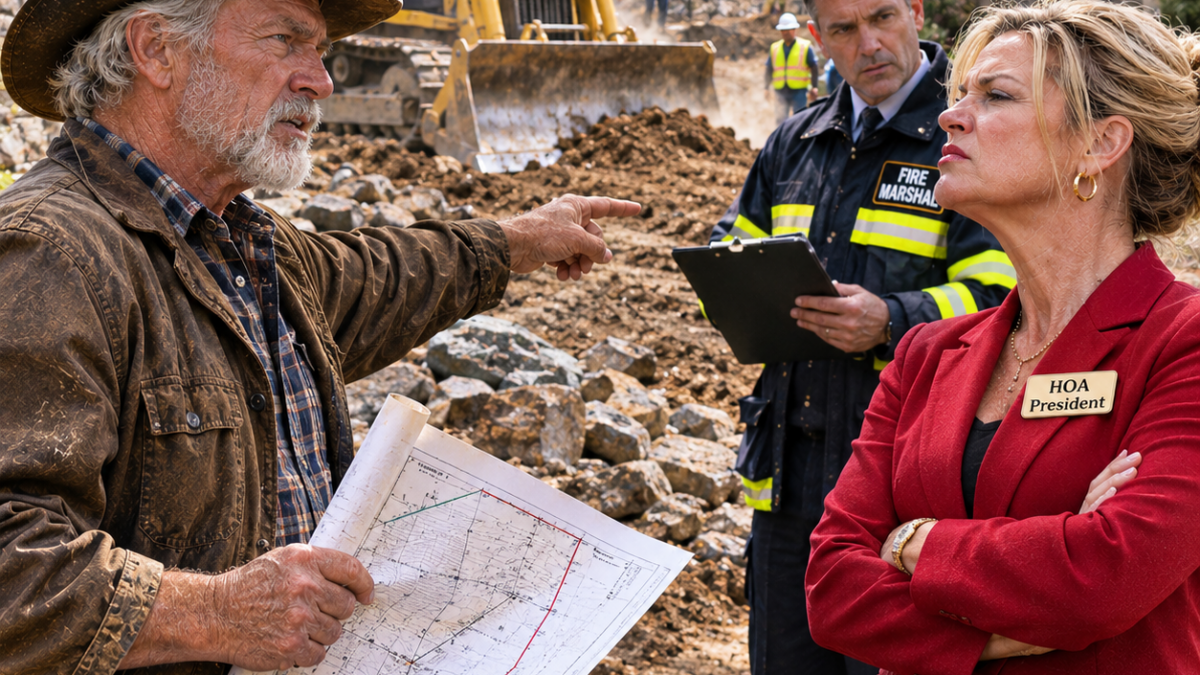
I unrolled the survey.
“This line is mine.”
She did not even look.
“We have counsel.”
“Good.”
“Then have your counsel explain why your bulldozer just destroyed my gate.”
She sighed.
Not angry.
Worse.
Patient.
Like I was an old man confused by modern procedure.
“Daniel, last summer exposed a serious safety issue.”
“My name is Mr. Mercer if you’re bulldozing my property.”
Her smile tightened.
“Mr. Mercer.”
“Thank you.”
“Our community has one primary entrance.”
“I know.”
“In a wildfire, that is unacceptable.”
“I agree.”
“Then you understand.”
“No.”
That surprised her.
I pointed toward the machine.
“I understand you need another route.”
“Yes.”
“I do not understand why that gives you my land.”
“The county code grants emergency-access authority.”
“Show me.”
“Our attorney can explain.”
“No.”
I stepped closer.
“You’re here.”
“Your bulldozer is here.”
“Show me the ordinance.”
She looked toward Mike.
“Continue.”
I stepped into the path.
Mike raised both hands.
“Nope.”
He shut the machine off.
Renata snapped:
“Mr. Keegan, you have a contract.”
“And he’s standing in front of the blade.”
“Call law enforcement.”
“I already did,” I said.
Her expression shifted for the first time.
Only slightly.
“You called the sheriff?”
“Yes.”
“Good.”
She folded her arms.
“The county supports emergency access.”
That sentence told me something.
She believed it.
Or had convinced herself she did.
There is a difference between lying and building a private version of reality so carefully that eventually you mistake it for law.
Renata was very good at the second.
To understand how we got there, you need to know what happened the summer before.
The neighborhood beside my property was called Cedar Ridge Estates.
Two hundred homes.
Technically 204 by the time all phases were completed.
Nice houses.
Half-acre lots.
Clubhouse.
Pool.
Private walking trails.
The main entrance came from a winding two-lane road cutting through a narrow tree corridor before reaching the state highway.
For years, county planners had warned that one access point was not ideal.
Then a wildfire started twelve miles west.
It never reached Cedar Ridge.
But smoke did.
Ash fell.
Emergency alerts came.
People panicked.
At 4:30 in the afternoon, residents tried to leave at once.
Cars backed up from the highway all the way to the clubhouse.
A traffic accident at the entrance made things worse.
For nearly two hours, some residents barely moved.
The fire remained miles away.
But fear did not care.
Parents had children in cars.
People had pets.
Elderly residents had oxygen tanks.
One family abandoned their SUV and walked toward the highway.
The footage spread locally.
And Renata Cole saw opportunity.
She had been HOA president for six years.
Before that she managed commercial properties in Portland.
She spoke well.
Dressed better than everybody in the room.
Understood meetings.
Understood fear even better.
At the first HOA meeting after the wildfire scare, she stood at the podium and said:
“We will never again place two hundred families at the mercy of one road.”
People applauded.
Reasonable sentence.
Then she announced:
“The board has identified a direct second access corridor across the western ridge.”
More applause.
That western ridge was mine.
Nobody said my name.
Nobody mentioned my deed.
Nobody asked whether the corridor existed.
Renata showed a map.
I saw it later.
Thick red line.
Clubhouse.
Ridge.
County Route 12.
The line passed straight through the northern portion of my forty acres.
Exactly 320 feet.
To frightened homeowners, the line looked like a road.
On paper, land becomes dangerously easy to forget.
No stones.
No trees.
No family photographs.
Just colored shapes.
The first letter reached me in March.
Potential Emergency Access Discussion.
That was the subject.
The body said the HOA was evaluating options and might need to discuss “limited ingress/egress accommodation.”
I called.
No answer.
Called again.
No answer.
Left voicemail.
Nothing.
I mailed a response:
I am willing to discuss a properly surveyed and compensated easement subject to county approval.
No response.
I assumed negotiations would eventually happen.
That was mistake number one.
In June, pink survey flags appeared along my tree line.
Not county flags.
I knew county markers.
These were cheap stakes with handwritten numbers.
I pulled one.
Then thought better.
Put it back.
Photographed every marker.
Called the county surveyor.
A woman named Nancy checked the database.
“No county project on your parcel.”
“No road?”
“No.”
“Fire district?”
“No application I can see.”
“Could the HOA survey without telling you?”
“They can commission private survey work.”
“Can they stake my property?”
“With permission.”
“I did not give permission.”
“Then talk to your attorney.”
I did not have one yet.
So I went to the HOA office.
Renata sat behind a large glass desk.
She made me wait fifteen minutes even though there was nobody else in the lobby.
Then:
“Daniel.”
“Survey stakes are on my property.”
“Preliminary engineering.”
“Who authorized entry?”
“The board.”
“My board?”
“Our board.”
“Then your board authorized trespass.”
She smiled.
“Emergency planning has different standards.”
“There it is again.”
“What?”
“Emergency.”
She leaned forward.
“Would you prefer people burn?”
That angered me.
Not because it was persuasive.
Because it was manipulative.
“You don’t get to turn every question about property into whether I want children to die.”
Her expression hardened.
“I didn’t say that.”
“You implied it.”
“We have a responsibility.”
“So do I.”
“To what?”
“My land.”
She laughed softly.
“That attitude is exactly why eminent powers exist.”
That word stopped me.
“Eminent?”
She realized she had said too much.
“The county has multiple emergency options.”
“Is the county taking my land?”
“You should speak with our counsel.”
“Give me his number.”
“He’ll contact you.”
He never did.
I told Sam that night.
Sam was thirty-four.
Civil engineer.
Lived in Bend.
He came over Saturday.
Walked the flags.
Measured rough alignment.
Then looked toward the Cedar Ridge clubhouse on the opposite ridge.
“Dad.”
“What?”
“This grade is ugly.”
“I know.”
“They’re planning a road straight down this?”
“Apparently.”
“That’s insane.”
“Why?”
“Fire apparatus.”
He pointed.
“Those engines are heavy.”
“I’m familiar with trucks.”
“No, I mean turning radius, width, slope, surface load.”
He opened a mapping app.
“If they’re calling this emergency access, there are standards.”
“Then county will stop them.”
Sam looked at me.
“You still believe somebody’s checking?”
“They have permits.”
“Do they?”
I did not answer.
That was the first moment I understood I needed help.
In August, the certified letter came.
Construction will begin in thirty days.
Emergency Vehicle Access Improvements.
No easement.
No offer.
No condemnation paperwork.
No county permit number.
Nothing explaining why an HOA board believed it could cross private property.
I hired Susan Kang.
Susan was fifty-eight.
Property attorney.
Twenty years handling land, water, easement, and boundary disputes.
Her office had two walls of file cabinets and one plant that appeared to survive exclusively out of professional obligation.
She read the HOA letter.
Then my deed.
Then the survey.
Then asked:
“Any recorded easement?”
“No.”
“Utility corridor?”
“No.”
“Old logging right-of-way?”
“No.”
“Public dedication?”
“No.”
“Any agreement you forgot?”
“No.”
She turned the letter over as if a hidden easement might be printed on the back.
Then:
“They don’t have anything.”
“That was my understanding.”
“They’re betting you won’t fight.”
“Why?”
“Because they need the road.”
“That doesn’t make sense.”
“It makes perfect sense.”
She tapped the letter.
“If they negotiate, you can say no.”
“If they build first, suddenly everybody talks about hardship.”
“Two hundred homeowners.”
“Fire safety.”
“Reliance.”
“Public interest.”
“The physical road itself becomes leverage.”
That sentence made my stomach tighten.
Susan sent a cease-and-desist letter.
Four pages.
Clear.
No access.
No construction.
No easement.
No consent.
Renata’s reply came through the HOA lawyer.
Four words in an email:
See you in court.
I printed it.
Put it in the folder Sam had insisted I create.
Tuesday morning, they bulldozed anyway.
Deputy Marcus Holt arrived at 8:03.
Forty-five.
Former Marine.
County deputy for twelve years.
I had met him once after a cattle trailer lost a wheel near my property.
He walked directly to me.
“What happened?”
I pointed.
“You’re looking at it.”
Renata stepped forward.
“This is an authorized emergency project.”
Marcus held up one hand.
“I’ll talk to everybody.”
He examined my deed.
My survey.
Susan’s cease-and-desist.
Then Renata’s paperwork.
She presented a board resolution.
EMERGENCY ACCESS EASEMENT AUTHORIZATION.
Marcus read.
Then looked at her.
“Where’s the recorded easement?”
“This resolution grants it.”
“No.”
“It’s authorized under the HOA emergency powers.”
“An HOA board can’t create an easement across land outside the HOA by resolution.”
“Our attorney disagrees.”
Marcus looked at the survey.
Then used county GIS on his tablet.
Walked the boundary with GPS.
The dozer sat silent.
Workers smoked near the equipment.
Finally Marcus came back.
“This road alignment crosses privately deeded land.”
Renata said:
“We know.”
“No recorded easement shows.”
“The board resolution—”
“Is not a deed.”
Her face reddened.
“Are you stopping construction?”
Marcus hesitated.
That hesitation taught me something about civil law.
People imagine ownership disputes end when police arrive.
Often they begin there.
“This is primarily civil.”
Renata smiled.
Too soon.
Marcus continued:
“But I’m documenting the property damage.”
Her smile disappeared.
“Damage?”
“The gate.”
“The wall.”
“Entry after written notice.”
“I’ll photograph everything.”
He looked at me.
“Daniel, your attorney needs emergency relief.”
“Understood.”
He looked at Renata.
“And if your counsel has county authority, permits, or recorded property rights, I suggest you produce them quickly.”
Renata said:
“Can construction continue?”
Marcus looked disgusted.
“I’m not ordering a private contractor to continue.”
Mike Keegan solved it.
“I’m shutting down until lawyers clear it.”
Renata turned.
“You’re under contract.”
Mike said:
“I’m also not getting sued for trespass.”
That afternoon Susan filed for a temporary restraining order.
But court scheduling took time.
Renata moved faster.
Early the next morning, another contractor arrived through HOA property from the opposite side.
By the time we learned, they had cut another seventy feet.
Susan was furious.
“We need another angle.”
Sam came over that night.
He sat at my kitchen table with county code open on his laptop.
“What exactly are they claiming this is?”
“Emergency access road.”
“Good.”
I stared.
“Good?”
“If they want the emergency label, they inherit emergency standards.”
He scrolled.
Then smiled.
That smile looked exactly like his mother when she caught somebody lying.
“Dad.”
“What?”
“Twenty feet.”
“What?”
“Minimum unobstructed width.”
He turned the computer.
Fire apparatus access roads.
Minimum width.
Vertical clearance.
Surface requirements.
Grade limitations.
Turnarounds.
Load capacity.
He kept reading.
“Maximum grade needs fire-code approval.”
“Curves require minimum radius.”
“Dead ends over a certain length need turnaround.”
“They have eleven feet cut.”
“How do you know?”
“I measured.”
I leaned closer.
“Permit?”
Sam searched.
Nothing.
“Dad.”
“What?”
“If this were approved as emergency access, fire marshal would have plans.”
That question changed the case.
I called County Fire Marshal Dean Alvarez at 8:01 the next morning.
His assistant tried to schedule me for the following week.
I said:
“An HOA is currently bulldozing a fire access road across private land.”
Pause.
“Across your land?”
“Yes.”
“Permit number?”
“They haven’t given me one.”
Another pause.
“Hold.”
Dean came on three minutes later.
“Mr. Mercer?”
“Yes.”
“Where?”
I gave the address.
“What district?”
I told him.
“Cedar Ridge?”
“Yes.”
Silence.
Then:
“I don’t have an active emergency-access permit for Cedar Ridge.”
My skin went cold.
“None?”
“Not that I can see.”
“They’ve been saying county-backed emergency access for months.”
“Who is ‘they’?”
“HOA president.”
“I’m coming out.”
Dean arrived at 1:40.
No drama.
No siren.
County pickup.
Orange vest.
Laser measure.
Digital level.
Camera.
He shook my hand.
Then Susan’s.
Renata arrived ten minutes later.
Someone had warned her.
Red blazer again.
“Marshal Alvarez.”
“Ms. Cole.”
“We’ve been waiting for your office to review.”
Dean looked at her.
“I have no application.”
“Our engineer filed preliminary paperwork.”
“With who?”
She named a planning employee.
Dean said:
“That is not fire access approval.”
“It was understood.”
“By who?”
Renata’s tone sharpened.
“The board has been working with county officials.”
“Give me names.”
She changed the subject.
“Would you like the site plan?”
“Yes.”
“Permit set too.”
Silence.
“I’ll have our counsel send it.”
Dean looked at the road.
Then at me.
“May I inspect?”
“It’s my land.”
Renata interrupted:
“It’s under HOA emergency authority.”
Dean looked at both of us.
“I’m inspecting the proposed fire route, not deciding ownership.”
Fair enough.
We walked.
He measured the first section.
Eleven feet.
Then nine feet, eight inches where the cut narrowed around rock.
He checked grade.
Eleven percent.
Then fourteen.
Then seventeen-point-two.
He stopped.
Measured again.
Same.
At one curve, he looked uphill for a long time.
“Engine would have to back this.”
Sam said:
“That’s what I thought.”
Dean looked at him.
“You fire engineer?”
“Civil.”
“Good eye.”
He continued.
No all-weather surface specification.
No apparatus load calculations.
No turnaround.
No hydrant access plan.
No drainage engineering.
No vegetation clearance.
At the end, Dean stood with his hands on his hips.
Renata approached.
“Well?”
He looked at her.
“This is not an approved fire apparatus access road.”
“It’s under construction.”
“That isn’t what I said.”
“We’re widening.”
“To what?”
“Twenty-two feet.”
Dean pointed toward a rock cut.
“You don’t have twenty-two feet without removing half that slope.”
“Our contractor—”
“What design standard?”
“County.”
“Which county detail?”
Renata did not answer.
Dean said:
“The current cut is approximately eleven feet at the widest usable portion.”
“Fire code requires twenty feet unless an approved exception exists.”
“Grade exceeds fifteen percent in two sections.”
“No exception approved.”
“No permit.”
“No engineered apparatus loading.”
“No turnaround.”
He looked directly at her.
“I would not send a structure engine down this road in an emergency.”
That sentence hit harder than anything Susan had written.
Renata had used public safety as armor.
The fire marshal had just taken it away.
I asked:
“So what exactly are they building?”
Dean looked at the half-cut road.
Then at Renata.
“I don’t know.”
Sam said:
“Not something a fire engine can use.”
Renata walked away.
Two hours later, Dean issued a stop-work order.
Official.
Red tag.
UNPERMITTED FIRE ACCESS CONSTRUCTION.
Work ceased.
Susan called it our first clean win.
It lasted one day.
Then Renata sent a community-wide email.
PRIVATE LANDOWNER OBSTRUCTS LIFE-SAVING EMERGENCY ROUTE.
She named me.
Not directly accusing me of wanting anyone hurt.
Close enough.
The email said county bureaucracy and “one adjoining owner’s refusal to cooperate” had delayed a project designed to protect families.
My phone number was not included.
Residents found it anyway.
First call:
“You’re going to get somebody killed.”
Second:
“My mother lives there.”
Third:
“You don’t even use that part of your land.”
That one made me laugh.
Apparently unused land becomes public if someone else develops a need.
Sam wanted me to respond publicly.
Susan said:
“No.”
“Why?”
“Because facts are still developing.”
“She’s lying.”
“Yes.”
“Then we correct it.”
“In court.”
I hated that.
Law moves slower than accusation.
The next break came from Dean.
He requested the HOA’s site plan.
What they sent claimed twenty-two feet.
Engineered grade below ten percent.
Compacted all-weather surface.
Emergency turnaround.
The drawing and the ground did not match.
Not slightly.
Completely.
Susan compared contractor invoices.
The road budget was $74,000.
Sam estimated a proper route through that slope would cost closer to $160,000, possibly more with retaining work.
Somebody had promised an emergency road for half the cost.
That meant one of two things.
They were incompetent.
Or they never intended to build what the plan showed.
Then Dean noticed the board resolution.
Three signatures.
Renata Cole.
Board treasurer Victor Shaw.
Board secretary Carol Benton.
Dean knew Carol.
She had taught his daughter in middle school.
He called her.
“Did you sign an emergency access resolution in May?”
Carol said:
“What resolution?”
That was the moment this stopped being only a land case.
Carol came to my house two days later.
Seventy-two.
Retired English teacher.
Small woman.
Sharp eyes.
The kind of teacher you apologized to before understanding why.
She carried a folder.
“I owe you an apology.”
“You didn’t bulldoze my wall.”
“I sat on the board.”
“Did you vote for the road?”
“No.”
She opened her folder.
Board minutes.
May meeting.
Emergency access was discussed.
No formal vote.
Carol objected to taking private land without an easement.
Victor Shaw said he wanted legal review.
Renata tabled the issue.
Yet three days later, a resolution appeared showing unanimous approval.
Carol’s signature at bottom.
She stared at it.
“That is not mine.”
Susan asked:
“Certain?”
“I have signed my name for seventy-two years.”
“Yes.”
Then Victor arrived.
He had seen the same document.
“Not mine either.”
Susan stopped smiling.
She hired a forensic document examiner.
The conclusion came back eleven days later.
Signatures traced.
Not merely similar.
Traced from previous board documents.
Same pen pressure patterns.
Same tremor duplication.
Same internal spacing.
Someone had copied Carol and Victor’s signatures onto a resolution that never passed.
Who had possession of the original signed board records?
Renata.
The county prosecutor opened an inquiry.
Deputy Holt’s first-day report suddenly became crucial.
Timestamped photographs.
Renata present.
Board resolution presented as authority.
Road construction continuing despite notice.
Fire marshal report.
Noncompliant road.
Unpermitted work.
Forged signatures.
Contractor invoices.
The case built itself.
Then money entered.
It always does.
Homeowners began demanding financial records.
The supposed emergency road had been funded through a special safety reserve.
$126,000 transferred.
Only $74,000 paid to the construction company.
Where did the rest go?
“Engineering.”
Except the engineering firm listed on invoices had performed only a desktop concept sketch.
“Consulting.”
Consultant was a company owned by Renata’s cousin.
“Emergency planning.”
No deliverable.
No county submission.
No permit.
By the time the board realized what they were looking at, the issue was bigger than my wall.
An emergency meeting was called.
Renata tried to preside.
Carol stood.
“No.”
According to Sam, who attended as my representative, the room went silent.
Renata said:
“Excuse me?”
Carol held up the forged resolution.
“You used my name.”
Renata’s face changed.
“This has been reviewed by counsel.”
“That isn’t my signature.”
“We have documentation.”
“You traced my signature.”
People began murmuring.
Victor stood.
“Mine too.”
Renata struck the gavel.
“This meeting is out of order.”
Carol looked at the homeowners.
Then at Renata.
“No.”
“For once, it’s finally in order.”
The membership demanded Renata step aside.
She refused.
The remaining board members voted to suspend her pending investigation.
She said the vote was invalid.
Nobody cared.
Her authority evaporated in less than ten minutes.
That was the thing about power built mostly from confidence.
Once people stop believing, it becomes furniture.
The HOA sent me a written apology the next morning.
I read it.
Then handed it to Susan.
“Does this fix my wall?”
“No.”
“Then keep going.”
The fire marshal’s office issued citations.
$41,000 in combined penalties for unpermitted construction and code violations.
The HOA was named.
Renata personally was identified in the report as the individual who submitted the false emergency documentation.
Homeowners were furious about the fine.
Some blamed me again.
Then the board released the forged signature findings.
Most stopped.
Not all.
There is always somebody who prefers the person exposing the problem to the person who caused it.
The prosecutor questioned Renata.
I was not there.
Susan later told me she used the same argument she had used on my property.
Emergency.
Urgency.
Public safety.
She claimed she believed the other board members had verbally approved.
Then why trace their signatures?
No answer.
She claimed an assistant prepared documents.
No assistant admitted it.
She claimed she had authority to sign on behalf of the board.
Bylaws said otherwise.
Then they found the original digital file on her office computer.
Created under her user account.
The forged signature images had been inserted from scanned PDFs.
That ended most of the debate.
Charges followed.
Forgery.
Fraud related to HOA records.
False filing.
The financial issues became a separate civil and potentially criminal review.
Local television ran the story.
That was when Renata’s red blazer became the image everybody remembered.
One clip showed her standing beside my destroyed stone wall three weeks earlier, pointing toward the bulldozer.
Another showed her leaving the courthouse wearing the same blazer.
People online were cruel.
Too cruel.
I did not enjoy that part.
I wanted my property restored.
I wanted accountability.
I did not need strangers insulting her appearance or threatening her family.
When a reporter asked me how I felt watching her “fall,” I said:
“I don’t know her well enough to enjoy her pain.”
The reporter looked disappointed.
“What do you want?”
“My wall back.”
That line aired.
My phone stopped ringing as much after that.
The court hearing on my property case happened before Renata’s criminal matter was resolved.
Judge Elaine Porter presided.
The HOA’s new interim counsel did something Renata’s lawyer should have done months earlier.
He admitted the obvious.
“There is no recorded easement.”
Susan almost looked disappointed.
Then he argued equity.
The neighborhood needed emergency access.
The partially cut corridor might still have public value.
My property could be restored or an easement negotiated.
Judge Porter asked:
“Was construction begun before an easement was acquired?”
“Yes.”
“After the owner objected?”
“Yes.”
“After his attorney sent written notice?”
“Yes.”
“Under a board resolution now alleged to contain forged signatures?”
The attorney paused.
“Yes.”
Judge Porter removed her glasses.
“Then I am having difficulty understanding what equitable remedy you believe favors the HOA.”
Susan did not have to do much after that.
She introduced my deed.
Survey.
Photos.
Deputy Holt’s report.
Fire marshal findings.
Cease-and-desist.
The forged resolution.
Then photographs of my grandfather’s wall.
Before.
After.
That was the first time emotion entered the courtroom.
I had tried not to make it sentimental.
Land cases are documents.
Lines.
But Susan asked:
“Who built that wall?”
“My grandfather.”
“When?”
“1961.”
“Why?”
“Boundary.”
“Did you maintain it?”
“Yes.”
“Did you authorize removal?”
“No.”
“Were you offered compensation?”
“No.”
“Were you offered an easement agreement?”
“No.”
“Did you refuse to discuss emergency access?”
“No.”
That mattered.
I had not refused.
I had offered discussion from the first letter.
The HOA skipped negotiation because Renata believed emergency language gave her leverage.
Judge Porter asked me directly:
“If the HOA had come to you with a properly engineered, permitted road and fair compensation, would you have considered it?”
“Yes.”
Renata, sitting behind counsel, looked up.
I continued:
“I still will.”
That changed the whole temperature of the room.
I was not fighting emergency access.
I was fighting theft.
Judge Porter ordered full restoration of my property at HOA expense unless we negotiated a lawful easement.
New stone wall.
Replacement gate.
Regrading.
Erosion repair.
Tree replacement.
Removal of unapproved road materials.
Attorney fees subject to later determination.
Then she said:
“Public safety is not a phrase that suspends private property rights.”
I looked at Renata.
She did not look at me.
The criminal case moved later.
Renata pleaded guilty to forgery in exchange for dismissal of one lesser count and reduced sentencing recommendations.
Probation.
Restitution.
Community service.
And as part of a civil settlement with the association, a permanent prohibition against serving as an officer or director of that HOA.
The version people later repeated said she was banned from every HOA board in the state.
That was not exactly how the legal order was written.
But she was finished at Cedar Ridge.
That was enough.
Carol Benton became interim president.
Her first call to me lasted forty-three seconds.
“Mr. Mercer?”
“Yes.”
“This is Carol Benton.”
“I know.”
“I would like to do what should have been done in March.”
“What’s that?”
“Ask.”
One word.
Ask.
That changed everything.
She came to my house with Dean Alvarez, a civil engineer, Susan, and two residents.
No red blazer.
No clipboard.
No assumption.
They sat at my kitchen table.
Carol said:
“Cedar Ridge still needs secondary emergency access.”
“I agree.”
“We would like to purchase an easement.”
“Properly?”
“Yes.”
“Fire-approved?”
Dean said:
“Or I walk.”
I smiled.
“Fair.”
They offered compensation.
Initial number too low.
We negotiated.
Not angrily.
Appraisal.
Land value.
Loss of use.
Wall relocation.
Maintenance.
Liability.
Insurance.
Gate rights.
Emergency-only restrictions.
Eventually we reached agreement.
The final route did not follow Renata’s original 320-foot cut exactly.
That was another insult to her plan.
A real engineer moved the alignment twenty-eight feet north to reduce grade.
They widened to twenty-four feet.
Compacted engineered base.
Drainage culverts.
Vegetation clearance.
Code-compliant turning geometry.
No decorative entrance.
No resident traffic except during declared emergencies or when the primary road was officially closed.
Recorded easement.
County reviewed.
Fire marshal approved.
Every signature real.
The HOA paid fair market value.
Not a fortune.
Enough.
More important:
They restored my wall.
That became a project.
My grandfather had stacked those stones by hand.
I told the contractor I wanted the rebuilt section to match.
He said:
“We can pour footing and veneer.”
“No.”
“That’ll be stronger.”
“I don’t care.”
“You want dry stack?”
“Yes.”
“That costs more.”
“Send invoice to Cedar Ridge.”
He did.
Two masons spent nine days resetting stone.
Where original rocks could be recovered, they reused them.
I watched from a folding chair the first afternoon.
One young mason asked:
“You inspecting?”
“Yes.”
“Nervous?”
“Yes.”
He smiled.
“My grandfather did stone too.”
That bought him some trust.
The new iron gate was modeled after Dad’s.
Sam helped hang it.
We stood there after sunset.
Fresh black metal.
Stone wall restored.
Sam pushed the gate.
Smooth.
He said:
“Grandpa would complain.”
“About what?”
“The hinges.”
“What’s wrong with them?”
“Nothing.”
“Exactly.”
We laughed.
For the first time in months, the property felt like mine again.
Six months after Renata’s bulldozer crossed my line, the new emergency road was completed.
Twenty-four feet wide.
Proper grade.
Fully permitted.
Recorded easement.
Locked gate on the HOA side with fire-department emergency access hardware.
Dean Alvarez performed the final inspection.
He drove the route.
Stopped near my fence.
Got out.
Looked around.
Then signed.
“Now it’s a fire road.”
I said:
“What was the first one?”
He looked at me.
“An expensive dirt path.”
Carol organized a community meeting after completion.
She invited me.
I almost declined.
Sam told me to go.
“Why?”
“Because two hundred people spent months hearing versions of this story.”
“They can read the court record.”
“Dad.”
“What?”
“Go.”
I went.
The clubhouse was full.
Some residents looked embarrassed.
Some angry.
Some friendly.
Ida Perkins, a woman I had never met, stood near the front.
Her husband used oxygen.
She had been trapped in the wildfire traffic the year before.
She approached me.
“I’m one of the people who called you.”
I did not know which call.
There had been many.
“What did you say?”
Her eyes lowered.
“I said if my husband died in a fire, it would be your fault.”
I remembered.
That call had bothered me more than the others.
“I was scared,” she said.
“I know.”
“I believed what we were told.”
“I know.”
“That doesn’t excuse it.”
“No.”
She looked up.
“I’m sorry.”
I shook her hand.
That was enough.
Then a man in the back asked:
“Why didn’t you just give us the land?”
The room became uncomfortable.
I looked at him.
“Why didn’t you give me your backyard?”
People laughed.
He did not.
I continued:
“That isn’t sarcasm.”
“It’s the question.”
“If my need makes your property mine, then ownership means nothing.”
He crossed his arms.
“But fire safety—”
“Fire safety is why I agreed to a proper easement.”
I pointed toward Dean.
“And why the road now actually works.”
Dean nodded.
The man sat down.
Carol spoke after me.
She did something I respected.
She did not blame everything on Renata.
“Our board failed.”
The room quieted.
“We allowed one president to centralize too much authority.”
“We did not verify documents.”
“We did not insist on legal review before construction.”
“We did not communicate honestly with homeowners.”
“My signature was forged.”
“That makes me a victim of one act.”
“It does not erase my responsibility as a board member to have been more vigilant.”
That was leadership.
Not pretending one bad person caused every weakness.
The HOA adopted new controls.
Two signatures on major contracts.
Independent review for property acquisition.
Member access to financial records.
No emergency resolution without counsel and recorded vote.
Conflict disclosures.
Annual fire planning with county officials.
Boring rules.
Useful rules.
The kind you only appreciate after expensive mistakes.
I received my easement payment.
Paid Susan.
Paid taxes.
Repaired an irrigation line.
Put some away.
Then I did something Sam did not expect.
I donated part of it to the volunteer fire district.
Not because Cedar Ridge deserved a gift.
Because the wildfire problem had always been real.
Renata had lied about the solution.
That did not make the danger imaginary.
Dean called.
“You trying to embarrass us?”
“With money?”
“People usually complain about taxes.”
“I can still do that.”
“Good.”
The donation helped purchase new wildland equipment.
I did not put my name on it.
Sam told everybody anyway.
Children are useless at secrecy even when they are thirty-four.
Renata moved away the following year.
I saw her once before she left.
Hardware store.
Paint aisle.
I was buying fence stain.
She was looking at brushes.
For one second we both considered pretending not to recognize each other.
Then:
“Daniel.”
“Renata.”
She looked thinner.
Tired.
No red blazer.
Jeans.
Gray sweatshirt.
“I heard the road opened.”
“It did.”
“Fire marshal approve it?”
“Yes.”
She gave a bitter laugh.
“Of course.”
Silence.
Then she said:
“You got what you wanted.”
That irritated me.
“No.”
She looked at me.
“I wanted you to ask.”
She flinched slightly.
“You would have said no.”
“Maybe.”
“That was the problem.”
“No.”
I put the can of stain into my cart.
“That was your problem.”
She frowned.
“You thought the possibility of hearing no justified not asking.”
She looked away.
“We were under pressure.”
“Everybody is.”
“Those people were terrified.”
“I know.”
“You didn’t sit in that evacuation traffic.”
“No.”
“You didn’t hear mothers crying.”
“No.”
“I was trying to fix it.”
I believed her.
That was the uncomfortable part.
Renata had not woken one morning deciding to become a criminal.
She saw a real problem.
She wanted a fast solution.
Then every obstacle became something to remove.
My deed.
Fire code.
Board votes.
Signatures.
Truth.
Good intentions do not protect you once you start believing the outcome makes the process optional.
I said:
“You could have fixed it.”
“How?”
“The same way Carol did.”
“Buy the easement.”
“Build the right road.”
“Get permits.”
She sighed.
“It would’ve taken months.”
“It did.”
“People wanted action.”
“And you gave them a road a fire truck couldn’t use.”
That ended the conversation.
She looked at the paintbrushes.
Then:
“I’m sorry about the wall.”
I had not expected that.
I said:
“Thank you.”
Not forgiveness.
Not friendship.
Just acknowledgment.
She walked away.
Years later, people still ask me about the story.
Usually they know the internet version.
HOA Karen Bulldozes Ranch.
Fire Marshal Destroys Her.
Judge Bans Her Forever.
Bulldozers.
Forgery.
Red blazer.
People love clean stories.
Real ones are messier.
Renata did something outrageous.
Yes.
She crossed private land without an easement.
Yes.
She used emergency language to justify it.
Yes.
Two board signatures were forged.
Yes.
She faced legal consequences.
But there were also two hundred frightened homeowners who genuinely needed another evacuation route.
A county that had warned about access but never forced the issue.
A board that relied too much on one president.
Contractors who accepted assurances they should have verified.
And me.
A man stubborn enough that once somebody destroyed my grandfather’s wall, I stopped caring how uncomfortable the fight became.
Facts were on my side.
That helped.
But Sam had been right from the beginning.
Facts do not automatically fix anything.
People have to document them.
Measure them.
File them.
Defend them.
Dean’s measuring wheel mattered.
Marcus Holt’s photographs mattered.
Susan’s cease-and-desist mattered.
Carol’s original meeting notes mattered.
The document examiner mattered.
The signatures mattered.
My deed mattered.
The fire code mattered.
Without those, the story might have become:
Stubborn landowner blocks emergency road.
That is how easily truth changes when one side controls the paperwork.
Today, if you stand near the restored wall, you can see the emergency road climbing toward Cedar Ridge.
It looks nothing like the first cut.
Wider.
Flatter.
Engineered.
Safe.
On my side stands Dad’s iron gate.
New steel.
Old design.
The basalt wall runs beside it.
Some stones are darker because they were buried after the bulldozer knocked them down.
I know which ones.
Nobody else probably notices.
I do.
One stone near the hinge still carries a shallow white scar from the dozer blade.
The mason offered to turn it inward.
I told him no.
Leave it.
Not because I wanted to stay angry.
Because restoration should not always erase evidence.
Sometimes a scar is proof that something was damaged and repaired correctly afterward.
The HOA pays an annual easement fee.
Small.
Mostly symbolic.
Their emergency gate gets inspected every year.
Dean retired eventually.
His replacement still sends me a copy of the inspection.
I never asked.
I think Dean told them to.
Carol served one full term as president and refused another.
When residents asked why, she said:
“Power should become inconvenient before it becomes comfortable.”
I liked that.
Sam still checks my property records.
Unnecessarily.
“You think Renata’s coming back?”
“No.”
“Then stop.”
He laughs.
“You raised me to read contracts.”
“I raised you badly.”
The wildfire threat has not disappeared.
Some summers are worse.
Once, three years after the road opened, a lightning fire pushed smoke toward Cedar Ridge.
The county issued a precautionary evacuation.
For the first time, the emergency route was opened.
I stood near my fence as cars came through.
Slow.
Orderly.
One direction.
Fire volunteers controlling traffic.
Families crossed those 320 feet of my land.
Nobody panicked.
Nobody got trapped.
An engine drove up the route heading toward the neighborhood.
Twenty-four feet of clearance.
Proper grade.
No problem.
Dean happened to call me later.
“Heard they used your road.”
“Their easement.”
He laughed.
“Still stubborn.”
“Yes.”
Then:
“Feel different seeing it work?”
I looked at the gate.
“Yes.”
Because that was the ending Renata should have wanted from the beginning.
A real emergency road.
Safe.
Legal.
Paid for.
No stolen land.
No fake vote.
No forgery.
No destroyed wall.
Nobody humiliated.
Nobody prosecuted.
The shortest route between a problem and a solution had never been across my property.
It was through a conversation.
She just refused to take it.
That is what I tell people now.
Emergency access is not a magic phrase.
Neither is public safety.
Important goals still have rules.
Maybe especially important goals.
A fire road has dimensions.
Grades.
Load ratings.
Permits.
Inspection.
A property right has a deed.
An easement has a document.
A board vote has a quorum.
A signature has an owner.
Those details feel boring until somebody ignores them.
Then boring details become the only things standing between authority and abuse.
Renata believed urgency gave her permission.
The fire marshal showed otherwise.
He did not shout.
Did not threaten.
Did not care about her title.
He simply measured.
Eleven feet.
Seventeen-percent grade.
No permit.
No safe apparatus access.
Facts.
That was enough to crack the whole story open.
And once investigators looked behind the road, they found everything else.
The forged signatures.
The false resolution.
The money.
The shortcuts.
The arrogance.
People sometimes ask what moment felt best.
The judge’s ruling?
No.
Renata’s suspension?
No.
Seeing the wall rebuilt?
Close.
The best moment came much later.
During that precautionary evacuation.
A fire engine crossed the new road.
I watched it climb the ridge without hesitation.
Behind it, a line of residents drove safely toward Route 12.
One woman slowed.
Window down.
It was Ida Perkins.
Her husband sat beside her.
Oxygen tube beneath his nose.
She looked at me.
Then at the road.
“Thank you.”
I shook my head.
“Thank the fire district.”
She smiled.
“We can thank both.”
Then they drove on.
I stood beside the wall my grandfather built.
The road worked.
My land was still mine.
Their families were safer.
Nobody had to lose for that to happen.
That was the lesson.
Not that one rancher beat an HOA.
Not that a fire marshal embarrassed a president.
Not even that forged signatures eventually catch up with the person who uses them.
The lesson was simpler.
If Renata Cole had knocked on my door with a legal map, a real engineer, a fair offer, and enough respect to ask before taking, I probably would have signed.
Instead, she sent a bulldozer.
So I sent a survey.
A lawyer.
A deputy’s report.
And one question to the county fire marshal:
Does this road they claim is about saving lives actually meet fire code?
It didn’t.
And once that answer came back, everything Renata had hidden behind the words “public safety” began falling apart faster than my grandfather’s stone wall under her bulldozer.
The wall stands again now.
So does the gate.
And twenty-four feet beyond it, the legal emergency road climbs toward Cedar Ridge exactly where the county says it should.
Every rock reset.
Every boundary recorded.
Every signature real.
That is what doing it right looks like.
It takes longer.
It costs more.
It requires permission.
But the first time a fire engine actually needed that road, it made it to the top.
And in the end, that was the difference between Renata’s plan and mine.
She wanted something that looked like emergency access.
I insisted they build something that actually was.








