HOA Built an Illegal Road Through My Farm—Then Sued Me for $850,000 When Their Company Got Shut Down
HOA Built an Illegal Road Through My Farm—Then Sued Me for $850,000 When Their Company Got Shut Down
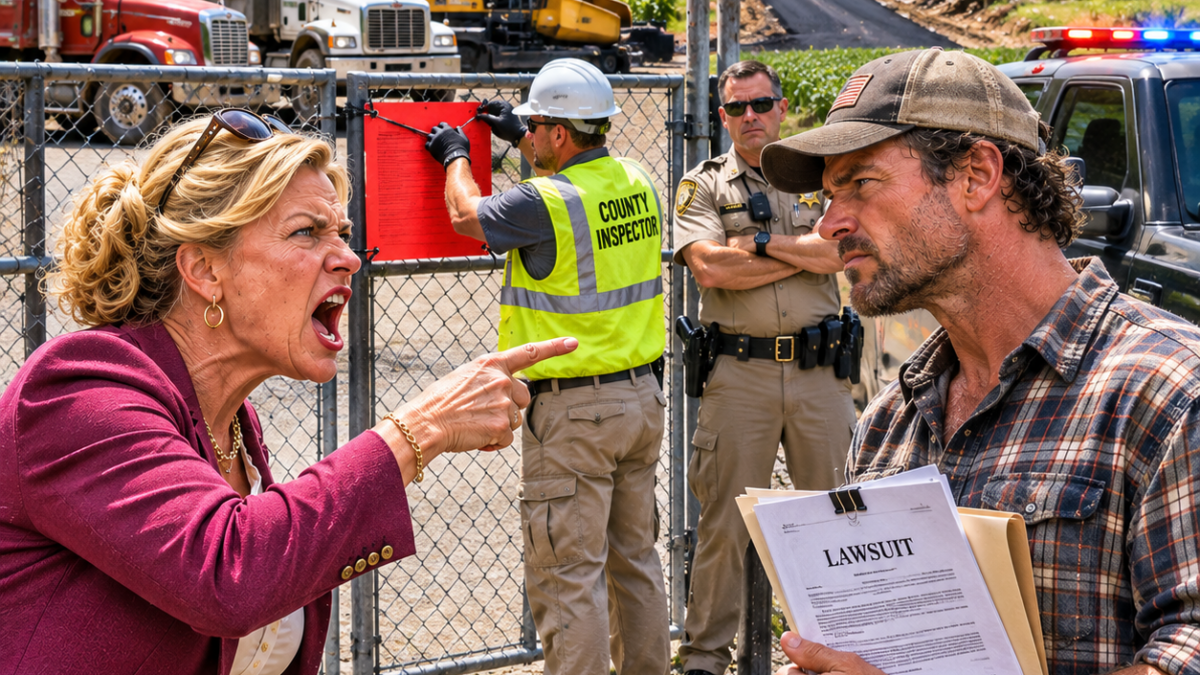
**“YOU SHUT DOWN MY HUSBAND’S COMPANY, NATHAN—AND NOW WE’RE GOING TO TAKE EVERYTHING YOU HAVE!” HOA president Patricia Dawson screamed while a county inspector chained a bright red shutdown notice across the gates of Ridgeway Community Services.**
**Her company had already bulldozed an illegal road through my soybean field, buried live water, power, and fiber lines under my farm, and then blamed me when the county discovered the work had never been legally authorized.**
**Then an investigator opened a trench beneath that same road and found a steel box labeled BROOKS FARM TITLE OPTIONS—and suddenly Patricia’s $850,000 lawsuit became the least dangerous document in the case.**
My name is Nathan Brooks, and Brooks Farm had been in my family since 1954.
My grandfather bought the first seventy acres after returning from military service.
Dad later bought another thirty-two when the neighboring farmer retired.
By the time the land became mine, Brooks Farm covered a little more than one hundred acres.
Corn.
Soybeans.
Pasture.
Woods.
A creek.
Two barns.
Equipment shed.
Old farmhouse.
Fourteen cattle.
And enough broken equipment to guarantee I would never run out of weekend projects.
I was thirty-eight when Dad died.
I repaired agricultural machinery in town part-time, but the farm was my real life.
Dad used to say farming was one of the few jobs where you could stand at the edge of a field in the evening and see exactly what your work had produced.
Some days that meant green rows.
Some days it meant mud.
Some days it meant discovering that one cow had somehow escaped a perfectly good fence for reasons known only to the cow.
It was not glamorous.
It was honest.
Then Meadow Ridge Estates was built east of us.
At first, around fifty homes.
Then another section.
Larger houses.
Clubhouse.
Pool.
Walking paths.
Eventually more than 130 families lived there.
I had no problem with Meadow Ridge.
Neither had Dad.
George Miller was one of the first homeowners.
Retired postal worker.
Good neighbor.
His backyard faced our eastern pasture.
He called before stepping onto the farm.
Helped repair fence after storms.
Sometimes brought his granddaughter Lily to see the calves.
His wife Diane traded homemade bread for eggs.
That was the relationship Dad always wanted with neighbors.
Be helpful.
Respect the line.
Move on.
Years earlier, when Meadow Ridge was first being built, the original developer asked Dad for temporary access across one narrow farm track.
Their heavy trucks struggled on the public entrance after heavy rain.
Dad agreed.
Written permission.
Ninety days.
Temporary construction access.
No permanent road rights.
PART2:
When construction ended, the developer repaired the damage.
Dad replaced the fence.
Finished.
Or at least we thought it was finished.
Years later, Patricia Dawson became HOA president.
She arrived at my eastern gate one afternoon while I was repairing a tractor tire.
White SUV.
Folder under one arm.
Confident smile.
“I’m Patricia Dawson. Meadow Ridge HOA president.”
“I know who you are.”
She smiled.
“We want to discuss transportation cooperation.”
That phrase alone made me suspicious.
“Transportation cooperation?”
“The south side of Meadow Ridge has serious traffic problems.”
Residents had to drive nearly three miles around to reach the highway.
Then she pointed across my field.
“There used to be an access road here.”
“No.”
Her smile tightened.
“Yes. During original development.”
“There was a temporary construction track.”
“That’s what I mean.”
“No. It isn’t.”
Patricia wanted Meadow Ridge to reopen the route permanently.
Gravel first.
Eventually paved.
Gate.
HOA maintenance.
Residents would use it as a shortcut to the county highway.
The proposed route crossed almost half a mile of Brooks Farm.
Right through a productive soybean field.
Near cattle fencing.
Across areas where I regularly operated tractors and combines.
I said no.
Patricia looked surprised.
“We would compensate you.”
“How much?”
“Five thousand.”
I almost laughed.
“No.”
“Ten.”
“No.”
The money was not the real issue.
A neighborhood road would divide one of my best fields.
Cars crossing while I moved equipment.
Delivery trucks near livestock.
Loss of crop acreage.
Liability.
Noise.
Trespassing.
I explained all of it.
Patricia responded like I had refused emergency medical care to the entire neighborhood.
“Meadow Ridge has more than a hundred families.”
“And Meadow Ridge has a legal entrance.”
“It’s inconvenient.”
“Inconvenient isn’t trapped.”
She handed me a proposal.
I put it inside the farmhouse.
Forgot about it.
Two weeks later:
$20,000.
No.
Then:
$30,000.
Still no.
Then Meadow Ridge’s attorney sent a letter.
The old construction agreement, they claimed, might have created continuing access rights.
That finally bothered me enough to call Rachel Lawson.
Rachel handled farms.
Easements.
Boundaries.
Land disputes.
She read Dad’s old agreement.
Then looked at me.
“Nathan, ninety days means ninety days.”
No permanent easement.
No renewal clause.
No future neighborhood access.
No recorded road rights.
The agreement had expired years earlier.
Rachel sent Meadow Ridge a formal response.
For about a month, silence.
Then orange flags appeared in my soybean field.
Perfect straight line.
From Meadow Ridge fence to county highway.
Exactly where Patricia wanted her road.
I pulled every flag.
That afternoon she called.
“You disturbed HOA planning markers.”
“They were on my farm.”
“Our survey company had permission.”
“From who?”
“The board.”
I laughed.
“The board doesn’t own my field.”
She hung up.
The next morning:
More flags.
I removed them.
Then came letters.
I was obstructing a historic route.
Then:
Emergency-service access.
Then:
Possible liability if an ambulance or fire truck was delayed because I refused to reopen the road.
That one made me angry.
Not because I believed it.
Because Patricia was using fear.
If a real emergency happened and responders needed the farm gate?
I would open it.
Dad had done exactly that during a winter storm years earlier.
A one-time emergency crossing was not the same as turning a private field into a neighborhood street.
George Miller came over.
He looked uncomfortable.
Patricia had held an HOA meeting.
She told residents I was blocking a safety project.
“She said fire trucks could save several minutes.”
“I’ve never denied emergency access.”
“I know.”
Then George mentioned the company Meadow Ridge hired to study what Patricia called “private road activation.”
Ridgeway Community Services.
Rachel searched it.
Small company.
Created eighteen months earlier.
Registered owner:
Thomas Dawson.
Patricia’s husband.
That got my attention.
HOA president pushing a road.
Husband’s company getting the road contract.
Still:
Family connection was not proof of wrongdoing.
Maybe the board knew.
Maybe Thomas was qualified.
Maybe everything had been properly disclosed.
Rachel kept saying the same thing.
“Facts first.”
So we watched.
Ridgeway trucks appeared near Meadow Ridge’s boundary.
At first, they stayed inside HOA land.
Measurements.
Photos.
Tree markings.
One worker named Brian Cole approached my fence.
“When do you think the connector opens?”
“It doesn’t.”
He looked confused.
“We were told access was approved.”
“By who?”
“Ridgeway.”
I handed him Rachel’s business card.
“Call her before you cross this fence.”
Brian took me seriously.
That probably saved him later.
Three mornings after that conversation, diesel engines woke me at 6:00.
I looked through the farmhouse window.
Two dump trucks.
Eastern field.
Then a grader came through a section of fence that had been removed overnight.
I drove across the farm.
By the time I reached them, a strip almost twenty feet wide had already been scraped through my soybean crop.
Plants crushed.
Topsoil pushed aside.
Fence down.
I jumped out.
“SHUT IT DOWN!”
The crew supervisor killed the grader.
David Porter.
He looked genuinely shocked when I told him he had no permission.
He showed me a work order.
MEADOW RIDGE SOUTH CONNECTOR.
Authorized by Ridgeway Community Services.
Property authority:
EXISTING ACCESS EASEMENT.
There was no easement.
I told every operator to stop.
David did.
Then called his office.
Then Ridgeway.
Patricia arrived before anyone else.
She drove straight through the removed fence into my field.
“You cannot interfere with authorized infrastructure work.”
I looked at the destroyed soybean rows.
“This is my farm.”
She held up paperwork.
According to her, Meadow Ridge had recently discovered that Dad’s old temporary agreement had never been “formally terminated.”
That made no legal sense.
Temporary permission does not become permanent because nobody files a farewell letter.
“Show me the recorded easement.”
“Legal is handling that.”
I called the sheriff.
Then Rachel.
Patricia looked offended.
“Why are you involving police in a civil matter?”
I pointed at the grader.
“Because there’s a construction crew inside my soybean field.”
County deputy arrived.
Told everybody to stop until land rights could be confirmed.
David cooperated immediately.
Patricia complained about project costs.
The deputy said:
“Cost doesn’t determine ownership.”
Rachel arrived with my deed.
Old ninety-day agreement.
County records.
No road easement.
The crew left.
But nearly two acres of crop were gone.
Fence damaged.
A shallow roadbed now cut into part of my field.
I thought that would finally stop Meadow Ridge.
Instead, Patricia escalated.
Emergency HOA meeting.
Residents were told an “adjacent landowner” had aggressively interfered with lawful infrastructure.
That was me.
George said many residents believed the road rights had already been verified.
They also believed Ridgeway Community Services was an ordinary third-party contractor.
Nobody told them Patricia’s husband owned it.
Rachel sent another cease-and-desist.
Then we filed a county complaint because Ridgeway had begun road construction without legal land access.
That complaint opened the first door.
County inspectors reviewed Ridgeway.
They found its contractor classification did not cover some of the road, excavation, and drainage work it was performing.
Expired equipment permits.
Missing project filings.
Then another landowner complained Ridgeway had cut a drainage trench across private land without permission.
One problem became several.
County suspended Ridgeway from taking new road work pending review.
Patricia called me.
“You shut down my husband’s company.”
“No.”
“You reported us.”
“I reported construction on my property.”
“Same thing.”
“No. County made its own decision.”
Ridgeway lost work.
Equipment sat.
Some workers were temporarily sent home.
I felt bad for them.
Most probably did exactly what they were told.
Brian Cole had stopped at my fence and asked questions.
I told him if he ever needed a statement confirming that, I would provide one.
My issue was not workers trying to feed families.
My issue was people above them giving illegal instructions.
Two weeks later, a process server came to Brooks Farm.
Meadow Ridge HOA and Ridgeway Community Services were suing me.
Amount:
$850,000.
Interference with contractual relations.
Business losses.
Reputational damage.
Obstruction of lawful road rights.
Intentional government complaints supposedly designed to destroy Ridgeway.
I sat at my kitchen table staring at the number.
Eight hundred fifty thousand dollars.
Rachel read the lawsuit twice.
Then smiled slightly.
“What?”
“They just gave us discovery.”
I did not understand why that was good.
She explained.
Emails.
Contracts.
Financial records.
Work orders.
Internal communications.
If they were suing me for stopping a road they claimed was legal, they would eventually have to produce evidence showing why they believed it was legal.
“They may regret filing this.”
I hoped she was right.
Still, that night I barely slept.
Farm mortgage was paid.
That did not mean legal costs could not hurt me.
What if a judge interpreted Dad’s old access differently?
What if they had some forgotten agreement?
Fear does not need good facts.
It only needs two in the morning.
The next day, George came over.
Many Meadow Ridge residents were furious at Patricia.
Their dues were funding lawyers to sue a farmer over a road most had never personally approved.
Then residents discovered something else.
Ridgeway had received more than $160,000 from HOA funds during the previous year.
George asked the board for detailed invoices.
Patricia refused.
Rachel immediately requested them through discovery.
Then county inspectors found something at Ridgeway’s equipment yard.
Project map.
BROOKS CONNECTOR — FULL BUILD.
Not:
Study.
Proposal.
Concept.
Full build.
The road crossed my soybean field.
Continued through cattle pasture.
Then exited onto fifty-four acres west of Brooks Farm.
Owner:
Dawson Land Ventures.
Thomas Dawson.
Patricia’s husband.
Now the road had another purpose.
Not merely shortening Meadow Ridge residents’ commute.
It connected Meadow Ridge to land Thomas could develop.
My farm sat between two valuable projects.
Then county inspectors found enough violations to shut Ridgeway down completely pending full investigation.
That was the day Patricia screamed at me.
Rachel wanted to serve Ridgeway with a preservation notice because our lawsuit required its records to remain intact.
We arrived at the equipment yard.
Three dump trucks.
Graders.
Paving equipment.
County inspector chained a red shutdown notice across the front gate.
Patricia stood beside Thomas and their attorney.
Then she pointed at me.
“YOU SHUT DOWN OUR COMPANY!”
“No.”
“We’re going to take your farm if that’s what it takes to recover what you cost us.”
She held the lawsuit papers.
I looked at Rachel.
She did not react.
Then another county employee approached carrying photographs.
He had been inspecting the roadbed on my farm.
Workers discovered something beneath it.
Fresh conduit.
Buried recently.
One photograph showed a large black water line beneath the illegal road.
Another:
Electrical conduit.
Third:
Fiber-optic cable.
Rachel stared.
“That road wasn’t just for cars.”
The inspector shook his head.
“No.”
He opened a Ridgeway map.
The underground lines crossed Brooks Farm and continued toward Thomas Dawson’s western property.
Water.
Power.
Data.
Infrastructure.
Already installed beneath my farm.
Without permission.
Patricia stopped shouting.
Then the inspector pointed to a handwritten note.
PHASE TWO UTILITIES ACTIVE AFTER ROADWAY OPENING.
Active.
Not planned.
Active.
County scheduled an emergency excavation for the next morning.
Before sunrise, my security camera triggered.
Three trucks entered the soybean field.
Men were digging at the county’s marked inspection location.
One held a chainsaw.
He was cutting through the exposed conduit.
I called the sheriff.
Rachel met me near the field.
Deputy Mark Reynolds arrived while the chainsaw was still biting into the outer casing.
“STEP AWAY FROM THE EQUIPMENT!”
The men froze.
One tried pulling a cable loose before Reynolds yelled again.
Chainsaw down.
Hands visible.
The operator was Kyle Patterson.
Ridgeway employee.
Other two men also worked for Ridgeway.
A company the county had shut down the previous afternoon.
Rachel asked:
“Who sent you?”
Kyle looked toward a white pickup.
Deputy repeated the question.
Finally:
“Thomas Dawson.”
Thomas supposedly said the utility lines were abandoned temporary materials and needed removal before county workers damaged them.
Rachel pointed at the conduit.
“Why before sunrise?”
No answer.
County inspector James Cooper arrived.
Furious.
The inspection area had been officially marked.
Nobody from Ridgeway had authority to return.
A utility specialist opened a junction box farther west.
His face changed.
“This is live.”
Everyone stepped back.
“What’s live?”
“Electrical.”
Not enough for dozens of houses yet.
Enough to prove the line was connected.
The black pipe also carried low water pressure.
The fiber cable was installed.
These were not scrap materials.
They were operational utility infrastructure under my land.
James ordered the entire corridor secured.
Deputies took statements.
One Ridgeway worker, Scott Lewis, admitted Thomas told them to:
“Clean out anything that could confuse the county.”
Scott still had the text.
REMOVE TEMPORARY UTILITIES BEFORE COUNTY DIG.
THEY’RE NOT PART OF FINAL PERMIT SET.
DO IT BEFORE 7:00.
There it was.
Direct order to remove evidence before inspection.
Sheriff tried calling Thomas.
No answer.
Patricia called me instead.
Rachel told me to put the phone on speaker.
“You’ve turned a simple access dispute into a criminal investigation!”
“You sent people onto my farm to cut live utilities.”
“We did not.”
“Thomas did.”
Silence.
Then she accused me of twisting messages.
Rachel took the phone.
“All communication goes through counsel.”
Patricia started shouting.
Rachel ended the call.
That was something I learned from her.
You do not have to win every argument.
Sometimes you just stop participating in bad ones.
County spent the morning mapping the buried system.
Water line.
From Meadow Ridge.
Across eastern field.
Under roadbed.
Through part of cattle pasture.
Toward Dawson Land Ventures.
Almost three-quarters of a mile.
Electrical followed nearly the same route.
Fiber too.
Every red mark across my field felt like another violation.
Installation would have taken days.
Maybe longer.
Meaning Ridgeway started burying utilities before I caught the grader.
Possibly while Patricia was still pretending to negotiate.
County aerial photographs showed disturbed soil six weeks earlier.
I remembered noticing it.
I had assumed storm drainage.
Rachel said:
“They started before negotiations ended.”
Maybe the offers were not really negotiation.
Maybe they were cover.
Sheriff investigators obtained a warrant for Ridgeway records.
I stayed home.
Repaired cattle fence.
George helped.
He said Meadow Ridge residents had learned about a special assessment.
$1,200 per household.
More than $150,000 total.
Residents were told it funded transportation and emergency infrastructure.
Now they wondered whether it financed the illegal road.
I felt angry for them too.
Ordinary homeowners had been used to finance a project most never fully understood.
That evening I attended the HOA meeting with Rachel.
Packed clubhouse.
Patricia at front.
Three board members.
Attorney Laura Mitchell.
Thomas absent.
Acting treasurer Henry Collins read the numbers.
Special assessment:
More than $150,000.
Regular HOA money sent to Ridgeway during eighteen months:
Nearly $220,000.
Invoices:
Road planning.
Emergency access.
Drainage.
Utility preparation.
Western integration.
Residents shouted.
Patricia asked for calm.
Henry said several payments had been approved under emergency authority without full board votes.
Patricia claimed prior approval.
One board member:
“Not for construction across Brooks Farm.”
Another:
“We were told utility work stayed inside Meadow Ridge.”
Then Rachel spoke.
No drama.
She listed facts.
Live water.
Electric.
Fiber.
Across Brooks Farm.
No easement.
No signed agreement.
No approved utility corridor.
Then:
“The lines appear to connect Meadow Ridge to property owned by Thomas Dawson.”
Every eye turned toward Patricia.
She called the western parcel part of long-term planning.
George stood.
“Whose planning?”
Patricia told him not to interrupt.
George ignored her.
“Is your husband building houses there?”
Laura Mitchell asked Patricia directly.
She admitted there had been discussions.
Rachel produced county planning records.
Preliminary plan.
Sixty-two homes.
Name:
DAWSON MEADOWS.
Thomas’s private development.
Now the financial purpose was obvious.
Meadow Ridge homeowners had been paying into infrastructure that could dramatically increase the value of Patricia’s husband’s land.
Henry asked whether Ridgeway had agreements with Dawson Land Ventures.
Patricia said she did not know.
Hard to believe.
Then a former landscape-committee member named Denise Parker stood.
She remembered Thomas presenting a plan about “western connectivity” almost a year earlier.
Patricia asked the committee to leave before the financial discussion.
Other residents remembered nighttime pipe deliveries.
Ridgeway trucks.
Construction materials.
Henry moved to suspend Patricia’s spending authority.
Four to one.
Patricia voted for herself.
Then Laura Mitchell announced her firm would not defend unauthorized construction or utility installation.
She would also review Meadow Ridge’s lawsuit against me immediately.
The lawsuit was supposed to frighten me.
Now the HOA’s own attorney seemed unsure it should exist.
The next morning:
Settlement offer.
Meadow Ridge would dismiss the $850,000 lawsuit if I granted a permanent twenty-five-foot road and utility easement across Brooks Farm.
Payment:
$75,000.
I stared.
Rachel laughed.
“They’re still using the lawsuit to buy the road.”
We rejected it.
New offer:
$150,000.
No.
Then:
$250,000.
Still no.
George asked whether I would ever sell for enough money.
Maybe.
Everything has a price somewhere.
But trust was gone.
A decision made while somebody has an $850,000 lawsuit hanging over your head is not much of a voluntary decision.
County investigators then discovered the utilities did not simply stop at Thomas’s property line.
Water line reached unfinished concrete foundation areas.
Electrical ended at temporary service equipment.
Fiber reached a mobile construction office.
Thomas was already developing Dawson Meadows without final legal road access.
Now the backward order made sense.
Utilities first.
Road second.
Permission last.
Build as though I would eventually surrender.
Then make reality look too expensive to undo.
County disconnected everything under my farm.
Water capped.
Electric off.
Fiber disabled.
Then Dawson Meadows itself was stopped because it lacked legal access and utility approval.
Now:
Ridgeway closed.
Dawson Meadows frozen.
Road blocked.
Utilities dead.
And they were still suing me.
Discovery began.
Rachel requested emails between Patricia, Thomas, Ridgeway, and the Meadow Ridge board.
One message changed everything.
Thomas to Patricia:
“Nathan will not sign voluntarily. Start the access use record before he realizes utilities are already in.”
Patricia:
“How much time do we need?”
Thomas:
“Three months visible use helps. Six is better.”
Visible use.
They wanted traffic using the route.
Workers.
HOA vehicles.
Contractors.
Then later they could say the road was established.
Another message:
Patricia:
“If he blocks us, legal pressure may force settlement.”
Thomas:
“Ridgeway losses can be claimed against him.”
Rachel read that twice.
“They planned the lawsuit before the shutdown.”
I felt cold.
This was not simply an emotional reaction after my county complaint.
Litigation had already been discussed as leverage.
Then an internal Ridgeway document.
BROOKS RESPONSE OPTIONS.
Option A:
Increase easement offer.
Option B:
HOA safety pressure.
Option C:
Emergency access argument.
Option D:
Litigation after obstruction.
Obstruction meant:
I said no.
The entire escalation had been mapped.
Then Sheriff Reynolds called.
“Come to the farm.”
Rachel came too.
Three sheriff vehicles.
County excavation crew.
Section of illegal road opened.
Inside the trench:
Large steel box.
Four feet long.
Buried beneath gravel.
Specialists opened it.
Waterproof containers.
Documents.
External hard drives.
Flash drives.
Envelopes containing cash.
One folder:
MEADOW RIDGE WESTERN ACQUISITION.
Another:
BROOKS FARM TITLE OPTIONS.
Another:
EMERGENCY EASEMENT PLAN.
Then a black recorder.
One hard drive had handwritten initials:
PD / TD.
Patricia Dawson.
Thomas Dawson.
Maybe.
Reynolds warned us.
“Labels aren’t proof of who buried this.”
Facts first.
Always.
The field became an evidence scene.
Yellow tape.
Photography.
Chain of custody.
I went home.
Trying to eat dinner after seeing a steel box full of secret files buried beneath an illegal road is harder than it sounds.
I put an empty pan on the stove and stared at it for ten minutes.
Eventually I ate a sandwich.
George came over.
“I thought this was a shortcut fight.”
“So did I.”
Every few weeks, it grew.
Road.
Utilities.
Lawsuit.
Secret records.
George asked whether I felt safe.
I had upgraded cameras.
Sheriff increased patrols.
But I refused to let fear make my own farm feel foreign.
The next morning, investigators started opening documents.
One folder contained public property records for Brooks Farm.
Nothing illegal about that.
Then handwritten notes.
Eastern soybean field:
PRIMARY CORRIDOR.
Northern pasture:
SECONDARY UTILITY ZONE.
Then:
OWNER LEVERAGE.
Possible pressure points:
Crop damage claims.
Safety complaints.
Emergency-access pressure.
HOA legal costs.
Business-loss lawsuit.
Foreclosure risk if litigation expenses escalate.
I sat down.
Somebody had considered whether they could make legal costs so high I would eventually have to sell.
That was not transportation planning.
That was pressure planning.
Rachel reminded me:
“We still need handwriting identification.”
Another folder contained aerial photos.
My farm broken into values.
Soybean field.
Pasture.
Creek.
Farmhouse.
It felt personal in a different way.
My family’s land reduced to acquisition math.
Digital investigators opened one hard drive.
Normal Ridgeway business files.
Then a protected folder.
PD/TD — PRIVATE.
Sent to forensics.
Second drive contained Dawson Meadows maps.
Early versions:
No legal access.
Later versions:
Connector across Brooks Farm shown as existing.
Not proposed.
Existing.
Some created months before Patricia ever approached me.
County planning had received one.
Legend:
AUTHORIZED ACCESS ROUTE.
Except I had authorized nothing.
They had represented my land as available before negotiation started.
Then investigators counted the cash.
A little over $36,000.
Different envelopes.
Initials.
Dates.
One said HC.
For a moment, I worried about Henry Collins.
Rachel warned:
“Initials are not proof.”
Later:
HC meant Highway Consulting.
Not Henry.
That was a useful reminder.
Suspicion is fast.
Truth is slower.
County crews capped illegal utilities.
Restoration planning started.
The soybean strip could not be replanted that season.
But farms recover.
George helped.
Diane helped.
Lily brought a notebook one day.
“Do farms have repair plans like houses?”
“More.”
“Why?”
“Because something is always broken.”
She laughed.
Then asked:
“Will the road disappear?”
“Eventually.”
That word helped.
Eventually.
Meadow Ridge changed too.
With Patricia suspended, Susan Parker became temporary president.
She called Rachel before sending me anything.
Asked permission before HOA workers approached my boundary to remove markers.
Asked whether insurance adjusters could photograph damage.
I said yes.
Difference:
She asked.
That was all.
Then Meadow Ridge’s lawsuit began collapsing.
Attorney Laura Mitchell moved to withdraw several claims.
County records now showed Ridgeway’s shutdown came from its own licensing and permit problems plus unauthorized excavation.
I did not “destroy” a compliant company by making a false report.
I reported a real road on my land.
The government discovered additional problems.
Rachel filed counterclaims.
Crop loss.
Trespass.
Fence damage.
Lost farm use.
Legal expenses.
Road removal.
I resisted at first.
“I don’t want revenge.”
“Compensation is not revenge.”
She was right.
The farm needed to be restored.
Someone should pay for the actual damage.
I also told her I did not want ordinary Meadow Ridge homeowners crushed.
They had already paid assessments into a project they did not understand.
Rachel said liability could be separated where evidence allowed.
Insurance.
Ridgeway.
Thomas’s companies.
Other responsible parties.
Good.
Then forensics opened the protected drive.
Emails.
Contracts.
Payment records.
Audio recordings.
Thomas apparently recorded meetings.
Nobody knew why.
One recording was eight months before road construction.
Voices:
Thomas.
Patricia.
Ridgeway manager.
A development consultant.
Discussion:
Dawson Meadows.
Thomas said the project could not support the cost of a separate western entrance.
The Brooks Farm connector was essential.
Then Patricia said:
“Nathan thinks no means no because nobody has shown him what no costs.”
I asked Rachel to play it again.
She did.
Same sentence.
No misunderstanding.
They knew I refused.
The plan was to make refusal expensive.
Another voice:
“What if he still won’t sign?”
Thomas:
“Build the route far enough that stopping it hurts everyone.”
That explained the strategy.
Residents dependent on road.
Contractors dependent on project.
Utilities already installed.
HOA money already spent.
Then I become the unreasonable farmer hurting everyone by insisting the land is mine.
The consultant warned:
“Do not install permanent utilities until access is secured.”
Thomas answered:
“We’re already past that.”
Silence on the recording.
Then Patricia laughed once.
Quiet.
That laugh bothered me more than yelling ever did.
Another recording, three months later.
The lawsuit.
Thomas said if Ridgeway lost money after a county complaint, the company could claim intentional interference.
Patricia asked whether that might pressure me into settlement.
A lawyer’s voice warned:
“A lawsuit could expose your records through discovery.”
Thomas:
“Then keep sensitive material off company systems.”
Rachel paused the recording.
The steel box.
Sensitive material off company systems.
Now burying records beneath the road made a terrible kind of sense.
A week later, Meadow Ridge dismissed the entire $850,000 lawsuit.
No business-interference claim.
No road-right claim.
Nothing.
Laura Mitchell told Rachel the HOA no longer supported the case after reviewing the evidence.
Relief.
Not victory.
The road still existed.
Utilities still had to come out.
Crop damage remained.
Legal bills remained.
Then Patricia came to the farm.
Alone.
She stopped outside the gate.
Called.
Did not enter.
That small detail surprised me.
I walked down but stayed on my side.
She looked exhausted.
“I want to talk without lawyers.”
I almost refused.
Then remembered Dad.
Listening is not agreement.
So I listened.
Patricia said Thomas convinced her road access was legally obtainable.
He told her Dad’s old temporary agreement could become permanent.
He promised the new development would benefit Meadow Ridge.
He claimed residents would gain property value.
Then I asked:
“Did Thomas tell you to pressure me?”
She looked down.
“Yes.”
First direct admission.
“I convinced myself the road was good for everyone.”
“That doesn’t make what you did okay.”
“I know.”
She said she did not bury the steel box.
Did she know about it?
Pause.
Thomas once said he kept backup files somewhere investigators would never find them if the development ever ran into trouble.
I told Patricia to give that to the sheriff.
She said she already had.
Then:
“I should have accepted your no.”
I nodded.
“Yes.”
She left.
No dramatic forgiveness.
No hug.
No friendship.
But something inside me loosened.
Two days later, Thomas disappeared.
His attorney could not reach him.
Phone off.
House empty.
Dawson Meadows office closed.
Sheriff wanted him for questioning.
Then George called after dark.
Black pickup left Meadow Ridge through maintenance lane.
Thomas’s truck.
I checked cameras.
Eastern field clear.
Farmhouse clear.
Pasture clear.
Then creek camera triggered.
Black pickup near western edge.
Lights off.
A man got out holding something long and metal.
Then second man.
They opened a junction box near the capped utility line.
One pulled a wrench.
The other carried a fuel container.
My stomach dropped.
The underground system was disconnected.
But conduits still ran beneath the illegal road until county removal.
Then the second man poured fuel into the trench.
Not into a machine.
Into the conduit trench.
I called 911.
On camera, the first man lit something.
Orange flash.
Then nothing.
Then flames burst from another exposed utility opening nearly two hundred yards away.
The illegal road was burning from underneath.
Fire moved inside the buried conduit.
Disappeared.
Reappeared farther down the field.
I stayed near the farmhouse.
Dispatcher kept me on the line.
Sheriff Reynolds reached the western access.
Fire trucks came from the county side.
The black pickup tried leaving.
Deputies blocked it.
It reversed toward Dawson Meadows.
Another unit trapped it.
Driver shut off engine.
Deputies ordered hands visible.
The men were:
Thomas Dawson.
Richard Lane.
Development consultant from the audio recording.
Firefighters opened sections of conduit and flooded them with foam and water.
Electrical service was already dead.
Water pipe capped.
Fire mainly moved through empty utility sleeves and fiber conduit.
It never reached the farmhouse.
Never reached the barn.
Never reached cattle.
Lucky.
Reynolds approached after both men were secured.
Thomas claimed they were removing company property.
“Why the fuel?”
“For the pickup.”
Two empty fuel containers sat near the trench.
Another half-full one in the truck.
Bolt cutters.
Shovel.
Portable torch.
Folders from Ridgeway.
His explanation weakened item by item.
The fire was contained by midnight.
Mostly damaged infrastructure the county already planned to remove.
For once, Thomas hurt his own project more than mine.
Sheriff later searched the truck under warrant.
Folder:
CLEANUP PRIORITIES.
1. REMOVE PRIVATE FILES.
2. DESTROY TEMPORARY UTILITY EVIDENCE.
3. RECOVER ACQUISITION DOCUMENTS.
4. LIMIT BROOKS DISCOVERY.
Rachel read it slowly.
“I think that explains why they came.”
The steel box also made more sense.
Sensitive records kept outside company systems.
Then county road removal accidentally uncovered them.
Cash from the box was eventually traced mostly to Ridgeway withdrawals.
Not proven bribes.
That distinction mattered.
Some looked like unreported subcontractor cash.
Some project expenses kept outside normal accounting.
The HC envelope was Highway Consulting.
Not Henry Collins.
Good.
The paper files were worse.
Multiple road-plan versions.
One called my route private land requiring permission.
Another:
Historic community access.
Another:
Existing road.
Another:
Emergency route.
Same physical road.
Different description depending on audience.
County planners saw authorized.
Residents saw safety.
Contractors saw approved.
I saw “still negotiable.”
Rachel called it a paper maze.
Every person received the version most likely to make them cooperate.
That explained why so many workers unknowingly participated.
Brian Cole questioned access.
David Porter stopped when told.
Kyle admitted the attempted removal order.
Several employees cooperated fully.
Ridgeway never reopened.
Licenses eventually revoked.
Equipment sold to cover creditors and claims.
Some employees found work elsewhere.
I wrote recommendation letters for Brian and David when they asked.
Rachel called that generous.
I did not.
They corrected course once they learned the truth.
People deserve a path forward when they do that.
Thomas and Richard faced far more serious consequences after the trench fire and evidence-destruction attempt.
Patricia was not in the truck, but investigators continued reviewing her actions separately.
Emails.
Audio.
HOA spending.
Pressure strategy.
The court process took more than a year.
I stopped attending.
The Dawsons had controlled enough of my schedule already.
The farm needed me.
Meadow Ridge’s new board wanted settlement.
Susan Parker invited Rachel and me to the clubhouse.
No yelling.
No fake easement maps.
No road plans across my field.
The written agreement said:
Brooks Farm had never granted permanent road rights.
Dad’s temporary construction agreement lasted ninety days.
It expired.
The road and utilities should never have crossed my property.
Insurance covered significant portions of:
Crop loss.
Fence damage.
Legal expense.
Soil restoration.
Road removal.
Ridgeway assets and insurance covered additional damage.
Thomas’s development company became responsible for more.
But my favorite section was simple.
Every pipe.
Every cable.
Every road layer.
Every culvert.
Every marker.
Every unauthorized structure.
Removed.
Not abandoned underground.
Removed.
Then soil restored to agricultural condition.
That was all I wanted from the beginning.
My farm back.
County supervised removal.
For nearly three weeks, crews dug the corridor apart.
This time:
With my permission.
Water line came out.
Electrical conduit.
Fiber.
Crushed stone.
Drainage structures.
It was strange watching the project disappear in reverse.
The road appeared quickly.
It vanished slowly.
Truckload after truckload.
George helped choose seed.
Soil had been badly compacted.
Agriculture specialist helped loosen and test it.
No serious contamination.
Another relief.
When the final gravel disappeared, George stood beside me.
“Hard to believe a road was here.”
“Next year I hope nobody can tell.”
“Plants are good at forgetting.”
I thought about that.
People are not.
Maybe that is useful.
Some things should be remembered without becoming permanent anger.
Meadow Ridge rewrote its rules.
Family-connected contracts had to be disclosed.
Large projects needed multiple bids.
Private land could not appear on HOA infrastructure maps without written proof of access.
Emergency spending could not fund expansion projects.
Future roads required resident approval before large expenditures.
Residents finally learned how carefully information had been divided.
Patricia told them I blocked ambulance access.
Told them the old farm track belonged to the community.
Told them property values would rise.
They did not know Thomas owned the western development.
Did not know utilities were already buried.
Did not know Ridgeway belonged to Patricia’s husband.
Most residents were manipulated too.
That mattered.
During settlement, Susan asked something.
“Would you ever allow actual emergency access?”
I thought.
Then:
“Yes.”
Not a public road.
We created a narrow emergency agreement.
Fire trucks.
Ambulances.
Only when Meadow Ridge’s normal entrance was physically blocked or public safety required it.
No resident traffic.
No development traffic.
No construction traffic.
No permanent roadway.
No utilities.
No expansion without my written consent.
George smiled.
“After everything, you still help them.”
“Helping was never the problem.”
Dad helped people.
That ninety-day construction agreement was kindness.
Thomas tried turning it into ownership.
The lesson was not to stop helping.
The lesson was to make limits clear.
Temporary means temporary.
Permission means permission.
No means no.
Dawson Meadows never became the sixty-two-home project Thomas planned.
Without the free corridor across my farm, the numbers changed.
Another developer eventually bought the property.
They proposed thirty-six homes.
Legal entrance from another county road.
They met with me voluntarily because we would become neighbors.
Showed me drainage maps.
Everything stayed west of Brooks Farm.
I wished them luck.
That was how development was supposed to work.
Your land.
Your road.
Your infrastructure.
Your cost.
The following spring, soybeans grew across the restored strip.
At first, rows looked uneven.
Compacted areas showed.
By midsummer, it became harder to see where the illegal road had been.
George and Lily visited.
Lily stared across the field.
“Where was the road?”
She pointed in the wrong place.
Then another.
Wrong again.
I finally showed her.
She squinted.
“I can’t tell.”
I smiled.
“That’s the idea.”
At harvest, yield in that restored strip was lower than the untouched field.
But better than expected.
I saved one handful of beans.
Not because they were special.
Because something damaged had produced again.
The court cases ended later.
Thomas accepted serious legal consequences, restitution, and restrictions tied to contracting and development.
Richard faced consequences for the evidence-destruction attempt.
Patricia permanently lost her HOA position and faced legal and financial consequences tied to misuse of authority and the pressure campaign.
No courtroom cheering.
No dramatic final speech.
Real endings are quieter.
Orders.
Payments.
Restrictions.
Reputation.
People leaving rooms carrying folders.
Relief instead of applause.
What I remembered most was still that $850,000 lawsuit.
Patricia stood outside Ridgeway’s gate while the county shut the company down and screamed that I had destroyed them.
Then they sued me.
At the time, that number terrified me.
Later, the lawsuit became one of their biggest mistakes.
Because discovery forced open records they had spent months keeping separate.
The pressure plan.
The business-loss strategy.
The buried utilities.
The road maps.
The audio recordings.
The messages showing litigation was discussed before Ridgeway ever shut down.
They sued me for exposing their illegal road.
Then the lawsuit helped expose why that road existed.
Sometimes people become so convinced they are the victim that they demand a courtroom without remembering that courtrooms ask questions in both directions.
Years later, Brooks Farm has no Meadow Ridge road.
No Ridgeway power line.
No fiber cable.
No water pipe.
No development shortcut.
Soybeans grow where the asphalt once started.
Cattle cross the pasture where the utility trench ran.
The farmhouse still stands.
The barn still stands.
The farm still belongs to the same family.
There is one small emergency gate near the eastern boundary.
Locked.
It can open when actual emergency responders need it under an agreement I voluntarily signed.
Mine.
Voluntarily.
George still lives beside us.
Lily is older.
She still comes during pumpkin season.
Susan remained HOA president for several years.
Meadow Ridge never became my enemy.
That was the part Patricia misunderstood most.
Saying no to the road did not mean I hated the neighborhood.
You can care about neighbors and still defend your land.
You can be generous without becoming easy to use.
Dad understood that.
I understand it now.
The old ninety-day construction agreement still sits in my office inside a clear folder.
The simple favor Thomas tried to turn into permanent access.
Sometimes I look at it.
Ninety days.
Temporary.
No permanent road.
A kindness years before Meadow Ridge became what it was.
Someone later saw that kindness and decided it could become leverage.
That was where everything started.
But it was not where it ended.
The ending is the field.
Every summer, crops grow where Ridgeway once poured stone.
Cattle walk where illegal utility lines once ran.
Nothing beneath them belongs to Thomas.
No private development depends on my farm.
No HOA traffic crosses the soybean rows.
And the county road stays exactly where a public road should stay.
Outside my fence.
Patricia once told me I had destroyed Ridgeway Community Services.
I did not.
I reported a road being built illegally through my land.
County inspectors discovered the company’s problems.
The road was not stopped because I hated Meadow Ridge.
It was stopped because they had no right to build it.
Dawson Meadows did not fail because I was selfish.
Thomas built his development plan around land he never owned and permission he never had.
That mistake belonged to him.
If the whole mess taught me one thing, it was that kindness and boundaries are not opposites.
A fence can have a gate.
A gate can open when somebody asks.
But the person standing outside does not get to cut through the fence just because they dislike hearing no.
That is not community.
That is entitlement.
And entitlement can hire contractors.
Print official-looking maps.
Bury utilities.
Write lawsuits.
Build roads.
Even pour asphalt.
But none of those things change where the property line actually is.








