HOA Built a Christmas Stage and Five Tents on My Orchard—So I Tore It All Down and Sent Their President a $150,000 Bill
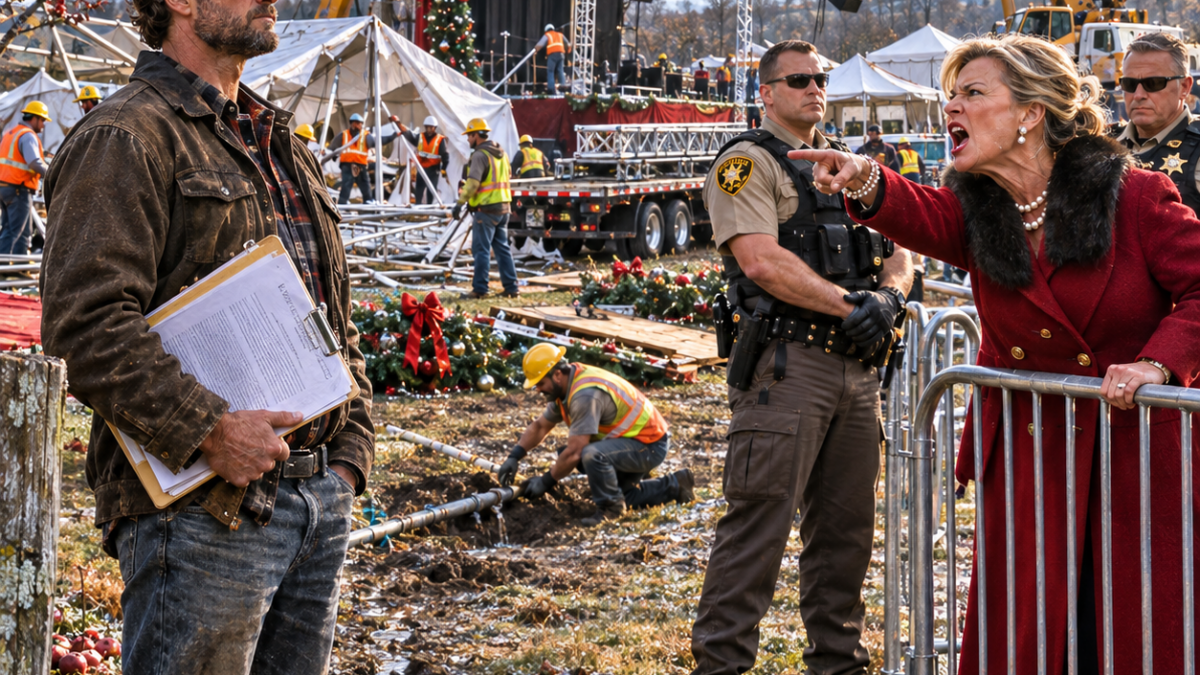
PART2:
Not some church-pageant riser.
A full event stage.
Steel frame.
Roof truss.
Lighting rig.
LED screen.
Nearly forty-three feet at the highest point.
Behind it, five enormous white tents covered the western half of the field.
Delivery trucks moved in and out.
Generators.
Speakers.
Cases of decorations.
Gold crowd-control barriers.
Artificial Christmas trees.
A temporary dirt road had been cut straight across the orchard.
My fence was gone.
Not damaged.
Gone.
Stacked in a pile beside the access road like scrap lumber.
Then I saw the trees.
That was when everything became quiet in my head.
Twelve fruit trees were missing.
Apple and pear.
Some cut.
Some pulled out by the roots.
The stumps and root balls sat in a ditch beside the temporary road.
I had planted the oldest six with my father.
He died seven years earlier.
PART3:
I still remembered him standing in that field wearing an old Carhartt jacket, holding one sapling crooked while arguing that I was digging the holes too shallow.
I remembered him saying:
“Trees don’t care if you’re tired.”
The row had been uneven.
He complained.
I complained back.
Every spring those trees bloomed.
Now half the row was lying in mud.
I got out of the truck.
A man in a black security jacket walked toward me.
“Sir, this area is restricted.”
I looked at him.
“This is my property.”
“Event personnel only.”
“I own the property.”
He gave me a tired expression.
Clearly he had already dealt with people all morning.
“Silver Pines Estates is hosting a private event.”
“I know where Silver Pines is.”
“Then you’ll need to contact the HOA office if you have concerns.”
I walked toward the field.
He stepped in front of me.
“Sir.”
I stopped.
Not because he intimidated me.
Because I understood something immediately.
He had no idea.
He had been hired.
Given instructions.
Probably shown paperwork.
Getting into a physical confrontation with a security guard who believed he was doing his job would solve nothing.
I reached into my truck.
Pulled out a folder.
“Deed.”
He looked at it.
Then me.
“I’m not authorized to review property documents.”
“Then find someone who is.”
A white SUV rolled up behind him.
The rear door opened.
Mara Treadwell stepped out.
Fifty-four.
Red wool coat.
Dark sunglasses even though the morning was gray.
HOA president.
I knew who she was.
Everybody around Silver Pines did.
Mara had the kind of personality that turned neighborhood volunteer positions into cabinet appointments.
She had been association president for nearly five years.
She spoke at county meetings.
Ran charity drives.
Organized fundraisers.
Posted photographs shaking hands with local business owners.
Always smiling.
Always positioned in the center.
Two younger event organizers hurried behind her holding tablets.
Mara looked at me.
Then at the deed folder.
“Mr. Whitlock.”
“You know who I am.”
“Of course.”
“Then you know this is my land.”
She smiled.
“The association has authorization.”
“For what?”
“The Silver Pines Christmas Spectacular.”
I stared.
She said it proudly.
Like the name itself had legal effect.
I pointed toward the field.
“You put a stage on my property.”
“The western parcel has been incorporated into the community activity plan.”
“What does that mean?”
“It means it’s being used as shared recreation space.”
“No.”
Her smile tightened.
“No?”
“It means somebody drew on a map.”
One of the organizers looked down.
Mara continued.
“This event has been in planning for months.”
“You never called me.”
“Your property’s relationship to Silver Pines has already been reviewed.”
“By who?”
“Our planning committee.”
I laughed once.
Not because it was funny.
“You don’t own planning authority over my deed.”
Mara removed her sunglasses.
“Three hundred guests are expected.”
“I don’t care.”
“Sponsors have paid.”
“I don’t care.”
“Vendors have contracts.”
“I don’t care.”
Her expression hardened.
“You should.”
I pointed toward the uprooted trees.
“Twelve trees are gone.”
“Temporary site preparation.”
“They’re dead.”
“They can be replanted.”
“Not those.”
She looked at the stage instead.
“This celebration is important to the entire community.”
“Get it off my land.”
One of the organizers inhaled.
Mara laughed.
Out loud.
Not nervous.
Dismissive.
“Nothing is coming down before December twenty-sixth.”
I stared at her.
“You’re serious.”
“Completely.”
Then she looked toward security.
“Please escort Mr. Whitlock off the event site.”
The guard hesitated.
“Mara.”
She glanced at him.
“He says he owns—”
“I heard him.”
The guard put one hand lightly against my elbow.
I looked down at it.
He removed it immediately.
“Sir, I’m going to have to ask you to step outside the barricade.”
I looked at Mara.
“This is my land.”
She put her sunglasses back on.
“Take it up with the HOA office.”
I did not fight.
That surprised her.
I walked toward the edge of the property.
Passed the destroyed fence.
Then stepped across the actual recorded boundary.
From there, I started taking pictures.
Every truck.
Every license plate.
Stage.
Tents.
Generators.
Stumps.
Road damage.
Decorations.
Orange survey flags.
Workers.
Then I saw water.
A dark patch behind the stage.
Too wet for December weather.
I walked the boundary until I could see more clearly.
Steel anchors had been driven into the field.
Huge stakes securing the tent cables.
I knew exactly where my buried irrigation lines ran.
So did the marks.
My stomach tightened.
One anchor sat nearly on top of a main branch.
Water bubbled slowly from the ground.
They had punched through the system.
I counted visible anchors.
Thirty-seven.
Some deeper than others.
I photographed everything.
Then called my lawyer.
Cassidy Roark answered on the fourth ring.
“Morning.”
“I need you.”
“That sounds expensive.”
“Probably.”
“What happened?”
“The HOA built a Christmas festival on my orchard.”
Silence.
“A festival.”
“Stage. Five tents.”
Another silence.
“On your deeded property?”
“Yes.”
“Did you sign anything?”
“No.”
“Did you lease anything?”
“No.”
“Give permission?”
“No.”
“Are you absolutely sure this is your parcel?”
“Yes.”
“I’m asking because once I send letters, I don’t want surprises.”
“I’ve paid the taxes eleven years.”
“Good answer.”
Then a young woman from the event crew walked toward my truck.
She placed a glossy flyer beneath the windshield wiper.
I pulled it free.
SILVER PINES CHRISTMAS SPECTACULAR.
The address listed the festival site as:
CHRISTMAS COMMONS
PROPERTY OF SILVER PINES HOA.
My jaw tightened.
Below:
VIP EXPERIENCE — $300.
Premium seating.
Private reception.
Sponsor lounge.
Holiday tasting.
I read it twice.
They were selling tickets on my land.
Cassidy said through the phone:
“Graham?”
“They’re charging three hundred dollars for VIP.”
“Photograph the flyer.”
“I will.”
“Do not remove equipment.”
“I wasn’t going to.”
“Do not threaten anybody.”
“I wasn’t going to.”
“Do not cut power.”
“Cassidy.”
“I know you.”
“Apparently not very well.”
“I know enough to know you’re looking at twelve dead trees and thinking about a bulldozer.”
I looked toward the field.
She was not wrong.
“I’m not doing anything.”
“Good.”
“Yet.”
“Especially yet.”
That afternoon, Cassidy pulled the county records.
Deed.
Recorded survey.
Parcel map.
Silver Pines plat.
No overlap.
No community easement.
No recreation rights.
No lease.
No HOA ownership.
Nothing.
The western field was mine.
All of it.
The next evening, December 18, I walked into the Silver Pines clubhouse carrying a folder.
Certified deed.
Recorded boundary survey.
Cassidy’s cease-and-desist letter.
Photographs.
The meeting room was full.
Sponsors.
Board members.
Event organizers.
Mara stood at the front beside a giant screen.
The screen displayed the festival layout.
Stage.
Tents.
VIP section.
Parking.
A green shaded area labeled:
COMMUNITY RECREATION PROPERTY.
My property.
I waited until Mara finished her presentation.
Then stood.
“Could you explain where that green parcel came from?”
Mara looked toward me.
Several people turned.
“Mr. Whitlock.”
“Yes.”
“This is a private planning session.”
“On my property.”
Murmurs.
Mara smiled at the room.
“Mr. Whitlock is currently disputing the association’s right to use land that has historically served Silver Pines.”
“Historically?”
“Yes.”
“I’ve owned it eleven years.”
“You acquired property adjacent to an established community.”
“Correct.”
“Which creates shared-use implications.”
“No.”
I walked forward.
Placed the certified deed on the table.
Then the survey.
“Show me yours.”
Mara folded her arms.
“This map reflects the current HOA recreation plan.”
“A map made by the HOA.”
“Yes.”
“Recorded where?”
She paused.
“Internally.”
“So nowhere.”
A gray-haired woman at the board table looked toward Mara.
I learned later that was Daphne Sloan.
Treasurer.
Her expression changed slightly.
Mara said:
“Three-point-eight acres are designated as amenity space.”
“By who?”
“The association.”
“On whose land?”
“The community’s.”
I put one finger on the deed.
“Mine.”
The room quieted.
Mara’s voice sharpened.
“You’re trying to sabotage an event that hundreds of families are counting on.”
“I’m asking you to remove structures from my property.”
“You waited until the last week before Christmas.”
“I got home yesterday.”
“You expect us to believe you knew nothing?”
“I was two counties away.”
“You’ve been aware of Silver Pines planning for months.”
“Planning what?”
She did not answer.
Instead:
“If you cause this festival to be delayed, the association will hold you responsible for its losses.”
I almost smiled.
“Really.”
“Vendor cancellation.”
“Sponsors.”
“Ticket refunds.”
“Labor.”
“Approximately forty thousand dollars if you continue obstructing preparations.”
Cassidy had warned me this would happen.
Sunk-cost pressure.
Spend enough money.
Create enough expectation.
Then tell the property owner it is too late to say no.
I looked around the room.
“If this land belongs to the association, show me the deed.”
Nobody moved.
Mara said:
“This conversation is over.”
“No.”
The silence sharpened.
“It ends when somebody answers the question.”
Daphne looked at the papers.
Mara looked at security.
“Please escort Mr. Whitlock out.”
I left three documents on the table.
Certified deed.
Survey.
Written demand to cease trespass.
I looked directly at the sponsors.
“From this moment forward, everyone in this room has written notice that Silver Pines has no permission to use my property.”
Then to Mara:
“Any additional damage gets added to the claim.”
She smiled.
“A letter from a lawyer isn’t going to make my stage disappear.”
I gathered the rest of my folder.
“No.”
I looked toward the screen.
“But something will.”
Outside, I reached my truck.
A young man jogged after me.
Event-company badge.
“Nate” printed on it.
“Mr. Whitlock.”
I stopped.
He looked back toward the clubhouse.
Then lowered his voice.
“I probably shouldn’t be telling you this.”
“That’s never a promising introduction.”
“The land agreement isn’t for Christmas.”
“What?”
“It’s nine years.”
My expression changed.
“What agreement?”
“Mara’s contract with our company says Silver Pines has a nine-year land-use authorization for the western parcel.”
I stared.
“I never signed that.”
He swallowed.
“Then you should probably ask for a copy.”
He left before I could ask his last name.
The next morning, Iris Calder arrived.
Licensed surveyor.
Two technicians.
Tripods.
GPS equipment.
County maps.
Irrigation records.
Cold air hung over the field.
Mara had security near the barricades.
Iris stayed entirely on my side.
By noon, the answer was absolute.
Stage:
My land.
All five tents:
My land.
Temporary truck road:
My land.
Supply yard:
My land.
Every anchor:
My land.
Not one square foot of the main festival site belonged to Silver Pines.
Then came the damage assessment.
Thirty-seven steel anchors.
Several pierced buried lines.
Two main irrigation branches leaking.
Soil compacted by heavy trucks.
Deep ruts.
Drainage altered.
Fence removed.
Private gravel road chewed apart.
Twelve fruit trees gone.
Iris walked from stump to stump.
“Age?”
“Different.”
I pointed.
“These six were planted eleven years ago.”
“Any documentation?”
“Photos. Nursery receipts maybe.”
“Get them.”
She crouched near one stump.
“This wasn’t just cut.”
“No.”
“They pulled it.”
I looked toward the ditch.
Root ball exposed.
“I know.”
Heavy equipment had torn the roots out.
Iris stood.
“We need an arborist.”
I nodded.
She walked toward the wet patch.
“This soil is saturated.”
“Broken line.”
“Probably more than one.”
“Can it be fixed locally?”
“Maybe pipes.”
She looked toward the tent anchors.
“But soil reconstruction is separate.”
“What does that mean?”
“You cannot drive loaded trucks over orchard soil for a week, compact it, disturb drainage, then rake the top and call it restored.”
I looked toward the stage.
“What will it take?”
“Testing.”
She tapped the ground with her boot.
“Possible removal of damaged surface layers. Scarification. Regrading. Drainage correction. Depends what we find.”
Mara arrived while Iris was still working.
This time with a local camera crew.
Promotional filming.
She walked toward us.
“You can’t survey inside the festival grounds.”
Iris looked at me.
Then at Mara.
“I’m working for the owner.”
“The association owns the recreation parcel.”
Iris pointed at a survey marker.
“County record disagrees.”
Mara looked toward the camera crew.
“This is exactly the kind of disruption we’re dealing with.”
I said, “Stop work.”
She ignored me.
“Mr. Whitlock is trying to leverage a holiday celebration into a personal payout.”
I walked toward the leaking irrigation line.
Water bubbled through the soil.
“Look.”
Mara glanced down.
“Little mud.”
“That anchor punched an irrigation line.”
“We’ll repair it.”
“With whose permission?”
“After the festival.”
“How many lines did your crew hit?”
“I don’t know.”
“Exactly.”
She turned away.
I said:
“Do you know what underground irrigation replacement costs?”
She looked over her shoulder.
“Send the bill to Santa Claus.”
The camera operator looked uncomfortable.
I said nothing.
But I remembered it.
That afternoon, Iris completed a preliminary damage summary.
Cassidy issued preservation notices.
HOA.
Contractor.
Event company.
Stage supplier.
Tent supplier.
Electrical subcontractor.
Security firm.
Nobody could destroy records.
Nobody could pretend later that documents had vanished.
The county building department also inspected.
Certain portions of the installation had inadequate documentation and unsafe ground conditions because of the water saturation.
A partial stop-work order followed.
Mara called it a technicality.
Then kept decorating whatever she still could.
That night, Iris called.
“I found something.”
“What?”
“Landowner approval on the construction drawings.”
I sat at my kitchen table.
“What approval?”
“Your name.”
I went still.
“I signed nothing.”
“I figured.”
“Send it.”
“Cassidy already asked for the original submission.”
The next morning, December 20, Cassidy came to the house.
Thick folder.
She put one document on the table.
TEMPORARY LAND USE AUTHORIZATION.
Grantor:
Graham Whitlock.
Grantee:
Silver Pines Estates Homeowners Association.
Area:
Approximately 3.8 acres.
Purpose:
Festival and community activities.
Term:
Nine years.
I read it twice.
Then the signature.
My name.
My handwriting.
Almost.
Cassidy placed another document beside it.
A right-of-way agreement I had legitimately signed six years earlier for a utility company.
The two signatures aligned.
Too well.
Same loops.
Same unusual break in the W.
Same upward tail.
She said:
“I had a document examiner do a preliminary comparison.”
“And?”
“Signs of digital extraction.”
“Copied?”
“Potentially.”
“From this?”
“Likely.”
She held up one hand.
“Preliminary.”
“So don’t call it forgery yet.”
“Correct.”
I looked at the date.
September 9.
I opened my phone.
Calendar.
“On September ninth I was at the Benton grading project.”
“Proof?”
“Timesheets. Badge access. Job logs.”
“Good.”
She continued reading.
The document allowed Silver Pines to:
Improve landscaping.
Install recreational amenities.
Conduct periodic events.
Maintain temporary and permanent structures as approved by its planning committee.
I looked up.
“This isn’t a Christmas permit.”
“No.”
“It’s an occupation agreement.”
“Yes.”
“For nine years.”
“Yes.”
Then Cassidy handed me a county permit application.
The HOA had checked a box:
LANDOWNER CONSENT OBTAINED.
The permit office had relied on that representation.
Nobody at the county independently verified my deed because applicants legally certify information.
Now the county knew consent was disputed.
The event permit was under immediate review.
Mara’s argument was collapsing.
Then Cassidy placed a sponsorship packet on the table.
“Read page twenty-two.”
Rendering.
Permanent amphitheater.
Covered stage.
Concrete foundations.
Stone entry wall.
Name:
SILVER PINES CHRISTMAS COMMONS PAVILION.
Location:
My western field.
Future amenity.
Sponsor opportunity:
$1.1 million.
I stared.
“Permanent?”
“Yes.”
“This wasn’t temporary.”
“No.”
Cassidy pointed to the narrative.
Silver Pines planned to establish the site as a year-round outdoor performance and community venue.
The Christmas festival would serve as the launch.
I leaned back.
Everything clicked.
The huge event was not merely entertainment.
It was normalization.
Put three hundred people there.
Call it Christmas Commons.
Print it on tickets.
Show sponsors.
Make residents emotionally attached.
Then after Christmas, approach me.
Sell.
Lease.
Donate.
Whatever.
If I refused, I became the man who took away “their” new community space.
Cassidy said it plainly.
“She’s creating facts on the ground.”
“Literally.”
“Yes.”
“She expects the festival to make ownership politically irrelevant.”
I looked again at the $1.1 million sponsorship page.
“Why?”
“Money. Influence. Reputation.”
“Something else.”
Cassidy nodded.
“Probably.”
Then she pulled an internal email.
Mara to construction manager:
LEAVE PRIMARY FOOTINGS IN PLACE AFTER FESTIVAL. WE’LL REUSE FOR PHASE TWO PAVILION.
I sat completely still.
This was not an accident.
Not a mistaken line on a map.
Not a rushed holiday decision.
Mara intended permanent construction on land she knew I had not given her.
I called Hollis Pike.
Hollis owned a heavy-lifting and structural-removal company.
We had worked together on commercial sites.
He arrived that evening.
Stood at the orchard boundary.
Looked at the stage.
Then at me.
“That’s not coming down with four guys and a wrench.”
“I know.”
“You want it removed intact?”
“Yes.”
“Why?”
“Because I’m not giving Mara one photograph she can call vandalism.”
Hollis nodded slowly.
“Good.”
He walked the perimeter.
“Stage rental?”
“Likely.”
“Tents?”
“Rental.”
“Lighting?”
“Rental.”
“Generators?”
“Probably.”
“Then first call the owners.”
He looked at me.
“If we get a court order, equipment owners will want their gear back before this turns into a bigger mess.”
We built the removal plan.
Not emotionally.
Operationally.
Identify ownership.
Notify vendors.
Secure court authority.
Lock down work zone.
Disconnect electrical.
Remove lighting.
Lower speaker arrays.
Separate tent canvas.
Release guy lines carefully around damaged irrigation.
Use cranes for stage roof and trusses.
Inventory everything.
Get signed receipts.
No smashing.
No burning.
No tractors pushing things into piles.
Every bolt accounted for.
Cassidy loved it.
“A judge will too.”
“Why?”
“Because it looks like restoration, not revenge.”
Hollis sent a written estimate.
$26,500 for safe removal of temporary structures.
Crew.
Cranes.
Trucks.
Electrical.
Site safety.
Storage handling.
Cassidy filed it.
Then she petitioned for emergency relief.
Deed.
Survey.
Damage photographs.
Stop notices.
Questioned land authorization.
Permit issue.
Permanent pavilion plans.
Continuing trespass.
She asked for an order barring use of my land and authorizing controlled removal if the HOA refused.
Meanwhile I contacted Summit Event Structures.
They owned most of the stage frame and tents.
Manager named Paul Kendricks.
At first he was defensive.
“Our contract shows authorized land use.”
“I know.”
“Signed.”
“I know.”
“You’re disputing signature?”
“Yes.”
I sent the deed.
Survey.
County notice.
Cassidy’s letter.
Paul called back an hour later.
“If the court orders recovery, we’ll cooperate.”
“Good.”
“We do not want our equipment in a trespass dispute.”
“Neither do I.”
That one conversation changed the practical balance.
Mara thought money already spent protected her.
In reality, vendors protect their equipment first.
On December 21, I stood outside the orchard fence.
The stage glowed.
Huge LED screen.
Silver Pines Christmas Spectacular.
Presented by Mara Treadwell.
Hollis joined me.
“You really taking all of it?”
“Everything I didn’t authorize.”
“Tents too?”
“Yes.”
“Chairs?”
“If rented equipment owners want it.”
“Decorations?”
“Same.”
He smiled faintly.
“You’re going to make a lot of people mad.”
“I already own the land.”
His phone buzzed.
Then mine.
New trucks.
Mara had ordered additional decorations despite the stop notices.
I forwarded everything to Cassidy.
December 22, Mara held a press preview.
Local reporters.
Sponsors.
Photographers.
She wanted certainty on camera.
I walked in with Cassidy.
Security moved toward us.
Cassidy held up the latest legal notice.
Nobody touched us.
Mara saw me.
Her smile vanished for half a second.
Then returned for the cameras.
“Graham.”
“Mara.”
“Come to threaten Christmas again?”
“No.”
Cassidy handed her the demand.
“Final notice.”
Mara glanced at it.
Then turned toward the cameras.
“Ladies and gentlemen, Mr. Whitlock is threatening to destroy a Christmas celebration that hundreds of our residents and guests have spent months preparing.”
Reporters looked at me.
I said:
“I’m asking her to remove structures from land she doesn’t own.”
Mara laughed.
“You intend to dismantle a charitable Christmas event twenty-four hours before opening.”
“I intend to stop continued trespass.”
“You’ll be liable for every ticket.”
“No.”
“Every sponsor loss.”
“No.”
“Every vendor cancellation.”
“No.”
“You think you can hide behind one deed?”
Cassidy answered.
“It’s called ownership.”
Mara’s smile cracked.
“VIP seats are three hundred dollars. We have approximately three hundred twenty guests expected.”
“That does not create a property right.”
“This community will know whose fault it is when Christmas gets destroyed.”
I looked at the stage.
Then at her.
“Christmas isn’t a stage.”
A reporter lowered her camera slightly.
Mara’s expression hardened.
Elsewhere in the clubhouse, Daphne Sloan was studying the festival accounts.
One payment stood out.
$84,000.
Vendor:
Treadwell Event Strategies.
Description:
Project management and sponsorship development.
Daphne stared at the name.
Treadwell.
She called Mara.
“What is Treadwell Event Strategies?”
Mara did not answer directly.
“A consultant.”
“Who owns it?”
“Why?”
“Because eighty-four thousand dollars of association money went there.”
“Daphne, this is not the time.”
“It’s exactly the time.”
“Stay out of festival operations.”
“I’m treasurer.”
“And I’m president.”
Daphne went quiet.
Mara continued.
“I will handle final financial reporting after Christmas.”
Daphne ended the call.
Then copied every record she had authority to access.
That night she called her own attorney.
The emergency hearing happened December 22.
Judge reviewed the deed.
Survey.
Damage.
Questioned consent.
Permit.
Mara’s attorneys argued that removing the structures would create enormous financial harm.
Cassidy answered:
“The financial harm arose from placing them on land the association did not own after the owner expressly objected.”
The judge agreed that I had shown strong evidence of ownership and ongoing harm.
Order issued.
Silver Pines barred from using the disputed parcel.
Temporary structures to be cleared.
Removal authorized under the submitted safety plan.
Equipment owners permitted to recover their property.
Law enforcement allowed to stand by solely to keep peace.
No one could enter the work zone without authorization.
Mara lost.
She still did not believe it.
She spent that evening calling sponsors.
Board members.
County contacts.
Vendors.
Anyone.
Then she ordered a new banner:
CHRISTMAS BELONGS TO EVERYONE.
It went across the front of the stage.
I watched through a camera feed.
Did nothing.
At 5:40 the next morning, December 23, the first crane arrived.
Then the second.
Four flatbeds.
Electrical crew.
Sixteen trained workers.
Hollis.
Iris.
Cassidy.
Equipment representatives.
Two deputies.
Cold hung over the field.
Gray.
Still.
The stage lights were still glowing when we began.
Hollis walked the site.
Radio in hand.
“Electrical ready?”
“Ready.”
“Crane one?”
“Ready.”
“Crane two?”
“Ready.”
“Vendor reps?”
“Checked.”
“Survey?”
Iris raised a hand.
“Marked.”
He looked at me.
“Your site.”
I nodded.
“Begin.”
The electrical crew moved first.
Circuit by circuit.
Lights went dark.
The glowing arch died.
Then the decorative trees.
Then stage washes.
Finally the enormous LED screen faded to black.
For the first time since I came home, the field looked less like somebody else’s event.
Speaker arrays came down.
Lift.
Lower.
Tag.
Load.
Generators disconnected.
Fuel secured.
Cables rolled.
Then tents.
Canvas first.
Guy lines.
Frames.
Anchor points handled under Iris’s direction.
Whenever workers approached one of the thirty-seven steel anchors, she stopped them.
“Slow pull.”
They loosened around damaged irrigation.
No ripping.
No jerking.
No more damage.
The first tent disappeared.
Then second.
Third.
Fourth.
Then VIP pavilion.
Velvet curtains.
Red carpet.
Gold tables.
Artificial garland.
Wreaths.
Crystal-looking fixtures.
Everything counted.
Everything returned or stored.
Nobody cheered.
That mattered to me.
I did not want theater.
Mara had already had enough theater.
At 9:20 she arrived.
Red coat.
SUV door slammed.
She ran toward the fence.
“What are you doing?”
Nobody stopped.
She screamed:
“Stop!”
Hollis raised one hand.
The current crane lift paused.
Not because Mara had authority.
Because yelling near suspended loads is a safety problem.
Cassidy approached.
Handed her the order.
“You’ve already received this electronically.”
Mara barely looked.
“I do not consent.”
“You don’t own the site.”
“This equipment belongs to Silver Pines.”
Paul Kendricks from Summit stepped forward.
“No, ma’am.”
She turned.
He pointed toward the tent and stage frame.
“Most of this belongs to us.”
“You were contracted by the HOA.”
“Yes.”
“And I’m president.”
“Yes.”
“Then order your people to stop.”
Paul shook his head.
“We’re recovering our equipment under court authorization.”
She froze.
That was the moment she finally understood.
Her vendors were not her army.
Her security guards were not her authority.
The stage existed because dozens of independent businesses had believed she possessed lawful control of the property.
Once that belief died, so did the structure.
She pulled out her phone.
Started recording.
“Everyone needs to see what Graham Whitlock is doing to this community.”
Hollis looked at his crew.
“Resume.”
Work continued.
I walked toward Mara.
Stopped outside the restricted zone.
“You can’t erase everything I built with one court order.”
I looked at the stage.
“You built it on land you don’t own.”
Then to Hollis:
“Keep going.”
The stage came down last.
Lighting truss first.
Then decorations.
Roof sections.
Cranes lifted the steel slowly.
One beam at a time.
Technicians unbolted connections.
Tagged hardware.
Loaded panels.
By noon, the giant roof was gone.
By one, the frame had shrunk to half its height.
By two, the platform was being separated into panels.
Then came the banner.
MARA TREADWELL PRESENTS
SILVER PINES CHRISTMAS SPECTACULAR.
Two workers lowered it.
Rolled it.
Placed it on a flatbed.
Mara stopped filming.
She just watched.
Across the field, several sponsors stood beside their vehicles.
They had arrived after receiving cancellation messages.
One woman from a local bank read something on her phone.
Looked toward Mara.
Then got in her car.
A developer who had been featured in promotional photos left without speaking.
Mara called after someone.
No answer.
The applause disappeared faster than the stage.
By late afternoon:
Five tents gone.
Stage gone.
Generators gone.
Lights gone.
Tables.
Chairs.
Signs.
Barriers.
Everything temporary removed.
The field remained.
And the field looked awful.
Ruts.
Mud.
Anchor holes.
Broken irrigation.
Compacted soil.
Stumps.
Fence gone.
Road damaged.
The festival had disappeared.
Its consequences had not.
I walked into the field.
Crouched.
Pressed my palm into the soil.
Soft.
Waterlogged.
Diesel smell.
Cold mud.
I looked toward the missing tree row.
That hurt more after the spectacle was gone.
My father’s trees had not been temporary equipment.
No crane could bring them back.
Mara stood beyond the work zone.
I walked toward her holding the preliminary restoration folder.
“The stage is gone.”
She said nothing.
“Now we deal with what’s underneath.”
She looked at the mud.
Then at me.
For the first time, she looked uncertain.
Christmas Eve morning, at exactly nine, a courier knocked on Mara’s door.
Cassidy’s firm had prepared the claim.
First page:
PROPERTY DAMAGE AND RESTORATION DEMAND.
Amount:
$150,000.
Not a random number.
Not punishment.
Not emotional damages pulled from the air.
Line items.
Safe removal of stage and five tents:
$26,500.
Irrigation surveying and repair:
$31,800.
Soil decompaction, drainage correction, and restoration:
$22,400.
Tree removal, site treatment, replanting, and orchard restoration:
$29,700.
Private road and fence repair:
$14,600.
Boundary surveying and engineering certifications:
$9,800.
Site cleanup and grass restoration:
$8,700.
Temporary pumping and water-service disruption:
$6,500.
Total:
$150,000.
Every completed item had an invoice.
Every unfinished item had a professional quote.
Estimated amounts were labeled.
Actual amounts would be reconciled.
Cassidy sent copies to:
Mara.
Silver Pines HOA.
Association insurer.
Relevant contractors.
Mara called me within minutes.
I answered.
“One hundred fifty thousand dollars?”
“Yes.”
“Are you out of your mind?”
“No.”
“You tore down my festival!”
“I removed unauthorized structures from my land.”
“You owe Silver Pines money.”
“No.”
“You cancelled three hundred tickets!”
“No.”
“You cost sponsors hundreds of thousands!”
“No.”
“You brought cranes!”
“Yes.”
“And now you want me to pay for them?”
“Yes.”
Her voice rose.
“You can’t create your own expense and bill me.”
“I told you to remove everything.”
“You had no right to destroy community property.”
“Nothing was destroyed.”
Silence.
“Equipment owners recovered their equipment.”
She said nothing.
“The stage company signed for its gear.”
Nothing.
“The tent company signed.”
Nothing.
“The electricians signed.”
Nothing.
“The court authorized the removal.”
Then she snapped:
“The HOA will never pay this.”
“That’s why Cassidy sent it to you too.”
She hung up.
Her next move was predictable.
She tried to shift the claim into association operating expenses.
If the HOA paid, residents absorbed the consequences.
Daphne refused.
At the next finance meeting, Mara presented an emergency authorization.
Daphne did not sign.
Mara stared.
“Sign it.”
“No.”
“You are treasurer.”
“That’s why I’m not signing.”
“This is an HOA liability.”
“It came from decisions the board didn’t approve.”
“The president had authority.”
“Not to use somebody else’s land.”
“You are not legal counsel.”
“No.”
Daphne placed another paper on the table.
“But I can read invoices.”
$84,000.
Treadwell Event Strategies.
Mara’s face changed.
“What is this?”
“You know exactly what it is.”
“Professional services.”
“Who owns the company?”
“Daphne.”
“Who?”
“Not relevant.”
“It shares your name.”
“Lots of people share names.”
“I checked state filings.”
Silence.
Daphne continued.
“Layered registrations.”
“Management LLC.”
“Then holding company.”
“And eventually you.”
Mara went pale.
“You had no authority to investigate my private business.”
“You used association money.”
“I provided services.”
“Did you disclose ownership?”
Mara said nothing.
“Did the board know?”
Nothing.
“Did you recuse yourself?”
Nothing.
Daphne pushed the payment record toward her.
“You are not using homeowner dues to hide this land claim.”
That was the first time someone on the board openly defied Mara.
Others followed.
In early January, the board ordered a full festival audit.
Contracts.
Payments.
Vendor relationships.
Sponsorships.
Permit documents.
Land-use paperwork.
The findings were devastating.
Mara had exceeded her spending authority multiple times.
The $84,000 consulting payment flowed to a business she ultimately benefited from.
No conflict disclosure.
No proper recusal.
No clear competitive process.
Then the internal planning documents revealed the larger strategy.
Phase one:
Launch Christmas festival on the western parcel.
Establish community use.
Phase two:
Secure long-term site rights.
Phase three:
Construct permanent pavilion.
Treadwell Event Strategies would continue as sponsorship and project consultant.
Years of potential fees.
The festival was not simply Mara’s vanity project.
It was a business opportunity.
One built on my land.
At the special HOA meeting, the clubhouse overflowed.
Residents expected Christmas refunds.
They got something worse.
Daphne stood at the front.
Projected financial records.
$84,000 payment.
Business registration chain.
Land-use agreement.
Survey.
Court order.
Pavilion proposal.
One board member named Edwin Marsh leaned forward.
“If this was for the community, why was the community paying your company without knowing?”
Mara replied:
“The company performed legitimate work.”
“That isn’t what I asked.”
“You’re trying to smear me.”
“I’m asking whether you disclosed a personal financial interest.”
“I acted in the association’s best interest.”
Daphne said:
“Then why was it hidden?”
Residents murmured.
Mara raised her voice.
“You all loved this event until one bitter landowner destroyed it.”
I was not at the meeting.
Cassidy advised me not to turn the board’s internal crisis into my spectacle.
Good advice.
Daphne continued.
“The landowner told us to leave.”
“The deed confirmed ownership.”
“The survey confirmed ownership.”
“The county questioned the land-use authorization.”
“The court barred us from the property.”
“This is not about whether we liked the festival.”
“It is about whether the association had the right to be there.”
A resident shouted:
“Did we?”
Daphne answered:
“No.”
That one word ended most of Mara’s defense.
The board froze every unsigned pavilion contract.
Removed Mara’s unilateral contracting authority.
Commissioned an independent audit.
Started procedures to remove her as president.
The questionable signature documents went to appropriate authorities for review.
Nobody promised criminal charges.
Nobody pretended the board could decide forgery.
Evidence would decide.
Meanwhile, my land had to be rebuilt.
Irrigation crews excavated damaged lines.
Thirty-seven anchor locations documented.
Several major punctures repaired.
Temporary pump kept water moving.
Compacted soil was scarified.
Some sections had to be stripped and rebuilt.
Drainage contours restored.
Gravel road resurfaced.
Fence rebuilt on the certified line.
Arborists inspected the twelve tree sites.
Some replacement trees could be planted quickly.
Others needed soil recovery first.
One old stump remained for several weeks.
My father had planted that tree.
I stood beside it one afternoon while Hollis worked nearby.
“You keeping it?”
“No.”
“Want a section saved?”
I looked at him.
“Can you?”
“Sure.”
He cut a clean piece from the trunk before removal.
I put it in my workshop.
Not because wood contains memories.
Because people do.
The $150,000 claim continued.
Silver Pines’ insurer questioned coverage.
Policies do not always protect intentional acts after explicit warnings.
Mara had received my written objections.
Seen the deed.
Been told by the surveyor.
Been told by Cassidy.
Continued anyway.
That mattered.
For the first time, she contacted me personally without performing for an audience.
“Graham.”
“What?”
“I want to resolve this.”
“Call Cassidy.”
“Can we speak like adults?”
“We are.”
“The HOA will contribute.”
“Call Cassidy.”
“If you reduce the demand, I can get the board to share it.”
“You don’t control the board anymore.”
Silence.
Then:
“You’re trying to bankrupt me.”
“No.”
“You know what one hundred fifty thousand dollars means.”
“Yes.”
“You can afford to absorb some of this.”
That sentence did something to me.
Not anger.
Clarity.
I looked out toward the orchard.
Twelve empty spots.
New dirt where pipes had been excavated.
Fence reconstruction.
“Why should I?”
She had no answer.
I continued.
“You told me to send the bill to Santa Claus.”
Silence.
“I sent it to you.”
Then I ended the call.
Cassidy handled everything afterward.
She prepared the settlement file.
Damage evidence.
Invoices.
Expert reports.
Permit documents.
Questioned land authorization.
Mara’s warnings.
Internal emails.
$84,000 conflict.
Permanent pavilion plan.
Mara’s own attorney apparently understood what a long civil case would mean.
Depositions.
Document discovery.
Questions under oath.
Financial records.
Ownership of Treadwell Event Strategies.
Who created the land authorization.
Who submitted it.
Who authorized construction after my objection.
Who approved the permanent footings.
Why.
By mid-January, Mara stopped fighting the damage claim.
Settlement:
$150,000.
Personal obligation.
Defined payment schedule.
Deadlines.
Default provisions.
The association was not required to disguise it as a community expense.
The settlement did not stop separate financial reviews.
I did not ask for an apology.
I asked for payment.
That was enough.
Mara signed.
Her presidency ended soon afterward.
Residents voted.
Not because I demanded it.
Because they had seen enough.
The permanent Christmas Commons Pavilion was cancelled.
Sponsor commitments withdrawn.
Treadwell Event Strategies fell under financial review.
Unsigned contracts died.
The $1.1 million sponsorship never funded.
The association eventually reorganized its contracting rules.
Conflict disclosure.
Independent review.
Land ownership verification.
Board approval for major spending.
No map became “community property” because the president colored it green.
By February, the orchard began to look like mine again.
Not restored.
Recovering.
There is a difference.
Fresh fence posts followed the real boundary.
Irrigation functioned.
Road smooth.
Mud gone.
Replacement trees ordered.
No stage.
No tents.
No VIP signs.
No fake evergreen arch.
Near the entrance, I installed one small sign.
PRIVATE PROPERTY
ENTRY BY PERMISSION ONLY
Nothing about Silver Pines.
Nothing about Mara.
No threats.
Just fact.
That spring, we replanted.
I invited Hollis.
Cassidy came too.
Iris brought her husband.
We planted twelve new trees.
Not exactly where the old ones stood.
An arborist recommended slight changes because the disturbed soil needed different spacing.
The first tree went near the location of my father’s original row.
Hollis held it upright.
I laughed.
“What?”
“You’re crooked.”
“I’m holding the tree perfectly.”
“You’re not.”
He looked at me.
“Your dad say the same thing?”
I stopped.
“Pretty much.”
Hollis adjusted the tree.
“There.”
“Still crooked.”
“Then plant it yourself.”
Everyone laughed.
That was the first time the orchard felt normal again.
Not because the damage disappeared.
Because something new was growing where the damage had been.
Silver Pines residents occasionally stopped near my gate.
Most were respectful.
A few apologized.
One woman named Marlene told me she had bought two VIP tickets.
“I was furious at you.”
“I figured.”
“I thought you destroyed the event.”
“I removed it.”
“I know that now.”
She looked toward the field.
“Mara told us the HOA owned this.”
“She told a lot of people that.”
“I should’ve checked.”
“You had no reason to.”
She shook her head.
“We always have a reason to check when somebody is telling us to be angry at a stranger.”
That was a better apology than I expected.
The board refunded ticket holders from festival funds where possible.
Some vendors recovered deposits.
Some costs were unrecoverable.
Residents were angry.
But they directed more of that anger toward the process than me.
That mattered.
The new board published the audit.
Not every expense was improper.
That was important too.
Mara had legitimately hired vendors.
Some work had actually been performed.
Some sponsorship development was real.
The issue was undisclosed conflict and authority.
People love stories where everything one person touched was fraudulent.
Real life is messier.
Mara mixed legitimate association work with private benefit.
That made the deception easier to hide.
The questionable land authorization remained under review.
Document examiners confirmed enough inconsistencies that authorities kept examining its origin.
I did not need to know every outcome to restore the field.
The civil settlement stood independently.
Evidence of trespass and damage was overwhelming.
My signature or no signature, Mara continued construction after I personally delivered the deed and demand.
That alone destroyed most innocent explanations.
By summer, the new trees took.
Small leaves.
Thin branches.
Nothing like the mature row.
I watered them manually the first few weeks.
Probably more than necessary.
Hollis made fun of me.
“They’re trees.”
“I know.”
“They don’t need supervision every hour.”
“My father would disagree.”
The soil recovered slowly.
Compaction is invisible after grass grows.
That is dangerous.
The surface can look fine while roots struggle beneath.
I learned more about soil than I ever intended.
I also learned the same thing applies to communities.
Silver Pines looked beautiful before the scandal.
Decorated entrance.
Trim lawns.
Matching signs.
Christmas lights.
Everything polished.
Underneath, too much authority had concentrated in one person.
Board members deferred.
Treasurer hesitated.
Vendors trusted signatures.
Residents trusted maps.
Sponsors trusted presentations.
Mara did not seize power in one afternoon.
Everyone handed her small pieces because it was convenient.
Then one day she stood on my land and believed a revised HOA diagram mattered more than a deed.
People later asked why I did not negotiate.
I did.
My first negotiation was simple.
Remove everything.
She said no.
Second:
Stop causing damage.
No.
Third:
Show legal right.
No.
Fourth:
Respect the cease-and-desist.
No.
At some point, negotiation becomes permission for delay.
That was when the court mattered.
Not because I wanted a judge to punish Mara.
Because I needed a neutral authority to say:
Whose land?
What right?
What remedy?
Once the answers were clear, the spectacle vanished quickly.
The stage had looked permanent when I first saw it.
Forty-three feet of steel will do that.
The tents looked enormous.
Generators loud.
Security guards official.
Banners polished.
Sponsors wealthy.
All of it projected certainty.
Then two cranes arrived.
Bolts loosened.
Canvas folded.
Steel loaded.
By sunset, gone.
That image stayed with me.
Large things can still be temporary.
Titles too.
Mara learned that.
A year passed.
December returned.
Silver Pines held another Christmas event.
Inside the actual community.
At its clubhouse.
Smaller.
No celebrity sponsor wall.
No private land.
No $300 VIP tickets.
Residents brought food.
Kids sang.
Someone told me it was better.
I did not attend.
I had plans.
Christmas dinner at the farmhouse.
Hollis.
Cassidy.
Iris and her husband.
Two old friends from work.
No stage.
No tickets.
One string of lights near the gate.
A few chairs.
Firepit.
Food.
The orchard sat dark beyond the porch.
New trees bare for winter.
Healthy.
The private-property sign reflected a little light.
Hollis raised his glass.
“To Christmas Commons.”
Everyone groaned.
Cassidy said:
“Do not call it that.”
He laughed.
Then looked at me.
“Do you ever regret missing the biggest Christmas show in the county?”
I looked toward the western field.
I could still see it if I tried.
Stage.
Tents.
LED screen.
Mara’s name.
Cranes.
Then the field after.
Empty.
“I saw the best part.”
Hollis smiled.
“What part?”
“The crane taking her name down.”
The table laughed.
I did too.
Not because Mara lost.
Because my land came back.
Later that night, after everyone left, I walked to the gate.
Cold.
Quiet.
The small Christmas lights glowed along the fence.
No giant arch.
No banner.
No security guards.
No one selling access to my orchard.
I closed the gate.
Latch clicked.
Then I went inside.
The signed settlement sat in a drawer in my office.
Final payment confirmation beside it.
Exactly on schedule.
One hundred fifty thousand dollars.
People heard that number and assumed it was revenge.
It never was.
Revenge would have been inventing a number.
The bill was pipes.
Soil.
Trees.
Road.
Fence.
Cranes.
Surveyors.
Engineers.
Cleanup.
Water.
Everything Mara had treated like somebody else’s problem.
That is the part she never understood.
When you damage someone else’s property, the cost does not disappear because your event was popular.
When you build on land you do not own, the owner does not become unreasonable because removal is expensive.
When you sell tickets before securing rights to a site, those tickets do not become a weapon against the person who actually holds the deed.
And when you forge certainty on paper, the real records eventually matter.
Mara tried to create a future where I would no longer have a say in my own land.
Festival first.
Public attachment second.
Permanent pavilion third.
Nine-year authorization.
Sponsor money.
Her consulting fees.
By the time I understood the entire plan, I realized the Christmas stage itself was almost a distraction.
The real project was possession.
Not legal possession.
Social possession.
Make everyone believe the field belonged to Silver Pines.
Then force reality to catch up.
But ownership does not work that way.
Not because deeds are magical.
Because boundaries mean something only when they remain enforceable when inconvenient.
Mara’s mistake was thinking my refusal would eventually collapse under pressure.
Three hundred guests.
$300 tickets.
$1.1 million sponsorship prospect.
$84,000 consulting payment.
Five tents.
Forty-three-foot stage.
She assumed size made her claim stronger.
It did the opposite.
It made the damage easier to prove.
Thirty-seven anchors.
Twelve trees.
One broken irrigation system.
One ruined road.
One removed fence.
One forged-looking signature.
One very expensive file.
Every dollar traced back to something physical.
That was why Cassidy insisted on invoices.
Why Iris photographed anchors.
Why Hollis tagged equipment.
Why vendors signed receipts.
Why the removal was slow.
Anybody can be angry.
Documentation is harder.
Mara had relied on emotion.
Christmas.
Community.
Children.
Sponsors.
Charity.
Tradition.
Those things were powerful until placed beside:
Deed.
Survey.
Permit.
Invoice.
Photograph.
Court order.
Truth does not always arrive with better branding.
Sometimes it arrives stapled.
The next spring, one of the replacement apple trees bloomed.
Just a few flowers.
I stood beside it longer than necessary.
My father would have complained about the spacing.
I could hear him.
Too close to the next row.
Should’ve gone six inches east.
Roots need room.
I smiled.
The new tree was not the old one.
Nothing replaces everything.
That is another thing damage claims cannot fix.
Money can restore function.
Replace fencing.
Repair water lines.
Replant.
Rebuild soil.
It cannot make an eleven-year-old tree eleven again.
It cannot recreate a morning with your father.
That loss remained mine.
But so did the land.
That mattered more.
One afternoon, Mara drove past.
She no longer held office.
Silver Pines had removed her months earlier.
She slowed near the gate.
I was checking irrigation pressure.
Her window lowered.
I expected something bitter.
She said:
“You got everything you wanted.”
I looked at her.
“No.”
She frowned.
“You got your money.”
“Yes.”
“Your land.”
“It was always my land.”
“Your court order.”
“Yes.”
“My position.”
“I didn’t vote.”
She stared at the new trees.
“You destroyed everything I built.”
There it was.
The same sentence people like Mara always reach for.
Consequences become something other people did to them.
I shut off the irrigation valve.
“Mara.”
She looked at me.
“I came home and found your stage on my orchard.”
Her expression tightened.
“You could have worked with me.”
“I told you to remove it.”
“You could have leased the land.”
“You never asked.”
“I would’ve paid.”
“After you already built?”
Silence.
“You cut trees.”
“You broke irrigation.”
“You removed my fence.”
“You filed paperwork using my name.”
“You sold tickets.”
“You sold sponsors on a permanent pavilion.”
“And when I showed you the deed, you ordered security to remove me from my own property.”
She looked away.
I continued.
“I didn’t destroy what you built.”
I pointed toward the field.
“You built it where you had no right to build.”
Her window started up.
Then stopped.
“That event would’ve been beautiful.”
Maybe it would have.
That was never the point.
I nodded.
“Probably.”
That seemed to surprise her.
Then:
“It still wasn’t your land.”
She drove away.
I never spoke to her again.
By the second Christmas, the replacement trees were taller.
The repaired field had settled.
Irrigation ran properly.
Fence weathered into the landscape.
The event road disappeared under grass.
You had to know where the stage stood to see anything.
Sometimes I walked across the western field and tried to locate the exact center of the stage.
I could.
Barely.
Not because of damage anymore.
Because I remembered.
Memory is its own survey.
Near the fence, the sign remained:
PRIVATE PROPERTY
ENTRY BY PERMISSION ONLY
People occasionally asked why I kept it.
Not anger.
Clarity.
Permission is not hostility.
Boundaries are not selfishness.
Ownership is not an attack on community.
A community that needs someone else’s land should ask.
Then accept the answer.
That is the entire rule.
Simple enough that Silver Pines eventually wrote it into policy.
No event planning on non-HOA parcels without verified recorded rights.
No construction based solely on internal maps.
Conflict disclosures.
Vendor ownership checks.
Property consent independently confirmed before permits.
No president could authorize major land use alone.
Those reforms probably mattered more than my settlement.
Mara’s reign ended.
But the systems that allowed it needed to change too.
Otherwise the next president could simply repeat the same thing with a different holiday.
The final lesson came from Daphne.
She visited one afternoon to return a copy of my survey that had remained in the audit file.
We stood near the gate.
She looked toward the orchard.
“I should’ve questioned the map earlier.”
“You weren’t the surveyor.”
“I was treasurer.”
“That doesn’t make you responsible for Mara.”
“No.”
She paused.
“But I signed budgets because I assumed somebody else had checked the details.”
I understood.
“That’s how she got so far.”
Daphne nodded.
“Exactly.”
Large abuses often depend on ordinary assumptions.
Someone else verified it.
Someone else read it.
Someone else owns that.
Someone else got permission.
Someone else knows.
Mara needed dozens of people to assume.
Security assumed.
Contractors assumed.
County staff assumed certified applicant statements were accurate.
Sponsors assumed.
Board members assumed.
Residents assumed.
Then I came home.
That was all.
Not heroism.
Timing.
The owner returned before the permanent footings were poured.
Sometimes I wonder what would have happened if I stayed away another month.
Christmas event succeeds.
Photographs everywhere.
Sponsors celebrate.
Pavilion announcement.
Mara calls me after New Year.
Offers lease.
When I refuse, hundreds of residents already believe I am taking away something that belongs to them.
A much harder fight.
That was the future she wanted.
She almost got it.
Instead, she got cranes.
I still remember December 23 most clearly.
Not Mara screaming.
Not sponsors leaving.
Not the banner coming down.
The moment before Hollis started.
Sixteen workers standing ready.
Two cranes.
Equipment owners.
Deputies.
Surveyor.
Lawyer.
Cold field.
Everything enormous.
Hollis looked at me.
Waiting.
And I said one word.
“Begin.”
Then electricity died across the stage.
Lights off.
Screen black.
The illusion disappeared before the steel did.
That felt appropriate.
Mara’s power had worked the same way.
It looked huge because everyone kept feeding it.
Money.
Applause.
Contracts.
Deference.
Once lawful authority stopped supporting the performance, the rest came apart bolt by bolt.
By sunset, there was no Christmas Spectacular.
Only my orchard.
Damaged.
Quiet.
Mine.
And the following morning, Mara finally received the answer to the joke she had made while water leaked from my broken irrigation pipe.
She told me:
“Send the bill to Santa Claus.”
I did not.
I sent it to her.
$150,000.
Documented.
Itemized.
And in the end, the woman who built an entire Christmas empire on land that never belonged to her paid every dollar required by the settlement to put it back the way she should have found it in the first place.








