HOA Built a $900,000 Pavilion 63 Feet Inside My Pasture—So I Bulldozed It and Made Their Lawyer Prove the Price
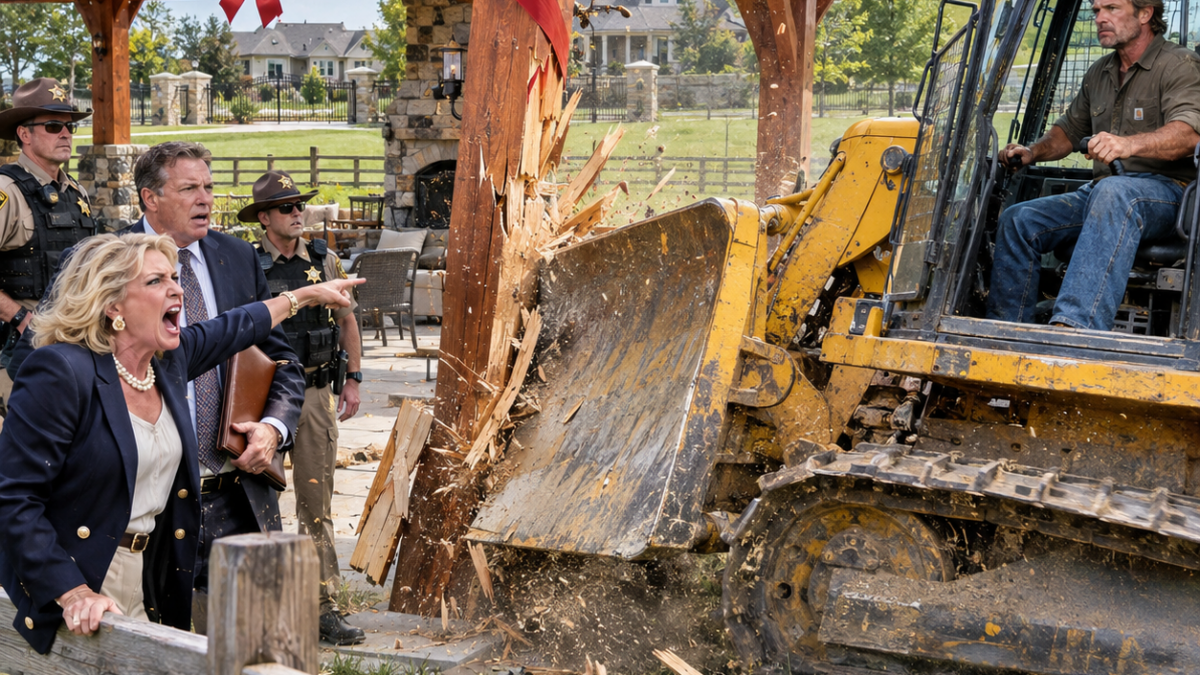
HOA Built a $900,000 Pavilion 63 Feet Inside My Pasture—So I Bulldozed It and Made Their Lawyer Prove the Price.
The HOA spent months building a luxury pavilion sixty-three feet inside my pasture, ignored two surveys, certified warnings, and thirty full days to remove it—then their president laughed in my face and told me I would never dare touch a $900,000 “community asset.”
So on the Monday after their grand opening, while the ribbons were still tied to the cedar posts, I drove my own bulldozer across my own field and reduced the entire structure to a bare concrete slab before their attorney arrived threatening liens, deputies, and a $900,000 lawsuit.
What he did not know was that the pavilion had actually cost barely a third of that amount, the county permit carried a forged version of my signature, and nearly half a million dollars from homeowners had disappeared into a consulting company tied directly to the woman screaming at me from the fence.
My name is Reed Callaway.
I was fifty-nine years old the morning I bulldozed Brier Glenn’s pavilion.
People who heard the story afterward liked to start there.
With the machine.
The ribbons.
The cedar posts breaking under the blade.
The HOA president screaming from the other side of my fence while her attorney warned me I had just destroyed nearly a million dollars in community property.
That made the story sound reckless.
It was not.
By the time I touched that first post, I had spent almost six months trying not to touch it.
That is the part people forget.
I owned 184 acres outside a growing suburban development called Brier Glenn.
The property had been in my family long before anybody invented that name.
My grandfather ran cattle there when the county road was gravel and the nearest subdivision was miles away.
My father added fencing.
A well.
Two equipment barns.
A dirt access lane that curved through the southern pasture and eventually connected with the highway.
I grew up walking that fence with him.
He taught me to read old corner markers before he taught me to drive.
Not because he expected a land war.
Because fences matter when people own land.
“Posts rot,” he used to tell me.
“Paint fades.”
“People forget.”
“Survey monuments don’t care.”
I remembered that sentence often during the Brier Glenn fight.
The pasture beside the subdivision was not especially valuable to anyone looking at it from the road.
Open grass.
A few cottonwoods.
Seasonal cattle.
One dirt track.
Nothing that would appear on a tourism brochure.
PART2:
That changed the moment somebody else decided the land would look better with a pavilion on it.
The first warning came in late spring.
I was driving the western fence line in my pickup when I noticed orange stakes.
Twenty or so.
Fresh.
Placed in a rectangle.
My first thought was utility work.
Power company crews marked easements occasionally.
Gas line contractors did the same.
I parked.
Got out.
Walked to the nearest stake.
Attached to it was a small white placard.
BRIER GLENN COMMUNITY PAVILION
PHASE 1.
I read it twice.
Then looked toward the subdivision.
The stakes sat on my side of the fence.
Not near the boundary.
Not straddling it.
Inside.
PART3:
Far enough inside that anybody with basic spatial awareness should have wondered why a homeowner association was staking construction in a cattle pasture.
I walked the rectangle.
Corner to corner.
Then drove directly to the Brier Glenn office.
The building sat beside the subdivision entrance.
Stone veneer.
Decorative lanterns.
Sign landscaped with dwarf evergreens.
Inside, a receptionist asked whether I had an appointment.
“No.”
“With whom?”
“Whoever decided to build on my pasture.”
That got me one.
Lydia Fenwick came out ten minutes later.
Fifty-three.
HOA president.
Former property-management executive.
Always composed.
Always dressed as though she might be meeting a banker after lunch.
She sat across from me.
No apology.
No confusion.
That bothered me immediately.
“I found survey stakes on Callaway land.”
She folded her hands.
“That strip is part of Brier Glenn’s recreational area.”
“No.”
She smiled slightly.
“Yes.”
“No.”
She opened a drawer.
Pulled out a folded map.
Blue-shaded strip running along the subdivision.
COMMUNITY RECREATION EASEMENT.
It extended directly into my pasture.
I looked at it.
Then at her.
“Where did this come from?”
“Our planning records.”
“That wasn’t the question.”
“It establishes community rights.”
“No.”
I tapped the map.
“This shows what somebody drew.”
“I want the recorded easement.”
Lydia leaned back.
“The easement predates the current subdivision plan.”
“Good.”
“Give me the recording number.”
“I don’t have it memorized.”
“I’ll wait while you find it.”
Her smile disappeared a little.
“You’re being unnecessarily adversarial.”
“I found your construction stakes sixty feet inside my pasture.”
“That land hasn’t been used in years.”
That sentence told me more than the map did.
I said:
“Unused isn’t unowned.”
“Brier Glenn is improving it.”
“You do not improve land you don’t own.”
“Our counsel has reviewed the rights.”
“Then your counsel can send me the easement.”
Lydia stood.
Meeting over.
“You should speak with the association attorney before making threats.”
“I haven’t threatened anyone.”
“You said construction could not proceed.”
“That is not a threat.”
“That is me telling you what happens on my property.”
Three days later, I drove back to the pasture.
Part of my fence was gone.
Not damaged.
Removed.
Concrete trucks were crossing through the opening.
Workers had started layout.
Forms.
Grade stakes.
Excavation.
I parked beside the access track.
Walked toward the foreman.
“Who authorized this?”
“Brier Glenn.”
“Who owns the land?”
“HOA.”
“No.”
He frowned.
I gave him my name.
My card.
The parcel number.
“Call your office.”
“Tell them the property owner says stop.”
He did not stop.
That is where people assume I lost my temper.
I did not.
I wanted to.
Instead, I took out my phone.
Photographed the fence opening.
Trucks.
Forms.
Contractor logo.
Plate numbers.
Equipment.
Stakes.
GPS coordinates.
Then I called Nolan Pierce.
Nolan was a licensed surveyor who had worked in the county longer than Brier Glenn had existed.
Sixty-seven.
Sunburned neck.
Terrible handwriting.
Excellent work.
He walked the property for two days.
Pulled my deed.
County plat.
Historical monuments.
Prior surveys.
Original fence references.
Then drove red stakes along the true line.
He stood beside me at the final corner.
“The nearest pavilion corner is about forty-one feet inside you.”
He pointed toward the far stake.
“That one?”
“Sixty-three feet.”
“Any ambiguity?”
“No.”
“Old survey conflict?”
“No.”
“Fence misplaced?”
“No.”
“Easement?”
“Not according to anything recorded with the county.”
Nolan looked toward the forms.
“They crossed your line.”
Then he added:
“And not by accident.”
The next morning I sent a certified stop-work demand.
Survey attached.
Deed attached.
Map attached.
The HOA signed for it.
Construction continued.
My attorney sent another.
No response.
A week later, Lydia emailed.
The association, she claimed, held a recreational easement from 1998.
That date stopped me.
Brier Glenn had not even been formally incorporated until years later.
It did not mean an older developer could not have held rights.
But it meant I wanted the document.
I searched county records.
Nothing.
I wrote back:
Please provide recording information and a complete certified copy.
No answer.
Then I went to the county permitting office.
The pavilion had a permit.
Approved.
That surprised me more than construction.
County systems are not perfect.
But they usually require site control.
Ownership.
Lease.
Owner consent.
Something.
Elaine Dorsey ran building and permits.
Sixties.
Direct.
Efficient.
She pulled the file.
Site plan.
HOA authorization.
Owner land-use consent.
She stared at the screen.
Then at me.
“Your signature is here.”
I felt my stomach drop.
“What?”
She turned the monitor.
OWNER LAND USE CONSENT.
REED CALLAWAY.
Signature.
It looked vaguely like mine.
Not enough.
But if you had never seen me sign, you might accept it.
“That isn’t my signature.”
Elaine studied me.
“You’re certain?”
“I’ve been signing my own name almost sixty years.”
“Yes.”
“I’m certain.”
“Did you authorize anybody to sign for you?”
“No.”
“Power of attorney?”
“No.”
“Email approval?”
“No.”
She sat back.
That changed the room.
“I need a certified copy of every page.”
“I can provide that.”
“And I want a note placed in the file disputing this signature.”
“I can do that.”
That was when the dispute stopped being about somebody putting stakes on the wrong side of a fence.
Someone had submitted paperwork claiming I consented.
Meanwhile, the pavilion grew.
Foundation cured.
Cedar columns went up.
Metal roof.
Outdoor kitchen.
Stone fireplace.
Patio.
Electrical trench.
Landscaping.
Every week it became harder for the HOA to admit the obvious.
They had built the wrong thing in the wrong place.
One evening, I found Lydia standing beneath the nearly completed roof.
She was alone.
Hands behind her back.
Looking across my pasture as if she owned the view.
I stopped at the fence.
“You have the survey.”
She turned.
“Yes.”
“You know where the boundary is.”
“Our attorney disagrees with your interpretation.”
“Nolan’s coordinates are not an interpretation.”
“The association has invested substantially.”
“That was your choice.”
Lydia smiled.
“By the time this works through court, Reed, this pavilion will be part of the community.”
“It’s on my land.”
“It will be used by Brier Glenn residents.”
“That does not change ownership.”
She walked closer.
“You wouldn’t actually tear down a finished pavilion.”
I stared.
“Is that what you’re betting on?”
She laughed.
Not a nervous laugh.
A real one.
“You wouldn’t dare.”
I said nothing.
Turned.
Walked back to my truck.
Next morning, I called the heavy-haul company I used for my excavation business.
Not because I had decided to destroy it immediately.
Because I was preparing.
There is a difference.
My own company did grading, site prep, drainage, and demolition.
I owned equipment.
A bulldozer.
Excavator.
Loader.
If the legal right existed, I did not need to hire someone to remove an encroachment.
But legal right was exactly what I intended to confirm before the machine moved.
The pavilion finished just under four months after the first stakes appeared.
Brier Glenn advertised it as the biggest amenity project in neighborhood history.
Photos went online.
Outdoor kitchen.
Large fireplace.
Cedar roof structure.
Stone patio.
Grand opening Saturday.
Adults-only evening reception.
Catered food.
Ribbon cutting.
I watched none of it in person.
I did see the photographs.
Lydia standing under the beams.
Scissors.
Red ribbon.
People raising glasses.
Caption:
A NEW ERA FOR BRIER GLENN.
I printed one photograph.
Put it in my case file.
Sunday morning, Nolan returned.
Second survey.
Different equipment.
Same boundary.
Forty-one feet.
Sixty-three feet.
Entire footprint mine.
Then a title examiner ran the complete chain.
No deed to Brier Glenn.
No easement across that pasture.
No lease.
No license.
No covenant.
No recreational rights.
Nothing.
The land never left Callaway ownership.
I had my lawyer send a formal notice to remove encroachment.
Thirty days.
Remove the structure voluntarily.
Restore pasture.
Repair fence.
No drama.
No immediate bulldozer.
Thirty full days.
Brier Glenn responded by sending me an invoice.
$8,750.
INTERFERENCE WITH HOA RECREATIONAL PROPERTY.
I laughed so hard I had to sit down.
My attorney did not find it amusing.
Then Graham Talbot entered the case.
Brier Glenn’s lawyer.
Experienced.
Confident.
His letter warned that the HOA had invested substantial resources and would hold me responsible for any interference with community assets.
I sent Nolan’s survey.
His reply did not dispute coordinates.
Instead:
Historic recreational easement.
Again.
I asked:
Produce it.
Nothing.
Thirty days expired.
I sent final notice.
Seventy-two hours.
Begin dismantling or I will remove the encroachment myself.
No response.
Lydia called a special HOA meeting.
She told residents I was trying to steal their pavilion.
Her map appeared on the projector.
Blue recreational strip.
No recorded easement.
Not one member was shown the actual instrument because none existed.
People became angry.
I understood why.
They had paid for something.
They had been told it belonged to them.
Now an outsider was threatening to tear it down.
If you do not know the history, I look like the villain.
That was part of Lydia’s protection.
She had eighty-six households emotionally invested in keeping the structure standing.
The seventy-two hours ended.
Not one beam moved.
I went to Elaine Dorsey’s office one last time.
She pulled the permit file.
Then said:
“We’re reopening approval review.”
“Because of the signature?”
“Yes.”
“Anything else?”
She pointed at the site plan.
“The ownership documents may not match the actual parcel.”
I nodded.
“I’m reclaiming my land Monday.”
Elaine looked at me carefully.
“I cannot give you legal advice.”
“I’m not asking.”
“Make sure your attorney knows.”
“He does.”
I met my attorney that afternoon.
We laid out everything.
Deed.
Two surveys.
Title chain.
Certified notices.
Thirty-day deadline.
Seventy-two-hour deadline.
Photos.
Permit.
Disputed signature.
Correspondence.
No valid easement.
No injunction preventing me.
No court order granting Brier Glenn possession.
My attorney said:
“If you do this, they’ll sue.”
“I know.”
“They will say the structure had enormous value.”
“I know.”
“They may seek an emergency order.”
“I know.”
“News coverage will be ugly.”
“I know.”
“Do you still want to?”
I thought about Lydia laughing.
You wouldn’t dare.
But anger was not the reason.
If I left the pavilion, every day it remained made their claim feel more normal.
Parties.
Meetings.
Photos.
Maintenance.
Insurance.
Eventually people would say:
It’s been there for years.
Everybody uses it.
Why does Reed suddenly care?
That is how encroachments gain emotional gravity even when legal rights stay clear.
I said:
“Yes.”
Monday morning.
6:30.
No announcement.
No crowd invited.
No social-media post.
I hauled my yellow dozer into the pasture.
Grand-opening ribbons still hung from the cedar beams.
Red against brown timber.
I parked.
Walked the entire structure.
Recorded every surface.
Furniture.
Grills.
Appliances.
Fixtures.
Anything removable.
I did not want accusations that I destroyed somebody’s personal property unnecessarily.
So before the blade touched wood, we removed chairs.
Tables.
Portable equipment.
Loose decorations.
Anything that could be safely salvaged.
Then I climbed into the cab.
Diesel engine settled into a low rumble.
For a minute, I did nothing.
People later asked whether I was nervous.
Of course.
Only a fool would not be.
A nearly new building stood in front of me.
Somebody had spent hundreds of thousands of dollars constructing it.
Maybe more.
The fact it was illegal did not make the physical act feel casual.
Then I looked at the red survey stake behind the pavilion.
Sixty-three feet inside my land.
I put the machine in gear.
The blade touched the first cedar post.
Slow pressure.
Wood flexed.
Then cracked.
The roof shifted.
Metal groaned.
One side dropped.
I backed away.
Let everything settle.
Then moved forward again.
That was when Lydia arrived.
White SUV sliding to a stop near the fence.
She came out running.
“STOP!”
I continued.
“REED!”
I stopped long enough to look through the open cab window.
“What are you doing?”
“Removing an encroachment.”
“That is community property!”
I held up Nolan’s folded survey.
She screamed:
“You’re destroying nine hundred thousand dollars!”
First time I heard that number.
$900,000.
I remembered it.
Then kept working.
Lydia called police.
Graham Talbot arrived about thirty minutes later.
By then, one entire pavilion side was down.
He stepped across the grass in dress shoes.
Looked at the wreckage.
Then at me.
“Do you understand what you have done?”
I shut the machine down.
Climbed out.
“Yes.”
“You destroyed a $900,000 structure.”
“I removed an encroachment from my pasture.”
“We will sue for every dollar.”
“That’s your right.”
“We will seek an injunction.”
“Okay.”
“A lien.”
“If you have grounds.”
“We may refer this for criminal review.”
I looked toward the survey stakes.
“Then bring the deed.”
Lydia stood behind him.
Arms crossed.
She looked satisfied.
As though she believed the bulldozer had finally made me the unreasonable one.
Deputies arrived.
Reviewed my deed.
Survey.
Notices.
Graham’s claim.
Lydia demanded arrest.
The deputies declined.
Civil dispute.
No immediate arrest.
No obvious basis to treat the HOA as owner at the scene.
I resumed.
By evening:
No pavilion.
Only concrete slab.
Salvaged materials stacked to one side.
Broken cedar.
Bent roofing.
Stone veneer.
Bare pasture around it.
As I locked the dozer, Graham handed me a folder.
DAMAGES CLAIMED:
$900,000.
I opened it.
Itemized breakdown.
Design.
Construction.
Consulting.
Planning.
Project management.
Materials.
Site development.
Professional services.
The numbers immediately felt wrong.
I had spent decades pricing earthwork.
Construction.
Site prep.
Concrete.
Hauling.
Demolition.
I knew roughly what that pavilion contained.
Cedar posts.
Metal roof.
Outdoor kitchen.
Stonework.
Patio.
Utilities.
Landscaping.
Nine hundred thousand did not make sense.
Not even close.
I drove home with the folder on my passenger seat.
By nine that night, I had rough-costed the project.
High side:
$350,000.
Maybe.
Depending on finishes.
I sent Graham’s itemization to an independent construction estimator.
His number came back:
Approximately $327,000.
Gap:
More than $570,000.
That was the number that changed the case.
The HOA sued within the week.
Headlines followed.
LANDOWNER BULLDOZES $900,000 COMMUNITY PAVILION.
People online decided who I was before reading anything else.
Spoiled rancher.
Anti-community.
Vindictive.
Crazy.
Lydia gave interviews.
She described me as hostile and reckless.
Said Brier Glenn had invested nearly a million dollars in a public-minded community facility.
I ignored the coverage.
Because once she sued me for $900,000, she had to prove $900,000.
Discovery began.
Invoices.
Bank records.
Contracts.
Permit files.
Meeting minutes.
Insurance.
Consulting agreements.
Every dollar.
At first, Graham tried to keep it simple.
Structure existed.
Reed destroyed it.
Value $900,000.
Pay damages.
My side answered:
If that is the value you want recovered, show us what you spent.
Documents started arriving.
Brier Glenn had collected a large special assessment from homeowners.
Approximately $9,600 from many adult owners.
The assessment notice listed:
COMMUNITY PAVILION PROJECT VALUE — $900,000.
Then contractor invoice.
Curtis Vale Construction.
$314,700.
I stared.
Almost exactly what my estimator had predicted.
Add landscaping.
Electrical.
Fixtures.
Still nowhere near nine hundred.
Then:
$486,000.
FENWICK DEVELOPMENT CONSULTING.
I looked at the name.
Fenwick.
Lydia Fenwick.
My attorney looked too.
“Related?”
“Has to be checked.”
State corporate records.
LLC formed four months before pavilion approval.
Mailing address:
shared office suite.
No meaningful project history.
No public portfolio.
No previous comparable work.
Then suddenly:
largest single contract tied to the biggest project Brier Glenn had ever funded.
Nearly half a million dollars.
That explained Lydia’s desperation differently.
If construction stopped early, people might ask:
Why did a pavilion costing around $315,000 require a $900,000 assessment?
If the pavilion finished, opened, and stood there looking expensive, most residents would never see the actual contractor bill.
They would see:
$900,000 community asset.
Beautiful.
Done.
Nobody asks what each cedar beam cost.
Then I bulldozed it.
And Lydia sued me for the inflated number.
To win, she had to show the math.
She had forced her own accounting into court.
Meanwhile, Elaine Dorsey finished assembling the complete permit file.
Three critical documents.
Site plan.
HOA authorization.
Owner land-use consent.
My fake signature.
The form also listed:
Phone number.
Not mine.
Email address.
Not mine.
Notary stamp.
Commission expired before the date shown.
File metadata traced the document creation back to a computer used by Brier Glenn management.
My attorney called.
“Reed.”
“Yes.”
“This is no longer only civil.”
“I know.”
Then we finally got the 1998 easement Lydia had cited from the beginning.
Nolan Pierce read it.
Maybe forty seconds.
Then smiled without humor.
“This is two miles east.”
“What?”
“Legal description.”
He pointed.
“This easement has nothing to do with your pasture.”
Different parcel.
Different chain.
Different coordinates.
Somebody had taken an old recreation easement from an entirely unrelated property and attached it to the pavilion site plan.
That meant:
The pavilion stood on my land.
No easement.
Permit consent forged.
Even the historical-rights document belonged somewhere else.
Graham Talbot’s letters changed tone.
At first:
Our client possesses documented rights.
Then:
We are reviewing certain matters.
Then:
Please direct all communications through counsel while we verify documentation.
He knew.
Maybe he had not known at first.
Lawyers rely on clients to give them true facts.
That distinction became important.
Graham shifted argument.
Even if the HOA lacked ownership, he said, I should have waited for a court ruling.
I answered with the timeline.
Two surveys.
Certified warning.
Stop-work demand.
Attorney warning.
Thirty days.
Another seventy-two hours.
Every notice received.
Every opportunity ignored.
The HOA’s theory had become:
We built something expensive enough that your ownership stopped mattering.
I rejected that.
Then Curtis Vale called my attorney.
The pavilion contractor.
He wanted to testify.
Curtis brought the original contract.
$314,700.
Signed.
Clear.
He had not billed $900,000.
Had never represented the structure was worth $900,000.
Then he told us something worse.
Lydia had asked him early in the job to produce revised paperwork reflecting a much higher project value.
He refused.
Afterward, Fenwick Development Consulting appeared as the outside budget-management entity.
My attorney asked:
“Did you know there was a boundary dispute?”
Curtis nodded.
“Before construction?”
“Yes.”
“What happened?”
He had looked at the existing fence.
Then the site plan.
Then survey markers.
The geometry bothered him.
Before pouring concrete, he told Lydia the fence line and plan did not match.
“What did she say?”
“The HOA already handled the land issue.”
“Did you ask for proof?”
“Yes.”
“What did she provide?”
Curtis looked toward me.
“The owner consent.”
My forged signature.
That mattered enormously.
The fake consent had not appeared late as a clerical patch after I complained.
Lydia had used it from the beginning to reassure the contractor that I had approved construction.
During Lydia’s deposition, my lawyer asked:
“Was the pavilion’s actual construction cost $900,000?”
She answered:
“The pavilion was a $900,000 community asset.”
Not the question.
“What did Brier Glenn pay Curtis Vale Construction?”
Graham objected.
Question answered later through records.
$314,700.
Then:
“What services did Fenwick Development Consulting perform for $486,000?”
Lydia said:
Planning.
Design.
Oversight.
Procurement.
Coordination.
“Produce the work product.”
Very little.
No detailed engineering.
No comprehensive procurement records.
No staff documentation supporting nearly half a million dollars in labor.
No meaningful design package justifying the fee.
Her explanation shrank under documents.
That was when I understood the $900,000 lawsuit was the biggest mistake Lydia made.
If she had accepted my thirty-day removal demand, the pavilion could have been dismantled quietly.
Embarrassing.
Expensive.
But contained.
Maybe the forged permit would still be discovered.
Maybe not.
Maybe homeowners eventually asked where the money went.
Maybe not.
But by suing me for $900,000, Lydia made the inflated valuation an issue the court had to examine.
She turned their accounting into evidence.
After her deposition, Graham requested private conference.
Fifteen minutes.
When he returned, he sat farther from Lydia.
That told me something.
Later, his correspondence showed why.
He had repeatedly asked Lydia for a properly recorded easement before filing aggressive claims.
Her written reply:
OWNERSHIP IS SETTLED.
PROCEED AGGRESSIVELY.
Graham had relied on his client.
Now he was discovering the foundation had cracks.
Not the pavilion.
The case.
Settlement offer followed.
HOA withdraws $900,000 claim.
Agrees never to rebuild on parcel.
Pays portion of survey expense.
In exchange:
I drop counterclaims.
Keep financial records confidential.
Do not forward suspicious documentation to outside authorities.
I said no.
My attorney asked:
“Any interest in negotiating?”
“Yes.”
“On what?”
“Recorded title acknowledgement.”
“No HOA claim.”
“Full restoration.”
“Fence replacement.”
“Removal of any lien or notice.”
“Actual legal expenses where recoverable.”
“And forged documents go where they’re supposed to go.”
“Meaning?”
“I’m not signing an agreement that hides them.”
Settlement failed.
Lydia became furious.
She began blaming Graham to board members.
Graham had emails.
He withdrew from certain claims tied directly to documents he could no longer ethically support.
That was the beginning of Lydia standing alone.
Elaine Dorsey issued county determination.
Pavilion permit had been approved using materially inaccurate ownership information.
My owner consent was not genuine.
The county officially recognized that I had never given permission.
Board members started seeing contractor invoices.
$314,700.
Then $486,000 consulting payment.
Questions came fast.
“If the pavilion cost nine hundred thousand, why did the builder get barely a third?”
Lydia talked about professional fees.
Contingencies.
Long-term reserves.
Design premiums.
Every meeting produced a slightly different explanation.
Homeowners became less interested in my bulldozer.
More interested in their bank statements.
I attended one association hearing.
One binder.
No speech.
I placed three items on the table.
My deed.
Nolan’s survey.
Forged consent.
Then said:
“You built on my land.”
“I warned you.”
“You sued me for money you cannot explain.”
“That is the entire issue from my side.”
Lydia stared.
For once, no instant response.
The civil hearing finally came.
Nolan testified first.
Boundary.
Sixty-three feet.
No ambiguity.
No valid recreation easement.
Then Elaine.
Permit.
False owner consent.
No genuine authorization.
Curtis.
Boundary concerns raised before construction.
Lydia dismissed them.
Forged form supplied as proof.
Certified-mail receipts.
Every warning.
Photographs.
Construction timeline.
Thirty-day notice.
Seventy-two-hour final notice.
Then damages.
HOA:
$900,000.
Actual construction:
$314,700.
Additional legitimate project costs brought the real physical value higher.
Still far below $900,000.
The rest:
Consulting.
Undefined fees.
Transfers.
Minimal documentation.
The judge asked Lydia’s side:
“What exactly does the $900,000 represent?”
Their lawyer talked about total project investment.
Planning.
Opportunity.
Community value.
Amenities.
The judge returned:
“What was physically destroyed?”
That was harder.
Because you cannot bill somebody $486,000 for vague consulting and then automatically treat every consulting dollar as physical replacement value of cedar and concrete.
The historic easement failed too.
Nolan placed its legal description beside mine.
Different parcel.
Two miles away.
Not close.
Not a typo.
Wrong land.
Layer by layer, the case collapsed.
The HOA had not proved any lawful right to build on my pasture.
The $900,000 damages claim was denied.
My counterclaims survived.
Trespass.
Fence destruction.
Restoration.
Survey expenses.
Certain legal costs.
Most important to me:
Brier Glenn was required to formally acknowledge that no recreational easement existed across that parcel.
None.
Not 1998.
Not later.
Not implied.
Not “community use.”
Nothing.
The boundary was mine.
On the record.
That mattered more than any check.
Then the homeowners turned inward.
The same people who had been told I destroyed their $900,000 pavilion started requesting full accounting.
Special assessment records.
Invoices.
Consulting contract.
Bank transfers.
Who approved Fenwick Development Consulting?
Who owned it?
What work existed?
Why was my signature forged?
Why was the wrong easement used?
Why did Lydia keep building after two surveys?
Why did the HOA sue for $900,000 if the structure did not cost anything close to that?
Those were no longer my questions.
They belonged to Brier Glenn.
I stayed out.
Reporters called.
Neighbors asked what should happen to Lydia.
“I don’t run their HOA.”
“What do you think members should do?”
“I think people should read documents before spending other people’s money.”
That was as far as I went.
My position never changed.
A property line is not a suggestion.
How much money somebody spends on the wrong side of it does not move the line.
Eventually, the pasture had to be restored.
Concrete slab broken.
Removed.
Stone pavers hauled.
Utilities disconnected properly.
Topsoil replaced.
Seed.
Fence rebuilt.
The HOA covered most restoration costs under settlement.
Nolan set permanent monuments.
Deep.
Visible.
Mapped.
I watched the new fence go up.
Same line my father taught me.
Same land.
No pavilion.
No blue HOA map.
Lydia was removed as president.
By the people who had once cut a ribbon beside her.
The financial irregularities and forged documents went through proper channels.
I did not need a public spectacle.
That was never the point.
Graham Talbot no longer represented Lydia personally in matters growing out of the false documentation.
Curtis got paid what he was legitimately owed.
His records cleared his company from the worst of the mess.
Elaine tightened county review procedures for owner-consent documents on projects where applicants were not the fee owners.
Small reforms.
Boring.
Useful.
Months later, I drove the same bulldozer back across the pasture.
Not to destroy anything.
To grade.
Fresh soil.
Smooth surface.
Grass beginning to return.
I stopped near where the outdoor kitchen had stood.
Nothing there.
No cedar.
No fireplace.
No patio.
No banner.
Nolan came by.
Looked across the field.
Then at the boundary monuments.
“900,000 dollars for a pavilion.”
He shook his head.
“Most expensive pile of paperwork I’ve ever seen.”
I looked at the straight fence.
“The pavilion wasn’t what cost them.”
He glanced over.
“What did?”
I pointed toward the survey cap.
“Thinking that line didn’t matter.”
He nodded.
That was the whole story.
People fixate on the bulldozer because demolition is dramatic.
What mattered happened before.
Waiting.
Surveying twice.
Checking title.
Certified notices.
Permit research.
Photographs.
Receipts.
Not tearing down the structure the first week, even though part of me wanted to.
If I had driven my dozer into the construction site the day concrete arrived, Lydia would have had exactly what she wanted.
Angry landowner.
Destroyed materials.
Unclear boundary.
No complete record.
No second survey.
No title search.
No county confirmation of forged consent.
No thirty-day notice.
Maybe the permit fraud never surfaces.
Maybe the $486,000 transfer never gets examined.
Maybe the HOA writes me a check under a confidentiality agreement and everyone moves on.
Patience changed that.
Not passivity.
There is a difference.
Passivity waits because it is afraid.
Patience waits because it is building something stronger than anger.
Every week Lydia assumed my restraint meant weakness.
Every week I added another document.
When she finally dared me to act, my file was thicker than hers.
That mattered more than the size of my bulldozer.
Years later, Brier Glenn still borders my pasture.
Different president.
Different board.
We are not friends.
We do not need to be.
We are neighbors.
That is enough.
The new HOA president once called me about replacing a drainage pipe near the boundary.
He began:
“Reed, before anybody does anything, I want Nolan to mark the line.”
I laughed.
“Good start.”
He said:
“I’ve heard that before.”
They hired surveyor.
Sent plan.
Requested written access.
I approved.
Work finished.
No lawsuit.
No bulldozer.
No forged signature.
Amazing what asking can accomplish.
The replacement fence still runs straight along the pasture.
Metal survey caps at corners.
I inspect them more often than necessary.
Maybe.
One afternoon, a young couple from Brier Glenn stopped while walking their dog.
They had moved in after everything.
The man pointed toward the open grass.
“Was that where the pavilion was?”
“Yes.”
“My neighbor says you destroyed it the morning after the ribbon cutting.”
“Pretty close.”
“Was it really worth nine hundred thousand dollars?”
I laughed.
“No.”
His wife said:
“So that number was fake?”
“I’d call it inflated.”
“Why?”
“That is a longer story.”
She looked toward the subdivision.
“People still argue about it.”
“I’m sure.”
The man asked:
“Would you do it again?”
I thought.
“Under the same facts?”
“Yes.”
“With the same notices?”
“Yes.”
“With the same surveys?”
“Yes.”
“Then yes.”
He nodded slowly.
“I don’t think I could.”
“Good.”
“What?”
“I hope nobody ever gives you a reason to find out.”
They walked away.
That answer became truer as I got older.
People mistake firmness for enjoying conflict.
I hated the whole thing.
I lost months.
Money.
Sleep.
Time with my family.
Employees worried about whether my legal bills would affect payroll.
My wife got tired of hearing the name Lydia Fenwick at dinner.
The pasture looked like a construction yard for almost a year.
Winning did not refund those days.
It gave me the land back.
That is not the same thing.
My wife, Susan, had been quieter about the dispute than almost everybody.
One night after the final ruling, she sat beside me on the porch.
“You happy?”
“Yes.”
She looked at me.
“No, you’re not.”
“I won.”
“That wasn’t the question.”
I stared toward the pasture.
“No.”
“What would make you happy?”
“I want the grass back.”
That surprised both of us.
Not money.
Not Lydia removed.
Not newspaper correction.
Grass.
My pasture looking like nobody had tried to steal it.
Months later, when green returned, Susan took a photograph.
Just the fence.
Grass.
Sunset.
No pavilion.
She framed it.
That is the only piece of the dispute displayed in our house.
Not court order.
Not bulldozer photo.
Not $900,000 lawsuit.
Pasture.
Restored.
I keep the legal file in my office.
Inside:
First orange-stake photo.
Nolan survey one.
Survey two.
Certified receipts.
Lydia email.
Permit.
Forged signature.
Wrong easement.
Curtis contract.
Fenwick Development Consulting transfer.
Court order.
The first page and last page tell the whole thing.
First:
BRIER GLENN COMMUNITY PAVILION — PHASE 1.
Last:
ACKNOWLEDGMENT OF NO EASEMENT OR PROPERTY INTEREST.
Everything between those documents was the price of making someone acknowledge what should have been obvious at the start.
The $486,000 payment became the most discussed part inside Brier Glenn.
Some homeowners wanted every dollar back.
Others wanted criminal charges.
Others blamed the entire board.
I did not pretend I knew every detail of their internal finances.
What I knew:
The physical pavilion did not cost $900,000.
Nearly half a million went to a consulting company tied closely to Lydia.
Documentation supporting that fee was thin.
The forged permit form came from the management environment.
The wrong easement had been used.
Lydia ignored contractor concerns.
She kept building after receiving my survey and notices.
Those facts were enough for my case.
What happened to her beyond that belonged to investigators and homeowners.
I learned not to inflate stories just because the truth was already ugly.
That mattered.
Lydia had inflated the pavilion.
I was not going to inflate Lydia.
A reporter once asked:
“Did she steal $486,000?”
I answered:
“I know where the records show the money went.”
“That isn’t the same question.”
“It’s the only answer I’m qualified to give.”
He looked frustrated.
Good.
Accuracy often disappoints people looking for drama.
The actual drama was enough.
One of the strangest moments happened years later at the county equipment auction.
I ran into Curtis Vale.
He was looking at a skid steer.
I was looking at a backhoe.
He laughed.
“You buying more demolition equipment?”
“Depends where Brier Glenn is building.”
He shook his head.
“I knew you’d make that joke eventually.”
Then he became serious.
“I should’ve stopped the project.”
“You raised the boundary issue.”
“I still poured concrete.”
“Because Lydia showed you my signed consent.”
“Fake consent.”
“You didn’t know.”
“I should’ve called you.”
“Yes.”
He looked surprised.
I continued:
“You should have.”
“I should’ve.”
That was it.
No absolution.
No condemnation.
Adults can acknowledge mistakes without pretending all blame is equal.
Curtis made an error.
Lydia made choices.
Those are different categories.
He had questioned.
Asked for proof.
Received a forged document.
Then built.
When truth emerged, he testified.
Provided original contract.
Emails.
Records.
Helped establish the timeline.
That counted.
Graham Talbot’s role was complicated too.
People assumed HOA lawyer means villain.
Not automatically.
He represented a client.
At first, Lydia told him ownership was settled.
Historic easement existed.
Permit valid.
Pavilion cost $900,000.
He pressed aggressively because attorneys do that.
Once records contradicted her, his language changed.
Once he realized critical information had been withheld, he stepped back from claims he could not support.
In one hearing after everything began unraveling, I saw him sitting behind Lydia.
She whispered angrily.
He shook his head.
She whispered again.
He moved his chair.
Six inches.
Then another six.
By recess he was almost at the end of the table.
Sometimes physical distance says what legal ethics letters cannot.
Nolan found that hilarious.
“Lawyer was trying to survey himself away from her.”
I laughed.
“Where’s the boundary?”
“As far as possible.”
I miss Nolan’s humor.
Surveyors tend to see the world differently.
Most people see land as:
Trees.
Grass.
Road.
House.
Surveyors see invisible geometry laid across everything.
Bearings.
Distances.
Monuments.
Recorded calls.
Lines nobody notices until money appears.
Nolan once told me:
“A boundary is boring right up until somebody spends nine hundred thousand dollars on the wrong side.”
That should be printed on county permit applications.
After the case, I changed the way my excavation company handles boundary-sensitive jobs.
Even if a client gives us a site plan.
Even if permit exists.
Even if somebody says:
Land issue handled.
If we are within twenty feet of a private boundary:
Verify.
Survey.
Owner authorization.
No assumption.
My crews complain sometimes.
“Boss, paperwork.”
“Yes.”
“Costs time.”
“Yes.”
“What are the odds somebody forged consent?”
I point toward Brier Glenn.
Conversation ends.
The strangest legacy of the whole affair is that my worst property dispute made me better at my own business.
Pain has an annoying habit of teaching useful things.
One summer, a storm knocked down part of the new fence.
A Brier Glenn resident named Carl called.
“Tree came from our side.”
“I see it.”
“We’ll pay fence.”
“Insurance can figure it out.”
“Our landscaper wants access.”
“Send me his certificate and proposed route.”
Carl laughed.
“You really do paperwork for everything now.”
“Yes.”
“Can’t imagine why.”
The tree got removed.
Fence repaired.
No drama.
That is what normal neighbor relations look like.
Things happen.
People call.
They ask.
They document.
Then everybody goes home.
Lydia’s real mistake was not ambition.
Communities build amenities.
HOAs improve common spaces.
There is nothing wrong with that.
Her mistake was deciding the desired outcome justified making consent appear where none existed.
A blue map.
A wrong easement.
A forged form.
A $900,000 number repeated often enough that residents stopped asking what was underneath it.
Each layer made the next easier.
Once the board believed the pasture belonged to them, pulling my fence felt administrative.
Once construction began, stopping felt expensive.
Once the foundation existed, Lydia could say:
Too late.
Once the pavilion was complete:
You wouldn’t dare.
That is why I eventually bulldozed it.
Not because I hate cedar posts.
Not because I wanted to humiliate residents.
Not because I thought destruction was fun.
Because somebody had built an argument out of permanence.
The more they spent, the more they believed I would have to surrender.
They turned money into leverage.
If I accepted that logic, every wealthy developer or organization could take private land simply by building something expensive fast enough.
Imagine that rule.
Sorry, we know the land is yours.
But we spent too much to give it back.
No.
That is not how boundaries work.
Or at least it should not be.
I had given them multiple ways out.
Stop before concrete.
Stop after survey.
Stop after certified notice.
Remove during thirty-day period.
Start dismantling during final seventy-two hours.
Each time, Lydia chose escalation.
Then when the dozer arrived, she called the consequence sudden.
People often do that.
They ignore warnings for months.
Then describe enforcement as unexpected.
The first time I drove past Brier Glenn after the grass fully returned, I noticed their old clubhouse announcement board.
New message:
PROPERTY IMPROVEMENT COMMITTEE VACANCIES.
I laughed.
Susan asked:
“What?”
“Nothing.”
She looked toward the pasture.
“Are you finally done talking about them?”
“Yes.”
I was lying.
The story still gets told.
But it no longer feels active.
That is different.
Time turned the pavilion from a wound into a lesson.
The field recovered.
Fence weathered.
Survey caps dulled.
New calves grazed where the outdoor kitchen used to be.
Most of the residents who originally attended the ribbon cutting moved on with their lives.
Some moved away.
Some stayed.
Brier Glenn did not collapse.
That is another thing people expect from HOA stories.
Entire neighborhood destroyed.
No.
It survived.
New board.
New controls.
More financial oversight.
Two signatures on major payments.
Independent review for land acquisitions.
Recorded easement verification before construction near external parcels.
Homeowners eventually got bored enough to complain about landscaping again.
Good.
Communities should be allowed to return to boring.
I received one letter from Lydia after everything.
No return address I recognized.
One page.
She did not apologize directly.
She wrote that she had believed the pavilion would improve Brier Glenn and that the project “became larger than anyone intended.”
That phrase annoyed me.
Projects do not become dishonest by themselves.
People make decisions.
Still, near the end she wrote:
I should have stopped construction when the survey was delivered.
That was the closest thing to accountability I ever got.
I read it.
Put it in the file.
Did not respond.
Not every apology needs a conversation.
Sometimes recognizing the correct sentence is enough.
If she had stopped then, much of what followed would not have happened.
The contractor would have lost some money.
The HOA would have been embarrassed.
Residents angry.
But:
No complete pavilion.
No bulldozing.
No $900,000 lawsuit.
No discovery into half-million-dollar consulting transfer.
No county permit fraud investigation triggered by litigation.
No public collapse of her leadership.
There are moments when admitting you are wrong feels expensive.
Then there are moments when refusing becomes far more expensive.
Lydia always chose later.
That is why Nolan’s line stayed with me.
The pavilion did not cost them.
Thinking the line did not matter cost them.
A boundary seems like nothing.
Invisible.
No wall in the air.
You can step across it without feeling anything.
But legally and morally, that invisible line represents something basic.
This is where my authority ends and yours begins.
Property is one version.
Consent is another.
Lydia crossed both.
Once she decided an unused strip of pasture would be better as a pavilion, she stopped treating my answer as relevant.
That was the original mistake.
Everything else was paperwork designed to make that decision look legitimate after the fact.
I often wonder what would have happened if she had come to my house the first week.
No map.
No threat.
Just:
“Reed, the HOA would like to build a pavilion near your boundary.”
“Would you sell us an acre?”
Maybe I say no.
Probably.
Maybe she offers enough.
Maybe we negotiate a ground lease.
Maybe we choose another site.
Maybe nothing happens.
But that conversation would have recognized something her whole strategy denied.
I got to answer.
That was all I wanted.
The right to say yes or no about my land.
Today, when I stand by the fence, there is nothing dramatic to see.
That is the point.
No pavilion.
No scar in the field.
No memorial plaque.
No sign saying:
REED CALLAWAY WON.
Just grass.
Fence.
Cattle.
A survey monument.
The dirt track my father drove.
Sometimes Brier Glenn residents walk along the path on their side.
Kids ride bikes.
Dogs pull at leashes.
Most do not know the full story.
Good.
They do not need to carry it.
One boy once asked me through the fence:
“Did there used to be a building here?”
“Yes.”
“What happened?”
“Wrong location.”
He accepted that.
Children understand simple truths faster than adults.
Wrong location.
That was the beginning and end.
Everything else was what happened because grown people refused to admit it.
The last time Nolan visited before he retired, we stood beside the corner marker.
Sun low.
Grass tall.
He nudged the steel cap with his boot.
“Still there.”
“It better be.”
He smiled.
“Think anybody will ever cross it again?”
“Somebody will.”
He looked at me.
“You’re pessimistic.”
“I work in excavation.”
“We dig up everybody’s old mistakes.”
Nolan laughed.
Then:
“What’ll you do next time?”
I looked at the pasture.
“Take pictures.”
“Survey.”
“Send certified mail.”
“And then?”
“If they still build?”
I smiled.
“I still own the bulldozer.”
He laughed so hard he had to hold the fence.
That was the ending people liked.
But I knew better.
The machine was never the important part.
Anyone can push a blade.
The hard part was waiting until the facts could survive everything that came afterward.
That is why, if you ask what saved my land, I will not say the bulldozer.
I will say:
The deed.
The survey.
The certified receipts.
The county permit file.
The contractor’s invoice.
The fake consent.
The wrong easement.
And the discipline not to move until every one of those things lined up.
Lydia Fenwick believed spending $900,000—at least according to her own paperwork—would make her pavilion too expensive for me to challenge.
She believed completed construction would become ownership.
She believed homeowners would protect the thing they had paid for.
She believed her lawyer could turn the price tag into a weapon.
Instead, the $900,000 claim forced the HOA to open its books.
The books showed the pavilion itself had cost roughly $314,700 to build.
The books showed nearly $486,000 flowing to Fenwick Development Consulting.
The permit file showed my forged signature.
The recorder showed the recreational easement belonged to another parcel.
The survey showed their pavilion sat sixty-three feet inside my land.
And the court eventually showed everyone what I had been saying from the beginning.
You cannot turn somebody else’s pasture into community property by spending enough money on it.
The pavilion disappeared in one day.
The paperwork took months.
But in the end, the paperwork did far more damage to Lydia’s scheme than my bulldozer ever could.
Because the machine only knocked down cedar, steel, stone, and concrete.
The lawsuit knocked down the story she had built around them.
And when that story finally fell apart, all that remained was the one thing she had tried hardest to ignore.
A straight property line.
Exactly where it had always been.








